Category Archives: Uncategorized

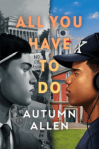
All You Have To Do by Autumn Allen

Standard
All You Have To Do by Autumn Allen

all you have

This historical fiction YA book was hard to put down.  While being invested in the characters and learning about the historical climate from an intimate account, I could feel my mind growing and my understanding deepening. The phenomenal writing quality, and the connection between the two fictional characters from two different times rooted in reality, allowed this thought provoking book to burrow into my mind, and makes me suggest it to high school English teachers to read with their students for a novel study.  Add in that the author is Muslim and that there is inclusion of side Muslim characters, makes me really really love this 432 page book.

SYNOPSIS:

Told from two perspectives: Gibran is a high school senior in 1995 at a prestigious New England, majority white prep school.  Being aware of the efforts his mother has made for him to have the opportunities he does, the incredibly bright boy isn’t content to sit back and let injustices go unchecked.  As he understands his position in his school, and perhaps in the world, he pushes to change how the system views him and on the cusp of the Million Man March he starts to get restless when others don’t support his efforts.

Kevin is at Columbia University in New York City in the wake of the Martin Luther King, Jr.’s assassination.  While the country pays service to the civil rights leader Kevin is witnessing the injustices at Columbia, and begins to question what his enrollment at the institution means and the hypocrisy it supports.  He also reflects back on choices his own family has made and what he would like his future to look like when opportunities to protest arise.

Kevin is Gibran’s uncle and their parallels show how little has changed in America.  The fears of the family, the institutionalized racism, the helplessness of a broken system.  The desire for two young men coming of age to decide for themselves where they belong, who they are, and what they are capable of in a world that wants to take that freedom away from them.

WHY I LIKE IT:

The power of this book is incredible, truly.  I really don’t have words.  I do have words about the side Muslim characters though.  Gibran’s sister is a hijab wearing convert and is respected and accepted by the family.  Kevin’s cousin and activist is also a convert and a powerful influence on the main character.  There are mentions of Muslims praying, and salams are given.  The book was beneficial to read, the Muslim characters and knowing that the author is Muslim, and reading the phrase, “In the Name of God the Most Gracious, the Most Merciful” before the dedication was just extra amplification of voices that this story brought to light.

FLAGS:

Racism, violence, police violence, incarceration, hatred, drugs, alcohol, sneaking out, partying, lying, stealing, segregation, oppression, language.  The reality of the situations discussed is not PG, but the book does not sensationalize anything for the sake of shock, it is rooted in reality and a YA audience will grasp that.

TOOLS FOR LEADING THE DISCUSSION:

Teachers, librarians, parents, teens: read this book.  Think about what you are reading, discuss what happened, what you understand, and how it makes you feel.  Preorder/order here

Huda F Cares? by Huda Fahmy

Standard
Huda F Cares? by Huda Fahmy

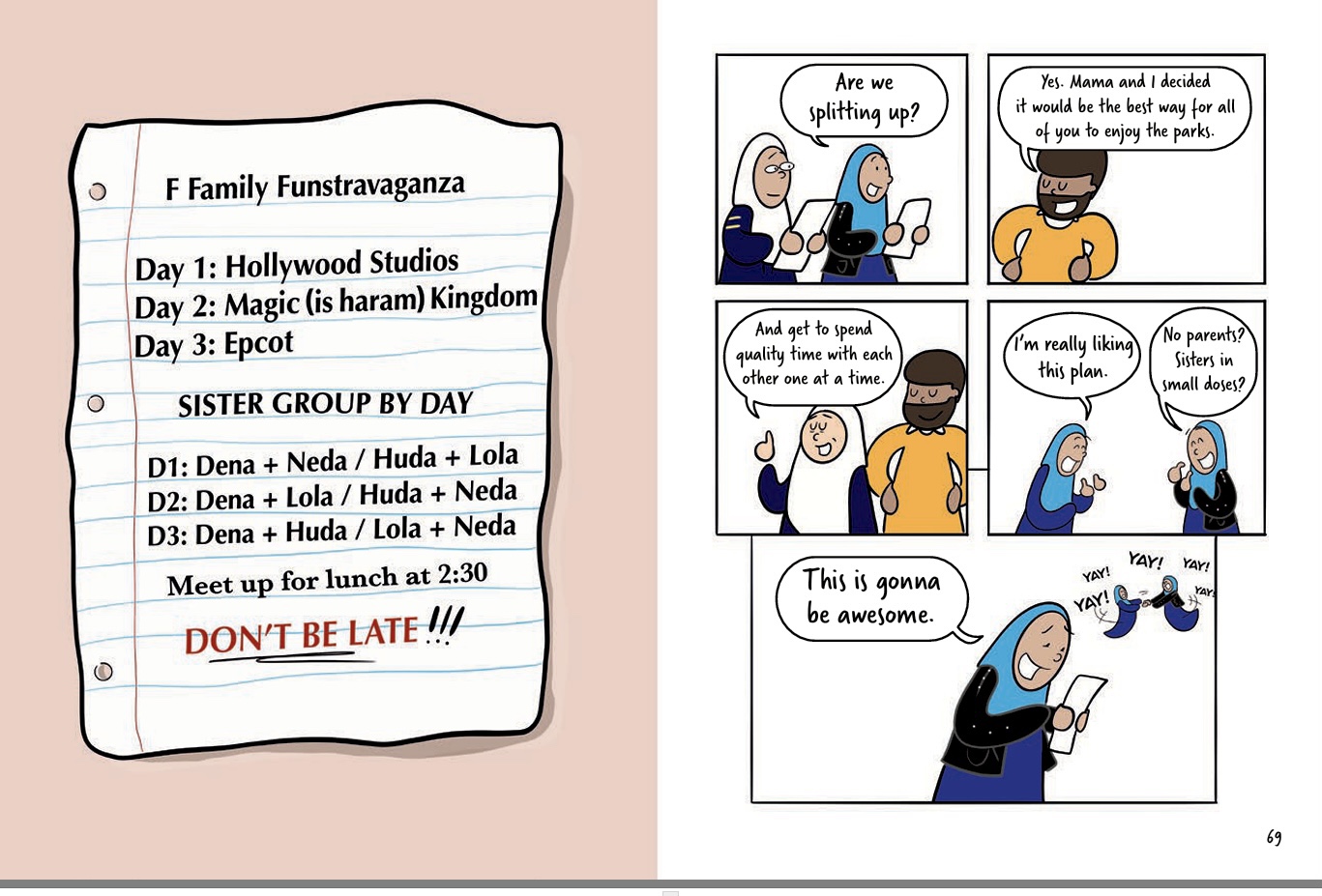
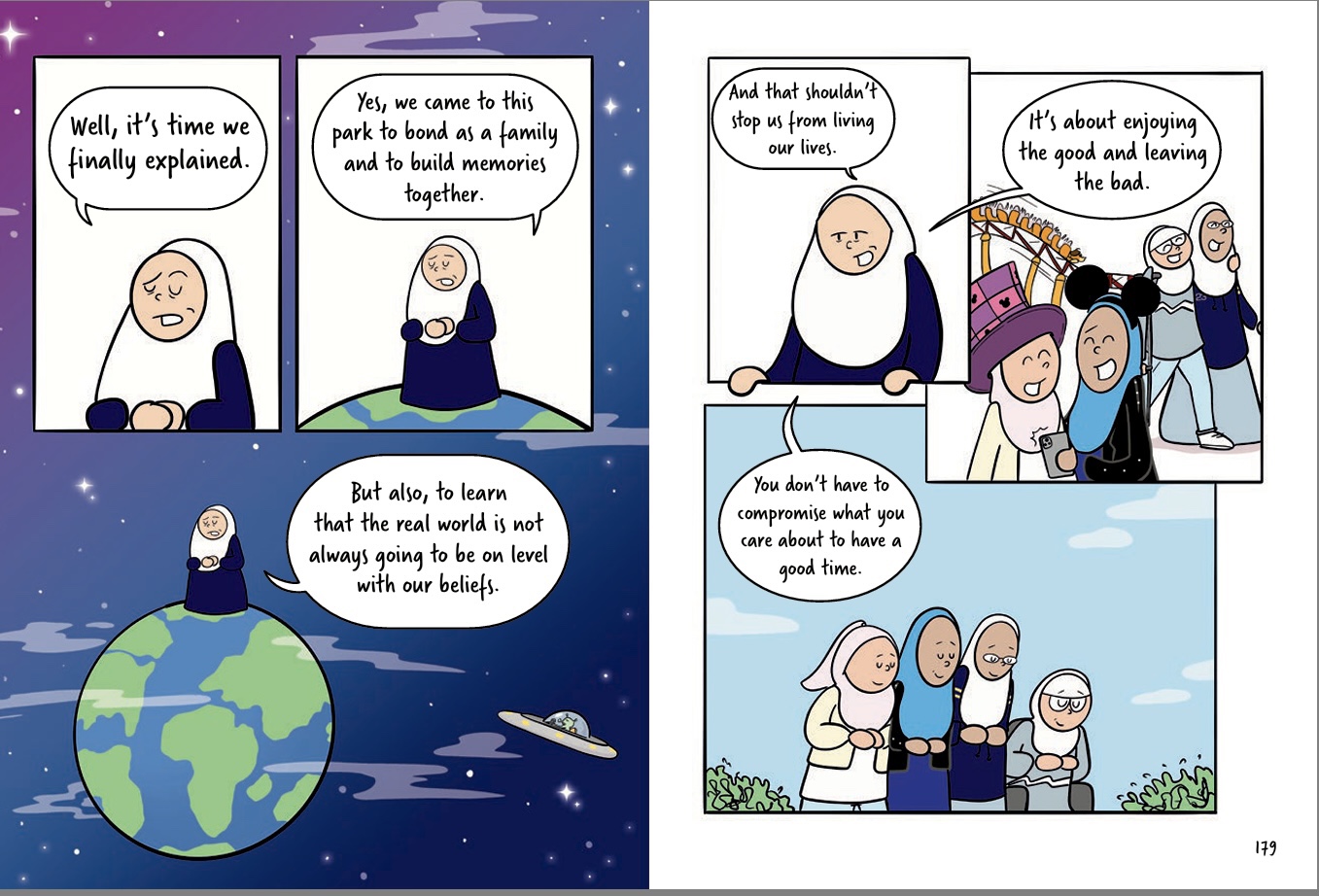
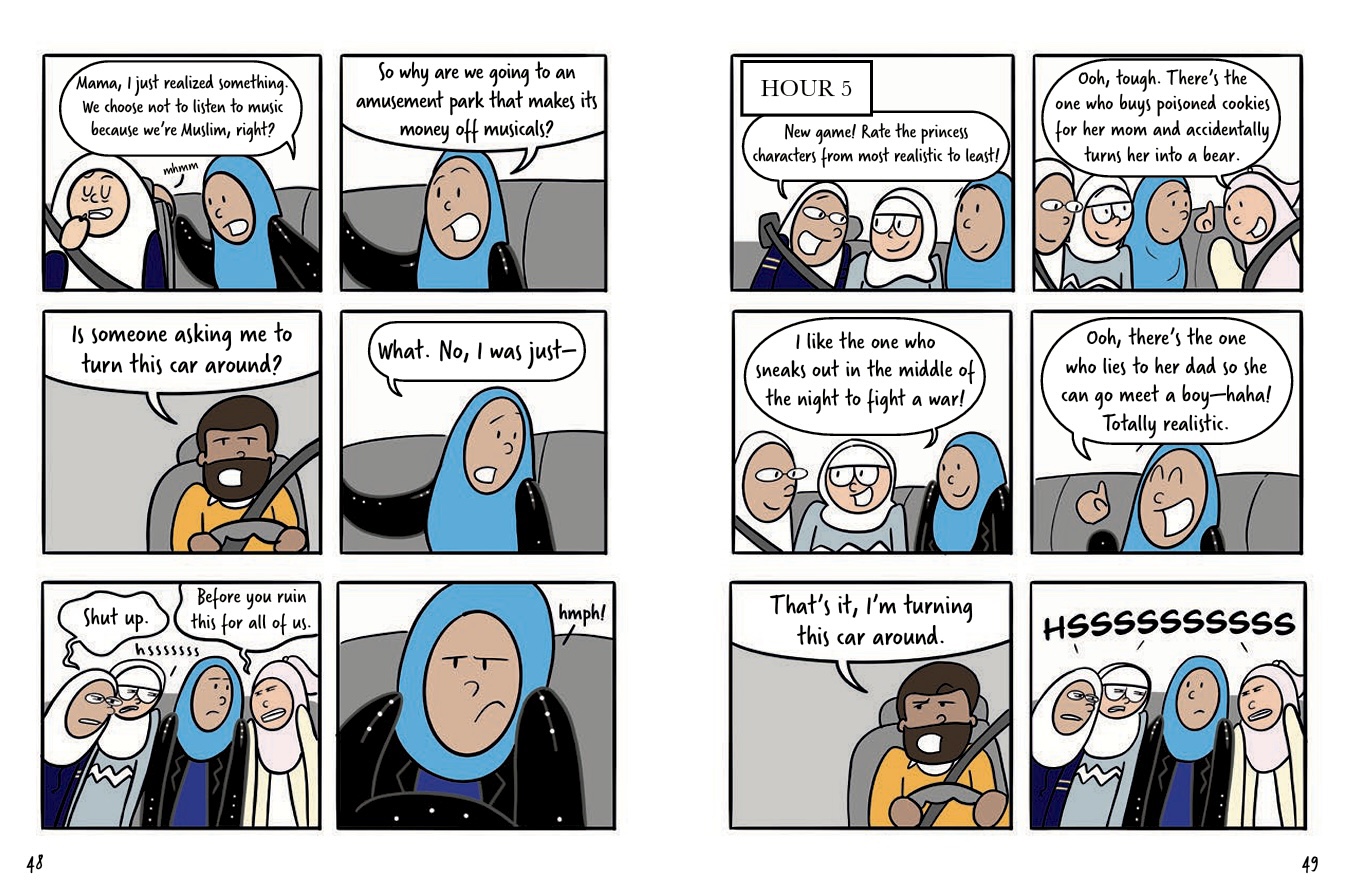
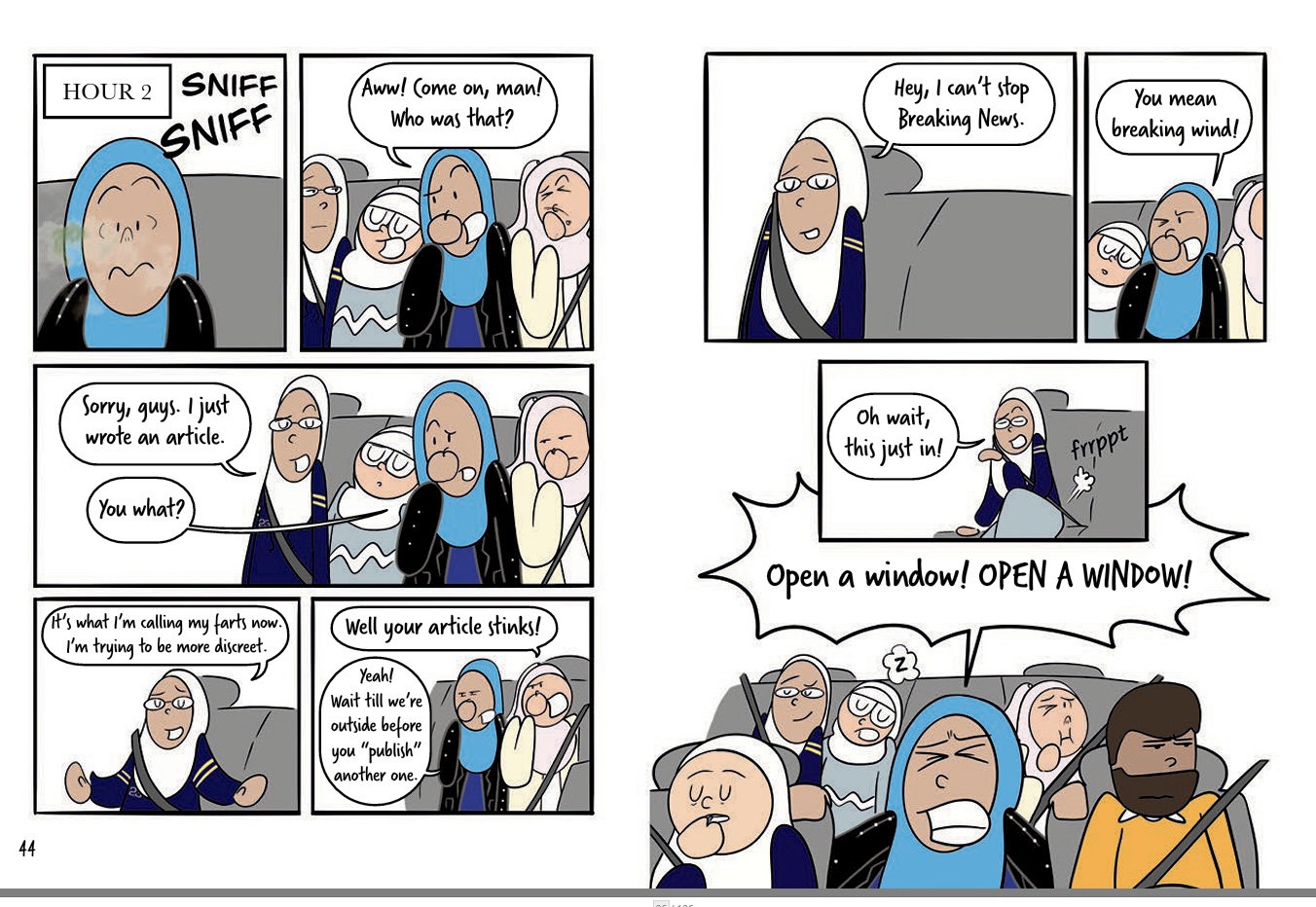
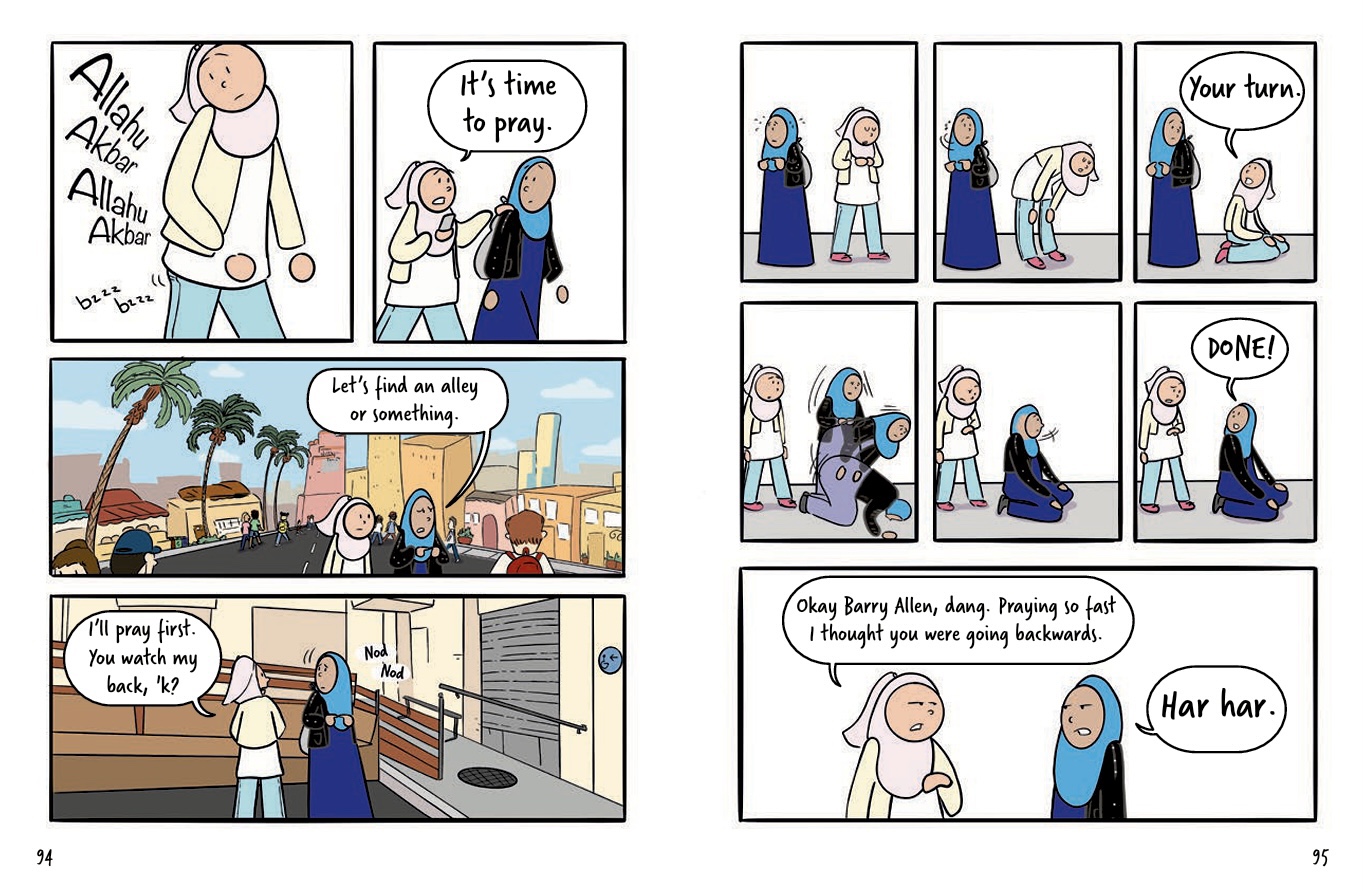
There is nothing quite like reading a YA graphic novel where you feel so completely seen, where you laugh out loud and snort at the shared idiosyncrasies, and where you don’t have to worry that the next page will normalize something haram.  This book, and the entire series, are such a gift to us all that I’m posting this review now, knowing full well that the book does not release until October, with the hopes that you will all preorder it.  This OWN voice authentic rep needs all the support we can offer it to signal to publishers that we want to see books like this published for our kids, ourselves, to share with our Muslim and non Muslim friends and that we want to see similar unapologetic voices in the future.  Huda loves Islam, she is Muslim, but that doesn’t mean she doesn’t feel uneasy at the idea of praying in public, or making wudu at a rest stop.  Her sisters sing Native Deen’s M-U-S-L-I-M to call her out, she fan girls about We Hunt the Flame, and the entire book reads like time spent with friends who can keep you laughing, comfort you when needed, and who are willing to share their very real relatable world with you as they take on Disney World.

SYNOPSIS:

It is summer and Huda and her family are heading on a road trip to Disney World. One sister hangs back for a Quran intensive, the one sister she likes.  Determined to make the best of it she piles in the back seat of the family car with her three other sisters and they hit the road.  The 24 hour one way trip is filled with sibling bickering, rest stop stresses, and parental gems.  Once they get to the park though, their parents have some surprises for them, and Huda finds herself bonding with her sisters despite herself.

FLAGS:

Fart jokes, bullying, punching, self defensive, hitting a boy in the privates for attempting to pull off a hijab, forced physical touch, lying, nothing YA can’t manage.  The title might seem crude to some, I, personally, love the ownership of one’s name, but the book is not offensive.

TOOLS FOR LEADING THE DISCUSSION:

This book won’t work as a book club selection, but I hope it finds its way to every home, middle school and up class and library.  Boys and girls will enjoy the content and I have no doubt, like the other books in the series preteens and teens will be regularly thumbing through the pages giggling and sharing their favorite parts.  You can preorder your copy here https://amzn.to/44Be87O

Please preorder if you can, and if you cannot please request your public library to shelve it, check it out, read, suggest, and enjoy!

Definitely one of my favorite books of the year, decade…..ever?

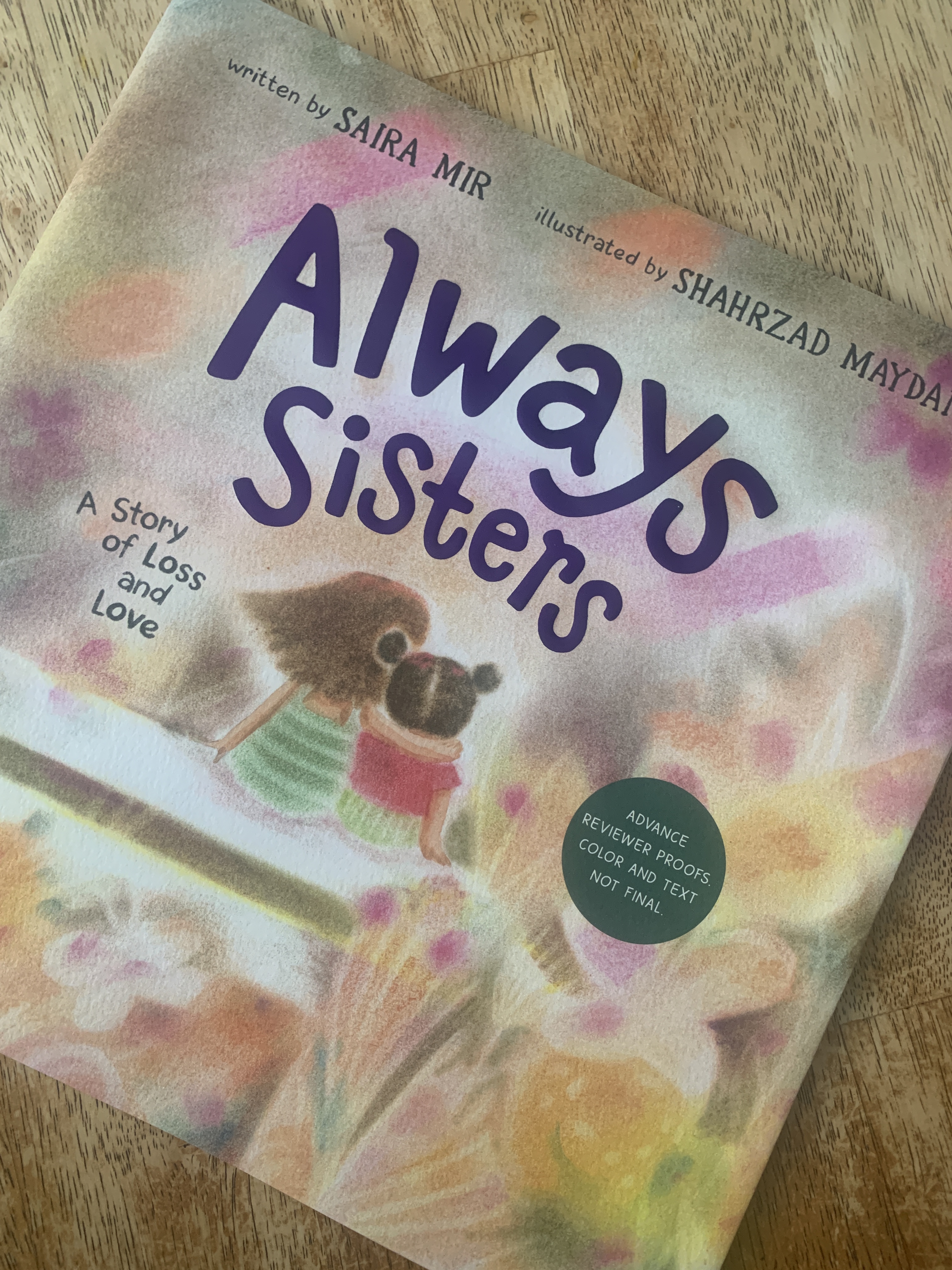
Always Sisters: A Story of Loss and Love by Saira Mir illustrated by Shahrzad Maydani

Standard
Always Sisters: A Story of Loss and Love by Saira Mir illustrated by Shahrzad Maydani

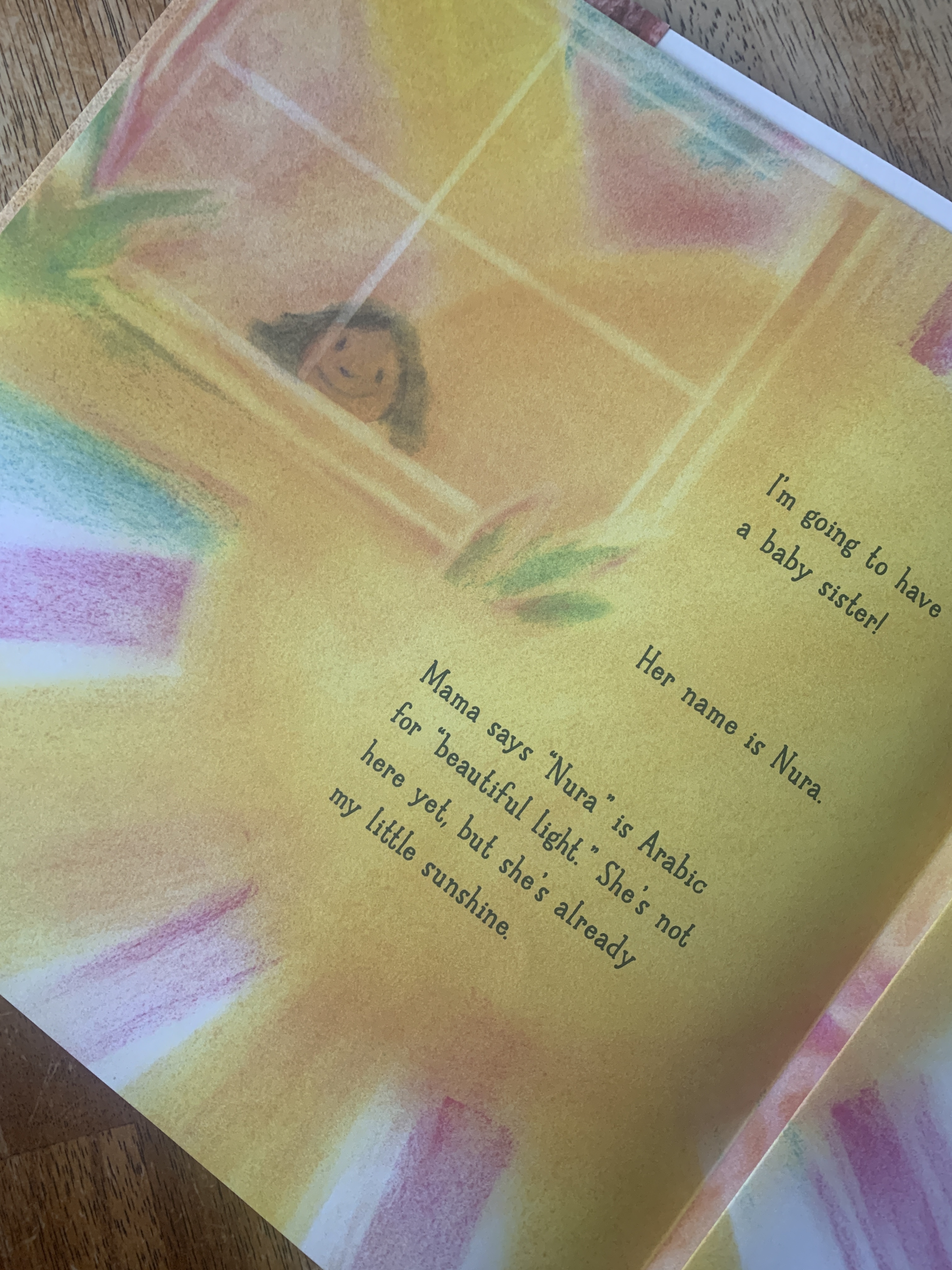
This 32 page picture book for early elementary children addresses an important topic of pregnancy loss and grief through the eyes of a young girl excited and then devastated by the loss of her unborn sister.  The author is Muslim, but their is nothing religious in the text, it is a universal and poignant story from an OB-GYN who has counseled patients and experienced it in her own family.  The book is a story that can benefit children needing reassurance or simply provide a way to have heartfelt conversations.  The soft illustrations and gentle steps the character takes to help with the big feelings inside will allow readers of all ages to feel less alone, and see that support is available.

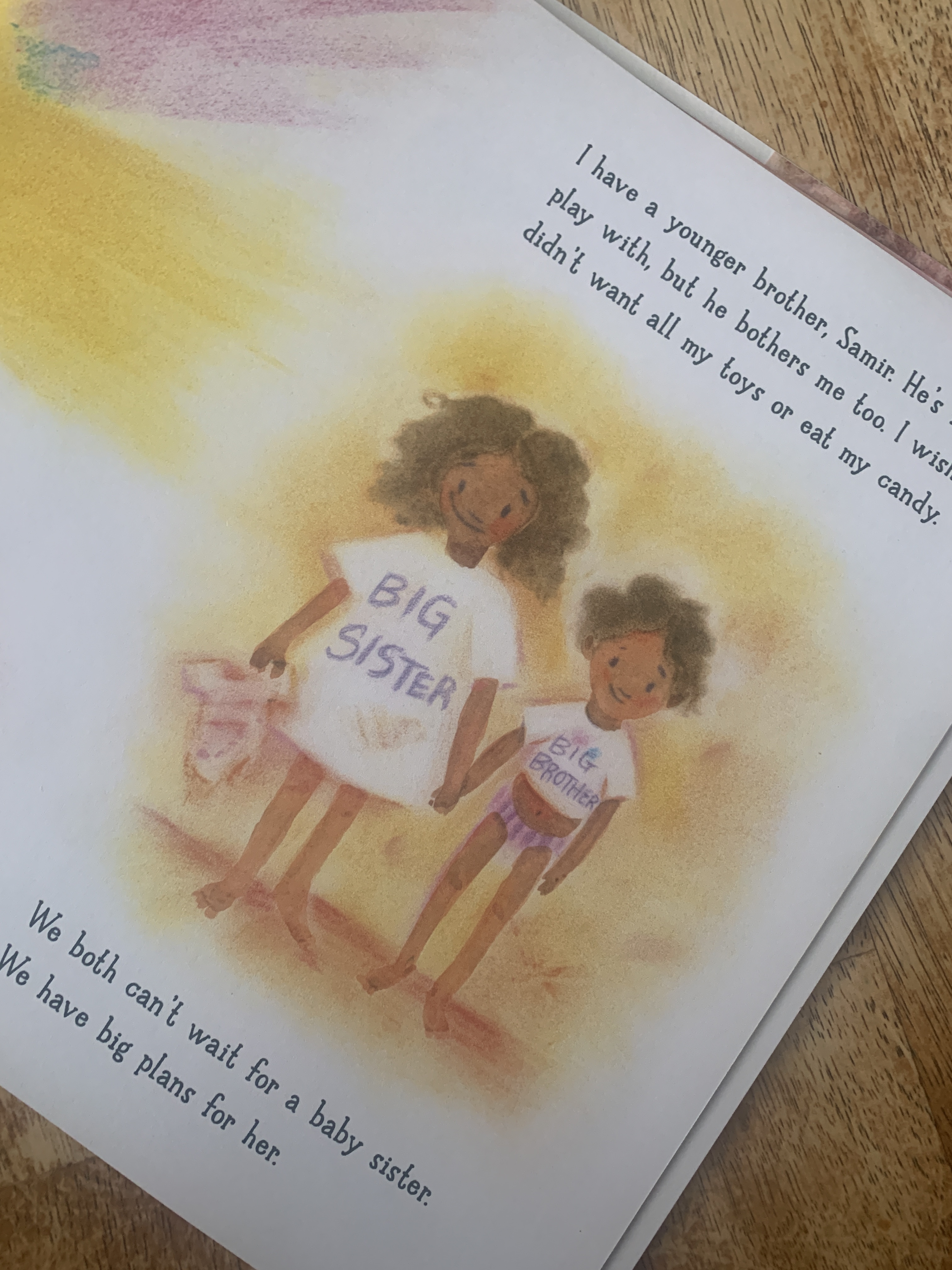
Nura is not born yet, and Samir is a fun little brother, but Raya has big plans for a baby sister.  They will run through sprinklers in matching bathing suits, and she’ll pass on her ballet costumes for her to wear, she’ll love chocolate and dolphins and they’ll share everything. Raya even hopes they will share a birthday, that would be the best present ever.

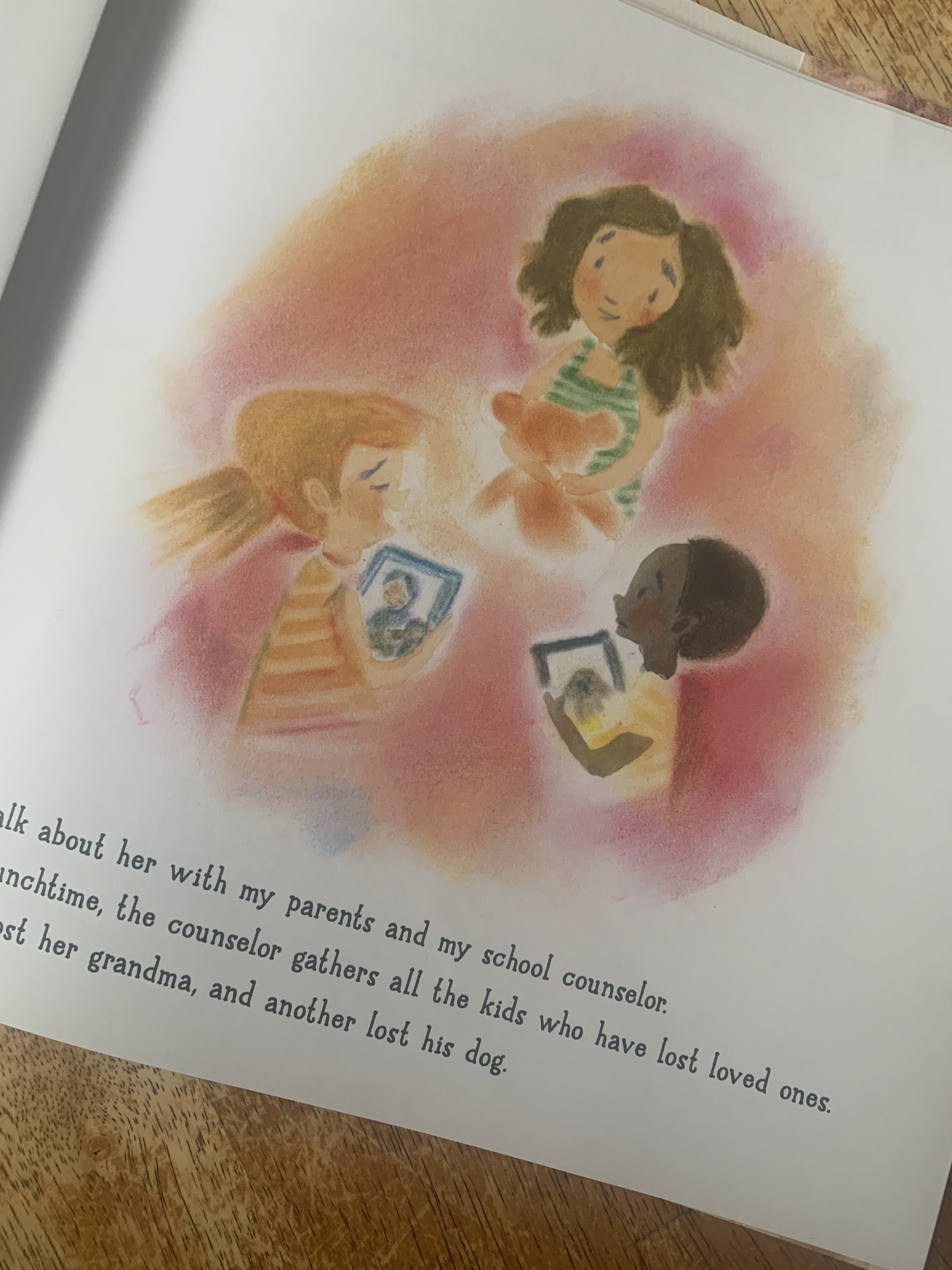
One day Mama goes to the doctor for a checkup, but when she comes back she looks like she has been crying.  She tells Raya, Nura won’t be coming home.  Nura is confused and sad.  There is an ache in her heart.  She talks to her parents, draws pictures, meets with the school counselor.  The family plants a tree and they talk about her and remember.

I like that you see the joy and anticipation the little girl has for the arrival of her little sister and the painful aftermath when she is not going to get to see her dreams materialize.  The book isn’t just a resource, it has literary elements as well that make the book valuable for those who can relate and even those that have been spared from such a loss.  The book can be preordered here. 

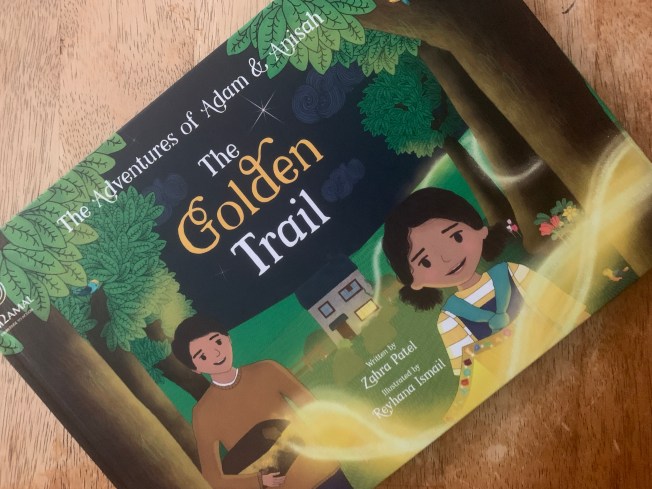
The Adventures of Adam and Anisah: The Golden Trail by Zahra Patel illustrated by Reyhana Ismail

Standard
The Adventures of Adam and Anisah: The Golden Trail by Zahra Patel illustrated by Reyhana Ismail

img_6818

This third book in the Adam and Zahra series, also available with a workbook, focuses on zakat and can be read alone.  Aimed at toddlers to early preschoolers, this rhyming story can also work at story time with slightly older kids as a reminder of zakat and giving to those in needs.  The book has very minimal text and as a result if you overthink it, it could be slightly problematic: there is magic, they are taking and giving something that doesn’t belong to them, Zakat is a portion of your wealth not sharing something you found-even if a note says otherwise.  I think the book is sweet though, and the discussions to have with little ones outweigh the adult concerns I’ve mentioned. It touches on giving to others, on people in need, of people in need living very close to you, that everything being a gift from Allah (swt), it shows siblings working together, sharing, generosity, a lemonade stand for Yemen, giving of food and money, and befriending others.  I think if you liked the other books in the series regarding a “magic” pray rug and a fasting shield, both mentioned in this, you will like the presentation of sharing and the term zakat presented in a similar fantasy laced manner; if those books felt uncomfortable for you and your family, this one probably will as well.
Adam and Anisa start the story in Ramadan, a week before Eid, digging in the sand at the beach.  Adam finds a treasure box and a message in a bottle.  The treasure box is locked and the message says that “My name is Zakat and I’m for someone in need…”  Once the kids get the box home and the lock off, a beam of light shines a path for them to follow.

img_6821

They follow the light out the door and through the field, and past the mosque and their friends, along the way they purchase a pie from the bakery for when they break their fast and keep following the light to the field as the sun starts to set.  They find a house in the forest with a mom, a baby, and a little boy, to whom they give the money and the pie. They learn that they had moved to this country and were all alone, but Allah swt provided for them, and He is never far. They all break their fast together and learn that “Whenever you give, Allah will give you more.”

img_6822

The backmatter of the book contains Context to the Story, Developing Character Strengths, Learning through Practice and a map of their adventure.  I purchased my copy from Crescent Moon Store here and if you use my initials (Islamic School Librarian) ISL at checkout you will save 10%.

img_6823

The Love Match by Priyanka Taslim

Standard
The Love Match by Priyanka Taslim

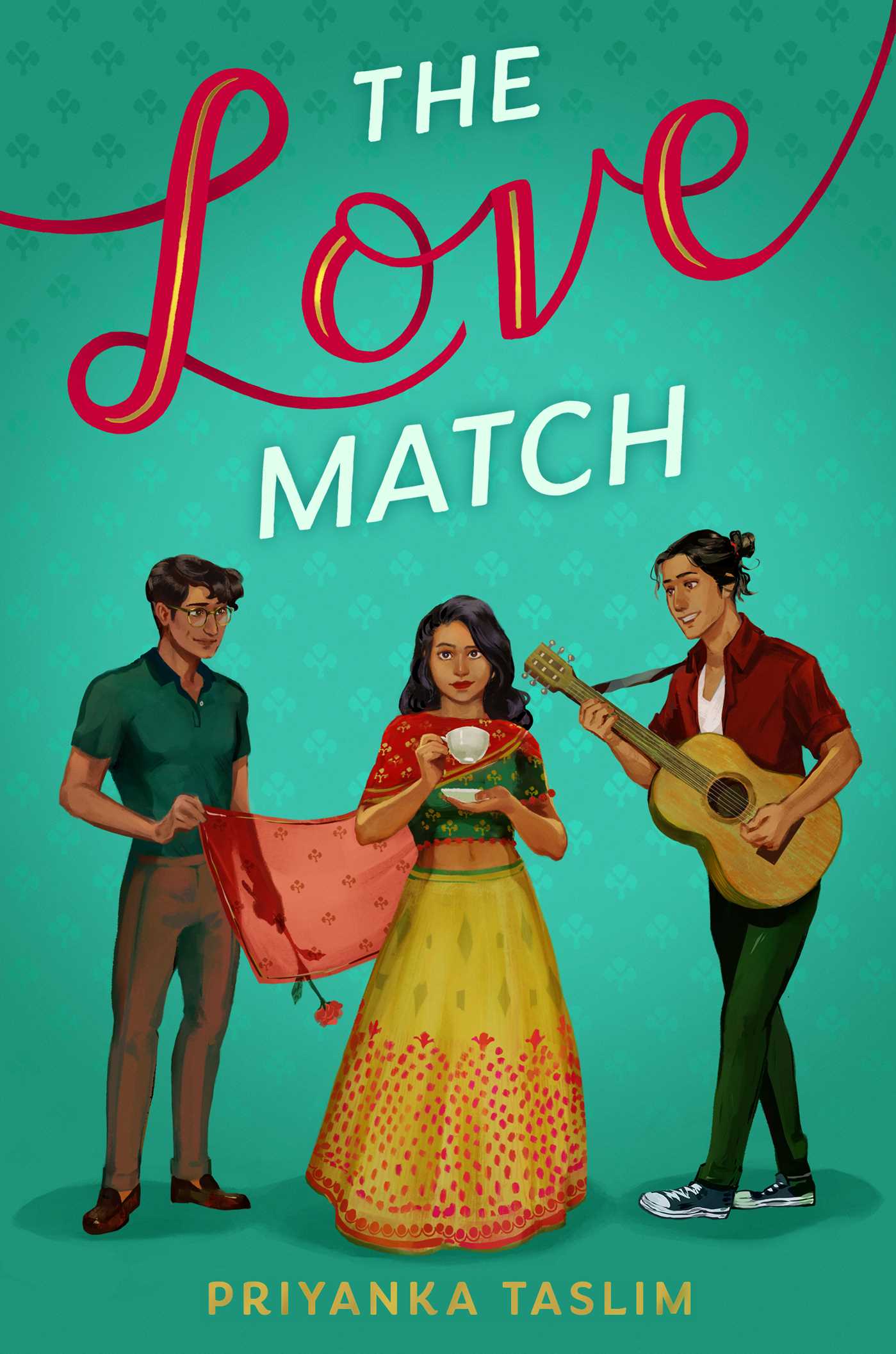
This new YA book features Muslim characters, but is not a religious conscious read that fits in the halal category.  There is a lot of Islam: waking up for fajr, celebrating Eid, a hijabi, mention of jummah, but the OWN voice rom com sets boundaries based on Bangladeshi culture and American perspectives.  The book does not other, or have internalized Islamophobia, or fall in to tropes of oppression and rebelling- quite the contrary- it normalizes everything: LGBTQ+ relationships, dating, music, etc.  The book is well written from a literary perspective: easy read, fleshed out characters, resolved plot lines, I wish there would have been more slow burn and heightened emotion, and cathartic release, but it happily held my attention for 388 pages, so I can’t really complain about plot holes or development.  The problem I have as an Islamic School Librarian is the non issue dating and romance is for the characters with their parents knowledge, both lesbian and heterosexual.  The book doesn’t get graphic, in fact there is only a handful of kisses, but there is a lot of hand holding and pdas in front of parents and even a sleepover with a lesbian couple in a Muslim family’s home, again, nothing “racy” occurs, but the normalization is worth noting for those thinking a Salaam Reads book is going to be a more Islamically centered publication.

SYNOPSIS:

Zahra Khan has graduated high school, and while she’d love to be heading to Columbia to study writing with her best friends, she is stuck deferring her admission and scholarships, and hiding her dream to be an author.  Two years earlier her father has passed away and Zahra works in a tea shop to help keep a roof over the heads of her mother, grandmother, and siblings.  In the Bangladeshi community in Patterson, New Jersey Zahra’s mom imagines arranging a marriage to a wealthy family for Zahra to ease their financial stresses.  When a potential match comes a possible reality, Zahra takes control to try and keep the peace and keep her dreams within reach.  In Jane Austin-y feels, a love triangle emerges, friends step up, culture and family touchstones shared and appreciated, and decisions about the future will have to be figured out at 18 years old.

WHY I LIKE IT:

I loved how easy a read the book is, the cultural framing was warm and rich and never overly explained or apologized for.  It is what it is, it is who the characters are, and while at times they push back on the negatives, it doesn’t disregard the love that exists at the core.  Unfortunately, I really struggled though with the ease in which the characters date with their parents’ knowledge, hold hands, cuddle.  I really couldn’t imagine a practicing Muslim family being so supportive of a lesbian daughter in the way that the Tahir family is and allowing a sleepover, nor could I see a hafiz attending musical concerts and Bollywood movies or an imam passing on “love” notes, even side comments about a loan between mother and daughter being paid back with interest felt off.  I know I know, there are lots of shades of Muslims, but the normalcy of haram I feel in a review of this book should be noted. It isn’t side mentions, they are central to the story and large portions of the book.  The reason I also feel they are worthy of note, is because the book includes a lot of Islam as well.  The characters pray and fast and eat halal.  They are conscious of chaperones in some settings and keeping things appropriate.  There is no doubt that the characters are Muslim, but I think intentionally, to avoid perhaps critiques such as mine, Islam is not used as a reason to do or not do anything, Islam is not used in the thought process or conscience of the characters, culture is.  There is no haram police setting boundaries, it just isn’t what “good Deshi girls do.” To be fair, I don’t think the author has ever claimed that this is a halal love story, or that the characters are exploring their Muslim identities, it is a love story that features Muslims is all.

FLAGS:

Straight and sapphic relationships, secret relationships, kissing, hand holding, hugging, lying, music, loss, bullying, interest.

TOOLS FOR LEADING THE DISCUSSION:

I would not be able to use this book, it would be very damaging to be given to a Muslim child from a Muslim teacher in an Islamic school.  It normalizes a lot of haram in a familiar Islamic framing that I think would really confuse YA readers who see themselves and see no push back or consequences for actions they know to be against Islamic ideology.

An Andalus Adventure by S.N. Jalali

Standard
An Andalus Adventure by S.N. Jalali

andalus

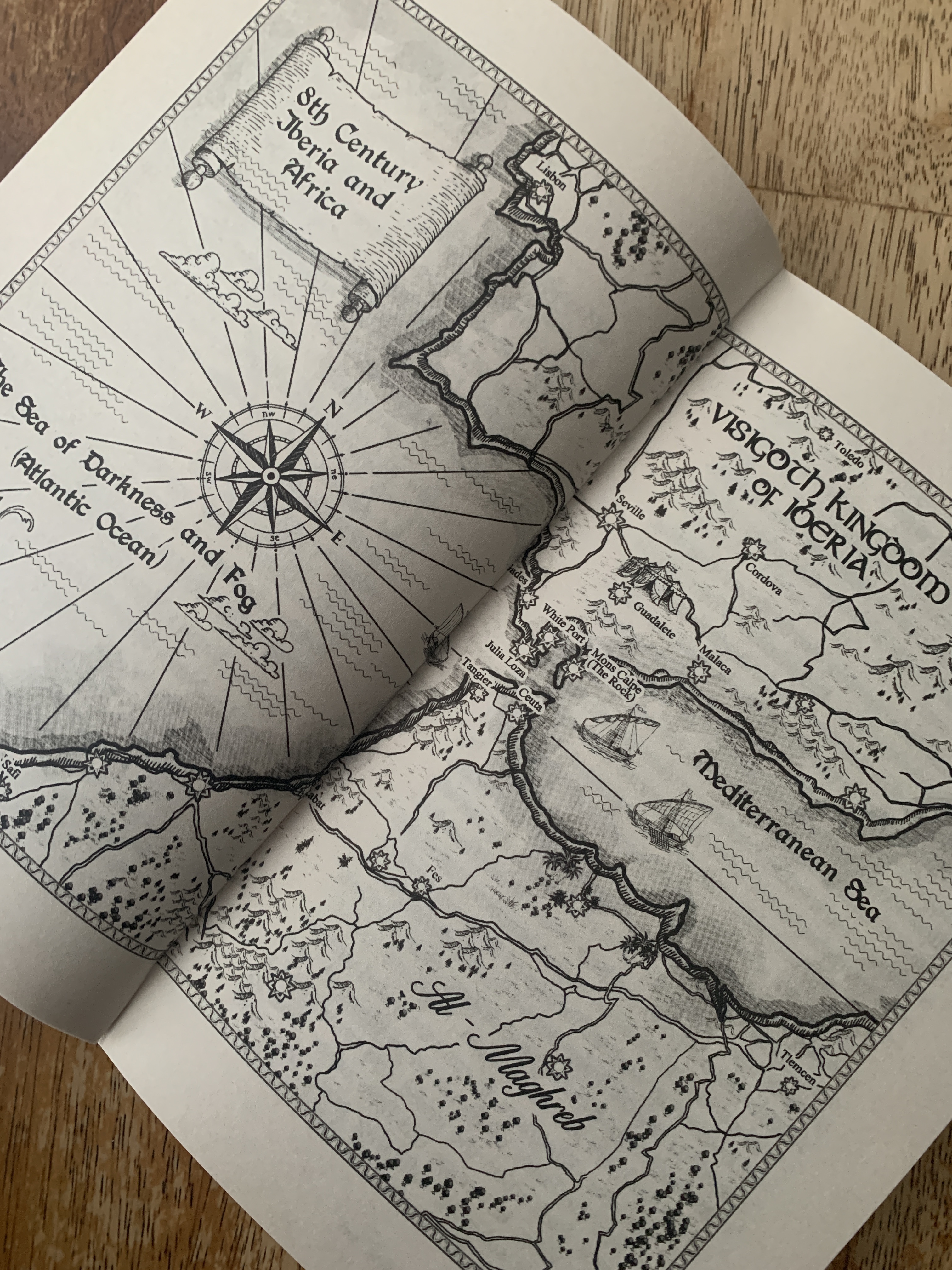
I truly am glad I read this book. I love historical fiction, visiting Spain is on my bucket list, this book has a map, details about what is historical what is fiction, has Islam woven in to the heart and soul of the story and characters, and yet it was a hard read.  The first few pages grip you, the last 50 bring it all together, but the middle 250 were hit and miss in this lower YA/upper MG book.  I honestly had to force myself to keep reading.  My teen and tween son couldn’t get past 38 pages or so, and I’ve asked around and no one I know that started the book, finished it.  I think ultimately there are just too many characters, too many points of view, that even though the history is rich, the literary points all in order, their isn’t enough character connection to hold the readers through the wandering details.  This author’s style is a bit more slow, but I think in the House of Ibn Kathir series, the setting of being in school and having friend problems is relatable to readers; boarding horses on to a boat, deciding to wage war, and going in to battle are not familiar concepts, and without the emotional connection it loses momentum.  The climax is nice but ultimately rather lackluster, and the beauty of characters taking shahada, Jews being freed, Solomon’s table, an old lady with a premonition, and a character dying are just not enough to keep the story in reader’s hands, unfortunately. 

img_4397

SYNOPSIS:

The summary might make the book seem fast paced, and while it does constantly move forward to a clear destination, it isn’t a “buckle your seatbelt and hang on” type of story.  The setting is Northern Africa and the Iberian Peninsula in 711 CE, 92 years after the Hijrah.  The book opens with two young siblings Ben and Bella, overlooking the coast, dreading their lives under Visigoth oppression, and hiding their Jewish culture and faith.  It then jumps to the Governor of Ceuta, Count Julian (Ilyan), awaiting to meet with Umayyad leader Tariq ibn-Ziyad.  He is hoping to rescue his daughter from the court of King Roderick and convince the Muslim General to enter Iberia, restore the rightful king, and free the people essentially.  Add in voices from Qasim, a young Berber, and Jacob a captured Iberian, and the stage is set to get everything in order to cross the straights, survey the enemy, take on the King, and introduce Islam to the new land.

WHY I LIKE IT:

I absolutely love the Islam and the history and the fictional liberties.  I love that the book is clean, although, I do wonder if more information about Lady Florinda would have helped the reader understand her father’s desperation, I do understand the vagueness, but it is a glaring omission that keeps the reader curious.  Ultimately I wanted more backstory.  The little given about the characters was engaging.  I loved the teasing about being a shepherd, Jacob coming to love Islam, Bella not wanting to marry, but it seemed to always stop short of sweeping me away.  I didn’t cry (SPOILER) when Hisham died, I barely knew him.  I didn’t feel the urgency to hide and escape from Leander’s proposal.  It set up to add depth regarding Old Mother Magda, the Cave of Secrets, and the unverified death of the king, but after being stated it was never mentioned again or resolved for any real purpose. 

All that aside, I think the book has value, it is just really dry in spots, a lot of spots, and given the vocabulary, the changing narrators, the choppiness between chapters, and the history, it is hard to keep reading or be anxious to pick up once you have put it down.  So with all that in mind, I think the book would be great to use in a classroom setting.  You could read a chapter Monday, and then pick it back up on Thursday and not worry that no one remembers anything because it is focusing on new characters anyway.  In a middle school, or upper elementary the book would be a great crossover between History, English, and Islam classes. The book would naturally lend itself to the students keeping character journals, the supplements and backmatter would allow for references and insight in to real history, and I think the book would do really well in this set up to connect with the audience. 

The Epilogue was nice, but a little disjointed.  I appreciated the updates on the characters and it showing Muslims and people of other faiths coexisting and being accepting even within families, but the connection to the story was a little lost.  Similarly, I love that it mentioned  Abbas Ibn Firnas, but I don’t know that most kids know enough about him to know what is being hinted at and what the outcome was of his flight at the end.

FLAGS:

Death, war, battles, killing, nothing graphic, very tame, not graphic or detailed gore.

TOOLS FOR LEADING THE DISCUSSION:

I don’t know that I could get middle school students to read the book for a book club, it would have to be motivated by a grade to get through it in a classroom setting I’m afraid.  See above to read my thoughts on how to present it.

I purchased my book on Amazon and will receive a few pennies if you decide to purchase a copy using this link.

Tittle Tattle Talia: A Story about Gossiping by Salwah Isaacs-Johaadien illustrated by Zeyneb Yildirim

Standard
Tittle Tattle Talia: A Story about Gossiping by Salwah Isaacs-Johaadien illustrated by Zeyneb Yildirim

tattle

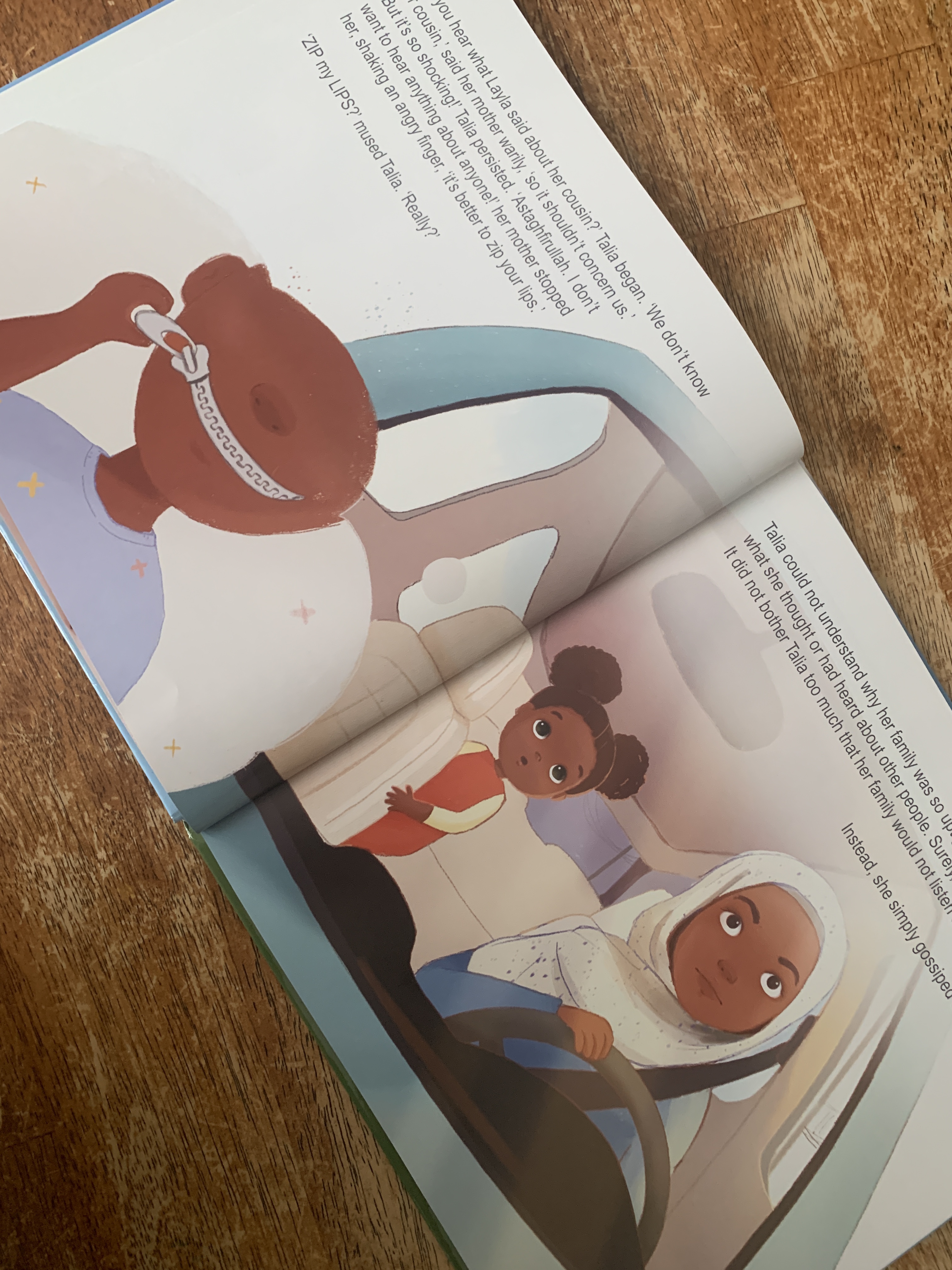
I really enjoyed this Islamic moral book about gossiping.  Over the years I’ve taught a few Sunday school lessons, class lessons, and even hosted story times on the Islamic cautions regarding backbiting, and honestly I don’t think kids really grasp how easy it is to commit the act and be a part of it.  They understand they shouldn’t do it, what the punishment is, and that it is bad, but I don’t know that the materials I’ve used and seen, have really connected with younger kids without a lot of supplementing; and this book highlighted that we really can be messaging better on a child’s level.  The pages are incredibly text heavy, but neither I nor my audience seemed to mind until close to the end, because of the comedy and relatability of the story up to that point.  I think the coach getting overly involved took it back to being a lesson from adults and broke the child perspective tone.  I do love that the kids that listen to the gossip are also held accountable, the importance of the coach’s message clearly is important, but the story telling quality would have benefitted from a few tweaks.  The illustrations are cute, unfortunately the font is not very appealing.  I do like that the salwat is given in Arabic, and that Hadith are mentioned in the text as well as in the backmatter with an author’s note.

img_2774

The story starts with Talia owning that she loves to share tales about the people around her, before telling one to her older sister.  Her sister tries to stop her and tells her that she needs to watch what she says or she might one day have to eat her words.  Talia wonders what eating your words means.  Similar situations occur between Talia and her brother, her mother, as well as her father.  Each time the story is reprimanded and a funny euphuism remarked upon and then giggled about by Talia.

img_2775

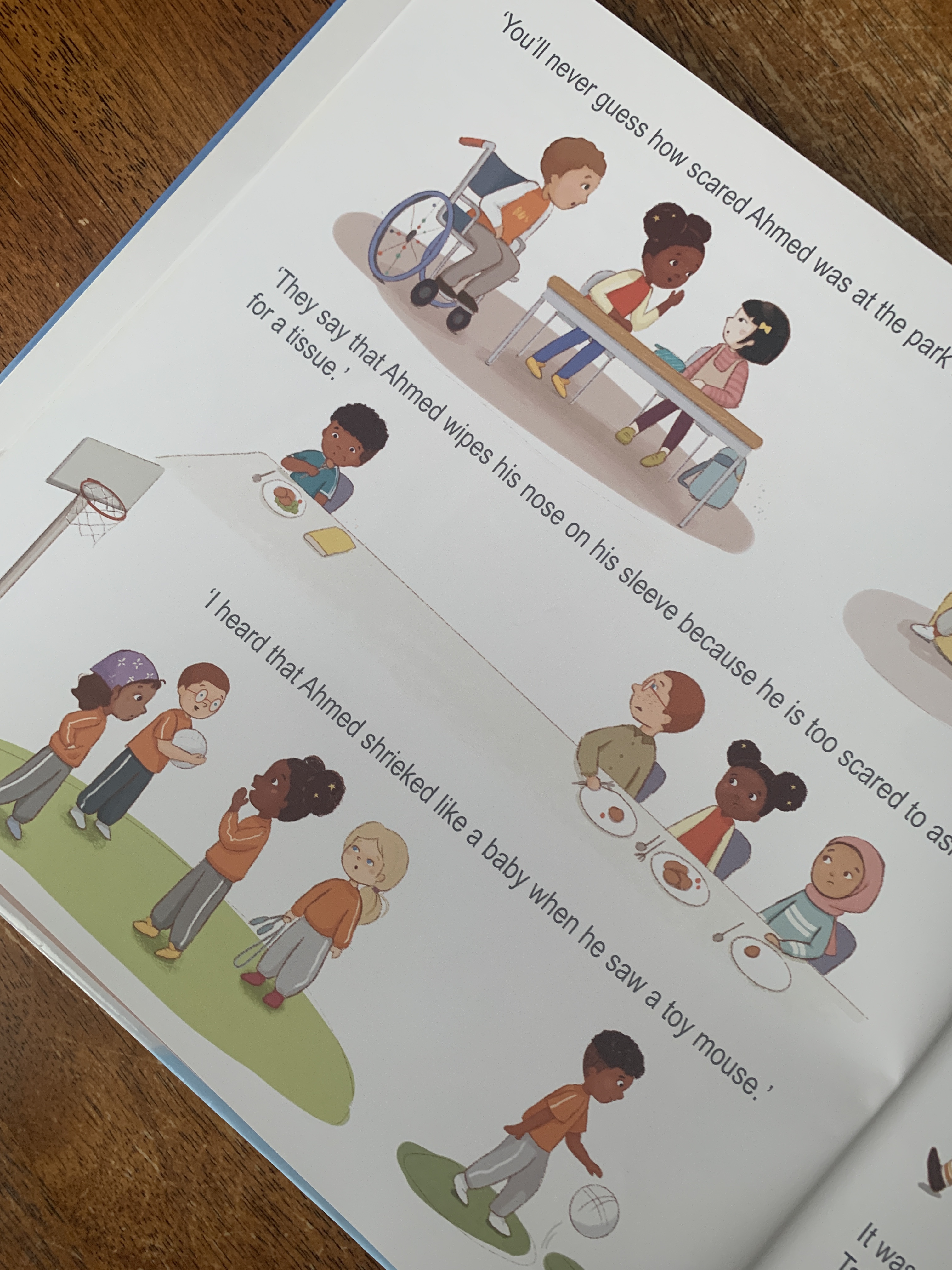
At school she does the same, telling stories, often at the expense of a boy named Ahmed, and the more interest the other kids show, the more outrages her tales become.  She soon starts telling them about everyone, and her classmates and friends grow weary and fearful that they might be next.

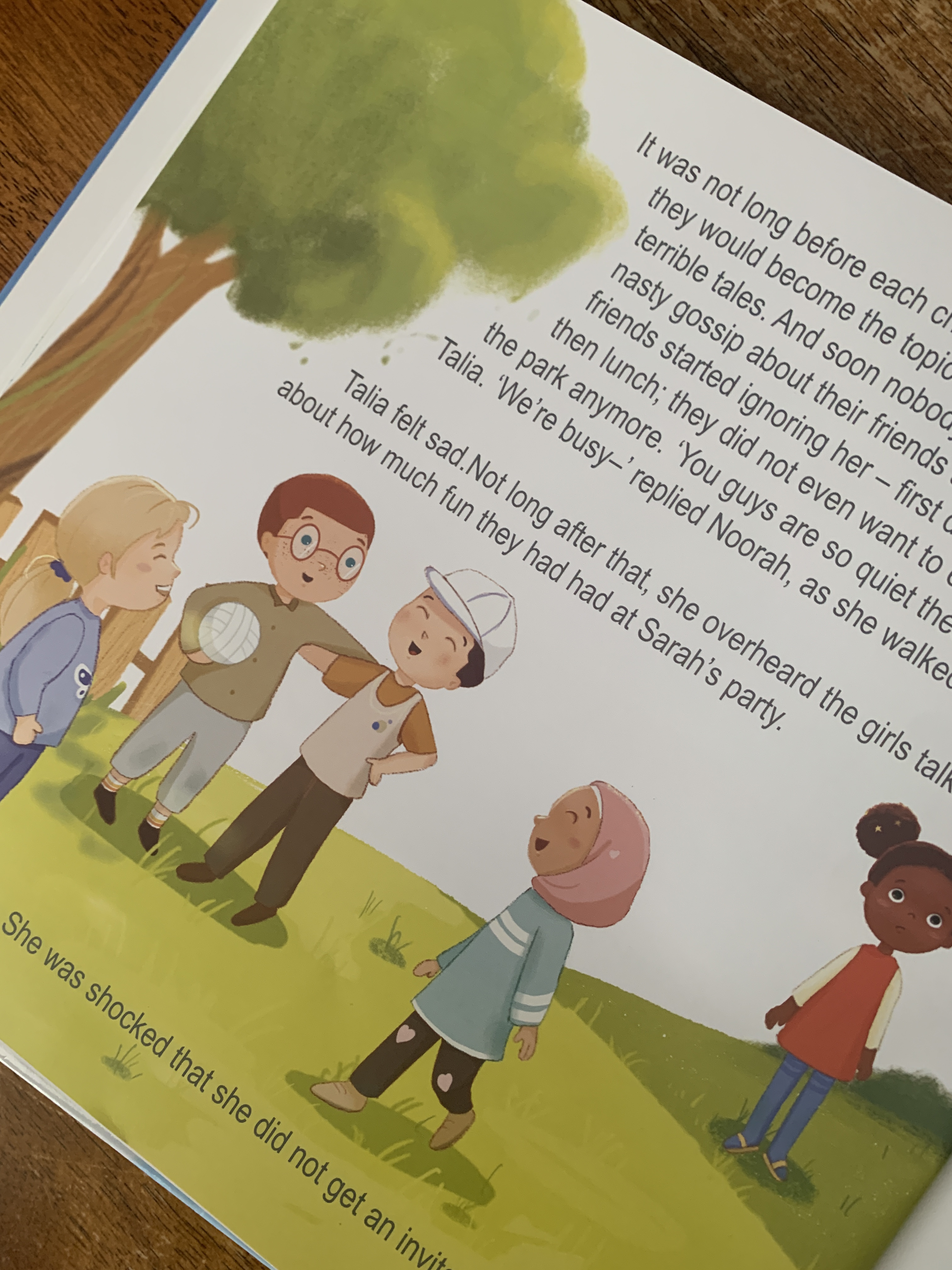
It all comes to a climax when Talia’s classmates say enough is enough and stop talking to her, and go as far as refusing to pick her when picking teams, and playing with her at all.  The coach concludes then that the match should be cancelled and Talia should apologize.  The cancellations seems extreme, and the forcing to apologize almost takes away from the emotional realization that her “tales” have become bullying.

img_2776

As Talia leaves, her classmates gather up and she sees Ahmed not joining them.  When she gets to her front gate, her friends catch up to her and apologize and acknowledge their roles in perpetuating the gossip.  Talia then goes to find Ahmed and get him some ice cream to apologize.

I don’t quite think the friends needed to apologize, I think they should have just realized their role, I think with discussion it might be clarified, but I worry that it defers Talia’s ownership of wrong doing, and could send some mixed messages.

img_2777

It is also a little pausing that Talia makes up a story about why a girl wears hijab, when her own mother wears hijab and she is clearly Muslim.  On the one hand, I like that it shows how ridiculous her tales have gotten, but it also could seem like she is falling for a stereotype as well.  There is good rep in the illustrations of those that cover and those that don’t, there is a child in a wheelchair and lots of shades of skin colors and hair types.  The text also contains traditional Islamic names and some that are not.

img_2779

The book helps our children to be better and the story engaging enough to be memorable, that while I wish it was cleaned up a better to strengthen the writing, I do find it a benefit on a shelf to be shared at bedtime, in classrooms, in story times and as a reminder to not participate in gossip or listen to it.

img_2778

That’s Not My Name by Anoosha Syed

Standard
That’s Not My Name by Anoosha Syed

not my name

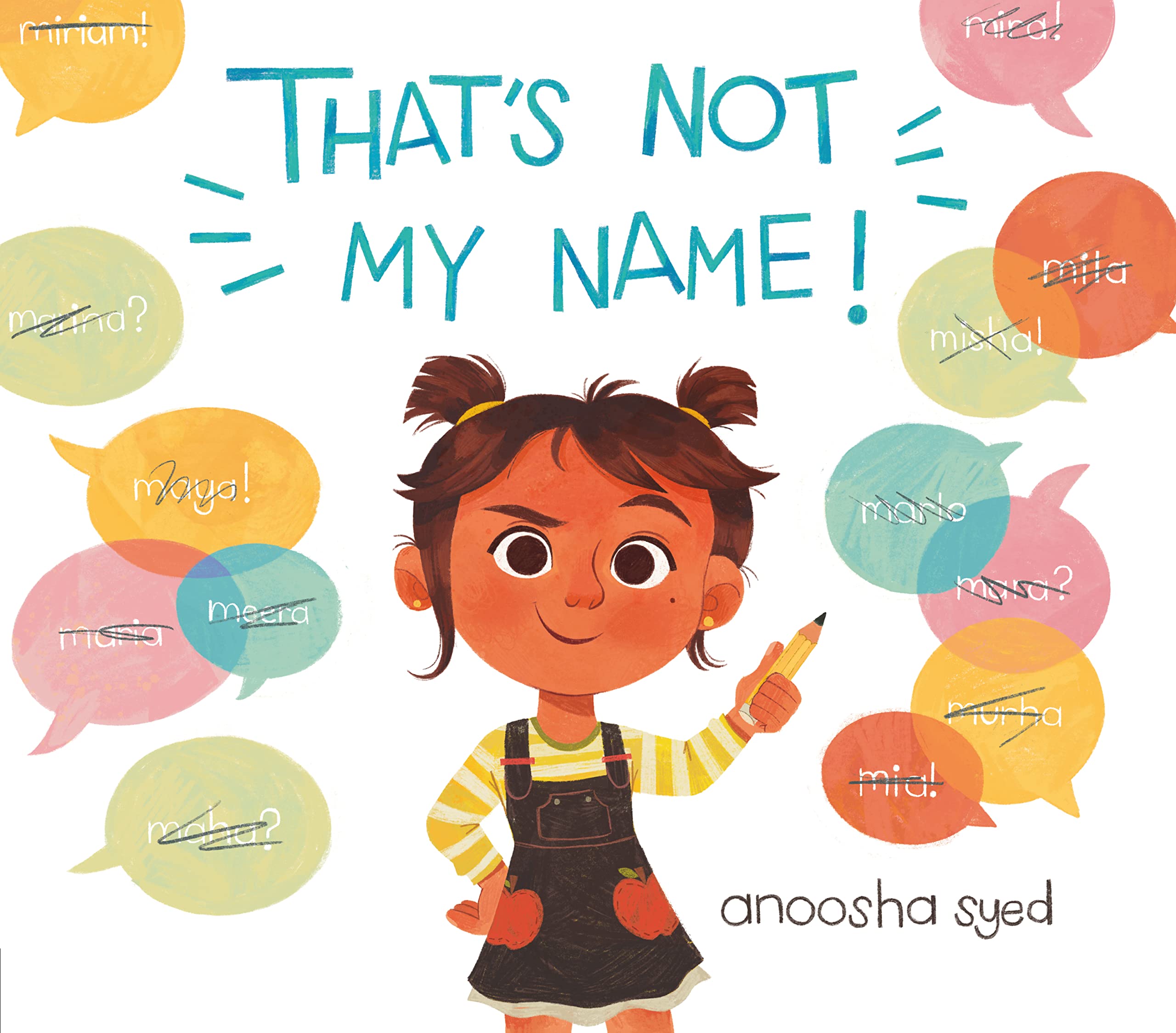
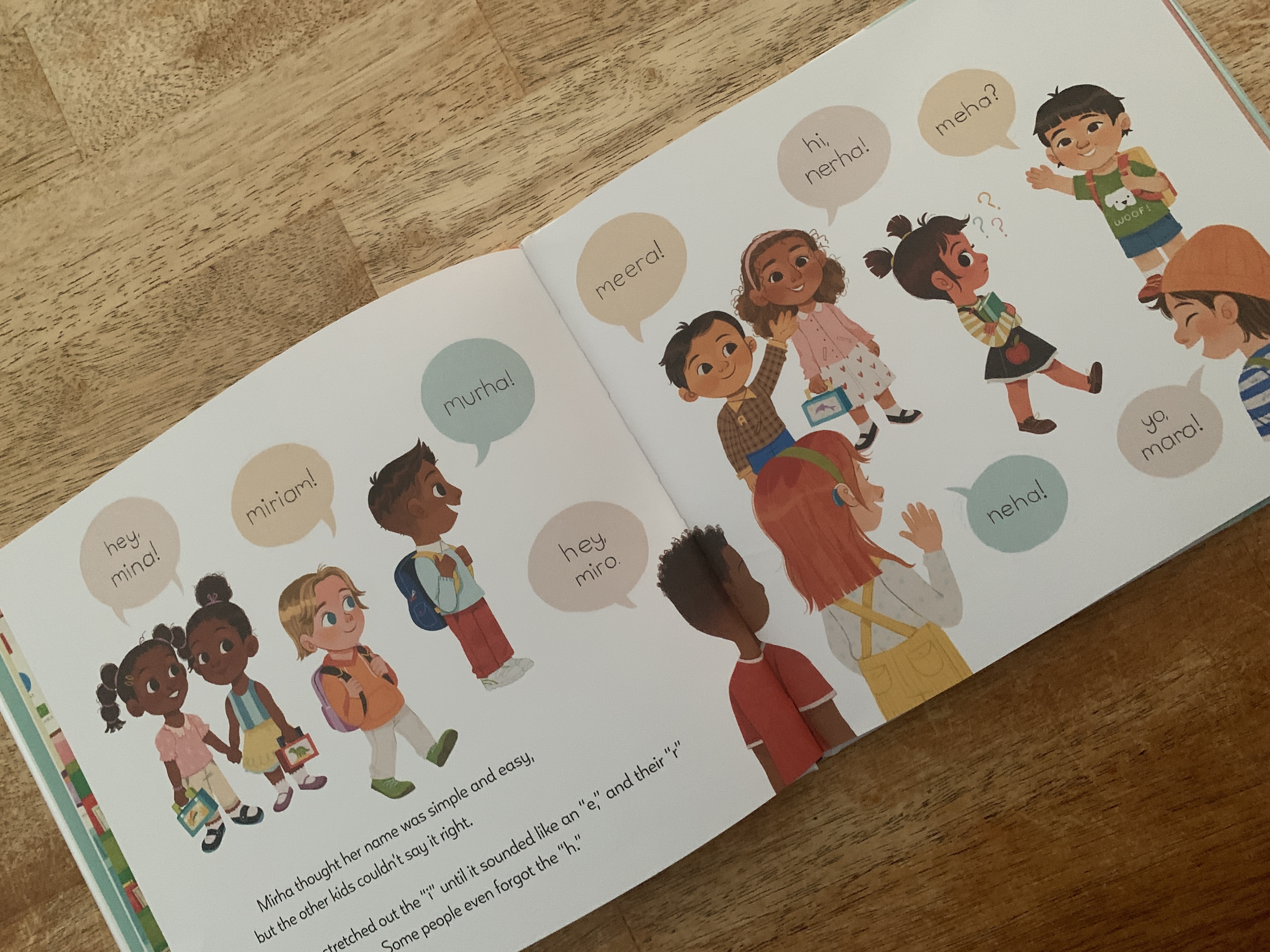
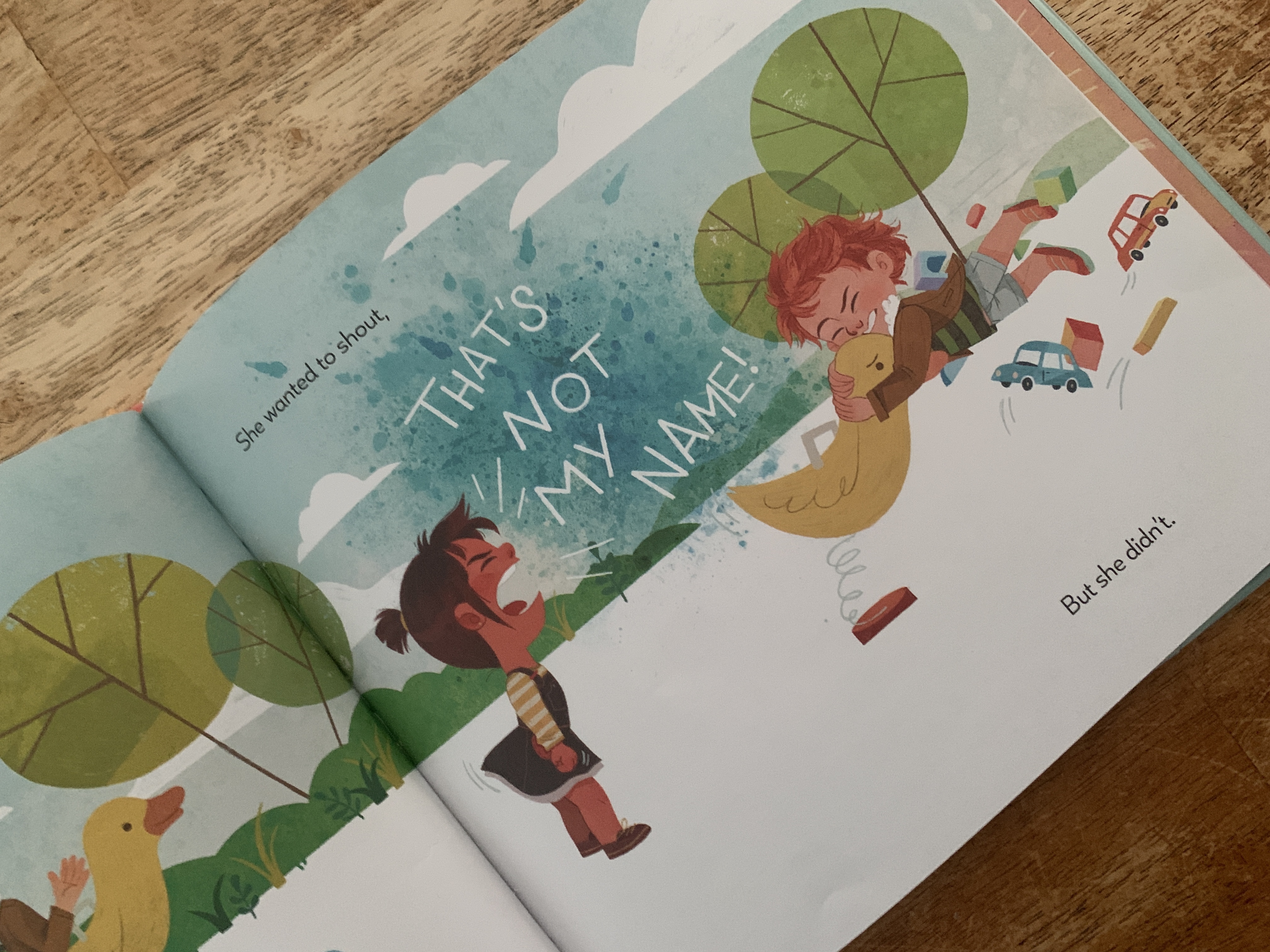
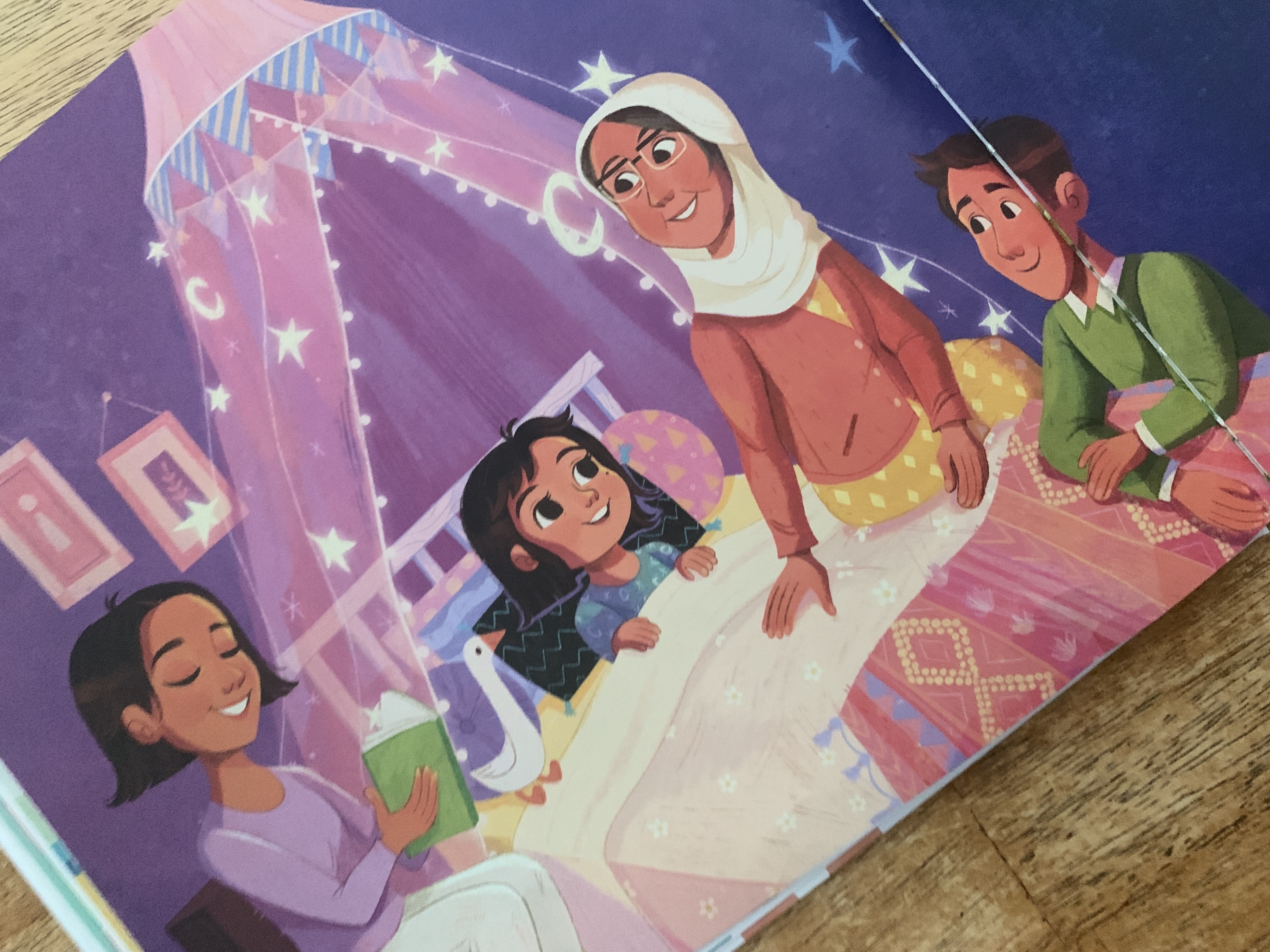
I have been looking forward to this book, as I’ve enjoyed so many of the illustrations the author has created for other authors, and was anxious to see what kind of story she would write for her own authorial debut.  Unfortunately, the book didn’t wow me.  It is rather forgettable, the book conflates notions of not being able to pronounce someone’s name with not being memorable and with not having a “normal” name, and then recognizing how so many classmates have unique names too.  A bit scattered in messaging, and overall reading like an adult talking, not a young girl of four or five, on her first day of school.  No doubt the illustrations are beautiful, and the book isn’t “bad” or a “waste of time,” but it isn’t a strong clear story.  I’ve seen reviews where people find the little girl rude, and I don’t know that I’d agree with that, she is frustrated and wants to scream, “that’s not my name” when people say it wrong, but I do agree that she could model what to say better and how to handle it.  Not that I expect those with uncommon names to have to carry the weight of making things easy, but the little girl at the end remarks that she has so many new friends at school with “unique, beautiful names, and she always makes sure she says them right,” implying that some dialogue, both about her name and about theirs, takes place to ensure pronunciation is correct, and some “showing” of how that is achieved would be nice.  Before the story starts, on the title page, there is a pronunciation breakdown of Mirha, but not in the text itself. There is nothing Islamic in the book, the Grandmother wears a scarf loosely draped over her head, there is a crescent and moon wall hanging in an illustration, and the girl’s name is claimed to be Arabic in origin.

img_2433

The book starts with it being Mirha’s first day of school.  She is excited to learn, to play, and to make friends, but when no one seems to be able to say her name, she starts to feel shy. Frustrated and sad she decides to change her name, and tells her mom when she gets home.  Her mother tells her, her name is beautiful and why she was named what she is named.  She builds her up and the next day armed with her mother’s words she is ready to make friends and teach them how to say her name. By the end of the book Mirha has friends, and wants to be your (the reader’s) friend too.

img_2434

The voice of the book is inconsistent at times it feels very older kid, almost adult, even though the 40 page book is meant for three to five year olds.  The examples read like an adult reflecting on their childhood struggles with their name, not as a young girl finding her voice and appreciation for the name she has.

img_2435

When Hayden asks if he can call her Maya instead of Mirha it is because Maya is easier.  Kids are hearing all sorts of names for the first time when they enter school, that conversation seems so forced.  Whether the kids are in preschool or daycare or kindergarten, most of the names they are hearing of their classmates are being heard for the first time.  If they watch a lot of tv and YouTube and movies, they have heard a whole variety of names, they are not going to have a dialogue that sounds like that, at that age, just not realistic.  Similarly after the first day of school she wants to change her name to something “normal?” What is a “normal” name even, then the mom even reinforces that notion when saying she knows she named her something “unique and different.”  A concept that returns at the end when asserting that Mirha has friends with lots of unique names.  Seems to go in circles.

img_2436

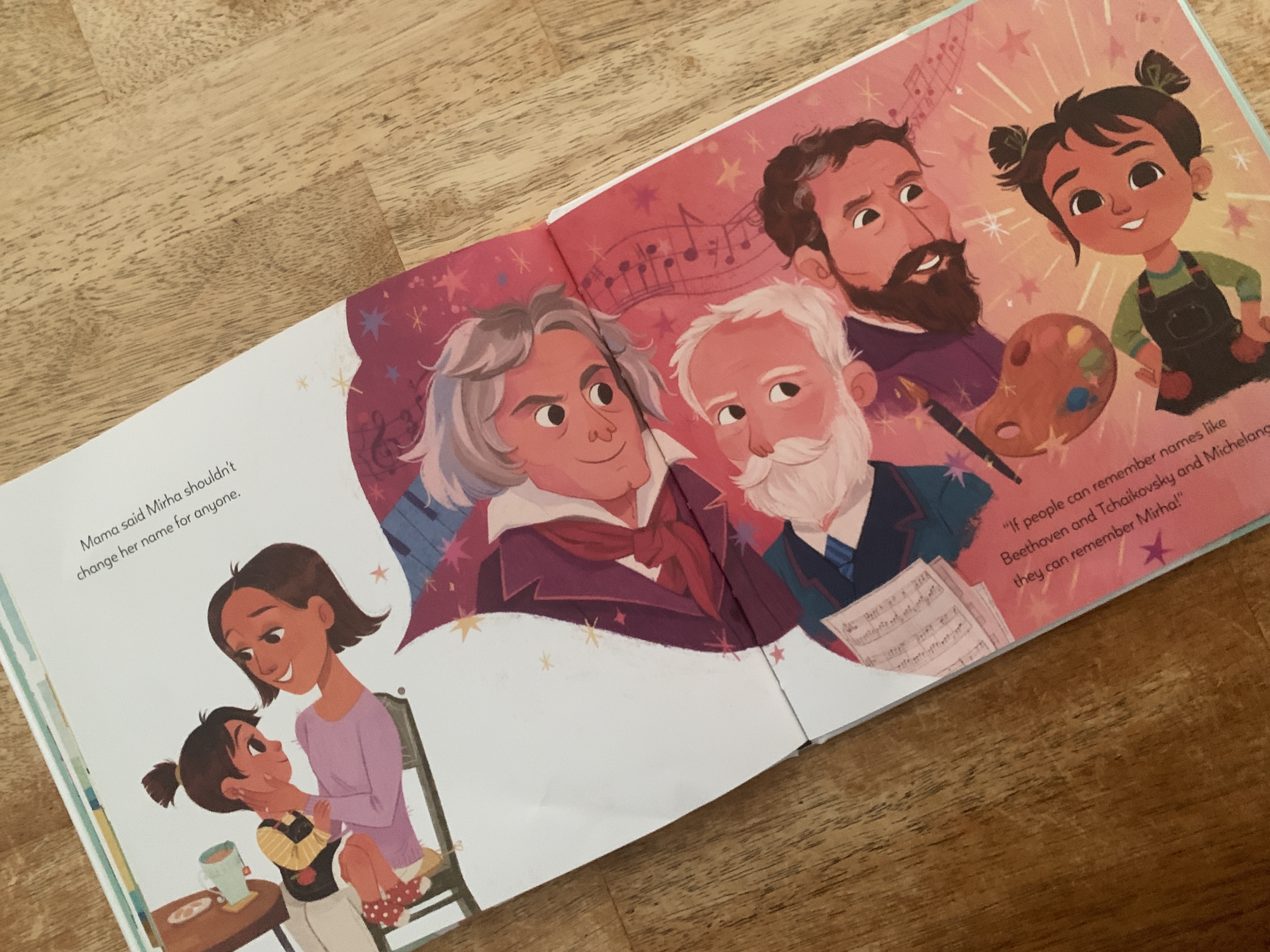
I appreciate that examples are given about not seeing your name on keychains or having the barista get it right, but again, she is under the age of five, are these really her points of reference for having a less common name than those around her?  When her mother is making the case that she shouldn’t change her name she references that names such as Beethoven and Tchaikovsky and Michelangelo are memorable.  First of all, what (under) five year old knows those names or who those people are, and second of all, now her name is not memorable? I thought it was hard to pronounce? Has she done something worthy of history books and admiration? I get what the author is trying to do, I often tell my students that they need to demand people say their names right.  If they can rattle off names from Pokemon, Star Wars, Lord of the Rings, and Beyblades, they can say the beautiful names they have been given.  But the kids I am saying it to are not in preschool, nor am I conflating the pronunciation of their names with being names of famous people that are memorable. Additionally, I do not speak Arabic, but a quick Google search does not show that Mirha means happiness in Arabic, and I have heard from native Arab speakers that they also found the meaning off.

img_2437

The illustrations are engaging, the broader message of getting people’s name right and demanding people get your name right is important, it just needed a more age aligning voice and connecting with the reader.

img_2438

Bhai for Now by Maleeha Siddiqui

Standard
Bhai for Now by Maleeha Siddiqui

bhai

We tend to love people and books that do things first, for good reason, they raise the bar, set the standard, and pave the way for all those that come after.  And no, this is not the first middle grade traditionally published book to have Muslim characters having a completely non-Islamic-identity-centered plot, BUT it might just be the best one I’ve read.  The amount of Islam woven into the characters and storyline is absolutely incredible and seamless. The writing quality keeping dual male point of views separate, engaging, and unique without judgement, is nearly flawless.  The emotional connection of the writing and characters and plot had me both laughing out loud and crying unapologetically within the span of the 276 pages of the book.  This book is a treat for the readers and everyone eight and up I’m quite nearly certain will enjoy this Muslim authored, unapologetically Muslim approach about two 8th grade strangers realizing they are twin brothers and getting to know each other.

SYNOPSIS:

Shaheer lives with his dad and paternal grandfather.  They are well-to-do with his father being an ER physician, but they move around a lot, and never stay in one place long enough to make friends, unpack boxes, or feel like they have a home.  Ashar has lived in Virginia since he was four.  He and his mom recently moved out of living with her brother and his family, but they are next door so even though money is often tight, family and love are always present.

The first day of eighth grade finds the two boys at the same school, staring at each other and wondering how they can maybe find the pieces of themselves that have always been missing. The idea is good, but the reality is complicated.  Ashar and Shaheer’s parents have refused to even acknowledge each other to the boys over the years, extended family plays along, and the boys have to decide if they can even forgive their parents for doing this to them.  Throw in a cousin who knows the boys are switching places, hockey practices, a masjid remodel, and the ever looming threat that Shaheer will be moving yet again and the stage is set for a lot of laughs, tears, and characters that won’t be forgotten anytime soon.

WHY I LIKE IT:

The retelling of “The Parent Trap” is not predictable, nor does it talk down to the reader and tie everything up in a nice unrealistic bow.  There are twists and disappointment and hope and joy, not just for the characters, but for the readers as well.  The side characters are even fleshed out and memorable, not just as foils for the protagonists (I loved cousin Zohra), but as characters with a vested interest in how it all plays out.  I was surprised how clearly different the characters are, even when imitating one another and how nuanced their differences are.  They are not simply opposites: one is not good the other bad, one outgoing one an introvert, rather they are just different, as any two siblings undoubtedly would be.

I absolutely love how Islam is so much a part of the story, a part of the characters, a part of the details, but is not the whole story.  There is no Islamophobia, internal or external, there is no religious othering, it is masterfully done and Muslims and non Muslims alike will benefit from the real tangible expression, growth, and presentation of faith for the characters.

Similarly, culture is presented as a part of the characters in various forms without overly explaining or white centering.  This is who the characters are and their present predicament, as crazy as it is, could happen to anyone, of any culture or of any faith, the two are not corollary. But because it is happening to Ashar and Shaheer, the reader is brought into their world where salat/namaz, athan, mosques, hockey, entrance exams, volunteer work, finances, naan, pineapple on pizza, donuts, and nihari are all present and all unapologized for.  Well, except for the pineapple on pizza.

The best part of it all, is that it is also clean.

FLAGS:

Nothing an eight year old can’t handle, but there is deception as they imitate each other, parental arguing.  There is mention of Shaheer putting his headphones on and listening to music. Zohra plays flute in the band and it mentions when she has practice or that the family all goes and supports her. Male cousins and female cousins interact with each other freely.

TOOLS FOR LEADING THE DISCUSSION:

If my middle school book club is mostly 6th graders in the fall, I think I will feature this book as soon as it is released on October 4th.  Even if it is a bit below “reading level” the writing is engaging and I don’t think even the most cynical book club member will be sorry they spent time with this book.  It would be a quick read for them, but an enjoyable one for sure.

It can be preordered here on Amazon

As Long As the Lemon Trees Grow by Zoulfa Katouh

Standard
As Long As the Lemon Trees Grow by Zoulfa Katouh

as-long-as-the-lemon-trees-grow

Anything I write about this YA book will fail miserably in conveying how powerful, beautiful, lingering, moving, emotional, and overall masterfully written every one of the 432 pages are; it just might be my favorite book of the year.  I do know that this will be my new standard for Muslim OWN voice stories, as the authenticity was absolutely engulfing, I’m not Syrian and I could feel it and naturally, I also verified it.  There is no pandering to a western gaze, the story and characters pull you in and show you Syria from the ground, there is no telling, there is no lecturing, it is mesmerizing storytelling at its finest.  The book has mental health issues, war, and a sweet “halal” romance, that I think upper YA, 16 plus, can handle and appreciate.  I hope every adult will spend time with this book, it truly is incredibly well done, alhumdulillah.

SYNOPSIS:

Homs is under the protection of the Free Syrian Army, but that isn’t enough to keep pharmacy student Salama and her family safe.  Her mother is killed, her father and brother taken, and so she moves in with her best friend Layla, her pregnant sister-in-law, her only family left.  Working as a doctor in the hospital where anyone remaining is given responsibilities far above their skill level, education, and experience- every day is a struggle to survive.

Haunted by the physical manifestation of her fear, “Khawf,” who urges her to fulfill her promise to her brother of keeping Layla safe and getting them out of the country, Salama at eighteen years old has to find a way.

Before all the pieces come together to escape, a boy enters the picture, Kenan, who gives Salama hope, who distracts her from the death and destruction that has consumed their lives.  A boy unwilling to leave his beloved homeland.

WHY I LIKE IT:

I’m a crier, but this book brought out ugly angry tears, shocked tears, heartbroken tears, sentimental tears, you get the point, this book held me in its grasps and never let go. I.COULDN’T. PUT. IT. DOWN. If this is the author’s debut novel I can’t even fathom what is yet to come.

I love that the characters are Muslim, and that they pray together, that they plead with Allah (swt) and meet at the mosque.  It is who they are, it is not up for debate or in need of explanation, it is what it is and it is not anything to discuss.  The parts where a character pleads with Allah for death over being taken, absolutely wrecked me.  Just as efforts to keep everything halal between Salama and Kenan made me beam.  (If I’m completely honesty, I did on occasion get frustrated, I mean come on they are being shot at, bombed, nearly sexually assaulted, scoop her up in your arms and console, her, I know haram, but it is fiction and I was invested, and there is a war.  Thankfully, I am not an author and she kept it all clean and her characters much stronger and mindful of the shortness of this world.)

I love that there are political voices, but that it isn’t a political book trying to give back story to the conflict.  In so many ways the news has failed to keep a light shining on Syria and books such as this, remind those of us outside Syria without strong connections to the land, that the conflict is still raging.  If this was a journalistic article it would be a human interest piece, it is character driven.  Readers see themselves in the characters that live lives that most of us of privilege could never imagine, yet here we are spellbound by the characters, their choices, their dreams, and their safety.  This book shows the power of fiction in opening our eyes to the horrors that are happening in our time, by giving us a face and a character to care so deeply about, that we are spurred to action and determined to not remain apathetic.

FLAGS:

Death, torture, physical abuse, sexual assault, fear, loss, coercion, war, murder, torture, child abuse, crimes against humanity, starvation, mental health, PTSD.

TOOLS FOR LEADING THE DISCUSSION:

I would love to use this book in a high school book club.  The story and themes of the book would open themselves up to discussion so effortlessly and the beauty of the writing would be a gift to share with students.