The Most Exciting Eid by Zeba Talkhani illustrated by Abeeha Tariq

Standard
The Most Exciting Eid by Zeba Talkhani illustrated by Abeeha Tariq

the most exciting eid

I was really excited for this book, I even contacted Scholastic USA and the author to see how we could get it here in America, but once I received my copy from the UK, I was disappointed.  It offers nothing new to the available Eid titles aside from the pretty illustrations. It is a rather forgettable story, with nothing more than surface level growth, predictable emotion, and a formulaic retelling of a basic Eid day.  Meant for preschoolers (3-4 year olds) the story will suffice as an introduction to Eid and reinforce the importance of sharing with others, but anyone older will find the story lacking unfortunately, and question why they didn’t go for Eid salat, if the cousin was even upset about not getting to ride Safa’s new bike, if the neighbors are poor and needy, and if they have gifts for neighbors or are just giving out random leftovers. Five years ago when reasonably priced brother sister duo books celebrating Eid were popping up everywhere, this book would have warranted excitement of representation and Eid joy, but the quality has elevated and while there might not be anything “wrong” with the book, it still feels like it sadly falls short.

img_8977

Safa and her parents see the new moon and that means it is Eid.  She is so excited as her mom puts henna on her like every year, and her dad brings out the box of decorations.  At night she is anticipating presents, gifts, new clothes and food that she can hardly sleep.

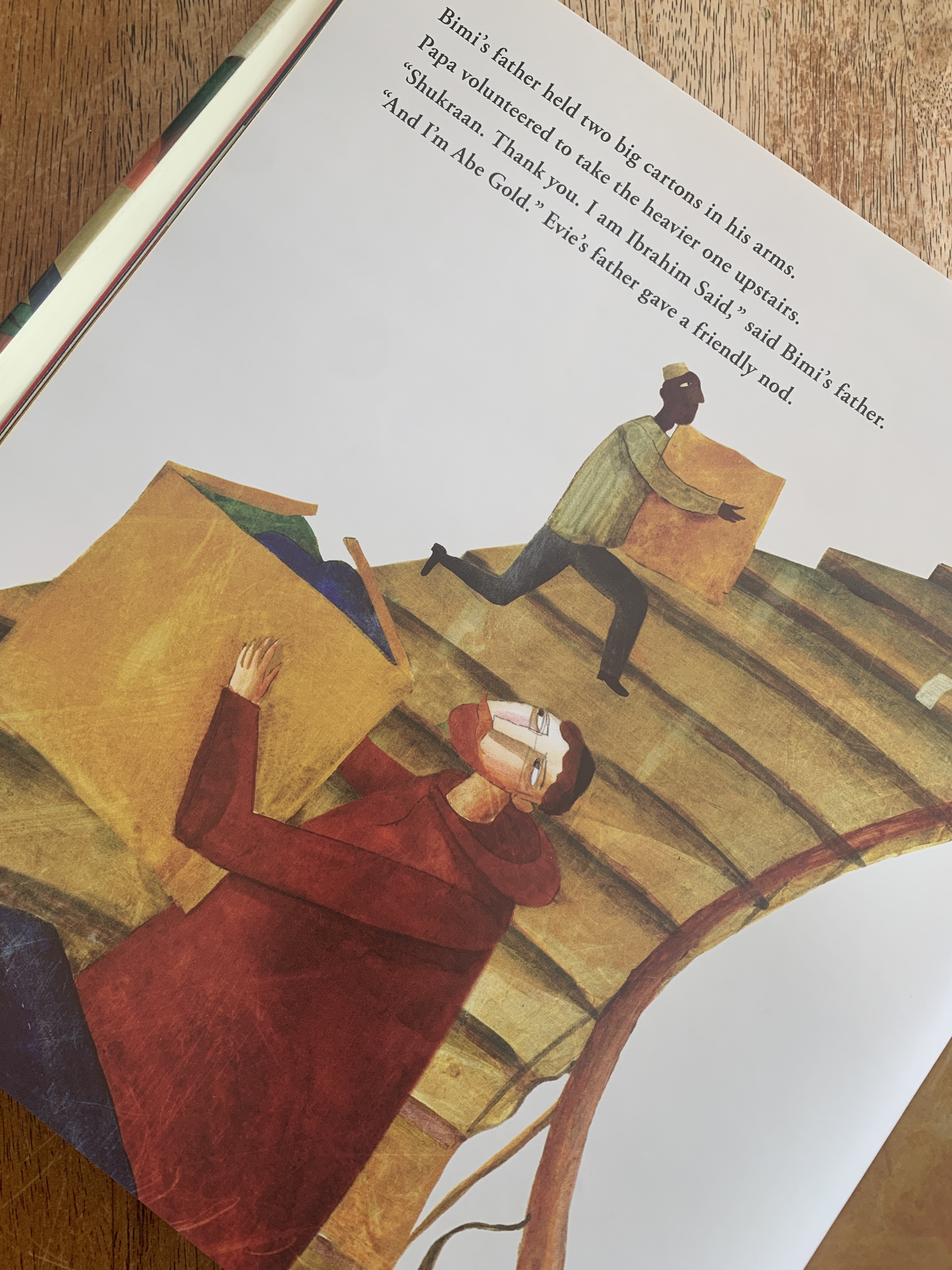
The next morning she comes down in new clothes, prays, asks Allah for a new doll, a colouring pencil set and a bicycle.  Guests come over, even Alissa her cousin. She opens her presents revealing she got everything she asked for.  Alissa calls after Safa, but Safa doesn’t want to share, she’s been waiting for this bike forever. Since sharing is the point of the story, it is worth noting that Alissa in the text shouts after her and in the illustration is shown to be calling out, there is no reinforcement that Alissa even wants to ride the bike.  I suppose I’m glad that Safa feels it, and regrets it later, but it is subtle and I don’t know that a 4 year old will even register that, that is implied.

img_8978

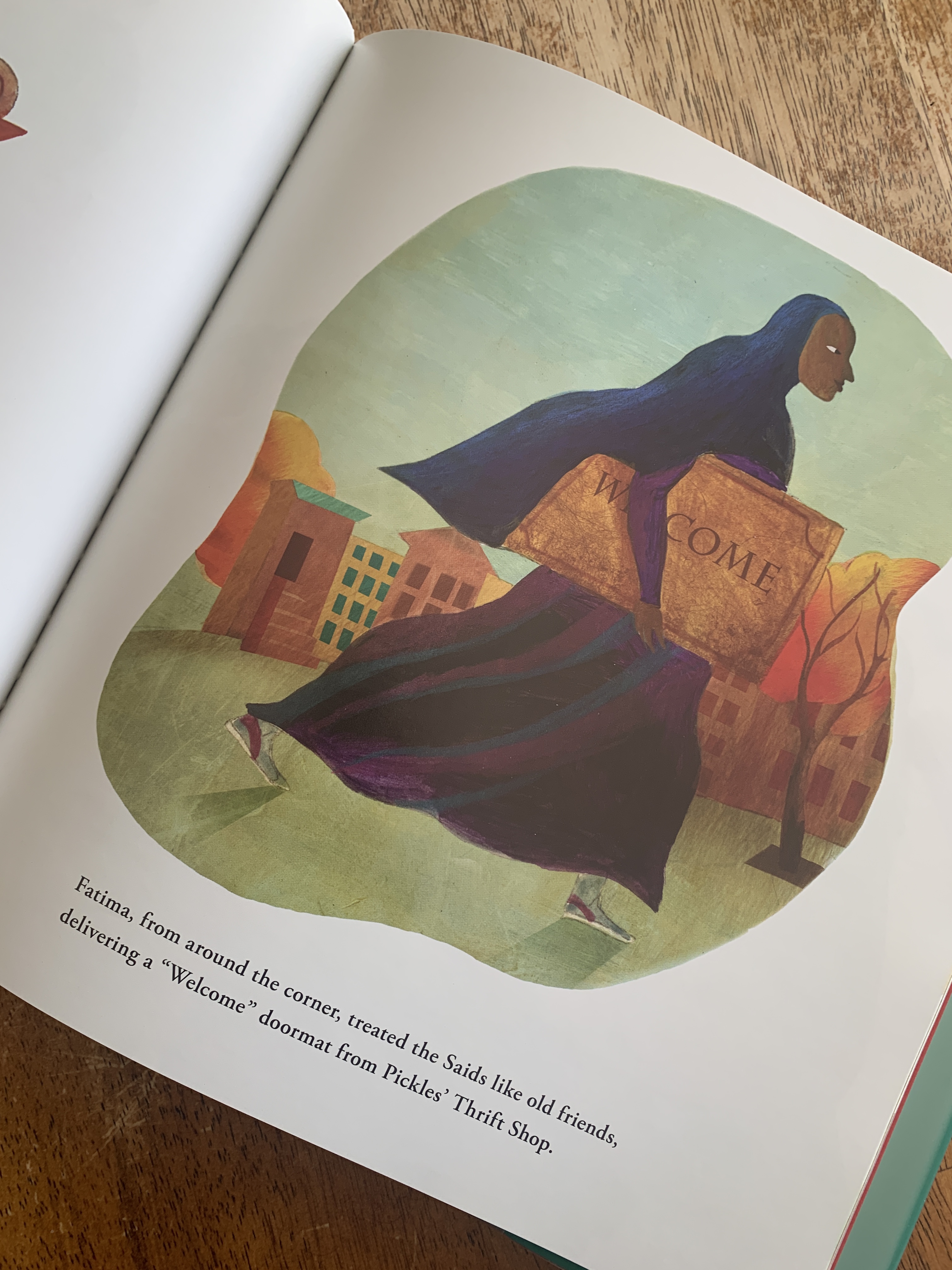
Mom then calls to Safa while carrying two huge purple bags to come with her to share joy and food with those in need.  Safa adds some of the treats she has received in to the big purple bags and they hand the items out to their neighbors. I love that they are visiting their neighbors and it brings the giver and receiver joy, but the set-up is that neighbors and those in need are one in the same, and I think that is conflating two different things.

Some neighbors get small gifts, one a potted plant, another homemade looking food, and then there is one bag left, somehow the purple huge garbage bag sized bags have shrunk to being a shopping bag size and the next recipient is a surprise: grandparents.

img_8979

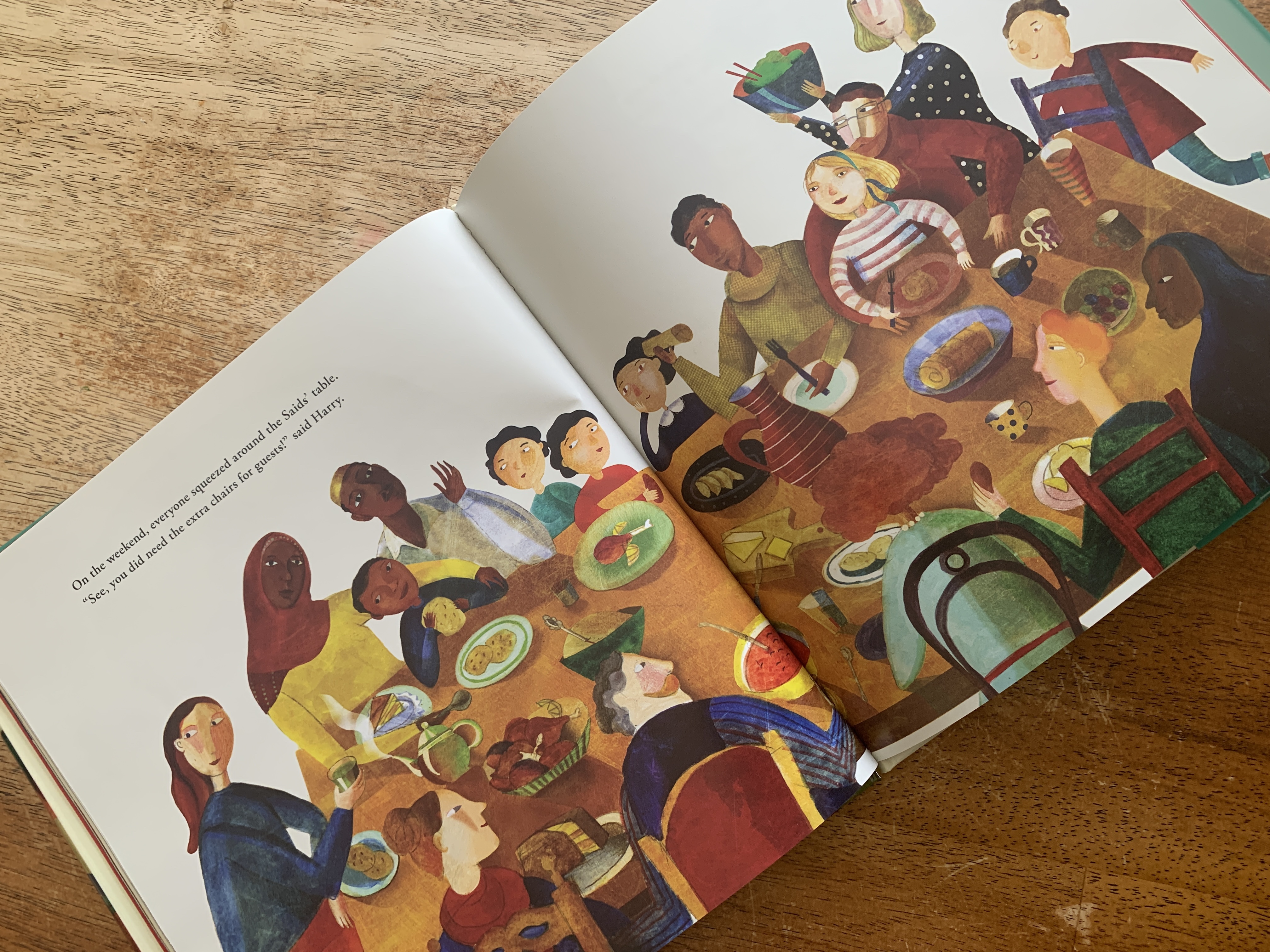
The mom and daughter join the grandparents for desi cultural foods of samosas, kebabs, biryani.  Dad does not join them, and I’m not sure why the grandparents didn’t come to the party at Safa’s house? I also wondered if the party at the house was still happening, because once Safa realizes she enjoyed sharing, her parents and Alissa are seen outdoors, with the little girls on bikes and Alissa asking her cousin where she went.

There is a two page spread glossary at the end which defines words that are not in the text, but is informative.  It mixes “cultural” words such as Allah Hafiz being defined as being a common way among Muslims to say goodbye, which technically isn’t wrong, but it is an Urdu word and only used by Desis.  It isn’t in the story, so it seems off to me as well.

img_8980

The illustrations are the highlight in the book.  They are vibrant, expressive and engaging.  The mom seems to have a dupatta on her head, it might pass for hijab, but she has wavy tendrils showing on the side, even the grandma shows much of the top of her hair.  Neither the father in the story or grandfather have beards.

My Dad is Always Working by Hafsah Dabiri illustrated by Arwa Salameh

Standard
My Dad is Always Working by Hafsah Dabiri illustrated by Arwa Salameh

This sweet 26 page story addresses a universal feeling with Islamic flavor.  The Black Muslim family in the illustrations is adorable, the sprinkling in of Islamic terms is lovely, and the concept of dad working unseen for the benefit of his child is touching, (I hope a Mom book is forthcoming).  The text size changing for no reason bothered me though, as did some of the wordiness and possible contradictions.  Ultimately the story will resonate with many children and mirror a common feeling that is not often addressed for young children, and I’m glad I have it on my bookshelf.

The book starts with Abdullah waking up for class and noticing his clothes laid out on his bed, and his dad with a dirty shirt rushing off to work.  He misses his dad and muses that his dad is “always working,” As he eats his favorite strawberry and chocolate pancakes.  He then jumps on his bike with his clean cleats and heads off to Sunday class with his friend Khalid.

In class they learn about “JazakhAllah Khair,” and homework is to make a card for a person who deserves our thanks.  When Abdullah’s mom, not dad, picks him up he decides to make a card for his mom who has woken him up, set out his clothes, made him breakfast and picked him up for class.

At dinner however, when he discusses class with his mom and the homework the mualimah has assigned, Abdullah’s mom shares with him all that his dad has done and Abdullah reconsiders why his dad is “always working.”

I don’t quite get why the next night when dad is cooking the food is burned, nor am I sure why it said Arabic school, when it seems it is Islamic school, or why he rode his bike to class but then his mom picks him up.  I do like that in the praising of the dad, the mom is not diminished, but rather both are elevated.  An important book, but as I often say, I just wish it was edited better, or more.   It has a lot of potential, the story idea is great, but the writing isn’t polished and it makes it hard to share repeatedly or with a wider audience because of it.

Purchased at Crescent Moon Store also available on Amazon

A Show for Two by Tashie Bhuiyan

Standard
A Show for Two by Tashie Bhuiyan

a show for two

I didn’t love the author’s debut novel, but wanted to see what a second novel would offer, and sadly it really is a lot of the same: light funny romcom surface story featuring a Bangladeshi Muslim character lead mixed in with layers of mental health, a toxic family, high school stress, and cultural expectations driving the plot.  There is crude language, hetero, lesbian, bi, and pansexual relationships discussed, but nothing more than kissing is detailed in any of the scenes.  There is a lot of cultural trauma from the parents and to the book’s credit, it does establish pretty early on that the main character is not religious, but that she does believe in Allah swt.  Similarly, there is a Bangladeshi loving family in the story, so it is not making a critique on the entire culture, it is just the character’s family that is cruel.  Ultimately, at 416 pages I was surprised that there were gaps in character arcs and plot.  I never really liked the protagonist, Mina, but because of how underdeveloped and pivotal the best friend and younger sister were, when it all came to a climax, I found myself rooting for her, which is a very shallow reasoning in an OWN voice book. Additionally, the parents are terrible, and had I dnf-ed it (I was tempted until about 30% through it) I doubt I would have ever known that there was a time that they weren’t terrors.  The peeling back of the layers of the family came too late, too slow, and the progression was muddled.  I probably will not actively seek out further books from this author if the same themes and tropes are present, if she changes it up, I probably could be persuaded.  The book is marketed 7th grade and up, but with the triggers, hate, language, content, genre, language, length I would say 17 and up, if at all.

SYNOPSIS:
Samina “Mina” Rahman is waiting to leave New York and her hateful parents, and start her life at USC as a film student.  All she needs to do is win the Golden Ivy Film Competition, and get excepted to USC.  Her parents dismissing her dreams, passions, and abilities agree to only let her leave if she wins the competition, doubting that it would ever happen, they even put it in writing.  Co-president of the high school film club and best friend, Rosie is equally determined to win, there is just one big problem, every year the winning film has a cameo by a famous actor.  Cue accidental meeting of Mina and Emmitt Ramos, up and coming indie movie heart throb that is cast in the new Firebrand blockbuster.  Sent to Mina’s high school to research for his upcoming role, Mina is tasked with convincing him to make an appearance in their film.  It is a romance story, so you can see where it is headed in this enemies to lovers book.

As family, friends, and college admission stresses mount, the simplicity of what Mina wants and how to go about getting it will be called in to question as her walls crumble and she will have to evaluate people in her life and how they will be affected by her actions.

WHY I LIKE IT:

I like that the story is based on real events in the author’s life, not just the religion, culture, mental health threads, but that an actor came to her high school in preparation for a part: Tom Holland.  I also like that while her parents don’t value her, she has found a support group of sorts that do.  At times Mina reads a lot older than she is, particularly when she is admonishing the freshman, but at other times she storms off pouting and seems to be very childish.  I vacillate between this being intentional and it being an inconsistency in the writing. The younger sister Anam is painfully written.  She is bold and confrontational, yet at the same time so clingy and needy and all over the place.  At one point I thought she perhaps was suicidal and was braced for a really dark twist in the story, but no it was just Anam being Anam, I suppose, and the stress was never revisited let alone resolved.

I truly dreaded the passages about Mina’s home life and her family, they all were just awful to each other and rather than taking Mina’s side because I was shown, I found myself questioning what I was missing in the before and after dynamic.  It is clear they are wretched, the victim doesn’t need to justify the abuse. The transformation of the family dynamic just felt lacking and in fiction when parts are explored it could have really showed some of the micro aggressions and changes that existed and made the relationship salvageable so that the reader would understand why saving and fixing the family were no longer options.  Generational trauma is real and serious and a little more attention I think could have provided an amazing mirror to readers dealing with similar elements.

If the book was half the length I would assume that details would be glossed over, but this book had room, and I don’t understand why so few photography and director references seem to find their way into the text to show that these characters truly are passionate about what they are claiming to desire.  I know the story isn’t a film story or a culture story, but they don’t spend hours editing the film or working on props? Emmitt is regularly pulled away from shoots, but always seems to have enough photos to choose from?  Mina talks of her dad cooking, but foods aren’t detailed, the connection of food to love to family and that being severed seemed like a gaping hole in the crumbling home scenes.  If halal food and no pork can make it into a love relationship, that much cultural/religious depth should have made it inside a families home.

As mentioned in the intro, it didn’t bother me from a religious perspective that Mina was off kissing a boy, that Anam had boyfriends, etc. because Islam was accounted for and the characters are not practicing, so I do appreciate that it didn’t become a stereotypical rebelling against religion book.  Truly, thank you.

FLAGS:

Language, relationships (straight, bi, lesbian, pan), kissing, making out, hand holding, lying, mental health, hate, deception, cruelty, emotional abuse, angry ex boyfriend, triggers.

TOOLS FOR LEADING THE DISCUSSION:
Would not shelve or encourage young readers at our Islamic school to read this.

Lowriders to the Rescue by Cathy Camper illustrated by Raúl Gonzalez III

Standard
Lowriders to the Rescue by Cathy Camper illustrated by Raúl Gonzalez III

lowriders

This is my first Lowriders book, so admittedly there was a lot going on that I really don’t feel confident that I understood, but even with that, it was a sweet story of first love (crush), Arab and Latinx joy, humor, social activism, environmentalism, gentrification, and fun.  I don’t know that the other books in this middle grades series explain the characters or their world any more or less, so I think it can be read as a standalone book, and I think the 140 page detailed illustration filled pages will tempt even the most reluctant readers to give it a try.

SYNOPSIS:

Sokar is an Arab Muslim monarch butterfly, and the fires have taken so many of her family, and cut the survivors off from being able to safely migrate.  She comes to town with a broken wing and in desperate need of help, only to find prejudice against her at every corner, until she meets the Lowriders:  Lupe, Flapjack, and Elirio.  Lupe is an impala, Elirio a mosquito, and Flappy a land octopus with brand new glasses who falls for Sokar at first sight.  Sokar, however, has concerns with the environmental impact the lowrider car has knowing that the fires and pollution are all related.  Add on that the Upscale Business Association gentrifying the neighborhood, and everyone is going to need to work together to save the monarchs, the neighborhood, the environment, and a tender friendship.  As characters find connections between Arab and Latin foods, Arabic and Spanish words, the readers will find similarities from the real world with this crazy one with people, animals, insects, and flying cars.

WHY I LIKE IT:

The author saw my review of Arab Arab All Year Long! and let me know that this book also had Islamic representation, and that I should check it out.  I love that there are Islamic phrases (inshaAllah, salam), a possible hijab on Sokar, connections to Moors of Spain, and Arab culture.  Part of me doesn’t love the love interest, crush thread, but it is between a land octopus and a butterfly and there is only a kiss on the cheek, so, I’m not sure it is that big of a deal.  I love that environmental concerns, discrimination and activism are the heart of the story, yet somehow it doesn’t read preachy.

The similarities of words, foods, and my favorite throwing of a chancla/throwing of a shabashib are all amazing for readers of all backgrounds to see and be made aware of.  I love the teamwork, altruism, and compassion that so many of the characters show, while not sacrificing the humor and quirkiness of it all.

I was a bit concerned with the posters going up everywhere, that seems like a lot of waste and excess, in every other instance they were so mindful: making the car solar powered, reducing plastic in the ocean, etc..

FLAGS:

Racism, discrimination, crush, kiss on the cheek, death, loss, destruction.

TOOLS FOR LEADING THE DISCUSSION:

I don’t think this would work for a full on book club selection, but I think it would be a popular book to give to a kid to read and then chat about it with them when they finish.  The book has a lot to discuss and maybe in small groups it would be a good selection.  I’m hoping to get it in the library when it releases and I’ll come back and report on how it works with reluctant readers, avid readers, and in getting the kids reading, thinking, and laughing.  You can pre-order yours to show support for the author by clicking HERE.

Abdul’s Story by Jamilah Thompkins-Bigelow illustrated by Tiffany Rose

Standard
Abdul’s Story by Jamilah Thompkins-Bigelow illustrated by Tiffany Rose

abduls story

I really don’t know what more you could want from a 40 page brightly illustrated picture book for ages 5 and up.  I felt seen, I got a little emotional, I was inspired, I smiled, I felt compassion and empathy, hope and nervousness.  I was reminded of the power of role models, of getting down on a child’s level, literally.  I was reassured that we all make mistakes, learn differently, and can still thrive. Suffice it to say the book is moving.  The OWN voice lyricism will resonate with children of all colors, but that the messaging is from a Black Muslim boy and is so unapologetic and proud and beautiful, makes the emotions Abdul feels palpable.  Every classroom bookshelf needs this book, every child needs to hear it, read it, and explore the layers contained within.  Alhumdulillah.

img_8766

The book starts out with absolute joy.  Abdul loves to tell stories.  Writing stories, however, is something else.  The letters are tricky, they get turned around, they aren’t straight and crisp like the one’s the barber cuts.   His pages don’t look like the neat lines of his classmates.

He decides that maybe his stories aren’t for books.  It isn’t like he even sees stories like his in books:  stories about the people and places that he knows.

img_8767

Then one day a visitor comes to class, Mr. Muhammad, and he is a writer.  He encourages the children to, “write new stories with new superheroes.”  Abdul tries, but he keeps making mistakes, and then he has to erase, and before long his paper is covered in smudges and holes.

img_8768

Mr. Muhammad encourages Abdul to keep trying and fix the messes later, Abdul has an idea, and with a “bismillah,” he gives it another go.  There is no perfection, there is just determination.  The struggles, success, and support of his peers and Mr. Muhammad, just might change Abdul’s mind about his stories.

img_8769

I love that the book is Black centered and Muslim centered.  There is praying salat, mention of bean pies, a classmate in hijab, and saying of Bismillah.  I’ve read the book seven or so times and it has yet to get old.  The characters burst with personality, even the side ones, that I’m positive it will be a favorite at story time and bedtime alike.

img_8770

Can be purchased at Crescent Moon Store or Amazon

The Button Box by Bridget Hodder & Fawzia Gilani-Williams

Standard
The Button Box by Bridget Hodder & Fawzia Gilani-Williams

img_8336

This 152 page book reads like a historical fiction interfaith Magic Treehouse for middle grades tale, and I thoroughly enjoyed it! I learned about Sephardic Jews, the language of Ladino, Prince Abdur Rahman, and a tiny bit about the Abbasids overthrowing the Ummayads.  I love that it starts with a map and ends with sources, facts about what information is real in the book and what is fiction, and a bit about Muslims and Jews and how to be an ally if you witness prejudice.  The book is co-authored, and in many ways the Jewish narrative does take the majority of the focus, but the Islamic phrases sprinkled in, the Islam practiced by a major character, and the setting, allow for both religions to shine and combine to make a compelling magical time traveling story for third graders (and their parents) and up.

SYNOPSIS:

Cousins Ava and Nadeem are in fifth grade and spend their afternoons afterschool with their Granny Buena.  Granny and Ava are Jewish and Nadeem is Muslim, though they believe differently, they always seem to find more that is the same, and respect is always given.  When they face bullying at school Granny Buena pulls out a crystal box full of buttons and tells the children, and the cat Sheba a tale about their ancestor Ester ibn Evram.  When she stops the story short, the two kids exam the button closer and find themselves back in time tasked with saving Prince Abdur Rahman and getting him from Africa to Spain.  They aren’t sure if that will be enough to get them back to their own time though, but they don’t have time to overthink it because if they fail, the Golden Age of Islam won’t happen, peace won’t come to Muslims, Jews, and Christians in the region, and their Jewish ancestors may face the backlash of helping the Muslim escape.  Along the way, they learn about their own family traditions, beliefs, and gain wisdom to handle their bullying problem at school.

WHY I LIIKE IT:

I love that I learned so much, and from what I could Google and ask about from those more knowledgeable, the facts about the time period and cultures all seem to check out.  Only one passage comparing Jewish belief and the text of the Quran is phrased oddly in my opinion, the rest of the Islamic sprinkling is well done.  There are numerous bismillahs, mashaAllahs, stopping for salat, quoting of the Quran and more.  The narrative is primarily Jewish, but the setting Islamic with athans being called and Salams being given.  The book does have a lot of Jewish detail, but I don’t think it was preachy, and the further uniqueness of Ladino words and culture I think would appeal to all readers no matter how familiar or unfamiliar they are with the two religions.

There are some questions that as an adult reader I wanted to know more about: how Nadeem and his mom are practicing Muslims in a strong Jewish family, how making sure history happened as it happened the first time sent the two kids back…then why were they sent there at all, is there going to be more button adventures, were their two cats or was it the same cat?   Honestly, a lot of the more obvious fantasy plot holes were accounted for and done quickly and simply: how their clothes changed but the button remained, how they could speak the language, how confused their aunt would be when her real niece and nephew arrived, etc.. The writing quality kept it all clear for the reader, and did so without the pacing of the story suffering.

FLAGS:

Near death experience, magic, mention of killing, fear, deception, bullying, fighting, physical altercation, misogynistic assumptions.

TOOLS FOR LEADING THE DISCUSSION:

This would be a great story to share if I return to the classroom. The history, the religions, the storytelling would provide so much to connect to and learn about.  As a book club selection though, it would be too young for our middle school readers and ultimately too short.  I would consider it for a read a loud with fourth and fifth grade.

To Purchase: Here is the Amazon link: https://amzn.to/3D9LyxI

Wiil Waal: A Somali Folktale retold by Kathleen Moriarty illustrated by Amin Amir and Somali translation by Jamal Adam

Standard
Wiil Waal: A Somali Folktale retold by Kathleen Moriarty illustrated by Amin Amir and Somali translation by Jamal Adam

wiil

This bilingual (English and Somali) book tells the folktale of a wise leader challenging the men in his province with a riddle, and it being solved by a poor farmer’s eldest daughter.  Based on a real Sultan from the mid 19th century, the book does not claim the story to be true, and leaves it up to the reader to form their own impression.  The lesson however, is rich with culture, insight, charm, and perhaps surprise.  There is no Islam present or hinted at, but the illustrator’s and translator’s names suggest that they are Muslim as the majority of Somali’s are, and the picture at the back of the book of members of the Somali Book Project show multiple females in hijab- so I’m sharing it on my platform to inshaAllah encourage often rarely seen, in western literature, cultures and traditions to be brought to more peoples’ attention.

The book starts with an author’s note explaining the tradition in East Africa of having a nickname and that Wiil Waal was the naanay of Garad Farah Garad Hirsi, a man who was a sultan for a brief time.  He was known to be a great leader who was brave, and clever, and used riddles to unite people.  Like all folktales though, this doesn’t claim to be a true story, but one filled with wisdom.

img_6966

Long ago Wiil Waal set forth a riddle, “bring me part of one of your sheep.  The sheep’s part should symbolize what can divide people or unite them as one.”  The one who can do so will be honored as a wise man.

img_6968

The men pick different parts to bring to the sultan with little success:  a rib, a liver, a shoulder of meat.  In a distant province a poor farmer who had few sheep and many children half heartedly prepared to slaughter his finest animal to present to Wiil Waal.  His oldest daughter comes to help him, and he tells her the riddle.  They work through it, and she thinks she is certain she knows the answer.

img_6969

Trusting his daughter the farmer presents the sultan with what his daughter recommended.  Quick to see that the farmer is not confident, he asks who solved the riddle and the story of the daughter’s intelligence is conveyed.

The book ends hinting that she is a future leader of Somalia.  And no, I’m not going to tell you the answer.  Go read the book!

img_6972

It’s Springtime! by Rabia Bashir illustrated by Azra Momin

Standard
It’s Springtime! by Rabia Bashir illustrated by Azra Momin

spring time

This sweet 18 page board book introduces seasons to our littlest Muslims through rhyming lines, Islamic gratitude and activities enjoyed during certain times of the year.  It even has a “spot and talk” activity at the back and a way to explain “Alhumdulillah” to children.  The text is simple and the illustrations engaging for ages infant to pre-k.

img_8386

The book starts with spring and dedicates four pages to praising Allah swt by appreciating the flowers and baby animals before looking forward to summer, that is on its way.

img_8387

Summer is also four pages of saying Alhumdulillah for the sunshine, ice cream, the beach, and sandcastles, before heading off to autumn.

img_8388

The book covers all four seasons and mentions that after winter is spring again.  The book’s size and the thickness of the pages makes it great for toting around for little ones, and the flowing lines make it a quick read that you don’t mind reading over and over again, Alhumdulillah.

img_8389

Songs and activities available at www.preciousbees.com

Ali and the Gladiators by Farheen Khan illustrated by Evgeniya Erokhina (Ali Series Book #1)

Standard
Ali and the Gladiators by Farheen Khan illustrated by Evgeniya Erokhina (Ali Series Book #1)

This new early chapter book series from Ruqaya’s Bookshelf comes as a boxed set (Books 1-5), so I wasn’t sure if I should review all of them as a collection, or just the first book.  I don’t typically review additional books in a series, but these books can be read out of order and stand alone just fine.  Ultimately, I’m just going to review the first book, but know the entire series is silly, clean and engaging for ages 7 and up (2nd grade will love these), they will connect with boys, girls, Muslims, non Muslims, and get readers of all ages smiling, if not laughing, at Ali’s outrageous adventures and choices.  Ali is presumably Muslim, the author is Muslim, the publisher is Muslim, but there is nothing religious at all in the text.  Even the one about Eid is very culture framed, not “I’m Muslim and this is what we do and why,” so to speak.  In Ali and the Gladiator there is a friend named Abdullah, his parents are referred to as Mama and Baba, they eat at Moe’s Shawarma Shop, and eat daal and roti at home, so there are hints of culture and religion that will further mirror a Muslim reader’s experience, but the focus is on the hilarious situations that Ali finds himself getting in to and out of with good friends, kindness, enthusiasm, and bravery.  All the books are about 60 pages long with short chapters, detailed pencil style drawings every few pages, inviting text, and an activity at the end.

TODAY (3/25/22) IS THE LAST DAY TO PREORDER AT THE SPECIAL PRICE, and THE BEAUTIFUL BOXED COLLECTION RELEASES APRIL 1st, JUST IN TIME FOR RAMADAN!

SYNOPSIS:

Ali really wants to impress his teacher, Mr. O’Reilly and a big project on Rome will be a great opportunity to do so, but he isn’t anxious to get started.  He has his April Party to prepare for, his friends to hang out with, and plus he knows he works best under pressure.  When he finally realizes he should get started, all the books on Rome are checked out, save a small book on the floor, yes Ali is on the floor in the library.  The book is about how to become a gladiator and that gives Ali an idea.  As his imagination works out the details he is off to his favorite store, the hardware store.  He has weapons to make and actors to train, and beasts to tame.  The assignment is supposed to be written, but Ali is extra and he does not want to be boring.  When he raises his hand to go first in the presentation, Mr. O’Reilly is confused, no one is presenting, they are just handing in their reports, but when gladiators and a “ferocious” cat enter the room, it is clear that Ali has his own way of doing most everything.

img_8157

WHY I LIKE IT:

I love that it is fun and well written.  The characters grow and the writing and descriptions smooth, the illustrations add detail and the books are perfectly silly for their intended audience.  So many books for this demographic resort to brattiness or potty humor, and I love that these are outrageous shenanigans, but they don’t cross into being obnoxious

I do wish there was more Islam in the books, or really any.  It doesn’t need to be Islam centered of preachy, but to add a bit of depth to the characters and flesh out their backgrounds would have been nice.  The desi foods are included, why not mention halal or toss in some inshaAllahs or that Ali gets to work on his weapons after fajr.

I absolutely love the presentation of all five books in a hard glossy case.  They look lovely on a shelf and would make wonderful gifts for Eid, or any time really.

img_8156

FLAGS:

none

img_8155

TOOLS FOR LEADING THE DISCUSSION:

I hope to have these in our school library, and encourage the 2nd and 3rd grade teacher to look in to having them on their classroom shelves.  Kids will be tempted to pick them up off the shelf, they will thumb through them and be drawn in, inshaAllah once they read one, they will read the whole series, and if that isn’t praise for a book series, I don’t know what is. Happy Reading!

ABC’s of Pakistan by Marzieh Abbas illustrated by Michile Khan

Standard
ABC’s of Pakistan by Marzieh Abbas illustrated by Michile Khan

abcs of Pakistan

I absolutely love this ABC book, it truly does Pakistan proud and I’m thrilled that I could obtain it, it wasn’t easy, sorry not sure where you can get it in the USA, and it isn’t available even at Liberty Books in Karachi, but if you can find it, grab a copy, or two because it really is a well done tour of the country.  My only suggestions would be thicker pages, the hardback 8.5 x 11 binding is nice, but the pages seem to have curled in the transporting from overseas.  Also, some pages have a large A or E, but others such as the words for B, C, D, are just all flowing story style over a two page spread.  I don’t mind one way or another, but I do side with consistency, either have the letter on all pages singled out, or on none.  The effort to string the pages together makes it read very much like a story, and I appreciate that it features little snippets of fact and history in talking bubbles throughout.

img_7514

Little Hassan and his cat Makhan introduce themselves and then take you on a tourney of Pakistan.  Included are landmarks, handicrafts, foods, famous people, festivals, sports, and more.  It concludes with a reminder to carry facemasks and hand sanitizers, which might date the book a little in the future, it was published in 2020.

img_7517

The book works for non Pakistani’s to learn, especially those of us with children that have not been to the “homeland,” as well as for Pakistanis in Pakistan to feel proud of their culture, history, tradition, and landmarks.  There are beautiful masjids and the azaan mentioned and hijab wearing and non wearing women, as well as famous men and women included.  It is inclusive on the F for festivals page where it mentions Eid, Basant, Christmas, Diwali, and Children’s Literature Festival.

img_7516

Enjoyable text and illustrations alike. InshaAllah, will be more readily available if we can convince the author and illustrator and publisher that there is demand, I hope, hint hint.  Happy Reading!