Tag Archives: Muslim Characters

Huda and Me by H. Hayek

Standard
Huda and Me by H. Hayek

huda

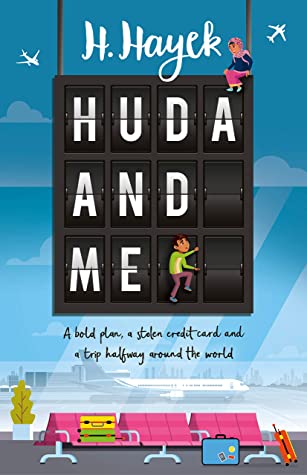
At 194 pages, this book just became required reading for all my children save the two year old.  Meant for middle graders, I absolutely loved this book.  Sure literary siblings often run away and have adventures, think Claudia and Jamie Kincaid from Mixed Up Files, or the sisters in Ticket to India, but this Australian Muslim duo adore each other and are doing it to reach their parents and save their other five siblings from an evil Aunty babysitter.  In some ways the book couldn’t and hopefully wouldn’t really happen, it is plausible however, and the way it is written bouncing back and forth in time until the resolution, and the absolute authenticity of the characters make the book hard to put down and had me laughing out loud.  The book is for everyone, Muslim kids specifically though, will feel an incredible kinship to the Muslim family and relate to the anxiety of making wudu in a public restroom, the shock of having the athan clock tossed in the freezer, the nervous looks between siblings hoping someone else will speak up about what Muslims can’t eat, mistaking a nun for a hijabi, amongst so many other little sprinkled in examples.  The power of OWN voice writing is exemplified and celebrated, and provides a mirror that a large swath of Muslims children, not just Lebanese Australians will benefit from and enjoy.

SYNOPSIS:

There are seven children in the family and when Mum and Dad announce that they have to make an emergency trip to Lebanon, the kids don’t understand why they need Mum’s friend Aunt Amel to stay with them in Australia.  They don’t really even like Aunt Amel, but they don’t really know her either and as their parents leave, they have no choice but to endure until their parents return.  When Aunt Amel assigns them all duties: 17 year old Omar is the 24/7 chauffeur, Kholoud becomes her personal stylist, twins Suha and Layla must keep her supplied with baked goods and tea, Akeal is the butler, Huda is the maid and little Raheed will be glued to her, some of the kids think it could be fun until they realize they are being used to provide Aunt Amel with a holiday in exchange for her staying with them. The kids are required to be up by five in the morning, are not allowed to talk to their parents, and some are even kept from school to provide the services Aunt Amel demands.  The kids grudgingly try to endure, but spunky Huda is pushing back, and with the help of the retired Polish Sleep Doctor next door, a plan is hatched, tickets are booked, and Akeal and Huda are making a run for Beirut. Along the way they will be met with an Islamaphobic teen pulling off Huda’s scarf, a variety of minders keeping track of the unaccompanied minors through airports and plane rides, and baited breath as they have obstacles at every step to find their parents in a country they have never even been to before.

WHY I LIKE IT:

The book is incredibly well written, I sometimes stumble a bit with Australian authored books, but this one was easy and universal in most of the dialogue and vocabulary. I enjoyed what was sprinkled in, and as a privileged American didn’t get lost at any point.  The shifts in the timeline to keep the story fast paced and moving also made the stress of “if they could pull off the escape” a little bit subdued allowing the experience and dialogue and connections along the way to really be enjoyed.  I think it was a smart move to not have it be full steam ahead, gritting your teeth, but more in the moment seeing why they had to do what they did, and how it was panning out for them.

I absolutely love that the family is unapologetically Muslim living in a western environment.  They don’t celebrate birthdays, but they seem ok with make-up, they pray, the mom wears hijab I believe, but I don’t think the sisters do, it really is such a relatable family with their own quirks and tests and they are active and doing their best.  It could be my family or most families I know, well lately my kids bicker a lot, that’s why it is required reading for them, but that is off track.  Back to the book, I was so proud of Akeal sticking up for his little sister wearing a scarf to be dressed up and not backing down from confronting her harasser.  I love the spunkiness but maturity of Huda.  From page one you are cheering them on, and it doesn’t let up.

FLAGS:

Kids scheming and lying and running away, all for good cause mind you.

TOOLS FOR LEADING THE DISCUSSION:

This would be super fun to read aloud to a 3rd or 4th grade class, but I don’t think it would work for a middle school book club, it is just too quick of a read.
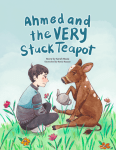
Ahmed and the Very Stuck Teapot by Sarah Musa illustrated by Rania Hassan

Standard
Ahmed and the Very Stuck Teapot by Sarah Musa illustrated by Rania Hassan

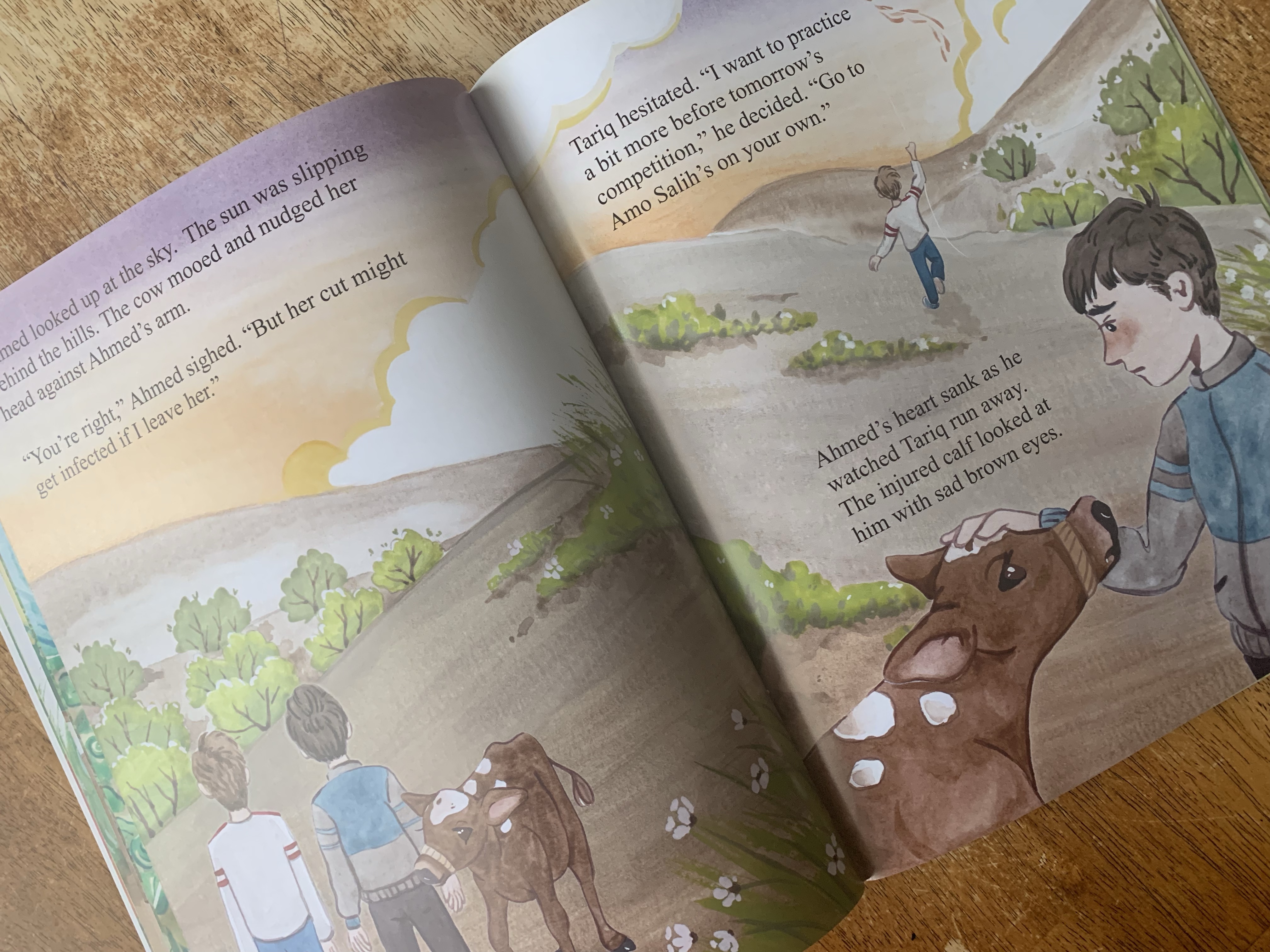
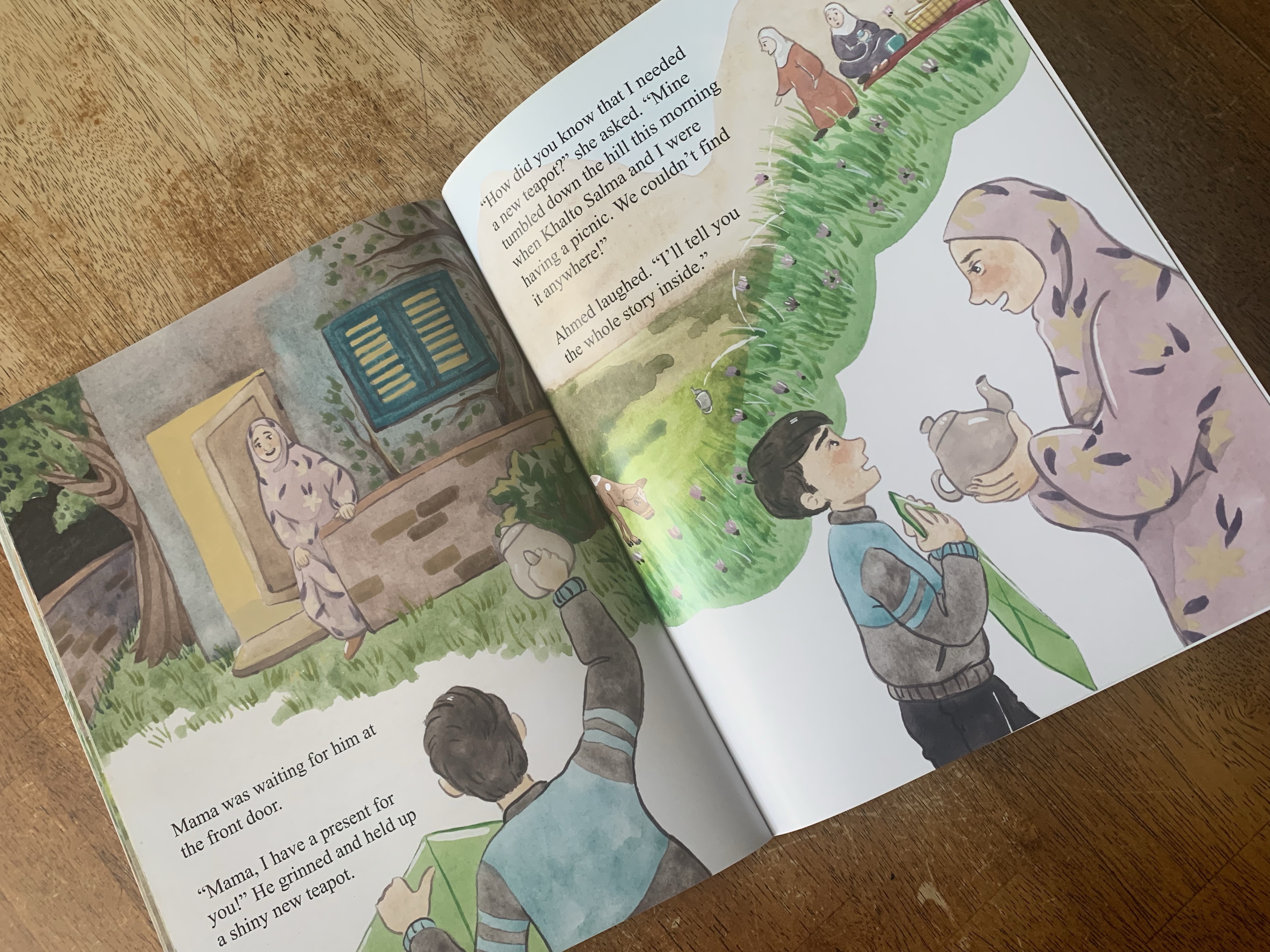
This 36 page early elementary book is packed full of choices and lessons packaged in a sweet story that kids and adults will enjoy reading and discussing over and over. My only real critique is the title. I’ve had this book sitting on my shelf for nearly a year thinking it was just a silly book about a calf with a teapot on her hoof that is stuck and would probably involve different people and methods and attempts to get it off. But the teapot is off by the tenth page, and the story is really just getting started. Like all Ruqaya’s Bookshelf picture books, the large thick shiny pages with a stiff soft cover binding make the story a great choice for storytime and bedtime alike. There are Islamic threads and references, but the story overall is universal.

Ahmed and his friend Tariq are practicing their kite flying skills for tomorrow’s annual competition, when Ahmed’s kite gets destroyed in a tree. Heartbroken Tariq suggests he hurry to buy a new one before the store closes at Maghrib. As the boys rush off they come across a brown calf with a teapot on her hoof. Ahmad recognizes the teapot as his mother’s and feels like he should help the poor animal. Tariq keeps reminding him that the shop will close, but Ahmed decides to take the cow to Amo Waseem’s to get help.

Amo Waseem, is able to help the cow get free, but in the process, the cow get’s hurt. The cow needs help from a shepard, Amo Salih, but Amo Waseem can’t go, and Tariq wants to practice more. Ahmed knows the cow can’t be left untreated, and takes the little cow to get help. The cow then needs to get to his owner, and the story continues until the shop is closed, and Ahmed realizes he won’t have a kite for the competition. He goes to the mosque for salat and starts to feel better, he knows that he did the right thing, and inshaAllah Allah will reward him in some other way. His reward comes quickly, however, much to Ahmed’s surprise and in gratitude he also manages to find a way to help his mother.

I love the gentleness of the lessons of doing what needs to be done, even when you don’t really want to, and your friends are not supporting you. Ahmed had chances to walk away, but he didn’t and he was at peace with the outcome. His friend wasn’t mean or bad, he just made different choices. There are discussion questions at the end as well. I think this book would foster great conversation with even the littlest listeners, and I can’t wait to share it at our masjid’s storytime.

Talaal and the Whispering Worrier by Shereeza Boodhoo illustrated by Khalif Koleoso

Standard
Talaal and the Whispering Worrier by Shereeza Boodhoo illustrated by Khalif Koleoso

talaal

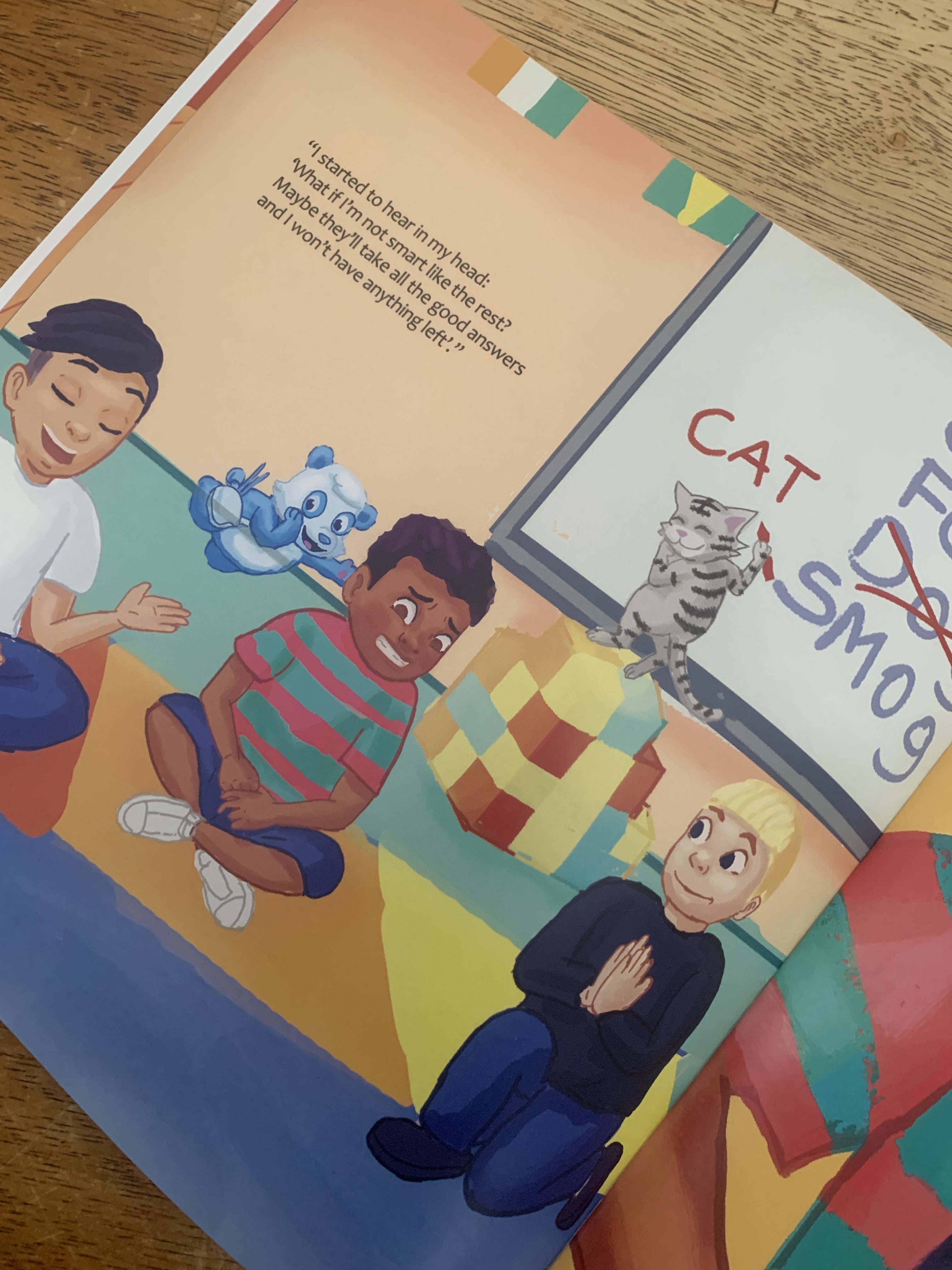
This 38 page book addresses anxiety and self confidence with Islamic tips and tools to help kids cope and feel less alone in their struggles.  The rhyming text on some pages is flawless, and elsewhere falters and distracts from the text.  Similarly, the panda that personifies the “Whispering Worrier” is at times a compliment to the story, and at other times seems to muddle the seriousness being discussed (I don’t understand the ever-present watering can).  The book is long and the text small, but overall the message is good and presentation sufficient.  Books like this by qualified professionals are incredibly valuable and important.  The use of Quran and trust in Allah swt to feel confident and at ease is something we need to share with our young ones early, often, and regularly. 

img_2530

Talaal comes home from school and declares that he feels sick and is not going back to school.  His parents can’t seem to find anything wrong and send him to go do his homework.  He passes his older sister who is praying and seems so relaxed, when she is done she comes and talks to him.  He explains how he felt when the teacher asked them to share and how the fear and nerves felt like his heart was being beat on.  She reassures him that she feels the same way at times and that a Whispering Worrier whispers unhelpful thoughts to tear us down.

img_2531

She suggests countering the negative thoughts with helpful positive ones.  She also suggests reciting Qur’an.  She then has him practice some ayats.  He recites the begining of Surah Ikhlas, and starts to feel better.  Talaal excitedly goes to tell his parents what is going on, and the suggestions his sister has given him for coping and overcoming his stresses.  They let him know that they too get nervous.  His mom, goes a bit off topic and explains various wonders that Allah swt has created and they reassure Talaal that he too is beautifully made.  Talaal starts practicing and finds over time, in different situations, he starts to calm his Whispering Worrier.

img_2533

I like that the advice is rooted in Islamic concepts and that his sister, not an adult, is who coaches him and guides him, making it seem normal and not a punishment.  I like that it isn’t an instant fix, but something to work out and be consistent with over time.  The end has a note to caregivers and some tips.  I think reading the book and having discussions is the first step and inshaAllah if your child or student is struggling that professional help will be sought, so that children don’t have to suffer needlessly.  

img_2534

I read this to a group of early elementary students to try and normalize the topic and encourage them to talk to a parent or teacher if they felt similar to Talaal.  Unfortunately, the book had a hard time keeping their attention and I think, in retrospect, it might be a better selection for smaller groups or one-on-one so that discussion and feedback can safely occur.

img_2539

The Colours of My Eid: Memories of Hajj and Eid al-Adha by Suzanne Muir illustrated by Azra Momin

Standard
The Colours of My Eid: Memories of Hajj and Eid al-Adha by Suzanne Muir illustrated by Azra Momin


colour


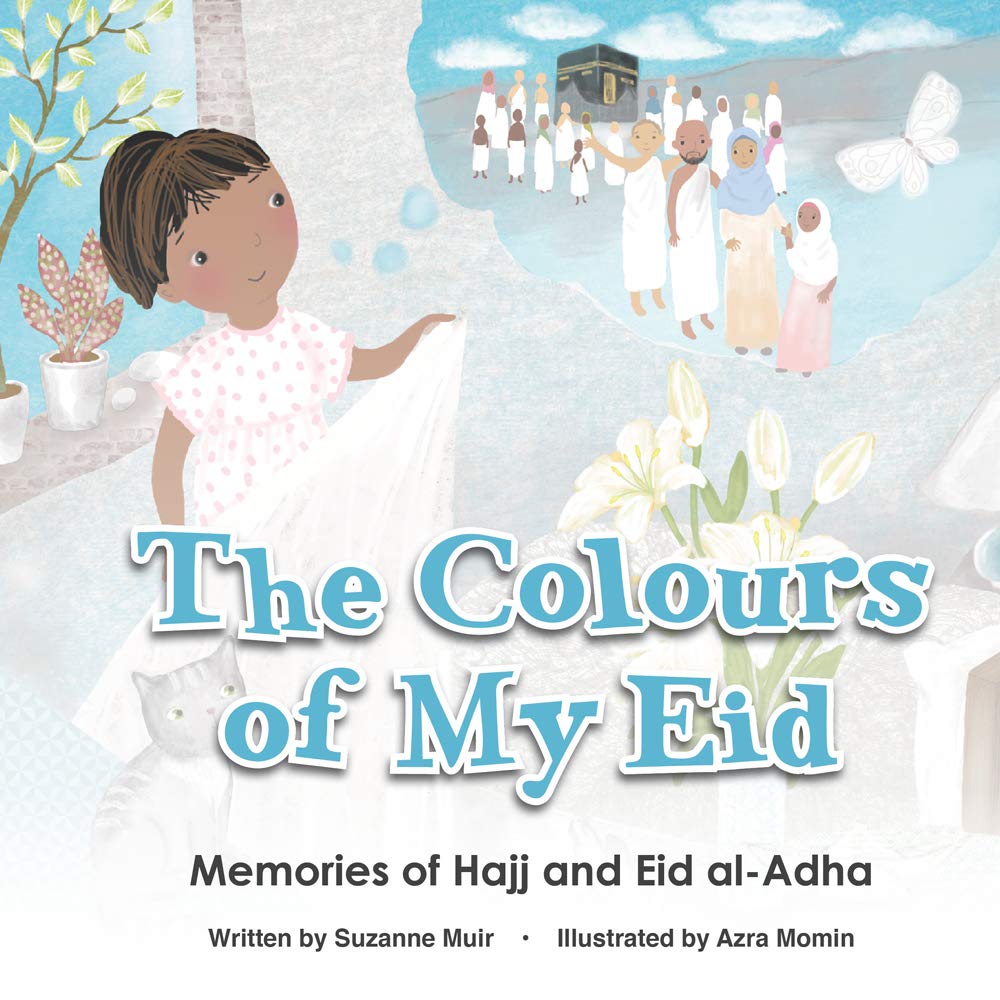
At 18 pages, this 8 x 8 book focused around colors contains a lot more information than what initially meets your eyes.  The warm beautiful, full page pictures fall opposite a highlighted color and a description of that color in the child’s world that reminds the characters of their time at Hajj or celebrating Eid al-Adha.  On each of the fun text pages is a light green text box at the bottom with factual information that older children or adults will benefit from and be able to share with younger listeners.  The main text is ideal for toddlers and up, and older kids up to 3rd grade will benefit from the nonfiction highlights that can educate or remind Muslims and non Muslims alike, about the importance of Hajj and Eid al-Adha.  

The book starts with an introduction about the Islamic language and perspective used, and clarifies that the colours emphasized are to help visualize the point being made, it also gives information about Eid al-Adha.

The colors highlighted are: white, black, brown, green, grey, yellow, and purple.  The large simple text takes something relatable such as the monkey bars, or balloons, or the sky and corresponds it to a memory of Arafat, or ihram, or the hills of Safa and Marwa.

The nonfiction text gives specific dimensions of the Ka’aba, the story of Hajar and baby Ismail, the requirement of Hajj and some of the steps.  There is a lot of information conveyed which at times is incredibly detailed, and sometimes, rather vague and generic, i.e. Tawaf is when Muslim pilgrims circle the Ka’aba as part of the Hajj rituals. Overall, this little book packs a punch, and I was equally impressed at how it held my five year old’s attention with the colors, and my interest with the facts detailed below.


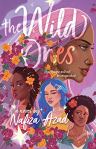
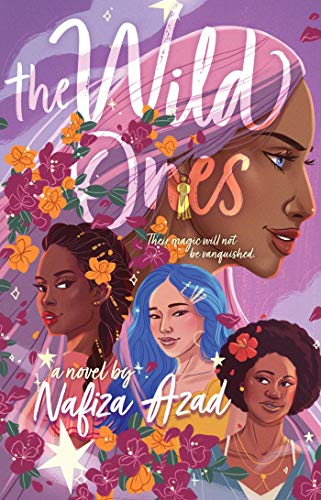
The Wild Ones by Nafiza Azad

Standard
The Wild Ones by Nafiza Azad

wild ones

At times this 352 mature YA book was really hard to read for a variety of reasons: the subject matter, the writing style, the pacing of the story, and the numerous characters and inconsistencies.  At other times, the book was descriptive, and ethereal and hard to put down.  It took me over a month to finish the book because it really is all over the place and a lot of internal force and motivation was required to get through it, yet for all its flaws, I find my thoughts drifting back to it often.  The book contains a lot of violence against women, as that is the thread that brings this feminist group together.  There are hetero, lgbtq+, trans, and nonbinary individuals and relationships in the book, but they are not explicit, the rape, assault, suicide, prostitution, child trafficking and murder are more detailed.  The book takes place all over the world, and often mentions the athan being called or a mosque being passed.  Many characters have “Islamic” names, but there is no religion specifically practiced in this hijabi authored women powered tale.

SYNOPSIS:

The premise of the book is simple and straightforward.  A girl, the daughter of a prostitute, is betrayed by her mother when she is sent to a man.  As she runs through the city to escape, she crosses paths with a young boy who tosses her a box that contains stars.  A star embeds itself in her palm and allows her to enter a place called the “Between.”  The Between is a magical corridor made of magic that contains doors that lead to locations all over the world.  Once she enters she stops aging and is now made of magic.  She has the power to scream which can destroy other middle worlders and she can go invisible when around normal humans.  She travels the world finding other girls betrayed by those who had been entrusted to protect them, and offers them a star and a place in the Wild Ones.  This has been going on for centuries.  When the boy with the star eyes is in danger, he is reunited with the girl and her gang, and they pledge to protect him.

WHY I LIKE IT:

The concept of the book is pretty good, but the plot for more than half of the book it seems focuses on the girls constantly arriving in a new location, exchanging diamonds for local currency, finding food, and getting settled in, before doing it all over again.  It is repetitive and pointless.  Sure it is nice to read about exotic locations and savor local foods, but these girls live forever essentially and we learn so little about them or what it is they do.  Toward the middle of the book you start to see them helping other girls, but this should have been made clear much earlier on, I’m sure many people stopped reading before they saw how part of each girls’ healing involved helping others.  It is not developed or shown, which I think other than the two encounters detailed would have created some connection between the characters and the reader.

The cause of most of the confusion is that there are 11 Wild Ones, and you never really get to know any of them, the point of view switches between Paheli, and unknown speaker, and it has pages of prose from other Wild Ones that are neither explanatory of their life before or in relation to what they are currently experiencing. The fourth wall is broken periodically, but inconsistently.  So often, I just had no idea what was going on.

At times the characters speak like they are the teens that they are when they entered the Between, really noticeably and painfully, but they are decades old at the youngest, and centuries old for some of them.  Also, Taraana is presented as a young small boy that needs coddling a lot, although he too is centuries old, but then as the girls start protecting him, he suddenly is this incredibly handsome man in love with Paheli.  I get that their physical ages are suspended, so a relationship really might be possible and not creepy, but Taraana seemed to change, and it wasn’t explained.

The world building overall is weak, which is a shame, because it isn’t disjointed from the real world, it is just a slight addition to what the reader already knows.  If the Between is just hallways how is there a library? Can you live in the Between? Can all middle worlders access it? If so why aren’t the corridors crowded?

The pain of the girls, their rage, their ability to deal with their traumas in their own way and time, is very empowering.  I wish the sisterhood was more mutual than blindly following Paheli, like lost little children.  These girls/women can decide what to partake it, and leave the group if they want, so they are strong and capable, they just don’t seem to get to show it as they bounce around from place to place to place eating and doing what they are told.

The book almost seems to have been written in sections and then dropped in to place.  Much of the character information comes too late to make the story resonate.  Sure part of it is intentional to clarify and create “aha” moments, but it creates really boring stagnant chapters, when these girls should be fierce and powerful, not lounging and mundane.

There were a few spelling errors and grammar gaps, but I read an advanced readers copy, so I’m hopeful they will be resolved.

FLAGS:

Prostitution, rape, assault, suicide, death, murder, child trafficking, torture, drowning, infanticide, girl/boy kissing, girl/boy and girl/girl flirting. Many of the online reviews make it seem more lgbtq+ than I felt it was.  There are two lesbian characters that flirt and imply that their relationship will move forward, but within the Wild Ones they aren’t all hooking up.  Paheli and Taraana kiss, but nothing more graphic.

TOOLS FOR LEADING THE DISCUSSION:

I don’t think there is any way I could do this as a book club selection at an Islamic school, nor would I want to. The book has powerful commentary on the status and crimes against women the world over, and possibly older, say early 20 year olds, would benefit from reading and adding their voices to a dialogue regarding life experiences. But, the story line might be too simplistic for older readers to bond with, and the confusion and inconsistencies may not be worth the time needed to finish the book.

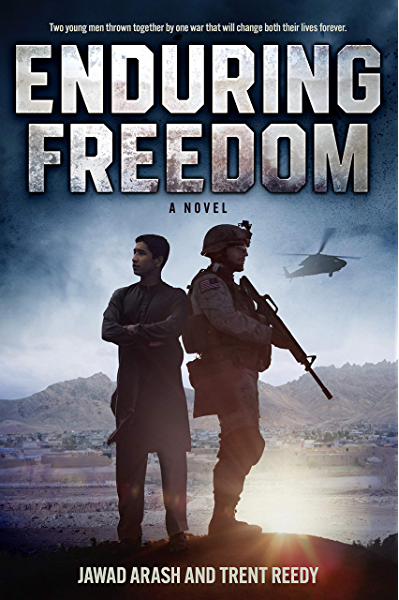
Enduring Freedom by Jawad Arash and Trent Reedy

Standard
Enduring Freedom by Jawad Arash and Trent Reedy

enduring freedom

This isn’t the type of book I am naturally drawn to, and had it not been offered to me as an arc, I didn’t even request it, I probably would not have read it.  So, to say that this young adult OWN voice 246 page post 9/11 war story had a lot to overcome for me personally, is putting it mildly.  I gave in and decided to read it for the simple fact that I was curious to see what the narrative is in today’s literature, as we approach the 20 year anniversary of the attacks on US soil.  The afterward is very clear that the agenda of the two authors, one an Afghan and the other a US veteran, was to show a personal view of growth and assumptions on both sides and how the future of Afghanistan needs to be rooted in education and stability.  I think the book accomplished its goals, and made very clear how the terrorists first victims were their own people, and that extreme ideologies of the Taliban were and are still not reflective of the larger population.  The pacing of the dual narratives, however, was a bit off to me, and I really felt that some of the major plot points didn’t get explored in a meaningful way, that they were simply glossed over and brushed aside to keep the book inline with the authors’ objectives.  The book is not overly political, and the Muslim characters are religious and knowledgeable, but for a book that talked about how even in war the people, the soldiers, are the story, I wanted to see more internal wresting with choices and their outcomes, then what was offered.

SYNOPSIS:

The book is told in alternating view points, one is that of Baheer an Afghan boy living with his large extended family in Kabul next to a Taliban compound.  The family is religious, Baheer’s grandfather, Baba Jan, is well read in poetry and religious text and often quotes the Quran by ayat and surah number.  The family sells carpets, and often hides the latest movies or news recordings in the rolls, so that they can be brought home, the blackout shades pulled and the tapes enjoyed.  They are fearful of being harassed for not having long enough beards, shaved heads, turbans and the like. Baheer and his brother Rahim do not enjoy school with the strict and abusive teachers.  The talibs seem to touch them inappropriately and scold them harshly.  Their older sister is not allowed to attend school and never has even though the family used to live in Pakistan where the boys enjoyed school. It doesn’t explain why they were there or why they returned.  One uncle is assaulted by the Taliban and soon after, a news clip showing the attacks on 9/11 is secretly watched by the family.  As a result they decide to move to Farah, in Western Afghanistan where Baba Jan has family and property, to be away from the impending US attacks and Taliban assaults.

Joe Killian is the other voice.  When the book starts he is sitting in class, his senior year, when news about the attacks on the World Trade Center starts to break.  He had joined the national guard that summer for the college money, and as his classmates sit glued to the televisions in Iowa, he is nervous that he is about to be called up to war.  He doesn’t get called up that day, he graduates, and is studying journalism in college when the call finally comes.  He is preparing for combat, but when he is deployed and discovers it is a reconstruction mission he is angry and annoyed.  A year of helping what he terms barbarians, is not what he signed up for.

The majority of the book reads like a ‘day in the life’ of each of these two voices, as they adapt to life in Farah, as they deal with each other’s presence and as their friendship forces their assumptions to change.  The interactions between Joe and Baheer show the power in getting to know someone to alter perceptions, and the threat of the Taliban on both the average citizen and the US forces on the ground as a unifying enemy to allow the friendship to grow.

The book concludes when Joe’s year of deployment is up, but really the authors’ notes at the end are a better conclusion to the real life friendship and growth of the two authors that resulted in the writing of the book

WHY I LIKE IT:

I love that the family sees the planes hitting the towers and is mortified at the brazen destruction and loss of life.  They immediately start praying for the victims even as they realize they will be the recipients of the backlash. I like that it highlights where practicing Muslims and extremists differ, by having the Quran quoted and explained as opposed to the rhetoric the Taliban is spouting.  Baba Jan’s manner for speaking the ayats is a bit awkward in that most people don’t in daily conversation source and reference their dialogues, but it does grow on you.  I think the book is very simplistic in making the Taliban to unequivocally be the ‘bad guys’ without any context of how they gained traction. It talks about the Soviets, but I think it will leave the readers wondering where this group came from and why the Afghan people allowed it. Unfortunately, there are a lot of nuances and complexities that are overlooked by such a simple narrative, and allow for an inaccurate picture to be formed.

I like that Baheer pushes back on Joe who thinks America is perfect and that Afghanistan is less than, by pointing out the flaws in American society as well as his own.  I was ok with Baheer pushing the cultural limits to talk to a girl, it was innocent and I think understandable. My biggest concern is that I really felt that there needed to be more space on the page dedicated to understanding the repercussions of him being an informant to the Americans, and his brother passing on information to the Talibs.  People were taken in to custody and injured and killed as a result of these boys’ actions and to just chalk it up to something to be forgiven, was not enough for me.  I wanted them to hash it out and wallow in their choices, not forgive and move on so quickly.  I also wanted to know more about their reconstruction efforts.  It seemed rather minimal: relocating explosives, helping a burn victim, sending supplies to a school, I think in a year, that there would be more mixing with the people than the book would suggest.  And finally, I felt like the sister not getting to go to school was handled as an obligation to address, not that any insight or understanding was really given to such a hot button issue.

The book is really slow and dragging at parts, I couldn’t tell you about any of the dozen or so soldiers that are mentioned, I don’t even recall any of their names. I think the book has a lot of potential, and perhaps it does shine in showing the effects of war and terrorism on the Afghan people.  It held my attention while actively reading it, but I just as easily could have put it down and forgotten about it if I wasn’t under obligation to offer an opinion in exchange for an early copy.

FLAGS:

There is language, stereotypes, physical abuse, sexual misconduct, death, killing, violence, acts of war, bloodshed, a crush. Upper middle school and high school can handle it.

TOOLS FOR LEADING THE DISCUSSION:

I don’t think I’d select this book as a book club selection because I’m not sure what would be gained from the book.  The characters assumptions are challenged and evolve, but I think most minorities know that, getting to know someone is often the best way to have their image changed.  I think the book still functions to make Americans feel better about  invading Afghanistan, rather than have us question what the long term affects of our involvement have been.

City of the Plague Gods (Rick Riordan Presents) by Sarwat Chadda

Standard
City of the Plague Gods (Rick Riordan Presents) by Sarwat Chadda

I was excited to hear that another Rick Riordan/ Rick Riordan Presents books featured a Muslim character and was anxious to see how the multi god genre would account for Islamic tenants.  But I was completely giddy (that’s putting it mildly), when I found out that Sarwat Chadda is aka Joshua Khan, author of the Shadow Magic Series and that this book has practicing Muslim Characters front and center.  In his own words, “it has taken be twelve years and eleven books to get around to writing a Muslim tale.” That isn’t to say that it is Islamic fiction, there is gay romance that is there if you want to see it and has been confirmed by the author outside of the book, there are  numerous fake gods in Mesopotamian mythologies, there is death and violence, but it is fun, oh so fun.  It has salat, and going to the mosque, and an imam, and saying surahs and discussing jihad an nafs, and sadaqa and it says the shahada in Arabic and English, it presents Muslims authentically in their words and actions, and it isn’t just the characters’ backstories it is who they are and how they see the world.  The book is an AR 4.5 with 383 pages and like all Rick Riordan books, full of humor, sentiment, family, growth, and ancient mythology.

SYNOPSIS:

Sikander “Sik” Aziz is 13 and when not at school is at his family’s NYC deli working away.  The son of Iraqi immigrants, he is dedicated to helping his family especially since his older brother Muhammed, Mo, has passed away.  Mo’s lifelong friend Daoud has moved in to Mo’s old room and helps out in the deli, but is really an aspiring actor who does anything to get out of work.  When the book opens, Sik and Mo are closing up when the deli is attacked by rat faced men demanding to know where it is.  Sik has no idea what they are talking about and the two demons tear apart the family restaurant until a mysterious girl appears and sends them and their stream of insects, disease and destruction from the deli.

The next day at school Sik’s injuries are healing remarkably quick and he and the new girl, Belet, find themselves getting sent to the principal’s office together.  When he learns that Belet’s mom is Ishtar, goddess of love and war, or rather passion, and was the girl at the deli, he can no longer deny that the tales Mo used to tell him about Gilgamesh, Enkido, Nergal, Kasusu, and Mesopotamian mythology are very real.  

As Sik, Belet, Ishtar, Daoud, and an army of cats, Lamassu, learn that the plague god Nergal is behind what is going on and that he plans to destroy Manhattan, it is up to them to stop the destruction, save Sik’s parents who are in the hospital, and ultimately the world.

WHY I LIKE IT:

The book was written before Covid 19 and the idea of a plague or pandemic was not yet on everyone’s mind, but when it was published in 2021 it sure become that much more relatable and close to home.  I love that some of the reactions of the characters and community to being around infected people and the backlash was so accurate to what we have all seen since 2020.  

The way that the oneness of Allah swt and the multi fake gods is reconciled is that the Mesopotamian cast are old and powerful, but not ALL-powerful, as Ishtar tells Sik, someone had to create us.  She also says that today people might call them something else.  It seems to leave open the idea that they have abilities and because of their abilities people worshipped them and the name stuck, not that they are creators or even claim to be. The concept of being between alive and dead is explored when Sik visits Kurnugi, he asks where Muhammad Ali is and Mo tells him he isn’t there, he went straight to Jannah.  It might not be a clear explanation, but it at least hints that Muslims in real life have a different view than the mythological one being explored.

I love the snark, and the humor, it flows so well and incorporates pop culture with ancient references very smoothly. I love that they say InshaAllah and AllahuAkbar and when Sik is presumed dead at one point and awakens he can’t go to the mosque because they are having his janaza and it would be awkward.  I love that there is a glossary that denotes if words are Arabic, Islamic, or Mesopotamian.  Muslim kids reading this will feel so seen and proud to be openly Muslim and inspired that they too can be heroes.

FLAGS:

Mythology, fighting, death, the use of the term badass.  Daoud and Mo’s relationship.  Daoud and Mo became friends in 5th grade and when Sik sees some photos of his brother that Daoud had taken, he says that he sees love.  When Sik and Mo are reunited in Kurnugi, Mo hints that there is more to the friendship, it is subtle.  In online interviews Chadda says they were in a romantic relationship.  It is not explored or heavily detailed.  The only other romance mentioned is that Gilgamesh in his prime refused Ishtar.

I think fans of Rick Riordan already know that there is going to mythological characters, creatures, battles and violence and a character or two that are LGBTQ+, some possible romantic angst between main characters, death, and unfaithful flirty gods.  This book is much “cleaner” than most, so 4th graders and up that are fans, will be fine reading this.  

TOOLS FOR LEADING THE DISCUSSION:

I don’t know if I could do this as a book club selection.  The romance is minor, but once you sense it and know it is there, it is a factor.  I don’t know if it would have to be discussed and how an Islamic school would want me to handle it, because both Mo and Daoud are practicing Muslims.  I think the book does a sufficient job of not committing shirk and shirk like messages with the mythology, but as always with these types of books it is a judgement call if the children (and their parents) can understand where the lines of fiction are and where they stand.

Fandom: https://riordan.fandom.com/wiki/City_of_the_Plague_God

This is Why We Pray: A Story About Islam, Salah, and Dua by Ameenah Muhammad-Diggins illustrated by Aaliya Jaleel

Standard
This is Why We Pray: A Story About Islam, Salah, and Dua by Ameenah Muhammad-Diggins illustrated by Aaliya Jaleel

this is why we pray

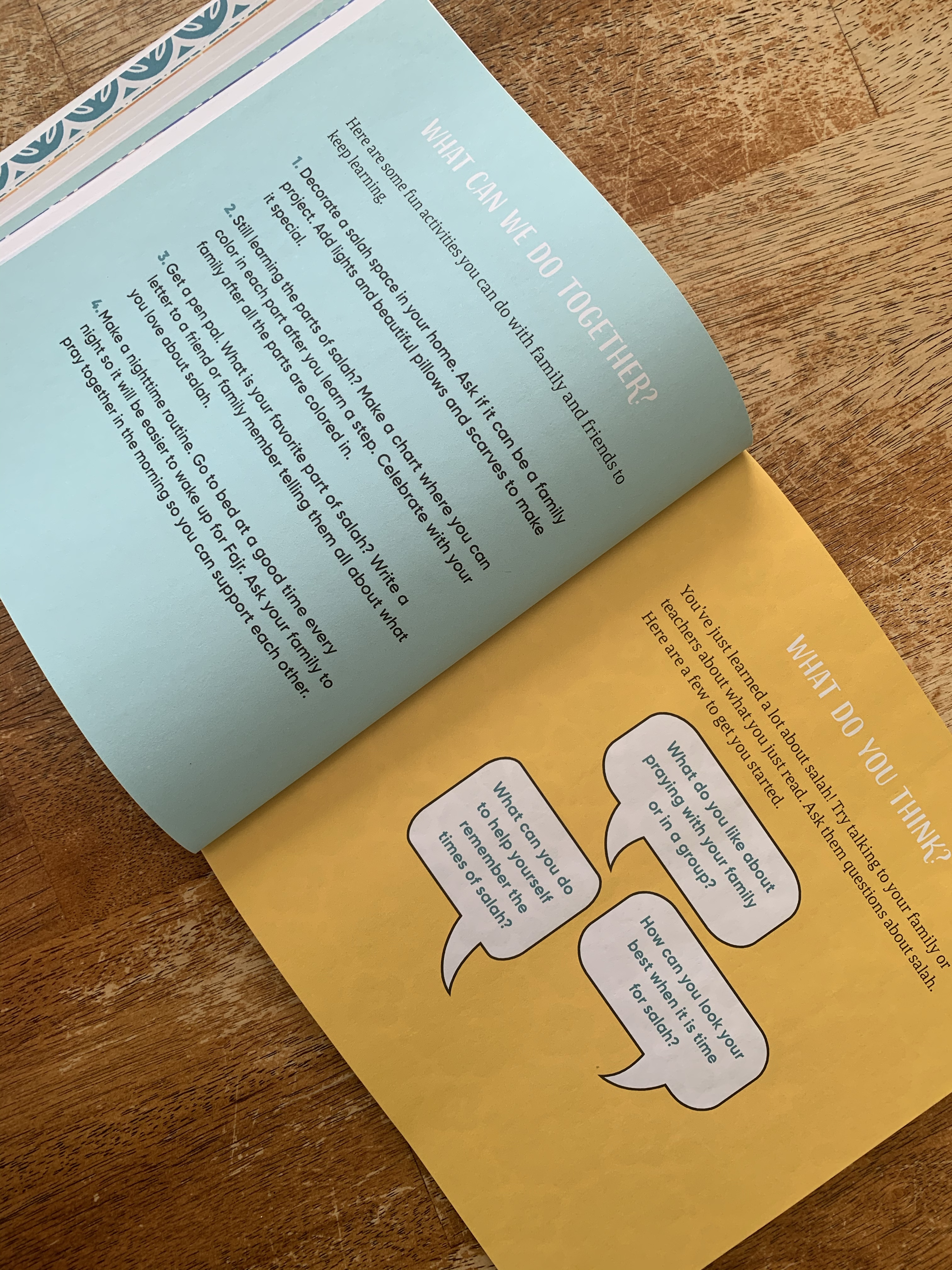
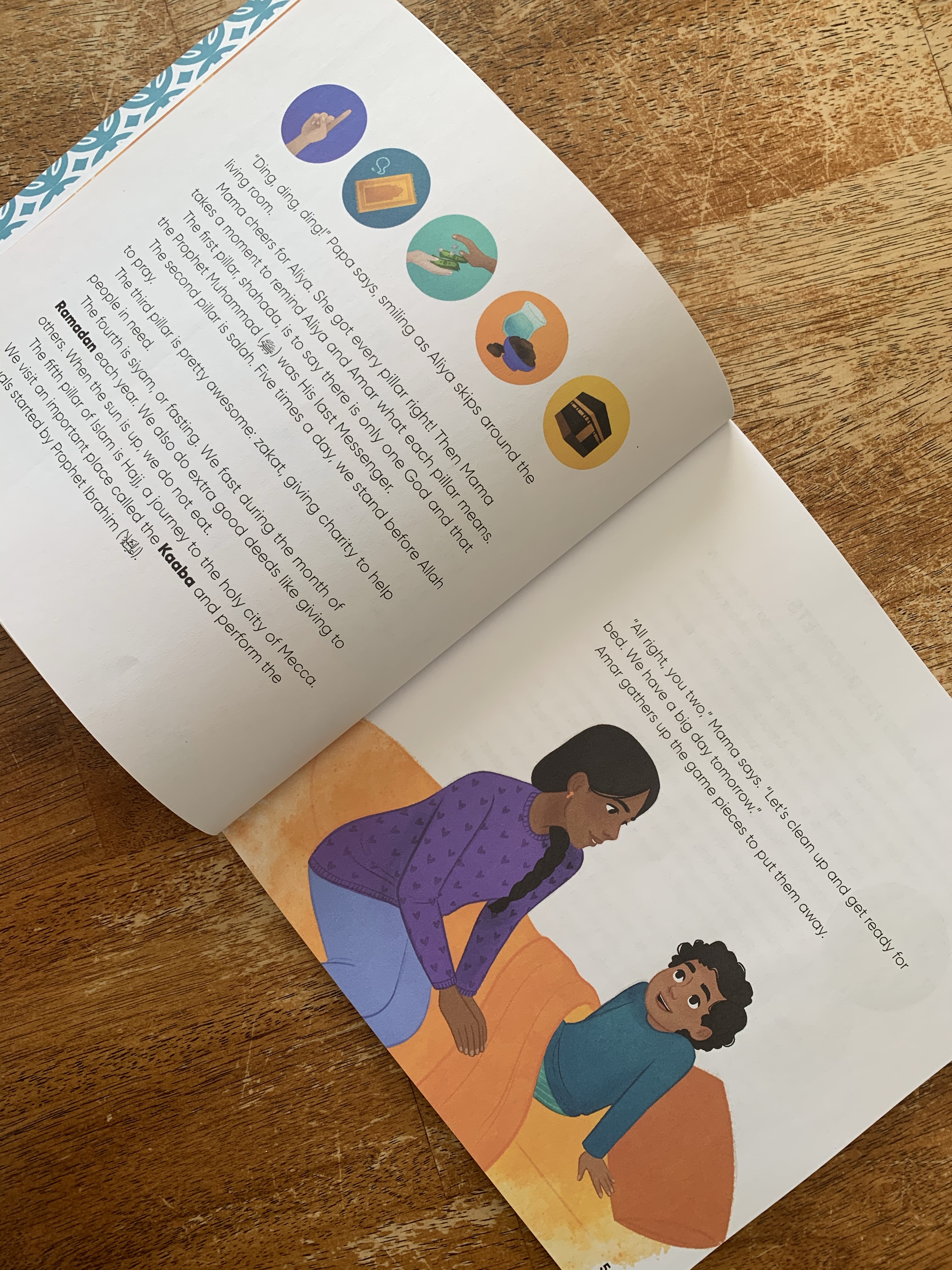
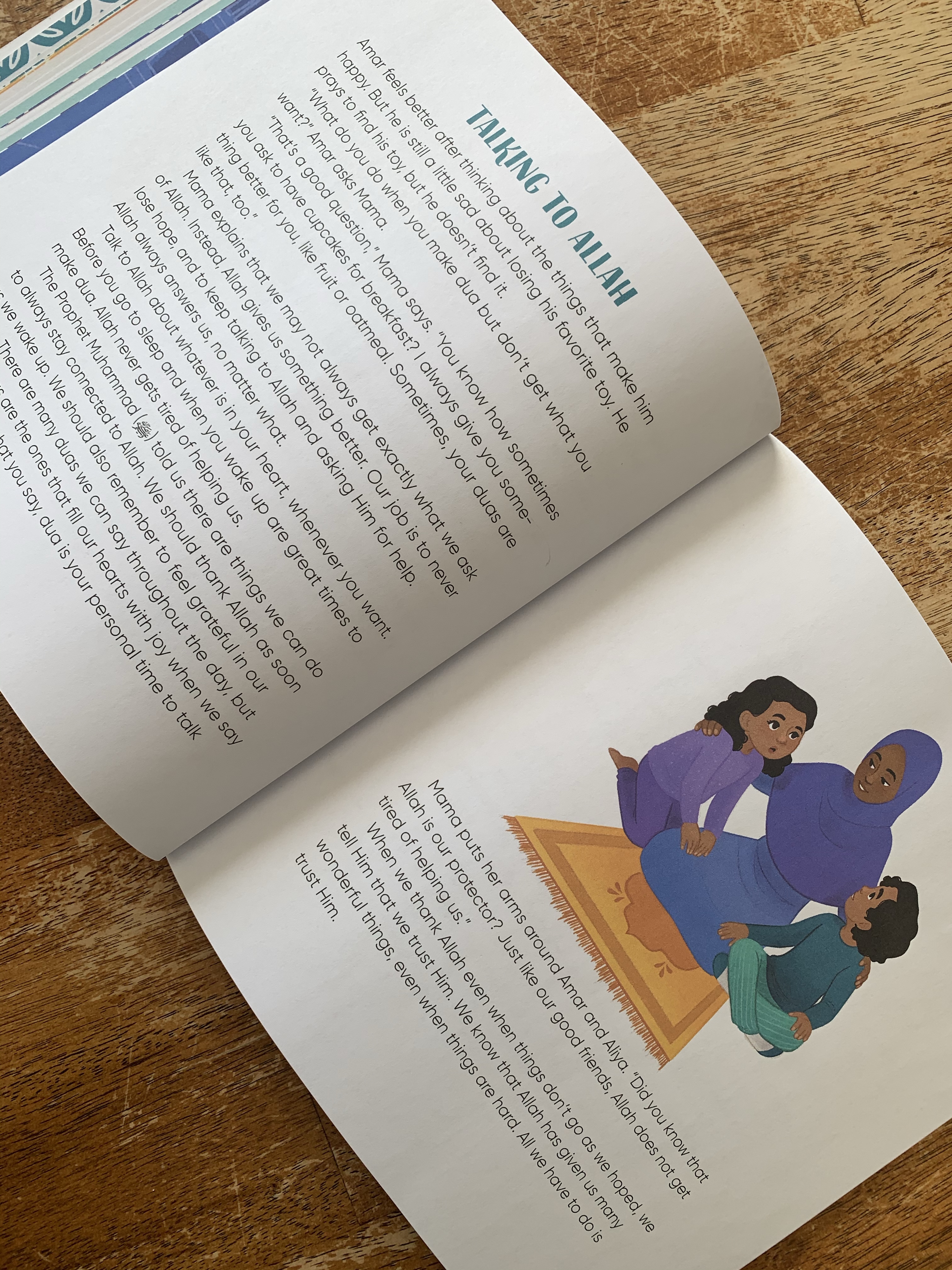
This 8×8 softbound 55 page book for ages 5 to 7 is a great resource for learning the basics about the five pillars, wudu, salah and dua.  It claims that it is a story, but I feel like that is a bit of a stretch.  It has fictionalized framing that is done well, but to call it a story I think is misleading.  It is set up like a children’s Islamic text book, think Islamic School or Sunday School curriculum, where there is a story that highlights Islamic concepts with vocabulary, there are breaks to focus on some specific idea from an outside source, in this case the Quran, there are things to think about, questions to answer, and then the same characters re-emerge in the next chapter to repeat the process. The book has an amazing illustrator, but there are only maybe three full page illustrations, four half page illustrations, and the rest are just small glimpses to compliment the heavily text filled pages.  I can see myself reading the entire book to my five year old, and then it sitting back on the shelf to be pulled out and revised when we need to go over salat, wudu, or need to learn some duas, and understand the five pillars.  I don’t think it will be requested for the “story,” or the pictures, it just isn’t that type of book.  It borders fiction and nonfiction, but I think it is closer to nonfiction, and works well as a tool to engage your children with easy to understand text, quality illustrations to see the steps of salat and wudu, and to see Islam practiced in scenarios that young children will recognize, such as playing games, going to the beach, and losing a favorite toy.

img_0647

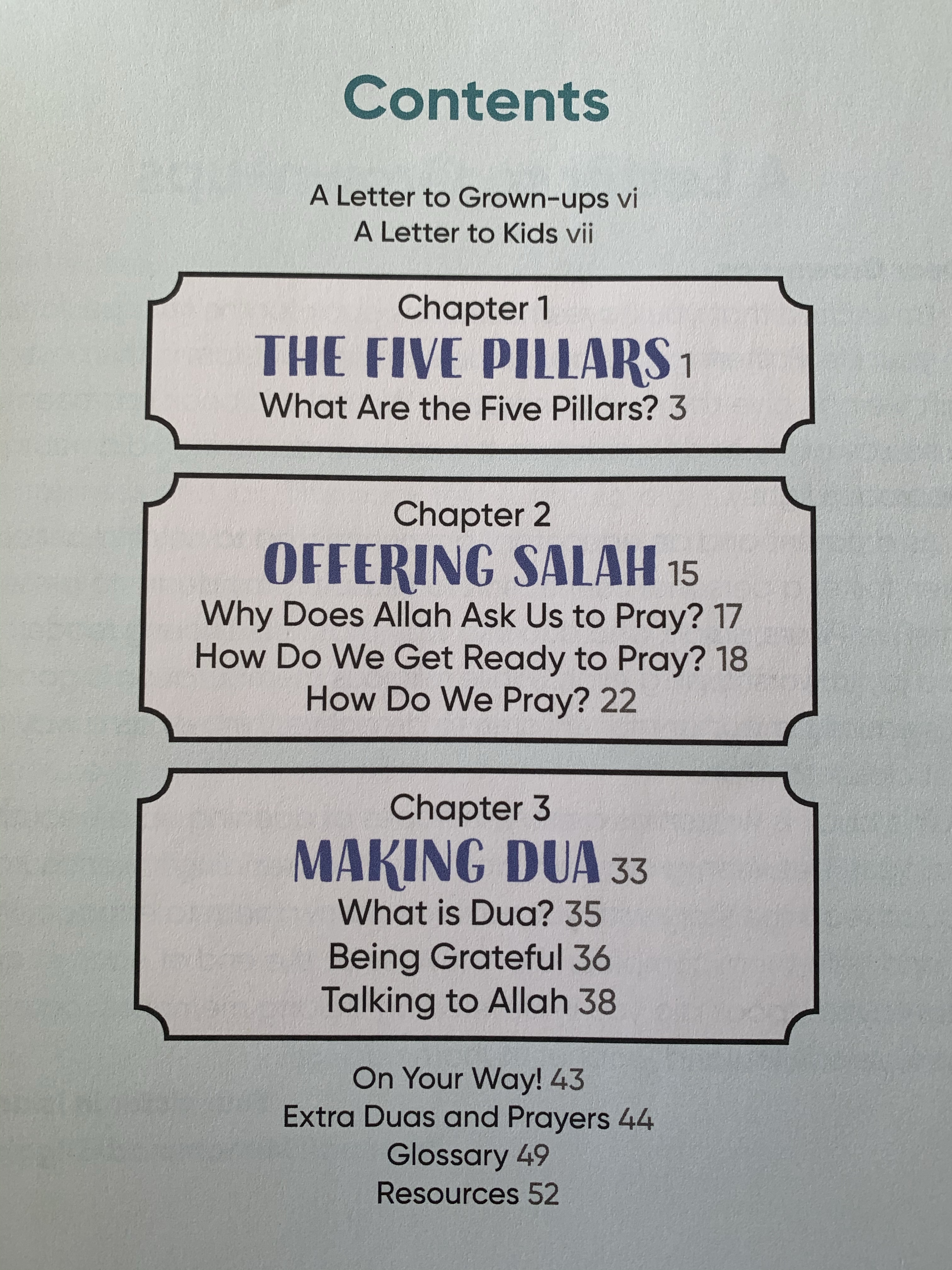
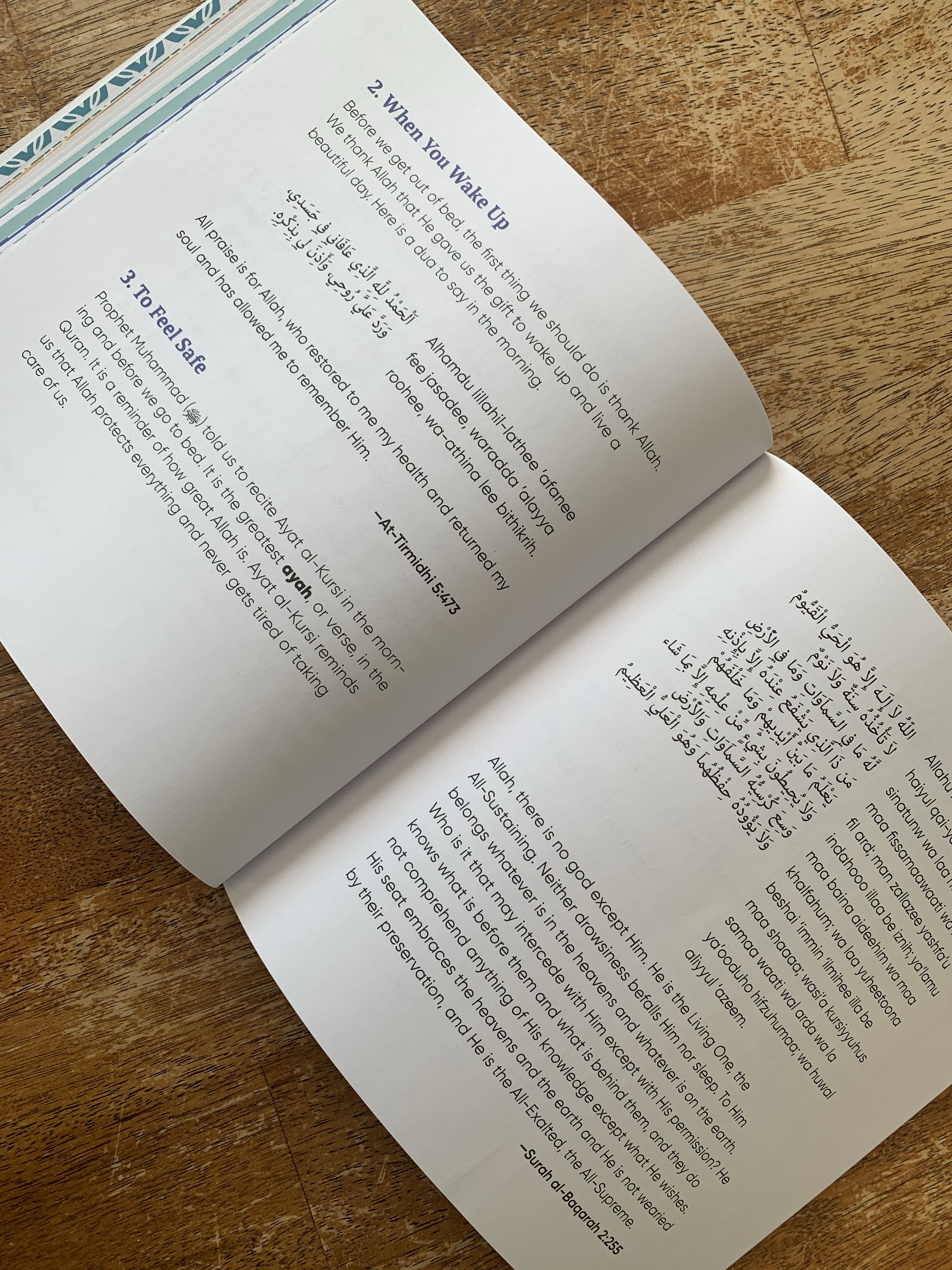
The book is divided in to three chapters: The Five Pillars, Offering Salah, and Making Dua.  Before the chapters there is a letter from the author to grown-ups and then one to kids.  After the final chapter there are reference pages with extra duas and prayers and a glossary.

img_0649

The first chapter opens with the Abdur-Rahman family playing an Islamic question game.  Older sister Aliya knows the five pillars, younger brother Amar needs a little more explaining.  The next morning the kids are heading to the beach, but first they have to get up to pray salah and send some food to the neighbor. As the kids drive they talk about Ramadan and their Uncle Sharif having just gone for Hajj.  There is then a page dedicated to a Quran Story Time that focuses on Allah swt wanting us to ask him for each and everything no matter how big or small. There is an ayat from the Quran as well as a hadith. The next page is a section called, “What We Can Do Together,” to further learn about the five pillars, and then some questions asking the reader, “What Do You Think?”.

img_0654

Chapter two has the family at the beach pausing their fun to pray.  But first they have to make wudu, and the steps are illustrated and detailed with tips and directions.  They then pray, again the steps and words are detailed and illustrated with tips about how to stay focused and the like.  The translation of the Arabic is included and the transliteration is as well.  The Quran Story Time focuses on Fajr and then the questions and ways to further engage with the information concludes the chapter.

img_0648

The third chapter is on Dua and has the kids barely making it to Sunday School on time.  Papa says he made dua that they wouldn’t be late, and even in class the lesson is on dua. After class Amar can’t find his toy even after making dua and is encouraged to be grateful for what he does have.  The Quran Story tells the story of Prophet Muhammad (saw) helping the old woman who is talking bad about the Prophet and how after he helps her and he tells her his name, she converts.  I don’t know that, that is in the Quran, I thought it was a hadith?

img_0655


The kids learn that Allah swt may not answer duas, but will inshaAllah give them something better.  There are four additional duas to learn in the moving on section and the bolded words throughout are defined in the glossary.

img_0651

I’m not sure about the title of the book, it is about more than just prayer, so don’t think that it is limited to just that.  It also doesn’t detail the number of rakats or what breaks wudu, it is specific in somethings, but is more a broad overview than an all encompassing handbook on salat.

img_0656

I think the book is well done and will be useful for most, if not all, Muslim families with young children learning the basics, but it isn’t a picture story book in my opinion, it is more of a fun engaging twist on information that might otherwise be presented in a boring manner.

img_0650


Halal Hot Dogs by Susannah Aziz illustrated by Parwinder Singh

Standard
Halal Hot Dogs by Susannah Aziz illustrated by Parwinder Singh

hotdogs

I’m not sure what I expected this book to be, I just knew I wanted to get my hands on it, but I’m fairly certain, that even if I would have had some expectations, they would have been no where near how well done this 40 page book for four to eight year olds is overall.  It is unapologetically American-Palestinian Muslim in an inclusive funny delightful way, that only an OWN voice book can be. There have been some great picture books lately that are authentic, yet mainstream, and this book pushes that standard just a little bit higher as it normalizes jummah, halal food, dabke, hijab, with familiar threads of street food, spunky little sisters, untied shoelaces, tradition, and excitement.  The story has a twist and some intentionally misleading foreshadowing, that give the book depth and added fun.  Readers of all backgrounds will relate to this book and find something that they can relate to, as they laugh and marvel at Musa’s infectious enthusiasm for hot dogs. img_0610

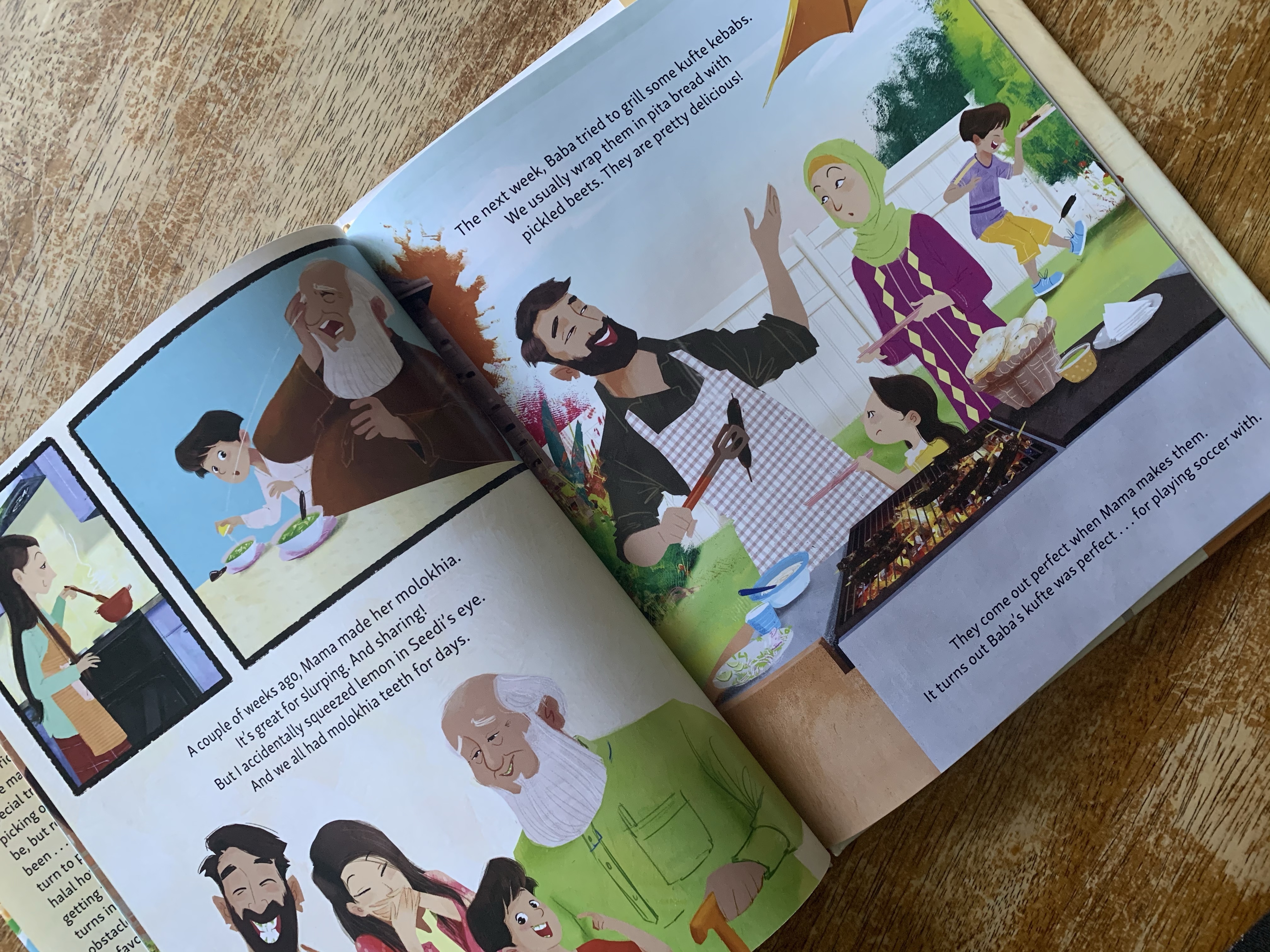
Musa Ahmed Abdul Aziz Moustafa Abdel Salam, aka Musa, loves Fridays.  His family heads to the masjid for Jummah prayer and then home for a special Jummah treat.  Lately, they’ve had molokhia, that stayed in their teeth for a week, kufte kabobs that were better for soccer playing than eating, riz bi haleeb with lost dentures, and prelicked jelly beans.  Alhumdulillah, this week is Musa’s turn to pick, and he is picking his favorite: halal hot dogs with Salam sauce.

img_0611

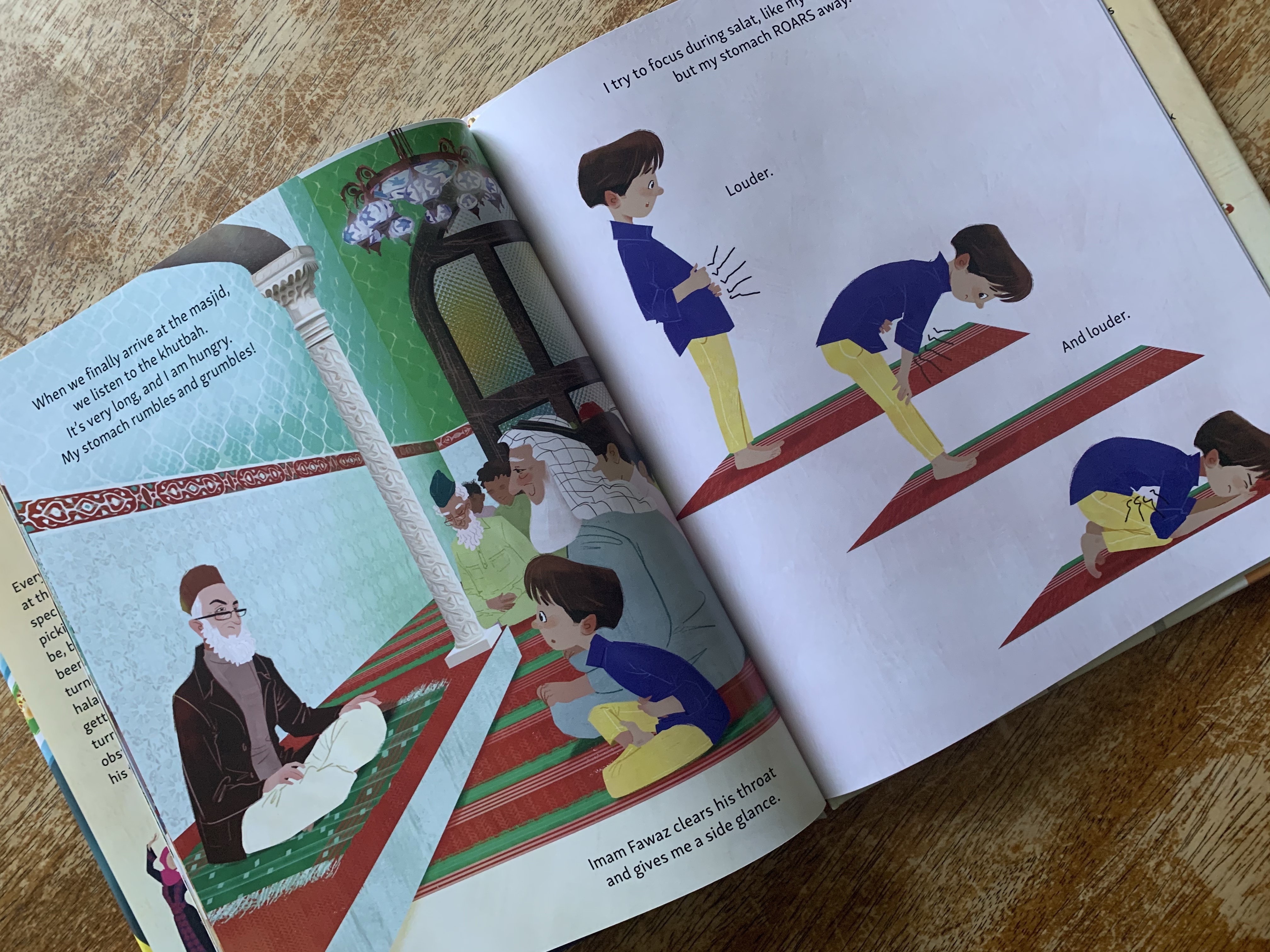
They head to the mosque dancing dabke as they leave their house with smiling faces.  The khutbah is long though, and during salat his stomach is roaring! Afterward he is off, but Seedi has to help Maryam find her red shoes in a sea of red shoes and mama is chatting with friends. 

img_0612

Dad gives in and lets Musa go get the hot dogs alone.  As he heads to the stall with the best hotdogs: the perfect amount of hot, chewy, juicy hot dog goodness, he passes all sorts of foods being eaten.  There is falafel and bao and tacos and samosas and churros, but he is determined to get hot dogs, even though the line is really long.

img_0613

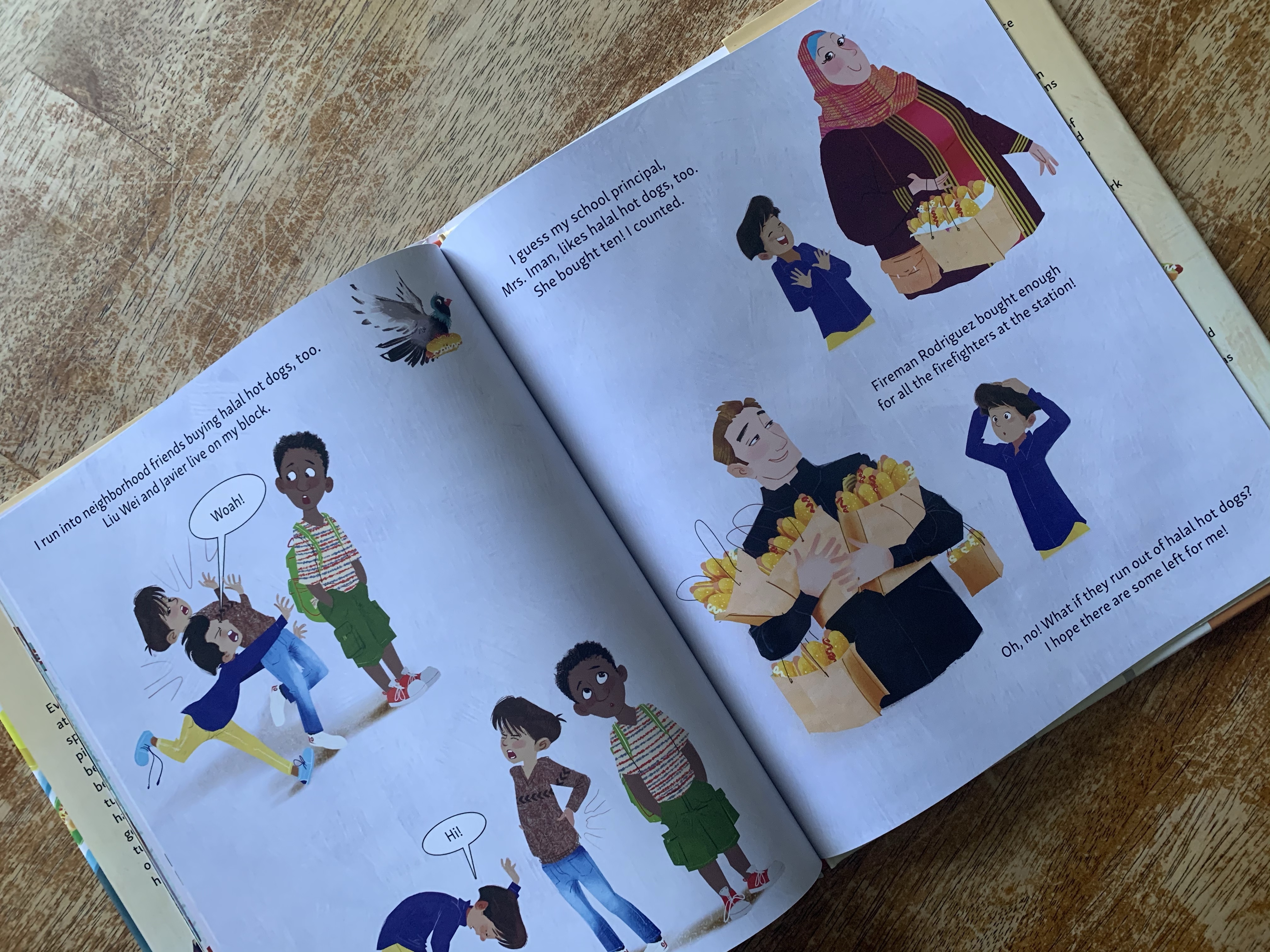
He sees friends in line, and firefighters, and even his school principal.  Everyone loves hot dogs, even birds and squirrels.  Finally he buys a whole bag full with special Salam sauce and races home to share with everyone.  But uh oh, it doesn’t go as planned, and I’m not about to spoil it, so get yourself a copy like I did from http://www.crescentmoonstore.com or your library, and maybe don’t read it while you are fasting, because you will be craving hot dogs, mmmmmm nom nom nom.

img_0614

There is an Author’s Note at the end that details her kids’ influence on the story and explains that a portion of the proceeds go to UNRWA USA, a non profit that helps Palestinian refugees.  There is a glossary of Arabic Words and Terms, and a section explaining Halal Laws.

img_0615

The book shows the mom in hijab outside the home, and uncovered within the home.  There are diverse skin colors among the Muslim and non Muslim characters in the book, as well as a variety of ages depicted.  Seedi wears a keffiyah on Jummah, but different clothes on different days.  The illustrations are wonderful and descriptive and do a lot to compliment the story by setting a relatable and diverse-positive visual.

img_0616

An Emotion of Great Delight by Tahereh Mafi

Standard
An Emotion of Great Delight by Tahereh Mafi

emotion

This 256 page YA OWN voice book is a real and raw look at a character and the many layers of life weighing down on her.  At the center of it all is a strong Muslim teen dealing with post 9/11 bigotry, the shattering of her family, toxic friendships, and a broken heart.  It is a love story, but it is so much more, as the protagonist’s voice draws you in to her crumbling world from the very first page and has you begging for more when the last page is read.  So often in Muslim-lead-mainstream-romance-themed novels, I want there to be introspection at the choices that the character is making and the internal processing of navigating their wants with their beliefs, and this book surprisingly does it.  There are some kissing scenes, cigarette smoking, cosmo magazine headlines, and waiting for her father to die, but not without introspection. Shadi reflects on her smoking quite often, she questions the repercussions of her actions, and she analyzes her father’s faith and approach to Islam as she forges her own relationship with the deen.  There is mention of a Muslim character drinking, doing drugs, hooking up, and it mentions he had condoms in his car, just those exact phrases, nothing is detailed or glorified, just stated.  There are also threads of mental health, self harm, death, and grief.  The characters are genuinely Muslim and some of their experiences are universal, and some specific to the faith, culture, and time.  Muslims and non Muslims will enjoy the book, and I would imagine relate to different things, but find it overall memorable and lingering.  For my Islamic school teens, I’d suggest this book for 17/18 year olds to early twenties.  It isn’t that they haven’t read more graphic books, but to be honest, Shadi has a lot going on, and if being close to Ali can lighten her load and help her find hope and joy, I’m all for it.  I know it is “haram,” but it is fiction, and it will have readers rooting for them to be together, not a message you may want to pass on to your younger teens.  As the author says in her forward, “we, too, contain multitudes.”
SYNOPSIS:

The layout of the book bounces between December 2003 and the year before.  In a previous time, Shadi’s life was easier, her brother was alive, she had a best friend, her Iranian immigrant Muslim family may have had stresses and issues, but they were a family. In 2003, Shadi is largely forgotten by her parents, her brother is dead, her father is close to death, her mother is self harming, her older sister preoccupied, and as a high school student Shadi is both falling and being crushed by her heavy backpack both metaphorically and literally.

The story opens with Shadi being approached by a police officer wondering why she is laying in the sun, he thinks she is praying, and she doesn’t have the energy to be angry by this assumption, she is exhausted, and doesn’t want to cause any waves that might get back to her fragile mother and cause any more stress than necessary.  So she drags herself up, and begins the walk to her college level math class miles away.  The sun is short lived and the rain begins to pour, she knows no one will come to pick her up.  Her parents have long ago stop being present in her life.  She once had a best friend, but that relationship, as toxic as it was, also has ceased to exist.  So she walks, and she is drenched, and she falls, so she is now soaking wet and bloody.  A car slows down to presumably offer her a ride, but then he speeds off drenching her in a tidal-wave.  The scene is set for the tone of the book. Shadi is drowning, we don’t know all the reasons why, they unfold slowly, but we know that it is going to get worse, her phone is nearly dead and her sister has just called to let Shadi know her mother is in the hospital.

I don’t want to detail my summary as I often do, because the way the story unfolds, would really make any additional information given act as a spoiler.  The book is short and a fast read, but along the way the introspection to the chaos that is Shadi’s life, makes it impossible to put the book down.  Shadi will have to confront her crumbling life and find away to reach toward hope.  She will have to keep walking to avoid drowning and along the way cling to the few precious things that give her joy: an emotion of great delight.

WHY I LIKE IT:

I really enjoyed this book.  I loved the Islam and real approach to her volunteering at the mosque and calling out racism within the community and diving deep in to understanding is Islam more than just rules and toeing the line.  It was a great mirror for so many nuances in real life, that I will probably re-read the book again in the near future, to enjoy it all.  I absolutely love the unpacking of the toxic friendship.  When women tear each other down under the guise of caring it is brutal, and the acceptance and growth that Shadi is struggling with in regards to her best friend of six years, Zahra. who is also Ali’s sister, is a reminder that sometimes walking away is the only choice.  

The two criticisms I have of the book are: one-that the book is too short, I wanted, no, I needed more.  And two I didn’t understand why Ali’s family and Shadi’s family were no longer close.  I get that Shadi cut Ali out of her life and Zahra and Shadi had a break, but Ali/Zahra’s family still care for Shadi and she for them, so what happened between the parents? It seems that the death of a child would draw the friends out and make them protective, not push them to being aloof.  It seemed off to me and major plot hole.

FLAGS:

As I mentioned above: kissing, smoking, drugs, hooking up, referencing condoms, cosmo headlines, self harming, grief, death, alcohol.

TOOLS FOR LEADING THE DISCUSSION:

I don’t think even high school could do this as a book club selection, because you really want to ship Shadi and Ali.  If you had like an MSA book club then I think this would be a great choice.  I would love to hear teens’/young adults’ thoughts about Shadi’s view of religion, her fathers approach, and how they view passing the deen on to their children.  I think it offer great role-play scenarios in empathy and how you’d react in real life to finding your mother struggling, your best friend taking off her hijab and being so jealous of you, the bullying, the assumptions, understanding your father and where to assign the blame for such a traumatic event that claimed your brother’s life.  There is so much to discuss, and I hope at some point I find the right forum to chat about this book and listen to other’s perspectives about it.