Tag Archives: Muslim Characters

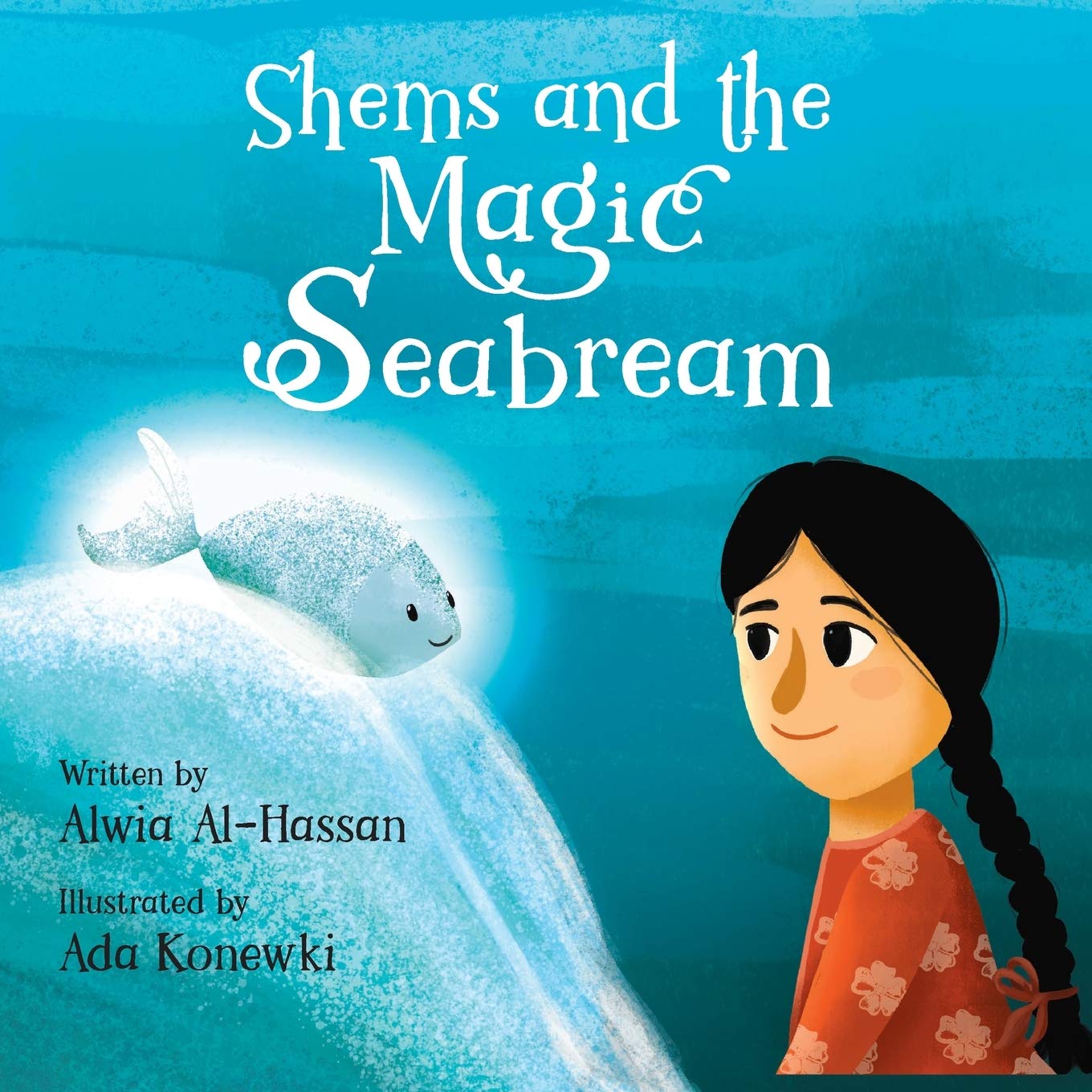
Shems and the Magic Seabream by Alwia Al-Hassan illustrated by Ada Konewki

Standard
Shems and the Magic Seabream by Alwia Al-Hassan illustrated by Ada Konewki

seabream

I don’t know how to review this book, I truly don’t, it claims to be based on Saudi folklore, it has #muslimsintheillustrations, and references Allah swt once, it is by a Muslim author, but it isn’t religious. And it definitely isn’t for everyone. It is terrible, and yet you can’t look away. Every stereotype about appearance and trope about step-mothers, it is all there, but EVIL CACKLE, the book is delicious, and not in the cooking the children and eating them sort of way, that is in the book too, but in the laugh-out-loud, gasp in disbelief, and be shocked at the complete disregard for political correctness, moral messaging, and lesson teaching that leaves a brightly illustrated dark tale for kids, and adults, to thoroughly enjoy. It pulls you in, it suspends reality, it makes good and bad so black and white that you accept the attempts at murder as justified, and it ultimately reminds you of the horrors that all fairytales build upon to entertain. I remember the first time as an adult I was asked to read Hansel and Gretel to a young niece. I knew the story, and started not thinking much of it, and then I froze: children are lost, they seek shelter in a home where they are not allowed to leave, the owner of the home wants to cook them and eat them. Yeah, this book is like that.

img_5299

Shems and her twin sister Shareefa live in a small town with their fisherman father. They are poor, but happy, until their father remarries and the stepmother is horrid. She is ugly and fat and covered in greasy spots, negative connotations that reflect her personality. (FLAGS: superficial judgement and body shaming). She hates children. (FLAG: Yes it uses the word hate, and calls children fat while contrasting them with cute children).

img_5300

She especially hates Shems and Shareefa. She tries to get rid of them: she puts them in the oven, abandons them in a field, tries to drown them in the night. But the girls somehow always escape and their father believes that it was all a misunderstanding. (FLAG: attempted murder).

img_5301

Now that the girls are older, they are forced to serve Mama Ouda, and when food runs low, she considers eating them. (FLAGS: abuse and threats). Luckily they are much too thin. One day when Mama Ouda is craving fish, Shems heads out to catch some seabream, yes that is a real type of fish. And the only one she catches is a magical one. (FLAG: magic).

img_5302

The next day Shems dressed as Shareefa recalls the fish’s promise near the water, and a basket of fish appears with pieces of sparkling gold. The girls eat like queens, hide the gold, and keep Mama Ouda fed. This carries on until they get caught and a murder and mermaid and moving out of their mud hut conclude the story and set up a potential sequel.

img_5298

The dad is pretty clueless and that has its own negative assumptions to counter, but if you and your kids can handle the over the top darkness, the story written in playful rhymes is sure to entertain and be asked for repeatedly. (FLAGS: stereotypes about fathers and stepmothers).

Huda F Are You? by Huda Fahmy

Standard
Huda F Are You? by Huda Fahmy

huda f

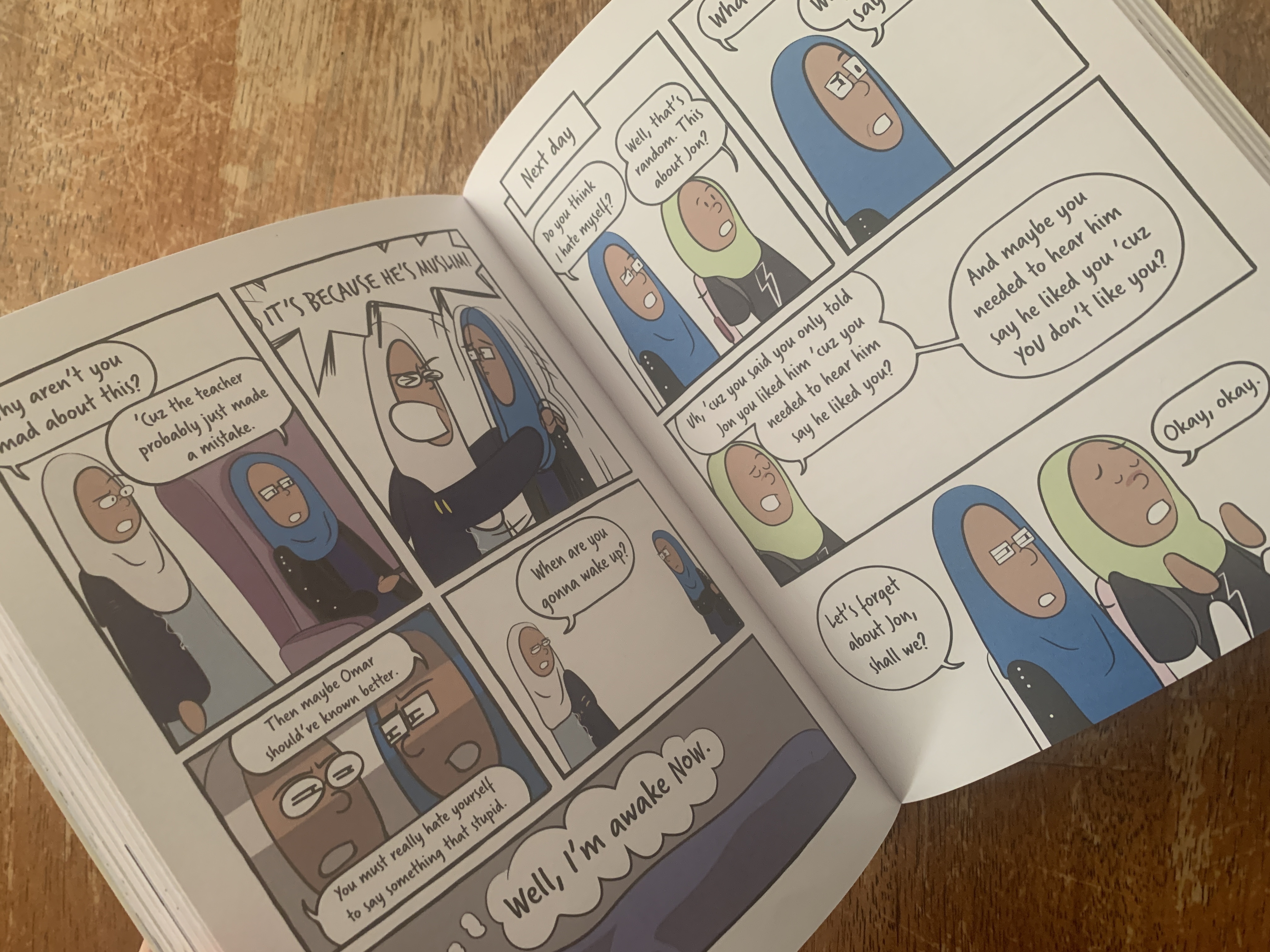
I think everyone has heard about this book by now and how fabulously fun, real, and relevant Huda’s life  is for so many.  I am happy to jump on the praising bandwagon, as this teen/YA 192 page graphic novel really is a great OWN voice unapologetically Islamic mainstream tale.  It does mention periods, relationships, hate crimes, and finding yourself, so probably 14 or 15 year olds and up.  My middle school boys read it, so it isn’t that it is inappropriate, just the target audience is more teen girl.  I know a lot of people, including Huda’s mom according to the inscription, have issues with the title, but I think it is brilliant.  She takes ownership of her name and it isn’t just for shock value, the book is about figuring out who you are, how you feel about Islam, establishing your friend circle, and growing and learning along the way.  My public library has it, as do major outlets, so what are you waiting for, go read, laugh, and feel seen.

img_5036

SYNOPSIS:

Huda has just moved to a new school and she is no longer the only hijabi.  She has moved to Dearborn, Michigan and there are A LOT of Muslims.  She is no longer defined by the cloth on her head, she has to figure out who she is.  Who she really is.  And sometimes the best way to do that, is to figure out who you are not.  

Huda tries different clubs, and different circles of friends, both at school and at the masjid.  Along the way she learns how much she craves approval and who is always in her corner.  When a kid at school is targeted for being Muslim, Huda will have to see how much internal hate she carries as well.  Her clothes change, her outlook changes, she tries new things, and she grows, all while the laughs help the story bounce from one serious topic to the next without coming across as arrogant or stereotypical.  This is Huda’s story and we are just along for the ride.

img_5035

WHY I LIKE IT:

I love that there is nothing to critique, it reads autobiographical even if parts are exaggerated or only based loosely in reality.  By being so real, and so well done, you are excited when you see yourself staring back, but you feel like you’re a friend learning about Huda even when you can’t relate exactly. Her comics online and her previous two books are all amazing, and I love that she is continually creating new material for us all to enjoy and benefit from.

img_5037

FLAGS:

She tells a boy she likes him that she doesn’t really like.  Periods are referenced and blood and a pad are shown, not graphic and gross, but the sentiment is there.  Discrimination is present, as is Islamophobia and stereotypes.

TOOLS FOR LEADING THE DISCUSSION:

Just keep the book out and around: it will be picked up, read, and mentioned, no tools needed.

One Sun and Countless Stars by Hena Khan illustrated by Mehrdokht Amini

Standard
One Sun and Countless Stars by Hena Khan illustrated by Mehrdokht Amini

one sun

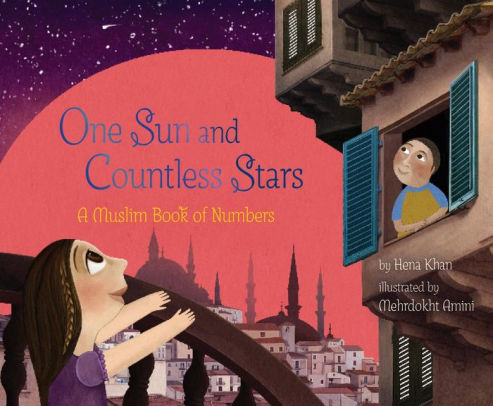
I don’t think that Hena Khan is necessarily a controversial figure, but some days her work feels very polarizing as some praise her ability to share OWN voice desi American Muslim stories while others feel like she waters down the very stories she is sharing to appease the majority.  Irregardless of our nuanced views, many of us first were made aware of her when we we were swept away in 2012 by the mainstream book, Golden Domes and Silver Lanterns.  Since then she also has published a book about shapes in the same format, and now this counting book that reminds me how beautiful and powerful it is to see Islam so unapologetically presented to all children.

Screen Shot 2021-11-10 at 10.25.04 PM

The author’s note at the end is important:

There are many significant numbers in Islam.  They include one for God, five for the pillars of the religion and daily prayers, seven for the circles pilgrims and visitors walk around the Ka’aba during hajj and more.

Mathematics and astronomy were among the intellectual pursuits of early Muslims.  They helped to develop algebra and used geometry to create the elaborate patterns found in Islamic art.

For this book, I chose concrete and illustratable terms rather than abstract concepts.  The representations for each number focus on things we can count in the world around us.

The book counts the diverse and global parts of a practiced faith.  The unique and the mundane, all beautifully illustrated and richly conveyed.  From cups of tea and shoes taken off for prayer to two hands making dua and four lines of a surah being memorized.  The book counts up to nine and then marvels at the countless stars that we see each night.

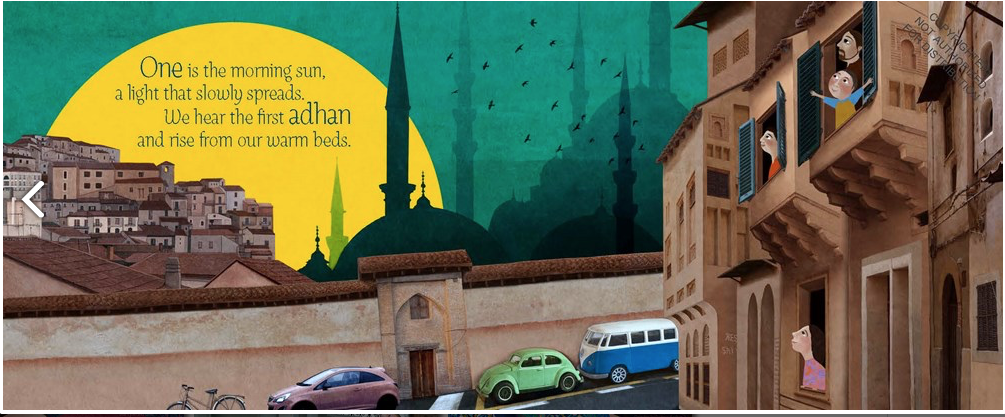
The first page is possibly a bit problematic in accuracy.  The tone and framing of starting the day with the sun rising and the sound of the adhan is warm and beautiful, but the adhan is not called at sunrise for the first prayer of the day, fajr.  Fajr begins at dawn.  There are only 21 words on the first page, so I’m inferring a lot about the correlation of the sun and athan that may or may not be present.  It is something frequently misrepresented, so it catches my attention. And yes, the seven tawafs mentioned in the author’s note would also apply to umrah, not just hajj.

Overall, the book is lovely and will remind many of us what made us all celebrate Hena Khan and her stories so many years ago.

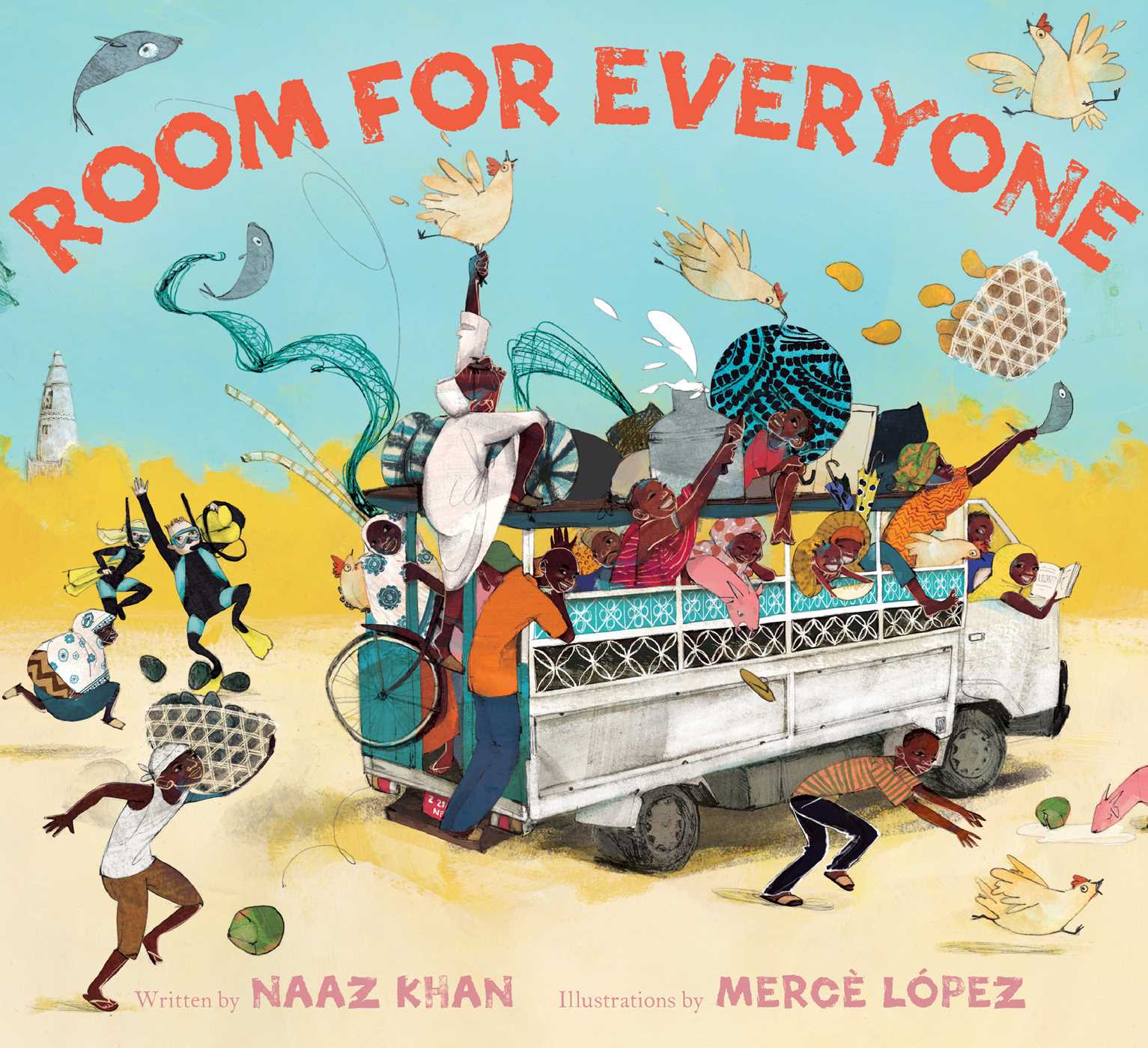
Room for Everyone by Naaz Khan illustrated by Merce’ Lopez

Standard
Room for Everyone by Naaz Khan illustrated by Merce’ Lopez

room for everyone

I started to read this book to myself, abruptly stopped, gathered my children around, and began again aloud.  This 40 page early elementary picture book isn’t just counting up and down with silly scenarios and outrageous details, it is familiarity with a culture often not represented with universal humor, appeal, and anticipation. This rhyming book begs to be shared: one-on-one, at story time, or in a classroom.  There is so much joy and connection that I’m ready to felt-board the story, march into my kid’s school and demand an audience.  I found mine at the library, but I think I am going to order it because it definitely deserves a place on the bookshelf to be read again and again.

Musa and Dada get in a daladala and are off to the crystal blue waters of Zanzibar.  But it is hotter than peppers out and the kind driver is offering everyone a ride.  First is the old man with his seatless bike, then it is two little goats and their herder, next is vendors with their three baskets of fruits.  Each time Musa cries and protests that there is not room for anyone else, let alone their stuff.  Yet when everyone wiggles and scoots and smooshes, there seems to be room for everyone.  This continues until there are ten scuba divers joining the smelly fish and stinky chickens, umbrellas and milk pails.

Alhumdulillah, they reach the beach.  Then one by one they all get out at Nungwi beach.  Giggles and wiggles and Musa and Dada are off the minibus and swimming in the cool waters. Alhumdulillah indeed.  The book concludes with a glossary and an author’s note.

“Find me on Twinkl’s list of best children’s books of 2021!” 

Golden Girl by Reem Faruqi

Standard
Golden Girl by Reem Faruqi

golden

I began reading this book not having any idea what it was about. All I knew, or all I cared to know, was that the incredibly amazingly talented Reem Faruqi wrote it, so I wanted to read it. While I know it will be hard for most to avoid knowing the plot, I think it was a blessing that I was able to be swept away so completely and so fully in a story that is wonderful and memorable, and truly sets a higher standard for the way that a story can be told. Faruqi’s voice and authenticity had me in tears. I didn’t even realize my eyes were dripping until my son asked me if I was ok. It wasn’t the plot that had my emotions spilling over, sure it helped, but it was the storytelling, the hadith and deen and snapshot of a life so unlike my own that simultaneously is exactly my own that a physical reaction emerged. It is the power of OWN voice storytelling. It is the power of brilliant writing. It is not just a book about a Muslim character, this book blurs the lines for me between Islamic fiction and fiction with Muslim characters. Middle school readers (mature middle grade readers) will enjoy the book, older readers will enjoy and appreciate the 336 page story told in verse. You can pre-order the book and I hope you will, it helps convey the message to publishers that this book is highly anticipated and that we need voices like this. Additionally, Goodreads currently is hosting a giveaway, you can head there to try and win a free copy.

(If you don’t want to know what the story is about, maybe skip the next section.)

SYNOPSIS:

Aafiyah’s name means well-being, protection, health, money, happiness, everything good, but Aafiyah has secrets too. She is privileged and loved, and she knows it, but sometimes when she sees something she likes she accidentally borrows it. Sometimes it isn’t an accident. Sometimes she doesn’t just borrow. Much of her life is wonderful, a best friend that lives next door, doting parents, tennis, vacations, trips to Pakistan to visit grandparents, and a love of “weird but true facts.” So what happens when all that changes. When her grandfather gets sick and the family wants to bring him to America for treatment, when Aafiyah’s dad gets detained and imprisoned on the way home, and Aafiyah’s secret may be a way to help her family?

WHY I LIKE LOVE IT:

I absolutely love that the characters are so well rounded and developed. Yes, Muslims have vices, and even young practicing Muslims have tests and struggles. The bar has been raised, we aren’t just a monolith, and our only struggles aren’t girl/boy issues, alcohol, not being oppressed and getting an education, we are complex people, we are human. The bulk of the story is Aafiyah growing up: her responsibility within her family, her changing body and appearance, her friendships, her responsibility for her actions, her desire to want to help and improve and step in to her own. I love that all these layers of life somehow are explored in such sparse lines. It doesn’t drag, but it gives the necessary pauses to involve the reader in her logic and view of the world. Aafiyahs’ kleptomaniac tendencies, her father being detained, her grandfather’s illness. they all move the story along, but they are foils for a much more intimate character story. A story that is surprisingly funny and light and impossible to put down.

I absolutely love how Islam is woven in, how she exudes Islam in all that she is, because she is a Muslim completely, the good and the bad. The guilt she feels, the desperation to be forgiven, the knowing that Allah swt sees all. The book is never even close to being preachy, but she proudly owns her identity and the details of her faith are not watered down, or even justified, it is who she is and it isn’t up for debate.

Culture is presented unapologetically as well. She is critical of things she sees in Pakistan, and similarly celebrates and admires good things about Pakistan and Pakistani culture. The book does not seem to have an agenda in presenting Muslims or Pakistan as good or bad, just as Aafiyah sees them. Which isn’t revolutionary on the surface, but it really is refreshing because it highlights how many books simply don’t. It makes the contrast painfully obvious between books that are shy about certain things, when they have their characters deflect and disassociate from certain “realities” and books that confidently uphold their identity and demand that the reader steps up and truly see the characters and their experiences.

There is a beautiful and raw author’s note at the end that shares some of the inspiration for the threads of the book, a glossary, a recipe for Aloo Gosht and resources for help with kleptomania.

FLAGS:

Stealing, lying, chatter about crushes, music, dancing. Being attractive and the reactions that it gets is woven through out.

TOOLS FOR LEADING THE DISCUSSION:

If I have a majority girl group, I will teach this. It isn’t a girl only book, but I think some of the more subtle themes would need a safer girl space to discuss.

Could Be Anything! by Eman Mouneimne El Ayoubi illustrated by Victoria Romanenkova

Standard
Could Be Anything! by Eman Mouneimne El Ayoubi illustrated by Victoria Romanenkova

mariam

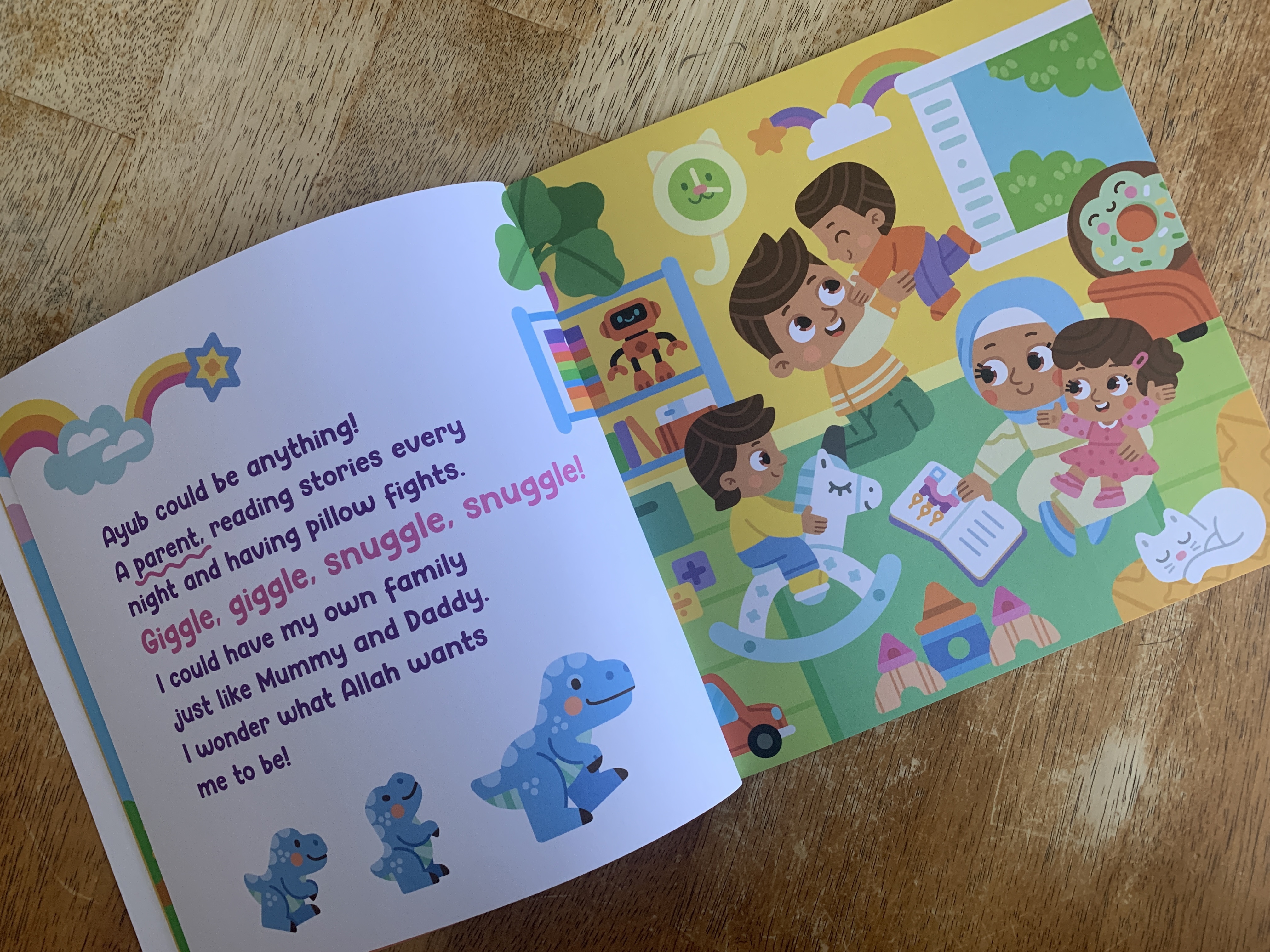
This is not normally a book I would review because it will read like paid endorsement, which it is not.  It is a 32 page personalizable book, that I’m highlighting because it exemplifies a concept of Islamic literature, that is often lacking.  We have numerous books teaching Islamic concepts to toddlers and preschoolers, but forget to teach the secular concepts through an Islamic lens.  We often have a bookshelf of Islamic books that include learning to say Alhumdulillah, and the names of Allah swt; and a bookshelf of non Islamic books that features stories about dinosaurs, monster trucks, and being silly.  This book reminded me of how important it is to have books that do both.  Not to necessarily preach, or even teach, just to merge the two shelves and present a singular framework of Islam, a way of life, not just a religion to our youngest believers.

Sure the name and customizable appearance is fun, but deeper than that, learning about different careers knowing that Allah swt created all of us to do so many worthwhile jobs is a great lesson to be sharing.  The larger concept of teaching Qadr to our children is only presented on the back cover of the book and can be implemented by using the parent guide at the end of the story.

img_4967

The book starts with asking what you want to be when you grow up and informing the child that Allah swt has a plan for us all.  Each page after then mentions the child’s name, introduces a career, and ties back to that Allah swt has written, or decreed something for us.

img_4968

The highlighted careers vary from being a parent, to an astronaut.  A teacher to a chef, a mechanic to a dentist.  There is no priority, nor opinion on one career or job or hobby being more important or more valuable than another.

img_4970

The pages are bright and colorful and the paperback book thick and sturdy.  I did struggle with the word “could,” and often would self edit as I read and would change it to, “Ayub ‘can’ be anything.” I’m not sure why the diction is what it is, but it reads incorrect to me.

img_4969

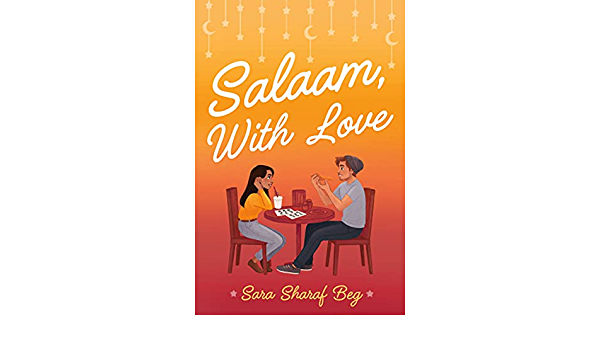
Salaam, with Love by Sara Sharaf Beg

Standard
Salaam, with Love by Sara Sharaf Beg

salaam

This 288 page YA contemporary Islamic romcom is very Islamic centered, and the storyline provides some nice twists along the way.  Unfortunately the writing is terrible.  Not the storytelling or even grammar per se, but the contradictions, errors, underdeveloped characters, and the inconsistencies. Yes I read an uncorrected proof, but this book is a mainstream major publisher presented book coming out in a few weeks, and it is in desperate need of some attention.  I really don’t think it is the author’s fault, it reads as if this was a manuscript that got shopped around and picked up and then never refined, polished, and made to sparkle.  The only saving grace is that as terrible as it is literary wise, once the main character starts to get over her “internalized islamophobia” (thank you @bintyounus for bringing this concept to my attention), the book as a whole presents a lot of unapologetic specific Islamic content on every single page: how Eid salat is different than normal salat,  the beauty of tajweed, the meanings of so many duas and surahs said regularly, the list goes on and on and doesn’t just cover the basics.  The flip side is that the characters are in a band that performs Islamic songs, but with instruments and everyone is fine with it, there are artists in the book drawing faces and portraits hang on walls, it is a romance, but it at most an arm or hand is touched and when tropes about Desi college choices are pushed back on the parents break the stereotype and relent.  There are threads of cultural-ism within Islam, Islamophobia and a violent near death experience, but the book is very clean and  honestly has a lot of potential, I have no idea why it is so sloppy.  SO SLOPPY, and I took notes, so buckle up.

SYNOPSIS:

Seventeen year old Dua is an only child and her doctor father and caterer mom are the only Pakistani and only Muslims in their small Virginia town.  They decide for Ramadan that they are all going to go and stay with family in Queens, New York for the whole month.  They have given Dua less than 48 hours notice to plan to spend the end of her summer with cousins she hasn’t seen in five years.  The parents hope that Dua will benefit from being around family, being closer to other Muslims in the month, and enjoy the cultural environment.  Dua is not excited, but when bear hugs and genuine smiles meet her at the door, she is sucked in to a bustling house and the happiness and drama that is bound to unfold.  Sharing a room with her older, law school bound cousin Mahnoor is by far the hardest relationship to cultivate.  Newly engaged, Mahnoor is quiet, reserved and deeply unhappy.  Dua makes little progress, but with Ramadan starting and her cousins setting goals for the month, Dua is determined to do better in all aspects of her life.  As she gets close to Mahnoor’s best friend, Haya, she also gets closer to Haya’s brother Hassan.   It is Ramadan though, and she isn’t good around boys, but Hassan is a hafiz and is helping her reach her memorization goals for the month, Hassan is also in a band and needs Dua’s help.  When Mahnoor’s engagement is called off to Haya and Hassan’s brother, everything comes to a standstill between the families, but when a cousin is shot, the families come back together to support one another and deal with their decisions and their outcomes.  By the end of Ramadan, every character has changed and grown and is sad the month is over and that Dua and her family are leaving.

WHY I LIKE IT:

Suffice it to say I love how Islam centered it is. I honestly checked the publishing information because of how much Islamic content is included, also for the amount of errors.  The book did not start off well for me with Dua trying to separate herself from her “religious” cousins.  The ones who practice communally and wear hijab.  She was not like “them” and the dichotomy of measuring religiosity as acceptable or not, too much or too little, enrages me.  It sets up that she practices Islam but in a relaxed manner and has been taught by her parents, and it is who she is, but it isn’t a huge part of her life.  As the story progresses, it seems that she just doesn’t know a ton of surahs, she actually is pretty religious, and devout, it is very awkward and not presented clearly, which is why I attributed it more to her being in denial or embarrassed by her identity, not about her level of belief.  Dua is also not like-able, she is incredible privileged and arrogant commenting on the size of houses and rooms, and her shoes.  About half way through she starts to comes across as clumsy, not sure then why is she always wearing heels.  Ultimately she is just not well-developed and often reads like an annoying helpless child.  The framing of Dua being a musician and not being so religious is quickly questioned as she gifts her cousins music paraphernalia, and looks at portraits on their walls.  If most are like me, and both families are praying, fasting, reading Quran, active musicians and artists and ok with hanging pictures, one would assume they are pretty in-syc with one another on their religious views and in practice.

Dua is not the only character that is poorly voiced, fractured, and inconsistent.  Her parents are so unrealistic and awkward in the beginning I physically cringed reading them telling her their reasons for going to New York.  In the car on the way, they even quiz Dua on her cousins names.  She hasn’t seen them in five years, she isn’t a toddler, she should know their names, she has clearly purchased incredibly personalized gifts for them, and is filled with detailed memories of when they all met up in Pakistan together, the whole scene is pointless. One of the cousins, Ibrahim, is blind and Dua says that a few years ago her parents had to explain to her what it meant to be blind.  Seriously?  I get the learning how to let him take the lead and how to interact, but you as a teenager didn’t know what it means to be blind? When you met him in Pakistan you didn’t know he was blind? The four year old cousin is cute and adorable, and has the vocabulary and mannerisms of a seven or eight year old at times, most times.  The 12 year old cousin has the wisdom of an old uncle and why do none of the adults in the book seem to work?  The book probably should have started at chapter five, it seems the book hits a bit of a stride that at least makes it readable.  

A huge plot of the book is the band, Sheikh, Rattle, and Roll, but the details about it are terrible.  Mahnoor is walking out the door and her mom tells her to take Dua.  The reader doesn’t know where they are going, but Mahnoor reluctantly agrees and they head out on the subway.  Mahnoor constantly is telling Dua to hurry so they aren’t late and miss it, when they arrive, the band performs one song and that is when Hassan and Dua and Haya all meet.  But the other two band members are her cousins, she is staying in their house.  What? Rabia is constantly talking, that is her character quirk, how does Dua not know that they are performing? Not know they are in a band?  No way would it not be mentioned.  And why only one song? That is so random.  At the end when they perform again on Eid, it is a concert, it is again only one song.  A concert is not one song.  Do they not practice or load up equipment, how is all this going on in one house and Dua is so clueless? 

The inconsistencies are aplenty.  A few examples: it says her cousin doesn’t wear make-up, a few chapters later has a whole face of make-up, on Eid she even does Dua’s make-up.  When they all are sitting down to write their lists of plans for Ramadan it says they don’t have to share their lists.  Yet a few lines later Dua is singled out in a very creepy way to share hers.  In a single paragraph it says that at home she prays fajr half asleep, or late and in a rush before school, but concludes the description by complaining that praying in congregation is more difficult for her to focus in.  Huh? praying while half asleep or in a rush gives you more focus than praying in jammah?  Even non Muslims are going to be scratching their heads.  At one point as Dua is trying to figure out what she wants to study and if she wants to start an MSA in her high school, since she is the only Muslim, she internally discusses how she wants to prove herself to her parents.  Then when she decides what she wants to do for her, she remarks that she isn’t just doing it to prove to her parents, but because she wants it for her.  The only problem is, no where have we seen or has it been established that her parents are requiring this proof.  

There are odd errors as well.  The athan on a phone goes off, the Uncle reaches in to his pocket for his phone and turns off his iPad.  That is a big pocket indeed.  Dua gifts Hassan a CD, really a CD? What is this 1999? Who gifts CDs in 2021? Dua starts playing a keyboard in someone elses house and no one mentions it other than the two people with her, how big is the house that you can’t hear it? The Uncle gets upset that Dua doesn’t pray Asr right at time, but a lot of people prefer Asr specifically to be prayed later within the time frame.  In a two chapter frame it mentions letting out a breath she didn’t realize she was holding three times, word for word the same.

I was genuinely surprised that music being questionable was not brought up at all, two of the bandmates are huffaz.  The author lets her own qualifiers slip in, perhaps her own desire to not take a stand that could seem alienating.  She says, “allegedly” the time right before iftar is the best time to make dua.  As Dua tries to figure out what is going on with Hassan she often remarks how it is hard or confusing “especially because he is Muslim.” Would a relationship with a non Muslim be ok, less hard, more hard? There is no lowering of any gazes, which for as religious as everyone in the book is, should have at least been mentioned even if not adhered to.  The book puts on odd stress on tasbeehs and kufis, not sure why.  

I do like the genuine love the characters have for Islam, Allah, Ramadan, salat.  It is so much a part of every thing they do, and it is lovely.  I also love Dua’s friend in Virginia, Kat, she is fasting in solidarity and wants to join the MSA even though she isn’t Muslim, but a seemingly amazing friend.

FLAGS:

The on-gain-off-again engaged couple do touch hands at Eid prayer.  Hassan touches Duas arm when she is perceived as helpless.  There are anti Islam protests and an angry man shoots Adam.

TOOLS FOR LEADING THE DISCUSSION:

If the sloppiness gets resolved, the book could be used as a high school book club choice.  Those girls love them some halal romance, and this book is incredibly religious and clean. 
Ms. Marvel Stretched Thin by Nadia Shammas illustrated by Nabi H. Ali

Standard
Ms. Marvel Stretched Thin by Nadia Shammas illustrated by Nabi H. Ali

stretch

This tween graphic novel of our favorite Muslim superhero is authored and illustrated by a new Muslim duo that share an OWN voice story over 110 pages about balancing life and priorities and making time for family.  There is a little bit of action, but the majority of the plot, really is balancing it all, with the help of school friends, one being the hijab wearing brilliant Nakia, and Kamala’s friends from Avengers Training: Miles Morales (Spider-Man) and Tippy Toe (Squirrel Girl).  This seems to be a different format of a lot of the same story-line found in the Avengers Assembly: Orientation book, but for fans of the characters and genre, this middle grades graphic novel (comic book?) will be well received with it’s easy to follow panels and relatable story.  For desi and/or Muslim kids they will appreciate the mehndi celebration, the hijab wearing side characters, the pressure to do well in Quran class, and the tight rope Kamala’s parents give the mixed gender group of friends.

img_4441

SYNOPSIS:

Kamala is being stretched thin with school, super hero training, writing her fan fic, moderating the website, and helping out with her nephew Malik while her brother and sister-in law are on vacation.  The stress has her embiggening all out of whack too, it is a lot for one girl, and when an evil robot takes advantage it will mean even more disappointment for her Ammi.  Kamala ruins her fancy mehndi dress and in embarrassment makes her family leave early, she is late to pick up Malik, and she is sleeping through school.  Finally, with the only two people that know about her alter ego, Kamala gets help from Nakia and Bruno to take down the robot.  She then combines her “club” friends, with her school friends, so that her family can meet everyone, and they can hopefully help her feel more at easy and less stretched thin.

img_4442

WHY I LIKE IT:

I don’t mind the story telling being more personal and less action, but the robot element is really underdeveloped and very much minimized, I’m not even really sure what the point of it was and how it was resolved.  The book seems to be confused if the kids are pre teen or teens, they are called both in the book, and I don’t know if it is an error, or is a joke from Tony Stark, but the voice seems to be ambiguous as well, which makes it hard to completely connect to the characters.  I wish the mom wouldn’t cover when at home, I mean I’m glad to see her covering and talking about Quran and all, but being an OWN voice portrayal, it would have been nice to see that detail.  The way that the friends as boys is handled is actually really well, it doesn’t become a whole religious or cultural soap box issue, but chaperones are present and the mom is on top of it. There is no hint that anything would be going on, but it is nice to see that accurate representation.  I also like the diversity that is present even within the Desi family.  Sadly, the book as a stand alone is rather forgettable, I’m not entirely sure what to compare it to, if there will be more in this particular series, or just more like it from other MCU characters, but for people that love Marvel, at least this rep exists if nothing else, it does offer a reminder to all kids to prioritize their time, ask for help when needed, and to make space for their families.

img_4443

FLAGS:

Clean. There is a destruction seeking robot and villain, but very tame.

img_4444

TOOLS FOR LEADING THE DISCUSSION:
I think the book would be fun on any middle grade classroom shelf.  There isn’t much to discuss, but kids especially in Islamic schools will  enjoy the representation.

img_4445

House of Glass Hearts by Leila Siddiqui

Standard
House of Glass Hearts by Leila Siddiqui

glass hearts

This 278 page magical realism YA book featuring a Muslim family grabs your attention and heart in the prologue, unfortunately it quickly releases it, and until you get over a third of the way in to the story, it is a struggle to read.  Once you accept that half of the book, the storyline set in the present, is going to be terrible, you enjoy the historical narrative and appreciate that the short book with a quick pace spends more time in the subcontinent during partition, than it does with the painfully underdeveloped characters trying to make sense of past secrets and their present day manifestations.  The book doesn’t have any major flags in terms of religious representation, it is just ritual acts of praying and reading Quran, nothing detailed or explored, and relationship-wise there is nothing high school readers can’t handle (spoilers and more details can be read in the FLAGS section).  Despite being a first time author, she works as an editor, so one would really expect the climax to hit harder with clearer writing, the characters to be developed, the details written to serve a purpose, and the protagonist teen’s voice not to read overwhelmingly at the beginning as a five year old.  The overall story concept and historical fiction component are exciting, the development of the characters just really failed an otherwise engaging read. 

SYNOPSIS:

Maera’s brother Asad goes missing in 2011 from their grandfather’s home in Pakistan while they are visiting.  They search and cannot locate him or a body, the loss devastates Maera’s family.  Ten years later, her grandfather passes away, and the next morning a greenhouse appears in their backyard in America.  Not just any greenhouse, her grandfather’s greenhouse from Pakistan.  Maera thinks she is going crazy, her mother doesn’t acknowledge the structure, she doesn’t acknowledge much, not about the reality in front of them, not the night Asad disappeared, or the needs of her daughter. Maera’s aunt (mom’s twin) and cousin come from Pakistan to mourn the loss of the grandfather together, he passed in Pakistan, not sure why Maera and her mom didn’t go there, but I digress.  Cousins Jamal, aka Jimmy, and Maera are the only two that seems determined to figure it all out.  Their grandfather’s journal turns up and with Maera’s friend Sara and Rob, the neighbor and former best friend of Asad, the four of them set out to understand what is going on in the greenhouse.
The greenhouse seems to be alive, and entering it dependent on the whims of something within, a churail,  a shape shifting creature of myth that is more than a witch, a succubus that targets men.  A woman who died violently and was wronged by men, whose feet are turned backward, and who is neither alive or dead.  As the four work through the journal, venture in to the greenhouse, and confront those within, secrets will be unearthed, exposed, and finally dealt with.

The historical interwoven story is that of the grandfather during colonial British rule and partition.  As a young boy Haroon is searching for his father fighting in Burma and the adventures he has along the way. Shah Jehan’s father takes Haroon in at one point, and the girl with an emperor’s name sneaks him out to watch the village deal with the churail who are killing the men in their village.  The incident scars Haroon, but his affection for Shah Jehan and the role she will continue to have in his life is established. The understanding that the subcontinent is being carved up and starved by the colonizers in the name of freedom is made clear in the characters that Haroon encounters and the quickly maturing boy grows in to a young man as he starts to understand the world around him and the larger powers at play.  When the migration and violence between Hindus getting to India and Muslims going to Pakistan occurs, the pieces in the past and present come together to reveal the terrors that the greenhouse houses. 

WHY I LIKE IT:

I loved the commentary both in the text, and explicitly detailed in the afterward about how culturally the past is handled.  How little generations discuss what they have endured and been through.  I have been asked by my father-in-law a few times to try and coax my mother-in-law to detail her journey with their oldest son from India to Pakistan.  She has apparently never clearly told what happened, what she saw, and what they experienced.  She waves it off now, but her own children didn’t even know there was more to the story, and as my inlaws approach their 90s I have little hope of them recalling or sharing their stories.  Recently my son needed to hear some first person accounts of war, so he contacted my American grandfather to learn about his time in the Korean War, much of it I knew, Americans, generally speaking, talk about this type of experience in passing.  My son, also wanted to compare his story to someone who lived as a civilian through a war, and asked my mother-in-law, his Dadi, about her experience living through the Indo-Pakistan War of 1971, not that long ago, and we all sat spellbound as she recalled the sirens and how they kept the children fed and calm and whatnot.  They were stories no one had thought to ask it seemed.  She has seven children and almost thirty grandchildren.  This book struck such a chord with me, I need to actively seek out these stories before it is too late.   Chances are no one else in the family will. Not speaking the language fluently has cost me my chance to learn my own father’s family’s stories and I need to find a way to gather my husband’s family’s stories before it is too late. I love that in the book, The Past is capitalized as if it is a named living person shaping the lives of so many.  It is, and these stories are wonderful reminders and motivators to ask the elders to share their memories.

The present day story thread, however, is chalked full of holes, one dimensional characters, and pointless tangents.  Sara and Maera read like they are early elementary aged.  They are so terribly voiced in the beginning, I have no idea, how an editor author and mainstream publisher did not require correction.  The dialogue, the action, the role of the parents, it is terrible.  Speaking of terrible, the mother and aunt are absolutely flat and useless.  They mope, sleep and sit in the corner.  I don’t understand why you wouldn’t develop them to link the past story to the present one.  I’m not being picky here, it is that bad.  I also wanted to know why the dad left.  Seems like it would flesh out the mom a bit, justify her approach to life.  Sara and Rob are obviously brought in to serve as vessels for the action, and for Maera and possibly Jimmy to play off of.  But their backstories are so pathetic.  How do you not know or see your neighbor for ten years.  Ok, I get that he was Asad’s best friend and your family in their grief and denial pushed him away, but he never checked the mail or took out the trash, or was seen? And Sara offers absolutely nothing to the story other than to be part of the forced crush/romance line pairing off her and Jimmy and Rob and Maera.  Alhumdulillah, it stays tame with the angsty longing and hand holding.  

Random details that serve no purpose reach a pinnacle with the paragraph long time spent on Maera wearing Rob’s tank top.   I have no idea why we should care that she is wearing a tank top.  Sure as a Muslim reviewer it furthered the notion to me, that she is probably more culturally religious, and yes I know Muslim’s dress to different degrees of modesty, but I really couldn’t find any other reason for the emphasis on the black tank top. Overall, all the friendships in the story seem so off: Rob and Asad, and Sara and Maera.  They should be easy plot points, but they don’t connect, or read believable.  

Plot wise: if you had a building magically appear in your back yard along with a journal, would you not read that journal as fast as possible? Sure you would lose sleep and maybe skip a meal or two, but hello, a building just appeared in your back yard that is moving and growing, your grandfather died and your brother’s body was never found: stop what you are doing and read the journal.  It mentions that when Asad went missing there were a lot of other kids, cousins at the house, so where are they now? Why was there no mention of them, and only Jimmy seems to have a vested interest in the grandfather passing, and the growing need to remember Asad.  I did not understand the sacrifice and hair connection and how that was what Maera understand the Churail to be asking for.  I did not understand the end of chapter entitled “The Separation,” it says they entered together, so…. ya?Off and on in the greenhouse there are multiple churail, this seems inconsistent with what we learn from the one churail about leaving.  The whole climax needs a Cliff’s Notes synopsis.  I honestly have no idea what happened.  The churail was scared of the beast, but they all went off together, affectionately? I’m trying not spoil anything here.  Why was the churail so different at the beginning compared to the end, why did she get a growth arc, when the other characters didn’t? Shouldn’t there have been some cathartic reprieve verbalized between the mom and SPOILER (sorry I tried) Asad? I felt deprived.  

There were a few grammar errors, but because I read an ARC, I’m hoping they have been corrected

FLAGS:

There is a little bit of language (F word at least once).  Children are conceived, it isn’t explicit, but the fact that it happened is critical to the story.  There are crushes, angsty/longing, hand holding, hugging.  There is sexual assault implied as a major plot point, but not detailed.  There is death, and killing, often gruesome, some real, (hits harder), some far fetched.  The book is YA and  ok for high school readers and up in my opinion.

TOOLS FOR LEADING THE DISCUSSION:

I would be interested in seeing if some of the muddled passages are cleaned up in the published physical copy, the book’s characters are weak, but the historical fiction component is a story that needs to be shared more and more as we, collectively, seek to understand the past, the impact of colonization, and the emergence of telling our OWN voice stories.  For all the flaws, I haven’t completely written off the book, I’m hopeful that even if this one doesn’t make the cut for a book club, that inshaAllah the author will keep writing and filling in the blanks.

What’s The Matter Habibi? written and illustrated by Betsy Lewin

Standard
What’s The Matter Habibi? written and illustrated by Betsy Lewin

matter habibi

This short silly 32 page AR 2.7 book by the illustrator of the famous Click, Clack, Moo books tells a tale of an unhappy camel in Egypt and his caring owner Ahmed’s attempt to understand what is wrong.  There is nothing religious in the book, save a few visible hijab wearing women in the bazaar illustrations, and the main human character’s name.  The cultural backdrop though,  does introduce and encourage familiarity for young readers who may not have exposure to Arabic words and people.  The author is clearly not Arab, but the book thanks the Cairo NESA delegates for their help in developing the story.  Before reading it I was nervous that because the presentation would be coming from an outside perspective,  that the messaging would be condescending and/or stereotypical.  I think I was perhaps giving the book way too much thought, because ultimately the story isn’t that deep.  The illustrations and tone are warm and focus on a camel wanting a fez and the efforts it takes for Habibi to acquire one and for Ahmed to track him down.  It is surface level silliness for younger kids, the camel and owner are kind to each other and the setting just ties it all together.  I am not Arab, and could definitely argue that the camel and his silly owner do perpetuate stereotypes, so feel free to offer up your thoughts if you have read the book.  Irregardless of where you side, the fact that I’m sure had I read this book in 1997 when it was published, I would have been gushing to see the name Ahmed in a widely available book, but here we are nearly 25 years later and I’m questioning if these are stories that are better left to be told by OWN voice perspectives.

img_4356

Ahmed and Habibi give rides to children every day, but one day Habibi refuses to get up.  Ahmed asks if it is a toothache, a tummy ache, and no response.  When he asks if his feet hurt, Habibi stands up, and Ahmed gives the camel his babouches (that magically fit).

img_4357

Habibi then takes off running through the bazaar.  He approaches the man selling fezzes and a trade is made: the slippers for a hat.  Ahmed trailing behind barefoot, then has to purchase his own shoes back.  As Habibi passes different shops and hears how handsome he is, Ahmed is able to follow him.  When they finally reunite, Habibi is surrounded by happy children, and Ahmed admits, he really is a handsome camel.  Happily Habibi gives the children extra long rides and then let’s Ahmed ride him home.

img_4358

This book would work well for story times to ages four and up.  It would lend itself to themes about silly animals, hats, Egypt and Arab culture.  The crowds of people including the children are dressed in both thobes and pants and t-shirts.  You see traditional headgear on some and none on others.  It seems clear that the camel is not the normal mode of transportation, as there are no other camels, or even cars, only people walking in the book.  Habibi is a novelty for the children and adults he passes, so one could possibly safely assume he is a tourist attraction of sorts.

img_4360