Category Archives: Elementary Fiction

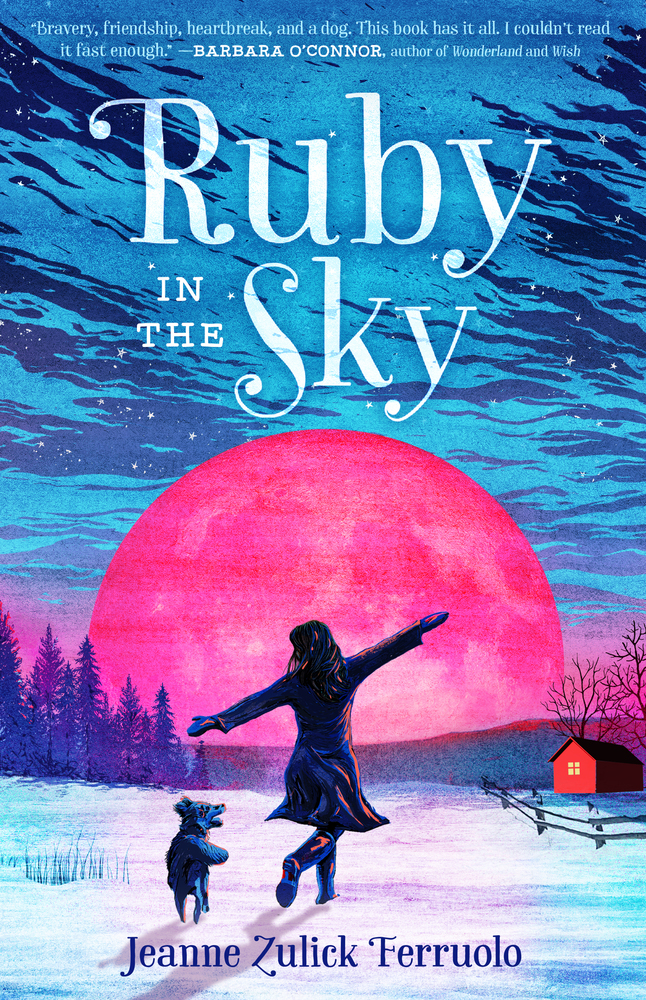
Ruby in the Sky by Jeanne Zulick Ferruolo

Standard
Ruby in the Sky by Jeanne Zulick Ferruolo

ruby

The author of this wonderful middle grades novel reached out to me after I reviewed her book A Galaxy of Sea Stars, to let me know that this book too has a Muslim character.  As we exchanged emails back and fourth I learned more about her work with Integrated Refugee and Immigrant Services in New Haven Connecticut (IRIS), and the impact the people she has met there have on her and her writing (the new paperback version of Galaxy has bonus content that reflects this).  Allies and advocates are gifts for Muslims and for our fictional representation.  The details and warmth of her Muslim character, Ahmad, a Syrian refugee, is seamless and accurate, and while this is not his story, his support of the main character helps normalize Muslims as friends and in daily life.  He takes time out for his five daily prayers, he refuses to shake a female’s hand, and he uses the word inshaAllah.  The story is Ruby’s though, and her journey pulls you in from the first chapter and leaves you cheering for her long after you close the book.  Over 295 pages (AR 4.1) you witness Ruby find her voice, dare to not be invisible, accept friendship, and help others.   

SYNOPSIS:

Ruby has just moved to frozen Vermont from their last “forever home” in Florida.  Originally from D.C., Ruby and her mom have been moving to places they have vacationed to try and find joy.  Since Ruby’s father, a police officer, died, the two of them have been broken and barely surviving.  The only constant is a cousin, Cecy, who helps them out and convinces Ruby’s mom to come back to her childhood town of Fortin, and to be closer to her.  The winter is bitter, the house is freezing, and even with Cecy arranging for Ruby’s mom to have a job, it only takes a day for Ruby’s mom to be arrested, fired, and for Ruby to be on her own.  With only a garbage bag full of belongings, and some thrift store finds for warmth, Ruby’s plan is the same as it has been in every other town they have landed in: keep her head down and be invisible.  Ruby’s dog, Bob, though has other plans, and when he takes off into a neighbor’s yard filled with ‘No Trespassing’ signs a meeting with Abigail takes place that will change Ruby.

Abigail Jacobs is known in Fortin as the “Bird Lady.”  She has a home, but lives in a shed on her property, dresses in layers of scraps and scarves, feeds the birds, and keeps to herself.  The rumor is that she killed her husband and daughter, everyone knows it, it could just never be proven.  There are also stories that she has a moon rock.  When Ruby meets her she is angry and cold, but the way she interacts with the animals and her knowledge of the moon, keeps her intrigued and even though Ruby’s mom forbids her from visiting Abigail, Ruby and her develop a friendship of sorts.

At school Ruby’s plan to go unnoticed is challenged by Ahmad Saleem, a refugee who lives with his uncle a grocery store owner and is teased by a few classmates for his accent and disappearances at lunch time when he goes to pray.  He is kind and and determined to help Ruby and immediately declares her his friend.  Ruby tries to avoid him, but eventually he starts to win her over.  With the upcoming wax museum, a Fortin favorite, drawing near, Ruby tries to explain to her teacher that they will be leaving back to D.C. before the final presentation, but Mr. Andrews isn’t letting her off and somehow she finds herself researching Michael Collins, the astronaut that stayed on the space shuttle alone to circle the dark side of the moon while Neil Armstrong and Buzz Aldrin took their historic walk. 

With the mayor singling out Abigail with his new ordinances, Ruby’s mom deciding not to take the plea deal and fight her case at trail, the short cold days, the desire to return to D.C., the wax museum approaching, and Ruby needing answers, Ruby at some point will have to stand up and speak out.

WHY I LIKE IT:

I love that the story unfolds in layers.  You don’t know where it is going, but the slow peeling away shows the complexity of people and situations.  The book doesn’t shy away from confronting stereotypes and looking beyond appearances.  I like that there is some discussion of Islamophobia, when Ahmad is overheard speaking Arabic for example, but the character that needs the most standing-up for is an elderly white woman.  The small pivot allows the book to avoid a familiar theme and shows the reader a Muslim shop owner helping the tattered woman that the town fears and resents. I enjoyed the strong reminder of how women and science and their careers have not been widely accepted until recently.  I think many readers will be surprised that much of Abigail’s rumors stem from her being a brilliant educated woman that society struggled to respect then and now.  I absolutely love the science and space aspects that bring Ruby Moon, her neighbor, and her class project together.

I wish there was a little bit more about her mom and her relationship at the end.  The disconnect in their relationship warranted the sparse information in the majority of the story, but I needed some hope for the two of them.  Same for the relationship with Cecy.  I get that Ruby doesn’t have a good relationship with her mom’s cousin, but as Ruby grew in so many ways, I wish that her appreciation of what Cecy has done for her and her mom would have also been realized in some capacity.

FLAGS:

Ruby being dishonest. Death, injury of a pet, physical assault, bullying, teasing, Islamophobia.  

TOOLS FOR LEADING THE DISCUSSION:

I probably wouldn’t focus an entire book club on this book, but I think it would be a great addition to a summer reading list.  The insight into a character trying to find herself within her own family and experiences with connections to history and science would be a benefit to any child to read and reflect upon.
The Olive Tree by Elsa Marston illustrated by Claire Ewart

Standard
The Olive Tree by Elsa Marston illustrated by Claire Ewart

olive tree


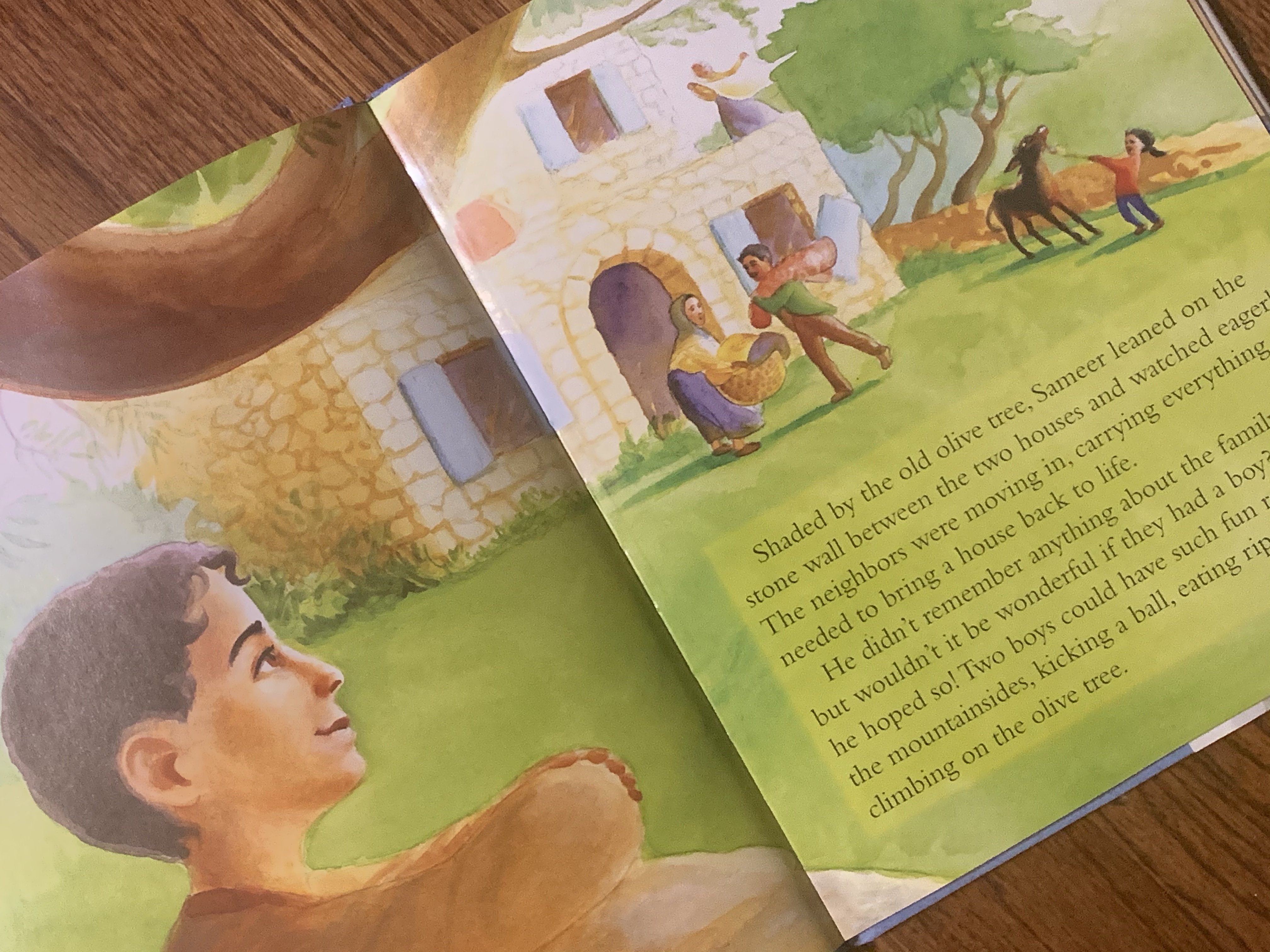
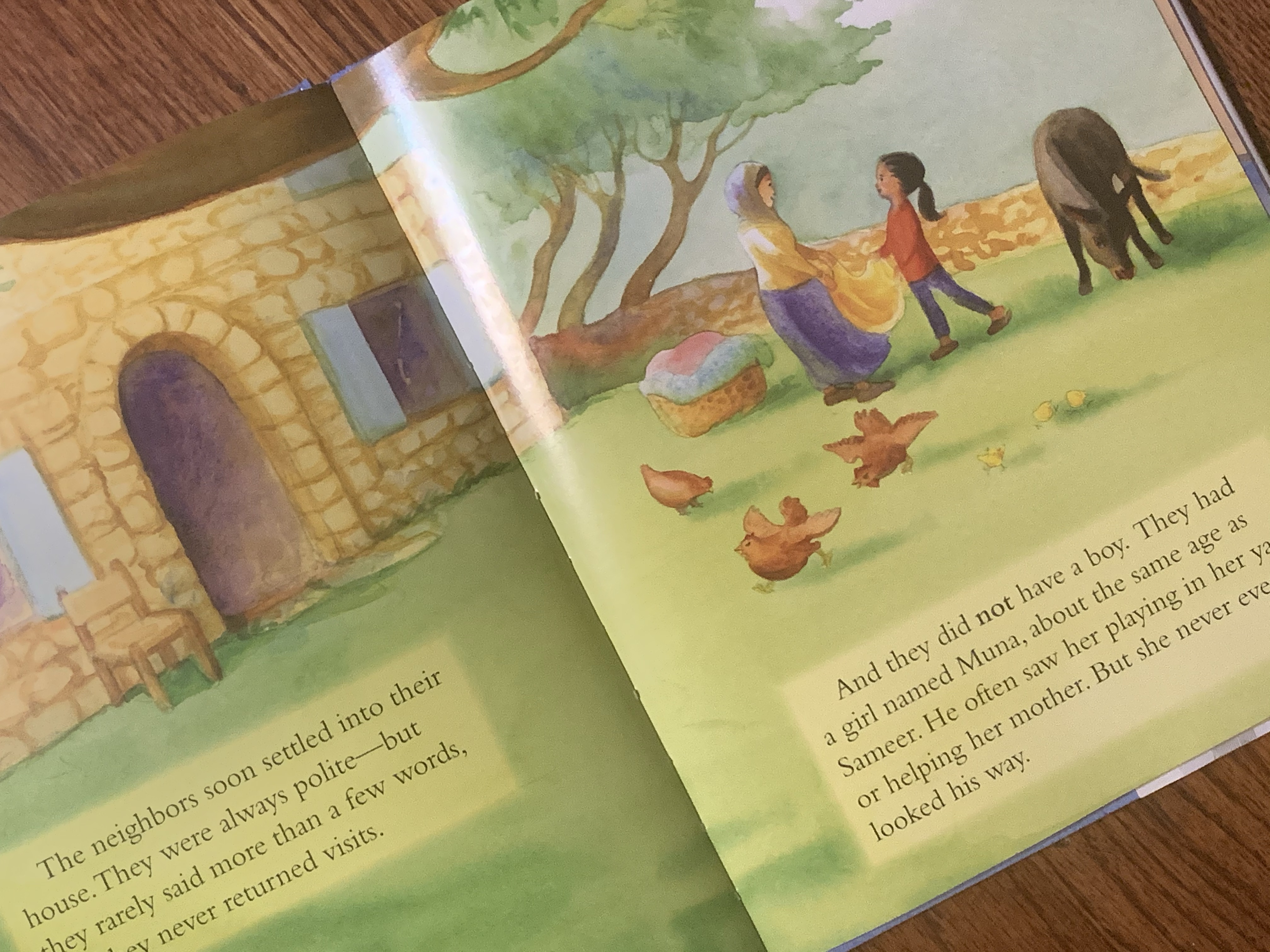
Set in Lebanon, this 32 page book for kindergarten to second graders uses the ever important olive tree as a point of contention between two neighbors. Muna’s family moved away during the conflict because they were not like the others in the village, and while they were gone, Sameer’s family cared for the olive tree on their neighbor’s property, and collected the olives that fell on their side of the wall. But now that the neighbors have returned, Sameer is not only disappointed that they don’t have a boy his age to play with, but also clashes with Muna when she says that he shouldn’t take their olives. By the end of the book, olive branches of peace will be referenced and hope hinted at in this brightly illustrated book with a lesson.

img_1647

I like that why Muna’s family left is not abundantly clear, saying that “For many years the house next to Sameer’s had stood empty. . . that the family who lived there had gone away during the troubles because they were different from most of the people int he village.”  Lebanon is a diverse place and the illustrations seem to show both Mom’s wearing head scarves, the text does not detail if they are unlike each other because of religion, or culture, or some other reason, and I kind of like that it is left vague so that children learn in the end perhaps, it doesn’t matter.  

img_1648

When the family moves back home, Sameer watches them and recalls the ways his mom prepares the best olives in Lebanon.  The neighbors are polite, but not friendly.  They don’t ever say much and they don’t return visits.  One day when the ripe olives have fallen on the ground, Sameer heads out with his basket to collect them.   Muna, who has never looked over at Sameer, watches him and tells him that they are her olives, and that the tree has been in her family for a hundred years.

The two bicker about who has rights to the olives on Sameer’s side of the wall and in anger, Sameer dumps his basket of olives on Muna’s side and walks off.  After that, no one on Sameer’s side collects the olives on the ground.  One night there is a storm and the olive tree and part of the stone wall are destroyed.  The adults gather to survey the damage, but walk off without saying anything.  The two children are left to decide what to do next about their beloved tree, and their relationship with one another.

img_1649

I like that the resolution is subtle, but thought provoking and that the adults don’t seem to interfere too much.  I can’t imagine that they don’t have opinions about their neighbors and the olives, but the book stays on the children and the assumptions, stubbornness, and unsaid words that have created such a divide, and must ultimately be resolved as a result.


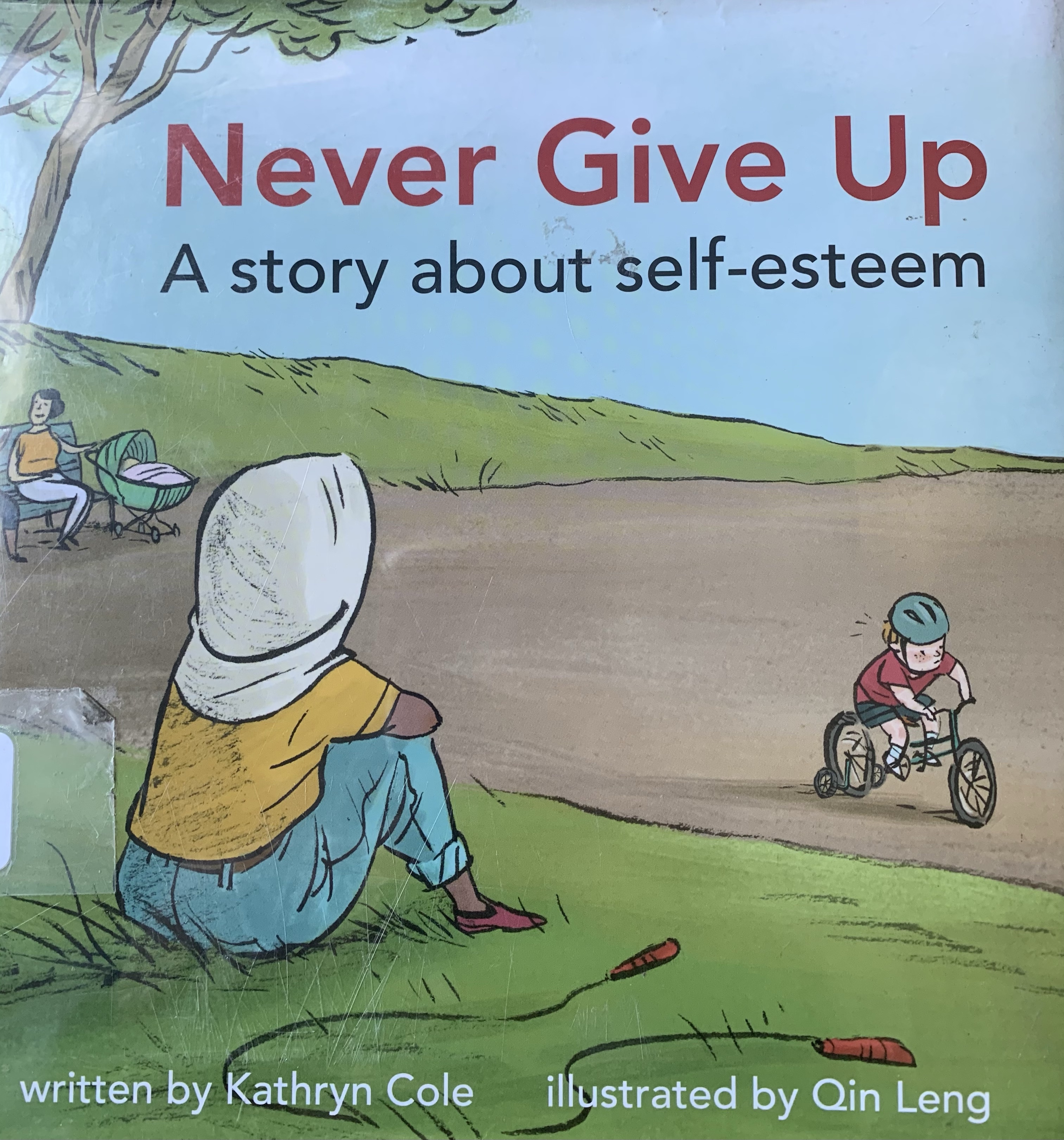
Never Give Up: A Story about Self-Esteem by Kathryn Cole illustrated by Qin Leng

Standard
Never Give Up: A Story about Self-Esteem by Kathryn Cole illustrated by Qin Leng

img_9838

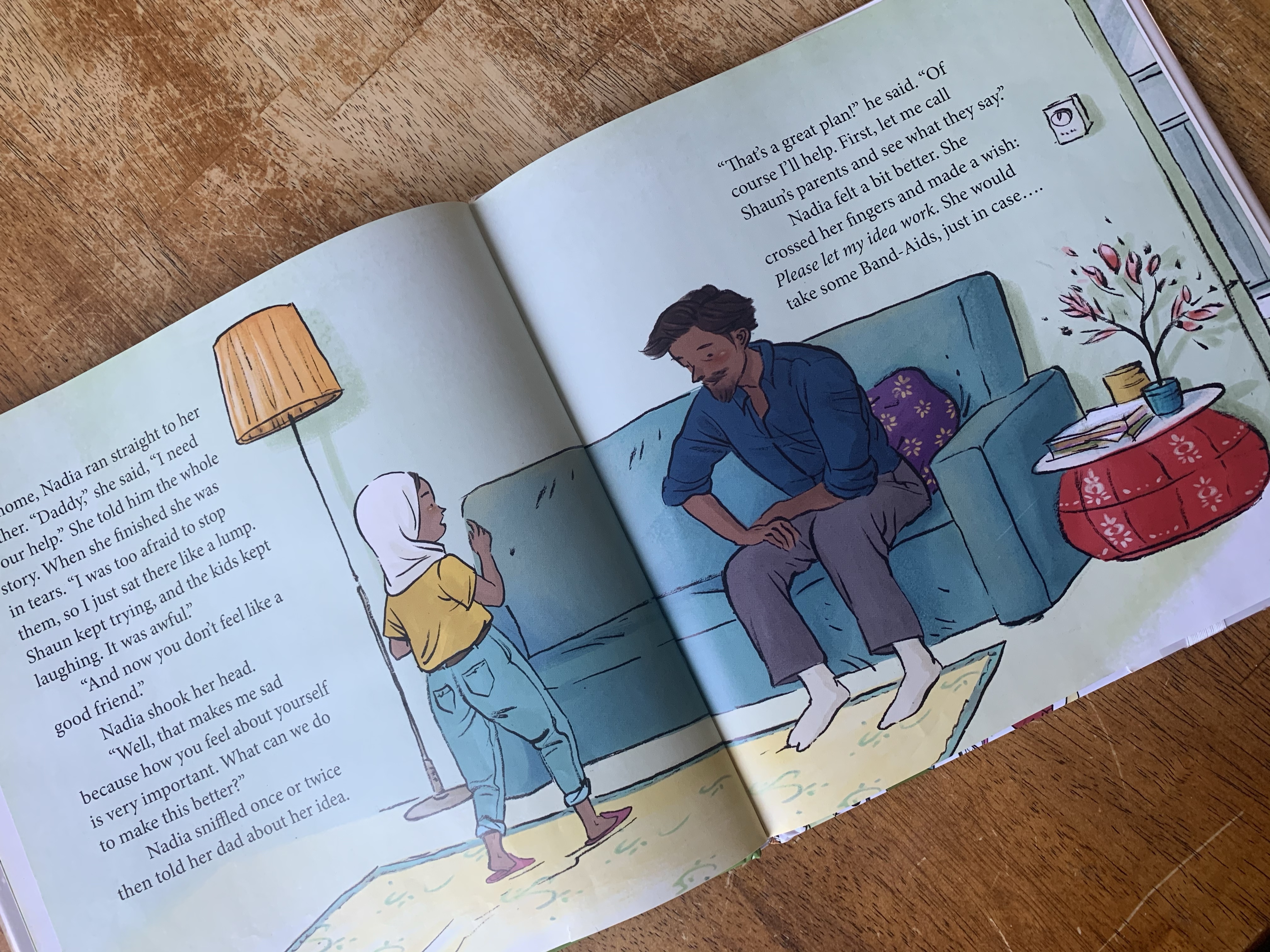
This first through third grade teaching series highlights different life lessons and concepts and features diverse characters. I reviewed a book in the series earlier with a Muslim character, not realizing that there was also one with Nadia in the lead. The 24 pages show her in hijab both at the park and at home although she wears short sleeves and is much younger than puberty, when covering becomes required. Neither the author, nor the illustrator seem to be Muslim, and religion is not present in the book, other than Nadia’s scarf. It is worth mentioning that Nadia crosses her fingers and makes a wish that her plan works, something most Muslims would say inshaAllah for and possibly want to be made aware of in a book like this. Overall the message is strong, and would be a great book to read and discuss with a child, Nadia and her friend Shaun have noteworthy traits that we can all learn from.

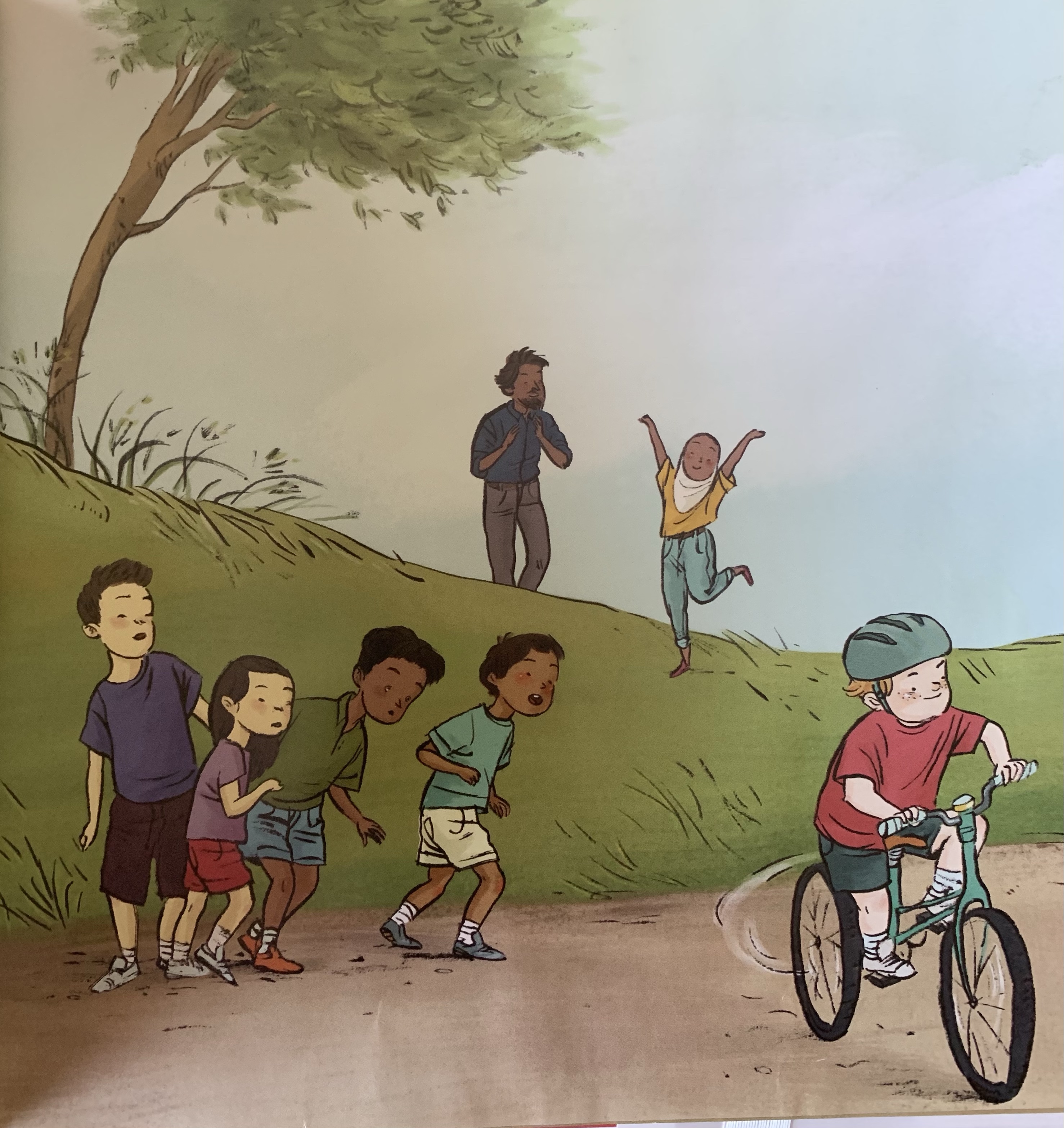
Nadia is heading to the park to practice jumping with her new rope. She stops when she sees her friend Shaun riding his bike with training wheels. She has been riding on two wheels for a while, and even on training wheels Shaun is struggling. Kamal, Joseph, Lin, and William start teasing Shaun, and Nadia is upset, but not brave enough to do anything about it.

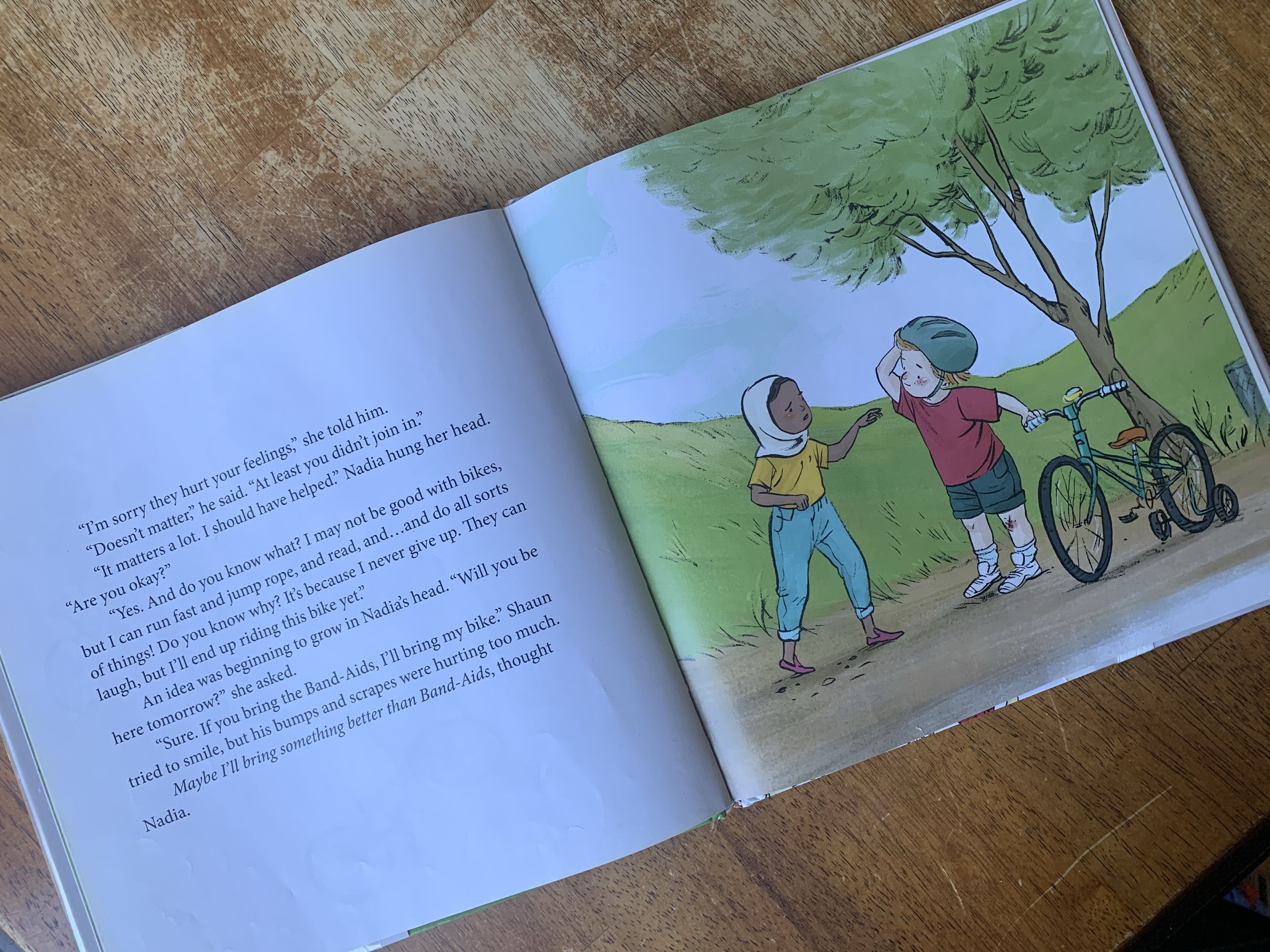
After crashing a few times, the crowd grows tired of laughing at Shaun and Nadia goes down the hill to check on him. She apologizes that the other kids were teasing him, he takes it in stride and thanks her for not joining in. He also lists off things he is good at. He is determined, and Nadia has an idea. The two agree to meet back at the park the next day.

Nadia is upset when she gets home. She tells her dad the whole story and how she wishes she was a better friend. She then talks to her dad about her plan, and gets him to agree to help, her dad checks it off with Shaun’s parents and the next day they all meet at the park to take off the training wheels and teach Shaun how to ride with two wheels.

After multiple attempts and lots of cheering, Shaun is riding his two wheeler. He didn’t give up! Now it is Nadia and her dad’s turn to try jump roping, and after some struggles, it is the kids cheering on Nadia’s dad and encouraging him to try again.

The end of the book has Tips for Grown-Ups about how to develop and support children’s self-esteem.

Sitti’s Olive Tree by Ndaa Hassan illustrated by Soumbal Qureshi

Standard
Sitti’s Olive Tree by Ndaa Hassan illustrated by Soumbal Qureshi

olive trees

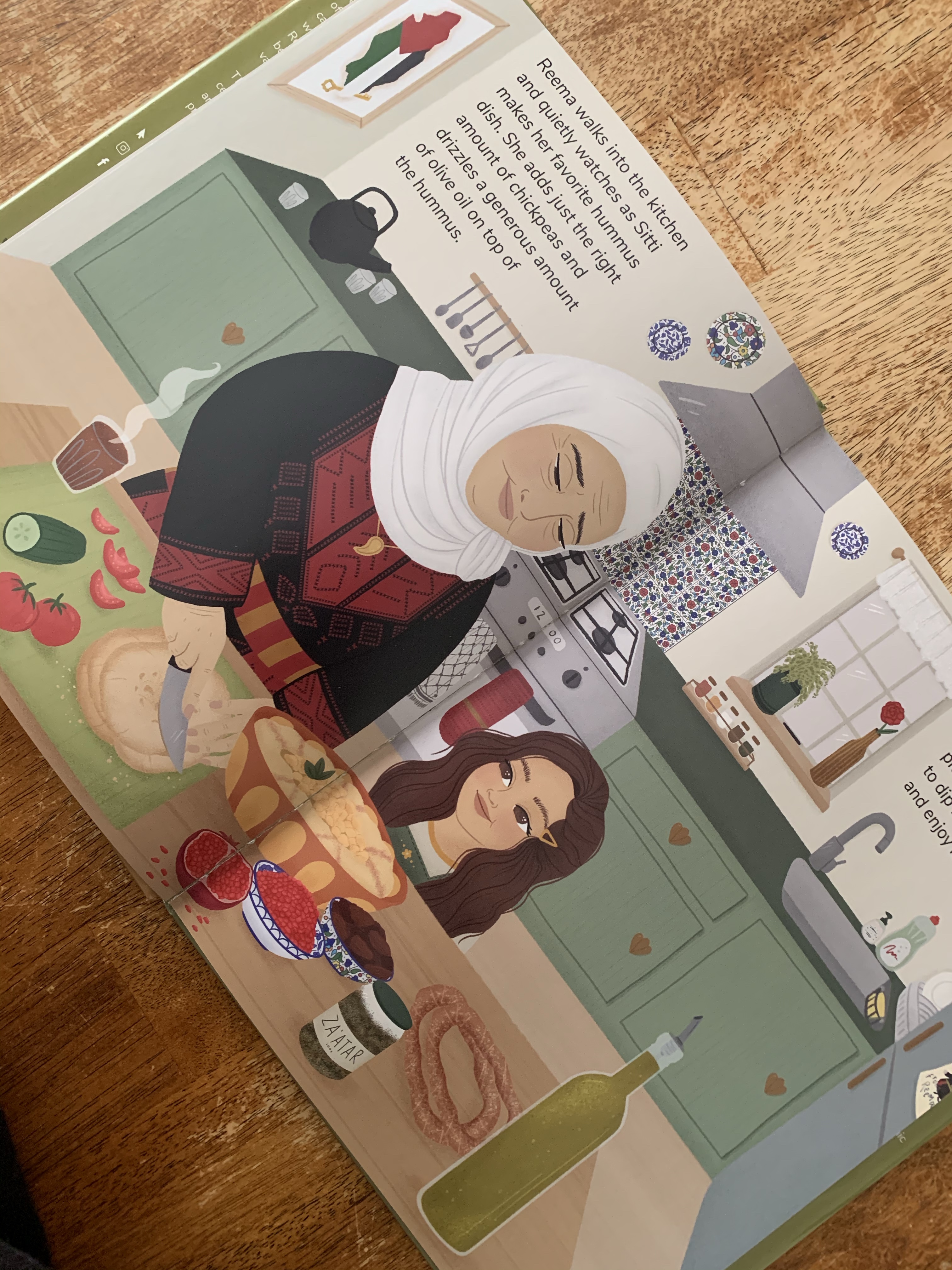
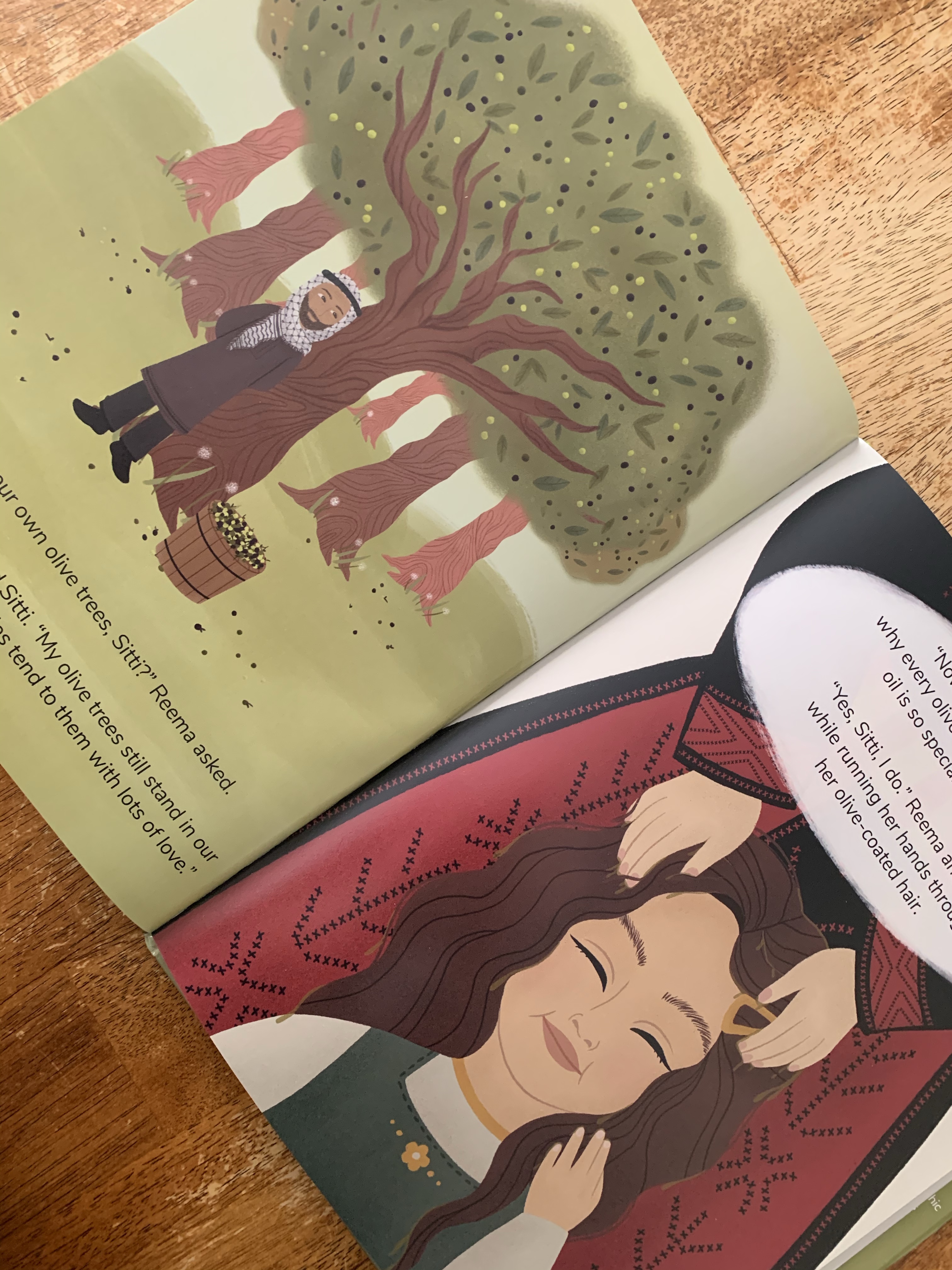
This lovely 27 page book is a story infused with love, culture, and olive oil.  The hardbound, large thick pages are richly illustrated as the text, perfect for ages preschool to second grade, tell of the olive harvesting season in Palestine.  The story is framed between a young girl learning about the past from her grandma’s memories and enjoying the olive oil sent by her uncles from their homeland.  The story is warm and informative and does not discuss politics or conflict. There is a key hanging on a map of Palestine in the illustrations, but nothing in the text.

img_1213

Young Reema watches her Sitti make hummus. When a drop of olive oil slips down the side of the bottle and Sitti wipes it up and rubs it in Reema’s hair.  Reema wants to know how olive oil, zeit zaytoun, can be used in such different ways. As Reema is reminded of how far the oil has traveled and recalls that her Sitti never buys olive oil at the store, the two settle in for Sitti to tell Reema some of her memories about the harvest on her ancestral land.

img_1214

Olive harvesting season comes at the end of the year and the families gather to pick the olives and fill the buckets before climbing ladders and catch the falling olives on blankets.  The elders sort them, and at the end of the day they eat and drink tea and coffee and laugh and enjoy each other’s company.

img_1215

They tell stories to pass on to the next generation just like Sitti is doing to Reema, because the olives keep the families together.  Sitti hopes one day Reema will go to Palestine and play among her family’s trees.

I wish there was a bit more detail about the hummus, it seems to imply that the garbanzo beans are whole and not smooshed or blended, also when it lists the other things Sitti’s grandparents would do with the olives, the list is olive oil, olive soap and olives for eating.  I would imagine there are more things to do with the olives, even perhaps detailing the way the olives for eating are pickled, or preserved, or prepared would have been nice.

img_1216

There is a glossary of a few terms at the end.  There is nothing religious in the text, but many of the women wear hijab in the illustrations.

Overall this book is well done and serves an important point in showing a culture that is rich and full, aside from conflict and politics.  It is a sweet story between a grandmother and her granddaughter and shows how stories, traditions, and food help pass on culture and heritage.

.

The Girl Who Stole an Elephant by Nizrana Farook

Standard
The Girl Who Stole an Elephant by Nizrana Farook

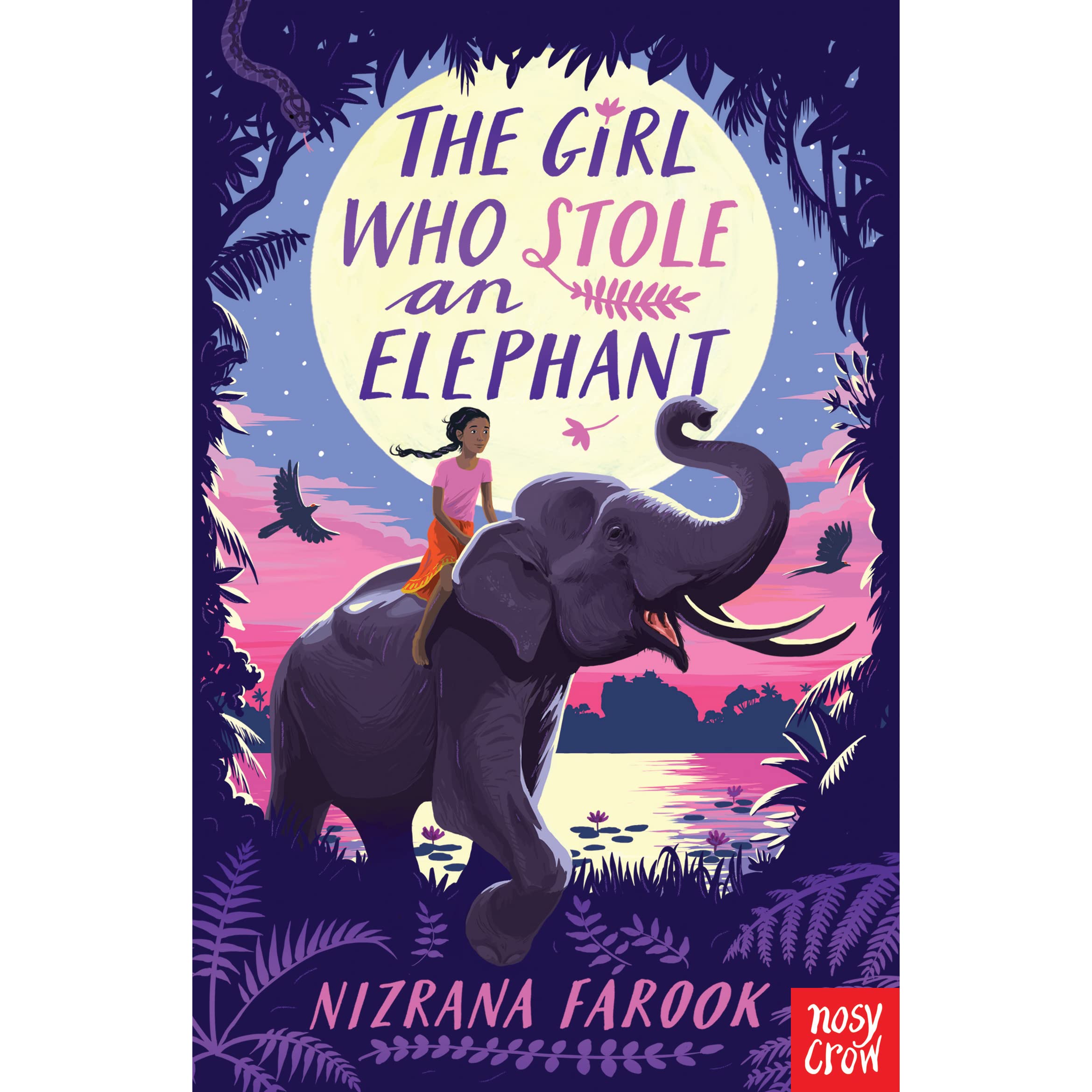
elephantI have to admit this 240 page middle grade OWN voice book had me invested and glued to the pages.  I was swept away to Sri Lanka and in disbelief at the boldness, cleverness, and spunkiness of the Robin Hood-esque 12-year-old protagonist.  I could not put it down as my head worked over time to figure out how this trio of children, one being a Muslim girl, was going to get out of the heap of trouble they had caused.  Yes, admittedly it wraps up a bit too quickly and simply, the main character Chaya doesn’t learn her lesson and is a terrible friend, and there isn’t a good moral of lying and stealing being bad.  But all that aside, the book is a fun adventure that while written pretty straightforward and clearly, is rich in adventure, culture, and excitement for second to fourth grade readers (and 40 year old moms that love strong girls).

SYNOPSIS:

Chaya is the daughter of a tribal representative, whose mother has passed away.  She goes to school, attends the temple once a week to learn Sanskrit, and at dawn is known to steal things to give to those in need.  At night time, people are on guard, expecting trouble, but dawn seems to be the perfect time to take what she needs from people that won’t even notice.  The book starts out with her stealing jewels from the Queen with the hopes of helping a friend who was bitten by a crocodile get medical help in the next town over.  The people in Sarendib have an unjust king, and stealing from his wife to help take care of people that need assistant is a job Chaya takes seriously.  Her heart is in the right place, but when a guard sees her she stops to visit a friend who works in a wood shop to hide the jewels until the heat dies down.  The box they hide the stolen goods in is purchased by a young Muslim girl, and now Chaya has to steal them back from her to get them to people that are in need.

The chain of events is just getting started, and when the jewels are discovered the wood working Neel takes the blame and is imprisoned, and the new girl in town, Nour, is determined to help free Neel from prison and save the villagers from being tormented by the royal guards.  Chaya devises a plan to free Neel from the palace dungeons, but nothing ever quite goes to plan and all the prisoners are freed.   As she runs to escape her own doom, she steals an elephant to get away, the king’s elephant.

The entire story is a series of follies and at each turn the children have really good intentions, they just keep snowballing into situations beyond their control with the stakes constantly multiplying.  I really don’t want to give it away, but they might just bring down a monarchy as they tromp through the jungle on an elephant, accidentally burn down villages, and find that even though Nour is a wealthy meat eater, they can in fact be friends.

WHY I LIKE IT:

I love that the story is outrageous, yet grounded.  I was sucked in from the first few short chapters and didn’t look back.  Chaya is oh so plucky and her fallibility and flaws make her so endearing.  She is a bit of a mean girl to Nour, but I think she shows growth.  The slight raised eyebrow regarding her, is that she didn’t learn some grand lesson, and in fact is possibly emboldened by her thieving and getting away with it.  There probably should have been some humbling at the end, but she is bold and outspoken, and not one for regrets.  I absolutely love the letter she left her father owning up to her role in the whole hullaballoo, and as an afterthought acknowledging that she skipped two days of school.  She is a cheeky one, but her heart is huge and she has her own sense of integrity that is unwavering.

I like that Nour is acknowledged as being Muslim, eating meat, and going to mosques before she moved.  It doesn’t articulate that Chaya doesn’t like her for her faith, but it isn’t helping the two girls befriend each other either.  I love the elephant, and the plants, and fruits, and animals that bring the story to life.

FLAGS:

Lying and stealing. Some destruction of property.

TOOLS FOR LEADING THE DISCUSSION:

I can’t see me doing this as a book club selection, it is just too young of a target audience, but it would be a blast to read aloud to a second or third grade class, or to assign in a classroom setting.  The chapters are really short that early chapter readers will feel accomplished when they complete the book, and the subject matter will compel them to keep turning the pages to find out what happens next.

The Unicorn Rescue Society: The Secret of the Himalayas by Adam Gidwitz and Hena Khan illustrated by Hatem Aly

Standard
The Unicorn Rescue Society: The Secret of the Himalayas by Adam Gidwitz and Hena Khan illustrated by Hatem Aly

unicorn

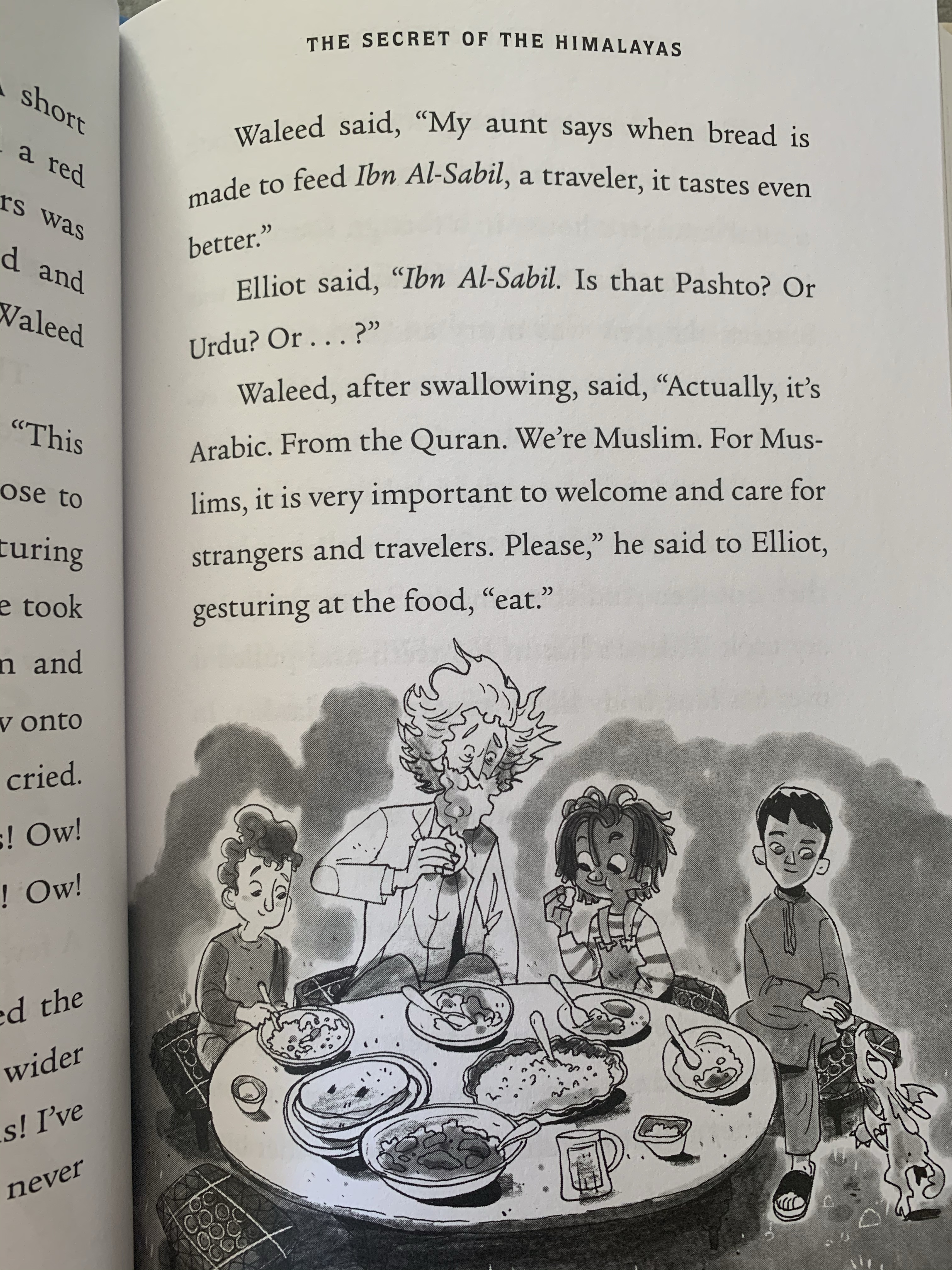
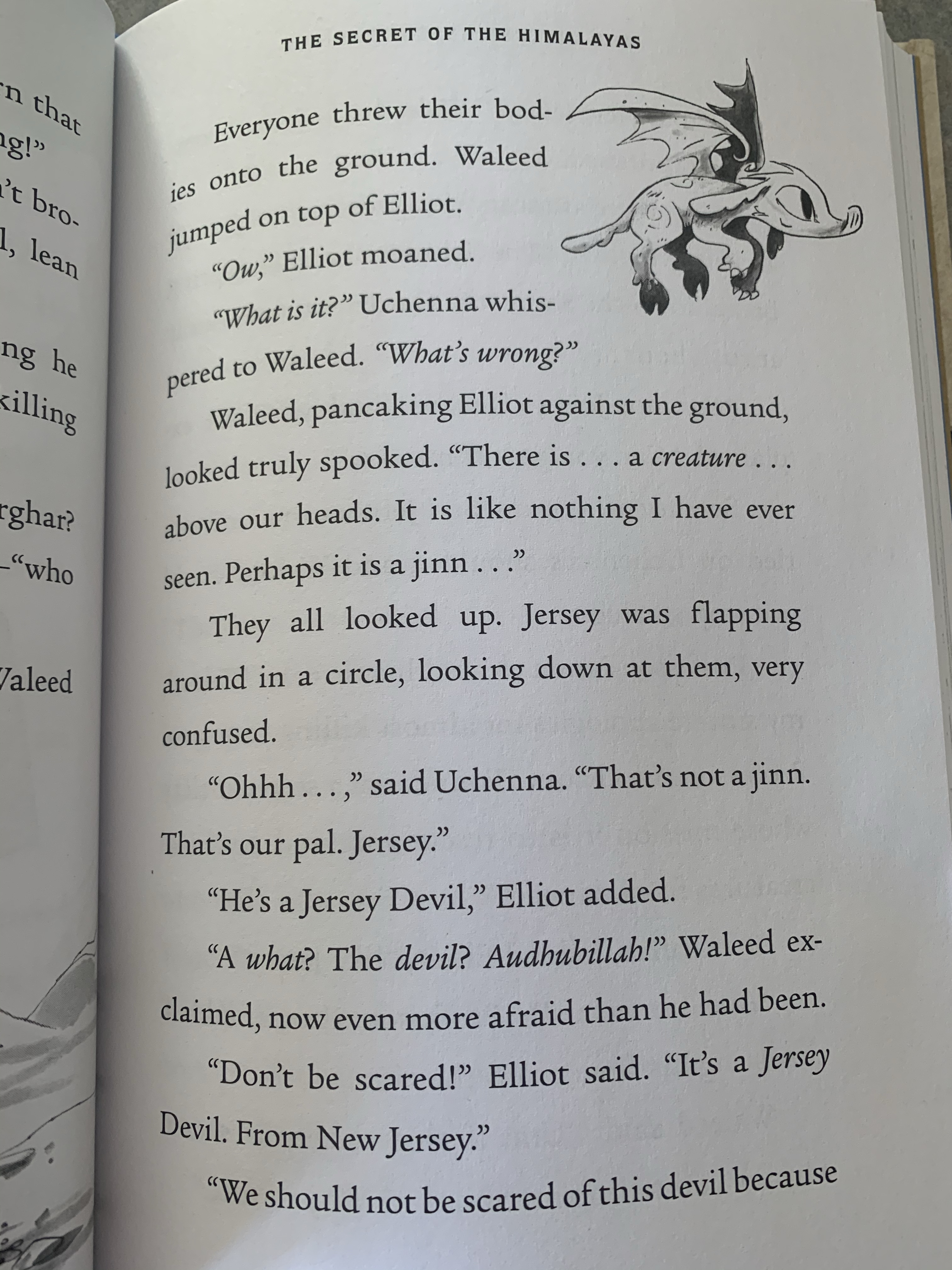
This middle grades 208 page book is part of a series, but this particular installment is co-authored by Hena Khan, takes place in Pakistan, and features Muslim side characters in the quest to find and protect the mythical, magical, and illusive unicorns.  The adventure is quick, the cultural and religious references sincere and appreciated, the characters quirky and fun, and the writing smooth and enjoyable.  I can’t speak for the whole series, but I think second to fourth grade readers will enjoy the eccentric teacher, the clever kids, and the knowledge about animals, culture, and geography that is woven in to the story to keep it engaging.  I don’t think you need to read the books in order, but I would encourage it.

img_0785

SYNOPSIS:

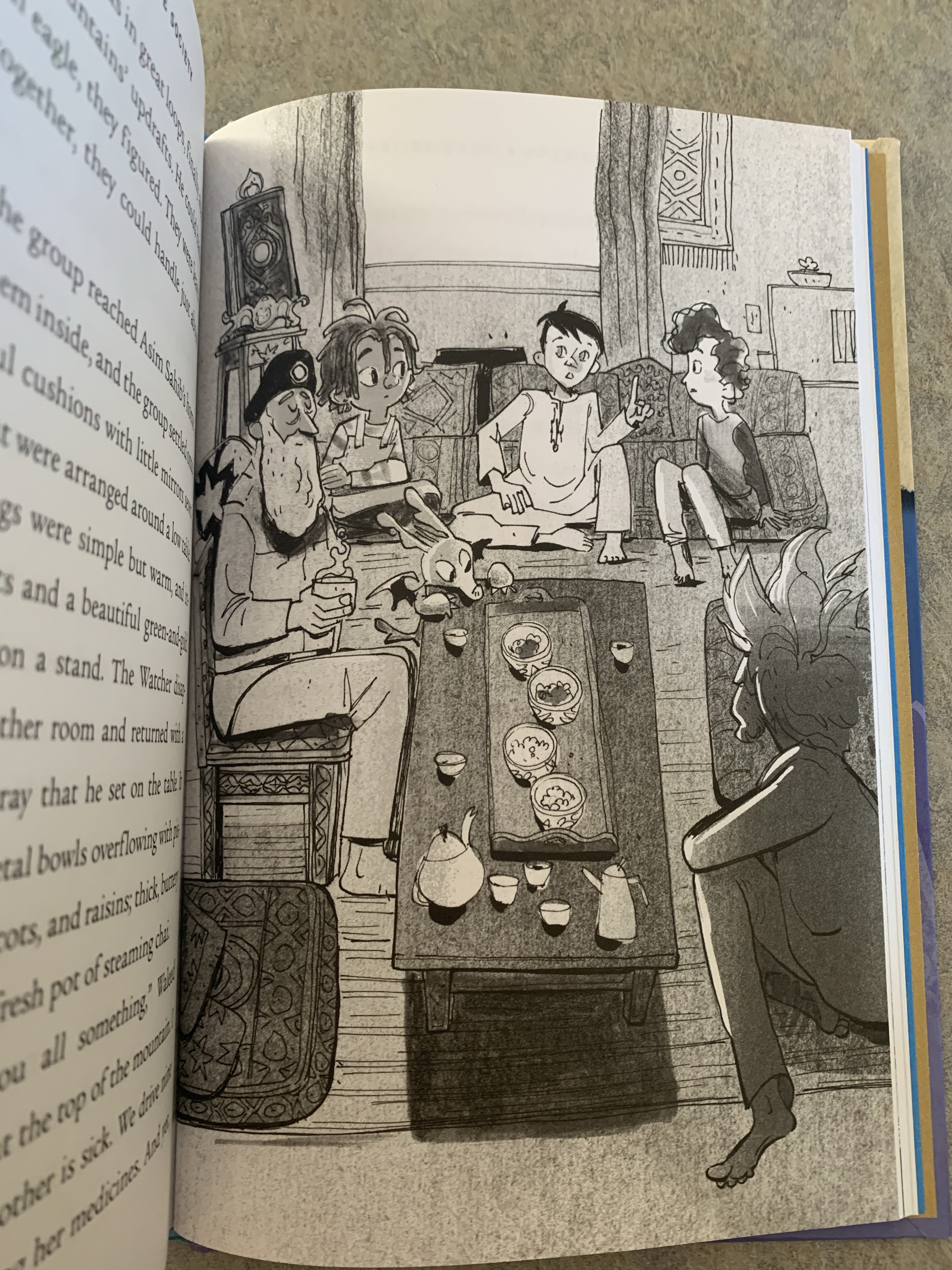
Elliot and Uchenna are elementary aged students and also members of the secret, Unicorn Rescue Society.  When a classmate starts a newspaper and interviews local businessman, the kids teacher, Professor Mito Fauna spots what he thinks is a unicorn horn in an accompanying picture and is determined to go and protect, once found, the imaginative creatures.  He enlists the kids and Jersey, a creature with a blue body, red wings, a goat face, clawed front legs and hooved hindlegs, to set off in his single propeller plane for the Himalaya mountains of Pakistan.

They arrive in Torghar, Pakistan and make a rough landing that nearly kills a local boy.  Alhumdulillah, Waleed is fine, and in true Pakistani and Islamic tradition the boy takes the visitors to his grandmothers home to be fed and welcomed.  Waleed agrees to help the Americans find a man known only as the “Watcher,” to see what he knows about unicorns and the hunters that come to poach for sport.

Hiking the mountains and getting short of breath makes each act that much more difficult, but alas the kids find the Watcher, aka Asim Sahib, but sadly *SPOILER* don’t find unicorns.  Rather a species of mountain goats, markhors, that have two long twisted magical looking horns. The wealthy businessman brothers also show up in their helicopter to capture, not kill the markhors.

The rescue society follows them and learn that the sinister brother are testing out the magical properties of a bezoar on pit viper bites.  Needless to say it doesn’t work and the rescue society must rescue the dying butler, and captured markhors.  All is not lost, even if they didn’t find any unicorns, at least they made new friends, and know that if they haven’t found the unicorns yet, hopefully no one else has either.

img_0778

WHY I LIKE IT:

I love that there is praying, and thikr, and ayats from the Quran quoted and explained in the book regarding saving animals, caring for each other and trusting Allah swt.  There is culture regarding taking gifts, welcoming guests, drinking tea and even breaking stereotypes of what a boy from Lahore visiting his family in the mountains knows and doesn’t know.  It isn’t preachy on any accounts, but the messages relayed in their silly way are very well woven in and leave a wonderfully represented impression of Islam, Muslims, and Pakistan.

The diversity featured in the book is nice, even within the main characters: one is an African American girl, one a Jewish boy, and the teacher is Hispanic.  The story at the end, A History of The Secret Order of the Unicorns, takes place during the reign of Charlemagne at a monastery, and features a boy named Khaled and his little sister Lubna. It is clearly intentional and a reflection of the author and illustrator.

img_0776

FLAGS:

There are some possibly gross moments featuring the goats licking urine, tea being made from the markhors’ saliva and the near death of a man requiring venom to be sucked from his leg.

img_0777

TOOLS FOR LEADING THE DISCUSSION:

The book is definitely below a middle school book club level, but I think younger elementary teachers and parents would see students get hooked on the series and would benefit from having the books around.

img_0780

The Prophet (salla Llahu ‘alayhi wa sallam)Described by Zaheer Khatri illustrated by Fatima Zahur, Elaine Limm and Jannah Haque

Standard
The Prophet (salla Llahu ‘alayhi wa sallam)Described by Zaheer Khatri illustrated by Fatima Zahur, Elaine Limm and Jannah Haque

prophet described

This 48 page rhyming prose filled picture book details our beloved Prophet Muhammad (saw) in accordance with the Holy Qur’an and as stated by Hadith.  The repetitive refrain highlights the two-page spread’s thematic descriptions of Rasul Allah’s appearance, speech, mannerisms, walking style, etc., and the best part is, it is all sourced and referenced at the end.  It features the same two characters and the same layout, as The Prophet’s Pond, which this book even references, but notably, my copy of that book does not have faces in the illustrations of the boy and his mom, and this new book does.  I tried to see if you could find a faceless version and could not, perhaps, that option is forthcoming.  As I often remark to those around me, there are not that many books about Prophet Muhammad (saw) that are factual, but framed in a fictitious manner for children, or that are fun and playful, and this book helps fill that void in creating love and connection to the Prophet.  It is a bit text heavy and it is very thoughtful, but the repetition and rhyme along with the beautiful large horizontal illustrations, create a mood of reflection, appreciation, love, and admiration and will be suitable for ages five and up.

img_0618

Zayd and his mom are back and the book starts with Mummy telling Zayd that one day he will meet a special man inshaAllah, and Zayd asking her to give her details so that he can guess who it is. The first set of clues describe how gracious the most handsome man is, and how he will greet Zayd one day.

img_0619

The story then moves on to describe Prophet Muhammad’s fragrance, his hands, his words, his stature, his complexion, his hair, and so on.  As the details flow, Zayd and his Mummy journey through nature, standing near beaches, and forests, and rivers and waterfalls.  They cross a bridge on their way out of the city, and the full color pages move from night (or possibly really early morning) to day to night again.

img_0620

Zayd seems to know it is Prophet Muhammad (saw), but keeps begging to hear more details, before he proudly proclaims the only human whose beauty reaches so far is Prophet Muhammad, peace and blessings be upon him.  The book then says he will be waiting by a pond, but that is a story for another day, giving a shoutout to its companion book.

img_0624

There are questions recapping what is learned in the story before 10 pages of reference material.  It really is incredibly well done and is a great resource in addition to being a lovely story.  Thank you @crescentmoonstore for getting the book to me so quickly.

img_0625

Halal Hot Dogs by Susannah Aziz illustrated by Parwinder Singh

Standard
Halal Hot Dogs by Susannah Aziz illustrated by Parwinder Singh

hotdogs

I’m not sure what I expected this book to be, I just knew I wanted to get my hands on it, but I’m fairly certain, that even if I would have had some expectations, they would have been no where near how well done this 40 page book for four to eight year olds is overall.  It is unapologetically American-Palestinian Muslim in an inclusive funny delightful way, that only an OWN voice book can be. There have been some great picture books lately that are authentic, yet mainstream, and this book pushes that standard just a little bit higher as it normalizes jummah, halal food, dabke, hijab, with familiar threads of street food, spunky little sisters, untied shoelaces, tradition, and excitement.  The story has a twist and some intentionally misleading foreshadowing, that give the book depth and added fun.  Readers of all backgrounds will relate to this book and find something that they can relate to, as they laugh and marvel at Musa’s infectious enthusiasm for hot dogs. img_0610

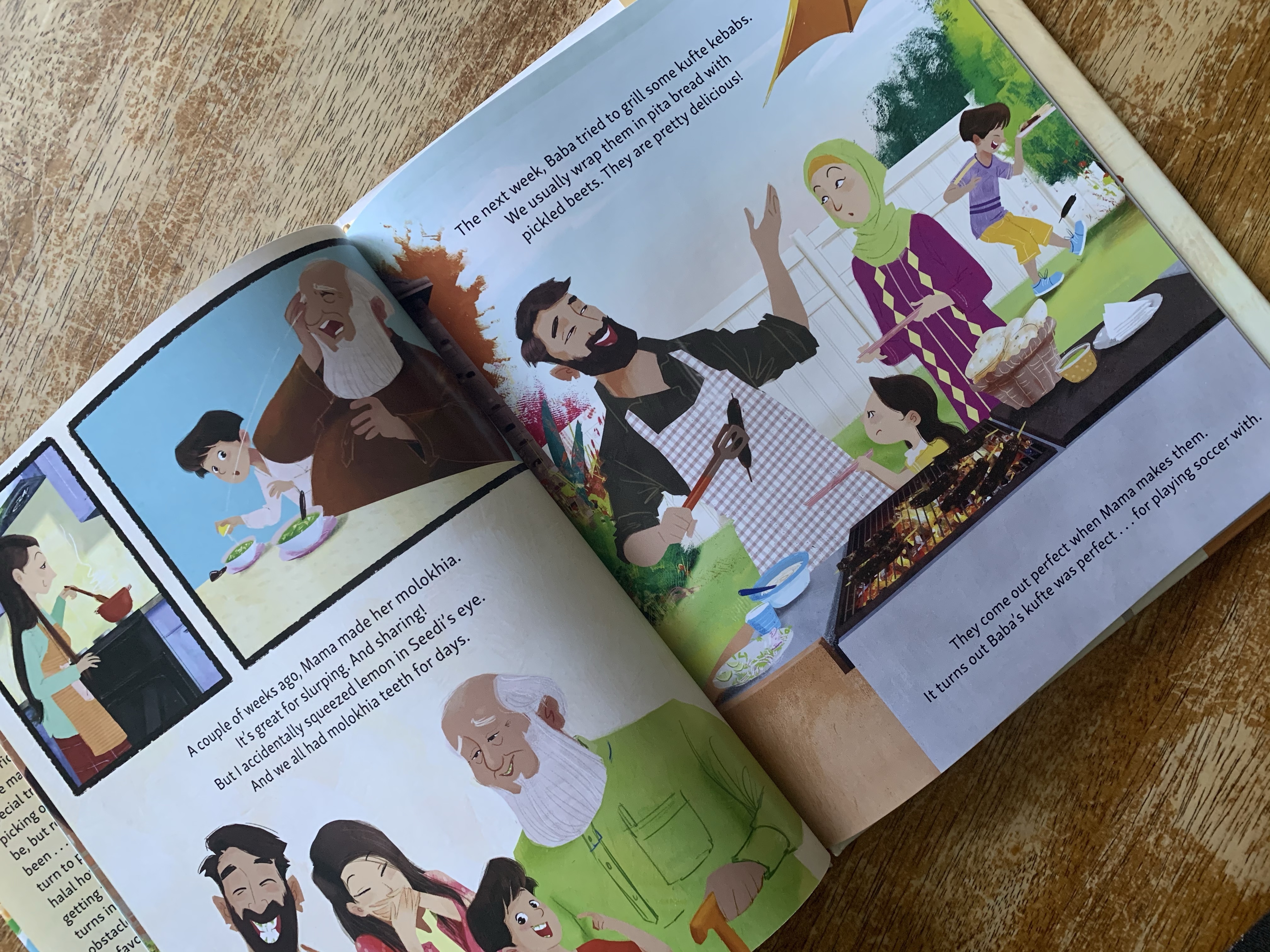
Musa Ahmed Abdul Aziz Moustafa Abdel Salam, aka Musa, loves Fridays.  His family heads to the masjid for Jummah prayer and then home for a special Jummah treat.  Lately, they’ve had molokhia, that stayed in their teeth for a week, kufte kabobs that were better for soccer playing than eating, riz bi haleeb with lost dentures, and prelicked jelly beans.  Alhumdulillah, this week is Musa’s turn to pick, and he is picking his favorite: halal hot dogs with Salam sauce.

img_0611

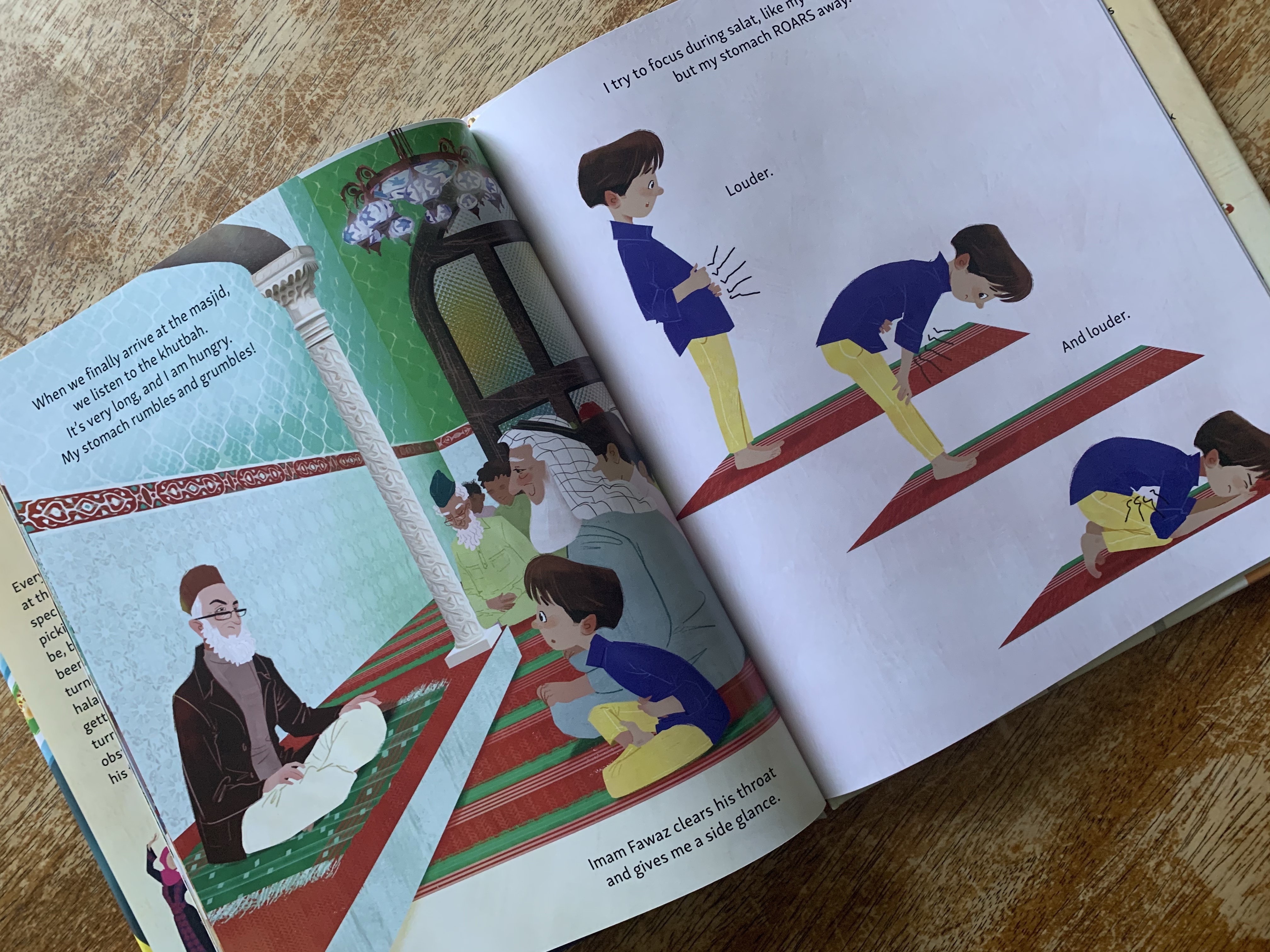
They head to the mosque dancing dabke as they leave their house with smiling faces.  The khutbah is long though, and during salat his stomach is roaring! Afterward he is off, but Seedi has to help Maryam find her red shoes in a sea of red shoes and mama is chatting with friends. 

img_0612

Dad gives in and lets Musa go get the hot dogs alone.  As he heads to the stall with the best hotdogs: the perfect amount of hot, chewy, juicy hot dog goodness, he passes all sorts of foods being eaten.  There is falafel and bao and tacos and samosas and churros, but he is determined to get hot dogs, even though the line is really long.

img_0613

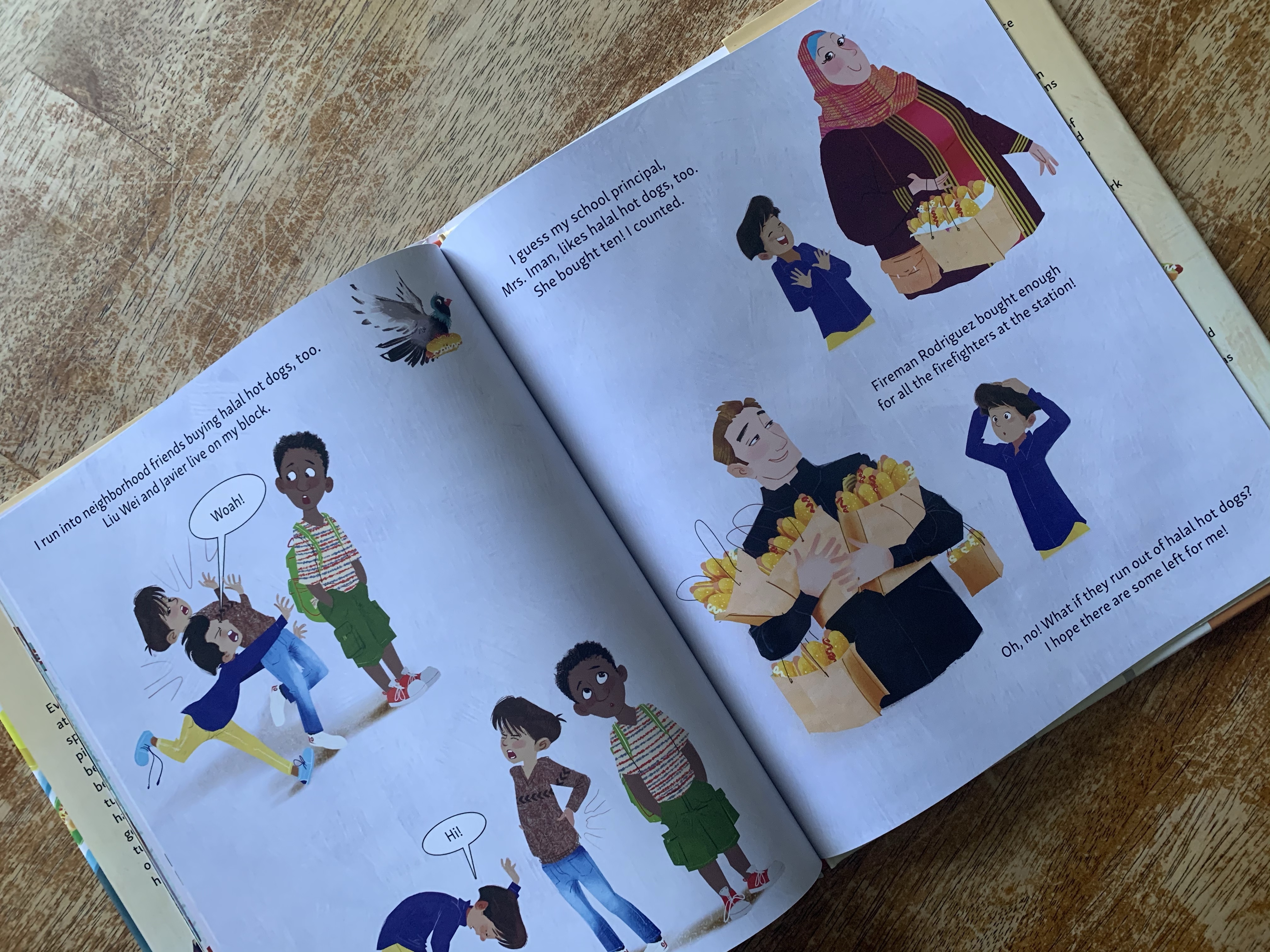
He sees friends in line, and firefighters, and even his school principal.  Everyone loves hot dogs, even birds and squirrels.  Finally he buys a whole bag full with special Salam sauce and races home to share with everyone.  But uh oh, it doesn’t go as planned, and I’m not about to spoil it, so get yourself a copy like I did from http://www.crescentmoonstore.com or your library, and maybe don’t read it while you are fasting, because you will be craving hot dogs, mmmmmm nom nom nom.

img_0614

There is an Author’s Note at the end that details her kids’ influence on the story and explains that a portion of the proceeds go to UNRWA USA, a non profit that helps Palestinian refugees.  There is a glossary of Arabic Words and Terms, and a section explaining Halal Laws.

img_0615

The book shows the mom in hijab outside the home, and uncovered within the home.  There are diverse skin colors among the Muslim and non Muslim characters in the book, as well as a variety of ages depicted.  Seedi wears a keffiyah on Jummah, but different clothes on different days.  The illustrations are wonderful and descriptive and do a lot to compliment the story by setting a relatable and diverse-positive visual.

img_0616

Mel and His Trouble with One Thousand Shoes by Somayeh Zomorodi illustrated by N. Broomand

Standard
Mel and His Trouble with One Thousand Shoes by Somayeh Zomorodi illustrated by N. Broomand

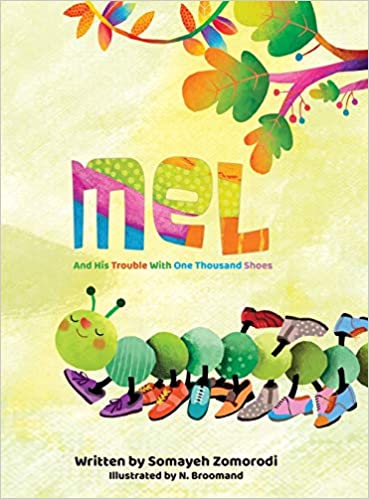
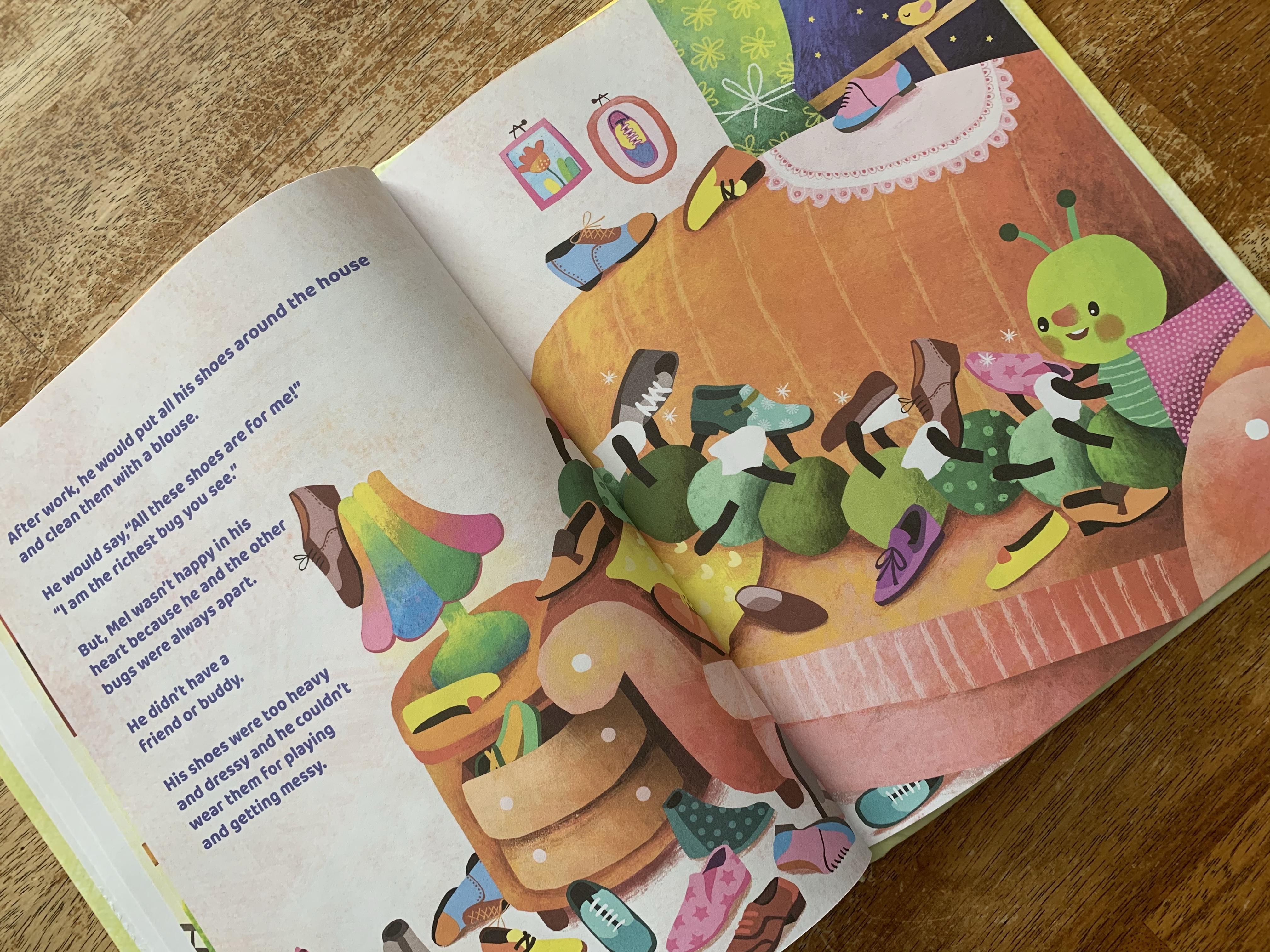
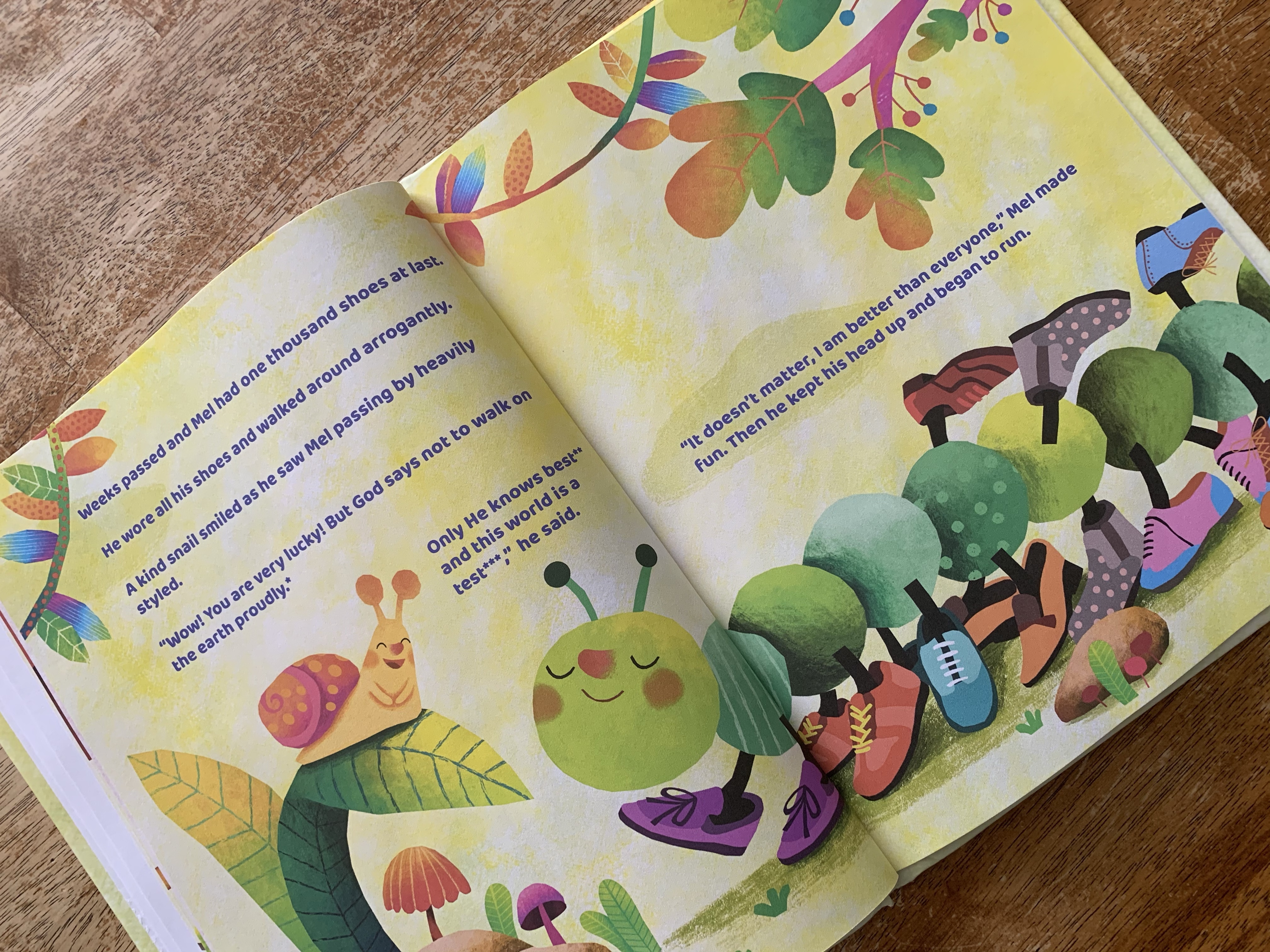
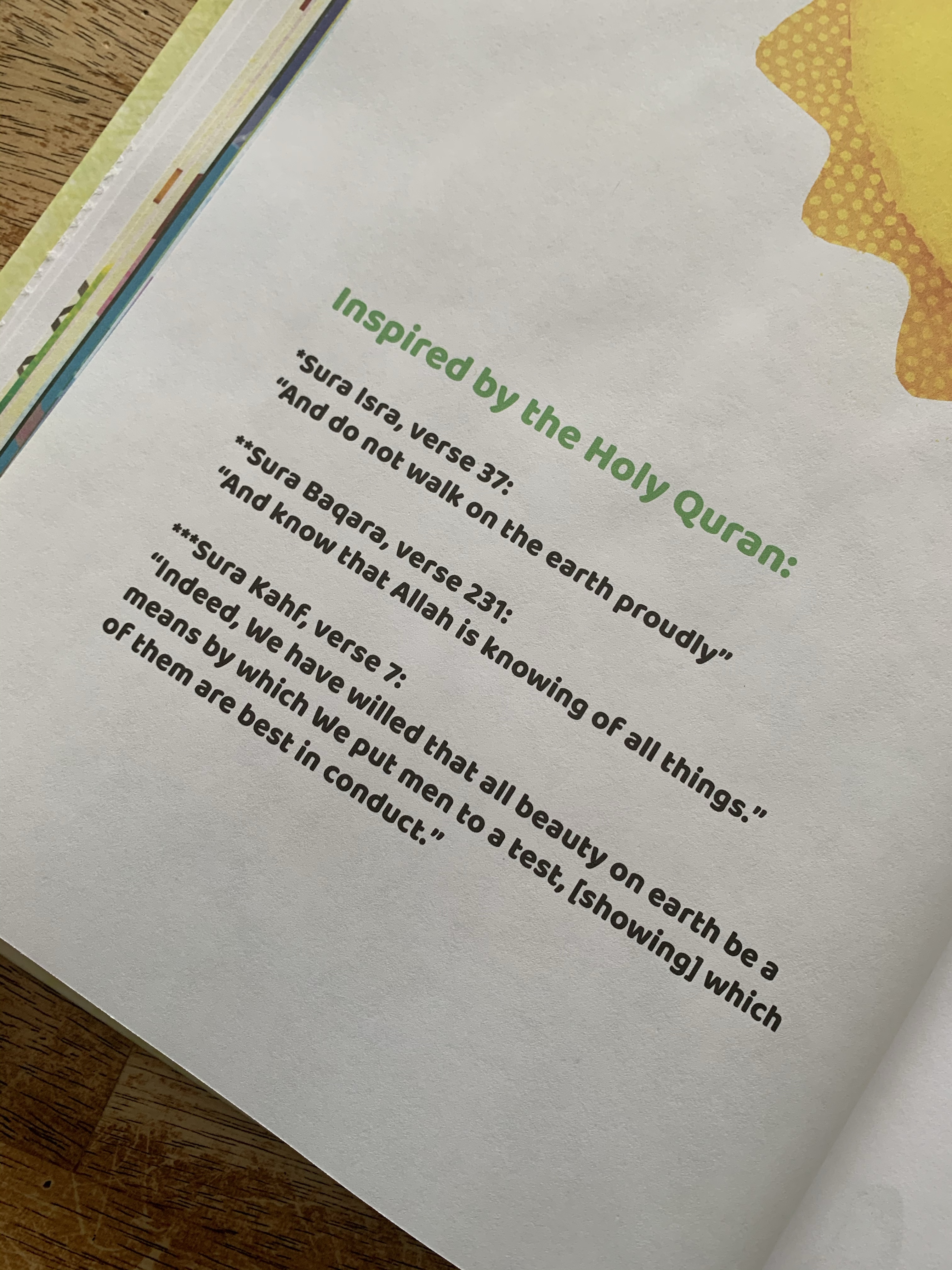
The book has a solid premise, although it reads a lot like The Very Greedy Bee, and has lovely 8.5 by 11 pictures on its 24 pages, but unfortunately the text is all over the place. The story contradicts itself, it is overly wordy, and way to rhymy. Yeah, rhymy isn’t even a word, but if it were, this book, would be a great example. I struggled with the font as well, the lowercase f looks like a capital F, and no matter how many times I read it, I’d get tripped up thinking an interior word was being capitalized. The book says that it is based on the ayat in the Quran that reads, “And do not walk on the earth proudly,” and even has two other ayats listed at the end as inspiration, but really it is a single page and a single character that blurts out the ayats from the Quran that talk about walking on the earth proudly and this world being a test. While the illustrations are fun, it just isn’t enough to make the book a solid read to convey humbleness and gratitude. Children will be lost in the text, confused by the inconsistencies, and disappointed in the super quick resolution.

Mel the millipede lives in a farm next to a well. He has one thousand feet and although he doesn’t need shoes, he likes to collect them. He has 950 and is working to find the remaining 50 to complete his collection.

It says, “No one was as happy as Mel; one could tell.” Then on the next page as he cleans his shoes with a blouse it is revealed that he isn’t happy in his heart because he is always alone. But the picture stills shows him smiling.

He finally has his 1,000 shoes, we don’t know how or where he got them, when a small snail tells him that “God says not to walk on the earth proudly. Only He knows best and this world is a test.” There is no explanation, Mel just says “it doesn’t matter, I am better than everyone.”

This whole time walking, Mel has been wearing his shoes although it has mentioned that he can’t wear them because they are heavy and he doesn’t want to get them dirty. As he watches the other bugs fly kites and balloons he is sad that he can’t play because his shoes are too heavy. But he has been walking outdoors and is on a mushroom lamenting with his shoes on. Those flying kites aren’t moving much…one is a worm, one a snail, very inconsistent.

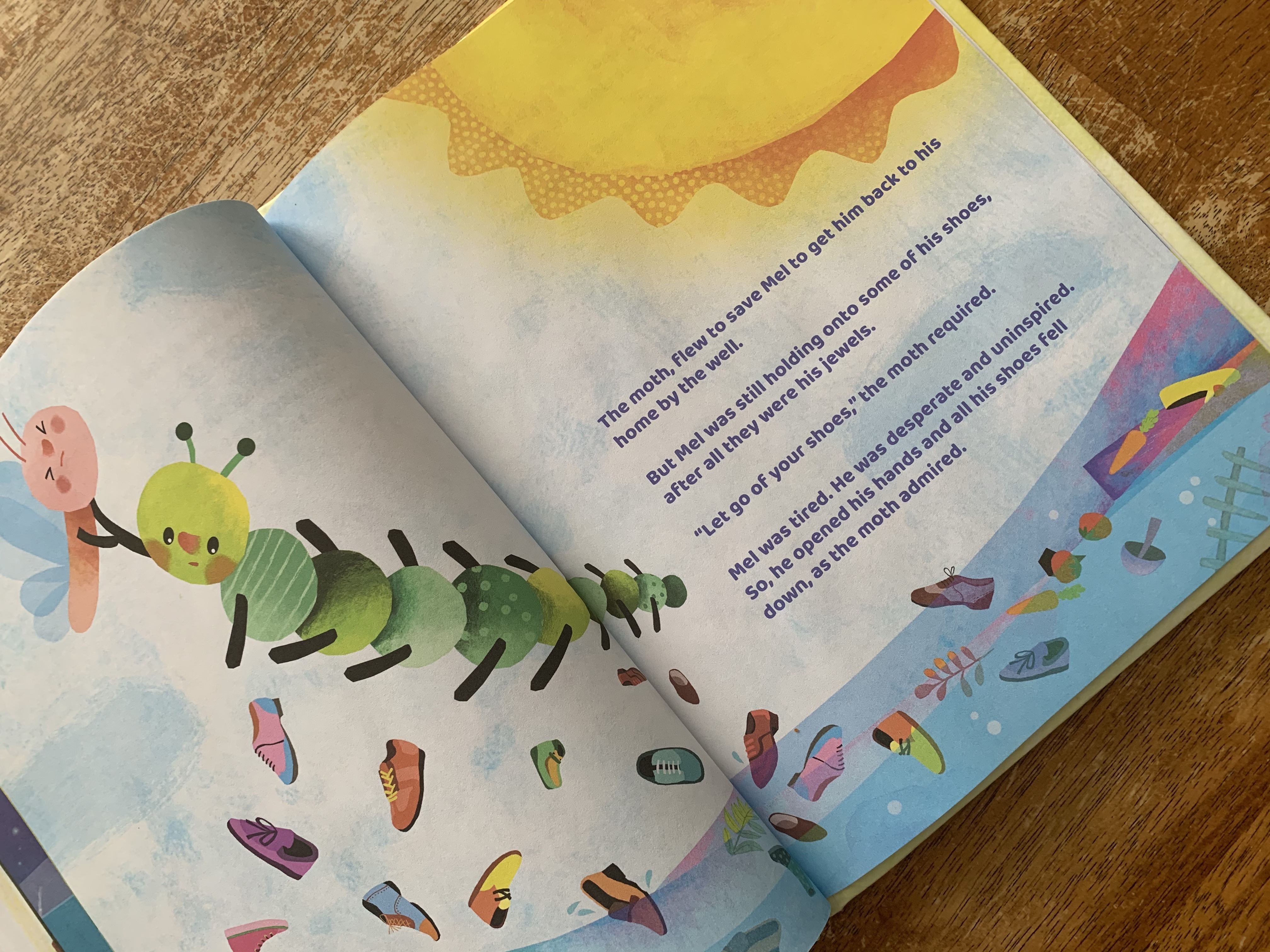
One night a moth knocks on his door warning Mel of a flood. Mel ignores the frantic urgings, fearing that it is a trap to get his shoes. He thinks everyone is jealous of his shoeing. The flood waters sweep him and his shoes out of the house and throughout the night he risks his life multiple times to save his beloved shoes.

When morning arrives, he is still trying to save his shoes, when moth, attempts to save Mel. To get Mel back to his house, he will have to convince him to drop his shoes. Mel is tired and desperate and uninspired so he drops his shoes and is brought to dry land. I don’t think uninspired is the right word, shouldn’t be be grateful and willing to change to save his life? But even that notion is a stretch because in the illustrations he is so close to land. He could just swim over, shoes or no shoes, moth doesn’t need to be flying him to safety. Additionally, when the water recedes, won’t his shoes still be there?

The conclusion is Mel hugging moth and apologizing to the bugs. I’m not sure what he is apologizing to them for, nor is it explained. Since the book claims to be based or inspired by ayats, I feel like this would have been a good place for a moral cathartic lesson, but alas, it just says, “the end.”

Brave with Beauty: A Story of Afghanistan by Maxine Rose Schur illustrated by Patricia Grush, Robin Dewitt, and Golsa Yaghoobi

Standard
Brave with Beauty: A Story of Afghanistan by Maxine Rose Schur illustrated by Patricia Grush, Robin Dewitt, and Golsa Yaghoobi

brave

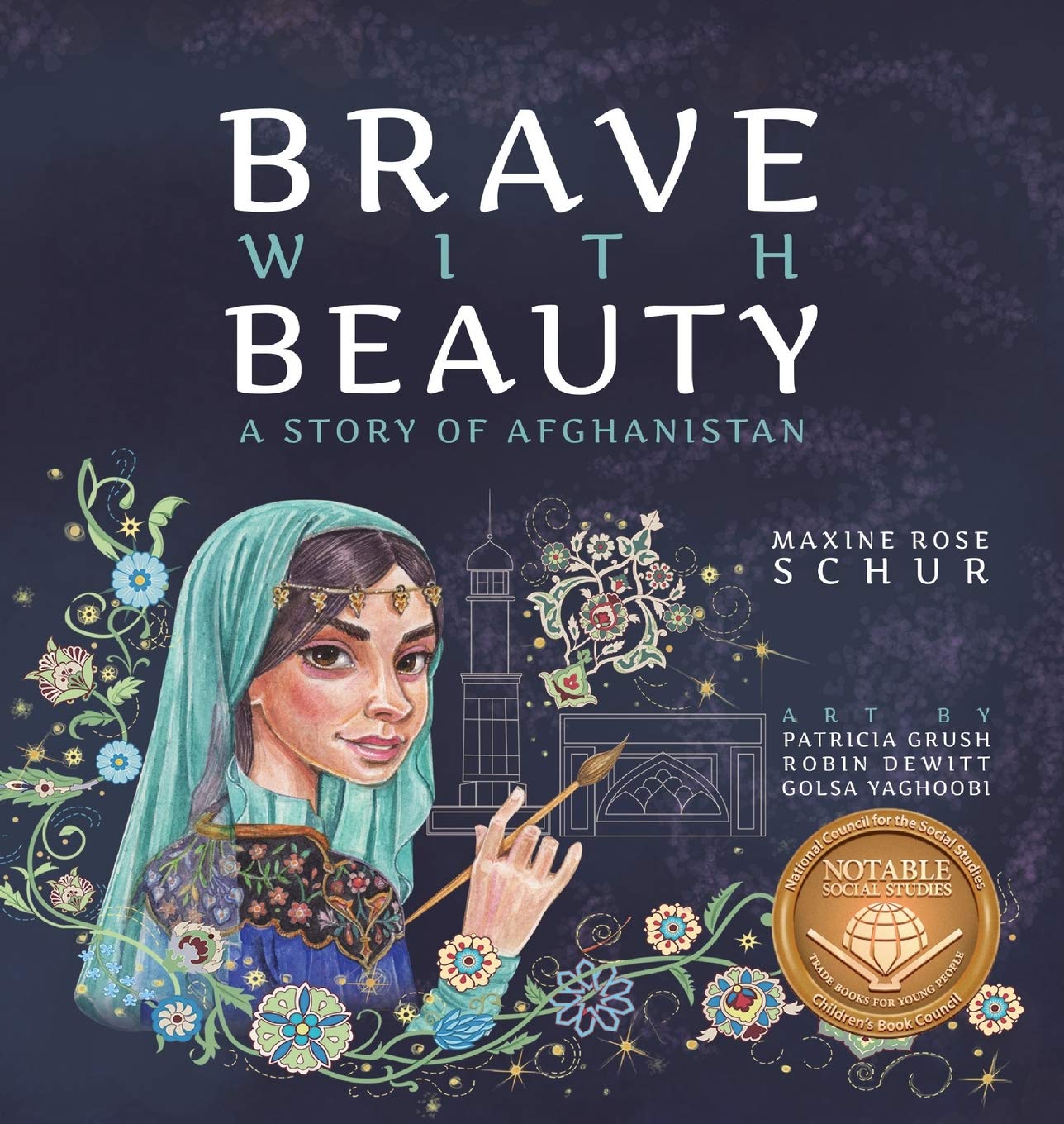
This 44 page fictionalized retelling of Queen Goharshad, a 15th century monarch of the Timurid dynasty in Afghanistan should really be a larger book than 8 x 8 to appreciate the artwork that is detailed and stunning.  The story of Goharshad, wife of Emperor Shah Rukh, and her influence on art, music, culture, higher education, and architecture, is one that we should be more familiar with, but the actual text and manner in which the story is conveyed isn’t consistent for me and I wanted more details about the society she stepped in to to rule,  I know it is fiction, and meant for 2nd to 4th graders, but I would like to think that readers will want to know what obstacles she had and what support she enjoyed and from where.  That they will question if it was a rich kingdom that she could pay musicians to play everywhere, and wonder if families sent their daughters to the University she built, ask why it wasn’t for women to design a  Masjid, and what was the name of the smaller mosque that bore an older woman’s name? The book at times overly summarizes and at other times is haltingly detailed.  It is a good read to reflect a strong woman and her influence on her land, but unless assigned, I don’t know that seven to ten year olds will pick up the book and be inspired by it enough to change their perception of the Afghanistan that they may see on the news.

img_0171

Seven centuries ago Goharshad loved beautiful things such as painting and the texts of Rumi.  Her brothers played at being like Genghis Khan and teased her for not being brave.  She vowed to be brave with beauty even though she didn’t know what that even meant.  At age 14 she was given in marriage to the king, Shah Rukh, in Herat.  She ruled with her husband and had resources and time to spread her beauty by speaking up and being brave.

img_0172

Her first act of beauty was by filling the kingdom with music.  She wanted music every day in the court and beyond. Music that was playful and pious, music that painted pictures in the listeners minds and brought joy like the laughter of God.  She next sketched and designed a beautiful and enchanting garden to be built.  It doesn’t say where it was, but that people came from all around to enjoy it.

img_0173

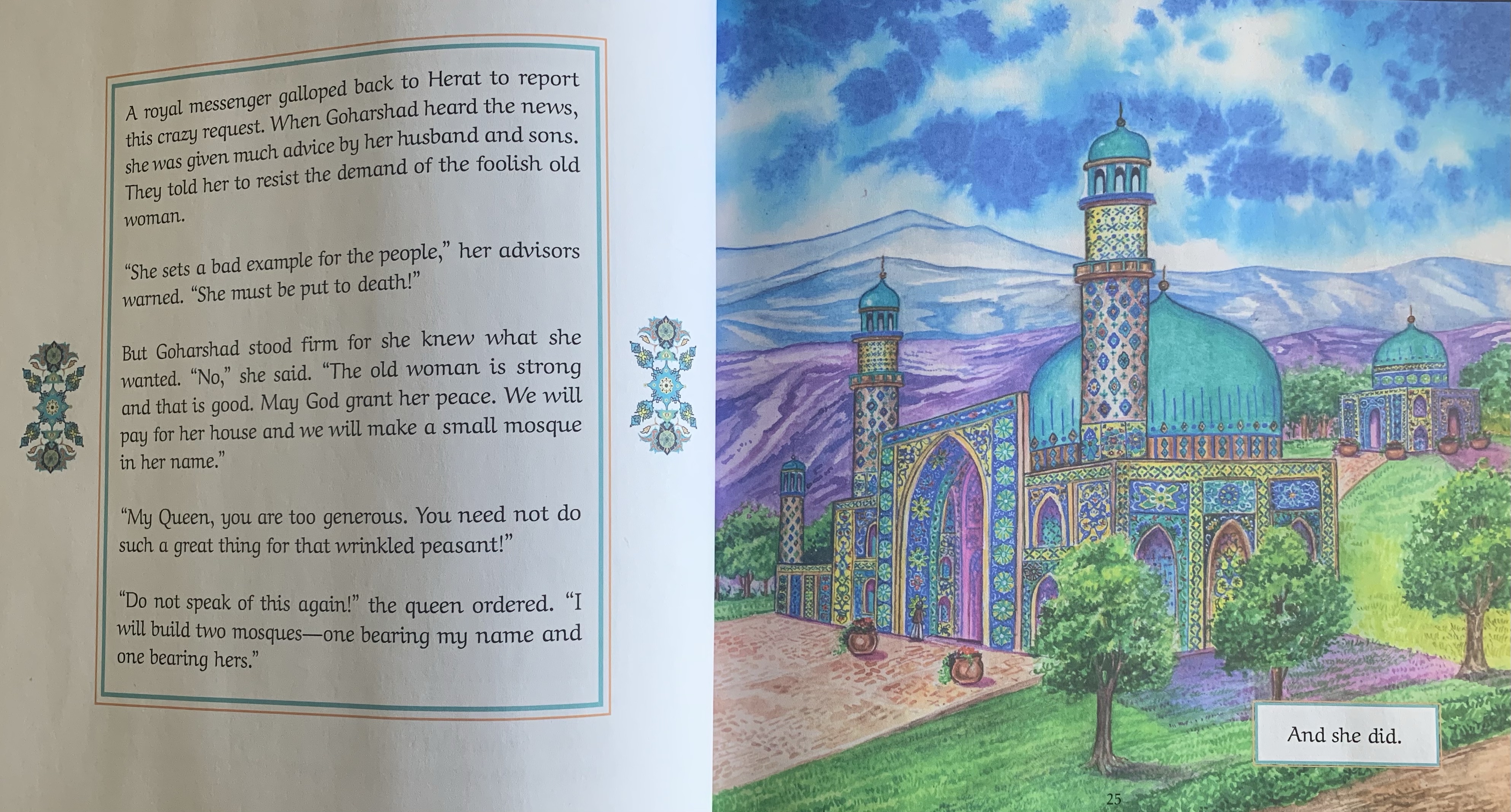
Feeling braver she turned her sights on building a mosque in the western city of Mashhad.  She designed it and called the court architect, Qavam al-Din Shirazi to discuss.  He doubted if it was right for a woman to design such spaces, but she assured him that she had the talent for it, so construction began.  An elderly woman refused to sell her cottage for the new project unless a mosque with her name was built.  The advisors wanted the old woman put to death or imprisoned, Goharshad disagreed appreciating the woman’s strength and instead agreed.  The big mosque was built with Goharshad’s name and a smaller one on the property with the old lady’s.

img_0175

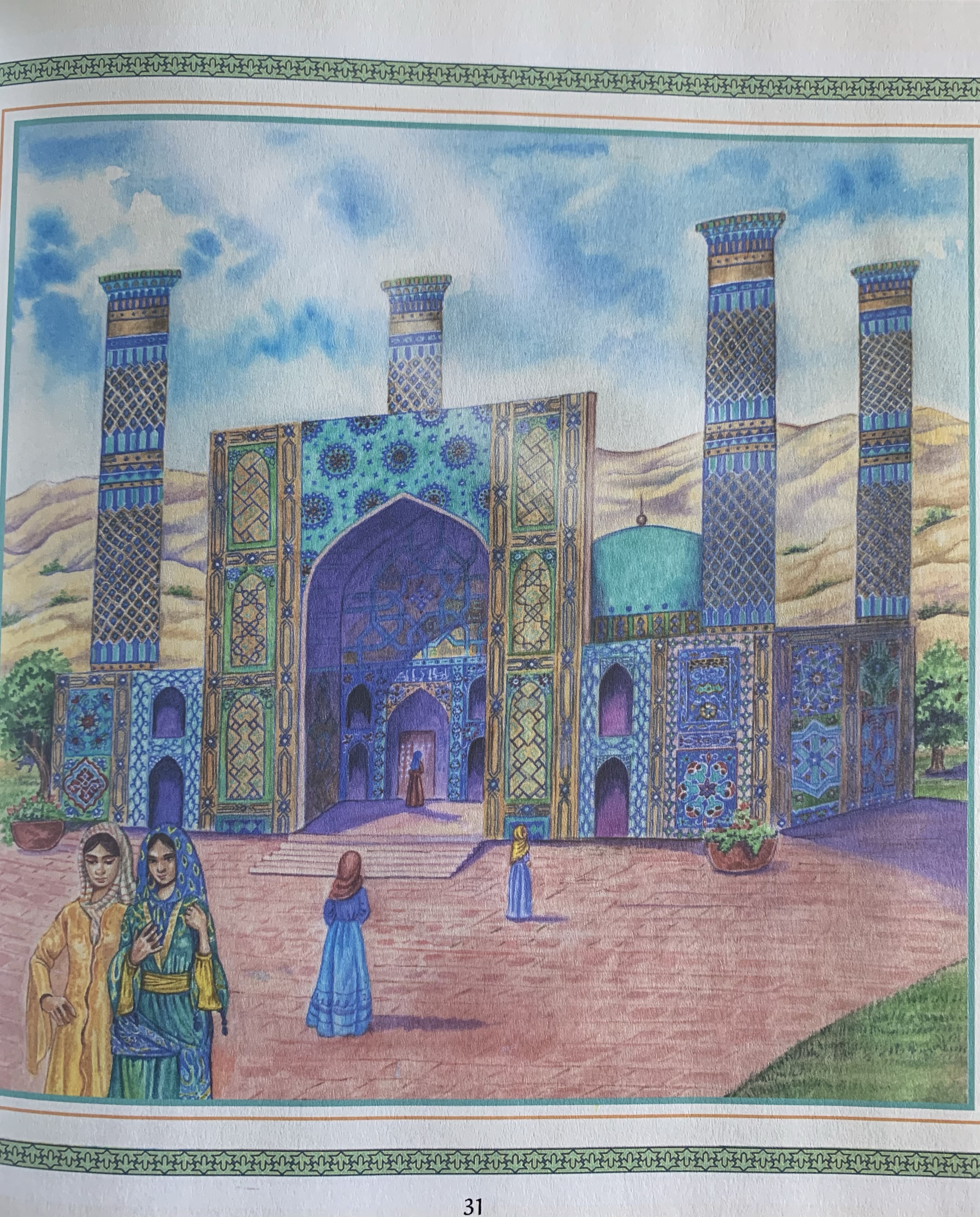
With such an accomplishment complete, the Queen again summoned the architect and expressed her desire to build a great center for learning.  A college for girls, a grand mosque for prayer, and a vast library.  She wanted the structure decorated with paint from precious stones and sold her crown to finance the project.

img_0174

After her husband died Goharshad reigned, but sadly after she died, much of her accomplishments died as well.  Over time, harsh weather and war, nearly all her buildings disappeared and those that remain, do so in ruin.  The book ends with hope that memories of her will endure, A guide to some of the words in the story,  an Author’s note, and a Guide for Parents and Educators.

img_0176

There is not a lot of Islam in the story, just the building of masajid .  Some may take issue with her stress and celebration of music, and likening it to God laughing, but if you look at it as her story, it should be able to be appreciated even if you disagree.

img_0177