Tag Archives: OWN Voice

Egyptian Lullaby by Zeena M. Pliska illustrated by Hatem Aly

Standard
Egyptian Lullaby by Zeena M. Pliska illustrated by Hatem Aly

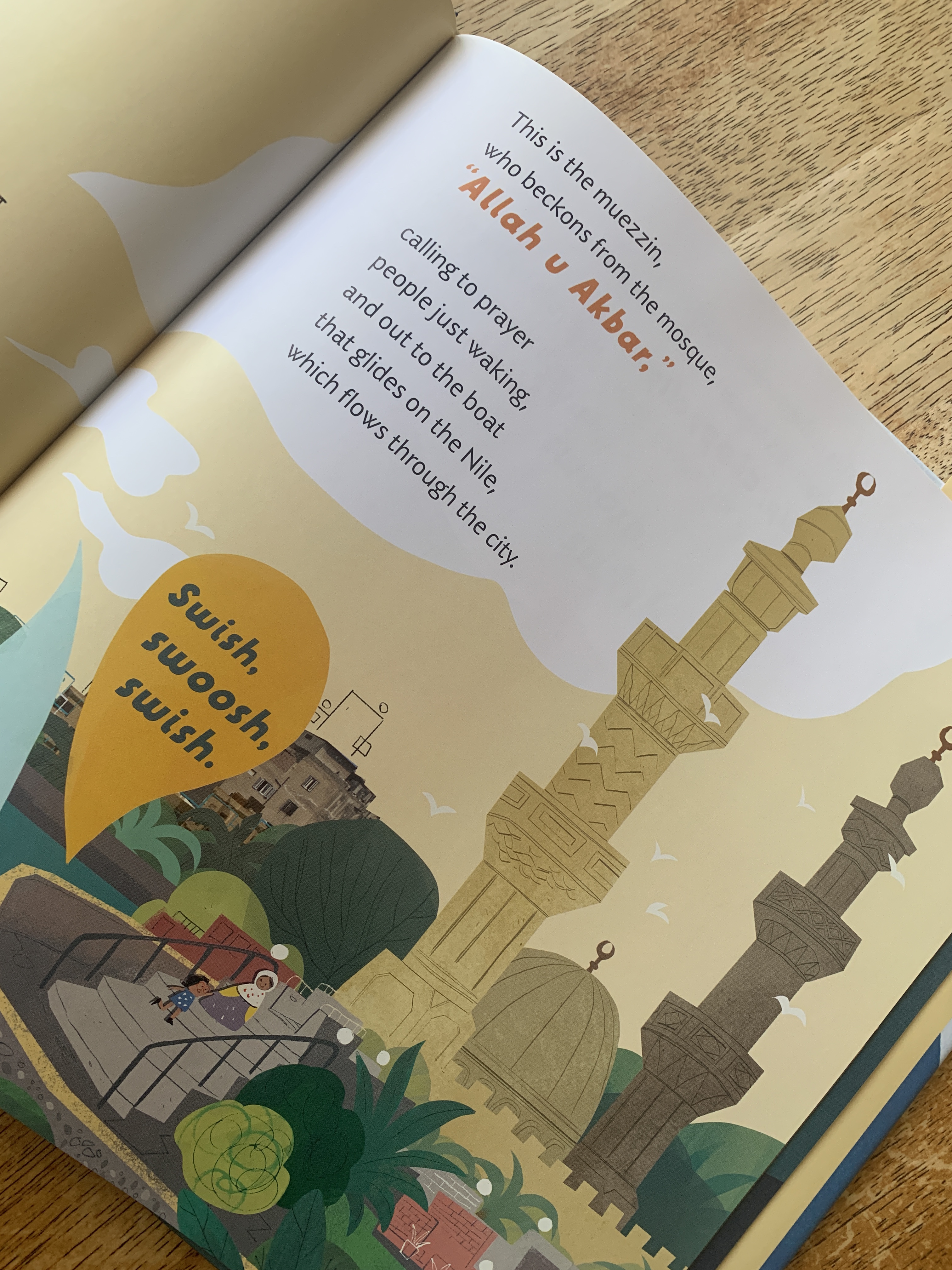
There was a time in college when my friends and I would gift each other Cinderella retellings and versions from all over the world, that was nearly 20 years ago, and I haven’t thought much of it, until this book reminded again of “This is the House that Jack Built.” Having just read and reviewed “The Masjid that Kamal Loves” which is structed similarly, I can confidently say forget Cinderella, I’m loving this new trend, of a repetitive layered story conveying love and excitement and joy to little readers in such an engaging way. This book has more of a story than the original and shows relationships and longing, even though it is primarily a love letter to Cairo.  The swapping out in some verses for Arabic words and English translations, the sound affects and the connections really elevate the OWN voice details in the text and make the book an absolute treat to read and share even for those of us who are not Egyptian and have never visited.  The Auntie who visits wears hijab, the muezzin calling Allah u Akbar is a repeated refrain, their are numerous illustrations of women in hijab and a masjid is shown repeatedly throughout allowing Muslims everywhere to feel seen with this culturally specific story.  The Glossary with the Arabic script and pronunciation guides and Notes from the Author and Illustrator really radiate with love and invite the reader to participate in the celebration on the pages.  I have no doubt children (and their parents) three and up everywhere will fall in love with the 40 page story and delightful illustrations.

Auntie Fatma comes to visit a little girl’s family from Egypt and brings sahlab and changes for two weeks to the home.  Arabic is spoken, and a nightly lullaby of the sounds of Cairo are among the beloved additions to connect the little girl to her Auntie and her culture.

The lullaby begins with the sound of the Nile, the boats floating through the city, the athan calling to prayer, the carts on the streets, the traffic.  The halawa ya battekh, swish, swoosh, swish, Allah u Akbar, beep honk toot, all add layers to the bustle of the city as the little girls memories of the sights and sounds of Egypt soothe her to sleep.  When it is time for Auntie to return the little girl’s sadness is palpable, but Auntie finds a way to reassure her and all those that have drunk from the Nile and long to return.

It is hard to say if the text adds to the illustrations or the illustrations to the story, both combine to make this book impossible to read without smiling.  I love that the mosque is shown in the daytime and at night implying that the call to prayer is not a one time thing without articulating that Muslims pray five times a day. I don’t know if the author identifies as Muslim or if the inclusion of the athan and Allah u Akbar is just an environmental reality of Egyptian daily life and thus featured.  The illustrator could have very well added the hijabs on his own as there is nothing religious or explanatory in the text.  Perhaps it is worth noting that there is a dog in the family’s home that seems to sleep with the little girl.  The book is a cultural heartfelt portrayal, and that Islam is prominently featured so beautifully made for a lovely surprise.

I hope you will consider preordering the book here, requesting it at your library, and sharing it on classroom and home bookshelves.  Happy Reading!

The Masjid Kamal Loves by Ashley Fraklin illustrated by Aaliya Jaleel

Standard
The Masjid Kamal Loves by Ashley Fraklin illustrated by Aaliya Jaleel

img_7811

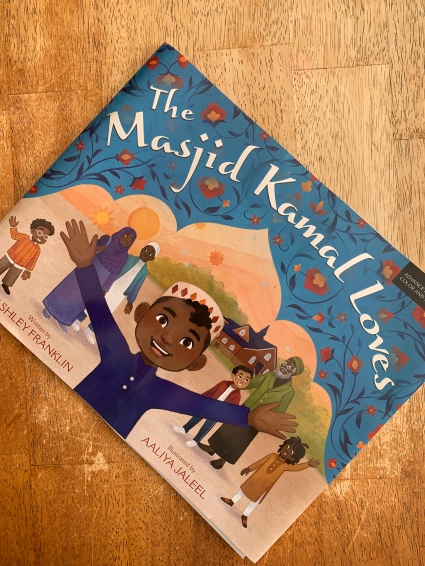
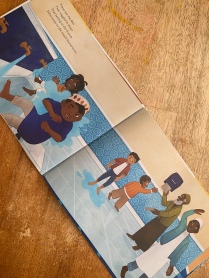
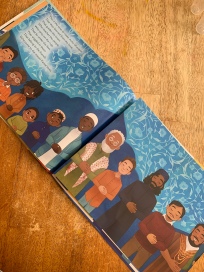
I don’t normally post about upcoming releases this far in advance (2.5 months), but I am hoping that if I share the link for preorders, I just might help in signaling to the traditional publishing world that books like this are so so so important and that we will support unapologetic, well written, Muslim centered, Muslim and Black joy featured books with our purchasing power.  This book is incredible for toddlers to early elementary in its “This is the House that Jack Built” format.  Muslim kids will giggle with excitement as they see themselves happy to see their friends at Jumu’ah, flinging shoes a little too hard before entering the musallah, splashing a bit when making wudu, playing while helping put out the prayer rugs, and getting a little wiggly or tired during the khutbah.  The happiness and love radiates off the pictures and through the text that even non Muslim readers will feel our connection to our Masjids and the prayers that occur within.  Muslim authored, Muslim illustrated, masjid not mosque, and a beautiful Author’s Note, makes this book a must have on every shelf where young children need books that mirror their experiences and provide windows into the beauty of Islam.

img_7814

The book starts out describing Kamal’s smile and offering the reason for such joy as being Jumu’ah at the masjid. It then starts with describing the masjid and all that is contained with the lines adding on the refrain of “the masjid Kamal loves.”  The friends, the shoes, the feet, the rugs, etc.. Terms such as imam, ummah, salaam are in the text and the illustrations show wudu, salat, khutbah, conveying a Jumu’ah experience.

img_7813

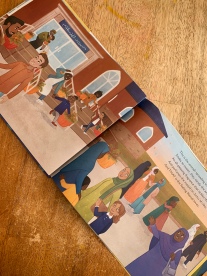
Each page is brightly illustrated across horizontal orientated scenes.  The expressions on the kids faces, are engaging and smile inducing and the lyrical text has a rhythm and strength that makes you feel proud to also have a masjid to love like Kamal.

img_7816

I have an arc, but have preordered a copy for myself here and hope you will do the same. Please also request your public libraries to order it, and if they have already you can place the book on hold, inshaAllah little steps to show support.

Grounded: A Novel by Aisha Saeed, Huda Al-Marashi, Jamilah Thompkins Bigelow and S.K. Ali

Standard
Grounded: A Novel by Aisha Saeed, Huda Al-Marashi, Jamilah Thompkins Bigelow and S.K. Ali

Over the years I’ve read to a lot of kids, with a lot of kids, discussed books in classrooms, and in book clubs, so when reviewing I often share what kids think or what I imagine kids will think, and I usually acknowledge when I’m being overly critical as a reviewer, but this book I will tell you, I did not read through the intended middle grade lens, I read it as a 42 year old seasoned reader.  I know this because I cried during the entire second half, and the book is not sad.  It is fast paced, joyful and adventure filled.  I cried at the ownership of identity, the pureness of friendship, the acceptance of the flaws and strengths of those closest to us, the love of family and that this book is written by four incredible Muslim women authors for Muslim kids to be seen and for non Muslims to see Muslim kids in action in a fantastic, non preachy, authentic, powerful engaging story.  In short I loved it.  I love that the voices are different, but polished and seamless in conveying a fictional story with universal themes through a variety of Muslim characters without talking down or over explaining anything. From the maps to the crossover character Hanna from S.K. Ali books, the poetry from they young lyricist to the representation and discussions of Muslims not being a monolith, and the sprinkling of a Hadith or Quranic ayat here and there (I wish there was more), the book tugged at my heart strings.  For kids third grade and up, some of those themes might resonate, or it might just be a book about a lost cat in an airport and a hodgepodge group of strangers, turning friends, stranded in an airport searching for her while dodging security and exasperated parents.

SYNOPSIS:

The end of the MONA  (Muslims of North America) Conference has lots of families at the fictional Zora Neale Hurston heading home.  Tired parents and restless kids lead Feek’s little sister Ruqi to go missing and Feek to blame.  As he searches for his little sister he meets Hanna, a girl looking for a lost cat, not her lost cat, just one she has heard about from her animal activist group that is missing at the airport.  As they search for Ruqi, Sami gets dragged along even though he’d rather be mentally keeping his anxiety in check as he prepares for the Karate competition he is heading to.  Luckily Nora, Congresswoman Najjar’s daughter, finds Ruqi and the five strangers are brought together.  When all flights are grounded because of weather, the group goes in search of the missing cat, Snickerdoodle, finding leads, security, secret corridors, self confidence, friendship, and skills along the way.

WHY I LIKE IT:

I knew the book would be good with the authors’ names on the cover and their ability to tell a good story, but I was still blown away by how real the characters were fleshed out and their “problems” articulated.  The emotional connection to each character facing their insecurities and supporting one another’s’ vulnerabilities was reflective and insightful. I love the diverse inclusion of showing Muslims that don’t speak Arabic or don’t know if they are Muslim enough, of Black Muslims and Black culture, of being an only children and struggling with siblings, understanding parental expectation and finding your voice to speak up to those you love.  The surface story is paced well and entertaining and sufficient, but the details and the story beneath the surface, really is powerful.

Again with the reviewer lens- I did wish in the middle there was a tiny bit more inclusion of a Bismillah when following a lead or an AstugfirAllah when breaking a rule or a quick prayer when running from authorities, the beginning and end was Islamically rooted, but as an Islamic School Librarian, I must admit I’d like a few more mentions during the “adventure” parts.

FLAGS:

The kids are dishonest, they break rules (possibly laws), they lie, and do some damage, they sneak and kind of talk back to their parents, nothing is normalized or accepted though and they are called to account.  There is a birthday that is celebrated with everyone singing, and possible triggers of talking about a deceased parent. The kids are 12/13 and younger, and brought together by circumstance, but by the end the girls and boys have developed close friendships.

TOOLS FOR LEADING THE DISCUSSION:

Even though the book is meant for middle grades, I think younger middle school readers would enjoy the book and find plenty to discuss as they see themselves and others in the characters, imagine what they would do in such a situation, and get swept up in the ride.

What Color is My Hijab? by Hudda Ibrahim illustrated by Meenal Patel

Standard
What Color is My Hijab? by Hudda Ibrahim illustrated by Meenal Patel

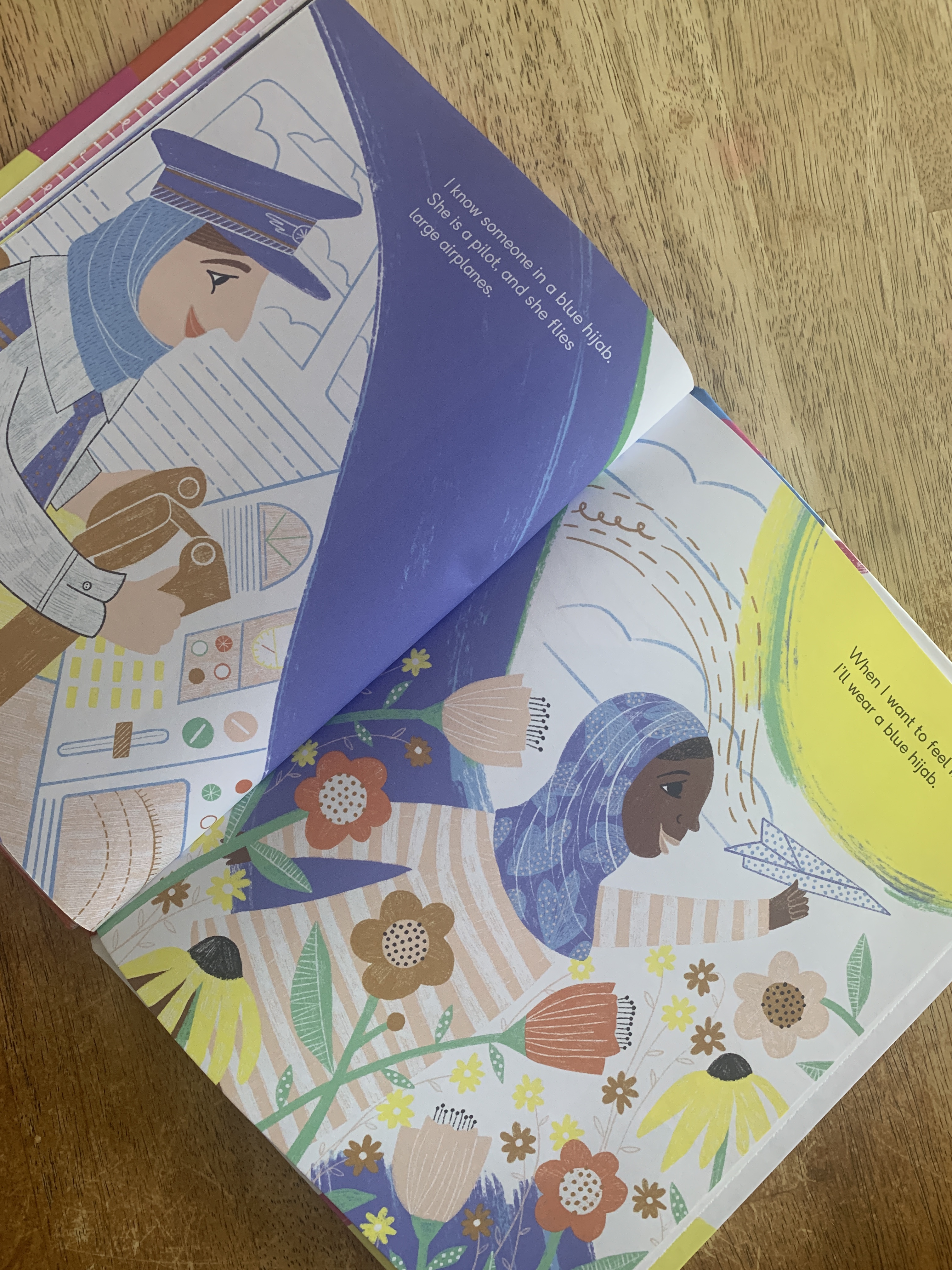
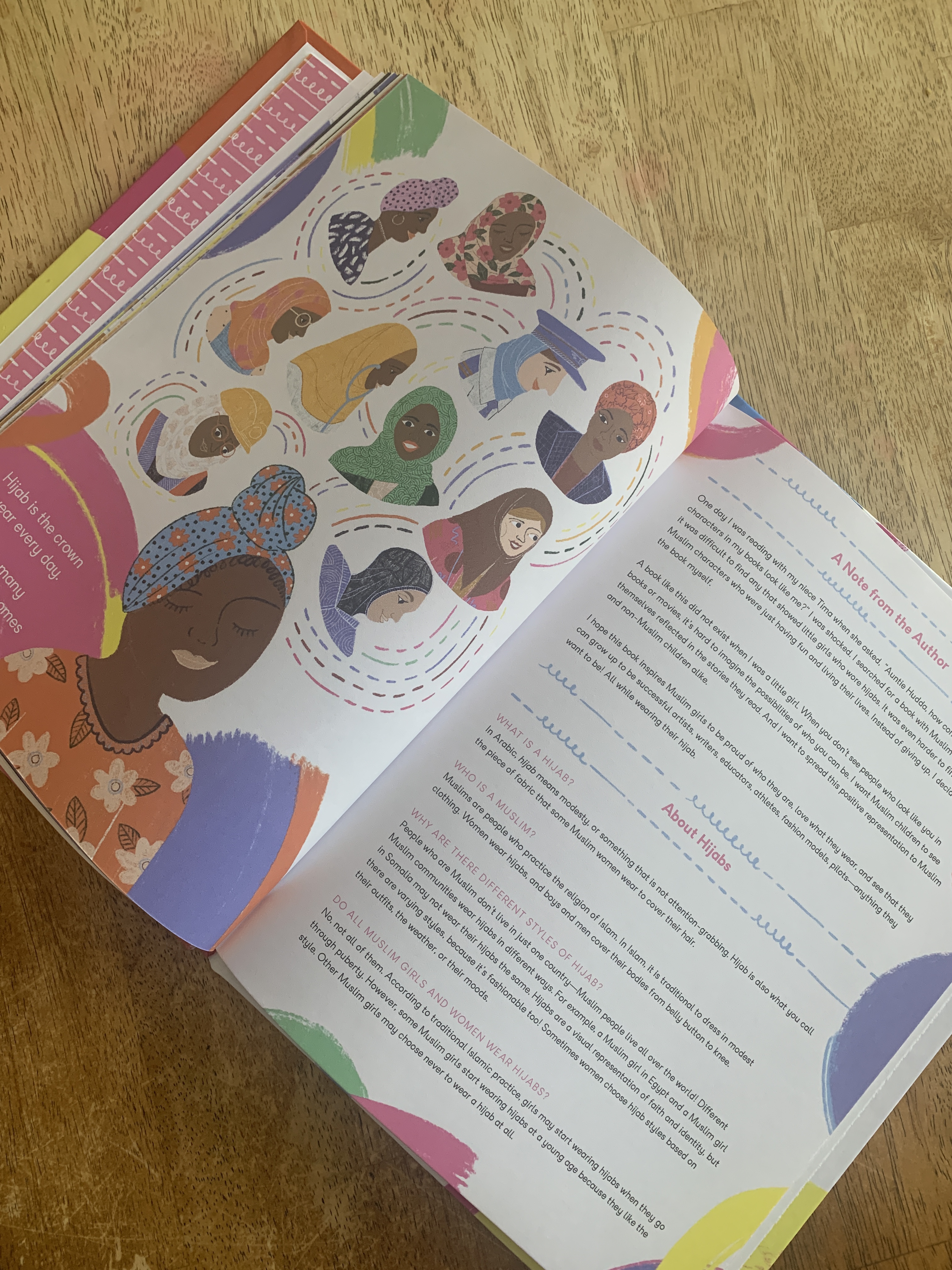
When this book arrived I flipped through it and loved that it tied hijab colors to careers, when I asked my seven your old to read it to my three year old and I overheard snippets, I was impressed that positive characteristics associated with the professions were articulated and embodied by the main character to inspire young girls everywhere.  When I finally sat down to read the book my self, I enjoyed the joy, diversity, and backmatter, but unfortunately felt like a page was missing at the end.  Over 32 pages the book introduces a color as seen on someone the narrator knows hijab, and identifies the woman’s job and a couple of characteristics.  The facing page highlights that when the girl wants to have strength or show kindness she too will wear that color hijab.  The text on the first page and the last page is the same, “Hijab is the crown/I wear every day./It is worn many ways, and it comes in every color.”  I absolutely love the premise of the book, but it seems that the conclusion should perhaps broaden that we can be anything and everything no matter the color we wear.  The blurb on the back of the book actually uses language of wearing “yellow, ‘like’ my doctor’s hijab, brown ‘like’ my teacher’s hijab,” etc.  that allows for a more interpretive and less literal view of I have to wear this color or that to be a leader or athlete or loving. I know I know, I’m probably overthinking it, but I’ve read the book so many times, and each time I just feel like the conclusion tying it together is missing and makes the book primarily a color book and thus preventing it from transcending into being more.

The book text is like a poem with the opening and conclusion reading the same.  The patterned body of the book works very well in establishing the links between hijab, color, occupation, empowerment, characteristics and implementation.  The pictures also allow the reader/listener to broaden their knowledge about various careers and see what they look like in action and what attributes they draw upon.

At times the wording gets a little loose with “give kindness” and “show wisdom” but the overall tone conveys the sentiment and allows for the stronger, “get results” and “be a leader” to balance out the flow of the book.  The illustrations amplify the color being presented, but it is worth pointing out that the hijab’s are all patterned and could be a little confusing to little readers.  Similarly, the yellow hijabs appear more orange and the purple more pink.

I love that the book is authored by a Somali woman and that the illustrations show diversity (skin color, mobility, body shape), but focus on strong black women inspiring the young protagonist.  The backmatter hints that it is the author’s niece and also explains hijab, and hijab styles.

I purchased mine from Book Depository, but they are going out of business, you can also purchase it on Amazon, here.

Book One: Thunderbird by Sonia Nimr translated by M. Lynx Qualey

Standard
Book One: Thunderbird by Sonia Nimr translated by M. Lynx Qualey

img_7178

My public library had this book and so I picked it up seeing that it was Palestinian authored fantasy, and I am always on the lookout to support OWN voice Palestinian stories.  The book cover is gorgeous, the inside text unfortunately is tiny making this middle school aged book only 110 pages.  It is translated from Arabic and published by a university, so my expectations were pretty meager which assisted in me being fully swept away by the story at hand.  Sure the book has a few glitches in point of view,  often it feels a bit abrupt and djinn stories are a dime a dozen, but what elevated this book and made it stand out was the Palestinian history interwoven into the plot: snippets about the Mamluk soldiers and Ottomans, the Ayyubid rulers and walls around Jerusalem.  There isn’t enough history touched upon in my opinion, but I look forward to see, now that the world building is established, if the rest of the series will highlight the historical thread.  I have no idea if the characters or author are Muslim, there are references to praying and hearing the athan, but they could just be cultural.  There is magic, fantasy, djinn, prophecies, and reading of tea leaves, as well as fighting, assault, and talk of oppression under Israeli rule.  I’d assume it is advanced Middle Grade or lower YA, but to me it seems 11 and up would enjoy the quick fast paced read.

img_7175

SYNOPSIS:

Noor’s parents are dead, and she lives with a grandmother who loves her, and an uncle and his family who don’t.  When her grandma dies, Noor is alone and with things combusting in to flames around her and no one left to defend her claims that it wasn’t her, Noor is trying to piece together a ring left to her, her mother’s research, and her flame creation abilities.  Her search leads her to a colleague of her mother’s and an old archaeological site.  While staying with an aunt in Jericho over the holidays, a mysterious cat guides her to the same archeological site where the cat reveals that she is really a djinn.  The barrier between the seen and unseen world is failing, and Noor is prophesized to be the only one that can ensure it doesn’t happen.  With a trait of the mythical phoenix Noor must find ways to travel in time and retrieve a feather before the bird is reborn.  Along the way she will have the help of the djinn and of her doppelgänger from that time period.

img_7176

WHY I LIKE IT:

The story is clever, fast paced, and the character endearing.  I wish the details were fleshed out and of course I wish there was more history when she travels back in time.  The climaxes are quick builds and even quicker resolutions, but despite all the flaws I really enjoyed the story and look forward to the rest of the series.  The book ends on a cliff hanger that feels rather abrupt, but being it is clearly established as book one in a trilogy, I don’t think readers will be too upset at the sudden end.

img_7177

FLAGS:

Magic, time travel, prophesies, fortune telling, assault, oppression, fighting, loss, arson, arguing, djinn, fighting

TOOLS FOR LEADING THE DISCUSSION:

The book probably is too short for a book club read, but I think a teacher could definitely use it as a reference in story writing, historical fiction fantasy, culture inclusion lessons.  If you wanted to use the book, you’d be able to find plenty to draw on for teachable moments in literature, history, and writing style.  There would also be a lot to discuss in terms of occupation, myth, legend, and culture.

If your library doesn’t have it you can find it on Amazon

The Month that Makes the Year: A Joyful Celebration of the Spiritual Practices of Ramadan by Inda Ahmad Zahri

Standard
The Month that Makes the Year: A Joyful Celebration of the Spiritual Practices of Ramadan by Inda Ahmad Zahri

img_7355

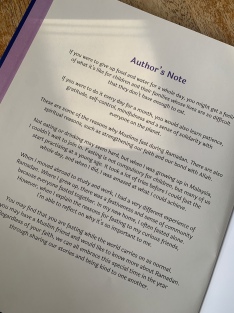
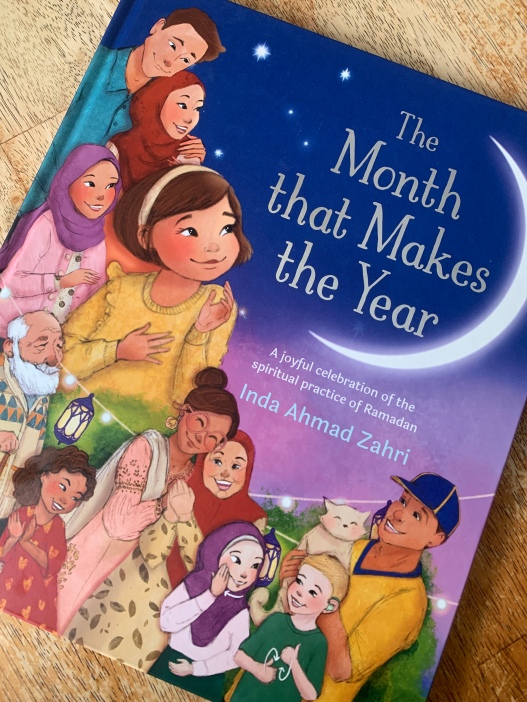
This book was definitely worth the wait, alhumdulillah.  For all the complaining I do about books regurgitating facts, or Ramadan joy books leaving out the religion, and presentation feeling like it is more for non Muslims than for our own little children; this book does a great job of sharing key points about Ramadan with authenticity and heart that Muslims and non Muslims alike will benefit from the light story, engaging and adorable illustrations, and Muslim child centering.  This 32 page book works well for preschool to early elementary readers and listeners at bedtime, at story time, and in settings were introductions to Ramadan are shared.

img_7358

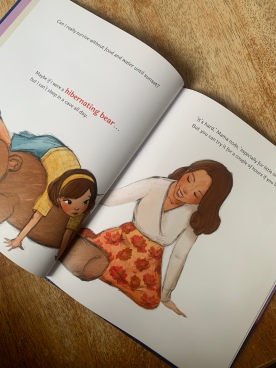
I was a little nervous that this book was framed as a child’s first fast, but a few pages in my concerns disappeared.  Little Deenie knows what Ramadan is, her family is encouraging her to try and fast for a few hours, and she knows that she can’t hide in a cave and sleep like a hibernating bear because Ramadan is so much more than going without food and drink.

I love the shelving of tempting snacks and bad habits of unkind words, waste, impatience, and that little changes lead to big changes one at a time: kindness, love, attention, gratitude.

img_7361

Deenie goes a little longer each day, and her tummy rumbles, but where she once felt lonely in the quite spaces, she is finding new things that otherwise would have been missed.  She helps the coach off the pitch at soccer, the family connects without screens, the “ordinary feels extra-ordinary.”

img_7357

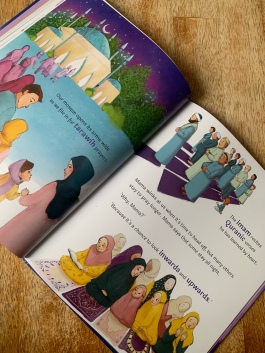
The mosque opens its arms for tarawih, and extra prayers are “a chance to look inwards and upwards.” A chance to belong.  There is sadaqah and Zakat, and being thankful, learning about traditions and connecting with others.  There are non Muslim friends changing a lunch date to a gallery stroll, and realizing the kindness is not required, but appreciated none-the-less.  The human body is amazing, and Deenie is growing stronger with each Ramadan day.  Eid is a time of celebration, but Ramadan is missed, and we are not the same people we were before the blessed month..

img_7356

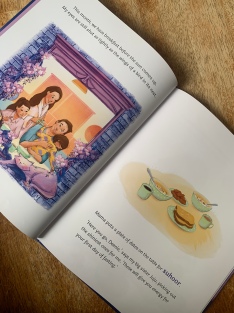
The book starts with an Author’s Note and ends with a Glossary.  The hardback 11 x 9 book is a great size to allow kids to truly enjoy the sweet illustrations that add to the text and bring the feelings to life.  There are a variety of skin tones, mobilities, clothing styles and head coverings, or not covered characters shown.  There are so many smiling faces, and relatable scenes.  This book is really well done and an absolute joy to read and share.

I personally needed to see that my expectations for a Ramadan read were not unrealistic, and this book alhumdulillah, not only proved that good representation can be beautiful and heartfelt and unapologetic, but raised the bar.  I can’t wait to share this for our Masjid Ramadan story time, I only wish it was easier to obtain in the USA.  I preordered mine from Book Depository, but since publication the price has gone up, inshaAllah if we all show our support, local stockists will find a way (www.allenandunwin.com).

The Night Before Eid: A Muslim Family Story by Aya Khalil illustrated by Rashin Kheiriyeh

Standard
The Night Before Eid: A Muslim Family Story by Aya Khalil illustrated by Rashin Kheiriyeh

img_7123

This 40 page early elementary picture book is set the night before Eid and radiates with love from a boy to his Teita, traditional ka’ak, and the family’s Egyptian culture.  The robust and personal backmatter shares a glimpse into the threads from the author’s real life that the story touches upon, and makes the book extend beyond the pages.  It is worth noting that this book does not articulate if it is for Eid al Fitr or Eid al Adha and thus works for both.   There is nothing religious in the book except a reference to something happening after Eid prayer in a memory, and the shape of the cookie being round like the Ramadan moon, Eid day is not mentioned, it is simply the catalyst for this warm family story about a boy and his grandma making a special treat for the first time and sharing it at school.  The large hardback book with fun illustrations is ideal for both story time and bedtime readings alike.

img_7124

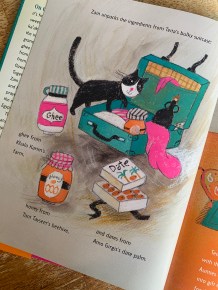
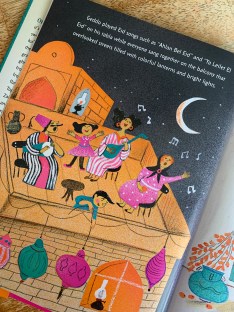
It is the night before Eid and Teita has arrived from Egypt.  Zain can’t wait to make ka’ak to take to school and share with his friends.  The beloved powdered sugar cookies are steeped in tradition, both in Zain’s family and in Egyptian history.  Once the suitcases is unpacked and the special ingredients found, Teita and Mama share memories of baking with cousins, painting henna designs on hands and putting eidiya in envelopes.  The family recalls singing together on the balcony while Geddo played the tabla and lights and lanterns filled the streets below, after Eid prayer they would hand out the ka’ak.

img_7125

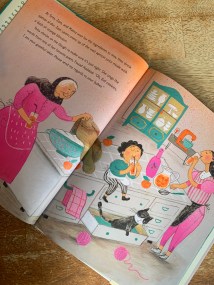
Zain wants the ka’ak to turn out perfectly so his teacher and friends will like them.  Teita tells him that ka’ak is as old as the ancient pharaohs, and that recipes were found in the pyramids.  At one time rulers would even put gold coins in the cookies.  Zain and his Teita mix and add the required ingredients, and drink iced apricot juice as they wait for the dough to be just right.  Getting the cookies pressed with the molds though is harder than it looks, and Zain gets frustrated. Teita’s love and patience and Zain’s clever thinking get the treat making back on track.  The ka’ak doesn’t have a gold coin filling, but they are filled with tradition.

img_7126

The timeline is a bit off for me with the grandma coming before Eid and then the cookies going to school on Monday, and then Monday evening when Zain is writing down the recipe with Teita he is telling her Eid Mubarak and that it is the best Eid ever.  So, it seems that he went to school on Eid, not to Eid prayers, which is fine, just a little sad that there was no Eid celebration or prayers.  I don’t know that kids will be bothered by it, but the lack of mirroring and stressing how joyous Eid is does somehow get lost and mitigated, in my opinion, by skipping acknowledgement of the religious holiday.   In the backmatter the author remarks that she has “outgrown the magic of Eid,” so perhaps it is intentional that the day is not included in the text.

img_7127

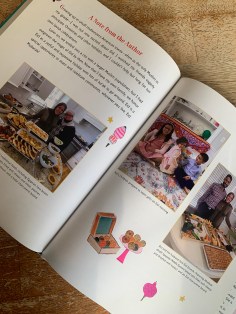
The last six pages of the book are filled with informative and engaging information about What is Eid, Ka’ak Time Line, A Note from the Author with photographs of her and her family celebrating Eid, a Simple Ka’ak Recipe and Additional Resources.

I purchased my copy from Crescent Moon Store where if you put my initials ISL (Islamic School Librarian) in at checkout you will save 10% or is available here on Amazon where the book currently has a coupon for $3.80 off.

Moon’s Ramadan by Natasha Khan Kazi

Standard
Moon’s Ramadan by Natasha Khan Kazi

moon

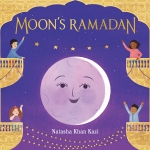
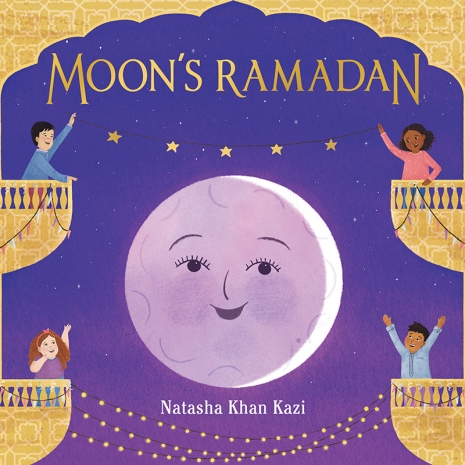
This beautiful lyrical book has a simple premise of the moon looking down on people celebrating Ramadan as it circles the Earth, but stands out as being unique thanks to the poetic language and engaging illustrations.  Each spread shows moon in a different phase over a different country, and the joy, activities and worship that Muslims are partaking in during the blessed month.  I’m embarrassed to say, I didn’t realize that the author is also the illustrator until I sat down to write this review, and honestly it makes sense, as the story text and illustrations work seamlessly together.  The tone of the book, the details in the pictures, and the rich language make this a good read for a large audience.  Little ones probably won’t fully understand the poetry, but they will be mesmerized none-the-less and feel the excitement.  My three year old calls the moon all year round, the “Ramadan Moon” and he understood that the Moon in the story is excited seeing us celebrate and worship.  He consistently would still be peeking in windows or searching the scenes, not quite ready for me to turn the page long after the text was done being read.  Older kids will appreciate the shared global bonds of Muslims and the cultural specifics too.  They will grasp the information shared and beliefs touched upon in the flowing words that do not preach.  My only criticism is that the book starts with Moon saying, “Hello.”  In an Islamic centered book I would have expected to see Assalamualaikum, especially since it appears on the page where moon is above Egypt, so I’m not sure why the English greetings is used.  The book has a glossary and notes at the end making it a great addition to Muslim and non Muslim spaces alike.  I plan to read the book for a Masjid story time as the large hardback book will work just as well for a group of kids as it does at bed time.

Told from a personified Moon’s perspective, the book begins with Moon smiling at Earth as people all over the world excitedly point and look up at her, but once they see her, they rush off to prepare for the month. Over Turkey, the Ramadan Drummer awakens sleepy people for suhoor and over Indonesia he sees families gathering for iftar. As each day passes Moon grows fuller watching the children do good deeds and people sharing their wealth.

Nights of Taraweeh and listening to the Quran over Somalia, sharing treats in the United Kingdom, and  interfaith among neighbors in the United States bring joy to Moon.  And as the waning crescent sees henna being put on hands in Dubai the month is coming to an end.  People once again look to the sky, but they cannot see Moon in Argentina, Moon is new.  It is Chaand Raat and then it is Eid.  Moon is back in Egypt watching people celebrate and then the world returns to looking up at Moon and she beams with love and gratitude.

There are diverse characters of a variety of skin tones, mobilities, ages, body size and abilities featured all throughout the book in a positive and inclusive normalizing manner.  The backmatter makes the concepts more accessible and the book work on different layers.  I really enjoyed the book and am excited to share it.  I purchased mine at Crescent Moon Store where using my initials ISL (Islamic School Librarian)  will save you 10% it is also available here at Amazon Even my local public library has it on the shelves already! Happy Ramadan!

Crescent Moon Friends by Wadia Samadi & Mo Duffy Cobb illustrated by Lisa Lypowy

Standard
Crescent Moon Friends by Wadia Samadi & Mo Duffy Cobb illustrated by Lisa Lypowy

img_6247

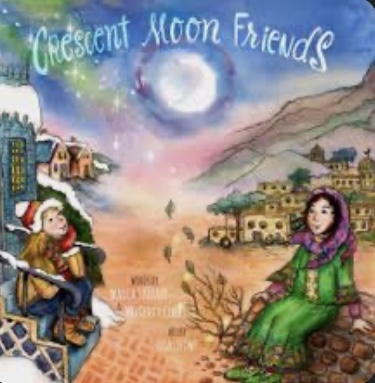
This 32 page book does not read like a new release, it looks like something you would have found in the early 2000s when the recent war in Afghanistan started and books about refugees from the region were popping up.  Admittedly back then, I probably would have been more forgiving that the smiling illustrations showed Islam in action and two characters from different cultures coming together through dialogue, respect, acceptance, and fun, but for reasons I’ll articulate, this book reads very superficial, dismissive and erroneous at times.  I am not Canadian or Afghani, I am a neighbor to both as a Pakistani American, and the book is OWN voice, so if I am just being overly picky, or sensitive, and am wrong, I am happy to acknowledge it, but before you push back, please read the entire review.

The description of the book says:

Crescent Moon Friends introduces the reader to two best friends Amelia and Aisha. While the pair is from Canada and Afghanistan, the girls reconcile their differences through exploration of the values they share. This book initiates a family conversation about Islam, explores tradition and language, and brings the girls closer together as a result. It is our hope that the book will be used as a teaching tool to help children understand the cultural backgrounds of others, and to create a warm environment for refugees resettling in Atlantic Canada from the Middle East.

This picture book is for both non- Muslims who are living in the West, and Muslims who are living outside their home countries. The focus of the book is on tradition, not religion, it also captures the significance of Islam. This is a valuable title for library and classroom use.

So first of all, I feel like the foundation of the book is othering Islam in making it seem that this book is an introduction of Islam to non Muslim with the premise being that Islam is what, a foreign religion? Numerous Canadians are both Afghani and Muslim in 2022, before I even began the book I was already fearing the framing.  Then it identifies Afghanistan as the Middle East, which just made me really question the accuracy.  Somehow after that first paragraph, the book then tries to say that the book is not about religion, but traditions.  While part of me appreciates that distinction, the second part of the sentence saying that it wants to capture the significance of Islam really shows the poor focus of the book.

Let me pause here though and answer a question I’m sure many of you are wondering, “why review a book that is not well written, and is not widely promoted or known about.” The answer is simple, a book such as this may not sell in big numbers and be regularly seen online and in stores, but they often do find their way into libraries and classrooms.  They are often shelved to fill “diversity” or “inclusion” quotas and thus their messaging does often reach our children.  I also highlight books like this, not just to pick on this particular book, but to show that OWN voices doesn’t make something automatically correct.  If this is the author’s own experience or is a memoir, there is some leeway, but saying that Afghanistan is in the Middle East or that Salam is Dari, not Arabic, or that it is “naan tandori” instead of “tandoori naan,” just makes the book seem inauthentic.  Often publishers, editors, agents perhaps don’t want to push back and appear uncultured or racist, so they don’t question details, is the only thing I can think of as to why this trend continues to perpetuate.  Which is also why the importance of having a piece sensitivity read cannot be overlooked, even when the author is writing about their own religion or culture. Yes, I too am only one person saying I have issues, but beta and sensitivity readers such as @muslimbookreviewers are four people and we discuss based on what we know and between the four of us there are a lot of singular specialties and a lot of  overlapping expertise that really help books get it right. Sorry for my rant, back to the book at hand…

The book starts with the white Canadian girl camping with her family and wondering what the upcoming school year will bring.  The text says. “she loved to look at the crescent moon.”  Already the writing is clearly weak, who loves to look at a particular phase of the moon, does she not like the waxing gibbous or whole moon? The next spread introduces Aisha, she is standing in the foreground with a mosque behind her and the text says she loves the moon too.  “There was a crescent moon on top of the mosque where her family went to pray.” Aisha has her hair loosely covered, and immediately we are connecting Aisha to her faith and to Amelia through their love of the crescent moon.  Interestingly, Aisha who would presumably love the crescent as it symbols holidays and month changes in the lunar calendar is presented as liking the moon because of it decoration aesthetic. It is where her family went to pray, sure it reminds her of home, but chances are she didn’t often go to the masjid as culturally most women don’t, so I’m not sure that this spread really has any accuracy or value, it just sounds good…if that.

The next spread is the first day of 6th grade with the teacher introducing a new friend to the class.  If it is the first day of school, aren’t they all new to the class? Aisha recalls that she left Afghanistan because there was a war in her country and school wasn’t safe, if she is twelve or thirteen, I’m not sure what caused the change in real life for the war timeline being referenced.  On a more relatable note it mentions that she missed swinging in her grandfather’s garden with cousins as well.

The next page showing the girls being silly with pencils to look like a bunny and walrus is sweet.  It shows language isn’t necessary, that silliness is universal and it is cute.  The girls then show how they share things unique to their culture with one another.  Aisha teaches her how to say Salam, hello in Dari, how to dance the Attan, about Eid, the most important Muslim holiday, and about a game with stones called anjaaq panjaaq.  But this is wrong, Salam is Arabic, Eid is Arabic for festival or holiday so what Eid is the book referring to? Also why not tell how to play the game, or how to do the dance or how Eid is celebrated? If the book is to build cultural (or religious) bridges, thus far I’ve only learned how to stick pencils in my mouth to look like a walrus or behind my head to look like a rabbit.

It is then Amelia’s turn to share Canadian culture and the book picks: ghosts, goblins, Santa Clause and the Easter Bunny.  I find this a bit offensive on Canadians’ behalf, really their holidays are what make them who they are?  Later we will learn that Amelia is not religious, yet the symbols for religious holidays of Easter and Christmas are what are being presented.  Additionally, the holidays mentioned are not even unique to Canada: Christmas, Halloween, and Easter, are the same in America at the very least.

The next spread shows their moms becoming friends and the girls playing in Aisha’s mom’s scarves, hijabs, shoes and make-up.  I find the joy sweet, but I wonder if the book as stated in the details by the author/publisher is to help refugees- is this a bit misleading- that they are settled and have an abundance of clothing accurate?  Often refugees need assistance, will a book like this send the wrong message about helping those fleeing war get established, by not just avoiding talking about need, but celebrating surplus?

Aisha is then shown helping Amelia with math and when Aisha needs help with a Halloween costume, Amelia is there.  The book really is doubling down on the importance of Halloween to Canadian culture, which again feels off.  But also most Muslims don’t celebrate pagan holidays, so I’m not sure I like the positioning that it is cultural to celebrate and that to be Canadian one must engage in the rituals.  Whether you see it as pagan or just assimilation, either way it doesn’t sit right for a book aimed at finding common ground between diverse individuals.  Math is neutral and universal, why not have Amelia help Aisha with something also less controversial?

img_6242

The next spread shows Aisha missing Afghanistan, and Amelia being a supportive friend and wanting to visit Afghanistan too.  Unfortunately, once again the weak writing has her sounding like an adult missing the laughter in the air and hope and flowers, not a kid talking.  When Amelia joins in, naan tandori is mentioned, which is backward, if it is the same as in Urdu it should be tandoori naan.  She also wishes they could wear colorful Afghani clothes and dance the Attan, which are two acts not limited to Afghanistan.  They can put on traditionally clothing and dance in Canada.

The story then takes a huge pivot and shows Aisha and her mom praying with the very vague text of her mom “described her way of life, Islam as the peace in her heart, and said turning to Allah in prayer would keep Aisha happy.”  The text seems misplaced and the messaging completely pointless, why not frame it as what Aisha believes or what her faith teaches her? It almost comes across as her mom forcing the belief on her and this being the first Aisha has heard about it.  The next page is set up the same, but shows Amelia’s faith to be kindness and compassion while they sit in nature.  I think the intent was to be positive, but when you have two people representing entire populations, all sorts of stereotypes come in to play that either have to be so general as to be accurate or more specific to the two characters at hand.  In this case I feel the takeaway is that holidays define Canadians, even religious holidays, but they are fine to participate in because Amelia is not part of organized religion.

Thus the next spread of Aisha’s family celebrating Christmas with Amelia makes sense in the story, but I find alarming because it normalizes abandoning your own religious convictions and adopting another faiths in order to fit in and assimilate.  Imagine a teacher reading this book to a first grade class and little Muslim children who demand that Christmas and Easter stay out of public schools are hearing messaging normalizing the holidays for people of all faiths.  Imagine a recent immigrant or refugee further feeling pressured to adopt these practices because they want to be seen as “good citizens” or be accepted by the larger community.  The contrast of Aisha’s family celebrating Christmas is Amelia helping make star and moon shaped cookies for Eid.

The story comes back to the girls love of the moon, one as a dreamer, the other as a scientist.  It tells of other firsts Aisha experiences and Amelia learning about Aisha and her faith.  I’m not sure what a genie lamp has to do with Islam, but it is in the illustration with a hamsa hand, a book, a tasbih, and a crescent with a minaret coming out.

Aisha then starts to wear hijab and Amelia learns how to wear one too. No details about what or why hijab is worn or given, and in the illustrations it doesn’t completely cover anyone’s hair. The girls ski together and drink hot chocolate and living in Canada allows Aisha “to be the girl she was meant to be.”  I’m not sure what that means, but that seems to be the resolution to the book before it circle backs to the mom and concludes.

I think on the very surface the book is a nice idea, but the conflation of what it means to be Canadian with observance of holidays and the lacking details of what it means to be Muslim Afghani make the book miss so much and ultimately do more harm than good if shared.

A Bit of Earth by Karuna Riazi

Standard
A Bit of Earth by Karuna Riazi

earth

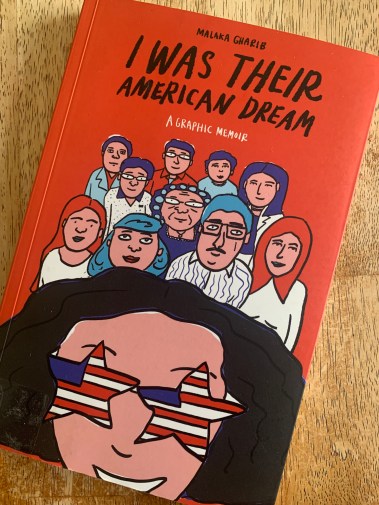
This Secret Garden retelling mixes the heart of the original with a dash of modernity, the flavor of desi culture, and the lyricism of a good writer.  Over 368 pages the slow plot but rich imagery will draw readers in, hold their attention, and leave them thinking about the characters they have been fortunate to spend time with on Long Island.  Islam is practiced and normalized and naturally woven into the Muslim characters’ daily lives without othering or over explaining.  I did struggle a bit trying to keep the relationships of who was supposed to be caring for the protagonist at various points since her parent’s died clear, but once I abandoned stressing about it I was able to be swept away.  I recently reread The Secret Garden with my own children and the original is not plot heavy, nor action packed, but I watched as my own children were drawn to the slower, more grounded (pun intended) nuanced tale, and I think this book, in the same vein, will find its way in to the hearts of middle grade readers.  The book is clean, there is a possible crush hinted very slightly at the end, periods are also endured, and I do have reservations of the terrible marital relationship between Mr. and Mrs. Clayborne, but it establishes that change will occur, so at least it isn’t normalized.  There are sprinkles of magic implied regarding the house, but it is always framed without clarity and in a subtle way to set the tone and the emotions the characters are feeling more than centralizing something rooted (see I did it again) in fantasy.
SYNOPSIS:

The book updates and mirrors the original fairly well with an obstinate orphan arriving at a sprawling house, finding a prickly boy, and setting off to form a tentative toleration of one another with friendly neighbor kids in a garden that is unquestionably off limits.

Maria Latif arrives from Pakistan against her will to be taken in by a distant relative (I’m not sure how she is related), but Asra has been called away and she is forced to stay with Lyndsay, the new wife of Mr. Clayborne.  The first wife was a friend of Maria’s family, but Lyndsay is just as emotionally overwhelmed and lost as the child in her charge.  With Mr. Clayborne away on businesses, his mother Charlotte keeps them all on edge.  When Colin Clayborne is expelled and returns home, more tension erupts and the two children find themselves in an off limits garden trying to make the most of a difficult situation.

WHY I LIKE IT:

I love the mix of poetry and standard novel format.  It is beautifully written and clearly the author does a remarkable job of making her very unlikeable characters worm their way in to the reader’s heart.  Both Maria and Colin are thorny and difficult, stubborn and rude, but you seriously cheer for them, and I did shed a few tears at the end.  With the author’s writing ability apparent, I’m still not sure why the foundation of the relationships and getting Maria to the Clayborne home is so cumbersome.  It is too muddled and it drags the book down every time it is revisited.  The Dadi having the aunt’s phone number was too easy, the inconsistency of the neighbors having no relationship to the Clayborne’s for so long and Lyndsay not even pausing to think another Bangladeshi family living a few houses down might be my husband’s first wife’s friends, seems inconsistent.  Honestly Lyndsey in general needed to read like a competent woman struggling, not a teenager in over her head. I disliked her and Mr. Clayborne’s relationship and I would hate to think any reader would find it ok or normal.
I love the Islam and how it presents when the character has to pray, she goes and prays, it is part of the story and it is seamless.  I don’t think the culture is handled quite as well.  Lyndsay is a foot writer who is always cooking, yet knows nothing of desi foods? If Colin’s mom is desi, wouldn’t she at some point tried to cook familiar foods for him.  Half the neighborhood is Bangledeshi, so it seems everyone has a parent or step parent or distant relative that is desi and I loved the normalizing, but it seemed a bit assuming.  I don’t think kids will wish it was more clear, but as an adult reading it, I felt like it needed to be interjected more without explanation, or if left as is, adding some context. I also wanted to know what Maria’s parents did and a little introspection from Maria.  Again as an adult I see how her anger and grief changes how she remembers them, but from them always being away, to such soft poignant memories at the end, I think kids will need a little hand holding to understand the grief process and her understanding of them.  As it is, they just seem terrible and then all of the sudden great, and the pacing gets thrown off in the process.

FLAGS:

It seems to hint at the end that Maria might have a bit of a crush on Colin, I honestly thought up until a single line that they were making a chosen family with the people who cared for them, but that line seemed to suggest it might be more of a romantic feeling than friend or brotherly.  I read an early copy, so this is subject to change.

Maria gets her period and it is detailed what she is feeling.  I think boys and girls can and should read it.  It is presented on age and appropriately: cramps, achy, dry about blood leakage, having it start young like her mother, etc..

Implied magic (possibly), music and musical instruments being played, milaad, lying, sneaking, being kicked out of school for physical assault, close male and female friendships, ADHD stigma.

TOOLS FOR LEADING THE DISCUSSION

I think this book would work in a classroom and would appeal to readers in an Islamic or public library.  I would consider it for a middle school book club, I think readers will connect and feel empathy for Maria, Colin, and Lyndsay and be better for it.

I preordered my copy HERE and I hope you will do the same