Category Archives: strong women

Golden Girl by Reem Faruqi

Standard
Golden Girl by Reem Faruqi

golden

I began reading this book not having any idea what it was about. All I knew, or all I cared to know, was that the incredibly amazingly talented Reem Faruqi wrote it, so I wanted to read it. While I know it will be hard for most to avoid knowing the plot, I think it was a blessing that I was able to be swept away so completely and so fully in a story that is wonderful and memorable, and truly sets a higher standard for the way that a story can be told. Faruqi’s voice and authenticity had me in tears. I didn’t even realize my eyes were dripping until my son asked me if I was ok. It wasn’t the plot that had my emotions spilling over, sure it helped, but it was the storytelling, the hadith and deen and snapshot of a life so unlike my own that simultaneously is exactly my own that a physical reaction emerged. It is the power of OWN voice storytelling. It is the power of brilliant writing. It is not just a book about a Muslim character, this book blurs the lines for me between Islamic fiction and fiction with Muslim characters. Middle school readers (mature middle grade readers) will enjoy the book, older readers will enjoy and appreciate the 336 page story told in verse. You can pre-order the book and I hope you will, it helps convey the message to publishers that this book is highly anticipated and that we need voices like this. Additionally, Goodreads currently is hosting a giveaway, you can head there to try and win a free copy.

(If you don’t want to know what the story is about, maybe skip the next section.)

SYNOPSIS:

Aafiyah’s name means well-being, protection, health, money, happiness, everything good, but Aafiyah has secrets too. She is privileged and loved, and she knows it, but sometimes when she sees something she likes she accidentally borrows it. Sometimes it isn’t an accident. Sometimes she doesn’t just borrow. Much of her life is wonderful, a best friend that lives next door, doting parents, tennis, vacations, trips to Pakistan to visit grandparents, and a love of “weird but true facts.” So what happens when all that changes. When her grandfather gets sick and the family wants to bring him to America for treatment, when Aafiyah’s dad gets detained and imprisoned on the way home, and Aafiyah’s secret may be a way to help her family?

WHY I LIKE LOVE IT:

I absolutely love that the characters are so well rounded and developed. Yes, Muslims have vices, and even young practicing Muslims have tests and struggles. The bar has been raised, we aren’t just a monolith, and our only struggles aren’t girl/boy issues, alcohol, not being oppressed and getting an education, we are complex people, we are human. The bulk of the story is Aafiyah growing up: her responsibility within her family, her changing body and appearance, her friendships, her responsibility for her actions, her desire to want to help and improve and step in to her own. I love that all these layers of life somehow are explored in such sparse lines. It doesn’t drag, but it gives the necessary pauses to involve the reader in her logic and view of the world. Aafiyahs’ kleptomaniac tendencies, her father being detained, her grandfather’s illness. they all move the story along, but they are foils for a much more intimate character story. A story that is surprisingly funny and light and impossible to put down.

I absolutely love how Islam is woven in, how she exudes Islam in all that she is, because she is a Muslim completely, the good and the bad. The guilt she feels, the desperation to be forgiven, the knowing that Allah swt sees all. The book is never even close to being preachy, but she proudly owns her identity and the details of her faith are not watered down, or even justified, it is who she is and it isn’t up for debate.

Culture is presented unapologetically as well. She is critical of things she sees in Pakistan, and similarly celebrates and admires good things about Pakistan and Pakistani culture. The book does not seem to have an agenda in presenting Muslims or Pakistan as good or bad, just as Aafiyah sees them. Which isn’t revolutionary on the surface, but it really is refreshing because it highlights how many books simply don’t. It makes the contrast painfully obvious between books that are shy about certain things, when they have their characters deflect and disassociate from certain “realities” and books that confidently uphold their identity and demand that the reader steps up and truly see the characters and their experiences.

There is a beautiful and raw author’s note at the end that shares some of the inspiration for the threads of the book, a glossary, a recipe for Aloo Gosht and resources for help with kleptomania.

FLAGS:

Stealing, lying, chatter about crushes, music, dancing. Being attractive and the reactions that it gets is woven through out.

TOOLS FOR LEADING THE DISCUSSION:

If I have a majority girl group, I will teach this. It isn’t a girl only book, but I think some of the more subtle themes would need a safer girl space to discuss.

A Sari for Ammi by Mamta Nainy illustrated by Sandhya Prabhat

Standard
A Sari for Ammi by Mamta Nainy illustrated by Sandhya Prabhat

sari

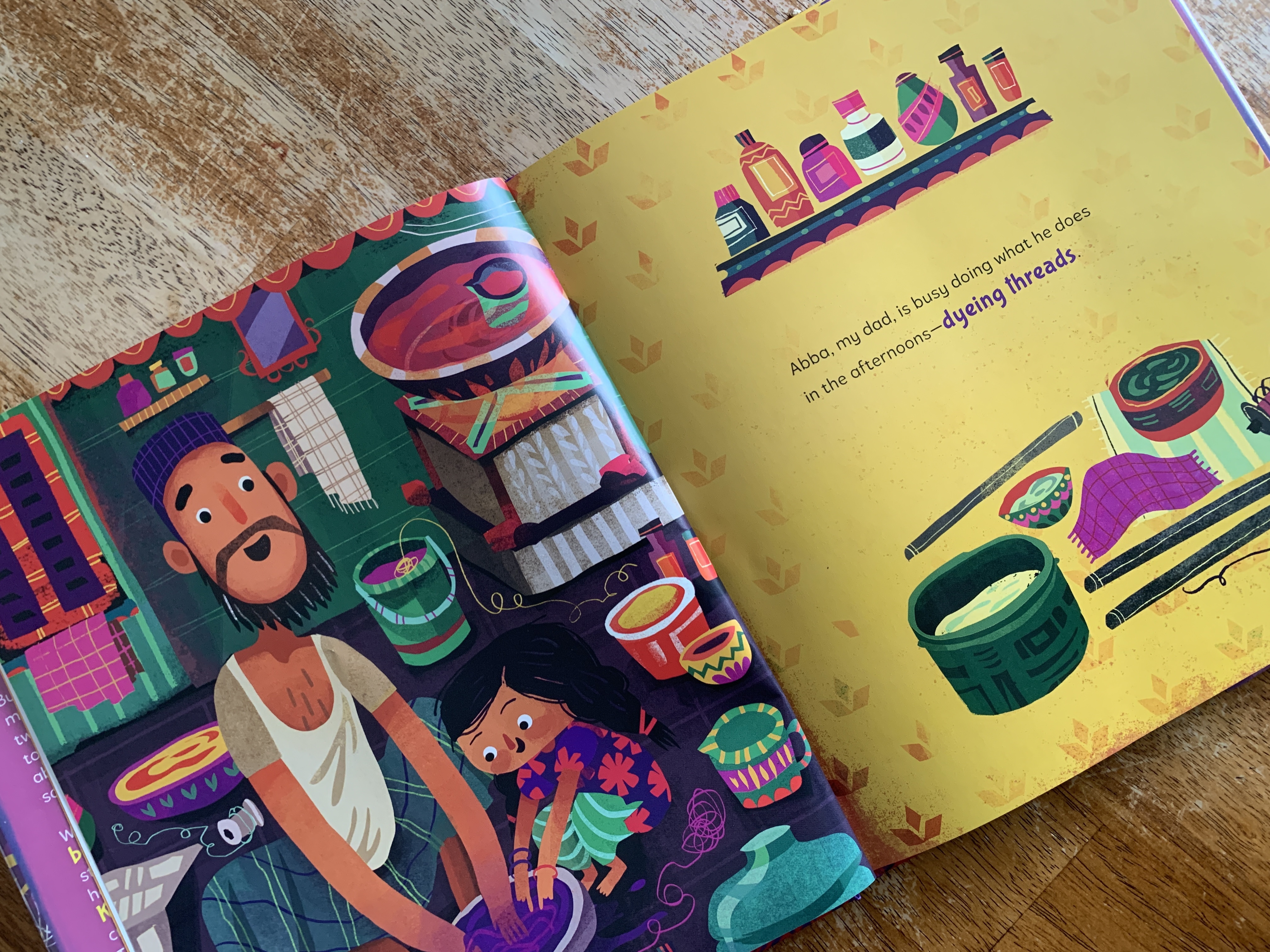
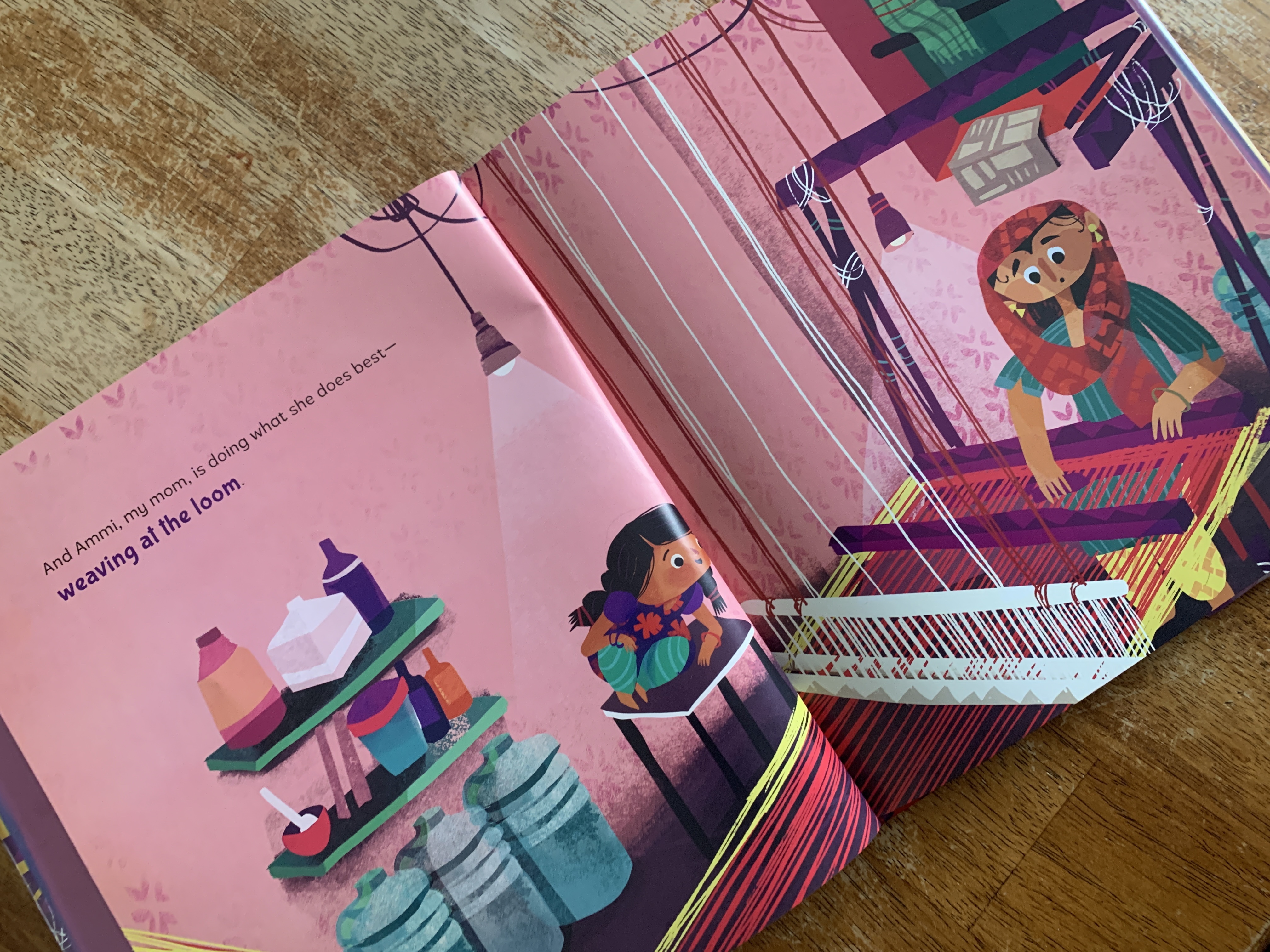
This book combines knowledge with a sweet story and a spunky narrator.  Over 32 brightly illustrated pages the reader learns about the art of dyeing yarn, weaving, and the tradition of weaving saris in India moving from Mysore to Kaithoon in Kota.  The little girl loves it all, helping her father dye the threads, and watching her mother work the loom.  It often takes a month to make a sari, and her mother makes beautiful saris, but she never wears them.  With the help of her older sister Sadaf, the little girl hopes to earn enough money to gift her mother a beautiful sari to wear.  It will take a lot of work, some community help, and some sacrifice, but Ammi is worth it and the girls are up for the challenge.  Preschool to early elementary readers will enjoy learning about the daily life of these amazing Indian Muslim artisans and a craft that they perhaps were not aware existed.

img_4662

The buffalo are sleeping, but in the afternoon Abba is busy dyeing threads, and mama is weaving colors into prints of mangoes, peacocks, birds, leaves, and flowers.  The whole family helps.  Abba goes to the haat to sell the completed saris.  Sometimes Mama goes as well, but she doesn’t wear the saris, she wears worn-out salwar-kameezes.

One day, when Ammi finishes a particularly beautiful sari the little girl asks her to keep it, but her Ammi says, “If we keep the saris, how will we eat?”  The little girl doesn’t understand, they don’t eat saris.

img_4663

Sadaf explains to her little sister that the only way their Ammi will wear a sari is if they buy her one.  So the little girl breaks her bank apart to count the money she has and convinces Sadaf that the things they wanted with the money are nothing compared to how much they want something for their mother.

But Sadaf says they only have enough money for a towel, not a sari, so the girls gather some items to sell to the junk man.  They have enough to buy Ammi a duputta, but still not a sari.

img_4665

They wander home through the wheat field trying to come up with other money raising ideas.  The wheat remind the little girl of worshippers on Eid day- all praying together at the mosque.  The little girl remembers that sometimes their neighbor Amina Khala purchases dyed threads from them and they rush over to see if she has any work for them.  Luckily she does, and they have just enough to buy a sari for Ammi and be rewarded with a smile and tears from their beloved and talented mother.

img_4664

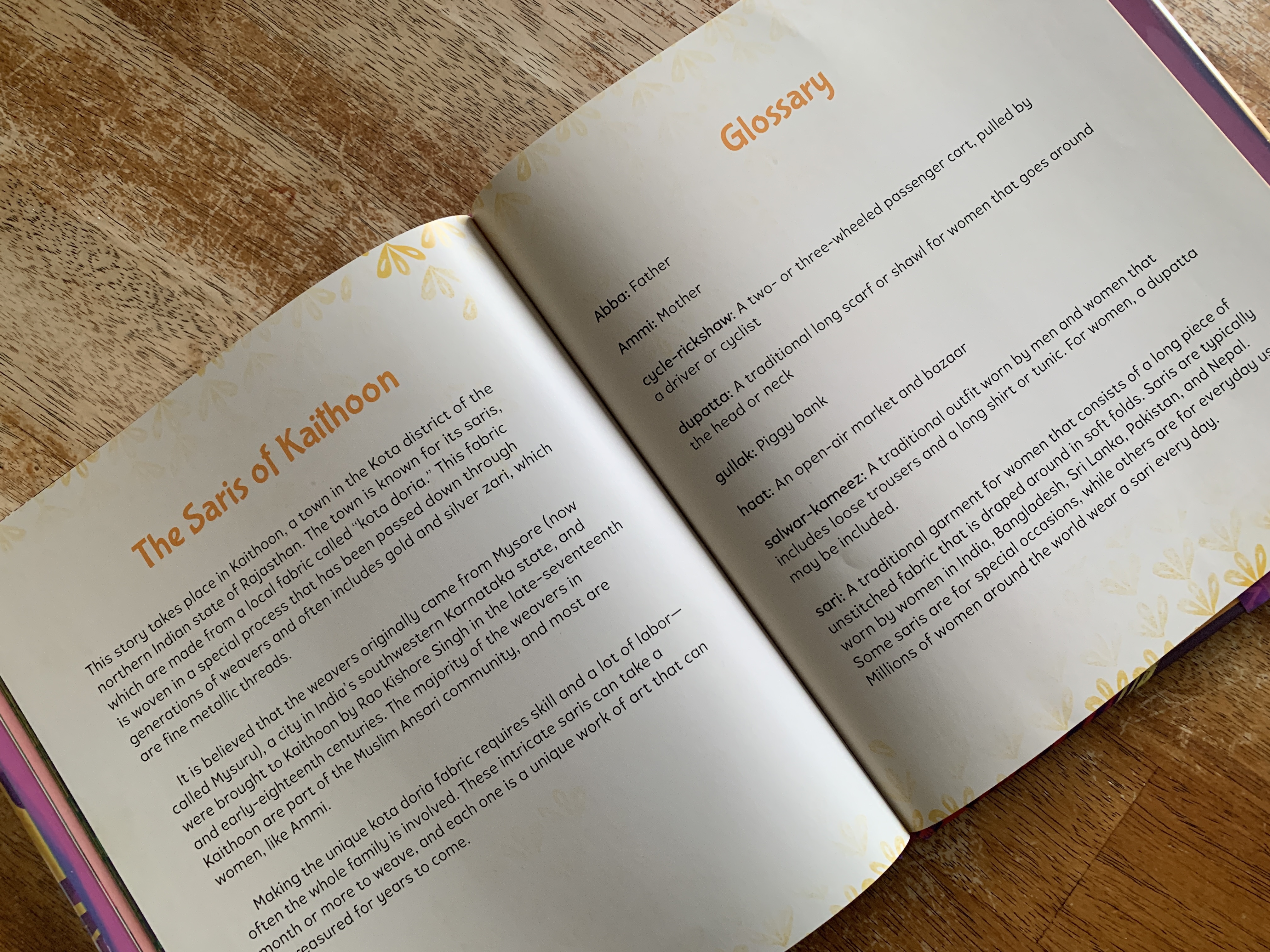
The book has an information page at the end about The Saris of Kaithoon, as well as a glossary.  The story ends a bit abruptly, but the teardrop in the illustrations, the hugging, and the smile, do provide a universal relatability to parents everywhere when their children gift them something so genuinely from the heart.  The illustrations also show women with their heads covered going about their daily life.

img_4666

My Name is Bana by Bana Alabed illustrated by Nez Riaz

Standard
My Name is Bana by Bana Alabed illustrated by Nez Riaz

bana

OWN voice books are always important, and while we see a rise in minority voices claiming their own stories, to read a child’s story about war and hope by a child, is particularly impressive.  Bana Alabed was born in 2009, she is an activist, a Syrian refugee, and now an author.  Her clear voice doesn’t stumble and her perspective is unapologetic, yet hopeful.  Over 40 pages she tells her story in her own words with beautifully warm and complementary illustrations filling the pages.  For kindergarten and up, this book stands out in a crowded field of refugee inspired stories for its authenticity, strong author, and overall emotional connection.

img_4629

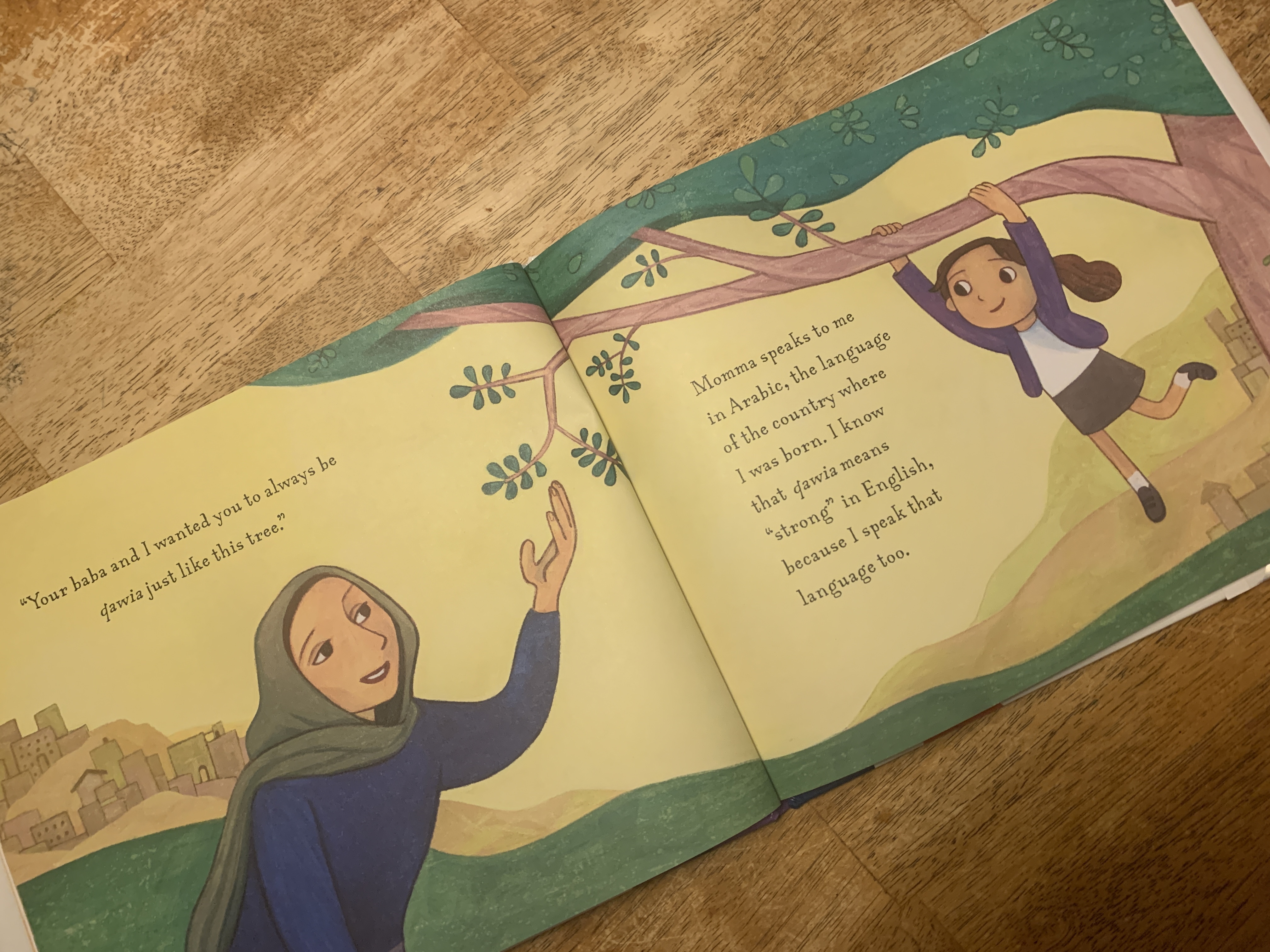
Bana begins her picture book memoir by asking her mother why she was named Bana.  Her mother explains that she was named after a tall bushy tree that grows in Syria.  Her favorite tree.  A tree that is qawai, Arabic for strong.

img_4630

Bana then asks what it means to be strong.  And once again her mother lovingly explains, that strong is to be brave even when you are scared, and to be sturdy so others can lean on you.  It also means you use your mighty voice to speak up when something is wrong, you read, study, and exercise your body.

img_4631

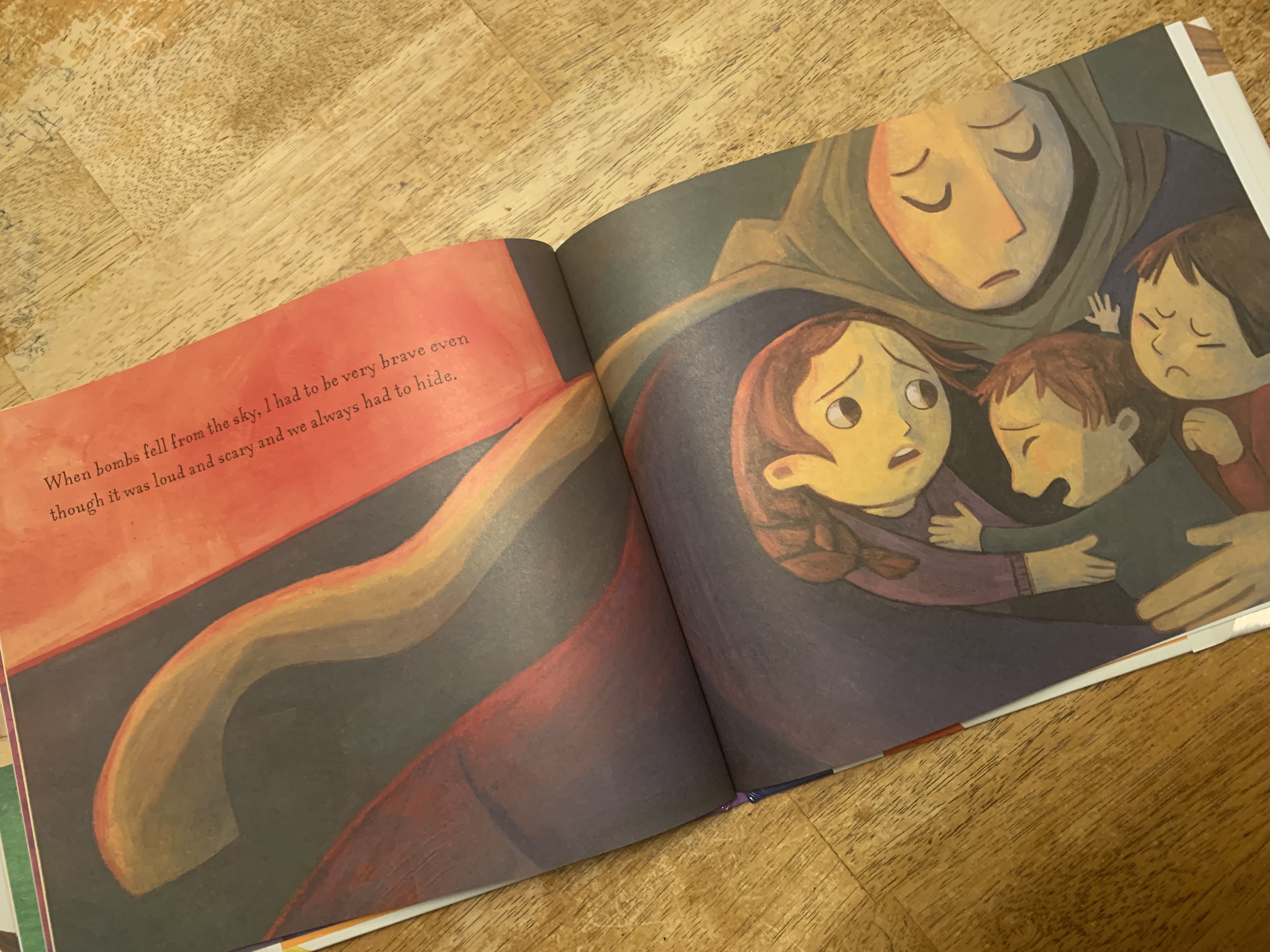
Bana appreciates her name, and being strong, because war came to her country.  When bombs fell they had to hide, when her brothers were scared, she had to keep them distracted, when they moved to a new place where they didn’t know the language or any people, she had to be strong still.

img_4632

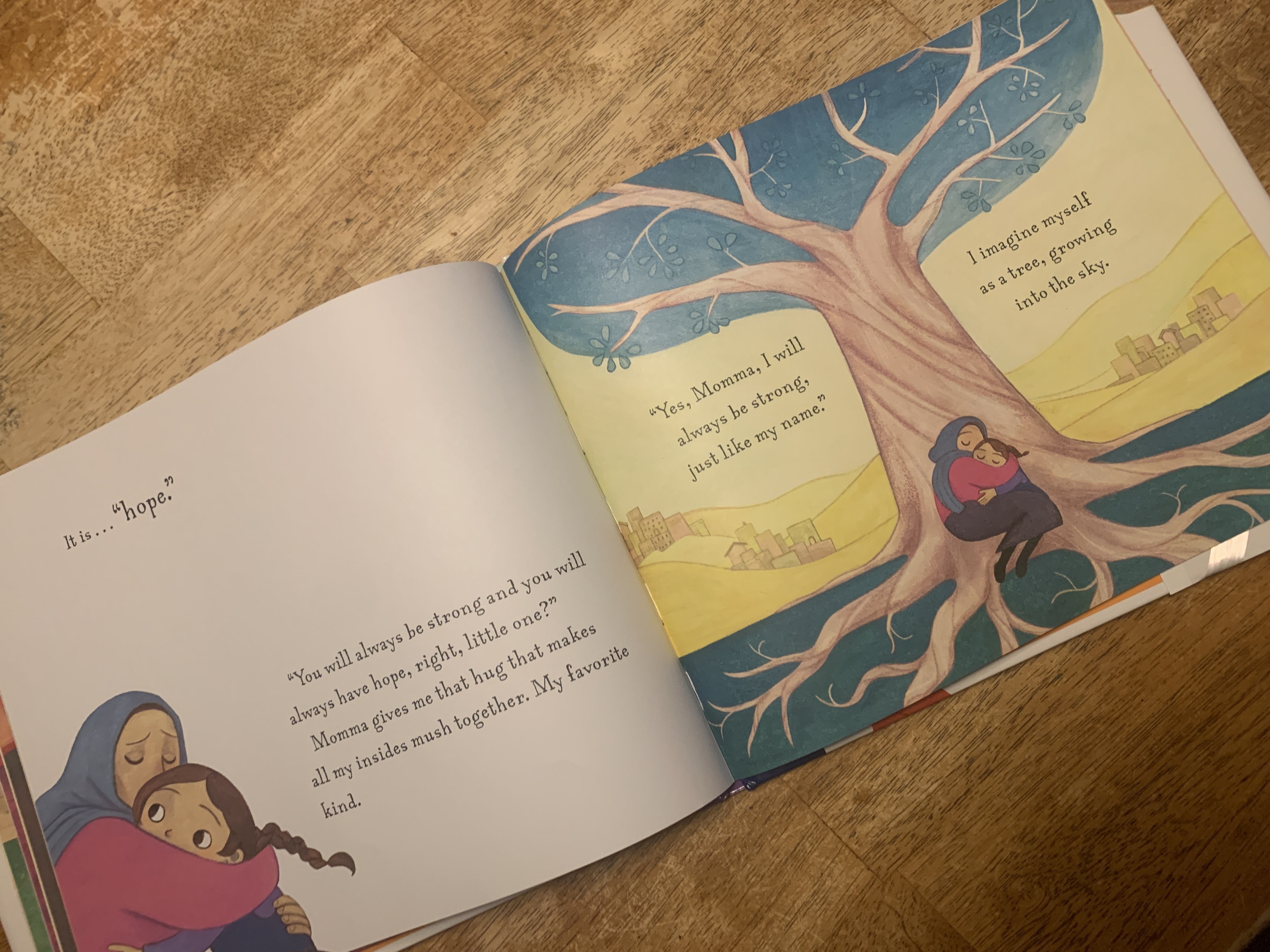
As a young girl, Bana tweeted about the war, the book doesn’t touch on that, but it does show her being strong as she shares her story all over the world.  It then returns to her and her mother discussing amal, Arabic for hope, and Bana imagines herself strong, reaching into the sky.

img_4633

The book ends on a simpler note of acknowledging her little brothers’ names: Laith and Noor, lion and light.  The Author’s Note at the end is just as powerful as the text of the book and provides more information about Bana’s experience and outlook. The way that war is handled is not overpowering for young readers, and will provide a great starting point of discussion.  The relationship between Bana and her mother is warm and supportive and equally deserving of mention with the little people you share the book with, alhumdulillah.

“Kids shouldn’t have to always be strong.  Every child deserves to live in peace.” Bana Alabed

A Sky-Blue Bench by Bahram Rahman illustrated by Peggy Collins

Standard
A Sky-Blue Bench by Bahram Rahman illustrated by Peggy Collins

sky cover

I know many of you are thinking, another book about school for girls in Afghanistan, and given the reception by most to the author’s first book, The Library Bus,  I can sense the rolling eyes.  I was in the minority on that one, as I enjoyed it, but, this one is simpler, sweeter, more universal while being complimented by culture, and I hope it is a more authentic and accurate OWN voice portrayal.  I know I have a lot to learn about white washing narratives and breaking down colonial paradigms, so I promise if you disagree I will listen.  But I genuinely enjoyed the illustrations and little Aria finding a way to make a bench so she could sit comfortably at school with her prosthetic leg.  The girls go to school, and the furniture was burned to keep warm in the winter, a concept that the author verifies at the end as something experienced in his own life.  Aria has to find a way to sit in class because she wants to learn, and lack of wood working experience, resources, and doubt that a girl can do it from her classmates, isn’t going to stop her.  Over 32 pages, early elementary age children will meet a determined young girl as she pieces together scraps to build a bench.

Screen Shot 2021-10-22 at 10.49.20 PM

Aria has been in the hospital for a while after an accident took her leg.  She is excited to be back at school, but quickly realizes it is hard to sit on the floor with her new helper leg.  She tries leaning on the wall, standing even, but just getting up and down off the floor is really difficult.  At home when she mentions it to her mom, her mom reassures her that she can get through it and her little brother offers to help her carry her things.

Screen Shot 2021-10-22 at 10.51.12 PM

That night Aria considers how much she would miss school if she isn’t able to figure something out.  Then she has an idea, she’ll build a bench.  At school the next morning, classmates tell her “Girls don’t build benches,” but Aria responds, “I can do anything a boy can.”

With that, a single friend joins Aria as they comb the city for discarded wood, broken furniture, screws, and nails.  They assemble the resources and when they have enough Aria and her mom head across town, past the Blue Mosque, to visit the carpenter, Kaka Najar.  He shows them how to fit the pieces together like a puzzle and loans them the tools needed to be successful.  He even gifts her some sky-blue paint, “the color of courage, peace, and wisdom.”

Screen Shot 2021-10-22 at 10.52.30 PM

That weekend Aria and her mom and little brother build a bench, paint it blue, and get it to school.  When the other students see it, their excitement bubbles and they imagine building tables, book cases, and more.  Anything is possible after all, there is paint left in the can and they are willing to work together.

Screen Shot 2021-10-22 at 10.53.08 PM

There is nothing religious in the text, save the mention of walking past a mosque, but in the illustrations the women are all covering their heads when they are out, and are uncovered at home, the school uniform seems to be a white hijab and black abaya.  I wish there were some Pashto words sprinkled, and it was a bit off that she was building a bench, but the finished project was a bench and table. The end has an Author’s Note and I enjoy seeing the smiling faces and bright illustrations in a book set in Afghanistan.

Screen Shot 2021-10-22 at 10.54.15 PM

Daring Dreamers Club: Piper Cooks Up a Plan by Erin Sodenburg illustrated by Anoosha Syed

Standard
Daring Dreamers Club: Piper Cooks Up a Plan by Erin Sodenburg illustrated by Anoosha Syed

piper

This is book two in the series, I couldn’t get the first book from the library, and I wasn’t willing to wait for the one that focuses on Muslim character, Zahra’s story to be published, it could be a few years.  At 224 pages this middle grades book is fairly formulaic with five diverse girls becoming friends, each book featuring one girl’s story with the others serving as supporting characters, and with the tie-in to Disney Princesses, I really didn’t expect much. Imagine my surprise when I found myself enjoying the characters and their lessons and struggles, sigh.  The book is sweet, the characters like-able, and the author really doesn’t try and force all the characters into every scene.  The book focuses on Piper and the other girls add to her story where it helps, they don’t all have equal time and it doesn’t get confusing because of it.  You can even read the books out of order.  Zahra wears hijab and her Islam is mentioned in a journal entry where she discusses the five pillars, the importance of charity, and getting dirty looks.  There is nothing preachy, but none of the other character’s are defined by their faith and I truly don’t know if I’m bothered by the singling out of Islam being her identity or flattered by it.

img_4279

SYNOPSIS:

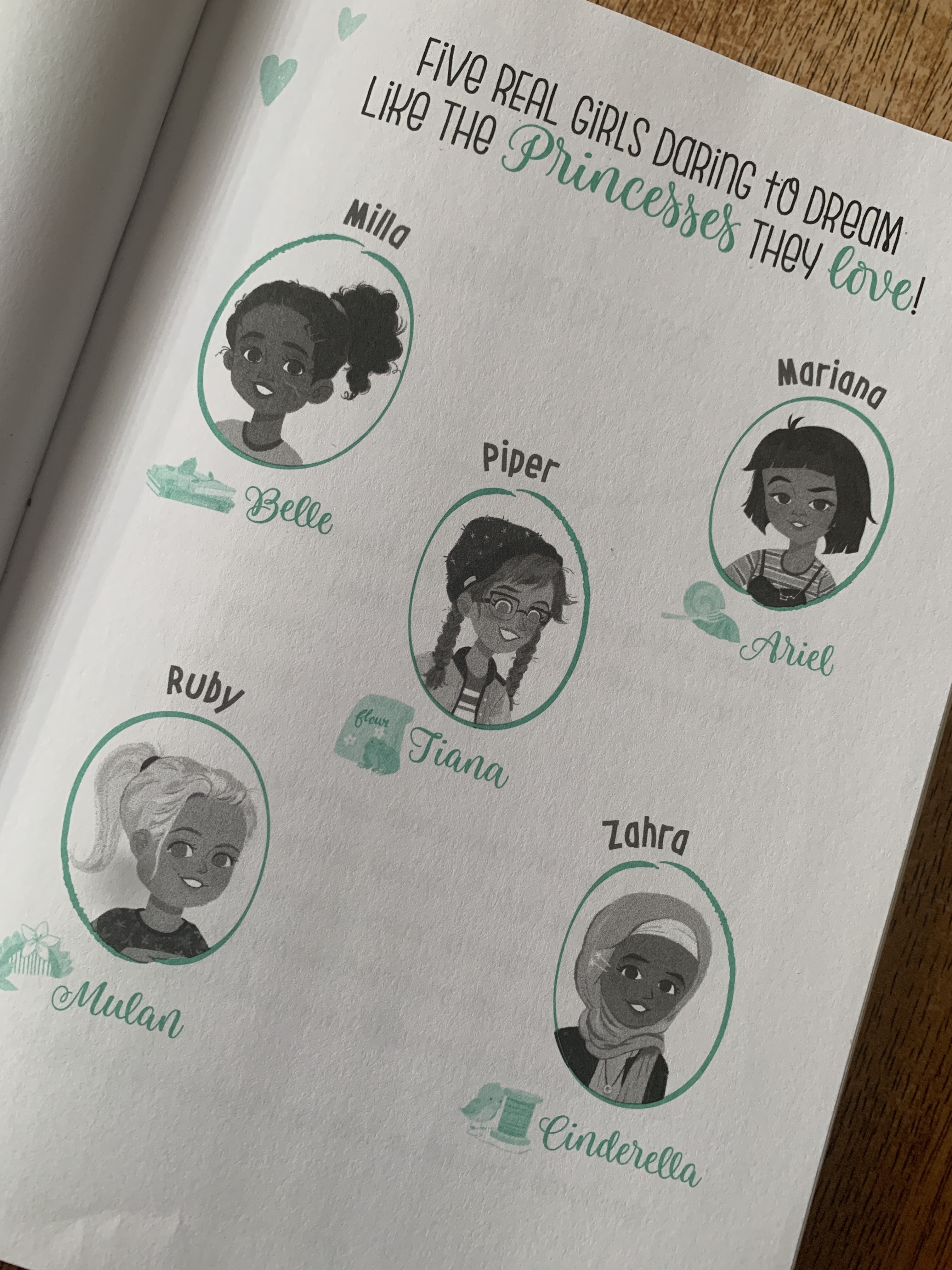
Five girls are grouped together at school in an advisory class to help prepare them for middle school: Milla, Piper, Ruby, Mariana, and Zahra.  Their advisor loves Disney Princesses and in their weekly journal entries has them write about their assigned Princesses as they explore their similarities and how they would tackle challenges, face fears, and the like.  The girls are diverse in family dynamics, race, religion, ability, etc.  Milla is African American with two moms and food allergies.  Zahra is good at art, Muslim, and likes to sew.  Ruby is a twin, her parents are divorced and she is great at sports.  Mariana is hispanic, and is an amazing swimmer.  Piper is Jewish, has dyslexia and loves to cook.  In the book she is struggling with school, while she excels in her food science creations.  She gets accepted to appear in a kids cooking show competition, but will need the help of her Daring Dreamer friends to prepare for the challenges about to be thrown at her during the competition, and to help her from falling behind in school.

Each girl has their journal entry presented in the book which helps to understand more about the different girls, as well as a little bit of introspection to the events happening in the larger story.

WHY I LIKE IT:

I like that the characters are really supportive, and the lessons aren’t so on the nose.  Piper isn’t just told that she doesn’t have to win the competition to have value, you feel it long before she accepts it herself.  Her personality really comes through and it isn’t for attention or for sympathy, she helps a competitor, there is no giant round of applause or moral reflection, she just helps.  I love that even though the story is Piper’s and her dream, there are larger issues woven in and felt, not necessarily preached. Piper is the middle child and feels she has to prove herself, she remarks on how being pulled out of class in early elementary school to get help has made it hard for her to ask for academic help now, the role of confidence and how charity and giving back is important, even while her own family’s financial situation isn’t clear.  I like the role of Piper’s siblings, they are quirky, but loving, and they work through their annoyances to help each other.  It is heartwarming.

I have my own mixed feelings about Disney Princesses, as a child of the 80’s, the 90’s brought all the glory of Jasmine, and Ariel, and Belle, and Mulan, and my friends and I definitely identified with different characters.  I may or may not have tied my hijab up many a days and claimed that I was Mulan in high school, but somehow with my own daughter I didn’t really bring the Princesses in to her day-to-day existence, I don’t think she has even seen all the movies, we read books (we didn’t even have a tv when she was little), she’s 14 now.  It had become too commercialized, I worried about the messaging more.  This book reminded me of what my friends and I as older “kids” channeled the Disney Princesses to be.  It wasn’t all about pink and sparkles, it was battling the bad guy, hanging on to your dreams, and persevering when things were tough.  This book channels those thoughts, it isn’t in your face Disney, it is more muted, and I appreciate that.  It is a solid middle grade read and I think an enjoyable one at that.

img_4283

FLAGS:

In this particular installment, there are no crushes, no holidays, no music, one character has two moms, but in this book, I don’t know that a casual reader would pick up on it. It says “Moms” once, it might be a bigger deal in the story that focuses on Milla, but I haven’t read it to comment.  There is lying and Piper tries to justify it, but I think it is clear and has its own resolution.

img_4284

TOOLS FOR LEADING THE DISCUSSION:

It is much too young for a middle school book club, but I think because it is such an easy engaging read, that in a home, or classroom, the book would be appealing to 3rd graders and up.

The author’s website: https://www.erinsoderberg.com/daring-dreamers-club.html

img_4280

The Tale of Princess Fatima, Warrior Woman: The Arabic Epic of Dhat al-Himma translated and edited by Melanie Magidow

Standard
The Tale of Princess Fatima, Warrior Woman: The Arabic Epic of Dhat al-Himma translated and edited by Melanie Magidow

princess fatima

I’m not sure how to really review this 167 page book.  It is the translated YA work of an Arabic Epic that took place somewhere between the seventh and 10th centuries and began possibly being compiled in the 1100s.  It was told orally, but when written, comprised some 6000 pages.  The translator notes that the choices of what to include and how to translate, all potentially alter and reshape the narrative, so as a reviewer I’m simply going to review the text in my hands.  I have no outside knowledge of this epic woman, and approached the book as I would have in high school when reading The Odyssey or Beowulf: some of the history is accurate, the characters fictitious, the culture possibly representative.  As a result, I find the comparisons to Wonder Woman and Katniss Everdeen on the back cover, very odd choices.  At times the contemporary diction, in my opinion cheapens the narrative.  Sure I appreciate the modernization of the text to make it an easy read, but throwing in modern slang seems too much.  I found the book’s framing unfortunately counterproductive of what it hoped to achieve.  I have no idea what the other 5,900 pages include and what the translator had to choose from, but the majority of the book focuses on marriage, being raped by her husband, and working to prove who the father of her Black son is when her and her rapist husband are white.  I was prepared for battles, and conquering, and fighting misogyny, and saving the down trodden, not every one just wanting to marry her.  Many of the characters are Muslim, some convert to Christianity to escape Dhat al-Himma, the Quran is quoted, prayers are made, the Kaaba visited.  I do however, take issue with the explanation of the child’s skin coloring being attributed to intercourse (rape) occurring while Fatima is menstruating and a case of Prophet Muhammad (saw) being used as proof of this occurring.  So much of the text is footnoted, this instance is not, and I find it disturbing.  The book also contains a lesbian character who ends up marrying a man, violence, death, and many other potential flags (see below) that might make it better suited for older college age readers.

SYNOPSIS:

The story doesn’t begin with the birth of Fatima, but rather with her great great grandfather.  It sets the stage a bit to show culture, how women and honor are treated, and the line of her ancestry.  When we get to know Fatima a few chapters later she is being born and her gender is a disappointment, so she is hidden away.  As she grows away from her tribe she becomes an accomplished warrior and captures her father in a raid.  When she returns to her people, her cousin, Walid, born the same time as her, is struck by her beauty and wants to marry her.  She refuses.  Repeatedly.  Finally she agrees to battle him and if he wins, she will marry him.  She wins, and he still doesn’t back down, finally she is forced/tricked in to marrying him by the Caliph’s agent.  The two are pronounced wed, but little changes for Fatima, she is a warrior and does not seek intimacy or companionship.  Eventually, her husband Walid enlists the help of Fatima’s milk brother and friend, Marzuq, to have him drug Fatima, so that he can rape her.  He acknowledges the rape, the whole community does, but allows it, because he is her husband.  When the child is born he is Black and Walid and his family refuse to accept that the child is his.  Amira Fatima is socially put on trial for being a whore and that the child is illegitimate.  As Walid works to have them killed, Fatima works to prove her innocence and carry on with her life trusting in Allah swt completely, all while the Arab-Byzantine battles are raging in the borderlands.  As Abdelwahhab, Fatima’s son, grows he too becomes a formidable warrior and the two have continued adventures.

WHY I LIKE IT:

I love the richness of the culture coming through a compelling story. Fatima is incredibly devout in her worship of Allah, swt.  She does not falter, ever.  When she is being tested she needs only her faith, at one point a man converts to Islam upon having a dream as a result of her conviction in praying.  That being said, I genuinely don’t understand a few critical points.  How can a woman who single handedly destroys tribes not be listened to, to make her own decisions to lead her own life.  I get that that is perhaps the poignant point of the story in today’s context, but there are a lot of strong women in this book, so why does her marriage and being defined by her not wanting to marry get so much of the spotlight? Her father didn’t want her, but they don’t resolve anything, they just reunite and all is well.  I need more.  I want to know what happened to Walid once he became Christian, was it a permanent thing, a temporary fix? What ended up happening between her and Marzuq? He was her trusted advisor and immediately regretted drugging her, what happened to him.  I want more about her mother, maybe even her Aunt or other women to see how their lives compared and contrasted to the powerful women highlighted.  How did they view her, was she inspiration, an anomaly, beloved, loathed?

I appreciate the footnotes, the introduction, the Note on the Translation, the further reading list, help with pronunciation and the character list.  A map would have been nice.

FLAGS:

There is violence, killing, rape, talk of sexual intercourse and menstruation.  There is misogyny, racism, flirting, sexual temptation, a lesbian character, magic, jinn.

TOOLS FOR LEADING THE DISCUSSION:
I would not be able to lead a proper discussion on this book, I am just not knowledgeable enough on the larger story.  I think I would like to be a student or be able to join a discussion led by someone well versed in The Tale of Princess Fatima and all the subtext that brought her story to life and maintained it over time.  It would be fascinating.

Beautifully Me by Nabela Noor illustrated by Nabi H. Ali

Standard
Beautifully Me by Nabela Noor illustrated by Nabi H. Ali

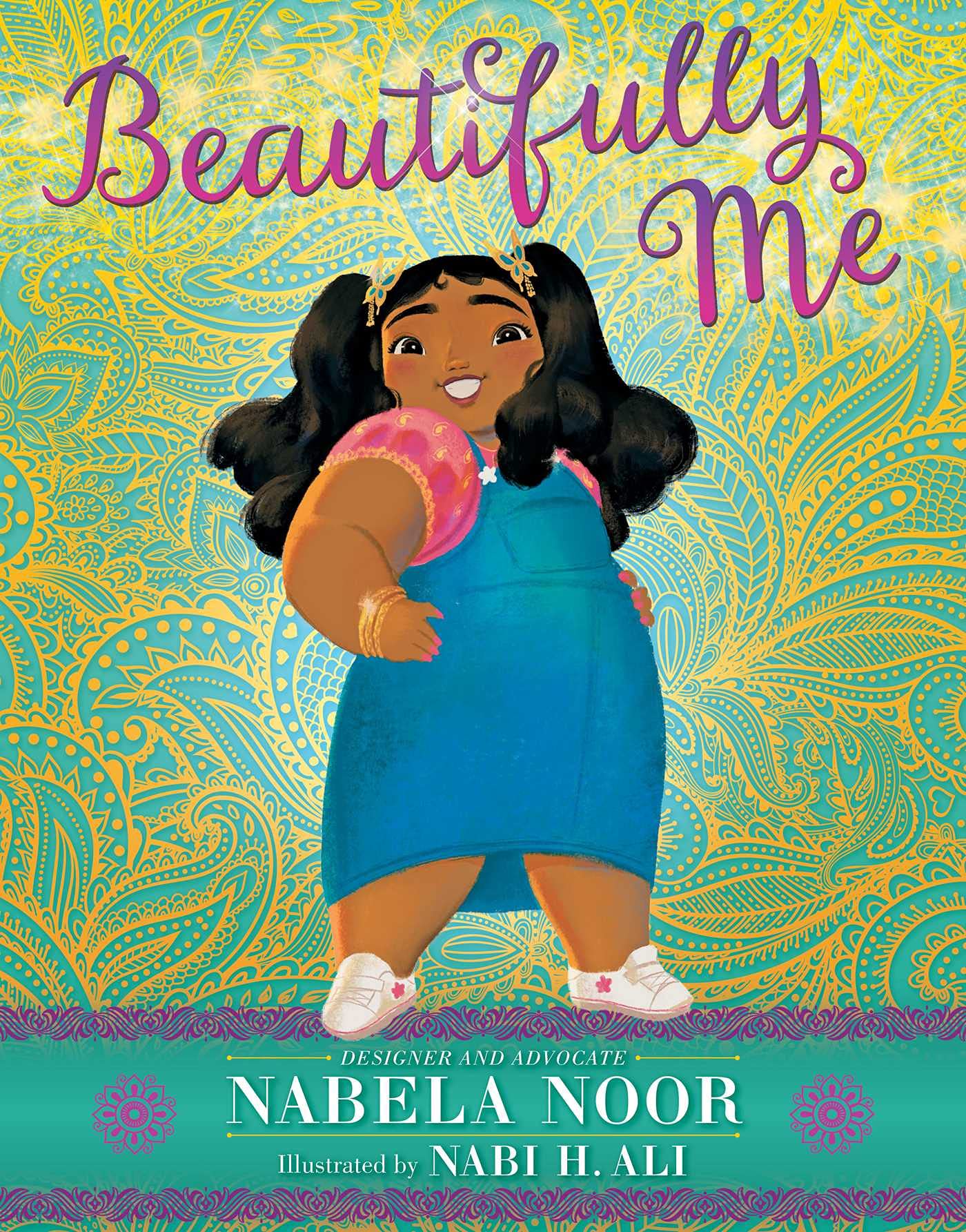
beautifullyThis 40 page glowing OWN voice book bursts with body size positivity, Bangladeshi culture, Islamic terminology, diversity, and a beautiful message.  The illustrations and theme alone make the book worth your time and reveal how few body positive books are out there for our early elementary aged children.  That being said, the book might require or benefit from some child led discussion.  If your child is aware of various body shapes including their own, then this book is a great mirror to build them up and as a tool in emphasizing the critical importance of understanding and knowing people are beautiful just as they are.  If your child doesn’t seem to be aware that society views individuals with a larger body size as being a negative, this book might take a little navigating as the theme is more focused on pushing back on fat shaming than it is on accepting all body types.  The book also opens its self up to discussions about pronoun identity, what beauty means, why people tease or be mean to themselves and others, and being aware of how our words affect those around us.

img_3976

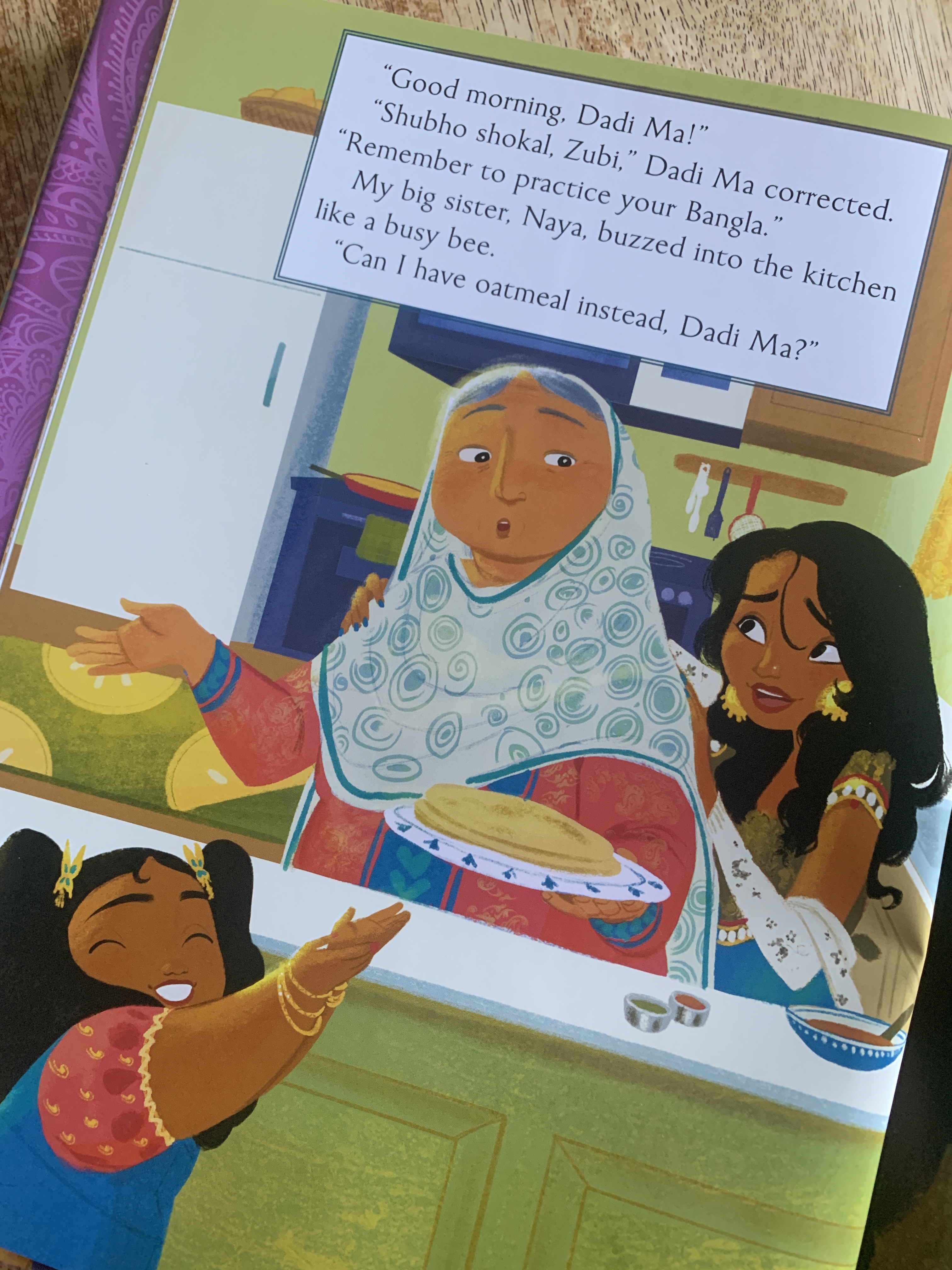
The family is visibly Muslim with Zubi starting with salaam.  The mom wears hijab and a sari, even at home, Dadi also has her head covered.  Eid is mentioned as a time when a gift was given that is too tight to wear, and worth noting from an Islamic perspective- Zubi’s sister is dieting to look pretty at a school dance.  Bangladesh is represented in the foods and some of the phrases the family says, and the clothing mentioned and depicted in the illustrations.  There is a glossary at the back.

img_3977

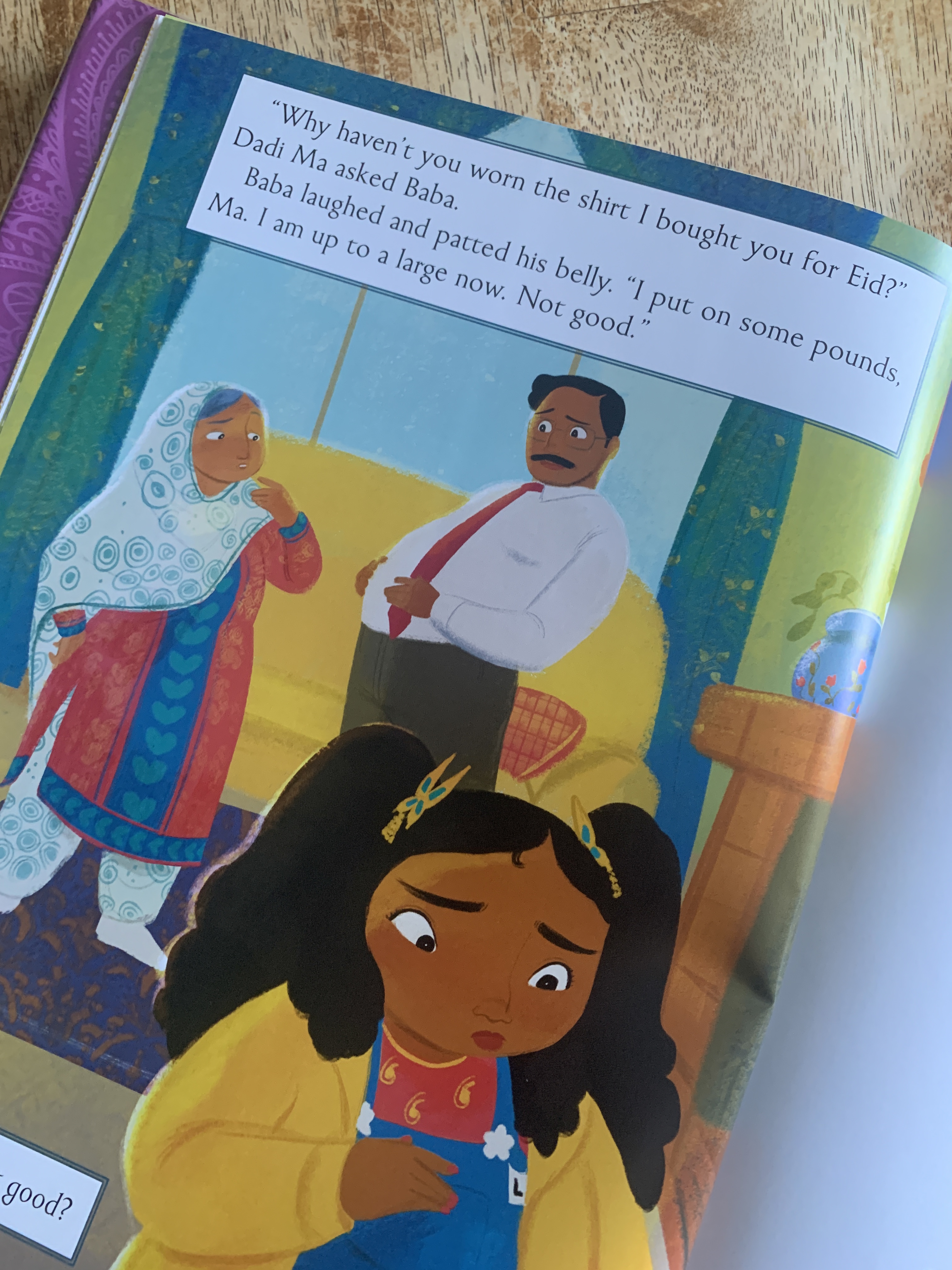
Zubi is excited for her first day of school, she slides on her dress and shirt her mom had made for her in Bangladesh and her bangles on each arm.  She heads to her parents room to show off her outfit where she finds her mom in a gorgeous yellow sari complaining about her big belly.  At breakfast Dadi has made flaky parathas, but Zubi’s older sister Naya is dieting and would rather have oatmeal. Dad calls the girls to take them to school when his mom asks how come he hasn’t worn the new shirt she got him for Eid.  He embarrassedly admits he has put on some pounds and his size is now a large, not good.

img_3978

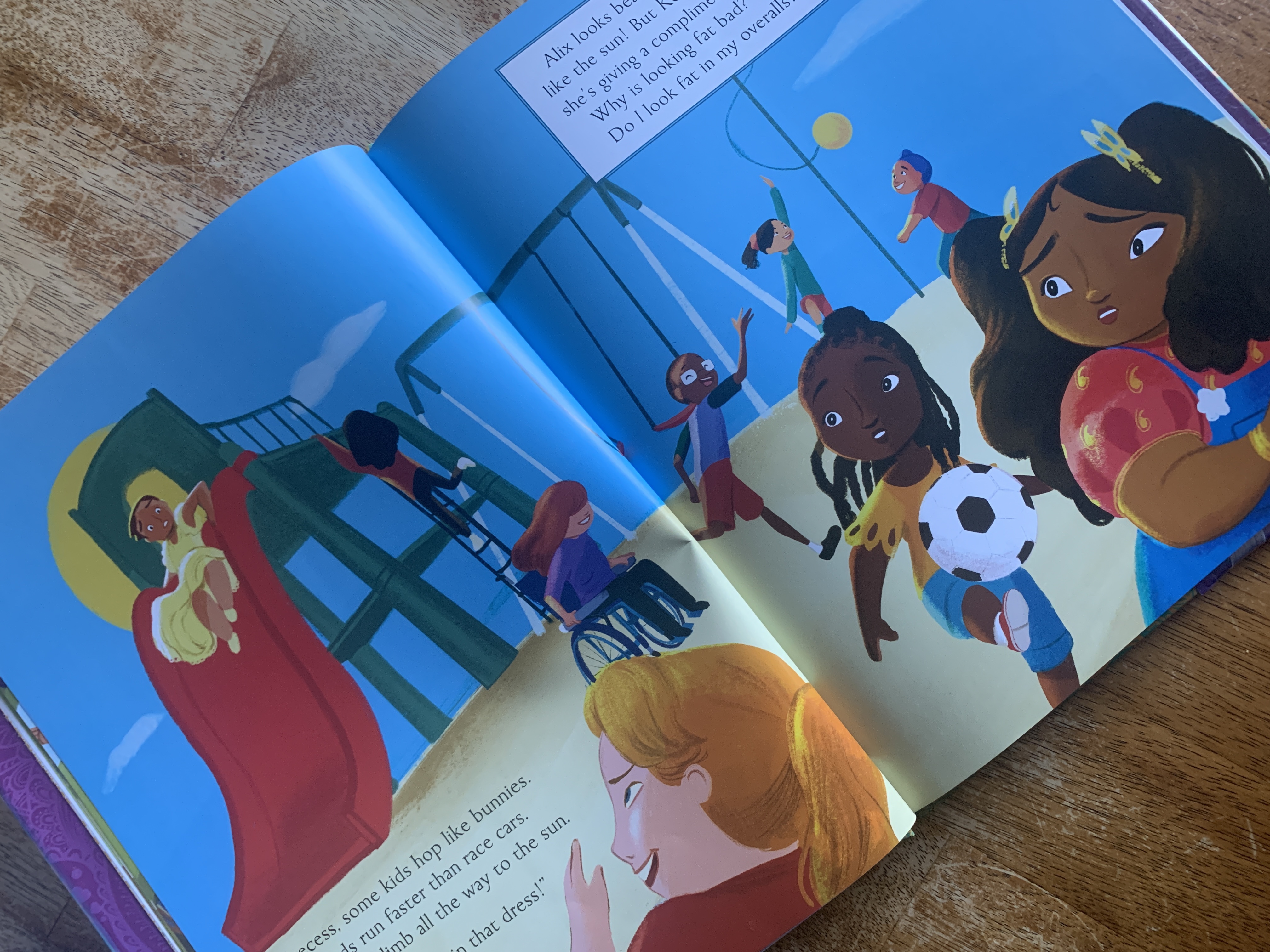
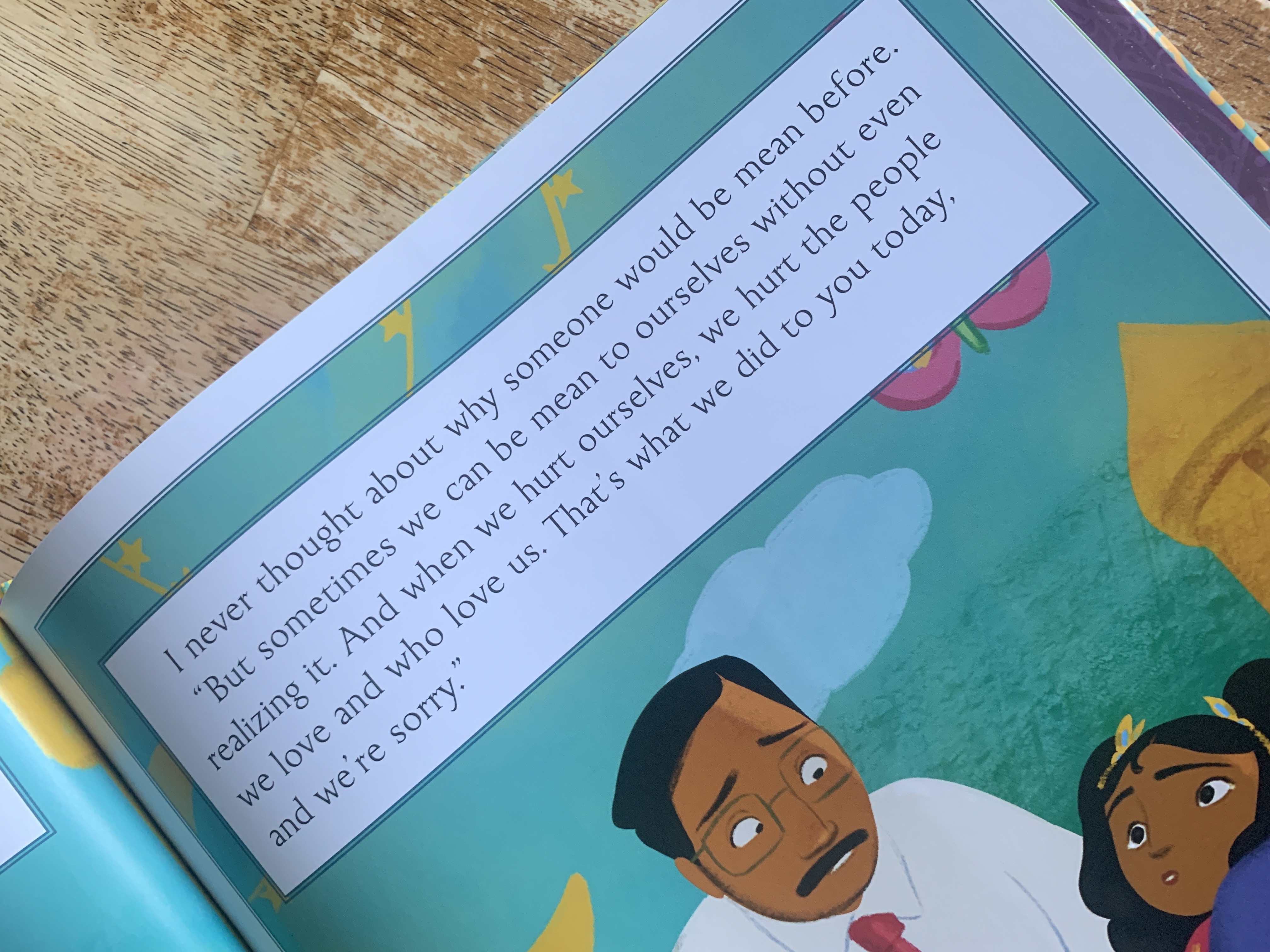
At school she is having fun and even makes a new friend, but at recess some one yells that Alix looks fat.  Alix is wearing a yellow dress that Zubi thinks is beautiful and doesn’t understand why when they are called fat in it, it comes across as negative. After each incident Zubi mulls over what she is hearing and what it means for her, once she is home though she isn’t quite ready to talk to her family about it.  At dinner, it all hits her as she decides she too shouldn’t eat, that she should be on a diet to be pretty.  She heads off to her room, as her family realizes the impact of their own views and words about themselves, have had on Zubi.  The family works to unpack their own mistakes and be better all while making sure the message to Zubi is that you are beautifully you.

img_3979

I like that the book has the dad helping the mom put on her sari, and the dad comes and chats with Zubi about what happened at school.  Mom might be in the medical field, she seems to be wearing a white coat over her sari, which is subtle and impressive that she is going to work in a sari for anyone that has ever tried to wear one and simply get in and out of a car (just me maybe).  I do like that the mom remarks that she should be kind to her body since it housed her daughters.  I think reminding us that bodies serve a miraculous function is important.   I love the diversity in the classroom and how full of life Zubi is in all aspects of her day.   She is proud of her culture, and sees those around her as being bright, kind and funny, not just the shape of their bodies.  Some of her self reflections after an incident do highlight that many kids, including Zubi, don’t see body size as good or bad, its just one’s body.  Hopefully the adults reading the book will also be reminded and realize that is a message worth actively working to maintain, at any age.

img_3980

I think some of the criticism about the book not showing healthy food choices, or overall health is that we sometimes expect one book to do it all when there aren’t a lot to chose from.  The book celebrates being beautiful AND being big.  It doesn’t need to address all the societal and adult baggage that comes from food choices, lifestyle, health, judgement, stereotypes, etc.. And I think if you feel really strongly and defensive about it, then focus on pushing for more books, not one book to do it all.  Encourage illustrators to show a variety of body types on the pages of books in young children’s hands as well as by toy makers, cartoons, movies, tv shows, etc..  Body positivity and being confident in yourself, no matter your size, shape, appearance, benefits everyone. Celebrate being beautiful.

img_3981

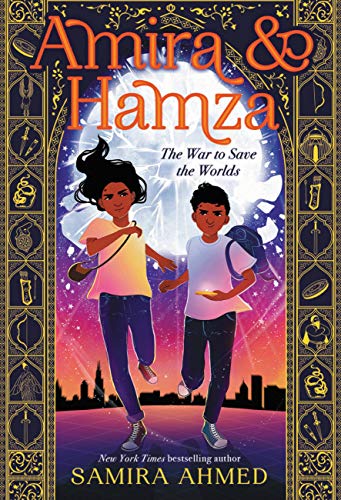
Amira & Hamza: The War to Save the Worlds by Samira Ahmed

Standard
Amira & Hamza: The War to Save the Worlds by Samira Ahmed

amira and hamza

Make sure you are sitting in a comfy spot when you crack open this middle grades fantasy adventure, because it hits the ground running from the very beginning and doesn’t let up over 368 pages.  The like-able and relatable brother sister duo snarkily banter and bicker about everything from cultural Indian (Desi) folklore, religious stories, Marvel, Lord of the Rings, He-Man, Arabic Sesame Street, Star Wars, hygiene, fears, potential science fair projects, and food, all while battling jinn, devs, peris, and reality as they work to save the worlds.  The book is chalked full of STEM concepts, cultural touchstone, Islamic footholds, pop culture, and fun, as one character remarks, it is the ultimate fan fiction. I regularly Googled people, references, and concepts, and ended up learning quite a bit.  And don’t fret if you ever get lost or confused, or something doesn’t make sense, you don’t have to worry that you missed something or that the author left a gap in the narrative, the book moves quick and Amira’s constant dialogue and commentary points out all the ridiculousness of what they are experiencing and the questions that she wishes she had time to ask, explore, and discover.  The author never loses control of the narrative, and keeps the world building on level without skimping on details and understanding.  I have not loved any of the author’s previous books in their entirety, I think this one, however, is her best one yet, and the switch to middle grades is a good fit.  

SYNOPSIS:

Twelve-year-old Amira and her 10-year-old brother Hamza are heading to the Shriner’s Madinah Temple in their hometown of Chicago to explore the exhibit of Ancient Astronomy artifacts, or as Hamza calls it “tools that belonged to dead Muslim Astrologers.”  Hosted by the Islamic Society of Ancient Astronomy corresponds with the eclipse viewing party of the incredibly rare super blood blue moon.  In typical Hamza fashion however, a Nerf gun is brought and things are touched.  When Amira is tasked with bringing her brother up to the roof to learn how to use the telescopes, the two scuffle over a small box with a tiny moon inside, a series of snatching and tussling between the siblings cause the Box of the Moon to break, or rather start working.  As day turns to night, the moon seems to be breaking a part, and everyone in the world is suspended in sleep except for Amira and Hamza, and an entire jinn army is heading their way.

When jinn leaders Abdul Rahman and Maqbool reach the children they must convince them that they are not there to harm them, but rather to recruit them as the chosen ones to save the worlds: Qaf and Earth and the barrier, the moon, that keeps the realms separate from destruction at the hands of Ifrit.  The confusion over there being two of them creeps up, but is squashed as Suleiman the Wise left tests to prove that the chosen one is properly equipped to battle Iftrit as it has been prophesized.  The children must work together to prove themselves they must then actually seek out and defeat Ifrit.  As tests and challenges arise, it becomes clear (pun intended) that the two are not the chosen ones, but with no option of turning back they must forge ahead none-the-less.

“What? We’re Indian, dude, we were basically born half doctor.”

WHY I LIKE IT:

I love Amira and Hamza’s banter.  The references are at times laugh out loud funny.  Similarly, I was impressed by all the historical and STEM concepts intertwined in the story, there is even a tiny bit about mental health.  I learned about parts of the moon, historical figures, folklore, and more.  The characters are Muslim, Amira wears Ayatul Kursi around her neck and they talk of Sunday school.  The book isn’t religious though, in they aren’t saying Bismillah before they embark on things, or supplicating when in danger, but they greet different beings with peace, and the framing is clearly from an Islamic paradigm.  I think the high speed pacing works for most of the book, and somehow you still get to know and connect with the characters, but at times a slight pause to clarify a point would have been nice.  I would have liked to have the kids proving they were the chosen ones a bit more articulate and dramatic before hand rather than in retrospect.  I feel like the jinn transportation of cauldrons could have used a bit of backstory as well.  And a little fleshing out of the scroll, the government structure and communication methods of Qaf, would have helped some of the transitions between the action.  I read a digital ARC and it had a page reserved for a map, and I think when the physical book comes out that will be really helpful, as I didn’t quite fully understand the 18 realms and their locations  in comparison to the locations the children encounter.  

FLAGS:

UPDATE:  I TOOK THIS BOOK AS COMPLETE FICTION. THAT THE ISLAMIC PREMISE WAS A STARTING OFF POINT, AND DIDN’T DWELL TOO MUCH ON THE ACCURACY.  I READ AN ADVANCED READER COPY OF THE BOOK THAT DID NOT HAVE ALL THE SUPPLEMENTAL AUTHOR’S NOTES AND RESOURCES AT THE END.  I WAS UNAWARE THAT THE AUTHOR FELT SHE WAS INCOPERATING FACT AND ACCURACY IN THIS INCREDIBLY FICTIONALIZED BOOK. AND AS A RESULT I AM NERVOUS TO SUGGEST THIS BOOK TO THE MIDDLE GRADE INTENDED AUDIENCE.  IF YOU HAVE A MUSLIM CHILD THAT IS WELL VERSED ON PROPHET SULAIMAN, THE CONCEPT OF FICTION, AND IS OLDER THAN THE IMPRESSIONABLE EIGHT OR NINE YEAR OLD INTENDED AUDIENCE, ONLY THEN PERHAPS WOULD THIS BOOK WORK FOR YOU.  IT WOULD BE VERY MISLEADING IF YOUR CHILD TAKES THE TWISTED STORY AS FACTUAL AND BASED ON THE NOTES AND RESOURCES AT THE END, THIS VERY WELL COULD HAPPEN. To read more about the concerns you can click here and head over to Muslim Mommy Blogs take on the book.

There is magic and magical beings. A transgendered jinn.  It mentions Amira and Hamza celebrating Halloween. Death and fighting.

TOOLS FOR LEADING THE DISCUSSION:

I think this would be a great audio book to listen to with the family or a read aloud in a middle grades classroom.  It is too young for middle school readers to not find it slightly predictable, but if you had it on a classroom or home shelf I am sure it would be picked up, read, enjoyed by middle grades and middle schoolers alike.  It reads much like the Rick Riordan Presents series and I hope that there are more books featuring Amira and Hamza in the future.


Barakah Beats by Maleeha Siddiqui

Standard
Barakah Beats by Maleeha Siddiqui

barakah

I have been waiting for this book for a really long time: a girl leaves an Islamic school for a public middle school and is not just unapologetic, but proud of who she is and of her religion, all while navigating such a huge life change and the day-to-day stresses of school, family, friends, and life. This is it right, the middle grade 288 page book that holds up the mirror to our own experience as a typical Muslim family in the west, that so many of us have been waiting for? Except, sigh, for me it was just ok. Don’t get me wrong, if you are new to seeing mainstream (Scholastic) Muslim protagonists shining and making their salat on time, this book is revolutionary and amazing. But, I’ve been doing this a long time, and I guess I wanted more than a tweak on Aminah’s Voice. I wanted to relate. I’m not a hafiza, nor do I know many 12 year olds that are. I enjoy boy bands, but have never been asked to join one. Sure the details and her decision to follow Islam the way she understands it is a great message, but it doesn’t clearly appear til nearly the end of the book, and until I got there my brain was constantly finding holes in the narrative, to the point I got out a notebook and started taking notes. There is absolutely no reason you shouldn’t read the book, and I know I am clearly in the minority here, so brace yourself this is a long review. If you see this at your child’s book fair and you think it looks cute, grab it, it is. I am cynical and jaded and I’m owning it, so perhaps we can agree to disagree, I’m just sad that I didn’t absolutely love it, so hold on, because I’m going to get it all out so that I can move on, inshaAllah.

SYNOPSIS:

The book opens with Nimra at her Ameen, a celebration to acknowledge her completion of not just reading the entire Quran, but of memorizing it. Her best friend Jenna, her non Muslim neighbor, is there and as everything is explained to her, the readers learn about Surah Yaseen, becoming a hafiza, and the schooling differences that Nimra and Jenna have had. That night when Jenna is sleeping over and the girls are watching Marvel’s Infiniti War, Nimra’s parents inform Nimra that she will be starting public school and that the two girls will finally be together. The news is big, but Jenna shrugs it off, and Nimra senses that something is off between them. When school starts, Jenna is surprised that Nimra is planning to wear her hijab to school, and this is before they have even left in the morning. The rest of the day: comments by Jenna’s friends, purposefully being excluded at lunch by Jenna, and being overwhelmed with a big school and so many teachers, makes Nimra miss her small three person Islamic school. Additionally she loves art, and is always tucked away in a corner with a sketch pad, her parents, however, have made her take Spanish instead of art class, and the frustration is painful. When she asks the principal for a quiet place to pray, another girl Khadijah pipes up that she can pray in the band room where she does. Khadija and her immediately hit it off, but she has already prayed, so Nimra sets off on her own to find the room. As she is about to start, some music starts, so to tune it out and focus on her salat, she recites aloud. When she exits, three boys are in awe at her vocal abilities: Bilal, Waleed, and Matthew, three Muslim boys. Better known as the middle school celebrity boy band, Barakah Beats, the boys beg her to join them. Nimra says she’ll think about it, but as the days show her and Jenna drifting further apart, being in the band might just be the way to get Jenna to pay attention. Unfortunately, Nimra’s family doesn’t believe Islam allows for musical instruments. She acknowledges that it is controversial, but that her family doesn’t play any instruments, attend concerts, or get up and dance. She figures she can join the band, just long enough to get Jenna’s friendship back on track and then dump the band without having to tell her parents. There is just one giant hiccup, they are planning to perform at a refugee fundraiser, oh and she really likes hanging out with the boys and Bilal’s sister Khadijah.

WHY I LOVE IT:

Had I read this book five maybe seven years ago, I’d be gushing, swooning, but when the author says in the forward that she is showing a girl proudly owning her religion, and essentially daring to be her authentic self, I expect something almost radical, revolutionary even. We are all settling in to seeing our Muslim selves in fiction and acknowledging that we are not a monolith, that we are diverse and flawed and valuable, but this premise felt different somehow, and I really wanted to connect with Nimra and her family, so when I didn’t, it hurt. It isn’t just a main character Muslim POV, or an OWN voice book, it is portrayed as being authentic to those of us that love our faith and don’t feel like we need to tone it down to be American. We are second or third generation American Muslim, we know our deen and this is our country, there is no going back to a homeland or assimilating. The book is about her being true to her self, but I don’t know that I know what she wants or what she believes, aside from her parents. The book addresses intergenerational conflict of power and expectation between her parents and grandparents, but other than for Spanish vs Art class, it seems to skim by the music issue, the main issue of the book. The book expects readers to acknowledge the maturity and voice of a 12 year old girl, but that same expectation isn’t given to the readers of nearly the same age. It glosses over any articulate arguments for why musical instruments are or are not allowed. It mentions that some people feel it is ok if the lyrics are not bad, some say it isn’t ok, that there are disagreements, that there are controversies, but it never explicitly answers, why? And readers are going to notice. I found it incredibly odd, that the music controversy is at the heart of this book, but the safe alternative is art and drawing. Drawing faces is a HUGE point of differing opinions among Muslims, perhaps as big, if not bigger than music. Nimra is always sketching and it mentions that she often is drawing super heroes: people, with faces, and possibly (magic) powers! The whole book she is in the band, and she regrets that she is using it to get back at her friend, but there isn’t a whole lot of internal debate if she thinks music is haram like her parents or it is ok, she just stays in the band, and plots how she will leave it so her parents don’t find out. SPOILER: I like that she ultimately makes the decision that is best for her and leaves the band after fulfilling her commitment, but we never see that, that is what her heart is telling her. There is no self exploration or critical thinking, it is just justifying why she is doing it, and then not doing it.

In terms of character development, only Nimra is really explored, the side characters are all pretty flat. Jenna gets some depth, but not much. I mean, how does Nimra’s best friend and neighbor who comes over every day after school not know that she has been working on memorizing the Quran? Not know how to dress at a religious themed celebration, a halter dress, really? Jenna is never shown to be a good friend, or even a nice person, the tone around her is negative from the start. We are told she is a good friend, but we never see it. The conversation about Nimra wearing hijab to school is like two lines, but is made to be a much bigger issue in Nimra’s head as she feels things haven’t been right since then. But, I’m not buying it. The girls go to movies, they go shopping, and she wears hijab, so why would school be so different? All of Jenna’s friends know about Nimra, so she can’t really be that embarrassed by Nimra’s scarf if they go out when she is wearing it and none of the other classmates seem surprised. I also felt off with the portrayal of the character because we so fervently believe that often the best dawah or even method to break down stereotypes and bigotry is to get to know some one personally. Jenna knows all of Nimra’s family and has for nearly her whole life, and she is so hateful and clueless to everything Islam? It is a stretch, the family prays, fasts, dresses Islamically, cares for her, feeds her cultural food, yet she is oblivious to it all. I get that her hate or lack of interest is probably reflective of how a lot of our neighbors are, but there aren’t many non Muslims in this book, and that portrayal is going to linger heavily for young readers.

Nimra is likeable enough on the surface, but the more you think about her, she isn’t really any different than those she is hurt by. She is mad when Julie assumes she doesn’t speak English, but she assumes Matthew isn’t Muslim because he is white. She checks her self in other ways, but this one seems to slip by. Other inconsistencies I noticed are when the first day of school teachers are really mean to her, but then it is never mentioned again. I wanted to know did they keep at it, did she prove them wrong? It was built up and then just abandoned. At her old school there were two other girls doing hifz, but when she meets up with one at Saturday school it seems they both are no longer at the school either. Did they graduate? Did they abandon it? Her Quran teacher comes to see her perform a song, perhaps a little understanding about her point of view in addition to the other Muslim’s in the band would have helped explain the why music is controversial in Islam. Also, does and would ADAMS allow music at an event? I’m genuinely curious. I even tried to Google it. Most masjids probably wouldn’t, but maybe a community center would. Readers are going to be so confused why Nimra is so stressed when the religious teacher and the place of worship are fine with it.

The friends as boys thing is sweet, but a little surprising, having three boys come over to hang out and watch a movie, high fiving them, sure it isn’t shocking, but its a bit inconsistent given the narrative. Plus, Nimra trying to help hook Waleed and Julie up? For as much as the book doesn’t want to sell itself out, little acts like this without a little hesitation or comment or introspection, kind of make it seem like its trying to normalize non Islamic acts as being ok.

I love the pop culture Marvel references, The Greatest Showman songs and the shoutout to Amal Unbound. I even loved the Deen Squad remixes getting acknowledged, but it made me wonder if all the songs of Barakah Beats are Islamic themed. Perhaps it doesn’t matter, but it would be interesting to know since the entire school adores the band, even asking for autographs at one point.

FLAGS:

Nothing a third grader and up couldn’t handle: music, art, lying, bullying, talking about crushes.

TOOLS FOR LEADING THE DISCUSSION:

I think I’d pass on the book as a middle school book club option, as it really is a middle grades read, and the thematic issues brought up for discussion are better found elsewhere. If I had an in person classroom, however, I would have the book on my shelf, it is a quick short read, that I think might encourage a discussion on music to take place, or at least allow readers to see a proud Muslim doing well in different environments.

It All Comes Back to You by Farah Naz Rishi

Standard
It All Comes Back to You by Farah Naz Rishi

it all comes back to you

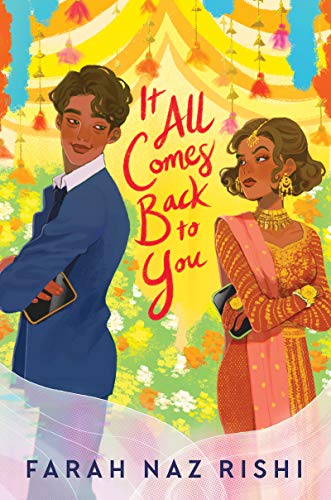
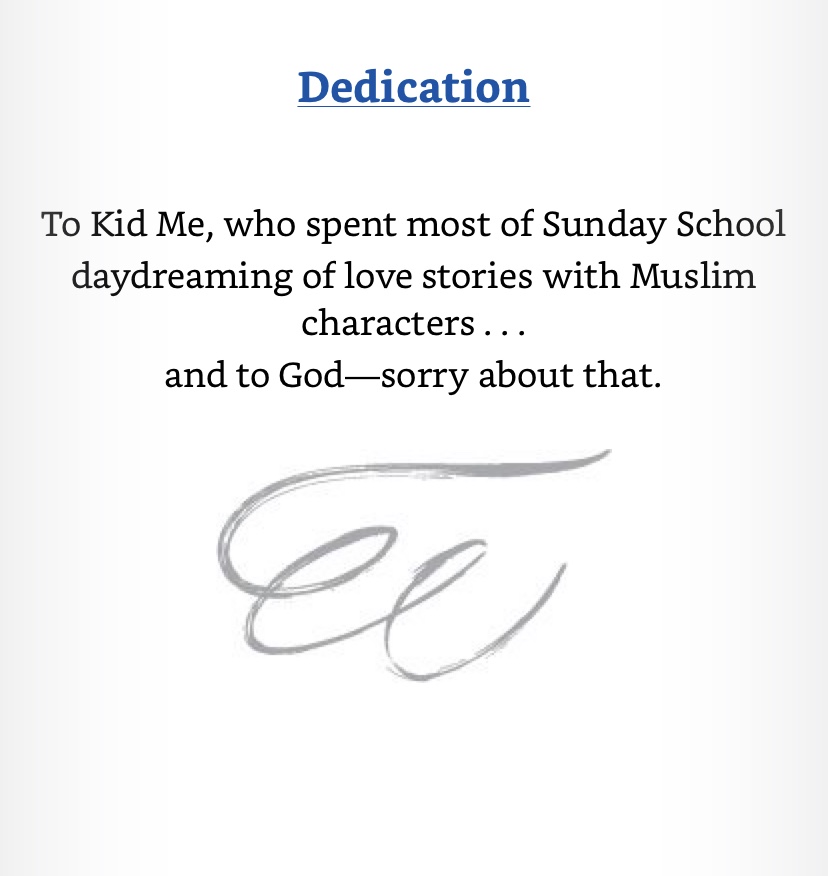
Sometimes you just want a light fun, empty-calorie read, and in that regard I feel like this book really delivered.  The characters are in college, and yet it is published by HarperCollins Children, so I wasn’t entirely sure what to expect, which perhaps added to the lack of expectation and increased forgiveness.  It reads very much like a Bollywood movie, there is dancing, angst, romance, redemption, culture, religion, and a sense that a certain arbitrary line of it all won’t be crossed to earn the book an R rating, and will keep it safe for Muslim high school teens.   I think the book is fine for Muslim’s in 10th/11th grade and will be enjoyed by those in college (and up) as well.  Over 429 pages the highly predictable tropes find their footing in their unique religious and cultural framing.  The plot is perhaps a bit on the nose and overly serendipitous, but individually the characters show range and complexities that will resonate with readers.  They have all made good and bad choices and continue to do so, but the big ones are largely in the past, and what we, the readers, get to see in many ways is them reaching for forgiveness in a contemporary whirlwind culmination of a wedding, overcoming addiction, a past felony, secrets, ex-significant others, familial expectations, loss, change, and school.  The book is not preachy, although there is a like-able imam as a side character and he gets some advice in.  The Muslim characters grapple with their faith as they would their culture; picking and choosing what to practice, but never really escaping it or wanting to completely abandon it either, it is just who they are and part of their identity. I enjoyed the book, reading it in two sittings and not feeling guilty that I lost sleep doing so, but like most rom-coms, the specifics and characters will blur over time.  It has a lot of similarities with Hana Khan Carries On, while not having quite the religious adherance of S.K. Ali’s characters or rawness of Tahira Mafi’s.  One thing that is uniquely it’s own, however, is the author’s beginning dedication, I don’t think I have ever read one quite so perfect, memorable, and possibly guilt causing.  I laughed out loud!
img_3576

SYNOPSIS:

Kiran’s mom passed away a year ago from ALS, and with her older sister Amira in law school at the time, she dealt with her mother’s illness and passing, largely alone as she additionally had just been ghosted by her first and only boyfriend, Deen.  Now that her sister is about to graduate, and Kiran is about to start university, they can finally be roommates and reunite the family.  Except, Amira has met someone, Faisal.  Someone who was there for her when her mom died, and they are planning to move across the country to California in a few months.  Devastated Kiran forces herself to be happy for her beloved older sister, until she finds out that Faisal is Deen’s older brother, and there are some gaping holes in his past.  With her sisters future on the line, promises to her deceased mother haunting her, and a serious lack of communication abilities (more on that later), she is determined to uncover the truth about Faisal and maybe even Deen in the process.

Alternating point-of-view chapters give Deen a chance to provide his side to the story: the reason he had to disappear from Kiran’s life, what happened to his brother, and the unreasonableness of his family.  As he struggles with his own conscious and stumbles around unsure of his own potential and worth, Deen comes across as selfish and arrogant, but ultimately only cares about his brother and making things up to him.  He is determined that Deen deserves to be happy and he is committed to keeping Kiran from destroying it.

In typical desi fashion, appearances matter and while all the behind the scenes sleuthing, plotting, and fighting is taking place, on the surface, wedding plans are being made and dances choreographed.

The book includes pages of texts from three years ago between Deen and Kiran as they meet at Sunday school and sneak behind the mosque.  There are also gaming dialogues between two anonymous fantasy characters that it is pretty obvious are Kiran and Deen.  The reveal isn’t a shock to the readers, only the characters, and proves a nice way to see redeeming traits in characters who’s present real actions aren’t exactly endearing.

WHY I LIKE IT:

The OWN voice representation of Desi culture and Islam is not in addition to the story, it is woven in to the characters and the plot.  The characters are largely liberal as the families are chill with dating, mixed gender hand shaking and dancing, and what not, but their Muslim upbringing is almost always close by.  The characters say “astagfirulllah” after kissing, they acknowledge that some of the Muslims drink and some have left that lifestyle, they miss visiting the mosque, they recognize that they aren’t praying, etc., while many flags are present, they really aren’t sensationalized or given more than a single word in print.  It strikes a pretty solid balance of showing where some thoughts or values come from, and where personal individuality takes over.  I don’t think Muslims will be offended, nor non Muslims confused.

The biggest issue I had with the characters is that it really could have been resolved, all of it, with a few decent sit down conversations.  Kiran and Amira, for example, are terrible at communicating and it blows this whole thing into a ginormous mess.  Sure, there is no book if there is no drama, but they never fix this.  So many lessons are acknowledged and the character arcs are shown or hinted at, this one, not so much, if at all.  They didn’t talk when their mom was sick, when she died, about what they were going through, about their dad, about their future plans, about the wedding, about the concerns with Faisal, about Kiran and Deen having a past, about moving to California,…the list really is exhaustive, and it doesn’t seem to show that they acknowledge their role in escalating everything and vowing to be better.  Sigh.

I read a digital ARC and it had a few spelling errors, it broke down the fourth wall in one paragraph, and I’m hoping the final copy will have resolved these issues.  It mentions that typically the bride and/or her family pay for the wedding in Islam, and this is erroneous, culturally possibly: the brides family would cover the nikkah and ruhksuti, with the groom covering the walima, but to put it on religion is just incorrect.

FLAGS:

Deen talks about “knowing women,” but it isn’t explored, and the groom is teased that he will be loosing his virginity card.   The kisses aren’t usually described, it is just conveyed as something that happened.  There is a bit of detail in the chemistry felt in the dances, but in true Bollywood fashion, they stop short of kissing. There is a stripper called to the bachelor party, but the characters are appalled and she is immediately escorted out. A religious character accidentally drinks alcohol and blacks out.  There is profanity, not excessive, but conversationally.  There is talk and repercussions of addiction to prescription drugs, a felony crime committed and punished for, deceit, lying, bullying, and physical altercations briefly recalled.  There are parties attended, alcohol consumed,and  at one point a female forcefully kisses an unconsenting male.

TOOLS FOR LEADING THE DISCUSSION:

I’ve gone back and forth with suggesting to the high school book club advisor to consider this book.  I think the right group of readers could really opine on the characters actions from the shy Faisal with a huge forgiving enduring heart to the nosey obnoxious Mona Khala, but there are some potential flags that might ultimately keep this book from being entirely Islamic School appropriate even for the highest grades.  Ahh, I’ll keep you posted on what I decide.