Piece by Piece: The Story of Nisrin’s Hijab by Priya Huq

Standard
Piece by Piece: The Story of Nisrin’s Hijab by Priya Huq

piece by

At 224 pages, this graphic novel tells an important OWN voice story in beautiful and powerful illustrations, but despite reading it multiple times, I ultimately found the pacing off, the narrative and plot holes quite large, and the conclusion too forced.  It claims to be for middle grades which would explain the happy ending, but the assault, trauma, mental health, Bengali history, language, and protagonists age (13), make it more suited for upper middle school readers.  I read a digital ARC in predominately black and white images, so I’m hopeful that part of the problem is on me, and that I simply missed or misunderstood parts that seemed to jump around and assume, or that because it was an uncorrected proof, some revisions are still to come.

piece by1

SYNOPSIS:

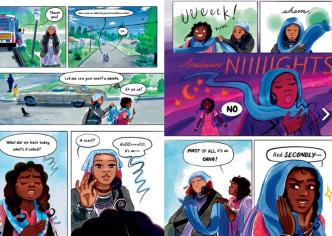
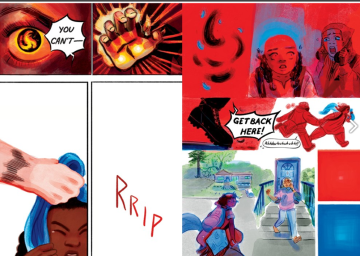
Nisrin is 13 and lives in Oregon with her mother, and maternal grandparents.  Her mom travels a lot and she seems to spend most of her time with her loving Nani, grandmother.  The story opens with Nisrin in 8th grade giving a presentation about her Bangladeshi heritage to her school.  On the way home with a friend, Firuzeh, she is still wearing the cultural clothing and they are playing around with the scarf, when they are violently attacked and the scarf is ripped off of Nisrin’s head.  Her hair is pulled out in the process and the two girls are taken to the hospital and when released maintain professional counseling to process and deal with the assault.  Nisrin fears leaving her house and is increasingly isolated within her home.
pice by 2

Over the summer we see her and her Nani go over to some cousin’s house where Nasrin is gawked at with her short hair and everyone is unsure how to act around her.  She joins some cousins playing video games where she asks about a cousin in hijab who says that it is essentially her choice between her and Allah (swt), that it isn’t any one else’s business.  A younger cousin tells that she plans to start hijab soon and is surprised to learn that Nisrin’s mom is not Muslim.

As summer comes to an end, Nisrin will be starting high school and exits her room the night before wearing a hijab, or in Bengali, an orna.  Her family freaks out, her Nana, maternal grandfather, is furious claiming that she should have been raised better, and Nisrin is scooted off to her room by her Nani, so that her mom and grandfather can argue.
piece by 3

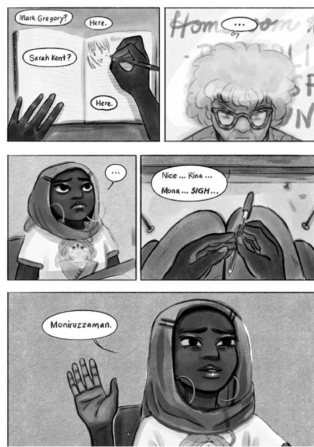
On the first day of school, Nisrin tries to talk to Firuzeh, but once again things are awkward between the two girls.  A teacher refuses to try and say Nisrin’s name and becomes angry and aggressive, and at PE she is called a slut and asked if she will be beat for showing her legs.  Nisrin goes home to research Islam and hijab, but everything is so angry and opinion based that she is more confused than when she started.

The next day she meets a nice girl, Veronica, and the two work on an assignment in class and then have lunch together.  Veronica suggests that Nisrin learns about Islam like she would a school assignment and go research it at the library.  Later at home, Nisrin starts to understand what her grandparents and mother saw and endured in the war of 1971 when Bangladesh became independent from Pakistan.  Her mom and Nana argue over what was seen and Nisrin starts to find her voice in her family.

Nani takes Nisrin shopping for long sleeved clothes and scarves, things are worked out with Firuzeh and Nisrin’s family accepts that Nisrin is not asking permission to wear her scarf, but is hoping they will accept it.

piece by 4

WHY I LIKE IT:

The book is such a flip on the over-used-stereotype that Muslim girls are forced to wear hijab, in truth many are encouraged not to.  At one point Nisrin says, “If I can’t be safe…then can’t I at least be proud.”  She was attacked for just playing with a scarf and putting it on her head, so she reasons, that there is not safety from racism and hate, she might as well be proud of who she is.  I also love the strength in the idea that she doesn’t need anyone’s permission, it is her faith, her head, her choice.

There is a lot of good in the book, but I struggled understanding quite a bit of it.  It mentions that she was at Texas and she loved it, but there was bullying? No idea what it was in reference to or what purpose it served.  At the beginning the two girls seem like they have been friends for a while, but yet Nisrin warns Firuzeh that her Nani will force her to eat.  Nisrin seems to really love her sleep overs, and I don’t know if it is just to show at the end the healing by coming full circle, but it seems a bit juvenile to be that excited about it to me.

The family dynamic and history, left me very confused.  Nisrin doesn’t know her cousin wears hijab, and is confused that her aunt doesn’t.  Nor do her cousins know that Nisrin’s mom isn’t Muslim?  These cousins call Nisrin’s Nani, Dadi, and since there is no father in the picture it is obvious to even none desi folk that these cousins are related through the mom’s family and the cousins father, so why when Nisrin decides to wear hijab is the maternal side so upset? Why does Nasrin’s mom ask if her cousins have put her up to it? Ok if the mom isn’t religious, but does she actively practice another faith? Why in one of the portraits on the wall does the woman seem to have a bindhi? The Bangladesh independence admittedly is something I should know more about, but I don’t, and this book, didn’t really fill me in.  How is the grandfather both siding? He doesn’t like invader nationalism, but I still don’t completely understand why he left, and what that solved.

The pacing and tone at times are off too me too.   I didn’t feel the strain on Nisrin and Firuzeh’s relationship, the text suggests that they are and were best friends, but when Veronica asks if Nisrin’s stress is in part to the cute girl she was staring down, I was curious too if there was more to their relationship.  A lot seems to happen between the attack and Nisrin starting to wear hijab and I wish we were allowed inside Nisrin’s head to know how she feels about her mom, her nana, starting high school, her attack, her desire to wear hijab, it seems a bit rushed.  Which is odd since, the story spends a few pages detailing when Nisrin feels like everyone hates her after Nani picks her up on the first day of school and Nani points out that not everyone hates her, the squirrels don’t, and the dogs don’t, etc..  It seems really childish for the incredible ordeal she has been through.

I like the informative section at the end about Bangledesh. I wish the book would have shared some of what Nisrin learned about Islam in her own research, she goes to the mosque, but doesn’t detail if she plans to pray regularly, fast, etc..
piece by 5

FLAGS:
Language, violence, war imagery, rape mentioned, physical assault. Use of the word slut.

piece by 6

TOOLS FOR LEADING THE DISCUSSION:

I don’t know that this would work for a middle school book club at an Islamic School, graphic novels are often to quick of reads, but I have a few friends from Bangladesh and I really want them, and their daughters, to read it and clue me in to what I am missing, their view of independence and their impression of the book.

Halal Hot Dogs by Susannah Aziz illustrated by Parwinder Singh

Standard
Halal Hot Dogs by Susannah Aziz illustrated by Parwinder Singh

hotdogs

I’m not sure what I expected this book to be, I just knew I wanted to get my hands on it, but I’m fairly certain, that even if I would have had some expectations, they would have been no where near how well done this 40 page book for four to eight year olds is overall.  It is unapologetically American-Palestinian Muslim in an inclusive funny delightful way, that only an OWN voice book can be. There have been some great picture books lately that are authentic, yet mainstream, and this book pushes that standard just a little bit higher as it normalizes jummah, halal food, dabke, hijab, with familiar threads of street food, spunky little sisters, untied shoelaces, tradition, and excitement.  The story has a twist and some intentionally misleading foreshadowing, that give the book depth and added fun.  Readers of all backgrounds will relate to this book and find something that they can relate to, as they laugh and marvel at Musa’s infectious enthusiasm for hot dogs. img_0610

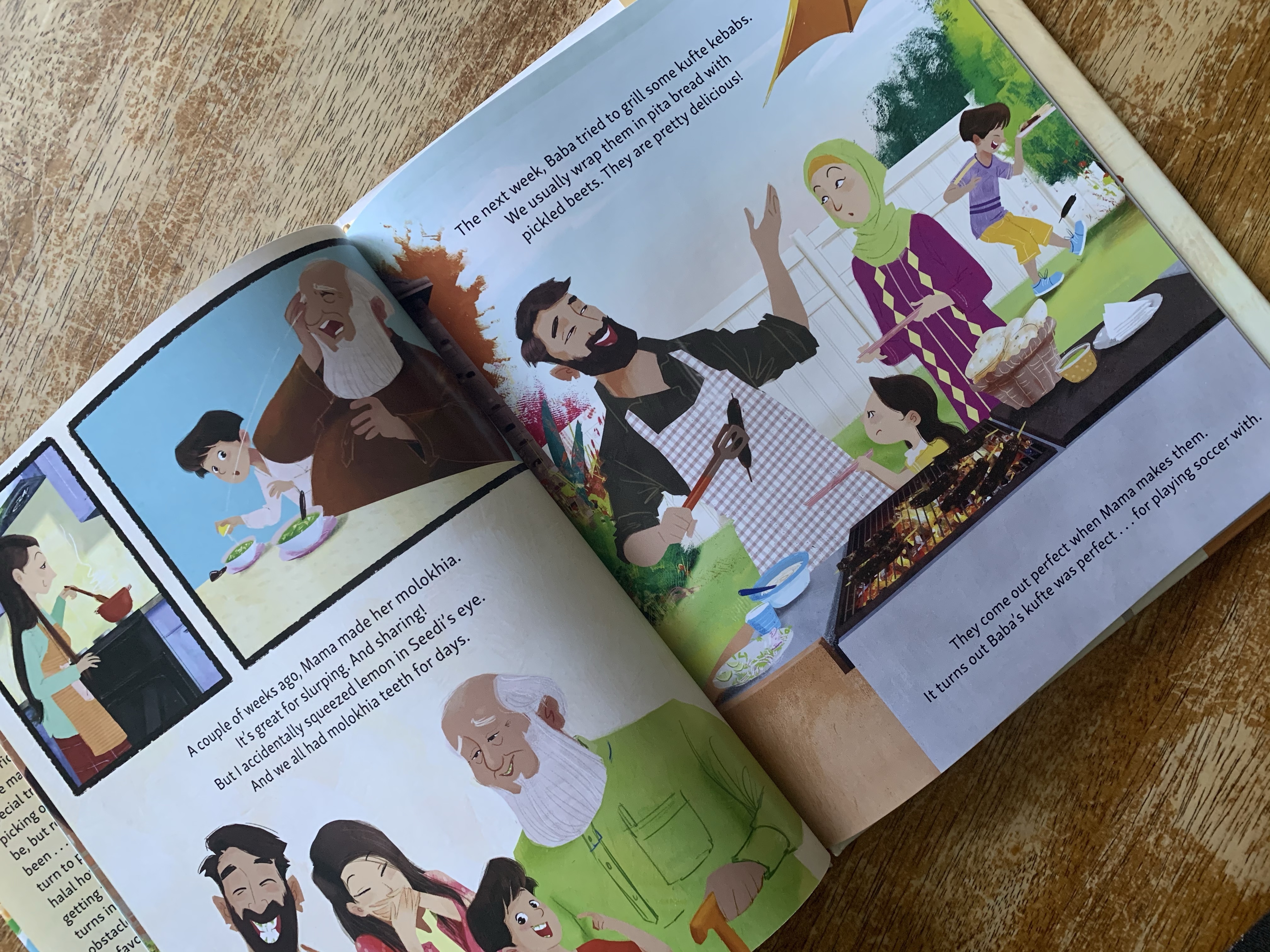
Musa Ahmed Abdul Aziz Moustafa Abdel Salam, aka Musa, loves Fridays.  His family heads to the masjid for Jummah prayer and then home for a special Jummah treat.  Lately, they’ve had molokhia, that stayed in their teeth for a week, kufte kabobs that were better for soccer playing than eating, riz bi haleeb with lost dentures, and prelicked jelly beans.  Alhumdulillah, this week is Musa’s turn to pick, and he is picking his favorite: halal hot dogs with Salam sauce.

img_0611

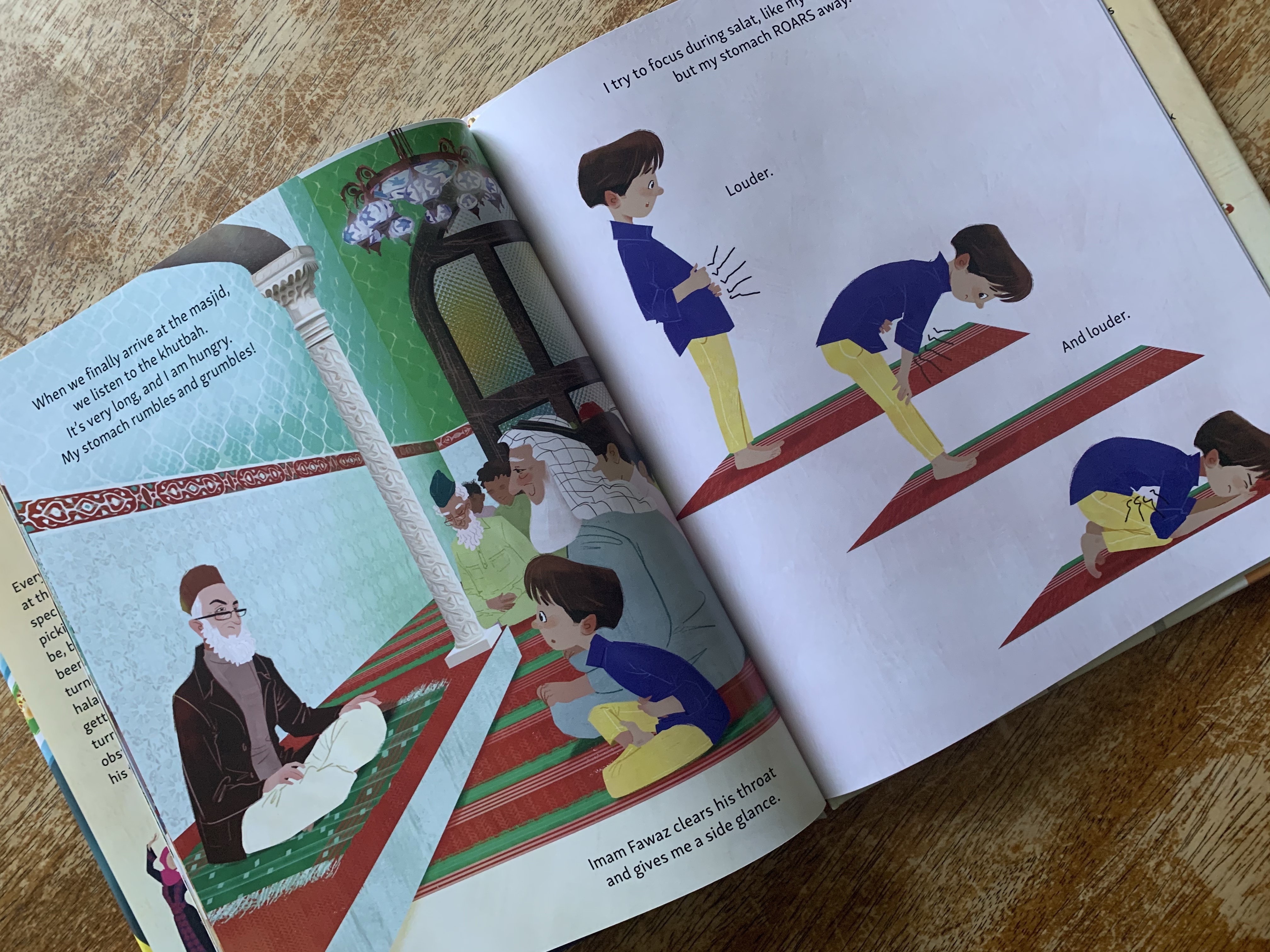
They head to the mosque dancing dabke as they leave their house with smiling faces.  The khutbah is long though, and during salat his stomach is roaring! Afterward he is off, but Seedi has to help Maryam find her red shoes in a sea of red shoes and mama is chatting with friends. 

img_0612

Dad gives in and lets Musa go get the hot dogs alone.  As he heads to the stall with the best hotdogs: the perfect amount of hot, chewy, juicy hot dog goodness, he passes all sorts of foods being eaten.  There is falafel and bao and tacos and samosas and churros, but he is determined to get hot dogs, even though the line is really long.

img_0613

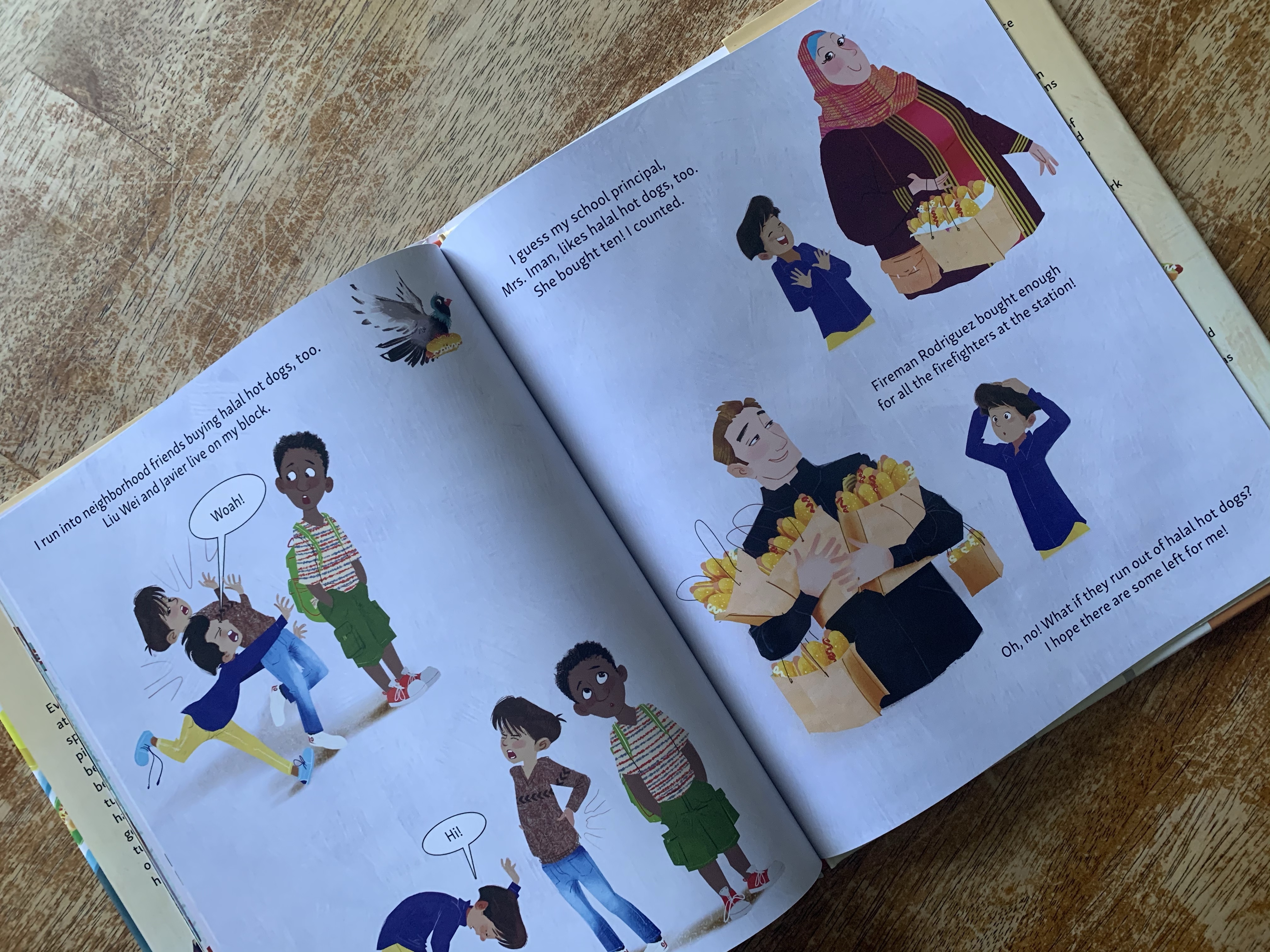
He sees friends in line, and firefighters, and even his school principal.  Everyone loves hot dogs, even birds and squirrels.  Finally he buys a whole bag full with special Salam sauce and races home to share with everyone.  But uh oh, it doesn’t go as planned, and I’m not about to spoil it, so get yourself a copy like I did from http://www.crescentmoonstore.com or your library, and maybe don’t read it while you are fasting, because you will be craving hot dogs, mmmmmm nom nom nom.

img_0614

There is an Author’s Note at the end that details her kids’ influence on the story and explains that a portion of the proceeds go to UNRWA USA, a non profit that helps Palestinian refugees.  There is a glossary of Arabic Words and Terms, and a section explaining Halal Laws.

img_0615

The book shows the mom in hijab outside the home, and uncovered within the home.  There are diverse skin colors among the Muslim and non Muslim characters in the book, as well as a variety of ages depicted.  Seedi wears a keffiyah on Jummah, but different clothes on different days.  The illustrations are wonderful and descriptive and do a lot to compliment the story by setting a relatable and diverse-positive visual.

img_0616

Mel and His Trouble with One Thousand Shoes by Somayeh Zomorodi illustrated by N. Broomand

Standard
Mel and His Trouble with One Thousand Shoes by Somayeh Zomorodi illustrated by N. Broomand

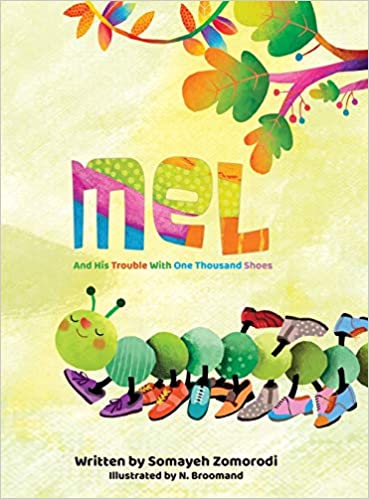
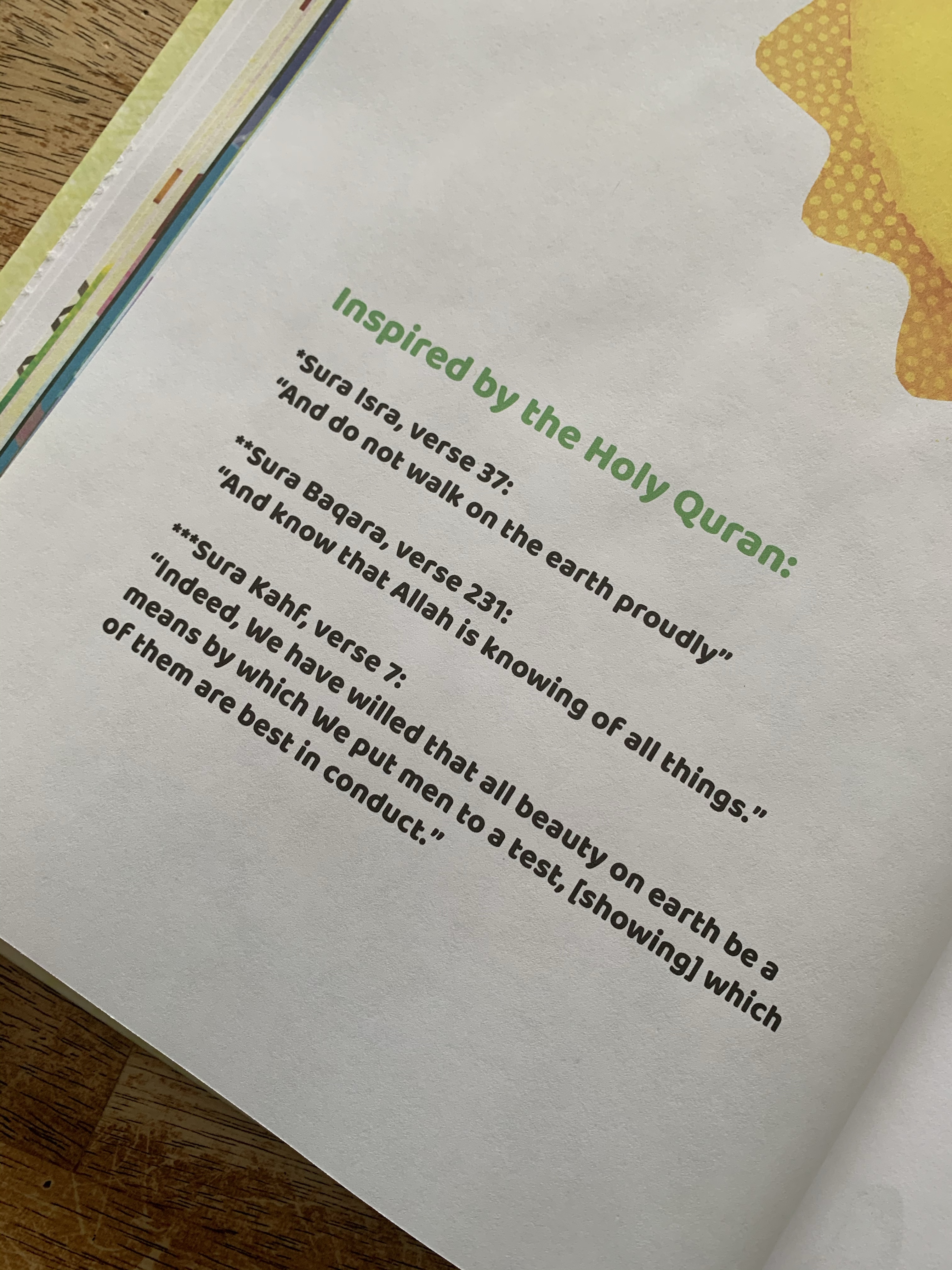
The book has a solid premise, although it reads a lot like The Very Greedy Bee, and has lovely 8.5 by 11 pictures on its 24 pages, but unfortunately the text is all over the place. The story contradicts itself, it is overly wordy, and way to rhymy. Yeah, rhymy isn’t even a word, but if it were, this book, would be a great example. I struggled with the font as well, the lowercase f looks like a capital F, and no matter how many times I read it, I’d get tripped up thinking an interior word was being capitalized. The book says that it is based on the ayat in the Quran that reads, “And do not walk on the earth proudly,” and even has two other ayats listed at the end as inspiration, but really it is a single page and a single character that blurts out the ayats from the Quran that talk about walking on the earth proudly and this world being a test. While the illustrations are fun, it just isn’t enough to make the book a solid read to convey humbleness and gratitude. Children will be lost in the text, confused by the inconsistencies, and disappointed in the super quick resolution.

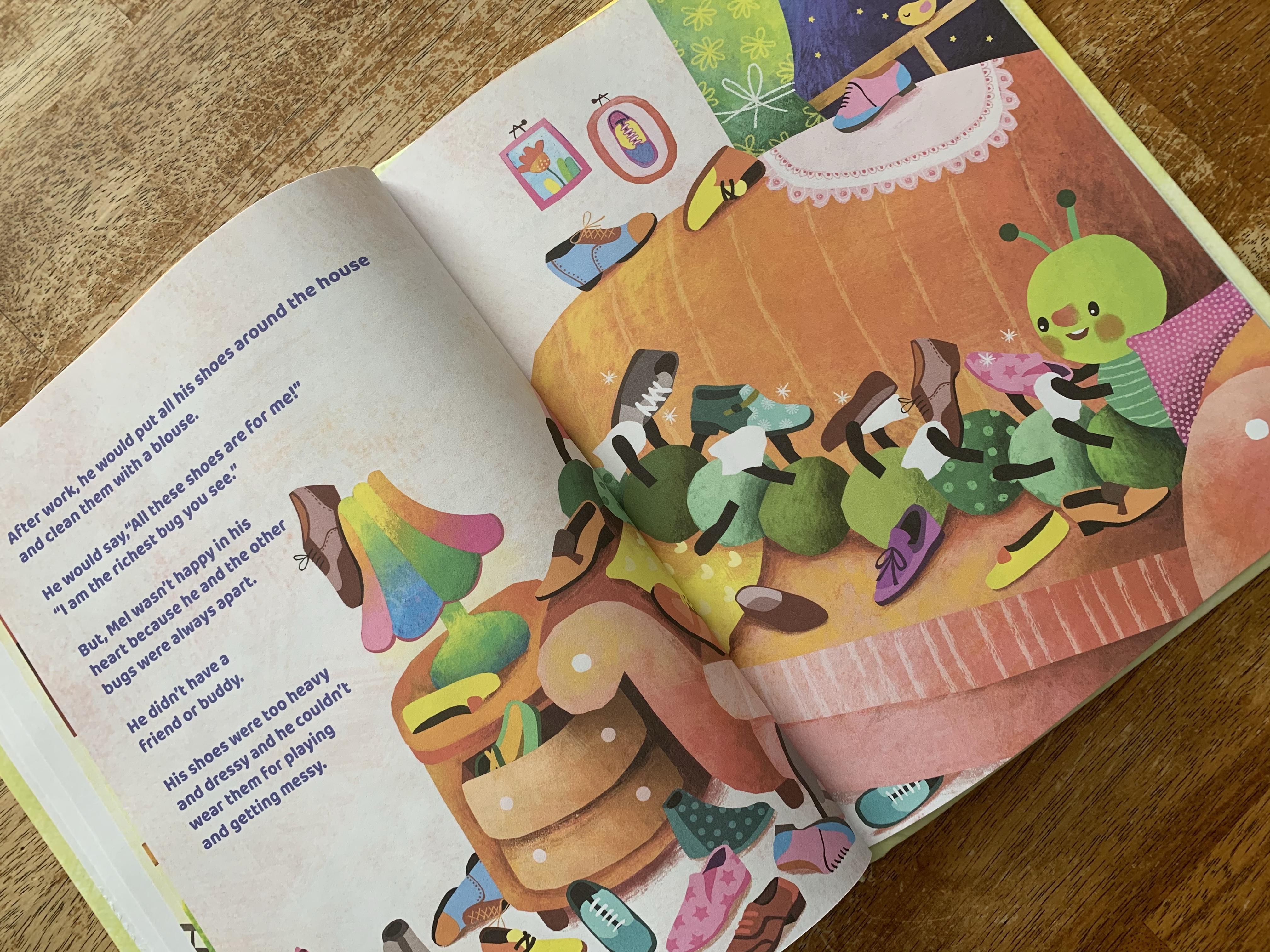
Mel the millipede lives in a farm next to a well. He has one thousand feet and although he doesn’t need shoes, he likes to collect them. He has 950 and is working to find the remaining 50 to complete his collection.

It says, “No one was as happy as Mel; one could tell.” Then on the next page as he cleans his shoes with a blouse it is revealed that he isn’t happy in his heart because he is always alone. But the picture stills shows him smiling.

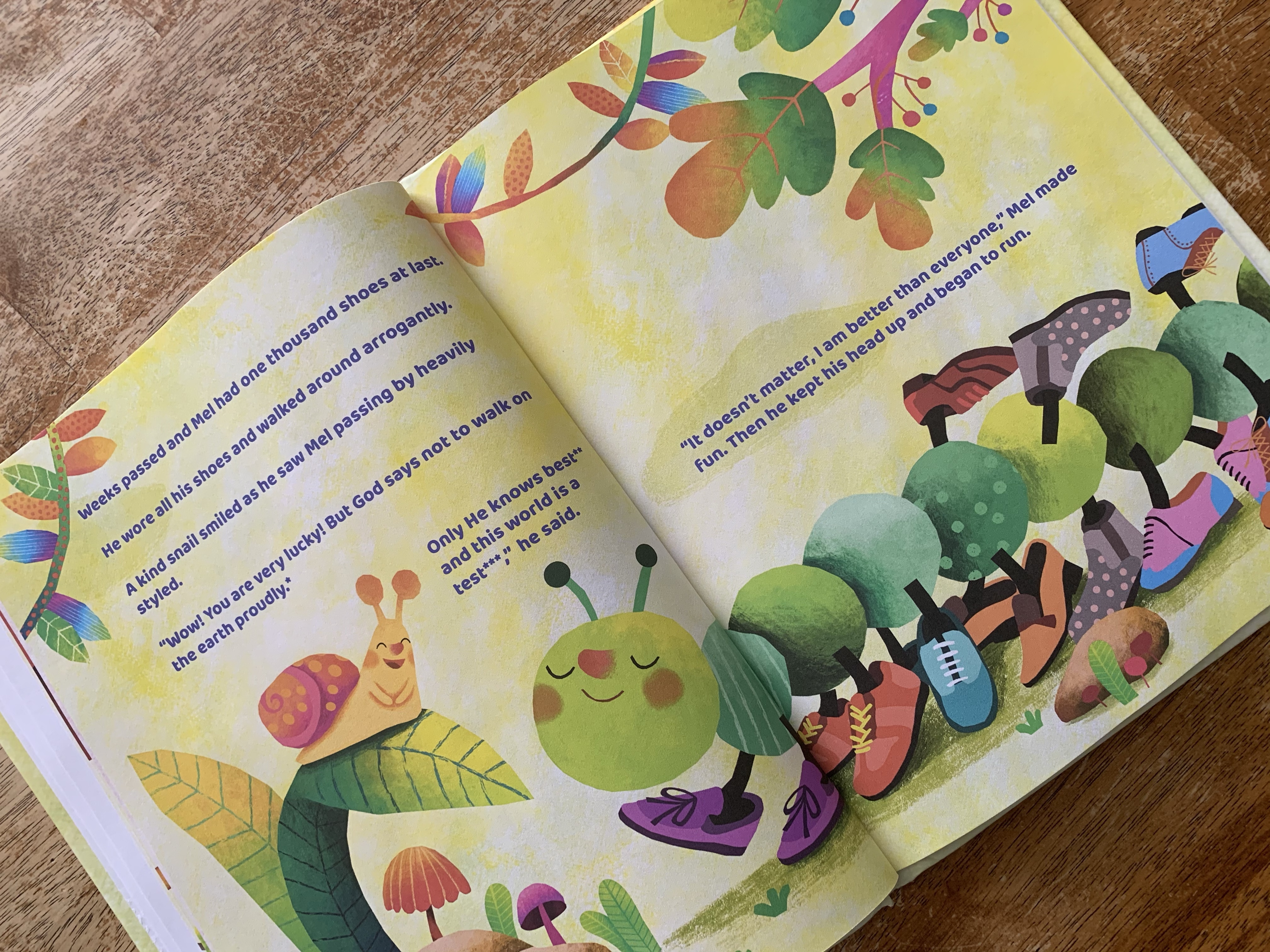
He finally has his 1,000 shoes, we don’t know how or where he got them, when a small snail tells him that “God says not to walk on the earth proudly. Only He knows best and this world is a test.” There is no explanation, Mel just says “it doesn’t matter, I am better than everyone.”

This whole time walking, Mel has been wearing his shoes although it has mentioned that he can’t wear them because they are heavy and he doesn’t want to get them dirty. As he watches the other bugs fly kites and balloons he is sad that he can’t play because his shoes are too heavy. But he has been walking outdoors and is on a mushroom lamenting with his shoes on. Those flying kites aren’t moving much…one is a worm, one a snail, very inconsistent.

One night a moth knocks on his door warning Mel of a flood. Mel ignores the frantic urgings, fearing that it is a trap to get his shoes. He thinks everyone is jealous of his shoeing. The flood waters sweep him and his shoes out of the house and throughout the night he risks his life multiple times to save his beloved shoes.

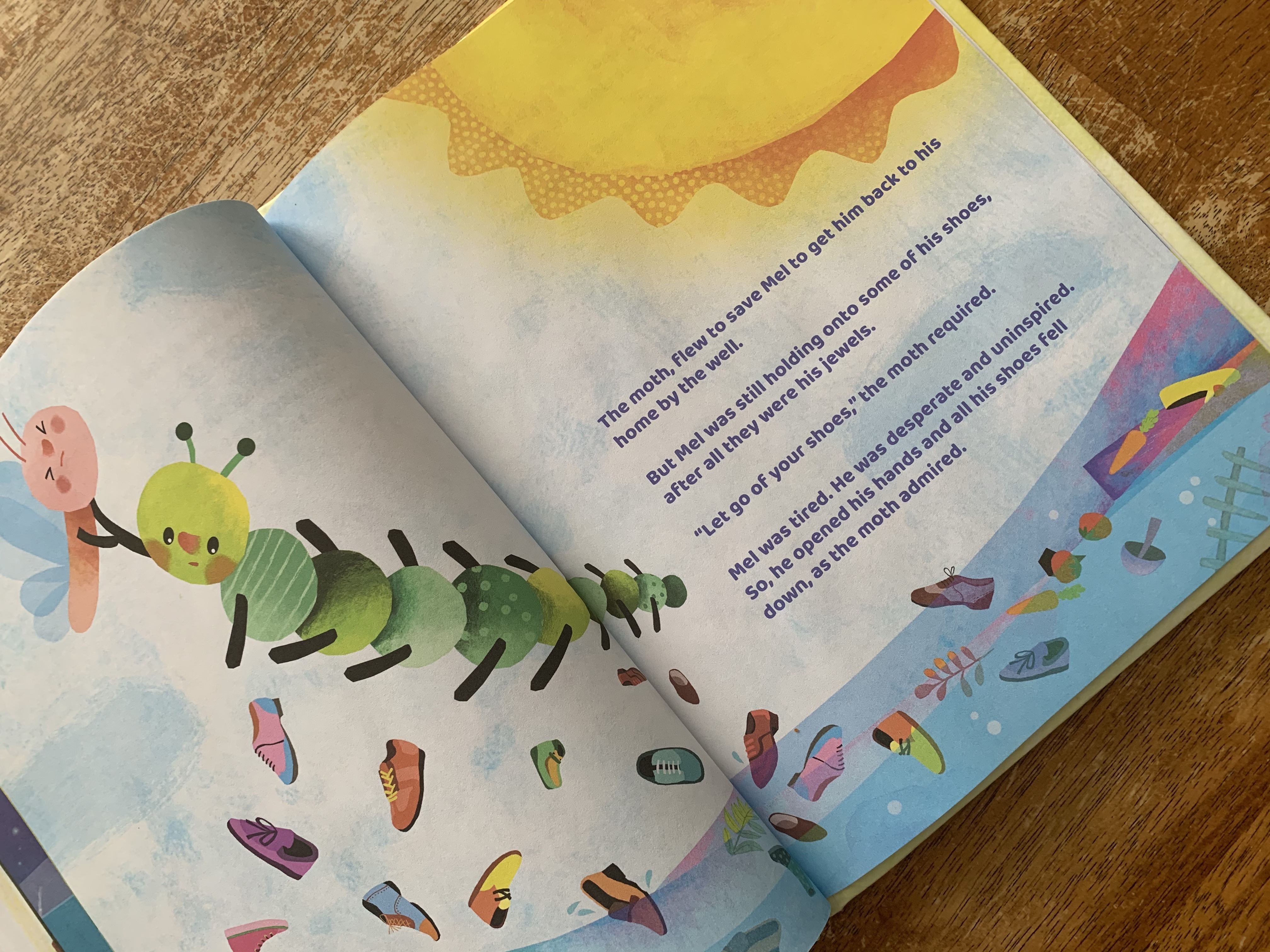
When morning arrives, he is still trying to save his shoes, when moth, attempts to save Mel. To get Mel back to his house, he will have to convince him to drop his shoes. Mel is tired and desperate and uninspired so he drops his shoes and is brought to dry land. I don’t think uninspired is the right word, shouldn’t be be grateful and willing to change to save his life? But even that notion is a stretch because in the illustrations he is so close to land. He could just swim over, shoes or no shoes, moth doesn’t need to be flying him to safety. Additionally, when the water recedes, won’t his shoes still be there?

The conclusion is Mel hugging moth and apologizing to the bugs. I’m not sure what he is apologizing to them for, nor is it explained. Since the book claims to be based or inspired by ayats, I feel like this would have been a good place for a moral cathartic lesson, but alas, it just says, “the end.”

Brave with Beauty: A Story of Afghanistan by Maxine Rose Schur illustrated by Patricia Grush, Robin Dewitt, and Golsa Yaghoobi

Standard
Brave with Beauty: A Story of Afghanistan by Maxine Rose Schur illustrated by Patricia Grush, Robin Dewitt, and Golsa Yaghoobi

brave

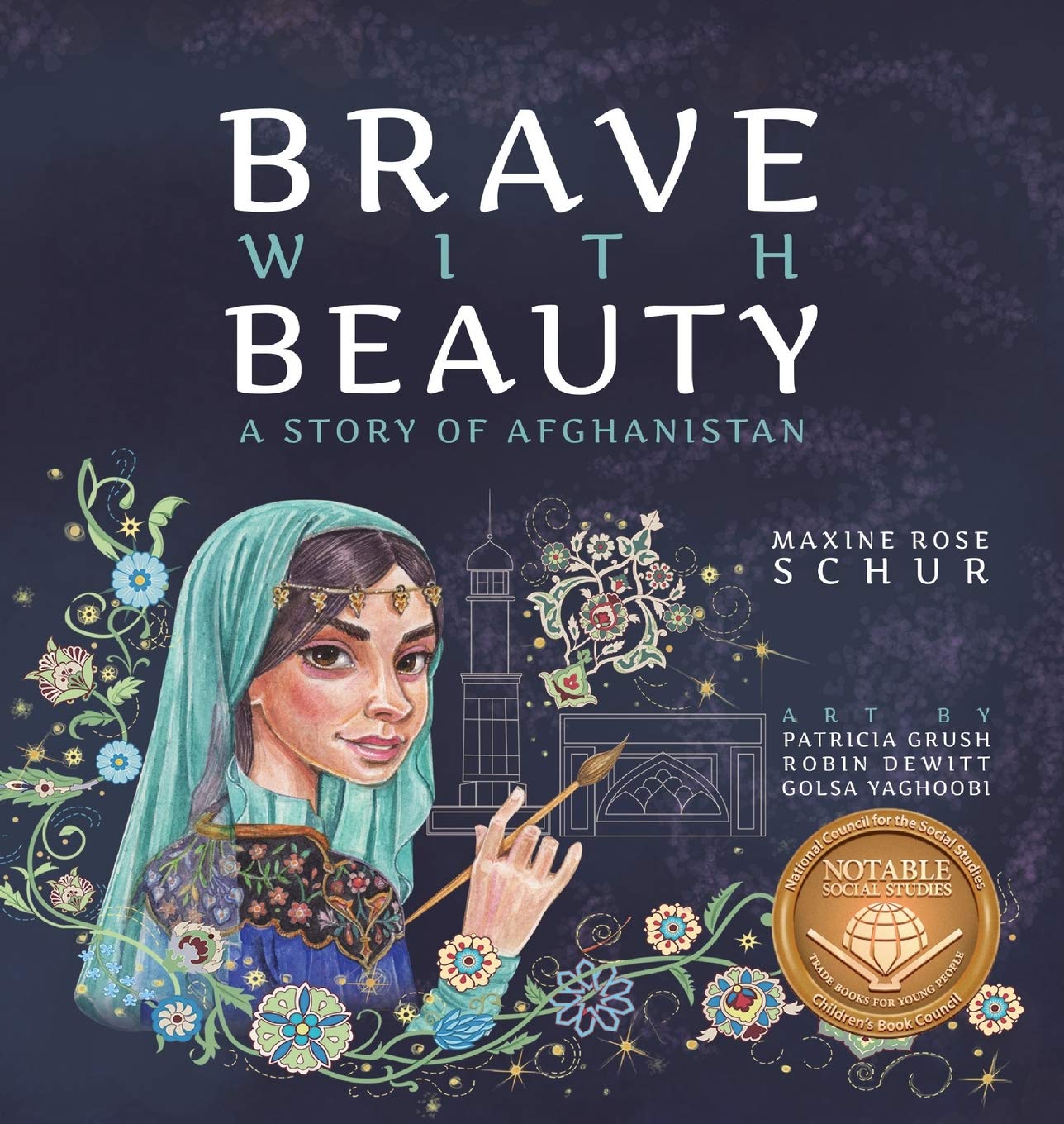
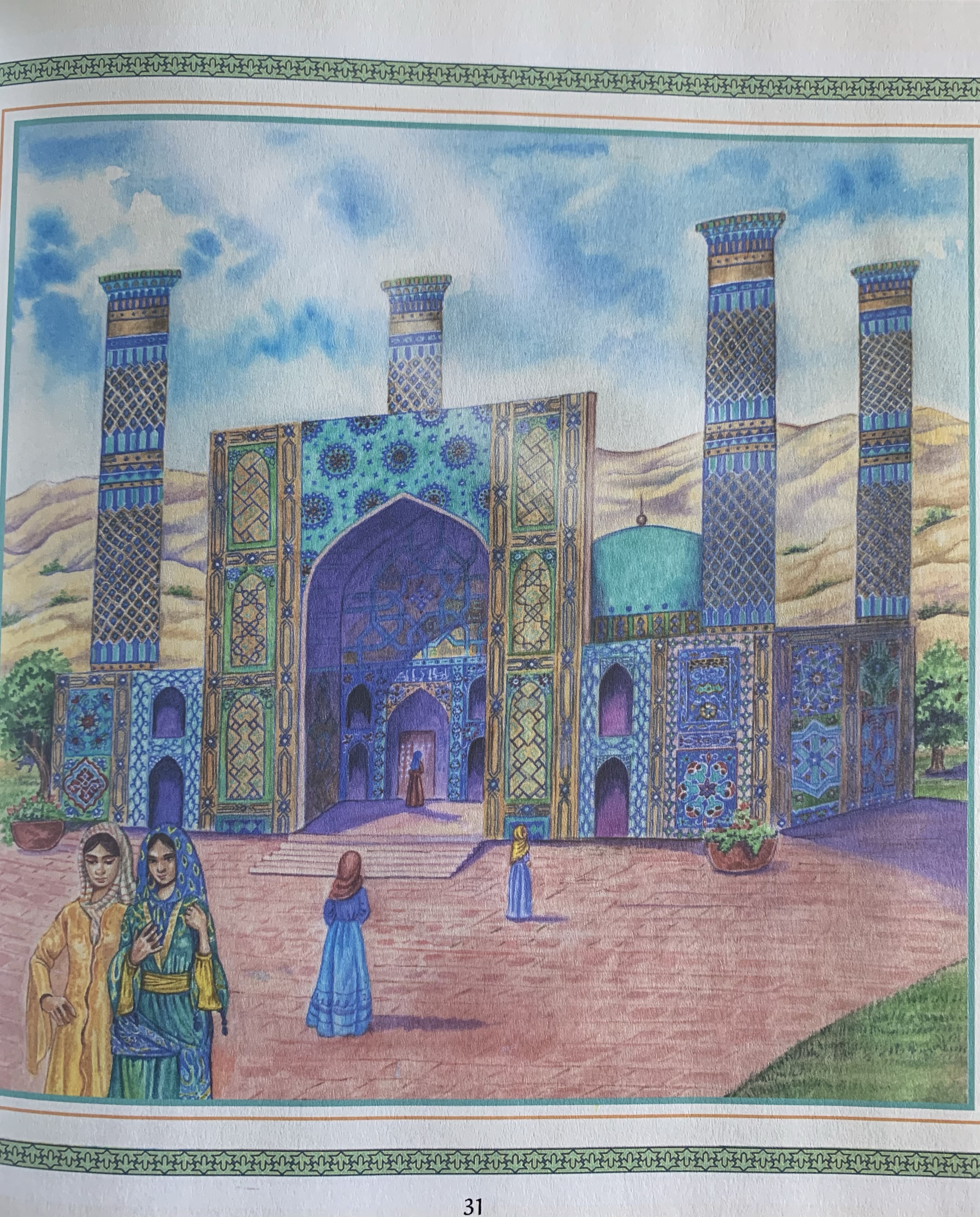
This 44 page fictionalized retelling of Queen Goharshad, a 15th century monarch of the Timurid dynasty in Afghanistan should really be a larger book than 8 x 8 to appreciate the artwork that is detailed and stunning.  The story of Goharshad, wife of Emperor Shah Rukh, and her influence on art, music, culture, higher education, and architecture, is one that we should be more familiar with, but the actual text and manner in which the story is conveyed isn’t consistent for me and I wanted more details about the society she stepped in to to rule,  I know it is fiction, and meant for 2nd to 4th graders, but I would like to think that readers will want to know what obstacles she had and what support she enjoyed and from where.  That they will question if it was a rich kingdom that she could pay musicians to play everywhere, and wonder if families sent their daughters to the University she built, ask why it wasn’t for women to design a  Masjid, and what was the name of the smaller mosque that bore an older woman’s name? The book at times overly summarizes and at other times is haltingly detailed.  It is a good read to reflect a strong woman and her influence on her land, but unless assigned, I don’t know that seven to ten year olds will pick up the book and be inspired by it enough to change their perception of the Afghanistan that they may see on the news.

img_0171

Seven centuries ago Goharshad loved beautiful things such as painting and the texts of Rumi.  Her brothers played at being like Genghis Khan and teased her for not being brave.  She vowed to be brave with beauty even though she didn’t know what that even meant.  At age 14 she was given in marriage to the king, Shah Rukh, in Herat.  She ruled with her husband and had resources and time to spread her beauty by speaking up and being brave.

img_0172

Her first act of beauty was by filling the kingdom with music.  She wanted music every day in the court and beyond. Music that was playful and pious, music that painted pictures in the listeners minds and brought joy like the laughter of God.  She next sketched and designed a beautiful and enchanting garden to be built.  It doesn’t say where it was, but that people came from all around to enjoy it.

img_0173

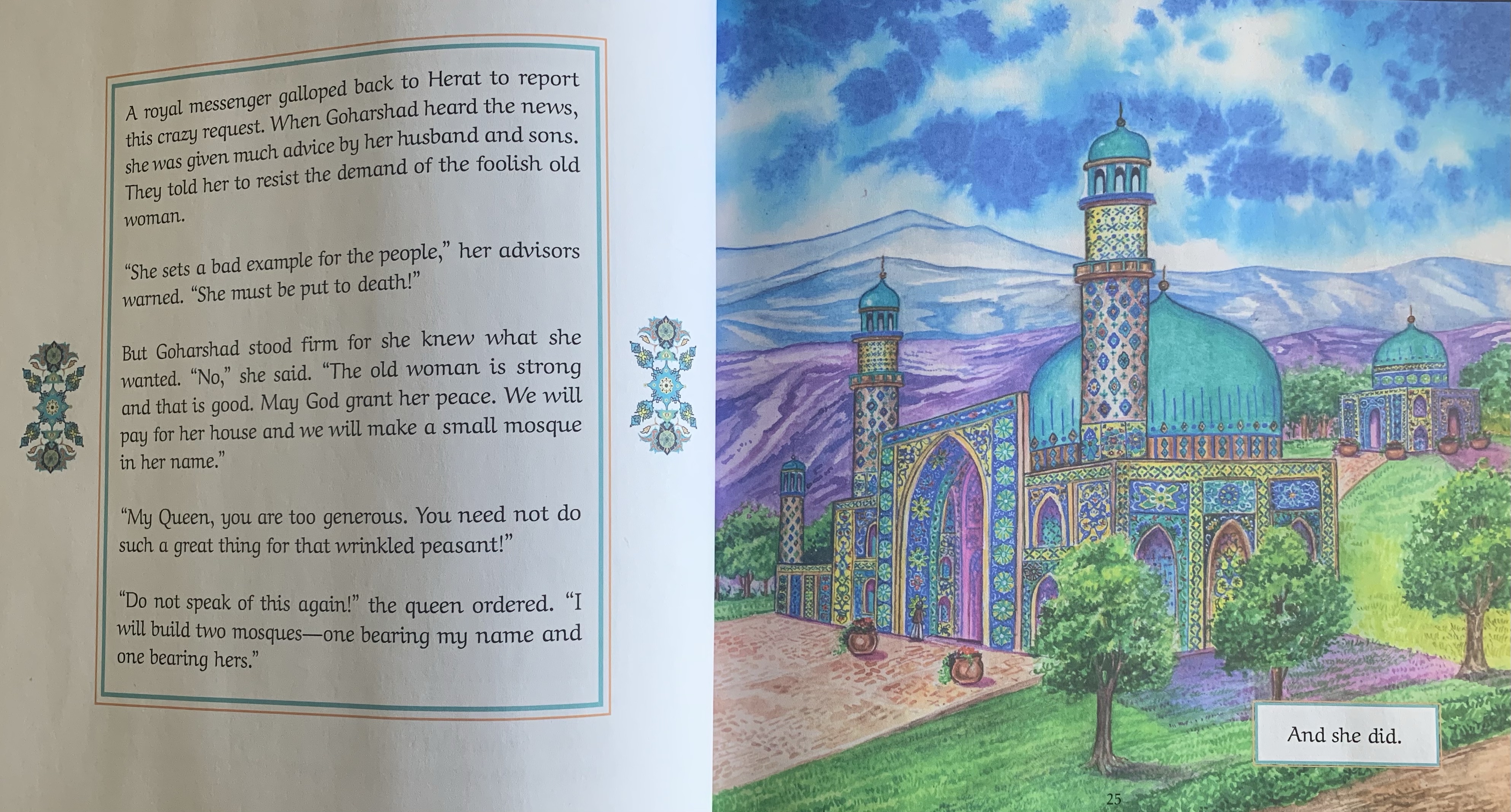
Feeling braver she turned her sights on building a mosque in the western city of Mashhad.  She designed it and called the court architect, Qavam al-Din Shirazi to discuss.  He doubted if it was right for a woman to design such spaces, but she assured him that she had the talent for it, so construction began.  An elderly woman refused to sell her cottage for the new project unless a mosque with her name was built.  The advisors wanted the old woman put to death or imprisoned, Goharshad disagreed appreciating the woman’s strength and instead agreed.  The big mosque was built with Goharshad’s name and a smaller one on the property with the old lady’s.

img_0175

With such an accomplishment complete, the Queen again summoned the architect and expressed her desire to build a great center for learning.  A college for girls, a grand mosque for prayer, and a vast library.  She wanted the structure decorated with paint from precious stones and sold her crown to finance the project.

img_0174

After her husband died Goharshad reigned, but sadly after she died, much of her accomplishments died as well.  Over time, harsh weather and war, nearly all her buildings disappeared and those that remain, do so in ruin.  The book ends with hope that memories of her will endure, A guide to some of the words in the story,  an Author’s note, and a Guide for Parents and Educators.

img_0176

There is not a lot of Islam in the story, just the building of masajid .  Some may take issue with her stress and celebration of music, and likening it to God laughing, but if you look at it as her story, it should be able to be appreciated even if you disagree.

img_0177

An Emotion of Great Delight by Tahereh Mafi

Standard
An Emotion of Great Delight by Tahereh Mafi

emotion

This 256 page YA OWN voice book is a real and raw look at a character and the many layers of life weighing down on her.  At the center of it all is a strong Muslim teen dealing with post 9/11 bigotry, the shattering of her family, toxic friendships, and a broken heart.  It is a love story, but it is so much more, as the protagonist’s voice draws you in to her crumbling world from the very first page and has you begging for more when the last page is read.  So often in Muslim-lead-mainstream-romance-themed novels, I want there to be introspection at the choices that the character is making and the internal processing of navigating their wants with their beliefs, and this book surprisingly does it.  There are some kissing scenes, cigarette smoking, cosmo magazine headlines, and waiting for her father to die, but not without introspection. Shadi reflects on her smoking quite often, she questions the repercussions of her actions, and she analyzes her father’s faith and approach to Islam as she forges her own relationship with the deen.  There is mention of a Muslim character drinking, doing drugs, hooking up, and it mentions he had condoms in his car, just those exact phrases, nothing is detailed or glorified, just stated.  There are also threads of mental health, self harm, death, and grief.  The characters are genuinely Muslim and some of their experiences are universal, and some specific to the faith, culture, and time.  Muslims and non Muslims will enjoy the book, and I would imagine relate to different things, but find it overall memorable and lingering.  For my Islamic school teens, I’d suggest this book for 17/18 year olds to early twenties.  It isn’t that they haven’t read more graphic books, but to be honest, Shadi has a lot going on, and if being close to Ali can lighten her load and help her find hope and joy, I’m all for it.  I know it is “haram,” but it is fiction, and it will have readers rooting for them to be together, not a message you may want to pass on to your younger teens.  As the author says in her forward, “we, too, contain multitudes.”

SYNOPSIS:

The layout of the book bounces between December 2003 and the year before.  In a previous time, Shadi’s life was easier, her brother was alive, she had a best friend, her Iranian immigrant Muslim family may have had stresses and issues, but they were a family. In 2003, Shadi is largely forgotten by her parents, her brother is dead, her father is close to death, her mother is self harming, her older sister preoccupied, and as a high school student Shadi is both falling and being crushed by her heavy backpack both metaphorically and literally.

The story opens with Shadi being approached by a police officer wondering why she is laying in the sun, he thinks she is praying, and she doesn’t have the energy to be angry by this assumption, she is exhausted, and doesn’t want to cause any waves that might get back to her fragile mother and cause any more stress than necessary.  So she drags herself up, and begins the walk to her college level math class miles away.  The sun is short lived and the rain begins to pour, she knows no one will come to pick her up.  Her parents have long ago stop being present in her life.  She once had a best friend, but that relationship, as toxic as it was, also has ceased to exist.  So she walks, and she is drenched, and she falls, so she is now soaking wet and bloody.  A car slows down to presumably offer her a ride, but then he speeds off drenching her in a tidal-wave.  The scene is set for the tone of the book. Shadi is drowning, we don’t know all the reasons why, they unfold slowly, but we know that it is going to get worse, her phone is nearly dead and her sister has just called to let Shadi know her mother is in the hospital.

I don’t want to detail my summary as I often do, because the way the story unfolds, would really make any additional information given act as a spoiler.  The book is short and a fast read, but along the way the introspection to the chaos that is Shadi’s life, makes it impossible to put the book down.  Shadi will have to confront her crumbling life and find away to reach toward hope.  She will have to keep walking to avoid drowning and along the way cling to the few precious things that give her joy: an emotion of great delight.

WHY I LIKE IT:

I really enjoyed this book.  I loved the Islam and real approach to her volunteering at the mosque and calling out racism within the community and diving deep in to understanding is Islam more than just rules and toeing the line.  It was a great mirror for so many nuances in real life, that I will probably re-read the book again in the near future, to enjoy it all.  I absolutely love the unpacking of the toxic friendship.  When women tear each other down under the guise of caring it is brutal, and the acceptance and growth that Shadi is struggling with in regards to her best friend of six years, Zahra. who is also Ali’s sister, is a reminder that sometimes walking away is the only choice.  

The two criticisms I have of the book are: one-that the book is too short, I wanted, no, I needed more.  And two I didn’t understand why Ali’s family and Shadi’s family were no longer close.  I get that Shadi cut Ali out of her life and Zahra and Shadi had a break, but Ali/Zahra’s family still care for Shadi and she for them, so what happened between the parents? It seems that the death of a child would draw the friends out and make them protective, not push them to being aloof.  It seemed off to me and major plot hole.

FLAGS:

As I mentioned above: kissing, smoking, drugs, hooking up, referencing condoms, cosmo headlines, self harming, grief, death, alcohol.

TOOLS FOR LEADING THE DISCUSSION:

I don’t think even high school could do this as a book club selection, because you really want to ship Shadi and Ali.  If you had like an MSA book club then I think this would be a great choice.  I would love to hear teens’/young adults’ thoughts about Shadi’s view of religion, her fathers approach, and how they view passing the deen on to their children.  I think it offer great role-play scenarios in empathy and how you’d react in real life to finding your mother struggling, your best friend taking off her hijab and being so jealous of you, the bullying, the assumptions, understanding your father and where to assign the blame for such a traumatic event that claimed your brother’s life.  There is so much to discuss, and I hope at some point I find the right forum to chat about this book and listen to other’s perspectives about it.

Rumaysa: A Fairytale by Radiya Hafiza illustrated by Rhaida El Touny

Standard
Rumaysa: A Fairytale by Radiya Hafiza illustrated by Rhaida El Touny

rumaysa

This middle grades retelling of the classic fairytales: Rapunzel, Cinderella, and Sleeping Beauty, replaces white characters with diverse Desi characters, reclaims female characters’ empowerment, and weaves the stories together with Rumaysa first freeing herself, and then using a magic necklace that takes her to those in need  (Cinderayla and Sleeping Sara) in her quest to find her long lost parents.  After a few chapters, I started writing a list of gaping-huge-ginormous plot holes, they are frequent and laughable, then I took a deep breath and recalled the similar eye-rolling inconsistencies that plague perhaps all fairy tales, but specifically Disney-esque ones. Once I let go of trying to understand why Rumaysa is wearing hijab while locked in an isolated tower, or how the witch can’t remember her name, but Rumaysa knows the name her parents gave her when she was kidnapped on the day of her birth, or that she knows she was kidnapped and her whole backstory, just to name a few, the book was much more enjoyable.  I still have major issues with some of the forced Islamization and cultural tweaks, but not because they existed, but rather because they weren’t strong enough.  Why have an Eid ball for all the fair maidens in the land.  It was awkward to read all the young people showing up to pair off, and then people asking the prince to dance, and him saying he didn’t know if he could.  Why not just make it an over the top Desi wedding with families, where dancing and moms working to pair their kids off is the norm. Having it be a ball for the maidens in the land, just seemed like it was afraid to commit to the premise of twisting the fairytales completely.  There are a few inconsistencies, however, that I cannot overlook.  This is a mainstream published books and there is at least one spelling error and grammar mistake.  I could be wrong, as it is British, and I am by no means competent in even American English, but I expect better.  Even content wise, Prince Harun for example, is wearing a mask, but the text comments on his blushing cheeks, eyes, eyelashes, and smile, not a typical mask perhaps? And don’t get me started on the  illustrations, the same awkward ball has Ayla leaving, and in the picture not wearing a mask concealing her face as the text states.  Overall, the inside illustrations are not well done.  The cover, by artist Areeba Siddique is beautiful with the shimmery leafing on the edges, that would have brought the inside pages a lot more depth and intrigue than the ones it contains.  Despite all the aforementioned glimpses of my critiques to follow, I didn’t hate the book and quite enjoyed the light handed morals and feminism that was interwoven with clever remarks and snark. The first story has Rumaysa wearing hijab, finding a book about salat and praying.  The second story takes place on Eid and Ayla eats samosas, discusses Layla and Majnun, and has a duputta. The third story I don’t recall any culture or religious tidbits other than keeping with the consistency of cultural names.  There is mention of romance between an owl who has a crush on a Raven, but the heroines themselves are learning to be self sufficient from errors of their parents/guardians and are not looking for any males to save them.  Other than that the book really needs an editor and new illustrations, I can see fairytale loving middle grade kids reading the book and finding it enjoyable, or even younger children having it read aloud to them a few chapters at a time, and being drawn in to the stories and eager to see what happens next. It would work for that demographic, but perhaps no one else.

img_0394

SYNOPSIS: (spoilers)

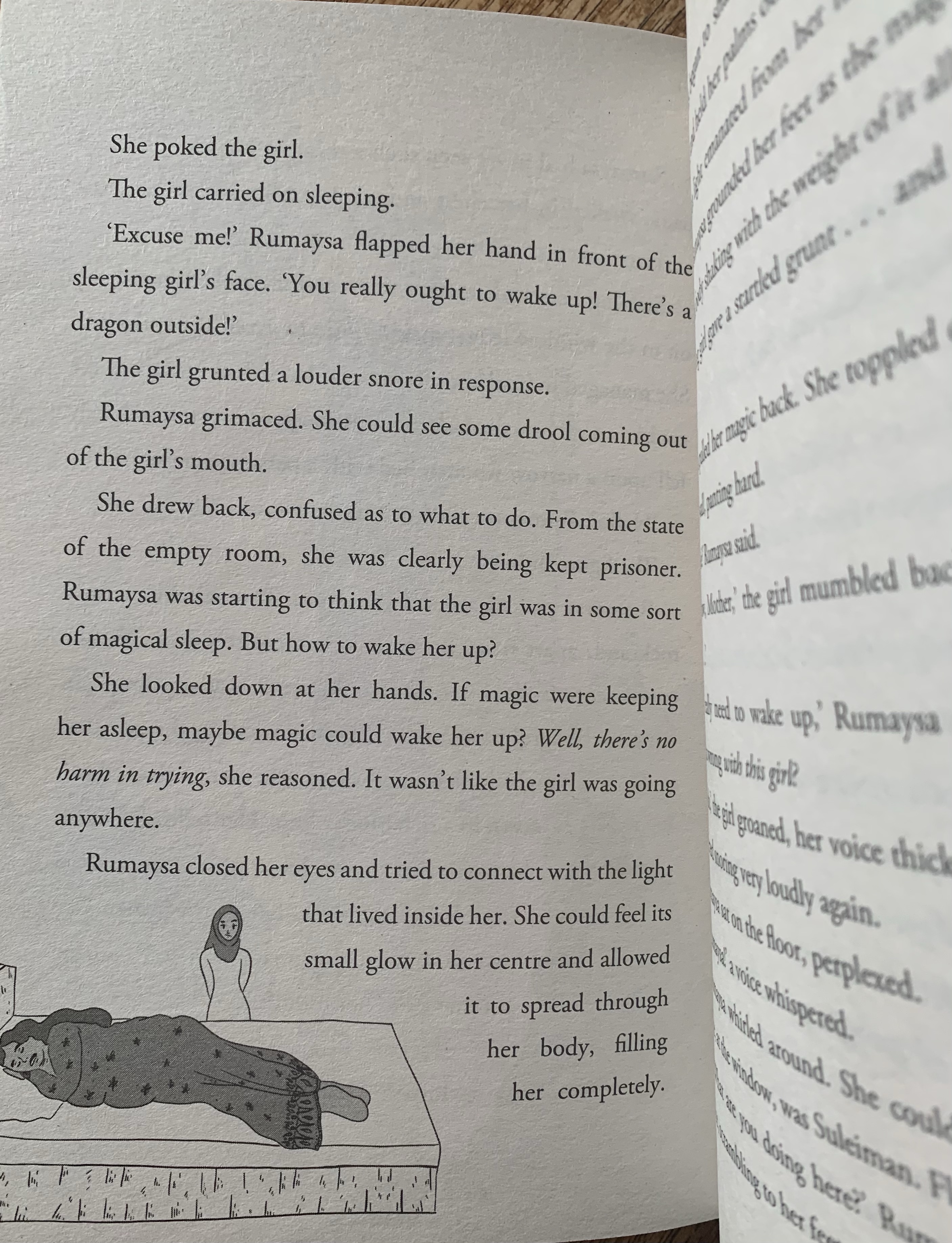
Rumaysa’s parents steal vegetables from a magical garden when there is no food or work to be found, as a result when Rumaysa is born, the owner of the garden, an evil witch, takes Rumaysa and places her in a tower protected by an enchanted forest and a poisonous river.  No one can get in, and Rumaysa cannot get out.  In the tower Rumaysa reads, no idea how she learned, and spins straw in to gold as she sings a song that channels the magic she consumed in utero from the stolen garden.  With only rations of oats to eat, a friendly owl named Zabina frequents Rumays daily and brings her berries and news .  When he brings her a new hijab, Rumaysa has the idea to lengthen the hijab with bits of gold over time, so that she might escape.  When she finally gets her chance, she is met by a boy on a magic carpet named Suleiman, and is both shocked and annoyed that someone got close to the tower, and only after she saved herself.  The two however, and Zabina, are caught by the witch and must escape her as well.  When that is all said and done, Suleiman gives Zabina a necklace that takes one to someone in need of help.  His parents want him to save a princess, he wants to study in his room, so he hands off the necklace hoping it will help Rumaysa find her parents, and he heads off on his flying carpet.

The necklace doesn’t transport Rumaysa to her parents, however, it takes her to a street where a girl is throwing rocks in desperation having been denied attending an Eid ball after her dress was torn to shreds.  The story starts with Ayla’s back story before Rumaysa arrives, but the two girls befriend each other, Rumaysa uses her magic gold weaving abilities to conjure up a new and beautiful dress and golden shoes and the girls head to the ball.  When Ayla heads off to get samosas she meets the prince, but doesn’t know he is the prince.  They argue about the play Layla and Majnun and when her stepmother asks about the dress, Rumaysa and Ayla make a run for it.  A shoe is lost, the stepmother comes to know, the guards search for the missing girl, and all is well.  Except Harun is incredibly shallow and superficial and only interested in Ayla’s clothes and status, so she rejects him and points out that she is much too young for marriage.  She instead reclaims her home, fixes her relationship with her stepsisters and begs Rumaysa to stay.  Rumaysa makes her excuses and is whisked away to a land that is being ruled by a man and his dragons.

Originally the land of Farisia is ruled by King Emad and Queen Shiva, but they have become unjust and disconnected from their people.  When Azra gets a chance to steal Princess Sara and take the kingdom, he does.  Rumaysa arrives to free a sleeping Sara from the dragon and restore apologetic and reformed leaders to the thrown.

img_0397

WHY I LIKE IT:

I do like the spinning of familiar stories and either updating them, or twisting them, or fracturing them, so I am glad to see an Islamic cultural tinge available.  I feel like the first story was the strongest conceptually even if the details and morals weren’t well established.  The second story was strong in the messaging that Ayla, and any girl, is more than just a pretty dress, but the premise was a little shaky and not that different from the original.  The third story was a little lacking developmentally for me and all three I felt could have gone stronger in to the religion and culture without alienating readers or becoming heavy.  There are characters illustrated in hijab, some in saris, some in flowing robes. Princess Sara is noted to be a larger body type and I appreciated that in elevating the heroines, other’s weren’t put down.  Even within the book, there is diversity which is wonderful.  

img_0398

FLAGS:

There is lying and stealing with consequences.  “Shut up” is said.  There is magic, death, destruction, and a brief mention of an avian crush.

img_0395

TOOLS FOR LEADING THE DISCUSSION:

I could see this being used in a classroom for a writing assignment to urge students to write their own tales.  I think it is fourth or fifth grade that children read fairytales from different points of view: think the three little pigs from the wolf’s perspective or the Stinky Cheese Man and Other Fairly Stupid Tales, and this book would lend itself easily to that lesson as well.

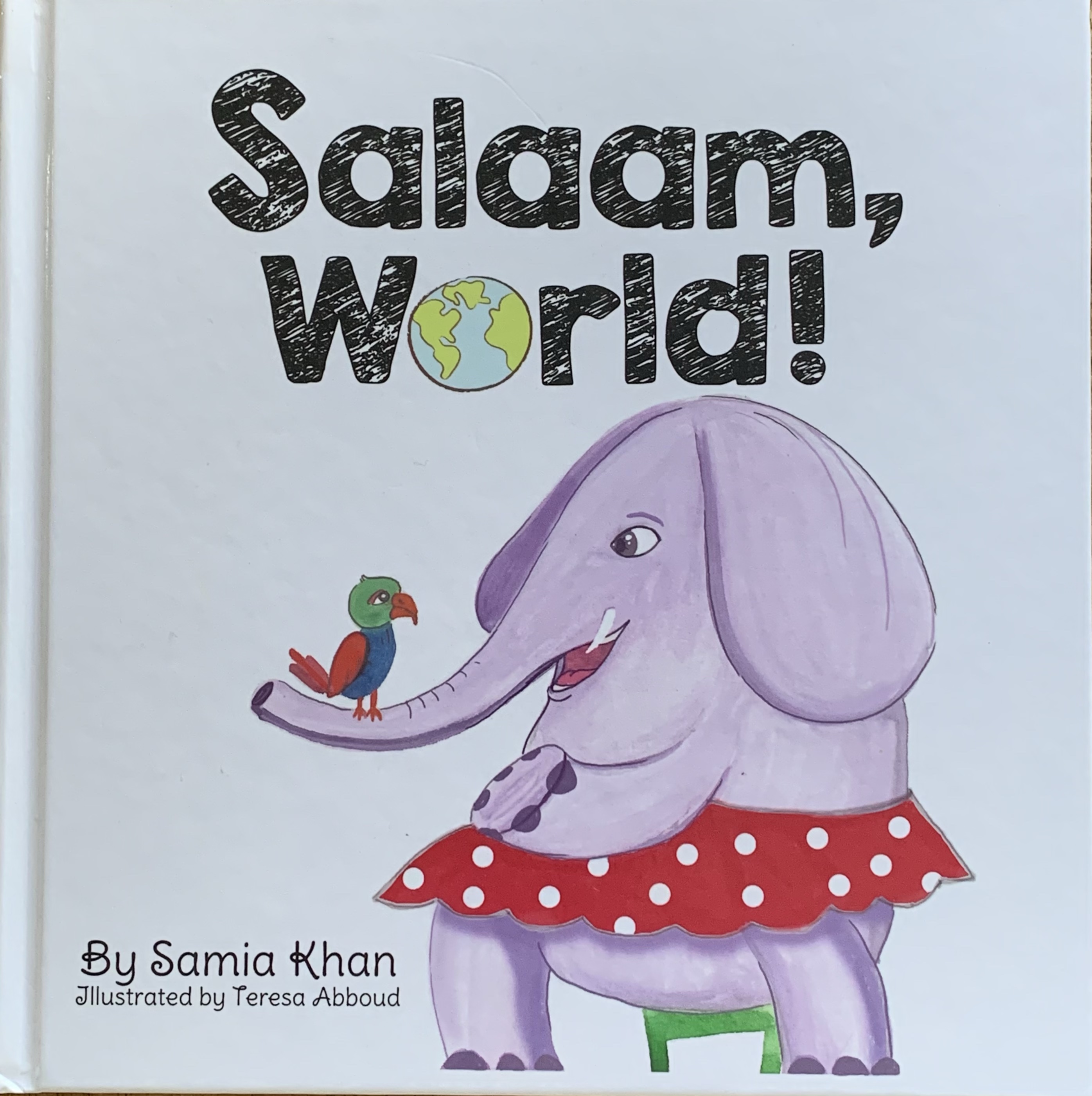
Salaam, World by Samia Khan illustrated by Teresa Abboud

Standard
Salaam, World by Samia Khan illustrated by Teresa Abboud

img_0255

This 26 page rhyming picture book starts out basic enough with salaam being said from various locations, but it digs a little deeper as the book progresses to explain what salaam means, and how to respond. A good introduction to the greeting of peace for ages three and up. The pictures are jungle animals testing out the word and the 10 by 10 size is sufficient for bedtime and in small groups. My picky critiques are I don’t like the font as I think it is hard for early independent readers to decipher when capitalized, words such as “catastrophic” and “salutation” are a bit advanced for the demographic, and I wish there was a bit more Islam in the book, but overall it is sufficient, and an effective tool to helping get little ones to say salaam.img_0246

“Salaam from above, salaam from below, salaam from the mountaintops covered in snow,” is how the book begins as a cat hanging from a tree and braving the elements offers his greetings. A donkey then asks us to hold up and explain what the word means.

img_0243

Salaam is defined as meaning peace in Arabic and a word that Muslims use that is like ‘hello’ only kinder. It is sending peace to those you say it to, and a show of respect. The animals say it to others before noting that you can say it short or long: Salaam or Assalamualaikum.

img_0245

The book then asks how to respond before teaching us to say walaikum-assalam and telling us not to be alarmed the next time we hear the greeting, but to return it and spread it.

img_0247

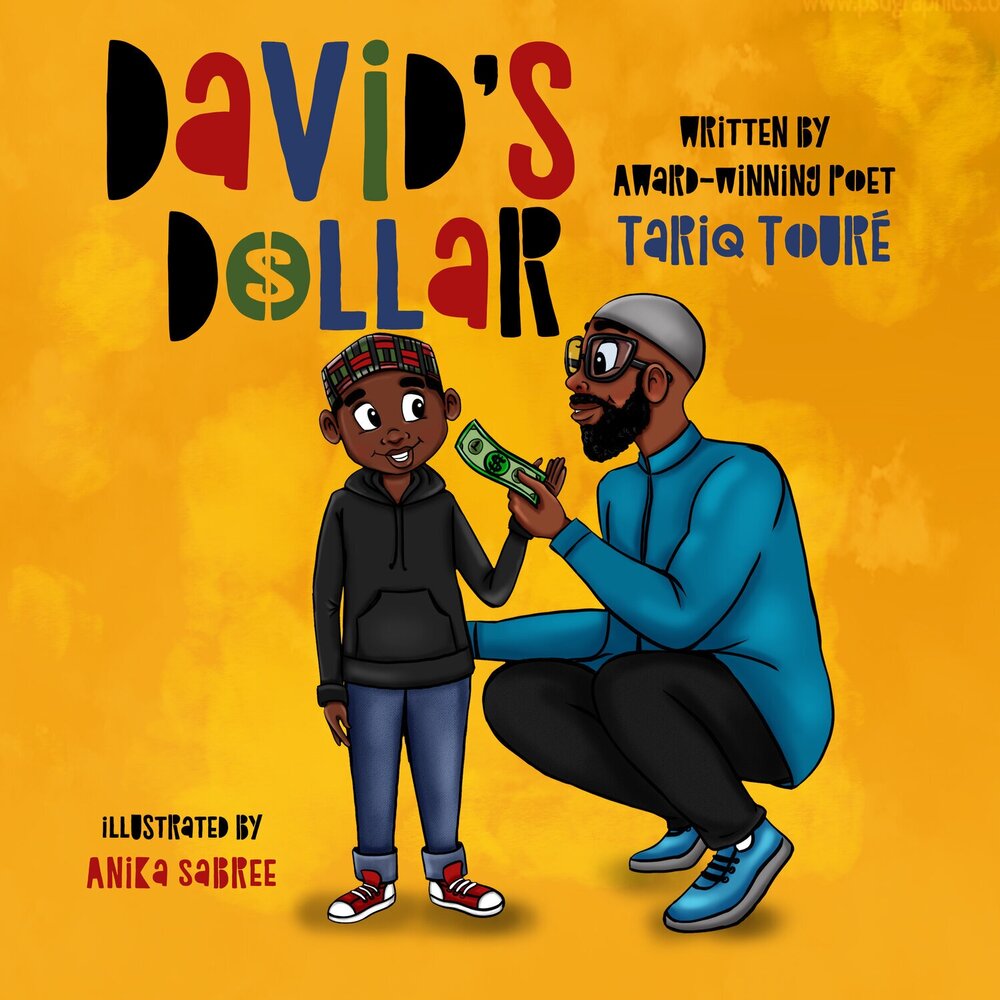
David’s Dollar by Tariq Toure’ illustrated by Anika Sabree

Standard
David’s Dollar by Tariq Toure’ illustrated by Anika Sabree

This early elementary 20 page story is an entertaining, yet informative look at community and economics on a kid’s level.  It features black Muslim characters, business owning women of color, commerce, charity, and relevance.  I loved the cadence of the book, the illustrations, and the simple text. Sure, maybe a dollar isn’t much and it is a transparent simplistic view, but it makes the point of how when you shop local everyone benefits, and how the path money takes impacts everyone it touches.

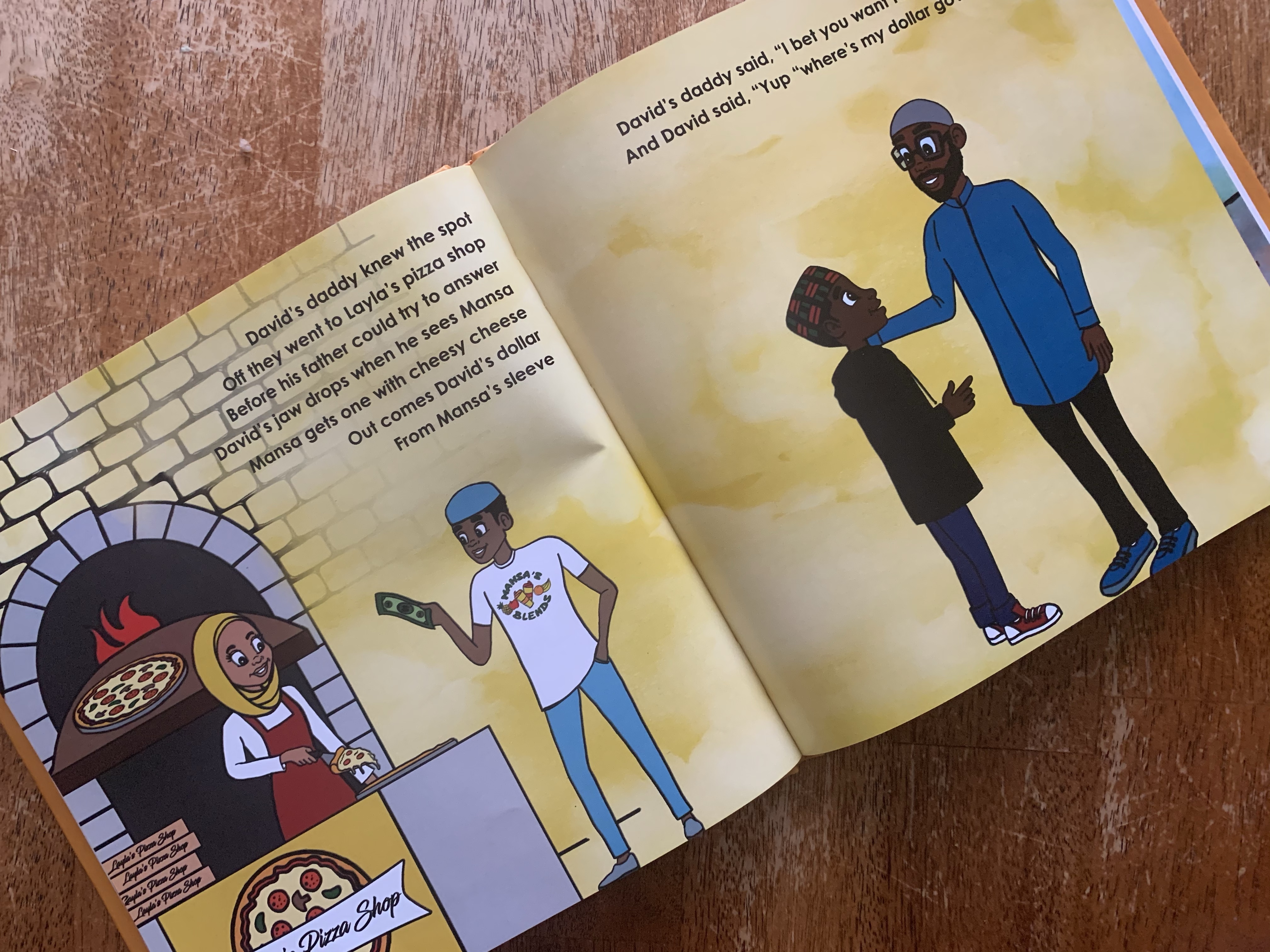
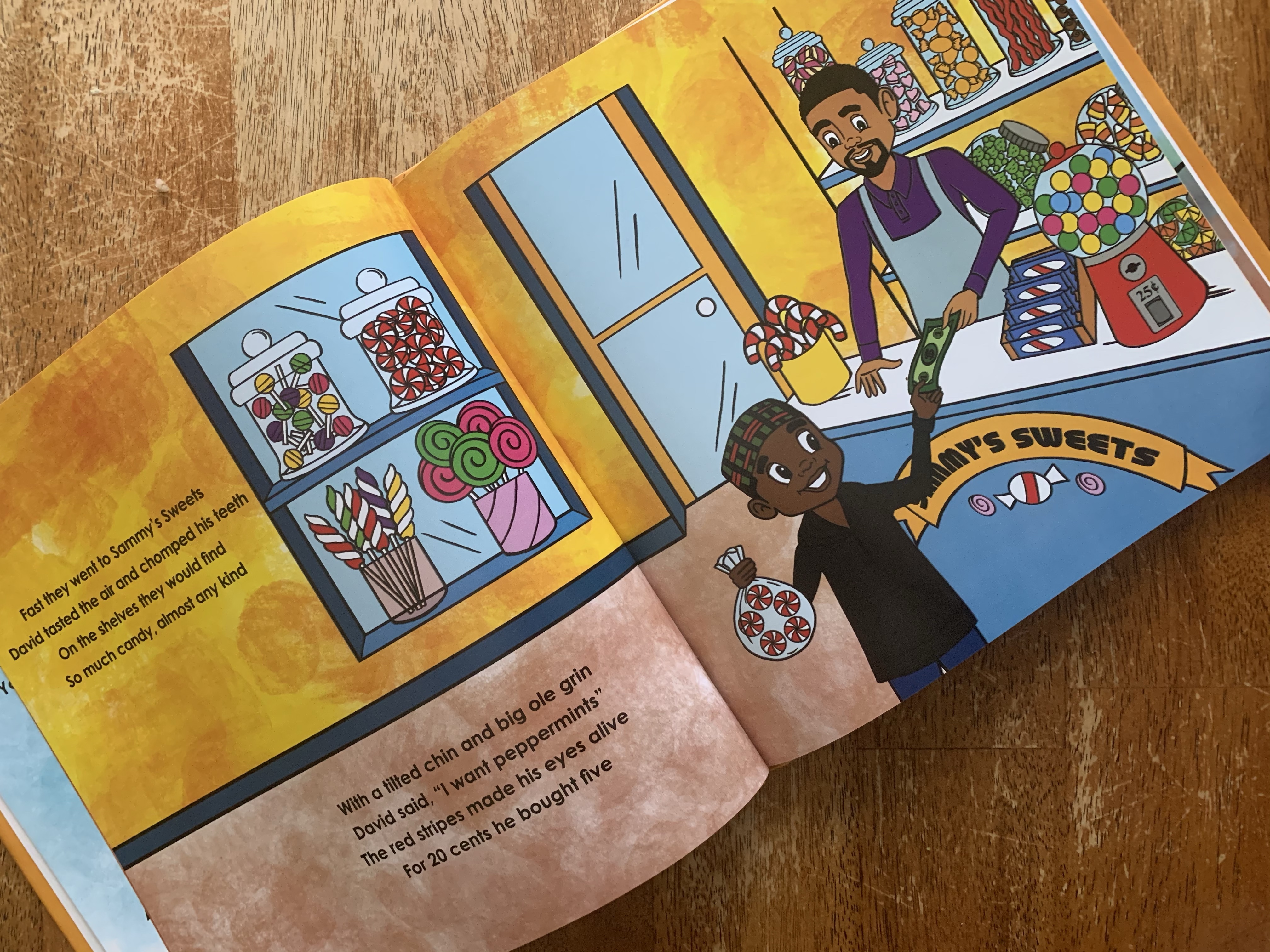
David is getting his dollar after doing his chores, and he is ready to head to the candy shop to see what to spend it on.  At Sammy’s sweets, he decides to get five peppermints, and just like that his hard earned money is gone.  He asks his dad where the money went and off they head to Mansa’s juice shop. When Sammy comes in and buys a drink, out comes David’s dollar and now it is in Mansa’s hands.

David and his Daddy follow the money and see it change hands at Layla’s Pizza Shop, and then Madame C’s Braids, before heading to Uncle Kareem’s hardware store where the dollar too has ended up.  It is time to pray so Uncle Kareem, Daddy, and David head to the mosque.

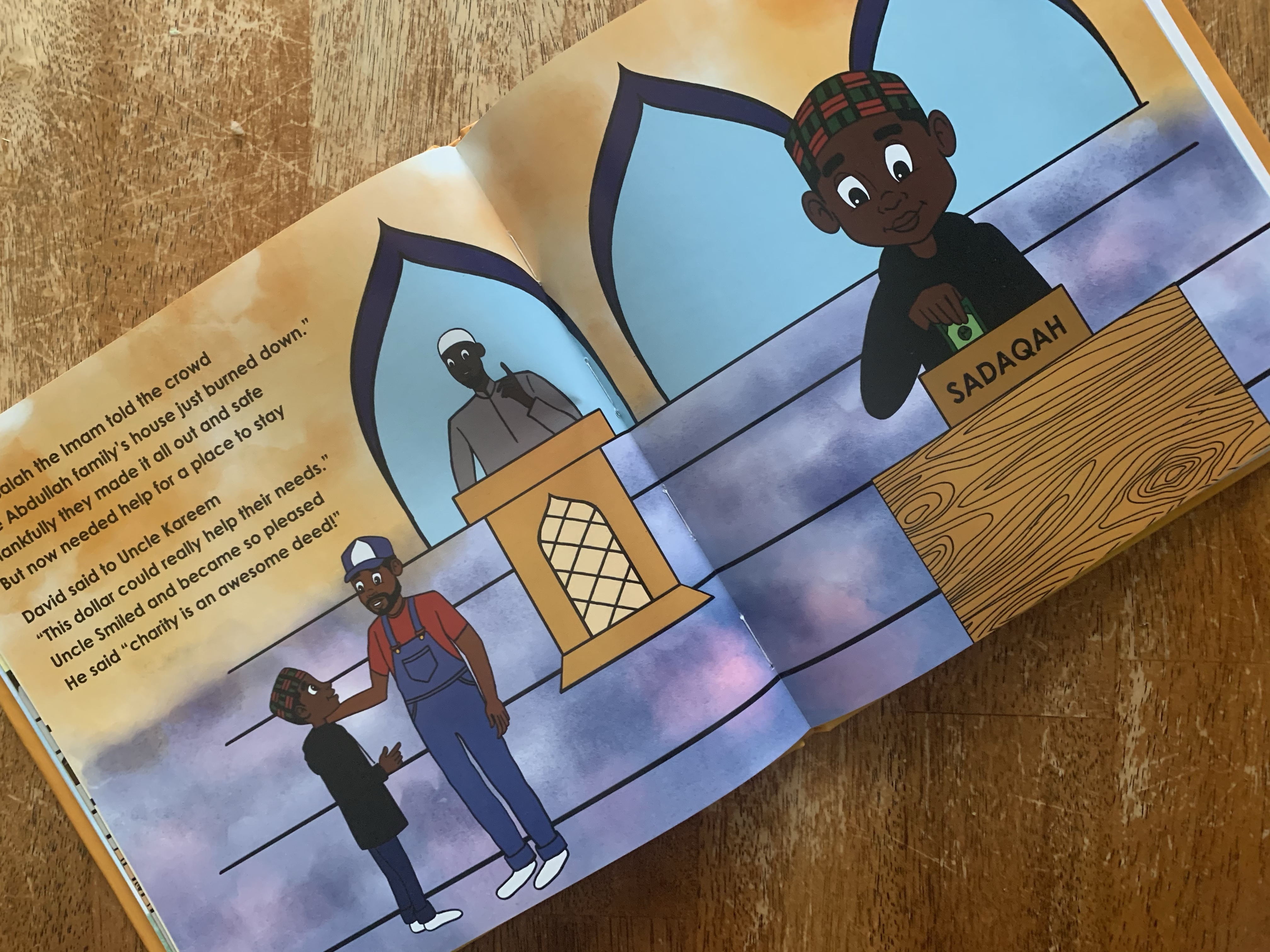
After Salah the Imam tells the crowd that a family’s house has burned down and they are collecting sadaqah.  David tells Uncle Kareem that that dollar should go to the family.  At night, David recalls all the places his dollar traveled and resolves to learn more math.

The book starts with a beautiful heartfelt gratitude message to Allah swt and the community of supporters.  The end of the book features a detailed bio of the book’s poet author and his successes and praises.

The story is rooted in an Islamic community, but is for all readers of all faiths.  There is no preaching or details about belief. many women have hijab on, there are Islamic names, they go to the mosque, they pray, and they give sadaqah.

Boy, Everywhere by A.M. Dassu

Standard
Boy, Everywhere by A.M. Dassu

boy

In a very crowded field of refugee themed books, this 400 page middle grades/early middle school novel sets itself apart by really focussing on the quality of life enjoyed in Syria compared to the life of a refugee on the move and in getting reestablished as an immigrant.  Where other books allude to how things in Syria got worse and then perhaps focus more on the horrific journey desperate individuals are forced to take, this book is very direct in showing the young protagonist’s daily life in Damascus and really cementing in the notion for western privileged readers, that losing everything could happen to anyone. The book does show hardships on the perilous journey by truck and boat as well as showing that life in England isn’t immediately better.  Side characters throughout the book show diverse opinions and strengths that for the preteen target demographic would provide starting points for wonderful discussion and dialogue to take place. Overall, the book does a decent job of not falling into the same cliche’ narrative even though the book does have a hopeful and happy ending.

SYNOPSIS:

Sami is the 13-year-old son of a surgeon and principal.  He has a little sister, a best friend, a desire to be on the football (soccer) team, the latest Air Jordans, a love of video games, his iPad, and a very comfortable life.  When he orders the newest soccer shoes to wear for tryouts and begs his mom to go pick them up from the mall, the Syrian civil war which has seemed an arm’s length away, comes to Damascus and to Sami.  The mall is bombed while his mom and little sister are getting his shoes and while they survive Sara is traumatized and stops speaking.  The family decides immediately and secretly that they have to leave.  Sami is kept slightly in the dark and thus, so is the reader as to how quick everything must be liquidated and how uncertain the future is for the family.  

Sami is forced to turn over his iPad to his parents, he stops going to school, and before he has time to talk to his friends, he is saying good bye to his grandmother and heading to Lebanon with his parents and sister.  The journey is perilous and fraught with danger.  The constant state of fear and silence, the peeing in bottles, the trust in smugglers is all so palpable.  The rooms they are locked in with other refugees and the the bonds and fears and squalor that Sami experiences is such a stark contrast to the life he has known of drivers and maids.  In one smuggler’s den in Turkey Sami befriends a boy slightly older than him that is traveling alone, Aadam.  Desperate to help his new friend, Sami tries to steal his father’s cell phone and some money to help Aadam ensure his seat on a boat, not a raft, to cross the Mediterranean.  Sami is used to his family helping others, this situation of not being able to help, not being able to help themselves, is very new to him, and causes a lot of stress and strain between Sami and his father.

Sami has a fear of boats and water, having nearly drowned years earlier, the idea of getting on a make shift boat in the night with rough water is not something Sami is mentally prepared to do and when a boat near them capsizes, the reader is made painfully aware that even those that survive this journey are not left unharmed.  The family makes it to England to claim asylum, they are put in a holding area, a prison more or less, to await the next stop in a long process.  Here Sami and his father are assaulted and the threat of physical violence and imprisonment start to really affect Sami.  When they eventually get to a distant family members house in Manchester, their struggles are far from over as the family is unwelcoming.  School brings out the racists, the parents take jobs as factory workers and cleaners and Sara is still not talking.  With the guilt of his family’s condition weighing heavily on Sami, the constant bullying by his family in England, and the sad condition of his family’s finances, Sami decides he needs to return to Syria to care for his Tete and unburden his family of his presence.  

Yah, sorry, I’m not going to give it all away.

WHY I LIKE IT:

I love that the book really articulates how Sami’s life is in Syria and has him remark multiple times in England how much nicer things were in Damascus.  It doesn’t come across as a criticism, but rather a rattling of the paradigm that the west is so much better across the board.  I love that Sami’s best friend in Syria is Christian and that they are so respectful of each other’s faith and it is a non issue.  I love that some of the refugees in the holding apartment are kind and some in the detention facility in England are criminal.  It allows for the reminder that people are people even when they are refugees and cannot be assumed to be a monolith.  It also opens the door to discuss how desperation changes people.  Sami’s family is usually very generous, but with their own futures in turmoil, they cannot afford to be, they also presumably are very social and yet, the silence between strangers and within their own family is very telling of the stress and worry that plagues them.  I like how the process humbles the characters.  Not that I enjoy or feel that the characters needed necessarily to be humbled, but it is a transition that the reader benefits from seeing.  Sami’s father is/was a doctor, a surgeon, but is loading boxes in a factory, the desire to take care of ones family trumps degrees and expectation.  The transition is conveyed to the reader and I think will plant a seed of empathy in even the hardest hearts.  

The family in Manchester, particularly the boy Hassan, is awful and the friend, Ali, from school is amazing.  These opposing Muslim characters also help break the stereotype of where bullying comes from, and who is welcoming, allowing for people to be seen more as individuals than they often are in literature and in real life.  Islam is presented as characteristics of the characters when it does appear.  They ask Allah for help and say salam, attend various mosques, but there are not heavy religious overtones.  

At times Sami is annoying, and as an adult reading the book, I had to remind myself that that is probably exactly how a 13 year old boy would behave.  He sees things in black and white and is often singularly focused on contacting his friends.  He doesn’t understand the bigger picture, nor is told a lot of the bigger picture.  It is a hard age of being kept from stuff because you are too young, and being expected to rise up and be mature because of the gravity of the situation.  The book is not overly political, it is character driven and very memorable thanks to Sami’s perspective and voice.

The book is researched, it is not an OWN voice story, and while it is a compelling and engaging read, that I hope is accurate, the framing of the story is not incredibly original.  Aside from other Syrian refugee focused books, the book reminded me quite a bit of Shooting Kabul, albeit the country being left is different.   Both plots focus on a boy leaving with his family and blaming himself for the tragedy that has befallen a younger sister and the repercussions it is having on the family as they reestablish themselves as immigrants.  In both books the character plans to board an airplane to return “home,” as well.  

I like that there is a map, a glossary, and an author’s note included in the beautifully spaced, visibly accessible book.
FLAGS:

The assault is intense as is the fear of physical assault.  There is nothing detailed in the bombing, but the implied stresses of war, the journey of the characters, and the situations that they are in would be best for ten year olds and up.

TOOLS FOR LEADING THE DISCUSSION:

I am hoping to use this book as a Middle School book club read to start next year off.  The book is not yet out in paperback, otherwise I would do it this year.  There are so many things to discuss: from Sami’s unhappiness, his strengths, his desire to help others, to considering life from Aadam’s perspective and Hassans.  This book begs to be talked about with young readers and I’m so excited to hear what their thoughts are and who they identify with.  They could be Sami, he is a boy, everywhere, and if we can all remember that, we all will be better humans, period, the end.

Hannah and the Ramadan Gift by Qasim Rashid illustrated by Aaliya Jaleel

Standard
Hannah and the Ramadan Gift by Qasim Rashid illustrated by Aaliya Jaleel

img_0275

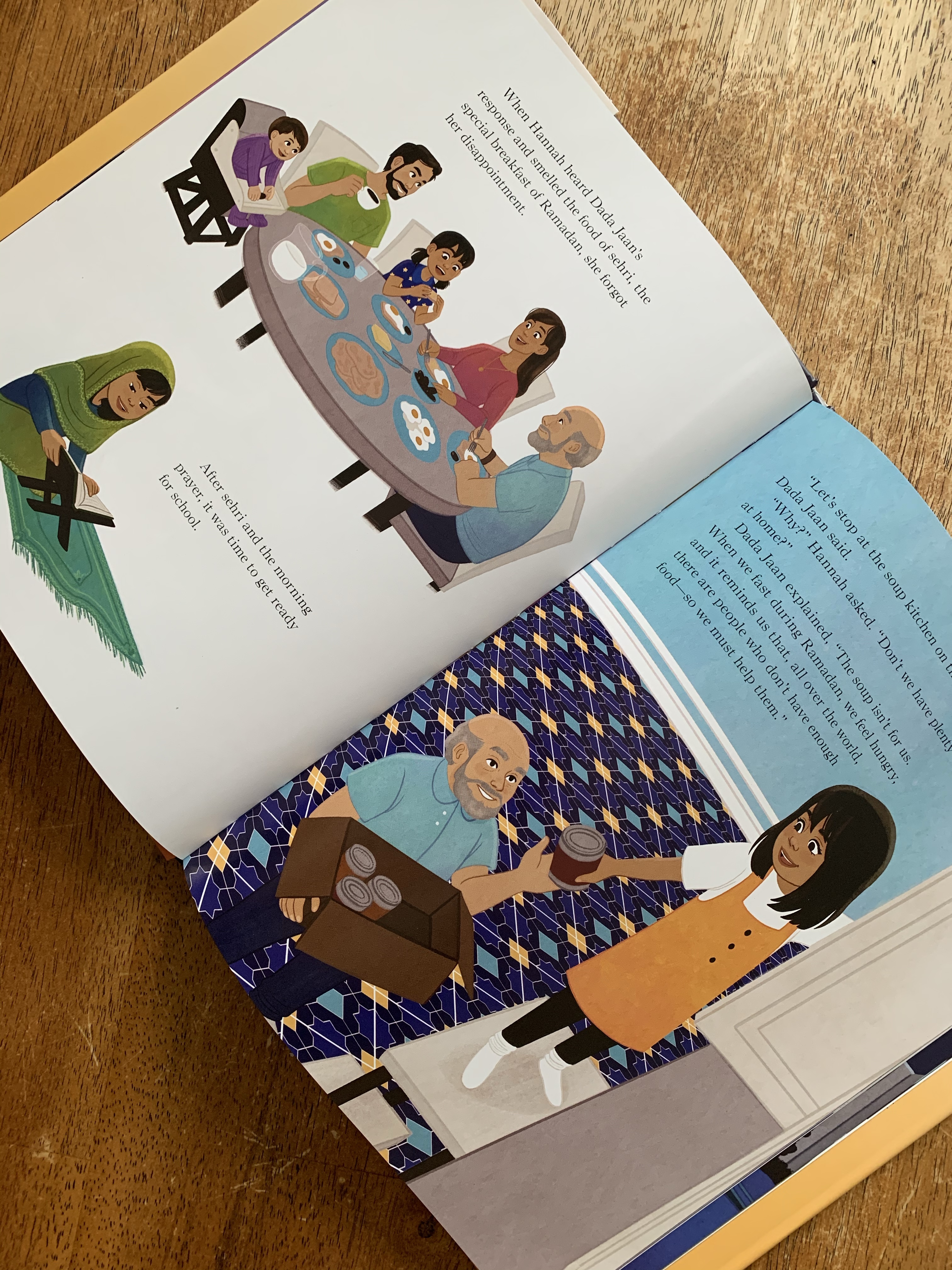
You may have seen this new 40 page Ramadan book that came out yesterday and thought, “another book about what Ramadan, is and a girl being told she is too young to fast, I’ll pass.”  And I’m here to tell you, please reconsider.  This book is wonderful and it is not the same-old-same-old.  I know the title and cover don’t hint at the heartfelt story within, but it really does an amazing job of showing, not just telling, about the feelings and purpose of Ramadan beyond the restraining of food and drink.  The text is a bit heavy, but the illustrations keep even four and five year olds engaged, and the story works for Muslim and non Muslim children alike.  The OWN voice book has a Desi slant with Urdu words, Pakistani clothing and featuring an immigrant family, but the cultural tinges are defined in the text and it flows smoothly.  This would be a great book to share with your children’s class to show how Ramadan is more than just going without food, or being just one day, or one act of kindness, it is an ongoing effort to show kindness to those near and far.  The book shows an authentic Muslim family and presents universal themes, making Ramadan and Islam more relatable and familiar to all readers, and inspiring Muslim children to find their own ways to save the world.

img_0276

The book starts with Hannah being woken up by her paternal grandfather, Dada Jaan, it is the first day of Ramadan, and she is excited.  She hopes that now that she is eight years old, she is old enough to fast.  Her heart sinks when she is told, “Fasting is for grown-ups, not for growing children,” but her spirits rebound when Dada Jaan tells her that she is going to celebrate Ramadan by saving the world.

The first thing Hannah and Dada Jaan do is collect cans from the pantry to take to the soup kitchen.  Dada Jaan explains what a soup kitchen is, and why it is important to help those that don’t have enough food.  Hannah is worried they won’t be able to help everyone in the whole world, but Dada Jaan encourages her to start with her neighbors.

img_0277

Later in the day, Hannah’s friend loses a beloved family necklace, and when the bell rings she doesn’t want to be late for class, but she remembers that she is supposed to help, so she does.  Hannah finds the necklace, but her teacher is not happy when she comes to class late, and Hannah isn’t even given a chance to explain.

On the 11th day of Ramadan, Hannah and Dada Jaan decide to save the world again before they head off to the science fair.  They are packing up clothes to take to the shelter.  Hannah is worried that the people at the shelter won’t know that they are the ones that donated the clothes.  Dada Jaan says that it is enough to help people out of love and adds that the best superheroes work in secret.

img_0278

At the science fair Hannah sets up her model replica of Abbas ibn Firnas’s flying machine next to her friend Dani.  When Dani runs off to see a robot, his globe rolls off the table and Hannah saves it. Dani ends up winning and she is happy for him, but she is sad that no one knows she saved his project.

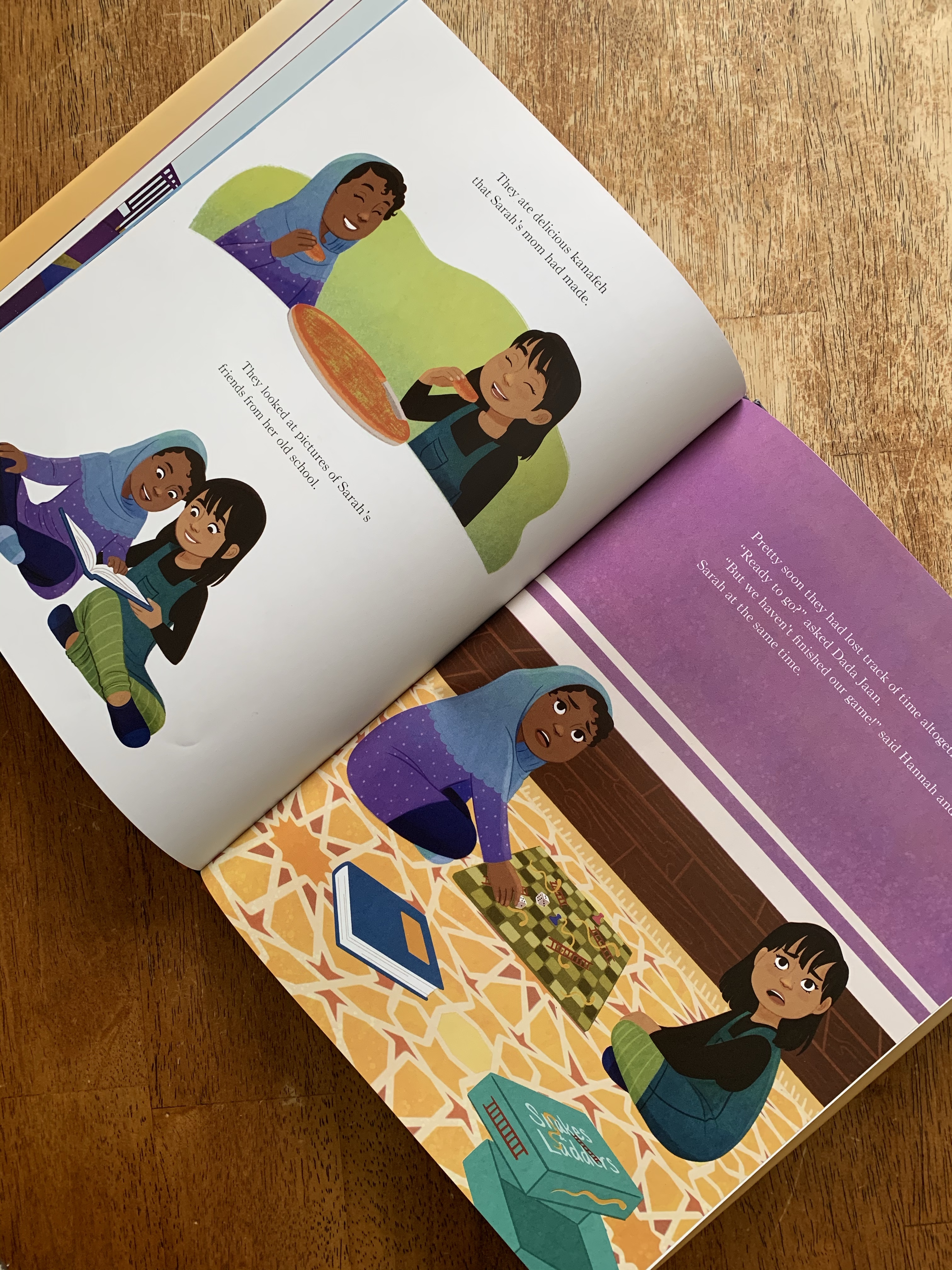
Twenty days in to Ramadan, Hannah has a play date with a girl she has never met before and Hannah does not want to go.  Sarah is new to the neighborhood and Hannah’s mom insists she goes.  Luckily Dada Jaan strikes up a deal that he will take her and they can leave when ever she wants.  Hannah and Sarah have so much fun together, Hannah doesn’t want to leave.

img_0282

When they get home, Dada Jaan shows Hannah old photographs of when he and Dadi Jaan had first come and didn’t even know the language.  They talk about how the kindness of others helped them, that and Dadi’s butter chicken.  The night before Eid, Dada Jaan asks Hannah if she helped make the world a better place, she doesn’t think she did, but he seems to think otherwise.

On Eid day they go to the mosque, then to the cemetery to pay respect to Dadi Jaan, and when they return home they find Hannah’s whole world there to celebrate with her.  Cousins, friends Maria and Dani from the church across the street and the synagog by the mosque, as well as the Sikh family that runs the soup kitchen.  Dada Jaan and Hannah enjoy gulab jamun, kheer, and jalebis as they discuss if Hannah really did help the world this Ramadan.

img_0280

It is hard in my heart to go wrong with a story that focuses on an amazing grandfather/granddaughter relationship that ends with them racing to get the last gulab jamun, so I might be a little bias.  But I was genuinely surprised and delighted by the direction the book took and the way it presented Ramadan in everyday situations that children can relate to and imitate. I was a little disappointed that the book wasn’t larger considering the phenomenal illustrations.  It is just 8.5 x 11.  I love that the characters pray and read Quran, and the mom covers and the neighbors are diverse.