Author Archives: islamicschoollibrarian

They Called Me a Lioness: A Palestinian Girl’s Fight for Freedom by Ahed Tamimi and Dena Takruri

Standard
They Called Me a Lioness: A Palestinian Girl’s Fight for Freedom by Ahed Tamimi and Dena Takruri

lioness

The writing style makes this book easy reading, but the content contained is absolutely horrific, heart breaking, and hard to truly comprehend.  If this was fiction it would be overkill, barbaric, cruel; the fact that it is factual, current, and ongoing is inexcusable.  There is no humanely possible way that we can still be ignorant or apathetic to the plight of the Palestinians.  It is an occupation.  It is apartheid.  It is oppression.  I often don’t review adult non fiction, but because this is ongoing and we have the power to do something, BDS, I’m reviewing this book.  The book describes torture, death, abuse, cruelty, you name it, but I think mature young adult readers can and should read it, along with every adult. A history of major events in Palestine interwoven with Ahed Tamimi’s own experiences in the last few years, she was 16 when imprisoned, so the recent past, as lived by her and understood by her, is powerful, moving, and inspiring.

SYNOPSIS:

The book shares a lot of facts, but because the facts are contextualized you feel yourself absorbed by what it means to have your land taken, your home bulldozed.  It isn’t just statistics of growing settlements, it is being cutoff from the Mediterranean Sea that you can see from the hills in your village, but cannot access because of checkpoints and armed guards, and walls.  It is understanding why throwing a rock, or slapping and kicking are a form of defiance, not terrorism.  It is truly seeing the situation from someone living it every day.  There is nothing for me to critique or opine about in her story, nor in the book and presentation. It is hard to read, it is harder yet to know that it still persists.

WHY I LIKE IT:

I love that I sobbed and clenched my fist and Googled again what companies and organizations to Boycott, Divest and Sanction (BDS).  That is what the book is asking those of us who support the Palestinian cause to do.  She says they don’t want our pity, they want our action.  They want us to look at South Africa and realize the power of economic efforts by the global community on an issue. They want us to be educated about what they endure and educate others.  They want us to help stop the erasure of Palestine and Palestinians.  I’m so grateful that the book pointed out the direction we should take, a bleeding heart is not enough.

I love that Ahed owns her own learning and growth as she got to know Israeli Jews sympathetic to the right of Palestinians, that protested with her and her village, that fought the legal battles using their privilege to help the oppressed. I love that the book is personal and that she doesn’t apologies, that she addresses the criticisms against her, that she calls on her own people to unify, and that she is so so fierce. 

I can’t imagine what her life is like, and it is truly humbling to imagine yourself in her shoes, in her mother’s shoes, her father’s.  It isn’t a life anyone would chose, it isn’t a spotlight you would want.  No parent would willingly push their child to this, so that she at such a young age had to endure and become what she is today, is humbling.   

Islam is not a big part of the book, but Ramadan, and jummah prayers, janaza and praying salat are occasionally included.  

FLAGS:

Death, fear, torture, killing, murder, oppression, loss, hate, racism, everything you can imagine and then some.  There is also mention of two men having sex and a man stripping, while on prison to court transport.

TOOLS FOR LEADING THE DISCUSSION:

I would love to attend a book club or panel discussion by Palestinians in the community using the book as a starting point for telling their own stories.  I think a high school book club could handle the book, but nothing younger than that. Please purchase a book, check it out from your library, request your library to shelve it, and spread the word about this memoir that is both personal and informative.


My First Book About Salah: Teachings for Toddlers and Young Children by Sara Khan illustrated by Ali Lodge

Standard
My First Book About Salah: Teachings for Toddlers and Young Children by Sara Khan illustrated by Ali Lodge

img_3719

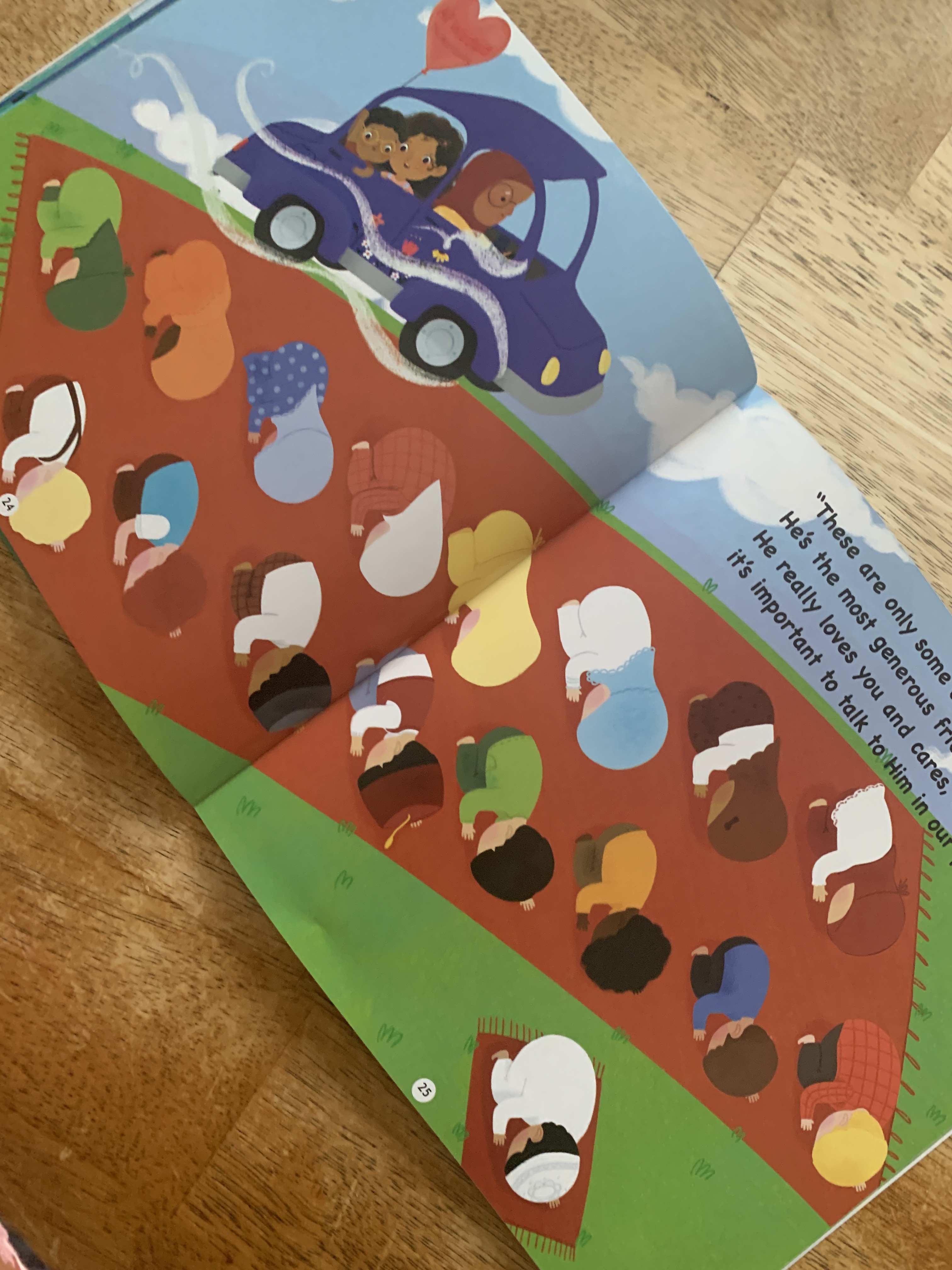
Looking at the books in the series, reading them to my children, getting the latest one delivered to my doorstep: every step along the way makes me smile, alhumdulillah.  The soft warm illustrations and impressive amount of information lovingly conveyed in board book form really makes the series a staple for young children.  The newest addition to the series is about Salah, and I love that the framing is that prayer is a blessing, it doesn’t open with listing the five daily prayers, it begins with Isra wal Miraj.  It sets the tone that prayer is special and beautiful and a gift.  It does eventually list the five required prayers, the words of the athan, Fatiha in English and Arabic, steps of wudu, and parts of salah, but the way it is woven together is seamless and so much more than just lists of information.  With ayats from the Quran sprinkled in, the book flows from one focus to the next, leaving the end as always, for facts and questions.  Appropriate for ages two and up, this 26 page board book can and will still inspire and teach older kids.

The only pause this book gave me were the illustrations.  There is not a single page where the people praying are standing shoulder to shoulder, foot to foot.  I could see if in a few pictures the creative liberty, or Covid reality manifest itself in the pictures, but whether it is a family praying, or people in a masjid, there is a gap between the individuals, and that seemed off to me.  Additionally because of the spacing in all the pictures, the pictures where perhaps the people are not praying together, but are just shown to be making tasleem or the illustration that all Muslims of all colors and all professions and all abilities pray, it almost seems to show men and women praying together.  I don’t know that the toddlers in the audience will notice, but perhaps be aware of it if when reading it to your children.  Aside from that the illustrations show the global faith of Islam and the beauty that we all worship together.

Available to purchase here and I’m sure it will be stocked by Crescent Moon as well.  Oh PS it also comes with a sheet of stickers.

We are All We Have by Marina Budhos

Standard
We are All We Have by Marina Budhos

all we have

In many ways this book reads like a reboot of the author’s 2007 book Ask Me No Questions, there are sprinkled in references to Islamic culture, but nothing about the characters or the author truly show the book to be a Muslim story, or Islam centered.   Much like Ask Me No Questions, the book is told through a female protagonist who is forced to figure out why a parent is detained, what to do now that they are on their own with a sibling, and figuring out why they are being forced to leave America if they are not undocumented, but asylum seekers.  And much like that book, the protagonist is really whiney, entitled, and annoying, as is the mother.  This 256 page middle school/young YA read draws drama from the 2019 Muslim ban and ICE raids, but is more a character based plot than a political focused telling.  Because of the similarities to the earlier published book, and the lack of Islam in the text, and being unclear regarding the faith of the author, I’m just going to write a quick review and move on. The book is a quick read it has flashbacks to Pakistan and in those scenes mentions mosques, Eid, and Ramadan in passing. A few cultural side characters mutter an inshaAllah on occasion and there is a clear #muslimintheillustrations like side character that is remarked to wear a scarf on her head named Amirah, but is barely in the story.  Worth being aware of for younger readers is romance, kissing, making out, between Rania and Carlos, and *SPOILER* that the mother left her husband for another man years earlier.

SYNOPSIS:

Rania is weeks away from high school graduation when an ICE raid casts a wide net and picks up her mother as collateral.  Rania has always known they check in regularly to appeal their status, but with her journalist father killed years earlier in Pakistan, the family fled to America for safety, Kamal was even born in America, it has never been a concern.  As her mother gets taken away, Rania starts to wonder about the secrets her mother has always kept and the truth starts to unravel.  In the process though, protective services takes her and her brother to a shelter where they meet Carlos and escape.  Once on the run, they attend Rania’s graduation, spend months on Cape Cod, gain protection from a congregation at a synagogue all while trying to piece together Rania’s truth.

WHY I LIKE IT:

I like that it touches on the Muslim Ban and the fear that gripped the nation for anyone in the process of being a citizen or trying to travel to the flagged countries.  I wish it would have actually spent a bit more time on that.  The title of the book makes it sound like the family is completely alone and isolated, yet, they are constantly surrounded by people that are looking out for them and sympathetic in their choice not to ask too many questions.  I struggled with liking Rania, when you write a book about people that may or may not have broken a law, regardless of if you agree with the law or not, you really have to make it compelling. You have to get behind the character and their motives, and I never did.  I did not understand why she for example finally finds her uncle or an aunt and doesn’t demand answers, it is like, I’m tired, I’ll nap and we will talk later, no, not believable.  Additionally, I could not get a feel for the younger brother, I get that he is sheltered, but he reads like he is four years old, not that he is in second grade at best, I think he might be in fourth.  Really all over the place.  And the Rania and Carlos relationship, should have stayed awkward.  They at times are like siblings, and when the line is crossed, Carlos even remarks on it, and I think having it be weird, but clear that they have a bond, would have been a much stronger choice.  A lot of the plot holes make the story drag such as what was the problems at the bank for the uncle, but because it is short, I think older readers will get through it. I don’t think I’d suggest anyone read the book, but it isn’t so awful that I would warn too harshly against it.   The characters don’t identify or act Muslim, so when they kiss or lie, it isn’t a reflection on the religion.

FLAGS:

Kissing, lying, running away, making-out. Muslim friend sneaking out, drinking, partying, stereotypical oppressive Muslim dad and meek mom.

TOOLS FOR LEADING THE DISCUSSION:

I don’t know that I would throw the book out, but I wouldn’t actively seek to acquire it to shelve either.

The Moon from Dehradun: A Story of Partition by Shirin Shamsi illustrated by Tarun Lak

Standard
The Moon from Dehradun: A Story of Partition by Shirin Shamsi illustrated by Tarun Lak

partition

I’ve read this book numerous times: sometimes for the text, sometimes for the tone, sometimes to slowly immerse myself in the pictures. I know the basics of my own family’s journey to Pakistan, and this book added to that understanding. I like that it forced me to slow down and to really appreciate what partition was for both sides, from a child’s perspective. Pakistan and India gained freedom from British rule 75 years ago. Nearly every Pakistani or Indian you know today, has a parent or grandparent that lived through it. It is not history from long ago, it is still very much with us, and no I’m not talking about the lingering effects of colonization, I’m talking family stories, and loss of property and wealth, memories of the journey, the terror, the fear, the relief, the determination. This book is one story, perhaps the first mainstream published in the west, of one family’s experience. There could be a thousand more books and they would all be different, all powerful, all reflective. I love that this book is Pakistani authored, Indian illustrated, I love that it offers pages with no words at all. I love that a child’s perspective for such a monumental event is told for other children. There is a lot there for desi readers to unpack, and consider, there is also a lot there for non desi’s to be made aware of, and I hope that you will seek out this book no matter who you are, and share it.

img_3563

The book starts with excitement from Azra about an upcoming train ride, even though her family has lived in Dehradun, at the base of the Himalayas, for generations. Suddenly though there is yelling outside because people are afraid, and her Abba runs in saying they have to leave now. Ammi, Abba, Azra, and the baby “Chotu,” rush out the door, leaving the cooking dinner still on the stove. When they get to the train, Azra realizes she has left her beloved doll, Gurya behind. They cannot go back for her.

img_3564

Azra blames Chotu, for making her forget her doll, for taking her parent’s attention, yet as the days and nights on the train reveal tired people, sad faces, and fear, Azra finds comfort in her little brother’s embrace.

img_3568

When they arrive in Lahore, they are met with food, and shelter. They are given a house that looks like the owners left in the same manner that they had to flee. There are balls of dough with a rolling pin, laundry strewn about, and even a doll left abandoned under a bed.

img_3565

The book concludes with a map, a glossary, and an informative author’s note addressing pre-partition, partition, and the author’s own family story. There is hardship and frantic upheaval, but peace and welcome too. The illustrations illuminate the text and show the powerful emotion when words sometime simply don’t exist.

img_3566

The book is not political or even religious. There is an Indian flag when they leave and a Pakistani flag when they enter, there are sounds of athan, and packing of a rehl, and a comparison to Eid, and the doll at the end has a bindi on her forehead. The book does not make one side out to be in the right or in the wrong, if you do not know that partition of the subcontinent was a mass migration based on religion and the chaos further exacerbated by the British, this book will not spell it out for you.

img_3567

I preordered mine here and it can now be purchased from all major book sellers.

Ida in the Middle by Nora Lester Murad

Standard
Ida in the Middle by Nora Lester Murad

ida-in-the-middle-9781623718060_lg

Ideal for middle school readers (upper mg/lower ya), this magical realism book takes readers from middle school in American to a Palestinian village outside of Jerusalem through the consumption of some magical olives.  Written by a Jewish author married to a Palestinian Muslim who raised their three daughters in Palestine, the book features a lot of Islam, but is Palestinian centered in its insight, critique, culture, and dreams.  Over 224 pages, Ida starts to find where she fits in both in understanding her self within her family, her place in America, her passion in life, and what it means to be Palestinian.  The story is important, and is told in a way that will encourage readers to learn more about the occupation.  Nuances are shown in characters and groups, but the line that the occupation is oppressive is never compromised.  I appreciate that the author writes from her own experiences and openly acknowledges that she is not trying to take away from Palestinian born and raised OWN voice stories, but she is an advocate, she has raised her children and lived in the West Bank, and her characters reflect a sense of intimate knowledge, love, and appreciation.  Even with Ida having to decide to stay in America or Palestine, the two countries are not pitted against each other or seen as black or white, as to which is better or worse, the middle is where much of the story takes place, and appreciating your culture no matter how much others are trying to erase your existence, is always stressed.

SYNOPSIS:

Ida is the middle child of her Palestinian immigrant family and isn’t artistic like her younger sister, a ballet dancer like her older sister, or a soccer player like her father.  She wishes she was invisible.  Especially when her classmates turn on her every time there are conflicts in the middle east.  When it seems that everyone wants to diminish her heritage, she finds herself at a new school, unsure of where she fits in.  With anti Palestinian attitudes and Islamophobic people, Ida just wants to go unnoticed, unfortunately middle school requires a passion project to be presented and Ida has no idea what her passions are, and how she will face the crowds.

One day when looking for a snack she finds a jar of olives stuffed in a cupboard- olives brought by a family friend from her now deceased aunt in Busala, one bite and she is magically transported to the familial village.  It is an alternate reality of what life would be if her parents never came to America.  Not only is she in a country she has never seen before, meeting family members she has never met before, but even her own parents and sisters are somehow different.  She enjoys the warmth, the communal activities, the extended family.  Her mom in hijab, the athan being heard, the men all going for jummah, but then they sit down for a meal and the same olives are served and Ida accidently takes a bite and is whisked back home.

Once home, she longs for so much of Palestinian life, but relishes in the convenience and ease of America as well.  Her passion project still looms and she finds herself hoping to escape it by going back to Palestine.  When she finds herself back near Jerusalem she ventures out with her Aunt, who isn’t dead in this reality, and learns more about the occupation and oppression, and how the families interact with the various Israelis: some sympathetic to Palestinians, some actively working to help Palestinians, and some settlers- forcefully killing and bulldozing Palestinian homes.

When Israeli military troops enter their village, the families meet to discuss the best course of action, the families do not agree, there is no clear way to prepare, there is no guarantee of survival.  Ida starts to find her voice, and when the soldiers enter, Ida finds herself rushing out to help a small boy. Guns, demolition, rocks, tear gas, fear, so much fear, what can one person do? What can one village do?  What will Ida do?

WHY I LIKE IT:

The book is relatable and moving, not just for those with a tie or interest in Palestine.  It is a coming of age story that shows a girl grappling with forces so much bigger than herself, while at the same time dealing with homework and friends and stereotypes.  Ida has a lot to figure out and the book doesn’t sugar coat a happy ending, it simply provides a moving story based on reality, through a character whose quirks and personality you find yourself rooting for.

I love the presence of Islam and the way it is apart of Ida and her surroundings, even though she makes it clear early on that her family is not religious.  The Quran is mentioned, the athan, various salat, hijab, Hajj, Ayatul Kursi, Ramadan, Eid, wasting food as being haram.  In Boston her friend knows she doesn’t eat pork, she went to Sunday school to learn Arabic at the mosque when she was younger.  It doesn’t gush with Islam, but it is present, for example Ida’s sister and her joke about a good Palestinian girl shouldn’t have a boyfriend, it isn’t tied to their religion. The story is a Palestinian one, and as someone who is not Palestinian, the images, the foods, the smells, the love all seemed to embrace everything I’ve ever heard Palestinian friends talk about, and it feels like a warm hug to read the effects being in Palestine has on Ida.

I love that the author is upfront about her perspective, and I love that she is putting this story out there.  The writing is sufficient: I was invested in the story, and it was an easy read. I don’t know that I’ll remember it months from now for it’s imagery or power, but I’m certain I’ll remember the commentary about life under occupation and the struggle to not be erased by a world that doesn’t seem to care about the settlers still taking Palestinian homes and their way of life away by force.

FLAGS:

Fear, crushes, death, injuries, loss, magic, bullying, racism, Islamophobia, guns, physical assault, threat of force, destruction.

TOOLS FOR LEADING THE DISCUSSION:

Our school is majority Palestinian.  Years ago when we read Where the Streets Had a Name, I learned so much about the students, their families, their own experience living under oppression, that I can’t wait to present this book with the middle schoolers and take notes on their thoughts.  I would not lead the discussion, I would let them, their voices will not be erased by me.

Preorder available here: Amazon

Dear Black Child by Rahma Rodaah illustrated by Lydia Mba

Standard
Dear Black Child by Rahma Rodaah illustrated by Lydia Mba

dear black child

This beautiful 32-page picture book by Muslim author Rahma Rodaah radiates joy through the text and illustrations.  The powerful and lyrical words on the page inspire confidence to take up space and encourage celebration through their messaging and tone.  My three-year-old enjoyed me reading it aloud, it kept his focus and his interest, and my seven-year-old read it over my shoulder and then numerous time on his own.  The sway and images painted by the text are so well refined that you could truly read this book a dozen times and still be moved by the passages.  The illustrations compliment the author’s message in their reflection of Black children of all shapes, sizes, shades, and mobility.  There is even a visibly Muslim woman in hijab (#muslimintheillustration) that looks like the author herself.

img_3431

I look forward to sharing this book with various story times in the community, in my children’s classes, and in regular rotation at my own home.  Framed as a letter to a beautiful Black child, the book speaks to “you.”  It starts with encouraging you to stand in your own light, take up space, say your name proudly, and proclaim your native tongue.

img_3430

It inspires the Black child to speak confidently, roam freely, to be rooted, yet move swiftly. To write the books and tell the stories that only they can tell, and to trust their inner compass.  It also reassures them that they are not alone, that there are those that will always help, always cheer them on, and remind them of their glory.

img_3432

The book is as powerful as it is beautiful and I hope it finds a home on every classroom, library, and home bookshelf.  I purchased mine here.

img_3434

Freestyle: A Graphic Novel by Gale Galligan

Standard
Freestyle: A Graphic Novel by Gale Galligan

img_3208

I one hundred percent understand that Muslims are not a monolith, but, I’m truly tempted to reach out to the author/illustrator of this upcoming 272 page middle grade graphic novel and ask her why she chose to have the female instigator in this coming of age story- that focuses on a dance crew, said girl tutoring a boy one-on-one in his bedroom, Halloween and a school dance, wear hijab? Yes there is also parental expectations, friend drama, leaving for high school stresses, and yo-yoing, but Sunna Ahmad being presented as a Muslim definitely gives me pause.  There is no romance in the book save a few background characters filling in frames holding hands, and it never articulates that Sunna or her older brother Imran are Muslim, but she doesn’t wear hijab when home with her family, does wear it when she goes out, so it definitely seems to imply it.  The cover and inside pages are bright and clear, and I think the book will be very tempting for young Muslim readers with the visible hijabi on the front.  Additionally the book is published by Scholastic, so if you are a parent whose kids get book order forms and attends a school where the Scholastic Book Fair is a big deal, you might want to read the entire review to see if it is Islamic representation that you are comfortable with supporting.

SYNOPSIS:

The Eight Bitz B Boy band is in their final year of middle school before they all go in separate directions for high school.  They want to win this year’s competition, or at least the leader of the crew, Tess, does.  Tess doesn’t want them freestyling and messing around, she wants the choreography and dancing in-synch and on-point.  Her military dictatorship is tearing the crew a part.  When Cory’s grades are not where his parents want them, he is grounded from dancing and forced to work with a tutor, Sunna Ahmad.  Sunna is weird, always writing intently in a secret notebook at school, and Cory wants nothing to do with her.  When he happens to see her throwing her yo-yo at school, though, he is impressed.  Reluctantly she trades teaching him yo-yo tricks if he agrees to do the work needed to get his grades up. Using yo-yo angles to teach geometry, it doesn’t take long before the two are friends.  It comes to a culmination when he invites her to the Halloween dance and his crew is both shocked and mad that he is hanging out with her, when he should be practicing with them.  As secrets and intentions come out, Cory has to make things right with his parents, his crew, Sunna, and himself.

WHY I LIKE IT:
I love graphic novels, they show context and setting and emotion, that often can’t be conveyed as well with words.  I absolutely love that Sunna wears different clothes on different days, from the hijab to the outfit, she has personality in her clothes as any middle schooler would, and nothing is mentioned about her hijab or her long sleeves, but the reader see’s it hopefully in a positive light. I do like the detail of her not covering at home when she is alone, or in the flashbacks when she is younger.

The story overall is decent and the added hip hop dancing and yo-yo infused details set the story apart, but some of the character building and plot points are a little rough.  When Sunna first starts tutoring Cory she feels like an adult disciplining, and reprimanding him.  She comes across as really arrogant and condescending, that he is somehow beneath her, yet they are the same age, in the same school, and are lab partners.  It reads off for no reason.

Similarly, I understand that the tension between middle schoolers and parents can be a source of contention, but the forced apology from Cory’s parents is incredible demeaning and cringe.  Sure flesh out that he shouldn’t yell at his parents, (Sunna shouldn’t either for that matter), but while the delivery was poor, the message was heartfelt and I think a book like this encouraging young kids to talk to their parents would be a great message, rather than have it almost glorified to not make the effort at all.  Not saying that the effort will always be received, but the forced apology would turn even kids with a good relationship with their parents questioning if it is worth talking to their mom and dad.

Poor communication and the stress it causes is a theme of the book, and I don’t understand why Tess keeps her choreography dreams a secret from the crew.  It seems underdeveloped, had she said that, that was the motivation, I think all the other seven members would have stepped up, not walked away.

FLAGS:

Music, dancing, girl and boys being alone with each other, girls and boys arms around each other, attending a school dance, girls and boys dancing together, Halloween being celebrated, birthday being celebrated, yelling back at parents, lying, secrets.

TOOLS FOR LEADING THE DISCUSSION:

In all honesty, I would probably not have this book on the library shelves, and would not display it during the book fair.  It normalizes a lot of gray if not haram actions for a very impressionable demographic because the character is visibly Muslim.  If the character was not visibly Muslim, I actually might be ok with shelving it and selling it.  The rep may be intended to show inclusion, but the character does not show actions that Islamically are appropriate.  If it were one or two actions, I might reconsider, but it is a lot very specific and varied activities.

freestyle3

The Girl Who Lost a Leopard by Nizrani Farook

Standard
The Girl Who Lost a Leopard by Nizrani Farook

leopard

This stand alone middle grade read by Muslim author Nizrana Farook is similar to her first two books about an elephant and a whale in that it is set in Serendib a long time ago and revolves around a beautiful wild animal and clever, endearing, determined young children. This actual story is an easy read at 203 pages (the end of the book is the first four chapters of one of her previously published books).  I think seven and eight year olds will enjoy getting to know Selvi and the beautiful leopard Lakka that she considers a friend.  For me the ending took an odd turn that seemed out of place, but up until then I was enchanted by the lush imagery, sheer determination, and sweet friendship shared within the pages.  The main character is not Muslim, but presumably some of the side characters are with names such as, Amir and Salma.

SYNOPSIS:
Selvi and her mother live in a small home on the mountain.  Most days she runs wild with a golden leopard she has named Lakka.  She keeps her distance, but there is a pattern to their interactions, and when Selvi’s mother finally allows her to go to school, and she finds the other children unkind, Lakka becomes her only friend.  One day poachers are on the mountain hunting not just any leopards, which are protected by the queen, but the rare golden one that is often seen in the area, Selvi tries to interfere.  And before she knows it, they are after her.  She hides near a home, and when the poacher’s come looking for her, she is at the mercy of Amir to lie and say he hasn’t seen her.  Amir is a classmate, a mean one, but he has seen her before with the leopard, and suddenly Lakka is not so alone.

Between making friends at school, battling her uncle’s rules to start behaving more ladylike, and keeping a leopard safe, the adventure is fast paced and the story entertaining.

WHY I LIKE IT:

I love kids outsmarting adults and saving the day, it makes for good story telling.  I don’t want to spoil the ending, but I really felt like it was forced.  I truly do not understand why the children needed to take a drugged Lakka to the port and back.  Why not leave him with the new friends and go to the port without him? He is a wild animal, we have been given reasoning for so much of the human animal interactions to be believable, that this seems to be negligent.  So much could have gone wrong and for what? There was no need.  The kids wanting to see punishment handed out is motivation enough for them to make the journey in my opinion.  Sigh, I don’t know that younger kids will be as bothered as I am, but I think fourth graders and up will definitely question it and be confused.  I also don’t know that I have ever seen the sneak peak of another book included at the end, being for a book previously published.  Aren’t they usually for upcoming releases? Either way, it seemed to make the last portion of the book deflate a bit for a story that was engaging, entertaining, and hard to put down until then.

FLAGS:

Lying, poaching, abuse, threats, killing, animal cruelty, bullying.

TOOLS FOR LEADING THE DISCUSSION:

This would be a fun read aloud in a classroom or at bedtime.  The short chapters have little illustrations above the headings that hint at what is to come, and the writing style is perfect for short blocks of time.

The book is available on Amazon

Mr. Grizzley’s Class: Rahma’s Gift by Bryan Patrick Avery illustrated by Arief Putra

Standard
Mr. Grizzley’s Class: Rahma’s Gift by Bryan Patrick Avery illustrated by Arief Putra

rahma

This 32 page early reader is part of Mr. Grizzley’s class, a series that sets out to help promote social and emotional skills in real life settings for ages five to seven.  The diverse class is featured in all the books with one student being the focus of each individual book.  This book highlights Rahma, a visibly Muslim girl of color, who has a gift of helping others with their problems.  The richly illustrated story shows what happens when she is having troubles with a friend, and what Mr. Grizzley and fellow classmates can do to help her find a solution.  I like the premise, I like the focus, I like the illustrations, but I did not understand the messaging.  I don’t understand why Rahma had to own the entire apology.  Sure, friendship is more important than a small misunderstanding and moving on by saying your sorry, even when it isn’t all your fault, has merit- but the book doesn’t take all that in to consideration.  It has Rahma taking responsibility for Madison not talking to her, Madison misinterpreting something Rahma did and getting jealous, and Rahma owning all the lacking communication, when clearly both of them failed to do so.  I found myself confused reading the book the first time, clearly I must have missed something, right? No.  And now writing this, I’m actually quite upset.  So, while the idea of the book and series might be sweet, I don’t feel like this particular book was well executed.  I have not read any others in the series, and thankfully checked this out from the library.  There is nothing particularly Islamic or religious in the book other than the hijab Rahma wears.

img_3111

The book starts out with Rahma nearly late for class because she was helping other kids resolve an argument.  It is a gift of Rahma’s to help others work out their problems.  When she tries to tell her best friend Madison about it, Madison doesn’t respond.  When Rahma tries again, Madison says, “I’m not speaking to you.”

img_3112

As a result when they pair up for math, Rahma works with Annie.  She tells Annie she isn’t working with Madison because she is mad at Madison for not speaking with her. Annie prods a bit and Rahma says, “I’m not talking to her if she won’t talk to me.”  Annie encourages Rahma to find out what is wrong.

Mr. Grizzley is then told, and he also tells her to find a way to find out why she is mad. At recess, Chad comes to thank Rahma for helping him and Ashok, and when she tells him her problem he gives her, her advice back, “listen to the other person.”

img_3113

Rahma definitely is in a pickle since Madison won’t talk to her, but with incredible maturity she tells Madison she doesn’t know what she did to make her angry, but she is sorry that she feels bad.  Madison caves and tells her she is jealous because Rahma made a necklace for Semira and she understood it to mean that because she didn’t make one for her, she didn’t want to be her best friend any more.  Semira and Rahma explain that Semira’s dog was sick and she was sad, so Rahma made it for Semira to cheer her up. The girls hug and all is well.

img_3114

The book concludes with directions on how to write an apology letter, a glossary, questions to talk about, and prompts to write about.

I loved Rahma’s phrasing of her verbal apology and wish that would have been the focus of the book: how to take someone’s feelings in to account even if you don’t know how you contributed or even if you feel you did not do something wrong.  As it is written with the two page spread at the end on how to write an apology note though, I feel like Rahma took on a lot of the blame unnecessarily.  I know I’m reading in to it a lot, but I don’t like the vibes that the book gives.  Madison in my opinion was in the wrong multiple times throughout, and Rahma each time took ownership and worked through it.  Yes, truly that is a gift, but I really hope people don’t take advantage of Rahma in the future.

img_3115

The Kaya Girl by Mamle Wolo

Standard
The Kaya Girl by Mamle Wolo

This sweet middle grades book about two girls in Ghana is a friendship story and a rags to riches gem.  The 336 pages immerse you in a rich and vibrant culture and share a story that while at times simplistic, really pulls you in and makes the over the top happy ending, tearful and joyful.  I read the entire book in one setting and loved that there was no glossary, or white pandering; the story works in the explanations and details for those unfamiliar with West African cultures to share a story about classism, friendship, growing up, and challenging stereotypes.  I loved while so much was new to me and culture specific, so much, at the same time, was universal and relatable to all.  The story is OWN voice, the main character is a wealthy girl,  but the friend is a poor Muslim one.  I am not sure where the religious representation ended and the cultural practices started, but the book does not criticize any culture or traditions, it only criticizes the mindset that one is superior to another because of where they are from.  I also don’t know that the Muslim character will mirror global Muslim experiences, but having the character identify as Muslim and be such a wise and determined friend, makes her a great character to cheer on and love no matter the reader’s background.  This would be a great book to teach, to shelve, to read aloud, and to discuss.

SYNOPSIS:

Fourteen year old Abena is spending her summer with her aunt in Makola market while her mother has traveled to London to give birth.  Abena’s father is a physician and her friends are part of the wealthy and privileged class that attends American schools, vacations abroad, lives in mansions with servants, and have the latest phones.  In a bit of a culture shock spending the weekdays with her aunt at the bustling market, Abena starts to see her country and its people in a different light. One day while getting out of her aunt’s car she makes eye contact with a kayayoo, a porter who carries customers purchases on their head.  She snaps a picture of the girl who appears about her age wearing an orange scarf, as she secretly is working on a journalism competition, and something about the girl intrigues her.  The two smile and carry on.  Later when they meet again they realize they do not share any common languages, they both speak a number of dialects and languages, yet somehow the girls connect.  Day after day they sneak away to have lunch together and learn about one another as they learn each other’s language, culture, history, and dreams.  Faiza opens Abena’s eyes to so much about Ghana that she had never known existed and Abena teaches Faiza English, science, shows her the internet and gives her the foundation for how to read and write.  Abena’s aunty does not approve of their friendship: stereotypes and assumptions about poor Muslims from the North prevent her from treating Faiza as an equal.  Yet, she doesn’t forbid the friendship either.  As the girls’ friendship grows, summer vacation comes to an end and goodbyes will have to be made.  Things get expediated though, in a climax of misunderstandings, regrets, and friendships separated by class and religion.

WHY I LIKE IT:

I love that right before Abena sneaks Faiza on to the laptop to Google dinosaurs, and the solar system, and cities in Ghana and maps, I was Googling images of geles, okro and Makola market, maps to see where Hausa and Dagomba regions are, and enjoying learning about people because it is so enriching whether fictional or in real life.

I love that there isn’t judgement by either girl on trying to understand why children are given to aunts to raise or why women are forced to marry.  It shows so much without othering any facet of sub culture within Ghana or anywhere for that matter.  Abena’s cousins aren’t put down for being wealthy, or Faiza for being poor.  Even the Haji looking for a fourth wife is not favorable because he is old and has brown stained teeth, not because there is judgement upon him having more than one wife or the family wanting their daughter to marry him.

I often remark that I like middle grade books that don’t tie everything up in a neat and tidy bow, but this book went the other extreme and tied everything up far in to the future, that I ended up loving the extreme nature of it as the tears of joy dripped off my cheeks.  If you are going to do it, do it for a reason, and this book did it to great effect.

Faiza is Muslim she wears hijab and stops Abena from taking it off at one point, but then at the end she has braids hanging out from underneath her scarf.  There are crushes and hugging between Faiza and males and an implied potential romantic relationship between Faiza and a non Muslim male that is never given pause.  A character goes for hajj, it mentions a space that Faiza uses for prayer, and it mentions Faiza’s Muslim family members getting drunk.  Nothing more than these details are given about being Muslim, other than her being labeled as a Muslim and identifying as one.

FLAGS:

Theft, crushes, lying, classism, racism, running away, drinking beer, getting drunk, forced marriage.

TOOLS FOR LEADING THE DISCUSSION:

I think that the book would lend itself very easy toward discussion and appreciating a people and culture that for many in the west would be new and unfamiliar.  I think outside research to supplement would be a natural extension and that the characters, their voices, their lives, and experiences, will stay with readers of all ages as we can rest easy knowing that they got their happy endings.