Tag Archives: Picture book

Hamza’s Pyjama Promise by Marzieh Abbas

Standard
Hamza’s Pyjama Promise by Marzieh Abbas

hamza

When I flipped through the book standing on my porch as the delivery truck drove away, I groaned a little internally at the simple illustrations, terrible font, large amount of text on each page, and the four fingered boy at the center of it all.  Alhumdulillah, I gave it a chance and ended up really liking it.  The book stayed with me, then I read it to my kids and it stayed with them.  Then I mentally made a checklist of all the teachable ways this book could be used in an Islamic school classroom, story time presentation, bedtime reading, and even just as a regular reference point.  This Islamic fiction book packs a lot of information in while connecting to religious concepts kids are most likely familiar with and silly points that will make five to eight year olds giggle.

img_2180

The book opens with verse 65 from Surah Yasin in English meaning of the translation and the Quranic Arabic.  The story then begins with it being bedtime for young Hamza and him running up the stairs to put on his rocket pyjamas.

img_2181

When he brushes his teeth he looks in the mirror and finds notes hanging all over addressed to him.  The first letter he reads is from his hands reminding him to wash them before he does anything and reminds him Prophet Muhammad (SAW) “said the best Muslim is the one who doesn’t harm others with his hands or tongue.”  It then mentions that the left hand doesn’t like carrying weight so use your body to ensure you get your book of deeds on the Day of Judgement in your right hand.

img_2182

The book continues with eyes, ears, tongue, nose, and feet writing messages urging Hamza to cover his eyes when something inappropriate pops up on the screen, or protecting his ears from listening in on other people’s conversations.  Every point of how to act is connected to an ayat in the Quran or Hadith of Rasullallah.

img_2183

After reading the letters, Hamza makes wudhu, says a dua before bed which is shared in English, promises to take care of the body Allah swt has blessed him with and then asks the readers what their pyjama promise is.

The book concludes with pictures and captions of Hamza’s bedtime routine of brushing his teeth, reflecting on his day, making wudhu, reciting tasbih (SubhanAllah 33 times, Alhumdulillah 33 times, and Allahu Akbar 34 times), reciting Ayat ul Kursi, and sleeping on  your right side.

img_2184

There are no sources in the book, but most seems “general knowledge” so to speak.  And for as preachy as the book may sound in my review, it really isn’t.  The character’s voice or rather the body parts’ voices are relatable and light.  I think young ones enjoy that they are hearing things they have probably heard before and making a connection to them being repeated in a new way.  Having your body parts talk is both silly and sobering as the target age group can imagine it happening.  It really reminds kids that their actions are seen and recorded, in a non scary or overwhelming way.

I look forward to sharing this book in library story times, masjid story times, and regularly with my own children.  The publisher is a Shia press, but I don’t think any Muslim would find anything controversial in the book (please note though I am not highly educated in these things). And while American’s may find the spelling of pyjama hard on the eyes, with the exception of that one word the book is not region specific or difficult to connect to for global readers of any age.

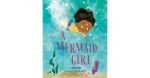
A Mermaid Girl by Sana Rafi illustrated by Olivia Aserr

Standard
A Mermaid Girl by Sana Rafi illustrated by Olivia Aserr

mermaid girl

I honestly don’t know how I feel about this book.  I have read it and reread it and thought about it and read it again, and ignored it and read it again, and alas I have no idea.  I really am having a hard time articulating my thoughts on this 40 page children’s book.  I think part of the problem is that I’m reading it shortly after reading another “religiously inclined” clothing inspired picture book for the same target demographic and I’m having a hard time not comparing them.  When I intentionally start to write a review that doesn’t compare them, I am cognizant that my readers probably will and the review spirals.  So I’m going to establish what I love about this book, and then highlight why I’m torn and leave it to you all to draw your own conclusions and opinions.  InshaAllah this will not be the new norm, I will not make a habit of straddling the fence, but for this book, I think it is the only way.

img_2174

I absolutely love the illustrations.  The warmth and joy the pictures portray are endearing and smile inducing.  I love the mother and daughter relationship and how feelings are not dismissed or belittled.  The mom connects the little girl to a legacy of strength and conveys her confidence, that the little girl is similarly brave, not just when things are hard, but especially when they are.  The little girl is shown to “feel” confident and joy in her clothing, not just “look” pretty, which is messaging that I love.  It is never too early to show that how one feels is more important than how one looks.  This depth, is not examined, but by simply using the words “When I put it on, I feel like a dainty seahorse,” rather than saying, “I look like a dainty seahorse,” the priority is not lost on the reader.  I like that the character has growth and challenges and has to reaffirm her position and as a result raises herself and those around her as well.

img_2175

So why some confusion you ask.  Well- the word burkini is used to explain the little girl’s new swimsuit.  Burkini traditionally is a Muslim implied modest swimsuit, derived from combining the words burka and bikini.  That said, anyone of any faith can order a burkini online and their faith is not a factor.  The little girl is young and doesn’t wear hijab, her hair is not covered.  The mother and the ancestors pictured wear hijab, but Islam or Muslim is never in the text.  Part of me likes this, people wear modest swimwear for a lot of reasons: comfort, religion, sun protection, personal preference.  Similarly for head coverings in a pool some people where them for hair preservation, modesty, hijab, aerodynamics, speed, preference, comfort, etc..  Unlike hijab which is in the Quran, birkini is not an “Islamic requirement.”  No one is forcing you to swim, no one is forcing you to wear this brand or that style if you choose to swim.  Covering and wearing modest clothing is a must on Muslim women, covering the awrah is required after puberty.  I both like that the little girl is covering up and wish that it said why she is, but also appreciate that it is left open.  I like that you should be able to wear whatever you want and be comfortable with it.  I like that you don’t have to conform, and you can be you and whether that comes from a religious rationale or a fashion one or a health one or a comfort one, it doesn’t matter, don’t police what women wear.  But the implied illustrated framing is Islamic and the link is not there in the text.  See why my thoughts are scattered.

img_2176

Similarly, the term “mermaid” is gender specific.  But colloquially it is often used to just describe someone with a human top half and fist tail.  So, isn’t “mermaid girl” redundant? At the end when male presenting Sam asks if he can be a Mermaid girl too is it implying gender neutrality? Is it like female kids saying they want to be a girl policeman or a lady firefighter?  Does it matter?
img_2177

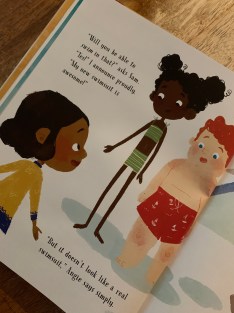
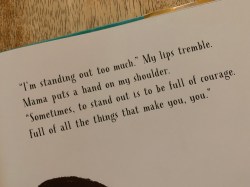
The story starts with Heba and her mother looking at photographs of past generations on their wall remarking how they are all mermaid girls.  Heba has gotten a new swimsuit, and her and mama are going to match in their new burkinis.  When they get to the pool however, all the excitement is pushed back on when her friends ask her if she can swim in that, and they tell her it doesn’t look like a real swimsuit. Heba sticks up for herself, but when she looks around, she sees, they are right, she doesn’t look like everyone else.  Mama reminds her of those before her and reassures her that she is not alone. She rejoins her friends, doing all the things she wants to do, and by the end they too want to be mermaid girls.
img_2178

There is music depicted and women in one and two piece swimsuits.  As someone who wore modest swimwear my whole life, this book had a lot of mirroring of summers arguing with life guards, showing up with other Muslims at public pools to rude comments and aggressive stares, and swimming all over the world to people asking where they could get a suit like mine as well.  Definitely normalizing swimwear that looks like a burkini is a great concept to see in a book.

I do wish there was backmatter.  Perhaps giving voice to the many reasons women should be free to wear what they want at all times, but how particularly in water activities it has become a political point of judgement and policing.  Perhaps something about how this little girl is wearing it for religion and modesty, but that people everywhere wear things for lots of reasons.  I like the ambiguity, but also wish their was more of a connection to Islam/Muslims.  I leave it to you to make your own decisions.  I found my copy at my local library, it is mainstream published and can be purchased here as well.

Salih by Inda Ahmad Zahri illustrated by Anne Ryan

Standard
Salih by Inda Ahmad Zahri illustrated by Anne Ryan

salih

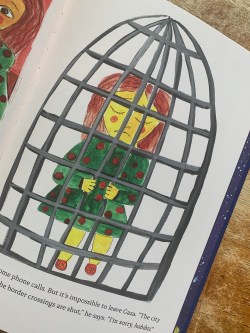
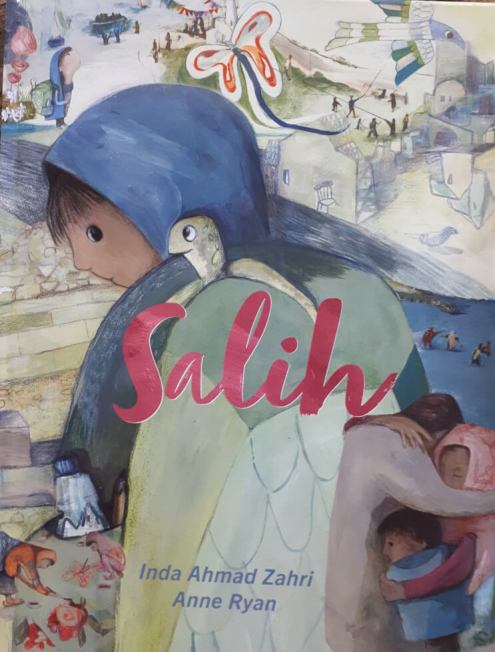
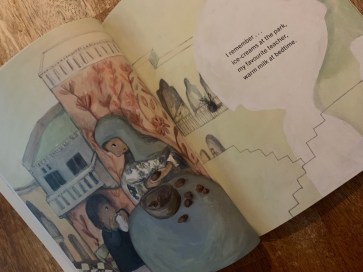
This is an example of a picture book that should not be categorized as being only for children.  The passages of short simple text and the expansive illustrations that pull the reader in, combine to set a powerfully moving tone that holds you in it’s grips until the final page.  The names and hijab clad women could make this book a refugee tale with #muslimsintheillustrations, but because the author is Muslim, and the book so beautiful, I wanted to do a full review.  Some of the vocabulary is a bit advanced for younger children, so I think the best application of this book is not to hand it to a small child to read independently, but rather to read it to a child and let the words tickle their hearts while they immerse themselves in the pictures.  I look forward to sharing this book at story time to kindergarten through third grade.  I think the imagery, concepts, and emotion will resonate and open minds and hearts.

img_2168

Salih is like a turtle, he carries his home on his back. He and others are heading to the sea.  He tries to remember when things were better, and forget the bad times.

An old man shows him how to paint.  Salih shares this creativity with others.  Then he slips all the paintings into bottles and when he is on the rough sea, the bottles float away.

The storm rages, but then it calms, and land is seen, and hopes and dreams return.

We, collectively, have become numb, apathetic even, to the plight of refugees.  I have been trying for a while to get this book from Australia, and even though I am over a year late since its publication, it is still timely.  It will always be timely.

img_2170

We cannot be so arrogant to dismiss the plights and challenges faced by those in our world.  That is why I say, yes it is a children’s book, but people of all ages, need to be reminded.  It isn’t the worst of the worst incidents that need to only be shared, or the over the top happy stories.  We need to not let our hearts grow so hard. And this gentle book, with a sweet boy and turtle shell imagery has a lot of potential to remind us of the human element of global conflict.

Available to purchase in the USA here

img_2172

Hana’s Hundreds of Hijabs by Razeena Omar Gutta illustrated by Manal Mirza 

Standard
Hana’s Hundreds of Hijabs by Razeena Omar Gutta illustrated by Manal Mirza 

img_1826

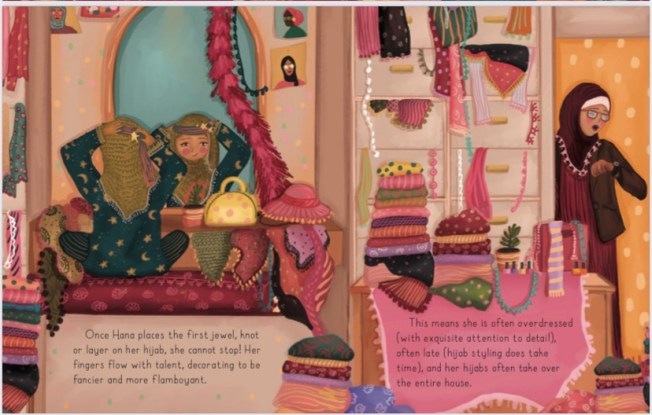
I love the idea of this book and I can see me reading it at story time to KG-2nd graders with great success. The illustrations are rich and detailed, the over the top bedazzling is fun and extra, the plot however, is non existent, surface level at best, the Islamic representation incredibly shallow, and the inconsistencies puzzling.  I’ve read this book a lot of times trying to articulate why it just rubs me the wrong way, and I think it is because it really reduces hijab to a fashion piece.  You can change the word “hijab” to hat or t-shirt or sock and the story would be EXACTLY the same. There is no connecting hijab to Islam, no showing or telling why a woman would even where it.  It presents hijab as being a costume or a decoration.  If you don’t read the author’s note at the end, you would have no idea that hijab is an obligation on Muslim women.  Even at story time in an Islamic school I don’t know that the author’s note will make the case clear enough, and I do plan to discuss with the classes how important it is to realize that hijab means something and is an act of worship and faith, and not something frivolous.  The 24 page book is cute, no doubt, but I wish it had just a bit more substance.

img_1827

A few other readers have shared that they found the story “offensive” and “triggering” for the main character’s judgmental and snooty attitude of criticizing others’ fashion sense.  As someone who doesn’t care much what I wear, I didn’t feel attacked, but their points are valid, so I share them. Hijab is incredibly personal and many women struggle with dressing for the sake of Allah swt with the messaging all around and pressures to compromise in one way or another, and this book for some could definitely add fuel to the fire of telling a woman how to dress.

img_1828

My plot concerns mainly pivot around Hana’s mom.  Why is the mom presented as irritated at the beginning and then so supportive at the end, what changed? Why doesn’t the mom remind her daughter about why one wears hijab when given the chance?  At least add the word “Muslim” in the above page between “strong” and “women.” I know the book is supposed to be fun and surface level, but connecting hijab to Islam isn’t preachy, it is logical. It is a key piece to the premise of the story.  Also, how does offering her services of styling solve the problem- wouldn’t it in fact make it worse?

img_1829

The fun illustrations and the extreme decorations really could have made the book a little girl favorite, but as it is, I don’t know that it will be requested more than once, or lend itself to being remembered once story time is over.  It draws on Fancy Nancy extremes, and thinking outside the box, but because of the faith based article at the core, it seems to miss the importance and true beauty that hijab represents.  I think Muslims will pick it up and be excited on first glance, but be left wondering what the point was, and non Muslims will probably be left with more questions than answers.

You are the Color by Rifk Ebeid illustrated by Noor Alshalabi

Standard
You are the Color by Rifk Ebeid illustrated by Noor Alshalabi

you are the color

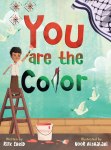
Books like this are hard for me to review, and I have gone back and forth on whether I should post anything or not.  On the one hand, we need books that are unapologetically Palestinian written by Palestinians.  They need to be celebrated and elevated and I want to offer my support to the stories, to the voices, to the authors, illustrators, everyone involved.  On the other hand, if I didn’t love it, why should I shy away from saying so, when I have purchased the book (pre-ordered and changed the shipping address even, to have it delivered to me on vacation because I didn’t want to wait to read it).  The book is emotional, but the last six pages unraveled the whole book for me, and in a picture book particularly of this nature, when you finish- if you don’t have a cathartic pull, you start to find holes in the story as you feel deflated.  The book, I would go out on a limb to say, needs to be discussed and given context even if you are Palestinian.  As someone who is not, I recognize my arrogance in such a statement and am happy to be corrected, but from a literary reviewer standpoint the book needs discussion and additional context.  The Nakba is only articulated in one paragraph in the author’s note.  In the story itself there is no indication that what happened to Thaer happened to so many Palestinians in 1948.  The use of color and how it is depicted in the illustrations is tangible and powerful, but as odd as it is to say, the words got in the way of the story.

img_0713

The book starts with Thaer trudging to school in dull sepia filled pages to begrudgingly sit at a desk and begin an art lesson.  He is glad the spitballs are just spitballs and not real explosions, but the tone is still melancholy.  When he sees boys playing soccer he recalls the last time he played soccer, and the memory comes alive in color.  He was in Yafa, it was the day before the Zionists came and took his family’s home.

img_0714

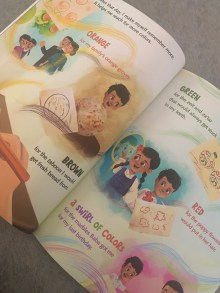
The teacher, back in muted tones, asks him to draw what has made him smile, and Thaer gives it a try.  Blue for the color of the sea, green for zeit and za’tar, brown for taboon to get fresh bread, etc..  When he takes the drawings home to his mother, she is not impressed.  Drawings are silly and colors aren’t going to bring Baba and Susu back.

img_0716

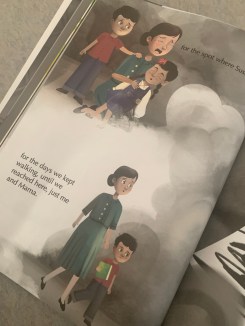
Defeated, the next day in class, Thaer recalls the men pounding down the door and Baba being shoved in a truck and Susu falling.  The next day at school they hang up some of their pictures and Thaer talks about his sister.  (SPOILER) On the way home Thaer paints the alleyway and brings color to his and his mom’s world.  His mama says that he is the color, and when the following day’s prompt is to draw what you want to be when you grow up it shows Thaer (presumably) on the beach as an adult painting.

img_0715

The disconnect for me occurred with the painting of the alleyway.  I was incredibly invested in the story, my heartstrings were being tugged, I was breaking for this character and his experiences, and it all came to a screeching halt because I couldn’t understand where the paint and the alleyway and the mama’s change of heart all manifested from.  As for the ending, I think I know what the author was going for, but it didn’t connect with any of my kids aged 2-15 nor my mother, a 40+ year early elementary veteran teacher.  I wish I could have taken a picture of their faces as she read the book to them.  The frozen expressions of huh and confusion at the end, until my 11 year old to broke the awkward silence to ask if the boy wants to be a painter or a father or an adult?  Those facets coupled with the often advanced vocabulary, makes the book an important one, but one that needs a lot of outside commentary to connect with the readers and to further the conversation about Zionism, al-Nakba, the occupation, and the continued oppression of Palestine.

There are flags of loss, kidnapping, sorrow, violence, etc., that parents will have to gauge if their children can handle. I’m not sure what age group is the best fit, the murder of a young girl, the forced displacement from one’s home, the removal of the father are all heavy themes.  I appreciate that it isn’t “watered down” for a western gaze so to speak, but I wish there was more about what happened to the dad, is there hope he is alive? I wish there was something about this not being an isolated reality for the protagonist and his family.  I wish there was some conversation or connection between the mother and son, because the loss of continuity really derailed the story.

As for the idea of the story, and the use of the illustrations to physically show two worlds I think is a great idea, it just sadly fell apart for me at the end: the faltering conclusion and the loss of emotional buildup that the first two thirds of the story worked so hard to create.

Hassan and Aneesa Go To a Nikaah by Yasmeen Rahim illustrated by Rakaiya Azzouz

Standard
Hassan and Aneesa Go To a Nikaah by Yasmeen Rahim illustrated by Rakaiya Azzouz

hassan and aneesa

The latest installment in the Hassan and Aneesa series caught my attention because there just aren’t a lot of books about an Islamic marriage process (it is Desi tinged).  Cultural weddings you often see, but despite the misleading title of them just attending a Nikaah, they actually walk the reader through the steps from wanting to get married, to getting to know someone, praying Salatul-Istikhara,  agreeing on a mahr, signing contracts, and a walima.  The idea and premise is brilliant and greatly needed, the finished product, not so much.  Somehow I had forgotten how tiny in size the books in the series are (6.5×7.5), making it all visually cluttered and the text often hard to see over the illustrations.  And while I love how the concepts and terms are defined, the point of view of having it witnessed and detailed by the brother sister duo is often awkward and wordy.  I wish the author would have ditched the familiar characters, and just written a book about the marriage process for kids.  The vacillating between a fictionalized story, factual requirements, kids witnessing their parents helping their cousin get married, makes for a tangled book that fails to connect to readers seven and up, let alone two and up like the book claims. If you’re kids are asking about how Muslims marry or seem curious about a halal way it can be done, I suppose this book would provide a way to understand some of the key facets in broad strokes, but it needs editing, and more space to show joy and excitement in a book about families and a couple coming together.

img_9813

The very first page set the tone for me, the overly dressed girl at a barbecue and the way her name seems to be so formally introduced.  Perhaps it is a difference of culture, but the book never bounced back from the heavy handed tone.  Aisha wants to get married and asks her parents to help her find someone.  They ask her what she is looking for and she tells them.  I like what she includes kindness, love of Allah, funny, etc.  I wish it would have suggested that she had given it a lot of thought before answering though.

img_9814

Aneesa and Hassan’s mom and their aunt are discussing Aisha’s want to marry at their painting class and a friend over hears and suggests her son Uthman.  The families agree to have the two meet in a cafe with Aneesa and Hassan’s dad and uncle so that her mahram is nearby.  Uthman and Aisha both enjoy sports and Uthman interacts with a baby at another table impressing Aisha.  They both pray istikhara and decide that the families should all meet.

img_9815

It is then time to pick out a dress and hand out invitations, which at least involves Hassan and Aneesa, but the pages are so cringe and awkward from the phrasing, to the structure of the concepts.  The spread is disjointed and you’ll catch yourself shaking your head and making a face every time you read it.

Mehndi is next and I’m not sure why it focuses on Aneesa not sitting still and looking sad when her design is ruined.  It seems like an odd inclusion in what should be a joyous book.  Hassan is entrusted with gift to hold on to by Uthman for Aisha, and the Imam gives a khutbah about marriage.

Contracts are then signed with Aisha her wali, uthman and the imam and each party is asked if they agree.  They have already decided on the mahr and then Hassan hands over the gift.  The walima feast is delicious and the reader is encouraged to go back and find the cat in the illustrations.

As for illustrations I do like that the main females are shown out of hijab at home, and in hijab while out.  At the wedding there are different shades of brown, different loves of covering and not covering, there is a guest in a wheel chair and the couple and their families seem happy.  I found it odd that it says they are in love, since there isn’t a lot of emotion mentioned before the last page and I wish the text on numerous pages wasn’t mixed in with the pictures.

The book concludes with a glossary of terms.

Mr. Men Little Miss Happy Eid by Roger Hargreaves

Standard
Mr. Men Little Miss Happy Eid by Roger Hargreaves

mr men

The nostalgic cast has reassembled recently, and now have an Eid title available.  Whether you grew up with Mr. Men and Little Miss or have never heard of them before, this book covers the basics of an Eid day celebration with (familiar) characters such as: Mr Greedy, Mr Bump, Miss Splendid, Mr Funny, Little Miss Scatterbrain and more.  The characters’ friend Aleena is fasting for Ramadan, the colorful crew help her to plan, and finally they all join in for the celebration.  The 32 pages are silly and random at best, but with a little discussion to help bridge the British to American English (if needed) ages three and up will enjoy the funny characters, seeing Aleena in hijab, and relating to the activities mentioned.  I love that generosity and forgiveness are included in the messaging, but was really irritated that a musical band is how they celebrate Eid night, and that Eid is compared to Christmas with gift giving.  The book is not written by a Muslim, so perhaps I should be forgiving about the Christian holiday comparison, but why write a book about Muslim joy, if you won’t let the Islamic holiday be enough on its own?  Thank you to Shifa @Muslimmommyblog for gifting me this after making fun of me for being old!

img_9333

Mr Greedy’s friend Aleena is fasting, and Mr Greedy breaks his fast nearly every hour so he is helping her.  Little Miss Inventor is out with her telescope and sees the moon, it is time for Eid.

img_9334

The days before Eid had been spent cleaning and decorating with the help of Mr Rush and Mr Bump.  They weren’t very helpful.

img_9337

Ramadan is also a time of generosity.  The football club receives donation, but what will they do with Mr Silly’s grandfather clock donation.

img_9336

Aleena puts mehndi on and is smart enough to not let Little Miss Naughty help, Little Miss Scatterbrain was not so wise.

img_9339

They all get dressed up, they give each other gifts, and share a meal. They then all settle arguments and forgive each other.

img_9338

Finally, they head to an Eid fair in town and eat treats while they watch a music show.  The book concludes with some factual information about Ramadan, Eid, and Zakat.

Title is available on Amazon.

A Bear for Bimi by Jane Breskin Zalben illustrated by Yevgenia Nayberg

Standard
A Bear for Bimi by Jane Breskin Zalben illustrated by Yevgenia Nayberg

This 40 page picture book for preschool and up does a decent job of highlighting how many of us have immigrants in our family history who have relocated much like the immigrants today. The story focuses on Evie and her family welcoming a Muslim family to the neighborhood.  Some are excited to help, including a Muslim neighbor, others are not so welcoming.  The book shows some of the obstacles an immigrant might face, ways someone already established can help, and just how to be a good neighbor- all on a simple pre-schoolr to first grade level.  For little kids it is a good story to start a discussion, and for slightly older kids it is nice to see Islamic names in the text, smiling hijabis in the illustrations, and different characters to identify with.

Evie’s parents tell her that a family from far away is moving in next door, she asks if they are coming like her grandparents did, and indeed they are.  When they arrive Evie runs out to introduce herself to Bimi. Evie’s parents help the Said family move in.  But one neighbor, Mrs. Monroe just glares out the window.

Bimi asks his parents about Mrs. Monroe and Evie asks hers.  Bimi’s parents tell him that some people are scared of people that seem different, and Evie’s parents wish Mrs. Monroe would remember what it was like when she first came to America.

That night Evie has an idea to help furnish Bimi’s house.  The whole neighborhood helps out, including Fatima who lives around the corner.   After getting the apartment set up, they all share a meal, everyone that is, except Mrs. Monroe.

When the kids go out to play, Mrs. Monroe’s shopping bag spills, and Bimi helps her and Mrs. Said invites her in.  Later Evie gifts Bimi her teddy bear and Bimi gives Evie a stone from his grandma’s garden.  Evie asks him what he will name the bear, and when he says Evie, the reader knows the two are friends, and Bimi is “home.”

The book isn’t exciting, emotional, or particularly memorable, but there is value in it and I appreciate the Islamic representation.

My Baba’s House: A Poem of Hope by Dr. Amani Mugasa illustrated by Eman Salem

Standard
My Baba’s House: A Poem of Hope by Dr. Amani Mugasa illustrated by Eman Salem

my babas house

I wanted to love this Islamic centered children’s book about grief, but I found it a bit problematic and misleading.  I am by no means an expert in Islamic matters of death or in psychological bereavement, but the note at the beginning of the book- if I wasn’t already going to look at it critically- really raised some warning flags.  It says that the book is not an instructional book on Aqeedah, that even though the title and whole story is about a house being built that “the book only expresses the idea that we hope and pray that Baba’s good deeds will lead him to Jannah, that that the rest of the family will meet him there one day, not that he is there already.” So, before you even start the story, it seems that the disclaimer is making it clear that this book is not religiously accurate, and that it is just meant to soothe and provided hope.  After taking all that in to consideration, and reading the 26 pages of text over a dozen times, I think I finally pinpointed why the book further reads problematic for me.  It is the repeating phrase, “Your Baba has been building a beautiful house for you,”  because he hasn’t right? He has built a house for himself through his good deeds in this duniya, he benefited HIS parents by being a righteous Muslim.  The words “for you” completely take the book in my head from being a slight suspension of timing where the deceased are, in to be misleading.  So if the book is not accurately framed and only to be taken as something “to open the discussion,” what is the point? Why fill it with Islamic references and concepts, if they will then have to be clarified, corrected, and re taught?  Sigh, I’m happy to listen to those that want to change my mind, truly I am.

img_9013

The rhyming book starts out with a mom and two kids being consoled by the text that their Baba has been building a house for them with Allah’s help.  That it is amongst the flowers, made with Allah’s powers. That with every good deed he did, their Baba becomes a builder, that there are pure rivers and trees, and that the house is hidden through Allah’s gate.

img_9014

To find their Baba’s house they will walk with Prophets, and see ripe fruits, and smell sweet musk.  There will be rivers of milk and he will carry them above his head.  The illustrations on this page are a little off in my opinion the shadows of a person elevating and even the girl looks a little concerned.

img_9015

I like that the next spread addresses that only Allah knows when the day will come that we reunite. And then the next pages tell how the children can help decorate their Baba’s house by calling adhaan, reading Qur’an, being kind, giving charity, and making duas.

img_9016

The book concludes with encouraging patience and finding reassurance in knowing we belong to Allah and to Him we return.

With the exception of the one page, the illustrations are adequate and show a mixed racial family.  The rhyming lines are rather weak, and ultimately there are just better books out there about grief that don’t have to be so qualified for accuracy.

The Most Exciting Eid by Zeba Talkhani illustrated by Abeeha Tariq

Standard
The Most Exciting Eid by Zeba Talkhani illustrated by Abeeha Tariq

the most exciting eid

I was really excited for this book, I even contacted Scholastic USA and the author to see how we could get it here in America, but once I received my copy from the UK, I was disappointed.  It offers nothing new to the available Eid titles aside from the pretty illustrations. It is a rather forgettable story, with nothing more than surface level growth, predictable emotion, and a formulaic retelling of a basic Eid day.  Meant for preschoolers (3-4 year olds) the story will suffice as an introduction to Eid and reinforce the importance of sharing with others, but anyone older will find the story lacking unfortunately, and question why they didn’t go for Eid salat, if the cousin was even upset about not getting to ride Safa’s new bike, if the neighbors are poor and needy, and if they have gifts for neighbors or are just giving out random leftovers. Five years ago when reasonably priced brother sister duo books celebrating Eid were popping up everywhere, this book would have warranted excitement of representation and Eid joy, but the quality has elevated and while there might not be anything “wrong” with the book, it still feels like it sadly falls short.

img_8977

Safa and her parents see the new moon and that means it is Eid.  She is so excited as her mom puts henna on her like every year, and her dad brings out the box of decorations.  At night she is anticipating presents, gifts, new clothes and food that she can hardly sleep.

The next morning she comes down in new clothes, prays, asks Allah for a new doll, a colouring pencil set and a bicycle.  Guests come over, even Alissa her cousin. She opens her presents revealing she got everything she asked for.  Alissa calls after Safa, but Safa doesn’t want to share, she’s been waiting for this bike forever. Since sharing is the point of the story, it is worth noting that Alissa in the text shouts after her and in the illustration is shown to be calling out, there is no reinforcement that Alissa even wants to ride the bike.  I suppose I’m glad that Safa feels it, and regrets it later, but it is subtle and I don’t know that a 4 year old will even register that, that is implied.

img_8978

Mom then calls to Safa while carrying two huge purple bags to come with her to share joy and food with those in need.  Safa adds some of the treats she has received in to the big purple bags and they hand the items out to their neighbors. I love that they are visiting their neighbors and it brings the giver and receiver joy, but the set-up is that neighbors and those in need are one in the same, and I think that is conflating two different things.

Some neighbors get small gifts, one a potted plant, another homemade looking food, and then there is one bag left, somehow the purple huge garbage bag sized bags have shrunk to being a shopping bag size and the next recipient is a surprise: grandparents.

img_8979

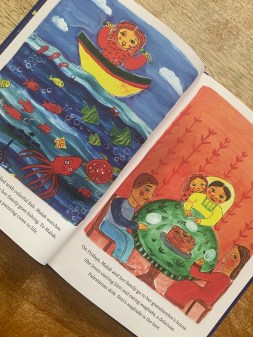
The mom and daughter join the grandparents for desi cultural foods of samosas, kebabs, biryani.  Dad does not join them, and I’m not sure why the grandparents didn’t come to the party at Safa’s house? I also wondered if the party at the house was still happening, because once Safa realizes she enjoyed sharing, her parents and Alissa are seen outdoors, with the little girls on bikes and Alissa asking her cousin where she went.

There is a two page spread glossary at the end which defines words that are not in the text, but is informative.  It mixes “cultural” words such as Allah Hafiz being defined as being a common way among Muslims to say goodbye, which technically isn’t wrong, but it is an Urdu word and only used by Desis.  It isn’t in the story, so it seems off to me as well.
img_8980

The illustrations are the highlight in the book.  They are vibrant, expressive and engaging.  The mom seems to have a dupatta on her head, it might pass for hijab, but she has wavy tendrils showing on the side, even the grandma shows much of the top of her hair.  Neither the father in the story or grandfather have beards.