Tag Archives: Muslim Character

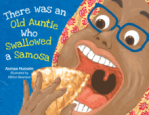
There was an Old Auntie who Swallowed a Samosa by Asmaa Hussein illustrated by Milton Bazerque

Standard
There was an Old Auntie who Swallowed a Samosa by Asmaa Hussein illustrated by Milton Bazerque

samosa

I feel like such a broken record of late (and in the future), of my reviews of books published by Ruqaya’s Bookshelf; the stories are WONDERFUL, but I really struggle with the titles.  I truly thought this was a cultural/religious version of the classic, I Know an Old Lady who Swallowed a Fly.  But it isn’t.  It is an original clever, laugh-out-loud hysterical story for preschool to early elementary.  And one that parents and caregivers will not dread reading over and over again with the well done rhyme, expressive illustrations, a silly conclusion, religious framework, and universal appeal.  The book is on point, the title and cover illustration, sadly for me are not, and don’t, in my opinion, do the story justice.

img_4190

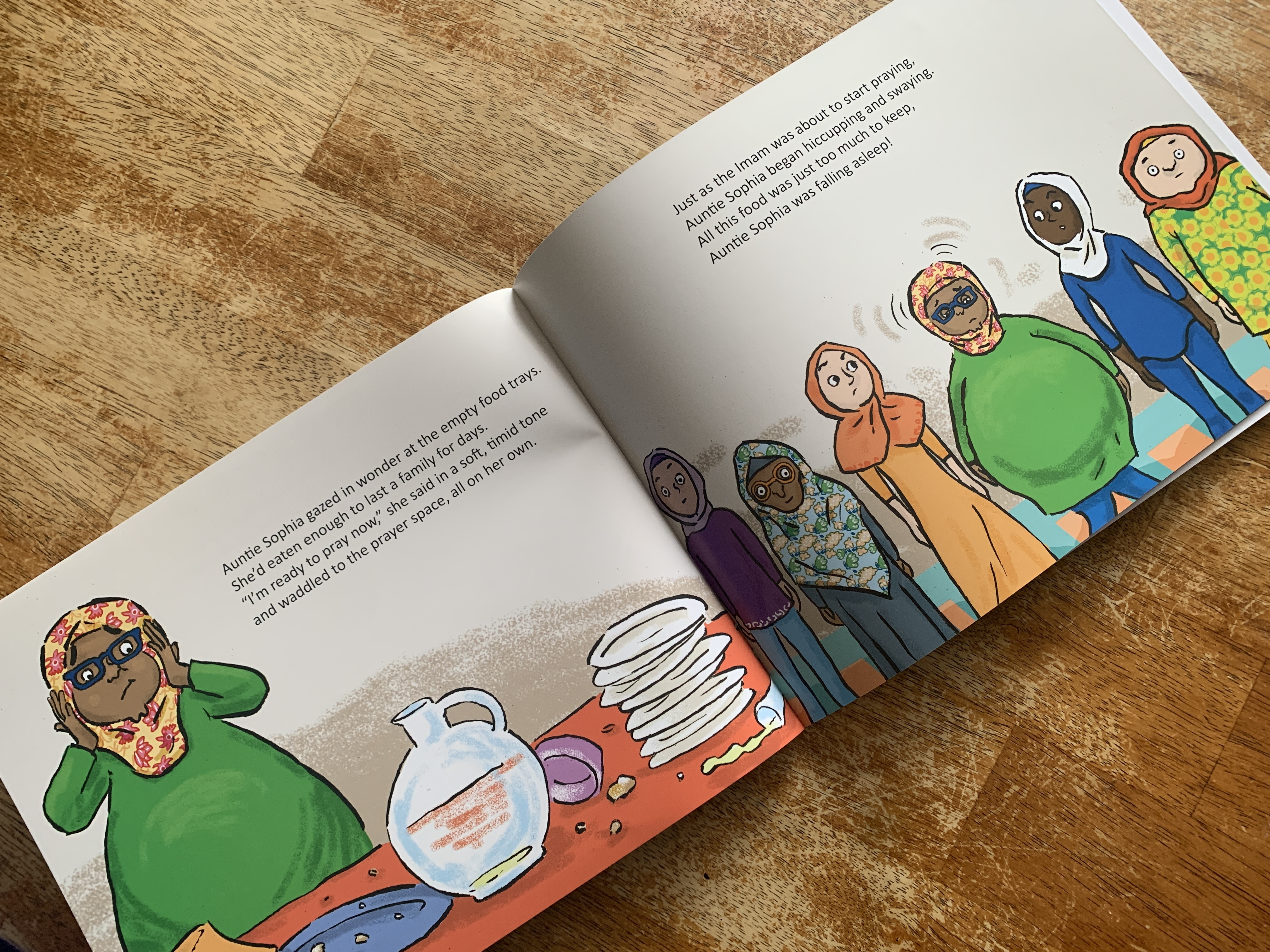
Auntie Sophie is making samosas with some peppers she grew herself.  Under the close company of her kitty, we learn how the Scotch bonnets were grown and cared for.  The doorbell rings and Auntie Eynara has arrived with her beautiful cake to take to the masjid for iftaar.  

img_4191

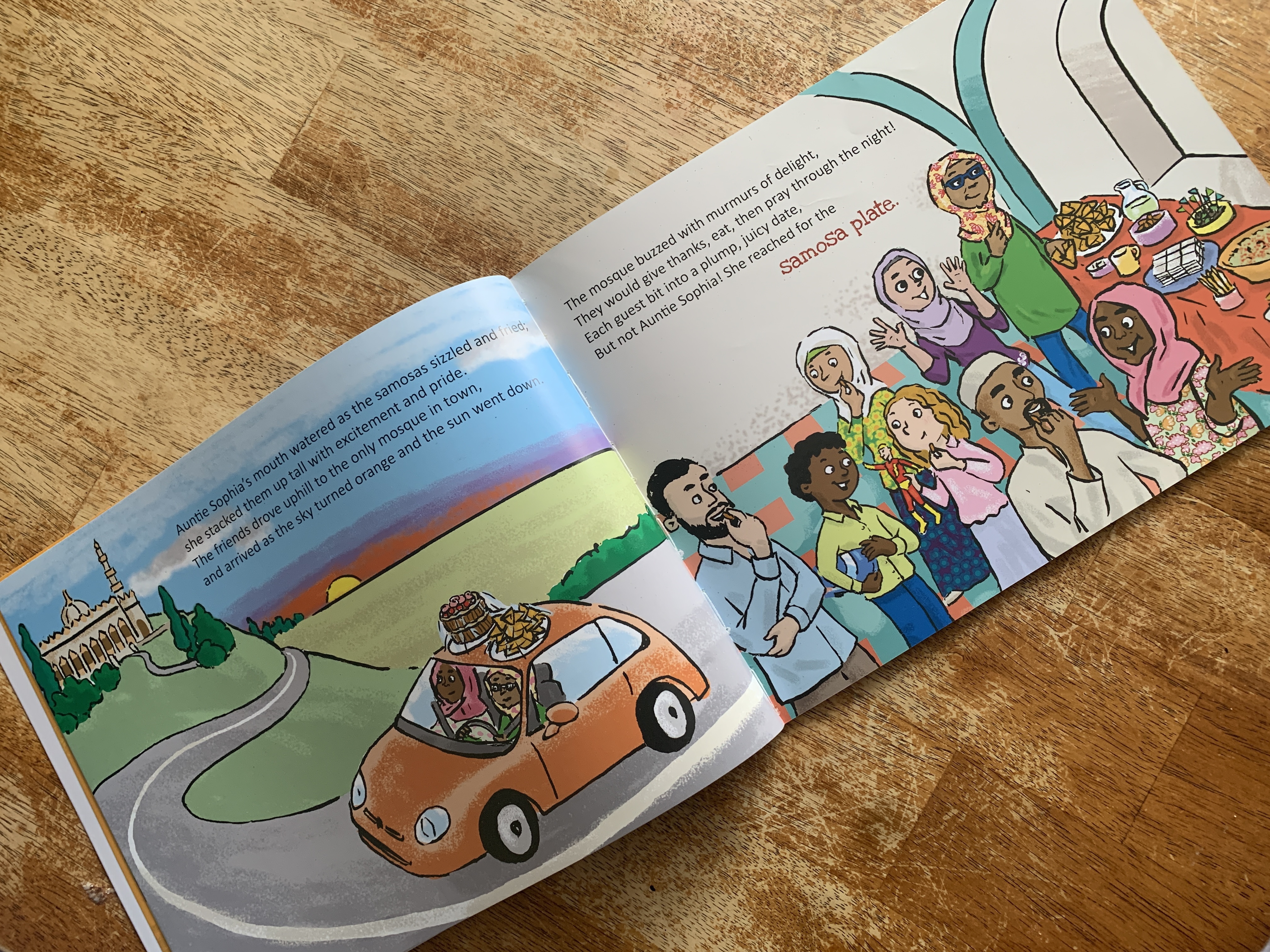
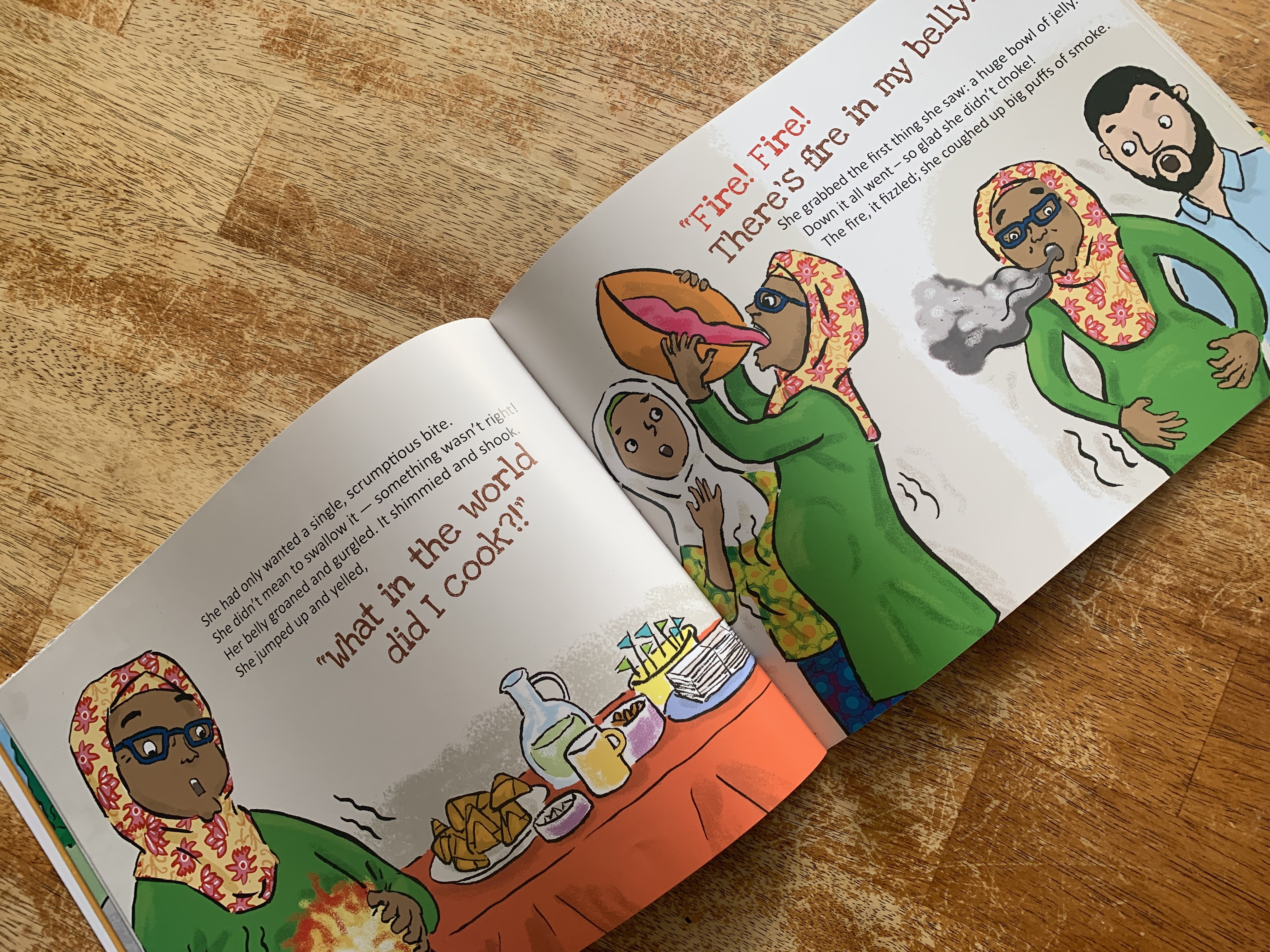
Auntie Sophie  hurries and fries her samosas and the ladies head up the hill to the only mosque in town.  Everyone breaks their fasts with a date, but Auntie Sophia dives in to her samosas.  When the imam’s mic crackles, she swallows the samosa whole and something is terribly wrong.  Her belly is on fire and jelly nor garlic knots nor mint lemonade not rice can cool it down.

img_4193

Just when she thinks she is ready to pray, it starts up again, and having eaten everyone’s dinner, Auntie Sophia is getting very tired. As she rolls out the door and down the hill to her house, she figures out what happened to her delicious samosa filling, and calls to have pizza and halal hot wings delivered to the mosque.  She also pledges to grow flowers next year instead!

img_4192

Kids will love the book as it is outrageous, while at the same time being so relatable.  The mosque, iftar, eating something spicy, the book is a favorite at our house for both the two and six year old and the horizontal 8.5 x11 orientation, keep eyes glued to the pages, while the rhyming lines move the story along.  I enjoy being able to talk about the peppers and different foods and smell of garlic with my kids after the 17th reading or so, and I love the diversity of the characters at the mosque. 

My Laugh-Out-Loud Life: Mayhem Mission by Burhana Islam

Standard
My Laugh-Out-Loud Life: Mayhem Mission by Burhana Islam

mayhem

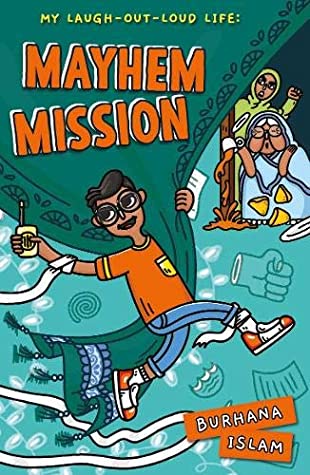
Fairness aside, any book about a genuine Muslim British boy written in first person with doodles, lists, and hilarity for middle grade readers is going to be compared to the Planet Omar Books, and not only do they have the advantage of being first, but they also have set the bar really high.  This 266 page book is decent and fun, and if your children enjoy Omar, they will enjoy this, but even my kids compared the two and found this one just a bit lacking.  The story is outrageous and funny and has a lot of heart, the writing is sufficient, it just feels like the story gets away from the author.  Information is given for no reason and to no purpose, the story loses its way and fumbles around for a bit in the middle, seems to get off track at points, and is a bit weak in character development.  That being said, would I purchase and read future books in the series? Absolutely! I love that the standard and quality for books with Muslim characters by Muslim authors for our children are at this level.  There is no apologizing for Islamic Bangladeshi culture in this book, and the mainstream publication means Muslim and non Muslim children are seeing a nutty, loving family that they can relate to in a myriad of ways, alhumdulillah.

img_4078

SYNOPSIS:

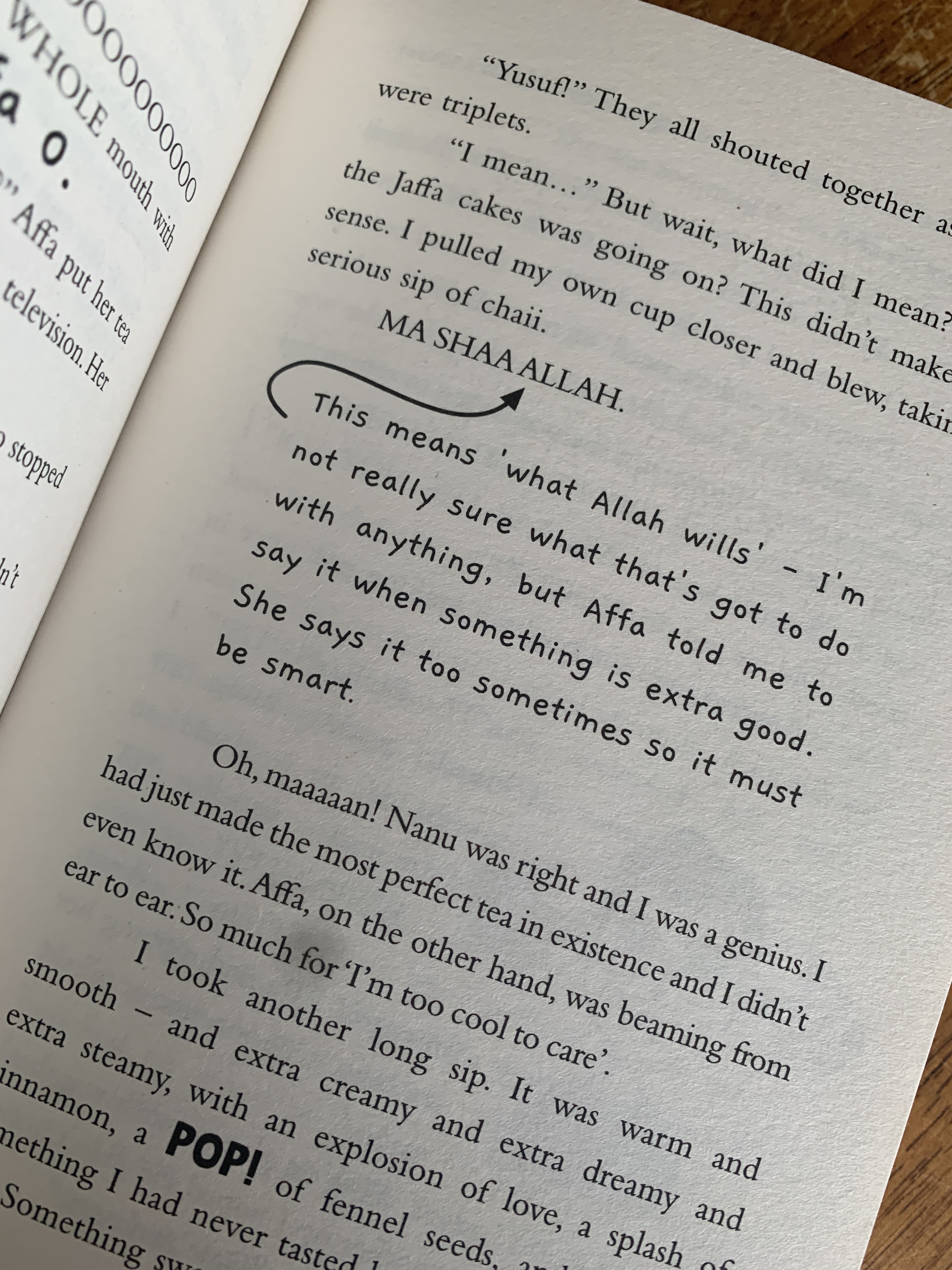
Yusuf’s much older sister is getting married, and she remarks that he now needs to be the man of the house.  Unsure of what that means, he asks Sheikh Google, and is not prepared to do what it entails.  Not at all, he is only nine, but rather than discuss it, he decides instead that he must stop the wedding. So, with a bit of help at times from his cousin Aadam, it is full steam ahead to sabotage the upcoming nuptials.  With little time, he attempts to make his sister unwanted in her inability to cook, keep her hidden in her room by removing all the hijabs in the house, spreading rumors that she has died, ruining her wedding dress, and more, so much more.  It is cringe worthy at times, and hard to put down at others, but alas there is a happy ending, and lucky us, we get to read all about it in Yusuf’s year five what I did over summer vacation essay.

img_4077

WHY I LIKE IT:

I love that the family dynamic is a single mom, her mom, and the two kids.  I think it is important to show some diversity that reflects the family situations of many Muslim children that have thus far been a bit down played.  The book is relatable and contemporary with Marvel references, while tossing in everyday cultural references too.  The family prays, does tasbeh, memorizes Quran, covers, etc.  The book tries to give some depth to the characters, such as Yusuf’s eczema, but it kids don’t get it and the text muddles it to the point, that it misses connecting to the readers.  Also, even kid readers get that a simple conversation could have prevented most everything in the book.  Time is tight, but not that tight for things to get so outrageous.  The book is a British, but I think US readers can handle it, they may, like me, have to Google Jaffa Cakes, but I think they will be fine.
img_4076

FLAGS:

Deceit, sneaking, lying, gossip, destruction of food and property.

TOOLS FOR LEADING THE DISCUSSION:

I don’t think the book would lend itself to a book club, but I think home and classroom and library shelves will benefit from hosting this book.

We Will Meet Again in Jannah: What a Great Day that will be! An Activity book for Bereaved Muslim Siblings by Zamir Hussain illustrated by Emily McCann

Standard
We Will Meet Again in Jannah: What a Great Day that will be! An Activity book for Bereaved Muslim Siblings by Zamir Hussain illustrated by Emily McCann

jannah

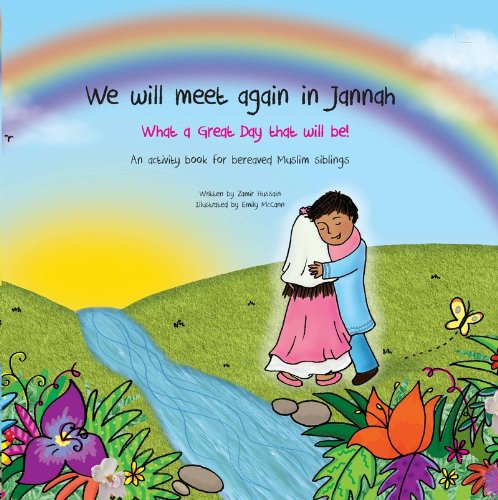
I don’t review workbooks, or a lot of non fiction books, but by far the most thematic requests I get asked about, are children’s books about bereavement.  The loss of a friend or loved one is just not a topic that you see covered very often, if at all.  Sure there are books about jannah, but they are more silly and framed as a reward, not about the loss felt that would precede paradise.  This 32 page paperback activity book is part reassurance, part encouragement, part discussion starter, and part remembrance all within a faith framework.  Much of the book is not sibling specific, perhaps a few tweaks and you could have a grandparent version, a parent version, an aunt or uncle version, etc.,  even as a parent you may consider adjusting the book as you share it if you are unable to find a specific book for your child’s needs.

img_3901

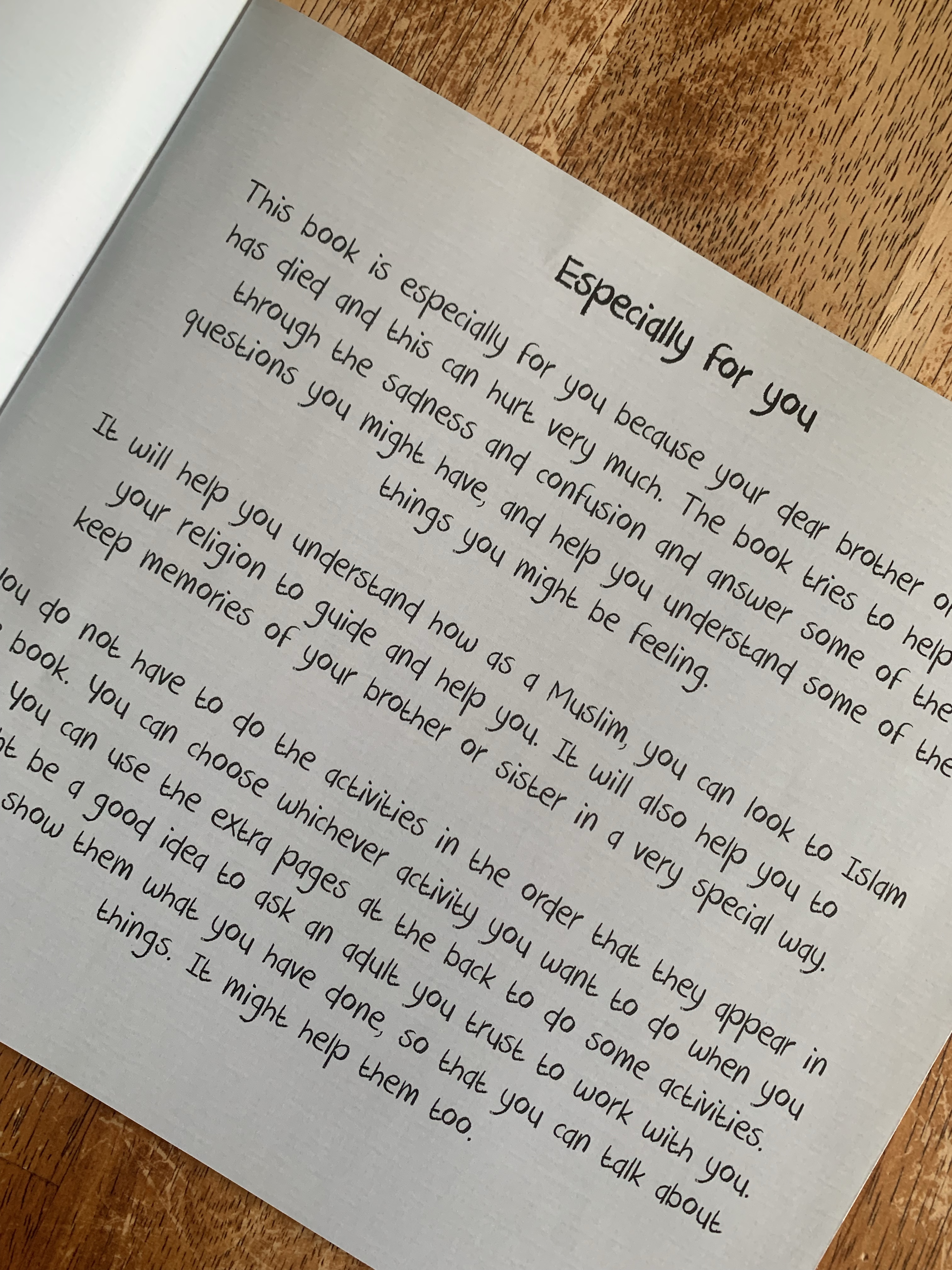
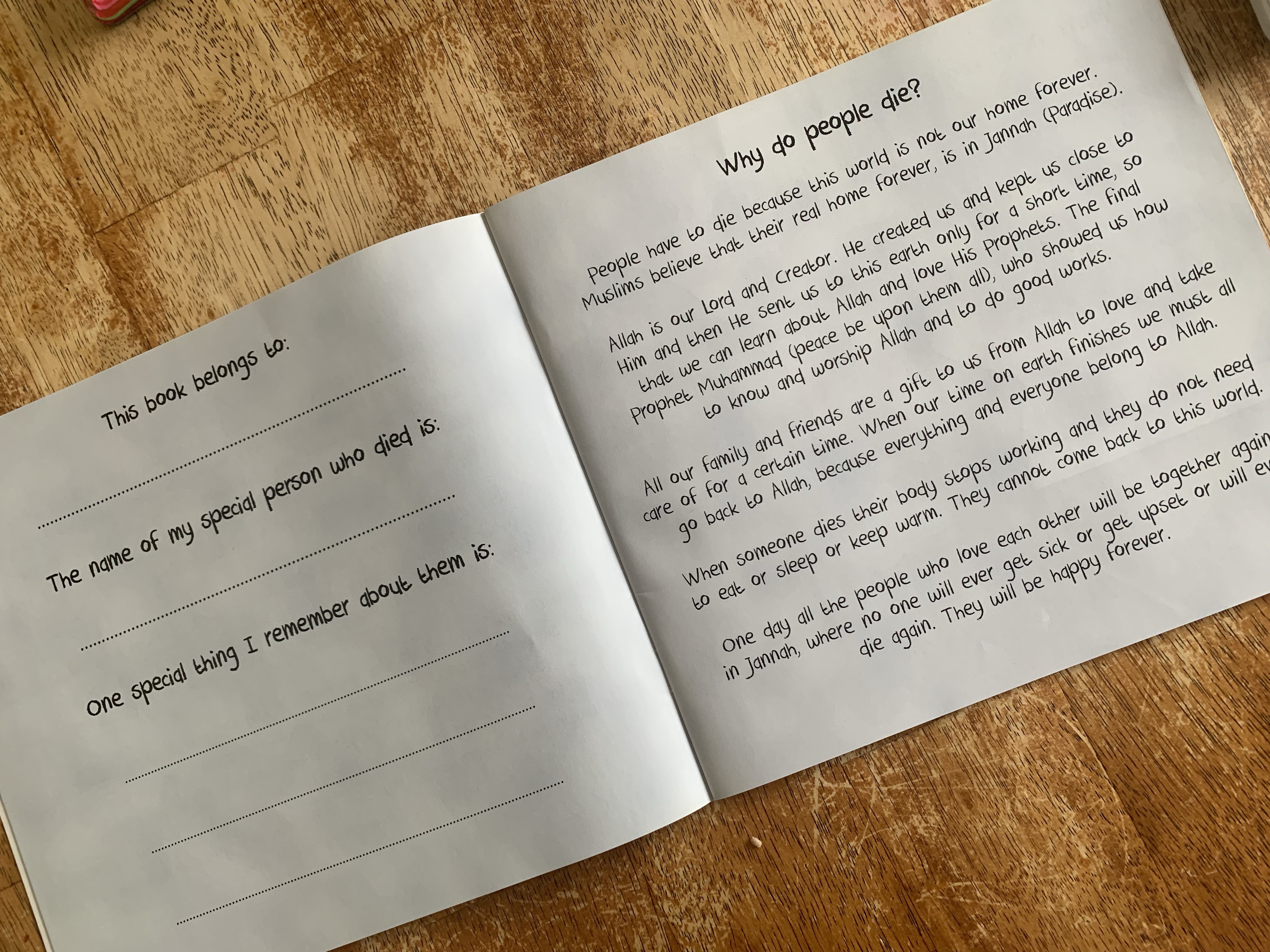
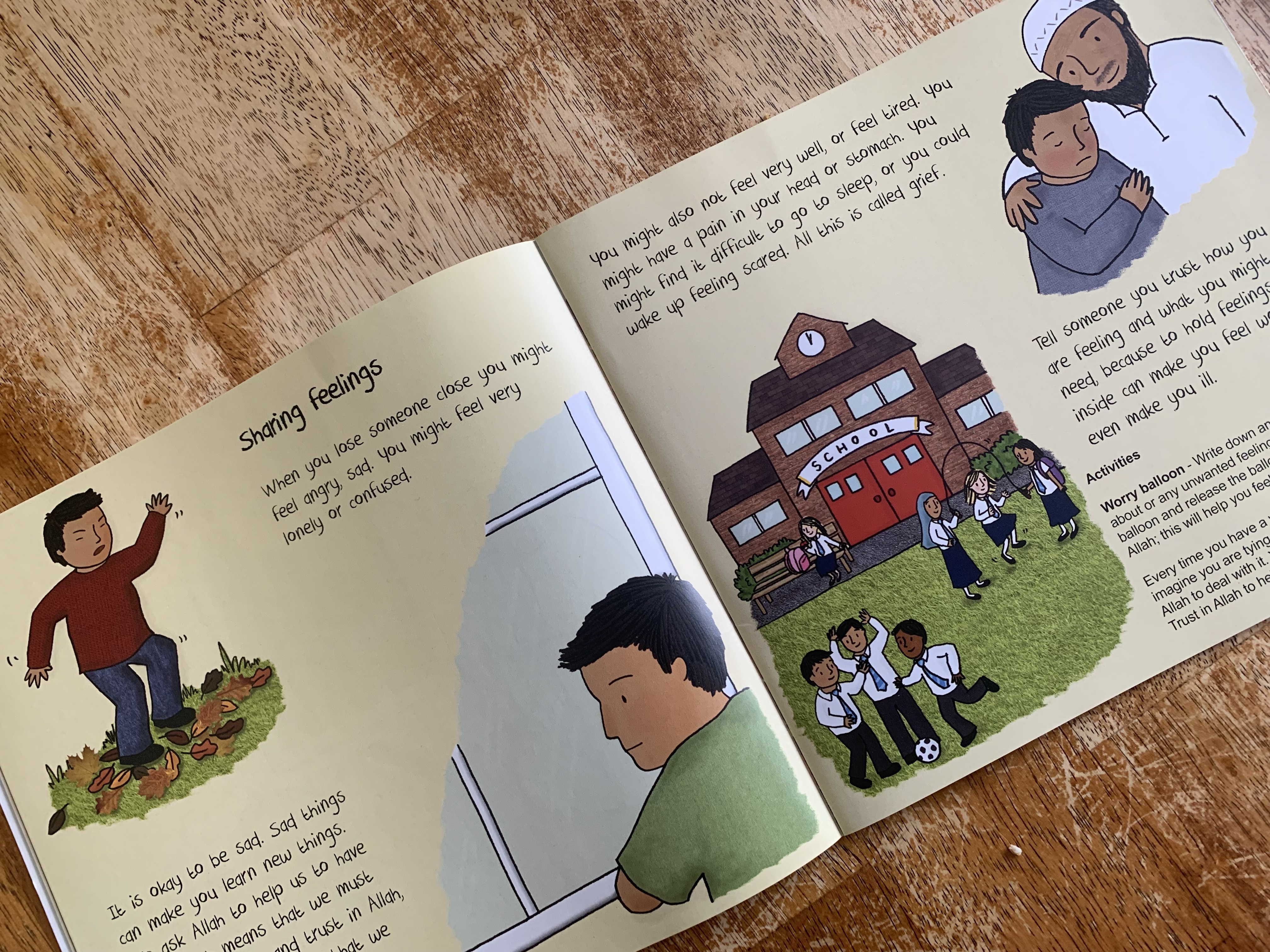
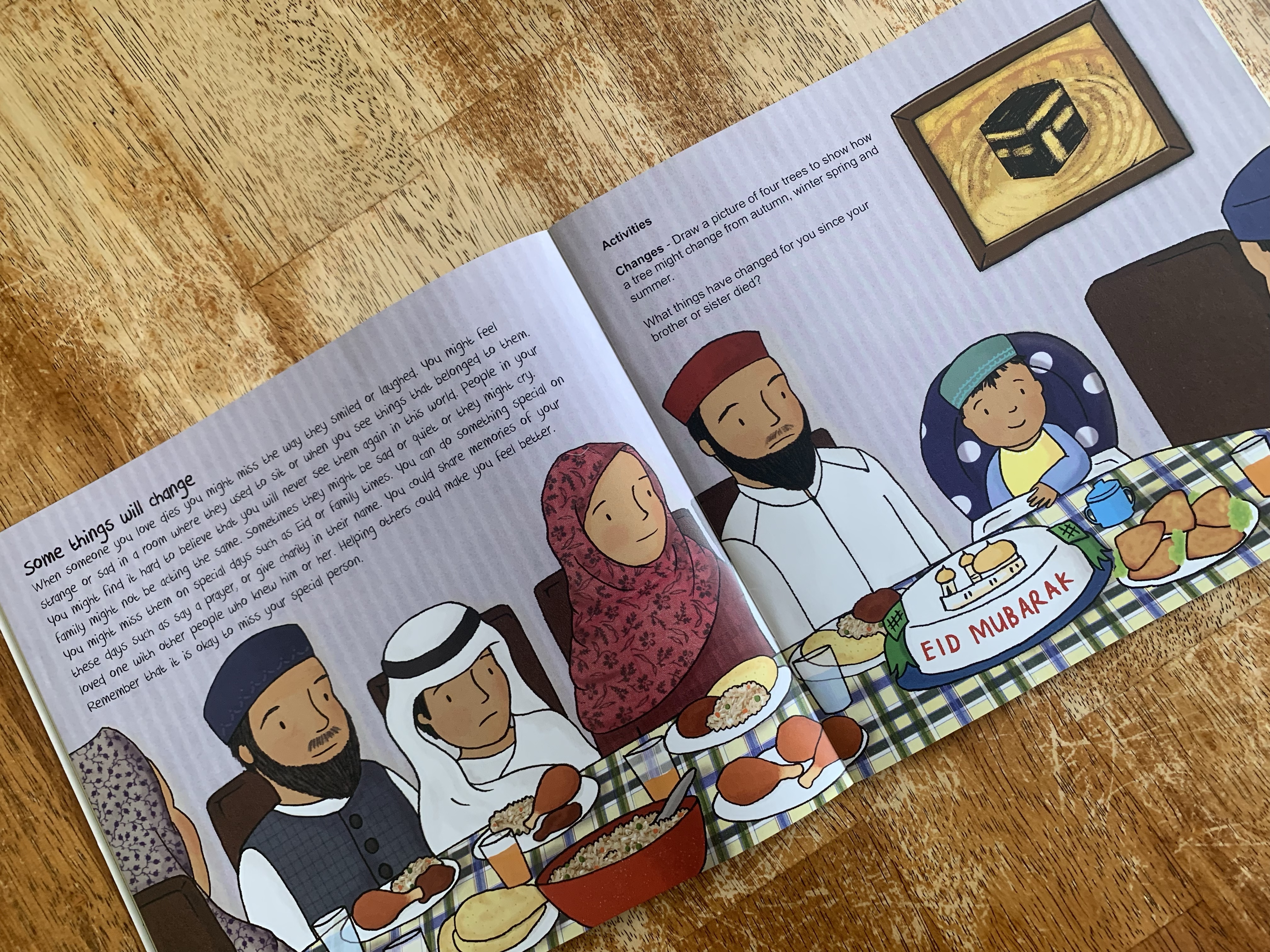
The book starts with the author talking to the reader and setting the tone about what has occurred and what is to follow in the book.  It then asks the reader to write or share who they are, who passed, and something special they remember about them.  It discusses why people die and then starts the two page spreads that address a theme and presents an activity to help you feel better, or to remember or celebrate the one who has died.  Topics include: You’re never too big to cry, It’s not your fault, Talking and sharing the pain, Some things will change other’s will stay the same, etc..  Some of the activities are wonderful and can be done in any order, at any time, and others, you may want to adjust.  The idea of releasing a balloon, for example, with your worries in it, is symbolically effective, but not so great for the environment.  The end of the book has additional resources on how to use the book, things to do with the child, further support,  additional resources, and Islamic guidance.

img_3902

I love that Islamic foundations and vocabulary are not just used, but explained in a very age appropriate, non condescending manner, through out.  I love that it is clear that you don’t have to talk if you don’t want to, that it is not the child’s job or responsibility to make the adults feel better, that nothing is anyone’s fault, and that there is no right or wrong way to grieve.

img_3903

I wish the book was larger in size and perhaps hardback so that the activities that require writing would have more space and ease in completing.  The text for the activities is also very tiny.  I also wish that the author’s qualifications for such advices was included.  I Googled the author to find out:  “Zamir Hussain is a Muslim Chaplain at Birmingham Children’s Hospital and has pioneered resources in Islamic health care. She has published several books for bereaved Muslim parents and siblings. She has also developed the first UK blended learning resource, including care plans and pathways for Islamic daily, palliative, end of life and bereavement care for paediatric staff. Zamir has worked as a Muslim Chaplain for both the Heart of England NHS Trust and Birmingham Children’s hospital for over five years, where she has also run training courses for the staff as well as delivering training and talks on care for Muslim patients to organisations around the country.”

img_3904

We need more books about coping, talking, dealing, understanding death for our children, inshaAllah this is a start, alhumdulillah.

Beautifully Me by Nabela Noor illustrated by Nabi H. Ali

Standard
Beautifully Me by Nabela Noor illustrated by Nabi H. Ali

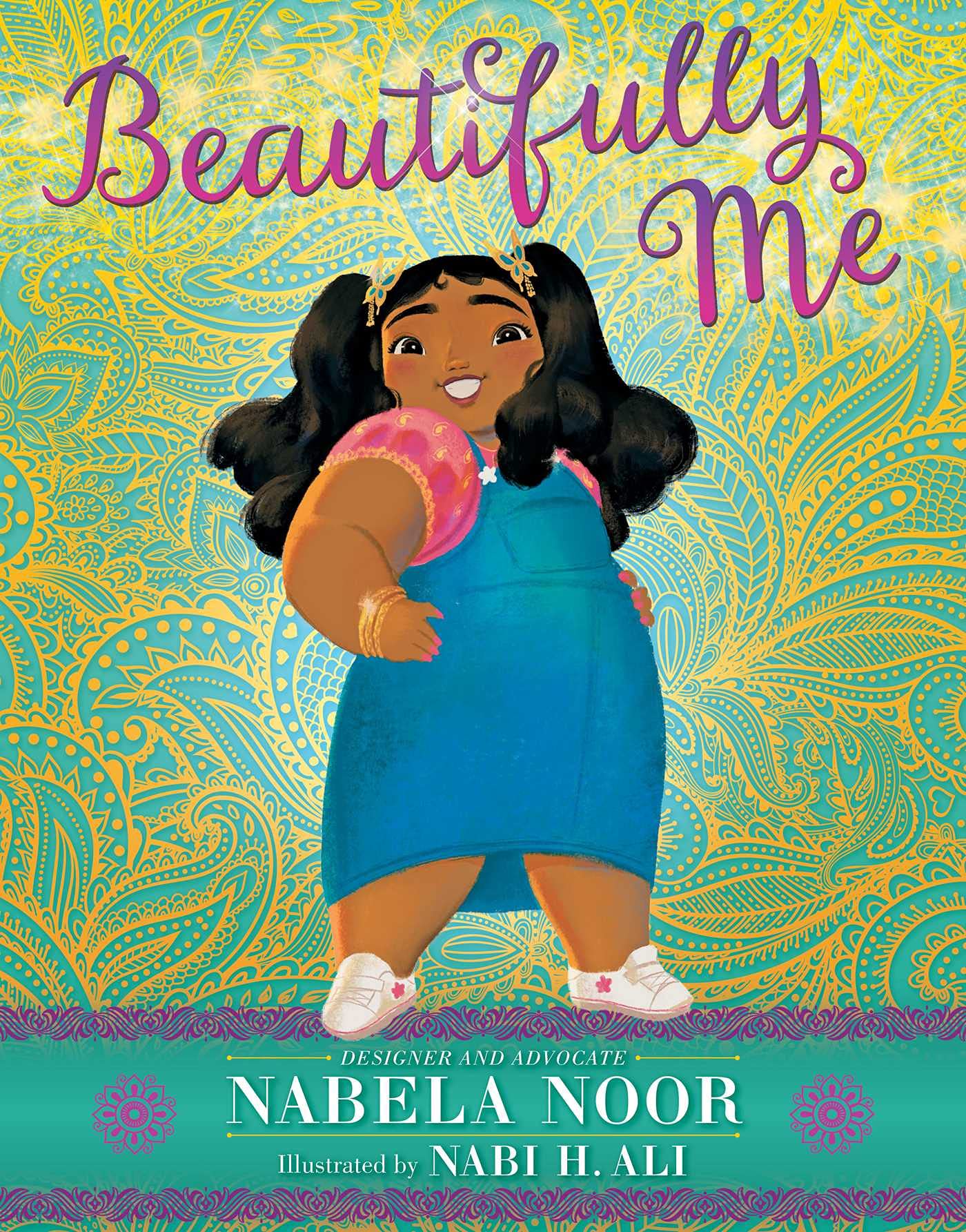
beautifullyThis 40 page glowing OWN voice book bursts with body size positivity, Bangladeshi culture, Islamic terminology, diversity, and a beautiful message.  The illustrations and theme alone make the book worth your time and reveal how few body positive books are out there for our early elementary aged children.  That being said, the book might require or benefit from some child led discussion.  If your child is aware of various body shapes including their own, then this book is a great mirror to build them up and as a tool in emphasizing the critical importance of understanding and knowing people are beautiful just as they are.  If your child doesn’t seem to be aware that society views individuals with a larger body size as being a negative, this book might take a little navigating as the theme is more focused on pushing back on fat shaming than it is on accepting all body types.  The book also opens its self up to discussions about pronoun identity, what beauty means, why people tease or be mean to themselves and others, and being aware of how our words affect those around us.

img_3976

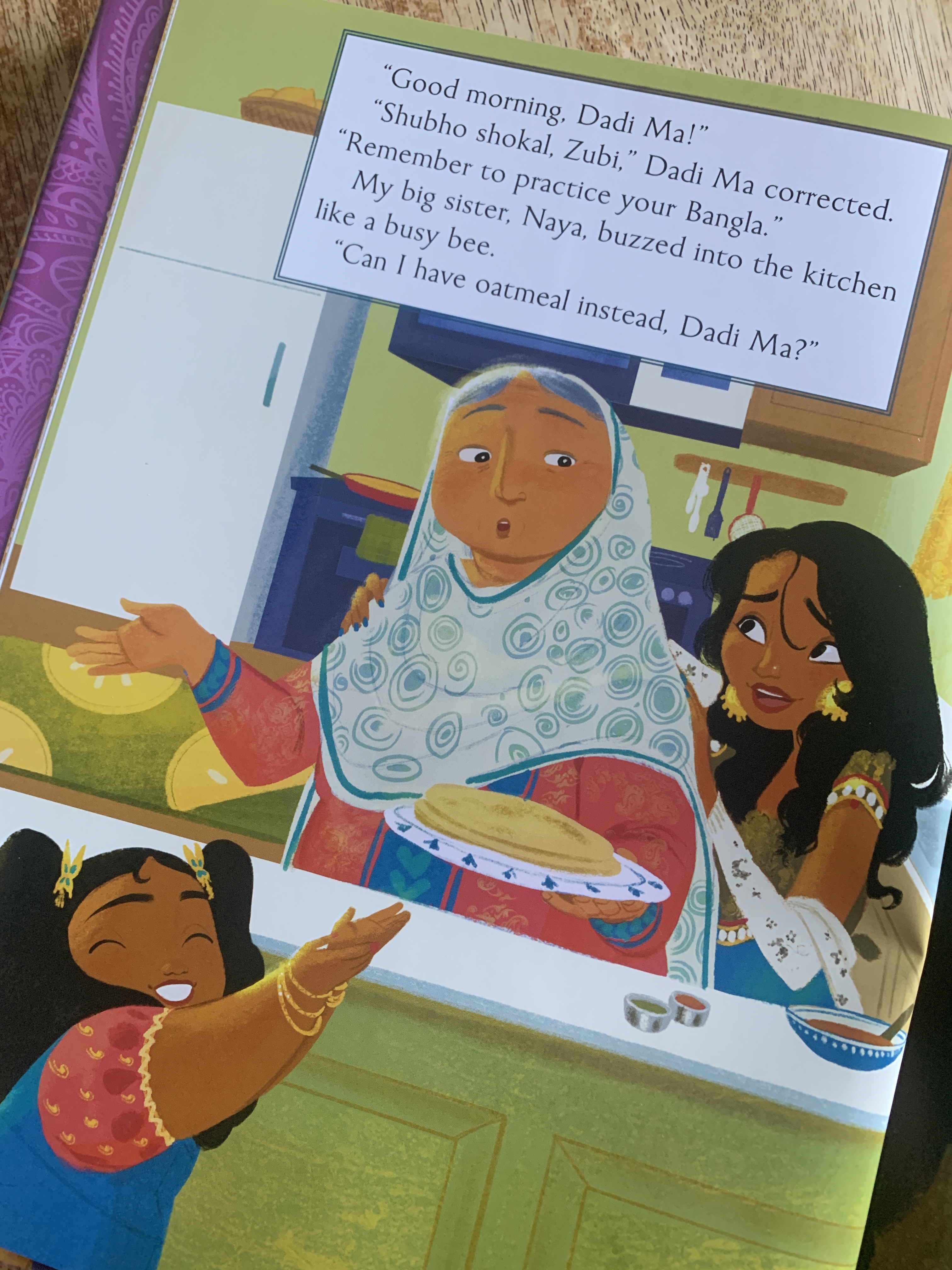
The family is visibly Muslim with Zubi starting with salaam.  The mom wears hijab and a sari, even at home, Dadi also has her head covered.  Eid is mentioned as a time when a gift was given that is too tight to wear, and worth noting from an Islamic perspective- Zubi’s sister is dieting to look pretty at a school dance.  Bangladesh is represented in the foods and some of the phrases the family says, and the clothing mentioned and depicted in the illustrations.  There is a glossary at the back.

img_3977

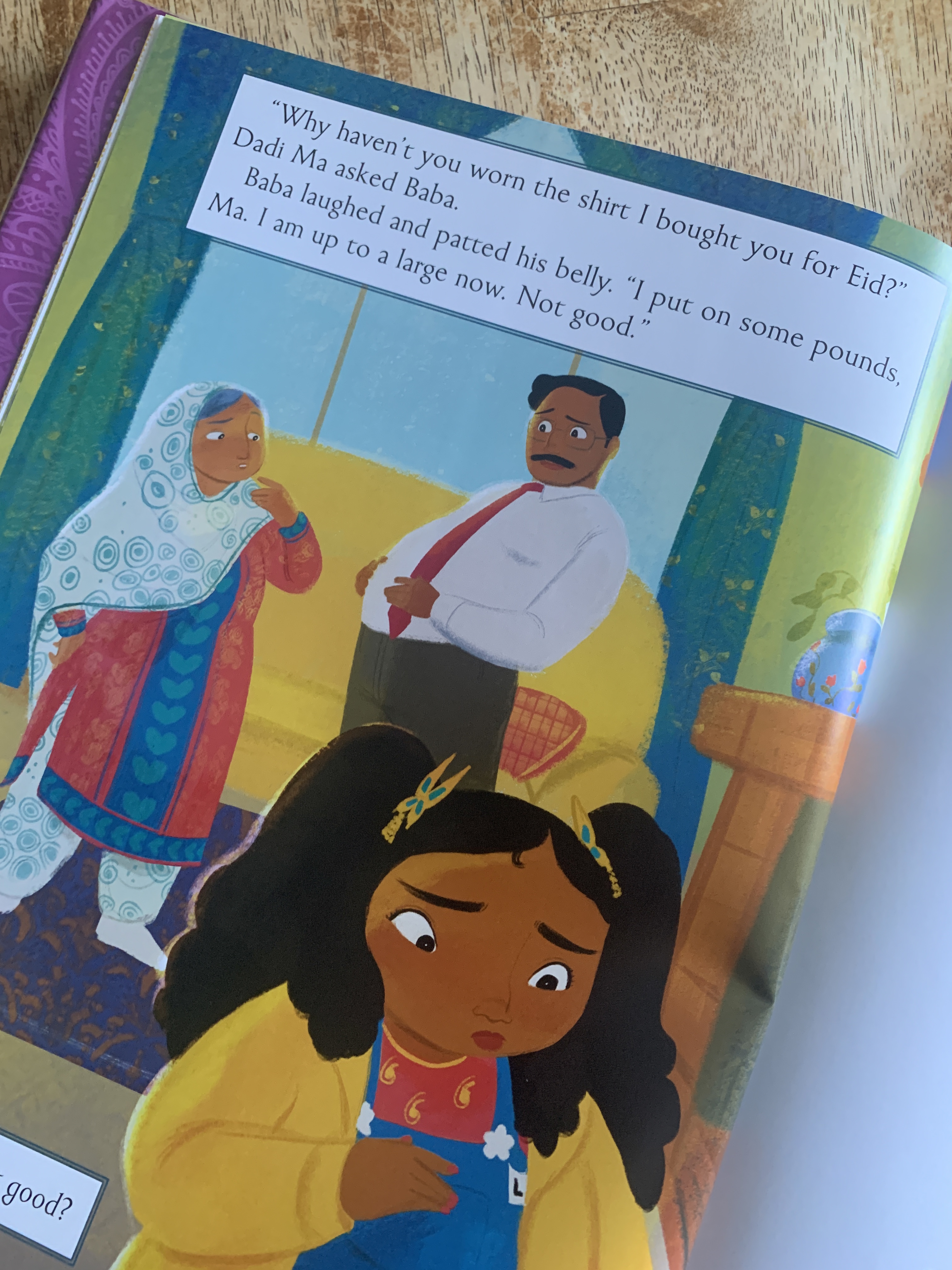
Zubi is excited for her first day of school, she slides on her dress and shirt her mom had made for her in Bangladesh and her bangles on each arm.  She heads to her parents room to show off her outfit where she finds her mom in a gorgeous yellow sari complaining about her big belly.  At breakfast Dadi has made flaky parathas, but Zubi’s older sister Naya is dieting and would rather have oatmeal. Dad calls the girls to take them to school when his mom asks how come he hasn’t worn the new shirt she got him for Eid.  He embarrassedly admits he has put on some pounds and his size is now a large, not good.

img_3978

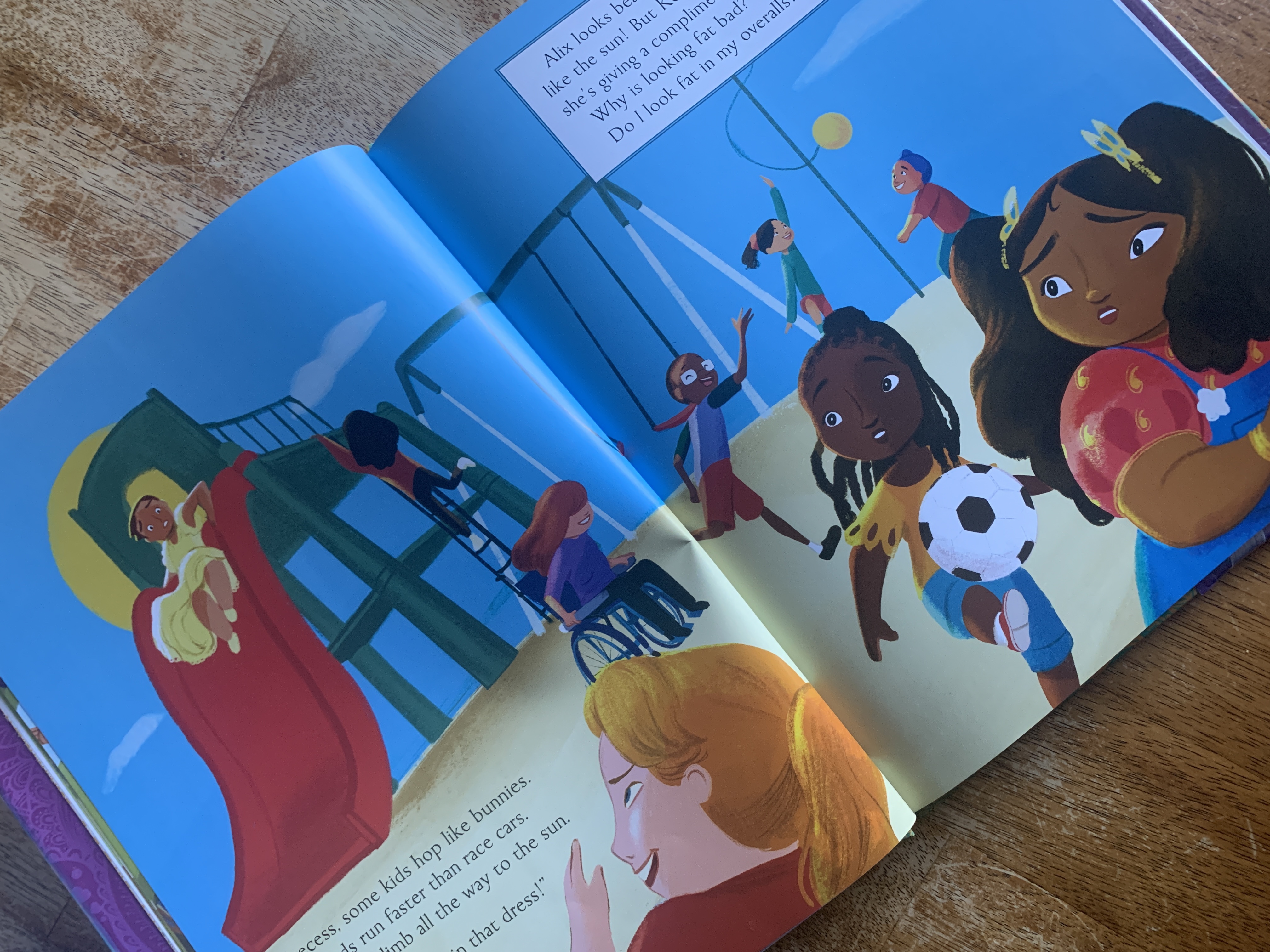
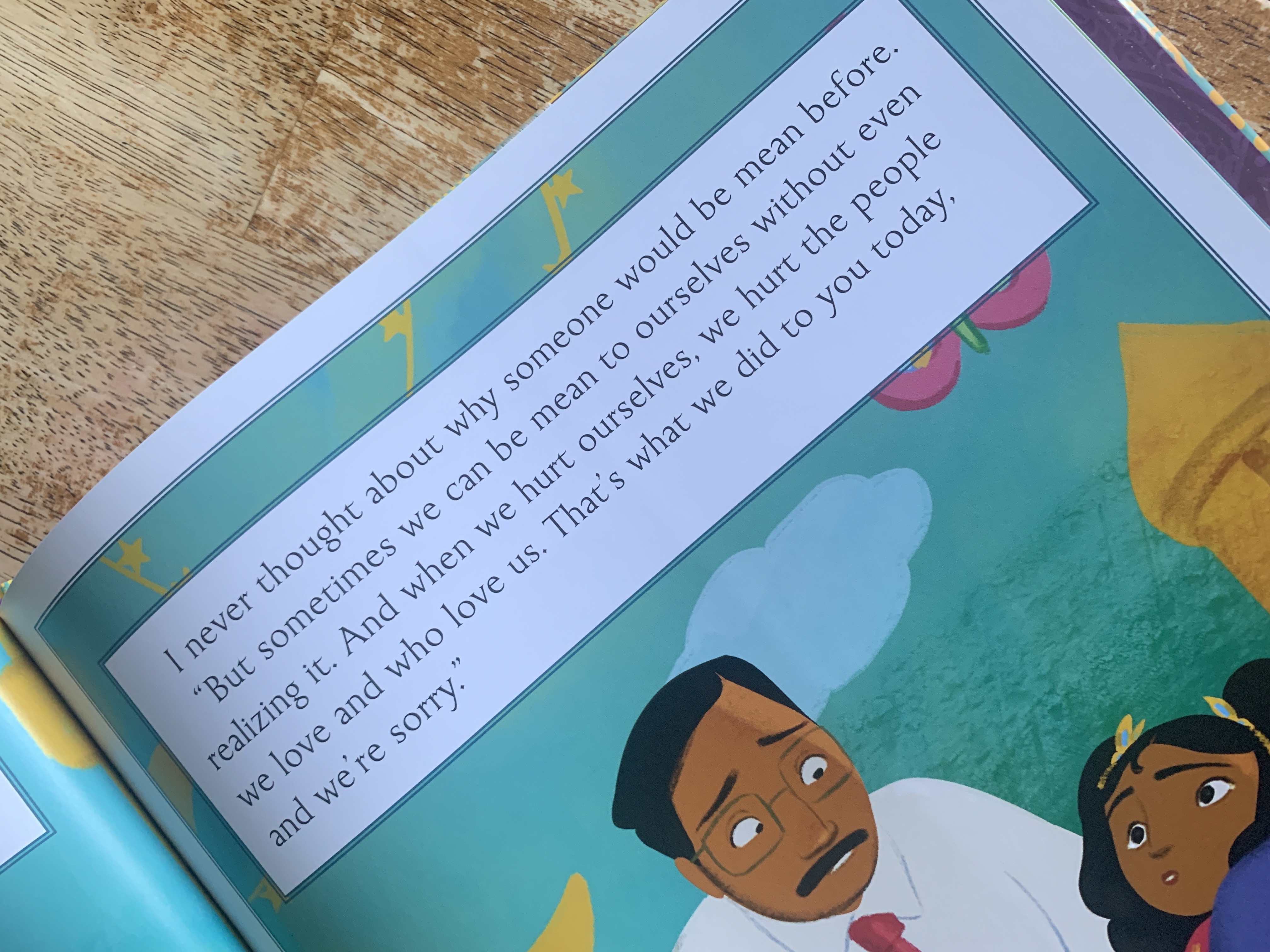
At school she is having fun and even makes a new friend, but at recess some one yells that Alix looks fat.  Alix is wearing a yellow dress that Zubi thinks is beautiful and doesn’t understand why when they are called fat in it, it comes across as negative. After each incident Zubi mulls over what she is hearing and what it means for her, once she is home though she isn’t quite ready to talk to her family about it.  At dinner, it all hits her as she decides she too shouldn’t eat, that she should be on a diet to be pretty.  She heads off to her room, as her family realizes the impact of their own views and words about themselves, have had on Zubi.  The family works to unpack their own mistakes and be better all while making sure the message to Zubi is that you are beautifully you.

img_3979

I like that the book has the dad helping the mom put on her sari, and the dad comes and chats with Zubi about what happened at school.  Mom might be in the medical field, she seems to be wearing a white coat over her sari, which is subtle and impressive that she is going to work in a sari for anyone that has ever tried to wear one and simply get in and out of a car (just me maybe).  I do like that the mom remarks that she should be kind to her body since it housed her daughters.  I think reminding us that bodies serve a miraculous function is important.   I love the diversity in the classroom and how full of life Zubi is in all aspects of her day.   She is proud of her culture, and sees those around her as being bright, kind and funny, not just the shape of their bodies.  Some of her self reflections after an incident do highlight that many kids, including Zubi, don’t see body size as good or bad, its just one’s body.  Hopefully the adults reading the book will also be reminded and realize that is a message worth actively working to maintain, at any age.

img_3980

I think some of the criticism about the book not showing healthy food choices, or overall health is that we sometimes expect one book to do it all when there aren’t a lot to chose from.  The book celebrates being beautiful AND being big.  It doesn’t need to address all the societal and adult baggage that comes from food choices, lifestyle, health, judgement, stereotypes, etc.. And I think if you feel really strongly and defensive about it, then focus on pushing for more books, not one book to do it all.  Encourage illustrators to show a variety of body types on the pages of books in young children’s hands as well as by toy makers, cartoons, movies, tv shows, etc..  Body positivity and being confident in yourself, no matter your size, shape, appearance, benefits everyone. Celebrate being beautiful.

img_3981

I went for Hajj by Na’ima B. Robert illustrated by Paula Pang

Standard
I went for Hajj by Na’ima B. Robert illustrated by Paula Pang

hajj

Before I review this delightful book, I would like to make a public service announcement of sorts.  It is not Hajj season, not even close.  I pre-ordered this book on June 23 from Amazon, I should have/was supposed to have it before Hajj in the middle of July.  I got it TODAY! When I realized that the US publication date was delayed for a book already published in the UK, I reached out to Kube Publishing and they suggested trying “an independent bookseller such as IslamicBookstore.com or CrescentMoonStore.com.”  I know this.  Noura is a dear friend, but I messed up.  Please don’t do the same.  SUPPORT LOCAL BOOKSELLERS! I’m sorry, lesson learned.

img_3841

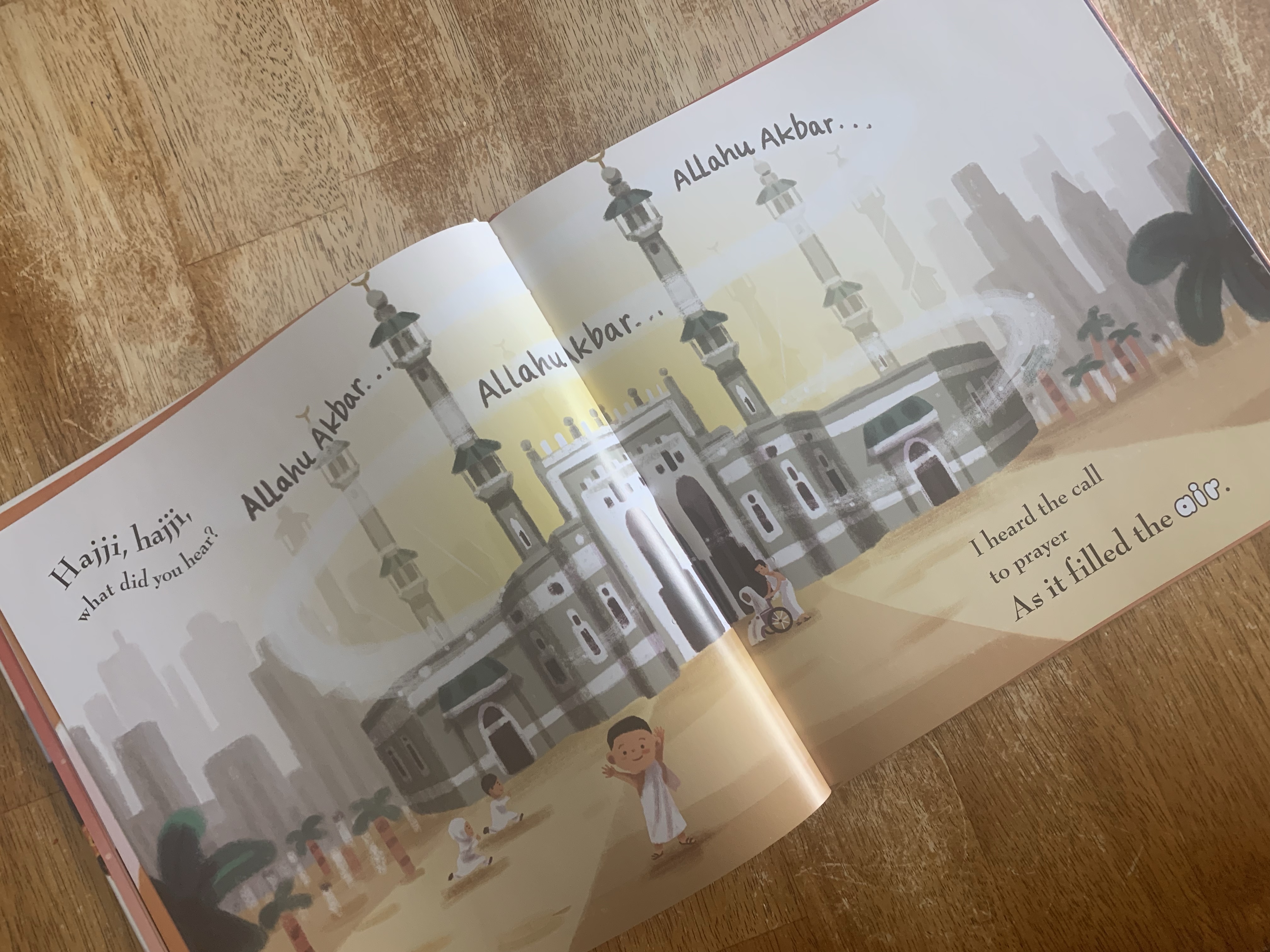
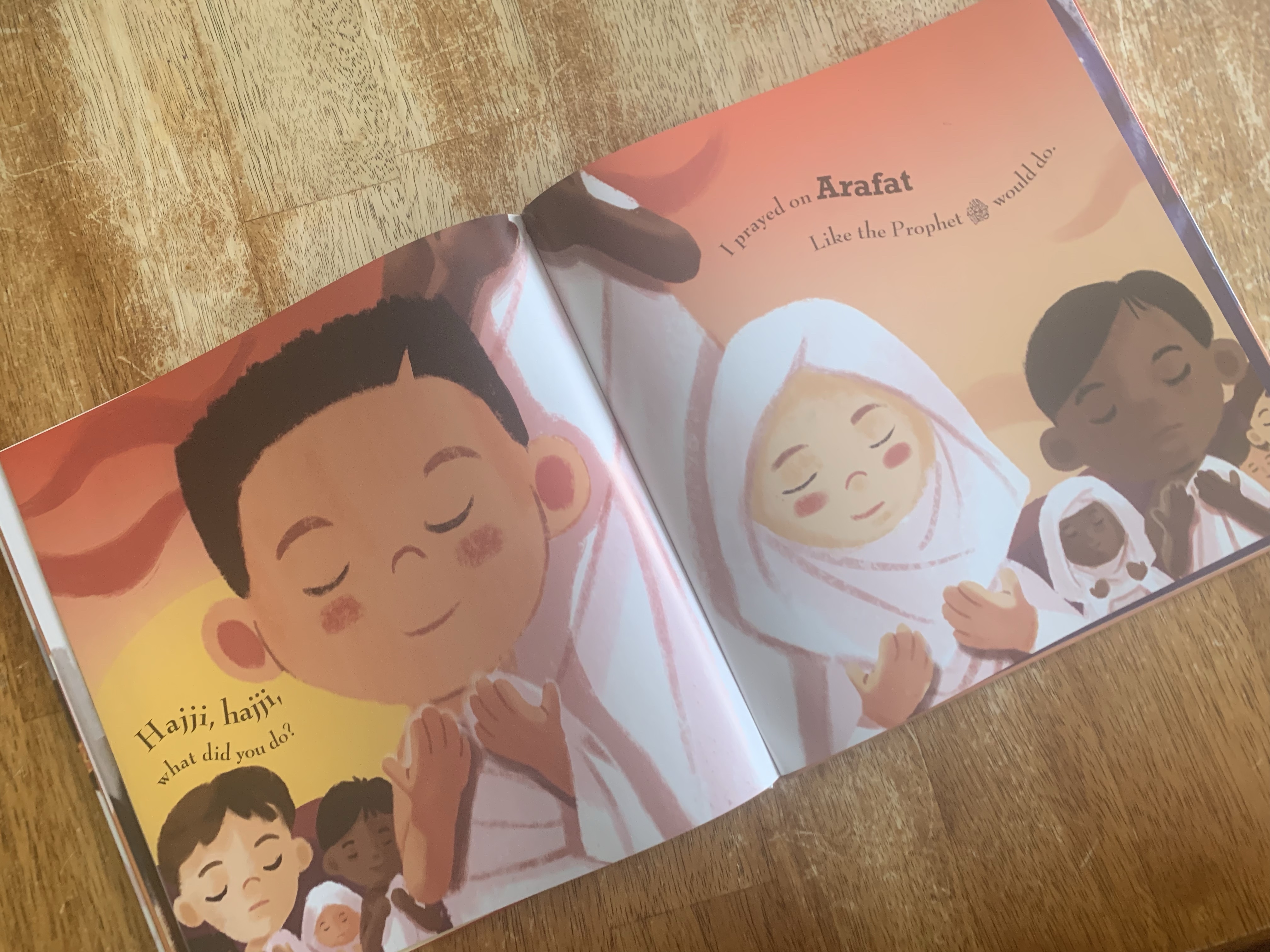
Now back to the book that already feels like a classic staple that needs to be on every Muslim families book shelf, and in every public learning space for non Muslims to enjoy and benefit from as well.   The 31 page “inspirational, semi-fictional narrative” is perfect for ages two to seven as it mimics the beloved Eric Carle and Bill Martin, Jr. classic, Brown Bear, Brown Bear, What Do You See? but framed around Hajj and what is seen, done, and heard.  Each two page spread begins with, “Hajji, hajji…”.

img_3842

The book starts with a detailed Note to Parents and Teachers that explains the points to highlight, and discuss with children.  The story is then organized by the steps of hajj in broad strokes and illustrated with both charm and detail that will hold readers and listeners attention.

Hajji, hajji what did you wear?

I wore two white sheets

And my shoulder was bare.

img_3843

The book starts with the little boy narrator on the plane looking down on the clouds and sea. He then puts on his two sheets, hears the call to prayer,  sees the black stone and the station of Ibrahim before he makes his seven tawaafs, runs between safa and marwa and heads to Mina. He prays at Arafat like the Prophet (saw) did, and falls asleep in the cold night desert air.  He sees stones being thrown and eats meat on Eid before getting his head shaved.  The book concludes with a glossary.

img_3840

The book is well done and is a great mix of information and entertainment, alhumdulillah.

Barakah Beats by Maleeha Siddiqui

Standard
Barakah Beats by Maleeha Siddiqui

barakah

I have been waiting for this book for a really long time: a girl leaves an Islamic school for a public middle school and is not just unapologetic, but proud of who she is and of her religion, all while navigating such a huge life change and the day-to-day stresses of school, family, friends, and life. This is it right, the middle grade 288 page book that holds up the mirror to our own experience as a typical Muslim family in the west, that so many of us have been waiting for? Except, sigh, for me it was just ok. Don’t get me wrong, if you are new to seeing mainstream (Scholastic) Muslim protagonists shining and making their salat on time, this book is revolutionary and amazing. But, I’ve been doing this a long time, and I guess I wanted more than a tweak on Aminah’s Voice. I wanted to relate. I’m not a hafiza, nor do I know many 12 year olds that are. I enjoy boy bands, but have never been asked to join one. Sure the details and her decision to follow Islam the way she understands it is a great message, but it doesn’t clearly appear til nearly the end of the book, and until I got there my brain was constantly finding holes in the narrative, to the point I got out a notebook and started taking notes. There is absolutely no reason you shouldn’t read the book, and I know I am clearly in the minority here, so brace yourself this is a long review. If you see this at your child’s book fair and you think it looks cute, grab it, it is. I am cynical and jaded and I’m owning it, so perhaps we can agree to disagree, I’m just sad that I didn’t absolutely love it, so hold on, because I’m going to get it all out so that I can move on, inshaAllah.

SYNOPSIS:

The book opens with Nimra at her Ameen, a celebration to acknowledge her completion of not just reading the entire Quran, but of memorizing it. Her best friend Jenna, her non Muslim neighbor, is there and as everything is explained to her, the readers learn about Surah Yaseen, becoming a hafiza, and the schooling differences that Nimra and Jenna have had. That night when Jenna is sleeping over and the girls are watching Marvel’s Infiniti War, Nimra’s parents inform Nimra that she will be starting public school and that the two girls will finally be together. The news is big, but Jenna shrugs it off, and Nimra senses that something is off between them. When school starts, Jenna is surprised that Nimra is planning to wear her hijab to school, and this is before they have even left in the morning. The rest of the day: comments by Jenna’s friends, purposefully being excluded at lunch by Jenna, and being overwhelmed with a big school and so many teachers, makes Nimra miss her small three person Islamic school. Additionally she loves art, and is always tucked away in a corner with a sketch pad, her parents, however, have made her take Spanish instead of art class, and the frustration is painful. When she asks the principal for a quiet place to pray, another girl Khadijah pipes up that she can pray in the band room where she does. Khadija and her immediately hit it off, but she has already prayed, so Nimra sets off on her own to find the room. As she is about to start, some music starts, so to tune it out and focus on her salat, she recites aloud. When she exits, three boys are in awe at her vocal abilities: Bilal, Waleed, and Matthew, three Muslim boys. Better known as the middle school celebrity boy band, Barakah Beats, the boys beg her to join them. Nimra says she’ll think about it, but as the days show her and Jenna drifting further apart, being in the band might just be the way to get Jenna to pay attention. Unfortunately, Nimra’s family doesn’t believe Islam allows for musical instruments. She acknowledges that it is controversial, but that her family doesn’t play any instruments, attend concerts, or get up and dance. She figures she can join the band, just long enough to get Jenna’s friendship back on track and then dump the band without having to tell her parents. There is just one giant hiccup, they are planning to perform at a refugee fundraiser, oh and she really likes hanging out with the boys and Bilal’s sister Khadijah.

WHY I LOVE IT:

Had I read this book five maybe seven years ago, I’d be gushing, swooning, but when the author says in the forward that she is showing a girl proudly owning her religion, and essentially daring to be her authentic self, I expect something almost radical, revolutionary even. We are all settling in to seeing our Muslim selves in fiction and acknowledging that we are not a monolith, that we are diverse and flawed and valuable, but this premise felt different somehow, and I really wanted to connect with Nimra and her family, so when I didn’t, it hurt. It isn’t just a main character Muslim POV, or an OWN voice book, it is portrayed as being authentic to those of us that love our faith and don’t feel like we need to tone it down to be American. We are second or third generation American Muslim, we know our deen and this is our country, there is no going back to a homeland or assimilating. The book is about her being true to her self, but I don’t know that I know what she wants or what she believes, aside from her parents. The book addresses intergenerational conflict of power and expectation between her parents and grandparents, but other than for Spanish vs Art class, it seems to skim by the music issue, the main issue of the book. The book expects readers to acknowledge the maturity and voice of a 12 year old girl, but that same expectation isn’t given to the readers of nearly the same age. It glosses over any articulate arguments for why musical instruments are or are not allowed. It mentions that some people feel it is ok if the lyrics are not bad, some say it isn’t ok, that there are disagreements, that there are controversies, but it never explicitly answers, why? And readers are going to notice. I found it incredibly odd, that the music controversy is at the heart of this book, but the safe alternative is art and drawing. Drawing faces is a HUGE point of differing opinions among Muslims, perhaps as big, if not bigger than music. Nimra is always sketching and it mentions that she often is drawing super heroes: people, with faces, and possibly (magic) powers! The whole book she is in the band, and she regrets that she is using it to get back at her friend, but there isn’t a whole lot of internal debate if she thinks music is haram like her parents or it is ok, she just stays in the band, and plots how she will leave it so her parents don’t find out. SPOILER: I like that she ultimately makes the decision that is best for her and leaves the band after fulfilling her commitment, but we never see that, that is what her heart is telling her. There is no self exploration or critical thinking, it is just justifying why she is doing it, and then not doing it.

In terms of character development, only Nimra is really explored, the side characters are all pretty flat. Jenna gets some depth, but not much. I mean, how does Nimra’s best friend and neighbor who comes over every day after school not know that she has been working on memorizing the Quran? Not know how to dress at a religious themed celebration, a halter dress, really? Jenna is never shown to be a good friend, or even a nice person, the tone around her is negative from the start. We are told she is a good friend, but we never see it. The conversation about Nimra wearing hijab to school is like two lines, but is made to be a much bigger issue in Nimra’s head as she feels things haven’t been right since then. But, I’m not buying it. The girls go to movies, they go shopping, and she wears hijab, so why would school be so different? All of Jenna’s friends know about Nimra, so she can’t really be that embarrassed by Nimra’s scarf if they go out when she is wearing it and none of the other classmates seem surprised. I also felt off with the portrayal of the character because we so fervently believe that often the best dawah or even method to break down stereotypes and bigotry is to get to know some one personally. Jenna knows all of Nimra’s family and has for nearly her whole life, and she is so hateful and clueless to everything Islam? It is a stretch, the family prays, fasts, dresses Islamically, cares for her, feeds her cultural food, yet she is oblivious to it all. I get that her hate or lack of interest is probably reflective of how a lot of our neighbors are, but there aren’t many non Muslims in this book, and that portrayal is going to linger heavily for young readers.

Nimra is likeable enough on the surface, but the more you think about her, she isn’t really any different than those she is hurt by. She is mad when Julie assumes she doesn’t speak English, but she assumes Matthew isn’t Muslim because he is white. She checks her self in other ways, but this one seems to slip by. Other inconsistencies I noticed are when the first day of school teachers are really mean to her, but then it is never mentioned again. I wanted to know did they keep at it, did she prove them wrong? It was built up and then just abandoned. At her old school there were two other girls doing hifz, but when she meets up with one at Saturday school it seems they both are no longer at the school either. Did they graduate? Did they abandon it? Her Quran teacher comes to see her perform a song, perhaps a little understanding about her point of view in addition to the other Muslim’s in the band would have helped explain the why music is controversial in Islam. Also, does and would ADAMS allow music at an event? I’m genuinely curious. I even tried to Google it. Most masjids probably wouldn’t, but maybe a community center would. Readers are going to be so confused why Nimra is so stressed when the religious teacher and the place of worship are fine with it.

The friends as boys thing is sweet, but a little surprising, having three boys come over to hang out and watch a movie, high fiving them, sure it isn’t shocking, but its a bit inconsistent given the narrative. Plus, Nimra trying to help hook Waleed and Julie up? For as much as the book doesn’t want to sell itself out, little acts like this without a little hesitation or comment or introspection, kind of make it seem like its trying to normalize non Islamic acts as being ok.

I love the pop culture Marvel references, The Greatest Showman songs and the shoutout to Amal Unbound. I even loved the Deen Squad remixes getting acknowledged, but it made me wonder if all the songs of Barakah Beats are Islamic themed. Perhaps it doesn’t matter, but it would be interesting to know since the entire school adores the band, even asking for autographs at one point.

FLAGS:

Nothing a third grader and up couldn’t handle: music, art, lying, bullying, talking about crushes.

TOOLS FOR LEADING THE DISCUSSION:

I think I’d pass on the book as a middle school book club option, as it really is a middle grades read, and the thematic issues brought up for discussion are better found elsewhere. If I had an in person classroom, however, I would have the book on my shelf, it is a quick short read, that I think might encourage a discussion on music to take place, or at least allow readers to see a proud Muslim doing well in different environments.
Llama Out Loud by Annabelle Sami illustrated by Allen Fatimaharan

Standard
Llama Out Loud by Annabelle Sami illustrated by Allen Fatimaharan

llama

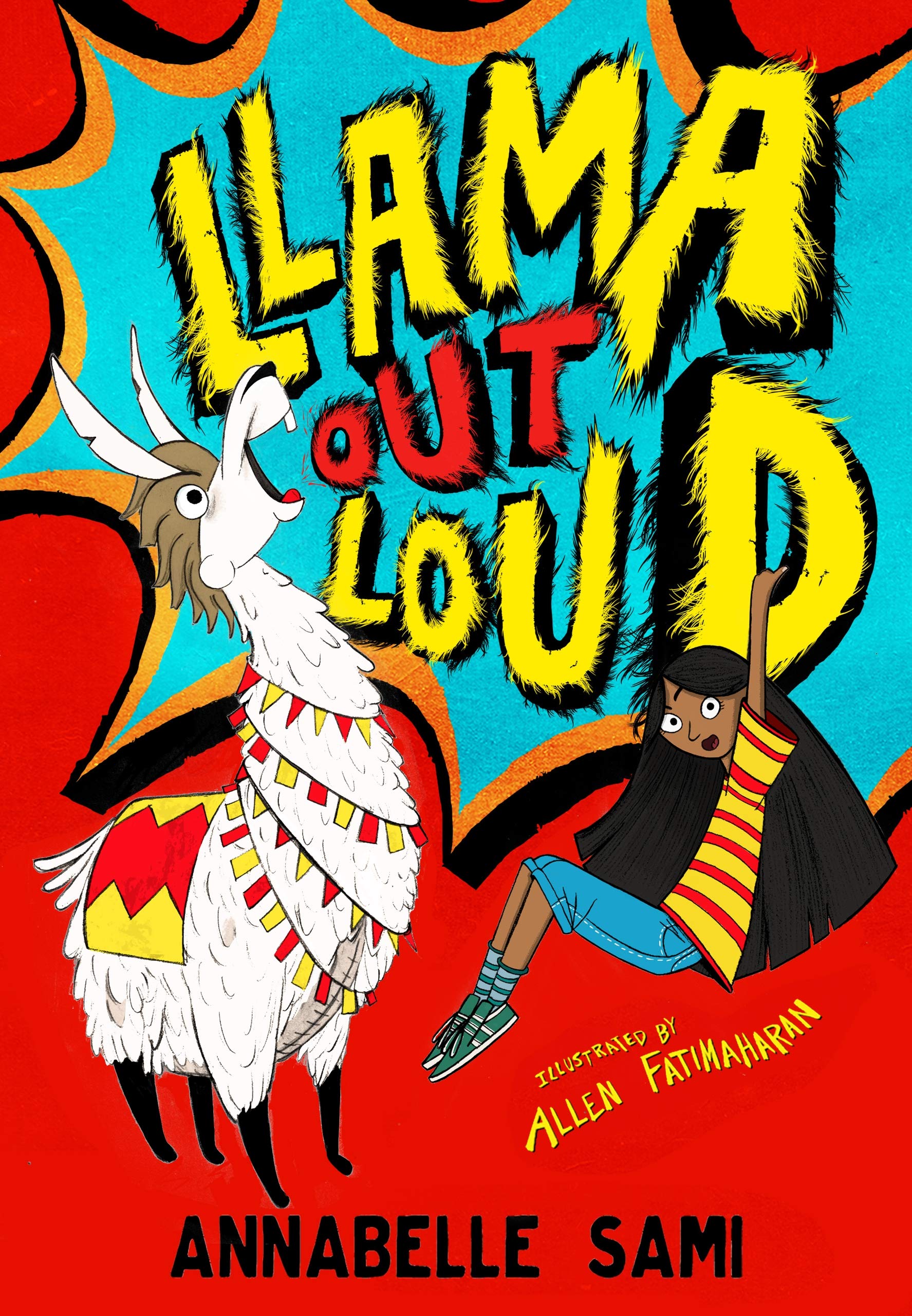
This 245 page middle grade doodle filled novel features a Pakistani-British protagonist as she endures life with a family that yells, brothers that prank, aunts that meddle, and now a magical talking obnoxious stuffed llama.  Yasmin Shah stopped speaking years ago, and a 10th birthday wish has brought about Levi, a llama who uses highly unconventional methods to help Yasmin stand up for herself and find her voice.  At times funny, tender, and relatable, the book similarly often feels really forced as it relies on predictable jokes for cheap laughs:  bum worms, wee wee taunts, the threat of being sent to Daadi in Pakistan as a punishment, bras and knickers being thrown around, etc..  The overall message is good and silly, and middle graders will probably feel some anxiety and frustration with Levi, but ultimately enjoy the book, and look forward to future books in the series.  

SYNOPSIS:

Yasmin lives in a full loud home.  It is her 10th birthday and she feels completely unseen.  Her mom has made her a lovely cake, but when her brothers use pepper to make her sneeze, the cake gets destroyed and she once again meets the wrath of her family.  She wishes she could stand up for herself, and just like that her life gets a whole lot crazier.  A stuffed old stained llama she saw in the market and her aunt decided to gift her, has sprung to life and won’t stop talking.  Levi seems determined to make Yasmin’s life even more miserable.  He shows up in her backpack at school and his misguided help gets her detention, he doesn’t want her to be friends with the octogenarians she plays checkers with at the local senior center and embarrasses her and gets her banned, life at home is more miserable too as he takes revenge on Yasmin who keeps trying to get rid of him.  At times it is hard to know if Levi is really trying to help and is just really misguided, or if he is out to get her.  As Yasmin loses her elderly friends and the chance to be checkers champion at the OLD home, she slowly lets new kid Ezra wear her down and possibly be her friend.  The climax reveals not just her voice, but a remorse for Levi that further helps Yasmin determine what her life will look like moving forward.

WHY I LIKE IT:

Antics aside, the story is about Yasmin being pushed/encouraged to be heard in her life.  The jokes amplify the need for her to find her voice and defend herself, her love of the old people and determination to win the checkers tournament is endearing, and her struggles with kids her own age shows real heartache.  I absolutely love Ezra and his mannerisms.  He is new at school, trying to meet Yasmin where she is at, and encourage her all while trying to focus, channel his energy, and fit in as well.  Yasmin’s family redeems itself and I think readers will get the exaggeration of much of the antics, but really Levi is annoying and while younger readers might find him hilarious and well-intentioned, I think anyone older than the intended audience will just want to strangle him.  

The illustrations, the comic strips, and the little flourishes on the pages are wonderful.  They bring the book to life and provide the charm and humor that the text needs to connect with the readers.

The only religious thing mentioned is Eid at the beginning.  Some of the women in Yasmin’s family wear a scarf on their head and her teacher wears hijab, it isn’t mentioned in the text.  I could not find if the author or illustrator identify as Muslim, I read that the author’s father is Pakistani so culturally and perhaps experience wise it is OWN voice, and reads with a lot of authenticity.  

FLAGS:

Possible verbal abuse, anxiety and bullying.  Mention and illustrations of undergarments.  Plotting and planning to harm/destroy a magical talking toy.  Practical jokes, threats, lying, deception, back talking, deceit.

TOOLS FOR LEADING THE DISCUSSION:

I don’t think I’d use this as a book club selection as it is for younger children than middle school.  But I think it is a fun book to have around the house and classroom for middle grade readers to pick up and chuckle over.

The Muslims: Book 1: The Test by Ahmad Philips

Standard
The Muslims: Book 1: The Test by Ahmad Philips

the muslims

This is the first anime comic book in an eight book series aimed at early elementary readers.  Often books have lessons, this however, simply presents as an illustrated moral.  There is a situation that contains the lesson that one should always try their best for the sake of Allah swt and that is about it.  The knowledge isn’t tested a few additional times or in different situations, it is just 22 pages to illustrate the concept of doing things for the right reason, in this case studying after a failed test.  There isn’t anything wrong with the bright colorful book, the brother sister duo read authentic as they try and recall Islamic teachings, and get each other in trouble by accident, the diverse family is supportive and understanding, it just seems that it would apply to a specific lesson in a home or classroom and then sit on a shelf unasked for and not very memorable.

img_2858

The book starts with seven year old Hani trying his best on a multiple choice test that he didn’t study for.  He battles the personified Quiz Monster to no avail and on the way home from school confesses all to his little sister, Huda.  She reassures him that Allah swt doesn’t give us more than we can handle and agrees to not tell their parents.  Hani plans to tell them himself, inshaAllah.

img_2859

When they get home though, she slips, and spills the news to their mom.  Their dad comes home soon after and everyone knows.  The parents he imagines will turn into evil monsters themselves, but rather they laugh and remind him that he should have the intention of pleasing Allah swt in all things, so that he will assuredly never fail.  That if he makes that his goal, then he will inshaAllah find success.  Hani decides that he isn’t going to be careless in his studying and keeps focused.  He has a nightmare that he studies the wrong material, but alhumdulillah it is just a dream and he is ready, inshaAllah.

img_2860

The Islamic lesson and the situational allegory isn’t super clear, and I feel some discussion will need to take place to connect all the dots and convey the lesson in a way to be succinct and memorable.  Had he maybe made dua or intention before he studied, then the message would have been put in to practice, not just something the father talked to him about.  It is admirable that Hani was honest, that he didn’t try and hide is score, which I wish would have been praised.  Additionally, a little resolution between the siblings to show all was forgiven would have been nice.  The mom wears hijab even in the home, and there is a glossary at the end as well.

Zara Hossain is Here by Sabina Khan

Standard
Zara Hossain is Here by Sabina Khan

zara

After reading a few chapters of this book, I really had no intention of finishing it, knowing that my review highlighting the main character’s bisexual identity and romance would draw critiques from both people that don’t want to see Muslim character’s identifying as any of the LGBTQ+ labels and those angered by my mentioning of them as potential flags.  Alas, I did finish the book, and I am reviewing it because as a (former) Islamic School Librarian, I would want to know how much romance is in any book that I would shelve or recommend, and this book particularly gives no insight about any romance in the blurb on the inside flap.  The author’s first book was very clearly about being a queer Muslim, but this YA short 244 page book focuses a lot on Zara’s relationships, her parents support and acceptance of her being bisexual, and her new romance with a girl.  The book is not graphic or even overly steamy, but the blurb suggests the book is only about immigration, hate crimes, and bullying.   So, I write this review to give a heads up to parents, like me, that might see this book on the library shelf or if like the author’s first book, which was picked up by Scholastic, in a school book fair, and not realize that there is a fair amount of discussion about her sexuality and how it is perceived in the Pakistani and Islamic culture, as well as how she doesn’t see the need to fast in Ramadan or pray five times a day, but still identifies as Muslim.  All that aside, I also didn’t love how the book was written, it is a lot of telling and not showing, I feel like the mom is painfully underdeveloped and flat, and the story threads don’t weave together consistently;  it reads scattered.  The book is pretty short for YA and with so many heavy themes, it ultimately can’t spend much time exploring any of them particularly well, a shame since the author in real life seems to have endured much of what she writes for her characters in regards to immigration status and citizenship.

img_2132

SYNOPSIS:

Zara Hossain is a senior at a Private Catholic school, in Texas, she has friends that have over the years become family as the parents too regularly get together.  Zara came to American when she was three.  Her family left Pakistan for more educational opportunities and after her father’s pediatric residency, he stayed on with a work permit and green card waiting for citizenship.  The process continues to drag on, and it isn’t finalized.

A boy at school, Tyler, is harassing Zara for being Muslim, an immigrant, and brown.  Her father wants to discuss it with the principal, her best friend Nick wants to beat him up, and her mother just worries.  When finally a meeting with the principal is set, Tyler’s father doesn’t show, and things escalate.  Zara’s locker is defaced with profanity, Tyler is suspended, and the Hossain’s house is vandalized.  When Zara’s dad, Iqbal, goes to talk to Tyler’s father, he is shot, by Tyler’s dad.  He ends up in a coma in the hospital.  During all this Zara is crushing and pursuing a relationship with Chloe, who has just come out to her parents.  Zara’s family is very accepting of Zara being bisexual, and take Chloe in when she needs a break from her conservative Christian family.

Tyler’s dad is well connected in Corpus Christi, and while Iqbal recovers, he is faced with trespassing charges.  Although trespassing is a misdemeanor, by pleading guilty and paying a $200 fine, a criminal record will further complicate their citizenship status, and where they call home.

WHY I LIKE IT:

I like that it shows how messed up legal immigration often is. Dr. Hossain is the victim, he is shot,  he is a vibrant member of his community, but is being forced to leave and uproot his family.  The issue however about trespassing isn’t ever completely clear, the reader is never given a play-by-play account of what happened that night.  I wish we were.  It would be nice to not leave that area gray.  Also a lot of what lead up to Tyler causing Zara so much trouble is rather glossed over.  I wanted to hate him and be angry with him, and then be forced to examine how much was his doing and how much was his father’s, but I never really felt that emotion until the book told me to be mad.

I vaguely recall from the book that she is in a religious high school, the inside flap when I took the picture (see above) seems to stress it more than the story does.  She does mention that they couldn’t start a Pride Club, but I wish she would have talked a bit about being Muslim in a Catholic school, or better yet, shown the reader.  She doesn’t come right out and say that all Muslims are different and this is her.  I wish she would have, instead she talks a lot about being annoyed at having to explain why she doesn’t pray and fast.  Yet she never tells the readers why she doesn’t.  She goes to mosques to counter Islamophobic protests, and talks of going to Sunday school to learn Arabic as a child, but she is very clear that she was encouraged to question religion and God, but not what she found or why she still identifies as Muslim if she doesn’t believe it.  I was curious if she doesn’t believe it actually, why fast at all? If she is still questioning, why not say that.  I really felt that Islam and being Muslim was just a box to be checked to justify the hate crime, but really, she could have just focused on the culture.  There are Urdu phrases, and lots of foods mentioned, she clearly loves Pakistan and talks highly of it and often points out the good and bad in both Pakistan and America.  Food is in the book a lot, and not just Desi food, frozen yogurt is a crutch for the story, and it gets a bit annoying.  I wish there was as much character development as there was food detail and banter.

I liked that her parents defend and stick up for their daughter.  Whether you accept the lifestyle of Zara and her family or not, it is wonderful to see families stick together.  The nosey aunty got put in her place and if you have ever had to deal with the stereotypical aunties or the threat of what everyone will say, you had to cheer for Zara’s parents.  I don’t care what your thoughts are about LGBTQ+, that scene was awesome.  Great job Iqbal and Nilufer.  It was one time that Nilufer got to shine, I really don’t get why Zara’s mom is relegated to the cooking, feeding, worrying stereotype for much of the book.  I lost track of the number of times the book says, “no need to worry your mother,” or something to that effect.  The lady clearly is loving and strong, but doesn’t get developed, and it is frustrating.

The ending is a bit abrupt, yes time is ticking, and whether to move to Pakistan or stay and fight the system is definitely not an easy decision, but how is Canada suddenly the magical answer? I assume for most it is enough, and being the OWN voice tale seems to be very close to reality in this regard, I have no room to roll my eyes, but Canada has civil rights issues with Muslims too, and this 2021 published book kind of made it seem like it is just the perfect answer to all their problems.

FLAGS:

Violence, bullying, Islamophobia, profanity, vandalism, crime, shooting, stereotypes, hate, lying, straight and lesbian romance, crushes, kissing.

TOOLS FOR LEADING THE DISCUSSION:

This book would not work for an Islamic School middle school book club selection.

The Sky at Our Feet by Nadia Hashimi

Standard

This 295 page middle grades AR 4.8 book is a fast passed romp through New York City as two 12-year-old kids explore freedom and fear in a new city while grappling with their own sense of identity and what it means.  The OWN Voice story features immigration, chronic disease, family, bravery, and friendship.  There is lying and avoiding police, sneaking and “borrowing” a horse, but it is all for a good cause, and third grade and up will enjoy this read.  There is very little religion in it, but the main character does say salam, notice the similarities between amen and ameen, and reference eid as his holiday. 

SYNOPSIS:

Jason D, known only to his mom and aunt as Shah, was named by a nurse when his mom wanted to make sure he had an American sounding name, and his middle initial D is for December, which comes from her staring at a calendar when asked if she wanted her son to have a middle name.  Life is fairly simple, he enjoys sneaking on to the roof of his apartment building to imagine training pigeons, his mom works at a dry cleaners, they walk where they need to go, money is tight, but they do ok, and his dad passed away before he was born.  His mom is from Afghanistan, but he doesn’t speak much Dari and his mom speaks English, but not confidently.  On her birthday as they are about to enjoy a cupcake he saved up for, the news in the background is covering protestors chanting for illegal immigrants to go home, and Jason’s mom starts to tell him about how she ended up overstaying her visa and  is living in the US illegally.  

Jason’s dad worked with the US military in Afghanistan and with his work came the promise of visas to America for him and for his wife to study.  Many of the locals though didn’t like that he was cooperating and vowed to take their revenge.  With the family in the US and Jason’s mom starting to study medicine, Jason’s dad had one more job in Afghanistan and sadly was killed by anti American Afghans.  Fearful to return, she chose to stay, but with a new baby, few resources, no family and friend support, eventually she was forced to drop out of school and remain undocumented knowing that to return would be at great peril to her and her son.  At some point she befriends an Indian lady, Seema and to Jason, she is Aunt Seema, the only family other than his mother that he knows.  

When a few weeks later Jason sees his mother being taken away by two officers, he knows that this is what she warned him about when she told him the truth about her legal standing.  Terrified and alone, Jason only knows that somehow he has to get to New York to Aunt Seema so that they can figure out how to save his mom.  He grabs a few pictures of his father, whatever money he can find a broken address and heads to the big apple from New Jersey.

Having never been to NYC or really out of his hometown, he loses his backpack to a dog, and struggles to figure out how to get a ticket to get in to the city.  When he arrives at Penn Station he is overwhelmed and exhausted and passes out, hitting his head, and landing himself in the hospital.  

When he awakens he is met by doctors making sure he is ok, and police trying to locate his parents, he opts to pretend he has amnesia and can’t remember anything.  This buys him time, and also acquaints him with Max, a girl with wires coming out of her head and who claims they are running tests on her to understand her level of genius.

The two hit it off and hitch a plan to escape the locked hospital floor, have a day of adventure in the city, and get Jason D to his aunts house.  Naturally this plan is going to have all sorts of obstacles, but thats the story and that is where the fun and discovery unfolds.

WHY I LIKE IT:

I was impressed at how emotionally cathartic the conclusion was.  I hadn’t realized how invested I had become in these two kids and their run through the city.  It was touching, and heartfelt, and a big sigh of relief when it all wrapped up.  I like that both kids are so very different, yet dealing with similar thematic issues from different perspectives.  Max is an epileptic and is kept on a short chain to ensure her safety. She is trying to find and define who she is outside of the medical diagnosis.  Jason is trying to understand if he can be American and Afghan and what that means about where he belongs, and where home is.  There is a lot that they ponder over as they run through central park and the zoo, duck into subways, and get all sorts of turned around on the streets.  Through it all though the kids show just how clever and smart they both are with the quick thinking, riddle solving abilities, and perpetual optimism.  It is at times far fetched, stealing a horse and bumping in to your doctor in the New York City Marathon, and at other times completely plausible, sneaking in to a zoo with a field trip group and ducking through turnstiles to get on the subway.

FLAGS:

Lying, stealing.

TOOLS FOR LEADING THE DISCUSSION:
This is a bit young for even early middle school readers, but would make a great addition to a summer reading list.  I think kids will marvel at the riddles and determination of the two protagonists and imagine a world where kids could maybe get away with such a bold adventure.