Tag Archives: 2021

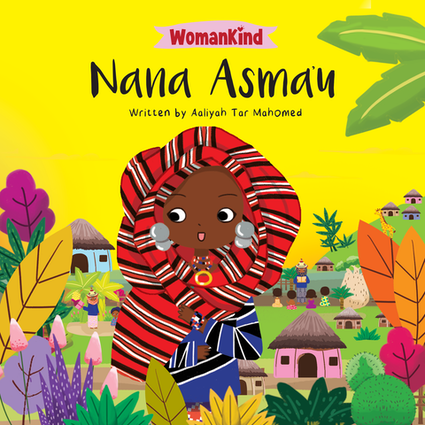
Nana Asma’u by Aaliyah Tar Mahomed illustrated by Winda Lee

Standard
Nana Asma’u by Aaliyah Tar Mahomed illustrated by Winda Lee

nana asmau

This book may only have 14 pages of text and be meant as an introduction for early preschool aged children and up, but I learned so much, or rather was made aware of so much that I knew nothing about, that I’m now eager to research her and the Sokoto Caliphate and the impact of Jajis.  The beautiful, bright, engaging pictures, the simple deliberate text, and the inspiring content matter make this a great book to share with little ones, and to keep on the shelf for repeated readings and reminders to learn more about this remarkable woman for older children.  My only wish was that there were some reference notes or sources included to give that extra reassurance of authenticity.

img_6076

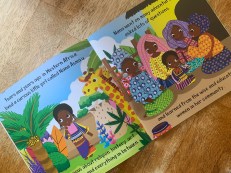
The book tells about Nana Asma’u’s life starting from being a curious child and asking questions to the wise women in her community.  By the time she grew up she had memorized the Quran and spoke four languages amongst many other things, and Nana loved to write poetry.

img_6077

During this time, there was a lot of conflict in Western Africa, and Nana’s father, Shehu Usman resolved the issues and created the Sokoto Caliphate.  With peace, Nana wanted to help educate the people. She thought long and hard about how to do it.

img_6078

She eventually brought together women from different regions of the Caliphate and taught them through poetry, she then sent the women back to their homes to share what they had learned.  These women were known as Jajis, and this tradition still exists today.

img_6079

I didn’t love the phrasing that she had learned all about Islam, seeing as one can always learn more.  And I would have like Prophet to have been capitalized and salawat given for respect.  Overall, a great book that alhumdulillah I was able to purchase from Crescent Moon Store.

The Unexpected Friend: A Rohingya Children’s Story by Raya Rashna Rahman illustrated by Inshra Sakhawat Russell

Standard
The Unexpected Friend: A Rohingya Children’s Story by Raya Rashna Rahman illustrated by Inshra Sakhawat Russell

friend

I have mixed feelings about this book. On the surface I am thrilled that there is a story highlighting the plight of the Rohingya for children and that it includes some character depth and relatability to global readers. On the flip side, the book is very vague and could be any refugee in any camp and is not Rohingya specific. Additionally, I feel that it is too idyllic. I am no expert by any means, I wouldn’t even say that I am well-versed, but the book paints an impression of a thriving organized camp with medical help, orderly food lines and a vibrant school. Yes, it talks about the lines being long, and naturally if you are out collecting firewood, it is a bit rugged, but I don’t know that the lasting impression is a humanitarian crises. I understand that in a 36 page, kindergarten to 2nd grade book, political complexities and horrors are not a natural platform, but I worry that the aim of bringing attention to the situation will miss its mark by not capturing its truth more clearly.

img_5377

Faisal has just finished his afternoon prayer and while outside the mosque he hears a faint chirping and discovers a small bird with a hurt wing.  He and his friend Rahim take the bird to the learning center to be cared for while the boys head to the forest to collect firewood.

img_5378

The forest can be dangerous, but in order to cook, they must have wood to burn.  While in the forest, the boys encounter an elephant and remark on how they are depleting the animals’ natural habitat.  When leaving Faisal trips and falls, scattering his collected firewood and breaking his arm.

img_5379

Rahim offers to share his firewood with Faisal and the two head back to camp to get Faisal to the doctor.    Like the bird, who’s wing has been bandaged, Faisal now too has a hurt appendage.  The two spend every minute together for weeks, and when both have healed, Faisal admits he doesn’t want to let the bird free. He knows it is the right thing to do and alas allows the bird to go.

img_5380

The book has an afterword regarding Cox’s Bazar and information about the author and Save the Children Foundation.

Hello! A Welcoming Story by Gina K. Lewis illustrated by Maria Jose’ Campos

Standard
Hello! A Welcoming Story by Gina K. Lewis illustrated by Maria Jose’ Campos

img_5289

This 62 page early elementary story is told from two perspectives, you flip the book to read each parallel story from two points of view, the refugee children’s and the children welcoming them.  Overall, I feel it is very well-intentioned and gets a lot right, but I found myself not feeling comfortable with some of the messaging regarding the visibly Muslim character included.

img_5290

I love that there are characters of all skin tones both welcoming the refugees and the refugees themselves. And I love the vague universalness that binds all the refugees together being expressed:  that they love their home, they had to flee, the journey was dangerous, they left everything behind, etc..

img_5291

I also love the warmth and genuine compassion that comes from the welcoming children.  They are reassuring, open, and seem to truly want to provide confidence to their new classmates.  The simple text really conveys a lot of emotion albeit very idyllic, that provides ways that readers in similar situations can also mimic when welcoming anyone new.

img_5292

On one of the two story sides a map is included showing that the refugee kids come from all over the world, the side that did not have the map I worry might confuse young readers.  They might not realize that the five children do not all come from the same country.  There should be a map on both sides, ideally.

img_5295

The illustrations that show how the welcoming kids understand the refugee stories is clever in the showing of their understanding.  The images are similar, but the different style is a great emphasis on how we process from our point of reference facts that others have lived.

img_5293

The concept of a new kid finding everything so different and not fitting in, is a great concept to explore in terms of clothing and food and language, but for some reason I didn’t like how the girl in hijab was presented.  I’m ok that she took off her hijab to fit in, and that her classmates encouraged her to be herself, and put it back on, but the text is too over reaching, to an erroneous end.

img_5294

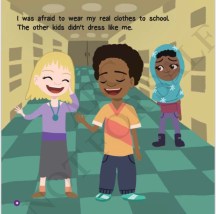
It says on one page, “No one looked like me, but most people smiled.”  Really, NO ONE? No other Muslims exist in your new home? It then says, “I was afraid to wear my real clothes to school.  The other kids didn’t dress like me.”  In the illustration her clothes are EXACTLY THE SAME, the only thing that changes is she has a scarf on. Hijabs are a religious article of clothing, they are not unique or country specific.  And what does real clothing even mean?

img_5296

I also didn’t like the text reading, “This is my journey’s end.”  That seems to imply that you leave the horrors behind, you build bridges, this is your home now, and that is it.  This is a children’s book, the message should be that there is so much more to you and to your life, and you will find welcoming people and be the one welcoming in the future.  I don’t like that it seems to carry the weight of finality to a person’s story.  People, all of us, are more than just a label.

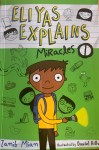
Eliya’s Explains Miracles by Zanib Mian illustrated by Daniel Hills

Standard
Eliya’s Explains Miracles by Zanib Mian illustrated by Daniel Hills

img_5692

It is quite remarkable how my standards and expectations have grown and evolved.  I anxiously have waited for the next book in the Eliyas series, having loved the Angels book that came out nearly two years ago.  Zanib Mian’s voice makes the reading of nearly all her books enjoyable, whether it is a fictionalized tale or an Islamic knowledge book with fictionalized framing.  This book disappointed me however, because I now expect and crave references and sourcing for books that present facts or at least qualified and named scholarly approval to be mentioned.  I also was not comfortable with the depiction of Buraq on the cover, on a full page illustration within the book, and on the back cover.  The text itself is lovely and informative, and nothing “seemed” off factually in this 92 page early chapter book, but the lacking reassurance of the content contained within prevented me from truly loving the book.

img_5687

SYNOPSIS:

Eliyas has finally convinced his family to go camping.  With a late start and a lot of chaos they will have to set up the tent in the dark, alhumdulillah there is a full moon out.  As they drive to their campsite and marvel at the moon, they begin to discuss the miracle of the moon being split in to two.  As they find a place to settle, they discuss miracles about water, as they collect firewood they talk about the tree where Rasul Allah gave khutbahs from crying when he moved to give the khutbah from elsewhere.

The family of Eliyas, his younger brother, older sister and parents learn and discuss the miracle of the Quran, Prophet Dawud and Prophet Sulaiman peace be upon them both speaking with animals, Buraq and the night journey, Prophet Ibrahim (as) being in the fire, Prophet Musa (as) dividing the sea amongst other things, Prophet Isa (as)’s ability to heal the sick and with Allah’s permission breath life in to a clay bird, and the she camel miracle of Prophet Salih (as).

The camping trip, the siblings bickering and then helping one another, and Eliyas having to admit to forgetting the food, all tie the miracles together in an easy to read and engaging manner.

img_5688

WHY I LIKE IT:

I really love Zani’b Mian’s books, and I genuinely hope that she will consider removing the illustration of Buraq and having the miracles sourced, or the book “approved.”  Kids will read this book over and over again, long after they have grown out of the early chapter book demographic and inshaAllah it will inspire deeper knowledge to be sought.

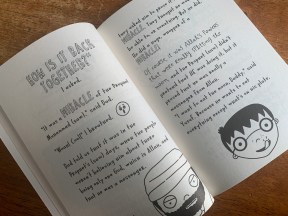
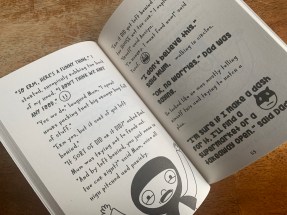
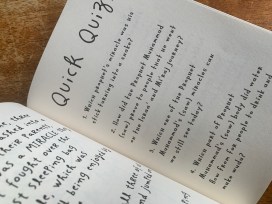
I love the quiz at the end-with answers, playful fonts and doodles throughout the book, the short chapters, and relatable banter between the characters.

img_5690

FLAGS:

Depiction of Buraq

img_5689

TOOLS FOR LEADING THE DISCUSSION:

Even with the depictions it could possibly be used as a read aloud story to first and second grade and up.  If you were a teacher or in a capacity to read the story to the students, so that they might not dwell on the illustrations, the book could be shared.  For reassurance, have someone more knowledgeable than I verify the miracles shared for accuracy though, before sharing.

This book, like so many of the books I review was purchased from http://www.crescentmoonstore.com and no I do not promote the store because it benefits me in any way, I just really the store, the service, the selection, and the prices.

Shems and the Magic Seabream by Alwia Al-Hassan illustrated by Ada Konewki

Standard
Shems and the Magic Seabream by Alwia Al-Hassan illustrated by Ada Konewki

seabream

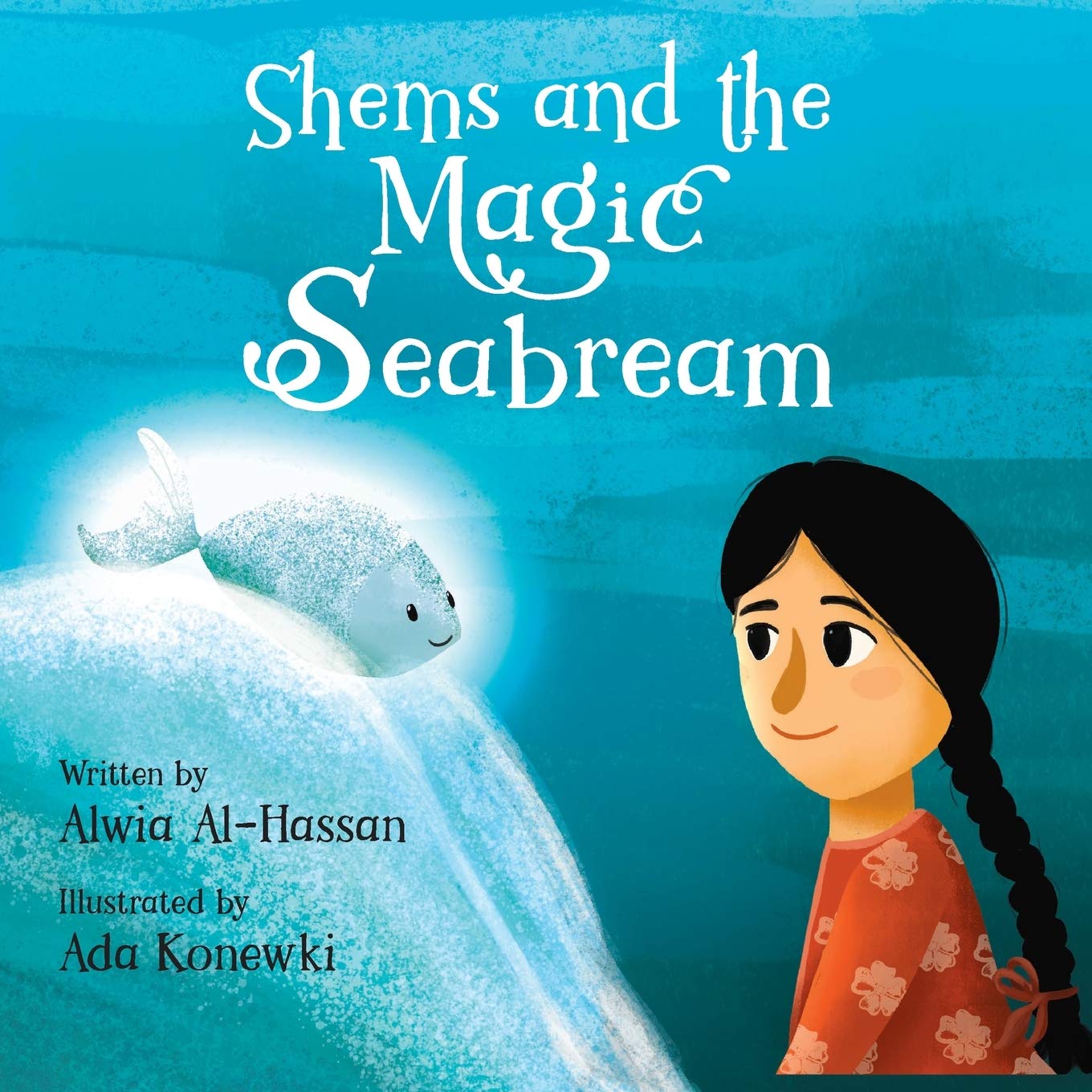
I don’t know how to review this book, I truly don’t, it claims to be based on Saudi folklore, it has #muslimsintheillustrations, and references Allah swt once, it is by a Muslim author, but it isn’t religious. And it definitely isn’t for everyone. It is terrible, and yet you can’t look away. Every stereotype about appearance and trope about step-mothers, it is all there, but EVIL CACKLE, the book is delicious, and not in the cooking the children and eating them sort of way, that is in the book too, but in the laugh-out-loud, gasp in disbelief, and be shocked at the complete disregard for political correctness, moral messaging, and lesson teaching that leaves a brightly illustrated dark tale for kids, and adults, to thoroughly enjoy. It pulls you in, it suspends reality, it makes good and bad so black and white that you accept the attempts at murder as justified, and it ultimately reminds you of the horrors that all fairytales build upon to entertain. I remember the first time as an adult I was asked to read Hansel and Gretel to a young niece. I knew the story, and started not thinking much of it, and then I froze: children are lost, they seek shelter in a home where they are not allowed to leave, the owner of the home wants to cook them and eat them. Yeah, this book is like that.

img_5299

Shems and her twin sister Shareefa live in a small town with their fisherman father. They are poor, but happy, until their father remarries and the stepmother is horrid. She is ugly and fat and covered in greasy spots, negative connotations that reflect her personality. (FLAGS: superficial judgement and body shaming). She hates children. (FLAG: Yes it uses the word hate, and calls children fat while contrasting them with cute children).

img_5300

She especially hates Shems and Shareefa. She tries to get rid of them: she puts them in the oven, abandons them in a field, tries to drown them in the night. But the girls somehow always escape and their father believes that it was all a misunderstanding. (FLAG: attempted murder).

img_5301

Now that the girls are older, they are forced to serve Mama Ouda, and when food runs low, she considers eating them. (FLAGS: abuse and threats). Luckily they are much too thin. One day when Mama Ouda is craving fish, Shems heads out to catch some seabream, yes that is a real type of fish. And the only one she catches is a magical one. (FLAG: magic).

img_5302

The next day Shems dressed as Shareefa recalls the fish’s promise near the water, and a basket of fish appears with pieces of sparkling gold. The girls eat like queens, hide the gold, and keep Mama Ouda fed. This carries on until they get caught and a murder and mermaid and moving out of their mud hut conclude the story and set up a potential sequel.

img_5298

The dad is pretty clueless and that has its own negative assumptions to counter, but if you and your kids can handle the over the top darkness, the story written in playful rhymes is sure to entertain and be asked for repeatedly. (FLAGS: stereotypes about fathers and stepmothers).

Huda F Are You? by Huda Fahmy

Standard
Huda F Are You? by Huda Fahmy

huda f

I think everyone has heard about this book by now and how fabulously fun, real, and relevant Huda’s life  is for so many.  I am happy to jump on the praising bandwagon, as this teen/YA 192 page graphic novel really is a great OWN voice unapologetically Islamic mainstream tale.  It does mention periods, relationships, hate crimes, and finding yourself, so probably 14 or 15 year olds and up.  My middle school boys read it, so it isn’t that it is inappropriate, just the target audience is more teen girl.  I know a lot of people, including Huda’s mom according to the inscription, have issues with the title, but I think it is brilliant.  She takes ownership of her name and it isn’t just for shock value, the book is about figuring out who you are, how you feel about Islam, establishing your friend circle, and growing and learning along the way.  My public library has it, as do major outlets, so what are you waiting for, go read, laugh, and feel seen.

img_5036

SYNOPSIS:

Huda has just moved to a new school and she is no longer the only hijabi.  She has moved to Dearborn, Michigan and there are A LOT of Muslims.  She is no longer defined by the cloth on her head, she has to figure out who she is.  Who she really is.  And sometimes the best way to do that, is to figure out who you are not.  

Huda tries different clubs, and different circles of friends, both at school and at the masjid.  Along the way she learns how much she craves approval and who is always in her corner.  When a kid at school is targeted for being Muslim, Huda will have to see how much internal hate she carries as well.  Her clothes change, her outlook changes, she tries new things, and she grows, all while the laughs help the story bounce from one serious topic to the next without coming across as arrogant or stereotypical.  This is Huda’s story and we are just along for the ride.

img_5035

WHY I LIKE IT:

I love that there is nothing to critique, it reads autobiographical even if parts are exaggerated or only based loosely in reality.  By being so real, and so well done, you are excited when you see yourself staring back, but you feel like you’re a friend learning about Huda even when you can’t relate exactly. Her comics online and her previous two books are all amazing, and I love that she is continually creating new material for us all to enjoy and benefit from.

img_5037

FLAGS:

She tells a boy she likes him that she doesn’t really like.  Periods are referenced and blood and a pad are shown, not graphic and gross, but the sentiment is there.  Discrimination is present, as is Islamophobia and stereotypes.

TOOLS FOR LEADING THE DISCUSSION:

Just keep the book out and around: it will be picked up, read, and mentioned, no tools needed.

Environmental Sunnahs: Emulating the Prophet One Earth-Friendly Act at a Time by Alia G. Dada illustrated by Sarah Hafeez

Standard
Environmental Sunnahs: Emulating the Prophet One Earth-Friendly Act at a Time by Alia G. Dada illustrated by Sarah Hafeez

This beautiful book explores how intertwined Islam and caring for the earth are in a kid appropriate manner.  The rhyming lines and fun illustrations are accompanied at the end by very detailed sourcing, references, and tips.  All non fiction or fictionalized fact books should be sourced this well, it really has set the bar, and left most books in the dust.  My only real critique of the book is that I wish it was larger.  The pictures and dancing text need more space to be poured over and enjoyed. The 8×8 size doesn’t do the 36 page book justice.  The inside text should also be a more uniform/consistent in size.  At times the rhyme is off and feels forced, but because there are facts on each page the story isn’t read consecutively.  You break the rhyme scheme to ponder over the “Did you know?” sections, so the beat and cadence isn’t super important.  Overall, a well-done book to share and discuss with children ages 5 and up, and a great reference, resource, and memorable teaching tool to bring us all closer to the prophetic mannerisms we strive to emulate.

img_5042

The book starts off with a message by naturalist, Director of the Art and Wilderness Institute and author of “How to Draw 60 Native CA Plants and Animals, a Field Guide (and my former childhood penpal) Sama Wareh.  It then jumps in to exploring the miracle of nature on land and under the sea. It shows desert landscapes, and mountainous ones, jungles, and farms, valleys and cities.

img_5043

The book talks about water: Zam Zam and wudu and where clean water comes from.  How little water we should use according to hadith and how to respect all living things. It talks about Prophet Sulaiman (as) showing kindness to even an ant. And how planting a tree is charity. It shares information about reusable goods, limiting waste, and understanding eco systems.

img_5044

The book concludes with easy to read Hadith references, Quranic references, a glossary, and action items.

Turning Back to Allah: Sulaiman’s Caving Calamity by Aliya Vaughan illustrated by Rakaiya Azzouz

Standard
Turning Back to Allah: Sulaiman’s Caving Calamity by Aliya Vaughan illustrated by Rakaiya Azzouz

turning back to Allah

Good early elementary books can be tricky: the voice needs to read authentic, the lessons not preachy, and the scenarios relatable, all while not talking down to the reader or talking above their comprehension.  As fabulous middle grade books seem to be popping up at record speed, I find myself reading the same old books with my fourth child who is six.  Alhumdulillah, this book was nominated in the Muslim Bookstagram Awards 2021 competition and I was able to purchase and receive it quickly from Noura at Crescent Moon Store.  My son can read it, although because of the British terminology, he did better when I read it to him, none-the-less, he could explain it, he genuinely understood and related to the main character, and was emotionally connected to the outcome of the story.  The 49 page, color illustrated story is perfect for independent readers first or second grade and up.  The book also contains comprehension questions, etiquettes for du’a, a list of times and places when du’as are answered, and evidence for the story from hadith.  Additionally there are ayats from the Quran at the beginning and end of this well sourced book, alhumdulillah.

img_4985

SYNOPSIS:

Sulaiman is getting ready for an overnight scout trip in some caves.  He is nervous having been stuck in his apartment elevators the summer before and being lost at a park with his family.  His stress has him being mean to his little sister, and his dad tries to mediate, but you can sense that their normal bickering is heightened because this is going to be hard for Sulaiman.  The scouts meet up to board their mini bus and Sulaiman is acting weird, he wants to sit by the window, he wants to read signs, finally he tells Jacob about his worries and the two boys agree to stick together like glue while they are in the caves.  Foreshadowing is set, and when Sulaiman’s batteries roll away and he stops to retrieve them he gets separated from the group and he will have to rely on his faith in Allah swt to feel less alone and brave what is to come.
img_4984

WHY I LIKE IT:

I love that when Sulaiman is arguing with his sister he doesn’t have hadith quoted at him.  Sure it is ideal, but really, as parents we just want the bickering to stop most times and our kids to be nice.  It is often easier to instill morals and lessons in calm times, not in the middle of an emotional kerfuffle.  At the same time, when he is scared, he falls back on the lessons he has been taught from the Quran and sunnah.  I love how it reads realistic.  We want our kids to turn to Allah swt for all things, but sometimes to teach that we encourage them to seek Allah swt in times of happiness and times of hardship.  Sulaiman is scared, really scared, and he turns to Allah swt, and it is heartfelt and emotional.

I’m embarrassed to say, but I was a little confused by the being lost in a park prior story thread.  It either needed more detail, or maybe just more context, but I thought it was the same park they are heading to with scouts, then realized it was a completely separate park and incident, so I would like a bit more framing of that story line.  Also the stress of being stranded in the elevator, doesn’t directly connect to the rest of the story, perhaps bringing up some claustrophobia fears would have helped tie it all together.  As it is, it just seems that Sulaiman seems to be tested a lot and rather traumatically.

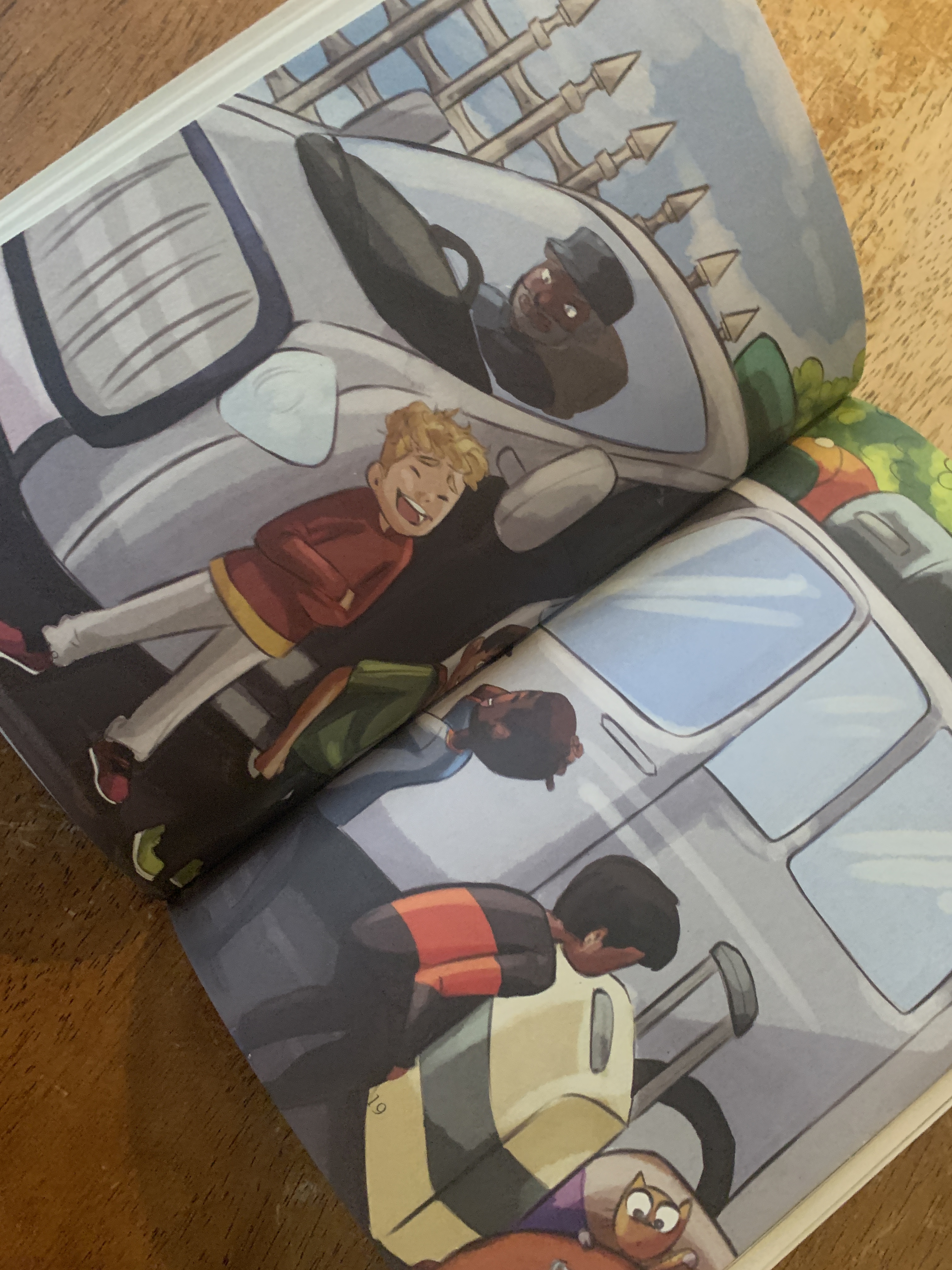
The illustrations being in full color and full page are a welcome surprise in the book.  However, there is one two-page illustration that shows the kids laughing before boarding the minibus, but it isn’t derived directly from the text, and I initially thought Sulaiman was being laughed at for his fears.  I went back, and it doesn’t seem that is the case, but I wonder if I was the only one confused by that illustration.

All-in-all the book physically is appealing to children with the open font, colorful pictures, size, and length.  The story is relevant, and the islamic tie-ins powerful, alhumdulillah.

FLAGS:

Some teasing, possible bullying among siblings.  Some scary moments mentioned and explored: being stuck in an elevator, lost in a park, left alone in a cave.

img_4984

TOOLS FOR LEADING THE DISCUSSION:

This would be a fun read aloud in a second grade class.

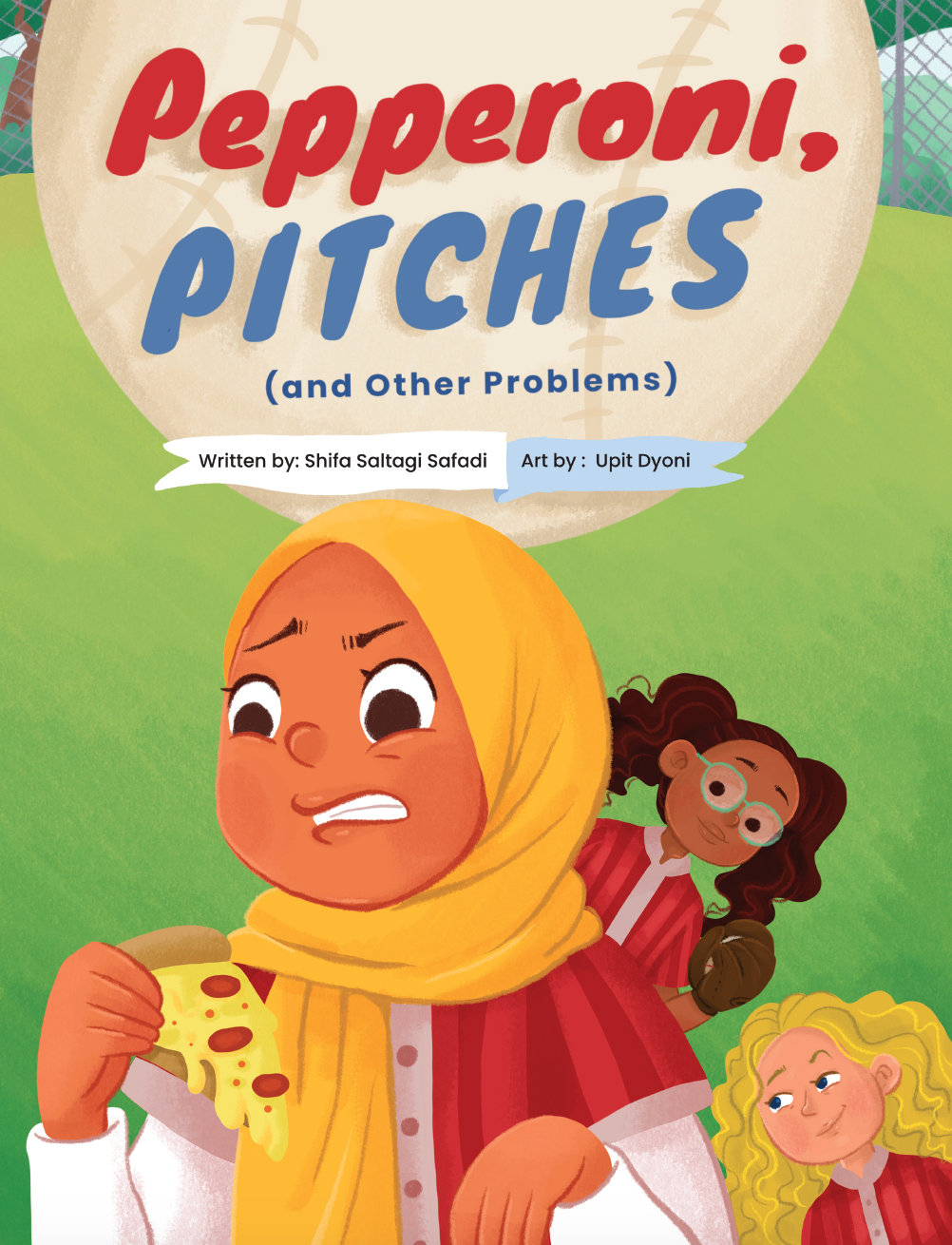
Pepperoni, Pitches (and Other Problems) by Shifa Saltagi Safadi illustrated by Upit Dyoni

Standard
Pepperoni, Pitches (and Other Problems) by Shifa Saltagi Safadi illustrated by Upit Dyoni

pitches

I absolutely love how smart this book is, and how it allows for elementary aged readers to feel that “aha moment” when they read it, get it, and realize that they need to remember the lessons because it could happen to them.  The illustrations are an added bonus and are perfectly aligned with the tone and text of the story.  My only issue, is the title.  Pitches reads as a euphemism for another word and since the book involves girl drama, teasing, and misunderstandings, it really is hard to not have that thought zap your brain when you see the title.  Perhaps if the “and Other Problems” would have used a bigger font on the word “Problems” the alliteration would have been more obvious, and hidden the word “Pitches” a bit.  If I’m alone in this, I apologize to the author and publisher, (I’ve mentioned my concern to them), but for others that saw the word and questioned the content, rest assured it is about baseball and the book doesn’t have even a speck of questionable content.

img_4682

Amira is at a new school, and luckily it is Tuesday, Pizza Tuesday to be exact, and she can’t wait to dive into a cheesy slice.  Unfortunately, Olivia takes the last cheese piece and when Amira asks if she will let her have it, Olivia says she had it first.  Stuck with an egg salad sandwich that smells, Amira sits alone and broods.
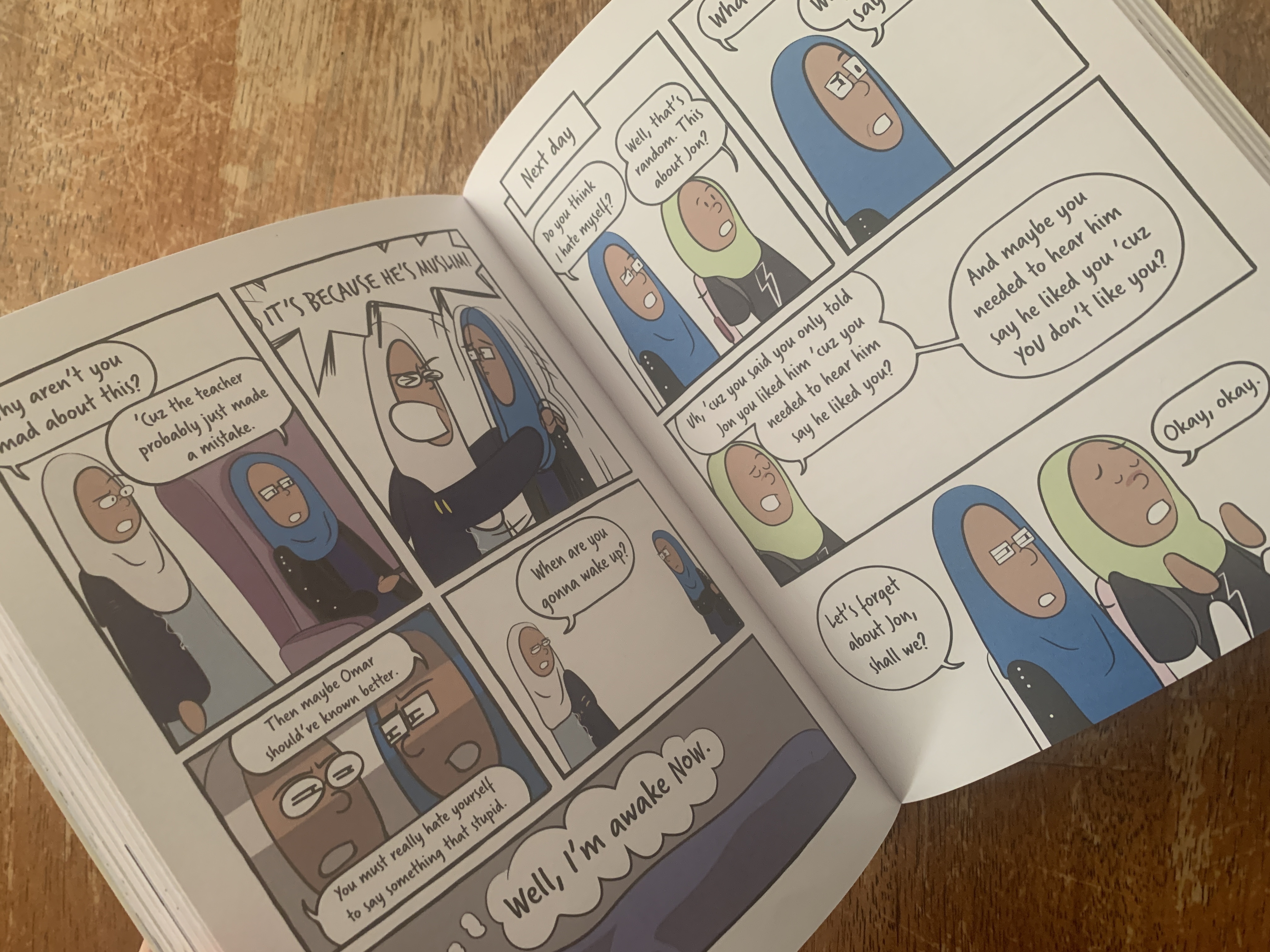
In gym they are playing baseball, but no one knows how good Amira is, and she is picked last.  When Amira is up to bat, Olivia is the pitcher and her pitches are terrible.  Amira still mad about lunch and afraid that the others will blame her for not hitting the unhitable balls, shouts, “you’re supposed to aim at my bat.”  Everyone laughs, but Olivia runs off clearly upset.  The new pitcher sends a decent throw and Amira hits a home run.  The captain of the team praises her, and Amira is hopeful she’ll have someone to sit with her at lunch.  After class, Amira sees Olivia crying in the bathroom and no one asking her if she is ok, Amira doesn’t feel so well, and doesn’t ask either. On the bus ride home Amira is greeted with cheers for her home run, but Elena the captain, isn’t among them.

img_4683

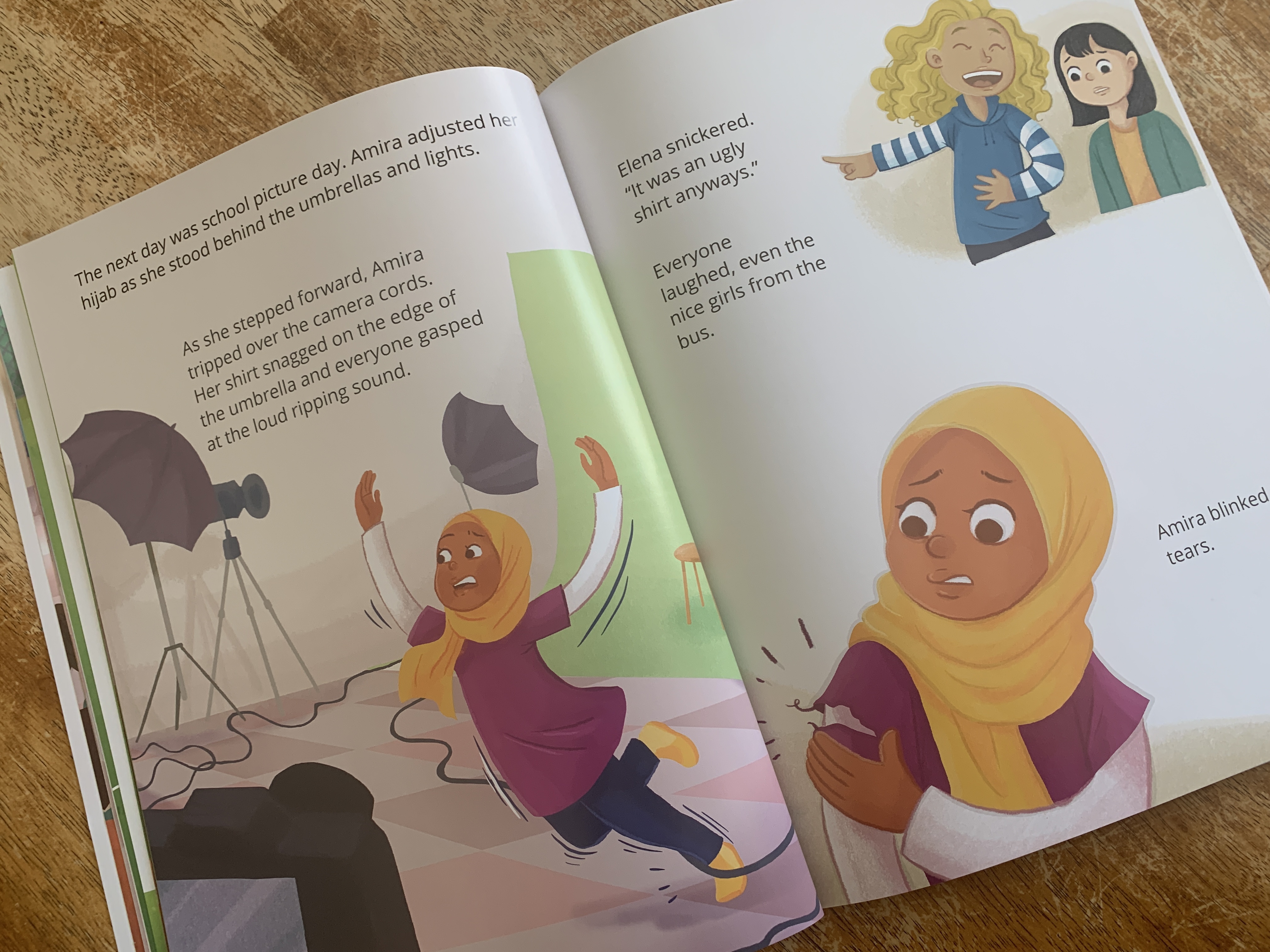
The next day is picture day, and Amira trips and rips her shirt.  Everyone laughs, Elena says, “it was an ugly shirt anyways.”  Only one person offers her help.  Could Amira have misread the whole class dynamics?  How should she move forward?

Sorry, I’m not going to spoil the ending, but the message about owning up to your choices is stressed, along with making kind decisions, and sometimes needing to take a step back and understand things from someone else’s perspective.

img_4684

Like nearly all Ruqaya’s Bookshelf books, the story is universal, but the characters, illustrations, and point of view is a relatable Muslim one that allows our young Muslim readers to feel seen and celebrated.  The reliable large glossy pages make the book a great deal for your money and is available on the publisher’s website: http://www.ruqayasbookshelf or from my favorite bookstore http://www.crescentmoonstore.com

img_4685

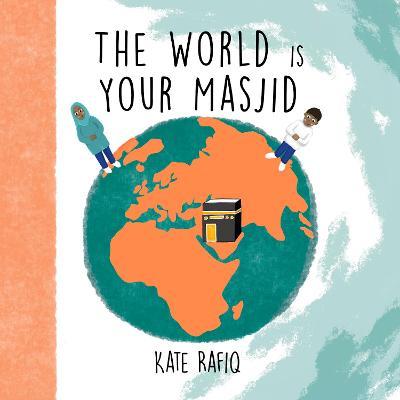
The World is Your Masjid written and illustrated by Kate Rafiq illustrated by

Standard
The World is Your Masjid written and illustrated by Kate Rafiq illustrated by

masjid

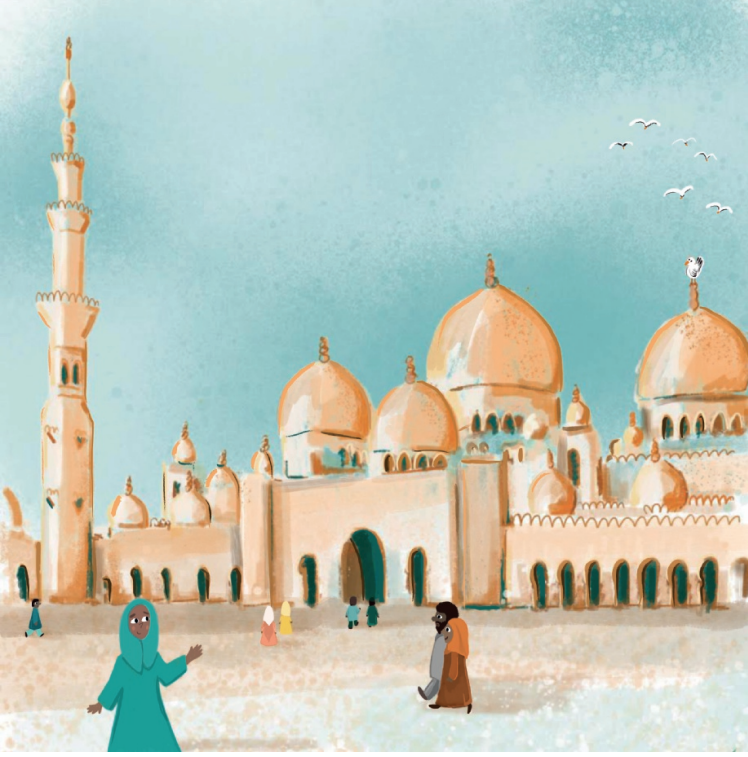
This 30 page preschool to early elementary aged book is a simple rhyming book that reaffirms all the places we can pray and touches on those that we shouldn’t.  The engaging illustrations and relatable scenarios make the book a great choice for bedtime stories and small group readings.  

Screen Shot 2021-11-17 at 11.33.41 AM 1

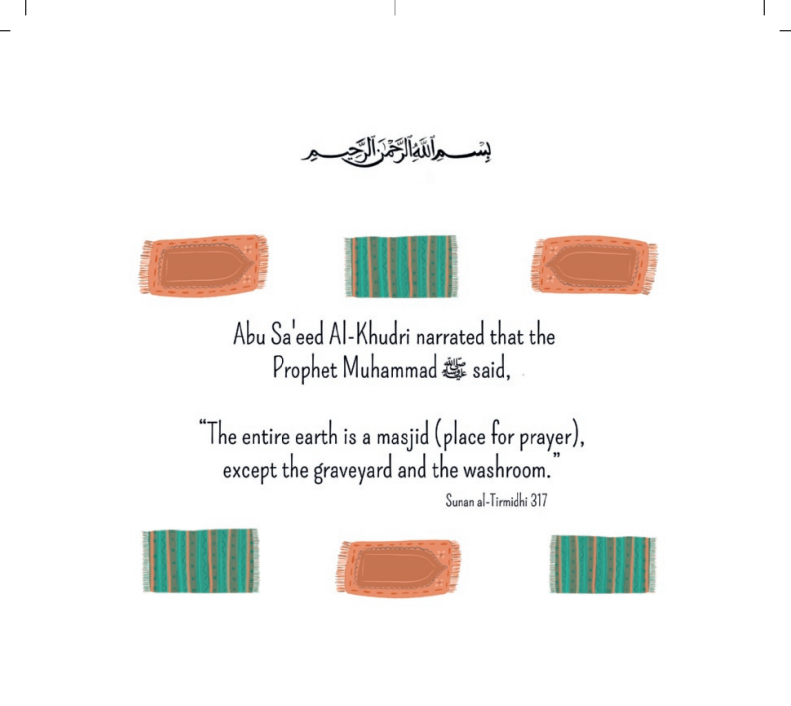
The book starts out with a hadith, “The entire earth is a masjid (place for prayer), except the graveyard and the washroom” (Tirmidhi-317) and points out that one must pray five times a day. Screen Shot 2021-11-17 at 11.37.00 AM

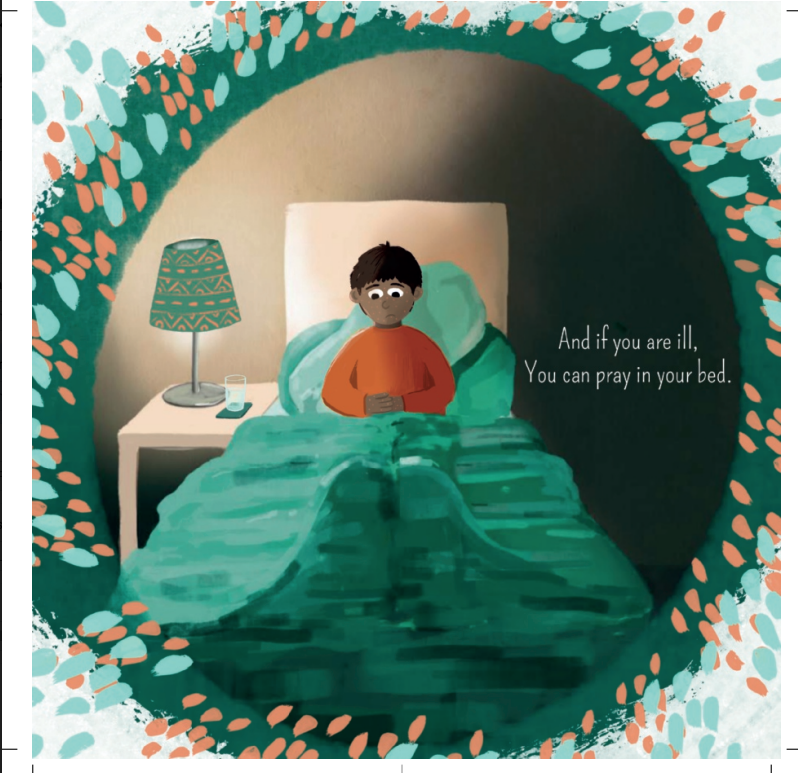
It establishes that if you pray it a mosque you can follow the imam, but not to worry if you cannot, because you can pray (nearly) anywhere: a field in the rain, school, a train, a garden, a shed, even when sick you can pray in your bed.

Screen Shot 2021-11-17 at 11.36.46 AM

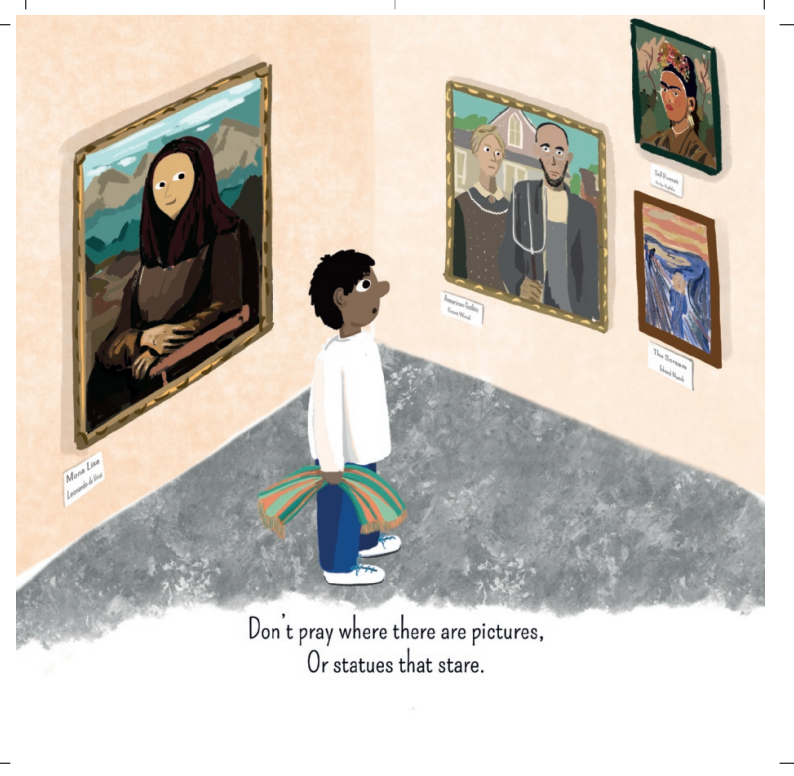
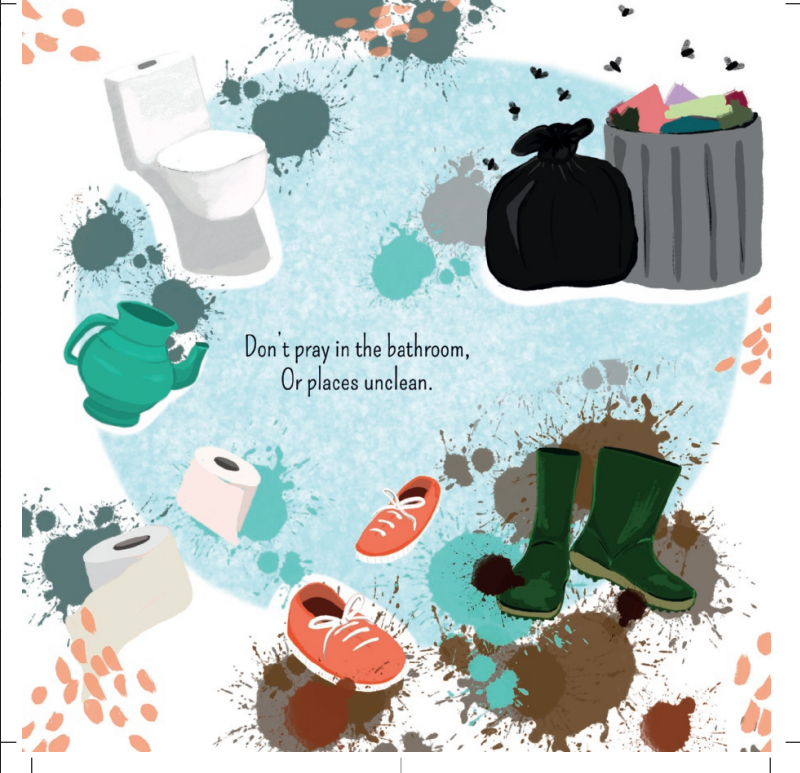
It then also turns to places you shouldn’t and can’t pray and sources a hadith about not praying where there are faces and statues that might distract you (Bukhari 374). The bathroom and graveyard are also included.  

Screen Shot 2021-11-17 at 11.35.05 AM

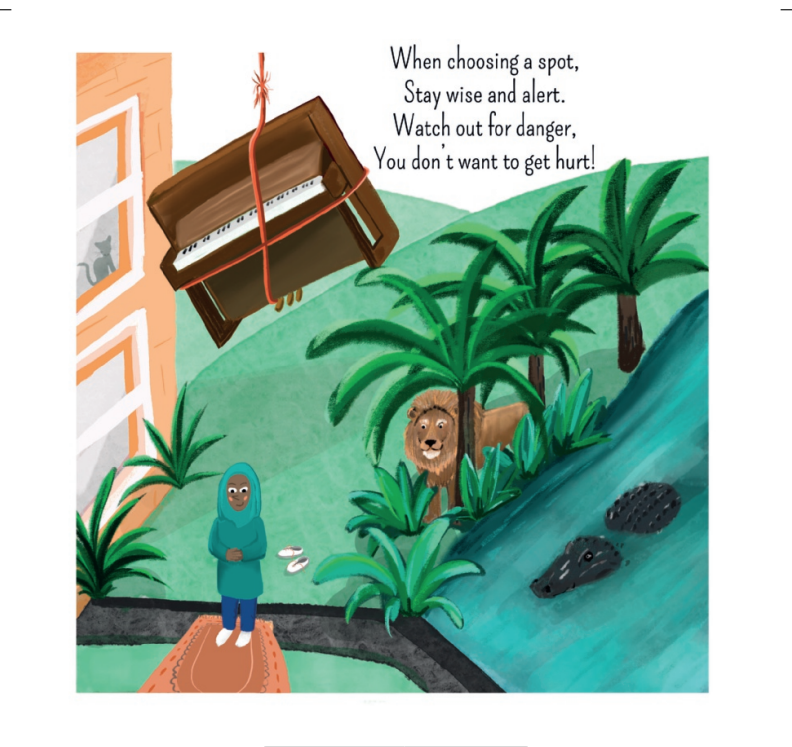
As an after thought, and for added laughs it reminds little readers to not pray in dangerous spots as well.

Screen Shot 2021-11-17 at 11.35.12 AM

Overall, I enjoyed the book and can see it pairing with In My Mosque to help create the foundation of a storytime theme about prayer and mosques.  The fact that it takes it a step further and doesn’t just list all the places serious and crazy that you can pray, elevates the book from being mediocre to being memorable and I appreciate that.  I also appreciate the Islamic sourcing, truly something that is required to show accuracy even in the “simplest” of all books.

Screen Shot 2021-11-17 at 11.35.30 AM