Tag Archives: series

Dark Nights and Light Hearts: A Muslim Book of Opposites by Hena Khan illustrated by Mehrdokht Amini

Standard
Dark Nights and Light Hearts:  A Muslim Book of Opposites by Hena Khan illustrated by Mehrdokht Amini

Every few years, for the last 13 or so, we get a new title in this series, and each one warms my cynical heart with its unapologetic Islamic representation and vibrancy.  The heartfelt rhyming lines, the Islam centering, and the enveloping illustration make these books timeless, sought after, and beloved.  This installment covers opposites, previous books in the series focused on colors, shapes, and numbers. From the BIG ummah to a SMALL baby’s aqiqah, HOT oud to COLD rain bringing barakah, SLOW honey full of shifa to FAST cars heading to Jummah, the book uses two page spreads per each term in the opposite pair with rhyming couplets in large clear font to introduce/remind, describe, and highlight an Islamic tradition.  As both opposites and Islam are conveyed, the cadence and illustrations pull Muslim and non Muslim children in and make the book delightful at storytime, in small groups, at bedtime, and for kids to look through on their own, over and over again.  Alhumdulillah.

The book is 36 pages with a Glossary of Islamic words at the end with an Author’s Note.  It is available wherever books are sold and a great reminder that well done Islamic books can make it from traditional publishers.


My First Book about Charity: teachings for Toddlers and Young Children by Sara Khan illustrated by Ali Lodge

Standard
My First Book about Charity: teachings for Toddlers and Young Children by Sara Khan illustrated by Ali Lodge

The newest board book in the My First Book series is a gentle and wonderful introduction to charity, both sadaqah and zakat. Sourced with ayats from the Quran, there is also backmatter that has Facts about Charity and Questions and Answers. I’m always amazed at how much information the series consistently contains in the 26 pages for our littlest Muslims.  With soft illustrations and smiling joyful faces, each page radiates warmth, information and simplicity in a way that grows with toddlers, to preschoolers, to early elementary aged readers, alhumdulillah.

The book starts with affirming that Allah has given us more blessings than we can count, and some of us have more than others.  To help those that have less, Allah wants us to give charity.  The book briefly explains that Zakat is one of the pillars that is required, and sadaqah is an extra reward that is not just money.

It talks about the sunnah of giving charity, and numerous ways that kindness can be carried out.  It shows respect and helping and concludes with Allah’s names of All-Knowing and All-Hearing before the final supplemental spread.

I don’t know how many books are planned for the series, but I love looking at them all lined up.  I share them with my own children and now that there are accompanying puzzles and a boxed set, I’m positive I’ll continue gifting them, not just to new parents as I’ve done in the past, but to toddler and preschoolers as well.

Momo & Bronty’s First Book About Allah by Zanib Mian illustrated by Laila Ramadhani

Standard
Momo & Bronty’s First Book About Allah by Zanib Mian illustrated by Laila Ramadhani

The short simple texts spread out over 14 thick pages talking about Allah swt is a great addition for our littlest believers.  Accompanied by engaging adorable illustrations, this book offers a great way to encourage kids to think, talk, and center Allah swt.  It isn’t just a list of all Allah swt created, it dedicates a spread to that, but then builds on it by sharing that He wasn’t born, He is one, He loves us, and that is why we worship Him and do what He has asked, so that we can one day see Allah swt in Jannah, inshaAllah.

The illustrations on every spread burst with joy and make it fun for older preschool and kindergarteners.  I love that it clearly states that “We do the things He asked us to.  And don’t do the things He said not to.”  I don’t recall ever seeing this articulated in a child’s book, and the simplicity is powerful.  Anyone that has kids, know they have a lot of questions about Allah swt and this book is a great start to cultivating the love and connection between child and creator.

I purchased my copy from Crescent Moon and if you use my initials at checkout (ISL) you will save 10%

Amina Banana and the Formula for Friendship by Shifa Saltagi Safadi illustrated by Aaliya Jaleel

Standard
Amina Banana and the Formula for Friendship by Shifa Saltagi Safadi illustrated by Aaliya Jaleel

img_8365-1

I have five children, I have taught second grade, I have shelved, recommended, and read aloud a number of early chapter books for the better part of the last 20 years, so when I say that this book changes the standard of what a book (series) for this demographic can and should be, I do not say it lightly. Yes, I am bias, the author is a dear friend, but Amina has layers, growth, insight, struggles, warmth, heart, and all the other glowing adjectives normally associated with beloved books and characters for older readers. This book is the first in a series of four, and each book is somehow better than the previous. At 126 pages with a robust backmatter that includes scientific extensions, a recipe for ful mdamas, and a note from the author, I am confident that children of all ages, everywhere, caregivers, parents and educators alike will all fall in love with Amina, cheer for her, laugh with her, and be enamored with her attitude, perseverance, and joy.

SYNOPSIS:
Amina loves having a plan, a formula in fact, and when she arrives in Indiana as a refugee from Syria she is determined to make friends in 3rd grade.  Things don’t always go as expected, but alhumdulillah Amina doesn’t stay down: classmates, family, and determination combine to help the clever, yellow-loving protagonist find a way to rework her experiments, accept what she can and cannot control, and succeed in making this new country feel a little bit like home.

WHY I LOVE IT:
I adore the humor, unapologetic Islam, the rich Syrian culture woven in, and Amina’s approach to life.  So often early chapter book protagonists are obnoxious, annoying, crude almost, bratty, arrogant, and repetitive, Amina is none of those things.  She is vulnerable and strong, confident, yet nervous, hopeful, but worried, she is tangibly real in a way that readers will see themselves and relate.  I love the humor of idioms being confusing, and the heart of seeing what the parents have sacrificed and are willing to sacrifice by starting over in a new place.  The illustrations add to the experience of drawing reluctant readers in and will help those transitioning from picture books to chapter books be immersed by the story.  As always the author’s writing is impeccable and the story well-crafted.

FLAGS:

There is some teasing, reflections on why Syria was left, the journey to America, and hardship.

TOOLS FOR LEADING THE DISCUSSION:
This book is ideal for classroom, library, and home shelves.  It would be a wonderful classroom read aloud and works equally as well at bedtime.  My children college to elementary have all read and loved Amina, and I highly encourage preordering so that your children will get a chance to fall in love with her too.


Our Neighborhood: Excited for Eid by Marzieh Abbas illustrated by Anoosha Syed

Standard
Our Neighborhood: Excited for Eid by Marzieh Abbas illustrated by Anoosha Syed

img_8357-1

Like the first book in the Celebrating Islam from the Our Neighborhood series, Friday Fun, this 26 page 7 x 7 board book is delightfully done in capturing the joy, sentiments, and traditions of the day. The mix of specifics and generalized parts of an Eid day experience offer both a window and mirror for toddler to early preschool kids. My concerns is that while maybe families will sense that henna/mendhi is cultural fun, and balloons and ice cream are not a religious requirement of the holiday, the two page spread dedicated to gathering at graves is a lot of space given to a cultural practice, not an Islamic one. I’m not a scholar and the book with its minimal words does not indicate if these families are visiting all graves, if they visit on days other than Eid, if they are grieving recent deaths and acknowledging that holidays can be hard. It shows multiple families at multiple graves some with flowers, some bare, some placing flowers, under the words, “gather together” and “love forever.” It is uncomfortable to me because of the space it takes up and the implication that it is a major part, or perhaps that it is a requirement of the religious holiday, when it is not.

img_8360-1

Similarly, the absence of going to the masjid or even praying is also glaringly missing. The family goes past the “lit up mosque” to get to the “fun kiosk” later at night for fun and games, but again no Eid prayers, five daily prayers, or really any worship is shown to take place on Eid other than in the illustrations reading Quran and making dua at graves. Hijab is shown on numerous women and mentioned in the text. For a book about a religious holiday, positioned to celebrate Islam, I would have hoped for some clear religious acts to be shown and articulated as being joyous parts shared by a global faith.

I enjoyed the little baby’s desire for ice cream that stretches through the story. It will add a layer of joy to even the youngest audience members. The gathering to eat and share and have fun is beautifully illustrated under the simple rhyming text, but Eid is a religious holiday, and that point seemed unfortunately absent.

Eliyas Explains Phenomenal Women in Islam by Zanib Mian illustrated by Daniel Hills

Standard
Eliyas Explains Phenomenal Women in Islam by Zanib Mian illustrated by Daniel Hills

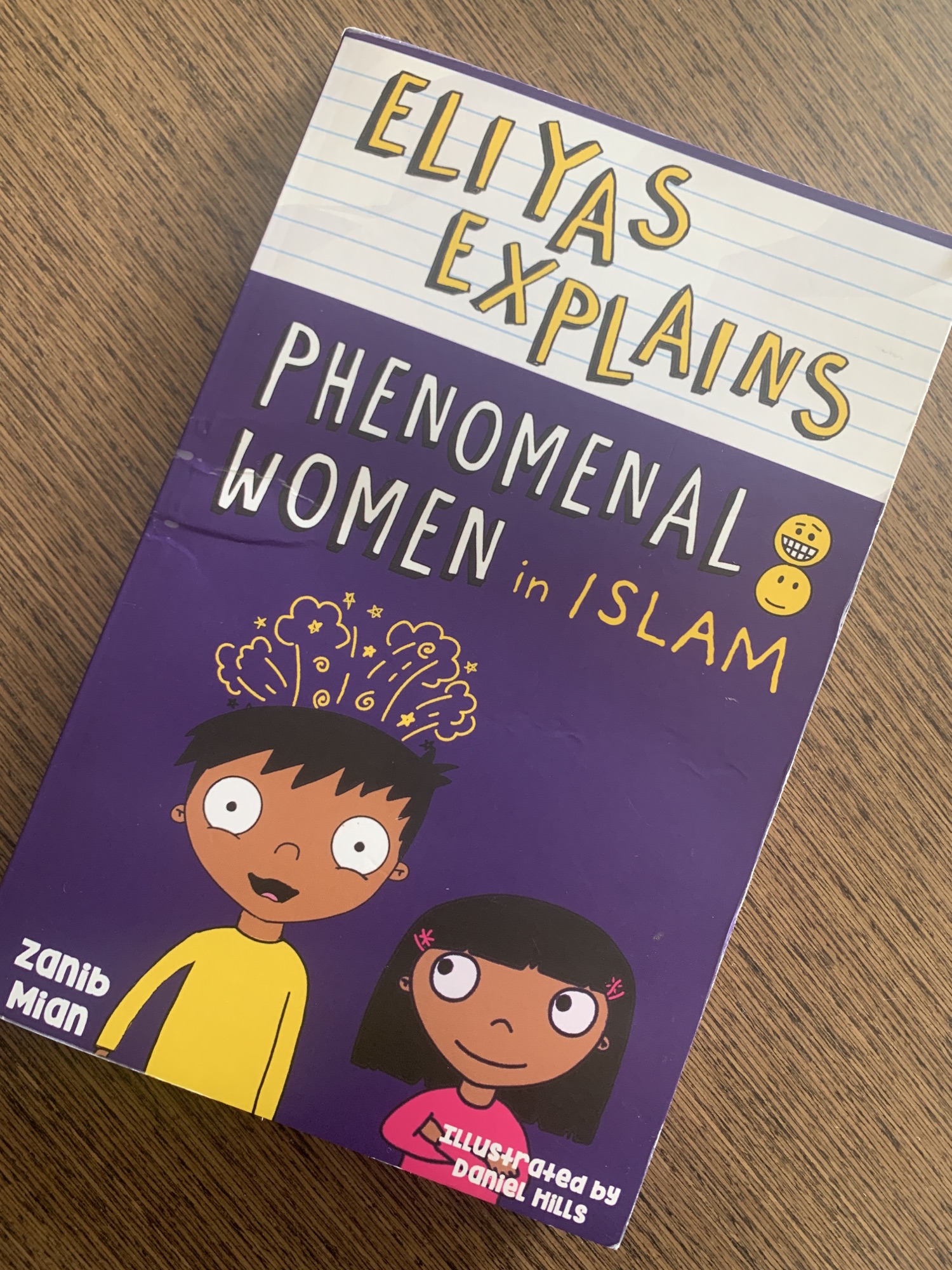
Another wonderful Eliyas Explains book that targets elementary readers with a relatable, funny, likeable voice that weaves in information, heart, faith, and humor in a way that makes them favorites at my house, even after my children have aged out of the target demographic. I particularly enjoyed this 106 page focus on women in Islam, because like the others in the series it is sourced, illustrated, and engaging, but I felt the cover story linking the facts was also compelling. I genuinely didn’t know what the family was going to do about the expo mix-up, and was invested in not just the Islamic role-modeling of how the family would handle the set back, and what historical woman it would be connected to, but also what they were going to do with all the Qur’an Match games, and I assure you, I didn’t see the resolution coming, or the twists that followed.  I always appreciate that the author’s books don’t talk down to the readers and with the information contained, I think both children hearing the stories for the first time or those that know them well, benefit.  The way they are presented serves as a reminder for some or a tease for others to go learn more.  Alhumdulillah for this series and this book that highlights Khadija (ra), Fatima (ra), Aisha (ra), Maryam (as), Hajar (as), and Aasiya. As prices for goods continue to soar, this reasonably priced book should be an auto buy for us all.

SYNOPSIS:

Eliyas and his family are heading to an expo to set up their booth and help their Mum sell her Qur’an Match game.  Mum is a little nervous and the road trip is the perfect setting to talk about phenomenal women in Islam to give her confidence and the kids some teachable moments.  The kids are wowed by the business savvy and status of Khadija bint Khuwaylid (ra), and they want to hear about the other  women promised jannah.  Little sister Aasiya is particularly interested in who she was named after.  Once they get to the expo though, things are not as expected.  The organizers have no record of the stall reservation, tickets are sold out, and Yusuf goes missing.  Alhumdulillah, Mum stays level headed and the family trusts Allah swt to provide them with something better.  The remainder of the book is the family taking what comes at them and making the best of each situation as they make their way home, share more stories, and enjoy each adventure as it comes.

WHY I LIKE IT:
I love the subject and how it is presented.  I always appreciate the sourcing given at the beginning so that the stress of accuracy is abated. The writing quality allows you to be sitting right there with Eliyas in the car taking it all in.  I know that many Eliyas books have workbook style prompts at the end, but I was glad this particular one is just a straight story read.  The illustrations as always are comical, and I can’t wait to see what is up next in the series.

FLAGS:

None

TOOLS FOR LEADING THE DISUSSION:

My kids read it and we talked and laughed, and I recommend it and the whole series for 2nd-4th grade classrooms to have for kids to read, enjoy and learn from, alhumdulillah.

Ilyas & Duck: Spectacular Salah by Omar S. Khawaja illustrated by Mattia Cerato

Standard
Ilyas & Duck: Spectacular Salah by Omar S. Khawaja illustrated by Mattia Cerato

img_3321-1

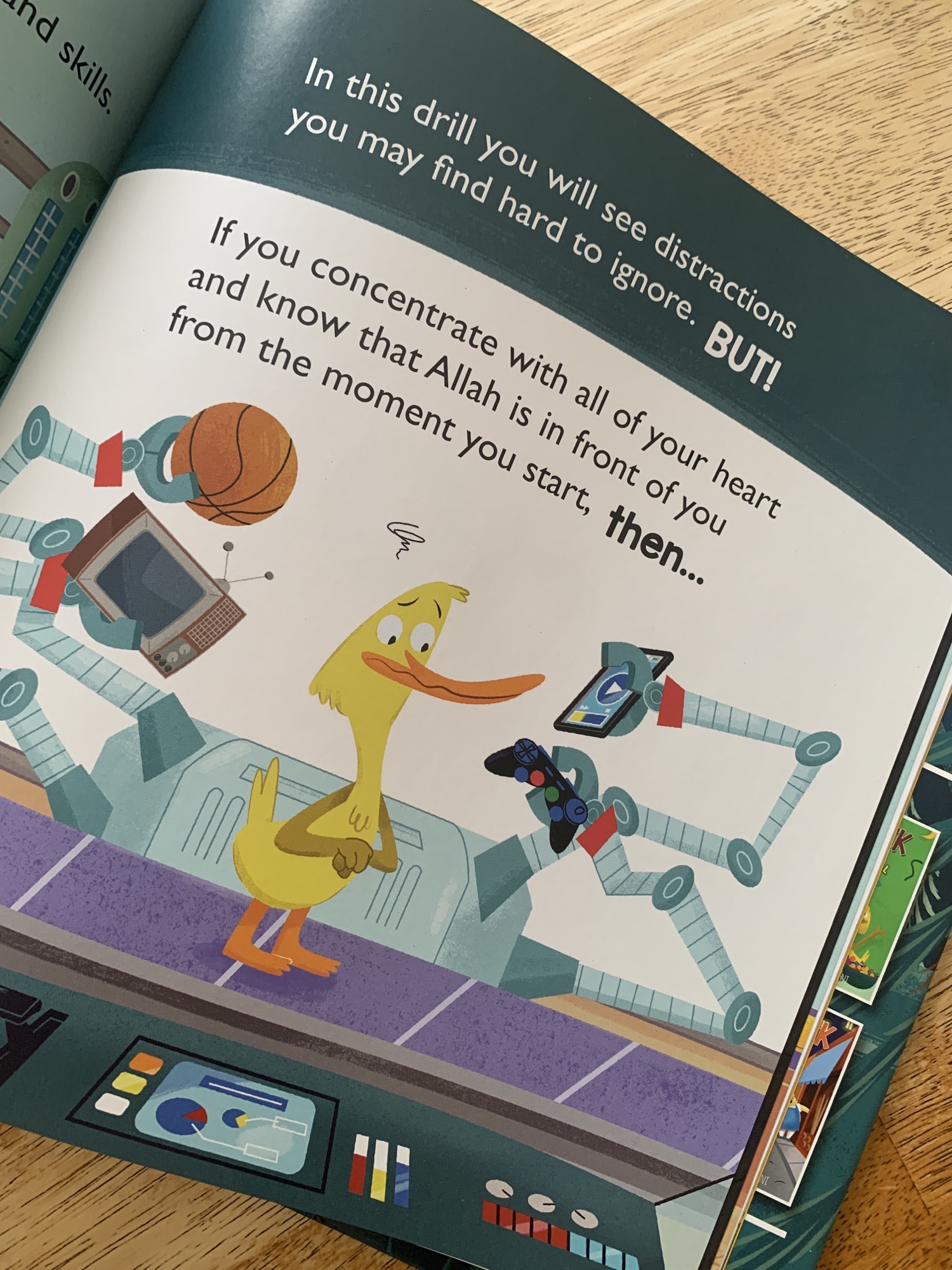
It has been a minute since we have had a new Ilyas & Duck book to read and share with our kids, and this one focusing on prayer is informative, fun, and was well worth the wait.  It is also long, 48 pages long to be exact.  There is a lot of information and works best for ages six or seven and up.  The clever rhyme and engaging illustrations tell about wudu, the times of the five daily prayers, Surah Al Fatiha, facing the Kabah, having the right intention, connecting with Allah, and not being distracted. I love the framing that salah is not just an obligation, but is an opportunity to talk to Allah swt and should be spectacular.  The author reads his books aloud a lot to kids, so if you have ever seen one of his readings, I highly recommend channeling the voices and energy, to hold the audiences attention if using the book at story time.  If reading at bedtime, or if handing to an independent reader, take the opportunity to discuss the points, check understanding, and reflect upon what Duck is learning.  As always the banter between Duck and Ilyas keeps the kids laughing, the story moving, and the information flowing, alhumdulillah.

The book starts with two verses from the Quran and the hashtag #freepalestine, before entering the world of Ilyas and Duck one summer afternoon,.  An alarm goes off and Ilyas heads off to make wudu and pray.  Duck couldn’t get up though, he prayed earlier, so he thought he was done.  Ilyas explains that there are five prayers in the day, and Duck is seriously worried that Fajr, Dhuhr, Asr, Maghrib, and Isha are going to cut in to his game time, snack time, and movie time.

When Ilyas tells Duck that prayers don’t take long and it is when you speak to Allah swt, Duck in his enthusiastic way is determined to make each and every prayer spectacular. He drafts a plan, learns the steps and what to say, finds the direction, makes his intention, says Allahu Akbar and starts training. 

He is praying all over the Earth whenever the time comes, but then he learns he can do more and goes to visit the Professor.  He learns about connection and closeness to Allah.  He also learns about using his heart and staying focused, before rushing back to tell Ilyas all that he has learned.

The book covers a lot of ground, and gets kids excited to pray.  I like that the information is a mix of highly detailed specifics, general knowledge, and humor.  The way the salah times are described and the emphasis on connecting with Allah swt and making your prayers heartfelt is not often seen in books for this age group, and I think it gives the book a wider lasting appeal.  My 8 year old did point out after reading it independently and laughing, that if Duck prayed Fajr didn’t he know a little bit about prayer already?  Also, given the length of the book, a line clarifying that infact not all places on Earth are ok to pray upon, would have been nice. 

img_3327-1

I hope this book signals more books in the series are heading our way.  I notice that the illustrator is not the same, but the pictures are similar enough I doubt most kids will notice. The book is widely available and can be purchased from Amazon here or from Crescent Moon here

Book One: Thunderbird by Sonia Nimr translated by M. Lynx Qualey

Standard
Book One: Thunderbird by Sonia Nimr translated by M. Lynx Qualey

img_7178

My public library had this book and so I picked it up seeing that it was Palestinian authored fantasy, and I am always on the lookout to support OWN voice Palestinian stories.  The book cover is gorgeous, the inside text unfortunately is tiny making this middle school aged book only 110 pages.  It is translated from Arabic and published by a university, so my expectations were pretty meager which assisted in me being fully swept away by the story at hand.  Sure the book has a few glitches in point of view,  often it feels a bit abrupt and djinn stories are a dime a dozen, but what elevated this book and made it stand out was the Palestinian history interwoven into the plot: snippets about the Mamluk soldiers and Ottomans, the Ayyubid rulers and walls around Jerusalem.  There isn’t enough history touched upon in my opinion, but I look forward to see, now that the world building is established, if the rest of the series will highlight the historical thread.  I have no idea if the characters or author are Muslim, there are references to praying and hearing the athan, but they could just be cultural.  There is magic, fantasy, djinn, prophecies, and reading of tea leaves, as well as fighting, assault, and talk of oppression under Israeli rule.  I’d assume it is advanced Middle Grade or lower YA, but to me it seems 11 and up would enjoy the quick fast paced read.

img_7175

SYNOPSIS:

Noor’s parents are dead, and she lives with a grandmother who loves her, and an uncle and his family who don’t.  When her grandma dies, Noor is alone and with things combusting in to flames around her and no one left to defend her claims that it wasn’t her, Noor is trying to piece together a ring left to her, her mother’s research, and her flame creation abilities.  Her search leads her to a colleague of her mother’s and an old archaeological site.  While staying with an aunt in Jericho over the holidays, a mysterious cat guides her to the same archeological site where the cat reveals that she is really a djinn.  The barrier between the seen and unseen world is failing, and Noor is prophesized to be the only one that can ensure it doesn’t happen.  With a trait of the mythical phoenix Noor must find ways to travel in time and retrieve a feather before the bird is reborn.  Along the way she will have the help of the djinn and of her doppelgänger from that time period.

img_7176

WHY I LIKE IT:

The story is clever, fast paced, and the character endearing.  I wish the details were fleshed out and of course I wish there was more history when she travels back in time.  The climaxes are quick builds and even quicker resolutions, but despite all the flaws I really enjoyed the story and look forward to the rest of the series.  The book ends on a cliff hanger that feels rather abrupt, but being it is clearly established as book one in a trilogy, I don’t think readers will be too upset at the sudden end.

img_7177

FLAGS:

Magic, time travel, prophesies, fortune telling, assault, oppression, fighting, loss, arson, arguing, djinn, fighting

TOOLS FOR LEADING THE DISCUSSION:

The book probably is too short for a book club read, but I think a teacher could definitely use it as a reference in story writing, historical fiction fantasy, culture inclusion lessons.  If you wanted to use the book, you’d be able to find plenty to draw on for teachable moments in literature, history, and writing style.  There would also be a lot to discuss in terms of occupation, myth, legend, and culture.

If your library doesn’t have it you can find it on Amazon

Spice Road by Maiya Ibrahim

Standard
Spice Road by Maiya Ibrahim

spice

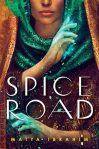
I have no idea if the author identifies as Muslim. I saw the 2023 YA book described as a Middle Eastern fantasy, characters with Arabic names,  djinn representation and possibly a hijab wearing protagonist on the cover, so I requested an advanced reader’s copy, squealed with delight when I got approved, and happily fell into the 464 page world of The Sahir and Kingdom of Alqibah.  Their is no Islam in the book, it is not a hijab, but I’m sharing it here, not just to let readers know it isn’t Islamic rep, but to let them know that for the genre it is pretty clean, and the story is an engaging easy read.  At times Imani is whiney and annoying, but she has a developed arc, and the book has a few slow patches, but nothing that lasted long enough to tempt me to give up on it.  I think 14 year olds and up can handle the three brief kisses, the sexual assault that is thwarted, the lusting glances, the killing, the potential addiction, and the commentary on colonizers and oppressors.  It is the first book in a series, so this review is only for this book and not an evaluation of the rest of the books that perhaps are not even written yet.

SYNOPSIS:

In Qalia, the Shields protect their community from monsters with the Spice entrusted to them, misra, that magically empowers affinities in them.  The top Shield, Imani, has an affinity for iron, and with the support of her powerful clan she exists in a world of privilege and opportunity.  When her powerful brother, Atheer, is assumed dead after stealing misra and suffering from magical obsession, the family’s reputation is not as pristine as it once was.  Imani’s younger sister, Amira, is also keeping secrets as she is caught stealing, skipping school, and refusing to follow family orders and country laws.  When the two girls find themselves following Atheer’s horse into the forbidden waste, they learn that their brother might not be dead and that there is more to their world than they ever were allowed to know.  With desperation to learn more about her brother’s location clouding her judgement, the Djinni Slayer, Imani, bonds with Qayn, a djinni who claims to not only know Atheer, but to have been his close friend.  Imani scrambles to know what to do, and seeks out answers and permission from Council, that results in her and three other’s heading off on a rescue mission to the Kingdom of Alqibah.  Everyone’s orders, however, are not the same, and first they must survive the desert, the monsters, and each other if they are to find Atheer.

WHY I LIKE IT:

I love  that the world building is not at the expense of character development.  The single linear story line does mean that at times side characters are seemingly forgotten, but the focus of the world through Imani’s eyes allows the gaps to be overlooked as her concerns and priorities take center stage.  I love the emphasis on family, it is sibling love that is motivating the protagonist and closeness to an aunt that allows for privilege and opportunity. The romantic threads and tangents never overshadow the familial importance- it isn’t a forced obligation it is very warm and it is nice to see and feel the truth in the characters approach to family.  I love the Arabic names, foods, and while my electronic version did not have a map, the author has one on her Instagram page that suggests the physical book will have a map.

I love that the book discusses colonizers and oppressors.  It may be fiction and fantasy, but there are some very real themes included in fleshed out way that would allow for a lot of deeper discussion and connections to be made. The book is well polished, I don’t know that it reads like a debut, which is always a good thing I suppose.  At times Imani is really unlikeable, but fortunately it doesn’t last too long, same goes for Amira and her bouts of childishness juxtaposed with her glimpses of maturity. Taha, is noted to be very different depending on the company he keeps, so while frustrating- it seems to be intentional. The only real hiccup I felt in the book was understanding how at times the language differences were such an obstacle and how at other times Imani could read the graffiti and be understood.

FLAGS:

Magic, romance, lust, kisses, flirting, attempted sexual assault, lying, killing, addiction, alcohol, drinking, murder, abuse, physical abuse, bullying, oppression, colonizing.

TOOLS FOR LEADING THE DISCUSSION:

I don’t know that I would pick this as a book club read, but I would definitely shelve it in a class, school, or home library.  I think it is a fun read for teens and up and I look forward to the rest of the series.  The book releases in January 2023 and as always presales are the biggest way to show support to authors and titles.  You can find the book here.


Mr. Grizzley’s Class: Rahma’s Gift by Bryan Patrick Avery illustrated by Arief Putra

Standard
Mr. Grizzley’s Class: Rahma’s Gift by Bryan Patrick Avery illustrated by Arief Putra

rahma

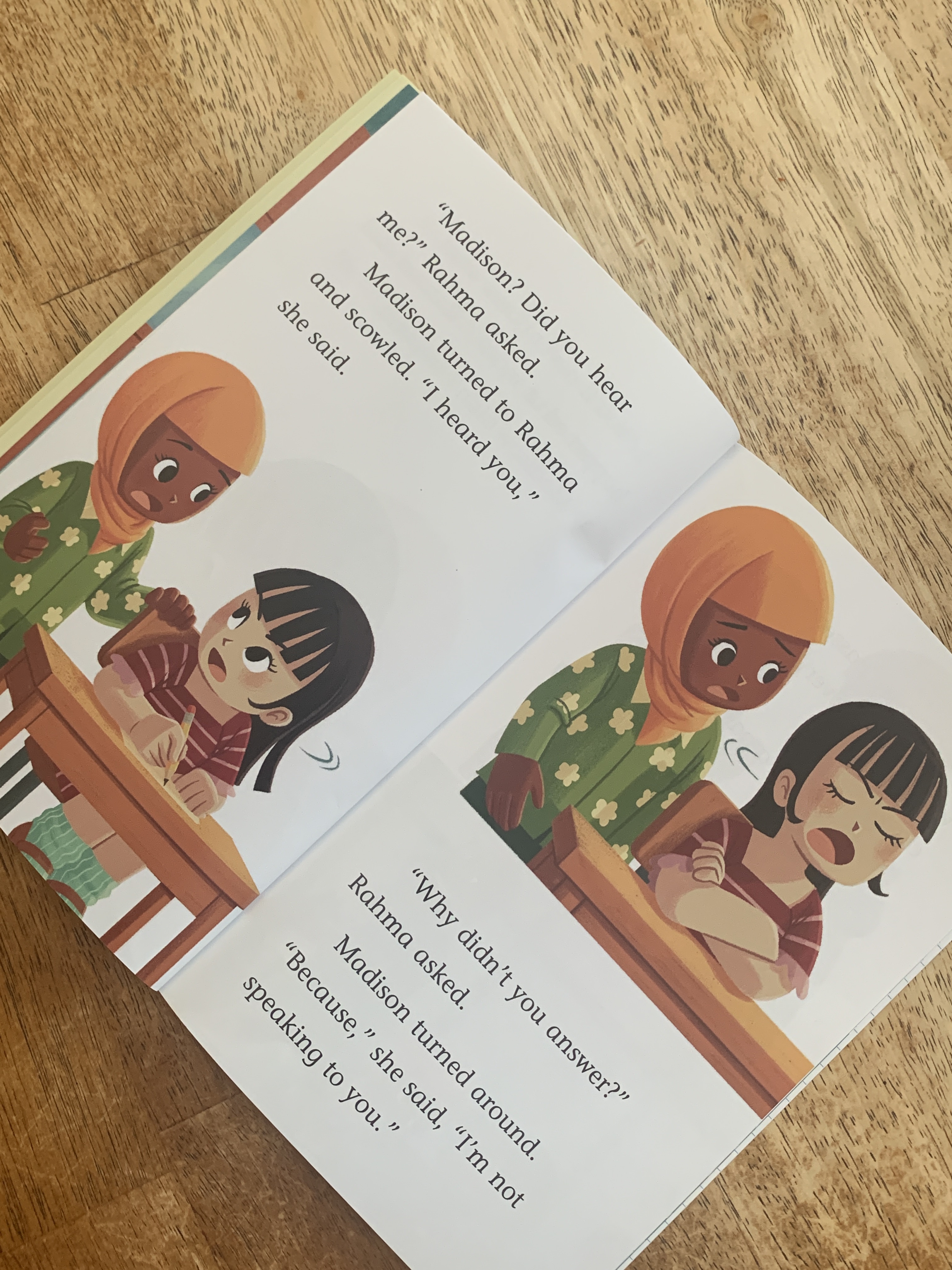
This 32 page early reader is part of Mr. Grizzley’s class, a series that sets out to help promote social and emotional skills in real life settings for ages five to seven.  The diverse class is featured in all the books with one student being the focus of each individual book.  This book highlights Rahma, a visibly Muslim girl of color, who has a gift of helping others with their problems.  The richly illustrated story shows what happens when she is having troubles with a friend, and what Mr. Grizzley and fellow classmates can do to help her find a solution.  I like the premise, I like the focus, I like the illustrations, but I did not understand the messaging.  I don’t understand why Rahma had to own the entire apology.  Sure, friendship is more important than a small misunderstanding and moving on by saying your sorry, even when it isn’t all your fault, has merit- but the book doesn’t take all that in to consideration.  It has Rahma taking responsibility for Madison not talking to her, Madison misinterpreting something Rahma did and getting jealous, and Rahma owning all the lacking communication, when clearly both of them failed to do so.  I found myself confused reading the book the first time, clearly I must have missed something, right? No.  And now writing this, I’m actually quite upset.  So, while the idea of the book and series might be sweet, I don’t feel like this particular book was well executed.  I have not read any others in the series, and thankfully checked this out from the library.  There is nothing particularly Islamic or religious in the book other than the hijab Rahma wears.

img_3111

The book starts out with Rahma nearly late for class because she was helping other kids resolve an argument.  It is a gift of Rahma’s to help others work out their problems.  When she tries to tell her best friend Madison about it, Madison doesn’t respond.  When Rahma tries again, Madison says, “I’m not speaking to you.”

img_3112

As a result when they pair up for math, Rahma works with Annie.  She tells Annie she isn’t working with Madison because she is mad at Madison for not speaking with her. Annie prods a bit and Rahma says, “I’m not talking to her if she won’t talk to me.”  Annie encourages Rahma to find out what is wrong.

Mr. Grizzley is then told, and he also tells her to find a way to find out why she is mad. At recess, Chad comes to thank Rahma for helping him and Ashok, and when she tells him her problem he gives her, her advice back, “listen to the other person.”

img_3113

Rahma definitely is in a pickle since Madison won’t talk to her, but with incredible maturity she tells Madison she doesn’t know what she did to make her angry, but she is sorry that she feels bad.  Madison caves and tells her she is jealous because Rahma made a necklace for Semira and she understood it to mean that because she didn’t make one for her, she didn’t want to be her best friend any more.  Semira and Rahma explain that Semira’s dog was sick and she was sad, so Rahma made it for Semira to cheer her up. The girls hug and all is well.
img_3114

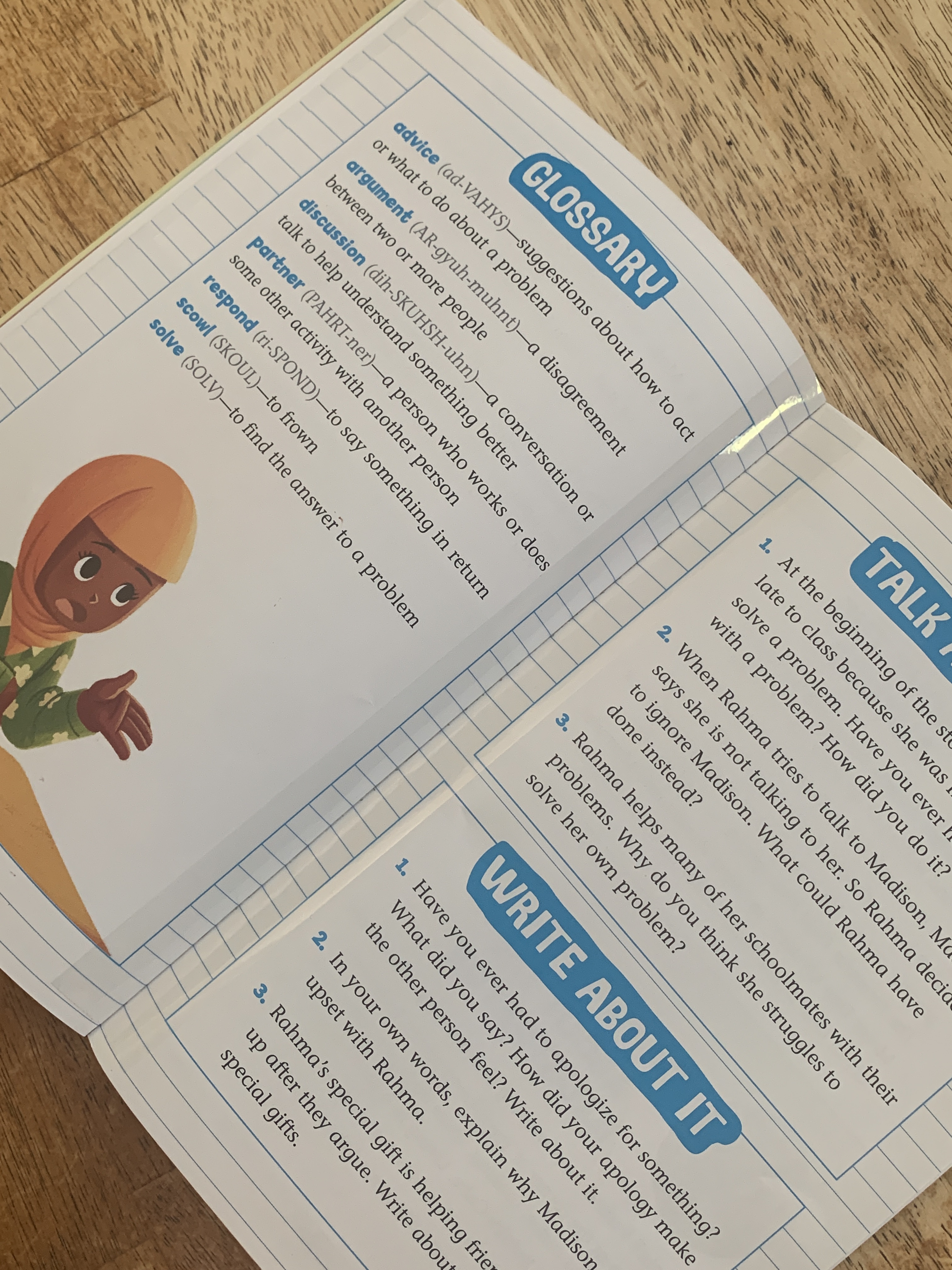
The book concludes with directions on how to write an apology letter, a glossary, questions to talk about, and prompts to write about.

I loved Rahma’s phrasing of her verbal apology and wish that would have been the focus of the book: how to take someone’s feelings in to account even if you don’t know how you contributed or even if you feel you did not do something wrong.  As it is written with the two page spread at the end on how to write an apology note though, I feel like Rahma took on a lot of the blame unnecessarily.  I know I’m reading in to it a lot, but I don’t like the vibes that the book gives.  Madison in my opinion was in the wrong multiple times throughout, and Rahma each time took ownership and worked through it.  Yes, truly that is a gift, but I really hope people don’t take advantage of Rahma in the future.

img_3115