Tag Archives: Muslim Characters

Bhai for Now by Maleeha Siddiqui

Standard
Bhai for Now by Maleeha Siddiqui

bhai

We tend to love people and books that do things first, for good reason, they raise the bar, set the standard, and pave the way for all those that come after.  And no, this is not the first middle grade traditionally published book to have Muslim characters having a completely non-Islamic-identity-centered plot, BUT it might just be the best one I’ve read.  The amount of Islam woven into the characters and storyline is absolutely incredible and seamless. The writing quality keeping dual male point of views separate, engaging, and unique without judgement, is nearly flawless.  The emotional connection of the writing and characters and plot had me both laughing out loud and crying unapologetically within the span of the 276 pages of the book.  This book is a treat for the readers and everyone eight and up I’m quite nearly certain will enjoy this Muslim authored, unapologetically Muslim approach about two 8th grade strangers realizing they are twin brothers and getting to know each other.

SYNOPSIS:

Shaheer lives with his dad and paternal grandfather.  They are well-to-do with his father being an ER physician, but they move around a lot, and never stay in one place long enough to make friends, unpack boxes, or feel like they have a home.  Ashar has lived in Virginia since he was four.  He and his mom recently moved out of living with her brother and his family, but they are next door so even though money is often tight, family and love are always present.

The first day of eighth grade finds the two boys at the same school, staring at each other and wondering how they can maybe find the pieces of themselves that have always been missing. The idea is good, but the reality is complicated.  Ashar and Shaheer’s parents have refused to even acknowledge each other to the boys over the years, extended family plays along, and the boys have to decide if they can even forgive their parents for doing this to them.  Throw in a cousin who knows the boys are switching places, hockey practices, a masjid remodel, and the ever looming threat that Shaheer will be moving yet again and the stage is set for a lot of laughs, tears, and characters that won’t be forgotten anytime soon.

WHY I LIKE IT:

The retelling of “The Parent Trap” is not predictable, nor does it talk down to the reader and tie everything up in a nice unrealistic bow.  There are twists and disappointment and hope and joy, not just for the characters, but for the readers as well.  The side characters are even fleshed out and memorable, not just as foils for the protagonists (I loved cousin Zohra), but as characters with a vested interest in how it all plays out.  I was surprised how clearly different the characters are, even when imitating one another and how nuanced their differences are.  They are not simply opposites: one is not good the other bad, one outgoing one an introvert, rather they are just different, as any two siblings undoubtedly would be.

I absolutely love how Islam is so much a part of the story, a part of the characters, a part of the details, but is not the whole story.  There is no Islamophobia, internal or external, there is no religious othering, it is masterfully done and Muslims and non Muslims alike will benefit from the real tangible expression, growth, and presentation of faith for the characters.

Similarly, culture is presented as a part of the characters in various forms without overly explaining or white centering.  This is who the characters are and their present predicament, as crazy as it is, could happen to anyone, of any culture or of any faith, the two are not corollary. But because it is happening to Ashar and Shaheer, the reader is brought into their world where salat/namaz, athan, mosques, hockey, entrance exams, volunteer work, finances, naan, pineapple on pizza, donuts, and nihari are all present and all unapologized for.  Well, except for the pineapple on pizza.

The best part of it all, is that it is also clean.

FLAGS:

Nothing an eight year old can’t handle, but there is deception as they imitate each other, parental arguing.  There is mention of Shaheer putting his headphones on and listening to music. Zohra plays flute in the band and it mentions when she has practice or that the family all goes and supports her. Male cousins and female cousins interact with each other freely.

TOOLS FOR LEADING THE DISCUSSION:

If my middle school book club is mostly 6th graders in the fall, I think I will feature this book as soon as it is released on October 4th.  Even if it is a bit below “reading level” the writing is engaging and I don’t think even the most cynical book club member will be sorry they spent time with this book.  It would be a quick read for them, but an enjoyable one for sure.

It can be preordered here on Amazon
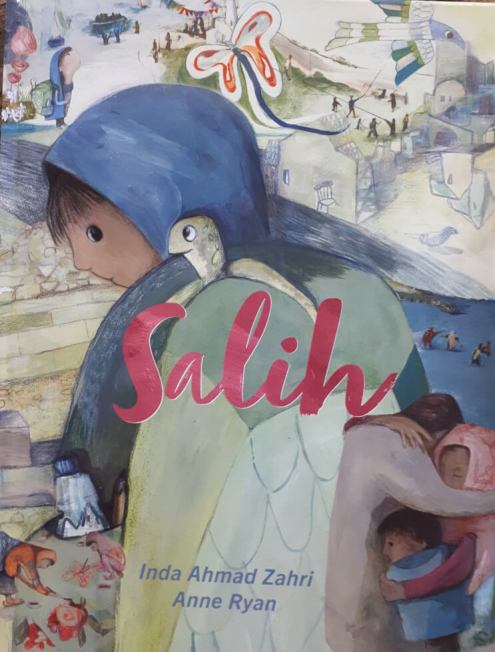
Salih by Inda Ahmad Zahri illustrated by Anne Ryan

Standard
Salih by Inda Ahmad Zahri illustrated by Anne Ryan

salih

This is an example of a picture book that should not be categorized as being only for children.  The passages of short simple text and the expansive illustrations that pull the reader in, combine to set a powerfully moving tone that holds you in it’s grips until the final page.  The names and hijab clad women could make this book a refugee tale with #muslimsintheillustrations, but because the author is Muslim, and the book so beautiful, I wanted to do a full review.  Some of the vocabulary is a bit advanced for younger children, so I think the best application of this book is not to hand it to a small child to read independently, but rather to read it to a child and let the words tickle their hearts while they immerse themselves in the pictures.  I look forward to sharing this book at story time to kindergarten through third grade.  I think the imagery, concepts, and emotion will resonate and open minds and hearts.

img_2168

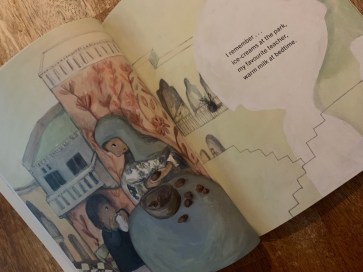
Salih is like a turtle, he carries his home on his back. He and others are heading to the sea.  He tries to remember when things were better, and forget the bad times.

An old man shows him how to paint.  Salih shares this creativity with others.  Then he slips all the paintings into bottles and when he is on the rough sea, the bottles float away.

The storm rages, but then it calms, and land is seen, and hopes and dreams return.

We, collectively, have become numb, apathetic even, to the plight of refugees.  I have been trying for a while to get this book from Australia, and even though I am over a year late since its publication, it is still timely.  It will always be timely.

img_2170

We cannot be so arrogant to dismiss the plights and challenges faced by those in our world.  That is why I say, yes it is a children’s book, but people of all ages, need to be reminded.  It isn’t the worst of the worst incidents that need to only be shared, or the over the top happy stories.  We need to not let our hearts grow so hard. And this gentle book, with a sweet boy and turtle shell imagery has a lot of potential to remind us of the human element of global conflict.

Available to purchase in the USA here

img_2172

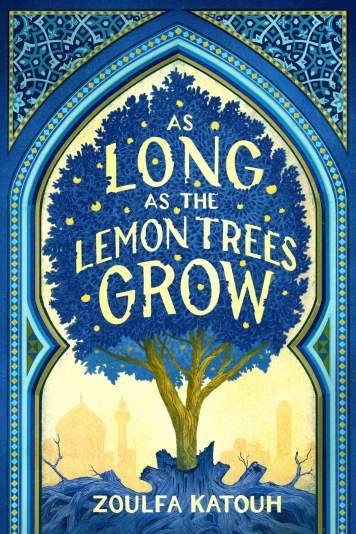
As Long As the Lemon Trees Grow by Zoulfa Katouh

Standard
As Long As the Lemon Trees Grow by Zoulfa Katouh

as-long-as-the-lemon-trees-grow

Anything I write about this YA book will fail miserably in conveying how powerful, beautiful, lingering, moving, emotional, and overall masterfully written every one of the 432 pages are; it just might be my favorite book of the year.  I do know that this will be my new standard for Muslim OWN voice stories, as the authenticity was absolutely engulfing, I’m not Syrian and I could feel it and naturally, I also verified it.  There is no pandering to a western gaze, the story and characters pull you in and show you Syria from the ground, there is no telling, there is no lecturing, it is mesmerizing storytelling at its finest.  The book has mental health issues, war, and a sweet “halal” romance, that I think upper YA, 16 plus, can handle and appreciate.  I hope every adult will spend time with this book, it truly is incredibly well done, alhumdulillah.

SYNOPSIS:

Homs is under the protection of the Free Syrian Army, but that isn’t enough to keep pharmacy student Salama and her family safe.  Her mother is killed, her father and brother taken, and so she moves in with her best friend Layla, her pregnant sister-in-law, her only family left.  Working as a doctor in the hospital where anyone remaining is given responsibilities far above their skill level, education, and experience- every day is a struggle to survive.

Haunted by the physical manifestation of her fear, “Khawf,” who urges her to fulfill her promise to her brother of keeping Layla safe and getting them out of the country, Salama at eighteen years old has to find a way.

Before all the pieces come together to escape, a boy enters the picture, Kenan, who gives Salama hope, who distracts her from the death and destruction that has consumed their lives.  A boy unwilling to leave his beloved homeland.

WHY I LIKE IT:

I’m a crier, but this book brought out ugly angry tears, shocked tears, heartbroken tears, sentimental tears, you get the point, this book held me in its grasps and never let go. I.COULDN’T. PUT. IT. DOWN. If this is the author’s debut novel I can’t even fathom what is yet to come.

I love that the characters are Muslim, and that they pray together, that they plead with Allah (swt) and meet at the mosque.  It is who they are, it is not up for debate or in need of explanation, it is what it is and it is not anything to discuss.  The parts where a character pleads with Allah for death over being taken, absolutely wrecked me.  Just as efforts to keep everything halal between Salama and Kenan made me beam.  (If I’m completely honesty, I did on occasion get frustrated, I mean come on they are being shot at, bombed, nearly sexually assaulted, scoop her up in your arms and console, her, I know haram, but it is fiction and I was invested, and there is a war.  Thankfully, I am not an author and she kept it all clean and her characters much stronger and mindful of the shortness of this world.)

I love that there are political voices, but that it isn’t a political book trying to give back story to the conflict.  In so many ways the news has failed to keep a light shining on Syria and books such as this, remind those of us outside Syria without strong connections to the land, that the conflict is still raging.  If this was a journalistic article it would be a human interest piece, it is character driven.  Readers see themselves in the characters that live lives that most of us of privilege could never imagine, yet here we are spellbound by the characters, their choices, their dreams, and their safety.  This book shows the power of fiction in opening our eyes to the horrors that are happening in our time, by giving us a face and a character to care so deeply about, that we are spurred to action and determined to not remain apathetic.

FLAGS:

Death, torture, physical abuse, sexual assault, fear, loss, coercion, war, murder, torture, child abuse, crimes against humanity, starvation, mental health, PTSD.

TOOLS FOR LEADING THE DISCUSSION:

I would love to use this book in a high school book club.  The story and themes of the book would open themselves up to discussion so effortlessly and the beauty of the writing would be a gift to share with students.

Love from Mecca to Medina by S.K. Ali

Standard
Love from Mecca to Medina by S.K. Ali

mecca to medina

This book is a game changer, or better yet: an industry changer.  It is about Muslims, for Muslims, by a Muslim- but it is MAINSTREAM and a huge panoramic window for anyone and everyone to see a “halal” fictional Muslim love story in action.  With every page proudly mirroring various Muslim experiences this sequel-ish standalone-ish book is unapologetically real, without compromising good storytelling, interesting characters, and engaging plot points.  In much the same way Reem Faruqi’s Golden Girl raised the bar for upper MG/lower YA, this book shows that upper YA Muslamic stories can be told.  That the publishing world isn’t always limiting OWN voices, and that it is up to us, the consumers, to purchase these particular books, pre-order them when announced and spread the word so that the message is loud and clear that we want more books like this.  I have no doubt S.K. Ali had to fight for her vision and advocate for her book at every turn, but now that it is here, we need to step up and show support with our purchasing power.  I’ve pre-ordered mine, and I hope you will do the same before the book releases on October 18, 2022, if you cannot, please purchase it when you can, and if that is not an option please request your libraries to shelve the book (and all of her books) and put them on hold so that the gate further opens for mainstream Islamic fiction.

Preorder link on Amazon

SYNOPSIS:

Adam and Zayneb are back after falling in love in Love from A to Z and getting their nikkah done.  They aren’t living together yet, though, and they are worlds apart with Adam jobless in Doha, and Zayneb homeless in Chicago.  When communication breaks down, exes show up, and a trip to Umrah is underway with the couple divided into gender segregated groups, the couple might fall apart in the same fashion that brought them together in the first place.  The steps of Umrah are beautifully highlighted and experienced, and characters from Misfits and A-Z come back to tie it all together and help the couple, keeping hope alive.  Throw in some marvels and oddities, artifacts and interpretive labels, a unifying cat, and a whole lot of love, and you have a sweet conclusion to a Muslamic love story.

WHY I LIKE IT:

So, I obviously love the standard of unapologetic Islam that this book offers on every page while still being accessible to the larger audience.  It took a little bit for me to be sucked in to the 352 page story, but by page 100 or so, I couldn’t put it down.  The steps of Umrah brought tears to my eyes and the awesome Sausun is fierce feminist friendship goals.  I honestly didn’t love the cat narrative that frames the story, but luckily it is sparse so I could see past it. I love that this book exists, I think I love the Misfit based duology a tiny bit more, but loved that this book had crossover characters and gave many of them a final bow of sorts as well. I read the book in two days and will probably re-read it when I receive my physical copy.  It really is remarkable how much Islam is present in a fictionalized story: not a oppressed Muslim story, or biographical memoir, or refugee story, but in a solid fiction story.   There is no “othering,” this is us, and this a love story about a Muslim couple trying to make it work with outside support and stresses, and beautiful writing.  Alhumdulillah, very well done.

FLAGS:

I’d encourage mature, older YA because the characters are married and sexually active and while it isn’t graphic or depicted it is often just the words mentioning them kissing, and sleeping together and sexting.  Nothing titillating or anywhere near inappropriate, but I think a bit of maturity would help it better reflect the values of Islamic marriages and relationships.  There is some minor language and hate speech.

TOOLS FOR LEADING THE DISCUSSION:

I would absolutely use the book for high school book club if it is mostly juniors and seniors.  I think it gives a good look at what a relationship can look like; the characters’ religious lens and lives will resonate with Islamic school students.

Hana’s Hundreds of Hijabs by Razeena Omar Gutta illustrated by Manal Mirza 

Standard
Hana’s Hundreds of Hijabs by Razeena Omar Gutta illustrated by Manal Mirza 

img_1826

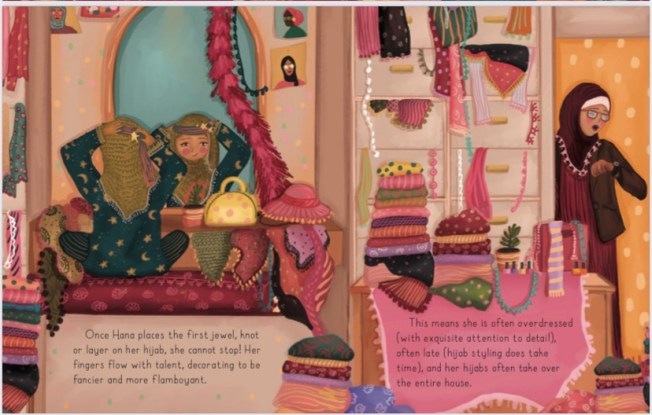
I love the idea of this book and I can see me reading it at story time to KG-2nd graders with great success. The illustrations are rich and detailed, the over the top bedazzling is fun and extra, the plot however, is non existent, surface level at best, the Islamic representation incredibly shallow, and the inconsistencies puzzling.  I’ve read this book a lot of times trying to articulate why it just rubs me the wrong way, and I think it is because it really reduces hijab to a fashion piece.  You can change the word “hijab” to hat or t-shirt or sock and the story would be EXACTLY the same. There is no connecting hijab to Islam, no showing or telling why a woman would even where it.  It presents hijab as being a costume or a decoration.  If you don’t read the author’s note at the end, you would have no idea that hijab is an obligation on Muslim women.  Even at story time in an Islamic school I don’t know that the author’s note will make the case clear enough, and I do plan to discuss with the classes how important it is to realize that hijab means something and is an act of worship and faith, and not something frivolous.  The 24 page book is cute, no doubt, but I wish it had just a bit more substance.

img_1827

A few other readers have shared that they found the story “offensive” and “triggering” for the main character’s judgmental and snooty attitude of criticizing others’ fashion sense.  As someone who doesn’t care much what I wear, I didn’t feel attacked, but their points are valid, so I share them. Hijab is incredibly personal and many women struggle with dressing for the sake of Allah swt with the messaging all around and pressures to compromise in one way or another, and this book for some could definitely add fuel to the fire of telling a woman how to dress.

img_1828

My plot concerns mainly pivot around Hana’s mom.  Why is the mom presented as irritated at the beginning and then so supportive at the end, what changed? Why doesn’t the mom remind her daughter about why one wears hijab when given the chance?  At least add the word “Muslim” in the above page between “strong” and “women.” I know the book is supposed to be fun and surface level, but connecting hijab to Islam isn’t preachy, it is logical. It is a key piece to the premise of the story.  Also, how does offering her services of styling solve the problem- wouldn’t it in fact make it worse?

img_1829

The fun illustrations and the extreme decorations really could have made the book a little girl favorite, but as it is, I don’t know that it will be requested more than once, or lend itself to being remembered once story time is over.  It draws on Fancy Nancy extremes, and thinking outside the box, but because of the faith based article at the core, it seems to miss the importance and true beauty that hijab represents.  I think Muslims will pick it up and be excited on first glance, but be left wondering what the point was, and non Muslims will probably be left with more questions than answers.

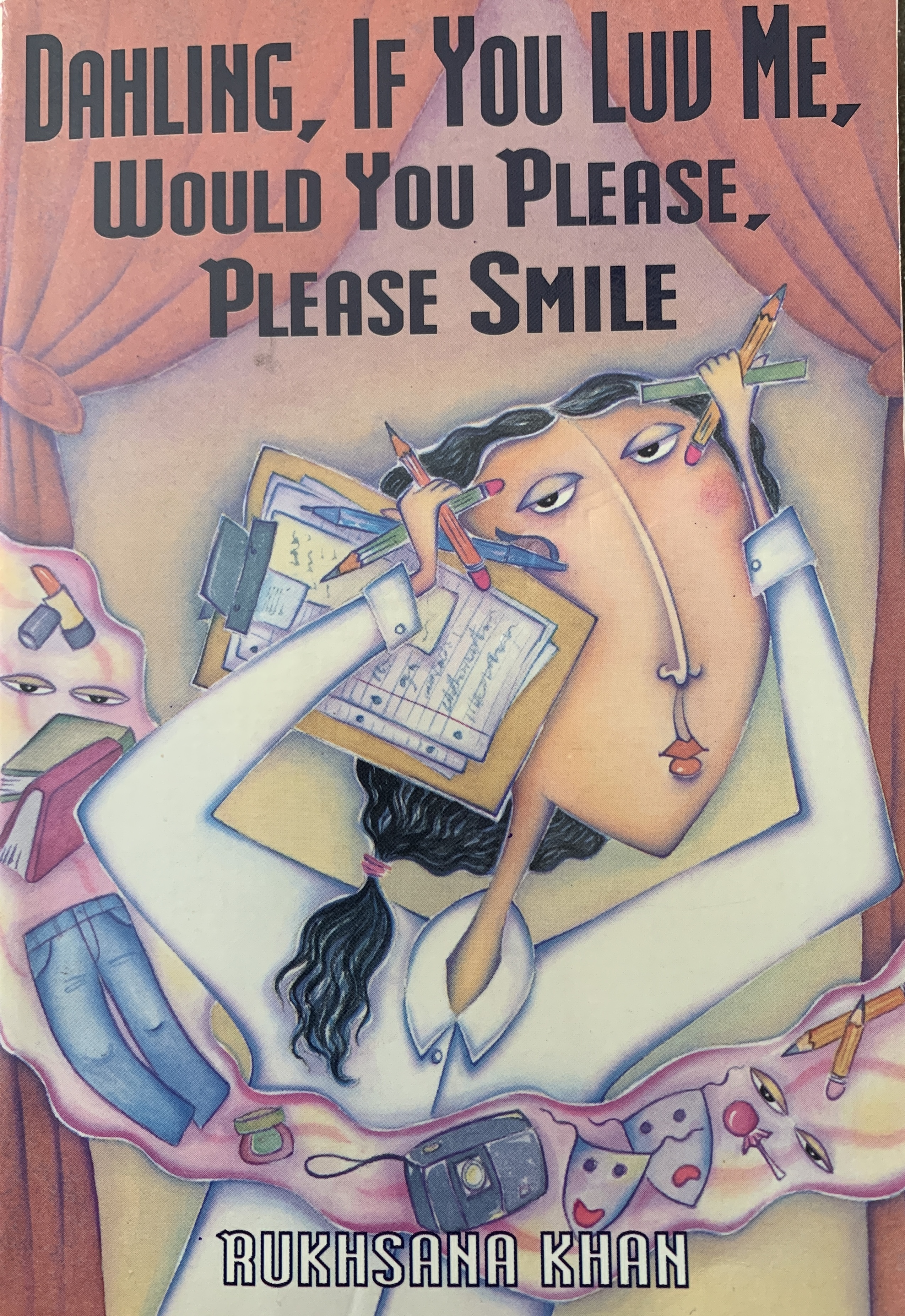
Dahling, If You Luv Me, Would You Please, Please Smile by Rukhsana Khan

Standard
Dahling, If You Luv Me, Would You Please, Please Smile by Rukhsana Khan

img_1788

I’m not sure how I missed this 1999 published YA book by the OG-groundbreaking-industry-changing- Rukhsana Khan, but until @bintyounus mentioned it to me recently I didn’t even know it existed.  The book has so much Islam, ayats, hadith, salat- Islamic fiction self-published often doesn’t have as much as this mainstream book has, but I would be lying if I didn’t say that some of the content was a bit shocking.  Part of my surprise I think comes from the fact that the book is only 206 pages, it takes its title from a game I remember playing in elementary school at recess, the main character is in 8th grade and the cover is soft pinks.  This book is solid YA both now, and nearly 25 years ago, it carries some incredibly heavy themes: attempted suicide, topless photographs, sexual coercion, cigarette smoking, assault, racism, misogyny, toxic relationships, neglect and more (see flags below).  The book is memorable and hard to put down, the Islam is confident and explored, even when weaponized by an older sister, but there is no denying the story telling abilities of the author, and  while I won’t be letting my 11 or 13 year old read it any time soon, I know I benefitted from reading it- reminiscing about wanting Lucky Jeans and standing in awe of how EVERY. MUSLIM. DESI. author making it in mainstream today is benefitting from the path paved by Rukhsana Khan.  On behalf of readers everywhere- thank you.  Thank you for fighting to tell your stories your way, raising the bar, and offering real Muslim characters from a Muslim voice. 

SYNOPSIS:

Zainab has no friends and doesn’t own a pair of Lucky Jeans, she is the only one in 8th grade that doesn’t.  She feels like if she could trade in her polyester pants for the “cool” pants everyone has, she’d be accepted.  When that plan fails and lands her in trouble, she gets tasked with directing her house’s school play.  The teacher convinces her that it will be a way for her to make friends, and earn her classmates respect, but middle school is never that easy.  Everyone is in love with Kevin, including Zainab, but he is a jerk and if he isn’t the lead, no one else will audition.  Jenny is poor, but has a big chest, so even though she is nice to Zainab, she is more in love with Kevin who only wants her for one thing, and takes advantage whenever his girlfriend isn’t around.  Add to the drama Zainab’s very strict older sister who lists off Zainab’s faults every night with Islamic references to try and make Zainab a better person, and this coming of age story will require Zainab to sort through it all and find her own way to be.  There are a lot of subplots that circle around the play, social circles, toxic relationships, and self growth, that while the characters are worried if they will win the competition and break the curse, the readers (at least this 41 year old mama) are hoping that the characters will survive the year unscathed. 

WHY I LIKE IT:

I love that the family is the same family that will become its own story in Big Red Lollipop just grown up, with names changes, and that the story is summarized.  I’m still a little torn if I love the raw grittiness of the way the two sisters interact or if it goes too far and leaves a bitter taste about Islam.  I really am on the fence about how young readers, both Muslim and non Muslim, in 1999 and in 2022, would view the role of Islam in the dynamic.  I think it reads powerfully, but I had a hard time going back to look at it through my 13 year old eyes and it as an adult it is intense.  I still can’t believe that this book was published with how much Islam it contains, even the play put on in a public school was religiously centered.  White privilege is called out and stereotypes about whites are stated, a Hindu character and the Muslim main character work through their baggage, economic privilege is opined on, women’s rights and expectations discussed, comments about “othering” are present-  it really covers a lot. Quite impressive in a lot of ways. 

The relationship and love themes are not shied away from which caught me off guard.  I expected some making-out and heavy petting, but was surprised it went to topless photos, a character’s mom being a nudist, and that there is a lot of forced touching.  I think for most Islamic school 8th graders, this book would be too mature, in fact I genuinely hope it is. Not to say it is not accurate, but it is very critical to the story and I think would need some discussion.  

I love that the characters draw you in, as much as you despise everyone picking on Zainab, you know she isn’t a pushover and you really pull for her.  I didn’t want to put the book down and kept reading because I wanted to make sure she was ok, see what choices she made, and in a fairly short book, that is remarkable story telling.

FLAGS:

The book is for mature readers in my opinion.  There are relationships, assault, cigarettes’, nudists, kissing, spying, sexual assault, coercion, topless nude photographs, attempted suicide, bullying, teasing, cheating, physical assault, language, verbal abuse, stereotypes, talk of female anatomy, and use of Islam to hurt.

TOOLS FOR LEADING THE DISCUSSION:

I don’t know that I would shelve this in the library, I would see if perhaps there is a version with a different cover, one that might signal a more mature reader.  I would worry if an early middle schooler read this, I think it would be a lot for them to take in, process, and reflect on.  It isn’t a light read, and would need some discussion, but ultimately I don’t know that a middle school book club at an Islamic school would be the right place for it. It could be for sure, but not the one I’m currently at.

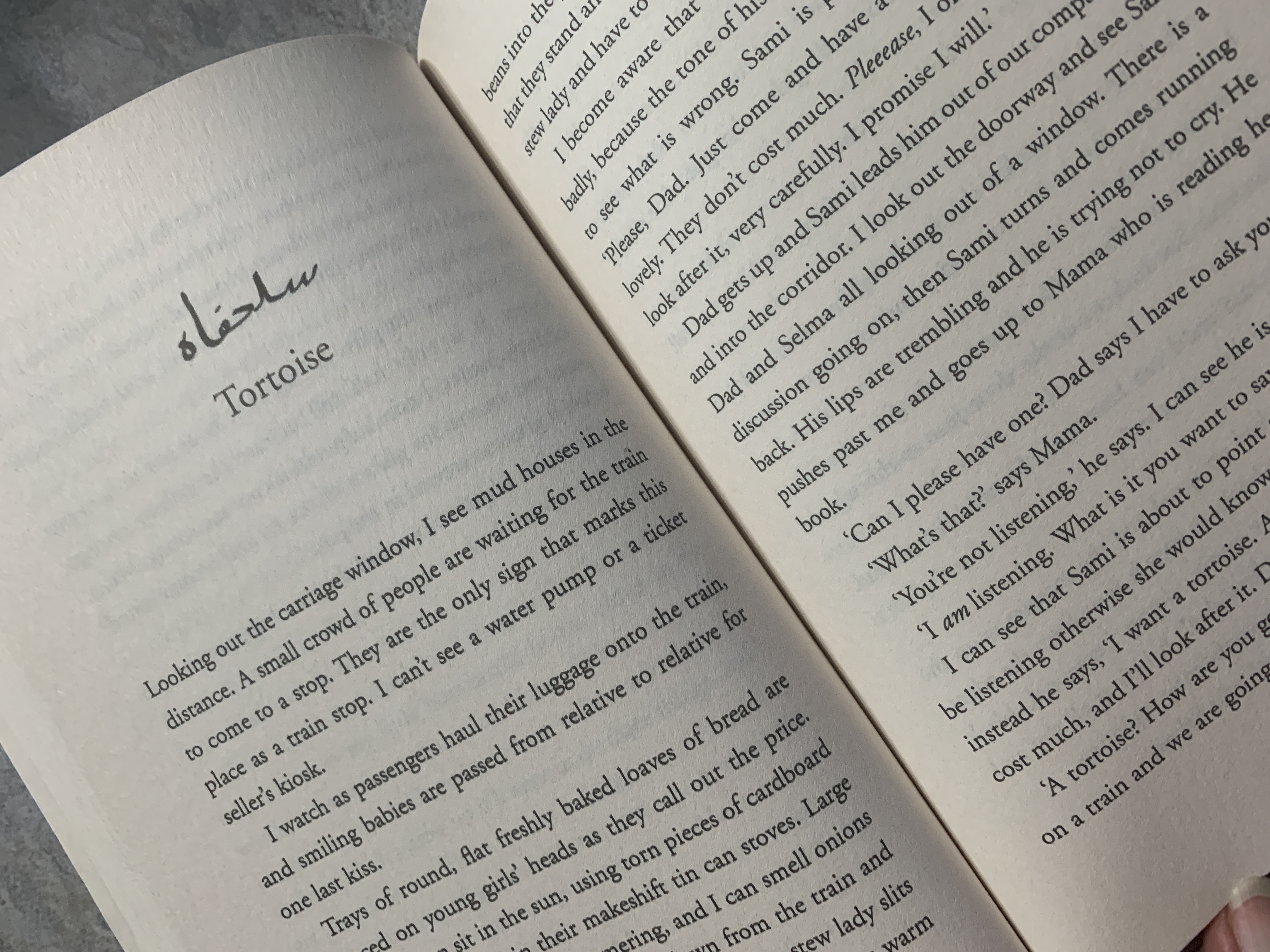
Swimming on the Lawn by Yasmin Hamid

Standard
Swimming on the Lawn by Yasmin Hamid

swimming on the lawn

This 176 page book about life in Khartoum, Sudan reads almost like a memoir with short, loosely connected chapters detailing a young protagonists day-to-day life growing up.  There is no real conflict  until the very, very end, and the majority of the chapters just seem like snapshots with little to no continuity.  That isn’t to say that I didn’t enjoy all the stage setting and the easy voice detailing a time and place that I know too little about, but I don’t know that most kids will feel compelled to keep reading.  The book is slow and wandering, best suited for lower YA/middle school, if they can be persuaded to read it.  I think the book would do well taught, as some good discussions about Sudan, growing up with an English mother in Africa, the role of religion,  the 1960s, the impact of financial comfort, and the threat of violence would make the book very relatable while also being eye opening.  The power and beauty of OWN voice makes this prose filled book thought provoking and memorable in a subtle and light way.

img_0276

SYNOPSIS:

The standalone chapters follow Farida and her siblings in Sudan in the 1960s.  Their summer vacations, visiting friends, trips to villages, making tea, lots and lots of tea, reading books sent by their Grandma in England, and the abrupt arrival of soldiers.  Told from a child’s perspective the short chapters focus on the events front and center and don’t carry over or carry morals or lessons.

WHY I LIKE IT:

I like that the chapters titles are written in English and Arabic and that Islamic holidays and customs are mentioned.  Interestingly though, the family doesn’t seem to practice.  There is cultural presentation of Eid and Mawlid and talk of hajj, but not of praying or saying Bismillah or inshaAllah in daily conversations.

I wish there was more information about the mom being English and how the parents met, and what cultural obstacles maybe had to be ironed out.  I also wish there was a bit more at the end, an afterward even something that gave some closure or insight into what the ending means for Farida and for Sudan.  The choppiness grows on you, but some stories even at that were too unresolved.  The whole chapter detailing her traveling with her uncle to his village only to find her back at home the next chapter without any reflection on the journey, how she returned, the cousins she met, etc., just seemed unresolved.

FLAGS:

A birth and burying the placenta is described, alcohol is mentioned, fear of a friends dad is hinted at, soldiers being present, father being taken away by force, shootings.

TOOLS FOR LEADING THE DISCUSSION:

I think in a middle school classroom setting the book would have a lot of potential.  Read a chapter and have kids journal their impressions or thoughts perhaps, or have them imitate the style and write about themselves.  It probably wouldn’t work as a book club, but it definitely should be shelved in a school or classroom library.

You are the Color by Rifk Ebeid illustrated by Noor Alshalabi

Standard
You are the Color by Rifk Ebeid illustrated by Noor Alshalabi

you are the color

Books like this are hard for me to review, and I have gone back and forth on whether I should post anything or not.  On the one hand, we need books that are unapologetically Palestinian written by Palestinians.  They need to be celebrated and elevated and I want to offer my support to the stories, to the voices, to the authors, illustrators, everyone involved.  On the other hand, if I didn’t love it, why should I shy away from saying so, when I have purchased the book (pre-ordered and changed the shipping address even, to have it delivered to me on vacation because I didn’t want to wait to read it).  The book is emotional, but the last six pages unraveled the whole book for me, and in a picture book particularly of this nature, when you finish- if you don’t have a cathartic pull, you start to find holes in the story as you feel deflated.  The book, I would go out on a limb to say, needs to be discussed and given context even if you are Palestinian.  As someone who is not, I recognize my arrogance in such a statement and am happy to be corrected, but from a literary reviewer standpoint the book needs discussion and additional context.  The Nakba is only articulated in one paragraph in the author’s note.  In the story itself there is no indication that what happened to Thaer happened to so many Palestinians in 1948.  The use of color and how it is depicted in the illustrations is tangible and powerful, but as odd as it is to say, the words got in the way of the story.

img_0713

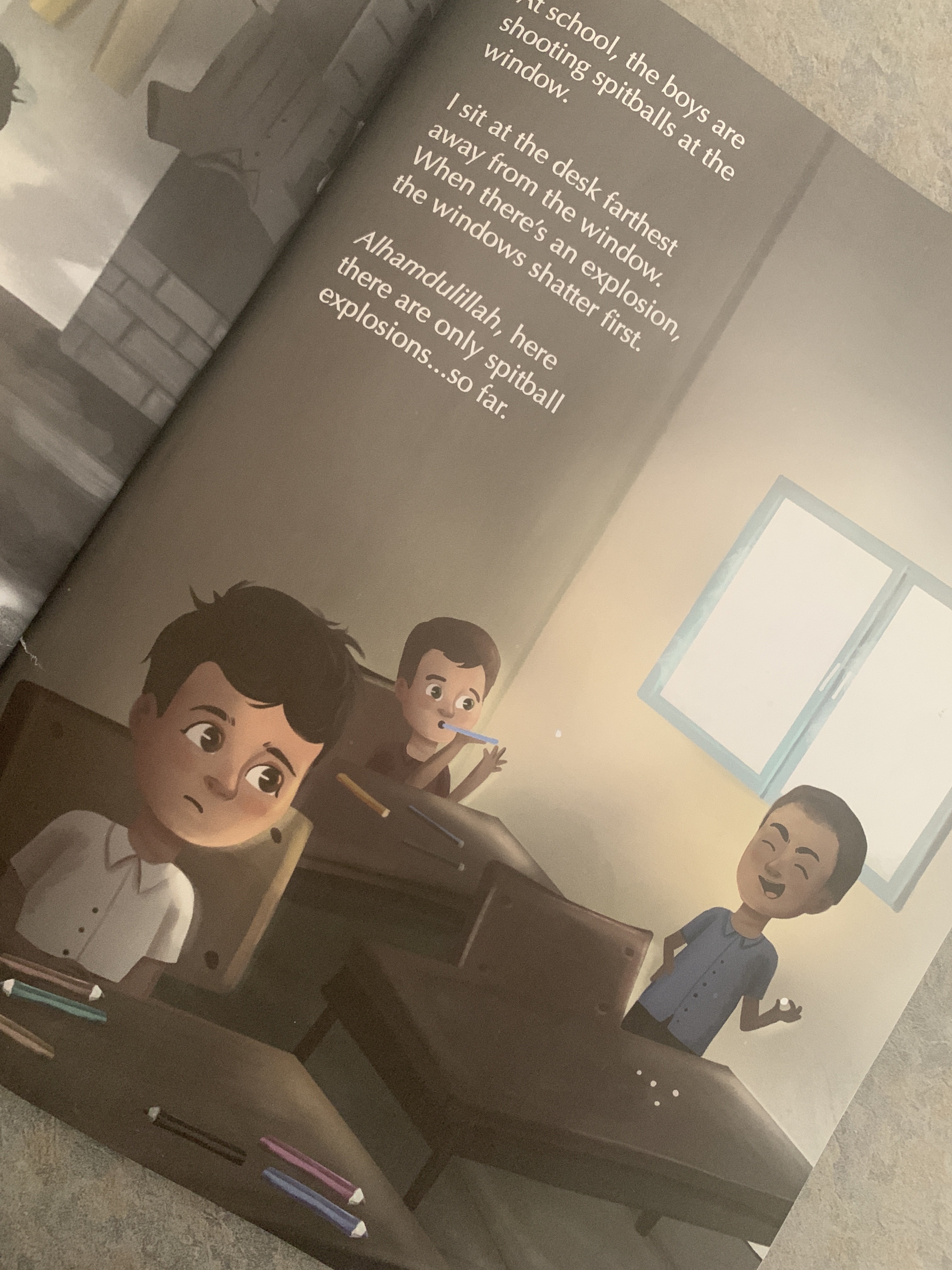
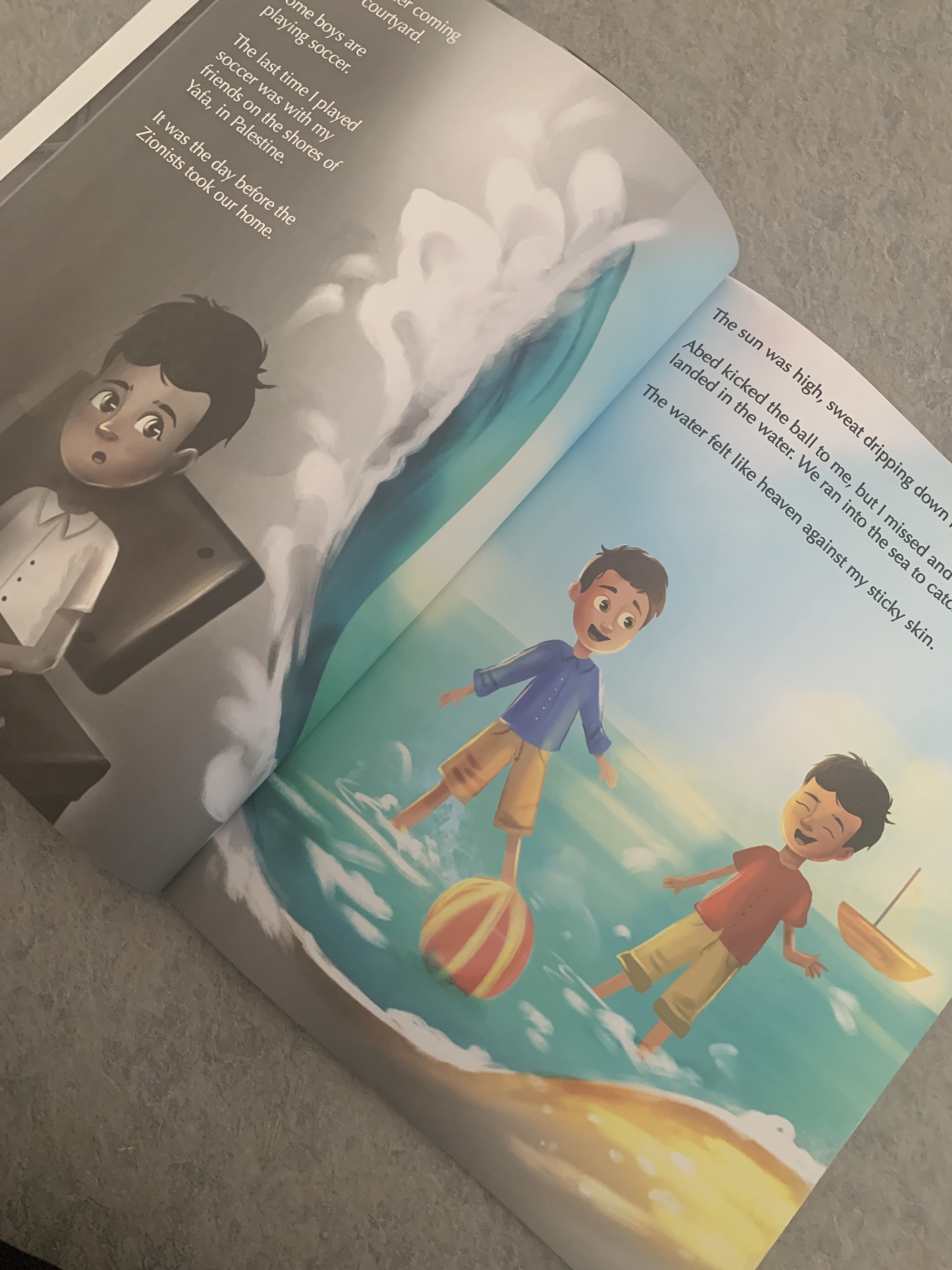
The book starts with Thaer trudging to school in dull sepia filled pages to begrudgingly sit at a desk and begin an art lesson.  He is glad the spitballs are just spitballs and not real explosions, but the tone is still melancholy.  When he sees boys playing soccer he recalls the last time he played soccer, and the memory comes alive in color.  He was in Yafa, it was the day before the Zionists came and took his family’s home.

img_0714

The teacher, back in muted tones, asks him to draw what has made him smile, and Thaer gives it a try.  Blue for the color of the sea, green for zeit and za’tar, brown for taboon to get fresh bread, etc..  When he takes the drawings home to his mother, she is not impressed.  Drawings are silly and colors aren’t going to bring Baba and Susu back.

img_0716

Defeated, the next day in class, Thaer recalls the men pounding down the door and Baba being shoved in a truck and Susu falling.  The next day at school they hang up some of their pictures and Thaer talks about his sister.  (SPOILER) On the way home Thaer paints the alleyway and brings color to his and his mom’s world.  His mama says that he is the color, and when the following day’s prompt is to draw what you want to be when you grow up it shows Thaer (presumably) on the beach as an adult painting.

img_0715

The disconnect for me occurred with the painting of the alleyway.  I was incredibly invested in the story, my heartstrings were being tugged, I was breaking for this character and his experiences, and it all came to a screeching halt because I couldn’t understand where the paint and the alleyway and the mama’s change of heart all manifested from.  As for the ending, I think I know what the author was going for, but it didn’t connect with any of my kids aged 2-15 nor my mother, a 40+ year early elementary veteran teacher.  I wish I could have taken a picture of their faces as she read the book to them.  The frozen expressions of huh and confusion at the end, until my 11 year old to broke the awkward silence to ask if the boy wants to be a painter or a father or an adult?  Those facets coupled with the often advanced vocabulary, makes the book an important one, but one that needs a lot of outside commentary to connect with the readers and to further the conversation about Zionism, al-Nakba, the occupation, and the continued oppression of Palestine.

There are flags of loss, kidnapping, sorrow, violence, etc., that parents will have to gauge if their children can handle. I’m not sure what age group is the best fit, the murder of a young girl, the forced displacement from one’s home, the removal of the father are all heavy themes.  I appreciate that it isn’t “watered down” for a western gaze so to speak, but I wish there was more about what happened to the dad, is there hope he is alive? I wish there was something about this not being an isolated reality for the protagonist and his family.  I wish there was some conversation or connection between the mother and son, because the loss of continuity really derailed the story.

As for the idea of the story, and the use of the illustrations to physically show two worlds I think is a great idea, it just sadly fell apart for me at the end: the faltering conclusion and the loss of emotional buildup that the first two thirds of the story worked so hard to create.

Welcome to the New World by Jake Halpern illustrated by Michael Sloan

Standard
Welcome to the New World by Jake Halpern illustrated by Michael Sloan

new world

I really like the concept and approach of this 192 page non-fiction graphic novel.  It isn’t a memoir or OWN voice retelling, it is basically an in-depth news story about a Syrian refugee family that has been fact checked and then illustrated.  Unfortunately, parts of the story are really choppy and unresolved, details shared for no purpose and occasionally reinforcing of stereotypes.  The book is an easy read and the Muslim family is shown to practice and be fleshed out, but more than once I found myself questioning what the author’s commentary was suggesting/implying based on what was being included.  I allowed my 12 year old son to read it before I was finished, but the last few pages had both misogynistic and homophobic slurs coming from bullies so I made sure to discuss that with him.  I think upper middle school to YA is probably the ideal readership because of the subject matter of escaping war, facing financial insecurities, PTSD, bullies, islamophobia, and navigating a new environment when you are not quite a child, but not yet an adult either.

SYNOPSIS:

Naji’s family is undecided if they should leave Syria or not.  Part of the family has permission to travel to Connecticut in America, but part of them still do not, including Naji’s grandmother.  The war has already imprisoned Naji’s father and uncles in the past and with the US election showing Trump having a chance, they feel like they need to make a decision quickly.  Naji loves all things American and is the only one in the family anxious to get to the US and get on with life, but when the moment of saying good-bye arrives, he has doubts.

Once they arrive in America, all their doubts multiply as life is difficult, help is hard to come by, and day to day fears of safety have not been left behind.  School, finding jobs, learning the language, and facing hate are just the big things that plague a family who has left everything to start over in this detailed account that follows Naji and his family as they navigate their new world.

WHY I LIKE IT:

I like that the book has been approached as a news article.  I just didn’t like the unresolved threads that seem to take up so much of the narrative only to be abandoned.  I really struggled with the idea that Naji knows America and obviously media is global, but is shown to be confused by a dining table.  I didn’t like the commentary of Naji’s sister Amal and her hijab, I find it hard to believe there aren’t other hijabs in the school or larger community and why it is made to be such a big deal by her, and those trying to help her.  It would seem small after everything she has been through.  I do like that there are a few other Muslims in the school and at least they discuss that there is not a nearby masjid.  I wish other Muslims would have been around to help settle the new family.  I know a few groups that helped in immigrants in New England, so that there were no Muslims in the welcoming groups seemed hard to accept.  By and large it does show Islam being practiced, not just names and hijabs, which I appreciated, but for a book that is based on a real family, with graphics, I really expected a stronger emotional impact that ultimately for me was just not there.

FLAGS:

Death, abuse of power, war, language, bullets, shooting, kidnappings, detainment, destruction, kids making out in hallways, implied rape/sexual assault, death threats, racism, islamophobia, misogyny, slurs, name calling, differential treatment, fear.

TOOLS FOR LEADING THE DISCUSSION:

This wouldn’t work for me for a book club selection, but if I ever teach a journalism class again, I think I would some how incorporate this book as a way to show what journalism can be, and also as a clear way to show how what parts you include and what parts you keep out affect the messaging of the story as well.

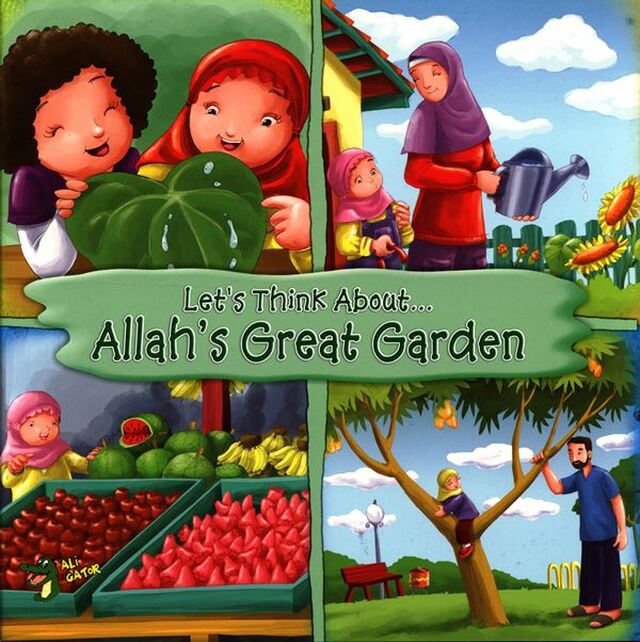
Let’s Think about Allah’s Great Garden by Ali Gator

Standard
Let’s Think about Allah’s Great Garden by Ali Gator

allah's garden

At 22 pages this book’s title aptly describes the contents within: at times factual, sometimes breaking down the fourth wall and asking readers to do something engaging, at times fictionalized, and often meandering and reflective.  The book is all over the place and only cohesive in theme.  It has sat on my shelf untouched by my children for quite a while, but when I needed options for the library during Earth Day, this book did a great job in facilitating discussion with pre k to 1st grade.  It isn’t a story time book so to speak, but it gets kids thinking and can be tailored to their level of discussion.  I don’t think that is how the book was intended, and as it is written it is rather unimpressive, but when pulled apart it did serve a very specific purpose.

img_9837

The book starts out with a few lines about Allah’s blessings of all things particularly trees and plants and gardens.  I wasn’t sure if it was trying to rhyme or not, but I think the first lines are just incidental rhyme as the flow and words quickly unravel. It talks of climbing trees and the narrator’s father telling him to be careful. It then discusses watermelons and how they grow in the ground, not on a tree and asks readers if they can see the watermelon seeds in the illustrations.

img_9836

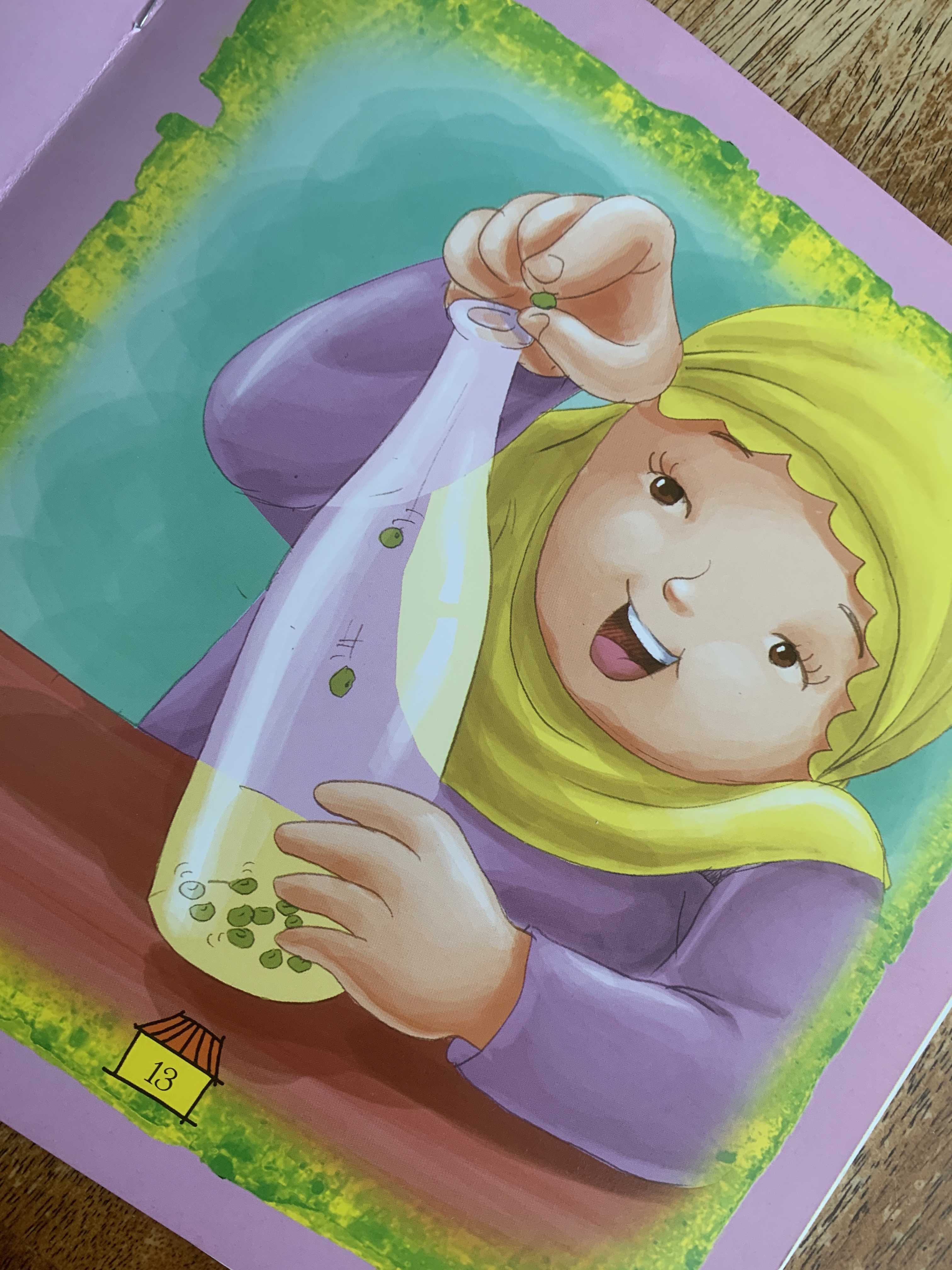
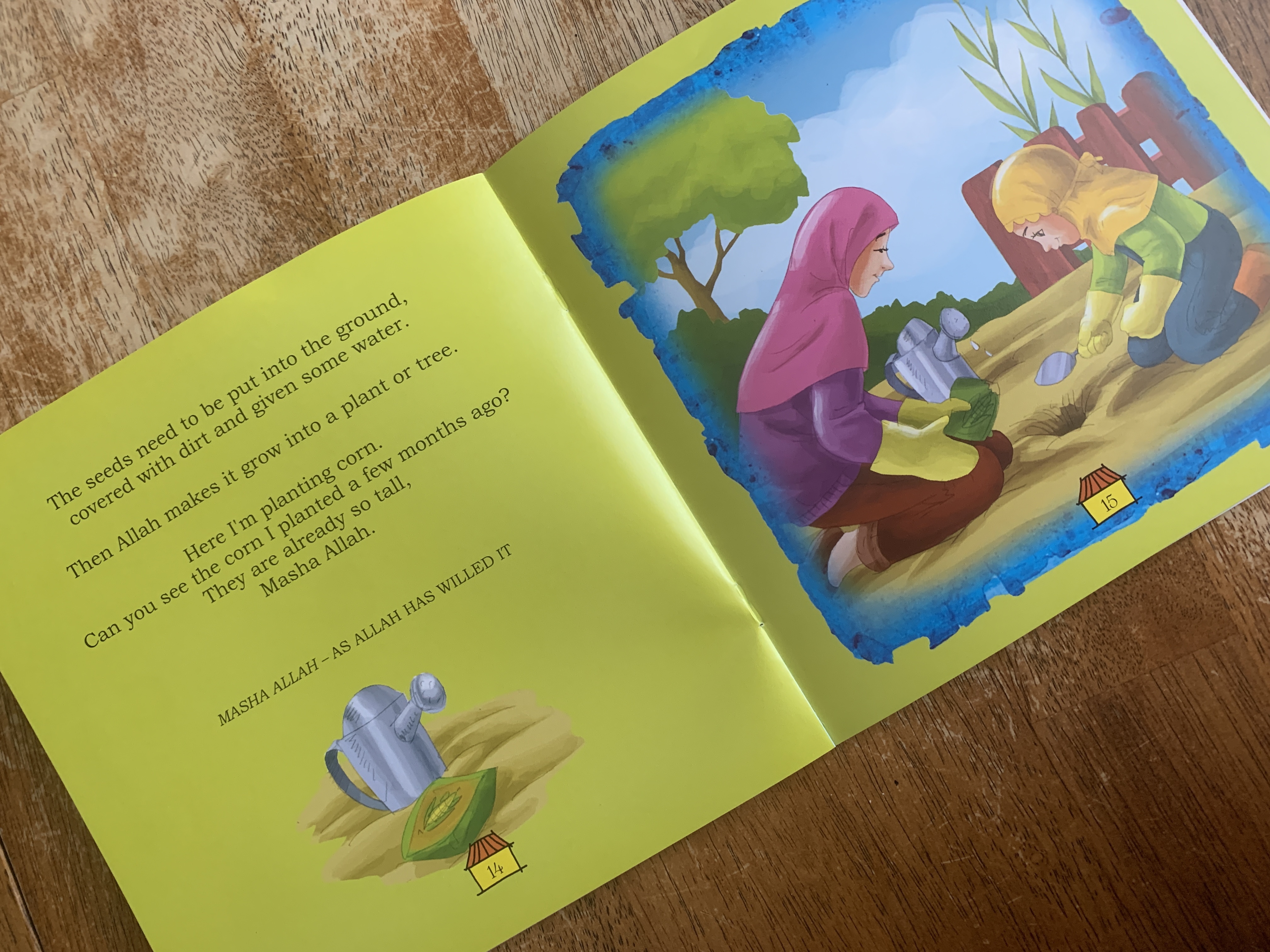
The book focuses on the life cycle of plants: seeds, flowers, trees. Drawing on that information it then shows the little girl collecting seeds to plant.  It then talks about the planting process and the needs all growing things have to prosper if Allah so wills it.

img_9838

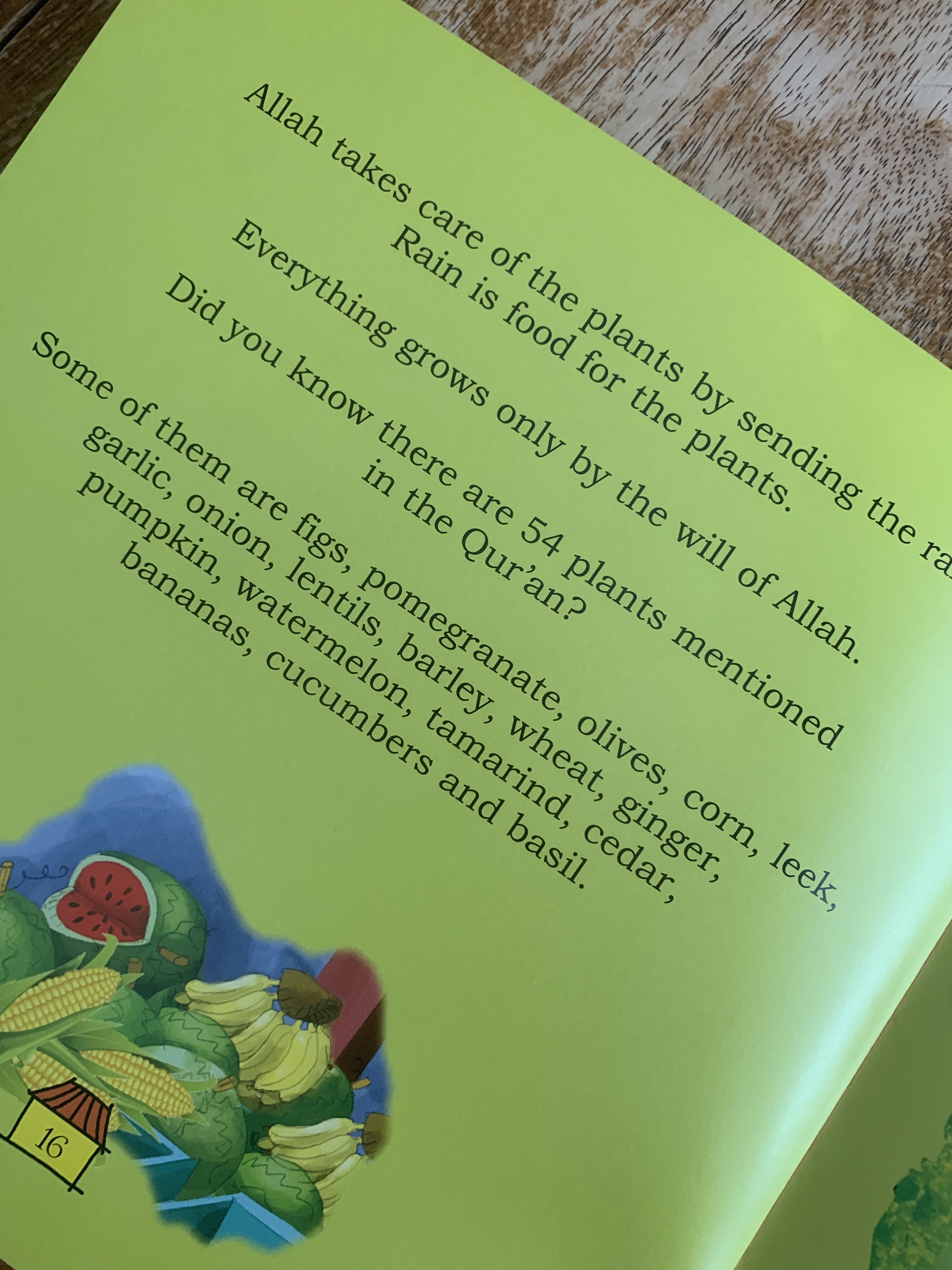
Then the book gets interesting and starts to discuss the plants mentioned in the Qur’an before returning back to the half hearted narrative remarking on how the flowers complement the color of their house.

img_9839

The story seems to then end, but it isn’t denoted that the remaining pages are factual or set aside as back matter, it just pivots and begins discussing rain in Surah an-Nahl, Trees in Paradise as mentioned in Qur’an and Hadith, and then again, but this time in table form, the fruits and vegetables mentioned in the Qur’an, and highlighting dates specifically.

img_9841

The book is all over the place, and I doubt it will be read again until next year.  There are a few other books that have come out about his topic, and I plan to look in to them to see if they work better for story time readings and child engagement.