Tag Archives: Muslim Character

Almost Sunset by Wahab Algarmi

Standard
Almost Sunset by Wahab Algarmi

At 224 pages, this middle grade graphic novel has a whole lot of heart. Seventh grade is not easy for anyone, and Hassan is balancing school, grades, soccer, fasting, and taraweeh every night, while dealing with friends, video games, cousins, and falling asleep in class. I love that this OWN voice book really centers Islam. It doesn’t shy away from showing the stresses that the character and presumably the readers of immigrant kids in public schools might encounter, right alongside stresses with Muslim cousins and friends at the masjid trying to pressure you to do something you don’t want to do.  And as in any coming of age story, young Hassan does not want any special treatment or parents to get involved. SPOILER: Hassan does hide his faith and that he is fasting for Ramadan at school, he also does make mistakes, notably among them is when he breaks his fast in what he is told is a loophole of sorts, but by the end he grows and trusts and realizes he doesn’t have to do it all, all the time, and that he isn’t alone. The book is not heavy, but it has layers that serve as relatable mirrors and windows for kids who are going to thoroughly enjoy this richly illustrated book.

SYNOPSIS:

The story starts with seventh grader, Hassan dreaming about food, drooling on his arm, and then being woken up by his teacher, again.  It is Ramadan and Hassan is fasting, going to taraweeh at night, trying to keep up with school and soccer, and on top of it all, he doesn’t want anyone to know.  He also doesn’t have the latest version of the popular video game that all his friends have, and he has to explain to his childhood friend Rosie why it is no longer appropriate for them to hang out together.  Nights and weekends with family and at the masjid should be a reprieve, but somehow even there he is the odd one out, opting to pray instead of play, and being unsure if closing your eyes while sneaking food really prevents Allah swt from seeing you eating like his cousins claim.  Threaded through it all are soccer practices, games, and falling grades that are going to get him tossed off the team, making this a Ramadan to remember.

WHY I LOVE IT:

Wahoo, some Yemeni representation, I loved the flashback/dream longing for Yemen.  I like that Hassan isn’t expecting adults or others to speak for him, and his heart is really in the right place.  I did feel a bit of a disconnect though when his friends knew he fasted the previous year, why he wouldn’t just explain it was time again for him to do so. Increasingly even the most isolated western cities are aware of Ramadan, so I didn’t feel that hesitation for Hassan to own it, even when a friend explicitly asks.  SPOILER, On a similar thread, his soccer coach is Muslim and their isn’t a huge sigh of relief and immediate kinship when the information is revealed.  If Hassan really feels he is shouldering it alone, why wouldn’t this empower him to step into himself so to speak.  I also didn’t understand why the end of the season pizza party wouldn’t have just been at iftar time. The book really had a chance to model how others can support their Muslim friends, and moving a food based celebration a few hours is an easy accommodation, but the Muslim coach didn’t even do it, so why would non Muslims.  

When Hassan does sneak food during his fast, he gets away with it, but it doesn’t sit right with him and I think it is powerfully done, him coming clean also is not punished as it really is something between Hassan and Allah swt and I love how it is left to that.  Regardless of if you feel it is required of a 7th grade boy or not, the ownership of faith I feel is more important than the getting in trouble by your parents in this case.

FLAGS:

Lying, failing grades, sneaks food during fasting, boy girl friendship, hints at internalized Islamophobia.

TOOLS FOR LEADING THE DISCUSSION:

I wouldn’t do this as a book club, but would absolutely have it on shelves for kids to easily access, and I would absolutely discuss with them, what their takeaways were.

MetalGhost: Kashif and the Echoes from a Past Life by Ali Mohammad Rizwan

Standard
MetalGhost: Kashif and the Echoes from a Past Life by Ali Mohammad Rizwan

img_8377-1

This 350 page YA book (14/15+) does not hit the ground running, but once it finds its stride, it is a lot of fun.  I handed the book to my son, who loves Islamic fiction, and at 30 pages he brought it back saying it was terrible. I upped the ante and bribed him with goalie gear to read to 100 pages, but he couldn’t stop, he finished the book, and returned the favor by encouraging me to move it to the top of my TBR pile.  Like him, I truly wanted to dnf it early on. There are too many names, too many line edit errors (mistakes, repetitive phrases, adverbs), and a little too many forced cheesy (halal) romance scenes. And then the writing gets a little better, the plot strengthens, the Islam is more than just the character’s religion, but something that actively engage with, humor is woven in, twists develop, emotional threads are pulled, and you find yourself absorbed and invested in the story.  The writing at the end unravels as well, it feels  forced, much like the beginning, but perhaps that is the vigilante/superhero genre’s norm to get readers to pick up the next book in the series for answers and clarity. I’m glad the book was nominated for the Muslim Book Awards, I may not have heard about it otherwise, and I love that my son, who is currently re-reading it, found a book that is relevant, appealing, and has an Islamic heart.  Think a mix of Batman and Green Arrow, with a splash of Ironman all wrapped up in a thobe, and being advised by his mother and the local imam to go pray.

SYNOPSIS:

Life is going pretty well for Kashif Razvi, he is about to marry his longtime crush, with both families’ blessings and excitement, he is busy at work but enjoys it, and he hangs out in his free time with his tech friend Samir, developing robotic and cutting edge devices, but then everything falls apart.  When his father dies because of a mysterious power outage in the ICU, Kashif can’t let it go, and starts looking for answers.  He comes up empty following the legal, traditional routes and decides to take matters into his own hands.  He throws on a suit designed by Samir and takes to the streets as MetalGhost, becoming the city’s new hope.  He follows leads to avenge his loss, uncovers corrupt police, cracks down on human trafficking, and seeks to set right other ails of the city.  No matter the crime, a few names always seem to be in the mix, and as the city starts to fall apart, copycat vigilantes start popping up, and MetalGhost finds it won’t be as easy as he thought to hang up his thobe and leave his crime fighting life behind.

WHY I LIKE IT:

Everyone wants a Muslim super hero, but usually they come across as overly juvenile, or their faith and culture performative. This book finds a nice balance of action, contemporary relevance and Islam. The structure feels formulaic, but it works as it seems to track with superhero movies.  You get the emotional tragedy, then the plot, then the resolution. The middle of the story flows and draws in seerah, sahaba inspiration, humor, and action.  The beginning and the end, though are just really stilted.  I’m not going to spoil anything, but the end was not as strong as it should have been, the reveals and twists were not articulated well and they should have been, they were so shocking.  The numerous names and characters at the beginning really need to be edited and simplified, they linger in the middle, but honestly the reader stops caring and just reads for the plot, hoping that it will get sorted.

FLAGS:

I love that the relationship beats are halal, there are a few tinges that might lean into the line, but are gray at most.  There is killing, death, torture, human trafficking, crime, lying, vigilantism.  For teens it is fine.

TOOLS FOR LEADING THE DISCUSSION:

My son and I have chatted about the book, but I think to take to a larger group, I really would want it to have another round of edits.  The idea of the story is wonderful, and to read by yourself I think it excels at what it is.  But to have teens, sitting around picking it apart to discuss and reflect on, will need the writing to be cleaner and stronger.

Amina Banana and the Formula for Friendship by Shifa Saltagi Safadi illustrated by Aaliya Jaleel

Standard
Amina Banana and the Formula for Friendship by Shifa Saltagi Safadi illustrated by Aaliya Jaleel

img_8365-1

I have five children, I have taught second grade, I have shelved, recommended, and read aloud a number of early chapter books for the better part of the last 20 years, so when I say that this book changes the standard of what a book (series) for this demographic can and should be, I do not say it lightly. Yes, I am bias, the author is a dear friend, but Amina has layers, growth, insight, struggles, warmth, heart, and all the other glowing adjectives normally associated with beloved books and characters for older readers. This book is the first in a series of four, and each book is somehow better than the previous. At 126 pages with a robust backmatter that includes scientific extensions, a recipe for ful mdamas, and a note from the author, I am confident that children of all ages, everywhere, caregivers, parents and educators alike will all fall in love with Amina, cheer for her, laugh with her, and be enamored with her attitude, perseverance, and joy.

SYNOPSIS:
Amina loves having a plan, a formula in fact, and when she arrives in Indiana as a refugee from Syria she is determined to make friends in 3rd grade.  Things don’t always go as expected, but alhumdulillah Amina doesn’t stay down: classmates, family, and determination combine to help the clever, yellow-loving protagonist find a way to rework her experiments, accept what she can and cannot control, and succeed in making this new country feel a little bit like home.

WHY I LOVE IT:
I adore the humor, unapologetic Islam, the rich Syrian culture woven in, and Amina’s approach to life.  So often early chapter book protagonists are obnoxious, annoying, crude almost, bratty, arrogant, and repetitive, Amina is none of those things.  She is vulnerable and strong, confident, yet nervous, hopeful, but worried, she is tangibly real in a way that readers will see themselves and relate.  I love the humor of idioms being confusing, and the heart of seeing what the parents have sacrificed and are willing to sacrifice by starting over in a new place.  The illustrations add to the experience of drawing reluctant readers in and will help those transitioning from picture books to chapter books be immersed by the story.  As always the author’s writing is impeccable and the story well-crafted.

FLAGS:

There is some teasing, reflections on why Syria was left, the journey to America, and hardship.

TOOLS FOR LEADING THE DISCUSSION:
This book is ideal for classroom, library, and home shelves.  It would be a wonderful classroom read aloud and works equally as well at bedtime.  My children college to elementary have all read and loved Amina, and I highly encourage preordering so that your children will get a chance to fall in love with her too.


The Djinn Waits A Hundred Years by Shubnum Khan

Standard
The Djinn Waits A Hundred Years by Shubnum Khan

img_8259-1

I didn’t realize how many characters this 308 page adult book has until I sat down to write this review.  The slow peeling back of layers into their backstories, motivations, perspectives, and insecurities, makes you get to know them in a way that feels real and deep, but in no way can be succinctly explained in a review.  First off to clarify, I feel the title is a bit of click bait, the djinn is there, but not a big part of the book, there is also a ghost, who is a more impactful character, so the vibe is more haunting than Islamic lens.  In fact, a few characters are Muslim, but that is about it.  The writing though, oh the writing is quite lovely and immersive.  The culture of desi characters in South Africa, the slivers of colonization and caste that get commentary, and the heartache of all those who have called, and do call Akbar Manzil home, will linger even if the details fade over time.  I listened to the audio book, so it is possible that triggers or flags might have been missed, for the most part the book is relatively clean, death, murder, attempted murder, and supernatural beings being the most obvious.

SYNOPSIS:

The main character is very much the grand estate of Akbar Manzil, a palatial home off the coast of South Africa that shaped lives and futures and hid horrors and loss.  In modern times it has been subdivided into apartments where lives and futures are still shaped and horrors and loss are also hid, and hid from.  When Sana and her father arrive to take up residence, the past and the present begin to unite, a djinn that has never left the house is stirred, and the more Sana pokes and prods, and the more she understands about the original inhabitants of the home, the more the house pushes back.

I don’t know how much to tell, as spoilers aren’t so easily defined in this book.  The family in the past is a man from India, Akbar, who falls in love with the area, builds a house despite his wife hating it all and desperate to leave, opens a sugar factory, his mother comes to live with them, they have two children, servants, friends, he stocks the gardens with monkeys, giraffes, a lion, and then one day he is enamored by a Hindu worker, Meena, at the factory and takes her as his second wife.  The jealously and family drama reaches a crescendo when she is pregnant and has a little boy.  Beyond the family storyline is a djinn also enamored by Meena, who takes up residence in the house to be close to her.

In present times, the other tenants in the house have their own baggage, loss, regret, and fears that cause daily squabbles and plottings.  Sana deals with the loss of her mother who hated her, and a dead sister who haunts her.  There is also Pinky in love with Shah Rukh Khan, Zuleikha a former famous pianist who has lost her edge, the Doctor who owns the home, a mother waiting for her son to visit, a parrot named Mr. Patel, Fancy, Razia Bibi, and so on. The house is occupied, but hollow, not full, and the the lingering djinn seems to always lurk just beyond the surface, in the corners and shadows that haunt them all.

WHY I LIKE IT:
I like that the writing keeps you hooked, even at times when there is no rising action, or conflict, you are genuinely drawn in and invested in just learning about the characters and how their lives, both those in the past and the present, intersect.  I didn’t like the fact that there is a djinn and a ghost, I feel like the ghost negates the realness that djinn.  It is possible that the ghost was a metaphor, or symbolism, but it was a little off to me, to have both as I understood it.  I don’t know how I feel about the vagueness of the final climax, yes I’m trying not to give anything away, but SPOILER: who set the fire?

FLAGS:

Loss, death, ghosts, djinn, murder, attempted murder, lying plotting, manipulation, music.

TOOLS FOR LEADING THE DISCUSSION:

I don’t know that this would work for an Islamic school book club, that doesn’t mean it wouldn’t work, but rather I need someone to discuss with me, so that I feel like I understood some of the lingering threads that are unresolved.  Basically, I would need to have someone explain parts to me, before I could help 15-16 year olds and up make sense of it all.

Dear Moon: Inspiration from the Beautiful Wisdom of the Qur’an by Zayneb Haleem

Standard
Dear Moon: Inspiration from the Beautiful Wisdom of the Qur’an by Zayneb Haleem

img_8075-1

At 128 pages, this hard back 7.5 x 8.5 inch book is a beautiful book from start to finish.  If you follow the artist online (@idotdoodle), you know her style and her incorporation of an ayat from the Qur’an or an Islamic sentiment with her signature young girl and nature embellished scenes.  But holding the book in your hands, and pausing on the two page spreads to reflect, and ponder, and be reminded to connect with the love of your creator, is truly a treat. Whether you read it from start to finish, or dip in and spend time with just a few pages at a time, the book will capture the attention of all ages and be enjoyed over and over again, alhumdulillah.

The book starts with a welcome to the reader from the artist, introducing herself, her connection to Islam, her love of art, her expression of emotions through her illustrations, how she picked the verses, where her own thoughts and reflections emerged from, and what she hopes the book will accomplish. 

The book releases in February 2025 and is available wherever you purchase your books.  I hope you will consider preordering to show your support.

Vultures in the House of Silence by A.R. Latif

Standard
Vultures in the House of Silence by A.R. Latif

img_7966-1

This 312 page richly imagined Islamic fantasy is both engaging and compelling.  It is too advanced for me to review as it weaves a complex tale based on history, religion, fantasy, and imagination.  I do know that it was for the most part well written, I have some issue when the character’s diction would include words that felt too contemporary slang, but it didn’t happen too often.  The pacing though, unfortunately for me, was definitely off.  Undoubtedly the author has tremendous skill.  The emotional pulls, the world building, the consistent cliffhangers at the end of each chapter, kept me curious to see what would unfold.  The story beats just dragged more often than they should have for no clear reason in developing the plot, defining character arcs, or adding to the rising action.  I don’t think I ever stopped reading at the end of a chapter, those hooks were well placed, but when I stopped in the middle of the chapter, it often took four or five days for me to be motivated enough to open the book back up.  I truly think it just needs a good editor to help cut certain scenes, and smooth out the tempo.  The idea and layers are great, and if I, as someone who struggles with middle grade fantasy, couldn’t walk away from this YA/Adultish read, I’m sure lovers of fantasy, jinn, monsters, Islamic history, found family, gray characters and action, will find this book an enjoyable read, even the slow parts, that  I struggled with.  So no this is not a negative review,  I am hopeful my teenagers will read it and enjoy it, I just really hope the author will consider working with an editor to elevate the text as it truly has potential.

SYNOPSIS:

I don’t know that I can retell the story, it has a lot going on and I’ll probably inadvertently spoil something, so here is the summary from the back of the book:

“A boy wakes up surrounded by corpses. Unable to move, he is assaulted by vultures who stop pecking at him only when he speaks. To survive this nightmarish ordeal, he tells them the story of how he ended up on their menu…

What follows is the wild tale of the young gardener Khurafa, coping with the aftermath of the Mongol invasion of Baghdad and the death of his parents amidst the bloodshed. After a vivid dream and several supernatural encounters, he becomes convinced that an ancient group of nine sorcerers called the Servants are bent on world domination. Accompanied by his scholarly mentor Shaykh Nariman, and the sly, uncannily perceptive Zakiyya, he seeks saintly help against the Servants, but finds mostly monsters instead.”

WHY I LIKE IT:

I love the opening, it really grabs you, the emotion of Khurafa and the loss of his parents and his predicament with the vultures connects you to him and his vulnerabilities.  The twists are also well developed and keep the book interesting.  I feel like the end needed more, and the middle needed less.  SPOILERS: I didn’t get the cat, or the going from village to village.  All the names, and all the drama at each village, dragged for me.

It appears the book is meant to be a series, so I wonder if many of the characters that died will return, but I feel like the final battle was a little disappointing, and anti-climatic.  All the build up and then it went so quick.  I appreciated the full circle on the House of Silence, and the answering of some of the questions, but for all the emotion  at the start, the end didn’t mirror that in the cathartic way I hoped it would.

I say all this with full acknowledgement that I am not drawn to fantasy, I am not well versed in Islamic history, and it is absolutely possible, that I just don’t get it. In brief, I am not the target audience.

TOOLS FOR LEADING THE DISCUSSION:

I think this book could be a good book club selection, with some motivation to get to the end, I think readers will be happy that they did, and I would imagine they would be willing to read the next book in the series. For many I would imagine it would be the first Islamic fantasy they will have read that has the layers, richness, and intrigue that this book does, and inspire them.

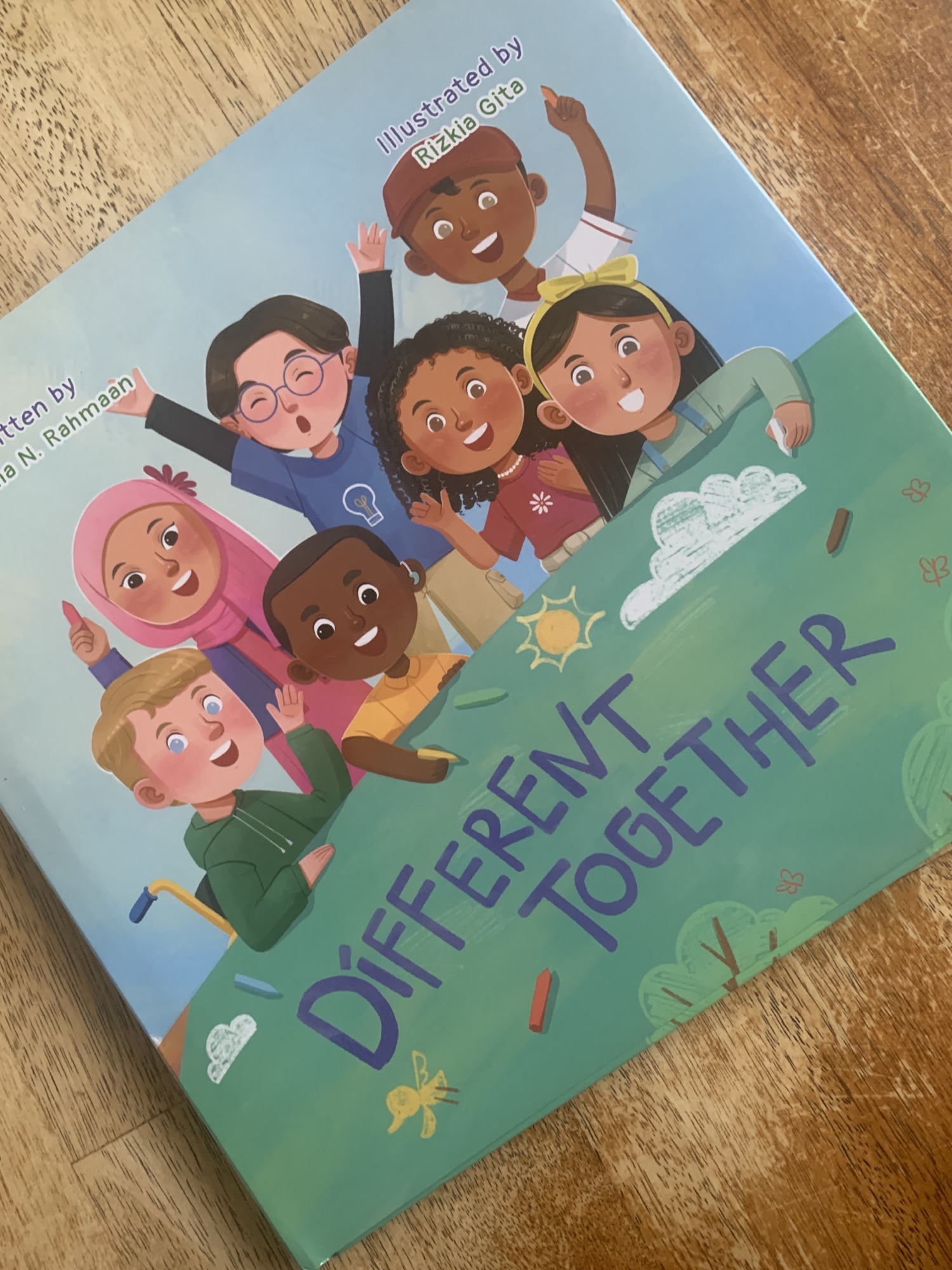
Different Together by Ayesha N. Rahmaan illustrated by Rizkia Gita

Standard
Different Together by Ayesha N. Rahmaan illustrated by Rizkia Gita

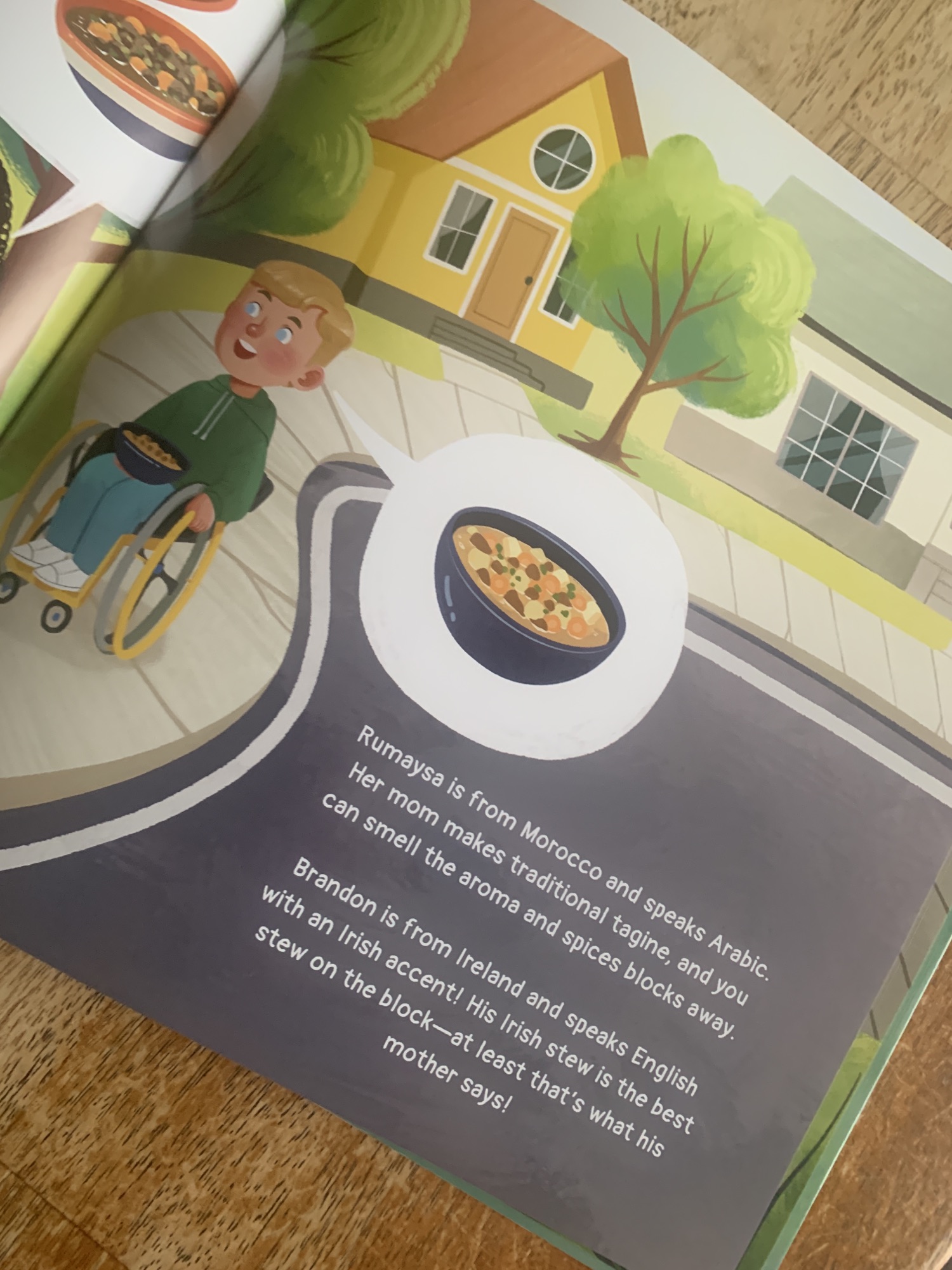
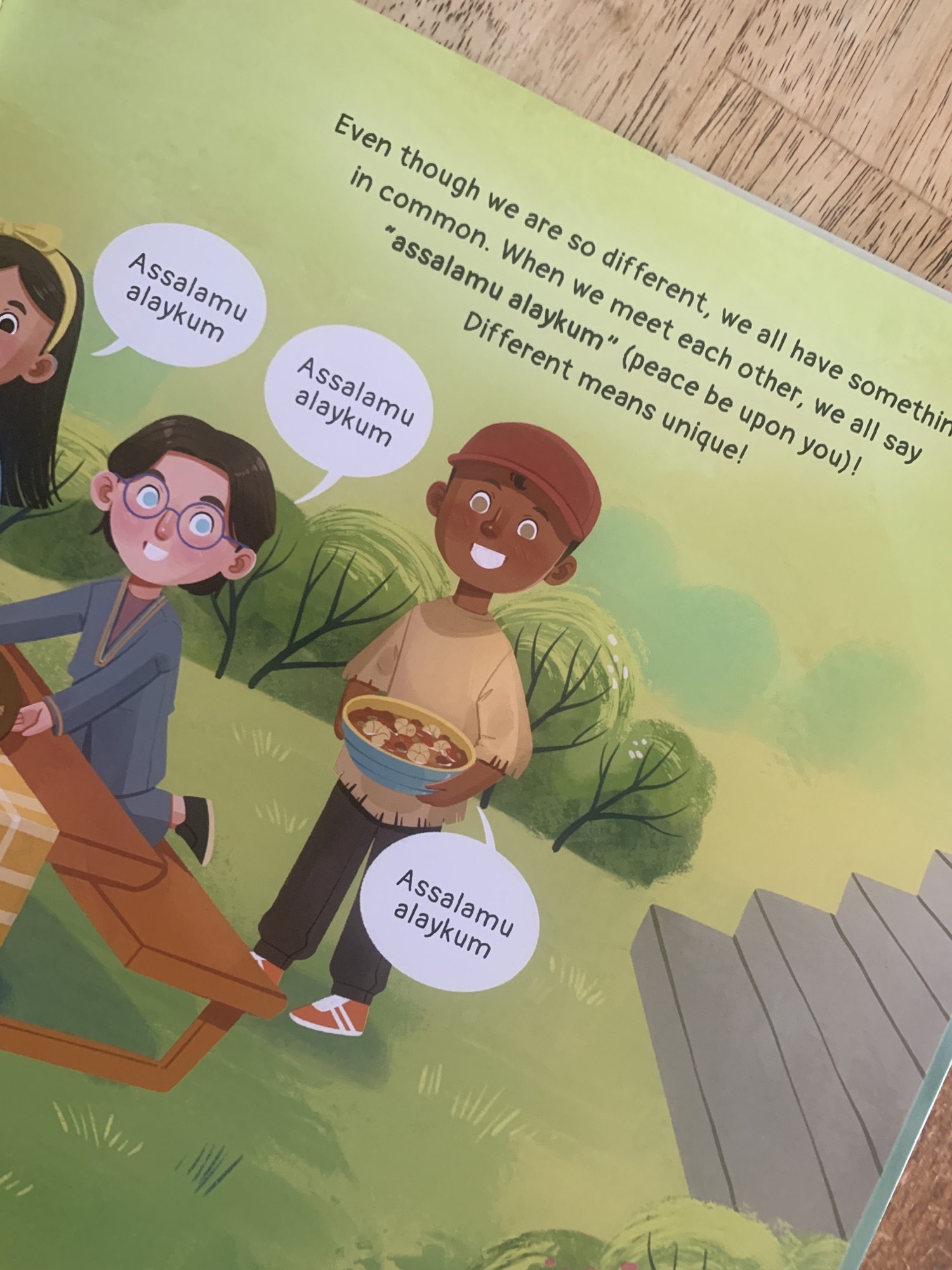
This 32 page large 10 x 10 hardback book explores how we are all different and unique, while also being the same too.  The illustrations and text present a nice way for children to learn that Allah swt created us all to be different in our appearances, what foods we like, how we dress, how we speak, but come together to all say Assalamu alaykum and stand foot-to-foot to pray.  Some of the refrains are a bit abrupt, and it really focuses a lot on physical descriptions and food, the target audience though of preschool to early elementary, will see themselves in the book, probably even a character that looks like them, and expand their understanding of al-Khaliq creating them all.


The book starts with an ayat from Surah al-Hujurat and then starts by asking the audience to imagine a world were everyone is the same.  It highlights that Allah created each of us starting with prophet Adam (as) to be just as we are, with different traits. From there, neighbors are introduced: their names, country of origin and favorite foods that all come together to make a table of sharing.

In school the students look different and play different, in the city the different building types are shown to come together, and in the masjid our hearts are in sync when we pray. The text concludes asking the reader to highlight five ways they are unique and a hadith in Arabic along with its English translation.

Bilal’s Bad Day by Neelum Khan illustrated by Alice Larsson

Standard
Bilal’s Bad Day by Neelum Khan illustrated by Alice Larsson

img_7727-1

I like the concept and presentation of this picture book that involves spinning a spinner at the midway point to determine what page you should “jump” to, to continue the story. I can see this being a great tool to introduce and practice different calming strategies to use when times are tough.  I love that some of the ideas of faith based, and some are not, and that a thorough introduction of how to use the book and strategies precedes the fictional story.  BUT, oh come on you knew it was coming, I don’t know if the information is sound.  Translation, I don’t have to use calming strategies, and the book does not disclose if the author is qualified to be giving them.  I can’t imagine the strategies would cause harm, and we can always benefit for de-escalating and centering, and truth be told I don’t even know if one would have to be “qualified” to give this advice.  I simply put it out there for you all to decide for you and your little ones.

The book starts with Bilal opening his eyes to the sounds of his siblings squabbling, breakfast disappoints when they are out of his favorite cereal, and dad’s joke about his hair is not appreciated.  Top it all off with news that guests with a baby were coming over for lunch, and Bilal knows it isn’t going to be a good day.  With cleaning, itchy clothes, and the smell of food building as the day passes, the doorbell ringing sends him over the edge and mum and dad need to find a calming strategy to help him.  This is when the reader gets to spin the arrow and jump to the page to see what and how to use the different options.

The book has whatever option picked work to calm Bilal down, but notes at the beginning that multiple options and repeats are often more the reality.  The story then has Bilal later that evening reflect on the day before asking the reader to reflect on their own similar experiences as well through six bulleted considerations. The 40 page book concludes with hadiths.

This book needs to be read and discussed before the moment of need arises, and be aware the spinner at bedtime is too much of a distraction.  The book is best with dialogue, understanding, and practice.

The Boldest White: A Story of Hijab and Community by Ibtikhaj Muhammad and S.K. Ali illustrated by Hatem Aly

Standard
The Boldest White: A Story of Hijab and Community by Ibtikhaj Muhammad and S.K. Ali illustrated by Hatem Aly

The third and final book in the standalone series is finally out and I absolutely love that Islam, salat, and the masjid are front and center. Faizah is once again brought to life through the incredible illustrations that provide all the emotional beats and make the book memorable.  The story though is only just ok, to be honest, it is clunky and disjointed.  I have read the book a half a dozen times to myself and twice aloud and I do not understand the Eid story line.  I doesn’t fit the themes of fitting in, being a leader, being bold, it just seemed to be there to motivate a white hijab being purchased, and it was very distracting to the cadence and continuity of the story. Every time Faizah is self reflecting on her fear, suddenly a conversation about Eid with a friend named Sophie disrupts the story. Even the refrain that “Bravery grows in your mind.  But its roots are in your heart,” sounds lovely, but is never explained or developed, so what are you to water it with? What are the right reasons?  I’m sure most will be fine with the concepts and presentation and not be bothered, but this book is an auto buy for Muslims and non Muslims alike, and while I appreciate the packaging, I wish the story itself was more, well “Bold.”

The book starts with Faizah going to Jummah with her mom and sister, and loving being part of the crowd, she then goes to fencing and loves being part of the crowd, “it feels right.  I feel right,” she says.  But then the coach calls her name and she starts to worry.  She doesn’t like when people stare at her, she worries she did something wrong. The coach has already reminded her to “saber first, then move forward,” so I’m not sure why she worries after if she did something wrong, it is a class, reminders and corrections are what happen in a class.

Then on Sunday, the trio is back at the masjid for salat before Asiya’s fencing lesson.  The coach asks Faizah if she wants to come in for extra practice before the tournament.  Faizah isn’t planning on participating in the tournament though and would rather think about Eid.  Thinking about getting together in the future with Sophie to pick out Eid clothes, is more fun than fencing.  The reader doesn’t know when Eid is, or why Faizah seemed to break into a day dream when asked about fencing.  Furthermore the reader doesn’t feel the worry of being in a competition because Faizah is not shown to be worried.

Later that night Asiya teaches Faizah the moves she learned and Faizah practices alone.  There is then a two page spread that I do not understand, on one page she is saying, “When no one is watching, I ‘m the best fencer in the world,” three lines later it says Even when others are watching, I can do it.  I can be the best.”  What happened in between? I get the following line, “but it’s hard to be my best when I have to stand out to do it,” but the the line in the middle makes no sense.  What is the point of the book if she can do it and knows it at the mid point?  And no, I’m not reading an arc, I checked out this copy from the library.

The family is back at the masjid on Friday and reassuring Faizah as they head to fencing, that she can do it even when people are watching, that bravery will come.  She hasn’t been nervous at class before, and hasn’t signed up for the tournament, so why is she suddenly uncomfortable, when at the start she loved fencing class as she felt she fit in.

Then it is Saturday, and Sophie finally comes, but not to prepare for Eid, just to discuss, how they will prepare for Eid.  At least now we know it will be next week. The next Friday, I know I feel like a calendar should have been included, it is fencing class again and Faizah is called up to demonstrate.  She finds her strength and she is shy, but realizes they are not just looking at her, but looking at what she can do.  She is leading, she is helping, she is being brave.

Finally it is Sunday, and Sophie and Faizah are at the hijab shop, and Faizah picks a white hijab because it matches the fencing clothes, and she is going to the tournament.

Yeah, sorry I spoiled it, I just really am sad that the book wasn’t as great as it could have been.  It connected the dots eventually, but not in a memorable way, and for the team responsible for this book, it really could and should have been amazing.

My Olive Tree by Hazar Elbayya

Standard
My Olive Tree by Hazar Elbayya

img_7154-1

I love that this author illustrator traditionally published book shows the ways that olive trees and their fruit connect people.  The little girl, Salam, can’t wait to grow her very own tree, but it takes a while, and when it finally sprouts, it is trampled by soldiers.  Heartbroken to lose her plant, her community shows her how they are like their beloved olive trees: their roots are deep, and they are a part of the land.  The tender illustrations, the poignant symbolism, and the love and unity that radiates through, makes this book an important read for children and adults of all ages and backgrounds.  There are no countries mentioned in the text (Palestine appears only in the author’s note), nor any religion, there are visible Muslims in the illustrations, even the soldiers are unnamed, but the setting is clear.  Picture books take years to be published and that it released at this point in history, shows how long the struggle for freedom has been taking place, and how strong and resilient Palestinians are.  This book that will be read over and over, shows even in the sadness, the feeling of hope abounds.

The book starts with Salam noting how old her grandpa is, and that only the olive trees are older than Sido.  Sido then explains to his granddaughter how the olive trees connect them all: farmed, picked, pressed, oil used to cook, olives sold to eat, added to dishes, and made into soap.  Salam goes to plant her seed and be part of the connection. She waters it and waits, but it doesn’t seem to be growing.

Finally a spout, and then a little plant, and then the soldiers march into their lands and destroy everything in their path, even Salam’s olive tree.  Sido reassures her that she will plant more olive trees in her lifetime, but Sido also wants to show her that she is not alone.  Friends, family, and neighbors, come together to show her, “just like the olive trees, when they try to break us, we grow back stronger.”

A truly beautiful hopeful book, subhanAllah.

img_7144-1