Tag Archives: 2021

Count by Ibrahim Moustafa with Brad Simpson and Hassan Otsmane-Elhadu

Standard
Count by Ibrahim Moustafa with Brad Simpson and Hassan Otsmane-Elhadu

count

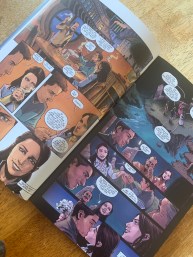
This graphic novel retelling of the classic, Count of Monte Cristo, is for middle school readers and up and is by a Muslim author and illustrator. There is nothing Islamic or cultural in the text of this 136 page sci-fi twist, and there is some kissing, a whole lot of killing, brutality and violence, but I think the swashbuckling tale will appeal to early teens and adults who enjoy fast paced reads whether they have read the original tale or not.

img_6765

SYNOPSIS:

Commoner Redxan Samud is elevated to Captain and marries his beloved, the first few pages of happiness, however, quickly disintegrate as he is framed and wrongfully imprisoned by the jealous powers that be.  Life in the hovering prison are barbaric, but the meeting of Aseyr, provides him with a plan and means to move forward.  First he will have to survive the death battles in the prison, escape the inescapable fortress, before he can locate the Isle of Sorrow, take control of ARU and extract his revenge.  Oh, but his revenge is strong, so very, very strong.

img_6766

WHY I LIKE IT:

I was admittedly hesitant to give the book a try, but when writer Shireen Hakim sent it to me, and my kids saw it, I thought I should read it first before letting them dive in.  I read it in one sitting, the story is engaging and clear.  I never was confused with who was who and why something was happening.  At times though it seemed too quick and that details were glossed over, or impact was minimized because major plot points were not given enough time to be felt.  I would have liked some answers provided of basic logistics and of character’s getting from one place to another, and how plans came to fruition shared in the story.  Additionally, some fleshing out of situations to ground the story a bit and make the revenge and extraction of revenge more cathartic, would have elevated the book and made it a popular choice in my house to be reread again and again.

img_6767

FLAGS:

Death, violence, murder, rage, kissing, torture, plotting, deceit.

TOOLS FOR LEADING THE DISCUSSION:
Not a contender for a book club read, but I would shelve it in a middle school classroom and in the school library for graphic novel and comic book enthusiasts as well as for high school students who might be familiar with the classic it references.

The Lady or the Lion by Aamina Qureshi

Standard
The Lady or the Lion by Aamina Qureshi

lion

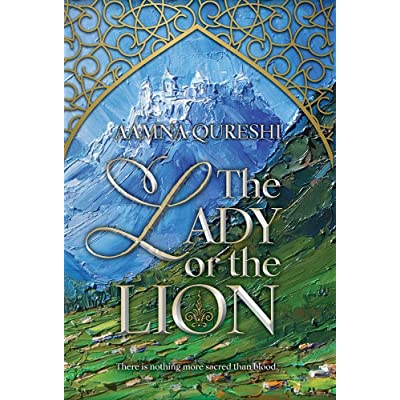
I was kind of surprised how well done this YA culture rich 350 page romance story was in holding my attention.  I don’t know that I had any expectations, but I was genuinely engaged in the growth of the protagonist as she began to emerge from her naive political state, and I look forward to some resolution from the cliffhanger conclusion of this the first book in the Marghazar Trials series.  The characters are practicing Muslims who pray and mention Allah swt regularly, they also acknowledge when they make extreme departures from basic Islamic tenants such as drinking, dancing, murdering, exhibiting racist attitudes, and mixing freely with the opposite gender.  It doesn’t stop any of the characters from behaving as they wish, but at least it is noted. The Urdu words and Pakistani setting in this fictional reimagining is filled with warmth and love, and while there are some steamy scenes and outright cruelties, I think 15 year olds and up can handle the contents, and recognize the suspension of reality and moral laxities for the sake of telling a story.

SYNOPSIS:

The book makes clear from the onset that “In the very olden time, there lived a semi-barbaric king. . . This is not his story.” This is the story of 18 year old Durkhanai, an orphaned princess raised by her grandparents, the King and Queen of Marghazar.  Marghazar is a prosperous country that is waging war on two fronts and does not let outsiders in, ever.  When the book begins it is doing so begrudgingly to avoid war with the neighboring districts that are working to unify and have recently been attacked.  With ambassadors arriving to determine the guilt or innocence of the one district unaffected by the terrorist attacks, the foreigners are seeing the inner workings of the kingdom for the first time.  All the ambassadors are females of various ages and experience, save the one from Jardum.  Asfandyar is young, dark, and handsome, and immediately discriminated against by the Badshah for his complexion.  Additionally Shehzadi has been warned by many to stay away from Asfandyar, which naturally makes him a great character for her to be swept away by.  She holds out for a while, but with her people mysteriously getting ill, her betrothed melting in to the background, and cracks in her country making themselves obvious, Durkhanai will find herself struggling to understand her heart, her country, her family, and her future, and with the cliff hanger ending, no simple answers will be given to her, or the reader.

WHY I LIKE IT:
I love that there is a map at the beginning, and lots of supplemental offerings at the end.  There are a lot of Urdu words and phrases and while I am moving away from feeling like all OWN voice books need to include glossaries, I think non Desi readers will be appreciative in this particular book to have one available.  For someone with some knowledge of the language the inclusion of the titles and relations and phrases between the languages is expertly done and delightful. There is also an author Q & A, as well as reader discussion questions.  There is a content warning at the beginning alerting the readers to physical and sexual assault as well as racist behavior and language and makes clear that it is contained to the characters and the story and is not the reflection of the author and publisher.  I like that it is there, and I like that the princess makes a stance against the racism and the sexual assault that she witnesses.

The high school girls at our Islamic School are always wanting “halal” romance books.  Ok so really they just want romance books, but I try and keep their pickings halal, and so I am forever reading these books trying to find new titles to recommend.  The book is very 1990s Bollywood in terms of romance flags.  There is a lot of proximity and caressing of necks and longing, and familiar obligation.  There is some snuggling and kissing, so maybe 2000s Bollywood, but the characters thus far don’t cross “that” line.

I really appreciated that Durkhanai was fleshed out and relatable.  Even though the setting is long ago, and the genre is romance, she didn’t wait to be rescued, even when she was hurting or pining, she was still maintaining her obligations and moving forward.  I also love that it showed some depth to her emotions.  She recognized that Asfandyar would let her speak and would show his support by being there, but he pushed back on her and challenged her too.  Rashid on the other hand would speak for Durkhanai and would fawn over her in a very superficial way almost.  Sure neither relationship was ideal, but from her perspective at least she was able to see how various presentations made her feel.

I was a little lost in some places, but I was reading quick and had distractions so I’m not entirely sure if it is my carelessness or plot holes or if gaps will be filled in future books.  I needed more reasoning though, for why Durkhanai’s cousins, Zarmina and Saifullah, truly hated Asfandyar as much as they did, or what exactly Saifullah was plotting and how it connected to ratting out the princess.  For all that is seemingly going on, the Badshah and Wali always seem available to chat and are often just lounging around.  I know it is not their story, but the negotiations, the plotting, everything seems to be done very slowly and could really use some fleshing out to show some depth to the side characters.  Other than a few voices, the side details are lacking.

FLAGS:
Lying, killing, racism, sexual assault, physical assault, plotting, murder, kissing, manipulation, touching, caressing, sneaking around, theft, cruelty, cursing, romance.

TOOLS FOR LEADING THE DISCUSSION:

The book is not an Islamic story or even a moral one, it is entertainment and it could possibly be used for a book club if the participants relish in these kind of books, but it probably wouldn’t have wide enough appeal and would alienate nearly all the boys from joining.

Spirit of the Cheetah: A Somali Tale by Karen Lynn Williams & Khadra Mohammed illustrated by Julia Cairns

Standard
Spirit of the Cheetah: A Somali Tale by Karen Lynn Williams & Khadra Mohammed illustrated by Julia Cairns

cheetah

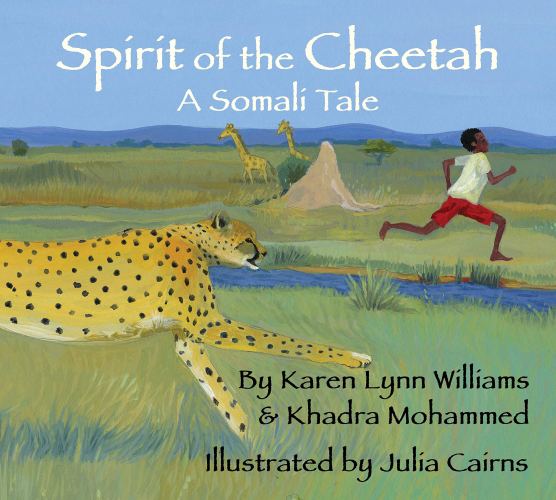
This timeless 40 page tale of a young boy as he prepares for his right of passage into adulthood is rich with wisdom, culture, and tradition.  So many gentle lessons can be found in the book, as it leaves deeper understanding and connection to be felt and explored long after the book has been closed and returned to the shelf.  There are seemingly hijab wearing #muslimsintheillustrations, and the author’s name would suggest she is also a Muslim, but with the line, “Called on the spirit of Shabelle,” and talk of the “Spirit of the cheetah,” it is hard to know for sure if the main character is.

The story starts with Roblay running everywhere in preparation for an upcoming race where he hopes to place in the top three, and prove he is a man and no longer a boy.  On the day of the race he races his fastest, but he does not come out at the top.

img_6579

His grandfather, his Awoowo, tells him that to be successful he needs to capture the spirit of their people and leave his thumbprint on a cheetah’s coat.  His grandfather then tells him about the cheetahs long ago and how the river is named after them.  He explains that thumbprints on a cheetah’s fur honor those that have proven themselves.

Roblay trains and searches for many days.  He wonders if it is enough to mark a cub.  But his grandfather asks him if he wants to remain a cub.  This motivates Roblay to work harder.  When a year has passed and the race is about to take place again, he finally touches his cheetah.

img_6580

He lines up for the race strong, proud and sleek, and he has the chance again to prove he is a man and make his family proud.  Nope, not going to tell you how it ends.

img_6583-2

The book starts with an Author’s notes from both authors and concludes with Notes on the Cheetah.

Moonlight Hope: A Muslim American Coming of Age Story by Nora Salam

Standard
Moonlight Hope: A Muslim American Coming of Age Story by Nora Salam

moonlight hope

This 354 page New Adult read is truly Islamic fiction, and as long as you know what you are getting in to, you probably will thoroughly enjoy it.  It is Islamic centered, it is preachy, it is idyllic, it counters many stereotypes about Muslims and various cultures, while simultaneously falling into other tropes that define the genre, it has mature framing that is not suitable for younger readers, but doesn’t detail anything that is super “haram.”  If you are looking for a potentially halal romance between YA and Adult ages with Islamic messaging this book is a solid choice.  If however, you will be annoyed by any of the aforementioned labels, this book will not hold your attention or beg to be finished.  It reminds me a lot of Umm Zakiyyah’s If I Should Speak and A Voice books where the story has its own twists and character arcs but it spends a lot of time preaching and setting itself up to tout an Islamic perspective, or concept as well.  I wanted to read two books in the “New Adult” category and see if I could spread my reviews to include them, and with this being the second,  I think I should resist the temptation, and stick to what my library background familiarized me with.

SYNOPSIS:

Told in alternating voices of Intisar and Majed, two individuals in New York City, at different places in their life, but finding that when they hit rock bottom, Islam is the answer.

Intisar is graduating nursing school when the story opens and has only one goal in mind, get married.  She has strict Sudanese parents and has put all of her dreams on finding freedom in the perfect spouse.  She meets a guy at a friend’s house and they secretly date, kiss, and hold hands.  When he ghosts her, she is devastated and reluctantly finds herself agreeing to marry a much older man of her parent’s choosing.  Loosing herself in the idea of marriage, she finds herself heartbroken, ostracized and falling apart.  She starts to put herself back together slowly by finding Islam, her confidence, and some much needed perspective.

Majed has a famous family: his mother a model, his father and siblings singers, and he manages their careers.  After passing out from drugs and alcohol more than once he really starts to examine his life and the road he is on.  He sneaks away to rehab and in the process stumbles on to Islam.  He is Egyptian, but the family is not religious at all, and infact stop talking to him when he converts.  The trials of being a Muslim in New York with no family are not easy, but he feels it is worth it and his journey to Hajj and through loss brings him closer to Allah (swt).

The two stories are parallel and collide slightly in the periphery, but the book ends with them finally coming together and the ever dreaded words of “to be continued,” leaving the reader hanging.

WHY I LIKE IT:

I do like that the story shows struggles when one comes (back) to Islam, it isn’t always a walk in the park, it has challenges and stresses.  The book starts each chapter with a verse from the Quran and is very open about what it is.  So, while at times, the preachiness did get to me, it was very clear what type of book it was from the beginning and I kept reading.

Some of the side characters I felt needed to be fleshed out a bit.  I didn’t understand many of the random friends, how they affected the main character often seemed off, or completely underdeveloped in what was revealed about them: particularly Izzedine, Parita, the girl that married Mansour, the uncle at the Masjid that thought Majed was a spy, etc..  I also really struggled with the presentation of Uncle Munir and his calling Majed, baby, and how he just happened to bump in to him outside the bar, and the kisses.  I’m guessing it was meant to show him as over the top affectionate, but it just read as odd.

I like that the book addresses hypocrisy, mental health, and expectations.  It doesn’t paint all Muslims as good or bad, nor society at large.  The book reads as a journey, and many characters are given a chance to correct their errors and be seen in a new light.

The majority of the book is written well, but right away the book gave me pause as Intisar and her friends chat all through the Jummah khutbah, I get that it is trying to show her disregard for intentional practice of her faith and her “boy crazy/marriage” obsession, but you cannot speak during the khutbah, it isn’t just dirty looks, you truly cannot talk for it to count, and it isn’t even remarked upon, and it made me skeptical of the book for a while.  There is a word missing from a sentence on page 161 and at one point a brother in the prayer hall aims a shoe to throw.  But you wouldn’t be wearing shoes in the room where you pray, and the mosque has hallways and a glassed off section for women, so this seemed like an obvious oversight that should be fixed.

FLAGS:

Drugs, alcohol, lying, overdose, sneaking out, kissing, hooking up, physical affection, violence, temptation, sexual predatory behavior, it is an adult book, so I’m not going to continue listing everything. Nothing haram is overtly detailed or glorified. Ages 17 and up, could handle it.

TOOLS FOR LEADING THE DISCUSSION:
Too mature for my book club crew, but I wouldn’t mind it on a shelf in the school library.

Jamal the Giant and the Largest Lesson by Mariam Hakim illustrated by Nesba Yoosef

Standard
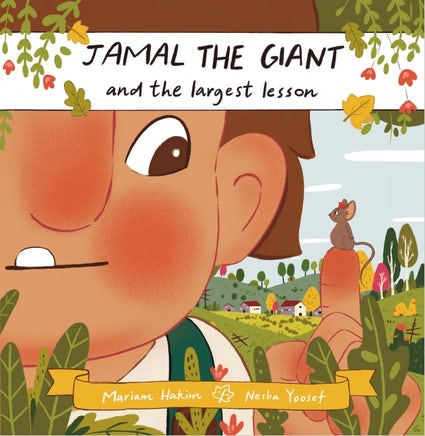
Jamal the Giant and the Largest Lesson by Mariam Hakim illustrated by Nesba Yoosef

jamal

My initial thoughts of this 32 page Islamic fiction, fable-style book, is that it needed to be tested on children, lots and lots of children.  It should have been read aloud to catch all the grammar, syntax, and diction errors, and young readers and listeners should have been asked what they learned or understood from the story, BEFORE, being published.  The message is sweet, the illustrations cute, but it feels unrefined and reads underdeveloped: pictures and concepts are not enough to carry a book if the writing is poor.

I have looked forward to obtaining the book since its launch, so as soon as it was available from a US stockist (@crescentmoonstore), I didn’t even hesitate to purchase it.  I knew the book was available for free online as a read aloud on YouTube, but because I truly love supporting Muslim authors and publishers, I wanted to wait until I had a physical copy in my hand.  These opinions are my own, all my reviews are.  I mean no malicious will to anyone, I’ve spent my money on something, and once I’ve done so, I am completely justified to have an opinion.  You don’t have to like it, or agree with it, but it isn’t personal.  I’ve given reasonings for my opinions, and I stand by them.

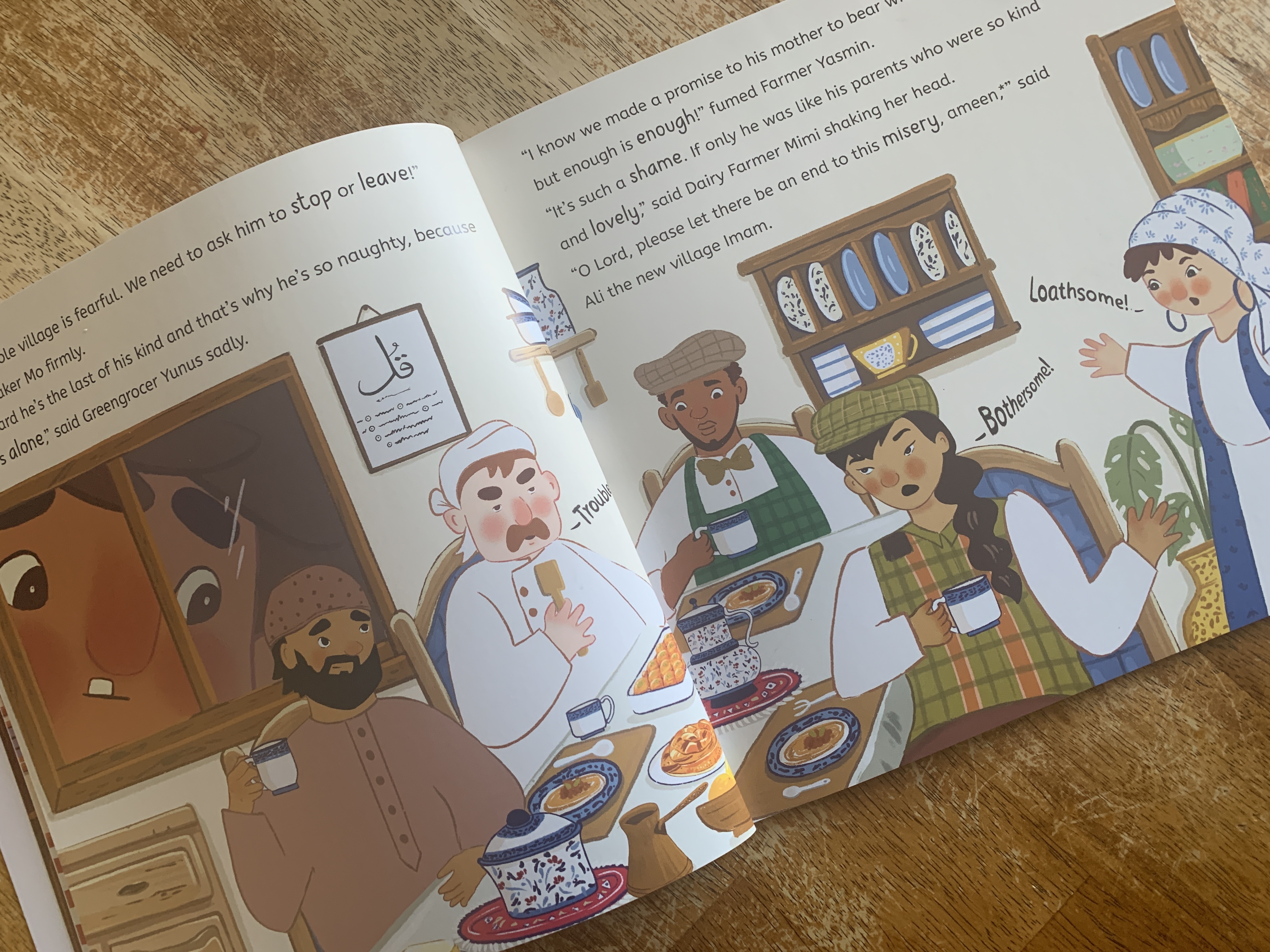
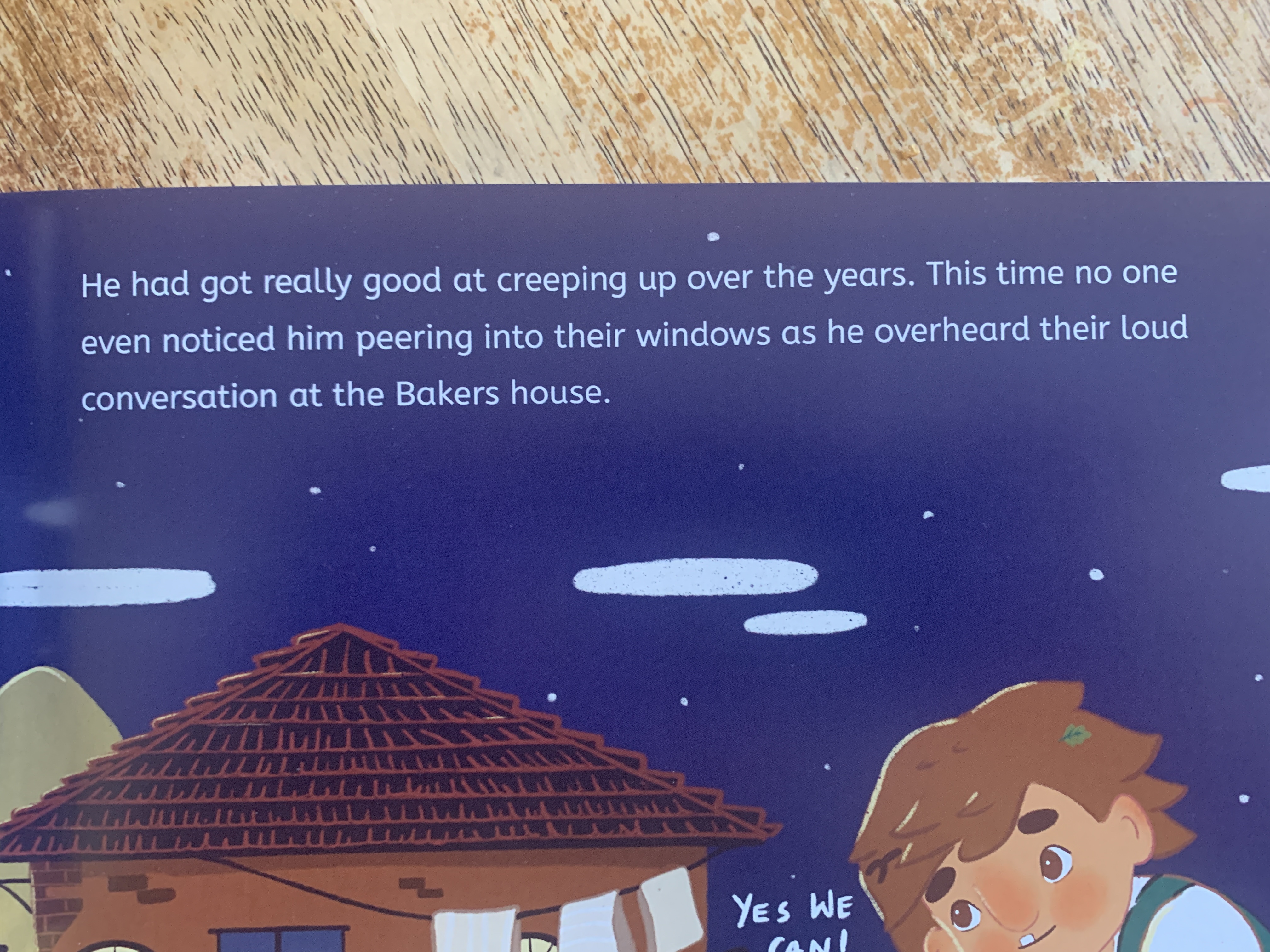
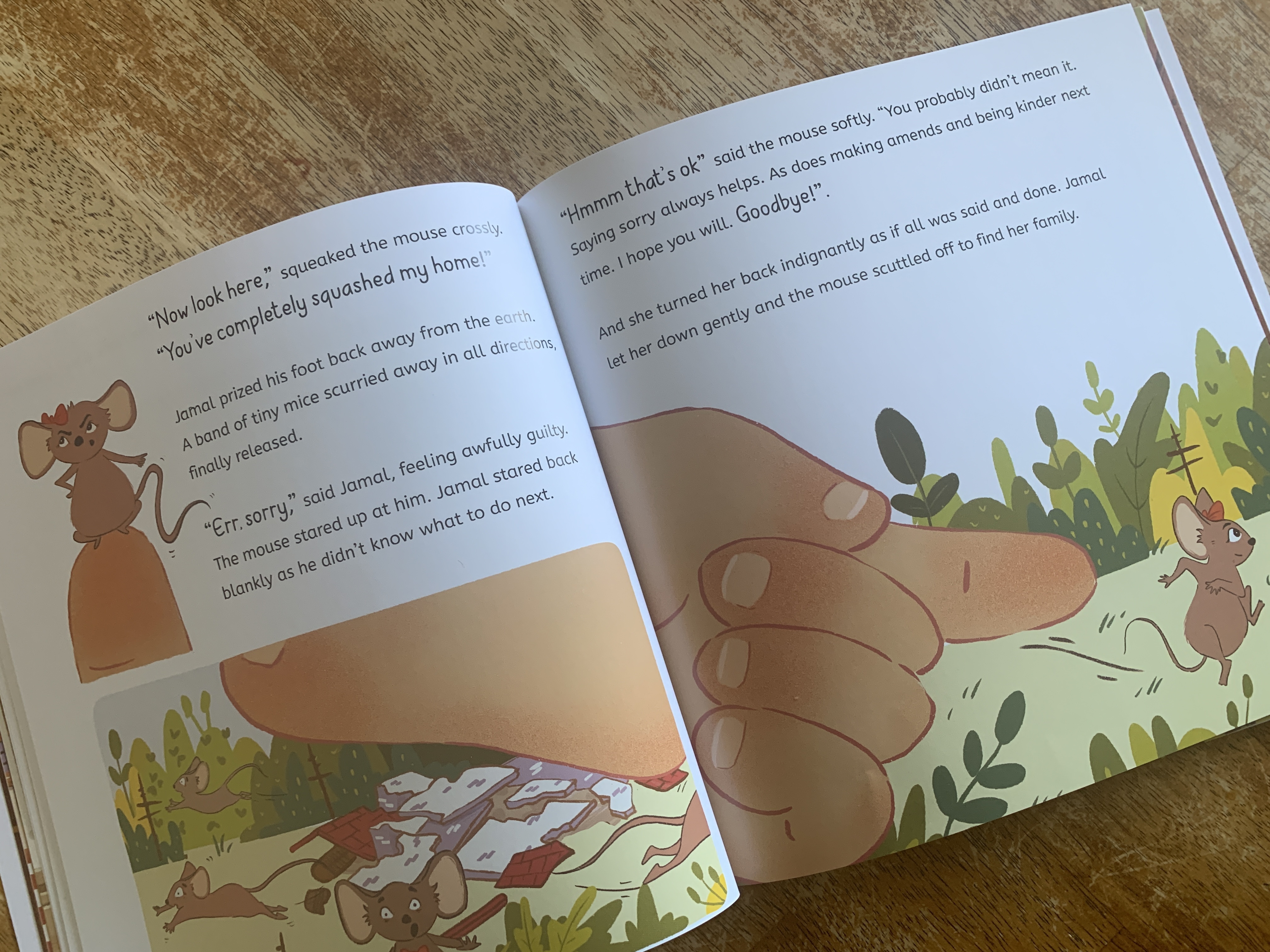
Jamal the Giant isn’t necessarily mean, but he is careless, young, and selfish.  He scares the animals in the woods, destroys their homes, ruins farmers’ crops, and steals from the village.  One night, he wants to steal some juice and in the process overhears the community members discussing how different he is from his kind parents, and that he must be forced to leave.  He tries to mend his ways before he is driven from his home, but to no avail.  Unsure how to fix things, it is the advice of a tiny mouse that sets his reform in motion and conveys the message from the Quran, surah 11 ayat 114, “Good deeds cancel out bad deeds.  This is a reminder for the mindful.” He learns he must apologize, make amends and be kind.

The message is accurate, but I have some concerns at how it is conveyed.  Why was the responsibility on the giant to learn how to behave.  Yes if he knew better, he should do better, but it is made clear that he is the last of his kind and his parents died when he was really young.  If the villagers aren’t going to try and teach him, who is?  It isn’t necessarily victim blaming, but if you don’t know better, and have no one to teach you, you definitely are a victim of neglect in some ways.  To have them going from enabling him out of a promise to his parents to threatening to kick him out from his home, is a little abrupt.

Story-wise there are some points that gave me pause.  Why is there an owl flying off in the daytime, sure there are some diurnal owls, but most kids are taught owls are nocturnal, why not change it to a woodland bird that is active in the day, don’t confuse kids.  It doesn’t specify a timeframe that the story takes place in, but it feels like a fable with talking animals a giant and a clear message.  There is a baker, a farmer, an imam, a greengrocery, it is all very quaint, but then the imam is holding a cell-phone, wait what? I do appreciate that the farmer is female though, and that some of the women cover and some do not, it seems representative.

I’m curious who taught the giant to read, and how come he writes his “s” backwards, there seems to be a bit of disjointedness to the upbringing of the giant, his age, even in giant terms.  A lot it seems the author assumes the reader knows about giants or their stereotypes perhaps, because the book doesn’t address them, and the result isn’t a fun moral story, but one that seems to miss things.

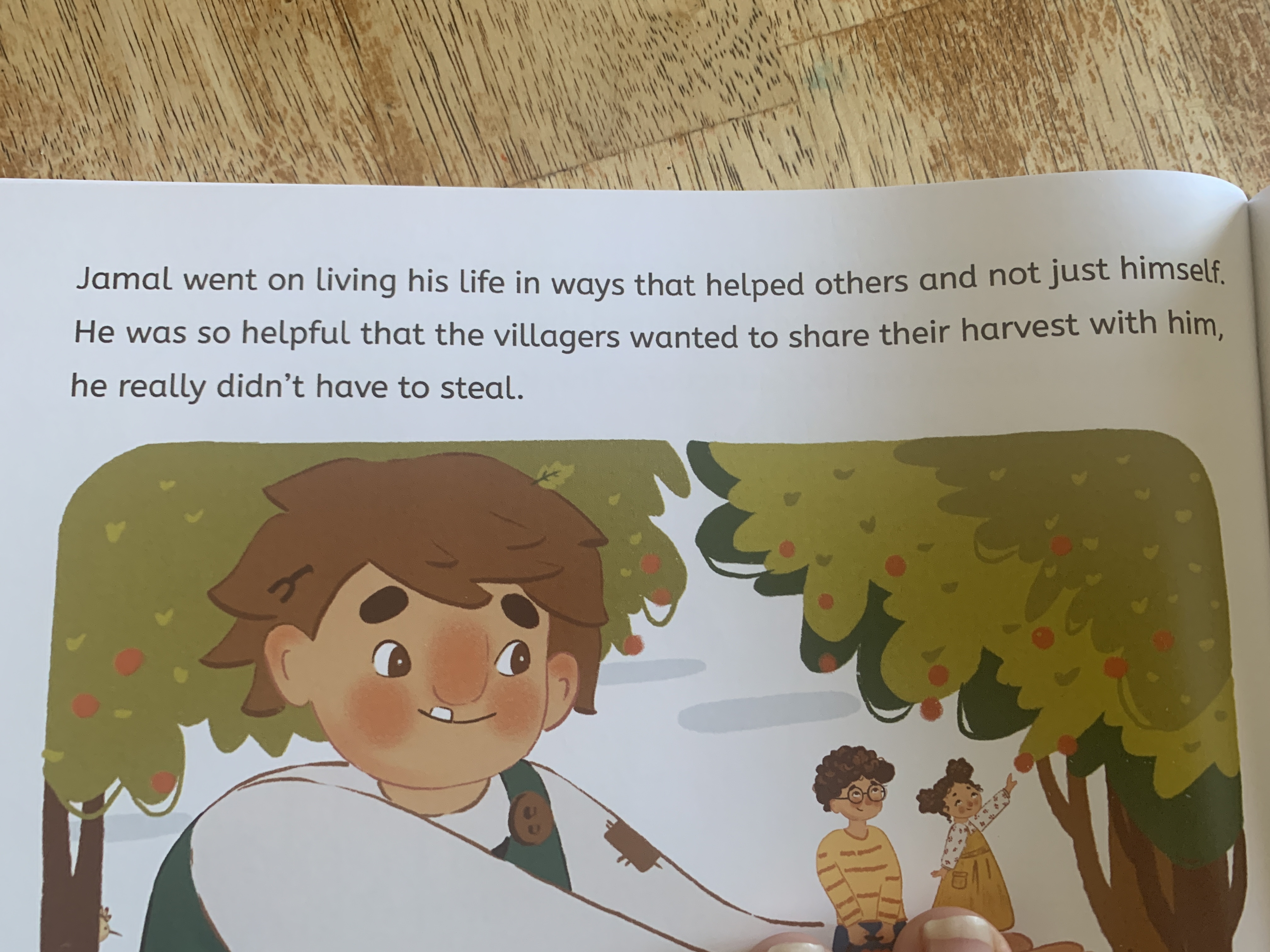
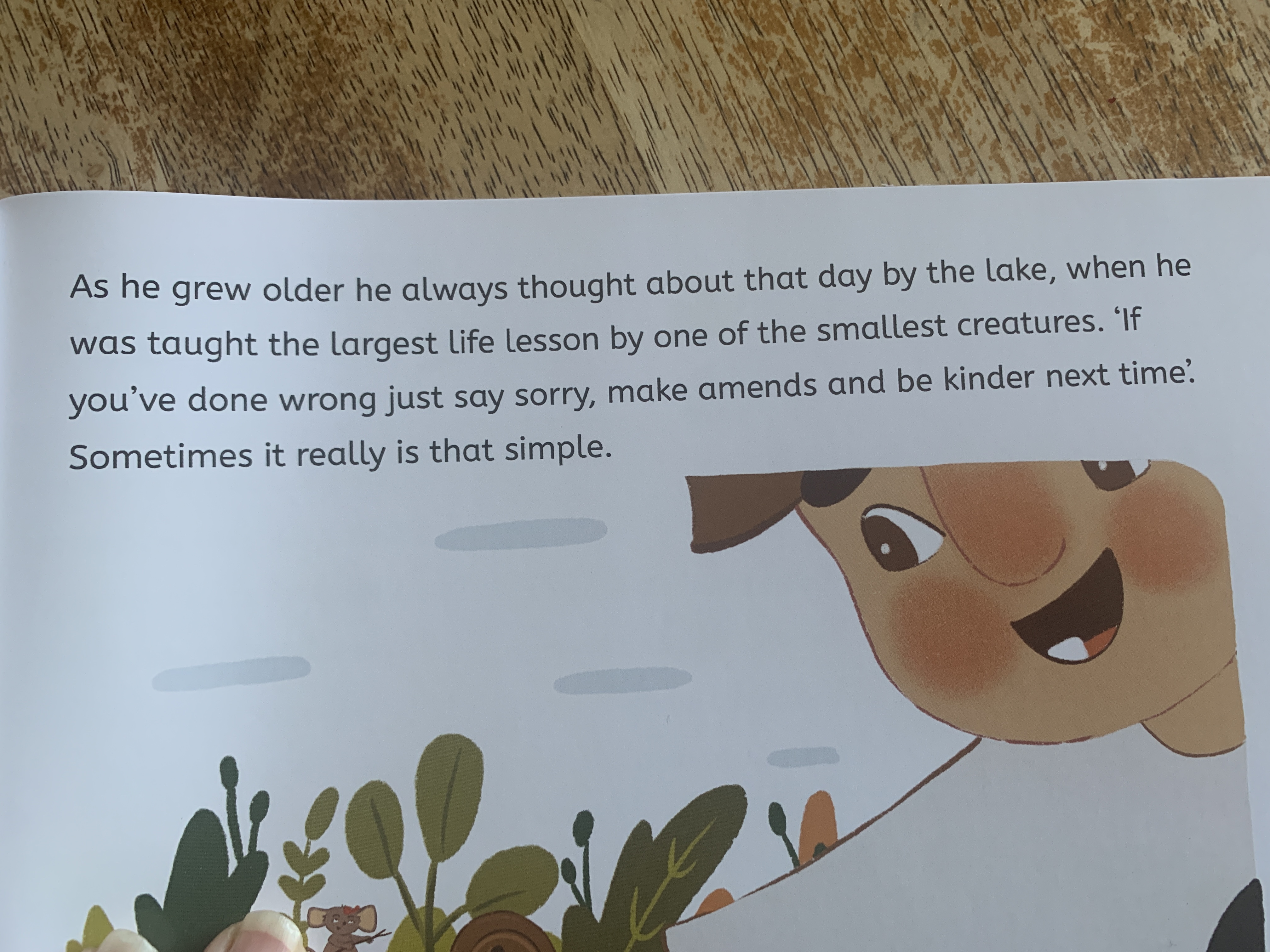
The little mouse teaching the big giant, carries some Lion and the Mouse-Aesop fable vibes, but really it is the proof-reading of the book that is disappointing.  When you read it aloud, commas are abundantly missing (even in the online reading pauses are placed where commas are not written).  Why is the B in Baker capitalized, and if it is the Baker’s house, as in last name is Baker, then an apostrophe is missing.  Many of the lines are just awkward and halting, even if not particularly erroneous.  The diction is questionable at times, Jamal “always” thinks about that day at the lake, woah, doesn’t reflect on it, but it haunts him “always.”  Jamal “‘really’ didn’t have to steal,” seems to imply he was justified in stealing a little, this should be a black and white issue in a children’s book, no?

There are questions at the end of the book, and a whole page of information about the author and illustrator as well.  In a case like this I don’t know if the publisher didn’t do justice to the author’s work, or if the author should have refined it more, before coming to the publisher, but it is unfortunate because clearly a lot of effort went in to the illustrations and promoting of the book.

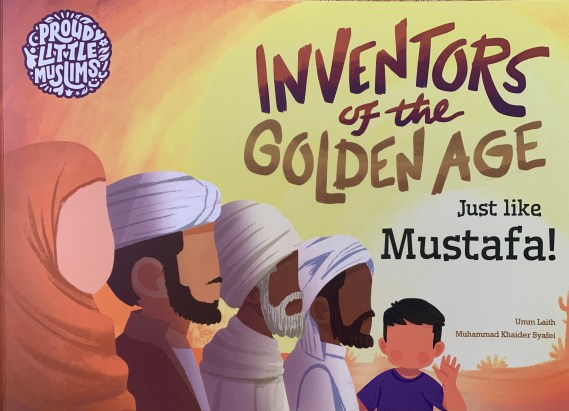
Inventors of the Golden Age (Just like) by Umm Laith and Muhammad Khaider Syafei (Proud Little Muslims)

Standard
Inventors of the Golden Age (Just like) by Umm Laith and Muhammad Khaider Syafei (Proud Little Muslims)

img_6450

Usually when you purchase a personalized book, the charm is that you get to see a name of your choosing in the story, and that you can make the main character look a certain way.  So imagine my surprise when this book arrived, and yeah sure my son’s name and likeness was included, but the story and information contained was also really well done and engaging.  This book, even without the personalization, is a solid story highlighting Fatima al-Fihri, Abbas ibn Firnas, al-Zahrawi, al-Idrisi, and their skills of generosity, persistence, kindness, and adventure as they shaped the world as we know it.

img_6418

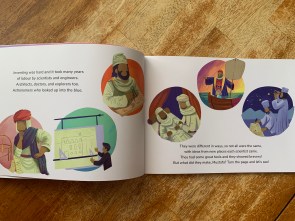
The fourth wall is broken as the book speaks to the reader encouraging them to come on an adventure in to the Golden Age.  A time when scientists, engineers, explorers, doctors, and astronomers were making remarkable advancements.

The first stop is Morocco to learn about Fatima al-Fihri and how she established the first university.  Her generosity in building and creating a place of Islam and learning is what set her apart and made her so remarkable.  It is then on to Abbas ibn-Firnas in Spain and his attempts at flying.  He failed often, but his mistakes helped him as he persisted and continued to learn and understand and make flight of humans possible.

img_6419

Al-Zahrawi, the surgeon, is who is detailed next, as his knowledge, skill, and inventions he made are still used today.  His regard for his patients fear and nerves and his kindness is what the book stresses before moving on to the mapmaker al-Idrisi.  Al-Idrisi was adventurous as he traveled the world making his maps and switching the poles.

img_6420

The book then focuses on the reader encouraging them to be generous and adventurous, kind and persistent, in making the future better like those mentioned from the past.

The book is horizontal, the pages thick, the faceless illustrations warm and detailed and the rhyming text flowing and appropriate for preschool aged children and up.

img_6421

Birmingham Boy by Kate Rafiq

Standard
Birmingham Boy by Kate Rafiq

birminghamboy

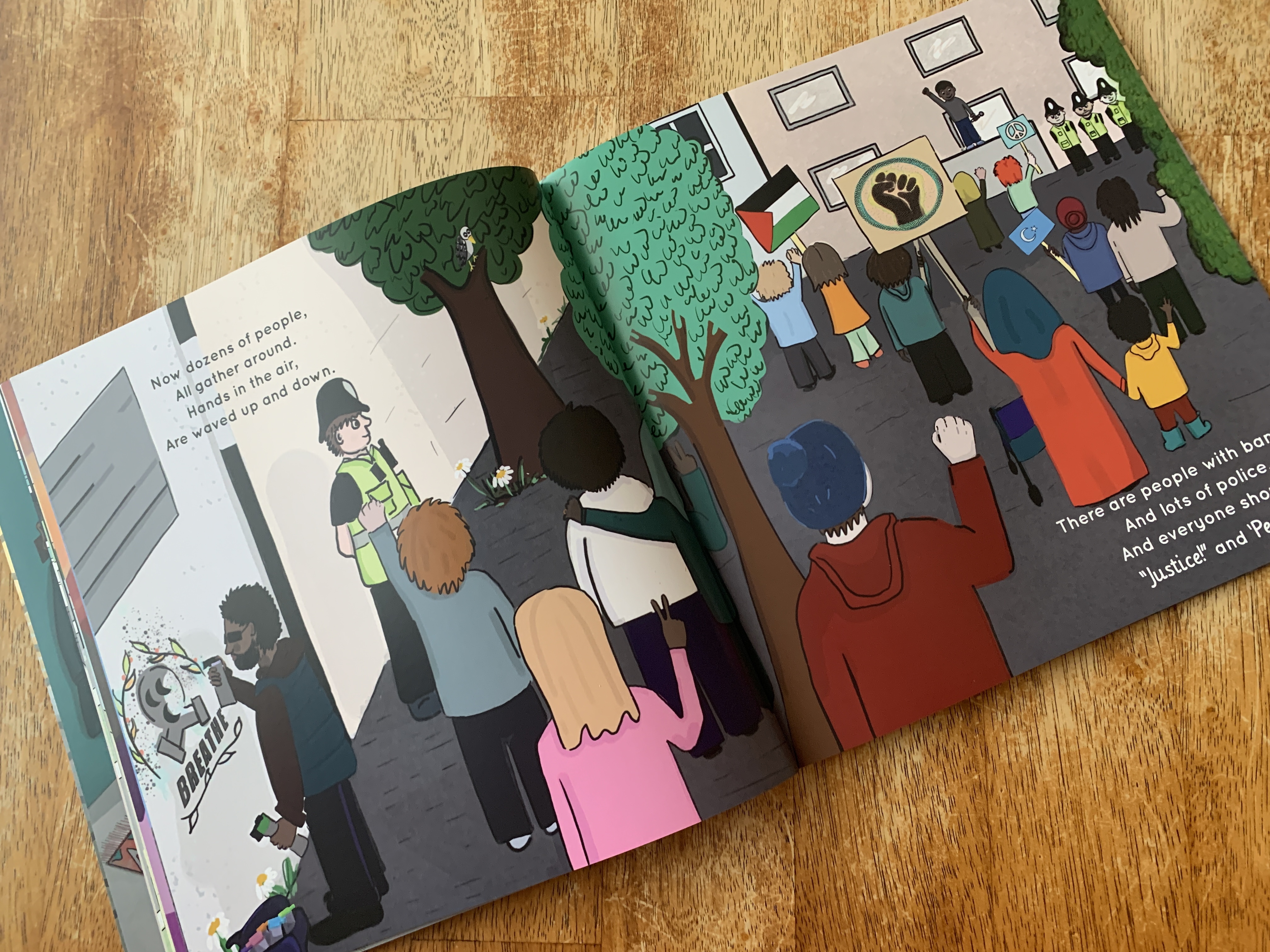
This 36 page ‘day-in-the-life-of’ book, follows a young boy and his mom on a day out and about in his city of Birmingham, England. Told in rhyme a few Urdu words are sprinkled in as general city observations are made, fun is had, and kindness is shown. The book touches on homelessness and protests, and the illustrations take the story deeper and show support for Black Lives Matter and Palestine, multiple hijab wearing women (#muslimsintheillustrations) throughout the city (including a burkini swimming mama), storefront signs acknowledging a diverse community, street artists, and different races, religions, and cultures everywhere.

img_6412

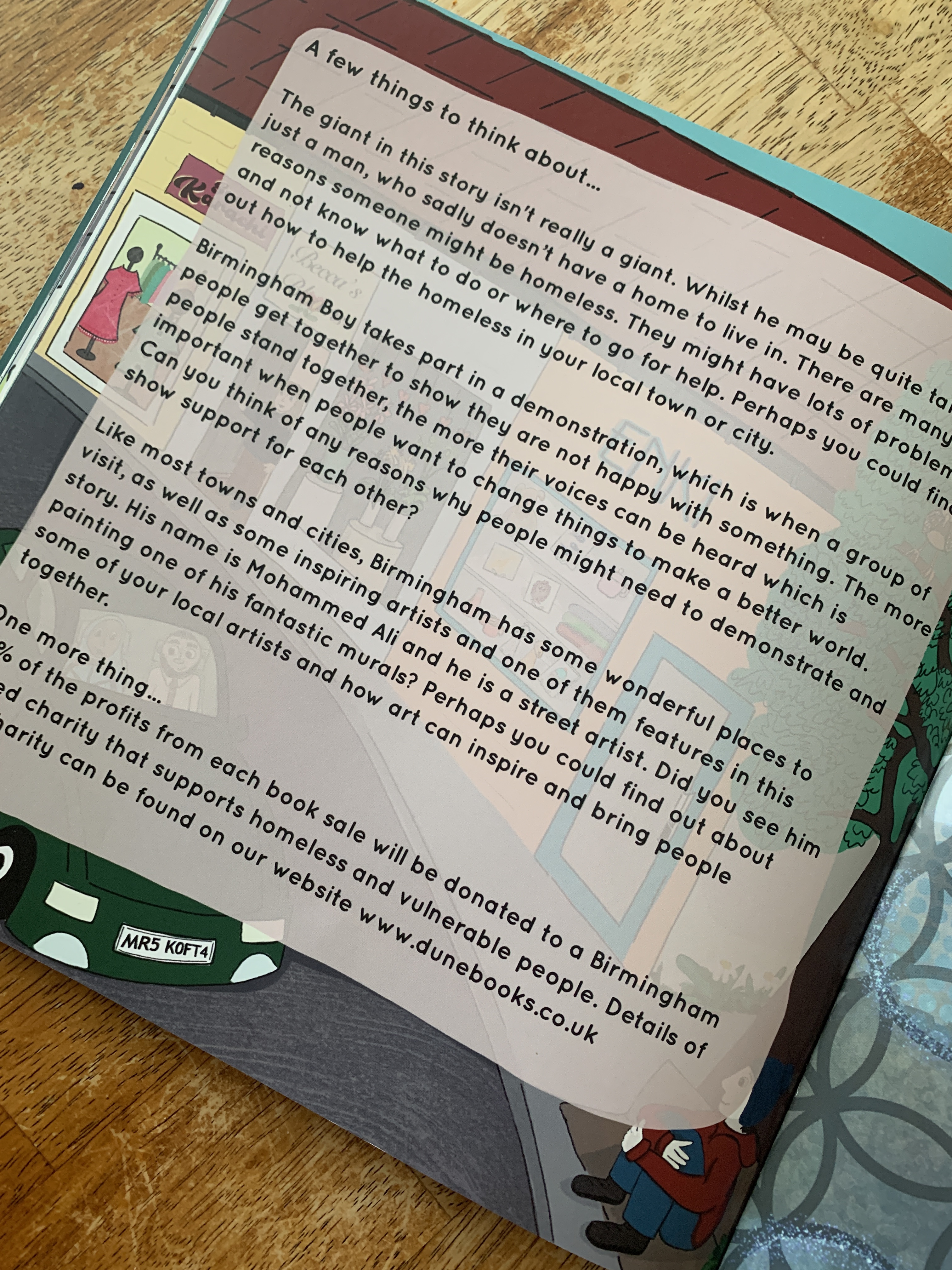
The book starts off with Birmingham Boy waking up, based on the Arabic signage in his room, I’d guess his name is Zakariya, everything is quiet and still- except for a giant that he sees outside his window.   He refers to the homeless man throughout the story as a giant, it doesn’t seem to be a negative description, nor is the boy scared, he shares food with him at one point, it is just what he refers to him as. 

img_6413

He then heads downstairs for breakfast of toast and dudhu (milk), before getting in a pram and heading out in the town.  They go past the deli and the flower show, and the giant on his cardboard mat.  They see someone getting their hair cut at the barbershop and they arrive at the swimming pool.

img_6414

The mom and son swim and play and Birmingham boy takes a nap in his stroller as his mom and he head off to their next location.  He wakes up to the sounds of the masjid and sees his mom praying.  He plays and then joins her in salat.

img_6415

After the masjid it is off to a cafe for cakes and tea, which they share with the giant, before they head off to a rally for justice and peace.  The book carries on in this sweet style of visiting places and interacting with the community until ending with a bath and dinner and getting tucked in to bed for the night.

img_6416

Being American and living in Birmingham, Alabama, my kids and I also learned about the sights of a different Birmingham and they got to learn some British words such as pram and wellies.  I loved the inclusion of Islam in their daily life and the joyful illustrations.

The Sleepy Farmer: The Farmer Who Almost Missed Fajr by Shazia Afzal illustrated by Ingy Hamza

Standard
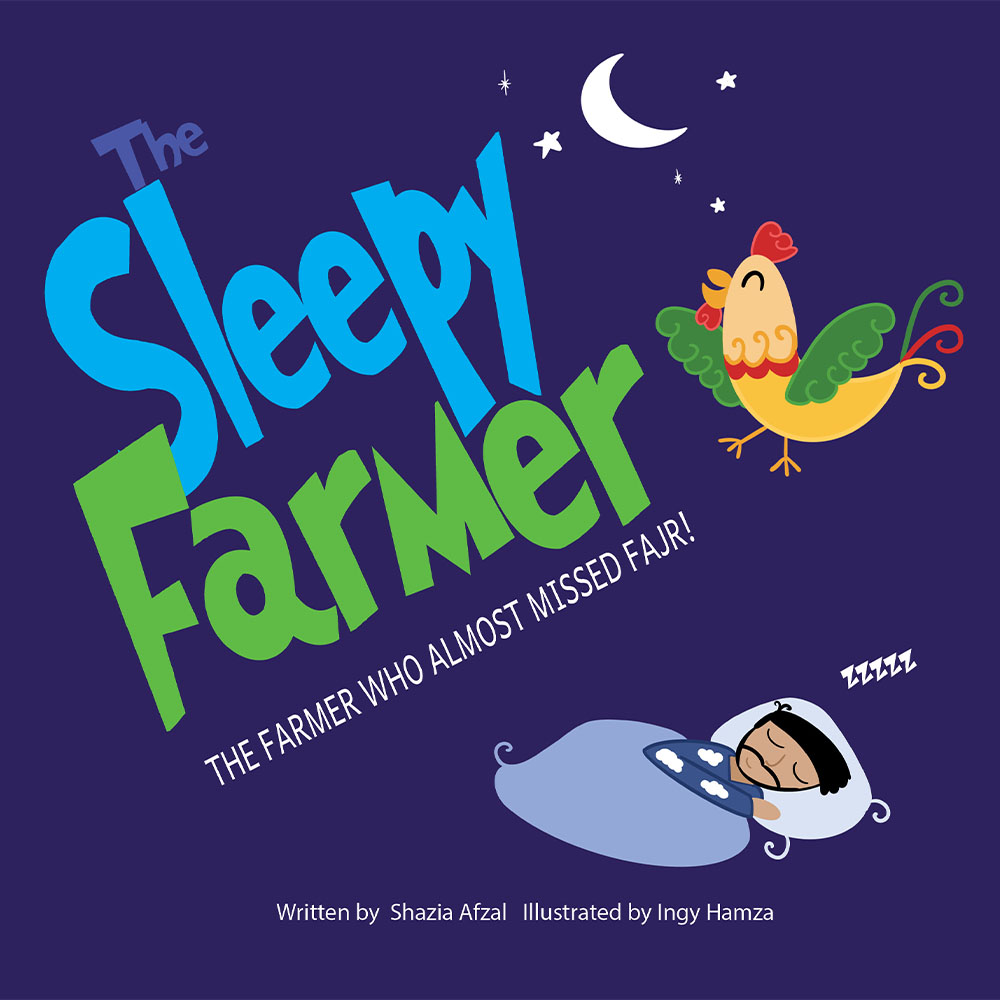
The Sleepy Farmer: The Farmer Who Almost Missed Fajr by Shazia Afzal illustrated by Ingy Hamza

The Sleepy Farmer_

This adorable board book combines animal sounds, team work, appreciation, and getting to the masjid on time for fajr.  Oh ya, and it is silly too.

img_5554

Farmer Salman stayed up late and doesn’t wake up in the morning when the rooster crows. The crowing wakes the hen who starts to cluck, the clucking wakes the horse who starts to neigh…and before you know it, it awakens the entire farm.

img_5553

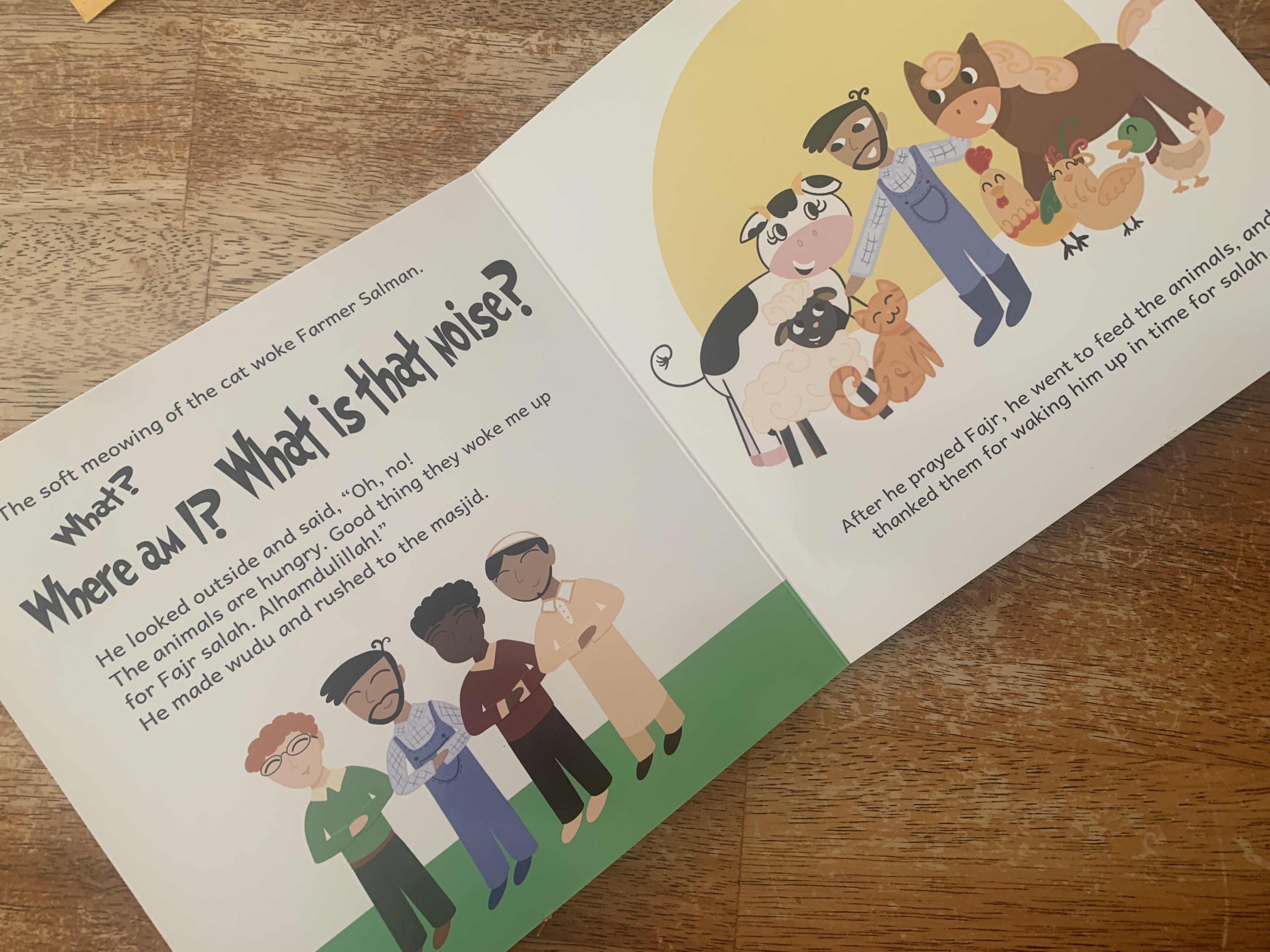
But, Farmer Salman still doesn’t wake up, so the animals get louder, and louder, and finally the cat in the house wakes up and meows in the farmer’s face.  The meowing wakes Salman up and he makes wudu and heads to the masjid, just in time for fajr salat.

img_5555

He returns from the masjid, thanks the animals and gives them their breakfast, alhumdulillah.

The book is only 10 pages and some pages are text heavy.  I think a few more pages to reduce the text on some of the pages would really make an already fun book, incredible.

My World of Hamd: A Reflective Book on Gratitude by Lateefah Binuyo

Standard
My World of Hamd: A Reflective Book on Gratitude by Lateefah Binuyo

hamd

This thick hardback 46 page book is a great next step after teaching your kids to say “Alhamdulillah” to helping them to understand what it truly means.  Meant for second graders and up, this book is text heavy and encourages deeper thought, reflection, and practice.  It is not a quick read, and some children may struggle to sit through the entire book, but any time spent, I think, will be incredibly beneficial as it strives to move from the habit of just saying “Alhamdulillah” to being intentional in our appreciation and gratitude.  The thick inside pages, warm large illustrations, and colorful reflections are well done and enjoyable.  I only wish the cover better conveyed the content within.

img_6093

The book begins with ayat 18 from Surah Nahl stating: “If you tried to count Allah’s blessings, you would never be able to number them.  Indeed, Allah is All-Forgiving, Most Merciful. With the tone set, the fictionalized story begins with Ibraheem and his mum having breakfast.

img_6090

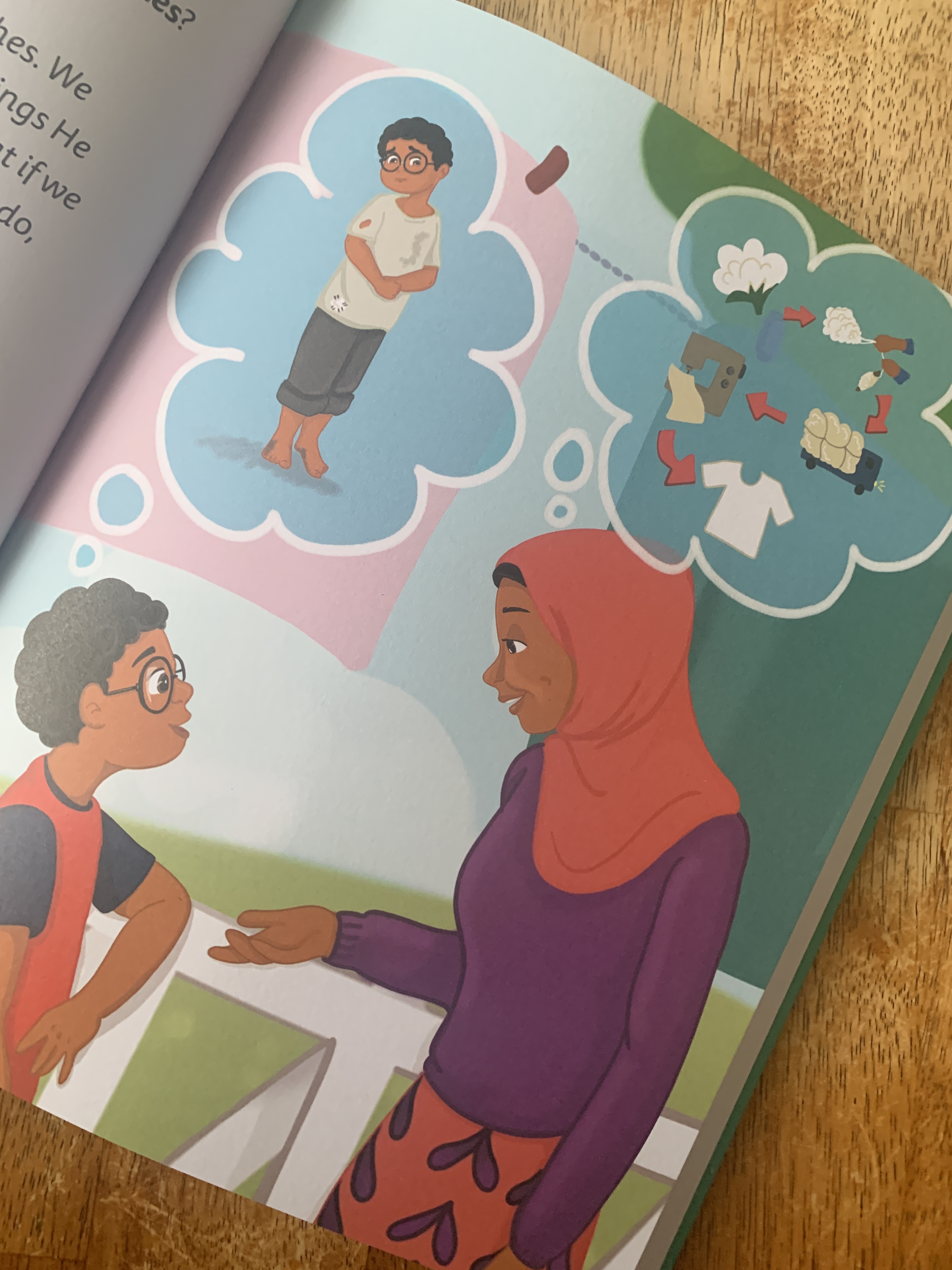
Ibraheem is a curious boy that is only ever quiet when he is sleeping or eating.  When his mum reminds him to say Alhamdulillah after he finishes eating, he gets to wondering, “What does Alhamdulillah mean?”

img_6092

Mum explains that the hamd in Alhamdulillah means praise and gratitude, and it is for Allah swt alone.  Ibraheem then wants to know how can he feel “hamd all the time?”  He and his mum discuss that hamd has to be felt within the heart, and it isn’t just saying it after a meal, but appreciation that you have food to eat.  Appreciation when you wake up in the morning, because many do not, etc.  The two discuss small and large aspects in a day that provide opportunities to truly appreciate the gifts of Allah swt.

img_6094

The book covers topics such as: sneezing and appreciating your muscles, getting dressed and recognizing the blessing of clothing, awards at school, losing your backpack, happy times and sad times too.  Along the way mum passes on information about how when we are grateful Allah swt gives us more, about how even in sad times we have so much to learn about patience and asking Allah for help, that we can fill our days with hamd.

img_6095

The book touches on never feeling sad in Jannah, Allah’s name Al-Hameed, and explaining how we have to still thank people and show appreciation to them because Allah sends his blessings through people as well.

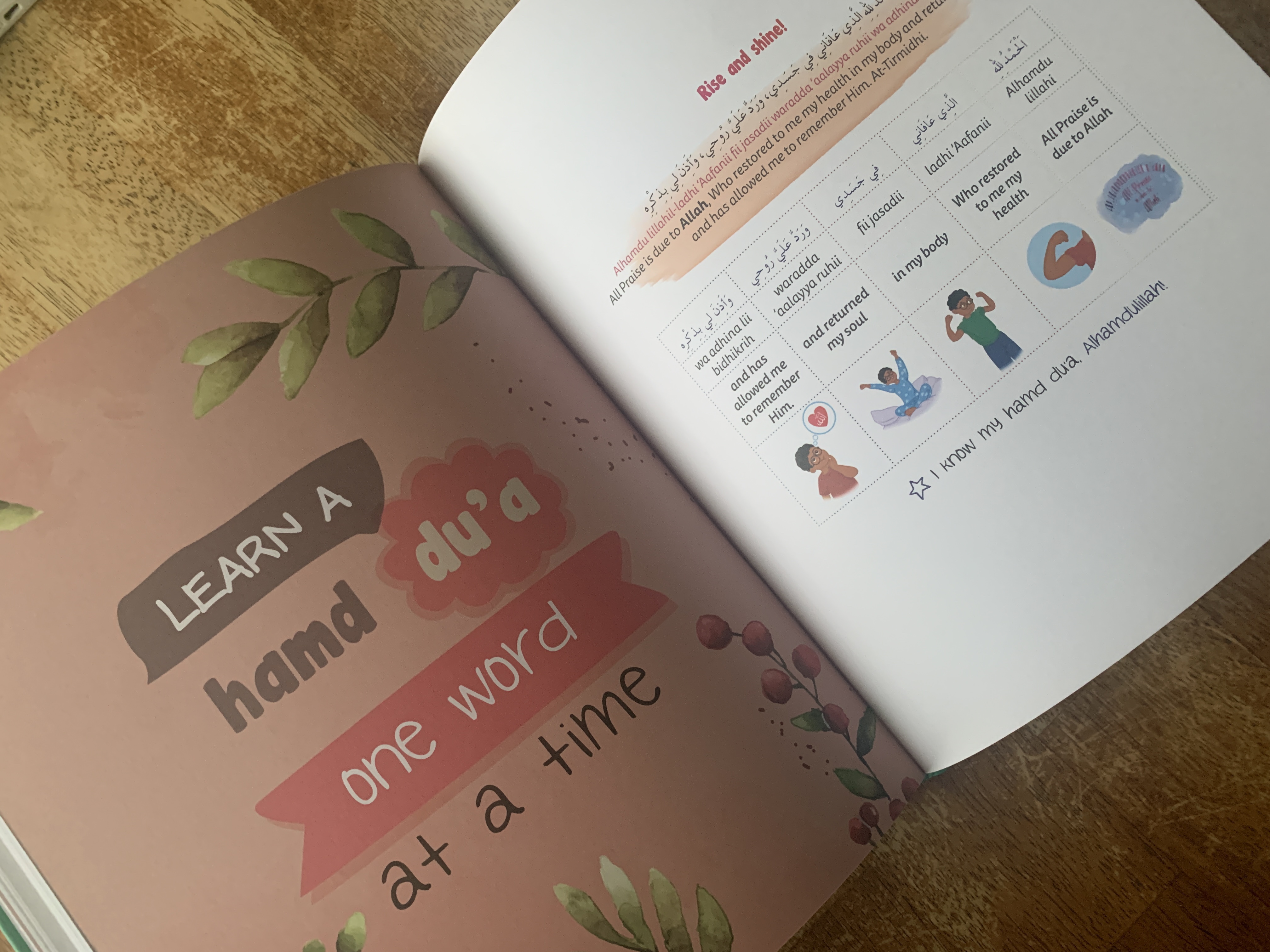
The book concludes with teaching duas about hamd one word at a time, a glossary, and tips for using the book.  There are a lot of hadith and ayats explained on a child’s level and overall really answers and provides insights about saying Alhamdulillah and feeling Hamd.

10 Steps to Us by Attiya Khan

Standard
10 Steps to Us by Attiya Khan

steps

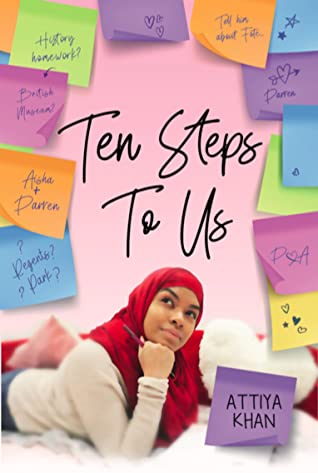
I try really hard to keep an open mind when reading Islamic YA romance books knowing that certain standards are probably not going to exist to move the story along, and of course I’m fully cognizant that Islam is practiced in a myriad of ways and chances are, I will disagree with a fair amount of any book in this genre.  This particular book though, was hard to read.  Ultimately I just didn’t like the protagonist, she was shallow and flimsy and her grasp on reality seemed lacking at times.  The premise of the book is that you can have a boyfriend, if the boyfriend is Muslim.  So by not agreeing with the very foundation; made the rest of the book hard to wrap my head around.  The book is largely about hijab, and the author starts the book thanking the individuals that “educated her about the hijab,”  yes, the article “the” is often used, and thus so much of the nuanced lived OWN voice experience of wearing hijab, is lacking.  The book features language, lying, kissing, making out, talk of wanking, condoms, groping, and a scene that nearly concludes with sex, but stops short, barely.  Perhaps high school seniors and college age teens could read this 231 page book, but I don’t know that the book is worth their time.  Practicing Muslims will be irritated by the lack of mirroring, cultural readers will be annoyed that the protagonist didn’t push back on toxic assumptions, and non religious readers will be left confused at what the book hopes to accomplish by including religion and culture to no real definitive purpose in a romance novel.

SYNOPSIS:

High school student Aisha wears hijab much to her parents protests, and tries to avoid the Islamophobic aggressions that she endures in her white Kent neighborhood.  She learns more about Islam than cultural superficiality from a family friend, an aunty, and she goes through her daily life largely unnoticed.  She has a close friend, who is popular and likes to party, but Aisha doesn’t go out much, yet Isabelle still finds ways to include her.  Everything starts to change however, when Darren moves in to town, defends Aisha at the bus stop and seems to be interested in being more than just friends.  Aisha doesn’t date, but reasons if Darren were a Muslim, nothing would stop her.  She devises a 10 step plan to make it all work, she just has to convert him.

While she sets her plan in motion, she finds herself lying to Isabelle, who has a crush on Darren, lying to her parents so that she can sneak around with Darren, and lying to Shafqat Aunty about her relationship with Darren.  Along the way, she will lose her friendship with Isabelle, uncover dangers of equating culture and religion, remove and reconsider her hijab, nearly lose her virginity, and have to decide where her boundaries are.  By the end of the book, nothing is clearly articulated for Aisha’s future or what she has decided regarding her relationship with Islam, hijab, and future boyfriends.

WHY I LIKE IT:

I struggled with the book.  I like the flipped stereotype of the family not supporting hijab, but Aisha wearing it for her self anyway, unfortunately, I never felt that I understood why she felt strong enough to wear it, what brought her closer to Islam, and learning about Islam, and what the catalyst of it all was.  I think knowing more of Aisha’s backstory might have made her more like-able.  Throughout the book Shafqat Aunty is her whole Islamic touchstone.  She doesn’t seem to have any other way of learning, or studying Islam.  It seems that to come to Islam in high school would mean a level of maturity would exist that the character simply does not exhibit.  I started wearing hijab at 16, I was the first in my family, I did it for me, I was actively trying to be a better Muslim and understand Islam, and hijab was simply a physical, tangible manifestation of that.  So to see a character so passive in the learning, was a bit of a disconnect for me.  I’m not saying that everyone has an experience like mine, but her grasp of basic Islamic tenants seems so weak, and she doesn’t seem to have a way to acquire understanding, or even a desire to obtain it.  Often Darren seems to know more about Islam than she does.

I really struggled with the conceptual thread that her hijab prevents her from feeling comfortable making-out with Darren, so she hides it when clothing starts falling off.  Shouldn’t hijab be the reminder to not have gotten in that situation in the first place? Perhaps if she would have had some depth, or the relationship wasn’t “love at first sight” I would feel a bit more invested in her trying to sort out her beliefs while in the midst of such strong lust, but it wasn’t developed to that level.

I liked the initial idea of sorting through cultural and religious views on divorce especially considering the woman involved is being abused, but I didn’t think the book exerted a strong enough stance that divorce in Islam is absolutely ok, that abuse is not ok, and anything otherwise is backwards culture.  The book set itself up to make a strong statement, but then it abandoned it.  I’m not sure why the author didn’t get up on a soap box and preach, I mean it would have given the book something really powerful to highlight and given Aisha some growth in understanding where culture has undermined the power of women’s rights in Islam.

The book dismisses understanding one’s faith, and falls into predictable troupes despite setting itself up to be “different,” when  Aisha fears being shipped off to Pakistan when her parents find out about her and Darren.  The writing feels forced at times, and a few times He when referencing God is not capitalized.  I appreciate that some surahs, and duas, and Ramadan are included, but they don’t seem to shape Aisha, it seems like she is simply going through the motions.

The book ends on a “cliff hanger” of her either placing her scarf in the hamper or the garbage.

FLAGS:

Language, talk of sex, fairly vivid make-out scene that stops short of sex when they pause to acquire a condom and then Aisha changes her mind.  There is a lot of lying, normalizing relationships if both are Muslim, even if both are not, talk of domestic violence, slut-shaming, hickies, crude jokes.

TOOLS TO LEAD THE DISCUSSION:

There is no way I would encourage this book in an Islamic school setting.