Tag Archives: Muslim Author

Golden Girl by Reem Faruqi

Standard
Golden Girl by Reem Faruqi

golden

I began reading this book not having any idea what it was about. All I knew, or all I cared to know, was that the incredibly amazingly talented Reem Faruqi wrote it, so I wanted to read it. While I know it will be hard for most to avoid knowing the plot, I think it was a blessing that I was able to be swept away so completely and so fully in a story that is wonderful and memorable, and truly sets a higher standard for the way that a story can be told. Faruqi’s voice and authenticity had me in tears. I didn’t even realize my eyes were dripping until my son asked me if I was ok. It wasn’t the plot that had my emotions spilling over, sure it helped, but it was the storytelling, the hadith and deen and snapshot of a life so unlike my own that simultaneously is exactly my own that a physical reaction emerged. It is the power of OWN voice storytelling. It is the power of brilliant writing. It is not just a book about a Muslim character, this book blurs the lines for me between Islamic fiction and fiction with Muslim characters. Middle school readers (mature middle grade readers) will enjoy the book, older readers will enjoy and appreciate the 336 page story told in verse. You can pre-order the book and I hope you will, it helps convey the message to publishers that this book is highly anticipated and that we need voices like this. Additionally, Goodreads currently is hosting a giveaway, you can head there to try and win a free copy.

(If you don’t want to know what the story is about, maybe skip the next section.)

SYNOPSIS:

Aafiyah’s name means well-being, protection, health, money, happiness, everything good, but Aafiyah has secrets too. She is privileged and loved, and she knows it, but sometimes when she sees something she likes she accidentally borrows it. Sometimes it isn’t an accident. Sometimes she doesn’t just borrow. Much of her life is wonderful, a best friend that lives next door, doting parents, tennis, vacations, trips to Pakistan to visit grandparents, and a love of “weird but true facts.” So what happens when all that changes. When her grandfather gets sick and the family wants to bring him to America for treatment, when Aafiyah’s dad gets detained and imprisoned on the way home, and Aafiyah’s secret may be a way to help her family?
WHY I LIKE LOVE IT:

I absolutely love that the characters are so well rounded and developed. Yes, Muslims have vices, and even young practicing Muslims have tests and struggles. The bar has been raised, we aren’t just a monolith, and our only struggles aren’t girl/boy issues, alcohol, not being oppressed and getting an education, we are complex people, we are human. The bulk of the story is Aafiyah growing up: her responsibility within her family, her changing body and appearance, her friendships, her responsibility for her actions, her desire to want to help and improve and step in to her own. I love that all these layers of life somehow are explored in such sparse lines. It doesn’t drag, but it gives the necessary pauses to involve the reader in her logic and view of the world. Aafiyahs’ kleptomaniac tendencies, her father being detained, her grandfather’s illness. they all move the story along, but they are foils for a much more intimate character story. A story that is surprisingly funny and light and impossible to put down.

I absolutely love how Islam is woven in, how she exudes Islam in all that she is, because she is a Muslim completely, the good and the bad. The guilt she feels, the desperation to be forgiven, the knowing that Allah swt sees all. The book is never even close to being preachy, but she proudly owns her identity and the details of her faith are not watered down, or even justified, it is who she is and it isn’t up for debate.

Culture is presented unapologetically as well. She is critical of things she sees in Pakistan, and similarly celebrates and admires good things about Pakistan and Pakistani culture. The book does not seem to have an agenda in presenting Muslims or Pakistan as good or bad, just as Aafiyah sees them. Which isn’t revolutionary on the surface, but it really is refreshing because it highlights how many books simply don’t. It makes the contrast painfully obvious between books that are shy about certain things, when they have their characters deflect and disassociate from certain “realities” and books that confidently uphold their identity and demand that the reader steps up and truly see the characters and their experiences.

There is a beautiful and raw author’s note at the end that shares some of the inspiration for the threads of the book, a glossary, a recipe for Aloo Gosht and resources for help with kleptomania.

FLAGS:

Stealing, lying, chatter about crushes, music, dancing. Being attractive and the reactions that it gets is woven through out.

TOOLS FOR LEADING THE DISCUSSION:

If I have a majority girl group, I will teach this. It isn’t a girl only book, but I think some of the more subtle themes would need a safer girl space to discuss.

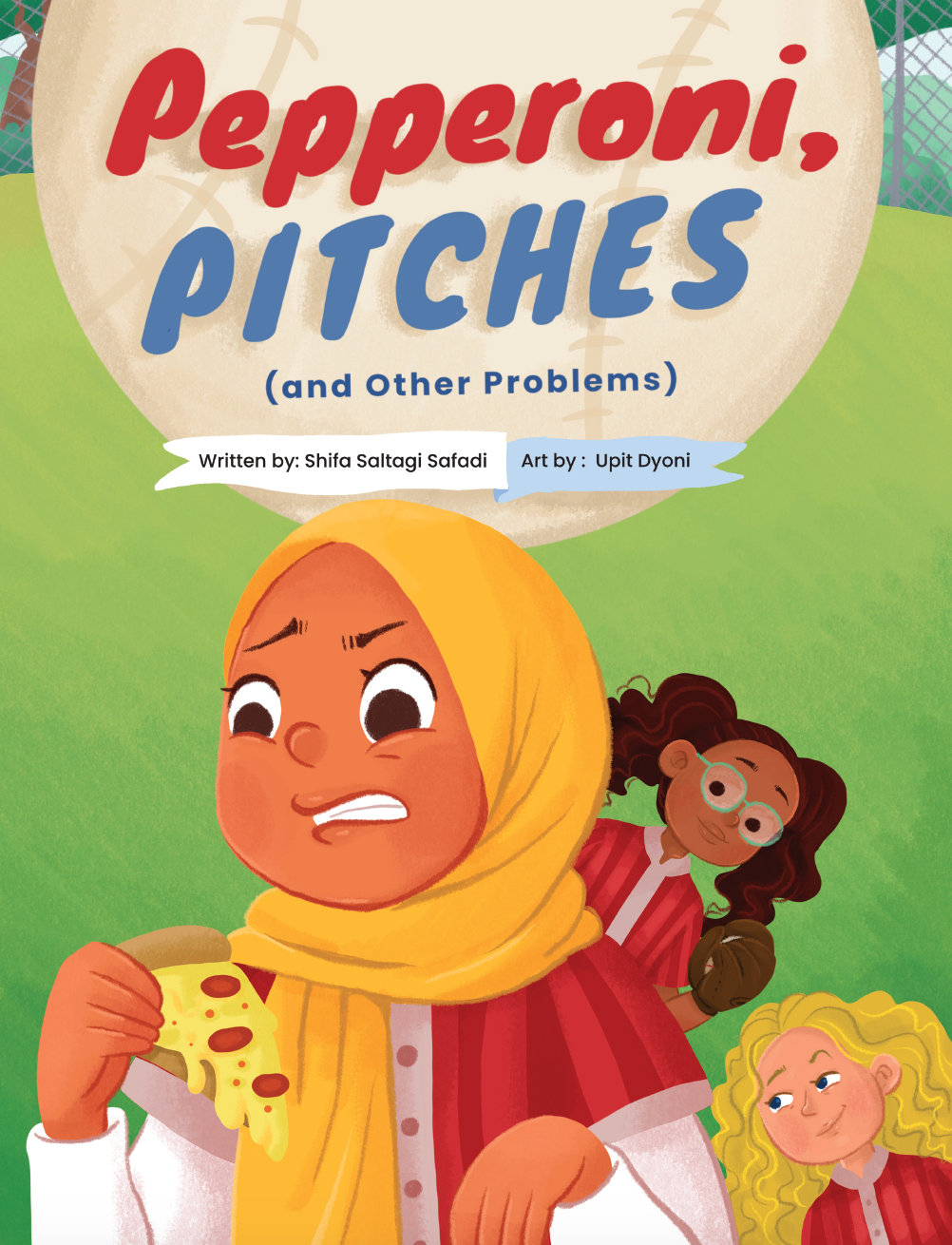
Pepperoni, Pitches (and Other Problems) by Shifa Saltagi Safadi illustrated by Upit Dyoni

Standard
Pepperoni, Pitches (and Other Problems) by Shifa Saltagi Safadi illustrated by Upit Dyoni

pitches

I absolutely love how smart this book is, and how it allows for elementary aged readers to feel that “aha moment” when they read it, get it, and realize that they need to remember the lessons because it could happen to them.  The illustrations are an added bonus and are perfectly aligned with the tone and text of the story.  My only issue, is the title.  Pitches reads as a euphemism for another word and since the book involves girl drama, teasing, and misunderstandings, it really is hard to not have that thought zap your brain when you see the title.  Perhaps if the “and Other Problems” would have used a bigger font on the word “Problems” the alliteration would have been more obvious, and hidden the word “Pitches” a bit.  If I’m alone in this, I apologize to the author and publisher, (I’ve mentioned my concern to them), but for others that saw the word and questioned the content, rest assured it is about baseball and the book doesn’t have even a speck of questionable content.

img_4682

Amira is at a new school, and luckily it is Tuesday, Pizza Tuesday to be exact, and she can’t wait to dive into a cheesy slice.  Unfortunately, Olivia takes the last cheese piece and when Amira asks if she will let her have it, Olivia says she had it first.  Stuck with an egg salad sandwich that smells, Amira sits alone and broods.

In gym they are playing baseball, but no one knows how good Amira is, and she is picked last.  When Amira is up to bat, Olivia is the pitcher and her pitches are terrible.  Amira still mad about lunch and afraid that the others will blame her for not hitting the unhitable balls, shouts, “you’re supposed to aim at my bat.”  Everyone laughs, but Olivia runs off clearly upset.  The new pitcher sends a decent throw and Amira hits a home run.  The captain of the team praises her, and Amira is hopeful she’ll have someone to sit with her at lunch.  After class, Amira sees Olivia crying in the bathroom and no one asking her if she is ok, Amira doesn’t feel so well, and doesn’t ask either. On the bus ride home Amira is greeted with cheers for her home run, but Elena the captain, isn’t among them.

img_4683

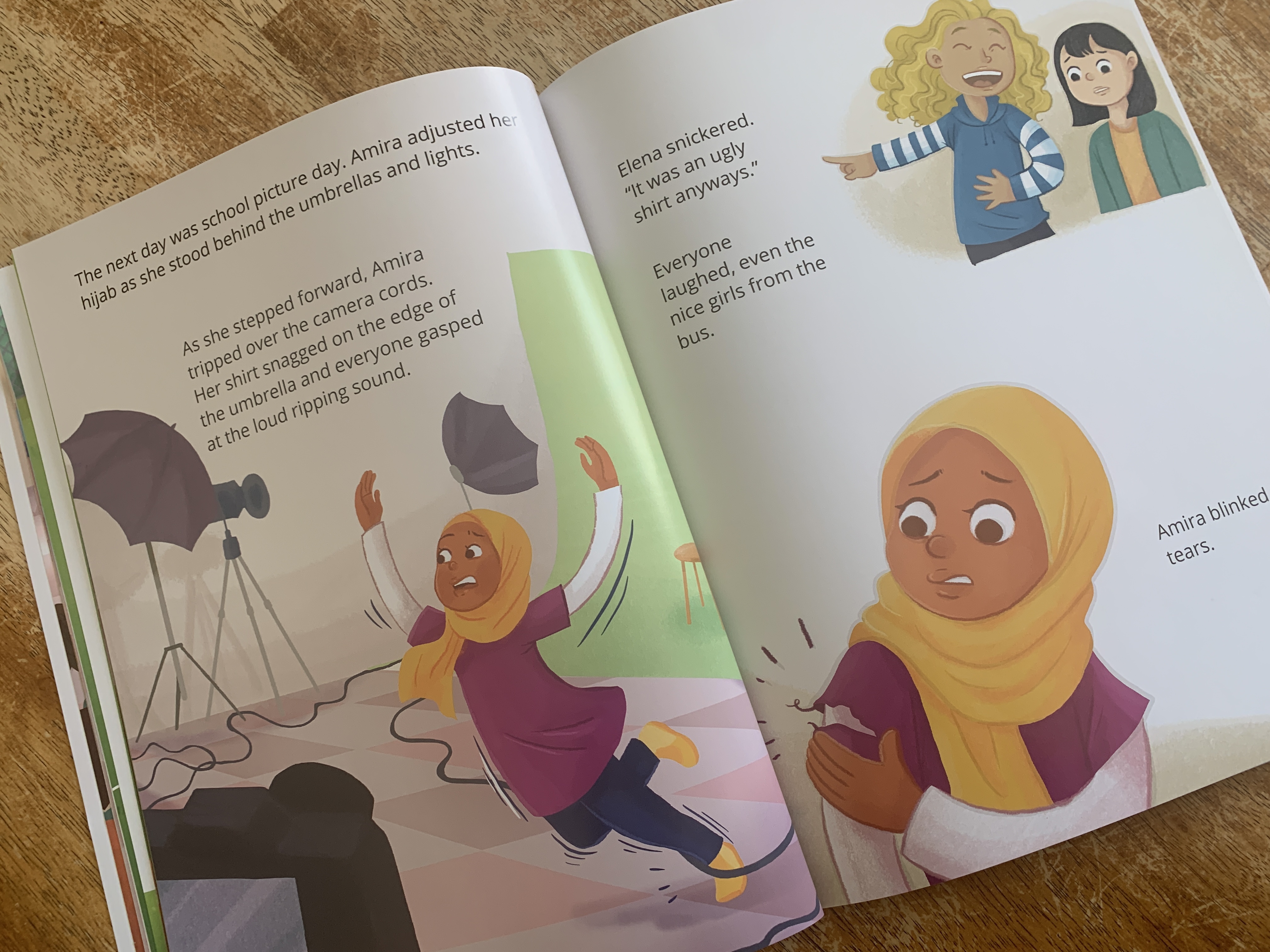
The next day is picture day, and Amira trips and rips her shirt.  Everyone laughs, Elena says, “it was an ugly shirt anyways.”  Only one person offers her help.  Could Amira have misread the whole class dynamics?  How should she move forward?

Sorry, I’m not going to spoil the ending, but the message about owning up to your choices is stressed, along with making kind decisions, and sometimes needing to take a step back and understand things from someone else’s perspective.

img_4684

Like nearly all Ruqaya’s Bookshelf books, the story is universal, but the characters, illustrations, and point of view is a relatable Muslim one that allows our young Muslim readers to feel seen and celebrated.  The reliable large glossy pages make the book a great deal for your money and is available on the publisher’s website: http://www.ruqayasbookshelf or from my favorite bookstore http://www.crescentmoonstore.com

img_4685

Could Be Anything! by Eman Mouneimne El Ayoubi illustrated by Victoria Romanenkova

Standard
Could Be Anything! by Eman Mouneimne El Ayoubi illustrated by Victoria Romanenkova

mariam

This is not normally a book I would review because it will read like paid endorsement, which it is not.  It is a 32 page personalizable book, that I’m highlighting because it exemplifies a concept of Islamic literature, that is often lacking.  We have numerous books teaching Islamic concepts to toddlers and preschoolers, but forget to teach the secular concepts through an Islamic lens.  We often have a bookshelf of Islamic books that include learning to say Alhumdulillah, and the names of Allah swt; and a bookshelf of non Islamic books that features stories about dinosaurs, monster trucks, and being silly.  This book reminded me of how important it is to have books that do both.  Not to necessarily preach, or even teach, just to merge the two shelves and present a singular framework of Islam, a way of life, not just a religion to our youngest believers.

Sure the name and customizable appearance is fun, but deeper than that, learning about different careers knowing that Allah swt created all of us to do so many worthwhile jobs is a great lesson to be sharing.  The larger concept of teaching Qadr to our children is only presented on the back cover of the book and can be implemented by using the parent guide at the end of the story.

img_4967

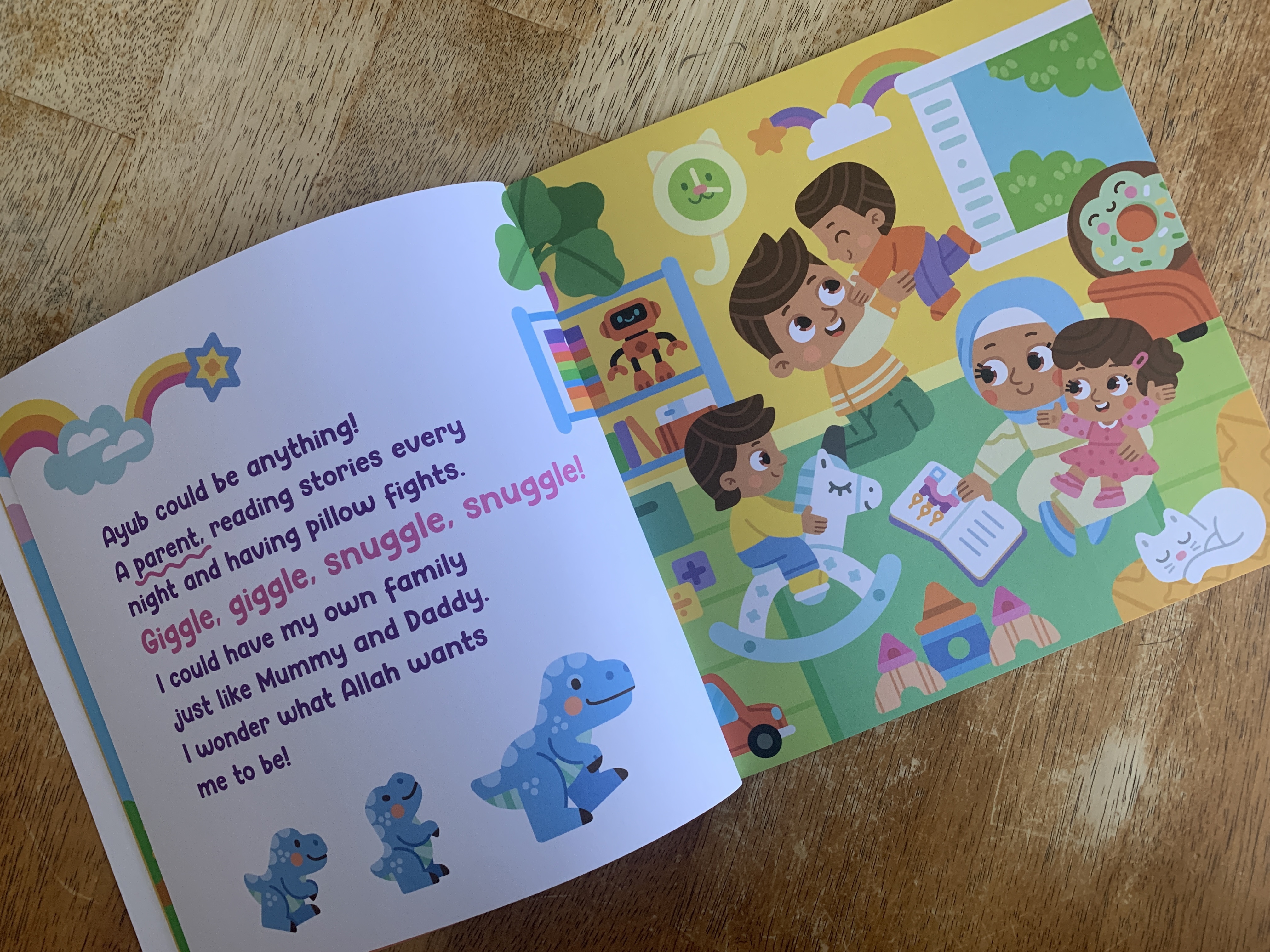
The book starts with asking what you want to be when you grow up and informing the child that Allah swt has a plan for us all.  Each page after then mentions the child’s name, introduces a career, and ties back to that Allah swt has written, or decreed something for us.

img_4968

The highlighted careers vary from being a parent, to an astronaut.  A teacher to a chef, a mechanic to a dentist.  There is no priority, nor opinion on one career or job or hobby being more important or more valuable than another.

img_4970

The pages are bright and colorful and the paperback book thick and sturdy.  I did struggle with the word “could,” and often would self edit as I read and would change it to, “Ayub ‘can’ be anything.” I’m not sure why the diction is what it is, but it reads incorrect to me.

img_4969

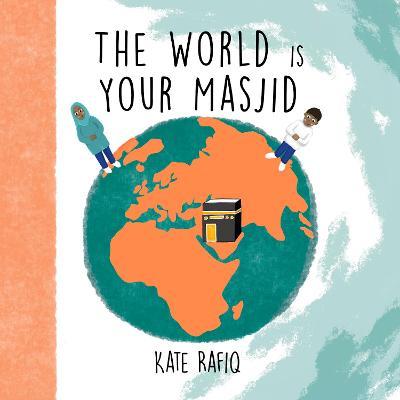
The World is Your Masjid written and illustrated by Kate Rafiq illustrated by

Standard
The World is Your Masjid written and illustrated by Kate Rafiq illustrated by

masjid

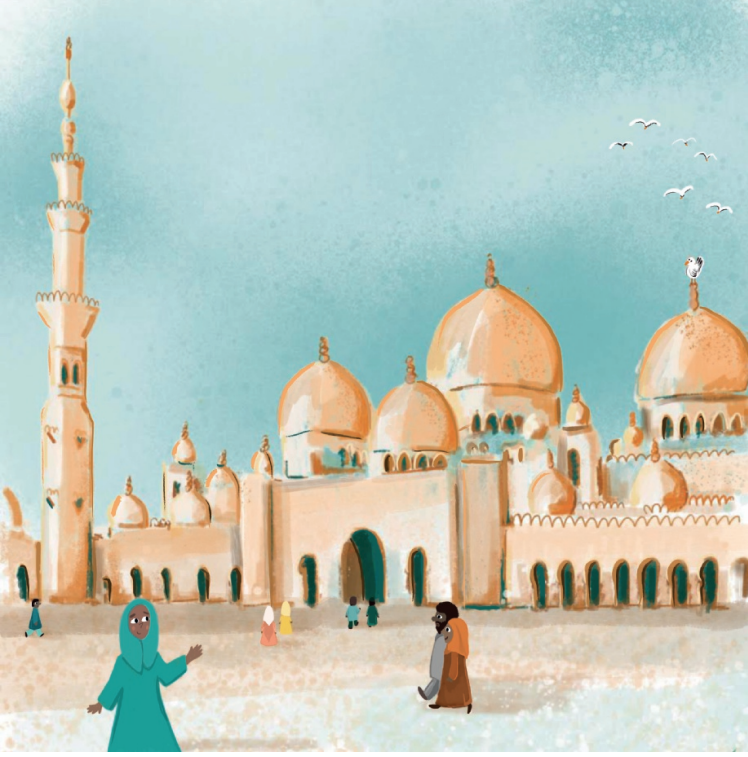
This 30 page preschool to early elementary aged book is a simple rhyming book that reaffirms all the places we can pray and touches on those that we shouldn’t.  The engaging illustrations and relatable scenarios make the book a great choice for bedtime stories and small group readings.  

Screen Shot 2021-11-17 at 11.33.41 AM 1

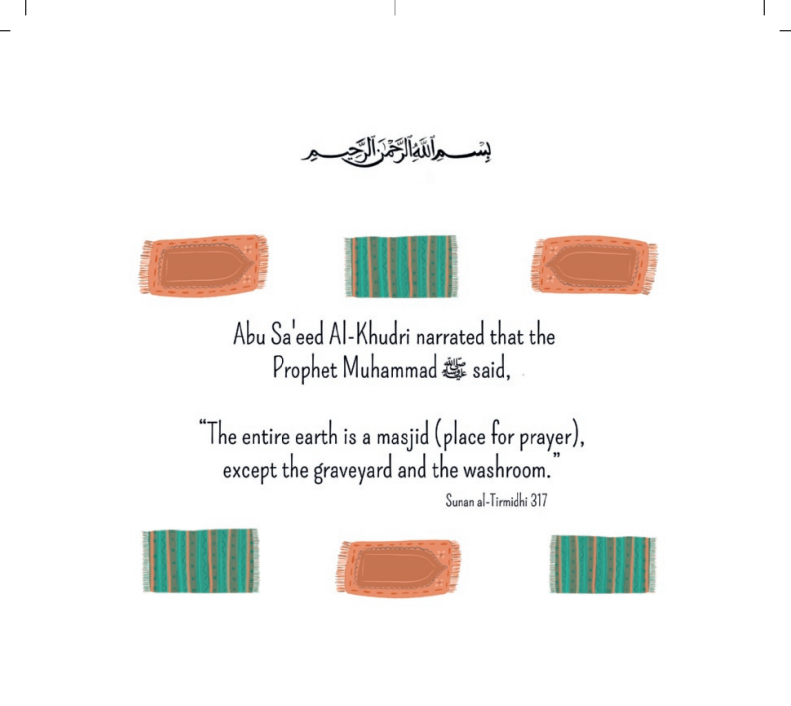
The book starts out with a hadith, “The entire earth is a masjid (place for prayer), except the graveyard and the washroom” (Tirmidhi-317) and points out that one must pray five times a day. Screen Shot 2021-11-17 at 11.37.00 AM

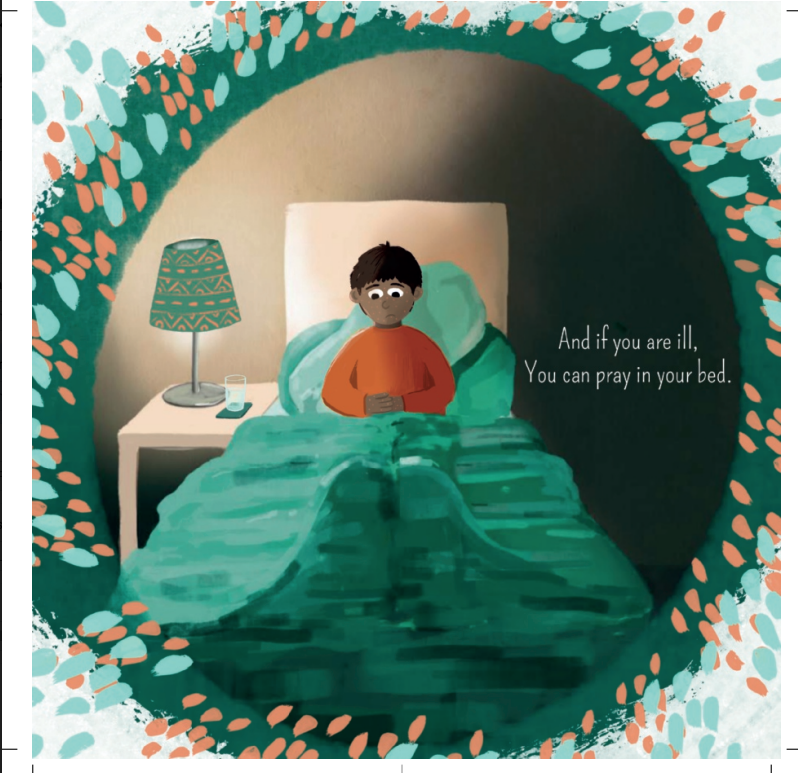
It establishes that if you pray it a mosque you can follow the imam, but not to worry if you cannot, because you can pray (nearly) anywhere: a field in the rain, school, a train, a garden, a shed, even when sick you can pray in your bed.

Screen Shot 2021-11-17 at 11.36.46 AM

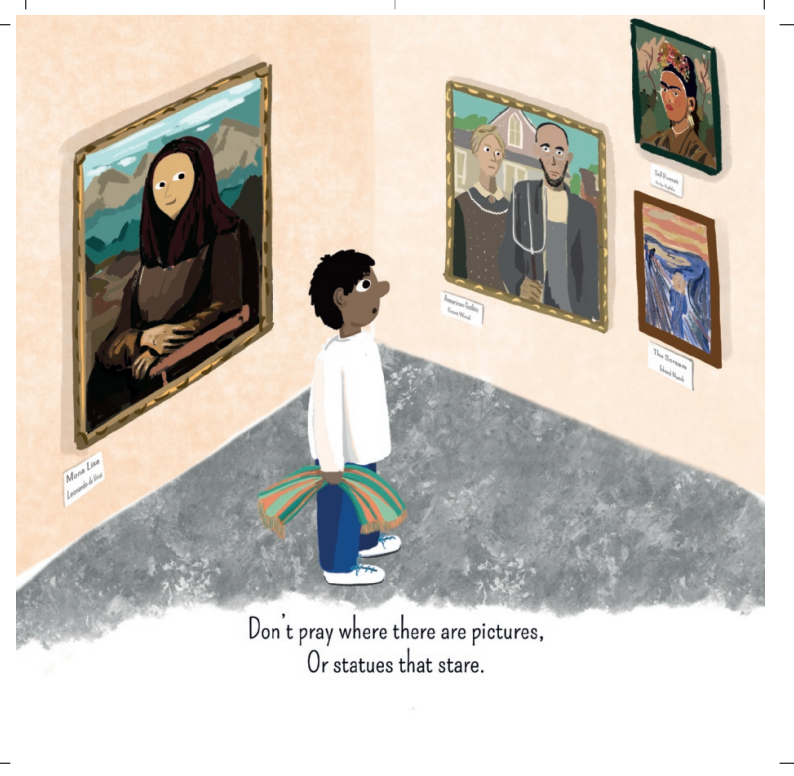
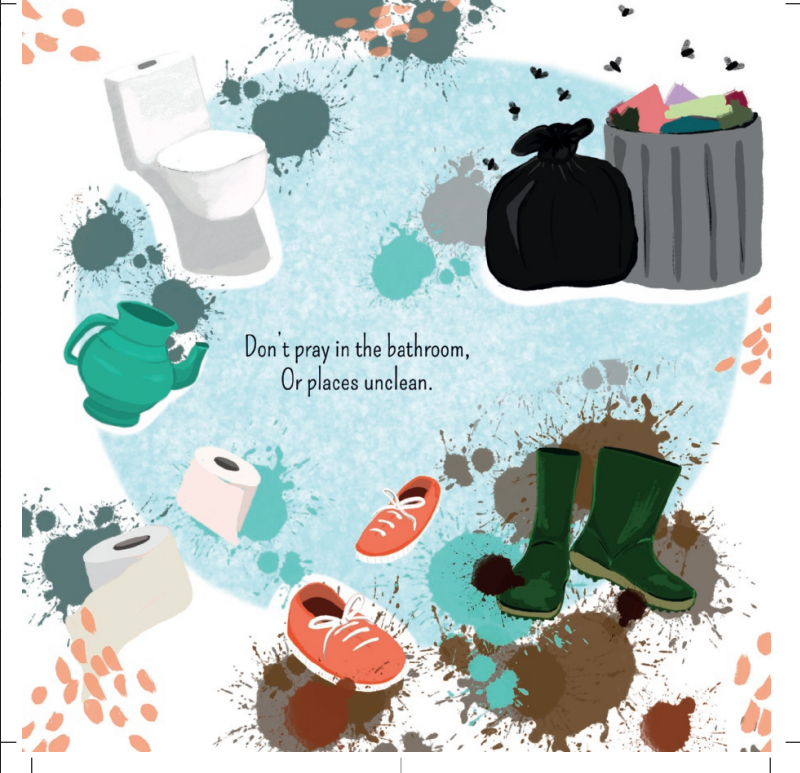
It then also turns to places you shouldn’t and can’t pray and sources a hadith about not praying where there are faces and statues that might distract you (Bukhari 374). The bathroom and graveyard are also included.  

Screen Shot 2021-11-17 at 11.35.05 AM

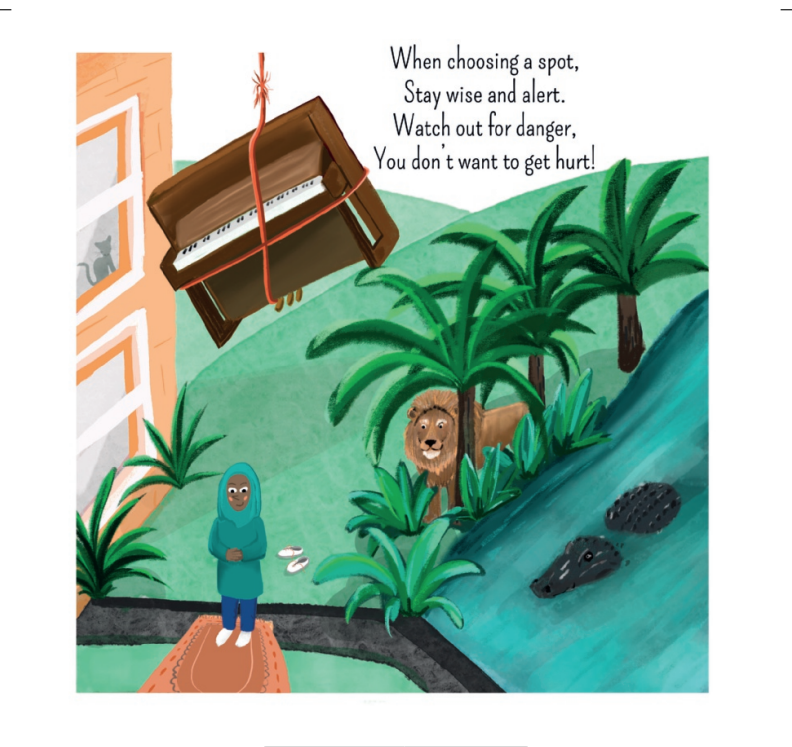
As an after thought, and for added laughs it reminds little readers to not pray in dangerous spots as well.

Screen Shot 2021-11-17 at 11.35.12 AM

Overall, I enjoyed the book and can see it pairing with In My Mosque to help create the foundation of a storytime theme about prayer and mosques.  The fact that it takes it a step further and doesn’t just list all the places serious and crazy that you can pray, elevates the book from being mediocre to being memorable and I appreciate that.  I also appreciate the Islamic sourcing, truly something that is required to show accuracy even in the “simplest” of all books.

Screen Shot 2021-11-17 at 11.35.30 AM

Salaam, with Love by Sara Sharaf Beg

Standard
Salaam, with Love by Sara Sharaf Beg

salaam

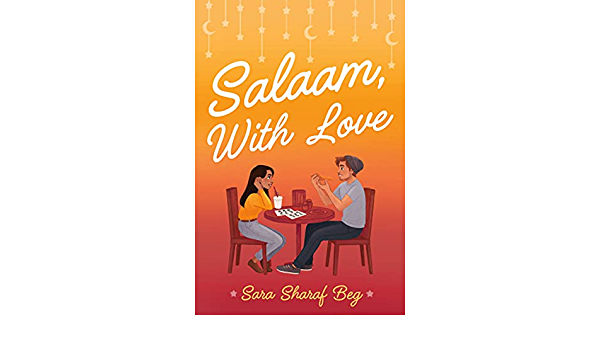
This 288 page YA contemporary Islamic romcom is very Islamic centered, and the storyline provides some nice twists along the way.  Unfortunately the writing is terrible.  Not the storytelling or even grammar per se, but the contradictions, errors, underdeveloped characters, and the inconsistencies. Yes I read an uncorrected proof, but this book is a mainstream major publisher presented book coming out in a few weeks, and it is in desperate need of some attention.  I really don’t think it is the author’s fault, it reads as if this was a manuscript that got shopped around and picked up and then never refined, polished, and made to sparkle.  The only saving grace is that as terrible as it is literary wise, once the main character starts to get over her “internalized islamophobia” (thank you @bintyounus for bringing this concept to my attention), the book as a whole presents a lot of unapologetic specific Islamic content on every single page: how Eid salat is different than normal salat,  the beauty of tajweed, the meanings of so many duas and surahs said regularly, the list goes on and on and doesn’t just cover the basics.  The flip side is that the characters are in a band that performs Islamic songs, but with instruments and everyone is fine with it, there are artists in the book drawing faces and portraits hang on walls, it is a romance, but it at most an arm or hand is touched and when tropes about Desi college choices are pushed back on the parents break the stereotype and relent.  There are threads of cultural-ism within Islam, Islamophobia and a violent near death experience, but the book is very clean and  honestly has a lot of potential, I have no idea why it is so sloppy.  SO SLOPPY, and I took notes, so buckle up.

SYNOPSIS:

Seventeen year old Dua is an only child and her doctor father and caterer mom are the only Pakistani and only Muslims in their small Virginia town.  They decide for Ramadan that they are all going to go and stay with family in Queens, New York for the whole month.  They have given Dua less than 48 hours notice to plan to spend the end of her summer with cousins she hasn’t seen in five years.  The parents hope that Dua will benefit from being around family, being closer to other Muslims in the month, and enjoy the cultural environment.  Dua is not excited, but when bear hugs and genuine smiles meet her at the door, she is sucked in to a bustling house and the happiness and drama that is bound to unfold.  Sharing a room with her older, law school bound cousin Mahnoor is by far the hardest relationship to cultivate.  Newly engaged, Mahnoor is quiet, reserved and deeply unhappy.  Dua makes little progress, but with Ramadan starting and her cousins setting goals for the month, Dua is determined to do better in all aspects of her life.  As she gets close to Mahnoor’s best friend, Haya, she also gets closer to Haya’s brother Hassan.   It is Ramadan though, and she isn’t good around boys, but Hassan is a hafiz and is helping her reach her memorization goals for the month, Hassan is also in a band and needs Dua’s help.  When Mahnoor’s engagement is called off to Haya and Hassan’s brother, everything comes to a standstill between the families, but when a cousin is shot, the families come back together to support one another and deal with their decisions and their outcomes.  By the end of Ramadan, every character has changed and grown and is sad the month is over and that Dua and her family are leaving.

WHY I LIKE IT:

Suffice it to say I love how Islam centered it is. I honestly checked the publishing information because of how much Islamic content is included, also for the amount of errors.  The book did not start off well for me with Dua trying to separate herself from her “religious” cousins.  The ones who practice communally and wear hijab.  She was not like “them” and the dichotomy of measuring religiosity as acceptable or not, too much or too little, enrages me.  It sets up that she practices Islam but in a relaxed manner and has been taught by her parents, and it is who she is, but it isn’t a huge part of her life.  As the story progresses, it seems that she just doesn’t know a ton of surahs, she actually is pretty religious, and devout, it is very awkward and not presented clearly, which is why I attributed it more to her being in denial or embarrassed by her identity, not about her level of belief.  Dua is also not like-able, she is incredible privileged and arrogant commenting on the size of houses and rooms, and her shoes.  About half way through she starts to comes across as clumsy, not sure then why is she always wearing heels.  Ultimately she is just not well-developed and often reads like an annoying helpless child.  The framing of Dua being a musician and not being so religious is quickly questioned as she gifts her cousins music paraphernalia, and looks at portraits on their walls.  If most are like me, and both families are praying, fasting, reading Quran, active musicians and artists and ok with hanging pictures, one would assume they are pretty in-syc with one another on their religious views and in practice.

Dua is not the only character that is poorly voiced, fractured, and inconsistent.  Her parents are so unrealistic and awkward in the beginning I physically cringed reading them telling her their reasons for going to New York.  In the car on the way, they even quiz Dua on her cousins names.  She hasn’t seen them in five years, she isn’t a toddler, she should know their names, she has clearly purchased incredibly personalized gifts for them, and is filled with detailed memories of when they all met up in Pakistan together, the whole scene is pointless. One of the cousins, Ibrahim, is blind and Dua says that a few years ago her parents had to explain to her what it meant to be blind.  Seriously?  I get the learning how to let him take the lead and how to interact, but you as a teenager didn’t know what it means to be blind? When you met him in Pakistan you didn’t know he was blind? The four year old cousin is cute and adorable, and has the vocabulary and mannerisms of a seven or eight year old at times, most times.  The 12 year old cousin has the wisdom of an old uncle and why do none of the adults in the book seem to work?  The book probably should have started at chapter five, it seems the book hits a bit of a stride that at least makes it readable.  

A huge plot of the book is the band, Sheikh, Rattle, and Roll, but the details about it are terrible.  Mahnoor is walking out the door and her mom tells her to take Dua.  The reader doesn’t know where they are going, but Mahnoor reluctantly agrees and they head out on the subway.  Mahnoor constantly is telling Dua to hurry so they aren’t late and miss it, when they arrive, the band performs one song and that is when Hassan and Dua and Haya all meet.  But the other two band members are her cousins, she is staying in their house.  What? Rabia is constantly talking, that is her character quirk, how does Dua not know that they are performing? Not know they are in a band?  No way would it not be mentioned.  And why only one song? That is so random.  At the end when they perform again on Eid, it is a concert, it is again only one song.  A concert is not one song.  Do they not practice or load up equipment, how is all this going on in one house and Dua is so clueless? 

The inconsistencies are aplenty.  A few examples: it says her cousin doesn’t wear make-up, a few chapters later has a whole face of make-up, on Eid she even does Dua’s make-up.  When they all are sitting down to write their lists of plans for Ramadan it says they don’t have to share their lists.  Yet a few lines later Dua is singled out in a very creepy way to share hers.  In a single paragraph it says that at home she prays fajr half asleep, or late and in a rush before school, but concludes the description by complaining that praying in congregation is more difficult for her to focus in.  Huh? praying while half asleep or in a rush gives you more focus than praying in jammah?  Even non Muslims are going to be scratching their heads.  At one point as Dua is trying to figure out what she wants to study and if she wants to start an MSA in her high school, since she is the only Muslim, she internally discusses how she wants to prove herself to her parents.  Then when she decides what she wants to do for her, she remarks that she isn’t just doing it to prove to her parents, but because she wants it for her.  The only problem is, no where have we seen or has it been established that her parents are requiring this proof.  

There are odd errors as well.  The athan on a phone goes off, the Uncle reaches in to his pocket for his phone and turns off his iPad.  That is a big pocket indeed.  Dua gifts Hassan a CD, really a CD? What is this 1999? Who gifts CDs in 2021? Dua starts playing a keyboard in someone elses house and no one mentions it other than the two people with her, how big is the house that you can’t hear it? The Uncle gets upset that Dua doesn’t pray Asr right at time, but a lot of people prefer Asr specifically to be prayed later within the time frame.  In a two chapter frame it mentions letting out a breath she didn’t realize she was holding three times, word for word the same.

I was genuinely surprised that music being questionable was not brought up at all, two of the bandmates are huffaz.  The author lets her own qualifiers slip in, perhaps her own desire to not take a stand that could seem alienating.  She says, “allegedly” the time right before iftar is the best time to make dua.  As Dua tries to figure out what is going on with Hassan she often remarks how it is hard or confusing “especially because he is Muslim.” Would a relationship with a non Muslim be ok, less hard, more hard? There is no lowering of any gazes, which for as religious as everyone in the book is, should have at least been mentioned even if not adhered to.  The book puts on odd stress on tasbeehs and kufis, not sure why.  

I do like the genuine love the characters have for Islam, Allah, Ramadan, salat.  It is so much a part of every thing they do, and it is lovely.  I also love Dua’s friend in Virginia, Kat, she is fasting in solidarity and wants to join the MSA even though she isn’t Muslim, but a seemingly amazing friend.

FLAGS:

The on-gain-off-again engaged couple do touch hands at Eid prayer.  Hassan touches Duas arm when she is perceived as helpless.  There are anti Islam protests and an angry man shoots Adam.

TOOLS FOR LEADING THE DISCUSSION:

If the sloppiness gets resolved, the book could be used as a high school book club choice.  Those girls love them some halal romance, and this book is incredibly religious and clean. 

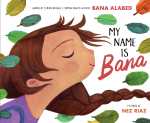
My Name is Bana by Bana Alabed illustrated by Nez Riaz

Standard
My Name is Bana by Bana Alabed illustrated by Nez Riaz

bana

OWN voice books are always important, and while we see a rise in minority voices claiming their own stories, to read a child’s story about war and hope by a child, is particularly impressive.  Bana Alabed was born in 2009, she is an activist, a Syrian refugee, and now an author.  Her clear voice doesn’t stumble and her perspective is unapologetic, yet hopeful.  Over 40 pages she tells her story in her own words with beautifully warm and complementary illustrations filling the pages.  For kindergarten and up, this book stands out in a crowded field of refugee inspired stories for its authenticity, strong author, and overall emotional connection.

img_4629

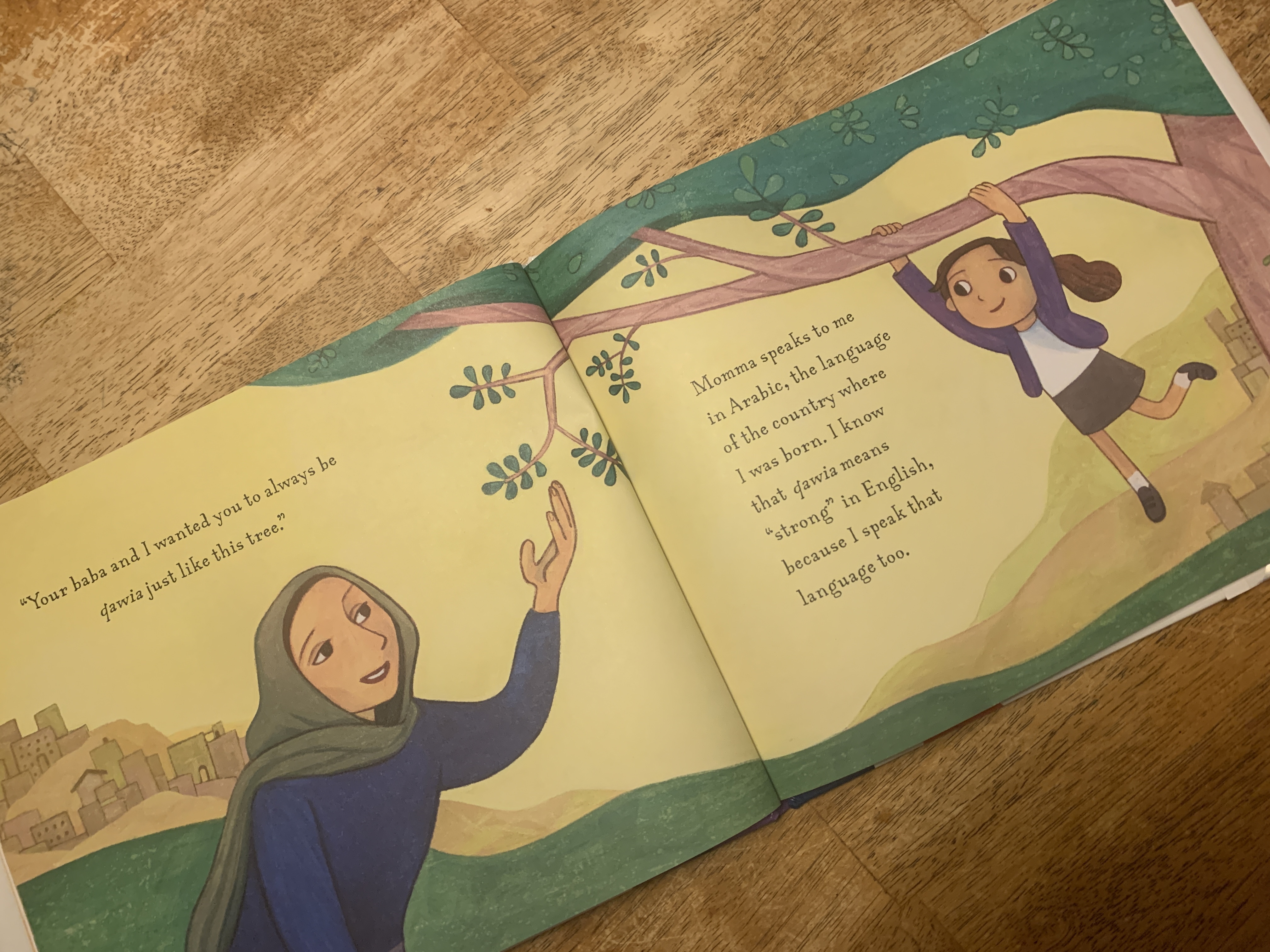
Bana begins her picture book memoir by asking her mother why she was named Bana.  Her mother explains that she was named after a tall bushy tree that grows in Syria.  Her favorite tree.  A tree that is qawai, Arabic for strong.

img_4630

Bana then asks what it means to be strong.  And once again her mother lovingly explains, that strong is to be brave even when you are scared, and to be sturdy so others can lean on you.  It also means you use your mighty voice to speak up when something is wrong, you read, study, and exercise your body.

img_4631

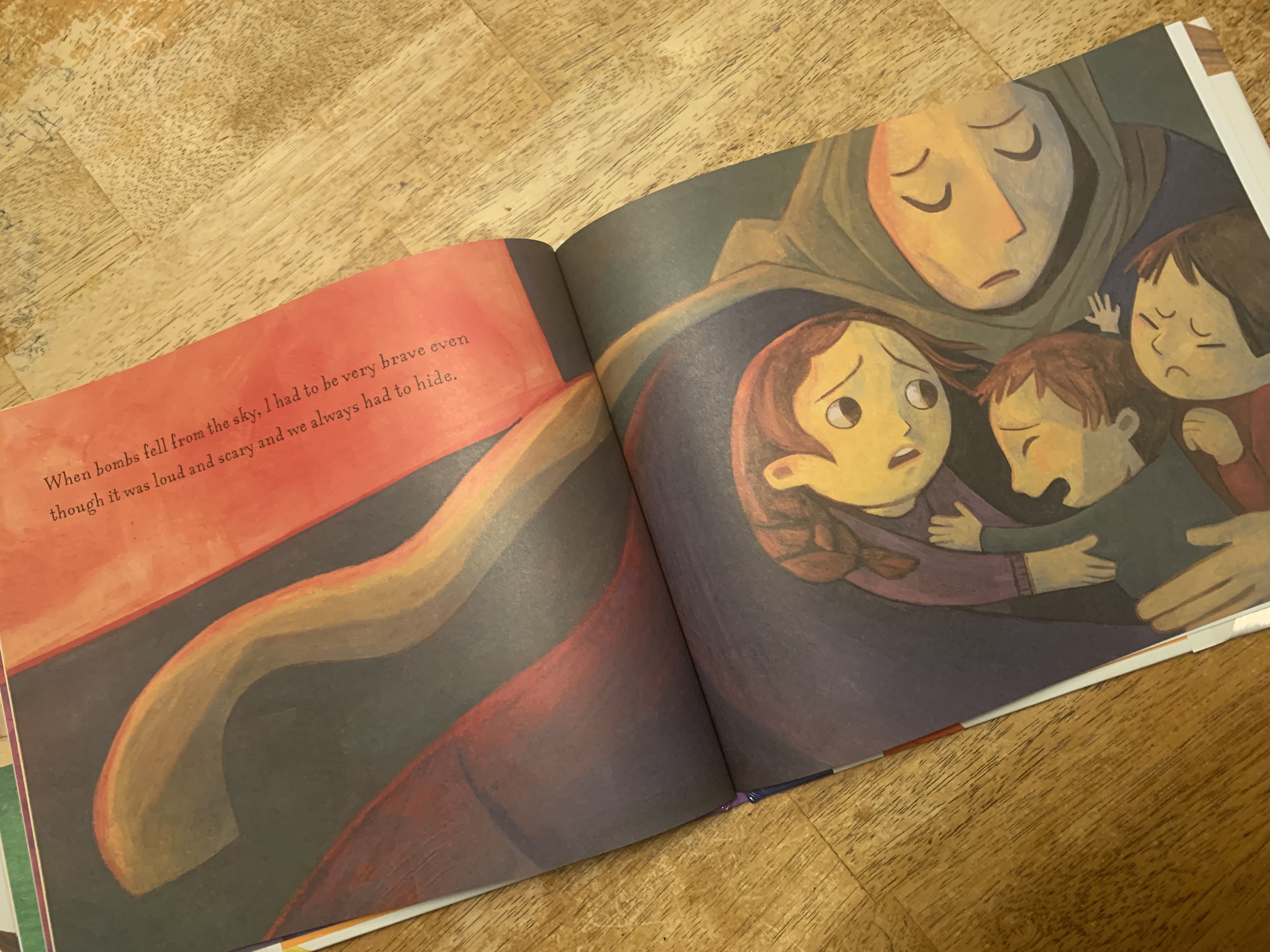
Bana appreciates her name, and being strong, because war came to her country.  When bombs fell they had to hide, when her brothers were scared, she had to keep them distracted, when they moved to a new place where they didn’t know the language or any people, she had to be strong still.

img_4632

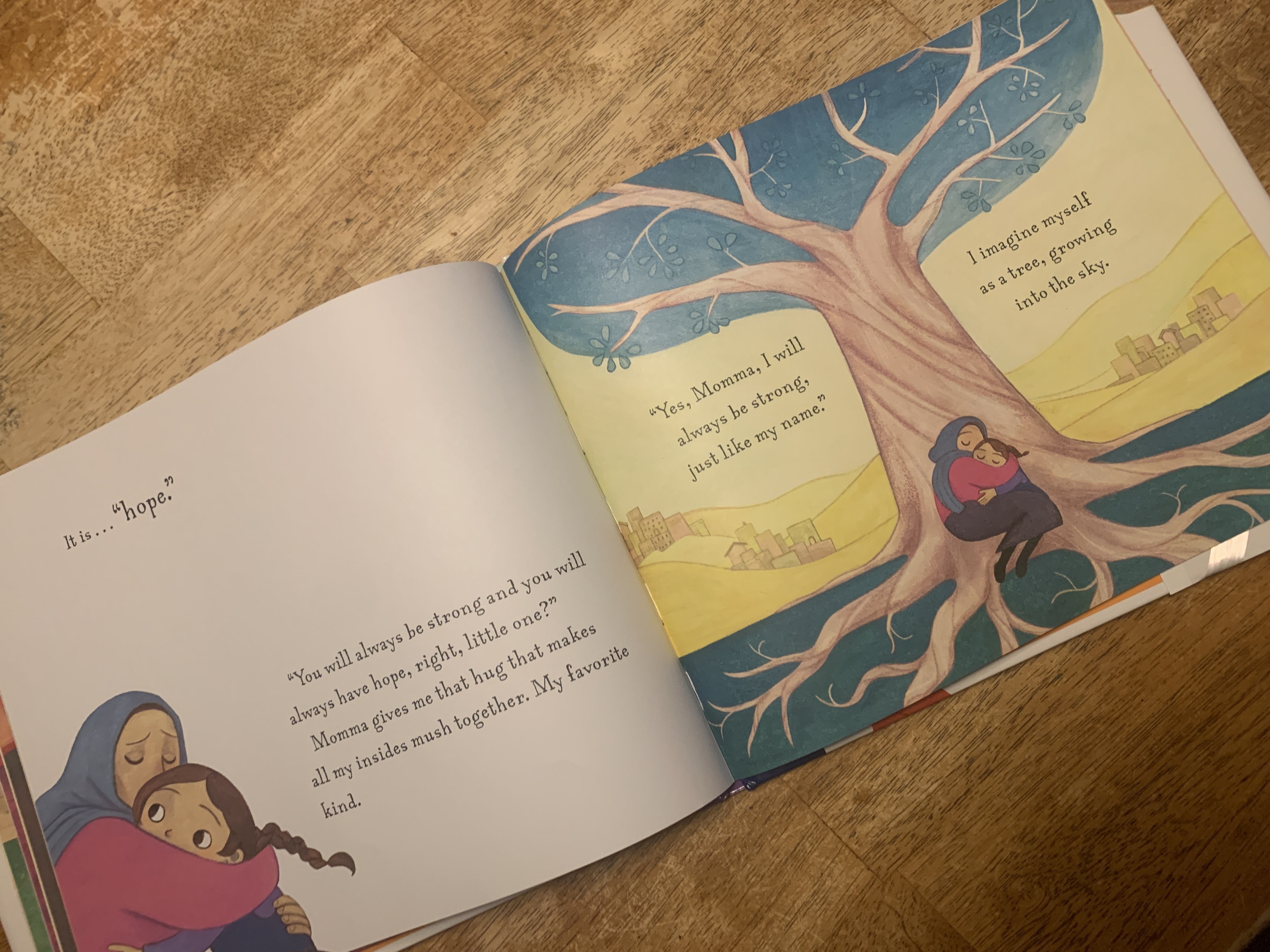
As a young girl, Bana tweeted about the war, the book doesn’t touch on that, but it does show her being strong as she shares her story all over the world.  It then returns to her and her mother discussing amal, Arabic for hope, and Bana imagines herself strong, reaching into the sky.

img_4633

The book ends on a simpler note of acknowledging her little brothers’ names: Laith and Noor, lion and light.  The Author’s Note at the end is just as powerful as the text of the book and provides more information about Bana’s experience and outlook. The way that war is handled is not overpowering for young readers, and will provide a great starting point of discussion.  The relationship between Bana and her mother is warm and supportive and equally deserving of mention with the little people you share the book with, alhumdulillah.

“Kids shouldn’t have to always be strong.  Every child deserves to live in peace.” Bana Alabed

The Adventures of Nur Al-Din by Badees Nouiouat

Standard
The Adventures of Nur Al-Din by Badees Nouiouat

nur al din

I really enjoyed this book.  It is self published, and the expectation was zero and I honestly read all 214 pages in two sittings. I probably could have read it faster, but ahh kids and dinner, and my middle school son somehow got to it to read when I put it down.  We both enjoyed the quick pace, the strong Islamic presence, and the historical fiction based plot.  The book has a bit of language, hell and damn a few times, mentions prostitution and a brothel in two instances, and alcohol is present, but it is always crystal clear on Islamic and Muslim behavior.  The book is linear and straight forward and  probably YA readers will appreciate it, but I think it really is a middle school aged read, I think technically that makes it Young YA or Lower YA.  My only small grievance is the modern slang.  I appreciate that it isn’t written like Treasure Island and that you understand what the pirate crew is saying in plain modern English, but the few mentions of “idiot,” “chill out,” and “awesome” stick out very obviously and could easily be “fixed.”  Overall, so very impressed by the consistent pacing, historical references, writing quality, and internal reflection on our ummah’s strengths and weaknesses.

SYNOPSIS:

Farid is a young boy in Tunisia, and as the Spaniards start to flex their influence, his life begins to change.  The son of a fisherman, the family can barely enter the waters under the watchful eyes of the Spanish fleets.  When approached after a fight to join an Islamic pirate crew by Captain Aruj of the Barbarossa and his brother Khidr, he decides to leave his family and stretch his wings.   Having always dreamed of being in a leadership role, his optimism, and eagerness is quickly put to the test as the crews’ first mission in Northern Africa fails and sends the pirates scrambling on land.  They journey to the Mosque of Uqba (Great Mosque of Kairouan), and get help from the Emir in Tunis to replenish their losses.  It is then onto Tripoli where friendships and internal issues of race, and nationality threaten the cohesion of the Muslim pirates.  But it is in Spain where things really come to a head and Farid finds himself separated from his crew, in-prisoned for years, and tested both physical and emotionally that the story finds its climax before ending, and leaving the reader ready for more.

WHY I LIKE IT:

I have a soft spot for historical fiction, the original American Girl books for me were treasures to behold.  So the setting of this book really won me over: the mention of rulers, historical landmarks, the pain of the Inquisition on Spanish Muslims, the fact that there was a not just one map in the book, but two, all great things.  Like I mentioned above the pacing of the book is quick, from start to finish, and it is a pirate story so there is death, violence, battles, killing, and treason, but seeing as often in books about these type of things, I find myself glossing over the long detailed battle scenes, I was grateful that they are short and quick and possibly overly simplified.  It discusses weaponry, but it is not detailed, no glossary is needed, although there is one of the Islamic words at the beginning.  As for the Islam presence, it is very much a part of the story.  They raid a ship, the alcohol goes in the sea, they call athan differently, the characters discuss different madhhabs, just rulers are just even if they aren’t Muslim, and terrible rulers can also be Muslim, it doesn’t shy away from internal reflection and I appreciate that.  The only thing that caught my attention of being unaccounted for Islamically was when Farid puts on red and gold pants to head in to battle.  One- that seems the opposite of camouflage, and two- many Muslim don’t find it permissible for men to wear red and gold, obviously different people feel differently, but it seemed odd that the colors were specifically mentioned in such a quick moving book to no end.

Character-wise, I wanted a little more insight into Sameer and his racism, I also would have liked a little more about Farid’s first day in the sun after imprisonment.  I liked that the Jewish struggles under King Ferdinand in Spain weren’t just mentioned, but were brought in to the story.  And while I appreciate the reasoning for showing that Muslims were hiding behind a brothel to participate in learning and worship and thikr, that and the mention of a woman trying to seduce Farid in the street, both make the target audience a little more mature than the rest of the book might warrant otherwise.

FLAGS:

There is killing, fighting, raiding, stealing and there is plenty of physical violence.   The book mentions prostitution, seduction, and there is a fleeting glance at a woman that the main character pauses for, knowing he should lower his gaze, but then she is rescued and never seen or heard from again.  There is mention of alcohol as it is captured, as non Muslims stagger around drunk, etc.. There are a few curse words used a few times each: damn and hell and God.

TOOLS FOR LEADING THE DISCUSSION:

I think I would absolutely do this for a middle school book club amongst a mature group of girls and boys.  It is an easy read, but the discussions would be phenomenal as history and context would all come in to play.

For the sake of buzz and growth and attention, I hope the author will shop the book around, if he hasn’t already, see if it can be published on a larger platform and gain some traction.  We need books like this, solid Islamic fiction books, that aren’t shy to show our strengths and weaknesses and inspire our youth.

Seven is Special! By Shagufta Malik

Standard
Seven is Special! By Shagufta Malik

sesven

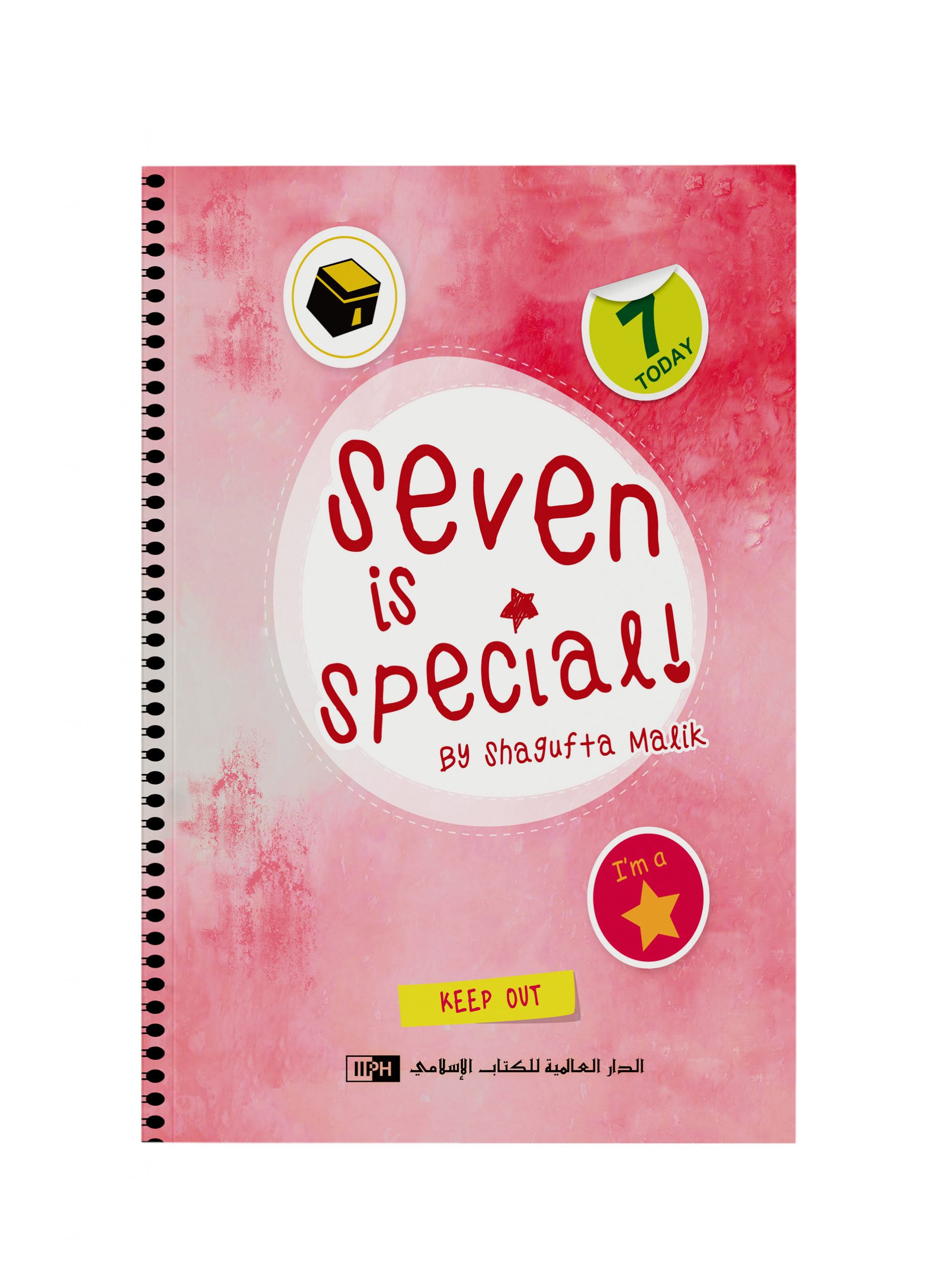
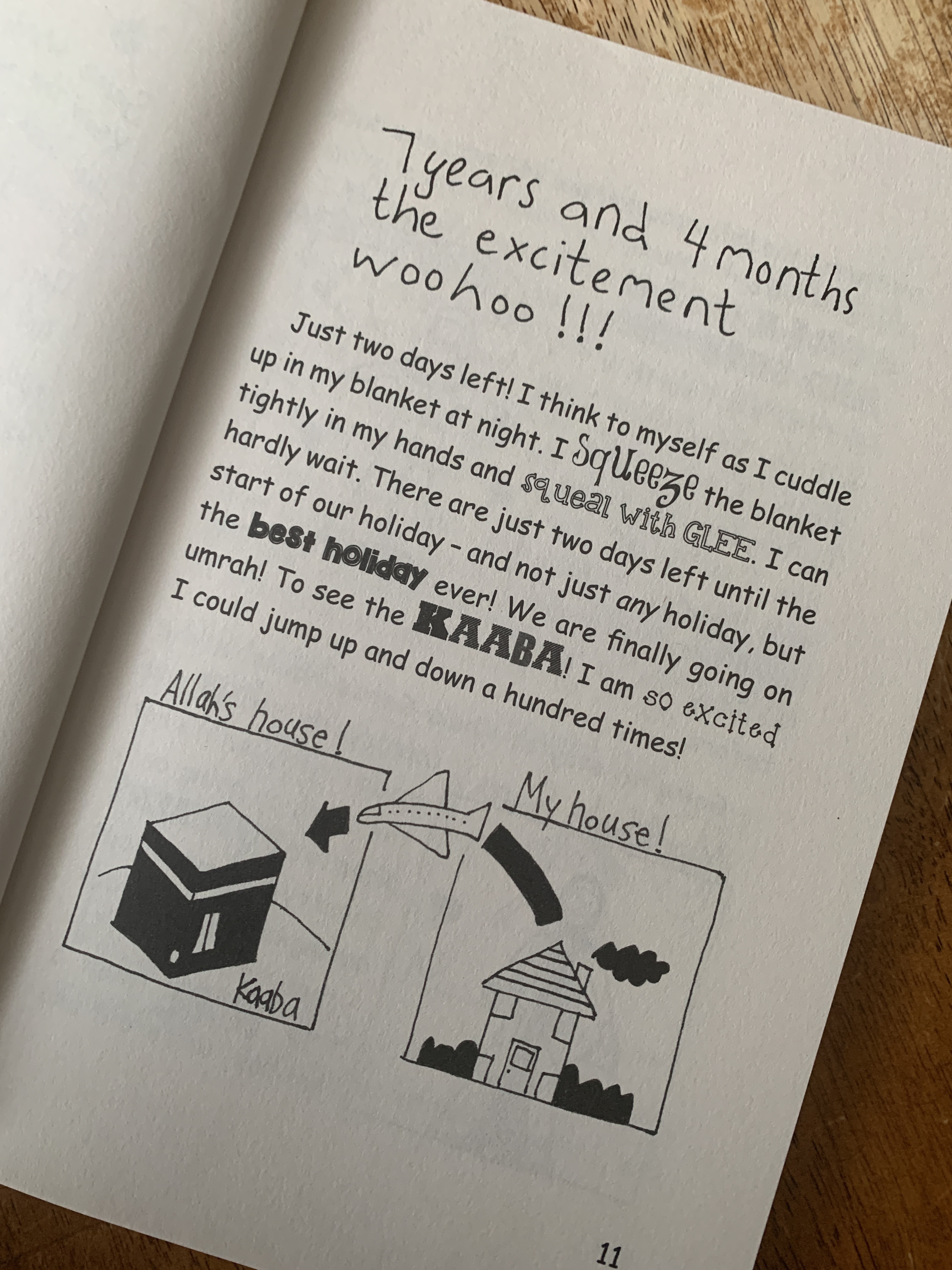
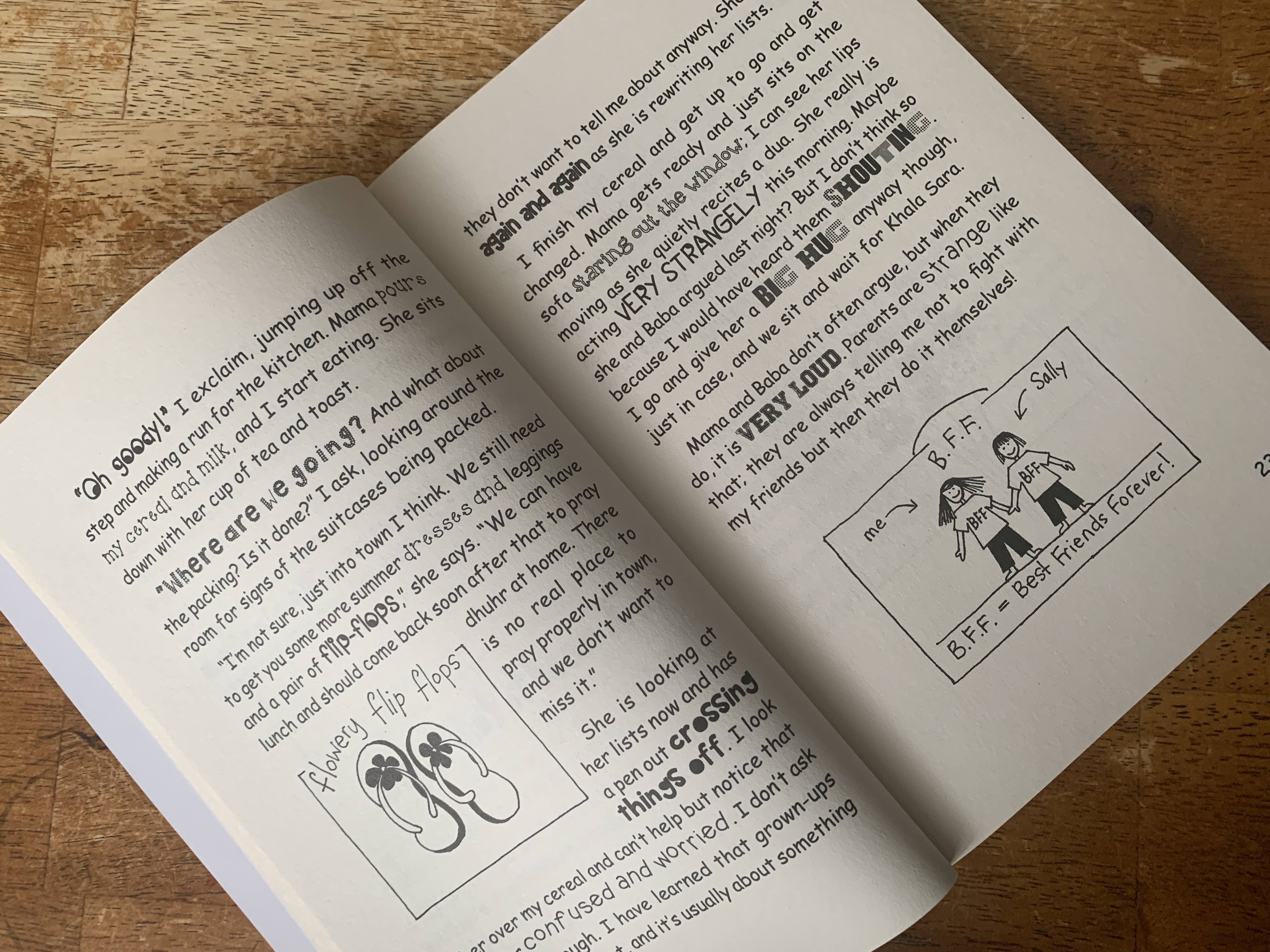
I’ve seen this book on and off over the years, but it wasn’t until I saw @muslimkidsbooknook’s post about it, did it register that it is a chapter book, with a plot and story.  I thought it was a journal for seven year olds with prompts perhaps.  Needless to say I judged a book by its cover and hope at some point the author will consider changing the title, redesigning the cover, and tightening up the story, because there is a lot to enjoy in this book, but to get to it, you have to get it in your hands, and open the cover.  The doodles, the author’s voice, and the playful font over 128 pages will appeal to elementary aged girls, but boys will find plenty to relate to as well if you can convince them to give it a try.

img_4501

SYNOPSIS:

Seven-year-old Maryam has started taking her salat more seriously, and finally the family, her parents and her, are going on a REAL holiday.  They are going for Umrah.  Maryam is so excited, but then the trip gets canceled and her mom is sick, and Maryam is tired of always feeling different than her classmates.  Will everything work out? Will prayers and duas be answered? Will eight be great?

img_4502

WHY I LIKE IT:

I love that the book stays on a seven/eight year old level, but I do question how much stress is on how sick the pregnant mom is, and how kids will understand that.  I was sick, very sick, with all my pregnancies, and my older children saw me and it still affects them, in sometimes surprising ways.  My oldest daughter says she is never having kids.  Granted she is 14, but I would worry that reading a children’s book that mirrors something that was pretty traumatic for her to see will cement her impression about childbearing.  Obviously, I could be the exception, and perhaps like many literary mirrors it would make her relate more to the story.  I know she is above the target audience, but the illness of the mom is a large part of the book, and it is very detailed and specific.  I think if you are a young child reading it, you might ask your mom if that was her experience, and it could be a lovely conversation about heaven being at your mother’s feet, and the tests and blessings of it all, but the book really doubles down on some of the details of the throwing up and vomiting, and I wish her being sick could be shown in more situational ways.  Maybe she tried to do an activity with her daughter, but couldn’t, or she had to ask another mom to help with something she normally did at Maryam’s school, etc..  There are such wonderful tangible little nuggets in the book about salat at the park, and kids duas, and making wudu in public, that I think a little reframing of the illness and symptoms is definitely in the author’s skill set.

I love the unapologetic voice of being Muslim and some of the insecurities that Maryam faces and grows from.  Kids will enjoy seeing their concerns articulated, and inshaAllah benefit from her perspective as they make decisions about their own identity and attitude.  I know some families make a big deal about starting salat at seven, but when the book starts she has been seven for a while, so I’m not entirely sure why that was the focus of the book’s title.  Additionally, the pink cover really screams that it is a girl book, and I think boys will be nervous to be reading a “girl book,” that really isn’t gender specific in the storyline.  Yes, there are all sorts of stereotypes in that assessment, but I think you all get what I’m saying.

img_4503

FLAGS:

Illness, a bit of a temper bubbling over, stress.

img_4504

TOOLS FOR LEADING THE DISCUSSION:

I think young readers that are handed the book and start it, will finish reading it.  It is a super quick read, and with the drawings and conversational language, they will enjoy the pages as they fly by.  It is an elementary read, and anyone older will probably see the foreshadowing that the mom is expecting, while the second and third grade readers, will probably be genuinely surprised.

Little Seeds of Promise by Sana Rafi illustrated by Renia Metallinou

Standard
Little Seeds of Promise by Sana Rafi illustrated by Renia Metallinou

seeds

This sweet, well-done 48 page picture book for early elementary aged readers shows the fear associated with being in a new place, the love of an elder family member, and the courage it takes to make new friends.  The story focuses on a young Pakistani girl who has recently moved to a new country and how she tries to remember the wisdom of her Nani to blossom in her new home.  The culture rich story is universal and lyrical, with hints of making duaa, greetings of salam, and the soothing sounds of the athan that make memories of home so foreign to her in her new residence. Young readers will empathize with Maya, and see the symbolism in the seeds she is anxious to plant and cultivate.

img_4475

Maya finds her new home unfriendly and cold, she feels different with her food, and clothes, and way she speaks.  Home to her is dancing in the warm mansoon rains, saying As-salamu ‘alykum, and waking up to the sweet athan.  Nani was also there, her old home.  Sweet Nani with her hundred wrinkles, smelling like flowers.  When Maya left, Nani gave her a gift.  Little seeds of promise, so that they and she might bloom where planted.  But Maya doesn’t know where to plant them, she carries them with her everywhere she goes, but like a secret, she keeps them close.

img_4477

Channeling her Nani’s tenderness, she knows that she has to plant them if one day she wants to be surrounded by flowers.  Maya loves flowers, dancing around them, praying among them.  Maya finds a patch of earth.  She longs for rain, she hopes for warmth. She makes way for the rays of the sun.  The text talks of flowers, the illustrations show both the plant and the growing friendships.  For days nothing happens, with the seeds or the classmates.  But Maya remembers that seeds have a long journey from the ground up.

img_4476

Maya nurtures her seed, just the one she dared plant, with love and kindness.  She too feels ready to burst.  Can she be brave enough to plant all the seeds, can she share them, and her self in her new world? Can their be warmth here, like there was over there? Can this too be home?

img_4478

I love the symbolism and juxtaposition of the seeds growth with her own.  The character arc and the transition of home being one place to being the other, is very well done, older readers will feel an aha moment when they grasp it and younger kids will enjoy both the surface story and the dialogue you can have with them about blossoming where planted.

img_4479

Religion is not a strong thread, but Islam is present in her memories of her maternal grandmother and all the warmth and love that those memories contain.  I love that the classmates were never mean, they just didn’t know her either.  I wish there was a bit more diversity of skin tone and mobility in the classroom illustrations and the friend circle she is hoping to join.  Overall, a beautiful OWN voice picture book that will be enjoyed for multiple bedtime, small group, and classroom readings.

Ms. Marvel Stretched Thin by Nadia Shammas illustrated by Nabi H. Ali

Standard
Ms. Marvel Stretched Thin by Nadia Shammas illustrated by Nabi H. Ali

stretch

This tween graphic novel of our favorite Muslim superhero is authored and illustrated by a new Muslim duo that share an OWN voice story over 110 pages about balancing life and priorities and making time for family.  There is a little bit of action, but the majority of the plot, really is balancing it all, with the help of school friends, one being the hijab wearing brilliant Nakia, and Kamala’s friends from Avengers Training: Miles Morales (Spider-Man) and Tippy Toe (Squirrel Girl).  This seems to be a different format of a lot of the same story-line found in the Avengers Assembly: Orientation book, but for fans of the characters and genre, this middle grades graphic novel (comic book?) will be well received with it’s easy to follow panels and relatable story.  For desi and/or Muslim kids they will appreciate the mehndi celebration, the hijab wearing side characters, the pressure to do well in Quran class, and the tight rope Kamala’s parents give the mixed gender group of friends.

img_4441

SYNOPSIS:

Kamala is being stretched thin with school, super hero training, writing her fan fic, moderating the website, and helping out with her nephew Malik while her brother and sister-in law are on vacation.  The stress has her embiggening all out of whack too, it is a lot for one girl, and when an evil robot takes advantage it will mean even more disappointment for her Ammi.  Kamala ruins her fancy mehndi dress and in embarrassment makes her family leave early, she is late to pick up Malik, and she is sleeping through school.  Finally, with the only two people that know about her alter ego, Kamala gets help from Nakia and Bruno to take down the robot.  She then combines her “club” friends, with her school friends, so that her family can meet everyone, and they can hopefully help her feel more at easy and less stretched thin.

img_4442

WHY I LIKE IT:

I don’t mind the story telling being more personal and less action, but the robot element is really underdeveloped and very much minimized, I’m not even really sure what the point of it was and how it was resolved.  The book seems to be confused if the kids are pre teen or teens, they are called both in the book, and I don’t know if it is an error, or is a joke from Tony Stark, but the voice seems to be ambiguous as well, which makes it hard to completely connect to the characters.  I wish the mom wouldn’t cover when at home, I mean I’m glad to see her covering and talking about Quran and all, but being an OWN voice portrayal, it would have been nice to see that detail.  The way that the friends as boys is handled is actually really well, it doesn’t become a whole religious or cultural soap box issue, but chaperones are present and the mom is on top of it. There is no hint that anything would be going on, but it is nice to see that accurate representation.  I also like the diversity that is present even within the Desi family.  Sadly, the book as a stand alone is rather forgettable, I’m not entirely sure what to compare it to, if there will be more in this particular series, or just more like it from other MCU characters, but for people that love Marvel, at least this rep exists if nothing else, it does offer a reminder to all kids to prioritize their time, ask for help when needed, and to make space for their families.

img_4443

FLAGS:

Clean. There is a destruction seeking robot and villain, but very tame.

img_4444

TOOLS FOR LEADING THE DISCUSSION:
I think the book would be fun on any middle grade classroom shelf.  There isn’t much to discuss, but kids especially in Islamic schools will  enjoy the representation.

img_4445