Tag Archives: Muslim Author

Zahra’s Blessing by Shirin Shamsi illustrated by Manal Mirza

Standard
Zahra’s Blessing by Shirin Shamsi illustrated by Manal Mirza

Screen Shot 2021-11-18 at 11.57.45 AM

Just when you think all the Ramadan stories have been told, you flip open a new book, hold your breath as the stage of predictability is set, and alhumdulillah in this case, you squeal with delight when the big reveal in a children’s book swept you up and surprised you too.  This 32 page richly illustrated story for elementary readers is heartfelt, culture rich, informative, and embracing.  The book doesn’t dwell on the details of Ramadan, fasting, and Eid, but intentionally focuses on some of the feelings, blessings, and acts that make the month extra special.
Screen Shot 2021-11-18 at 11.58.04 AM

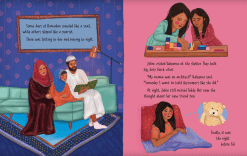
Zahra looks up at the Ramadan moon as she hugs her teddy bear and sends a prayer up asking for a little sister. The next day Mama is packing up beloved clothes, and ones that the family has out grown to be donated.  They discuss giving without hoping for anything in return and once again Zahra asks her mama for a little sister. To which her mother lovingly replies that she should be patient.

Screen Shot 2021-11-18 at 11.58.11 AM

When Teddy goes missing, Zahra can’t help but think a little sister would help her find it.  Iftar that night are all of Zahra’s favorite desi foods and prayer after is her asking for a sister and Teddy.  The following day Mama and Zahra take the collected donation items to the shelter and Zahra realizes how sad she is about losing Teddy and these refugees have lost everything.
Screen Shot 2021-11-18 at 11.58.28 AM

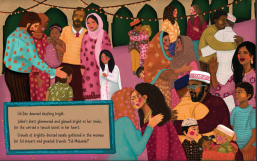
Zahra spends time with the children at the shelter and gets to know them.  She wishes she could find Teddy to gift to a young girl named Haleema.  Some days Ramadan crawls slow, and other days fast.  The family reads Quran together, fasts during the day and prays at night.  The night before Eid, Zahra’s dad whispers a secret to Zahra, one that she keeps close to her all through Eid prayers the next day.

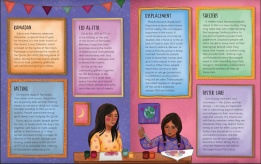
Not going to spoil it, although I’m sure you can guess what is going to happen.  There are hints in the remaining illustrations, but I think kids will enjoy not having the heads up.  The book concludes with some informational blurbs and details about the Muslim author and Muslim illustrator.
Screen Shot 2021-11-18 at 11.58.35 AM

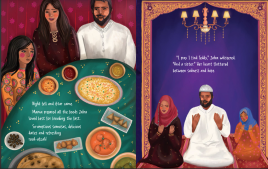
I enjoyed the illustrations, they are bright and bold and festive and unique.  They compliment the text completely as they show praying, reading Quran, making duas, etc.  The text doesn’t get preachy, it doesn’t even mention Allah swt or God, but talks of prayer and blessings.  The combination of the text and illustrations, however, definitely convey a strong unapologetic Ramadan/Muslim centered story.  Overall, it is universal and warm and sweet, and both Muslim and non Muslim children would benefit from reading it.
Screen Shot 2021-11-18 at 11.58.48 AM

My only concern is the page that the family is making dua together, it seems odd that they are all sitting in a line as if they have just prayed, but not prayed with the dad in front and the mom and Zahra behind. I read an electronic arc of the book and I look forward to purchasing a physical copy to add to my bookshelf.
Zahra’s Trip to Misr by Sufiya Ahmed

Standard
Zahra’s Trip to Misr by Sufiya Ahmed

misr

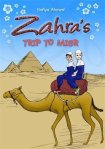
This middle grade series has been highly recommend to me numerous times over the years, and I finally found a copy to read and review.  It is book three in the series, and I have not read the first two, so I may be missing something, but the book didn’t wow me honestly.  The 147 page story published in 2011 has a lot of potential, but I felt like it didn’t know who the audience would be, and thus often felt cumbersome and disjointed to read.  At times it uses Islamic terms (muezzin), other times the Urdu words (namaz), and way too often the english meanings (ablution, peace be upon you, mosque), often all three in a single paragraph.  It is Islamic fiction and stays adventurous, without getting overly preachy and didactic, but there are some cruel life threatening antics by the girls, and some heavy themes of child trafficking, revenge, kidnapping, lying, bullying, gender treatment in Islamic spaces, finance and micro loans, but to its credit, it stays on level and, while as a mom some of the adventure needs adult intervention, I think young readers would support the young girls handling so much on their own.

SYNOPSIS:

Twelve year old Zahra and her classmates from her Islamic boarding school are headed on a class trip from England to Egypt.  For ten days they will be learning about the history, the culture, and connecting to Islam.  A group of first year girls and their chaperones in a foreign country meet with former students, another girls school from the UK, and some of their chaperone’s husbands giving this short book a lot of characters to get to know briefly, and only in passing.

The adventure starts right away as bully Saira locks a claustrophobic girl in the airplane lavatory in revenge of being locked in a freezer and forced to eat spiders earlier in the school year, and the foreshadowing that these battles are not over is set.  Once in Egypt, the girls muddle through worksheets sharing what they have learned, stopping to pray, and enjoying the experience.  Every so often at the hotel however, they see a girl they have dubbed, “sad girl” and the mystery to figure out what is making her so sad will ultimately make this a trip that brings the girls close to danger, and if successful will make them heroes. Toss in a nasheed concert, a runaway camel, and it is going to be a busy week and a half for them all.

WHY I LIKE IT:

The book presents a lot of Islam, and I think most readers will learn something and see Islam practiced authentically.  There is praying, and wearing hijabs, and halal meat, and Islamic history, and the 99 names of Allah all present in the characters naturally.

The book starts with Zahra and her mom and aunt rushing to the airport, they are running late.  Zahra’s aunt is not Muslim and presumably her mom is a convert, there is some really awkward dialogue before the family leaves, and it is called out as being awkward, but it just didn’t seem to fit either.  Why would a girl’s brother tell a non Muslim to wear a scarf? A character that is just in the first scene? I’m hoping there is more to her as a character in the first two books, and maybe this is a reference to something, but it just reads really weird and unrealistic (I hope).

Similarly, I am sure the first two books cover the forcing a bully to eat spiders and why she was locked in a freezer, but to just see that this is the level of the pranks, is a little disturbing.  The book acknowledges that locking a girl in a bathroom who has claustrophobia is dangerous, and that triggering the camel to run-off was similarly potentially deadly, but what about the other cruelties? It doesn’t even hint that there is more there, and I would have liked to see some context to recognize that these aren’t benign pranks, they are pretty big acts.

The child trafficking and kidnapping plot really had me wishing that the girls at least talked to Anu Apa. Having preteens take on such a dangerous situation so haphazardly was a little stressful for me, and I need to find some middle grade readers to help me see the actions through their eyes.

The randomness of the nasheed concert didn’t seem to fit for me, the song she wrote wasn’t that good, the whole thing came together too easily, and then some of the girls taking off their hijabs in wildness seemed such an odd tangent to me.

The biggest obstacle for me was the terminology and diction.  I don’t think it matters if the readers are Muslim or not, use the Islamic terms.  The teachers and students go to an Islamic school, it isn’t a stretch to have them use the proper term of salat instead of namaz, they can remark on the athan, not azan, they can say Assalamualaikum, they don’t need to say in english peace be upon you, and upon you when they greet, it seems so halting to the authenticity of the characters and flow of the story.

I think part of the difficulty in getting these books in the US is they just had one edition printed, and I genuinely hope that at some point the author will revisit the books especially now that she has been published mainstream for her other works, and hopefully grown as an author.  There is a lot of good in the book, it just could use some polishing and updating.

FLAGS:

Child trafficking, revenge, kidnapping, lying, bullying, cruel pranks, physical assault.

TOOLS FOR LEADING THE DISCUSSION:
I wouldn’t go out of my way to get these books on a classroom shelf based on this one book.  If a classroom or library already has them, I wouldn’t remove them.  Utlimately, I don’t know that many readers will stick with the sorting out of all the characters in the beginning of the book, and those that do I think would probably be slightly disappointed, not with the presentation of Islam, but in the side story building details.

Today I’m Strong by Nadiya Hussain & Ella Bailey

Standard
Today I’m Strong by Nadiya Hussain & Ella Bailey

strong

I really liked the way Nadiya Hussain’s book My Monster and Me discussed anxiety and was so eager for this book.   Unfortunately, I didn’t feel as connected to the characters, the little girls dread of dealing with a bully, or the resolution of channelling her imaginary tiger to find her voice strong enough.  With discussion I think the book would be a wonderful way to get young children, to open up about what is upsetting them, but on its own I feel like a bit more is needed to transition from thinking to action, from nerves to confidence, and from understanding what is bothering the little girl to understanding what needs to be done.

img_6852

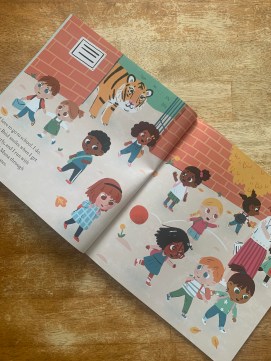
The story starts with a small girl going back and forth on whether she loves school or doesn’t and revealing that the tiger listens to her and doesn’t say a word.  It then starts the next few pages with the same line: “I love to go to school.  I do,” and detailing what parts of school make her happy.

img_6853

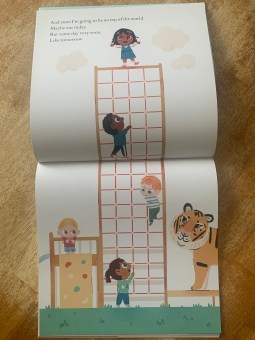
It then transitions to sharing why some days, the little girl doesn’t like school so much.  Days when her voice disappears, Molly laughs at her, or blocks her way to the climbing frame, or takes her cake.

img_6854

She then reinstates that she likes going to school most day, but not always, and then one day when Molly is mean, the little girl, thinks of the tiger, and knows what to do.  How to find her voice, and stand up to Molly. She then carries through on it, and realizes that soon she can be on top of the world.

img_6855

The messaging is universal and great, and while there is no religion shown, it is great to see a brown protagonist dealing with mental health.  The author is Muslim and I’m sure most everyone knows at least of her from the Great British Bake Off.

img_6856

Count by Ibrahim Moustafa with Brad Simpson and Hassan Otsmane-Elhadu

Standard
Count by Ibrahim Moustafa with Brad Simpson and Hassan Otsmane-Elhadu

count

This graphic novel retelling of the classic, Count of Monte Cristo, is for middle school readers and up and is by a Muslim author and illustrator. There is nothing Islamic or cultural in the text of this 136 page sci-fi twist, and there is some kissing, a whole lot of killing, brutality and violence, but I think the swashbuckling tale will appeal to early teens and adults who enjoy fast paced reads whether they have read the original tale or not.

img_6765

SYNOPSIS:

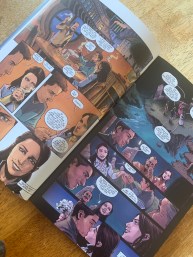
Commoner Redxan Samud is elevated to Captain and marries his beloved, the first few pages of happiness, however, quickly disintegrate as he is framed and wrongfully imprisoned by the jealous powers that be.  Life in the hovering prison are barbaric, but the meeting of Aseyr, provides him with a plan and means to move forward.  First he will have to survive the death battles in the prison, escape the inescapable fortress, before he can locate the Isle of Sorrow, take control of ARU and extract his revenge.  Oh, but his revenge is strong, so very, very strong.

img_6766

WHY I LIKE IT:

I was admittedly hesitant to give the book a try, but when writer Shireen Hakim sent it to me, and my kids saw it, I thought I should read it first before letting them dive in.  I read it in one sitting, the story is engaging and clear.  I never was confused with who was who and why something was happening.  At times though it seemed too quick and that details were glossed over, or impact was minimized because major plot points were not given enough time to be felt.  I would have liked some answers provided of basic logistics and of character’s getting from one place to another, and how plans came to fruition shared in the story.  Additionally, some fleshing out of situations to ground the story a bit and make the revenge and extraction of revenge more cathartic, would have elevated the book and made it a popular choice in my house to be reread again and again.

img_6767

FLAGS:

Death, violence, murder, rage, kissing, torture, plotting, deceit.

TOOLS FOR LEADING THE DISCUSSION:
Not a contender for a book club read, but I would shelve it in a middle school classroom and in the school library for graphic novel and comic book enthusiasts as well as for high school students who might be familiar with the classic it references.

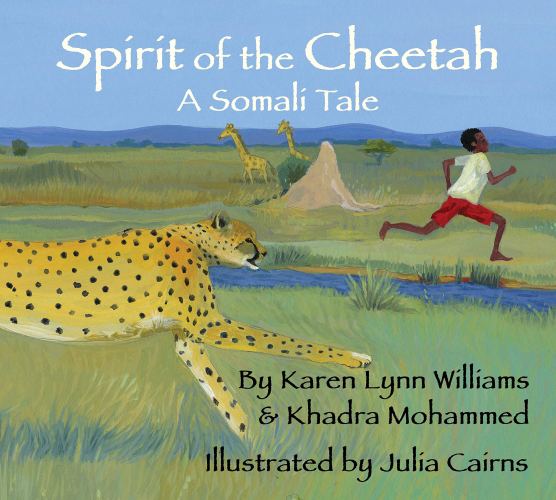
Spirit of the Cheetah: A Somali Tale by Karen Lynn Williams & Khadra Mohammed illustrated by Julia Cairns

Standard
Spirit of the Cheetah: A Somali Tale by Karen Lynn Williams & Khadra Mohammed illustrated by Julia Cairns

cheetah

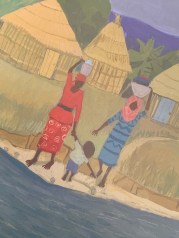
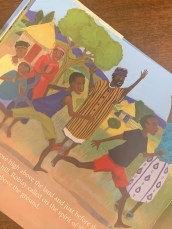
This timeless 40 page tale of a young boy as he prepares for his right of passage into adulthood is rich with wisdom, culture, and tradition.  So many gentle lessons can be found in the book, as it leaves deeper understanding and connection to be felt and explored long after the book has been closed and returned to the shelf.  There are seemingly hijab wearing #muslimsintheillustrations, and the author’s name would suggest she is also a Muslim, but with the line, “Called on the spirit of Shabelle,” and talk of the “Spirit of the cheetah,” it is hard to know for sure if the main character is.

The story starts with Roblay running everywhere in preparation for an upcoming race where he hopes to place in the top three, and prove he is a man and no longer a boy.  On the day of the race he races his fastest, but he does not come out at the top.

img_6579

His grandfather, his Awoowo, tells him that to be successful he needs to capture the spirit of their people and leave his thumbprint on a cheetah’s coat.  His grandfather then tells him about the cheetahs long ago and how the river is named after them.  He explains that thumbprints on a cheetah’s fur honor those that have proven themselves.

Roblay trains and searches for many days.  He wonders if it is enough to mark a cub.  But his grandfather asks him if he wants to remain a cub.  This motivates Roblay to work harder.  When a year has passed and the race is about to take place again, he finally touches his cheetah.

img_6580

He lines up for the race strong, proud and sleek, and he has the chance again to prove he is a man and make his family proud.  Nope, not going to tell you how it ends.

img_6583-2

The book starts with an Author’s notes from both authors and concludes with Notes on the Cheetah.

Moonlight Hope: A Muslim American Coming of Age Story by Nora Salam

Standard
Moonlight Hope: A Muslim American Coming of Age Story by Nora Salam

moonlight hope

This 354 page New Adult read is truly Islamic fiction, and as long as you know what you are getting in to, you probably will thoroughly enjoy it.  It is Islamic centered, it is preachy, it is idyllic, it counters many stereotypes about Muslims and various cultures, while simultaneously falling into other tropes that define the genre, it has mature framing that is not suitable for younger readers, but doesn’t detail anything that is super “haram.”  If you are looking for a potentially halal romance between YA and Adult ages with Islamic messaging this book is a solid choice.  If however, you will be annoyed by any of the aforementioned labels, this book will not hold your attention or beg to be finished.  It reminds me a lot of Umm Zakiyyah’s If I Should Speak and A Voice books where the story has its own twists and character arcs but it spends a lot of time preaching and setting itself up to tout an Islamic perspective, or concept as well.  I wanted to read two books in the “New Adult” category and see if I could spread my reviews to include them, and with this being the second,  I think I should resist the temptation, and stick to what my library background familiarized me with.

SYNOPSIS:

Told in alternating voices of Intisar and Majed, two individuals in New York City, at different places in their life, but finding that when they hit rock bottom, Islam is the answer.

Intisar is graduating nursing school when the story opens and has only one goal in mind, get married.  She has strict Sudanese parents and has put all of her dreams on finding freedom in the perfect spouse.  She meets a guy at a friend’s house and they secretly date, kiss, and hold hands.  When he ghosts her, she is devastated and reluctantly finds herself agreeing to marry a much older man of her parent’s choosing.  Loosing herself in the idea of marriage, she finds herself heartbroken, ostracized and falling apart.  She starts to put herself back together slowly by finding Islam, her confidence, and some much needed perspective.

Majed has a famous family: his mother a model, his father and siblings singers, and he manages their careers.  After passing out from drugs and alcohol more than once he really starts to examine his life and the road he is on.  He sneaks away to rehab and in the process stumbles on to Islam.  He is Egyptian, but the family is not religious at all, and infact stop talking to him when he converts.  The trials of being a Muslim in New York with no family are not easy, but he feels it is worth it and his journey to Hajj and through loss brings him closer to Allah (swt).

The two stories are parallel and collide slightly in the periphery, but the book ends with them finally coming together and the ever dreaded words of “to be continued,” leaving the reader hanging.

WHY I LIKE IT:

I do like that the story shows struggles when one comes (back) to Islam, it isn’t always a walk in the park, it has challenges and stresses.  The book starts each chapter with a verse from the Quran and is very open about what it is.  So, while at times, the preachiness did get to me, it was very clear what type of book it was from the beginning and I kept reading.

Some of the side characters I felt needed to be fleshed out a bit.  I didn’t understand many of the random friends, how they affected the main character often seemed off, or completely underdeveloped in what was revealed about them: particularly Izzedine, Parita, the girl that married Mansour, the uncle at the Masjid that thought Majed was a spy, etc..  I also really struggled with the presentation of Uncle Munir and his calling Majed, baby, and how he just happened to bump in to him outside the bar, and the kisses.  I’m guessing it was meant to show him as over the top affectionate, but it just read as odd.

I like that the book addresses hypocrisy, mental health, and expectations.  It doesn’t paint all Muslims as good or bad, nor society at large.  The book reads as a journey, and many characters are given a chance to correct their errors and be seen in a new light.

The majority of the book is written well, but right away the book gave me pause as Intisar and her friends chat all through the Jummah khutbah, I get that it is trying to show her disregard for intentional practice of her faith and her “boy crazy/marriage” obsession, but you cannot speak during the khutbah, it isn’t just dirty looks, you truly cannot talk for it to count, and it isn’t even remarked upon, and it made me skeptical of the book for a while.  There is a word missing from a sentence on page 161 and at one point a brother in the prayer hall aims a shoe to throw.  But you wouldn’t be wearing shoes in the room where you pray, and the mosque has hallways and a glassed off section for women, so this seemed like an obvious oversight that should be fixed.

FLAGS:

Drugs, alcohol, lying, overdose, sneaking out, kissing, hooking up, physical affection, violence, temptation, sexual predatory behavior, it is an adult book, so I’m not going to continue listing everything. Nothing haram is overtly detailed or glorified. Ages 17 and up, could handle it.

TOOLS FOR LEADING THE DISCUSSION:
Too mature for my book club crew, but I wouldn’t mind it on a shelf in the school library.

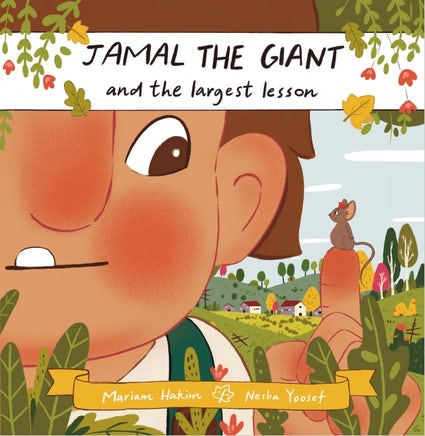
Jamal the Giant and the Largest Lesson by Mariam Hakim illustrated by Nesba Yoosef

Standard
Jamal the Giant and the Largest Lesson by Mariam Hakim illustrated by Nesba Yoosef

jamal

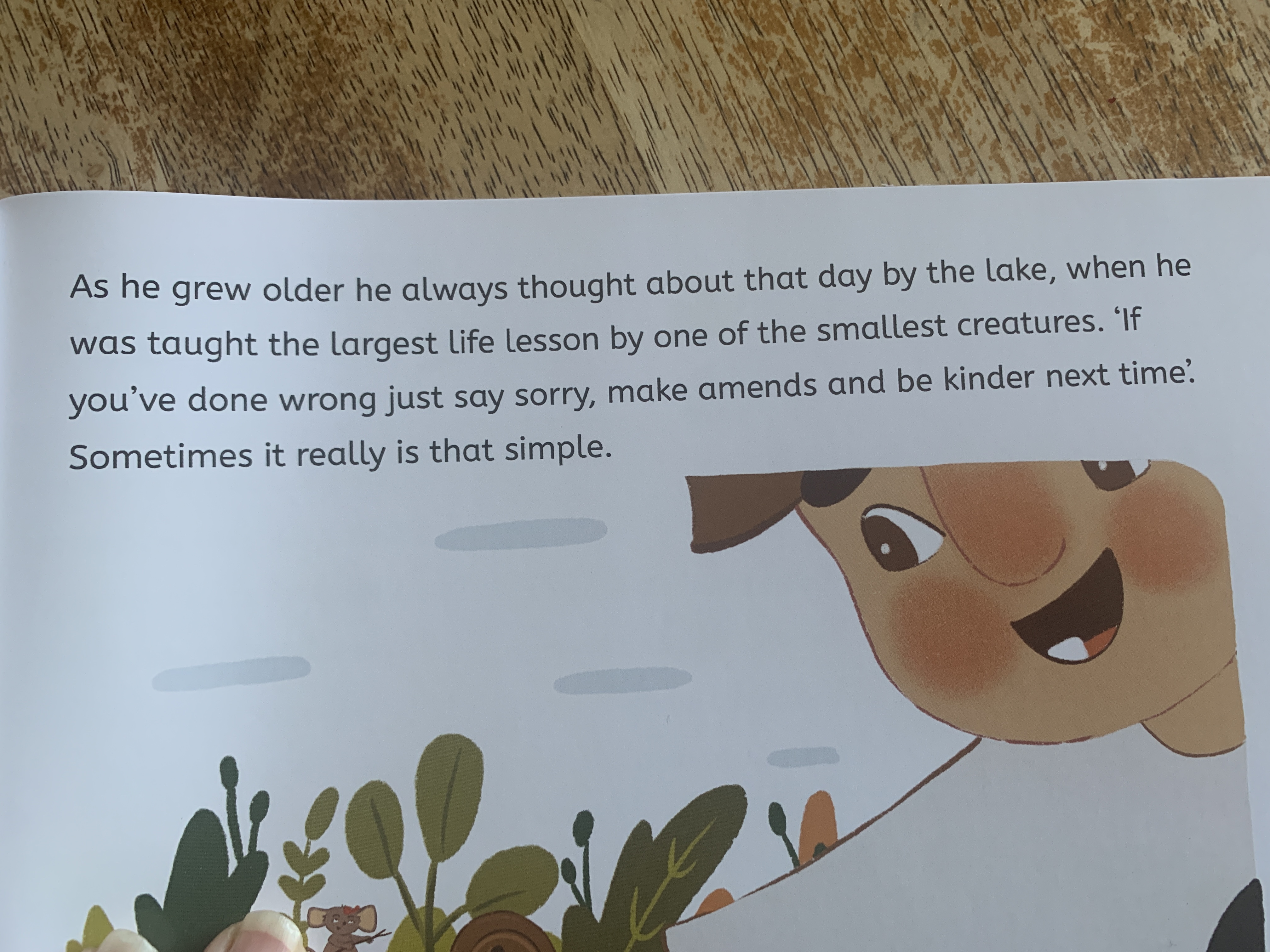
My initial thoughts of this 32 page Islamic fiction, fable-style book, is that it needed to be tested on children, lots and lots of children.  It should have been read aloud to catch all the grammar, syntax, and diction errors, and young readers and listeners should have been asked what they learned or understood from the story, BEFORE, being published.  The message is sweet, the illustrations cute, but it feels unrefined and reads underdeveloped: pictures and concepts are not enough to carry a book if the writing is poor.

I have looked forward to obtaining the book since its launch, so as soon as it was available from a US stockist (@crescentmoonstore), I didn’t even hesitate to purchase it.  I knew the book was available for free online as a read aloud on YouTube, but because I truly love supporting Muslim authors and publishers, I wanted to wait until I had a physical copy in my hand.  These opinions are my own, all my reviews are.  I mean no malicious will to anyone, I’ve spent my money on something, and once I’ve done so, I am completely justified to have an opinion.  You don’t have to like it, or agree with it, but it isn’t personal.  I’ve given reasonings for my opinions, and I stand by them.

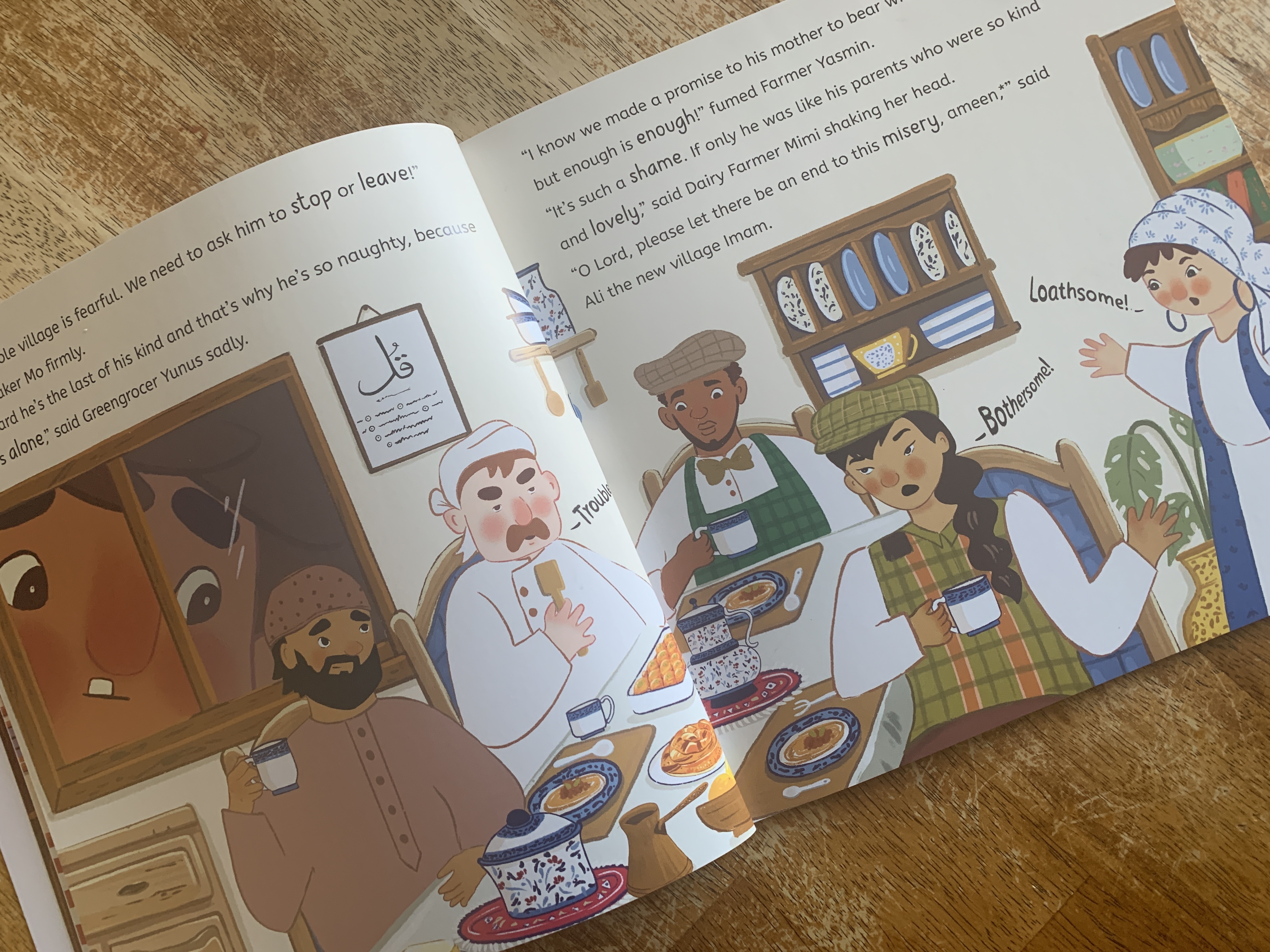
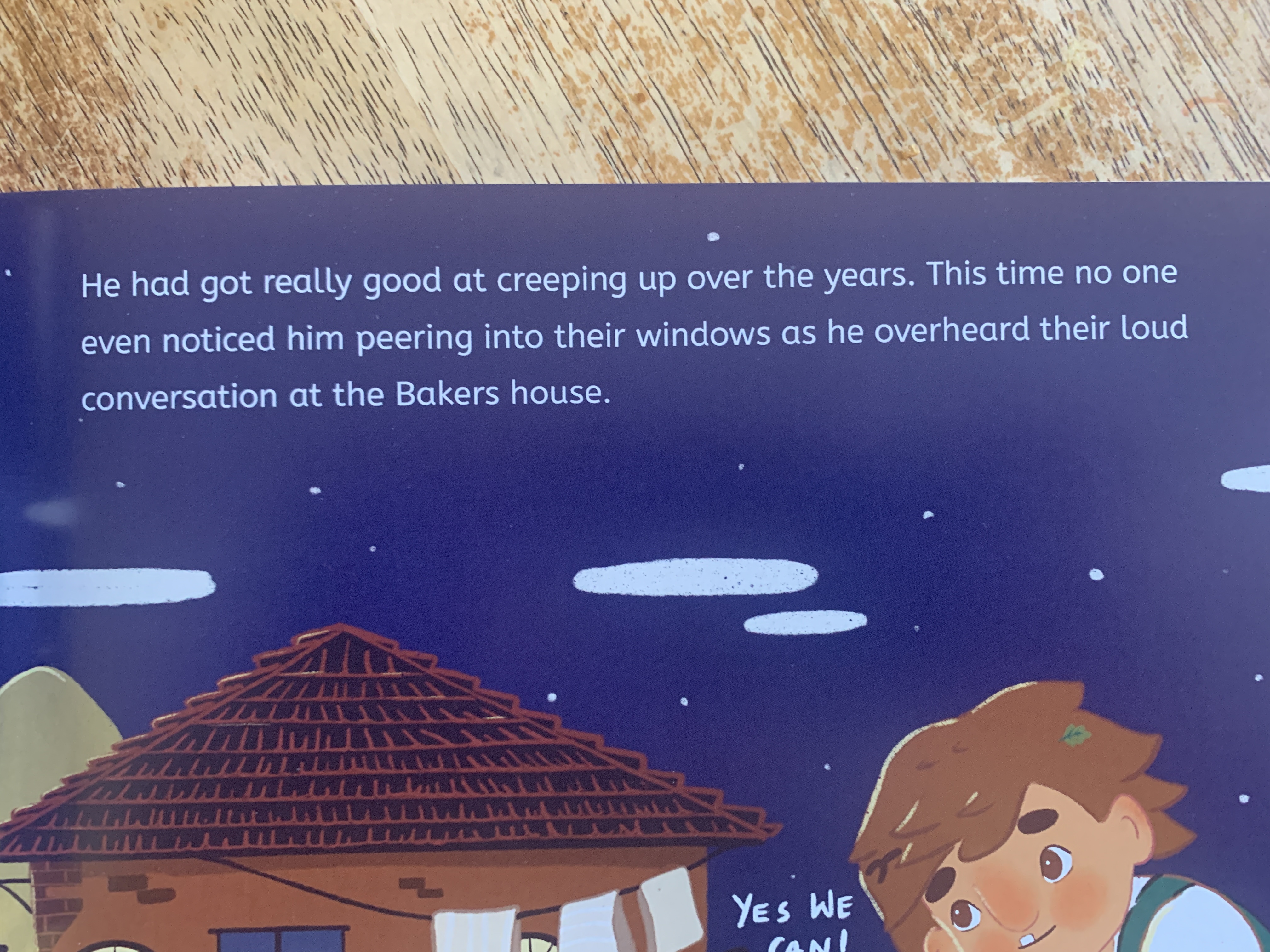
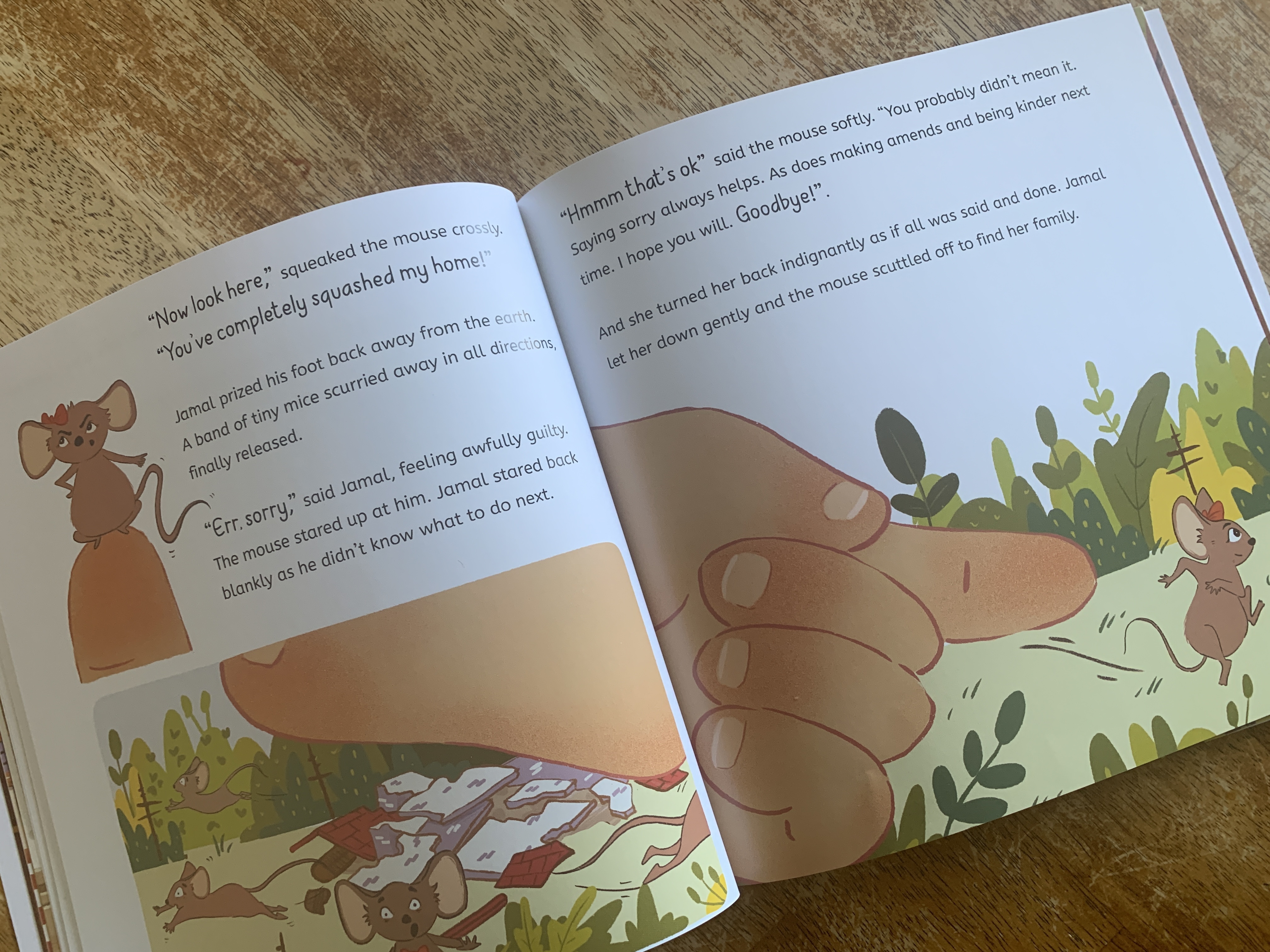
Jamal the Giant isn’t necessarily mean, but he is careless, young, and selfish.  He scares the animals in the woods, destroys their homes, ruins farmers’ crops, and steals from the village.  One night, he wants to steal some juice and in the process overhears the community members discussing how different he is from his kind parents, and that he must be forced to leave.  He tries to mend his ways before he is driven from his home, but to no avail.  Unsure how to fix things, it is the advice of a tiny mouse that sets his reform in motion and conveys the message from the Quran, surah 11 ayat 114, “Good deeds cancel out bad deeds.  This is a reminder for the mindful.” He learns he must apologize, make amends and be kind.

The message is accurate, but I have some concerns at how it is conveyed.  Why was the responsibility on the giant to learn how to behave.  Yes if he knew better, he should do better, but it is made clear that he is the last of his kind and his parents died when he was really young.  If the villagers aren’t going to try and teach him, who is?  It isn’t necessarily victim blaming, but if you don’t know better, and have no one to teach you, you definitely are a victim of neglect in some ways.  To have them going from enabling him out of a promise to his parents to threatening to kick him out from his home, is a little abrupt.

Story-wise there are some points that gave me pause.  Why is there an owl flying off in the daytime, sure there are some diurnal owls, but most kids are taught owls are nocturnal, why not change it to a woodland bird that is active in the day, don’t confuse kids.  It doesn’t specify a timeframe that the story takes place in, but it feels like a fable with talking animals a giant and a clear message.  There is a baker, a farmer, an imam, a greengrocery, it is all very quaint, but then the imam is holding a cell-phone, wait what? I do appreciate that the farmer is female though, and that some of the women cover and some do not, it seems representative.

I’m curious who taught the giant to read, and how come he writes his “s” backwards, there seems to be a bit of disjointedness to the upbringing of the giant, his age, even in giant terms.  A lot it seems the author assumes the reader knows about giants or their stereotypes perhaps, because the book doesn’t address them, and the result isn’t a fun moral story, but one that seems to miss things.

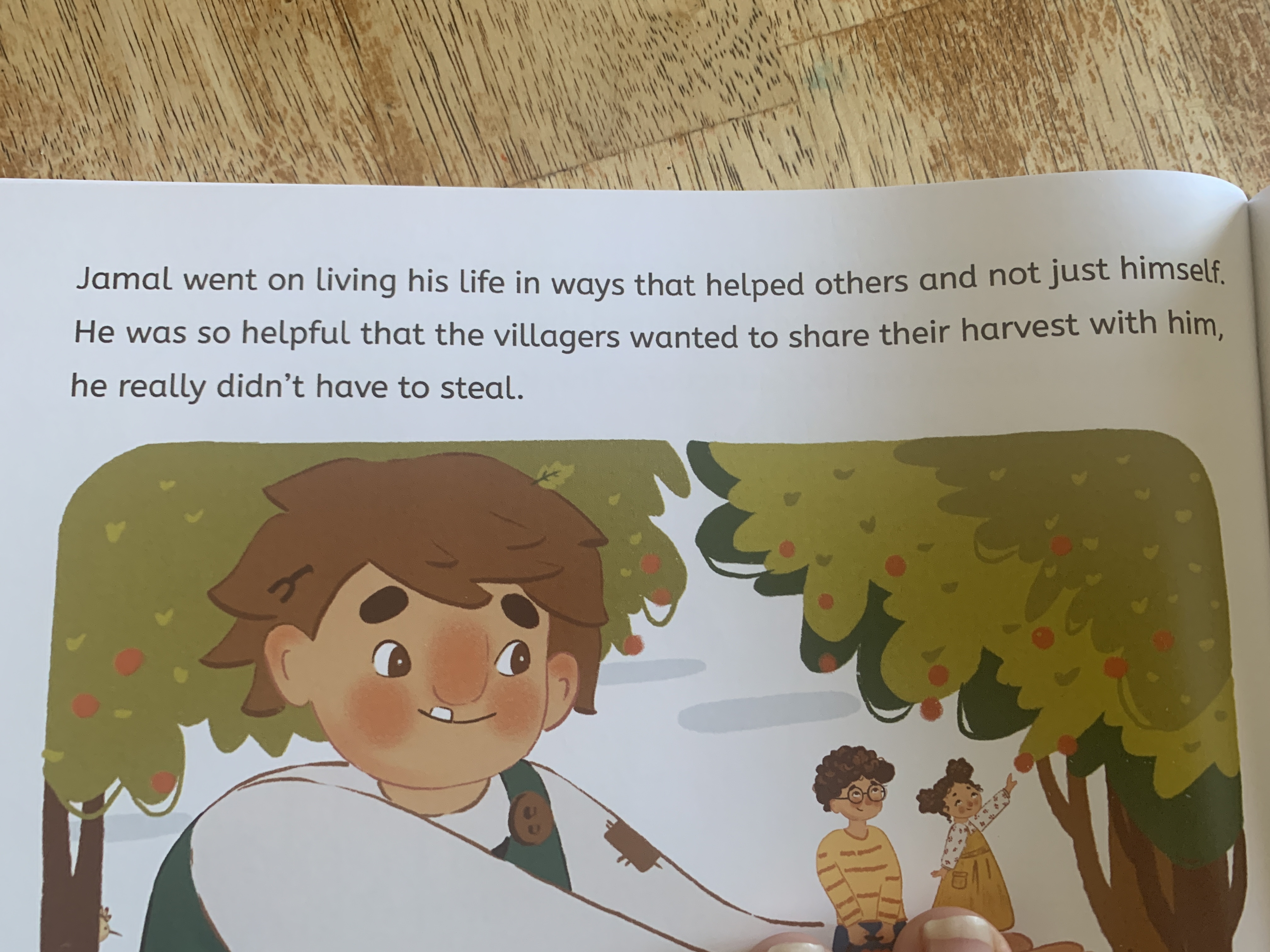
The little mouse teaching the big giant, carries some Lion and the Mouse-Aesop fable vibes, but really it is the proof-reading of the book that is disappointing.  When you read it aloud, commas are abundantly missing (even in the online reading pauses are placed where commas are not written).  Why is the B in Baker capitalized, and if it is the Baker’s house, as in last name is Baker, then an apostrophe is missing.  Many of the lines are just awkward and halting, even if not particularly erroneous.  The diction is questionable at times, Jamal “always” thinks about that day at the lake, woah, doesn’t reflect on it, but it haunts him “always.”  Jamal “‘really’ didn’t have to steal,” seems to imply he was justified in stealing a little, this should be a black and white issue in a children’s book, no?

There are questions at the end of the book, and a whole page of information about the author and illustrator as well.  In a case like this I don’t know if the publisher didn’t do justice to the author’s work, or if the author should have refined it more, before coming to the publisher, but it is unfortunate because clearly a lot of effort went in to the illustrations and promoting of the book.

Wrong Side of the Court by H.N. Khan

Standard
Wrong Side of the Court by H.N. Khan

court

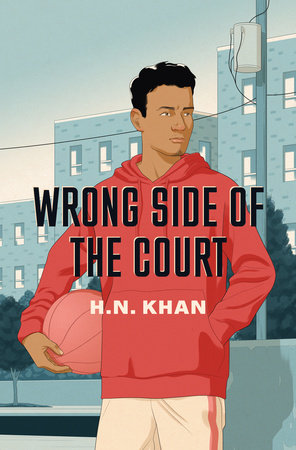
I don’t know what it is about male protagonist sports novels, but they often seem to be overly crass and crude.  Perhaps that is the real life environment that inspires such writings, or perhaps it is just male voiced YA books, but in this one in particular it seemed to stand out because the storytelling by-and-large is really enjoyable, it just has a lot of flags, A LOT.  Beside the language, sexual innuendos, drug use, violence and romance, it also has a few religious and cultural concerns that are possibly just specific to the niche that I review for, but did have me shaking my head out of confusion and sighing in disappointment. To its credit there is a decent amount of Islam featured, some male friendships that are quite heartwarming, and some emotional depth that presents really well.  The 312 page book is marketed to readers 12 and up, but there is no way I would encourage the book for anyone that young, Muslim or not.  For Muslim youth specifically I would say 17 plus.

SYNOPSIS:

The book is told from the perspective of fifteen year old Fawad who lives in Regent Park with his mom and sister.  He dreams of being the first Pakistani NBA player and the linear story bounces in time at the start and he sometimes even speaks to the reader, but the story is all his.  Regent park is a poor part of town pressed right up against a wealthy part of Toronto and the neighborhood is rough.  Fawad is a good kid: he doesn’t go out much after dark since his father died, he helps his mom, doesn’t run with a gang, he gets good grades, loves basketball, and doesn’t have a girlfriend, not yet anyway.  The story starts with him reliving the final minutes of a summer league basketball game where he opted to pass out of fear of the ever looming threat of Omar, rather than take the shot himself.  Omar ends up missing and they lose, oh yeah and Omar is the imam’s son.  Under the protection of Abshir, Fawad’s friend Yousuf’s older brother: Omar, Yousuf, and Arif have someone looking out for them on the streets.  Arif has some help from the Bengali crew, and Yousuf is Somali, but there are not enough Pakistani’s to make a stand or demand respect when out and about.  When Abshir gets murdered, Yousuf retreats into himself his music and smoking joints, Arif keeps his playboy ways to take his mind off things when he isn’t reciting Quran beautifully in classes at the masjid, and Fawad makes the high school basketball team and finds a girlfriend. Things with Omar physically escalate as well, while things at home have his mom putting in to action plans for Fawad to marry his cousin in Pakistan.
WHY I LIKE IT:

I really like that Islam and culture are presented powerfully with OWN voice strength and detail.  Things are not defined or over explained and if you don’t know what haram or Ramadan or an imam are, figure it out.  I rarely find myself wishing the ending of books were different.  You hear a lot about that in movies, that they didn’t screen well or something, and so the ending was changed, and that is how I feel about this book.  *SPOILERS* Fawad and Omar should not have resolved their issues so easily, it was more than a respect thing, there was blood and hospitalizations.  We never even knew why they had issues in the first place. Arif and Nermin should not have hooked up. The whole book she comes across as the strong Muslim hijabi that blurs the lines by side hugging her guy friends, but not being ok with it, then she shows up to a dance, and then hooks up with Arif, didn’t like that at all.  I get the mixed signals of Fawad having a girlfriend from his mom, and while he seems to be connected to the mosque it never shares that he understands Islam more than just I have to do this and I can’t do this, but I didn’t like him going back to Ashley and wanted him to choose his own self-worth and respect over accepting her apology and going back to her.  I do not understand why Fawad waited so long to tell his mother about Nusrat. It was nothing that would upset his mom, I don’t get why he dragged it out.  I do love that the cousins were friends or friendly, but were fronting to their parents, but it was unnecessarily dragged out, and the more it got dragged out, the more complicated and intertwined it got with Fawad having a girlfriend.

I did not get the mom and sister relationship at all.  The mom seems to have just given up on her, but they seem to spend a lot of time together, so that was a disconnect for me.  At first I kind of liked the twist on the stereotype that the boy was not allowed freedoms to go out, but the sister was, but it kind of unraveled in the logic department.  I am desi, (half anyway) and the stereotype is that the boys are earning before they get married.  So to be arranging Fawad’s wedding at age 15 is bonkers.  To be arranging anybody’s wedding at that age is, but it is so contrary to custom, that I couldn’t even ignore it and move on, it was constantly blocking the story from being smooth.  The mom’s rationale is that she wants a daughter-in-law to take care of her.  Again kind of bogus, but maybe there is some truth there, unfortunately there is the big gaping hole that she, the mom, doesn’t take care of her in-laws, so why the difference of expectation.  Suffice it to say the mom and sister are both road bumps in the story for me.

I was impressed at how much basketball play-by-play was in the book and how it didn’t get boring.  I love that there were plenty of male role models in the community and that the three boys really looked out for each other, supported each other, were connected to each other’s families, etc..  I didn’t like the abusive religious imam trope.  I’m glad that Omar’s dad wasn’t blind to his son, but to be abusive was uncalled for.

I don’t know why Nermin is called, “Arabic,” at one point, that is clearly erroneous and I wish that the condom talk and sexual innuendos were greatly reduced.  There isn’t a lot of resolution regarding who killed Abshir, if Fawad caused any permanent damage by playing, or what the future holds for any of the characters and their relationships, but it was a quick read and held my intention and I did quite enjoy the writing.

FLAGS:
Lying, violence, murder, physical assault, kissing, making out, talk of arousal, talk of condoms and sex and getting physical.  Drugs and alcohol and addiction.  Child abuse, theft, stealing, threats.

TOOLS FOR LEADING THE DISCUSSION:

There is no way I could teach this to middle school or high school in an Islamic school.

What if Dinosaurs Were Muslims? by Rabia Bashir illustrated by Laila Ramadhani

Standard
What if Dinosaurs Were Muslims? by Rabia Bashir illustrated by Laila Ramadhani

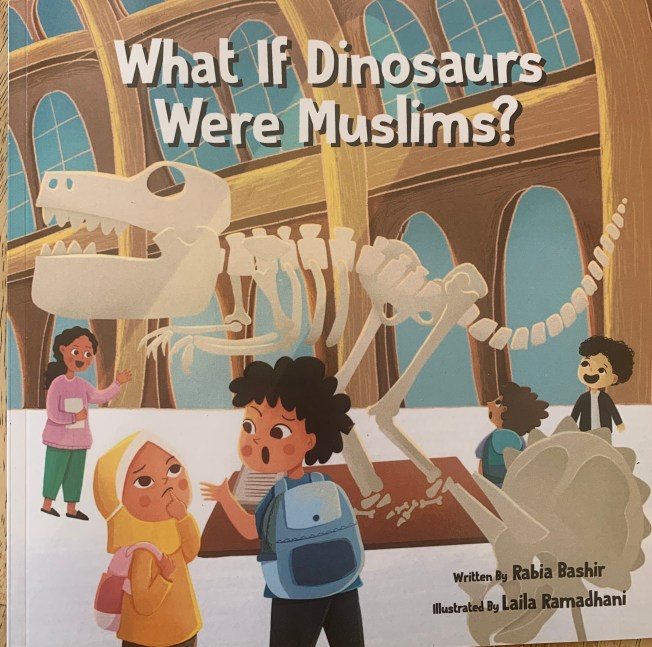
This rhyming Islamic tale wonders what dinosaurs would do if they were Muslim and alive today.  For littlest Muslim readers this repetitive tale ponders how they would eat, pray, love their mothers, respect their neighbors, dream, and feel, by tying all those things back to how Muslims behave.  The adorable illustrations kept my 6 year old glued to the story and the simple text held my 2 year old’s attention.  A fun book with wonderful supplements at the end to engage children in activities that everyone does compared to those that just Muslims do, a Fun Fact about (Muslim) dinosaurs and mums in Islam.  As well as extra activities, valuable information, and details about donations made with the purchase of this book.

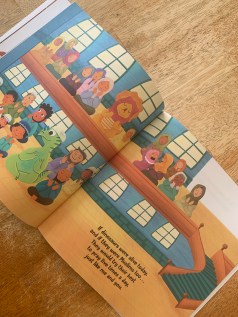
The book takes place in London and imagines if dinosaurs were alive and if they were Muslim what day-to-day life would be like.  The refrain starts out “If dinosaurs were alive today and if they were Muslims too,” before stating what they would do and having it conclude with “just like me and you.”

In a similar vein as the ever popular How do Dinosaurs series by Jane Yolen, the book teaches kids how to behave by teaching the dinosaurs.  The book is short, and the humor comes from the illustrations, primarily the facial expressions of the parents, more than from the text, but I think the wildness of Dinosaurs living today will get most little kids smiling.

The only real concern I have with the book is the text when they are in the masjid praying and it reads, “they would try their best to pray five times a day.”  I know we don’t demand our littlest ones to pray all five salat, but I don’t know if it would imply that trying to pray is sufficient even when you are older.

From start to finish I found myself smiling while reading this book aloud to my kids, even after the fourth time in a row, alhumdulillah.

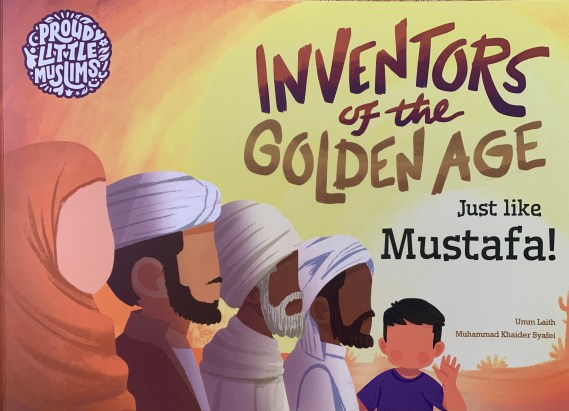
Inventors of the Golden Age (Just like) by Umm Laith and Muhammad Khaider Syafei (Proud Little Muslims)

Standard
Inventors of the Golden Age (Just like) by Umm Laith and Muhammad Khaider Syafei (Proud Little Muslims)

img_6450

Usually when you purchase a personalized book, the charm is that you get to see a name of your choosing in the story, and that you can make the main character look a certain way.  So imagine my surprise when this book arrived, and yeah sure my son’s name and likeness was included, but the story and information contained was also really well done and engaging.  This book, even without the personalization, is a solid story highlighting Fatima al-Fihri, Abbas ibn Firnas, al-Zahrawi, al-Idrisi, and their skills of generosity, persistence, kindness, and adventure as they shaped the world as we know it.

img_6418

The fourth wall is broken as the book speaks to the reader encouraging them to come on an adventure in to the Golden Age.  A time when scientists, engineers, explorers, doctors, and astronomers were making remarkable advancements.

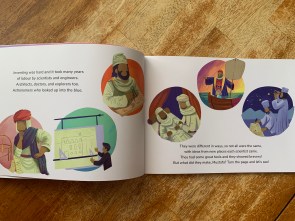
The first stop is Morocco to learn about Fatima al-Fihri and how she established the first university.  Her generosity in building and creating a place of Islam and learning is what set her apart and made her so remarkable.  It is then on to Abbas ibn-Firnas in Spain and his attempts at flying.  He failed often, but his mistakes helped him as he persisted and continued to learn and understand and make flight of humans possible.

img_6419

Al-Zahrawi, the surgeon, is who is detailed next, as his knowledge, skill, and inventions he made are still used today.  His regard for his patients fear and nerves and his kindness is what the book stresses before moving on to the mapmaker al-Idrisi.  Al-Idrisi was adventurous as he traveled the world making his maps and switching the poles.

img_6420

The book then focuses on the reader encouraging them to be generous and adventurous, kind and persistent, in making the future better like those mentioned from the past.

The book is horizontal, the pages thick, the faceless illustrations warm and detailed and the rhyming text flowing and appropriate for preschool aged children and up.

img_6421