Tag Archives: friends

Amina Banana and the Formula for Friendship by Shifa Saltagi Safadi illustrated by Aaliya Jaleel

Standard
Amina Banana and the Formula for Friendship by Shifa Saltagi Safadi illustrated by Aaliya Jaleel

img_8365-1

I have five children, I have taught second grade, I have shelved, recommended, and read aloud a number of early chapter books for the better part of the last 20 years, so when I say that this book changes the standard of what a book (series) for this demographic can and should be, I do not say it lightly. Yes, I am bias, the author is a dear friend, but Amina has layers, growth, insight, struggles, warmth, heart, and all the other glowing adjectives normally associated with beloved books and characters for older readers. This book is the first in a series of four, and each book is somehow better than the previous. At 126 pages with a robust backmatter that includes scientific extensions, a recipe for ful mdamas, and a note from the author, I am confident that children of all ages, everywhere, caregivers, parents and educators alike will all fall in love with Amina, cheer for her, laugh with her, and be enamored with her attitude, perseverance, and joy.

SYNOPSIS:
Amina loves having a plan, a formula in fact, and when she arrives in Indiana as a refugee from Syria she is determined to make friends in 3rd grade.  Things don’t always go as expected, but alhumdulillah Amina doesn’t stay down: classmates, family, and determination combine to help the clever, yellow-loving protagonist find a way to rework her experiments, accept what she can and cannot control, and succeed in making this new country feel a little bit like home.

WHY I LOVE IT:
I adore the humor, unapologetic Islam, the rich Syrian culture woven in, and Amina’s approach to life.  So often early chapter book protagonists are obnoxious, annoying, crude almost, bratty, arrogant, and repetitive, Amina is none of those things.  She is vulnerable and strong, confident, yet nervous, hopeful, but worried, she is tangibly real in a way that readers will see themselves and relate.  I love the humor of idioms being confusing, and the heart of seeing what the parents have sacrificed and are willing to sacrifice by starting over in a new place.  The illustrations add to the experience of drawing reluctant readers in and will help those transitioning from picture books to chapter books be immersed by the story.  As always the author’s writing is impeccable and the story well-crafted.

FLAGS:

There is some teasing, reflections on why Syria was left, the journey to America, and hardship.

TOOLS FOR LEADING THE DISCUSSION:
This book is ideal for classroom, library, and home shelves.  It would be a wonderful classroom read aloud and works equally as well at bedtime.  My children college to elementary have all read and loved Amina, and I highly encourage preordering so that your children will get a chance to fall in love with her too.


Our Neighborhood: Friday Fun by Marzieh Abbas illustrated by Anoosha Syed

Standard
Our Neighborhood: Friday Fun by Marzieh Abbas illustrated by Anoosha Syed

img_8215-1

At 26 pages and 55 words, this adorable board book conveys Jumu’ah sunnahs, joy, Islam, and community.  The simple rhyming words and bright engaging illustrations are meant for babies to three year olds, but I have a house full of older kids and this book made them all smile.  The book is part of a larger non fiction series, “Our Neighborhood,” that focuses on different communities, and the first of two that celebrate Islam.  “Excited for Eid” will be released before the end of the year.  The 7 x 7 size and thick pages can work in small groups in addition to bedtime.  Whether your audience is Muslim kids learning about Jumu’ah, or non Muslims learning about what Muslims do on Fridays, the book will have a large appeal and be a joy to read over and over.

The book establishes it is Friday and then the characters get ready for Jumu’ah at the masjid.  They shower and groom, and trim, and head to the mosque for a talk before the adhan signals the time to pray.  After duas they give charity, hug their friends, and share a meal.

The little kids, male and female, pray together, but I took it to be realistic as often little kids are with one parent and are not segregated like the adults.  The illustrations show some of the kids in hijabs, others not, some of the adults in duputta style head coverings, others in hijab, and some in niqab.  “Allah” is written in Arabic above the mimbar, and the word “sadaqah” is on a box under donations and above mosque.  All the other words are the English versions of the word, except Adhan is in the text and not defined as the call to prayer.  There is no glossary.  The book really is for Muslims, by Muslim, but as a mainstream published book, it also is an easy window to open for non Muslims to see us in our element on Jumu’ah, alhumdulillah.

img_8222-1

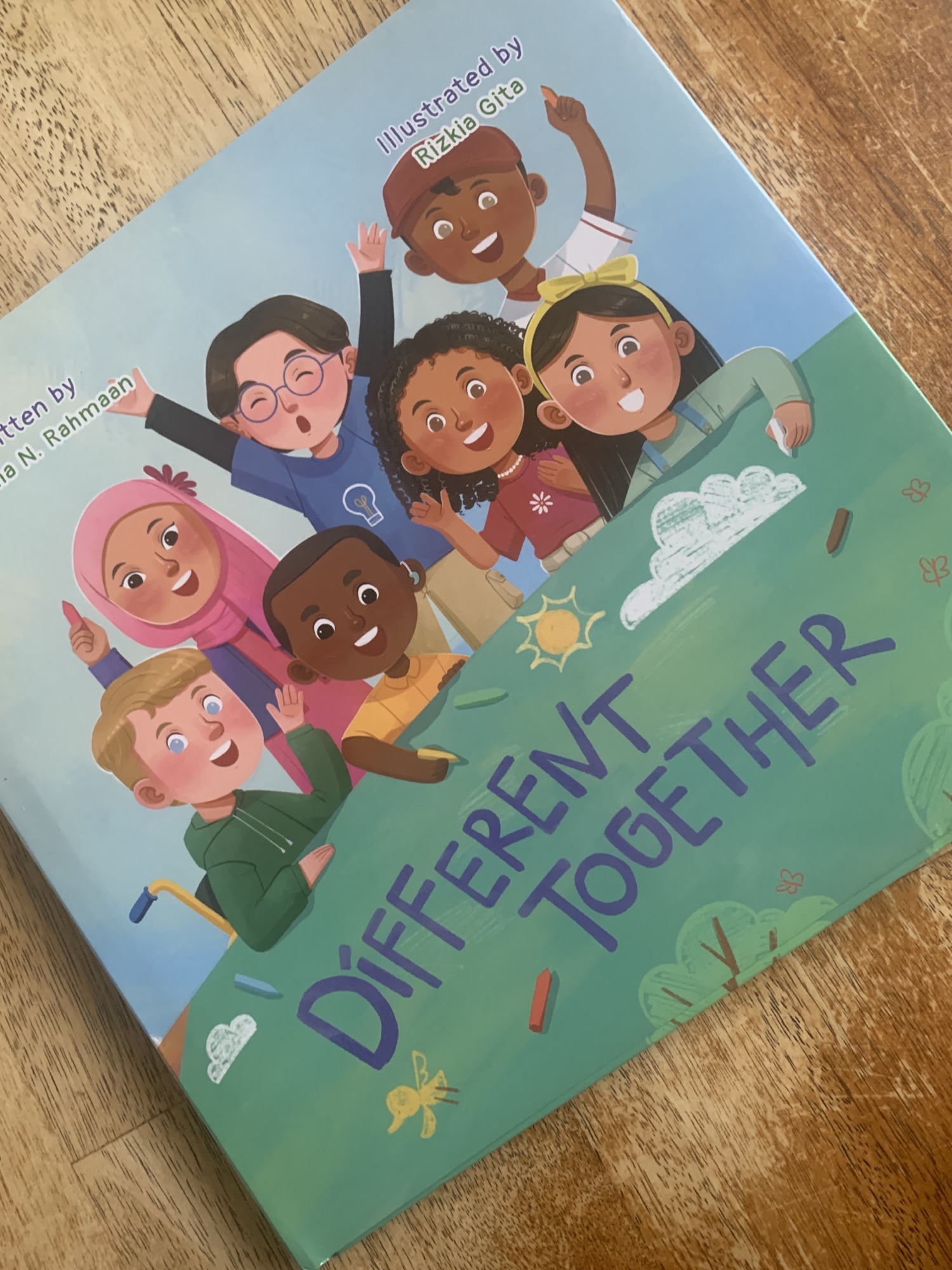
Different Together by Ayesha N. Rahmaan illustrated by Rizkia Gita

Standard
Different Together by Ayesha N. Rahmaan illustrated by Rizkia Gita

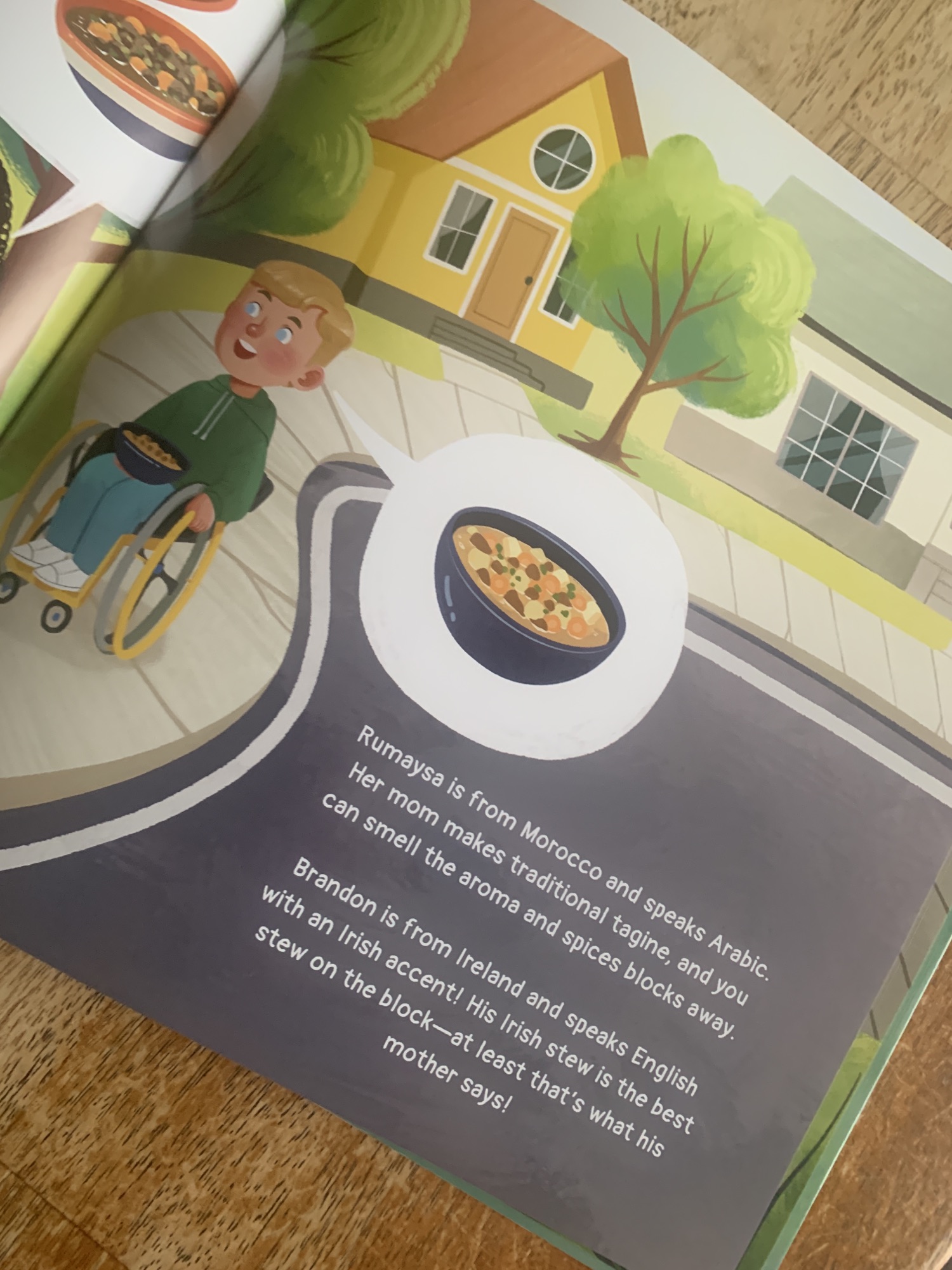
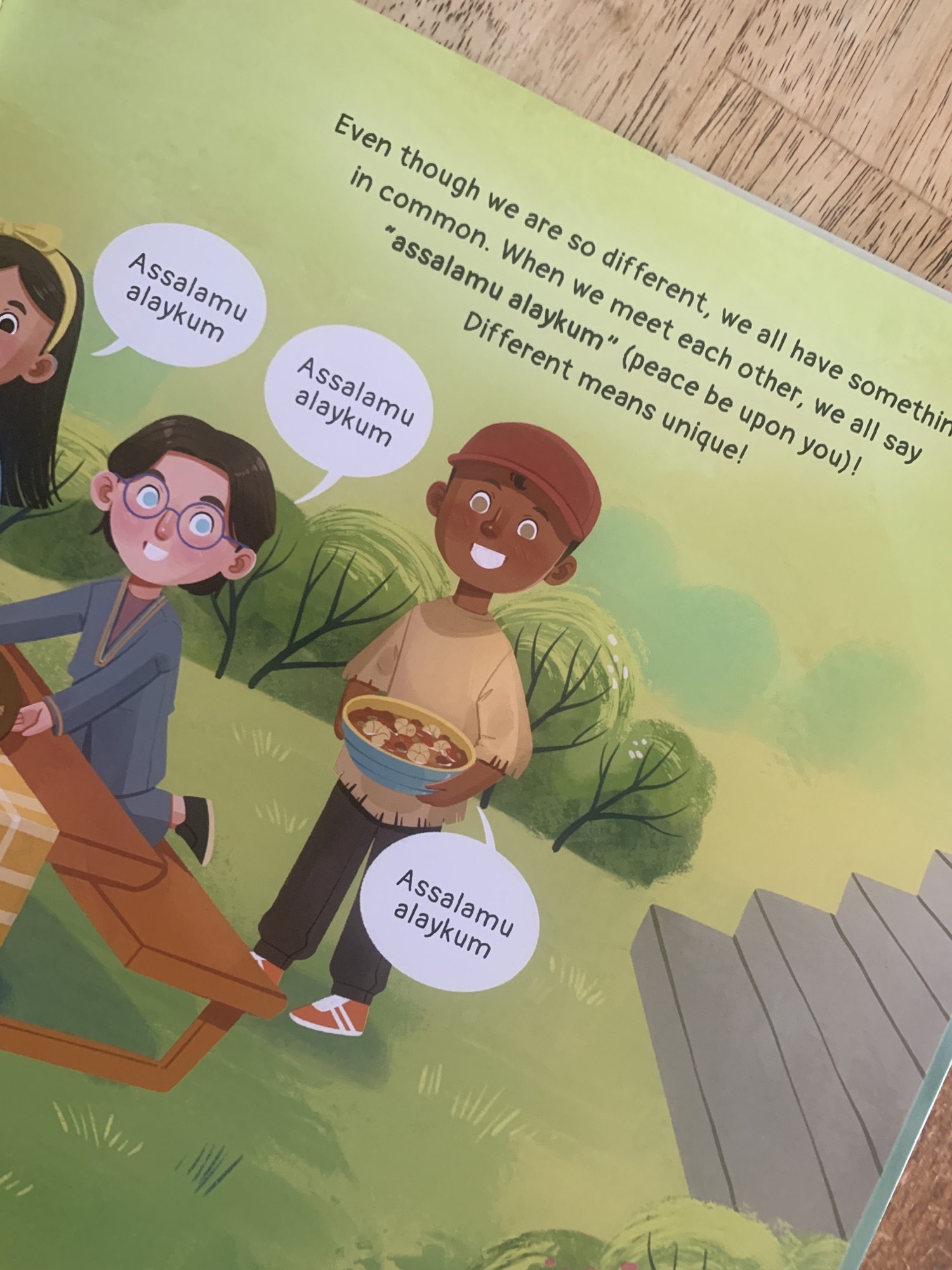
This 32 page large 10 x 10 hardback book explores how we are all different and unique, while also being the same too.  The illustrations and text present a nice way for children to learn that Allah swt created us all to be different in our appearances, what foods we like, how we dress, how we speak, but come together to all say Assalamu alaykum and stand foot-to-foot to pray.  Some of the refrains are a bit abrupt, and it really focuses a lot on physical descriptions and food, the target audience though of preschool to early elementary, will see themselves in the book, probably even a character that looks like them, and expand their understanding of al-Khaliq creating them all.


The book starts with an ayat from Surah al-Hujurat and then starts by asking the audience to imagine a world were everyone is the same.  It highlights that Allah created each of us starting with prophet Adam (as) to be just as we are, with different traits. From there, neighbors are introduced: their names, country of origin and favorite foods that all come together to make a table of sharing.

In school the students look different and play different, in the city the different building types are shown to come together, and in the masjid our hearts are in sync when we pray. The text concludes asking the reader to highlight five ways they are unique and a hadith in Arabic along with its English translation.

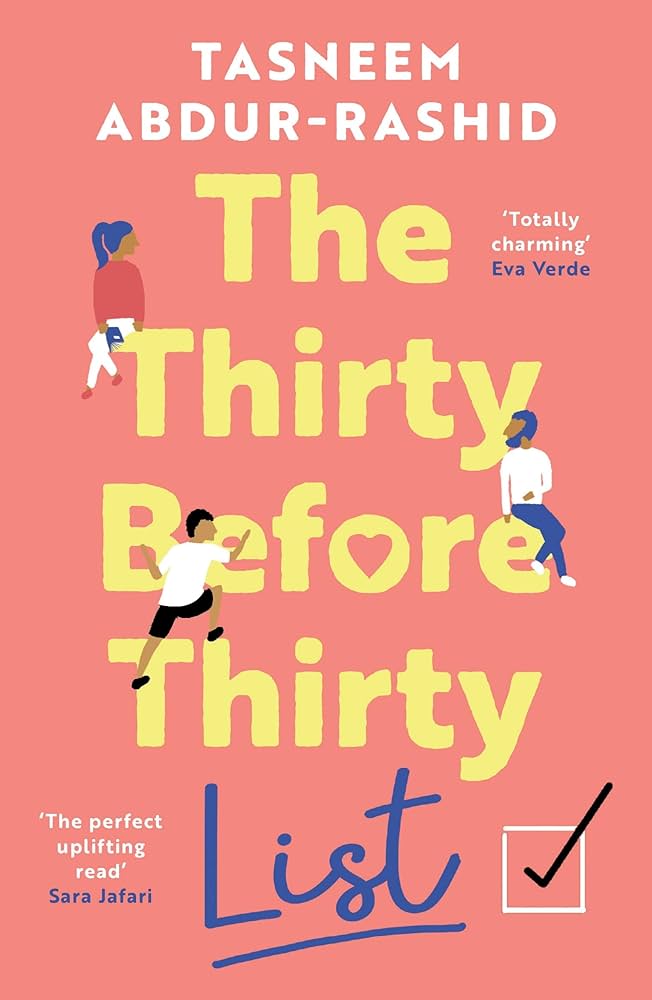
The Thirty Before Thirty List by Tasneem Abdur-Rashid

Standard
The Thirty Before Thirty List by Tasneem Abdur-Rashid

This is the second book I’ve read by the author and while I didn’t do a full review of the first (Finding Mr Perfectly Fine), I am going to do a full review of this one, because the book might not be “halal, halal” or intentionally Islam centered, but with a robust Muslim cast it stays impressively clean and there is a lot of Islam present.  I’m glad I bought a physical copy so my nieces or my daughter can pick it up and enjoy Rana’s growth and antics.  The book is nearly 400 pages long, but they fly by, and if you are 16 and up looking for a rom com style escape book this will fit the bill.  The only thing that really gave me pause is an early label the protagonist slaps on her self as “not being a devout Muslim.”  I get the point is to not let the stereotype of an arranged marriage and strict brown parents overshadow the initial impression of the book, but the author is a better writer than that early statement indicates.  As the story progresses you see her Islam IS very much part of her identity, her environment, her outlook, and the author shows it in relatable nuanced ways that the early “telling” was not needed.  Yes, the book has the protagonist and a different boy or two alone at times, and there is some hand holding and a few hugs, but the intention is always to find a spouse, and religious lines are usually clearly on the character’s radar.  There is some talk about mortgages, and a side Muslim character that has a girlfriend he keeps secret as they go on holiday together, but again, nothing obscene, or defensive, just realistic actions from contemporary characters viewing things their own way and doing the best they can.

SYNOPSIS:

Maya’s life is pretty predictable, she lives at home, goes to work, hangs out with her childhood friend on the weekend, and dodges any attempts to be set up for marriage.  Then one day on the tube a mysterious stranger, Noah, his leather bound notebook, and everyone else in her life moving forward, prompts her to open the notebook and copy his 30 before 30 list.  Adapting what doesn’t make sense at all for her life, she never peeks ahead, but rather takes one adventure at a time.  When people from different circles in her life start interacting, and Noah reenters her life, Maya will have decisions to make and a new list to commit to, her own.

WHY I LIKE IT:

I needed a diversion, I was going to be spending a few consecutive days in waiting rooms at hospitals and knew I’d need something light, easy to read, pause, and return to, and something to make me smile.  Maya is likeable, and her family and friends relatable.  Her Bangladeshi and British culture add depth and I was genuinely surprised and appreciative with how much Islam managed to find its way in to the plot and character arcs.

FLAGS:

Relationships outside of marriage, nude model, lying, hugs, hand holding.

TOOLS FOR LEADING THE DISCUSSION:

This would make a great adult, college, or even 12th grade book club selection, for just a fun book to laugh about and enjoy with friends.  It isn’t that deep, but there are threads that will hit, and to chat about it will bring friends closer together.

The Boldest White: A Story of Hijab and Community by Ibtikhaj Muhammad and S.K. Ali illustrated by Hatem Aly

Standard
The Boldest White: A Story of Hijab and Community by Ibtikhaj Muhammad and S.K. Ali illustrated by Hatem Aly

The third and final book in the standalone series is finally out and I absolutely love that Islam, salat, and the masjid are front and center. Faizah is once again brought to life through the incredible illustrations that provide all the emotional beats and make the book memorable.  The story though is only just ok, to be honest, it is clunky and disjointed.  I have read the book a half a dozen times to myself and twice aloud and I do not understand the Eid story line.  I doesn’t fit the themes of fitting in, being a leader, being bold, it just seemed to be there to motivate a white hijab being purchased, and it was very distracting to the cadence and continuity of the story. Every time Faizah is self reflecting on her fear, suddenly a conversation about Eid with a friend named Sophie disrupts the story. Even the refrain that “Bravery grows in your mind.  But its roots are in your heart,” sounds lovely, but is never explained or developed, so what are you to water it with? What are the right reasons?  I’m sure most will be fine with the concepts and presentation and not be bothered, but this book is an auto buy for Muslims and non Muslims alike, and while I appreciate the packaging, I wish the story itself was more, well “Bold.”

The book starts with Faizah going to Jummah with her mom and sister, and loving being part of the crowd, she then goes to fencing and loves being part of the crowd, “it feels right.  I feel right,” she says.  But then the coach calls her name and she starts to worry.  She doesn’t like when people stare at her, she worries she did something wrong. The coach has already reminded her to “saber first, then move forward,” so I’m not sure why she worries after if she did something wrong, it is a class, reminders and corrections are what happen in a class.

Then on Sunday, the trio is back at the masjid for salat before Asiya’s fencing lesson.  The coach asks Faizah if she wants to come in for extra practice before the tournament.  Faizah isn’t planning on participating in the tournament though and would rather think about Eid.  Thinking about getting together in the future with Sophie to pick out Eid clothes, is more fun than fencing.  The reader doesn’t know when Eid is, or why Faizah seemed to break into a day dream when asked about fencing.  Furthermore the reader doesn’t feel the worry of being in a competition because Faizah is not shown to be worried.

Later that night Asiya teaches Faizah the moves she learned and Faizah practices alone.  There is then a two page spread that I do not understand, on one page she is saying, “When no one is watching, I ‘m the best fencer in the world,” three lines later it says Even when others are watching, I can do it.  I can be the best.”  What happened in between? I get the following line, “but it’s hard to be my best when I have to stand out to do it,” but the the line in the middle makes no sense.  What is the point of the book if she can do it and knows it at the mid point?  And no, I’m not reading an arc, I checked out this copy from the library.

The family is back at the masjid on Friday and reassuring Faizah as they head to fencing, that she can do it even when people are watching, that bravery will come.  She hasn’t been nervous at class before, and hasn’t signed up for the tournament, so why is she suddenly uncomfortable, when at the start she loved fencing class as she felt she fit in.

Then it is Saturday, and Sophie finally comes, but not to prepare for Eid, just to discuss, how they will prepare for Eid.  At least now we know it will be next week. The next Friday, I know I feel like a calendar should have been included, it is fencing class again and Faizah is called up to demonstrate.  She finds her strength and she is shy, but realizes they are not just looking at her, but looking at what she can do.  She is leading, she is helping, she is being brave.

Finally it is Sunday, and Sophie and Faizah are at the hijab shop, and Faizah picks a white hijab because it matches the fencing clothes, and she is going to the tournament.

Yeah, sorry I spoiled it, I just really am sad that the book wasn’t as great as it could have been.  It connected the dots eventually, but not in a memorable way, and for the team responsible for this book, it really could and should have been amazing.

If You’re Not the One by Farah Naz Rishi

Standard
If You’re Not the One by Farah Naz Rishi

I suggest one reads my ENTIRE review of this book before deciding if it is right for you, because just the first few lines might signal that I liked this book, and honestly it was just ok, but I really liked parts of it. The protagonist is Muslim, it isn’t something that guides her view of the world or dictates her actions, but she is unapologetic, and it is not something she is grappling with. She prays, makes duas, it mentions a hadith, so I appreciate that it is there and always just below the surface. The “romance” might not be halal, halal, but it definitely isn’t raunchy and stays close to the line even when it crosses it. The male and female character are very close friends, and spend a lot of time alone together even before SPOILER there is hugging and a kiss, it is a rom-com after all. I loved the annotations, especially reading an e-version flipping to the protagonists commentary of her thoughts and then flipping back was easy and fun. I think my favorite line in a long time in the book is her translating rice to chawal (see images). My biggest frustration though, with the book is how close it mirrors the author’s biography, Sorry for the Inconvenience, which I read just over a month ago. Truly, it was like the biography was the book and this was the movie adaptation. Sure the younger brother was switched out for a younger sister, and this wasn’t as gritty or traumatic, but the romantic literary beats were all more or less the same: childhood betrothed, falling for a friend who made a bad first impression, dad being sick, parents and their on again off again divorce, medical diagnosis, it really is two versions of the same story, which meant I was never invested in the fictionalized characters, or on the edge of my seat to see what would happen next. When you have seen the behind the scenes inside scoop so to speak, it is hard to get on board with the faded carbon copy. Add in the consistent lack of communication, telling instead of showing, unlikability of the protagonist, and the non existent foundation of any of the relationships, and it made it hard to get lost in the fluff of the moment.


Side note: I had a whole paragraph rant about the cover, but when I went to post my review on Goodreads (still banned from Amazon) I saw that there is a newer cover with Marlow wearing yellow crocs. I have no idea why the illustrator and publisher would have arcs with the male lead in flip flops, but I think by now it is common knowledge there is often a lack of communication between authors and illustrators. sigh.


SYNOPSIS:
Anisa is in college, she has worked hard to get in to the all girl’s school near where her almost fiancé Isaac is already enrolled. When she takes a class on Isaac’s campus she meets Marlow, who makes a poor first impression on the very “perfect” Anisa. When Marlow and Anisa get paired up for a class paper, Marlow also offers his services as a “love coach” to help Anisa reconnect with a drifting away Isaac. The more time Anisa and Marlow spend together, and the more Anisa learns about Isaac , the more she ultimately learns about herself and what she wants out of a partner.


WHY I LIKE IT: (SPOILERS)
I’ve read a few of the author’s books, so I know she can write, which irritated me even more that this book felt so flat. Anisa and Isaac have been “together” for over six years, but know nothing about each other, don’t talk or text, and as much as the book wants to make it seem like it is an all of the sudden thing, it provides no real tangible suggestion that they have ever had any sort of connection. So why did they decide to be potentially engaged???? All the parents are on board, but how did the two of them set this into motion? With the exception of Isaac visiting her one late night before he went to school, there is so little for the reader to be emotionally invested in. Anisa has terrible communication with every character in the book, not just Isaac, even with Marlow and her family, the side characters all keep in touch just fine, and it is never addressed as a quirk, it just is accepted. If your dad was sick, or your parents divorcing, wouldn’t you be texting them periodically, or non stop? And text between characters are shown on the page, so how is Anisa texting Marlow throughout the 352 pages, but then goes MIA the last 20? It didn’t work for me clearly.

Additionally, I was so tired about hearing how perfect Anisa is, when it never seemed to show it, sure the duplicity with her outward appearance and home appearance was well done, but it never really shows up in any other facet of her life. She is unorganized, has few friends, doesn’t seem to be a very present daughter and sister, the repetitive telling and lack of showing, gave the book no foundation. I know romance-y type books often have to fudge common sense at times, but with no foundation at all, it was hard to be invested in any twists or swooning gestures. I think I just didn’t really like Anisa, and I weirdly feel guilty about it, because she so closes mirrors the author, and I liked the author’s self portrayal in her earlier memoir.


FLAGS:
Close male/female friendships, hugging, kissing, lying, “cheating,” talk of titillating role playing video games (otome) not details so much as shaming and teasing about Anisa playing them (the word porn is tossed in a few times).

TOOLS FOR LEADING THE DISCUSSION:
I think I’d shelve this book in an Islamic school library for high school students. I don’t think I would promote it, but I think those romance loving high school girls will enjoy and be able to handle this story. It won’t work for a book club, but it does make clear that Anisa “dates” with intent to marry, there is reassurance that she wants to marry a Muslim, that Marlow has been reading about Islam, but that Anisa isn’t going to force him, and that societal expectations and appearances aren’t impossible to push back on- which I think are good considerations for 16 and up readers to see fleshed out.

Academy Story by Naim Hammami

Standard
Academy Story by Naim Hammami

I dnfed this elementary aged book a few months ago, and pulled it back out feeling obligated that the publisher sent it to me and, I ought to read it.  So, I did, and it is not well-written, but since I read it, I’m writing a review, and hopefully sparing y’all the same frustration.  The cover is pretty cool, so is the idea, and the Islam is centralized and prioritized, but the story reads like an introduction, yes a 152 page introduction.  It repeats itself so often, it contradicts itself within the repeated ideas, and then moves forward at a snails place before ending.  I think it wanted to end on a cliff hanger, but because so little is accomplished up until that point, it feels like it doesn’t end at a climax, but rather the start of the action, which is irritating.  It feels like the author started telling a story orally about a family in a kingdom that when they finish primary school either continue to secondary school or find themselves in a secret academy, and no one knows how they are chosen, or what the academy is like; someone heard that much and told the author to write a book, and they did.  There is no character development, drawing the reader in, suspense, imaginative language, or refinement, it reads rough and I don’t know if it is because it is translated, or because there was never much to work with, but if you have seen this book, and were excited to see an Islam centered adventure story, sadly I’d say pass, it misses the mark.

SYNOPSIS:

The book starts with centralizing three siblings, Fatima, Suhayl, and Harun.  Fatima is the oldest and is a second mother serving her family, cooking, and apparently enjoys reading, she was not chosen for the Academy and is still bothered by it.  Suhayl is the protagonist who hates school, and Harun is the little brother who is still in primary school.  The first few chapters are the repetitive circling of anticipation and excitement for finding out who gets in to the Academy at home and talking about what little is known about the Academy, and why it is important as today is the day Suhayl will find out.  Why they had no idea about the Academy before breakfast on the day he is going to find out, is beyond me, the world building was an info dump, repeated in the following chapter when Suhayl is now at school.  His friends all discuss that they are going to find out about the Academy, only then to contradict that whole build up and wonder IF they will find out about the Academy today.  We meet the friends, find out some of them have parents that went to the Academy, but do not talk about, as they are not allowed.  The reader is not told what the benefits of having gone to the academy are either, outside of knowing all educators have been trained there.  The book then says how Suhayl doesn’t have friends and proceeds to discuss how close he and his friends are.  When the assembly starts the class learns there is no Academy announcement and no end of the year field trip, instead they will have to come up with a challenge, that is optional, to do over the school holidays.  After rounds of voting and a weird power flex, a business challenge with rules is established and the winner gets to leave school if they want. Suhayl is determined to win, he and his buddy, Yusuf, decide to make fans using the Venturi Effect to sell at their stall and try and make the most profit and win.

WHY I LIKE IT:

I like the premise, the artwork, the Muslim characters, I even like the business, life-lessons and science explanation of the fan.  I don’t understand how it makes Suhayl’s fan more effective than a regular fan, but the book has bigger problems. I know for many author’s writing is figuring it out or making it up as you go, so I realize the ridiculousness of saying that this book feels like the book is being made up on the spot. It is writing quality that allows readers to get lost in a story, enjoy the words, and connect to the characters knowing that the author has control of a story and taken care of the required elements of a completed book.  The rules of the challenge and how they were to finalize the idea, seemed so scattered, that combined with the weak writing, and repetitive premise building, made the intrigue of a whispered about Academy seem like a completely separate story.

Additionally, I don’t understand the stressing of the three siblings, The book is only about one, Suhayl, and his friends, yet each have a “character profile sheet,” but they are not all together at the start, or even the end.  One profile sheet is at the end of chapter 2, one at the end of chapter 4, and then the third at the end of chapter 6.  If the point is that as the series progresses you will see the sibling more, and it is meant to garner interest, the choice assumed that readers will stick around for a series, and I don’t think the book at hand, will pull readers in to see how the series pans out.

FLAGS:
Secrets, business deception

TOOLS FOR LEADING THE DISCUSSION:

If the book were donated I would shelve it, but I would not seek it out to shelve.

Amir and the Jinn Princess by M.T. Khan

Standard
Amir and the Jinn Princess by M.T. Khan

amir

This 304 page middle grade fantasy book is a quick fun read.  There is no religion in this Muslim authored book, jinn are not portrayed as creatures from Islamic doctrine, and with the exception of Quranic decorations hanging in a room and Zam Zam water being mentioned, once each, in passing, there is nothing hinting or signaling religion.  Even the jinn come across as characters who just happen to be jinn, who have control over fire and live in an alternate world, the book uses their fantasy elements to create an added layer, but the heart of the story is making choices, doing what’s right, being a good friend, and changing injustice when you can. This is a companion book to Nura and the Immortal Palace, and even with the lacking religion, I think I enjoyed this book more.  The plot is clearer, the characters are relatable, the thread of the missing mother is emotional, and the commentary on corporations and labor practices are awesome to see in a middle grade book.  

SYNOPSIS:
Amir is wealthy, really wealthy, and arrogant, and unlikeable, and yet, the over the top framing of him being all these things, makes even the target audience reader realize, that he is also a 12-year-old little boy who is grieving his missing mother, longing for friends, wanting to be seen in his competitive family, and ultimately smarter and more emotionally intelligent than he will ever force himself to admit.  Until, a cat, or rather a jinn princess in the shape of a cat, shakes up his world, by convincing him to come to hers.

Shamsa strikes a deal with Amir, she will help him look for his mother, if he helps her battle against her siblings to be the next heir of the Kagra Kingdom.  Amir knows she is a trickster, it is her nature, but he wants, no needs, to find his mother, so he is willing to pose as her slave and do her bidding.  There are three tasks to test the future heirs physicality, artistry, and diplomacy, and the irony that Amir does not want to be heir to his own fortune, while helping Shamsa claim hers, is not lost on him and will in fact force him to make choices about who he wants to be and what he wants to stand for.

WHY I LIKE IT:
I like that the book discusses monopolies and business and corporations and systemic gatekeeping.  It stays on level and articulates the points it wants the reader to explore with Amir, but does so without taking away from the story.  Also the ability to see all that Amir has, because he is wealthy, also allows the reader to see what he is also missing, and this is done with a little more subtly, some self-awareness, and some quality writing which results in making Amir a little more relatable.

I do wish there was some Islam, jinn are Islamic based and to not have any signaling seems a bit lacking.  Perhaps it kept it so that accuracy or rep was not a factor, I don’t know, but when Amir says that he thought only the uneducated believe in such creatures, it rubbed me the wrong way, just like when he makes a comment that, “those are the kinds of games God like to play with me.” The lines are minor, but when that is the only religion mentioned and it is done in a negative trivial, dismissive way, they carry more weight than perhaps intended.

I like that the characters and plot are solid.  It doesn’t feel like Amir is free-falling through a crazy chaotic world, there is direction and purpose.  There really isn’t a lot of world building or even Pakistani culture, it really is about the characters and their arc of growth and coming in to their own.

FLAGS:

Fantasy, jinn, lying, sneaking, death, abuse, manipulation, plotting, casinos, fears of water, abandonment, abuse.

TOOLS FOR LEADING THE DISCUSSION:
Probably wouldn’t do it as a book club, there are teachable moments and concepts that would be fun to discuss perhaps with economic or business tie-ins, but I don’t know that there is that much to discuss outside of what the book offers.  I do plan to shelve this though, so my own kids have easy access to pick it up and read and hope teachers, librarians, and parents will as well.


Farrah Noorzad and the Ring of Fate by Deeba Zargarpur

Standard
Farrah Noorzad and the Ring of Fate by Deeba Zargarpur

img_5607-1

This 323 page middle grade fantasy written by a Muslim author features Muslim characters in a jinn filled adventure, but is not very Islam filled.  Jinn are widely accepted these days in western literature even by non Muslims, so it doesn’t hold the Islamic rep weight it perhaps once did, and while the characters mention prayer once or twice, they are never shown to rely on faith, practice it, or have it be a central part of their identity.  None-the-less, at times I truly could not put the book down, the fast paced adventure coupled with the compelling characters really hooked me and pulled me in, until it didn’t.  I’m not entirely sure of why the rapid unravel of my connection to the book happened, but I’m guessing it is because of A: I struggle with fantasy. B: the plot was really kind of weak. C: the “Alice in Wonderland” style world building is not a style I enjoy. D: So much of the tension in the book is predicated on conversations not happening because the time is not right, but ultimately I’m pretty sure it is E: A little bit of all of the above.  The book is fun, I think kids will like it even though so much wasn’t clarified, resolved, and seemed unnecessary to me, I’m not the target audience, and I recognize that.  It is worth noting that the premise of the book stems quite heavily on the fact that Farrah is a “harami” as it is called, she is a child born out of wedlock. The details of the parents’ relationship prior to her birth are glaringly absent, but that stigma affects her relationships and is central to the story.

SYNOPSIS:

Farrah only sees her father one day a year on her birthday, Yalda, the winter solstice.  While hiking and climbing her father presents her with a gift, a ring, and when she hears a voice and makes a wish, her world will never be the same.  Her father, who she thought was a judge in the UAE, is actually a jinn king, who is now trapped in the ring that Farrah wished upon.  When he is imprisoned, a jinn boy named Idris is freed and together the two of them set out to free her father and get some answers.  They journey to the jinn world where they meet the other jinn kings and learn they are next to be imprisoned by the ring. While there they meet Farrah’s half brother Yaseen, who joins Farrah and Yaseen before returning to Earth, picking up Farrah’s human friend Arzu, and heading to battle Azar in the underworld.  New friends, new worlds, and new perspectives give readers a lot of reasons to cheer for Farrah and her found family as they take on jinns and try to make sense of it all.

WHY I LIKE IT:

I like the main characters: Farrah, Yaseen, Idris and Arzu.  I need more answers and more development of Farrah’s mom, dad, their relationship, Yaseen’s mom, Idris’s parents and situation, though a lot was resolved plot wise in the last 19 pages, the unresolved character arcs nagged at me.  I’m guessing there is going to be a second book, so perhaps some insights will come, but for as enjoyable as the main character’s voice is in understanding her own motives, and those of her friends, the lack of development for the remaining characters was quite a contrast.

I felt that the plot was a little weak as well, why did they go to the jinn world, just to return, whey did they seek the protection charms but then abandon them, why was Idris imprisoned in the first place, even if they got the ring back at the mall what were they going to do with it, what was the answer to the first riddle, who was making the rules about the riddles and the trades? I’m not saying some of that wasn’t answered and I just didn’t get it, but it is a sample albeit a small sample of all the unanswered questions I had about what was going on, at all times.

I’m biased against Alice in Wonderland type stories where the reader is just taken from one climax to the next without any world building showing or hinting at why this is now happening.  Like falling down a rabbit hole, it seemed like each event was building the fantasy world for Farrah and the reader in real time and I would have like a little grounding.  It worked for a large part of the book, but I think not understanding enough about the jinn and jinn world, is what made the climax fall a little short for me unfortunately.

I needed people to have conversations, I know when characters are fighting shadow creatures, they can’t explain their family dynamics, but when the same literary device happens again and again, and the characters never have conversations, never get answers, it gets a little frustrating for the adult reader reading a middle grade book, i.e. me.  Maybe kids don’t care, but mom and dad and the grandparents all needed to have a conversation, and that sadly never came.

FLAGS:

Lying, poisoning, entrapment, fighting, mention of being born out of wedlock, sneaking out, near death experiences, stealing.

TOOLS FOR LEADING THE DISCUSSION:

I don’t think I understand the book well enough to teach it, but I would absolutely have it on a classroom, library, and home shelf.

Leena Mo, CEO by Deena Shakir illustrated by Nez Riaz

Standard
Leena Mo, CEO by Deena Shakir illustrated by Nez Riaz

img_5445-1

For ages four to eight this 40 page picture book really introduces great concepts of leadership, business, support systems, and dreaming big.  Before Leena Mo, leads a company though, she thinks up ideas to solve a problem, she turns her ideas into a plan, tests her hypothesis with her prototype, and takes her invention to the next step when demand grows.  Investors, employees, storage, sales, Leena Mo has not only created a product and a company, but she is leading a business, and inspiring others, even back in her Mama’s home in Iraq. With a Mama wearing hijab, a singular mashallah in the text, and the Arabic word for “my dream” Helmy being what she names her snow clearing robot, children everywhere will be inspired and encouraged to think a little bigger than they may have done before.

I love that this business concept is brought down to an early elementary age (and even younger), in a way that they not only will understand, but also be inspired by.  Younger kids might not get the steps, but the fun engaging illustrations, and simple text builds to show that the idea is also growing, and even four and five year olds will grasp that this is exciting.  There are books about science, inventions, even increasingly more about financial literacy, so this is in many ways a next step, that touches on those concepts, but really focuses on the investors, growth and leadership.  The story and concepts weave together, and that culture finds a place as well, is a testament to the quality of this solid, joyful OWN voice read.

The book starts with Leena playing outside in the snow with her friends, when her Mama asks her to shovel before it gets dark.  Leena hates shoveling.  She finds it worse than raking leaves, doing the dishes, and even taking out the garbage.  Instead of complaining though, she starts to dream up an idea of something that would make clearing the snow easier.  She decides on a robot, and gets to work designing and building and testing.

Once it works, a neighbor, Miss Irma, asks to borrow Helmy, and when she returns it, the rest of the neighborhood wants to know where they can purchase one of their own.  When Miss Irma invests in Leena and her team, the next phase begins and as parts turn into products, and equations determine cost, the team of Leena, Olivia, and Lily starts rolling out Helmies.

The sweet ending of inspiring others, will also hopefully inspire readers to think bigger, dream bigger, and recognize the role support,  teamwork, and leadership all play in bringing ideas to life.

The book can be preordered and soon ordered anywhere and everywhere books are sold.