Tag Archives: culture

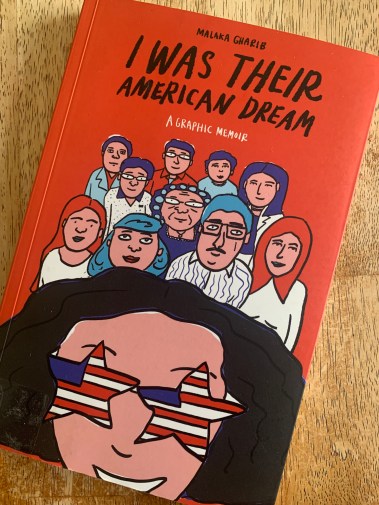
I Was Their American Dream: A Graphic Memoir by Malaka Gharib

Standard
I Was Their American Dream: A Graphic Memoir by Malaka Gharib

img_7800

I was hesitant to read the book, afraid it would pit the author’s two cultures (Egyptian and Filipino) and faiths (Catholic and Muslim) that her parents identified with against each other.  Raised as the daughter of immigrants from very different backgrounds in California I was very pleasantly surprised that the book leads with heart and positivity for the unique, yet universal feelings she experienced in her life.  The short 156 page red, white, and blue filled pages are funny, poignant, and reflective, that I think high school readers and up will enjoy spending time in Cerritos and Egypt through the eyes of Malaka.  It is easy to say that you can’t be Muslim and Catholic, but she doesn’t opine on the right or wrong of it in large terms, she discusses her life and her own situation.  As a teacher I would see students that would attend Islamic school five days a week and then go to church on Sundays, whether you agree with the choices this author/character makes is not what I intend to review, it is her life, but rather the manner in which it is shared.  There are many kids out there from “conflicting” backgrounds, and to see someone take the love and benefits offered to forge their own path in creating their own American dream, was a nice twist on the immigrant identity finding narrative.

SYNOPSIS:

The book starts with introductions to the characters, her family members that influence her, and then begins the tales of what brought her Filipino mother and Egyptian father to America, how they met, married, started a family, and divorced. Malaka exists outside her family in school, balancing her heritage and coming of age.  Raised during the school year by her mother and extended Filipino family, she spends summers in Egypt where her father resides with his new wife and children.  Coming of age as an immigrant, balancing cultures, religions, school, and dreams, the book concludes with her marrying a white Southerner and adding to the mix.

WHY I LIKE IT:

Even though she identifies more as Filipino American and goes to Catholic school, there is a fair amount of Islam and Egyptian culture included in the book.  I love that she loves her step mom and step siblings and finds beauty in Islam, learns to pray, read Quran, and mentions her love of Prophet Muhammad saw.  Sure as an Islamic school librarian, I wish she chose Islam, lived it and centered it in her life, but this is not a character, this is a real person, and to see her lovingly showing the goodness in Islam and how it has positively influenced her, is nice to see nonetheless.  There are a few storylines I didn’t quite understand, the skateboarding in Egypt a big one, but the quick pace of her narrative life-story flows well and is easily consumable.  Often stories like this are overly dragged down by dated pop cultural references and over criticizing “othering” paradigms, but this book contains enough to keep it grounded without it alienating contemporary readers.

FLAGS:

Stereotypes, lying, relationships, periods, music, dancing, nothing really stands out, there might have been some language, I read it a few days ago and honestly don’t recall anything overly problematic, but content wise it is a mature teenage read with retrospection and marriage being a part of the narrative.

TOOLS FOR LEADING THE DISCUSSION:
I don’t know that I would shelve or teach this book, but I think it is one to file away in my head for people I might encounter looking for a book about blended faiths and cultures benefitting from the many worlds they have one foot in and one foot out of, and those ultimately looking for a place to see their experiences mirrored.

I found my copy of this book at my local public library and it is also available here from Amazon.

The Kingdom Over the Sea by Zohra Nabi

Standard
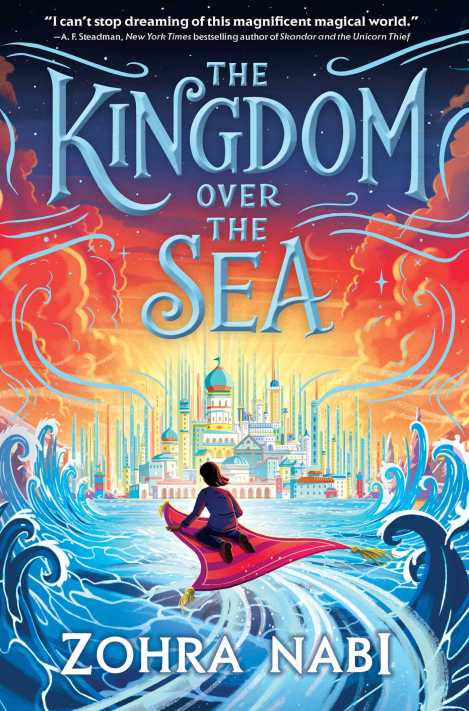
The Kingdom Over the Sea by Zohra Nabi

kigdom

This 336 page middle grade fantasy book had a lot of promise for me, but ultimately fell a little flat.  The protagonist was likeable, there was emotion, the story was compelling, and I know it is widely said that debut novels tend to be a little weak or be underdeveloped or having pacing problems, yet I hesitate these days to use this as an excuse.  I’ve been around the industry a few years and it seems many author’s debut novel, is not, in fact, the first book they’ve written or even the first book they’ve “sold.” Books are written and finalized years before they are released for some genres particularly of late, so I’m trying not to let myself get caught up in the author’s writing journey (I’m sure I’m all sorts of wrong about what I think it would be anyway), and just review the book in front of me. This book has no religion, and I don’t know if the author identifies as Muslim.  There are a hodgepodge of Arab and Desi cultural references in the characters’ names, and in the sprinkling in of salwar qamis, abaya, head scarf, sambusak, and there is a ma’a salama at one point along with the presence of jinn (not religiously referenced). There is also mention of medicinal wine, magic, a lady who has a crush on another lady in her youth, music, and dancing. The book held my interest as I wanted to see how it unraveled, and I recognize that there is a book two, so some of my thoughts might be premature, but I struggled with the premise of the protagonist trying to understand the journey her deceased mother has sent her on, and how the person she was supposed to find for the answers simply won’t talk, even though the two are living together.  It made the story really drag in places and seem underdeveloped.  The world building, the backstories, the adventure at hand, really is imaginative, but the development of the relationships in the story are absolutely non existent, and the book overall suffers because of it. Also the ease in which rising action is resolved is often the kids just throwing an idea out and it being right.  I read and review through a critical lens and many recent middle grade fantasy books have been absolutely incredible, perhaps it isn’t fair to compare, but this book just came up short for me in developing memorable characters and plot, even though all the elements were present, capitalizing on bringing it all together stayed just out of reach unfortunately.

SYNOPSIS:

Yara’s mother has died and when she finds a letter with instructions of what to do and where to go should this moment arrive, she decides to dodge her social worker and journey to a world of magic across the sea.  Unsure of her own background, she thinks she might be Iraqi, but doesn’t speak Arabic, she longs to find a place to belong, and when she arrives in Zehaira and hears the language of her mother, she is hopeful that this Leyla Khatoun, who lives in the third to last house on Istehar Way, will provide her with answers. But alas Leyla is not there, the Sultan’s alchemists are, and Yara is now on the run in a foreign land.  Help finds her and with a little magic she finds Leyla.  Leyla begrudgingly takes her in, but refuses her any insight into her past, her relationship with her mother, or why the letter directed Yara to her.  As the alchemists poison the sorcerers, Leyla and some other kids (friends?) have to find a way to save the settlement and magic in the land.

WHY I LIKE IT:

Yara as a character is likeable, she is plucky, resourceful, determined, and despite her circumstance does not want or need pity or handouts.  She advocates for animals, the poor, is a grassroots organizer, and unapologetic in how she carries herself.  I love that she isn’t whiney or helpless, and that she trusts herself to problem solve and isn’t afraid to think outside the box, while maintaining her kindness and appreciation for those around her.

As someone who doesn’t like Alice in Wonderland type stories, this book grounded the world building in an easily consumable way, so even though it is Yara leaving the UK and stepping into a new world, the functioning of the new world didn’t feel random or surprising.  While this was beneficial for someone like me, it made the focus of the story more on the characters’ relationships in enhancing the plot, and the book wasn’t strong in showing those connections.  Yara meets a map maker for a moment and a cat, and months later recalls the cat and the map maker by name and face.  A boy, Rafi, who is also studying magic and Yara don’t get along, yet are friends because it says so, the book doesn’t show us their bond.  Rafi meets some great uncle and the great uncle is painfully underdeveloped (along with his “friend”) and the tangent weak in reinforcing the major climax. The relationship between Yara and Leyla is the center of the story and so glossed over, there is no tangible connection, or cathartic release when details emerge, it was very disappointing to say the least. Yara and Ajal, the jinn, what is that relationship even, she frees him à la Aladdin freeing the Genie, but they are friends, not friends, he looks out for her, but doesn’t like her, the telling and the showing don’t align.  Even Yara’s relationship with the settlement and the inhabitants is disconnected from the plot of saving magic.  The climax is weak because we, the reader, don’t feel any connection to any magical folk.  The emotion of the mother dying at the beginning and the slight retrospection (I’m not going to spoil it) of the mother’s love at the end, was developed and made me invested in Yara, that same energy did not present itself, sadly, in any other relationships in the book.


FLAGS:

Death, loss, poison, imprisonment, magic, mention of medicinal wine, one line mention of a female character liking another female character as more than a friend, dancing, singing, jinn, torture, male and female friendships, destruction, lying, sneaking.

TOOLS FOR LEADING THE DISCUSSION:

I wouldn’t use this as a book club selection and wouldn’t go out of my way to shelve it in the school library or classroom library.  I will probably read the second book though and see where the series goes and reevaluate. I will also probably read future works from the author as the sparks of good story telling and writing definitely show promise for the author even though this particularly book wasn’t “magical” for me.


Egyptian Lullaby by Zeena M. Pliska illustrated by Hatem Aly

Standard
Egyptian Lullaby by Zeena M. Pliska illustrated by Hatem Aly

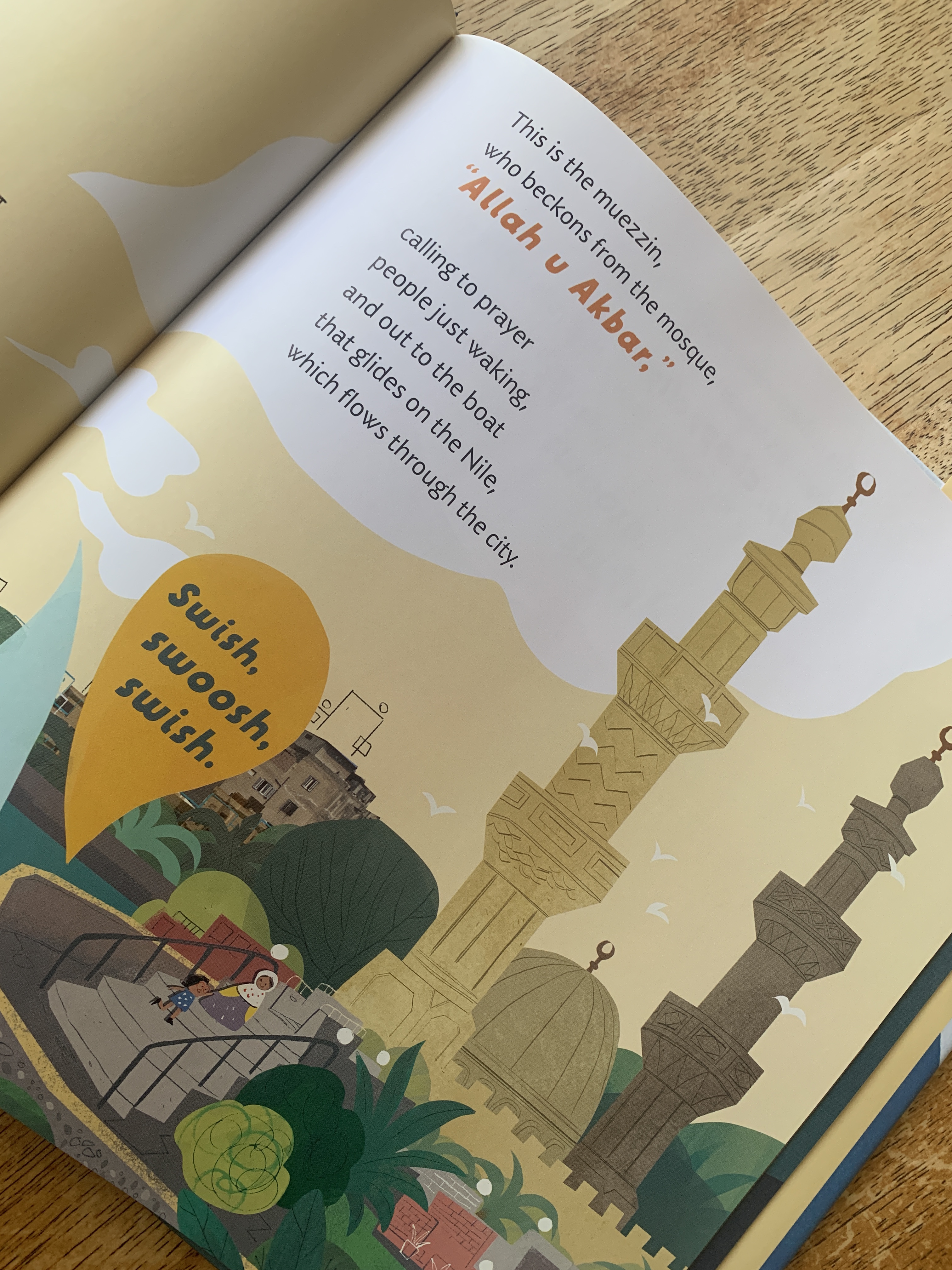
There was a time in college when my friends and I would gift each other Cinderella retellings and versions from all over the world, that was nearly 20 years ago, and I haven’t thought much of it, until this book reminded again of “This is the House that Jack Built.” Having just read and reviewed “The Masjid that Kamal Loves” which is structed similarly, I can confidently say forget Cinderella, I’m loving this new trend, of a repetitive layered story conveying love and excitement and joy to little readers in such an engaging way. This book has more of a story than the original and shows relationships and longing, even though it is primarily a love letter to Cairo.  The swapping out in some verses for Arabic words and English translations, the sound affects and the connections really elevate the OWN voice details in the text and make the book an absolute treat to read and share even for those of us who are not Egyptian and have never visited.  The Auntie who visits wears hijab, the muezzin calling Allah u Akbar is a repeated refrain, their are numerous illustrations of women in hijab and a masjid is shown repeatedly throughout allowing Muslims everywhere to feel seen with this culturally specific story.  The Glossary with the Arabic script and pronunciation guides and Notes from the Author and Illustrator really radiate with love and invite the reader to participate in the celebration on the pages.  I have no doubt children (and their parents) three and up everywhere will fall in love with the 40 page story and delightful illustrations.

Auntie Fatma comes to visit a little girl’s family from Egypt and brings sahlab and changes for two weeks to the home.  Arabic is spoken, and a nightly lullaby of the sounds of Cairo are among the beloved additions to connect the little girl to her Auntie and her culture.

The lullaby begins with the sound of the Nile, the boats floating through the city, the athan calling to prayer, the carts on the streets, the traffic.  The halawa ya battekh, swish, swoosh, swish, Allah u Akbar, beep honk toot, all add layers to the bustle of the city as the little girls memories of the sights and sounds of Egypt soothe her to sleep.  When it is time for Auntie to return the little girl’s sadness is palpable, but Auntie finds a way to reassure her and all those that have drunk from the Nile and long to return.

It is hard to say if the text adds to the illustrations or the illustrations to the story, both combine to make this book impossible to read without smiling.  I love that the mosque is shown in the daytime and at night implying that the call to prayer is not a one time thing without articulating that Muslims pray five times a day. I don’t know if the author identifies as Muslim or if the inclusion of the athan and Allah u Akbar is just an environmental reality of Egyptian daily life and thus featured.  The illustrator could have very well added the hijabs on his own as there is nothing religious or explanatory in the text.  Perhaps it is worth noting that there is a dog in the family’s home that seems to sleep with the little girl.  The book is a cultural heartfelt portrayal, and that Islam is prominently featured so beautifully made for a lovely surprise.

I hope you will consider preordering the book here, requesting it at your library, and sharing it on classroom and home bookshelves.  Happy Reading!

The Masjid Kamal Loves by Ashley Fraklin illustrated by Aaliya Jaleel

Standard
The Masjid Kamal Loves by Ashley Fraklin illustrated by Aaliya Jaleel

img_7811

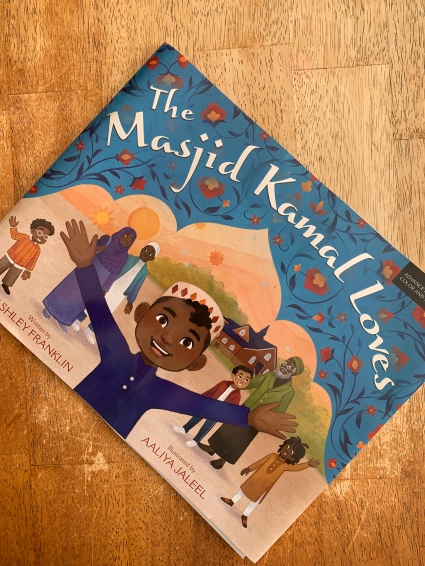
I don’t normally post about upcoming releases this far in advance (2.5 months), but I am hoping that if I share the link for preorders, I just might help in signaling to the traditional publishing world that books like this are so so so important and that we will support unapologetic, well written, Muslim centered, Muslim and Black joy featured books with our purchasing power.  This book is incredible for toddlers to early elementary in its “This is the House that Jack Built” format.  Muslim kids will giggle with excitement as they see themselves happy to see their friends at Jumu’ah, flinging shoes a little too hard before entering the musallah, splashing a bit when making wudu, playing while helping put out the prayer rugs, and getting a little wiggly or tired during the khutbah.  The happiness and love radiates off the pictures and through the text that even non Muslim readers will feel our connection to our Masjids and the prayers that occur within.  Muslim authored, Muslim illustrated, masjid not mosque, and a beautiful Author’s Note, makes this book a must have on every shelf where young children need books that mirror their experiences and provide windows into the beauty of Islam.

img_7814

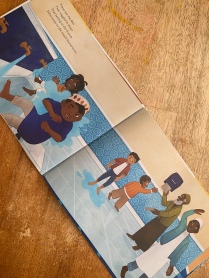
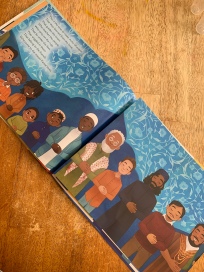
The book starts out describing Kamal’s smile and offering the reason for such joy as being Jumu’ah at the masjid. It then starts with describing the masjid and all that is contained with the lines adding on the refrain of “the masjid Kamal loves.”  The friends, the shoes, the feet, the rugs, etc.. Terms such as imam, ummah, salaam are in the text and the illustrations show wudu, salat, khutbah, conveying a Jumu’ah experience.

img_7813

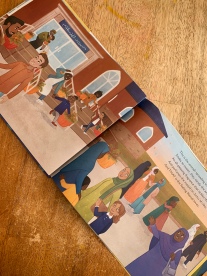
Each page is brightly illustrated across horizontal orientated scenes.  The expressions on the kids faces, are engaging and smile inducing and the lyrical text has a rhythm and strength that makes you feel proud to also have a masjid to love like Kamal.

img_7816

I have an arc, but have preordered a copy for myself here and hope you will do the same. Please also request your public libraries to order it, and if they have already you can place the book on hold, inshaAllah little steps to show support.

Grounded: A Novel by Aisha Saeed, Huda Al-Marashi, Jamilah Thompkins Bigelow and S.K. Ali

Standard
Grounded: A Novel by Aisha Saeed, Huda Al-Marashi, Jamilah Thompkins Bigelow and S.K. Ali

Over the years I’ve read to a lot of kids, with a lot of kids, discussed books in classrooms, and in book clubs, so when reviewing I often share what kids think or what I imagine kids will think, and I usually acknowledge when I’m being overly critical as a reviewer, but this book I will tell you, I did not read through the intended middle grade lens, I read it as a 42 year old seasoned reader.  I know this because I cried during the entire second half, and the book is not sad.  It is fast paced, joyful and adventure filled.  I cried at the ownership of identity, the pureness of friendship, the acceptance of the flaws and strengths of those closest to us, the love of family and that this book is written by four incredible Muslim women authors for Muslim kids to be seen and for non Muslims to see Muslim kids in action in a fantastic, non preachy, authentic, powerful engaging story.  In short I loved it.  I love that the voices are different, but polished and seamless in conveying a fictional story with universal themes through a variety of Muslim characters without talking down or over explaining anything. From the maps to the crossover character Hanna from S.K. Ali books, the poetry from they young lyricist to the representation and discussions of Muslims not being a monolith, and the sprinkling of a Hadith or Quranic ayat here and there (I wish there was more), the book tugged at my heart strings.  For kids third grade and up, some of those themes might resonate, or it might just be a book about a lost cat in an airport and a hodgepodge group of strangers, turning friends, stranded in an airport searching for her while dodging security and exasperated parents.

SYNOPSIS:

The end of the MONA  (Muslims of North America) Conference has lots of families at the fictional Zora Neale Hurston heading home.  Tired parents and restless kids lead Feek’s little sister Ruqi to go missing and Feek to blame.  As he searches for his little sister he meets Hanna, a girl looking for a lost cat, not her lost cat, just one she has heard about from her animal activist group that is missing at the airport.  As they search for Ruqi, Sami gets dragged along even though he’d rather be mentally keeping his anxiety in check as he prepares for the Karate competition he is heading to.  Luckily Nora, Congresswoman Najjar’s daughter, finds Ruqi and the five strangers are brought together.  When all flights are grounded because of weather, the group goes in search of the missing cat, Snickerdoodle, finding leads, security, secret corridors, self confidence, friendship, and skills along the way.

WHY I LIKE IT:

I knew the book would be good with the authors’ names on the cover and their ability to tell a good story, but I was still blown away by how real the characters were fleshed out and their “problems” articulated.  The emotional connection to each character facing their insecurities and supporting one another’s’ vulnerabilities was reflective and insightful. I love the diverse inclusion of showing Muslims that don’t speak Arabic or don’t know if they are Muslim enough, of Black Muslims and Black culture, of being an only children and struggling with siblings, understanding parental expectation and finding your voice to speak up to those you love.  The surface story is paced well and entertaining and sufficient, but the details and the story beneath the surface, really is powerful.

Again with the reviewer lens- I did wish in the middle there was a tiny bit more inclusion of a Bismillah when following a lead or an AstugfirAllah when breaking a rule or a quick prayer when running from authorities, the beginning and end was Islamically rooted, but as an Islamic School Librarian, I must admit I’d like a few more mentions during the “adventure” parts.

FLAGS:

The kids are dishonest, they break rules (possibly laws), they lie, and do some damage, they sneak and kind of talk back to their parents, nothing is normalized or accepted though and they are called to account.  There is a birthday that is celebrated with everyone singing, and possible triggers of talking about a deceased parent. The kids are 12/13 and younger, and brought together by circumstance, but by the end the girls and boys have developed close friendships.

TOOLS FOR LEADING THE DISCUSSION:

Even though the book is meant for middle grades, I think younger middle school readers would enjoy the book and find plenty to discuss as they see themselves and others in the characters, imagine what they would do in such a situation, and get swept up in the ride.

Not Now Noor! by Farhana Islam illustrated by Nabila Adani

Standard
Not Now Noor! by Farhana Islam illustrated by Nabila Adani

img_7621

This 32 page book is incredibly adorable and silly, and yet so vague in the answer that is the whole premise of the book, that it really has me wondering why we are so afraid (in children’s books and possibly in our daily lives) to say that we wear hijab because Allah swt commands it?  The book articulates that we are Muslim and that hijab defines us, which I love, it just seems that while the rest of the book is incredibly direct and funny, the answer is fuzzy and lyrical.  It is by no means wrong, it just at the end presents what hijab means, the benefits of wearing it, and one’s personal feelings toward it, while skirting the answer the girl keeps asking of why? It seems to be a common approach lately, and I wish that more picture books about hijab would clearly articulate that the commandment to cover is in the Quran.  It isn’t for any other reasons. It may have perks of keeping your ears warm, fashion, or hiding your earbuds, but that isn’t why Muslim women wear hijab.  Perhaps the trend has me more frustrated than this book on its own warrants, it really is sweet and I don’t regret purchasing it and having it sent from the UK.  It allows for a serious conversation about hijab to occur after, and it intentionally pushes the humor, which I definitely think we need more of in Muslim centered books.

img_7623

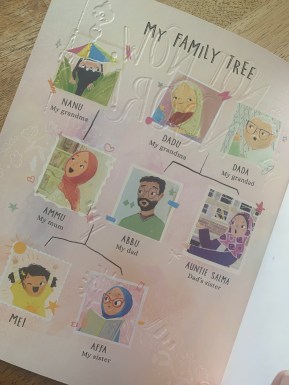
The book starts with Noor identifying what her Ammu’s hijab is and isn’t, how she wears it and how she doesn’t.  The next page shows Noor’s bustling family and she compares how her Ammu’s hijab is not the same as her Nanu’s or Dadu’s or Aunt’s or even her sister’s, but she doesn’t know why any of them wear it.  Yes, I’m sure there is some pointed criticism I should make about how can a child her age not know, but I think for the sake of it being a book and being comically done, I am willing to let it slide.  I do wish that the spread had the women and their style of wearing a scarf shown.  I appreciate that they are in the dining room at home and thus not wearing a scarf, Nanu is because Dada is in the picture, authenticity which I love seeing, but children need a little more hand holding to see which person the text is talking about. Yes I know there is a family tree on the inside cover, but at story time, it is cumbersome to flip back and forth.

img_7626

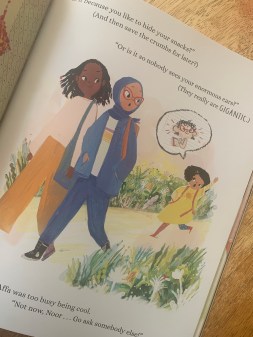
Back to the story, Noor starts by asking her sister, the coolest hijabi she knows, if she wears it to hide her snacks in, or hide her big ears, but Affa brushes her off with a, “not now, Noor” and she is off to the next family member to ask.  Each time the rationale gets more outrageous: hide the eyes on the back of your head, prevent you from getting nits, etc..  And each time the person she asks sends her on her way with a “not now, Noor.”

When Noor finally gets to her mom it is she who answers with poetic lyricism, “We are Muslim women, my Noor, Unapologetic and true.  We are believers.  We are dreamers.  We are thinkers. We are leaders. We can wear our hijabs on our heads like our hearts on our sleeves.  Whether you choose to or not, my Noor,, we are so many things…and we are more than enough.” On the next page it continues, “My hijab is not just a scarf.  It means more to me.  It is a reminder of who I am, where I’m from, and where I’m going to be.  And perhaps one day you’ll understand what I mean.  Because, most of all without my hijab, my Noor, I don’t feel like me.”

img_7622

A flowery sentiment, but little Noor and the reader never got the answer as to why Muslim women wear hijab, and I think that it is unfortunate.  The book is beautifully illustrated, the size is great to be shared, the text funny, the voice playful, the joy contagious but the answer for me, just missed the mark, not by a lot, but by enough that I think an adult would need to supplement the overall takeaway message.

My Baba is the Best by Bachar Houli illustrated by Debby Rahmalia

Standard
My Baba is the Best by Bachar Houli illustrated by Debby Rahmalia

img_7434

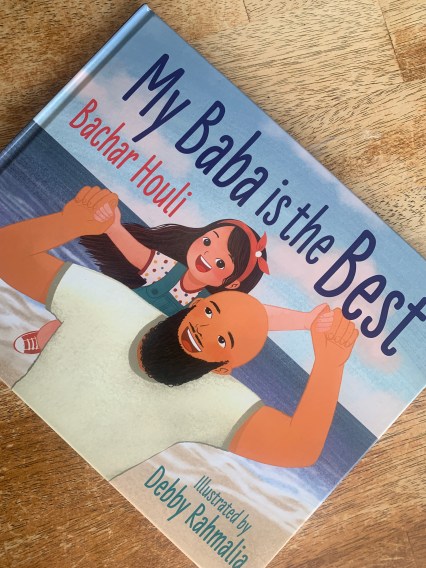
This 32 page horizontal picture book by an Australian footballer starts out much like a list detailing why a little girl loves her Baba, after a few pages though of more superficial delights, the book gets deeper.  It shows the family making duas at bedtime, going to the masjid on Fridays, it even gives a little insight into Eid and fasting before it then takes readers on a camping trip.  There isn’t really a story or plot, but the bouncing around fits the narrator’s point of view and will appeal to the intended target audience.  The book is mainstream published by Penguin in Australia, so I absolutely love the inclusion of Islam, the mom in hijab, the dad’s beard and the love shown between the little girl and her Baba.  Sometimes celebrity books feel a little forced, but having never heard of this athlete, I still found the book incredibly sweet and joyful, and the illustrations by a Muslim illustrator a great amplification of the simple heartfelt text.

The book starts with a little girl rushing to give her Baba a hug on the field as fans cheer in the background.  After all her Baba gives the best hugs, it then mentions that he is always doing something and shows him washing his boat and jumping on a trampoline with the little girl and her younger sister.  The trio garden, exercise, ride bikes, train and go fishing. They also watch movies at the theater or at home with the whole family. At night Baba reads special prayers to protect them while they sleep.

On Fridays, the family goes to the mosque for prayers, and the most special time is when they all go for Eid in their best clothes.  They listen to the imam and give donations to those in need. They open presents and after fasting they eat Lebanese pizza before going to visit teta and jeddo.

The best time is when they go camping.  They all set up the tent, and get sticks to roast marshmallows.  They even see kangaroos eating dinner before heading back to eat theirs.  On many of the pages it is just the girl and her Baba, but even when the whole family is present, the focus is on the strong relationship between the two.

The book is very endearing and as a daddy’s girl myself, I love seeing the relationship unfold on the pages with big things, and little things, fun things, and reflective things, and from the little girl’s point of view.  The book is not readily available in the United States, I purchased mine from Book Depository, where they offer free shipping.

Book One: Thunderbird by Sonia Nimr translated by M. Lynx Qualey

Standard
Book One: Thunderbird by Sonia Nimr translated by M. Lynx Qualey

img_7178

My public library had this book and so I picked it up seeing that it was Palestinian authored fantasy, and I am always on the lookout to support OWN voice Palestinian stories.  The book cover is gorgeous, the inside text unfortunately is tiny making this middle school aged book only 110 pages.  It is translated from Arabic and published by a university, so my expectations were pretty meager which assisted in me being fully swept away by the story at hand.  Sure the book has a few glitches in point of view,  often it feels a bit abrupt and djinn stories are a dime a dozen, but what elevated this book and made it stand out was the Palestinian history interwoven into the plot: snippets about the Mamluk soldiers and Ottomans, the Ayyubid rulers and walls around Jerusalem.  There isn’t enough history touched upon in my opinion, but I look forward to see, now that the world building is established, if the rest of the series will highlight the historical thread.  I have no idea if the characters or author are Muslim, there are references to praying and hearing the athan, but they could just be cultural.  There is magic, fantasy, djinn, prophecies, and reading of tea leaves, as well as fighting, assault, and talk of oppression under Israeli rule.  I’d assume it is advanced Middle Grade or lower YA, but to me it seems 11 and up would enjoy the quick fast paced read.

img_7175

SYNOPSIS:

Noor’s parents are dead, and she lives with a grandmother who loves her, and an uncle and his family who don’t.  When her grandma dies, Noor is alone and with things combusting in to flames around her and no one left to defend her claims that it wasn’t her, Noor is trying to piece together a ring left to her, her mother’s research, and her flame creation abilities.  Her search leads her to a colleague of her mother’s and an old archaeological site.  While staying with an aunt in Jericho over the holidays, a mysterious cat guides her to the same archeological site where the cat reveals that she is really a djinn.  The barrier between the seen and unseen world is failing, and Noor is prophesized to be the only one that can ensure it doesn’t happen.  With a trait of the mythical phoenix Noor must find ways to travel in time and retrieve a feather before the bird is reborn.  Along the way she will have the help of the djinn and of her doppelgänger from that time period.

img_7176

WHY I LIKE IT:

The story is clever, fast paced, and the character endearing.  I wish the details were fleshed out and of course I wish there was more history when she travels back in time.  The climaxes are quick builds and even quicker resolutions, but despite all the flaws I really enjoyed the story and look forward to the rest of the series.  The book ends on a cliff hanger that feels rather abrupt, but being it is clearly established as book one in a trilogy, I don’t think readers will be too upset at the sudden end.

img_7177

FLAGS:

Magic, time travel, prophesies, fortune telling, assault, oppression, fighting, loss, arson, arguing, djinn, fighting

TOOLS FOR LEADING THE DISCUSSION:

The book probably is too short for a book club read, but I think a teacher could definitely use it as a reference in story writing, historical fiction fantasy, culture inclusion lessons.  If you wanted to use the book, you’d be able to find plenty to draw on for teachable moments in literature, history, and writing style.  There would also be a lot to discuss in terms of occupation, myth, legend, and culture.

If your library doesn’t have it you can find it on Amazon

The Night Before Eid: A Muslim Family Story by Aya Khalil illustrated by Rashin Kheiriyeh

Standard
The Night Before Eid: A Muslim Family Story by Aya Khalil illustrated by Rashin Kheiriyeh

img_7123

This 40 page early elementary picture book is set the night before Eid and radiates with love from a boy to his Teita, traditional ka’ak, and the family’s Egyptian culture.  The robust and personal backmatter shares a glimpse into the threads from the author’s real life that the story touches upon, and makes the book extend beyond the pages.  It is worth noting that this book does not articulate if it is for Eid al Fitr or Eid al Adha and thus works for both.   There is nothing religious in the book except a reference to something happening after Eid prayer in a memory, and the shape of the cookie being round like the Ramadan moon, Eid day is not mentioned, it is simply the catalyst for this warm family story about a boy and his grandma making a special treat for the first time and sharing it at school.  The large hardback book with fun illustrations is ideal for both story time and bedtime readings alike.

img_7124

It is the night before Eid and Teita has arrived from Egypt.  Zain can’t wait to make ka’ak to take to school and share with his friends.  The beloved powdered sugar cookies are steeped in tradition, both in Zain’s family and in Egyptian history.  Once the suitcases is unpacked and the special ingredients found, Teita and Mama share memories of baking with cousins, painting henna designs on hands and putting eidiya in envelopes.  The family recalls singing together on the balcony while Geddo played the tabla and lights and lanterns filled the streets below, after Eid prayer they would hand out the ka’ak.

img_7125

Zain wants the ka’ak to turn out perfectly so his teacher and friends will like them.  Teita tells him that ka’ak is as old as the ancient pharaohs, and that recipes were found in the pyramids.  At one time rulers would even put gold coins in the cookies.  Zain and his Teita mix and add the required ingredients, and drink iced apricot juice as they wait for the dough to be just right.  Getting the cookies pressed with the molds though is harder than it looks, and Zain gets frustrated. Teita’s love and patience and Zain’s clever thinking get the treat making back on track.  The ka’ak doesn’t have a gold coin filling, but they are filled with tradition.

img_7126

The timeline is a bit off for me with the grandma coming before Eid and then the cookies going to school on Monday, and then Monday evening when Zain is writing down the recipe with Teita he is telling her Eid Mubarak and that it is the best Eid ever.  So, it seems that he went to school on Eid, not to Eid prayers, which is fine, just a little sad that there was no Eid celebration or prayers.  I don’t know that kids will be bothered by it, but the lack of mirroring and stressing how joyous Eid is does somehow get lost and mitigated, in my opinion, by skipping acknowledgement of the religious holiday.   In the backmatter the author remarks that she has “outgrown the magic of Eid,” so perhaps it is intentional that the day is not included in the text.

img_7127

The last six pages of the book are filled with informative and engaging information about What is Eid, Ka’ak Time Line, A Note from the Author with photographs of her and her family celebrating Eid, a Simple Ka’ak Recipe and Additional Resources.

I purchased my copy from Crescent Moon Store where if you put my initials ISL (Islamic School Librarian) in at checkout you will save 10% or is available here on Amazon where the book currently has a coupon for $3.80 off.

Nadia and Nadir Eid Surprise by Marzieh A. Ali illustrated by Lala Stellune

Standard
Nadia and Nadir Eid Surprise by Marzieh A. Ali illustrated by Lala Stellune

img_7058

This is another holiday book in the Nadia and Nadir series for early readers, this one focusing on Eid al Fitr, but also celebrating Muslim American athletes Ibtijaj Muhammad and Muhammad Ali, sadqa, and the love of grandparents.  The 32 page book with four chapters shows Desi American siblings enjoying both their Pakistani and American cultures while consistently embodying their Islamic faith.  They pray salat, wear hijab, discuss sadqa, and say Salam and Eid Mubarak.  I am not sure why they pray Eid prayers at home, and not in a community congregation, no it is not a Covid set book, they then go to the mall, but the pride in their faith, culture, and family is enjoyable.  Early readers will enjoy the colorful pages, large illustrations, and relatable story situations.

img_7062

The book starts with the siblings hearing laughing downstairs, then seeing suitcases, and being surprised by their Nani and Nana coming from Pakistan to surprise them on Eid.  The family eats paratha and chai together before praying and making duas.

img_7061

After presents are passed out, the kids receive eidee and are off to the mall to pick out a toy.  Nadia sees an Ibtihaj doll, and Nadir points out that she is wearing a hijab just like his sister.  Nadia recognizes her and shares some facts since she has read her books.  Nadir wonders if Ibtihaj knows it is Eid and the family reassures him that Muslims everywhere in the world are celebrating.

img_7060

When it is Nadir’s turn to choose what to buy, he picks some boxing equipment with marketing images by Muhammad Ali.  Nana fills him in on the activism and accomplishments of Ali and how impressive his fearlessness really was.  When the change is given after paying, the kids and their grandparents discuss sadqa, charity, and this gives Nadia an idea.

The book concludes with a glossary of new words and information about the illustrator and author.  You can purchase your copy at all major retails such as here at Amazon, or you can support small business owners like Crescent Moon store and purchase your here.