Tag Archives: culture

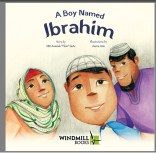
From Here and There by Larissa Olinda illustrated by Herry Prihamdani

Standard
From Here and There by Larissa Olinda illustrated by Herry Prihamdani

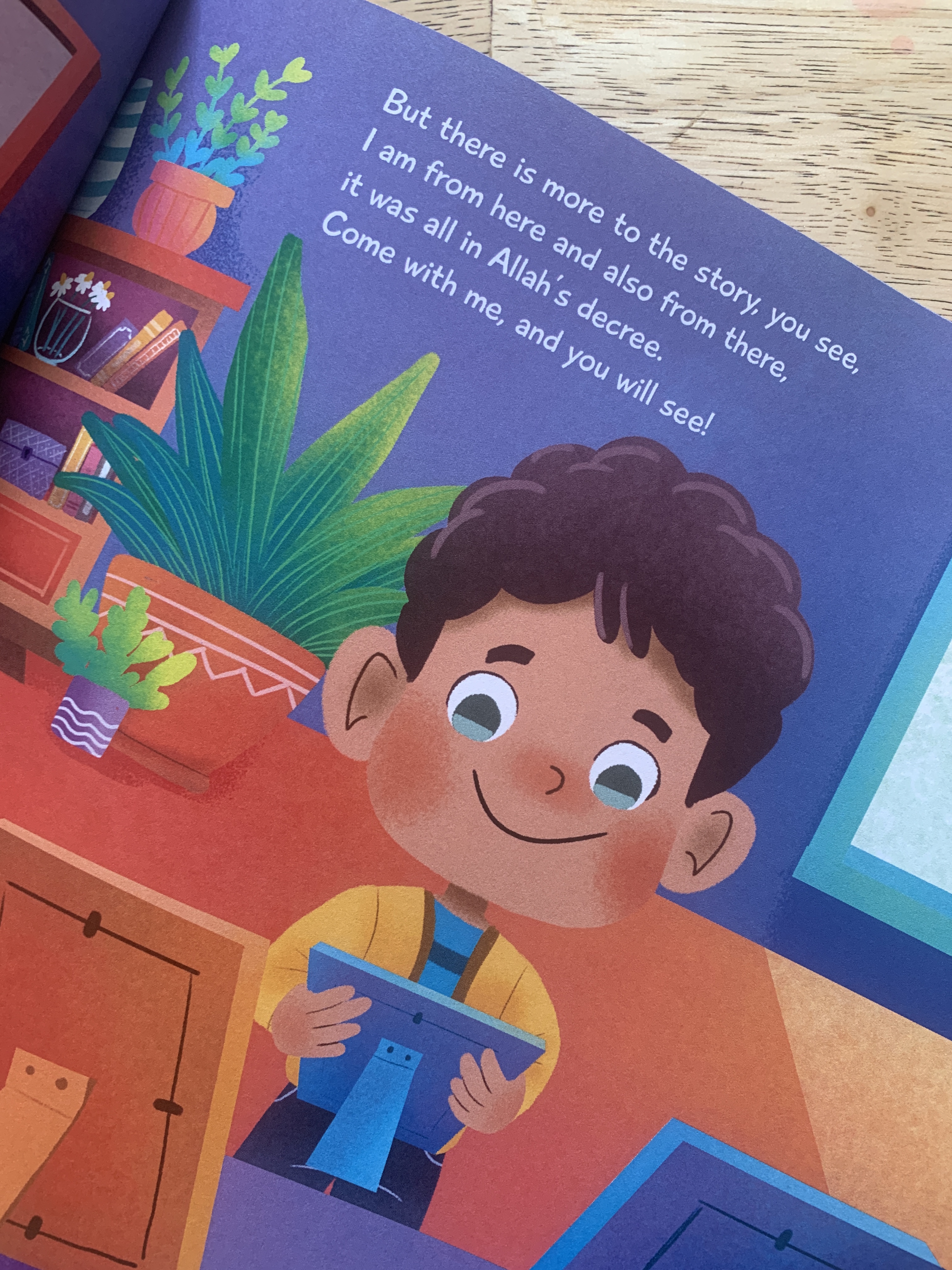
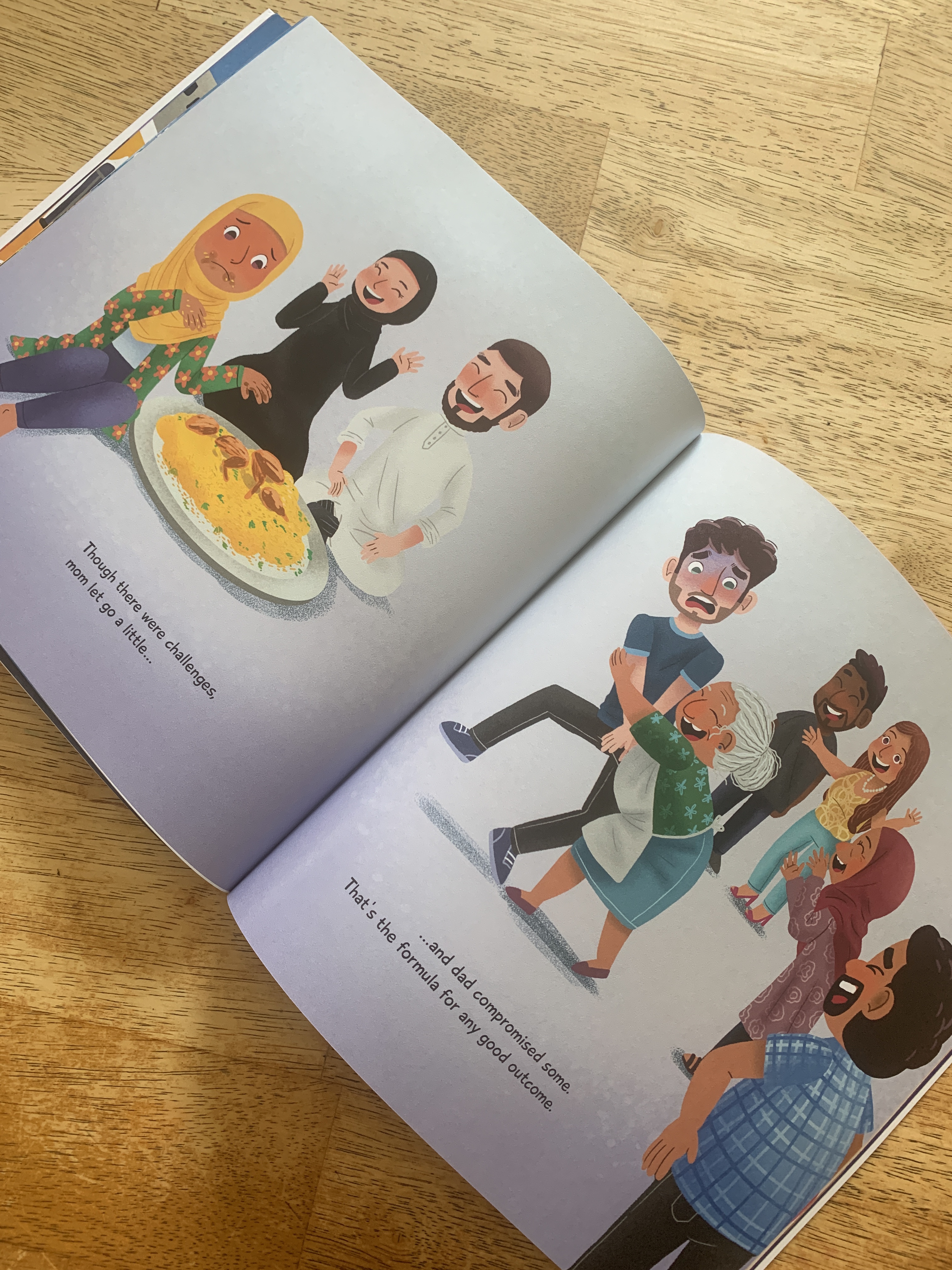
This sweet rhyming picture books discusses, focuses, and celebrates being a multicultural child.  Not the often seen child of an immigrant living in a society that is different than their parents, this story doesn’t even discuss where the child in the story resides, it just joyfully explores having a Brazilian mom and a Saudi father, while centering Allah swt in bringing them together.  The book highlights each culture, notes some differences, and acknowledges compromise, making this a reflective book for kids with parents from different cultures, but also a window of coming together that all readers can enjoy. Toddlers to early elementary will enjoy the 31 pages with bright engaging pictures and introduction to cultures and a topic not often seen in Islamic fiction, or any books for that matter.

The book is told from the child’s perspective as he breaks down his appearance and him being half his mom and half his dad.  He discuss the different sounds of Arabic and Portuguese, how meals are eaten, time is spent, people dress, and handwriting looks, without belittling or othering either culture.

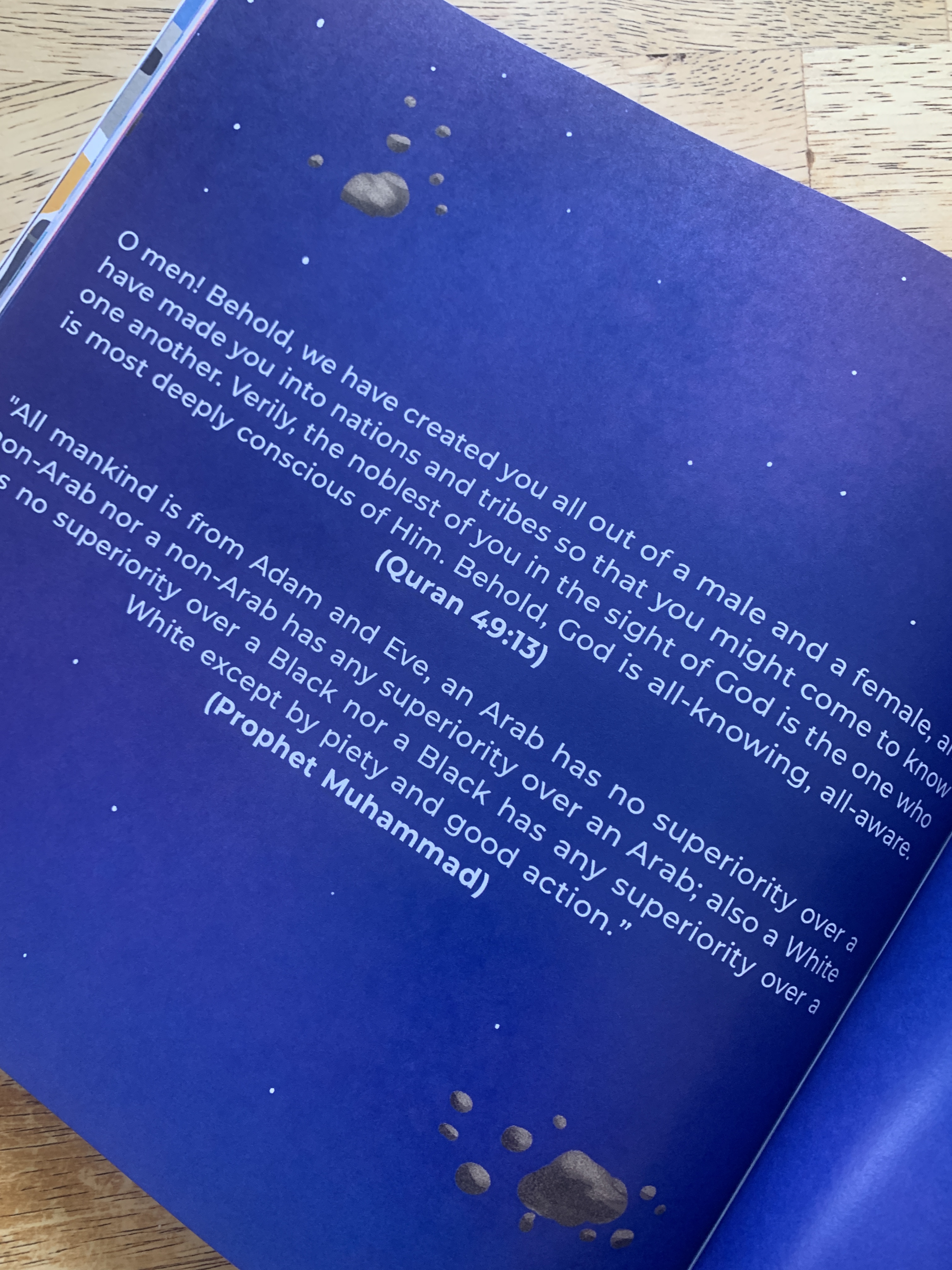
The little boy circles back numerous times that this is all Allah’s decree, that brought his parents from different parts of the world together.  It shows challenges and compromise at time, and ultimately love and smiles.  The book concludes with helping readers like him to feel seen and articulates Prophet Muhammad (saw) saying that no person is better than another based on where they are from.

The book concludes with an ayat from the Quran and a hadith, and is based on the author’s life. I can really see this book being used in a class as an introduction to a lesson asking kids to write their own family traditions coming together. It also works well at bedtime, or anytime.

You can order the book here

The Big Yard Sale: David Learns How to Treat Customers by Tariq Touré illustrated by Anika Sabree

Standard
The Big Yard Sale: David Learns How to Treat Customers by Tariq Touré illustrated by Anika Sabree

img_9753

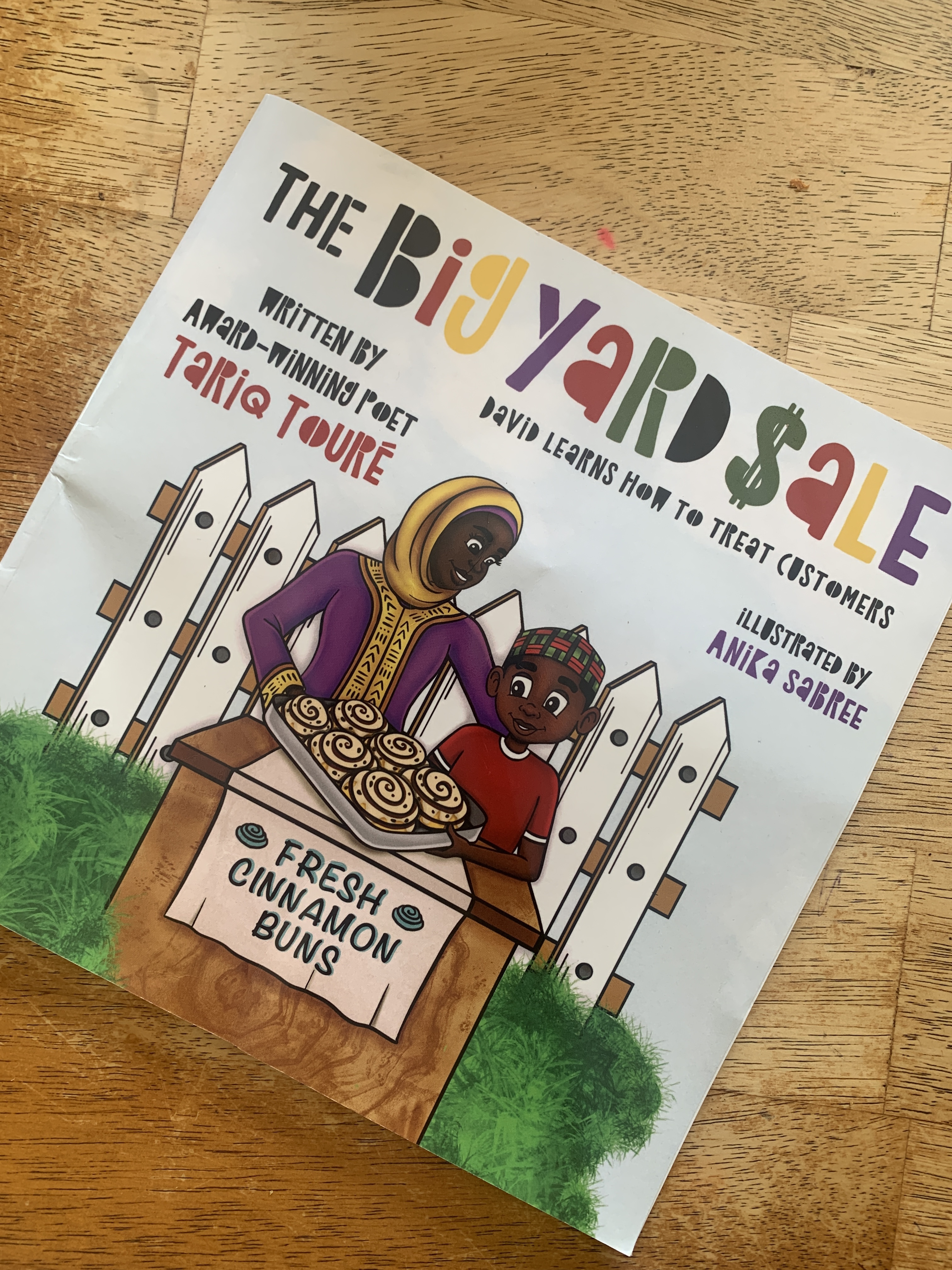
David Kareem is back and learning how to treat customers at his neighborhood yard sale.  The 26 page rhyming poem, turned children’s book (note there is little punctuation) is brightly illustrated as it follows David on his selling journey.   With Mommy’s baking and guidance on how to treat customers, his Saturday morning offers lots of lessons, mistakes, learning, and entrepreneurship for David and the reader alike.  There is a hint about a smile being charity, an Imam stops by, and David puts on a kufi.  It has good lessons and the same community vibe as the first book David’s Dollar, with visible Muslims in the illustrations and with Muslim names in the text throughout. But there was a page with two typos which disappointed me, a changing number of cinnamon rolls, and when the copy arrived it was pretty damaged and bent (probably/possibly not the fault of the author, but it cost $25 through the preorder Launchgood, so disappointing none-the-less, alhumdulillah you can now purchase it here from Amazon for $12).

David wakes up and hears commotion outside, he thinks he left a toy on, but soon realizes the neighbors have their stuff on tables and are selling things.  David wants in on the action, but can’t figure out what to sell.  He seems to gather up some toys and household items in the early illustrations, but ultimately it is about him selling his mother’s cinnamon rolls.  She is a baker, and is testing them out, but he says he only needs five and is off to peddle his wares.

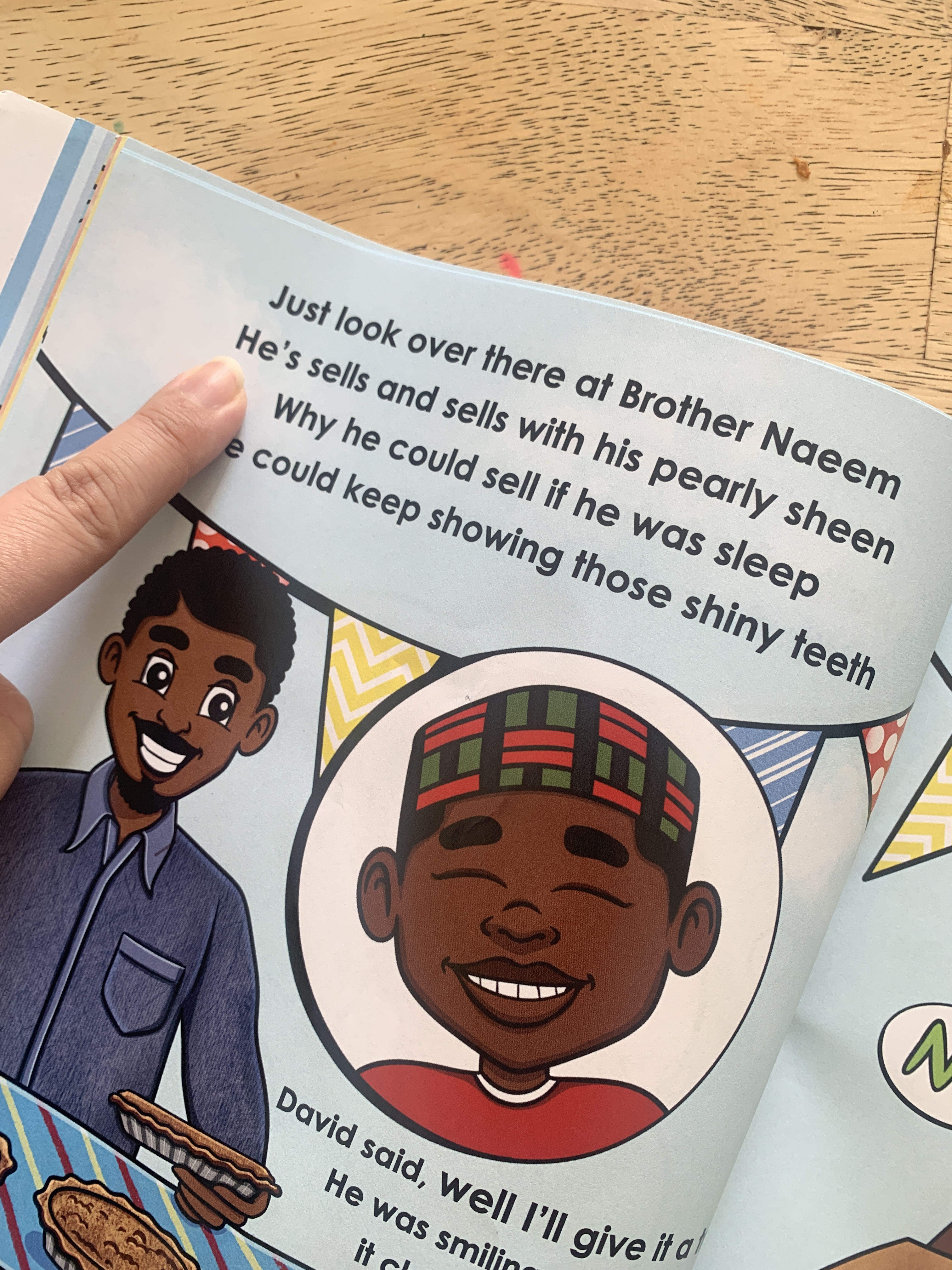
The first costumer comes, and leaves, he asks his mom what he did wrong, and she advises him to adjust his attitude by smiling.  They look at Brother Naeem as an example. The next costumer comes, but asks if he can warm up the now six cinnamon rolls in the illustrations.  David says no, and once again he turns to his mom to find out why.  She tells him that “the customer is always right” heads off to get a heat lamp, and uses Sister Khadijah selling beads for reference.  When Imam Musa comes, David completes the sale, but Mommy says he needs to learn gratitude.

img_9757

One page has “He’s” when it should be “He,” and “sleep” when it should be “asleep.”  I get the lack of punctuation is stylistic, but I don’t feel like these two on the same page are intentional, they just seem erroneous, and being that they are on the same page, makes it seem like the page was just missed perhaps in editing.

Overall I enjoyed the presentation, representation and content of this book and am glad I preordered it months ago. I wish it had a smidgen more Islam in it, but I think this book would be great in an early elementary story time with recently traditionally published books about business for a similar demographic, including the author’s earlier book, David’s Dollar. Teaching kids about entrepreneurship, ethics, gratitude and doing it with Muslim characters is incredible to see and important to share.

Saving Sunshine by Saadia Faruqi illustrated by Shazleen Khan

Standard
Saving Sunshine by Saadia Faruqi illustrated by Shazleen Khan

img_9623

The themes, messaging and Islamic and cultural representation in this upper MG/lower middle school graphic novel are wonderfully unapologetically present.  Yet somehow, I never connected with the characters, and the plotting seemed stiff.  I don’t regret reading the book, and I’m sure most readers will be delighted with the main story of sibling annoyance, a sick turtle, and independent kids with reflective flashbacks and OWN voice threads of Islamophobia, immigration, starting to wear hijab, identity and othering.  I just felt the tropes were predictable, stereotypical even, and when the dad takes a stethoscope to a medical conference and the TSA agent doesn’t know what it is, I cringed.  Seriously, who takes a stethoscope on vacation? Who doesn’t know what one is? I normally love the author’s characters and wish for more Islam, this book gave me the Islam, but I really disliked the siblings, they were mean, angry, and annoying.  I own that reading a book about bickering kids a few days before my own five children returned to school may have jaded me, and I do think I found the religious touchstones predictable because I do read a lot of kid lit and I’m older, so while I’m not gushing in my praise for this book, I will be preordering a copy for myself and the school library. How is that for having an opinion and then completely walking it back? Yeah, it happens.

SYNOPSIS:

Twins Zara and Zeeshan bicker, a lot.  Zara loves animals and nature, Zeeshan space exploration, and both love their phones.  When the family heads to a medical conference in Key West where their mom is getting an award, the kids get their phones taken away by their parents when the two won’t stop fighting. The parents stick to their policy and the two are forced to stick together and entertain themselves while their parents attend lectures.  At one point they find a turtle and Zara takes the lead to try and help Sunshine, but will need her brother along the way.

WHY I LIKE IT:
I love that the characters identifying as Muslim was central and unapologetic.  I liked the flashbacks that provided a little bit of depth to the parents coming to America and their life in Pakistan, along with the personal reflections about starting to wearing hijab and when the kids started to go their own way.  But the airport scene, the identity issues, and the Islamophobia seemed a little superficial and over done.  The heart to hearts with the dad and his son and mom and Zara were sweet and insightful about belonging and where you come from, and not being so angry, but they also seemed very natural and in-character for the parents which is a disconnect from the anger the kids seem to carry.  If the parents are talking to them and modeling all this, it is a bit of a stretch that they are reacting as they are in the book.

I have a brother, it is just the two of us, we aren’t twins, but growing up in the 80s as the only Muslims in the area with a convert mom and immigrant dad, we came together a lot because only each other could understand the stresses we faced in and outside our home.  I thought this book would draw on that universal theme, and I was surprised that the point of the book felt a little underdeveloped.  I know MG can handle more than we give them credit for, but I felt like this book built up to have more of a warm hug, than I felt.  I wanted more of them plotting together, I didn’t feel like Zara really needed her brother to stick up for her, she wanted it sure, but that was a foot in the door that I think was missed.  She is strong, yet was being vulnerable with her brother, and he was able to step up for her, but it needed a few more beats to be appreciated.  I also wanted more connection to the turtle, his name is in the title, I thought he’d have a bigger role.

FLAGS:

Disrespect, lying, anger, yelling, bullying, teasing, Islamophobia, stereotypes, prejudice

TOOLS FOR LEADING THE DISCUSSION:

The book would allow for discussion for middle grade readers who might see themselves in the family dynamic or be able to relate to some of the Islamophobia.  It could also cause some worry for some children that being visibly Muslim or having cultural names, and wearing cultural clothes will bring negative differential treatment to them.

Available for order here

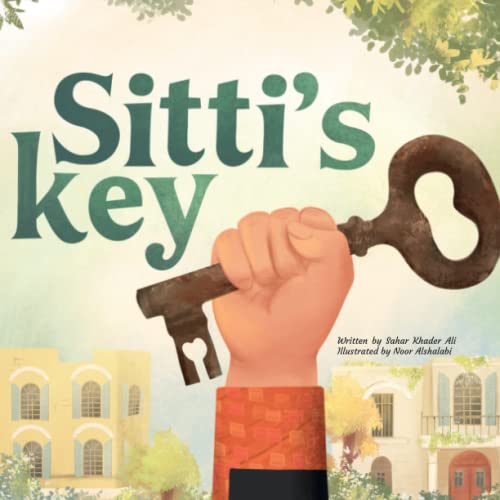
Sitti’s Key by Sahar Khader Ali illustrated by Noor Alshalabi

Standard
Sitti’s Key by Sahar Khader Ali illustrated by Noor Alshalabi

sitti key

I try and buy, read, and review every children’s book about Palestine that is published, it is the least I can do.  I also try not to compare them to each other as they present different aspects of oppression, perspectives of strength, examples of joy, and messages of hope, even among many similar themes of food, keys, traditions, and culture.  I really appreciate that this book though is incredibly blunt.  It isn’t lyrical, it isn’t poetic, and as Israel is bombing Jenin as I write this I’m glad it doesn’t mince words about the Nakba. I do think caregivers though, should probably read it first as it might be a little triggering for sensitive children.  The story is OWN voice and probably best suited for middle elementary aged children.  It is perhaps also worth noting that the book could be seen as making Jews synonymous with Zionists.  The characters are Muslim, Islamic phrases and Arabic terms are sprinkled throughout, and even despite the pain the family has endured, the book stays hopeful and proud.

Sitti is coming and Amal is excited, it has been two years since she last saw her.  She loves how excited her mom and grandma are to unpack gifts of olive oil, dates, and zataar from friends.  Amal isn’t sure what to do with the “old lady thoub” she has been gifted, but she smiles in appreciation none-the-less.  When Sitti pulls out an old key, Amal starts to ask her about it, but her mother shuffles her off to bed.

The next day at school, Amal has to work on a presentation about “culture,” but there are no Palestinian books in her school library, so she just watches the other kids.  At home they eat and listen to Sitti’s stories of long ago in Haifa, and Amal asks her why she left Palestine.  Despite her mother trying to redirect, Sitti says it is time she knew about the Nakba.

Sitti tells about living on the land for generations and how the Jews believed the land belonged to them.  In 1948 the British decided Palestine would be the homeland for the Jews.  Armed men came and arrested anyone who tried to stay in their homes. Sitti’s brother was handcuffed and never seen again.  The family grabbed what they could including the key to their home as they made their way to a refugee camp in Lebanon.  They stayed for three years, before making their way to America.

When Sitti concludes her story she hands the key to Amal and her hope that she will return to their home inshaAllah.  Feeling the pride and warmth of home, Amal has a determination to reclaim her heritage and share her “culture” with her classmates.

The illustrations are sweet, the mom and Sitti wear hijab even in the home, and the inshaAllahs and salams come naturally. The book does not stop to define zataar or marimya, which helps the flow. I also like how it shows that there aren’t books about Palestine in the school library, it is strong and important detail.  I don’t understand where Sitti is coming from though, it would seem Palestine as she is bringing gifts from friends, but in the story it says after Lebanon they made their way to America, so I’m not sure where Sitti lives, and how the logistics of the family work to be honest.  I also kind of wish there was a  recipe for zataar in the book and lyrics with translation for the song the family sings.

Book is available on Kindle or can be ordered from www.littlehibba.com

The Unlovable Alina Butt by Ambreen Butt-Hussain

Standard
The Unlovable Alina Butt by Ambreen Butt-Hussain

img_9079

This middle grade book in many ways reads like a memoir, it isn’t, it is OWN voice fiction, but the chapters often come across like short stories with their own climax or punchline.  The lacking continuity of smaller threads being resolved means if you put the book down, you aren’t necessarily itching to pick it back up to see what happens next.  There isn’t a larger pressing conflict driving much of the book, yes the girl is bullied, but by one kid, and she has a great group of friends and a supportive family, so the intensity is just not present.  I do like the growth of the character toward self-acceptance, but I don’t know that the target audience will get the 90s references of Spice Girls,  CDs, lava lamps, and gel pens.  The book hits most of the stereotypical immigrant tropes of feeling othered by one’s name, clothes, food, and while she works through them to deal with the bully and find her own confidence, she unfortunately never deals with her internalized Islamophobia, which is disappointing.  She puts Islam on her parents as something they practice, and only begrudgingly seems to acknowledge she too is Muslim when she doesn’t eat pizza with non halal meat.  She is embarrassed when her friends see Islamic calligraphy at her house, hear the athan, she doesn’t reply to her parents salaams, she calls her mother “the most devout in our family” as the reason she has to wear tights under her skirt: she only seems to ok with being Muslim when outsiders give their approval.  The book for me is mediocre, nothing to rush out and buy, nor anything to pull from shelves.  I’ll send my copy to the Islamic school library shelves as the book is fairly clean: a few giggles about naked statues at the museum and very lightly hinted at boy/girl crushes. The older sister deals with a boy who wants to date her and harasses her to the point of affecting her personality, but I think if a 10 or 11 year old picked up the book and read it, they would be ok to see the characters finding their voice, good friends, and sibling support.

SYNOPSIS:

Eleven year old Alina Butt is in her fourth school in three years since arriving in England from Pakistan.  She never fits in, and never has friends, but she is determined that if she can keep her last name a secret, she might have a chance.  One the third day of 6th grade though, her last name becomes known and Adam Atkins has his eyes set on giving her a hard time.  With encouragement from her older sister and love from her baby brother, Alina puts herself out there to make friends and when the teacher assigns her a new group, she finds herself among three girls happy to welcome her in.  The new group also puts her sitting across from Adam, but at least now she doesn’t have to face him alone.

At home, she navigates life as an immigrant trying to blend her worlds.  Her loving family lives above the grocery store they own and face Islamophobia and settling in together as they each have to find their strength and voice and resilience to drive, stand up to harassment, and for Alina, to love herself.  Alina gets the courage to try out for the school play, but when she lands the part of Gus in Cinderella, she has to dig deep to be happy for her friend, forgive a bully, and step in to the spotlight.

WHY I LIKE IT:

Alina is likeable enough, and I love that she grows to love herself too, I’m not sure she was ever unlovable though as the title suggests.  I don’t like that potentially really big plot points are mentioned and then abandoned.  She cuts her bangs way too short, her mom says something and no one else ever mentions it, and she never brings it up again.  Her dad is so sick he leaves the truck on the side of the road and sleeps and the mom takes care of everything, and what was wrong with the dad is never revisited.  These are just two examples of rising action that present that they are going to be important that are seemingly undermined by the lack of follow through.

I love that she finds a way to stand up to the bully and she even helps her sister deal with the boy antagonizing her.  It is strong and resonates with the reader, but it should also be noted that as soon as she has friends, they are gossiping and being rude to Adam too.  I’m not saying it isn’t warranted, and he definitely is worse, but if she is modeling behavior she should perhaps at least feel bad teasing him even before she knows that he has a bit of a rocky home life.  Plus he is one kid with two stereotypical sidekicks, yeah he is annoying and mean, but she has friends and family and teachers that are completely on her side too.  And Adam bullies her about her name, but no one else even acknowledges it or asks her about it.

I didn’t quite get the schooling, but it is probably because I am American.  She is in middle school, but she has one teacher all day and they play on the soccer fields at break and her kg aged brother does field day with her?   The 90s references were fine for me, but I don’t know that the target audience will get some of them, and it might be a little annoying to get through for younger readers.

Ultimately, the way Islam was presented was really disappointing.  It feels like we should be past the internalized othering of our faith.  The culture was worked through and appreciated internally for Alina, but for some reason, religion was only ok when the outside influences deemed it acceptable, and I’m not sure that in 2023 this angle of narrative is doing anyone any favors.  She loves her mom, and part of the character arc is seeing and appreciating her mother’s strength, but very early on mom is labeled as “devout” even though they are all Muslim.  And this self othering to be the reason her mom is keeping her from dressing like everyone else left a bitter taste in my mouth.  Never once does it feel that Alina has a connection to Allah swt, no matter what she is going through there is no bismillah, or prayer, or dua to ask for help, and strength, or show appreciation.  I absolutely get that not every story will have that, but the way Islam is presented as something foreign and never circled back on or portrayed as something that she embodies, makes all the mentions of faith seem deliberately othering, and as a Muslim book reviewer, I feel it is an important point to mention about this book. I wonder if it was intentional or an oversight sensitivity reading would have helped resolve.

FLAGS:

Birthdays, music, bullying, harassment, teasing, othering, mention of naked statues, some sneaking and dishonesty.

TOOLS FOR LEADING THE DISCUSSION:

I wouldn’t use this as a book club selection, and as stated above I wouldn’t rush out to buy the book to shelve at home, in a class or school library, but if it found its way to the shelves I would not remove it.  The book has heart, I just feel like along the way the messaging of finding your voice and putting yourself out there to make friends, the book also hints that the Quran on your walls, modesty, the athaan, eating halal, are all things that are weird, unless your friends think it is cool, then it is ok- and that is not messaging I would really want to spread.

The Grimoire of Grave Fates by Hanna Alkaf and Margaret Owen

Standard
The Grimoire of Grave Fates by Hanna Alkaf and Margaret Owen

I keep saying I won’t read anymore anthologies or collections, but this 464 page YA fantasy mystery intrigued me because each chapter is written by a different author, presenting a different character to unravel a whodunit.  In total there are 18 character perspectives, 18 authors, and one murder that needs to be solved.  With two Muslim authors included and it created by a Muslim writer, I hoped there would be some Islamic representation.  The list of authors is quite diverse, and I think every character presents some minority label to normalize a specific culture or identity.  The Muslim characters both wear hijab, but nothing more about their religion is mentioned and no other faith is included.  There are Black, Asian, Hispanic characters, and every letter of LGBTQ+ is highlighted and seemingly the focus of the book.  At times it is just attempted normalizing that a character is queer or gay, but other times it is central to the plot such as when two girls spending the night together provides an alibi, and a few times it really takes away from the story, for example at one point two boys (one magical, one neutral) kissing and falling in love.  There are gender fluid, non binary, pronoun preferences, trans male-to-female, female-to-male characters as well. I kept reading to get to Hafsah Faizal and Karuna Riazi’s chapters, which were 10 and 12 and by then I was so close to the conclusion, I just finished.  Some chapters are stronger than others, but the resolution was really anticlimactic and didn’t do the buildup justice.  I share this review not just to comment on the story, but to also give a heads-up to the content so that you can decide if the book is suitable for you and your children.  I would not shelve this book in our Islamic school library, which is unfortunate, because I think even with the weak ending, I like the theoretical storytelling concept.

SYNOPSIS:
In moving school for magical students, a murder has been committed, and the students who all feel like they are the “chosen one” are determined to solve the case.  The characters share what they know and add to the “solving” of the case for the reader with their different magical abilities.  Some of the students are werewolves, some necromancers, there are those whose dancing is magical, others whose embroidery is, a few are the same, many are unique.  They don’t compete with one another so much as they are in their own world trying to prove their worth and right to belong.  When a homophobic, racist teacher “dies” secrets are uncovered and dirty administrators are called to account.

WHY I LIKE IT:

I like seeing a glimpse of the action from a character and then not really seeing that character again, it made it seem more puzzle-like in the coming together of the clues.  I also liked it because if I didn’t particularly like a character or writing style, it didn’t last the duration of the book.  I wish it didn’t feel so token representation though.  If the goal was to be inclusive, the mirroring uniqueness was lost when each character seemed to have to tick a box.  It made it read formulaic.

The conclusion just unraveled, and I know mysteries and horror stories tend to fall in to this trap, but I was hoping it would go out with a bang.  The buildup was strong, but then it became a lot more just telling, then sleuthing, and I don’t know if it was a reflection of the individual authors, or the overall arc of the book.  Either way, I felt like it could have concluded with a bigger punch and wrapping up of some of the loose ends.  Hanna Alkaf didn’t have a chapter, presumably she wove it all together and made it flow cohesively with the internal memos and emails and notes.

I wish the two “Muslim chapters” would have had some more representations about Islam or the girls’ cultures influencing their magical style or goals, but with token rep it is often just a label, an identifier, and then nothing more.  The two connect over fear of Islamophobes blaming them for the death of their teacher.

FLAGS:

The focus of the book is largely on relationships, mostly LGBTQ+ but some hetero crushes as well.  Trans, non binary, gender fluid, bullying, racism, prejudice, murder, magic, lying, sneaking. The Muslim characters do not have crushes or romantic relationships mentioned, but one has a close male identifying gay friend that she does have physical contact with, a reassuring hug- so the book does have Muslim girls with close male friends. Fear of Islamophobia, stereotypes.

TOOLS FOR LEADING THE DISCUSSION:

I would not be able to teach this book or shelve it in an Islamic school.

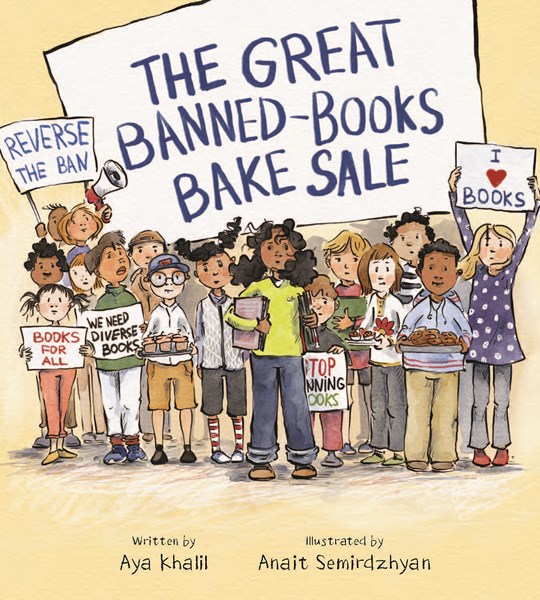
The Great Banned-Books Bake Sale by Aya Khalil illustrated by Anait Semirdzhyan

Standard
The Great Banned-Books Bake Sale by Aya Khalil illustrated by Anait Semirdzhyan

banned

This follow-up picture book to The Arabic Quilt, takes readers back to Kanzi’s school, but also works as a standalone for ages 7-10.  Addressing the hot topic of book banning, the fictional story brings the discussion down to an elementary level and shows kids speaking up and pushing back against something they don’t agree with.  The main character finds a connecting thread to events in Egypt, and with her class and family behind her, she finds her voice and takes the lead.  The story bounces around a bit and feels a little rough and underdeveloped at times, but the subject matter is important and can be used to help guide discussions, encourage peaceful protesting, and taking action.  There is nothing Islamic specific in the text, the main character’s mom and teita wear hijab and are in the illustrations (#muslimsintheillustrations), in a memory of Egypt there is a man holding a cross.  The author is Muslim and mentions it in the Author’s Note at the end.

banned1

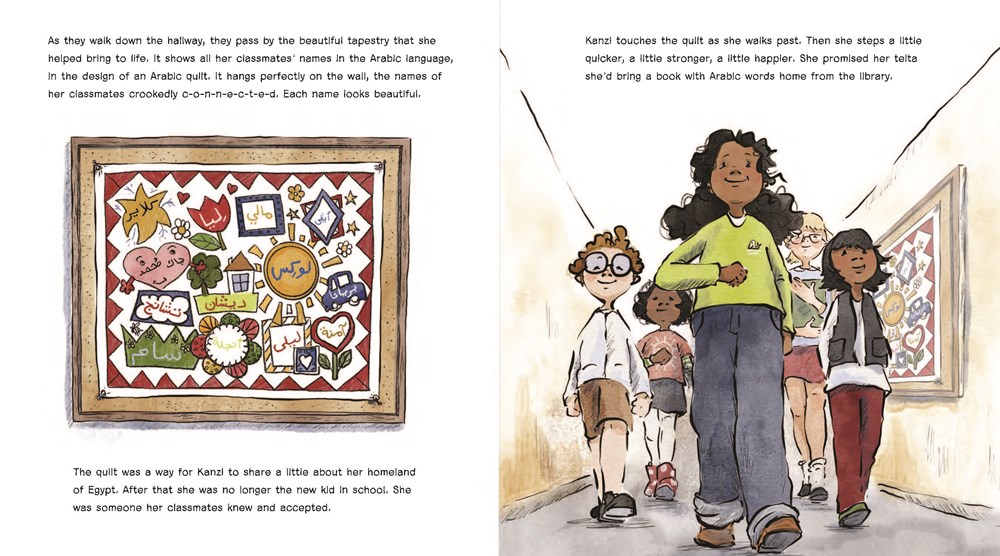
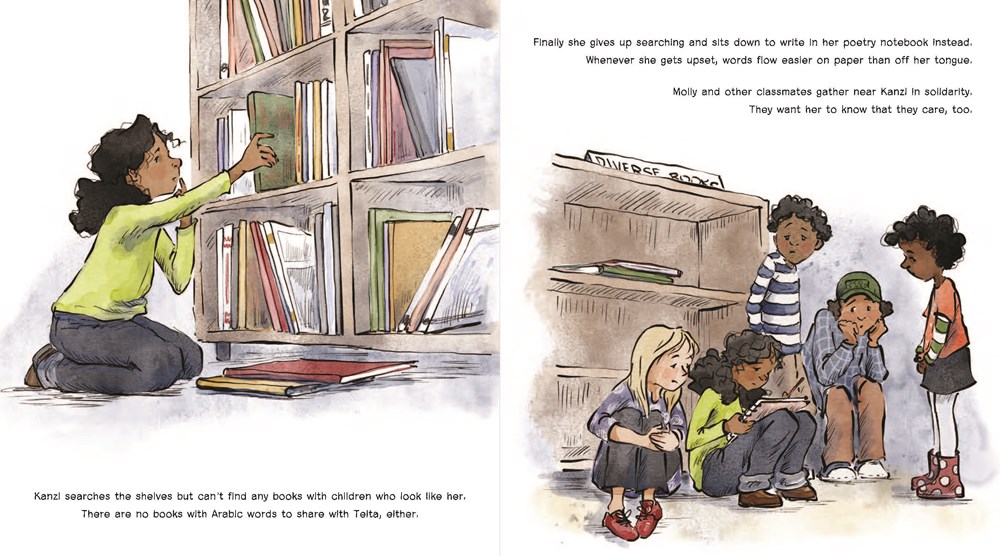
The book starts with Kanzi leading the class to the library, she passes the Arabic quilt she helped bring to life and walks a little taller.  She has promised her Teita she will bring home a book with Arabic words from the library, but when she walks in to the library, the “bookcase where the new diverse books were displayed has been emptied.”  The librarian explains that the books have been banned.  That the school district, like many others around the country, have decided certain books are not allowed. Kanzi is upset, but her classmates “gather near (her) in solidarity. They want her to know that they care, too.”

banned 2

Back in class the teacher opens up the discussion, and Kanzi can’t find her words.  Kareem says it is unfair and when the teacher explains that people are responding by protesting, writing letters, and buying more copies of banned books.  Kanzi finds her voice and suggests a bake sale.  Kareem suggests they raise money to buy books that are banned and call it “The Great Banned-Books Bake Sale and Protest.” Molly adds that they can put the books in Little Free Libraries. The class agrees that Friday will be the day, that baked foods inspired by books that are banned will be sold to raise funds to buy more banned books, and the local news station will be invited to broadcast the protest.

banned 3

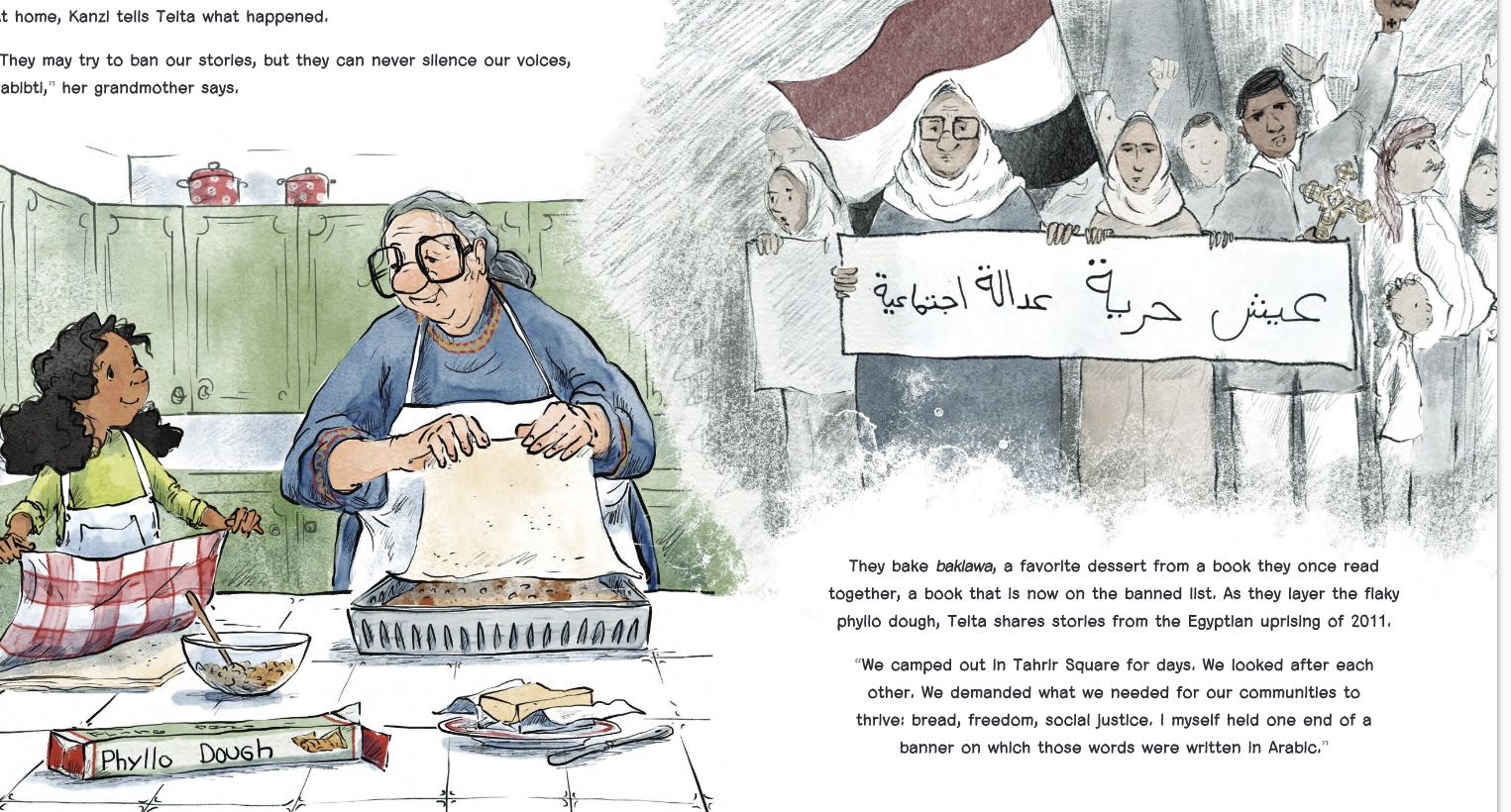
Kanzi helps Teita make baklawa from a book they once read, while her grandma tells her stories of protesting in Tahrir Square.  Teita held a banner and demanded rights for the people of Egypt. Friday comes, and the kids are determined to be heard, as the crowd grows, Kanzi’s nerves also grow, but her strength comes from those that support her and who have also spoken up to be heard.

I enjoyed the illustrations and the backmatter.  The inclusion of a baklawa recipe and insight to how this story came about with the banning of The Arabic Quilt, definitely adds to the book’s appeal.  I felt a little disconnect though from the emotions of the book, and oddly enough, little connection to the characters.

I wish it would have shown her joy when she first saw the diverse book display.  How it made her feel seen and valued and included to see books that reflected her and her classmates.  Then we, the readers,  would feel the pain too, now that they are gone.

I also was a little unsure of the scene when all the kids gather around Kanzi in solidarity, why is she the only one upset? Is it that they care about her or that they care that the books are no longer available? Sure it can be both, but again, as it is written, it isn’t particularly strong.

img_8594

I’m not sure why the three characters named in the book Kanzi, Kareem, and Molly, do not have their names shown on the Arabic quilt pictured in the illustrations, and I also don’t know why it bothered me that the book banned that had baklawa/baklava was not named.  I don’t care that it isn’t a real book, but I wanted a title to make the case of how ridiculous this ban is more articulate.  Additionally, I love Little Free Libraries, but it seemed tossed in without much fleshing out. The book doesn’t explain what Little Free Libraries are, so I’m not sure that kids will even understand the plan.

The book is a decent read, I don’t know that the climax or characters will be memorable on their own, which is unfortunate because connection with the success or failure of this fictionalized book ban really could have radiated out of the book and deeply inspired kids.  The reversal of the boards decision doesn’t directly link to the kids’ actions.  I had to provide that link to my own kid when I read the book to him (he is almost 8).  It is implied, but a line or two about how the kids protest encouraged other people to also speak up, or write letters, or that the school board attended the bake sale, would have shown that when voices amplify it is hard to ignore them.

The book has value on the shelf and can be preordered here https://amzn.to/3C5Baaj

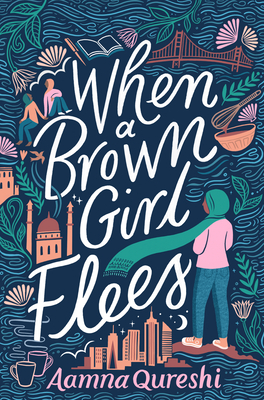
When a Brown Girl Flees By Aamna Qureshi

Standard
When a Brown Girl Flees By Aamna Qureshi

when a brown girl flees

I was both nervous and excited to read this contemporary book having loved the author’s fantasy, but unsure how a Brown Muslim Pakistani American girl running away from home would be presented.  Alhumdulillah, the author approached the story from a place of love.  There is no internalized Islamophobia, self othering, or in broad strokes even an identity crisis. The protagonist has made decisions, drastic ones, and is trying to piece her life back together on her own terms, but the love of culture, family and faith, is always upheld.  It reads like Islamic fiction, with very didactic passages and moral positioning, I’m still quite surprised that it is traditionally published.  The version I read had grammar errors, so I’m hoping that they will be corrected when the book releases in a few weeks.  The story is engaging, but the writing a bit monotone.  Much of the story is telling, not showing, and because of the surface level spoon feeding of so much of the plot, when the catalyst or rationale is not provided, the book seems underdeveloped, or lacking, unfortunately.  I would not recommend this book for the target audience of YA readers (12/13 and up) it contains sex, slut shaming, self harm, depression, suicidal thoughts, physical and emotional abuse, profanity, and mentions drug use.  I do think though, early college age readers will enjoy and benefit from reading the book.  At a time in the reader’s life when they are defining themselves on their own terms, owning up to their own mistakes and laying out a future path, this book will provide relatability amplified by religious and cultural touchstones.  The heart of the story is the connection of a girl with Allah swt after she has sinned, the guilt and regret she feels, and how she finds herself, and returns to try and fix things with her family.  The characters are flawed and the overall messaging beautiful, hopeful and uplifting.  Unfortunately, it just reads like an early draft and I wish it had a bit more refinement.  Keeping that in mind though, it does have a place, and I’m glad to see our “new adults”  can find reflections of  themselves in a piece of literature that amplifies their Islamic identity instead of criticizing or questioning it.

SYNOPSIS:

The book starts with Zahra deciding to run away from home.  She parks her car, leaves her phone and catches a flight to New York from California.  The reader doesn’t exactly know why she is running, only that a few days after high school graduation she is escaping a toxic home life, an impending wedding, and misery.  As the story peels back layers we start to see some of the nuance of what she is running from as characters from her past find her and physical space allows her some perspective to see her own role in her “old” life.  When she arrives in New York, it isn’t the city life that she seeks, but rather the nature and pace of Long Island that offers her a fresh start.  She heads to the masjid, makes a friend, and starts to put her life together without parental obligation, outside interference, and self loathing.  She cannot run forever though and she cannot escape herself.  She must confront her past, own her mistakes, be honest with her new friends, and find peace with her family, not because she has to as a Brown daughter of immigrants, but because she trusts Allah, loves her family, and wants to “fix” things.

WHY I LIKE IT:

I’m a sucker for books that show redemption through the love and mercy of Allah (swt).  Yeah her new friends were idyllic in their family life, relationships and worship, but we all want friends that make us better Muslims, so I let it slide. Islam is centered, she wears hijab, she reconnects with salat, it is her identity even when she is just going through the motions. The author at times conflated culture and faith, but it never issues blanket statements or falls into universal stereotypes for Desi culture or Muslims.  She does a good job of keeping the negatives to the people and the critiques to the failure to push back on dangerous expectations. My issues weren’t the character flaws either, I’m onboard with the messiness of being human and the ability to seek and receive forgiveness from our creator.  I just wanted to feel things more.  So much was just told when it should have been shown.  I wanted to see the stress and anguish of her family life, not simply told it was depressing.  I wanted to see her cutting life long friends out and being isolated, not told she had lost her friends.  The book focuses on her running, and why she ran, but a big plot point for why she ran, having sex, needed more fleshing out.  Why was she driven to such an act? I know that she was depressed, I’m not belittling that, but what pushed her to such a strong stance, when she was already allowed on the school trip, she hadn’t yet been given the ultimatum and over and over the book says “I miss my family,”” I miss my home,” “I miss my mom.”  I didn’t feel the connection or understand what she was feeling, thinking, and it seemed like a huge hole in the book.  For all the themes of mental illness, faith, generational trauma, misogyny, abuse, expectation, depression, lying, culture, life choices, higher education, family dynamics, self harm. the book never quite felt rich with emotion or deeper than the surface level story.  At the beginning the author says she first wrote the book when she was a senior in high school, and while that may have made the main character’s perspective and voice ring true, as a successful author now, I wish she would have added the nuance, the insight, the subtlety that would have drawn the reader in and allowed them to get inside Zahra’s head and heart to see her and perhaps even themselves.

FLAGS:

The author and book identify triggers in the book “please be mindful of TWs: depression, anxiety, emotional abuse, physical abuse, self-harm, suicidal ideation, slut-shaming, PTS.”

There is also music, boys and girls alone in cars together, lying, cursing, generational trauma, misogyny, abuse, expectation, depression, anxiety, guilt, life choices, higher education, family dynamics, cutting, a brother who is often high or smells like weed/pot, it mentions partying, a sexual event, deceit, physically assaulted by a parent.  Nothing haram is glorified, but it is there and it is detailed, and not everything is resolved.

TOOLS FOR LEADING THE DISCUSSION:

I would not be able to shelve or teach this book in an Islamic school library, but in a college MSA book club or a youth group of a similar age this book would be incredible to read and discuss.
The Jasad Heir by Sara Hashem

Standard
The Jasad Heir by Sara Hashem

jasad

When I requested this book, I really thought it was YA, when I saw it was 528 pages I went online to see what I missed, and sure enough it is considered an “Adult Fantasy” and in the process I read some of the (negative) reviews about the book.  I grew nervous as I’m not naturally a fantasy fan, mg fantasy is more my level, with occasional YA entrapping me.  I told myself 25% is the least I could do, and if it wasn’t clicking, I’d know I gave it a genuine shot.  By about 21% I couldn’t put it down.  I think not expecting the complexities of an adult book was a benefit.  The book has no Islam, it contains Egyptian cultural references, but religion is not present, and thankfully that means no djinn either (they seem over represented these days).  The protagonist is in her early twenties, it has an enemies to lovers trope, and magic is central to the storyline, but aside from frequent unremorseful murder and torture, an intimate make-out scene at the end, and some drinking of ale, the book is fairly clean. I feel like there might have been some plot holes, but I honestly was so swept up in the story and proud of myself for understanding the world building and politicking, that I am just going to assume I missed something or it will be addressed in the next book of the series.  The author is Muslim and while it is labeled Adult, I think high school juniors and seniors and up, can and will, love Sylvia and Arin and sorting through the lies and deception to see the Jasadi heir rise.
SYNOPSIS:

The book follows Sylvia a young woman apprenticing with the village chemist, living in a keep (aka orphanage) and hiding her magic, or rather hiding that she is Jasadi, her magic is useless with the invisible handcuffs placed on her as a child before the kingdom burned in the Blood Summit.  She is unkind, harsh, and selfish, but somehow a few other orphans have not been scared off and on her birthday she is forced to acknowledge that people in her life might care about her.  There are four kingdoms that remain (Lukub, Omal, Orban, and Nizahl) and every three years they participate in the Alcalah, a battle to pay honor to the founding siblings who were entombed to cease their magic from destroying others and going mad.  The tradition makes no sense as the champions often end up dead (think Hunger Games), and the people acknowledge it, but none-the-less, they all get caught up in the excitement and entertainment.  Since the destruction of Jasad, the magic kingdom, magic everywhere has been outlawed.  Originally all people had magic, but it was lost over time.  Sylvia is the heir of the Jasad kingdom, and with no magic and no sense of obligation to Jasadis that have scattered, she carries on hoping to one day take over for the aging chemist.  When the son of the Supreme responsible for the death of her loved ones and all of Jasad crosses her path, deals will be made, a champion will be crowned and love will felt. Sylvia will also have to reexamine people from her past, her selective memories, and decide what type of future she wants to fight for.

WHY I LIKE IT:

Phew, even writing that lame summary was challenging, the book weaves a lot together and I loved the politics and world building, but clearly don’t feel confident enough to discuss it.  I think the slow burn romance was a little obvious, but I also think the author knew it would be obvious and rather than try and disguise it, she embraced it, and provided actual obstacles in their coming together (they cannot touch), not just that they want to kill each other.  I am assuming that the physical copy (I read an electronic arc), will have a map and perhaps a list of the kingdoms and characters.  It wasn’t hard to keep it all straight, but it will definitely add to the overall packaging.

I would have liked a little more explanation at points, even if it is my own weakness requiring it, but I didn’t understand the magic mining, the handcuffs, and would have liked a little more back story on the warring magic factions, their splintering timeline, and Soraya’s fallout.  I also would have liked more about Sylvia’s parents relationship and how that union came to be across two kingdoms.  Honestly I didn’t even quite get Sefa and Marek’s relationship.  I probably needed to slow down and read, but I couldn’t it was action packed, fast paced, and I needed to know what was coming next.  The climax was a little weak and the book ended on a cliff hanger as a book two is already forthcoming, but the fact that I read it and enjoyed it, speaks volumes as to the characters, story quality, writing, and approachability of the book.

FLAGS:

Mention of rape, whores, sexual assault, sex, a character is asked if a character’s needs are met by a man or a woman, an intimate male/female passionate scene at the end, using physical flirting as a distraction, theft, killing, lying, torture, murder, poisoning, breaking of a back, stabbing, it is an adult fantasy, there is all sorts of deviant behavior, but I really think 17 and up even in an Islamic school can handle it.

TOOLS TO LEAD THE DISCUSSION:

The backmatter and author reference the book to Egypt, yet aside from the names and some foods and clothing, there isn’t a lot that a casual reader would catch.  I think discussion about the Arab Spring and linking the plot to real politics could make for a fun discussion in a high school book club setting.  There is some Arabic sprinkled in that I would assume is accurate and would enjoy having translated by students as well.

Ali the Great and the Market Mishap by Saadia Faruqi illustrated by Debby Rahmalia

Standard
Ali the Great and the Market Mishap by Saadia Faruqi illustrated by Debby Rahmalia

Akin to her beloved Yasmin series, author Saadia Faruqi offers up a new set of books similarly rich with culture, family mishaps, problem solving, and fun for early readers.  This is the first book in the series, with three more announced that follow the Pakistani American family, and seem to perhaps even connect to Yasmin (based on the cover pictures).  The books are not religious, Ali’s mom wears hijab, and there is an Eid title in the series, but having only seen this particular book I’m not sure if it is faith detailed or not.  Over three chapters and 32 brightly illustrated pages, second grader Ali Tahir, along with his little brother and Dada head to the South Asian store to find some snacks and ends up having to find little Fateh.  With a family portrait and Urdu words defined at the start, the story concludes with some jokes, some details about traditional desi snacks, questions to consider and info about the Muslim author and Muslim illustrator.

It has finally stopped raining and Dada needs snacks, so he puts Fateh in the stroller and the three of them head off to the market.  Dada is from Pakistan and he and Dadi live with Ali’s family.  Once they make their way to the store, they take in the sights and start looking for Dada’s favorite chips.   Ali has to let go of Fateh’s hand to catch a spicy chips display from falling over, and that quickly Fateh disappears.?

I love that the Yasmin series is such a staple and so widely beloved that a similar series with a boy protagonist is now going to grace our classroom, school and public libraries.  This particular book might only have a #Muslimintheillustrations, but it normalizes religious garb, cultural traditions, and larger themes that unite us all in a fun, age appropriate book that will get early readers smiling and brown Muslim kids glad that yet another mirror exists for them and a window for those around them.