Category Archives: strong women

A Place at the Table by Saadia Faruqi and Laura Shovan

Standard
A Place at the Table by Saadia Faruqi and Laura Shovan

a lkace at the table

This fabulously fresh and honest book told in alternating OWN voices shows how two seemingly different 6th grade girls discover how much they have in common as they learn about themselves and their families along the way.  Sarah is a Muslim Pakistani-American, and Elizabeth is Jewish and has an English immigrant mom, the two come together over food, family stress, discrimination, and middle school social drama to form a solid friendship.  But fear not, it isn’t easy and the book will keep upper elementary/ early middle school girls hooked.  Not sure if boys will be as drawn to it, but if they can get over the brief mention of having a period, they too will enjoy the story.  The 336 page book shows how much we have in common, and how hard fitting in can be for everyone.

SYNOPSIS:

Sarah is starting a new school, a public one, having been at a small Islamic school prior to 6th grade.  She is not happy about it and to top it off, her mother is teaching an after-school cooking class at the school that she is required to attend.  Hoping to sit in the back drawing and go unnoticed, she finds she can’t sit quiet when her classmates start giving her mom a hard time.  Unaware of why she had to leave her previous school, and tired of her mom needing her help with her catering business, Sara also has to help her mom study for her citizenship test, handle two little brothers, deal with no friends at school and not being able to celebrate Halloween.

Elizabeth loves cooking. Her mother does not.   She is excited to learn Pakistani food at the cooking club even if her best friend thinks they shouldn’t be learning things from “them.” Elizabeth is admittedly nerdy, and struggling with a life-long friend finding others to spend time with, her life at home is difficult too.  Her dad is always traveling for work, and her mom is depressed with the recent passing of her mother in England, to the point of not really functioning.  With Elizabeth doing the cooking at home, and trying to get her mom to study for her citizenship test, Jewish holidays and obligations get neglected, and Elizabeth not knowing how to help her new Muslim friend handle racism,  is spiraling herself.

When the two girls decide to give each other a chance they find they might be able to be more than just cooking partners, but it seems like one of them always does something to mess it up.  Either saying something hurtful, getting defensive, or not sticking up for each other.   The girls get their mom’s together to study for their test, but it isn’t so easy for the girls, who are hesitant to trust one another.

An upcoming cooking competition, offers the girls a chance to make a cross cultural fusion dish that can wow the judges, help Sarah’s family’s financial situation, prove to the school that diversity is a good thing, and hopefully give the two girls a solid friendship.

WHY I LIKE IT:

I love how authentic it sounds and feels and how it doesn’t focus on boys or crushes, but on friendship between two girls at an awkward point in their lives and the family stresses they are experiencing.  The book is for all readers and does a great job of not going overboard with what the girls face.  I love how tolerant they have to learn to be with one another and that they have to learn to drop their defensive guards.

I read the book in two settings and didn’t want to put it down, it has enough pull that you really want to see where the book is going and are happy to overlook the slight repetitiveness of them stressing about the competition, but doing nothing but talking about the stress. Really the competition doesn’t even seem that important at the end, but considering everything going on, that to me is exactly as it should be.

I love the rich culture of Pakistan, England, Islam, and Judaism that seep in and never get preachy or dogmatic, but get celebrated and experienced.  This is why OWN voice books are so beautiful and powerful.  Admittedly, Elizabeth’s family is not super religious, but a few more similarities would have been nice.  Yes her brothers are eating pepperoni Hot Pockets, but a shout out about halal/kosher marshmallows would have really rung true for so many of us that stock up at Passover.

I also love how the side characters have substance and aren’t just used as a foil to show something about the main characters.  They get a little flesh on their own, and that enhances the richness of the story.  Seeing that they have their own struggles to overcome as well shows how none of us have it all together, and that we are all capable of improving ourselves.

FLAGS:

The girls meet during school hours when Elizabeth lies about her period starting to get out of class.  Sarah mentions that hers has already started.  Elizabeth mentions that her Jewish grandmother is visiting her son and his husband, nothing more is said, just that.  There are some derogatory things said about Sarah and being Muslim and Pakistani, but really mild.

TOOLS FOR LEADING THE DISCUSSION:

I want to find a way to do this book for a middle school book club.  I’ve already told my 13 year- old daughter it is required summer reading.  The Muslims have diversity within themselves, some wear hijab, Sarah does not.   The book is so relatable and the personas sound the age for their views and struggles and perspective.  The financial stress, the mental illness, the immigrant experience, the racism, the politics, are all wonderfully woven together, and the food, well, there is a reason I didn’t recommend this book at the beginning of Ramadan, you are welcome.  Happy Reading.


The Vine Basket by Josanne La Valley

Standard
The Vine Basket by Josanne La Valley

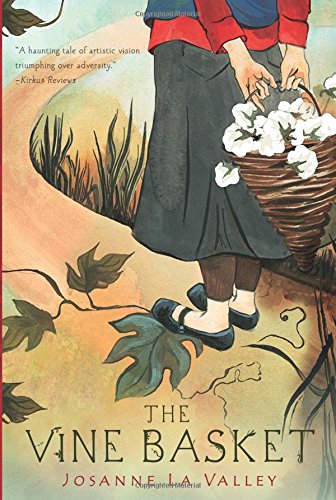
vine basket

While in the midst of moving from Knoxville to Birmingham nearly 4 years ago, a lady reached out to me telling me that a colleague of hers, also an author, was a follower and fan of my blog and had recently passed away, she asked if she could send me a copy of her friend’s books.  I agreed, not knowing what type of books the lady had written and didn’t think much of it.  In the chaos that is moving, I received the books and boxed them up and then unboxed them and vaguely remembered that they were about Muslims in China.  I put them in the to be read pile and just never got to them.  Then as the plight of the Uyghurs started to be known here in the US, something tickled my brain, but nothing came of it, until recently when I realized, a lady, a non Muslim years ago was trying to tell the Uyghur’s story, and had reached out to me, and I didn’t get it, and still wasn’t getting it.  So alas, I have now read the Vine Basket, and while it might not present Islam the way we are used to seeing it in life and in print, the characters do identify as Muslim and this middle grade book is a simply woven, beautiful story that gives voice to a population that is horrifically being silenced.  The AR 5.0, 252 page book is a quiet book that will stay with me: the drunken father, the threat of being sent to a factory, the loss of tradition;  I am so glad I read the book, and only wish I could reach out to the author to hear more about her knowledge of the region, of the people, of the culture that is being erased.

SYNOPSIS:

Mehrigul is 14, and since her older brother left, she has been forced to leave school to help her father sell goods in the marketplace.  More often than not though, it is solely Mehrigul’s responsibility as her father drinks and gambles away the meager earnings the family makes. Her mother, ashamed of the poverty the family endures along with some presumed mental illness and headaches, seeps further and further away from the reality of life and the chores that need to be done to ensure food and survival of the family.  Her younger sister is the only spark in a dreary and difficult life, and Mehrigul is determined that she should stay in school and be shielded from the darkness hanging over the family.

One day while in the market, an American woman approaches Mehrigul and asks to purchase a frivolous grape vine basket Mehrigul had made and hung to decorate the cart.  She offers her 100 yuan, more money than Mehrigul has ever seen, and asks her to make more baskets, and that she will be back in a month to purchase them. The basket serves no purpose like the willow baskets her grandfather weaves and despite the money, Mehrigul’s father is not happy.

Mehrigul is forbidden from making the baskets for the American, and the fact that she will even return is dismissed.  Her father grows increasingly cruel toward Mehrigul and keeps her busy to prevent her from making more.  Mehrigul seeks solace in her elderly infirm grandfather who tries to help her find inspiration and time to make her baskets as he sees in her a gift that has value in their old culture.  At one point as her father steals her baskets to take on a “religious” pilgrimage to the mountains.  And her planting crops in the fields leaves her hands cut and swollen, unable to make more with just days left before the American lady is due to return.

WHY I LIKE IT:

At first I was really uncomfortable with the idea of a white American savior coming to a dying oppressed culture to offer hope, until I read the afterwards and understood that much of the story was inspired by the author’s own experience and that she worked with Uyghur’s to get the story right.  The book reads like historical fiction which makes the day to day life of this modern book all the more heart breaking, it isn’t about the past it is the present, and life in East Turkestan is bleak.  I like the character of the father, he is an abusive mess, yet somehow it isn’t that easy to write him off, he has his own struggles and the depth of character I found in him, in a middle grades book, is haunting.  I also really like how Mehrigul’s story is so foreign to us here in America, yet her emotions and insights are universal and thus relatable.  She wants to find her place, and excel, and help her family, and she is scared, doesn’t know who to trust, and takes on more than most children any where should, but often are forced to do.

The characters identify as Muslim and as a people the Uyghurs are Muslim.  They say salam in the story, but only to the grandfather, and the girls all cover their hair with scarves.  The father obviously drinks and gambles, two practices, not permitted in Islam.  Mehrigul fastens a talisman and connects her prayers to it as a form of worship which I would imagine is cultural perhaps, and when things go awry she remarks she should have prayed to Allah swt.  The father goes on a pilgrimage to a mountain shrine, which again seems off from traditional Islam, but is presented in the book instead as odd because the father is not normally religious.  Islam is not a big part of the book, so it is hard to know if the representation of it are isolated to who the author met, or a larger norm of the community.  Considering how isolated and oppressed the Uyghurs are, I tried really hard to suspend judgement, or offer my privileged limited critique of the people.

FLAGS:

Drinking, gambling, abusive father, anger, lying, deception.

TOOLS FOR LEADING THE DISCUSSION:

I would consider this for a middle grades or even middle school book club, there is so much going on in China and in the erasing of Islam there that this book would supplement the news and few stories we are hearing.  It opens up the culture and gives it a face that is not political, but personal.  The faults of the father are not glorified at all, and the discussion about his desire to hold on to culture and fear about his daughter surpassing him would be fascinating to hear from people the protagonists age.

Khadijah and Cat: Ramadan is Here by Shamsa Ahmed illustrated by Afsaneh Bagherloo

Standard
Khadijah and Cat: Ramadan is Here by Shamsa Ahmed illustrated by Afsaneh Bagherloo

khad and cat

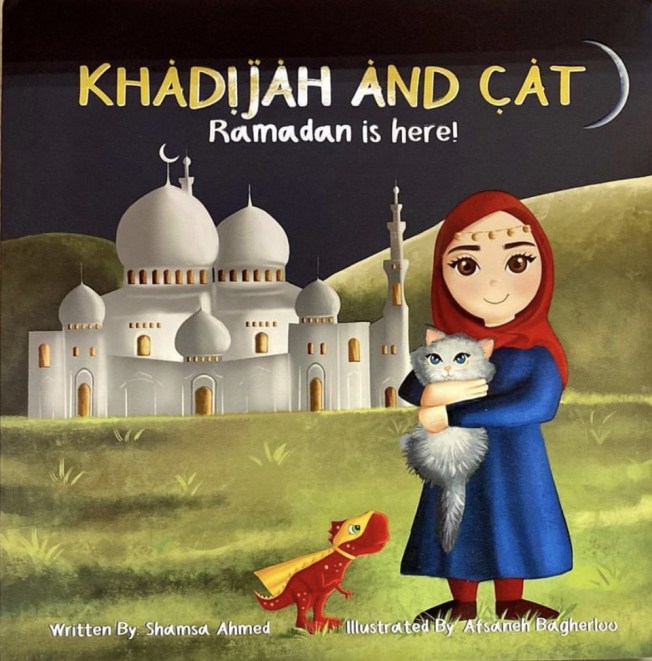
New this year in the Ramadan category is this gorgeous 40 page hardback book that mixes information about the blessed month with personable characters very well.  It stays on track without getting silly, even with a talking cat and a reoccurring super hero dinosaur, but I don’t understand the attempted rhyme scheme.  I’ve read the book over a dozen times trying to map it, and sometimes it is so natural that it makes reading it aloud smooth and lyrical, and sadly a few times it seems so forced that it makes the sentence nonsensical or awkward.  There is so much information, so beautifully paced and illustrated for children 4 and up, that I’m willing to overlook the few sentences that irked me to recommend this book for you and your children to enjoy this Ramadan.  Without a glossary though, it is probably best for Muslim children, or those with someone who can explain words such as: suhoor, iftar, adhan, SubhanAllah, dua, Allah, etc..

47EC69E5-532D-49CE-BA55-31787B8FF517

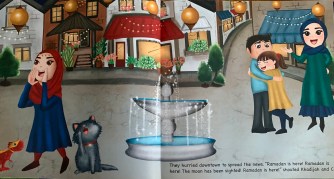
Khadijah and Cat are looking for the moon to know if it is the start of Ramadan, and once they find it, they rush to spread the news.  Immediately everyone starts decorating and celebrating and sharing delicious food.

663D21CA-B838-4CE3-8205-7CF1561B267E

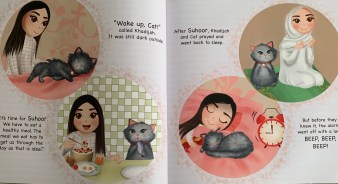
They then head home to sleep so they can wake up early for suhoor.  They make a point to eat something healthy to sustain them for the whole day, then they pray and go back to sleep.

87F8555A-229B-40B8-8FC3-EAC757057BFE

Cat wakes up ready to eat and is surprised that they have to wait until sunset before they can eat or drink anything.  Khadijah explains that Ramadan is a holy month and one of the five pillars of Islam.  The illustrations show the other pillars, but the explanation of Ramadan is a bit advanced with words such as regression, unpriviledged, compassion, and purifying.

CA7C44AE-AD4B-41EF-BBBF-0B802A42CCC9

The next page continues listing off what Khadijah and Cat are learning about Ramadan, as they spend time praying and reading the Holy Quran.  At the sound of the fourth Adhan they break their fast.  The names of the salat or that they pray five times a day is not mentioned, but lends itself to a great teaching point.

789953D0-E39D-4847-A274-F72BA6BC941A

They then pray and eat and take the neighbors some gifts.  Cat is convinced that the day was good and is ready for the next 30.  The last ten nights are identified as important and Laylat al Qadr is mentioned as being special, but it does not tell why they are unique.

1684103F-25CF-4E67-A13C-50A8D50FAF0D

Khadijah and Cat then invite you to fast and see why Ramadan is so special.  The end of the book has some questions, a Ramadan count down and a coloring page.  I was surprised that there was not a glossary as the Arabic words in the text are enlarged, and often not defined.

C1681A56-BE04-4CE0-917C-7A5F3DFA3F9C

I love the font and binding and horizontal 10 x 11.5 layout.  The illustrations are gorgeous and the details in the decor and Khadijah wearing hijab while out, but not at home are very well executed.  I’m not sure why the Meer-Rex is in the book, he is never identified or given attention, maybe in future books he will have more of a role, inshaAllah.

I ordered mine from Crescent Moon Store and received it within days of placing the order, thank you!

Once Upon an Eid: Stories of Hope and Joy by 15 Muslim Voices edited by S.K. Ali and Aisha Saeed

Standard
Once Upon an Eid: Stories of Hope and Joy by 15 Muslim Voices edited by S.K. Ali and Aisha Saeed

once upon an eid

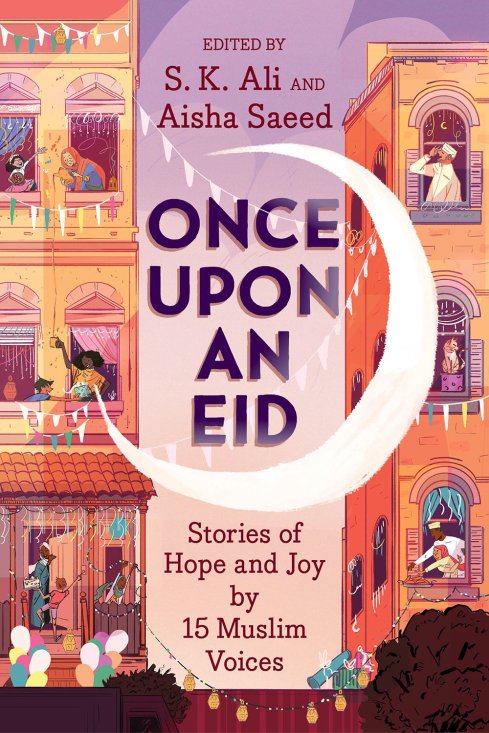
I’ve never been a huge fan of short stories, but this book has me reconsidering such an arrogant approach, as every single story in this collection has me feeling the warmth of Eid, the joy of authenticity, and the beauty of being a part of a faith with such strong female writers.  Fifteen entries for middle graders in mind: short stories, poetry, and even a graphic novel, spread over 304 pages that shine light on Eid in today’s world,  Eid al Fitr and Ramadan make up the bulk of the focus, but Eid al Adha and Hajj are in there too.  And the best part of the book is that you will see yourself in it, possibly all through out it, but reading such diverse OWN Voice stories are sure to make a Muslim reader feel represented and right at home, and give non Muslim’s a peek at us from the inside, inshaAllah.

SYNOPSIS:

I don’t know how to review the book as a whole since there really are 15 different stories, that are each heartfelt and strong in their own right and yet somehow made better by the company around them.  There were no weak links.  There are stories with bickering siblings, annoying cousins, different cultures, mixed background familes, divorced families, converts’ stories, stories of families where money is tight, stories with illness, stories of loss, a story from the perspective of a refugee, and stories of reaching out of your comfort zone.  There is one story about Eid al Adha and a story starring a Shi’a muslimah feeling different within Islam.  There are stories told from boys voices and girls voices and every single story has a take home message, some more subtle than others, but all there and all real.  I feel like even a summary of a story would prove a spoiler and take away from one just falling in to the collection and receiving the warm hug that awaits.   I’ll leave the summaries to their titles and well known authors to spark your curiousity.

Perfect: Jamilah Thompkins-Bigelow

Yusuf and the Great Big Brownie Mistake:  Aisha Saeed

Kareem Means Generous: Asmaa Hussein

Don’ut Break Tradition: S.K. Ali

Just Like Chest Armor: Candice Montgomery

Gifts: Rukhsana Khan

The Feast of Sacrifice: Hena Khan

Seraj Captures the Moon: G. Willow Wilson and Sara Alfageeh

Searching for Blue: N.H. Senzai

Creative Fixes: Ashley Franklin

Taste: Hanna Alkaf

Eid Pictures: Jamilah Thompkins-Bigelow

Not Only an Only: Huda Al-Marashi

Maya Madinah Chooses Joy: Ayesha Mattu

Eid and Pink Bubble Gum, Insha’Allah: Randa Abdel-Fattah

WHY I LIKE IT:

I recieved this book as an Advanced Reader (digital) copy and I am thinking I want a hard copy too, (I wasn’t able to view the artwork).  A lot of people ask me and I see postings in various social media groups asking for suggestions of books to read each night as a family in Ramadan, and I think this one would work for grades 3 and up.  Have each kid read the story throughout the day and then discuss in the evening.  Every story will have something that is familiar, probably something new, and each has a teachable moment.  I think different kids will identify with different aspects of the story and to articulate them in Ramadan will really bring the already memorable characters to life.

The book is very well done, and reads very smooth and cohesive, it really has a unified tempo and mood which is remarkable because so many different author’s and voices are included.  The book stays focused on the feeling rather than getting too weighted down by doctrine.  There are stories that feature hijab prominantly, and a bit of Prophet Muhammad (SAW), and some slight mention of islamaphobia, but it focuses on the friends and the love that support us, both Muslim and non, that make Eid and life hopeful.

FLAGS:

Clean

TOOLS FOR LEADING THE DISCUSSION:

I would consider this as a book club book to be hosted just as I hope to do this Ramadan with my own children in my home (see above).  I think really I just want to buy a bunch of copies to give as gifts to the fabulous elementary aged children I know, alhumdulillah.

Eid Breakfast at Abuela’s by Mariam Saad illustrated by Chaymaa Sobhy

Standard
Eid Breakfast at Abuela’s by Mariam Saad illustrated by Chaymaa Sobhy

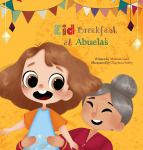
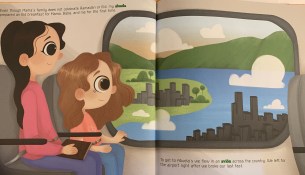
breakfastThis book is the first in a series (hopefully) called Trilingual Sofia, where English is the predominant language, and Spanish and Arabic are interwoven to tell the story.  Focusing on Eid and spending the holiday in Mexico with her non Muslim grandmother, the story with bright illustrations is a celebration of diversity, acceptance, family, and Eid.
DBFF1967-9421-47C8-B88C-4AAF8703E31F

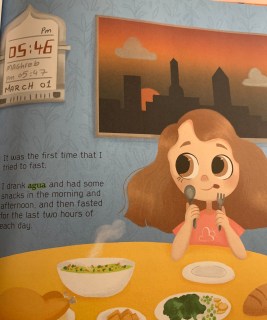
Sofia has had a special Ramadan.  She tried fasting for the first time and now that the month is over, they are breaking their fast and then getting on a plane to Mexico to have Eid breakfast with her Abuela.

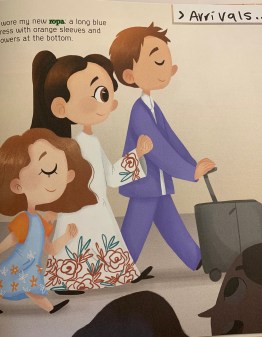
On the plane she keeps her pretzel bag to add to her scrapbook and then they get changed into their Eid clothes before they land.  Once in Mexico they go straight to the mosque to meet their friends and then to Abuela’s house.

2CA2CEE1-B699-4E8E-A829-C25E3E313FBC

Abuela’s house is decorated for Eid and all the family is there.  They eat breakfast together and the kids play games and sing songs and take pictures.

084D716E-6D5D-448E-A580-95E48C73FDD0

The 32 page 8.5 by 8.5 inch hardback book claims to be for toddles and preschoolers, but I think it is more for kids in early elementary with the small and ample text.  The Spanish words are highlighted in green and Sofia teaches some Arabic to her Mexican cousins.  There is a glossary of all three languages at the end.  

0DA1427C-192E-4E78-B3DE-A564B98A4327

The book is not meant only for Muslim children, but it doesn’t explain Ramadan or Eid, so while Muslim’s might be able to connect the dots of why she only fasted the last two hours of a day or why they went to the mosque before they went to Abuela’s, I wish the book explained it.

00BE02BE-79D1-4753-BA92-A48C7311B4C3

I love that their are subtle connections between the three languages, like Angel Gabriel/Jibreel and the name Yusuf/Joseph.  The book is a great example of Islam outside of the Middle East and the Asian subcontinent and I truly hope there are more books in this series and more books like it to show the diversity of Islam and the commonalities we all share.

The Little Green Drummer by Taghreed Najjar retuld by Lucy Coats illustrated by Hassan Manasrah

Standard


A485FA5B-6839-4720-9E5B-BA2D9AB71901

This book is perfect for early readers that are more fluent than picture books, but not quite ready for a full on chapter book.  With five chapters, pictures on every one of its 73 pages, this book is a joy to read both on your own or out loud to a group.  It is fun for Muslim children and non Muslim kids, and a great addition to bedtime or story time at Ramadan, or any other time of the year for that matter.

3BC30F96-8F88-48D3-8963-99E9EFA5BE44

SYNOPSIS:

Samia and her Yaba live in Lifta, Palestine and her dad’s job in the month of Ramadan is is to wake the whole village up as the dawn waker-upper.  Samia loves his important job, and hopes one day to do it too, but her dad says a girl has never done it before.  Samia doesn’t understand why, girls can shout and bang drums as well as anyone else.

The day before the start of Ramadan, Yaba is not feeling well and doesn’t know what he will do.  Samia sees her chance and says she can do it.  Her drum is loud, her lantern is bright, and her dog, Barkie, will keep the wild wolves away.

As she sets out in the dark, she sees orange scary eyes in the woods and sings a song to herself to keep her brave as Barkie defends her.  When she gets to the first house, they are surprised to see her, but the children of the home rush out to join her with their own drums.  When the three children and Barkie get to the next house, their friend Omar wants to join in with his tambourine.  This continues as the village children join together with whatever instruments, even pots and pans, they have to make sure everyone gets up in time for suhoor.  For five is louder than four, all the way up to nine being the loudest of all.

The children all sing and the villagers reward them with candy and treats.  On the way back home the wolves stay away and when they reach home Samia’s dad is feeling better and can’t wait to hear of her adventure.

44520351-F7CC-4FAA-A643-936E6858FD73

WHY I LIKE IT:

The book is based in truth which is detailed at the end of the story on three pages that tell about Lifta, and how after a war the people were not able to return.  It also tells about Ramadan as the story text itselft mentions it very little.  Yes, it takes place in Ramadan, and the people need to be woken up to eat before the day starts to fast, but the afterword gives a bit more about the holiday and Eid that follows.

I love that the book is about a girl doing something because she can, I was afraid it was going to be like Hiba Masood’s Drummer Girl, but it takes a different turn in showing Samia having to be brave, showing team work and cooperation in getting the job done, and the village not even really caring who wakes them up, her being a girl doing a “man’s job” is never even mentioned again.

The book is fun with the sound effects and inclusion of everyone and the illustrations are incredibly well done.

8A2F6DC8-8573-46E1-8CD0-364E46DDB1AC

FLAGS:

The book is clean, the “scary part” is quick and while it adds a little tension, not enough to scare even sensitive little ones.  The dog stands his ground and becomes the Dog King of the Village.

A658F1B7-5975-42C1-822A-90F652CA668D

TOOLS FOR LEADING THE DISCUSSION:

I’m trying to see if I can do this as an online story time during Ramadan amid Covid 19.  It is a super quick read, and is a lot of fun, but the small (8×5) size might make the pictures hard to see.  I think all kg through 2nd grade classes should have this story.  It explains a cultural celebration of Ramadan in a universal way that will make Muslims feel proud and non Muslims excited to learn about something new.

5871BBBF-1802-4A33-A387-A9B3C91020F6


You Must Be Layla by Yassmin Abdel-Magied

Standard
You Must Be Layla by Yassmin Abdel-Magied

layla

This OWN story, upper middle grades book, is heavy on the pop culture, relatable on the Islamic family presentation and honest in its portrayal of Islamaphobia, yet somehow the tidiness in which everything wrapped up seemed too forced and a bit flat.  At 293 pages, including a three page glossary, the book is a quick read meant mainly for girls.  It involves robotics, academic achievement, and invention, while also discussing crushes, a character coming out to his family and friends, and mention of girls not praying at certain times of the month.

SYNOPSIS:

Layla lives in Australia and goes to the Islamic School of Brisbane. Her Sudanese family: older brother, younger twin brothers, and parents, her Doctor mom and medical machine tech dad, are active Muslims and proud of their culture.  They assimilate to Australian norms in varying degrees, but with all the kids at ISB, Layla doesn’t feel all that different in her school and social life.  Unfortunately she wants more, she wants to be an adventurer, and when she meets Adam over the break and learns about the various opportunities he has it his school, Layla decides she wants to prove herself on a larger stage.  Going in to “shut down” mode Layla has tunnel vision to ace the scholarship and entrance exam and go to a new school.

She gets in to Mary Maxmillion Grammar School and when she goes to meet the board they let her know that the decision to accept a girl like her was not unanimous.  Layla is an immigrant, she is black, she wears hijab, she is loud and proud, and apparently very smart, but as one trustee asks, is she brave?  On the first day of school she arrives late to first period, insults the teacher repeatedly and also makes friends with a group of slightly diverse boys.  At the end of the day however, Peter, a boy who had insulted her earlier, reinforces his disapproval of her being allowed at their school and pushes her.  Standing her ground, she verbal attacks and then head butts the boy in front of a large portion of the school at dismissal.  No one offers any help, nor speaks up when she is suspended for a week, her scholarship and admission put on probation, no one even asks for her side of the story, Peter, is let off completely free, as he is also the son of the Board Chairman.

Layla decides to prove she belongs at the school she is going to win a prestigious robotics competition and since everyone already is on a team, she decides to go for it solo.  The only problem, is she doesn’t know what to invent.  When she returns to school, her friend that she is crushing hard on is acting weird, and she gets caught up in a lie of sorts that serves as both the idea and silliness turned cleverness of the book.  While choking on gummy worms, she says she is working on an edible actuator for her robot, and somehow has to make that come to fruition.

The rest of the book is Layla making a lot of silly errors of judgement: missing classes being in SD mode in the workshop, forgetting to file the paperwork and registration to actually compete in the competition, and leads up to the resolution between her and Peter, learning her crush is gay, and deciding to be herself and proud of it.

WHY I LIKE IT:

I actually like the majority of the book, I really like how Islam is presented and lived.  They pray and say salam and cover, and recite tasbeeha to reflect, and quote hadith very naturally, even how others attack them, and the anger that Layla’s brother Ozzie feels at his inability to get a part time job reads and feels very authentic.  I also like how one of the teacher’s own experience as being a descendant of the forgotten generation and being a first nations ethnicity is woven in.  I felt the side character being gay was added and forced in as an after thought and I don’t know why, as it didn’t show Layla to be a particularly good friend.  She handled his coming out well, but when he was miserable she was wrapped up in her own stuff and didn’t reach out very well, even though he ended up being the spark for her invention.  Her friend at ISB is also an under developed character, that while I get is used to show another side of Layla, in many ways also showed her to be a rather poor friend.

I found the pop culture references annoying, not in and of themselves, but in knowing that they will date and make the book irrelevant in a few short years.  There is a lot of repetition of phrases and ideas that a few times when I put the book down I struggled to re-find my place (I know bookmarks, right?) but certain refrains and paragraphs seem so very similar.  I

There is a lot of good information about Sudan and their food and culture and traditions.  There is also a decent amount about Muslims in Australia.  I like that even within her family there are different views on how much to assimilate, and how much to fight back against perceptions, the fact that there is a lot of gray makes non Muslims and non immigrants reading the book hopefully realize how diverse all people are and to not assume anyone is only one way.  I would have liked more about Layla’s mom and being recruited to come to Australia, and how she was perceived at work, by patients and colleagues.  I also would have liked some sort of resolution about Ozzie and his job search.  Really though my biggest complaint is Layla, herself.  What does it even mean to want to be an adventurer? I like that she is fallible and human and in some ways she does grow, but I felt like her being smart and a go-getter is the foundation of the story, but that she didn’t seem to have much common sense seems a bit off.  Yes she is loud and funny and puts in hard work, but the way she talks to teachers, and misses classes and deadlines, and behaves seems like a disconnect from the pages constantly telling me how smart she is.  To me, part of being smart is knowing when to lash out and when to listen, I don’t feel like her growth arc was all that great, in a nut shell, she changed schools and confronted a bully, that is the story, while not a bad story, it could have been so much more.

FLAGS:

There is crushing, violence, a gay character, mention of alcohol at a party Layla didn’t attend, talk of hooking up in passing and some language.  There is lying but it is acknowledged guiltily, and not familiar with Australian slang, regular use of the phrase, Janey Mack, which according to google is a replacement for Jesus Christ.

TOOLS FOR LEADING THE DISCUSSION:

I don’t know why I wouldn’t use this book as a book club selection.  It just didn’t strike me as something they would benefit from.  I wouldn’t be opposed to someone picking it up and reading it in my house, but I doubt I’ll recommend it to my daughter and she is the ideal reader: she wears hijab, is in 8th grade at an Islamic school, and loves to read.  The book is really not memorable as good or bad, it just fell flat and I doubt I’ll read it again, luckily it only took two sittings to read, so I don’t feel like it was a waste of time, but seeing as I had to pay cover price and international shipping, I kind of regret rushing to buy it.

Teacher guide: https://www.penguin.com.au/content/resources/TR_YouMustBeLayla.pdf

Tasting the Sky: A Palestinian Childhood by Ibtisam Barakat

Standard
Tasting the Sky: A Palestinian Childhood by Ibtisam Barakat

tasting the sky

This memoir may qualify as non fiction, but the majority of this 176 page book is told from the perspective of the author when she was three years old, so much of it reads to me as somewhere between historical fiction and autobiography.  No matter how you categorize it though, this AR 5.8 book is better suited for middle school and up. I love that this is is a Palestinian perspective of the Six-Day War and the immediate aftermath, but after reading it, I’m not haunted by the atrocities of the Israeli occupation so much as, some of the choices her family made.  I got my copy through Scholastic and in excitement, purchased multiple copies that I sadly think will sit in a box as I doubt I’ll find many students that will enjoy this book.

SYNOPSIS:

The book is divided into three parts with the first and third being short letters written in 1981, and the second part being the majority of the story taking place between 1967-1971.

The first part is a high school Ibtisam getting detained at a checkpoint after heading out to check a PO Box that she uses to keep in touch with her pen pals from around the world.  She reveals what life is like and shares the joy of learning about the outside world from her correspondence, but that she rarely talks about her childhood and her life during the war.  Part two is her sharing that.

The Barakat family lives removed from neighbors and a city, but Ibtisam loves her two older brothers and younger sister and at three years old is happy.  When war comes, the family decides to run, in the process Ibtisam doesn’t have time to find a shoe, and then she gets separated from her family and swept up with the people running for the caves to escape the bombings.  Once reunited with her family, they along with numerous other Palestinians make their way to Jordan and some safety.  Safety comes at a cost though and the family is separated as her father leaves to find work.  When the war ends, the family moves from the shelter and finds a small room to rent until they can return home.

Once the family returns home, things do not return to normal as the Israeli army begins training near their house causing Ibtisam’s mom to worry constantly in her attempts to keep the children inside and away from the windows.  Eventually, the mom takes the children and herself to an orphanage in Jerusalem saying that their father cannot keep them safe.  Ibtisam is close to her father and this dramatic change does not sit well with her.

In the orphanage, the boys get separated from the girls and eventually their father promises the mother to build a wall and make repairs to the home and purchase a goat if they come home.  They do, and the kids are grateful to be together again.  The boys then start school and the goat has a baby and life carries on.   Ibtisam grows close to the baby goat and their father promises that he will remain the children’s pet and will not be slaughtered.  But, when the boys are 8 and 9 they get circumcised and the feast involves the goat.

The next major event in young Ibtisam’s life is when she finally gets to go to school.  Incredibly smart, her mother essentially equates her love for her daughter with her success in school and with that motivation and predisposition to learn and excel, she does very well.  One day on the way home, she is sexually assaulted by an older boy, and makes arrangements to always have her brothers with her when walking.  Her parents are not made aware of the offense, and don’t seem to investigate Ibtisam’s change in attitude toward school.  When an Israeli soldier attempts to assault her mother, the family moves once again and part three is a teenage Ibtisam quarreling with her parents and once again excelling at school.

WHY I LIKE IT:

I like that tidbits of memories are woven together to give an overall impression of the author’s childhood.  The book is a quick read and is compelling enough to hold one’s attention.  The family is culturally religious, but the book makes a point that the father prays, not indicating that the rest of them do or even know how.  I love how the freedom and hope that Ibtisam has comes from learning the first letter of the Arabic alphabet, alef.  The love of language and the power found in reading and writing, is celebrated in its reverence to the learning of the letters.

I don’t get the mother, and while I get that war is a horrific time, and she is 24 when Ibtisam is 3 and has like four kids, so her life is definitely not easy, I still find it disturbing to me that she would lose a one shoe-ed daughter, take her kids to an orphanage to live while both parents are alive and well, and be so cold to her daughter.  The father seems to be loving to the kids, but he still slaughtered their pet, and I’m guessing culturally circumcisions are done at that age, because that seems incredibly cruel.

FLAGS:

War, loss, sexual assault, details about the circumcisions.

TOOLS FOR LEADING THE DISCUSSION:

I won’t do the book as a book club selection and while I know the book is in many libraries and classrooms I doubt many kids would be compelled to pick it up and read it based on the cover and synopsis on the back.  I have a few Palestinian friends that I will ask to read the book to see if they find it an accurate representative of life during the six-day war and even today as it could definitely be used to teach about the region, the conflict, and writing a biography about life for others to learn from.


My Great-Grandmother’s Gourd by Cristina Kessler illustrated by Walter Lyon Krudop

Standard
My Great-Grandmother’s Gourd by Cristina Kessler illustrated by Walter Lyon Krudop

gourd
A beautiful story based on a true event in Sudan, this 32 page AR 4.2 book contains lessons about tradition, new technology, village life, culture, family, love, and community.  Unfortunately it is one of those books that I doubt any child would pick up and want to read.  Meant for fourth graders, there is a lot of text on each page, and the story is not quick and light, it is thoughtful and memorable. The book is a powerful one in opening one’s eyes to a different culture, environmental challenges, and innovations making it an important one for parents and teachers to share with younger children and encourage older ones to spend some time with.

8A5303D5-525F-4D37-A886-F22F18D0FE0B

Fatima’s Sudanese village has just installed a new pump, and to show how easy it is to use, Fatima is chosen to try it out first.  With all the excitement over new technology, life for the village is about to get easier.  No more hauling the water with camels and filling the baobab trees to store the water in for the dry season.

104E36DC-E27A-47BB-8C4C-A510198CE604

Easier for everyone except Fatima’s grandmother.  She refuses to abandon the methods of the past so easily, and independently begins to prepare her tree, her great-grandmother’s gourd.  Fatima tries to talk her out of it, and the other villagers mock her refusal to accept technology.

DCB3DBD3-7EC3-4631-9A9D-EC34DE46055F

When Fatima hears the neighbor louder than the call to prayer calling her grandmother a fool and laughing at her, Fatima boldly and defiantly joins her grandmother in preparing the tree for when the rains come.

84F665EB-EFD6-49A6-BFDA-FF348CD80D00

The two dig a circle, a necklace, around the old tree to catch the water in the hard red clay, when the rains come, it catches the water, and when it stops, the two move the water to the inside of the tree with buckets. All the while, the villagers shake their heads at the two hard at work.

56BA11B5-7314-4D88-BDAA-50FE61765467

When, in the middle of the dry season, the pump breaks and it will be days before it can be repaired, the chief, Ibrahim, declares they must resort back to the old ways and Fatima and her grandma offer to share their water to hold everyone over.  “Maybe it’s wise to mix old with the new,” Grandma poignantly notes.  The following year the village works together to prepare the trees, just in case the pump breaks.

E4443445-EDEA-4C9C-99E4-4BE6AFB96C1A

There is a glossary of Arabic Words at the beginning of the book and an Author’s note about the “Thirst Triangle” and the use of the baobabs or tabaldi trees used to store water.

F429299A-BFD4-4BCC-9DA4-134FEAF09E4F

There is nothing overtly religious in this culturally rich story.  The women cover their head, they say “inshaAllah,” the call to prayer is mentioned and they have Islamic names: Fatima, Ibrahim, Musa, Ahmed, Ali, Osman etc..

The Candle and the Flame by Nafiza Azad

Standard
The Candle and the Flame by Nafiza Azad

flame

It takes about 124 pages to be swept away to the city of Noor, but once it happens, it is hard to come back.  The 391 page fantasy story takes a while to get going, but the character driven plot filled with amazingly strong and diverse women is worth the slow start.  Middle school readers and up (AR 5.8) will enjoy the blend of Islamic imagery, sub-continent Asian culture, fire, Ifrits, Djinn, family, relate-ablity and good quality story telling.  The fact that it is a main stream book, with so much religion and culture makes it all the more remarkable in its universal appeal.

SYNOPSIS:

Fatima is a Muslim girl adopted by a Hindu family, only everyone in the entire city was killed eight years ago except for Fatima, her adopted sister, and an elderly lady, when the Shayateen attacked.  The orderly Ifrit were asked to defeat the Shayateen and protect the city, and when they did, the wealthy returned along with people from other cities.  Thus Noor is now a vibrant city of different backgrounds, cultures, religions, and languages repopulated and ruled in halves by the Maharaja, Aarush and Ifrit Emir, Zulfikar.

Fatima works as a messenger and her favorite place to deliver packages to is an old book shop owned by Firdaus, an Ifrit she regards as a fatherly figure.  He has taught her languages and provides her a place to learn and grow.  When he dies in front of Fatima, she is forever changed, literally, he transfers his powers to her, and she is now not only part human, part Ifrit, but also the Name Giver, an incredibly powerful and important being in bringing the smokeless Djinn from their wold to her hers.

With rebel forces threatening the Maharaja’s rule, Ghul and Shayateen entering the city, a taint threatening the leader of the Ifrit, a traitor in each palace, and a budding romance between Fatima and Zulfiqar, the characters pull you in and create an enjoyable story that is vivid, fantastic, and hard to put down.

WHY I LIKE IT:

The story doesn’t have a neat and tidy plot culminating in a climax, but the character arcs and vivid world building pull you in and keep you interested.  I love that the characters are different and complex and unique, and that women are so so strong and celebrated for their strength in all spheres, not at the expense of the males, but solidly in their own right.  It is refreshing and glorious to see the matriarchal Ifrit world contrasted with the human world, and the strong females that emerge in both.

I love that there is so much diversity and tolerance and the book doesn’t shy away from presenting faith practices and acceptance in such an honest manner.  There is a four page glossary and it is needed, yet not overwhelming at the same time.  The most read page in the book for me however, was the Dramatis Personae page listing the characters.  Until that 124 page mark, I was constantly flipping back trying to keep everyone straight, not so much because the characters are confusing, but “what” they are took a little while to stick.

I got sucked in by this book truly, I ignored my children during our Corona virus quarantine one day to read the second half, and I don’t regret it one bit.  The romance, was a bit cheesy at the end, but it was clean, and sweet and presented as a way forward, not as a settling or sacrificing choice for either character which was greatly appreciated.

FLAGS:

There are a few kisses once the two main characters are married.  There is stalking and attempted sexual assault by a character, but Fatima more than took care of that with the support of many strong females.  There is mention of a homosexual relationship, but not dwelled on, and I think one could argue that there is  possibly something more going on between two of the females, but it isn’t explored.  There is death and killing and violence, but nothing extreme.

TOOLS FOR LEADING THE DISCUSSION:

I had hoped to sneak this in for book club next month, but with school closed indefinitely, it might have to wait until next year. I think girls will gravitate more to it than boys, but I think that is ok, because often girls need more of a nudge, in my experience, to give fantasy a try.  I am trying to convince my daughter to read it, but the first 100 pages are pretty slow, so if I can’t force her through it, I don’t know what chance I’ll have, here’s hoping.

NPR Review: https://www.npr.org/2019/05/18/724120066/language-has-magic-in-the-candle-and-the-flame

Interview with Nafiza Azad and Hafsah Faizal (We Hunt the Flame) https://www.slj.com/?detailStory=hafsah-faizal-and-nafiza-azad-interview