Category Archives: strong women

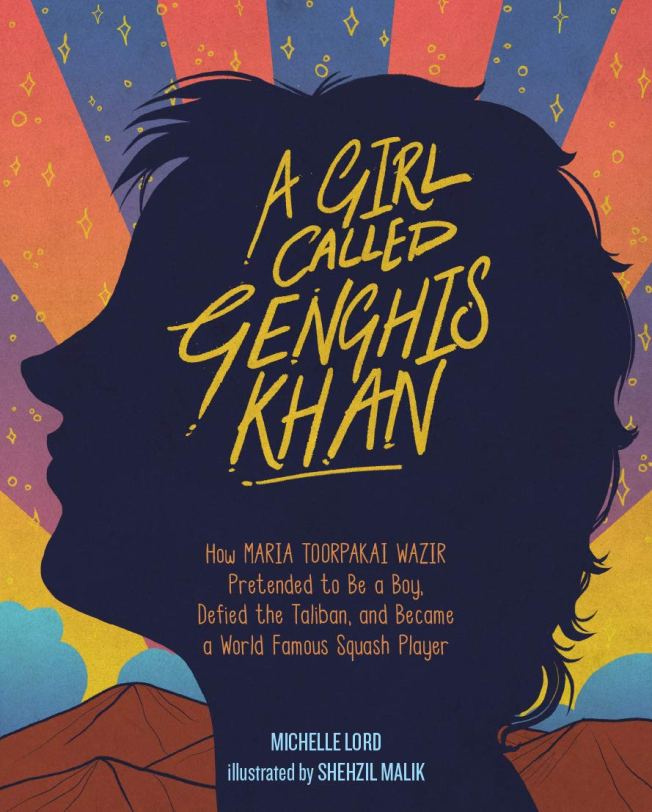
A Girl Called Genghis Khan: How Maria Toorpakai Wazir Pretended to Be a Boy, Defied the Taliban, and Became a World Famous Squash Player by Michelle Lord illustrated by Shehzil Malik

Standard
A Girl Called Genghis Khan: How Maria Toorpakai Wazir Pretended to Be a Boy, Defied the Taliban, and Became a World Famous Squash Player by Michelle Lord illustrated by Shehzil Malik

maria

This children’s biography of Maria Toorpakai Wazir, Pakistan’s world famous squash player, is simplified and suitable for children 2nd grade and up.  At 42 pages with bright illustrations older kids will understand a little bit more about the cultural norms that were being oppressive and the strength and risks Maria took to play a sport she loved and defy the Taliban while disguising herself as a boy. Younger children will probably only get her determination and perseverance, which is impressive in its own right.

C9A2CED0-B2A4-43F9-942A-B5A32B0B7E9C

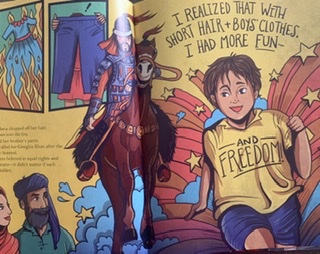
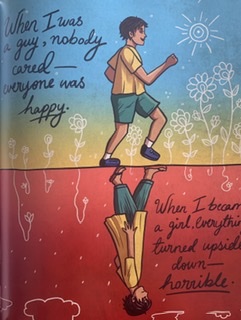
In 1990, Maria was born in the mountains of the Tribal Areas in Pakistan.  Conservative society and strict gender roles amplified by the control of the Taliban in 2001.  Maria’s parents supported rights for their sons and daughters, and allowed Maria to cut her hair, dress like a boy, and play sports.

9C7E2AE9-5668-48C6-8E41-304F1583B644

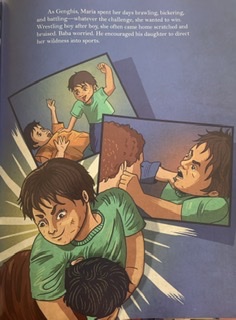
Her father called her Ghenghis Khan after the great warrior and when the family moved to the city of Peshawar he even introduced her as his son to people.  As Ghenghis, Maria was always picking fights and encouraged instead to play sports to channel her wildness.

2FB5AF13-2468-44A6-ACD2-1A118F69F9C6

She fell in love with the game of squash, and when she went to join the Squash Club she had to submit her birth certificate which revealed that she was a girl.  The director let her join the club, as the only girl among 400 boys.  But now her secret was out.

713C71CE-338C-4241-BD6F-05091868E560

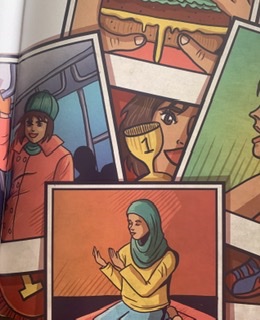
She was bullied and her family ridiculed, but she kept playing and kept winning.  The President of Pakistan awarded her honors for her outstanding achievements, but that infuriated the Taliban and they threatened her family.

FF2A709B-F539-44B0-92FB-48C336C2213B

As a result Maria had to hide, and would practice at night, in secret, and for 3 years she played against the wall in her bedroom.  Appealing to squash clubs around the world for help, she finally heard from Jonathon Power in Canada, willing to help her get away from the Taliban and be able to play.

3915AD01-442F-4473-9571-9D798C8B1389

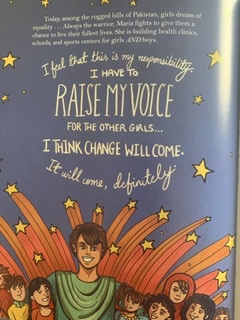
She left behind everything she knew at 20 years old to train in Toronto.  She still represented Pakistan in tournaments.  She studied, she prayed, she succeeded.  She now is back in Pakistan establishing health clinics, sports clubs, and schools for girls and boys.

The story is inspirational, and well told, it shows how culture limited her, not religion, and that in a larger city, culture was a little less conservative.  Muslim and non Muslim children will be inspired by her efforts, her willingness to look like a boy and her determination to excel.  Muslim kids will enjoy that it shows her praying, but might be surprised to see her in shorts and tank tops.  The book would be a great conversation starter about women’s rights and how it isn’t just in Pakistan that women struggle to have equal opportunity and respect.  It also might many children’s first exposure to the sport of squash.

138B3D8B-B868-437B-B7C8-5674879B81DA

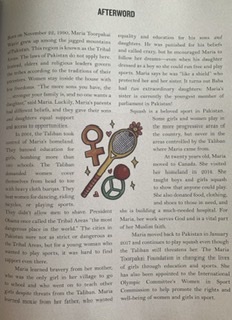
There is an afterward at the end with more information.  A list of additional reading about other inspirational women, a selected bibliography and a highlight timeline of female firsts in sports.


Poe Won’t Go by Kelly DiPucchio illustrated by Zachariah Ohora

Standard
Poe Won’t Go by Kelly DiPucchio illustrated by Zachariah Ohora

poe

This silly book has an abrupt ending, but plenty of giggles along the way that make you forgive the sudden conclusion.  Additionally there is a lot of diversity in the illustrations, a little hijabi girl of color that steals the show, and a lesson about asking and listening that children 4-7 will find sweet and enjoyable.  It is an AR 2.5 and has 36 pages.  Some are text heavy, but my 4 year old had no problem sitting through it with the silly pictures and large 9 x 11.5 size.

383F79FA-EB31-4C0B-B305-BF7F3CDE9759

Poe is an elephant that has planted himself in the middle of the only road in Prickly Valley.  The citizens do everything they can think of to get him to move.  They honk, write him a ticket, bang pots and pans, play trombones, blast megaphones, tickle, beg, and bribe.  They even bring in mice, and magnets, and motivational speakers.  Clowns and copters, cranes and pastors, magicians and the mayor, no one can get him to move.

5376BF1C-4727-4160-8C52-6F360EE19055

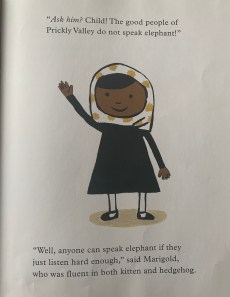
After lots of discussions involving coffee in stryrofoam cups, a little girl named Marigold, asks the mayor if anyone has asked Poe.  Such an obvious suggestion, the Mayor laughs and says she doesn’t speak elephant.  Little hijabi Marigold says, “anyone can speak elephant if they just listen hard enough.”  She is also fluent in kitten and hedgehog.

C34B829A-CA57-4C1F-94B8-ACD7258CE1F0

Marigold discovers that Poe is waiting for a friend that is very late.  A reporter asks if the friend could be wearing a polka-dot-tie, it is determined that it is possible and that also perhaps he is sitting on his friend. At that Poe stands up, finds his friend Mo and the two walk off.

The randomness of Poe sitting on his friend made me have to read the story a few times checking to see if a page was missing or stuck together, but alas no, it just suddenly is resolved and ends with no clues indicating that the elephant is sitting on a monkey.

6FDD18F5-94B3-45FA-9A15-C1299B318EEF

I love that the name in the text for the little girl is Marigold, and that the illustrator chose to depict her as a little Muslim girl of color.  On many of the other pages with the town folk trying to move the elephant, there are people of all colors, body shapes, hairstyles, head gear, eye wear, facial hair, body art, etc shown.  Marigold seems to be at work with her father at their flower shop, and the mayor is a female.

397E7902-B48D-4C1F-982E-F090955F9258

There is nothing religious in the book, save a pastor trying to persuade the elephant to get behind him, and it doesn’t appear that the author or illustrator are Muslim (it is published by Disney Hyperion) which in someways makes the normalizing of a girl in hijab all the more sweeter.  Sure, someone her age wouldn’t be required to cover, but the message and representation is deliberate and appreciated.

The Day Saida Arrived by Susana Gómez Redondo illustrated by Sonja Wimmer translated by Lawrence Schimel

Standard
The Day Saida Arrived by Susana Gómez Redondo illustrated by Sonja Wimmer translated by Lawrence Schimel

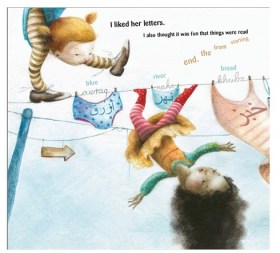
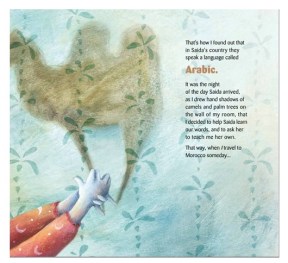
saidaThis absolutely gorgeous lyrical book will sweep you up and hold you tight as you imagine a world where more people take the time to get to know one another through the power and beauty of language.  Over 32 pages that are exquisitely and whimsically illustrated the words dance and come to life in English and Arabic as a friendship is formed.  Perfect for preschool through 3rd graders, older children and adults alike will be softened by the kindness and example shown between two little girls.
saida1

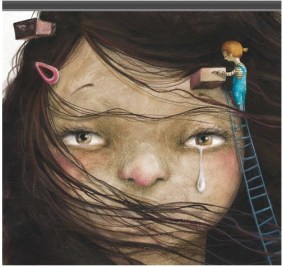
Told from the perspective of a little girl that meets a new girl in school named Saida and decides right away that they are going to be friends.  Unfortunately Saida speaks only Arabic, and the little girl only English.

saida2

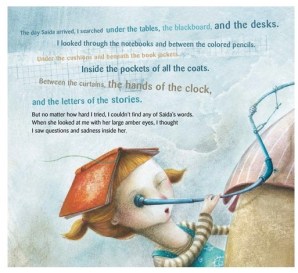
But it is no problem, because the little girl is going to help Saida find her words.  She is going to look everywhere to let her get rid of her tears and throw away her silence.  So that she doesn’t see questions and sadness locked up in her.

saida4

That night at home, the little girl’s parents tell her about Morocco and find it on the globe.  They explain that Saida’s words don’t work here and that her words wouldn’t work in Morocco.

saida5

Undeterred the two girls start teaching each other words in their languages.  Some stick, some float away, but the two learn and communicate and connect. They find friendship in learning each other’s words.

They recite a poem by Jacqueline Woodson and tells stories about Marrakesh. The two girls plan to travel the world together. The book concludes with both alphabets shared and the reader wishing to join the little girls on their adventures.

saida 3

I was blown away by the presentation of the book and the feeling of compassion and cultural appreciation depicted.  Such a beautiful approach to welcoming someone different in to your life.

There is nothing Islamic or religious in the book, or really even cultural, aside from language.

No True Believers by Rabiah York Lumbard

Standard
No True Believers by Rabiah York Lumbard

believers

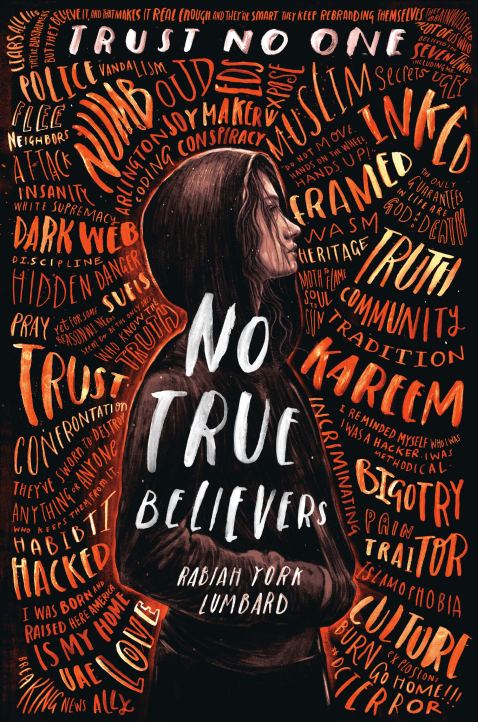
This YA Fiction book by a Muslim author filled with many Muslim characters has a lot going for it, and while I didn’t love it, and felt that it was trying to do too much in 304 pages, I think most early high school readers will enjoy the cyber hacking plot, the islamaphobia and white supremacy themes that keep the book fast paced, relatable and timely.  The main character is a Muslim and has a Muslim boyfriend and all family members are fine with it, she also gets a tattoo with her mother’s permission and breaks the law, but usually with worthy motives.

SYNOPSIS:

Salma Bakkioui is the high school aged daughter of a North African father and convert mother.  They go to the mosque a few times a year, but don’t really practice, it is more heritage than actual intentional praying five times a day, yet somehow ayats from the Quran and hadith do float in and out of the story.  It is Ramadan, and the Muslims in the book are fasting except for Salma, who suffers from EDS (Ehlers-Danlos Syndrome) a connective tissue disorder, her best friend Mariam, who lived next door has just moved away because her father’s chiropractic business was failing due to racism and Islamaphobia.  Salma tried to use her hacker skills to send him more business, but ultimately they moved to the UAE.  Amir, the supportive boyfriend, oud player, and fellow Edward Norton fan is steady and good and constant.  As are her partying friend Vanessa, her physical therapist and her daughter, unfortunately, things are about to get really crazy, really fast.

When Salma and Amir go over to meet the new neighbors that have moved in to Mariam’s old house the blaring TV broadcasts a terrorist bombing nearby in DC.  The neighbors seem nice, but something is off about them, and Salma can’t quite figure it out.  From the dad and son’s matching number tattoos, the mom’s nervous behavior, and snippets of overheard conversations, it becomes apparent that something infact fishy is going on.  Salma and her younger siblings start getting bullied by classmates, and teachers and administrators turn a blind eye, cops interrogate Salma at school, and illegal snooping on the dark web reveal that the neighbors aren’t as innocent as they claim. As more and more is uncovered about the neighbors, Salma learns that she better have a plan to get out, as she is about to be framed for a lot of destruction as the new face of Islamic extremism.

WHY I LIKE IT:

I like that Salma is relevant and relatable, and while I know a lot about her family and friends, and illness, for some reason I don’t feel invested in her, and I am totally willing to conceded that that is on me, and others would really identify with her, but for some reason as much as I wanted to connect with her, I didn’t.  The supporting cast is fairly fleshed out, I’m not entirely sure why Dora and Boots are highlighted so much and I didn’t feel a tug on the emotional heartstrings of Mariam leaving, of Amir leaving, of Salma possibly saying good-bye.  I felt like even Salma and Amir being a couple and being connected through Edward Norton and Fight Club was a bit forced.  I didn’t feel it was organic or natural, it was almost like the author was trying to make a point of Muslim youth having relationships, and finding imams that were ok with tattoos. Rather than it being a plot point it seemed like it was trying to voice the author’s perspective whether it fit smoothly into the storyline or not.

I do like the tech and and the parallels between extremism whether Islamic or Christian, foreign or domestic, that drove the action of the book.  The unraveling of pieces and connections seemed a bit rushed, with unnecessary tangents affecting the pacing overall of the book, but at least there were answers to help it all make sense at the end, and make the story feel complete.

Having never written a book, I don’t know if some of the hiccups are first novel related, but I really hope the author keeps writing and keeps changing up what the mainstream Muslim protagonist lead consists of.  I love that Salma is smart and level headed and aware of her world, while still growing and owning up to her faults.  It isn’t a coming of age story, but she sets a great precedence for continued growth, loving your family and trusting yourself too. I particularly like the nuances in racism.  Some of the kids at school are jerks and bullies, some staff and teachers are bigoted and prejudice, but the right wing conspiracy groups are actively working, and their level of hatred and intelligence to mask it is great to see in a YA book.

FLAGS:

Relationships, kissing, references to marijuana brownies being consumed, violence, cursing, lying, illegal activity.

TOOLS FOR LEADING THE DISCUSSION:
I can’t use this book as a book club selection since the two main characters are making out in the first chapter, but the book really is more than a relationship story and I would be ok with my young teen reading it.  The illegal hacking is more problematic then helpful in the end, and the language, and other deviant behaviors exhibited aren’t done for shock value alone, I think a discussion after the book would be great: privacy, hate, conspiracy, faith, religion, friendships, etc.


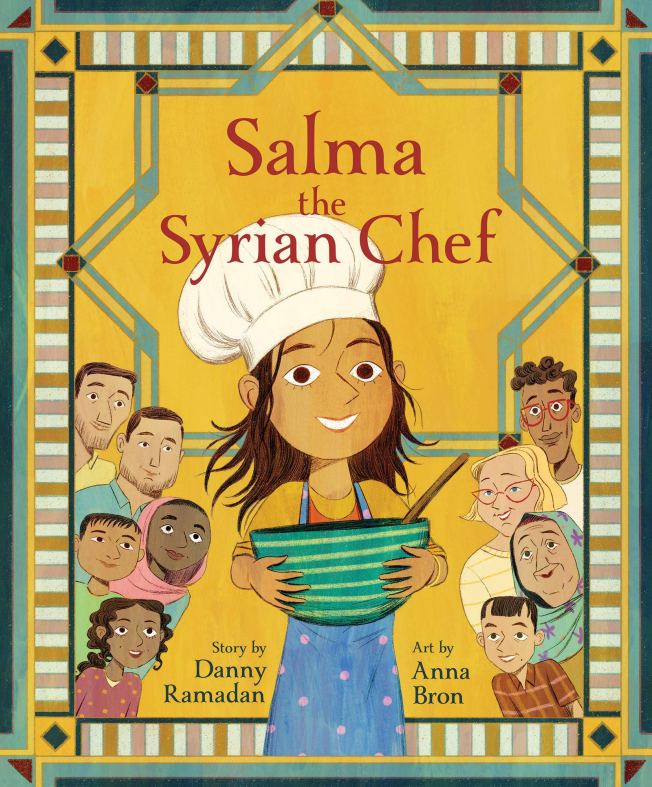
Salma the Syrian Chef by Danny Ramadan illustrated by Anna Bron

Standard
Salma the Syrian Chef by Danny Ramadan illustrated by Anna Bron

salma

This 40 page picture book meant for 4-7 year old children is full of diversity, community and love.  The only thing missing, is a recipe for the dish, foul shami, that Salma recruits everyone at the refugee Welcome Center to help her make to cheer up her mom. Possible flag is there is a gay couple featured in the text and illustrations.

syrian1

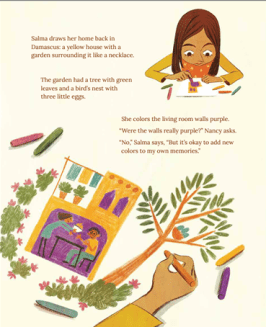
Salma and her mom are refugees from Syria living in Vancouver, and desperately missing Salma’s dad who still has not been able to join them.  When Salma shares her sadness with Nancy at the Welcome Center, she is encouraged to draw her good memories.  And then Salma has the idea to cook a dish from home for her mom. The other kids at the center mention foods they miss, Ayman from Egypt, Riya from India, Evan from Venezuela.   Then the translator, Jad, from Jordan helps her find a recipe online.

syria

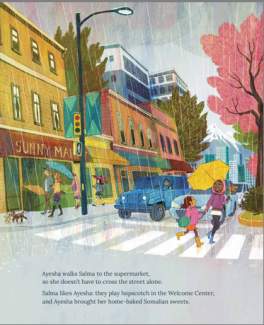
Convincing herself that she can do this, Salma  draws a picture for each of the ingredients since she doesn’t know the names in English.  She then heads to the market with Ayesha from Somalia, an older girl that helps her cross the street, and get the needed groceries.

syria2

Back at the Welcome Center to cook. Malek and Amir, a gay couple from Lebanon help her chop the vegetables and kiss away each others onion tears.  The spices make Salma sneeze, but she can’t find the sumac.

syria 5

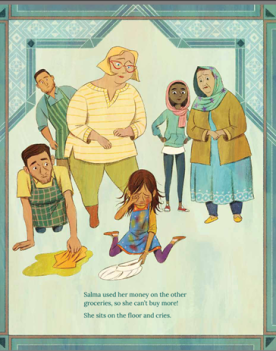
Granny Donya from Iran has the missing spice and reassures Salma that she can do this.  That is until the olive oil bottle slips and falls and shatters.  With no more money and feeling discouraged, it takes Nancy and everyone else to convince Salma not to give up as the dish is made with love and Mama will love it.

syriasad

Everything is set up to surprise Mama with the dish, but once mama comes home and the door bell rings, it is Salma who is surprised with all her friends coming over to bring her olive oil.

Mama laughs and tells Salma her smile is home, and Salma dreams of riding her bike around the Vancouver seawall laughing with her friends and Mama.

syriabike

I love the sense of community that it takes to make the dish and that she finds love and support from so many.  I also like her determination to make her mother smile along with her willingness to accept help when she needs it.

I’m assuming the family is Muslim, the mom appears to remove a scarf when she returns home, Ayesha and Granny Donya also wear hijab.


Diana and the Island of No Return by Aisha Saeed

Standard
Diana and the Island of No Return by Aisha Saeed

dianaThis Wonder Woman story of Princess Diana as a young girl is not noteworthy because of its groundbreaking storytelling, but more for the fact that the series and story is by a Pakistani-American Muslim author.  I am not sure how authors are assigned or chosen to  write these reimagined character series, but I think it is a great compliment to her writing and a great mainstream representation of diversity that we should celebrate.  Even more exciting is the subtle addition of Diana’s best friend, Princess Sakina, daughter of Queen Khadijah to the story, and that while they are citizens of fictitious world of Greek gods, they seem to spout Islamic wisdom on occasion, and be equally strong and important to the adventure at hand.  The book is meant for middle grades and at 288 pages is a fun light read for girls and boys of all ages.
SYNOPSIS:

Young Diana is anxiously waiting for the start of the yearly Chara Festival, when strong women from all over the world come to her island home of Themyscira to celebrate their different cultures and strengths.  Most of all Diana is waiting to spend the week with her best friend Sakina.  Frustrated that her mother is not allowing her to train with the other Amazonian women, Sakina listens to her and they hope to persuade Queen Hippolyta that this is the year.

As the women are arriving and gathering in the palace, Diana discovers a boy near the ships, Augustus.  Boys are not allowed on Themyscira.  There is no exception, but when all the women in the palace are drugged to sleep, her and Sakina are forced to trust him to try and save their loved ones.

Augustus confesses that a demon has hypnotized everyone on his island home, and that he was told to break the spell he needed to bring Princess Diana to the demon.  With no options and determined to prove her self, Diana and Sakina and her trusty bird fly off on a chariot to another world.

With tests around every corner, literally, the trio has to work together, to stay alive, gather the ingredients to make a potion to save the people on both islands, and push themselves to be brave.

WHY I LIKE IT:

So the story is ok, it is fun, I’m sure most kids that like superheroes and even many that don’t will enjoy the quick paced plot of the story.  There are definitely little nuggets of inspiration and motivation that make the book a positive influence on the reader.  The trio discuss bravery and how being scared doesn’t make you less brave, they encourage one another to push themselves and they forgive each other when they make mistakes.

Sakina and her people are scholars and on occasion says deep thoughts.  She says at one point, “My mother always says we are supposed to enjoin the right and forbid the wrong.” Which is a general principal, but the word choice sounds a lot like Surah 3 verse 110 “enjoining what is right, forbidding what is wrong,”

FLAGS:

There is talk of Zeus and the other gods.  There is lying.

TOOLS FOR LEADING THE DISCUSSION:

I probably wouldn’t do this as a book club book, but I would definitely encourage kids to read it.  I think muslim kids will get a kick out of seeing the names Sakina and Khadijah in the book and feel like its a bit of a shoutout, which I think is awesome.  It seems like it is book one in a three part series, so I hope to have my kids read them all and make sure the 3rd-5th grade teachers at their school have them as well.


Mae Among the Stars by Roda Ahmed illustrated by Stasia Burrington

Standard
Mae Among the Stars by Roda Ahmed illustrated by Stasia Burrington

mae

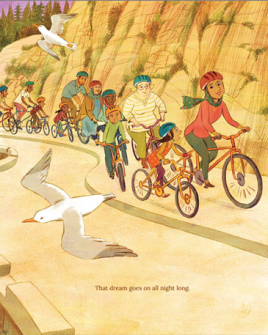
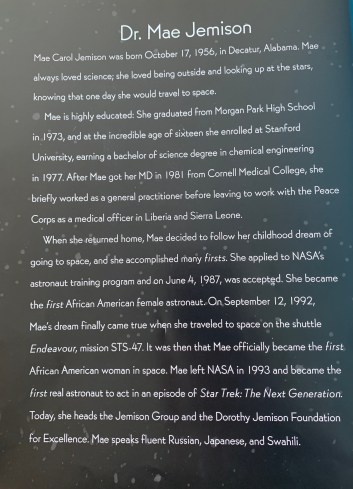
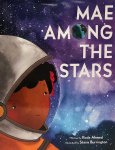
Inspired by the early life story of astronaut Mae Jemison this 36 page AR 3.0 children’s picture book is inspiring and encouraging.  It is not a biography of the first African American woman in space for children, infact with the exception of the note at the end, there really are very few specifics about how she went from being discouraged by a teacher to flying in outer space.  That isn’t to say the book isn’t beautiful and impressive, because it is, and it shows how no one should limit your dreams or your success.  The book radiates warmth and determination and for children, preschool to third grade, if desired, offers a way to start a discussion about racism and sexism all while celebrating the amazing accomplishments of Mae Jemison.

9291EB01-47EA-42C7-AE9A-2E2601245176

Mae is a dreamer and her homework one day asks her what she wants to be when she grows up, she tells her family she wants to see the Earth from up there, pointing to the sky.  Her mom tells her that she will have to be an astronaut to do that.  Nervous that it might be too lofty of a goal, her family reassures her that if she can dream it and believe it and work hard for it, that anything is possible.

ACD1927E-46F4-4525-84D9-4D1D4479B261

From then on, Mae reads books about space from the library, plays pretend, and makes herself a space suit from old curtains and a cardboard box.  She dreams about being in space and looking back at Earth, and she tells everyone she can about her dream to be an astronaut.

869AD060-D37E-4B8A-AB1A-C77F1E92A68C

At school when the teacher asks what everyone wants to do and be in the future, Mae’s answer gets her laughed at.  Ms. Bell tries to encourage her to be a nurse instead.  Once home, Mae breaks in to tears that her teacher didn’t believe in her.  Mae’s mom tells her that her teacher was wrong and that she hoped Mae didn’t believe her.  She told Mae that no one could stop her from pursuing her dreams.

EC432DA0-0032-45F8-B22D-9017DD033DAE

With her family’s unwavering support and a lot of hard work, Mae goes to space. The book ends with her keeping her promise of waving to her parents and looking down on Earth.

958EA75A-98CD-4FD0-9AA0-5091A9E06B65

The book touches on a lot of powerful issues that I really hope adults will point out and discuss with their children.  Why her teacher didn’t think she could be an astronaut, not as a belittling of the nursing profession, but as a woman of color what would make her teacher think that was her best option.  When and how should we handle when teachers, or people in authority,  do or say something that we disagree with. I also hope that the note at the end that tells more about Dr. Jemison’s accomplishments is poured over again and again and again and appreciated.  Truly she is a hero!

4532F757-FC28-41E8-AB6B-D548B60DB1BB

There is nothing Islamic in the book, I’m assuming the author is Muslim, but honestly I didn’t find anything in my Google searches that would indicate that she is or isn’t.  It is really just my assumption about the name and my wanting to share this inspiring story with beautiful illustrations with the people who frequent my blog.  Enjoy!

When Stars are Scattered by Victoria Jamieson and Omar Mohamed

Standard
When Stars are Scattered by Victoria Jamieson and Omar Mohamed

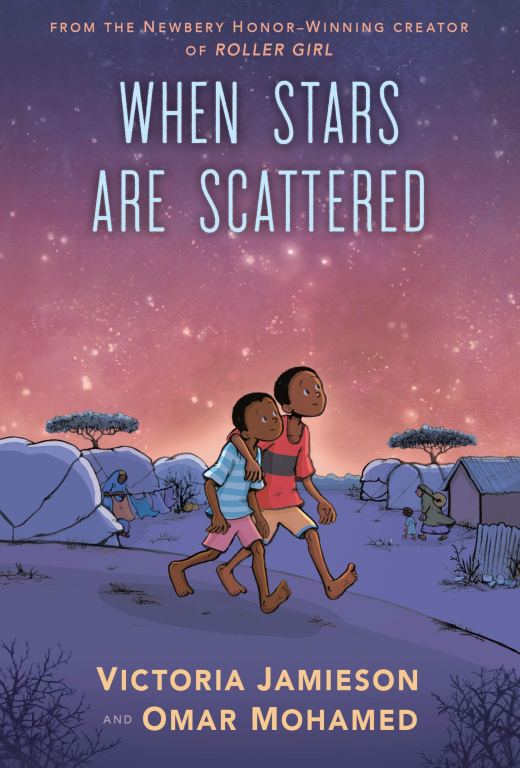
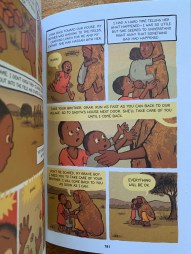
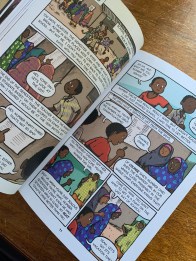
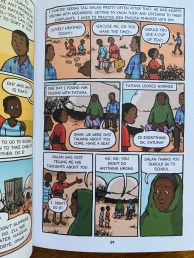
starsThis graphic novel swept me off my feet and left me in tears, not because of the hard life and sadness that life in a refugee camp entails, I had braced myself for that, but because of the hope and humanity and beauty that is so powerfully expressed and conveyed in this 264 page book.  Meant for 3rd graders and up, I think kids through middle school should be encouraged to read it.  The illustrations and colors are incredibly well done and the story is based on a true story that needs to be told and shared.  It is definitely in the top 10 books I’ve read this year and I keep catching my 11 year old re-reading this book repeatedly (like 5 or 6 times).
52BE6C8B-4246-4A92-BA66-004378A21862

SYNOPSIS:

Omar Mohamed lives in Dadaab refugee camp in Kenya.  His father was killed in the Somali war and his mother has not been seen after she sent Omar and his younger brother Hassan to run with the neighbors to escape the violence.  Hasan suffers from seizures and doesn’t speak, save one word, Hooyo, mother in Somali.  The two boys have an adopted mom Fatuma, who looks after the boys in the camp as if they were her own.  Unable to go to school, Omar spends his days looking after his brother, playing soccer with plastic bags, and waiting in lines for water, food, and news of a better opportunity.

When Omar gets the chance to go to school (5th grade) he has to make the difficult decision of pursuing his own opportunities, with the hope of helping Hassan later, or living day to day and taking care of his younger brother.  He is finally convinced that education will help them both, and that if the girls can find a way to do their chores and attend class, he can too.

Each transition from primary, to middle to secondary school requires testing, and only the top get to continue.  Determined to stay in school, Omar studies while dealing with life’s many challenges and the daily additional challenges of living with little food and resources.

When Omar and Hassan’s names finally appear on a UN interview lists for resettlement, hope seeps in, but the wait and the uncertainty prove to be yet another test.  Along the way there are side characters from the United Nations that show compassion, other families that show how generous and loving humans can be, female classmates show him how to take advantage of his privilege and friendships that move friends to family.

D74285FB-CBDC-4C4A-BD7B-070439BB08EF

WHY I LIKE IT:

The book is gripping and has heart.  I don’t know what I expected, but I truly could not put it down.  The character’s stresses are felt and emotions are conveyed so powerfully, that I don’t know that you can read the book and forget it.  The most emotional part for me was his honesty in dealing with his brother, the strength of his friends, particularly female, and the bond to Fatuma.  Truly their living arrangements and loss of family is gut wrenching, but it was the little things that touched me the most.  The honesty of Omar having to decide if he was tempted to not go to school because he was scared. Was he using his brother as an excuse to stay with something he knew.  The emotional tipping point of no return for me was when he realized Fatuma would not be able to go to the second interview with the UN and would not be a part of what came after.  Of course I knew that, but by that point I was so connected to the character, that when Omar realized it, I broke for him.  To feel that connection in a graphic novel was new for me, perhaps a first, and alhumdulillah I am better for it.

The characters are Muslim and behave traditionally with praying and Ramadan and Eid.

F9E64F9D-1722-4CBD-B905-BE754BCE6C77

FLAGS:

There is talk of khat, something the men chew on the side of the road to forget things.  There is some violence, bullying, a young girl getting married before 6th grade and having a baby.

CDD12698-52CE-4FFD-9444-29A666980797

TOOLS FOR LEADING THE DISCUSSION:

Yes! I am hoping if and when we resume school I am starting with this book inshaAllah, for my middle school book club.  There is so much to talk about and understand and empathize with.

More Than Just a Pretty Face by Syed M. Masood

Standard
More Than Just a Pretty Face by Syed M. Masood

more than just a pretty face

This book is a Muslim YA romcom OWN voice written by a Muslim male.  Woah, right? And the actual story, sigh (blush) I enjoyed it, and part of me is disappointed in myself for how much I enjoyed it.  Most of the characters are Muslim and all over the spectrum in their religiosity so to speak, there are a lot of jokes at the expense of tenants in Islam and trivializing of certain concepts which really isn’t something to celebrate, but it reads real and there is a lot of Islam that is front and center and deep and though provoking. For most non Muslim readers, I’m sure 15 or 16 and up would be fine with the content and 353 page length, but as a former Islamic School Librarian, I’d have to reserve recommendations to college age.  The protagonist is 19, there is talk of sex, but not crass, the main female character has a past that includes a sex tape, and there is a lot of language, but its also really funny and really relatable and really sweet and takes place in high school.

SYNOPSIS:

Danyal is a pretty face, but he isn’t very bright.  He goes to an elite private school though somehow, and while he is admittedly dingy, he is also very kind, innocent and generous.  He was held back at some point in school and is 19 as a senior in high school.  He works in a French restaurant and dreams of being a chef.  He has no desire to go to college and as the only son of Pakistani immigrants, they are not thrilled with their son’t future plans.  Danyal is pretty chill about it though and his mom wants to arrange his marriage, and he is willing, although he is crazy in love with his friend’s twin sister.  He is religious and hasn’t really broken any of the Islamic relationship rules, he prays fajr, and just kinda floats through life doing the best he can and forgiving himself and others when they mess up.

When his mom arranges a meeting with Bisma he is willing to get to know if they are a match.  She however, fully discloses her past to him when they head out for coffee, which involves her rebelling, once a few years earlier, against her father and going to a party, further rebelling and getting drunk and then making the poor and regrettable choice to sleep with someone.  To make matters worse, the event was video taped and spread around the community forcing the family to move.  Bisma is pretty religious and really studious and really sorry, but her father and most community people don’t let it go.  Danyal thinks that is stupid, one mistake shouldn’t haunt her forever, unfortunately he doesn’t think chivalry and pity are enough of a reason to marry her as he doesn’t think they are meant for each other.  Basically, he is still really crushing on Kaval.  So he and Bisma decide to be friends.

When Danyal’s history teacher in a fit of spite nominates Danyal for a prestigious Renaissance Man competition, Danyal calls on Bisma for help.  The topic is Winston Churchill, the beloved British leader, but Danyal quickly learns he is not beloved by most Indian subcontinent people.  Kaval offers to help so that Danyal can win the competition, impress her parents and then maybe give them a chance.  But, suddenly Danyal doesn’t know if that is what he wants.  He wants to be himself, he wants to be accepted, he wants Bisma.

WHY I LIKE IT:

You know how it is going to end, you don’t know entirely how it is going to get there, but you know where it is headed, yet the book is still compelling and fun.  Between the banter of the religious friend, and the no longer religious friend, the advice the French Chef bestows on Danyal and Danyal’s complete and utter cluelessness to everything, the book is really warm and the characters really like-able.  I dislike the stereotype of the “religious” character, but the other side characters are better developed.

On occasion I think Danyal’s stupidity is over done, he isn’t an idiot, he just isn’t book smart. So when he doesn’t know what “break a leg” implies for example, it seems a tiny bit off.  I know his friends say he isn’t funny, but I think he is hilarious, especially with his commentary on the Desi community.  “It is the curse of brown boys everywhere.  We either die young or we live long enough to see ourselves become uncles.”

The role of Islam is incredibly prominent, and the characters understand what it means to be Muslim differently.  Sometime I agreed with them, sometimes I didn’t, sometimes the characters didn’t agree with each other, sometimes they did.  There is a lot to think about: destiny, Allah’s mercy, Qalb-e-saleem (a pure heart), caring for the less fortunate.  Even politically there is a strong thread of colonialism, which the characters wrestle with and with being immigrant’s children.   There is a lot packed in, but it flows so smooth and the writing rich with authenticity, that quite often I would laugh out loud and read various lines to my young children.

FLAGS:

Talk of sex and losing virginity, but not detailed, just stated.  The chef is a lesbian.  There is lots of language including the F word, not thrown in effortlessly, usually for a reason, and often reprimanded.  There are a few kisses on the cheek and lips between Danyal and Bisma, but in a Disney princess movie sort of way.

TOOLS FOR LEADING THE DISCUSSION:

Not for middle or even high school book club. I don’t think that it is a completely “halal” romance story, but I think I wouldn’t be concerned if juniors and seniors were reading it, I think they would love it, and I might just have a few that I want to suggest it to…