Category Archives: Muslim Illustrator

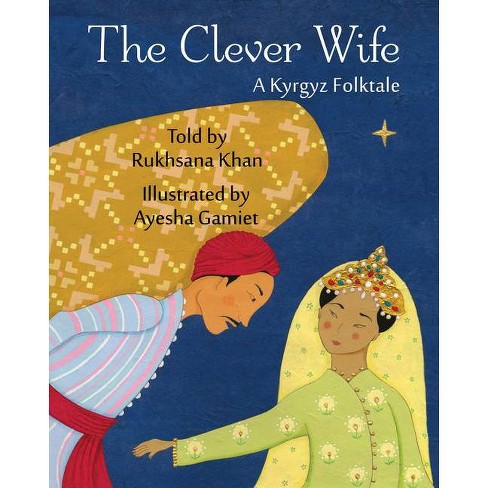
The Clever Wife: A Kyrgyz Folktale by Rukhsana Khan illustrated by Ayesha Gamiet

Standard
The Clever Wife: A Kyrgyz Folktale by Rukhsana Khan illustrated by Ayesha Gamiet

the clever wife

It has been nearly 10 years since a new Rukhsana Khan book has been published, and alhumdulillah, she is back with a delightful folktale.  This story starts off like many popular fairy tales, but it doesn’t simply end with a wedding and living happily ever after.  The story is just getting started, once the clever Danyshman and Khan Bolotbek start their lives together.  Over 40 richly illustrated pages brimming with character, culture, and hints of what might happen, the ending will sweep readers aged 5 and up into smiles and giggles and leave them begging to hear the story again and again.

img_7220

When the old Khan is on his deathbed, he leaves the future rule to be decided upon by his beloved white falcon.  The bird lands on the shoulder of a young shepherd and the subjects begrudgingly accept him as their leader.  As his kindness and compassion over the years wins the people over, their only concern is that he hasn’t yet taken a wife.

So, many high born maidens gather and try and solve the questions Khan Bolotbek sets before them.  When one poor maiden learns what is happening and accompanies them, they are surprised with her clever answers, and the khan asks her to marry him.

img_7223

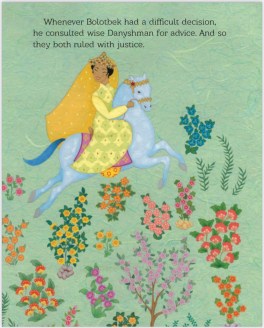
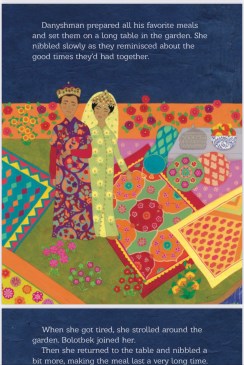
The khan discusses and consults with Danyshman and they essentially rule together.  There is just one promise the khan asked of his bride, and that is to “not share her wisdom with anyone, but him.”  The story continues, but with a clever wife being held to that promise, it is only a matter of time before her wisdom is shared, and it will take true cleverness for her not to lose everything as a result.

I love the strength of Danyshman, the levelheadedness of both her and the khan in ruling, and in remembering their humble roots.  The story is timeless, and this retelling ensures that more families with be familiar with this tale from Kyrgyzstan.

img_7222

One Wish: Fatima al-Fihri and the World’s Oldest University by M.O. Yuksel illustrated by Mariam Quraishi

Standard
One Wish: Fatima al-Fihri and the World’s Oldest University by M.O. Yuksel illustrated by Mariam Quraishi

one wish

This book is so long overdue, yet at the same time it was worth the wait.  The writing is simply superb: Fatima al Fihri is celebrated, Islam is centered, there are references, and the story compelling.  We, Muslims, as a whole know so little about the beautiful impact fellow Muslims have had on the current world and our way of life, that to see this book being celebrated in public libraries, in Islamic schools, at masjids, and retail bookstores, truly makes you sit up a little straighter, and reach confidently to get this book in your hands to share with those around you.  Thank you Mindy (@moyuksel.author) for these 40 pages of absolute delight, ages 5 and up will read it to learn, read it again to enjoy, and inshaAllah read it repeatedly to be inspired.

img_7723

The book begins with a Hadith regarding seeking knowledge and leaving knowledge behind.  It then begins the biography of Fatima as a small girl curious about the world around her starting with the word Iqra, read, from the Qur’an.  It sets the stage of her living in the desert in the early ninth century, a time where some boys went to school and some girls learned at home. Her connection to Islam and it teaching her the value of knowledge caused her wish, to build a school, to grow stronger.

img_7726

When war destroys her town her family flees to the busy city of Fez, Morocco.  She begins to accompany her father to the souk and enjoys listening to talk of planets, distant lands and different languages and wishes these scholars could educate everyone. She grows and gets married and her and her family become wealthy merchants.

img_7725

Tragically, her father and husband die, and Fatima must decide what to do next for her family.  She decides to help her community as a form of sadaqah jariyah and make her wish a reality.  She sets out to build a school where everyone can live and study for free.  She purchases land, and the building begins.  Fatima oversees each detail and names it the al-Qarawiyyin after her hometown in Tunisia.  It takes two years to build and it still functions today.

The back matter is just as compelling as the story with an Author’s Note, information on The University of Al-Qaryawiyyin, a Glossary, Bibliography, and a Timeline.  The only complaint I have about the book, are the illustrations.  I really don’t understand why half of her hair is showing when based on the time and her connection to her faith, she most likely was a niqabi.  I don’t understand the continuity of the hijab from a young child to adulthood.  I get that it shows her influence moving forward at the end, but it could have been a small print on an outfit for token representation of symbolism, I don’t get it as being a complete outfit her whole life.

img_7724

I absolutely love the role of Islam in both Fatima’s life and in this book.  It is so much a part of her and her wish, that every reader will recognize how connected her faith and the creation of the University were and I’m confident both Muslim and non Muslim readers will be in awe of her devotion and accomplishments, inshaAllah.

After Iftar Tales arranged by Bismillah Buddies

Standard
After Iftar Tales arranged by Bismillah Buddies

after iftar tales

This book’s beautiful dark blue cover with sparkly stars feels good in your hands and looks lovely on the shelf.  It is a collection of 10 short stories presumably to be read by an adult to a child or children during Ramadan and has its highs and lows.  As often is the case in anthologies, some are written better than others and while I particularly liked two of the stories contained, I couldn’t help wishing that the entire collection would have been better edited.  I don’t know any of the authors, or their ages, and there is not an intro or conclusion detailing how the stories were selected or compiled, but as a whole, the grammar errors (spaces before and after commas and periods), failure to spell out numbers less than ten, and the overall plot holes in so many of the stories, makes it hard to love this book.  Something about judging a book by it’s cover would seemingly apply here, the illustrations are decent, the topics and themes covered are important, but the finishing is lacking, and the book really had a lot of potential.

SYNOPSIS:
The ten stories cover Ramadan in different ways, and do not get repetitive.  With different authors and illustrators and pictures on every other page at a minimum, the books presents well.  Many of the stories are adequate, but largely forgettable as the plot holes just made me and my kids dismiss them.  A few are too lengthy and wandering, but there are two that even despite writing obstacles, thematically were memorable:  “A Ramadan Surprise” by Malika Kahn and “Iftar in Space” by Tayyaba Anwar.

“A Ramadan Surprise” is written in rhyming verse and discusses the need for wheelchair accessibility at masjids.  Focusing on a young girl it also hints on the importance of accessibility for the elderly.  This is such a needed and important reminder and I love that it is present in a book that is positioned to be read and thus hopefully discussed.

“Iftar in Space” similarly opens itself up to be discussed and marveled at between a child(ren) and an adult: how would you fast and pray if you were on the International Space Station. This connection could then be made for people that live near the poles, and how science is valued in Islam and so much more.  I love that Islamic information is seemingly sourced, but I would have loved a line or two at the end clearly articulating that in fact this is what this scholar or these scholars have declared.

WHY I LIKE IT:

At first it didn’t bother me that the text was so small, but mid way through, it started to because the pictures are so inviting and regular.  If a child is snuggled up with a reader looking at the pictures it is impossible for them to follow along. I get that that is kind of the point, but with huge margins, the text size can easily be increased.

I don’t know why the book doesn’t seem to have been edited.  The cover and illustrations and binding are all decent to high quality, the cost of the book for consumers is high, so I don’t know why an editor was not (seemingly) involved in the process.  Sure I am picky, but it isn’t one or two grammar errors, it is a lot, and when it is a regular concern, it ruins the flow and feeling of the book.

Overall, honestly there is also very little Islam present in most stories except for the timing of Ramadan, and many of the stories seem to have gaps.  In the first story, a boy is found by a stranger and gifted a lamp, and the family never even tries to find the person who saved their son to thank him? They live in a small village?  In one of the stories where a little girls is fasting for the first time she is also making a salad independently and pulling a cooked tray of lasagna out of a hot oven. A child in one story eats moldy candy, and in a contemporary story kids donate their money to an orphanage.  Are there still orphanages? In one story it opens with a banner being made that is crooked, but the accompanying illustration does not match.  One error or two is easy to overlook, but again, when it is every single story, it is incredibly disappointing.

FLAGS:

Clean

TOOLS FOR LEADING THE DISCUSSION:

I think while reading it you would find plenty to discuss with your children.  On stories where your children seem bored you could skip them, if sentences don’t make sense you can alter them.  I doubt children will read the book independently, so there is some wiggle room to add or subtract from the text to make the points you want to make and keep the stories engaging.  There are a few stories that discuss Covid and the frustration that it has caused to daily activities, which might help add another layer of connection to the text.

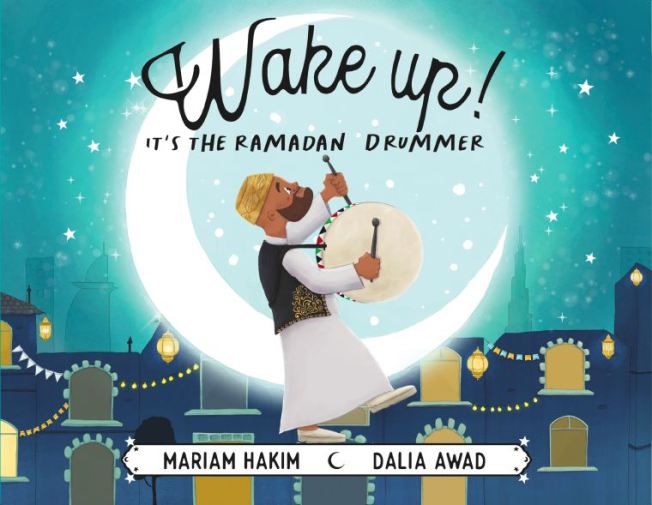
Wake Up! It’s the Ramadan Drummer by Mariam Hakim and Dalia Awad

Standard
Wake Up! It’s the Ramadan Drummer by Mariam Hakim and Dalia Awad

wake up

The beautiful shimmering cover of this new Ramadan book drew me in from the first few pages with the emotional impact of the father in the story losing his job.  Unfortunately the fun illustrations and overall story are not quite enough to make the book an enjoyable read over multiple readings.  By the time you read the book a second time, the missing punctuation, the assumptions and continuity holes, make the book unravel.  It has merit and highlights, I just really hope that an editor is brought in before a second printing takes place to clean up the sentences, patch the holes, and polish it to make it shine.  It has so much potential, but it is disappointing especially if you have been waiting, perhaps a bit impatiently, to share this with children to get them excited for Ramadan.  Even more so if you had hopes of reading it again and again throughout the month.

img_7075

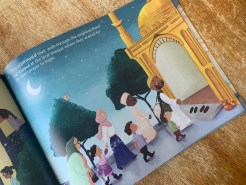
The book summarizes Ramadan on the first page, presumably making the ideal reader a Muslim already familiar with Ramadan significance, and then jumps into revealing that the Baba has lost his job.  The optimistic mama isn’t deterred and sends the Baba and kids to the store so she can cook up something special.

img_7077

While at the store an elderly woman greets the kids and their father as, “Abu Tabla.” The son dismisses it until later that night when Baba has gone to the mosque and Mama surprises Adam and Anisa with the story of their Baba’s baba walking the streets before dawn to wake people up for suhoor.  She even digs out an old photograph, and with that, Adam is determined to get his father to revive the tradition.

img_7076

I love that Adam and his Baba work together to figure out lyrics and a beat.  I also like that it isn’t an instant success, but rather takes some grit, determination, and perseverance.  I also like that the whole family and eventually neighborhood come together, and that men and women go to the masjid for fajr.

There are some concerns I have though as well.  There are a lot of missing commas, the text uses mosque instead of masjid which reads inauthentic, and the whole old lady character, Hannah, is all sorts of underdeveloped.  She has to introduce herself, yet she knows where Abu Tabla lives, a drum magically appears in her hands, and her prodding is based on the premise that she knows what is going on inside people’s homes, what they are thinking, and what their intentions are.  I get that it is a kid’s story, but by the second or third reading it is hard to unsee how erroneous the logic is.  Especially when fasting like so many acts in Islam, are between a person and Allah swt, not for everyone else to judge.

img_7078

Presumably the story takes place in an Islamic majority setting and the neighbors are all Muslim, which offers a great discussion starter for readers in non Muslim majority places to find ways to maybe share Ramadan or to imagine living where everyone is fasting.

I feel like the last few pages about the drummer going viral is unnecessary, and the story could have, and probably should have, ended with the family and parade entering the masjid.  I particularly found it odd that a line reads, “News of the Ramadan drummer tradition starting up again reached as far as Pakistan, Egypt, Somalia, Turkey and even Indonesia,” why is Indonesia called out like that? Seems off putting somehow, not inclusive. The book concludes by circling back to the Baba getting paid to wake people up and finding jobs through the people also coming to fajr, which seems a bit raw for a children’s book.  A simpler, “even though Baba found another job, being the drummer was still the one he loved most,” would have tied everything up a little better for the demographic.  I’m hoping to include this story during one of my weekly Ramadan story times in my local community, and will probably skip the last few pages and just read the hadith at the end about waking up for suhoor.

Zahra’s Blessing by Shirin Shamsi illustrated by Manal Mirza

Standard
Zahra’s Blessing by Shirin Shamsi illustrated by Manal Mirza

Screen Shot 2021-11-18 at 11.57.45 AM

Just when you think all the Ramadan stories have been told, you flip open a new book, hold your breath as the stage of predictability is set, and alhumdulillah in this case, you squeal with delight when the big reveal in a children’s book swept you up and surprised you too.  This 32 page richly illustrated story for elementary readers is heartfelt, culture rich, informative, and embracing.  The book doesn’t dwell on the details of Ramadan, fasting, and Eid, but intentionally focuses on some of the feelings, blessings, and acts that make the month extra special.

Screen Shot 2021-11-18 at 11.58.04 AM

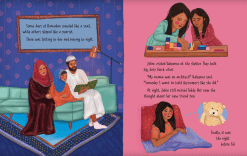
Zahra looks up at the Ramadan moon as she hugs her teddy bear and sends a prayer up asking for a little sister. The next day Mama is packing up beloved clothes, and ones that the family has out grown to be donated.  They discuss giving without hoping for anything in return and once again Zahra asks her mama for a little sister. To which her mother lovingly replies that she should be patient.

Screen Shot 2021-11-18 at 11.58.11 AM

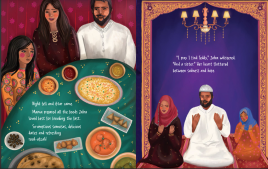
When Teddy goes missing, Zahra can’t help but think a little sister would help her find it.  Iftar that night are all of Zahra’s favorite desi foods and prayer after is her asking for a sister and Teddy.  The following day Mama and Zahra take the collected donation items to the shelter and Zahra realizes how sad she is about losing Teddy and these refugees have lost everything.

Screen Shot 2021-11-18 at 11.58.28 AM

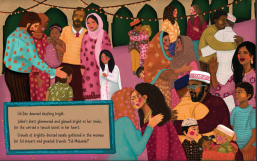
Zahra spends time with the children at the shelter and gets to know them.  She wishes she could find Teddy to gift to a young girl named Haleema.  Some days Ramadan crawls slow, and other days fast.  The family reads Quran together, fasts during the day and prays at night.  The night before Eid, Zahra’s dad whispers a secret to Zahra, one that she keeps close to her all through Eid prayers the next day.

Not going to spoil it, although I’m sure you can guess what is going to happen.  There are hints in the remaining illustrations, but I think kids will enjoy not having the heads up.  The book concludes with some informational blurbs and details about the Muslim author and Muslim illustrator.

Screen Shot 2021-11-18 at 11.58.35 AM

I enjoyed the illustrations, they are bright and bold and festive and unique.  They compliment the text completely as they show praying, reading Quran, making duas, etc.  The text doesn’t get preachy, it doesn’t even mention Allah swt or God, but talks of prayer and blessings.  The combination of the text and illustrations, however, definitely convey a strong unapologetic Ramadan/Muslim centered story.  Overall, it is universal and warm and sweet, and both Muslim and non Muslim children would benefit from reading it.

Screen Shot 2021-11-18 at 11.58.48 AM

My only concern is the page that the family is making dua together, it seems odd that they are all sitting in a line as if they have just prayed, but not prayed with the dad in front and the mom and Zahra behind. I read an electronic arc of the book and I look forward to purchasing a physical copy to add to my bookshelf.

Count by Ibrahim Moustafa with Brad Simpson and Hassan Otsmane-Elhadu

Standard
Count by Ibrahim Moustafa with Brad Simpson and Hassan Otsmane-Elhadu

count

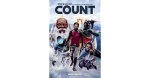
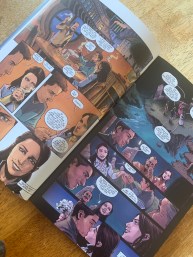
This graphic novel retelling of the classic, Count of Monte Cristo, is for middle school readers and up and is by a Muslim author and illustrator. There is nothing Islamic or cultural in the text of this 136 page sci-fi twist, and there is some kissing, a whole lot of killing, brutality and violence, but I think the swashbuckling tale will appeal to early teens and adults who enjoy fast paced reads whether they have read the original tale or not.

img_6765

SYNOPSIS:

Commoner Redxan Samud is elevated to Captain and marries his beloved, the first few pages of happiness, however, quickly disintegrate as he is framed and wrongfully imprisoned by the jealous powers that be.  Life in the hovering prison are barbaric, but the meeting of Aseyr, provides him with a plan and means to move forward.  First he will have to survive the death battles in the prison, escape the inescapable fortress, before he can locate the Isle of Sorrow, take control of ARU and extract his revenge.  Oh, but his revenge is strong, so very, very strong.

img_6766

WHY I LIKE IT:

I was admittedly hesitant to give the book a try, but when writer Shireen Hakim sent it to me, and my kids saw it, I thought I should read it first before letting them dive in.  I read it in one sitting, the story is engaging and clear.  I never was confused with who was who and why something was happening.  At times though it seemed too quick and that details were glossed over, or impact was minimized because major plot points were not given enough time to be felt.  I would have liked some answers provided of basic logistics and of character’s getting from one place to another, and how plans came to fruition shared in the story.  Additionally, some fleshing out of situations to ground the story a bit and make the revenge and extraction of revenge more cathartic, would have elevated the book and made it a popular choice in my house to be reread again and again.

img_6767

FLAGS:

Death, violence, murder, rage, kissing, torture, plotting, deceit.

TOOLS FOR LEADING THE DISCUSSION:
Not a contender for a book club read, but I would shelve it in a middle school classroom and in the school library for graphic novel and comic book enthusiasts as well as for high school students who might be familiar with the classic it references.

Jamal the Giant and the Largest Lesson by Mariam Hakim illustrated by Nesba Yoosef

Standard
Jamal the Giant and the Largest Lesson by Mariam Hakim illustrated by Nesba Yoosef

jamal

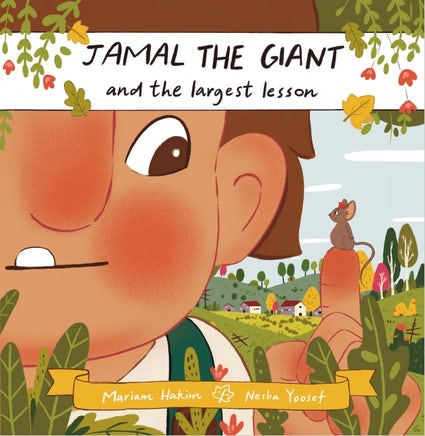
My initial thoughts of this 32 page Islamic fiction, fable-style book, is that it needed to be tested on children, lots and lots of children.  It should have been read aloud to catch all the grammar, syntax, and diction errors, and young readers and listeners should have been asked what they learned or understood from the story, BEFORE, being published.  The message is sweet, the illustrations cute, but it feels unrefined and reads underdeveloped: pictures and concepts are not enough to carry a book if the writing is poor.

I have looked forward to obtaining the book since its launch, so as soon as it was available from a US stockist (@crescentmoonstore), I didn’t even hesitate to purchase it.  I knew the book was available for free online as a read aloud on YouTube, but because I truly love supporting Muslim authors and publishers, I wanted to wait until I had a physical copy in my hand.  These opinions are my own, all my reviews are.  I mean no malicious will to anyone, I’ve spent my money on something, and once I’ve done so, I am completely justified to have an opinion.  You don’t have to like it, or agree with it, but it isn’t personal.  I’ve given reasonings for my opinions, and I stand by them.

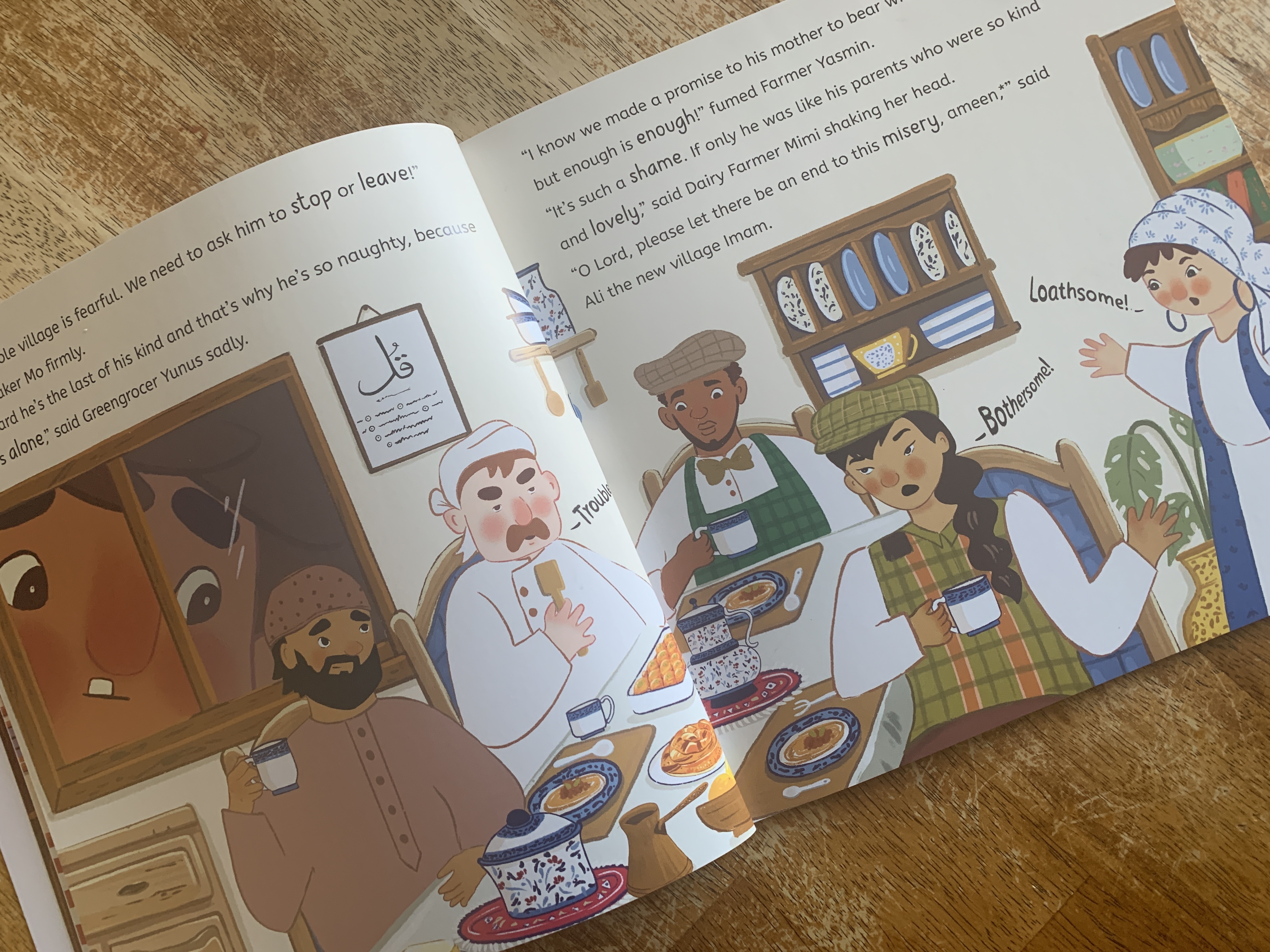
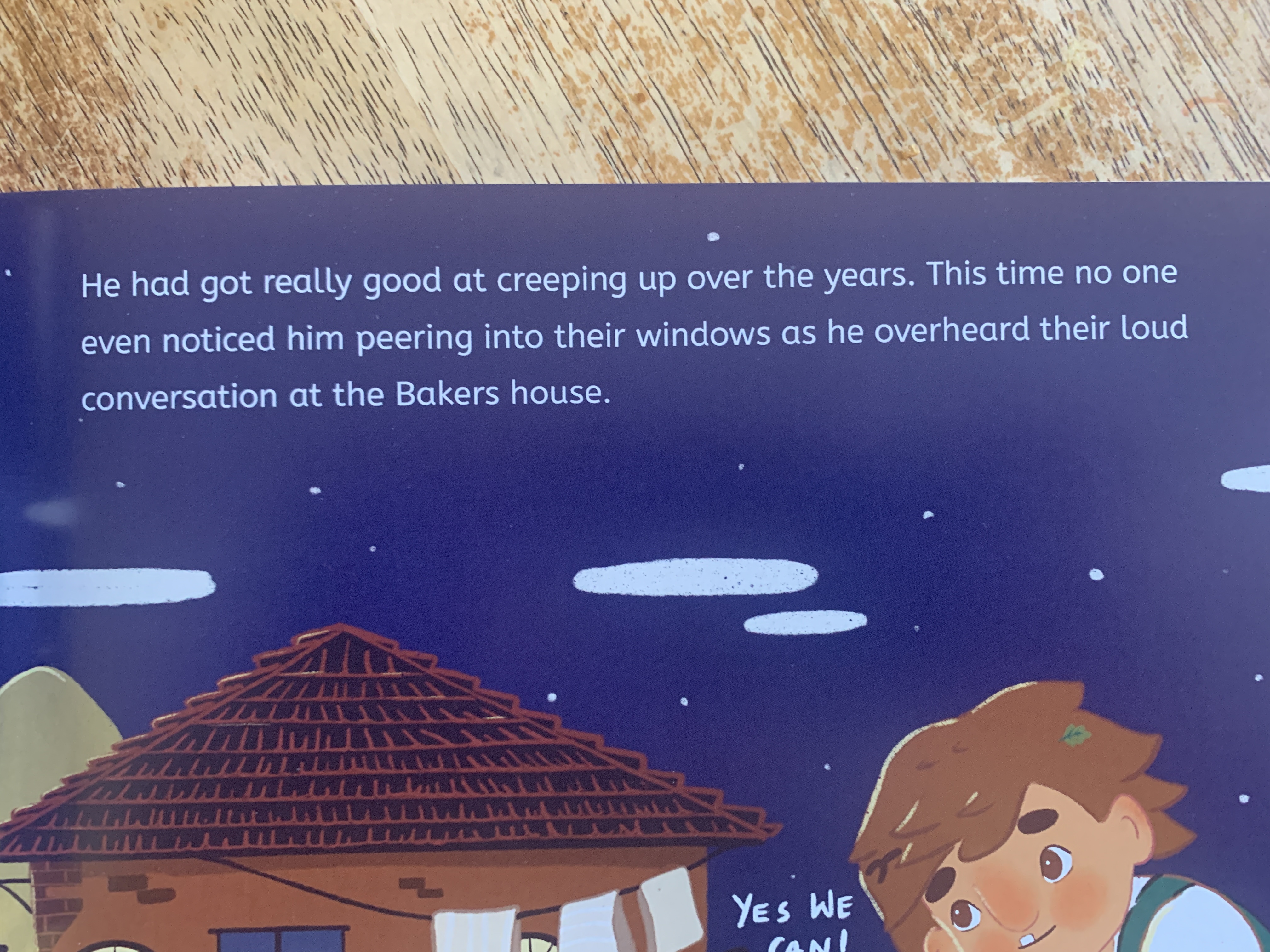
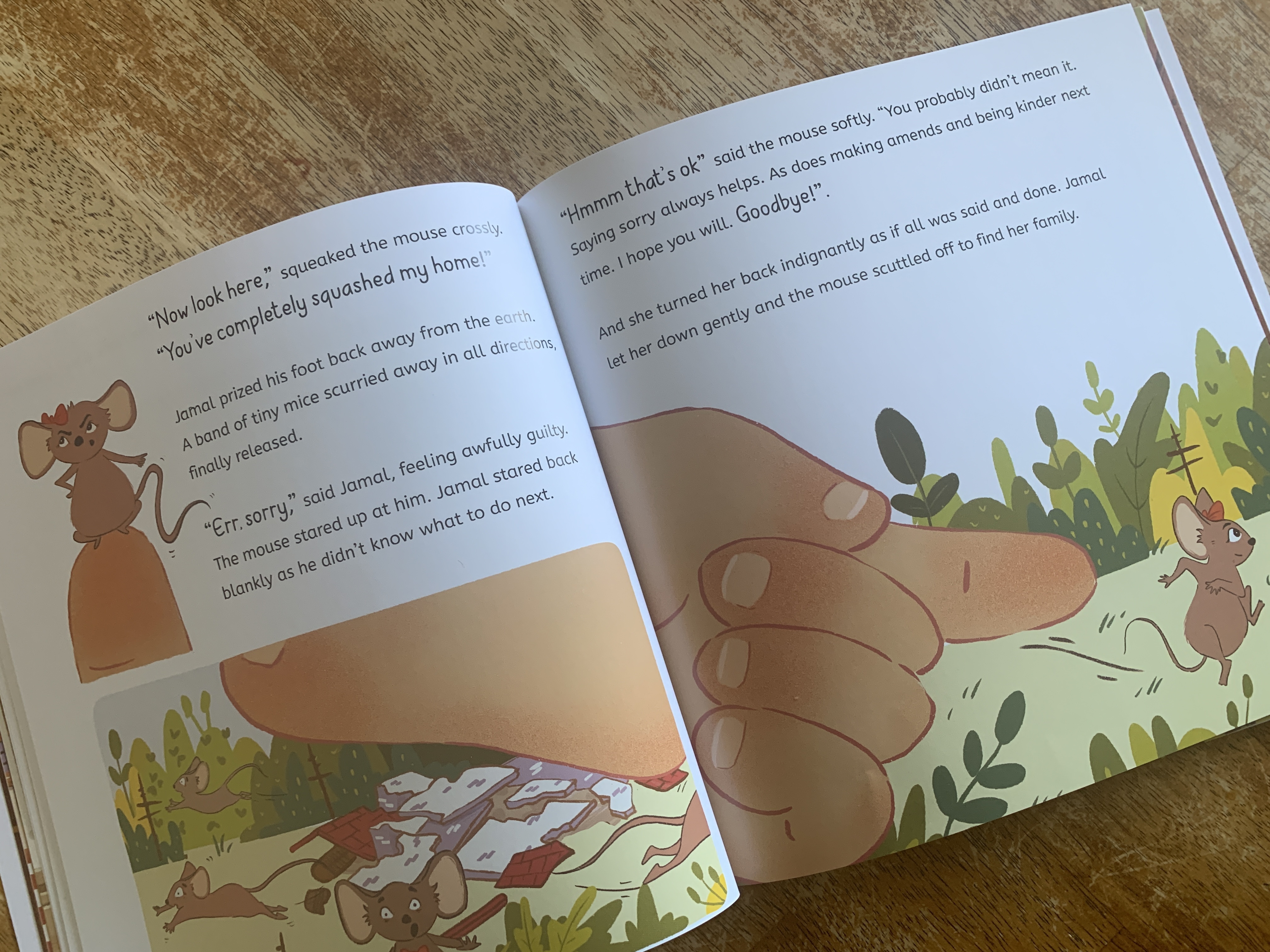
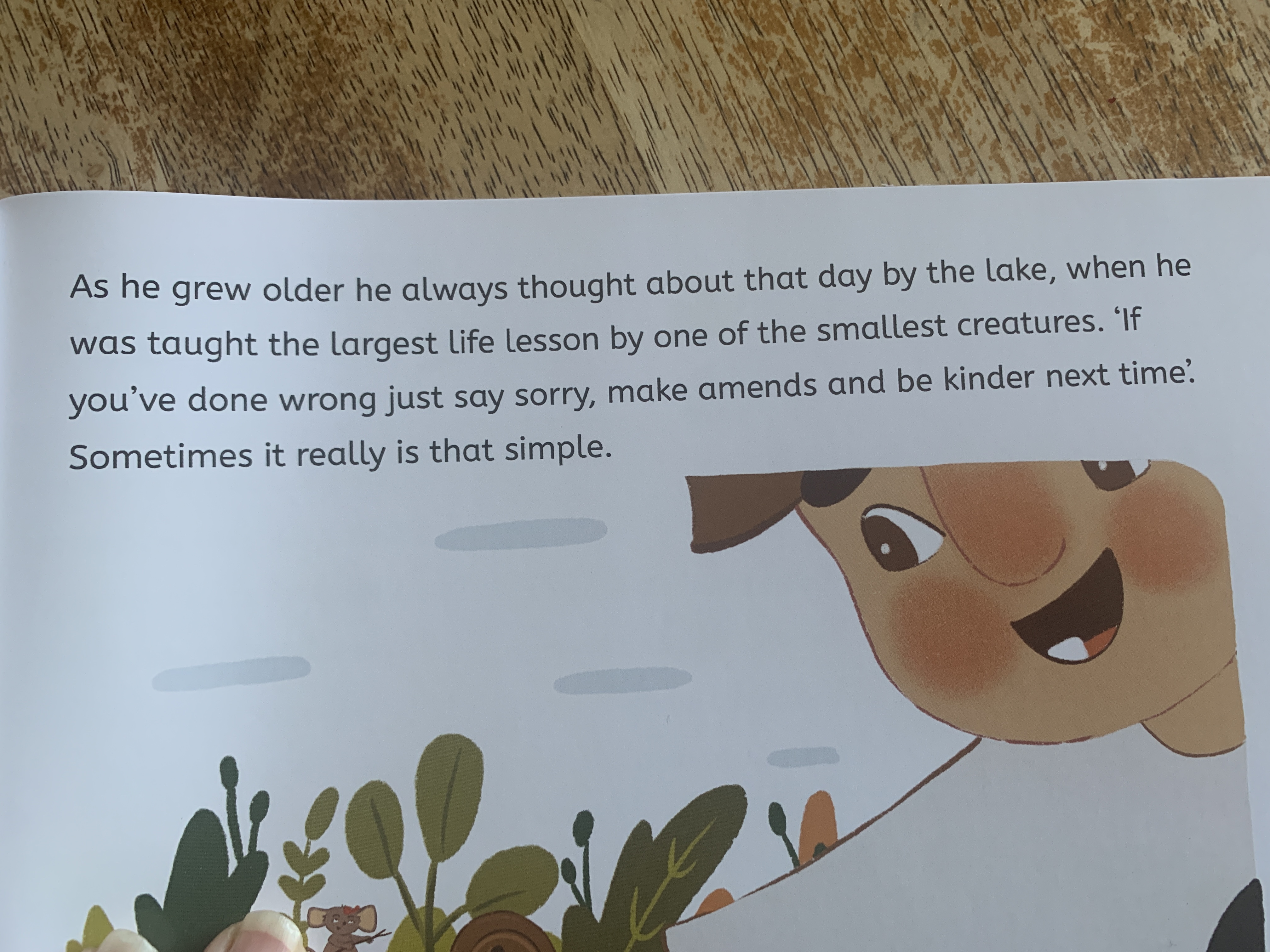
Jamal the Giant isn’t necessarily mean, but he is careless, young, and selfish.  He scares the animals in the woods, destroys their homes, ruins farmers’ crops, and steals from the village.  One night, he wants to steal some juice and in the process overhears the community members discussing how different he is from his kind parents, and that he must be forced to leave.  He tries to mend his ways before he is driven from his home, but to no avail.  Unsure how to fix things, it is the advice of a tiny mouse that sets his reform in motion and conveys the message from the Quran, surah 11 ayat 114, “Good deeds cancel out bad deeds.  This is a reminder for the mindful.” He learns he must apologize, make amends and be kind.

The message is accurate, but I have some concerns at how it is conveyed.  Why was the responsibility on the giant to learn how to behave.  Yes if he knew better, he should do better, but it is made clear that he is the last of his kind and his parents died when he was really young.  If the villagers aren’t going to try and teach him, who is?  It isn’t necessarily victim blaming, but if you don’t know better, and have no one to teach you, you definitely are a victim of neglect in some ways.  To have them going from enabling him out of a promise to his parents to threatening to kick him out from his home, is a little abrupt.

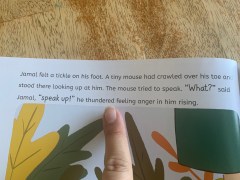
Story-wise there are some points that gave me pause.  Why is there an owl flying off in the daytime, sure there are some diurnal owls, but most kids are taught owls are nocturnal, why not change it to a woodland bird that is active in the day, don’t confuse kids.  It doesn’t specify a timeframe that the story takes place in, but it feels like a fable with talking animals a giant and a clear message.  There is a baker, a farmer, an imam, a greengrocery, it is all very quaint, but then the imam is holding a cell-phone, wait what? I do appreciate that the farmer is female though, and that some of the women cover and some do not, it seems representative.

I’m curious who taught the giant to read, and how come he writes his “s” backwards, there seems to be a bit of disjointedness to the upbringing of the giant, his age, even in giant terms.  A lot it seems the author assumes the reader knows about giants or their stereotypes perhaps, because the book doesn’t address them, and the result isn’t a fun moral story, but one that seems to miss things.
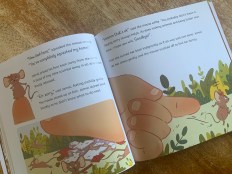
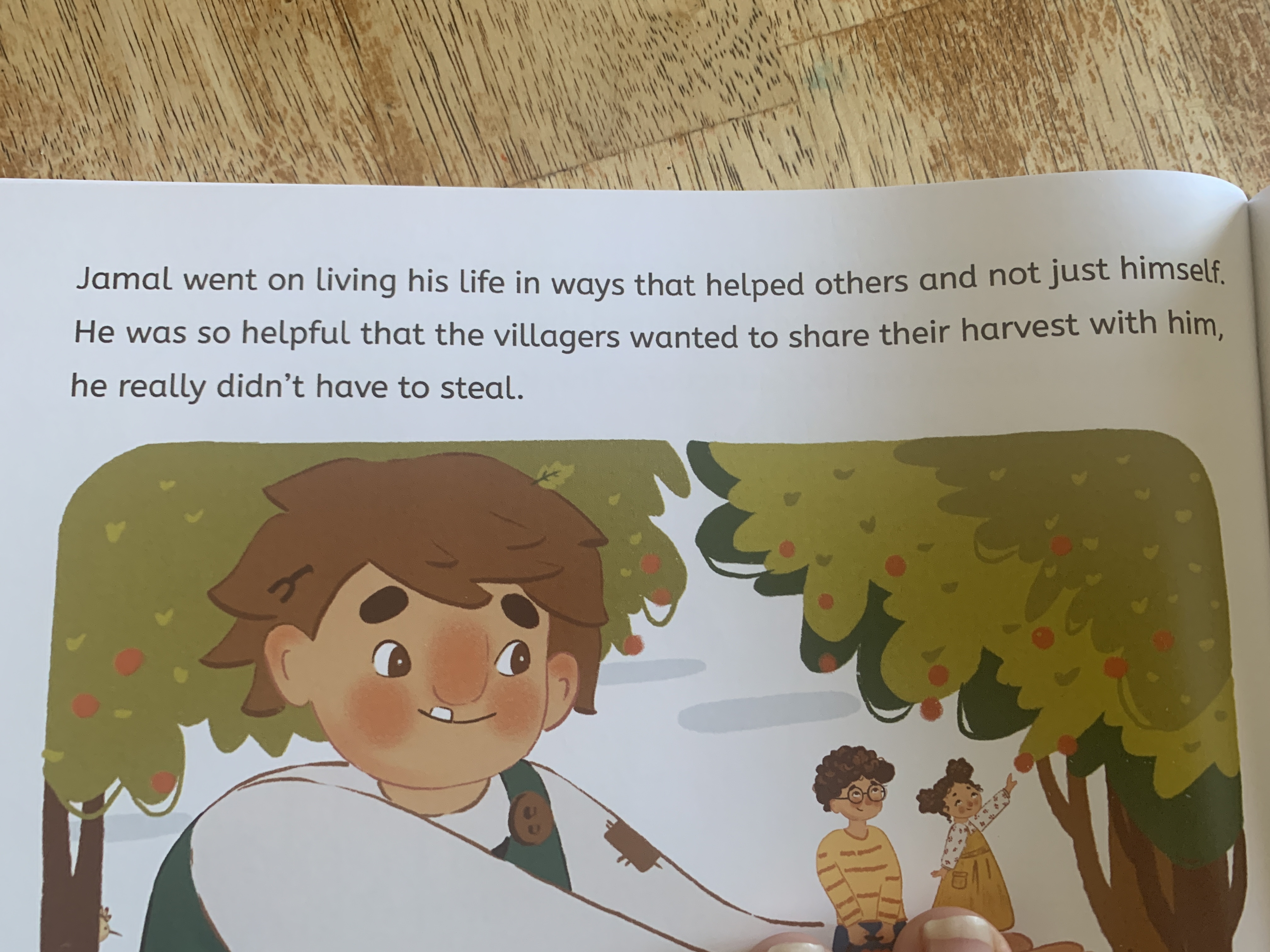
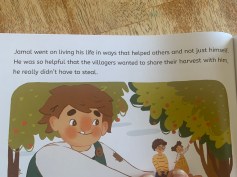
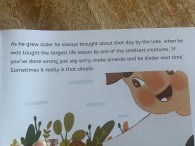
The little mouse teaching the big giant, carries some Lion and the Mouse-Aesop fable vibes, but really it is the proof-reading of the book that is disappointing.  When you read it aloud, commas are abundantly missing (even in the online reading pauses are placed where commas are not written).  Why is the B in Baker capitalized, and if it is the Baker’s house, as in last name is Baker, then an apostrophe is missing.  Many of the lines are just awkward and halting, even if not particularly erroneous.  The diction is questionable at times, Jamal “always” thinks about that day at the lake, woah, doesn’t reflect on it, but it haunts him “always.”  Jamal “‘really’ didn’t have to steal,” seems to imply he was justified in stealing a little, this should be a black and white issue in a children’s book, no?
There are questions at the end of the book, and a whole page of information about the author and illustrator as well.  In a case like this I don’t know if the publisher didn’t do justice to the author’s work, or if the author should have refined it more, before coming to the publisher, but it is unfortunate because clearly a lot of effort went in to the illustrations and promoting of the book.
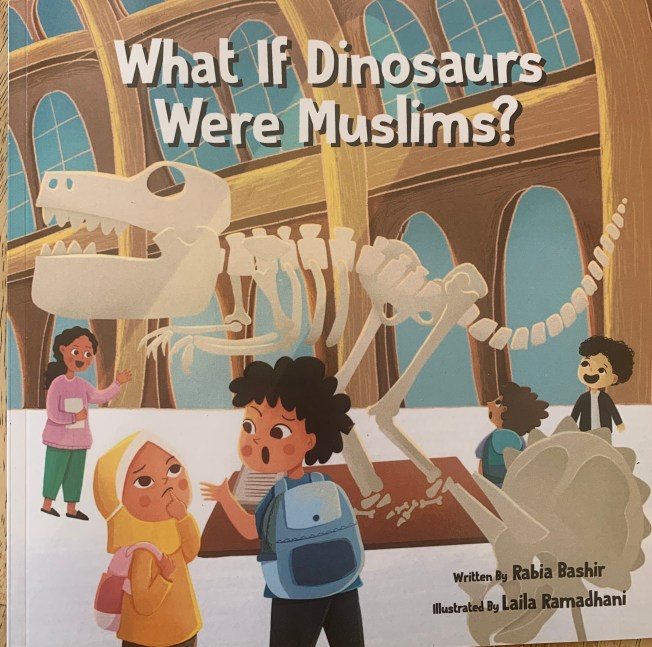
What if Dinosaurs Were Muslims? by Rabia Bashir illustrated by Laila Ramadhani

Standard
What if Dinosaurs Were Muslims? by Rabia Bashir illustrated by Laila Ramadhani

This rhyming Islamic tale wonders what dinosaurs would do if they were Muslim and alive today.  For littlest Muslim readers this repetitive tale ponders how they would eat, pray, love their mothers, respect their neighbors, dream, and feel, by tying all those things back to how Muslims behave.  The adorable illustrations kept my 6 year old glued to the story and the simple text held my 2 year old’s attention.  A fun book with wonderful supplements at the end to engage children in activities that everyone does compared to those that just Muslims do, a Fun Fact about (Muslim) dinosaurs and mums in Islam.  As well as extra activities, valuable information, and details about donations made with the purchase of this book.

The book takes place in London and imagines if dinosaurs were alive and if they were Muslim what day-to-day life would be like.  The refrain starts out “If dinosaurs were alive today and if they were Muslims too,” before stating what they would do and having it conclude with “just like me and you.”
In a similar vein as the ever popular How do Dinosaurs series by Jane Yolen, the book teaches kids how to behave by teaching the dinosaurs.  The book is short, and the humor comes from the illustrations, primarily the facial expressions of the parents, more than from the text, but I think the wildness of Dinosaurs living today will get most little kids smiling.

The only real concern I have with the book is the text when they are in the masjid praying and it reads, “they would try their best to pray five times a day.”  I know we don’t demand our littlest ones to pray all five salat, but I don’t know if it would imply that trying to pray is sufficient even when you are older.

From start to finish I found myself smiling while reading this book aloud to my kids, even after the fourth time in a row, alhumdulillah.

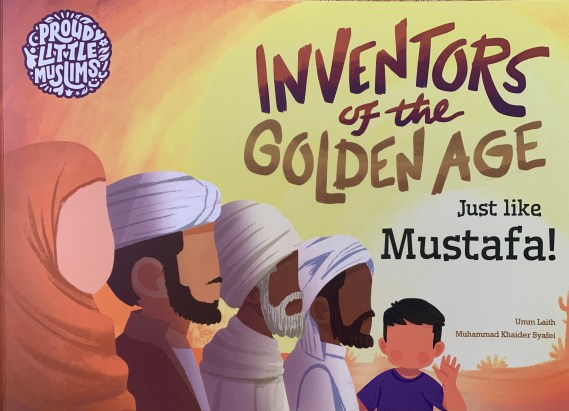
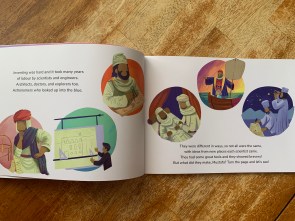
Inventors of the Golden Age (Just like) by Umm Laith and Muhammad Khaider Syafei (Proud Little Muslims)

Standard
Inventors of the Golden Age (Just like) by Umm Laith and Muhammad Khaider Syafei (Proud Little Muslims)

img_6450

Usually when you purchase a personalized book, the charm is that you get to see a name of your choosing in the story, and that you can make the main character look a certain way.  So imagine my surprise when this book arrived, and yeah sure my son’s name and likeness was included, but the story and information contained was also really well done and engaging.  This book, even without the personalization, is a solid story highlighting Fatima al-Fihri, Abbas ibn Firnas, al-Zahrawi, al-Idrisi, and their skills of generosity, persistence, kindness, and adventure as they shaped the world as we know it.

img_6418

The fourth wall is broken as the book speaks to the reader encouraging them to come on an adventure in to the Golden Age.  A time when scientists, engineers, explorers, doctors, and astronomers were making remarkable advancements.

The first stop is Morocco to learn about Fatima al-Fihri and how she established the first university.  Her generosity in building and creating a place of Islam and learning is what set her apart and made her so remarkable.  It is then on to Abbas ibn-Firnas in Spain and his attempts at flying.  He failed often, but his mistakes helped him as he persisted and continued to learn and understand and make flight of humans possible.

img_6419

Al-Zahrawi, the surgeon, is who is detailed next, as his knowledge, skill, and inventions he made are still used today.  His regard for his patients fear and nerves and his kindness is what the book stresses before moving on to the mapmaker al-Idrisi.  Al-Idrisi was adventurous as he traveled the world making his maps and switching the poles.

img_6420

The book then focuses on the reader encouraging them to be generous and adventurous, kind and persistent, in making the future better like those mentioned from the past.

The book is horizontal, the pages thick, the faceless illustrations warm and detailed and the rhyming text flowing and appropriate for preschool aged children and up.

img_6421

Squire by Sara Alfageeh and Nadia Shammas

Standard
Squire by Sara Alfageeh and Nadia Shammas

squire

This 336 page YA graphic novel set in a fictitious world draws on the authors’ Arab culture and creates relatability for universal readers everywhere.  Themes of coming of age, war, family honor, discrimination, classism, deceit, and friendship, all interweaves with rich illustrations and warmth.  With a few unnamed #muslimsintheillustrations the story shows a lot of heart and with some language, violence, death, and oppression would be best suited for 9th grade and up.

SYNOPSIS:

Aiza and her family belong to the Ornu tribe and are treated as second class citizens in the Bayt-Sajji Empire.  With their traditional arm tattoos and seemingly more plentiful food, they are greatly disliked by the larger community and oppressed at every opportunity.  Aiza dreams of joining the army, rising in ranks, earning citizenship for her family and changing their future.  She also dreams of being a hero.  When she finally convinces her family to allow her to enlist, they also encourage her to hide her identity, and just like that, she is off.

Once in training she is pushed to excel or risk being sent to the front lines.  As she navigates new friendships, harsh instructors, and the shadowy General Hende, Aiza learns there is so much more to war and politicking than meets the eye.  Her life, her loyalties, her understanding of the world will all be tested, as Aiza must decide which path is for her.

WHY I LIKE IT:

The text and illustrations are seamless in conveying a united story, I was a little nervous with two authors, and I like that the story has twists and multitudes.  I loved seeing strong women in the military, as the authors’ say tough girls with swords.  While reading it I was completely submerged in the story and the characters, but writing this review a few days later, I’ve largely forgotten the characters names and quirks.  I’m not sure if it is because I read a digital version, or because the character building is a little lacking.  I don’t know that I was emotionally invested in some of the major plot points because I was not seeing the struggles it was requiring of the character to endure.  Admittedly I have not read a lot of fantasy graphic novels, so I don’t know that I have a lot to compare it to, but I do plan to read a physical copy when I can, and read follow up books in the series, to see if my impression changes.

FLAGS:

Some language, bullying, oppression, violence, death, killing.

TOOLS FOR LEADING THE DISCUSSION:

There is nothing religious in the text, so I wouldn’t use it as a book club selection, but I would definitely shelve it in a school library, classroom, and keep it in mind for readers that love these kind of books.