Category Archives: 5th grade and up

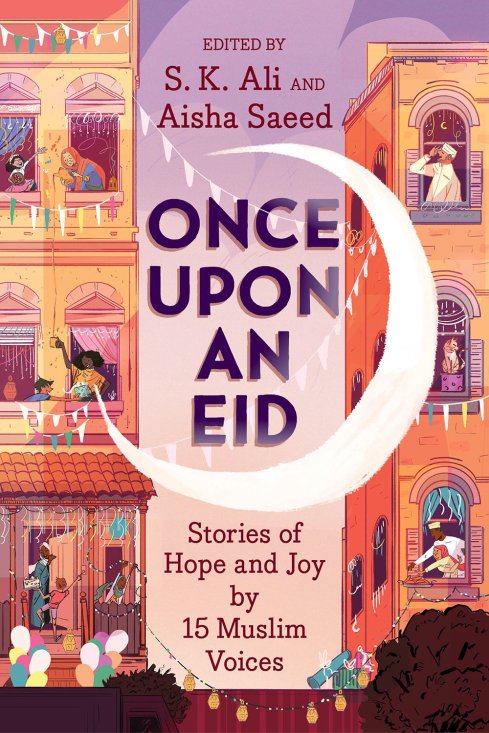
Once Upon an Eid: Stories of Hope and Joy by 15 Muslim Voices edited by S.K. Ali and Aisha Saeed

Standard
Once Upon an Eid: Stories of Hope and Joy by 15 Muslim Voices edited by S.K. Ali and Aisha Saeed

once upon an eid

I’ve never been a huge fan of short stories, but this book has me reconsidering such an arrogant approach, as every single story in this collection has me feeling the warmth of Eid, the joy of authenticity, and the beauty of being a part of a faith with such strong female writers.  Fifteen entries for middle graders in mind: short stories, poetry, and even a graphic novel, spread over 304 pages that shine light on Eid in today’s world,  Eid al Fitr and Ramadan make up the bulk of the focus, but Eid al Adha and Hajj are in there too.  And the best part of the book is that you will see yourself in it, possibly all through out it, but reading such diverse OWN Voice stories are sure to make a Muslim reader feel represented and right at home, and give non Muslim’s a peek at us from the inside, inshaAllah.

SYNOPSIS:

I don’t know how to review the book as a whole since there really are 15 different stories, that are each heartfelt and strong in their own right and yet somehow made better by the company around them.  There were no weak links.  There are stories with bickering siblings, annoying cousins, different cultures, mixed background familes, divorced families, converts’ stories, stories of families where money is tight, stories with illness, stories of loss, a story from the perspective of a refugee, and stories of reaching out of your comfort zone.  There is one story about Eid al Adha and a story starring a Shi’a muslimah feeling different within Islam.  There are stories told from boys voices and girls voices and every single story has a take home message, some more subtle than others, but all there and all real.  I feel like even a summary of a story would prove a spoiler and take away from one just falling in to the collection and receiving the warm hug that awaits.   I’ll leave the summaries to their titles and well known authors to spark your curiousity.

Perfect: Jamilah Thompkins-Bigelow

Yusuf and the Great Big Brownie Mistake:  Aisha Saeed

Kareem Means Generous: Asmaa Hussein

Don’ut Break Tradition: S.K. Ali

Just Like Chest Armor: Candice Montgomery

Gifts: Rukhsana Khan

The Feast of Sacrifice: Hena Khan

Seraj Captures the Moon: G. Willow Wilson and Sara Alfageeh

Searching for Blue: N.H. Senzai

Creative Fixes: Ashley Franklin

Taste: Hanna Alkaf

Eid Pictures: Jamilah Thompkins-Bigelow

Not Only an Only: Huda Al-Marashi

Maya Madinah Chooses Joy: Ayesha Mattu

Eid and Pink Bubble Gum, Insha’Allah: Randa Abdel-Fattah

WHY I LIKE IT:

I recieved this book as an Advanced Reader (digital) copy and I am thinking I want a hard copy too, (I wasn’t able to view the artwork).  A lot of people ask me and I see postings in various social media groups asking for suggestions of books to read each night as a family in Ramadan, and I think this one would work for grades 3 and up.  Have each kid read the story throughout the day and then discuss in the evening.  Every story will have something that is familiar, probably something new, and each has a teachable moment.  I think different kids will identify with different aspects of the story and to articulate them in Ramadan will really bring the already memorable characters to life.

The book is very well done, and reads very smooth and cohesive, it really has a unified tempo and mood which is remarkable because so many different author’s and voices are included.  The book stays focused on the feeling rather than getting too weighted down by doctrine.  There are stories that feature hijab prominantly, and a bit of Prophet Muhammad (SAW), and some slight mention of islamaphobia, but it focuses on the friends and the love that support us, both Muslim and non, that make Eid and life hopeful.

FLAGS:

Clean

TOOLS FOR LEADING THE DISCUSSION:

I would consider this as a book club book to be hosted just as I hope to do this Ramadan with my own children in my home (see above).  I think really I just want to buy a bunch of copies to give as gifts to the fabulous elementary aged children I know, alhumdulillah.
Planet Omar: Unexpected Super Spy by Zanib Mian illustrated by Nasaya Mafaridik

Standard
Planet Omar: Unexpected Super Spy by Zanib Mian illustrated by Nasaya Mafaridik

planet omar

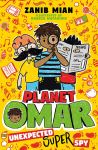
Omar is back, and the nine year old kid with a huge imagination, proves that his heart is even bigger.  Middle graders that loved the first version, The Muslims, and the reboot, Planet Omar: Accidental Trouble Magnet, will undoubtedly love this book’s adventures and the real, relate-abl, presentation of Islam in a Muslim family.  While it references the first book, it can work as a stand alone book too, and can and will be enjoyed by kids and adults, girls and boys, Muslims and non Muslims.  At 217 pages, the large spaces, doodles, playful fonts, and illustrations, make the book fly by and beg to be read again and again.

C95DB8C6-9652-4EB8-8008-112361FAE8DF

SYNOPSIS:

Omar’s family still has their Science Sundays, but they don’t visit a new mosque every Saturday, as they have found a mosque near their home that gives his parents, “secret smiles” and them all a sense of community.  Omar and his sister still bicker, and his little brother Esa is still lovable, and the former bully, Daniel, is now a great friend to Omar and Charlie.  Life is good, Alhumdulillah, but in the midst of the boys planning how to get laser guided Nerf guns and have an all out battle, Omar learns the mosque’s roof is in need of repair and that the congregation will need to come up with 30,000 pounds to cover the costs, and fast.  In an act of selflessness, Omar abandons his dream of a foam gun and donates to the masjid.  Seeing that is not going to be anywhere close to enough he plots and schemes with his friends, his non Muslim friends, on how to raise the funds.  They bake cookies, make origami birds, and get their school to host a talent show to raise the money.  Their teacher and the head teacher coordinate the hall and judges and winning prizes all to help out Omar and the mosque, in the end though, they raise just under 1,500 pounds.  Not enough by themselves, but a great contribution to what other people hopefully are scrounging up.  The worst part however isn’t that they didn’t make enough, but that what they did make, goes missing.  Omar, Charlie, and Daniel, along with the parents and police and school personnel, try and find the money and who might have taken it before time runs out.

0030B40D-17F8-415C-A54A-7874768A5B5D

WHY I LIKE IT:

I love how effortlessly the author adopts a nine-year-old’s voice and persona.  So many of the details, for example, about how the school administration signed off on a fundraiser for a religious building, and how tickets were sold, and the planning took place are left out, as a nine year old, probably wouldn’t know, or be concerned with the logistics of such endeavors.  It seemed like some details should be given, but I doubt readers would feel that way, so I pushed it aside and went along for the ride.

Omar has amazing friends, from the unpredictable old neighbor lady, to his non Muslim friends being so enthusiastic and supportive of saving a mosque.  I love it, and that they are that way because Omar is so unapologetically Muslim first.  They even discuss a hadith about how building a mosque, builds you a house in Jannah, and a mainstream book published this, and it is AMAZING! It isn’t just a kid and his family, who happen to be Muslim, the whole plot of the book is to save a mosque, and the fact that this book exists, seriously is so beautiful, and powerful, and hopeful, Alhumdulillah.

This book has a lot of layers, most kids won’t pick up on the interfaith aspects being so ground breaking, or the beauty of teachers and parents believing and supporting young kids, but will just read it as a funny story with anecdotes and inside jokes that they get as kids, as Muslims, and maybe even as Desis.  It truly is the culmination of an author who can write well, characters that our kids can see themselves in, and an opportunity to tell our OWN stories that make this book work for kids, adults and everyone in between.

3C3DA84E-29F6-4A6D-90FE-0BC134E7E615

FLAGS:

Omar and his sister are mean at times, but alas love each other and look out for each other too.

TOOLS FOR LEADING THE DISCUSSION:

I don’t do an elementary book club, but if I did, I would do this book in a heartbeat.  For middle school it would be too quick of a read, but I think all classrooms and all libraries should have the book, up through middle school.

https://www.alaraby.co.uk/english/society/2020/2/7/planet-omar-pushing-for-muslim-characters-in-childrens-literature

I got my copy here in the US at www.crescentmoonstore.com and as always you cannot beat their customer service and prices.  If you don’t have the first book, you can get it there, too.  Thank you Noura and Crescent Moon Store.

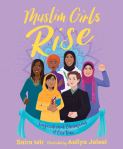
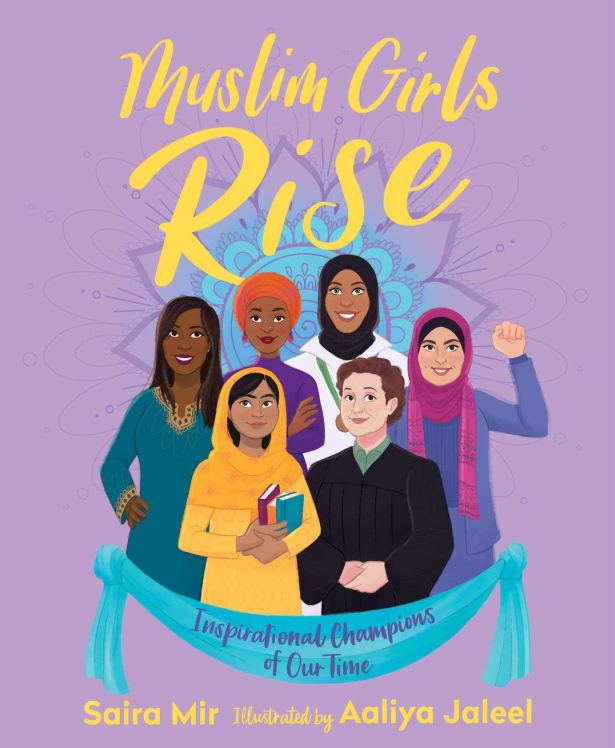
Muslim Girls Rise: Inspirational Champions of Our Time by Saira Mir illustrated by Aaliya Jaleel

Standard
Muslim Girls Rise: Inspirational Champions of Our Time by Saira Mir illustrated by Aaliya Jaleel

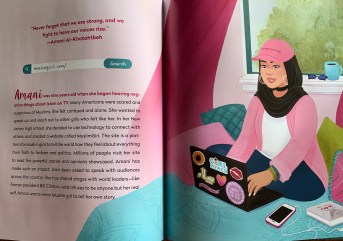
rise

Women you have heard of, some you are meeting for the first time. Some you like, some you disagree with, women that cover, women that don’t, some young, others older, some athletic, some academic, some a little bit of both.  One fictional, a few political, but in the end, all strong women of today, all Muslim, all unique, from all over the world, all known for paving the way for others to follow.

C51C5834-B3C5-4D19-94B3-99B21ADF83EA

In 42 pages, 19 females are highlighted and illustrated to inspire Muslim and non Muslim boys and girls alike, but really Muslim girls will get the most out of it.  Sure a female gets mentioned here or there in other compilations of influential people of our time, but this one, well, this one seems mostly for us.

2D8175C8-0798-4AC1-BF15-D0A9C284AEA9

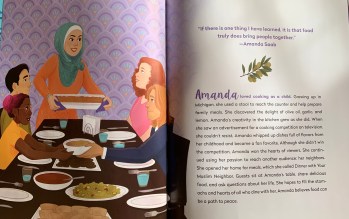
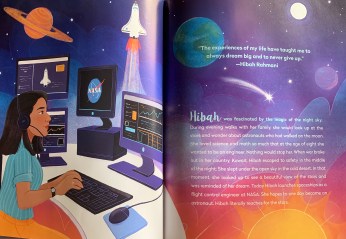
There are famous females in science, activism, fashion, film, sport, education, media influencers, make-up artists, you name it, and Muslim’s participate, so finally a book shining a light on the best of the best.  With each person getting a full two page spread, a few tidbits about who they are and what they are “famous” for are detailed in easy to read sentences that inspire, and if you haven’t heard of them before, enough general knowledge to get acquainted.  A few felt a little generic, but once you have a name, Googling them or researching them, is obviously, not difficult.

6D798E55-709C-442A-8DFF-4BA184C960E1

I wish there was a bit more information detailing who was chosen and why.  At first I thought it was  US or “western” movers and shakers, but then you have Maria Toorpakai Wazir, the tennis player in Pakistan, and Shirin Ebadi from Iran.  So then I thought ok, they are all contemporary, but Maryam Mirzakhani passed away in 2017.  Needless to say, one could argue that the list is arbitrary, and I think I would agree.

85FF7A9C-FD80-4F37-A1DE-B8726762E9CB

One could also argue, that these women may make history for notable things, but that they might say or do things that you might take issue with, and again, I agree.  They are people, they are fallible, and diverse, and have different perspectives and life experiences, but that’s ok, infact I think that might even be the point.  We all have different passions, and paths, and views and yet at the end of the day we should be able to lift each other up and inspire.  I think every person who reads this book will find someone that sounds or feels or looks like them, and that is a good thing, no, a great thing!

9C6EB606-F612-40BF-A947-092D2B76F1FE

My favorite was the Kamala Khan entry, because I didn’t realize the G. Willow Wilson was Muslim.  I erroneously assumed the other co-creator, Sana Amanat gave Kamala’s back story and home life its sense of OWN Voice, and I love that I learned I was wrong from a book.

2EC5EAF4-87F4-406C-B4D1-C95341536B66

The illustrations are right on and do an amazing job of conveying the character and the inspiration of the collection.  The book is much needed and I hope they do a similar style book for Muslim women in other time periods.

Special gratitude and appreciation to Gayartri Sethi (IG @desibookaunty) for gifting me this book for no other reason than to share the power and strength of women, and being a leader in that, by sending me a beautiful book.  May I learn from your generosity and pay it forward! Thank you.

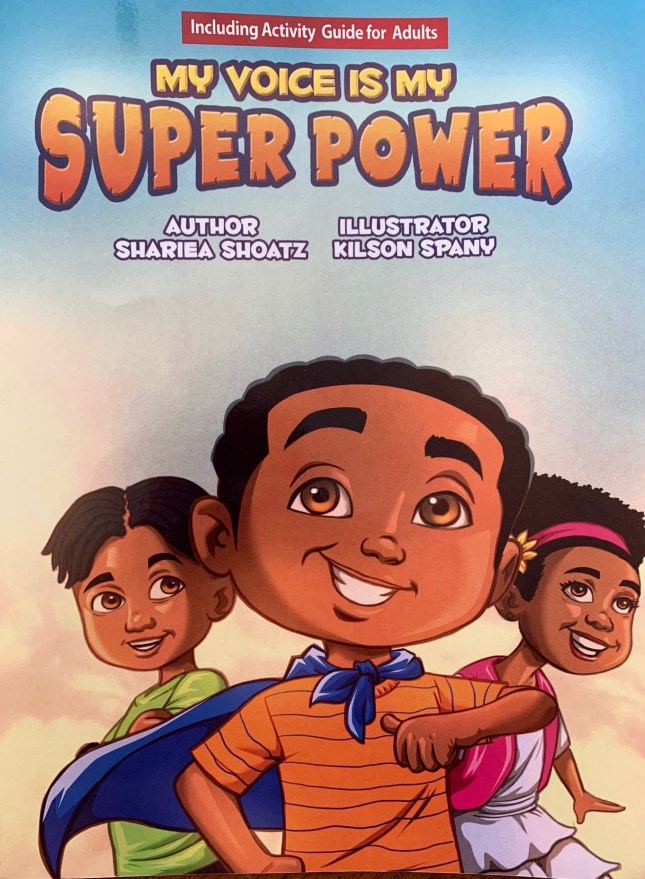
My Voice is my Super Power by Shariea Shoatz illustrated by Kilson Spany

Standard
My Voice is my Super Power by Shariea Shoatz illustrated by Kilson Spany

IMG_0210

I want to believe most parents and/or caregivers discuss body boundaries and what’s appropriate and what’s not, with their children regularly.  But if you don’t, or haven’t, or just glossed over it while at the doctors office, this book is a great discussion starter and road map.  The author comes from a place of educational and personal experience and the 33 page book tells a story that children can read independently with a discussion guide for parents to follow at the end.  Even if you don’t feel comfortable letting your children read the story independently or with you, there is a page depicting male and female private parts, I still think the book is a way for adults to face their own squeamishness of discussing it, and get ideas of how to present to their children.  Being nervous or uncomfortable is not an excuse to not discuss sexual abuse against children with our children.  For their voice to be their super power, we must first be willing to use ours to open the subject with them, educate them, and empower them.  Abuse happens in every culture, religion, socio economic bracket, period, to think differently is naive and dangerous.

IMG_0120

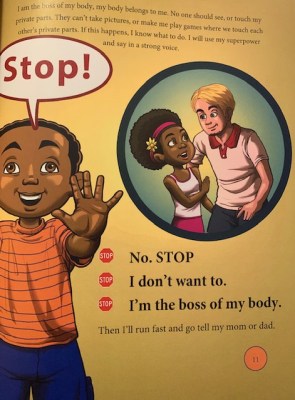
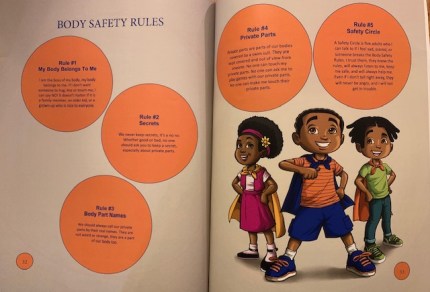
Nine-year-old Buddy is heading to his cousins’ house for a sleepover, but before heading out, he addresses the readers to make sure they know the body safety rules and to make sure his super power, his voice, is ready.  His voice is what he can use if he feels unsafe, or to help his friends if they feel unsafe.  He can say “Stop” or “No” if someone breaks one of the Body Safety Rules.

IMG_0121

His mom, a muhajaba, has being teaching him since he was three to use his voice to let people know his body belongs to him.  He knows he can say no when he doesn’t want to hug or kiss or touch someone, even if they are a family member.

IMG_0122

The book then talks about body parts that everyone can see and labels them with a diagram before explaining private parts and labeling them as well.  The book also discussing using the proper names, not nicknames or “cute” names, such as hotdog and cookie, to describe anatomy and body parts.

IMG_0123

If someone breaches or doesn’t listen to the “No” or “Stop” the book encourages everyone have a safety circle of adults you trust and like and that you feel safe and comfortable talking to.  It also mentions that if one person doesn’t listen or believe you to go to another person in the circle until someone does.

IMG_0124

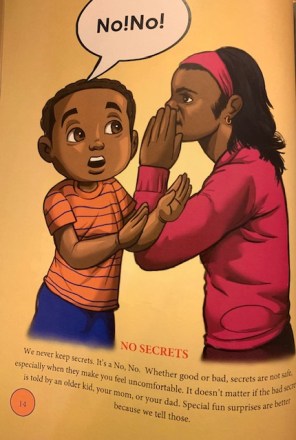
Another rule is No Secrets, and the book explains the difference between a secret and a surprise, which does eventually get told.

IMG_0125

When Buddy gets to his cousins house, the kids play and have fun, when a friend of the aunt’s stops by and gives only Keisha a treat before leaving.  When Buddy asks about the friend, his cousin talks about how they play pretend and tickle and how they have a secret touch game.  Buddy explains the rules to his cousin and then goes with her to help her talk to her mom about the breaking of Body Safety Rules.

IMG_0126

The story ends with the mom calling “people” to take the friend away and the kids feeling empowered that they kept their bodies safe.

IMG_0127

The Activity Guide for Adults gives information for each of the pages in the story to help the adult understand why that part of the story is included (i.e. grooming, disclosure, etc.) and activities to ensure understanding and mastery.

IMG_0128

The book is not religion specific, and would be a great benefit to all children, everywhere with parental involvement and dialogue.

May Allah swt keep all our children safe, ameen.


Luv Ya Bunches by Lauren Miracle

Standard
Luv Ya Bunches by Lauren Miracle

bunchesA book about 5th grade friendships told from the perspective of four different girls in a variety of styles: instant messages, chatroom conversations, video scripts, and traditional text.  The author seems to have a checklist of diverse characters and afflictions that all must make an appearance in the 335 page story.  It is written on an AR 4.4, but with one of the main characters having two moms, details of a suicide mentioned, talk of pole dancing, male anatomy joked about, thongs, crushes, and mental illness, four girls coming together to form friendships and take down a bully, might raise more questions for young readers than they are ready to handle.  Yasaman the Muslim girl in the group, also borders on perpetuating more stereotypes than she breaks, and while I definitely don’t think this book is a good fit for 4th and 5th graders, I don’t really recommend it for readers of any age, there are just better books out there.
SYNOPSIS:

Asian American Katie-Rose doesn’t have friends, unless you count her neighbor Max, but she doesn’t.  She dreams of having blond haired Camilla as a best friend, but the Camilla she went to Pioneer camp with is not the Milla at school who hangs out with Modessa (aka Medussa) and Quin, and is popular.  Katie-Rose also dreams about being a cinematographer or director, she isn’t sure yet, but she loves to imagine scenes and scripts and how things ideally should play out, even when in reality they never quite seem to do so.

Milla, isn’t sure if she wants to stay friends with Modessa and Quin, they aren’t nice and she has a lot more fun with Katie-Rose, but somehow she always ends up going back to the popular crowd.  She also has a lot of anxiety and needs various totems with her at all time to feel secure.  When her little plastic turtle goes missing, she struggles to stay composed, and her and her turtle will end up changing a lot at Rivendell Elementary.

Violet, is the new girl at school and she is not liking her life at home or at school.  Her mom is in a mental hospital and she misses her desperately, her dad brings home fast food every night for dinner and life just isn’t the same since she moved to California.  Immediately able to tell who the popular kids are at school, she hasn’t decided which group of friends is the best fit for her, but when she stumbles on Tally the turtle, and doesn’t immediately return it to Milla, she has to understand what that says about her, and figure out if she is strong enough to make things right.

Yasaman is the quiet computer wiz, she is also Turkish-American, Muslim, and a hijabi.  She designs a platform where kids who are too young to join Facebook can chat, stream videos and send cupcakes.  The only problem is, she has no friends to get to join.  When Katie-Rose and her strike up a friendship, the first seeds of the four flower named girls are planted, but it will take all four of them to put Modessa in her place, rescue Tally, and deal with stereotypes, emotions, and family along the way.

WHY I LIKE IT:

I love that a Muslim, muhajaba is included in the quartet, and that her religion, her scarf, her culture, and her belief in Allah, actually are sprinkled in.  I don’t love how in the book’s efforts to include such diversity, that it also seems to fall for a lot of the stereotypes that it on the surface seems to be dispelling.  Katie-Rose asks her if she even knows what YouTube is before being made aware of how computer savvy she is.  All this is to subtly show the assumption that Muslims are not aware of technology and whatnot, and set the record straight, but also regularly thrown in are side comments from Yasaman that her father would never let her wear something, or she wouldn’t be allowed to do that because of her dad, definitely reinforcing a male dominated, authoritarian, out-of-touch patriarchal view.  Even her mother, an artist, is shown to demand a lot of Yasaman and be incredibly strict.  A lot of things aren’t spelled out, they are just dropped in and assumed that the reader get’s it.  But only Yasaman’s parents are portrayed this way.  Milla’s two mom’s are caring, Violet and her dad seem close, and Katie-Rose’s parents are rarely highlighted.  So, I felt like it was noticeable, and not in a positive way.

I’m still completely confused as why pole dancing and male anatomy made appearances in the book.  And the pole dancing reference appeared not once, but twice when Yasaman is talking to an older cousin who is talking about a friend who’s aunt is a pole dancer, and then later when Katie-Rose’s babysitter also mentions the same friend.  They also discuss people as being slutty and boy crazy and skanky.  The male anatomy isn’t spelled out it is hidden with a girl with major orthodontia reading a Wikapedia page on the greek satyrs, discussing their physical pleasures and talents.

There is also a lot of mental health issues that I’m glad are present, but I’m not sure if they are handled seriously enough.  I’m glad they are addressed, because awareness is a good thing, but discussing how someone swallowed pills to commit suicide and even though she changed her mind still died, and not giving any context seems to make the concept come across as a bit trivial to me in its presentation.  Same goes for Camilla’s anxiety and Violet’s mom being in a mental hospital.  These girls have some major stuff going on that their preoccupation with a snotty group of girls, and the obsession of mud being consumed in an ice cream shake, seems a bit off.

Overall, the girls seem incredible perceptive and articulate in their self reflection and understanding of social personas, that I found their banter completely disjointed.  I don’t think the author’s voice is consistent, and the heavy stuff is too much coming from 5th graders in my opinion.

FLAGS:

Stereotypes, and discrimination against Yasaman and her younger sister Nigar.  Possible triggers with talk of suicide.  Milla has two moms, it is never labeled or made an issue, she just refers to them as Mom Abigail and Mom Joyce. Talk of boy private parts and erections, crushes, pole dancing, words such as skanky, and slutty and dingleberry (poop hanging on) used.  There is lying and bullying and retaliation and poetic justice.

TOOLS FOR LEADING THE DISCUSSION:

I wouldn’t use this book for a book club or even have it in the classroom.  I think it gets a bit crass unnecessarily and the cute flowery cover and inside flap, makes it all the more surprising.  You might expect some potty humor in other books, but knowing it is there allows the reader to make a decision to read it or not, I would imagine most Muslim parents would see four diverse girls on the cover, one wearing hijab, get excited and hand the book to their 3rd or 4th or 5th grade daughter and have no idea what the book also includes in passing, with no relevance to the story lines highlighted on the inside flaps and back of the book.

Azad’s Camel by Erika Pal

Standard
Azad’s Camel by Erika Pal

camel

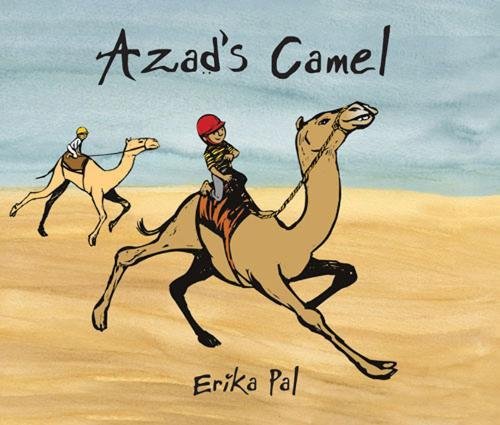
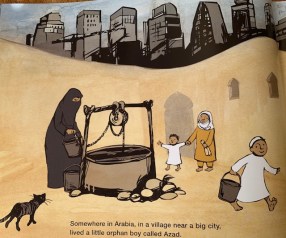
This beautifully illustrated picture book takes the reader in to the world of camel racing, children jockeys, mistreatment by adults, children being sold by their families and running away, all in a span of 40 pages and on an AR 3.5 level.  Yeah, its a lot for a kid’s book, but it has a happy ending and it does draw attention to an atrocity not often discussed or thought about.

IMG_8781

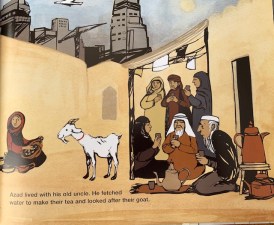
Young Azad lives with his old uncle in a village outside the city.  He helps take care of the goat and fetches water for tea in the mornings,  in the afternoons he plays with his friends.  One day he is doing handstands on a soccer goal post when a rich Sheikh drives by and sees him.

IMG_8780

The Sheikh comes back and convinces the uncle to let him take the boy to be trained as a camel rider to one day be famous.  The uncle agrees saying he can’t afford to keep him.

IMG_8782

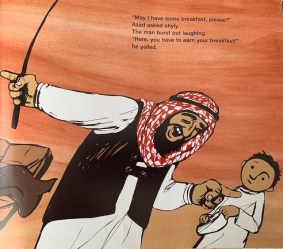
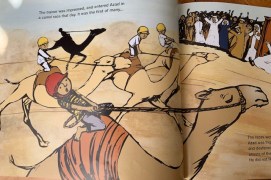
The Sheik takes Azad to the desert with other boys to live and be trained.  Azad learns that food is earned and chores are a must.  The races are dangerous and Azad doesn’t like them, but he is good and is forced to keep racing.

IMG_8783

One night the camel, Asfur, talks to Azad and the two plan to keep running past the finish line at their next race.  The pair are so fast that, they do just that, and no one can catch them.  They run through the city, and back to the desert.

IMG_8784

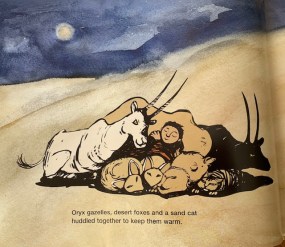
The other animals of the desert keep them warm when it gets cold and until a Beduin tribe discovers them and takes them in.  At last Azad and Asfur find a home.

IMG_8785

There is information about camel racing at the end including how robots are replacing child jockeys in some countries and how many young children are being returned to their families, school and a normal life.

IMG_8786

I like that the book takes on a real and sad occurrence, bringing camel racing and forced child labor in to light.  The story is truly written for younger elementary kids with short paragraphs on each page, large engaging illustrations, quick jumps in events and glossing over any truly graphic details.

IMG_8787

I do worry that stereotypes are reinforced with the use of calling the rich man who bought Azad a “Sheikh” and the Bedouins dancing at the end.  Culturally the book is a generic Middle Eastern country and doesn’t mention or emphasize religion at all with the exception of the women in the pictures being veiled.

I found the book at the library and think it has good information to discuss with your children, but I don’t know that I can see it being anyone’s favorite book, or a regular night time request.  While, yes, it does have a happy ending, you don’t really “feel” what Azad is going through, you are just glad he finds people that want him.


Allies by Alan Gratz

Standard
Allies by Alan Gratz
allies.jpg

This is the second Alan Gratz multi-perspective historical fiction novel I’m reviewing for its inclusion of a Muslim character.  While in Refugee it seemed a natural choice to include a Muslim family, I was completely shocked that he would feature one in a WWII D-Day novel.  With numerous storylines spread over 322 pages the book is quick, fast paced, intense and emotional.  An enjoyable read for history lovers and curious kids fifth grade and up, it is an AR 5.6 and older kids will benefit from it too.

SYNOPSIS:

The characters and timeline are fictionalized to all take place on D-Day, June 6, 1944, as the Allied forces and French resistance come together to storm German occupied France on the beaches of Normandy.  Many of the details do come from history though as detailed in the Author Notes at the end of the book.

The book starts out following Dee, a German national who left for America to escape the Nazi’s and is now returning in a Higgins boat to fight them. Knowing no one will understand, including his friend Sid, a Jew from New York, he keeps this knowledge to himself and focuses on the task ahead.

Samira and her mother are the focus of the next mission and highlight the role of the French Resistance, the Maquis.  What makes their story more meaningful is that they are spies with the French Resistance, but they are French Algerians, not really a part of France at all, and they are Muslim.  In Samira’s back story we learn how she must remove her hijab and how she is treated different at school because Algeria and France are at odds.  When her mother is taken by the Nazis before she can deliver the message to the Resistance, Samira vows to do it and get her mother back as well.

19-year-old James from Winnipeg Canada is a paratrooper who volunteered for combat to feel empowered after years of bullying. His buddy in the story Sam is a Cree Indian from Quebec, who has few rights at home, and hopes to have more success in the military.

Medic Henry is scrambling along on the beach helping anyone and everyone he can.  Having left behind a segregated US, even the military has reservations about African Americans saving and serving. As he performs one heroic act after another being questioned and doubted and insulted all along the way, readers see how ridiculous and infuriating racism is on every level.

We meet Private Bill Richards who drives a Sherman tank and is following in his fathers WWI footsteps.  But who is unfortunately killed before reaching Bayeux.   And finally we meet Monique Marchand, a French 13 year old girl, who gets caught up in the invasion because she left her swim suit in the beach hut the day before and has returned to retrieve it. Determined to do something other than cower in fear, she starts helping fallen soldiers and meets up with American journalist Dorothy, a strong woman determined to not be stopped on the basis of gender.

All the story lines criss and cross as the invasion is a chaotic mess and everyone is dropped, disembarked, or arriving in the wrong place at the wrong time.  Surviving the day is an immediate challenge and not one that everyone will succeed at.  The larger success of the mission will depend on some lucky breaks and a whole lot of teamwork.

WHY I LIKE IT:

I love that the story somehow isn’t political at all in the traditional war story, war strategy sense.  But the strength at least for me, wasn’t the horrific battle at hand, which is truly violent and abhorrent, but the relationships between the people.   The realizing what is driving them, what matters and more importantly how hard our prejudices are.  The larger story of the Allies shows British, Americans, and Canadians coming together to defeat he Nazis, but yet, a girl, an African American, and a Cree are treated as “other” irregardless of how beneficial they are even in matters of life and death.

As for the story of Samira, she is a tough girl, both clever and brave.  To have a Muslim in  an American/westerm story of D-Day and a young girl at that, to me was pretty remarkable.  There isn’t mention of faith or anything other than that she is told to take off her scarf and continues to wear a small kerchief on her head anyway, but for Muslim kids all over, this character and how she behaves will spark a sense of extra pride in the Allies success over Hitler, just as the other minority characters will for their representation in such a dramatic event.

FLAGS:

There is a bit of mild profanity.  There is violence and death, and blood, not too bad, but the point is clear, the beach isn’t pretty.

TOOLS FOR LEADING THE DISCUSSION:

I think this book would be a great supplement to any WWII history lesson.  There are great resources at the end, and maps at the beginning and a high energy, short chaptered book that doesn’t skimp on character building or war intensity.

Author’s website: http://www.alangratz.com


Satoko and Nada 1 by Yupechika

Standard
Satoko and Nada 1 by Yupechika

satoko.jpg

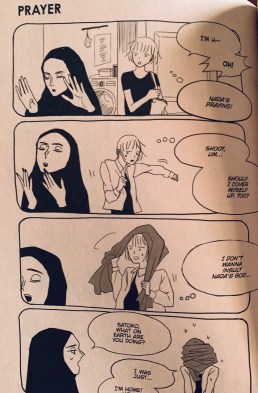
A manga series about two college roommates who have come to America to study, Nada from Saudi Arabia and Satoko from Japan.  Written by a Japanese author and translated into English, there is a lot about Muslims, particularly Muslims from Saudi, as the two characters get to know each other and become friends.  Their interactions work to dispel a lot of stereotypes and promote how rewarding getting to know people different from your self can be.  Volume one (there are three) is 127 pages, read right to left in four panel pages, and is fairly clean for all ages (they do buy underwear and bras at one point), but would most likely appeal to female readers in 4th or 5th grade and up.
8CE09DE5-2BEB-48C0-9157-96B13CC78CD9

SYNOPSIS:

The book is about two girls getting to know each other, learning about each other’s culture, and navigating life in America.  There isn’t really a plot or a story line outside of this basic framework, and with a heading every page or two it reads like a quick scene about the topic expressed in the heading.  So, for example there are headings of Veils, Ramadan, Birthday, MashAllah Choice, etc, and then a few panels showing the girls having an interaction about it, resulting in understanding, humor, or a lesson.

In a bit of a stereotype twist, Nada is more street savvy then Satoko when approached by a stranger for a ride, and thus Nada hasto educate her a bit.  The book brings in a Christian American character and a third generation Japanese character learning Japanese, to further show how assumptions plague as all and how simple conversation and an open mind, can lead to some amazing friendships.

WHY I LIKE IT:

The book is really choppy, but you get used to it and soon you forget that it isn’t a typical story.  I admittedly haven’t read a lot of manga so, I have no idea if this is the norm, or something unique.  I love that its upfront about stereotypes, if it was an American writing it, or a even a Muslim it would probably come across as preachy or arrogant, but somehow it doesn’t seem like the two characters have much baggage, nor feel a need to defend their culture by putting another’s down.  They deal with issues such as women driving in Saudi, differences between hijab, burka, abaya, niqab, being around alcohol,  the joy of a fatwa allowing soy sauce and its alcohol content to be permissible, etc.  Some things are cited for clarity and something are very Saudi, but it really contains a lot of information, about Islam that I am pretty impressed by.  There isn’t a ton about Japanese culture since I would assume it was written for Japanese readers, so it would be redundant, but I did learn, according to Satoko, how religion is viewed by Japanese, how putting age and gender and race on forms seems incredibly personal, and some information about food.

FLAGS:

There is a possible failed abduction, not sure what the guys intention was, but the girls treated it as such.  The girls do go buy undergarments, so they are visually depicted.  There is mention of alcohol.

2DF66805-A246-4150-89BA-E7E1EAF90E90
TOOLS FOR LEADING THE DISCUSSION:

I wouldn’t do this as a traditional book club, but I think I am going to get a copy of the series to pass around my daughters middle school group of friends, to

one- give them a taste of manga

two- see what they think of the Islamic rep from a Japanese paradigm and

three- give us all something to chat about

The book is fun, I got it at the public library and think it might open up a new book type for kids to try and a new point of view for many of us to consider.

The Star Outside My Window by Onjali Q. Rauf

Standard
The Star Outside My Window by Onjali Q. Rauf

star outside.jpg

Woah! Domestic abuse, foster care, murder, astronomy, and above all hope and bravery. It is so, so much, and so beautifully dealt with from the perspective of a child, that I’m still living in Aniyah’s world and praying she is doing ok.  As the beginning of the book states, it is a story written for everyone, but it then goes on to say that there could be triggers and difficult things to read. So please, while it may be written for ages nine and up, you should know what your child can handle before suggesting they read such a heartbreaking 306 page book, and if they aren’t able to handle it yet, make a mental note to have a discussion when they are ready, it is important.

SYNOPSIS:

The book starts with a map of London and the chapters start with constellations, maps to the stars, and a little girl who wants to be a star hunter.  Drawing on Simba from the Lion King and wholeheartedly believing that stars are people who’s hearts were so big that when they die they light up the night, she maps the stars outside her foster house window, on the lookout for a new star, her mom.  Not remembering all the details that brought her to this foster home, she and her little brother Noah are trying to figure out their new life, the foster home rules, the loud pain they felt, and if they are winning the game of hide-and-seek with their father.

Unable to speak, Aniya, breaks her silence when a news story on TV tells of a star breaking the rules of gravity and flying by Earth.  Convinced it is their mom, Aniyah and Noah with the help of fellow foster kids Travis and Ben hatch a plan to go 73.6 miles from Waverly Village to the Royal Observatory in Greenwich, to make sure the star hunters name the star the correct name, and not the random computer generated one the contest rules dictate.

WHY I LIKE IT:

The book is inspired by the author’s aunt who was a victim of domestic abuse and killed by her husband.  The love and pain she feels at her loss, I believe is conveyed through the pages and felt by readers of all ages.  I had my 10 year old son and my 12 year old daughter read the book, because this book’s topics are heavy and weighty, but handled with such sensitivity and childlike innocence that it is a great introduction to the topic, without being overly heavy and weighty.  The author is amazing, and I was curious how she would follow up her amazing debut novel The Boy at the Back of the Class, and I think this one is just as powerful, if not more so. 

All of the foster kids suffer from some form abuse and there is even a note at the beginning about how the author does not like the term “domestic abuse” and there are resources and information at the end of the book for children or adults suffering or how to help someone they know suffering abuse.  There is also a page about Herstory, the constellations, and some personal anecdotes about the author’s aunt.

The book is truly heartbreaking because as an adult reading the book I could easily figure out what happened, that the father killed the mother, and that the games the mom would have the kids play were not games at all, but ways to mask what was going on. The book is very subtle in how it talks about what the mom and kids endured and some kids will not get it, and others will, either way, parents should be aware and available to discuss that abuse is never ok and that if their friends or someone they know is suffering/surviving, there is help.

The book is powerful also in the way the foster kids for the most part stick together, I think the way they are so willing to help and risk their own chances at adoption is selfless and memorable.  Also the way they put up with Noah, a little kid, who gets annoying, but handled lovingly,  because family means so so much when you don’t have one. 

On the surface though, it is an adventure story, can a ragtag diverse group of kids with little money, injuries and a deadline travel nearly a hundred miles to name a star?  Its fast paced, interesting, and emotional on many levels.

There is nothing Islamic in the book, not even a Muslim name in passing, but the author is Muslim and the story universal.

FLAGS:

Halloween is when they run away.  There is a lot of lying, but they know it.  Lying when the mom covers her bruises and marks, and how she is doing, lying when the kids run away and steal the bikes and sneak on a bus without paying, and break in to the observatory.  The kids feel guilty and know right from wrong in every instance, but when they opt to do something uncouth they rationalize it because they have to name that star!

TOOLS FOR LEADING THE DISCUSSION:

I’m seriously considering reading this as a middle school book club selection.  It is written for a younger audience, but I think I want to open up the topic of abuse and have the school counselor come and listen to the discussion.  The book is that good, and that important, and that powerful, that a discussion and lessons, will keep these characters’ stories in the middle schoolers’ minds as they grow and hopefully teach them empathy, compassion, appreciation, and patience.


Islamic History for Kids: Story of Badr by Qasim Riaz

Standard
Islamic History for Kids: Story of Badr by Qasim Riaz

badr.jpg

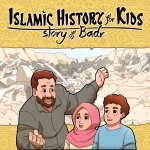
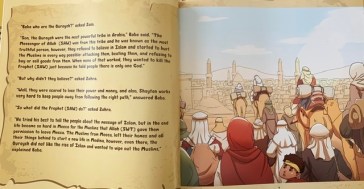
This fictional story of a non-fiction-historical event over 37 large, 12×12, pages really brings the battle of Badr to life for readers ages seven and up.  The book is engaging and keeps chidden focused, excited, and clear as to what is unfolding, why the battle was important for Muslims, and why it still has lessons today.  Unfortunately, there are no source notes, bibliography, or references in the book, so I’m not sure how accurate the details are, and I haven’t yet had a chance to have someone more knowledgeable than I check it for accuracy.  The ayats from the Quran quoted are identified in text and yes, I understand it isn’t a reference book, but even having some imam or scholar give their approval would reassure people considering purchasing the book.  Additionally, fairly prominently there is a disclaimer at the beginning of the book that says, “The characters in this book are entirely fictional.  Any resemblance to actual persons living or dead is entirely coincidental,” which is a common disclaimer, but in a book of this nature, it did strike me as odd.  So, you may want to read it first yourself before presenting it to your child as fact.

3A02CEE2-B385-4AF0-8091-BB9E54CBE579

There is also a typo that my children discovered rather quickly and pointed out to me, I was a little disheartened when I asked about it, to discover the author knew about it before mailing it out, but for some reason didn’t find it necessary to put a note or let the customer be aware of it. I put a post-it note in mine to show all of you, and will be taking a black marker to it shortly.  Mistakes and typos happen, but I felt that they should have let the consumer know, once they knew that it was there, for accuracy sake.

85C78105-8FD8-4B2F-B031-A49272D287DF

The book starts off with a brother and sister fighting, Zain and Zahrah.  When the father goes to stop them, Zain tells him that Prophet Muhammad (SAW) used to fight, and the father concedes the point, but points out it was not something he wanted to do.  He tells them that for the first 13 years he didn’t fight back even when the Quraysh made fun of him.

DA52115E-5314-4E5A-BE6B-9E38E6E88817

The kids ask who the Quraysh are and why they didn’t believe the Prophet, to which the father lovingly answers their questions before telling him about the verses revealed allowing them to fight from Surah Al-Baqarah.

They learn about Abu Sufyan returning from Syria with a large caravan and how the Prophet wanted to surprise them. Only to learn that Abu Sufyan had arranged a much larger army from Mecca to come and attack the Prophet and his Companions.

There are details about how they determined the size of the army based on how many camels were being eaten, and how the Muslims camped near the wells to control the water.  The story reads smoothly and pulls out when the children have questions seamlessly.

FF278825-CA1F-4904-9F20-DF21DA7085BE

As the battle is set 1000 soldiers against 313 Muslims, the book explains how the battle starts with three duels and explains how Utbah, Shaiba and Walid battle Hamza (RA), Ali (RA), and Ubaydah (RA).  The Ansar win all three battles and the Quraysh charge.

5F4EFF83-0553-4FD0-919A-45814B973E9F

Prophet Muhammad (SAW) makes duas, and Allah (SWT) answers sending a thousand angels following one after another to help.

715028DE-D6FB-436D-88A1-65ACCA437AB2

When the dust settles the Muslims are victorious and the order is given for the prisoners to be treated kindly.  They are given food, rides, and the opportunity to pay a ransom for their freedom or they could teach 10 Muslims to read and write in exchange for their release.

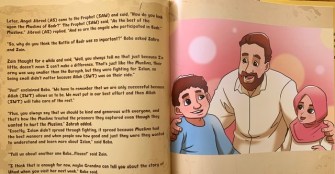
With the story concluded the father then makes sure the children understand some of the many lessons from the battle.  Including having Allah on your side, trusting Allah, putting in your best effort, and being kind and generous even to those against you.

DE00F1A5-8C32-4CF9-8B6D-D880A4C77726

There is no illustrator listed, but the pictures are done really well showing modern relatable, squabbling kids getting drawn in to a historical story by their father.  The emotion on the characters faces adds depth to the story and engages the readers in seeing and understanding a desert battle so long ago.

The text on some pages varies quite noticeably, with some pages barely having a line to spare and some only being a line or two long.  It does slightly affect the rhythm (and aesthetic) of the book, but it is manageable as long as you remember to give the kids enough time to see the picture on the short pages, as the overall size makes the book perfect for story time to large and small groups.  The book stays on level, which is nice, and there is a glossary of abbreviated terms (AS, RA, SAW, SWT) at the end.

The company: Ghazi Production is planning Uhud to be the next book, and informed me a bibliography will be included in that one.  InshaAllah!