Tag Archives: Picture book

The Night Before Eid: A Muslim Family Story by Aya Khalil illustrated by Rashin Kheiriyeh

Standard
The Night Before Eid: A Muslim Family Story by Aya Khalil illustrated by Rashin Kheiriyeh

img_7123

This 40 page early elementary picture book is set the night before Eid and radiates with love from a boy to his Teita, traditional ka’ak, and the family’s Egyptian culture.  The robust and personal backmatter shares a glimpse into the threads from the author’s real life that the story touches upon, and makes the book extend beyond the pages.  It is worth noting that this book does not articulate if it is for Eid al Fitr or Eid al Adha and thus works for both.   There is nothing religious in the book except a reference to something happening after Eid prayer in a memory, and the shape of the cookie being round like the Ramadan moon, Eid day is not mentioned, it is simply the catalyst for this warm family story about a boy and his grandma making a special treat for the first time and sharing it at school.  The large hardback book with fun illustrations is ideal for both story time and bedtime readings alike.

img_7124

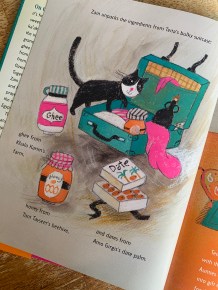
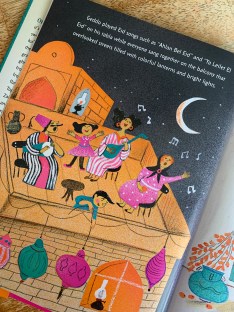
It is the night before Eid and Teita has arrived from Egypt.  Zain can’t wait to make ka’ak to take to school and share with his friends.  The beloved powdered sugar cookies are steeped in tradition, both in Zain’s family and in Egyptian history.  Once the suitcases is unpacked and the special ingredients found, Teita and Mama share memories of baking with cousins, painting henna designs on hands and putting eidiya in envelopes.  The family recalls singing together on the balcony while Geddo played the tabla and lights and lanterns filled the streets below, after Eid prayer they would hand out the ka’ak.

img_7125

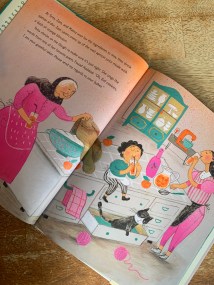
Zain wants the ka’ak to turn out perfectly so his teacher and friends will like them.  Teita tells him that ka’ak is as old as the ancient pharaohs, and that recipes were found in the pyramids.  At one time rulers would even put gold coins in the cookies.  Zain and his Teita mix and add the required ingredients, and drink iced apricot juice as they wait for the dough to be just right.  Getting the cookies pressed with the molds though is harder than it looks, and Zain gets frustrated. Teita’s love and patience and Zain’s clever thinking get the treat making back on track.  The ka’ak doesn’t have a gold coin filling, but they are filled with tradition.

img_7126

The timeline is a bit off for me with the grandma coming before Eid and then the cookies going to school on Monday, and then Monday evening when Zain is writing down the recipe with Teita he is telling her Eid Mubarak and that it is the best Eid ever.  So, it seems that he went to school on Eid, not to Eid prayers, which is fine, just a little sad that there was no Eid celebration or prayers.  I don’t know that kids will be bothered by it, but the lack of mirroring and stressing how joyous Eid is does somehow get lost and mitigated, in my opinion, by skipping acknowledgement of the religious holiday.   In the backmatter the author remarks that she has “outgrown the magic of Eid,” so perhaps it is intentional that the day is not included in the text.

img_7127

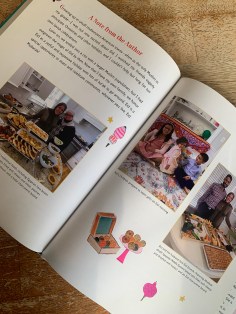
The last six pages of the book are filled with informative and engaging information about What is Eid, Ka’ak Time Line, A Note from the Author with photographs of her and her family celebrating Eid, a Simple Ka’ak Recipe and Additional Resources.

I purchased my copy from Crescent Moon Store where if you put my initials ISL (Islamic School Librarian) in at checkout you will save 10% or is available here on Amazon where the book currently has a coupon for $3.80 off.

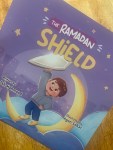
The Ramadan Shield by Fadelah Mahmood illustrated by Ayun Sekar

Standard
The Ramadan Shield by Fadelah Mahmood illustrated by Ayun Sekar

img_7028

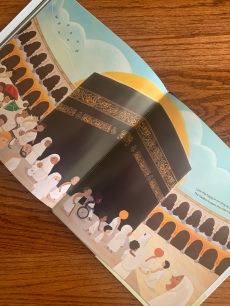
This new 32 page rhyming book focuses on a boy who gets frustrated and often loses his temper and how the onset of Ramadan has his father imparting the lesson that fasting isn’t just staying away from food and drink, but also about behavior and controlling your anger.  He shares the hadith of saying “…I’m fasting, I’m fasting,” which is shared in its entirety and sourced at the end.  The book has a lot of text and scenarios in its moral framed telling that creates a bit of a disconnect between the presentation and the target audience.  The characters are fasting, there is no discussion about why they are fasting or that it is a first time fasting (thank you). the child’s art assignment is pretty advanced, and friends are seen independently out and about, but the rhyming lines and illustrations at the end of the kids on the rug seems aimed at a much younger reader/listener.  For my purpose of story times to children 4-9 it is a great choice, because it can appeal to the large range of relatability and attention spans, but for repeated readings in a home, it might need some shortening or additional explaining to connect as intended.

img_7029

The story starts with Nuh working on an assignment to draw and paint a picture of the Kaba, but it keeps coming out tilted and he crumples and throws page after page.  His dad snuggles him close and explains that Shabaan is over and Ramadan is about to start which means that he needs to go without food and water, but also work on his behavior.  He explains, how to use the advice of saying, “Fasting is my shield; I will not be defeated! I am fasting, I am fasting.”

img_7030

Empowered by the words, Nuh starts his next morning remembering his father’s advice.  When he spills water on his painting he remembers the advice. When a grocery cart collision at the store with his nemesis gets his fist clenching, he remembers his father’s advice.  He even gets a chance to share his knowledge with his friends.

img_7031

When the day is over he is eating iftar with his family and determined to keep his temper at bay throughout he whole month and beyond, inshaAllah, starting with him trying his drawing of the Kaba again.

img_7032

I like that the focus is on behavior, I think that is a good reminder for older kids, and something younger kids that may or may not be fasting need to implement in Ramadan.  I also like that the parents are encouraging and invested, but not controlling the individual situations.  The book is preachy, and when the kid takes the lesson and starts preaching it to him, it is a little heavy handed, but I think it fits with the nature of the book.  I appreciate that the kid knows what Ramadan and fasting is, so that the lesson can go a bit deeper in this Islamic fiction story.

I got my copy from Crescent Moon store, and you can get yours there as well by clicking this link here.  If you use code ISL (Islamic School Librain initials) at checkout you will save 10%,

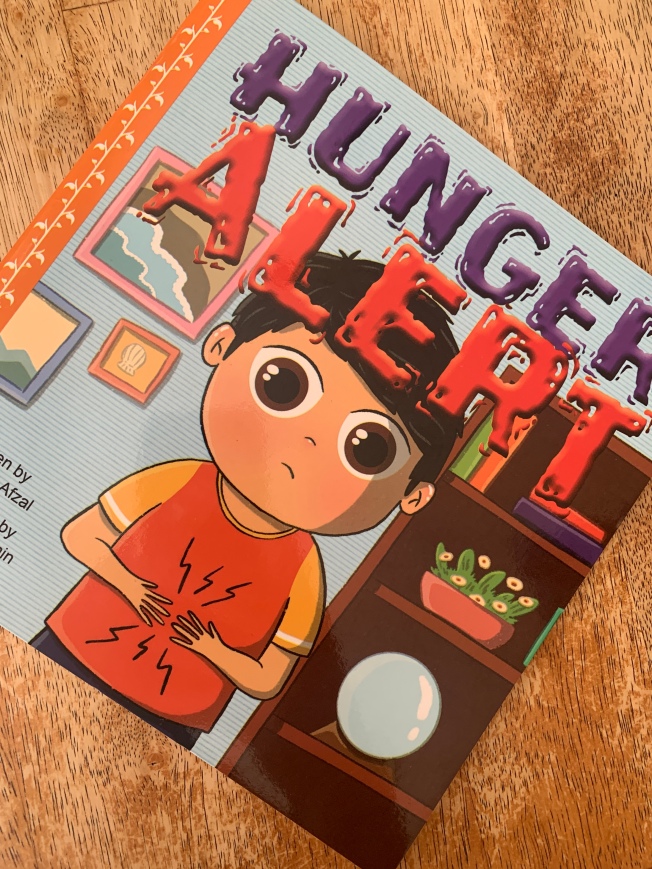
Hunger Alert by Shazia Afzal illustrated by Sania Hussain

Standard
Hunger Alert by Shazia Afzal illustrated by Sania Hussain

img_6919

On my first read through, this book came across as a bit text heavy and the presentation didn’t quite fit with the content for the target audience, but when my seven year old read it, then reread it, and my 12 year old picked up and read it and both said, “it’s good,” I realized, the target audience is not little kids, nor is it adults, it is kids who have fasted and have felt the pangs of hunger.  The character is getting through his first day, but the relatability is for kids everywhere fasting for the first time the hundredth time and everywhere in between.  It is Islam centered, I appreciate the healthy food temptations and the unwavering that fasting needs to be done, but as an adult and an educator, so often I wanted to interject Islamic touchstone to getting through the day asking Allah for help, talking your self up and increasing your determination by knowing the Angels are recording your struggles and you will be rewarded in the akhira, and while Quran is read, and a surah loved, and Islamic phrases included, the focus of the book is a little boy in a very idyllic family trying to keep hungry thoughts away. The small 8 x 8 soft back book with 22 thick cardboard pages would be a bit hard to share at story time, but the simple concept story is fine in smaller groups and at bed time.

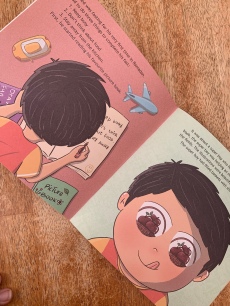
img_6920

The books starts with Ahmed fasting for the first time in Ramadan, he has a list of things he needs to complete his fast: 1-Keep busy, 2- Don’t think about food, and 3-Stay away from the kitchen.  I found when reading it to my younger kids I would pause here to discuss why we fast, and that we are doing it for the sake of Allah, so we need Him to be successful, not distractions.

img_6921

Ahmed starts with reading his favorite book about a charitable boy, the illustrations though had baskets full of shiny, big, read apples.  “Grr, Hunger Alert!” He runs to his brother’s room to keep busy with a soccer video game, but the prize on the screen are big, yellow bananas. “Grr, Hunger Alert!” This continues throughout the day, including while reading Surah Rahman, and the pomegranates trigger yet another Hunger Alert. When Grandpa asks him to take strawberries to his mom and his mom is in the kitchen, each of his rules will have to be broken.

img_6922

With iftaar approaching and fruit chaat waiting, Ahmed will have to persevere to complete his fast.  There is a glossary at the back and the book you can search online to find where the book is available near you http://www.compassbooks.ca

img_6923

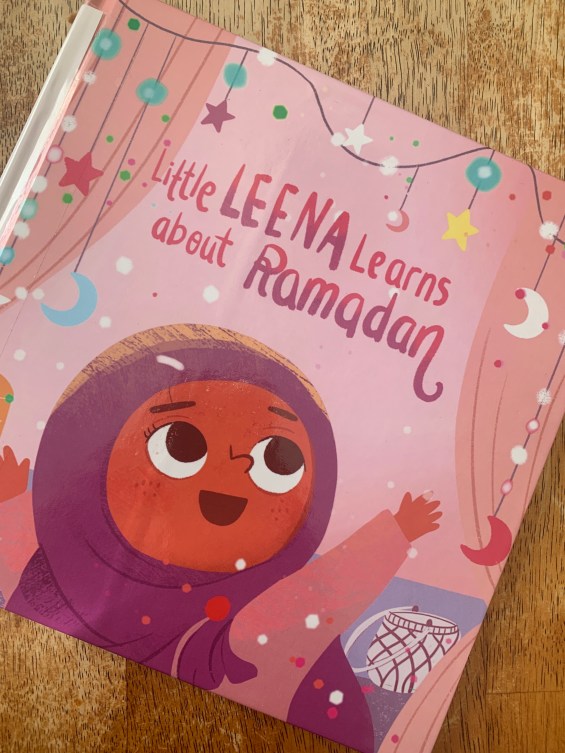
Little Leena Learns about Ramadan by Zainab Fadlallah

Standard
Little Leena Learns about Ramadan by Zainab Fadlallah

img_6913

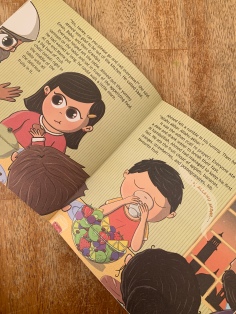
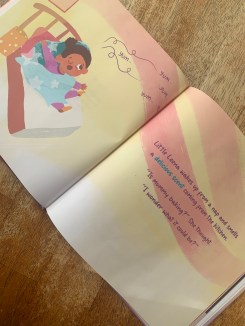
I was excited to see this 20 page book in my public library, and then once I started reading it I was equal parts frustrated, disappointed, and honestly a little upset.  The book is an example of what I posted a reel about a few days ago, about an over used, unrealistic, textbook fact share of Ramadan from a kid’s perspective in a plotless book.  In this book it is Little Leena waking up from a nap smelling something delicious and finds her family eating and wondering why.  She is told by her sister it is the ninth month of the lunar calendar, the new moon has been sighted.  Oh sure there are some mentions of cakes and cupcakes, but seriously, come on, what three year olds have a working knowledge of moon phases but don’t know what Ramadan is, know what “blessed Ramadan” means but have never heard “Ramadan Mubarak.” Ramadan is explained to be special because we try and be extra kind, and not because it is the month we are told to fast, and we get more blessings for being kind, and the month the Quran was revealed.  Yes I appreciate that hijabs are not worn in the house, but are worn outside, and the excitement and joy are visible, but how can you have a book this centered on Ramadan that contains no Islam in it.  You can’t say on the back that it is learning about “what the occasion is all about” if there are no religious inclusions: it does not say that it is an act of worship, that fasting is prescribed by Allah swt in the Quran, that we pray extra, there is nothing, it doesn’t even attribute Ramadan and Eid to a religion, sigh.  My frustration isn’t just in this book, it is in this growing trend that this book is a part of sadly.  Why have an OWN voice adorably illustrated book claiming to be teaching about Ramadan, when the religion is completely absent? If it was a cultural, or family traditional book of joy with or without Ramadan facts blended in, I might see what it was trying to accomplish, but a book for early elementary, from a toddlers perspective that is so formulaic misses the mark in my opinion, both in educating the target audience or in helping young Muslims feel seen.

img_6914

The book starts with Little Leena waking up from a nap and smelling something delicious.  She wonders if mummy has been baking cookies, or cupcakes with sprinkles, or maybe a chocolate cake.  She decides to go have a look and finds colorful lights and decorations and a magnificent chocolate cake.  She also finds her family sharing a meal, she asks what is going on and learns that it is Ramadan.

img_6915

Leena’s sister Safiyya explains that “Ramadan is the ninth month of the Lunar calendar” and “it starts as soon as the new moon is sighted.”  She further explains that “Grown ups fast from when the sun rises till the sun sets”  she says brave kids are welcome to try too.  I’m not sure what being brave has to do with fasting, to me determined or even strong would be better words to use as fasting isn’t scary, and kids are encouraged to try, not forced.

img_6916

Leena then wants her sister to explain what fasting is, and Leena can’t believe it means no food or drink during the day light hours.  Leena asks what makes Ramadan special, and is told, “Ramadan is special because during the month we try to be extra kind and do as many good deeds as we can.”  It does not say why we try and be extra kind though, before reminding that we also “try to remember to be grateful for all the things we have.” It is worth noting that in the illustration on this spread it has a Ramadan sign, that is spelled Ramadhan, not that one transliteration is write or wrong, but to have both in a children’s book is a little confusing.

img_6917

Leena then finds some presents and Saffiya explains that they are for Eid when Ramadan is over and we wear new clothes and get presents.  The two then discusses their love of presents and saying Ramadan Mubarak.

img_6918

The 8.5 inch square book is short, but the image quality and hardback binding in this library edition is nice, it just adds nothing in my opinion to the genre, to conveying to Muslim and non Muslims what Ramadan is and why it is important.  I worry that libraries might think this is good as our Ramadan reads are and not budget to get much better, engaging, reflective stories as a result.

Amir’s Blue Jacket by Sarah Musa illustrated by Rania Hasan

Standard
Amir’s Blue Jacket by Sarah Musa illustrated by Rania Hasan

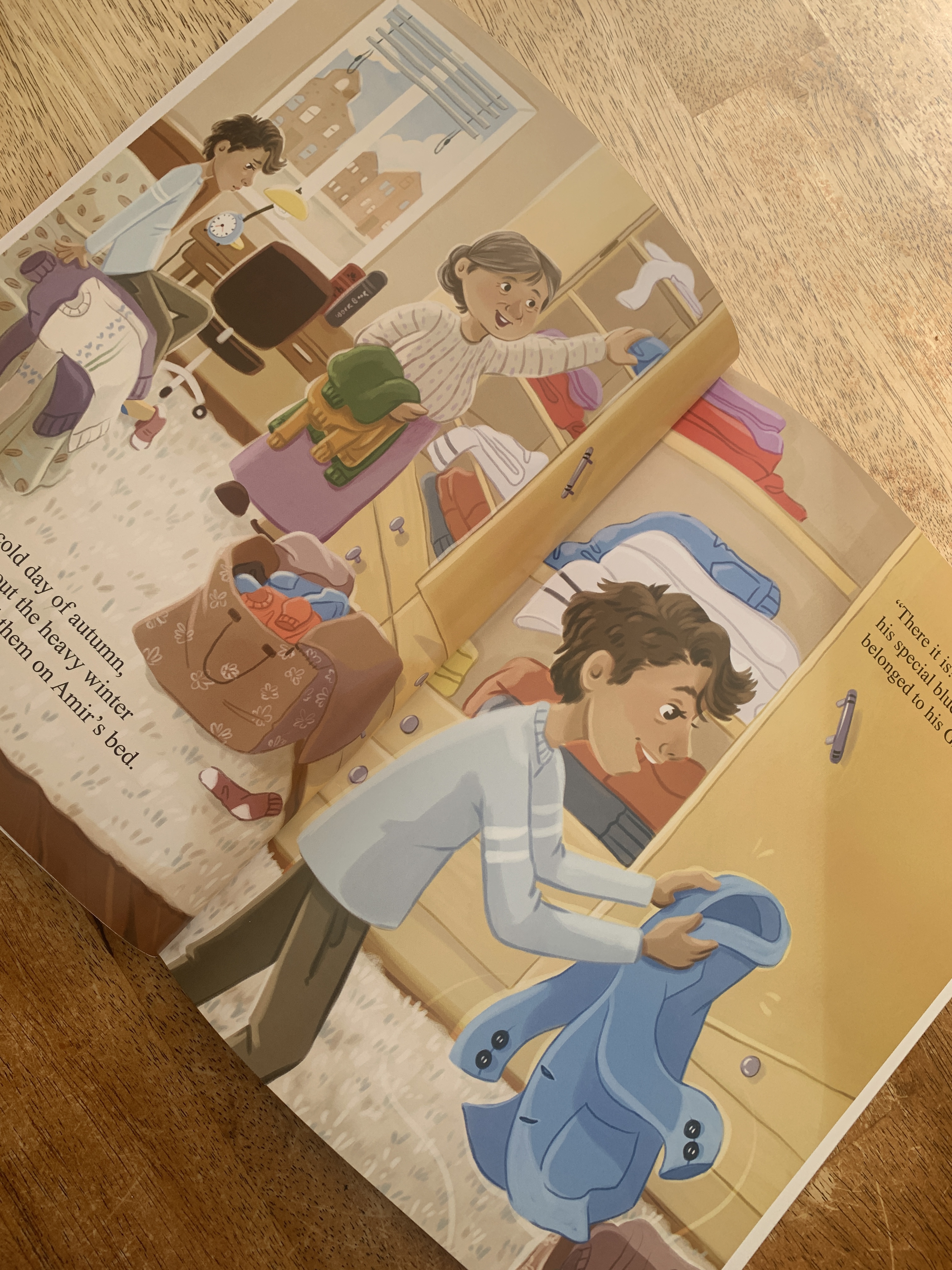
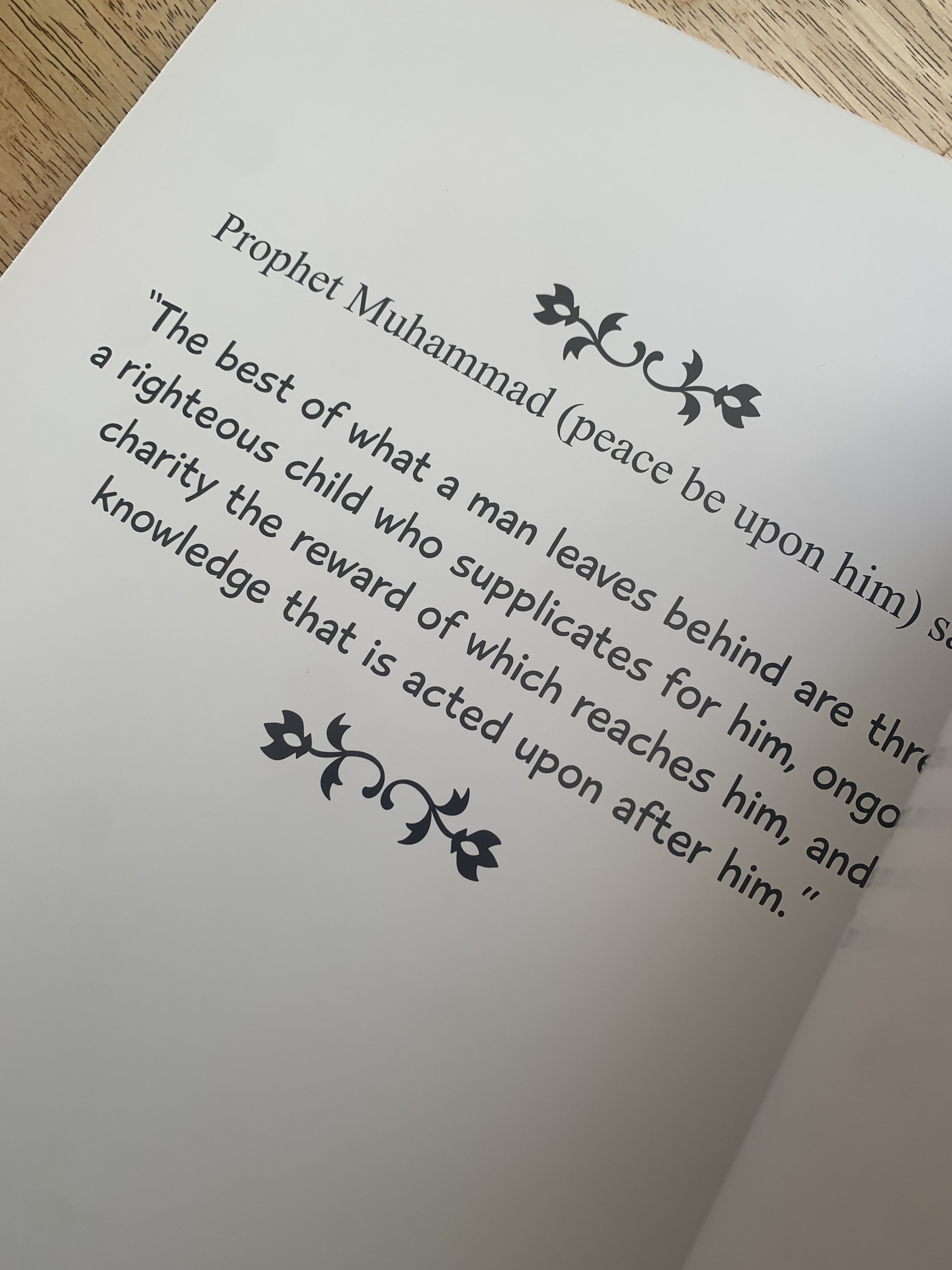
This heartfelt elementary picture book does a remarkable job of drawing the reader in to the emotions of the main character, his relationship with his grandfather, and imparting a moral message without being preachy. The illustrations are lovely on their own, but the way the muted tones convey the memories and illustrate the text really ties the book together. Whether it is for a larger story time or a one-on-one bedtime read, the book will offer discussion, comfort, guidance, and a little surprise at the end for Muslim and non Muslims alike. The slightly allegorical book does conclude with a widely known hadith (it is attributed to Prophet Muhammad saw, but is not further cited/sourced) and the family is clearly Muslim with their names mentions of Eid and God, and a hijab clad woman, but the book is universal and a lovely addition to any book shelf.

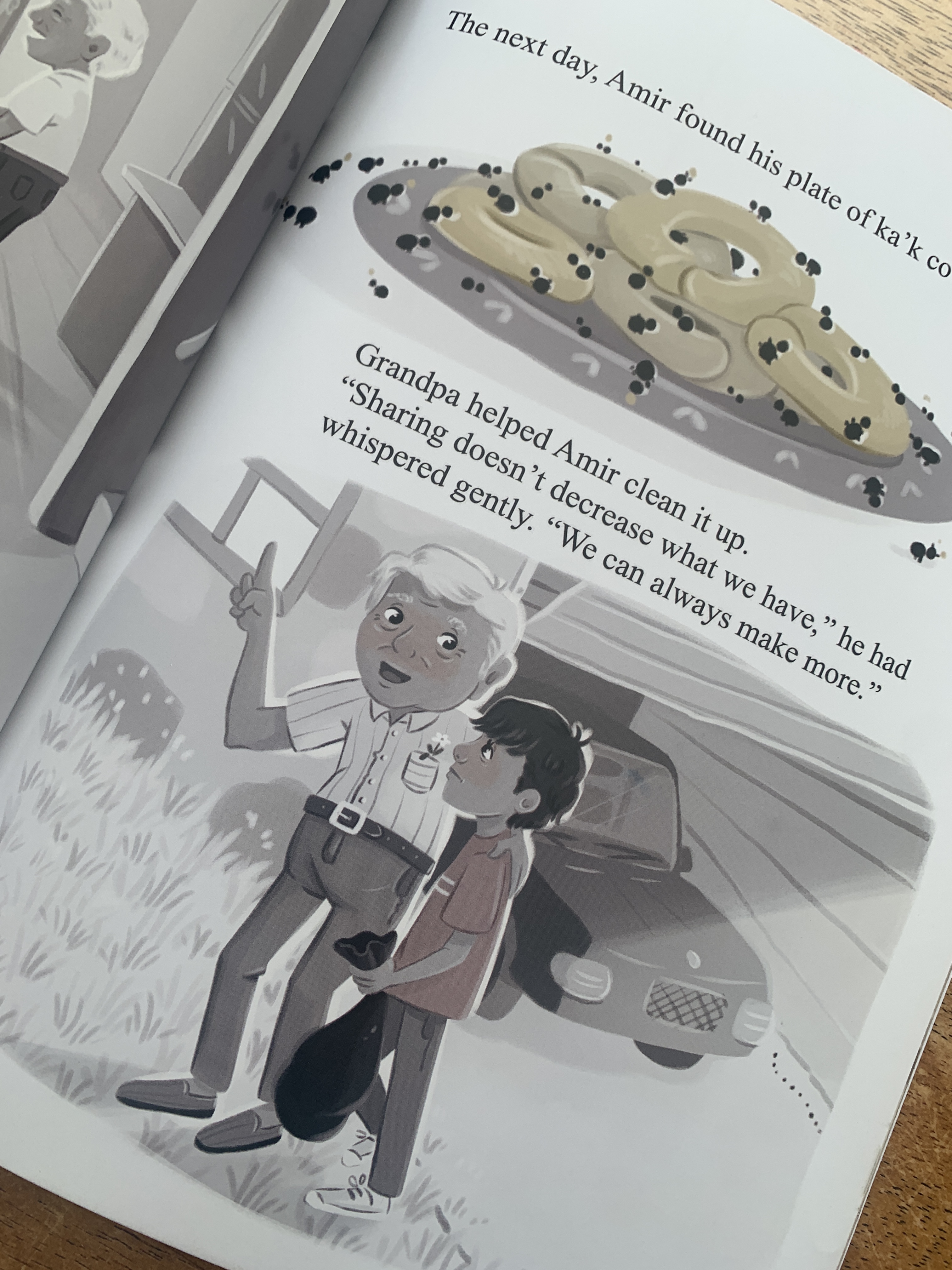
The book starts with Amir finding his Grandpa’s old blue jacket and recalling wrapping himself in it the day after his beloved Grandpa died. With it smelling like mothballs, he tosses it in the washing machine, but unfortunately when it comes out it has clearly shrunk. Amir is in denial, he says it fits fine and he has no desire for a new one. It is Grandpa’s jacket, and Amir is going to wear it, no matter how tight it is. Amir storms off to sit under the apple tree and recalls picking apples and making applesauce the year before for the whole neighborhood. Grandma shares that she used to keep grandpa’s cane but when someone needed it, she let it go.

Grandma stirs another memory in Amir when she pulls the tray of ka’k out of the oven, of him trying to sneak a whole plate for himself only to have his hiding spot taken over by ants. When he is asked this time to share a plate, every step to the neighbors house reminds him even more of making the trip with his grandfather. Slowly he starts to realize that his memories are with him, not in his grandfather’s things, and Amir makes a decision that would make his grandfather proud, and (inshaAllah) give him more good deeds, even though he is gone.

The idea of sadaqah jariyah is understood through the story, and present in the hadith at the back, but it is never mentioned outright. Just as God is used, not the term Allah (swt). As Amir feels denial, frustration, and eventually peace, nothing is really told, it is shown, which really opens the book up to be a tremendous tool in sharing it with children and asking them to discuss what they understand, what they feel, and what they took away from Amir and his Grandpa’s blue jacket story.

The book is available through the publisher Ruqaya’s Bookshelf as well as HERE at Crescent Moon Bookstore where code ISL will save you 10%.

Crescent Moon Friends by Wadia Samadi & Mo Duffy Cobb illustrated by Lisa Lypowy

Standard
Crescent Moon Friends by Wadia Samadi & Mo Duffy Cobb illustrated by Lisa Lypowy

img_6247

This 32 page book does not read like a new release, it looks like something you would have found in the early 2000s when the recent war in Afghanistan started and books about refugees from the region were popping up.  Admittedly back then, I probably would have been more forgiving that the smiling illustrations showed Islam in action and two characters from different cultures coming together through dialogue, respect, acceptance, and fun, but for reasons I’ll articulate, this book reads very superficial, dismissive and erroneous at times.  I am not Canadian or Afghani, I am a neighbor to both as a Pakistani American, and the book is OWN voice, so if I am just being overly picky, or sensitive, and am wrong, I am happy to acknowledge it, but before you push back, please read the entire review.

The description of the book says:

Crescent Moon Friends introduces the reader to two best friends Amelia and Aisha. While the pair is from Canada and Afghanistan, the girls reconcile their differences through exploration of the values they share. This book initiates a family conversation about Islam, explores tradition and language, and brings the girls closer together as a result. It is our hope that the book will be used as a teaching tool to help children understand the cultural backgrounds of others, and to create a warm environment for refugees resettling in Atlantic Canada from the Middle East.

This picture book is for both non- Muslims who are living in the West, and Muslims who are living outside their home countries. The focus of the book is on tradition, not religion, it also captures the significance of Islam. This is a valuable title for library and classroom use.

So first of all, I feel like the foundation of the book is othering Islam in making it seem that this book is an introduction of Islam to non Muslim with the premise being that Islam is what, a foreign religion? Numerous Canadians are both Afghani and Muslim in 2022, before I even began the book I was already fearing the framing.  Then it identifies Afghanistan as the Middle East, which just made me really question the accuracy.  Somehow after that first paragraph, the book then tries to say that the book is not about religion, but traditions.  While part of me appreciates that distinction, the second part of the sentence saying that it wants to capture the significance of Islam really shows the poor focus of the book.

Let me pause here though and answer a question I’m sure many of you are wondering, “why review a book that is not well written, and is not widely promoted or known about.” The answer is simple, a book such as this may not sell in big numbers and be regularly seen online and in stores, but they often do find their way into libraries and classrooms.  They are often shelved to fill “diversity” or “inclusion” quotas and thus their messaging does often reach our children.  I also highlight books like this, not just to pick on this particular book, but to show that OWN voices doesn’t make something automatically correct.  If this is the author’s own experience or is a memoir, there is some leeway, but saying that Afghanistan is in the Middle East or that Salam is Dari, not Arabic, or that it is “naan tandori” instead of “tandoori naan,” just makes the book seem inauthentic.  Often publishers, editors, agents perhaps don’t want to push back and appear uncultured or racist, so they don’t question details, is the only thing I can think of as to why this trend continues to perpetuate.  Which is also why the importance of having a piece sensitivity read cannot be overlooked, even when the author is writing about their own religion or culture. Yes, I too am only one person saying I have issues, but beta and sensitivity readers such as @muslimbookreviewers are four people and we discuss based on what we know and between the four of us there are a lot of singular specialties and a lot of  overlapping expertise that really help books get it right. Sorry for my rant, back to the book at hand…

The book starts with the white Canadian girl camping with her family and wondering what the upcoming school year will bring.  The text says. “she loved to look at the crescent moon.”  Already the writing is clearly weak, who loves to look at a particular phase of the moon, does she not like the waxing gibbous or whole moon? The next spread introduces Aisha, she is standing in the foreground with a mosque behind her and the text says she loves the moon too.  “There was a crescent moon on top of the mosque where her family went to pray.” Aisha has her hair loosely covered, and immediately we are connecting Aisha to her faith and to Amelia through their love of the crescent moon.  Interestingly, Aisha who would presumably love the crescent as it symbols holidays and month changes in the lunar calendar is presented as liking the moon because of it decoration aesthetic. It is where her family went to pray, sure it reminds her of home, but chances are she didn’t often go to the masjid as culturally most women don’t, so I’m not sure that this spread really has any accuracy or value, it just sounds good…if that.

The next spread is the first day of 6th grade with the teacher introducing a new friend to the class.  If it is the first day of school, aren’t they all new to the class? Aisha recalls that she left Afghanistan because there was a war in her country and school wasn’t safe, if she is twelve or thirteen, I’m not sure what caused the change in real life for the war timeline being referenced.  On a more relatable note it mentions that she missed swinging in her grandfather’s garden with cousins as well.

The next page showing the girls being silly with pencils to look like a bunny and walrus is sweet.  It shows language isn’t necessary, that silliness is universal and it is cute.  The girls then show how they share things unique to their culture with one another.  Aisha teaches her how to say Salam, hello in Dari, how to dance the Attan, about Eid, the most important Muslim holiday, and about a game with stones called anjaaq panjaaq.  But this is wrong, Salam is Arabic, Eid is Arabic for festival or holiday so what Eid is the book referring to? Also why not tell how to play the game, or how to do the dance or how Eid is celebrated? If the book is to build cultural (or religious) bridges, thus far I’ve only learned how to stick pencils in my mouth to look like a walrus or behind my head to look like a rabbit.

It is then Amelia’s turn to share Canadian culture and the book picks: ghosts, goblins, Santa Clause and the Easter Bunny.  I find this a bit offensive on Canadians’ behalf, really their holidays are what make them who they are?  Later we will learn that Amelia is not religious, yet the symbols for religious holidays of Easter and Christmas are what are being presented.  Additionally, the holidays mentioned are not even unique to Canada: Christmas, Halloween, and Easter, are the same in America at the very least.

The next spread shows their moms becoming friends and the girls playing in Aisha’s mom’s scarves, hijabs, shoes and make-up.  I find the joy sweet, but I wonder if the book as stated in the details by the author/publisher is to help refugees- is this a bit misleading- that they are settled and have an abundance of clothing accurate?  Often refugees need assistance, will a book like this send the wrong message about helping those fleeing war get established, by not just avoiding talking about need, but celebrating surplus?

Aisha is then shown helping Amelia with math and when Aisha needs help with a Halloween costume, Amelia is there.  The book really is doubling down on the importance of Halloween to Canadian culture, which again feels off.  But also most Muslims don’t celebrate pagan holidays, so I’m not sure I like the positioning that it is cultural to celebrate and that to be Canadian one must engage in the rituals.  Whether you see it as pagan or just assimilation, either way it doesn’t sit right for a book aimed at finding common ground between diverse individuals.  Math is neutral and universal, why not have Amelia help Aisha with something also less controversial?
img_6242

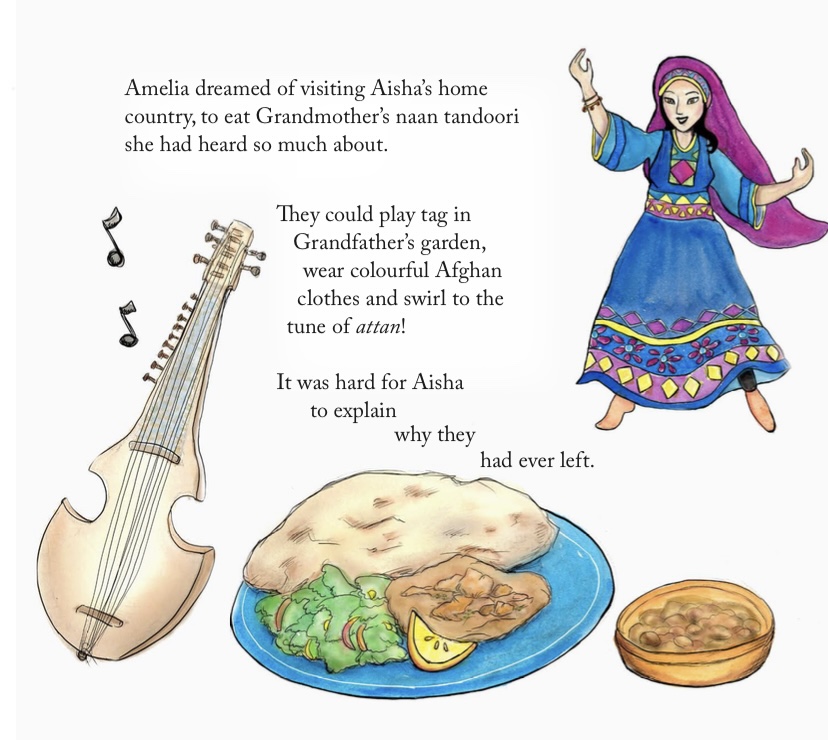
The next spread shows Aisha missing Afghanistan, and Amelia being a supportive friend and wanting to visit Afghanistan too.  Unfortunately, once again the weak writing has her sounding like an adult missing the laughter in the air and hope and flowers, not a kid talking.  When Amelia joins in, naan tandori is mentioned, which is backward, if it is the same as in Urdu it should be tandoori naan.  She also wishes they could wear colorful Afghani clothes and dance the Attan, which are two acts not limited to Afghanistan.  They can put on traditionally clothing and dance in Canada.

The story then takes a huge pivot and shows Aisha and her mom praying with the very vague text of her mom “described her way of life, Islam as the peace in her heart, and said turning to Allah in prayer would keep Aisha happy.”  The text seems misplaced and the messaging completely pointless, why not frame it as what Aisha believes or what her faith teaches her? It almost comes across as her mom forcing the belief on her and this being the first Aisha has heard about it.  The next page is set up the same, but shows Amelia’s faith to be kindness and compassion while they sit in nature.  I think the intent was to be positive, but when you have two people representing entire populations, all sorts of stereotypes come in to play that either have to be so general as to be accurate or more specific to the two characters at hand.  In this case I feel the takeaway is that holidays define Canadians, even religious holidays, but they are fine to participate in because Amelia is not part of organized religion.

Thus the next spread of Aisha’s family celebrating Christmas with Amelia makes sense in the story, but I find alarming because it normalizes abandoning your own religious convictions and adopting another faiths in order to fit in and assimilate.  Imagine a teacher reading this book to a first grade class and little Muslim children who demand that Christmas and Easter stay out of public schools are hearing messaging normalizing the holidays for people of all faiths.  Imagine a recent immigrant or refugee further feeling pressured to adopt these practices because they want to be seen as “good citizens” or be accepted by the larger community.  The contrast of Aisha’s family celebrating Christmas is Amelia helping make star and moon shaped cookies for Eid.

The story comes back to the girls love of the moon, one as a dreamer, the other as a scientist.  It tells of other firsts Aisha experiences and Amelia learning about Aisha and her faith.  I’m not sure what a genie lamp has to do with Islam, but it is in the illustration with a hamsa hand, a book, a tasbih, and a crescent with a minaret coming out.

Aisha then starts to wear hijab and Amelia learns how to wear one too. No details about what or why hijab is worn or given, and in the illustrations it doesn’t completely cover anyone’s hair. The girls ski together and drink hot chocolate and living in Canada allows Aisha “to be the girl she was meant to be.”  I’m not sure what that means, but that seems to be the resolution to the book before it circle backs to the mom and concludes.

I think on the very surface the book is a nice idea, but the conflation of what it means to be Canadian with observance of holidays and the lacking details of what it means to be Muslim Afghani make the book miss so much and ultimately do more harm than good if shared.
A Dupatta Is…by Marzieh Abbas illustrated by Anu Chouhan

Standard
A Dupatta Is…by Marzieh Abbas illustrated by Anu Chouhan

img_6073

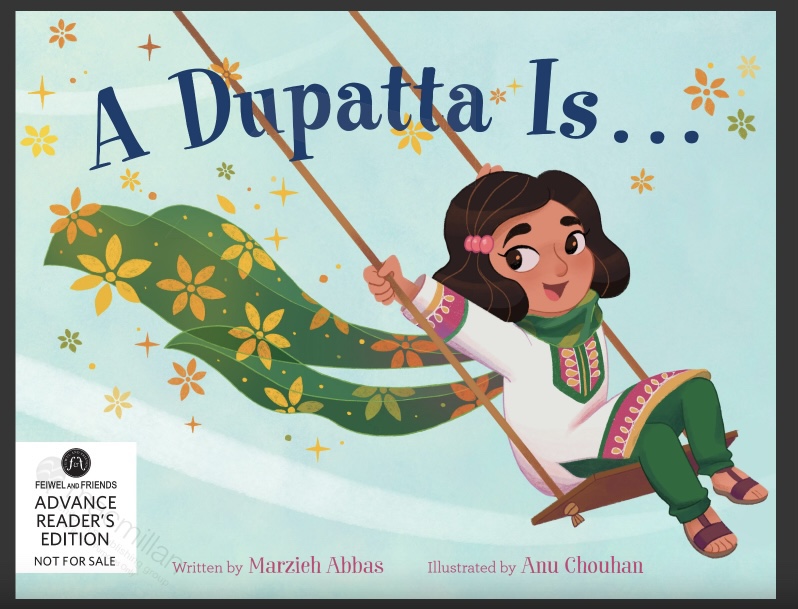
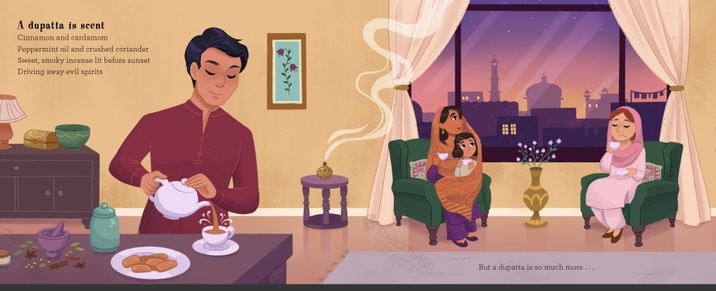
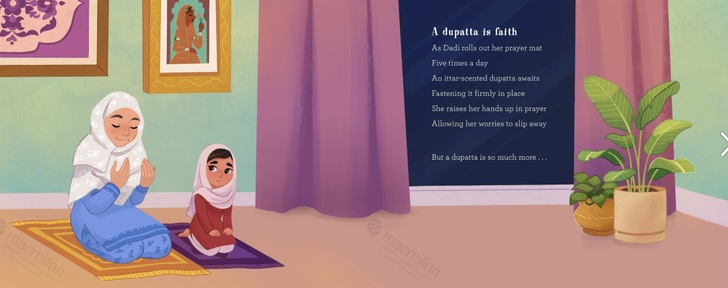
I read this 30 page early elementary book a few times before writing this review and honestly my cheeks hurt because I cannot stop smiling.  The lyrical writing radiates warmth and pride, culture and tradition, legacy and identity, while acknowledging both the playfulness and solemnness of a piece of fabric.  My heart breathed with the clarity and articulation that is felt and contained within the fabric that perhaps all Pakistanis feel, but cannot convey so poetically.  The book may be meant for children four to eight years old, but all readers will appreciate the text and illustrations that seamlessly flow like a favorite dupatta grabbed while running out the door. I struggled with picking only a few images to share, as every page became my new favorite as the book progressed.  Admittedly though, one page did give me pause as it conflated incense burning with getting rid of evil spirits which comes across as a religious belief, but is a cultural practice.
img_6074

The book starts out with the actual physical description of what a dupatta is and how it is adorned.  It then moves on to describing the color, the sound, the smell, the place, the function, the art, the beauty, the fun, the faith, the legacy, and the identity.  Each spread ends with the words, “but a dupatta is so much more…” seamlessly weaving so many facets of what a dupatta is together to create a true understanding of it from a tangible, to cultural, to practical perspective.

img_6076

I love that there is a page about faith, and praying five times a day with a dupatta being worn, it is a little odd that there is a portrait decorating the wall behind the two characters making dua, but at least it is clearly behind them.  I absolutely loved that so often the wearer of the dupatta was also wearing a hijab, particularly the bride picture- which is absolutely gorgeous.  It signals without words that a dupatta can be worn to cover a Muslim woman’s head, but it is also often not.  The backmatter further details that it was once worn as part of the national dress and as a form of modesty, but now is often worn as an accessory.

img_6077

One summer in Pakistan, a friend and some cousins and I started trying to formulate 101 Things to do with a dupatta (wipe noses, pull things out of the oven, catch fish), it was the year of net dupattas so clearly covering your head was not one of them.  Sure we were being silly, but to see the book also highlight wiping sticky hands, and wrapping it up like a sari, and using it as a cradle to rock a baby was very, very accurate and heartwarming.

img_6079

Please pre order this book, it signals to publishers that these books are in demand and is a way to show what type of books we want to see.  I preordered  mine here.

The Kindest Red: A Story of Hijab and Friendship by Ibtihaj Muhammad and S.K. Ali illustrated by Hatem Aly

Standard
The Kindest Red: A Story of Hijab and Friendship by Ibtihaj Muhammad and S.K. Ali illustrated by Hatem Aly

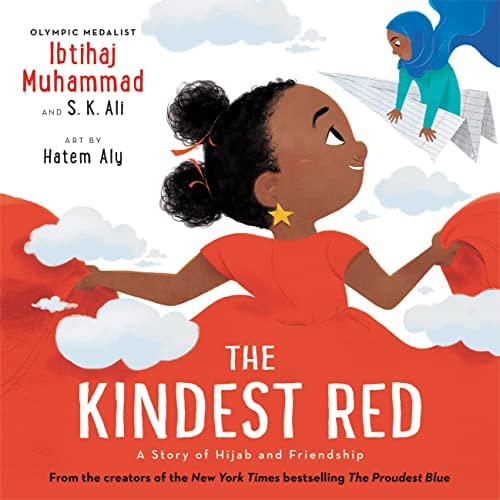
This heartwarming book centers kindness, family, and friendship in an inclusive way; and while the tagline says “A Story of Hijab and Friendship” I think the hijab angle is a bit of a stretch.  The authors are Muslims that wear hijab, the older sister and older females in the family wear hijab, but there is nothing in the story or text that connect hijab to Islam or to something Muslim women wear as part of religion.  I don’t want to compare the first book in the series, The Proudest Blue, to this book, but hijab really was centered in that book and the Author’s Note mentioned that hijab is an Islamic act.  This book does not make those same connections, which is fine, I just want consumers to be aware.  This book is beautiful and the messaging endearing, and the tone and heart over 40 pages ideal for preschool to early elementary children.  It works as a standalone, but with the same characters and sisterly love, I think most people will enjoy keeping them together.

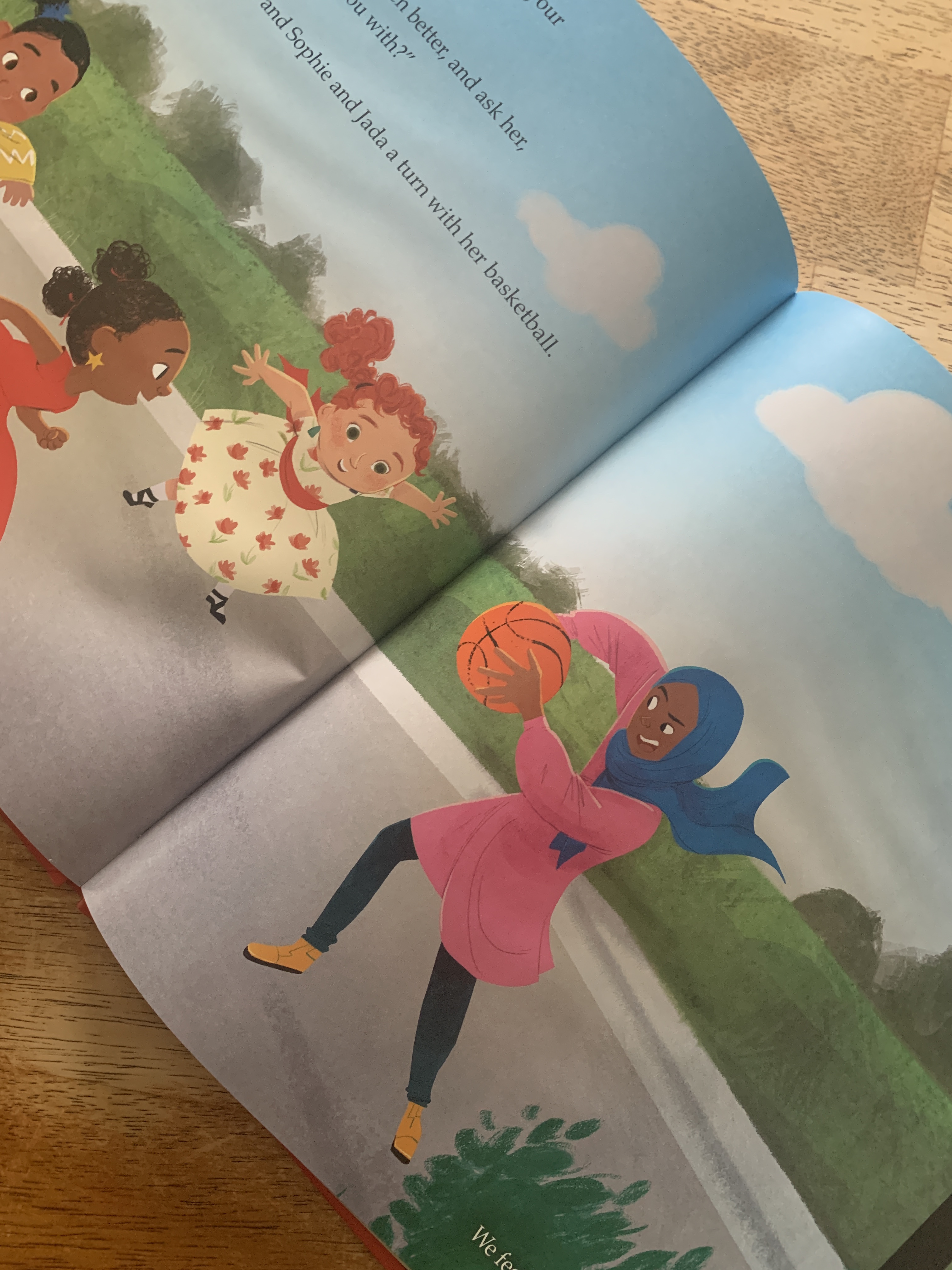
The book starts with Mama passing on Asiya’s dress to Faizah, that had been Mama’s even before that.  It is picture day, and the girls are helping each other get ready. At school Faizah and her friend Sophie twirl in their pretty dresses before heading in to class to discuss what kind of world they want.

Faizah wants a kind world, where there’s always a friend nearby, where everyone helps. At recess, Sophie and Faizah combine their visions, superheroes and kindness, to help other kids on the playground.  When picture time arrives the class is full of smiles, but when it is time for sibling pictures, Faiza and Asiya realize they don’t match.

Faizah is sad, and Sophie notices, can the kindness be passed along like the dress to help the sisters? To make Faizah happy too? I’m not going to give away the conclusion, but it is sweet and idyllic and shows how lovely the world can be if we all just share some kindness.

I love the illustrations and the hijab wearing super hero that presumably Sophie drew is powerful.  I think the book does wonders to normalize hijab, even if I do wish it articulated why one would wear hijab.  It seems that the industry trend is to keep hijab superficial and I recognize I am in the minority that wants religious centering for religious tenants.  So yes, I’m fully prepared for the backlash when people want to point out that it is joyful and that I’m a naysayer, but I deal with people on a daily basis that do not know that my own hijab is a reflection of me being Muslim.  With as connected as the world is through technology, I  think those in diverse environments take for granted the understanding of basic Islamic principals in the general population.  However, not everyone has those real life connections and rely on books and media to fill the gaps, so when books about hijab, don’t actually connect hijab to faith, I feel obligated to point it out.

I purchased (preordered) my copy here, but I hope you will support small business and order yours here  use code ISL for 10% off.

Baby’s First Series: Bismillah by Marwa Ahmed illustrated by Natalia Scabuso

Standard
Baby’s First Series: Bismillah by Marwa Ahmed illustrated by Natalia Scabuso

bismillah

Every few years a new Bismillah board book comes out and while after a while they all blur together, this new 2022 version is bright and colorful and at 24 pages a good length to show and teach toddlers when to say Bismillah without boring them.  At this age repetition is key, so while there is no real story, the book highlights familiar activities through the character Maryam and stresses saying Bismillah before you begin them. The book concludes with sourced duas to say when leaving the house, starting a meal, entering a bathroom, and before sleeping, and every morning and evening. I do wish the book would have clearly established that you say Bismillah, before starting anything and everything.  It hints at it at the end saying, “throughout the day, remember to say Bismillah,” but I worry that some kids would take it more literal, that you only say it at the times mentioned in the book, and not that the featured scenarios are just examples.  

img_4954

The book begins with Bismillah in Arabic text and the translation before starting the format of Maryam doing something on the left page spread and the saying of Bismillah on the right. So, “Maryam likes taking walks with her day,  When they leave, they say Bismillah.” In this manner Maryam takes the readers to play at the park, eat a meal with vegetables, drink a drink after her meal, read a book, wash before prayer, and get ready for bed.

img_4955

The faces of Maryam and other people are never shown, the stuffed animals in her room do not have eyes, although the duck bouncy seat at the park does.  The illustrations are blocky and colorful with the text clear and large.  The duas at the end tell when to say the dua, the dua in Arabic, the translation in English, and the source.

img_4956

For where to purchase the book you can visit the publisher’s website: www.litfancyhouse.com

img_4957

The Great Labne Trade by Eman Saleh illustrated by Eilnaz Barmayeh

Standard
The Great Labne Trade by Eman Saleh illustrated by Eilnaz Barmayeh

labne

My friend Noura, owner of Crescent Moon Store, said this book was good, so when I saw the amazing illustrations on the cover, I didn’t even look into what the book was about, I bought it and waited impatiently for it to arrive.  When it came I started reading it and thought ok, ok another book about lunch food that is perceived as “other” and the bullying that ensues with having a “smelly” lunch.  But the bullying never really came, and the book was suddenly not about being different, it was about entrepreneurship, and a mother’s love and support, and appreciating good food, and sharing culture, and raging against an oppressive system. Ok, so there was no raging, the book ended with determination and a following of the “rules,” in a very kid appropriate manner, but it was fun and a nice change from the typical storyline in rhyming children’s books.  There is no “Islam” aside from a boy named Ahmed and his sweet hijab wearing mother, but this book will result in smiles for kids preschool to early elementary and encourage business creativity and thinking outside the box.

img_5127

Ahmed is not thrilled to be taking a labne sandwich to school and would rather have a pb&j like everyone else. His mom encourages him to “be proud of who you are, appreciate how special you are, stand tall, don’t let other’s make you feel small,” and sends him out the door.  At lunch when the kids start to turn up their noses, Ahmed gets them to try the sandwich, and they love it.

img_5128

Ahmed gets an idea, maybe he can sell labne sandwiches to his classmates. Mama stays up late making them and Ahmed sets up shop in the cafeteria. He sets his price, and they sell out, so he increases the charge, and they are still selling. He also is open to trades for those that can’t pay.  Before you know it he is adding dishes to the menu.  Things are going well for entrepreneur Ahmed, until the lunch ladies have had enough and take matters to the principal.

img_5130

The 58 page book is not text heavy and the rhyme is fairly good, it is hit and miss at times, but the story is not hindered by it. I did feel like the book took a few pages to set the stage and get into the story. The initial timeline and the “smelly” lunch could be cleaned up a little, but once the business storyline presents it is smooth and enjoyable. And the illustrations, they are perfect for the story and for keeping Ahmed and his dream in your heart.

The book is available here at Crescent Moon or on Amazon.

img_5129