Tag Archives: Muslim

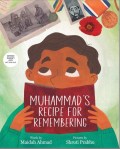
Muhammad’s Recipe for Remembering By Maidah Ahmad illustrated by Shruti Prabhu

Standard
Muhammad’s Recipe for Remembering By Maidah Ahmad illustrated by Shruti Prabhu

img_4274-1

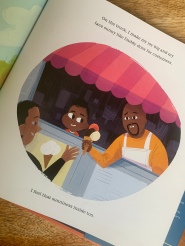
I feel like the idea and heart of this 40 page picture book is decent, but the story, presentation and takeaway are just really poorly executed.  The pitch is a Muslim Desi kid feeling left out when all his friends are rehearsing for the upcoming veterans assembly because he doesn’t have anything to share.  He then starts asking his family, and the Muslims and non Muslims hanging out at the mosque to find out about Muslim and Indian involvement in the World Wars.  A rarely explored topic, considering in the West WWI and WWII are taught from a Western centric perspective, no doubt.  Unfortunately, most early elementary readers, the book’s target audience is 4-7, have limited knowledge of the World Wars, let alone about the subcontinents own politics and that they were occupied themselves under colonial rule at the time, and this book does nothing to explain any of it.  The inconsistencies, plot holes, vocabulary and ultimate lack of sharing a single story from a descendant of someone who fought, make the book rather pointless and forgettable.  Truly the take away is that there were Muslims among the Indian army, they made roti and prayed.  No real idea what they experienced, saw, endured, or gained in return for being forced to fight for Britain on the global stage.

img_4275-2-1

The book starts with Muhammad listening in to his classmates talk about their family members that are veterans and him feeling left out.  At recess they don’t let him battle in the reenactments and instead make him be the cook. When he gets home his dad is making rotis and Muhammad asks his dad if they have veterans in their family, they then go ask his grandfather if his great great grandfather fought in either World Wars.  Dada jaan recalls that “they sent my grandfather to France in World War One.”  But he never spoke about it except to mention that they shared rotis.  He suggests they go to the mosque the next night as that is where, “a kaleidoscope of people gather.” He learns from a Sikh uncle in a turban that whole villages went to fight and from Imam Rafiq that the soldiers fasted in Ramadan, prayed, and celebrated Eid.  No one has any visible tokens of their family’s service as they were lost over time.  Determined not to let the stories be lost, Muhammad shares roti at the assembly.

img_4277-1

Ok, buckle up, I have a lot to point out, but first the positive.  I like that the dad makes rotis.  Mom isn’t in the book, but there are a lot of pictures of a lady hanging on the walls of the house, so possibly she has passed and dad has to cook, no matter, it is nice seeing a Desi dad in the kitchen.  I also like that the mosque is central to the story, I wish it was called a masjid, and that it was explained why people that are not Muslim are hanging out there.  Brown people are generally lumped together and this seems to reinforce that stereotype, which makes me less than thrilled.  It seems like a social environment with ping pong tables and snacks happening, so why not say it is a social hall at the masjid where people of all faiths often gather.  A “kaleidoscope of people” does not explain people of different religions at a mosque to most four year olds.  The book claims the assembly is honoring veterans, so why is Muhammad only curious about WWI and WWII is never explained.  He is teased and forced to be the cook by his friends, with a very negative connotations and depiction in the illustration, but that notion is never pushed back upon, and is actually heightened with rotis being the thread that ties the entire book together.  A missed opportunity to be sure.

img_4279-1

I really struggle with the reality that the majority of Indians were forced to fight, and the book keeps it vague in the text with lines such as “joined the war effort,” and “they sent..” who is they? It sounds nice that Muhammad doesn’t want the stories, like the artifacts to be lost, but WHAT STORIES? If the book is about remembering, and stories are to be shared at the assembly, I feel short changed that the reader doesn’t get a single story about a Muslim or Indian that fought in one of the World Wars.  Isn’t that the point of the book? Yes the book has sources at the end, but it is fictionalized, make up a story, give the reader and Muhammad something to take pride in, to understand through, to imagine, what it was like for his great great grandfather.

img_4280-1

I struggled with the illustrations as well, Imam Rafiq looks off in the final image, I don’t get why Dada jaans memories seem to be on the TV either.  I also didn’t understand why rotis were the thread, but then it is paratha at breakfast that gives the idea, and who really is constantly spreading ghee on paratha or roti let alone at war, or at recess.
img_4278-1

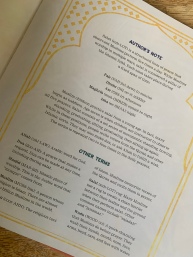
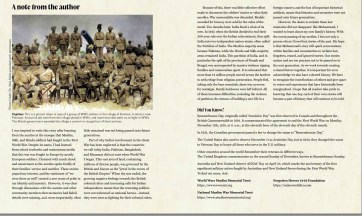
War is not a trivial matter, and I kind of feel like this book reduced it to food, and allowed some racism, classism, and  Islamophobia, to go unchecked along the way.  I like that the backmatter has a recipe and an author’s note, but colonialism, service, war, are all heavy topics that are hard to bring down to an early elementary level picture book, and sadly this book is unable to connect and inform readers about this time in history.

Shiny Misfits by Maysoon Zayid and Shadia Amin

Standard
Shiny Misfits by Maysoon Zayid and Shadia Amin

img_4083-1

I admittedly wanted to read this book because the author is of Palestinian descent. I have seen clips of her standup and I’m not a huge fan, although I do appreciate that she doesn’t deny her culture and Islam, doesn’t let her cerebral palsy keep her from working toward her dreams, and that she is successful.  All good messages for a 256 page middle grade graphic novel that is not autobiographical, but draws on her life none-the-less.  I was surprised, though, that there are no Palestinian references in the book, very few Arab cultural touchstones either, and yet swearing on the Quran and not eating pork are presented fairly often, almost as “bits” to be laughed at.  I truly understand that the character is presented as culturally Muslim more than centering Islam in her identity, but perhaps because the protagonist, Bay Ann, is rather unlikeable, it just rubbed me the wrong way.  I love that the people in Bay Ann’s life do not caudle her, and that she is fierce and dramatic and driven, but she is an awful friend, her obsession with Alyee Maq (yes full names are used throughout) gets annoying, and I worry that some of the humor will be missed for the younger target audience and be taken as Muslim or Arab norms.  The presentation of a disability in a well illustrated graphic novel is empowering, an amazing Arab dad is nice to see, a divorced family co-parenting is important, but the foundation for much of the story is Bay Ann’s crush on Alyee Maq, he does kiss her on the cheek for social media likes, the book starts with Halloween Idol, features dancing throughout, and concludes with a Nondenominational Holiday Spectacular.  Bay Ann’s mom is not very kind or involved, and Alyee Maq’s mom, the only hijabi in the book, also is rather rough.  This is a book where I acknowledge my own overthinking, as both an adult reader and reviewer.  If you are ok with the (random) Islamic rep, kids will benefit from seeing Bay Ann as a fully capable person who happens to have a disability.  I’d suggest seeing if your local library has the book and looking through it first to see if you are comfortable passing it on to your kids.

SYNOPSIS:

Bay Ann is a tap dancer and with Halloween Idol coming up, she plans to win.  Her best friend Michelle is going to do her make-up as a zombie bride, and be her zombie bridesmaid with Davey Matt, the third in their trio, being the dead ring-bearer dog.  They can’t be her backup dancers because she is a one woman show, but she needs them to cheer her on.  When she wins, she has the spotlight stolen from her by Alyee Maq kissing her claiming he is making “a sick girls dream come true.” The clip goes viral, as Alyee Maq is a bit of a celebrity and the competition is on.  Whether it is science fair, social media posts, or the class debate, Bay Ann is determined to knock Alyee Maq down, claim the online spotlight, and  prove her talent is more than her disability.  With each attempt failing, her resolve grows stronger and her tunnel vision pushes those closest to her away, as she joins Alyee Maq with the hopes that if she can’t beat him, she will join him and achieve the fame she seeks.

WHY I LIKE IT:

I know the book is rather intentionally ridiculous, but I wanted to cheer for Bay Ann, and I never really liked her.  I don’t like how she treats Davey Matt, or even Michelle.  If she was better to them at the beginning, I think it would have shown how disconnected her mom Malak is as well as the school administrators, and made it more funny, but it truly just makes her seem like she is awful to everyone, and thus you don’t really find yourself invested in her stardom, her friendships, or her defining her own narrative.

I wish their was some Arab rep, not just a few Arabic words tossed in here and there.  I also wish there was more Islamic centering, or honestly even less. The swearing on the Quran really bothered me, Friday prayer is mentioned in passing, but there is no impact on the characters or the story, so it seemed misplaced.

The pacing of the story is rushed, and at times a bit chaotic.  I think it is intentional, but it makes it hard to connect to the characters or to grasp their motivations.  I don’t know that I truly ever understood why Bay Ann wants the spotlight, or why Alyee Maq is famous, or why Davey Matt hangs around Michelle and Bay Ann when they belittle him. It doesn’t need to be thoroughly explained, but when you finish the book, and feel exhausted, but can’t even articulate what the book was really about other than a girl that wants to be famous for her talent not her shaking, and won’t let anything or anyone get in her way, it seems like some opportunities were missed.

FLAGS:

Close male and female friendships with touching, an unwanted kiss, lying, manipulation.  Swearing on a Quran, disrespect. Using people.

TOOLS FOR LEADING THE DISCUSSION:

I don’t know that I would seek this book out to own, but in an Islamic school library if it found its way in, I would probably not object to it being shelved.

Every Rising Sun by Jamilya Ahmed

Standard
Every Rising Sun by Jamilya Ahmed

The lush writing and ever present threads of Islam captivated me from the first page of this Shaherazade retelling.  I truly could hear my own voice in my head reading each word, and falling into the masterful story-telling of the protagonist/author.  With about a third of the book left though, I was sadly stopped abruptly in my tracks.  I found myself annoyed by Shaherazade, and having to convince myself that even though this is an adult read, she is very much coming of age and finding herself, only she doesn’t evolve and grow, and doesn’t have a character arc, and by the end I felt deflated.  Is the book good? Yes.  Would I recommend it to readers 18 and up that enjoy OWN voice, strong female, historical fiction? Absolutely.  But I find myself frustrated, because when the book was good, it was so good, but as the end drew closer, I realized there were holes, big ones, that could so easily have been fixed.  The author has the skill, the knowledge, all the tools, but alas, I didn’t appreciate Dunyazade because she is largely absent.  I didn’t know the interworking of her assistants and friends so I didn’t care about them, side characters were so painfully underdeveloped. And with 50 pages left, I was for the first time perhaps ever, glad that the narrative moved from showing to telling (I know, who am I even). I needed the articulation to connect the dots particularly of Shahryar and Shaherazade’s relationship.  The 423 page book could have, and should have, been a hundred pages longer to not feel so rushed at the end, and there should have been a map.  The book has adult themes but they are handled in almost a YA manner.  The beheadings, affairs, wedding nights, battles, war, are not detailed, but rather identified and moved on from even though they are so central to the plot.

SYNOPSIS:

In twelfth-century Persia the daughter of the Malik’s adviser stumbles on the Khatoon and her lover, she anonymously alerts the King to the affair and the beheading of wives begins.  To keep the country from revolting at their mad king, Shaherazade offers to become his next wife, to assuage her guilt for what she set in motion, on the hope that her storytelling will keep her alive come morning.  Life doesn’t pause however, as Shaherazade spins her tales, but rather amplifies.  She accompanies her husband, Malik Shahryar as they join Saladin in the Third Crusade.  The caravan, the journey, the battles, the romance, all bring the climax of returning home to a Kirman under siege will test Shaherazade’s story-telling abilities to the brink and with it the Seljuk Empire.

WHY I LIKE IT:
The prose is on point, time stood still while getting lost in a world of history, imagination, and the author’s skill.  The constant presence of Islam in the characters life was incredible. It was not established and then left to the side: the times are marked by prayers, the athan is ever-present, the duas are heartfelt.  Yes the characters drink wine, and sleep around, but they also fast and treat their prisoners of war with compassion.

I really struggled with how little I cared about people dying, there should have been more connection and more emotion for the side characters, and as the story progressed, I became increasingly irritated that I wasn’t forced to care about them, to know them, to appreciate what they meant to Shaherazade.

I also felt that the majority of the story took place over one year.  How do you forget that you are telling stories to save your life and (SPOILER) start sneaking around with some other guy.  You have a guard detail that follows you everywhere, you are in a caravan and you live in a tent, everyone knows everything!  Shaherazade is also clueless a lot of the times asking soft questions and then told how intelligent she is and allowed to plot and scheme with various rulers.  I love that she has a voice, she isn’t silenced, that she is never apologetic for being opinionated and her very presence is never a kindness, she takes up space and doesn’t look back, but the inconsistencies in her judgement needed some smoothing out.  Show her understanding grow, and increase her intellect to wisdom, don’t have her charming and manipulating leaders one minute and then being so naive the next.  She should have been so much smarter by the end of the book than she was shown to be in her personal dealings.  Her political knowledge was strong, and she was a force, and that level of insight into her own life would have been a character arc to see.

The book is adult, but it almost reads YA and I’m not sure why, it is sourced, the historical presence is exciting, the words and flavors intoxicating.  I normally love when the characters are shown and the reader doesn’t have to be told things, but the only reason I finished to the end was honestly because I got some telling.  I was relieved to hear from Shahryar what he knew, what he felt, what he could own up to.  Perhaps had there been more showing of the intricacies of palace life with the side characters the book would not have gotten to that point, but the lush writing could only carry the book so far.

FLAGS:

Relationships. sex, kissing, fornication, killing, beheading, lying, hangings, war, battle, drinking wine, scheming, kidnapping, attempted rape, it is Adult, but nothing is overly detailed or glamorized.

TOOLS FOR LEADING THE DISCUSSION:

I would love to chat about this book, I think I could be swayed to love it, or play the devils advocate and argue for the sake of arguing.  Being how highly recommended this book came to me from a dear friend, I’m ready to battle and anxious to discuss!

I got my copy from the library, but can be purchased here.

Muhammad Ali and Malcolm X: The Fatal Friendship by Randy Roberts and Johnny Smith adapted by Margeaux Weston (A Young Readers Adaptation of Blood Brothers)

Standard
Muhammad Ali and Malcolm X: The Fatal Friendship by Randy Roberts and Johnny Smith adapted by Margeaux Weston (A Young Readers Adaptation of Blood Brothers)

bloodbrothers

A lot of us Muslims name drop Muhammad Ali and Malcolm X in discussions about civil rights quite often, and at least, speaking for myself, I thought I had the general idea about the relationship between these two iconic figures. I have read a fair amount of books in my quest to identify books that show how Islam shaped the men as opposed to those that tend to gloss over their eventual conversion to Sunni Islam, but I read this book as if it were fiction and I didn’t know what was going to happen next.  I have not read the original Blood Brothers, but this young readers adaptation is well done in conveying the politics, environment, struggles, and humanity of these two men.  Their flaws and growth, their tests, their friendship, it really is a compelling read. The focus on their friendship puts Nation of Islam as the focus, but the book does a good job of identifying it as being different than Islam.  As their friendship falters, Malcolm X goes for Hajj and is seen to change, and choices made by Cassius Clay show the men quite distant at the time of el-Hajj Malik el-Shabazz’s assassination, even though eventually their paths proved quite similar. The 240 page book is MG, but I think middle school readers (in classrooms, book clubs, and on their own) will better appreciate the intersection of these two giants, the events of their time, and the legacy they have left for us all.

SYNOPSIS:

The book is a snapshot in time, sometimes focusing on Malcolm X, sometimes on Cassius Clay, sometimes of their time together.  It starts with background insight and then shares the rise of both of them in their respective worlds, Nation of Islam and boxing.  Threaded through it all is the influence that Elijah Muhammad had on them, and key events they experienced that shaped their thoughts and opinions on race relations, politics, religion, and life.  It shows Malcolm X as the teacher, and leader taking in Clay and believing in him against the Nation’s wishes and thus when Muhammad Ali pushes him away the reader sees the Champ in a different light.  It shows deception and manipulation, as deep and riveting as the best fiction out there, but is very vulnerable in showing regret and both individuals’ ability to keep learning and growing.  The conclusion highlighting Muhammad Ali reaching out to Malcolm X’s daughter Attallah, and the forgiveness that took place in restoring the love between the two men and their families, really was a cathartic release that reminds readers that for as idolized as these two figures are in pop culture and history, they were very real people.  The book has a Biography at the end that breaks down sources by Government Documents, Archival Collections, Newspapers, Magazine Articles, Books, and Websites.  It is a “Selected Biography” that is seven pages long.

FLAGS:

Racism, manipulation, assassination, hate crimes, stereotypes, propaganda, oppressions, abuse, police brutality, assault, bombing, arson, attempted murder, fear, threats, killing.

TOOLS FOR LEADING THE DISCUSSION:

I have preordered a book for my own children to read and one for the school, I really think this book needs to be easily accessible for middle school students in libraries, classrooms, and homes.  I would love to do this as a middle school book club, I think the authentic perspective will give our youth who have heard of Malcolm X and think they know Muhammad Ali some insight into really spending time with what they did, what they faced, and how remarkable their friendship was.

A Boy Named Ibrahim by Sitti Aminah “Flexi” Sarte illustrated by Aaron Asis

Standard
A Boy Named Ibrahim by Sitti Aminah “Flexi” Sarte illustrated by Aaron Asis

img_9818

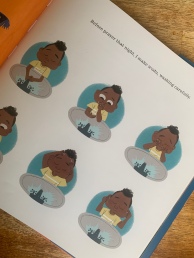
This 24 page Filipino book originally published in 2014 was republished with a new traditional publisher earlier this month and reads and feels like solid Islamic fiction.  The book focuses on the five daily prayers throughout the day of a young boy’s life, with the repetitive refrain being the steps of wudu. Ibrahim leaves his activities to pray, wakes up early to join his parents in salat, loves his mother, and listens to her reminder about prayer being an important way to remember Allah swt.  The book is preachy, religious, and unapologetic.  The timing of fajr is a bit questionable, but roosters do crow at all hours, and the light outside the window might be a street lamp and not the rising sun.  Islamic phrases are used, but it does say “Alaikum Salam” in response to “Assalamu Alaikum” which is a variation of the norm.  Overall, the book is a nice addition to share with young children highlighting the importance of prayer, it also works well to learn and review the steps of wudu, and the names and order of salat, alhumdulillah.

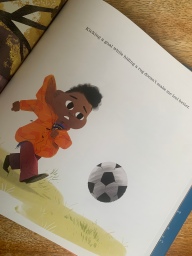
The sun is about to rise, Ibrahim says, “Bismillah,” makes wudu and joins his father for prayer.  It is the first day of school and Ibrahim is excited.  He spends half his day at school, then prays Dhuhr.  He makes wudu and prays.  While playing soccer in the afternoon, he leaves the game to pray his Asr, but first he makes wudu.

Once home he chats with his mother about prayer, and coming closer to Allah swt, while he enjoys a snack and then makes wudu and prays maghrib.  Baba then comes home, they eat and pray isha all together.

I enjoyed the illustrations and the simple story.  The book is straightforward, and the contentment and unapologetic portrayal of prayer in a person’s day is sweet and important to highlight. For preschool to early elementary this book would be a great addition to shelves, story time, and bedtime as well.

The book can be ordered on Amazon here

img_9830

The Big Yard Sale: David Learns How to Treat Customers by Tariq Touré illustrated by Anika Sabree

Standard
The Big Yard Sale: David Learns How to Treat Customers by Tariq Touré illustrated by Anika Sabree

img_9753

David Kareem is back and learning how to treat customers at his neighborhood yard sale.  The 26 page rhyming poem, turned children’s book (note there is little punctuation) is brightly illustrated as it follows David on his selling journey.   With Mommy’s baking and guidance on how to treat customers, his Saturday morning offers lots of lessons, mistakes, learning, and entrepreneurship for David and the reader alike.  There is a hint about a smile being charity, an Imam stops by, and David puts on a kufi.  It has good lessons and the same community vibe as the first book David’s Dollar, with visible Muslims in the illustrations and with Muslim names in the text throughout. But there was a page with two typos which disappointed me, a changing number of cinnamon rolls, and when the copy arrived it was pretty damaged and bent (probably/possibly not the fault of the author, but it cost $25 through the preorder Launchgood, so disappointing none-the-less, alhumdulillah you can now purchase it here from Amazon for $12).

David wakes up and hears commotion outside, he thinks he left a toy on, but soon realizes the neighbors have their stuff on tables and are selling things.  David wants in on the action, but can’t figure out what to sell.  He seems to gather up some toys and household items in the early illustrations, but ultimately it is about him selling his mother’s cinnamon rolls.  She is a baker, and is testing them out, but he says he only needs five and is off to peddle his wares.

The first costumer comes, and leaves, he asks his mom what he did wrong, and she advises him to adjust his attitude by smiling.  They look at Brother Naeem as an example. The next costumer comes, but asks if he can warm up the now six cinnamon rolls in the illustrations.  David says no, and once again he turns to his mom to find out why.  She tells him that “the customer is always right” heads off to get a heat lamp, and uses Sister Khadijah selling beads for reference.  When Imam Musa comes, David completes the sale, but Mommy says he needs to learn gratitude.

img_9757

One page has “He’s” when it should be “He,” and “sleep” when it should be “asleep.”  I get the lack of punctuation is stylistic, but I don’t feel like these two on the same page are intentional, they just seem erroneous, and being that they are on the same page, makes it seem like the page was just missed perhaps in editing.

Overall I enjoyed the presentation, representation and content of this book and am glad I preordered it months ago. I wish it had a smidgen more Islam in it, but I think this book would be great in an early elementary story time with recently traditionally published books about business for a similar demographic, including the author’s earlier book, David’s Dollar. Teaching kids about entrepreneurship, ethics, gratitude and doing it with Muslim characters is incredible to see and important to share.

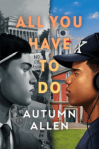
All You Have To Do by Autumn Allen

Standard
All You Have To Do by Autumn Allen

all you have

This historical fiction YA book was hard to put down.  While being invested in the characters and learning about the historical climate from an intimate account, I could feel my mind growing and my understanding deepening. The phenomenal writing quality, and the connection between the two fictional characters from two different times rooted in reality, allowed this thought provoking book to burrow into my mind, and makes me suggest it to high school English teachers to read with their students for a novel study.  Add in that the author is Muslim and that there is inclusion of side Muslim characters, makes me really really love this 432 page book.

SYNOPSIS:

Told from two perspectives: Gibran is a high school senior in 1995 at a prestigious New England, majority white prep school.  Being aware of the efforts his mother has made for him to have the opportunities he does, the incredibly bright boy isn’t content to sit back and let injustices go unchecked.  As he understands his position in his school, and perhaps in the world, he pushes to change how the system views him and on the cusp of the Million Man March he starts to get restless when others don’t support his efforts.

Kevin is at Columbia University in New York City in the wake of the Martin Luther King, Jr.’s assassination.  While the country pays service to the civil rights leader Kevin is witnessing the injustices at Columbia, and begins to question what his enrollment at the institution means and the hypocrisy it supports.  He also reflects back on choices his own family has made and what he would like his future to look like when opportunities to protest arise.

Kevin is Gibran’s uncle and their parallels show how little has changed in America.  The fears of the family, the institutionalized racism, the helplessness of a broken system.  The desire for two young men coming of age to decide for themselves where they belong, who they are, and what they are capable of in a world that wants to take that freedom away from them.

WHY I LIKE IT:

The power of this book is incredible, truly.  I really don’t have words.  I do have words about the side Muslim characters though.  Gibran’s sister is a hijab wearing convert and is respected and accepted by the family.  Kevin’s cousin and activist is also a convert and a powerful influence on the main character.  There are mentions of Muslims praying, and salams are given.  The book was beneficial to read, the Muslim characters and knowing that the author is Muslim, and reading the phrase, “In the Name of God the Most Gracious, the Most Merciful” before the dedication was just extra amplification of voices that this story brought to light.

FLAGS:

Racism, violence, police violence, incarceration, hatred, drugs, alcohol, sneaking out, partying, lying, stealing, segregation, oppression, language.  The reality of the situations discussed is not PG, but the book does not sensationalize anything for the sake of shock, it is rooted in reality and a YA audience will grasp that.

TOOLS FOR LEADING THE DISCUSSION:

Teachers, librarians, parents, teens: read this book.  Think about what you are reading, discuss what happened, what you understand, and how it makes you feel.  Preorder/order here

When a Brown Girl Flees By Aamna Qureshi

Standard
When a Brown Girl Flees By Aamna Qureshi

when a brown girl flees

I was both nervous and excited to read this contemporary book having loved the author’s fantasy, but unsure how a Brown Muslim Pakistani American girl running away from home would be presented.  Alhumdulillah, the author approached the story from a place of love.  There is no internalized Islamophobia, self othering, or in broad strokes even an identity crisis. The protagonist has made decisions, drastic ones, and is trying to piece her life back together on her own terms, but the love of culture, family and faith, is always upheld.  It reads like Islamic fiction, with very didactic passages and moral positioning, I’m still quite surprised that it is traditionally published.  The version I read had grammar errors, so I’m hoping that they will be corrected when the book releases in a few weeks.  The story is engaging, but the writing a bit monotone.  Much of the story is telling, not showing, and because of the surface level spoon feeding of so much of the plot, when the catalyst or rationale is not provided, the book seems underdeveloped, or lacking, unfortunately.  I would not recommend this book for the target audience of YA readers (12/13 and up) it contains sex, slut shaming, self harm, depression, suicidal thoughts, physical and emotional abuse, profanity, and mentions drug use.  I do think though, early college age readers will enjoy and benefit from reading the book.  At a time in the reader’s life when they are defining themselves on their own terms, owning up to their own mistakes and laying out a future path, this book will provide relatability amplified by religious and cultural touchstones.  The heart of the story is the connection of a girl with Allah swt after she has sinned, the guilt and regret she feels, and how she finds herself, and returns to try and fix things with her family.  The characters are flawed and the overall messaging beautiful, hopeful and uplifting.  Unfortunately, it just reads like an early draft and I wish it had a bit more refinement.  Keeping that in mind though, it does have a place, and I’m glad to see our “new adults”  can find reflections of  themselves in a piece of literature that amplifies their Islamic identity instead of criticizing or questioning it.

SYNOPSIS:

The book starts with Zahra deciding to run away from home.  She parks her car, leaves her phone and catches a flight to New York from California.  The reader doesn’t exactly know why she is running, only that a few days after high school graduation she is escaping a toxic home life, an impending wedding, and misery.  As the story peels back layers we start to see some of the nuance of what she is running from as characters from her past find her and physical space allows her some perspective to see her own role in her “old” life.  When she arrives in New York, it isn’t the city life that she seeks, but rather the nature and pace of Long Island that offers her a fresh start.  She heads to the masjid, makes a friend, and starts to put her life together without parental obligation, outside interference, and self loathing.  She cannot run forever though and she cannot escape herself.  She must confront her past, own her mistakes, be honest with her new friends, and find peace with her family, not because she has to as a Brown daughter of immigrants, but because she trusts Allah, loves her family, and wants to “fix” things.

WHY I LIKE IT:

I’m a sucker for books that show redemption through the love and mercy of Allah (swt).  Yeah her new friends were idyllic in their family life, relationships and worship, but we all want friends that make us better Muslims, so I let it slide. Islam is centered, she wears hijab, she reconnects with salat, it is her identity even when she is just going through the motions. The author at times conflated culture and faith, but it never issues blanket statements or falls into universal stereotypes for Desi culture or Muslims.  She does a good job of keeping the negatives to the people and the critiques to the failure to push back on dangerous expectations. My issues weren’t the character flaws either, I’m onboard with the messiness of being human and the ability to seek and receive forgiveness from our creator.  I just wanted to feel things more.  So much was just told when it should have been shown.  I wanted to see the stress and anguish of her family life, not simply told it was depressing.  I wanted to see her cutting life long friends out and being isolated, not told she had lost her friends.  The book focuses on her running, and why she ran, but a big plot point for why she ran, having sex, needed more fleshing out.  Why was she driven to such an act? I know that she was depressed, I’m not belittling that, but what pushed her to such a strong stance, when she was already allowed on the school trip, she hadn’t yet been given the ultimatum and over and over the book says “I miss my family,”” I miss my home,” “I miss my mom.”  I didn’t feel the connection or understand what she was feeling, thinking, and it seemed like a huge hole in the book.  For all the themes of mental illness, faith, generational trauma, misogyny, abuse, expectation, depression, lying, culture, life choices, higher education, family dynamics, self harm. the book never quite felt rich with emotion or deeper than the surface level story.  At the beginning the author says she first wrote the book when she was a senior in high school, and while that may have made the main character’s perspective and voice ring true, as a successful author now, I wish she would have added the nuance, the insight, the subtlety that would have drawn the reader in and allowed them to get inside Zahra’s head and heart to see her and perhaps even themselves.
FLAGS:

The author and book identify triggers in the book “please be mindful of TWs: depression, anxiety, emotional abuse, physical abuse, self-harm, suicidal ideation, slut-shaming, PTS.”

There is also music, boys and girls alone in cars together, lying, cursing, generational trauma, misogyny, abuse, expectation, depression, anxiety, guilt, life choices, higher education, family dynamics, cutting, a brother who is often high or smells like weed/pot, it mentions partying, a sexual event, deceit, physically assaulted by a parent.  Nothing haram is glorified, but it is there and it is detailed, and not everything is resolved.

TOOLS FOR LEADING THE DISCUSSION:

I would not be able to shelve or teach this book in an Islamic school library, but in a college MSA book club or a youth group of a similar age this book would be incredible to read and discuss.

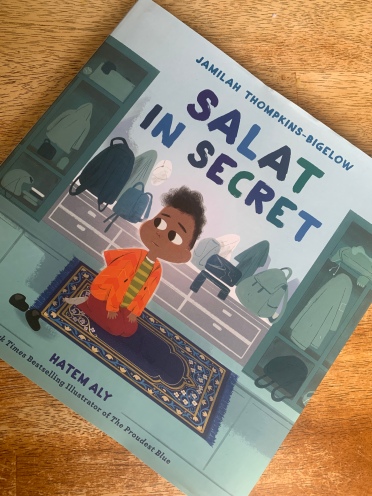
Salat in Secret by Jamilah Thompkins-Bigelow illustrated by Hatem Aly

Standard
Salat in Secret by Jamilah Thompkins-Bigelow illustrated by Hatem Aly

img_8430

It is quite remarkable in the course of 40 pages that so many themes, layers, emotions, windows, mirrors, and relevance can radiate with ease and entertainment for children four and up.  The authenticity of the text and illustrations create tangible feels in this book, that months after reading it for the first time, I am still moved to tears, both inspired by joy and as a cathartic release of being seen.  The true mastery is that even if you are not Muslim and cannot relate to the nervousness of praying publicly, you understand Muhammad’s hesitancy and feel for him as he battles not just finding a place, but watching onlookers reactions to his father, police proximity, and being brave enough to push yourself even when you are scared.  Usually when asked what my favorite book is, I stumble to narrow it down to just one, but truly this book has raised the bar of not just traditional publishing representation, but Islamic/Muslim literature across the board.  It is a gift to read, to share, to enjoy, and a blessing that such an unapologetic book is available so widely for our children to connect with, and our non Muslim friends to see us through.  Please spend time with this book and make it available to your children, your students, your community, it really is that good, alhumdulillah.

img_8431

It is Muhammad’s birthday and he is seven, “Old enough to pray five times a day,” his father gifts him a prayer rug, and  Muhammad is ecstatic.  He makes wudu that night and offers salat with full attention.  He says the Sunday school words and shares his most wished for wishes to Allah swt, not even letting little sister, Maryama distract him.

After Fajr the next morning, he is determined to find a secret place at school to pray Dhuhr. Daddy doesn’t need secret places, if prayer time comes he pulls his ice cream truck over and prays on the sidewalk, “never delay salat.”  At school, Muhammad heads to Mrs. Baker to ask for a place to pray, but his confidence waivers and he returns to his seat.

img_8432

Anxiety about where to pray has him looking for spots throughout the morning, but when recess comes he finds he can’t take the prayer rug out from under his jacket.  He lingers when everyone returns to class and rushes through the words and motions in the coat closet.

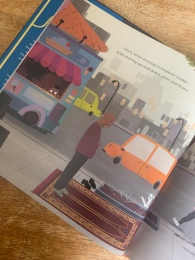
That evening he is with his daddy in the ice cream truck and the sunshine and smiles pour out of the two.  When the sun sets it is Maghrib time and Daddy heads to the sidewalk to pray, reassuring Muhammad that he can pray at home.  Muhammad watches his dad and various events spur him to make his decision.

img_8433

I love love love the way salat is approached with love and excitement and that the dad embodies safety and joy and does not pressure or force Muhammad.  The relationship is beautiful and allows for worship to be seen as both personal, as well as obligatory and merciful.  The duo also show a great parent child dynamic that warms the heart.

img_8434

I like that there really isn’t any “hate” given to anyone praying, it is hinted at, people do not understood, but the focus is not on the outside bystanders- it is what Muhammad thinks and feels.  I’m fairly certain every Muslim who has prayed in public has encountered a wide variety of responses, and this book keeps the gray to reflect and spark conversation.  It is often met with ignorance, with hate, with aggression, but it is also met with respect, apathy, and curiosity which the text and illustrations allow for.

img_8435

There is so much love and joy in the book as well as identity, that I don’t mind one bit that my littles ask me to read it over and over.  It is perfect for groups, one-on-one, and I cannot wait to share it in a story time, there is also an incredibly informative and heartfelt Author’s Note at the end.  If you haven’t preordered it yet, the book releases on June 6, 2023, please pre order it and signal the support for this book and future books that center authentic Muslim joy, Black Muslim representation, and OWN voice author and illustrator accuracy.  Request it at your library, put it on hold at your library, check it out, read it.  If you cannot preorder it, still purchase it when you can, inshaAllah it will be a beloved book in your home as well.

Girls Rock: Indonesia by Claudia Bellante illustrated by Josefina Schargorodsky

Standard
Girls Rock: Indonesia by Claudia Bellante illustrated by Josefina Schargorodsky

img_8112

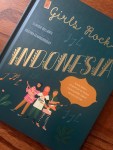
This book is part of a series that claims to want to bring the world closer to American children.  It is based on a true story, with noted liberties taken regarding the protagonists, and yet the Author’s Note says she went to Indonesia and was unable to meet with the characters whose lives the book is about.  I am not against non Muslims and non Indonesians per se writing a book about Muslims in Indonesia, nor am I naïve to the fact that music inspires many and radicalism is a real threat, but to conflate ideas without explanation, and not containing that OWN voice authenticity or biography feel, really leaves this book fighting against self made stereotypes and trying to seem woke and relevant while maintaining a very Western American paradigm of what it means to be happy and fulfilled.  The book (and series) may have had good intentions, but it just felt off to me, and with a publisher suggested reading age of 5-8, I think this book assumes too much about the readers prior understanding of hijab, Quran, Indonesia, music, heavy metal, radicalization, small village life, culture, Islam, Quran, imams, and prejudice and fails to assist in connecting the concepts, opting to use them interchangeably and ultimately making the 32 page book rather pointless.  I think if older children read it, it is one of those books that makes one feel like they are cultured and supportive of those breaking stereotypes, but I think Indonesian and Muslim readers will just be confused about why a book is supporting sneaking and lying and why music is ok, but loud metal is not, and why a Muslim teacher could have a band years before, but the current characters are receiving backlash now, amongst so many other things.

img_8105

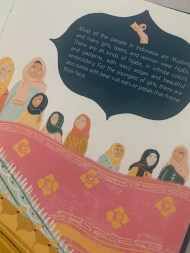
The book starts with basic information about Indonesia: Java, Jakarta, religion, and the motto.  It also includes hijab as something some Muslims wear but does not detail why or what it entails.  It then introduces the reader to three girls that go to school and study Quran, as the pride of their parents and village. The girls feel something is missing and while they are “studying” they in reality are often secretly watch YouTube videos after learning about the heavy metal band Metallica from their teacher.

img_8106

The girls want to learn to play, but fear their parents will get mad, why they would get mad is not articulated, so they go to their teacher and whisper their passion for heavy metal “as if they are confessing a sin.” Their teacher, Pima, says she used to play in a metal band, and that they can use the instruments in her garage to learn and practice.

img_8107

So while their parents think they are studying, they are playing music.  The book says music is not against their dreams, not against Islam, they choose to wear hijab, they start to write their own lyrics, and their teacher arranges for a producer to come listen to them. The girls worry the imam will get mad and so will their parents. When a local interview airs, the teacher asks negative folks, “who says a girl in a hijab can’t play loud music? Does the Quran forbid following your dreams?”

img_8109

Pima regrets letting the naysayers deter her from her music dreams, but earlier said her band broke up when the members moved or got married.  The parents seem fine when a festival in Jakarta is about to happen and presumably they live happily ever after.

img_8108

The backmatter then throws in radicalism and Muslim feminist groups, and I’m not sure what the takeaway would be for Muslim or non Muslim children reading this book.  I admittedly haven’t read the other books in the series, but I would be skeptical of their portrayal of cultures and religion after reading this one, it isn’t so much that it is wrong, but it just seems to water the reality down to make it more “palatable” and “acceptable” to American children which results in strong themes of “othering” and dismissal.