Tag Archives: Interfaith

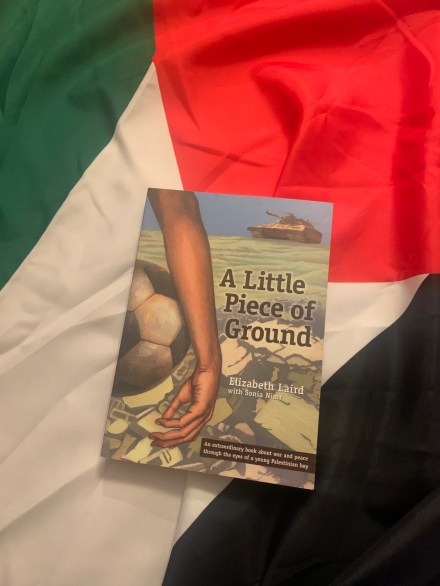
A Little Piece of Ground By Elizabeth Laird with Sonia Nimr

Standard
A Little Piece of Ground By Elizabeth Laird with Sonia Nimr

img_2165-1There are so few Palestinian middle grade books, so on that premise alone this 216 page book has a lot of value.  Because I am not Palestinian, I do not live, nor have I ever lived under occupation, I can argue some of the concerns from a point of privilege, and I acknowledge that is not my right.  I have been asked numerous times about this book and how it frames the suicide bombing mentioned in the text and blurbed about on the back of the book. It honestly is not a large part of the story, that being said, in my outside privileged view, I do not know that a 10 year old in the west will have context to understand the act of this level of desperation from the oppression and humiliation mentioned in the book. This is why I have held off my review.  The truth does not need to be defended or explained, and I fear my reservations will be taken as such, which is not my intention.  Would I let me 8 year old read this, yes, but we will read it together and discuss.  My children are aware of what is going on in Palestine, but Karim, the 12-year-old protagonist supports the bomber, and that notion is not clearly pushed back on. With discussion, absolutely, I think readers, will truly get Karim’s perspective that something has to be done to change the status quo.  The fear when Karim is alone and the target of soldiers, the settlers forcibly seizing the family land, the humiliation of strip searching men at checkpoints, the curfews, and constant fear of attack and imprisonment are all presented through the main character’s eyes, and would also do better with some discussion, so that empathy and duas and action can result.  But, the commentary as to the suicide bombing are minimal, there is even a prank package bombing that is presented as rebellion by a side character, and I would worry how a young child, without guidance, would internalize it.   Additionally, this is yet another difficult book for me to review, primarily because it was first published in 2003, and because I don’t know how much comes from a western gaze and how much the Palestinian voice played into it. Islam is clear on the prohibition of suicide.  In the early 2000 the news out of Israel was often about such attacks, but as an outsider, I honestly do not know if it was simply Israeli propaganda and stereotypes amplifying the idea as part of their public relations strategy or reality, seeing as now that Palestinians have direct outlets to share their daily life under an oppressive occupation, there is rarely talk of suicide bombing attacks. The author states on her website:

“I first visited Israel in 1968, and enjoyed a warm welcome from many Israeli friends. Later, I lived in Beirut with my husband and son during the civil war there, and became aware for the first time of the tragedy of the Palestinian refugees. I visited both Gaza and Ramallah, in the occupied territories, in 2002, while leading workshops for Palestinian writers. I was appalled by the circumstances in which people were living, and became aware that we in the West know very little of what life is like for Palestinians living under military occupation.

I have written A Little Piece of Ground in collaboration with Sonia Nimr, a Palestinian archaeologist, storyteller, writer and translator, who lives in Ramallah. We have tried to make our story as true to life as we can.”

The book is a hard read at times, but the joy is there.  Just as we as adults scroll through the devastation, the humanity persists.  The world may try and forget that they are attempting to erase a rich culture, but even in this book, their is laughter, and crushes, and sibling squabbles, and soccer games and friendship, and food, and joy.  There is a little Islam, not much, the main character is Muslim, a best friend is Christian.  It isn’t present in their everyday thoughts and actions, more just in identifying their faith.

SYNOPSIS:

Karim and his friends are not so much different than 12-year-olds everywhere, he loves video games, playing sports, isn’t so sure what he wants to be in the future, wonders what he will look like as he grows up, and is often annoyed with his family who he loves dearly.  Karim’s life in Ramallah is also unique, he lives under curfew, he doesn’t have freedom of movement, opportunity, or equal rights, and a simple family outing can be life altering.

The book follows Karim and his group of friend as they discover a patch of land they decide to turn into a soccer field, to claim as their own.  They work on it on days they can sneak away after school, in windows of time between curfews, and before long start to take pride in what the land can be. Adopting cats, learning about new friends from the refugee camp next store, teasing siblings about their crushes is all in contrast to Karim watching his father be stripped searched at a check point, being chased off their family land when they are harvesting olives by settlers shooting at them, and pranking soldiers in desperation of fighting back against oppression.

When soldiers roll in and occupy the land the boys have claimed, symbolic of their whole country, Karim gets stuck barricaded in an old abandoned car for days, with soldiers aiming their sights on him, and wondering if he will survive.

FLAGS:

Suicide, systemic abuse, oppression, humiliation, dehumanization, killing, beating, apartheid, genocide, violence, stripping, lying, crushes, occupation, shootings, injuries.

TOOLS FOR LEADING THE DISCUSSION:

This book does not need tools to be discussed.  It itself is a tool, to help middle grade kids be aware that this cruelty has been occurring for 75 years, this book took place 20 years ago, and today we just have social media sharing these stories more widely.  InshaAllah soon, Palestine will be free.

You can purchase this book here at Crescent Moon Store where code ISL at checkout saves you 10%

Three Holidays and a Wedding by Uzma Jalaluddin and Marissa Stapley

Standard
Three Holidays and a Wedding by Uzma Jalaluddin and Marissa Stapley

3 holidays

I don’t think I have ever sat down and watched a complete Hallmark Channel holiday movie, but I know the stereotypes and I’ve caught enough scenes while hanging out with my grandma to know that reality has to be suspended, there will be a happy ending, and the snow and small town charm is going to be laid on pretty heavy as the wholesome romance plays out.  This book is the literary equivalent of such a movie. So with that in mind, there are somethings I will concede can be overlooked, but religiously there are some things that need to be noted (see below).  I also have to admit that I couldn’t put the book down and read the entire 384 page Adult book in two sittings. The book is told in alternating perspectives: Maryam and Anna.  Maryam and her family are Muslim, the book takes place in 2000 when Ramadan/Eid, Christmas and Hanukkah all took place within days of each other.  Anna celebrates Christmas, but grew up celebrating Hanukkah too.  Even if a romance that has Muslims ok with adopting “Christmas-y” celebrations during the last ten nights of Ramadan no less. is not a book that appeals to you, it is worth noting that this book does an incredible job of not becoming performative.  There is no internalized Islamophobia, self-othering, no over explaining, convincing, justifying or religious or cultural identity crisis. For a book co authored by a Muslim and a non Muslim and traditionally published, I am excited for the precedence this book sets.

SYNOPSIS:

Anna is in a perfect relationship, with the perfect guy, and accidently sees the perfect ring in her boyfriend’s luggage.  With Christmas plans in Toronto to meet Nicks wealthy parents, it is clear that the perfect proposal is also going to happen.  But Anna is not perfect, and who she seems to be to Nick is not who she is or wants to be.  It feels so fake.  With separate flights from Denver to Toronto, getting redirected and stranded in Snow Falls, Ontario gives her the pause she needs to decide what she wants.  She meets Josh, someone in town visiting, which complicates things, and she sorts through her grief of loosing her father and the speed in which her ex step mother moved on, all why becoming good friends with Maryam and her family in this idyllic town that she doesn’t want to leave.

Maryam is the oldest daughter who shoulders the expectation so that her younger sister can live her best life.  She became a pharmacist to carry on the family business, so Saima could be a physician with Doctors Without Borders.  Now Saima has decided that she wants a wedding in Ramadan and Maryam has to plan it. The flight being diverted and the wedding party being stuck in Snow Falls has long ago crush Saif and Maryam sorting through their past and a possible future together.  

The two protagonists, their past, future, love interests are all multiplied by a town full of love and holiday activities, a wedding that might be missed, a Holiday Hoopla show, a movie being filmed, fasting in Ramadan, and wise old Dadu, a former Bollywood director guiding the characters to a happy ending.

WHY I LIKE IT:

The book is an easy read, it really is a guilty pleasure escape from reality and that it comes from a place of- we are Muslim, we fast, we pray, we don’t/shouldn’t date without marriage in mind, and everyone in the book already knows all this makes you feel ok about indulging.  It even has a thread of analyzing parental expectation and peeling back some of the assumptions regarding the disconnect worked in throughout the story.  

It took a few chapters for me to stop fighting and accept that the snow is so bad that the airport is closed, but every store, restaurant, and the roads in the town are open.  That the phones are out, no one has a charger, but the payphone works and food can be ordered and delivered.  That Anna is strolling around in a cocktail dress and can find a sweater, but she can’t find pants, and holiday gifts for everyone were not a problem to obtain.  The book notes the idyllic diversity and amazing payphone, but you really just have to let it go if you are to enjoy the book.

Some things I couldn’t let go though are the Islamic religious portrayals.  The characters note that a wedding in Ramadan is a terrible idea, but for as authentic as the waking up for suhoor and fajr are every day and iftar is every evening, the Muslim wedding party spend the last 10 days and nights of Ramadan watching Bollywood movies, dancing at a music filled mehndi party, planning and performing in an interfaith holiday show, and listening to Christmas music.  I know Ramadan staples of reading Quran, doing thikr, and praying, don’t fit the genre, but there are enough people to make jammat, one night it mentions they go to the musallah for taraweeh salat, but I really wish it was every night, and that more traditional Ramadan foundations were shared.  I did love that why Dadu couldn’t fast was explored, and that when Saima was stressed she went to the musallah, but really Bollywood marathons and parties in Ramadan are uncomfortable even in fiction.

FLAGS:

For Adults and New Adults the book is remarkably clean.  The romance is tame even for YA, the characters are all adults and it is more the Ramadan non worship and Christmas normalization that is more flag worthy to me if a Muslim teen were to read it, than the relationships.  So take what you will from the flags: Anna and Nick seem to live together at the beginning, Anna and Josh hold hands, kiss.  Maryam and Saif hold hands and hug.  Saima and Miraj hug.  There are some other hetero couples that kiss. Mention of Maryam’s prior relationship features her husbands infidelity, and Saif admits to having a girlfriend.  There are a few LGBTQ+ couples in the town that own stores and the inn, but don’t seem to be Muslim, and their relationships are not significant plot points.   Muslims joining in Christmas activities. Alcohol and a pub are mentioned, but Anna partakes, no Muslim characters.

TOOLS FOR LEADING THE DISCUSSION:

I don’t think I could do this as an Islamic school book club choice for middle or high school.  But I do want to gush about it with my Lit Sisters.  You can preorder it here https://amzn.to/3L7K9wQ

Fight Back by A.M. Dassu

Standard
Fight Back by A.M. Dassu

fight back

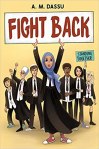
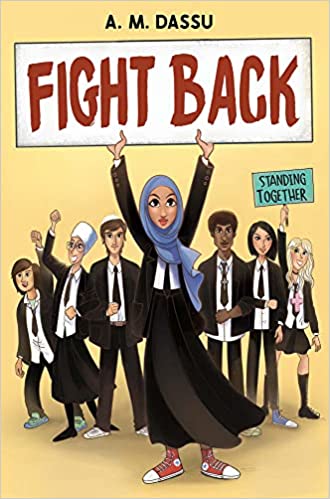
At 384 pages, this middle grades book takes on hijab, terrorism, Islamophobia, finding your voice, and fighting back.  At times the book was insightful and smoothly written, at other times the voice seemed childish and the writing directionless.  The inconsistencies don’t ultimately make the book good or bad for me, but rather very forgettable.  I read the book over the span of three days, but honestly remember very little about the book without looking at my notes.  The writing just isn’t particularly strong.  I never connected with the main character, and no it wasn’t because I didn’t agree with her wearing hijab out of solidarity, I accept that people make the decision for a variety of reasons, somehow I just never felt sympathetic to her as a person, or found myself cheering her on.  Her naivety vacillated too much for me to find her believable, and the pacing of the book made it hard to get revved up.  I think upper MG and middle school readers will be a better fit for the book with hate speech, assault, school bans, concert, musical references, and alt right indoctrination.  I think the book is worth shelving in a classroom/school library and I’m considering it for a book club selection, but I’m skeptical that the book would be finished, even if started, by most readers without some incentive to see it through.

SYNOPSIS:

Aaliyah and her friends are at a K-pop concert when a terrorist attack kills and injures numerous people.  A Muslim takes responsibility and with it coming on the heels of numerous London attacks, Islamophobia is at an all time high.  For 13-year-old Aaliyah, it is a stranger yelling at her mother in a parking lot, her best friend Lisa ignoring her, and her brother getting riled up in retaliation, that gets her to wonder why her mother wears hijab, when she started, and decide to start covering herself, in solidarity. As a result for Aaliyah there is now increased bullying at school which results in physical assault, and teachers turning a blind-eye.  It reaches an all time high when a religious display ban goes in to effect.  Still dealing with trauma from witnessing horrific violence, Aaliyah decides to push back.  Finding her inner strength and finding allies in a few good friends, and a secret cat adoption, she finds enough motivation to keep her plugging forward against the growing hate in her world. When she finally finds her voice will it be enough to overturn the ban and save her brother? Nope, not going to spoil it.  The fight is not a one-and-done, as anyone who has gone up against racism and systemic oppression knows, and this fictional book keeps that integrity and doesn’t give a happy ending, but rather hope and motivation.

WHY I LIKE IT:

I like that the Islam is centered in a consistent and empowering way.  At times it is a perspective that I’m not completely onboard with, but a few pages later the insight is powerful and the messaging clear.  I found it odd that Aaliyah doesn’t know when her mom started covering or why, or anything about hijab, it comes off very immature. The book keeps culture and religion separate, hijab a choice, and I like that it was Aaliyah who wants to cover even when her parents try to talk/force her out of it.  I find it a little off that she doesn’t go to the mosque, but her father consulted with masjid folks when looking for advice for handling the alt right groups.  She prays a few times in the book and it being mentioned is nice.

I like that the kids in the book think for themselves, and that the adults don’t have all the answers.  I enjoyed the passages asserting why the family came to the UK generations ago and why they have stayed, is powerful.   A few of the characters that are really strong at the start don’t ever get mentioned again.  Which is fine, but I did wonder about Harpreet and why Yusuf’s friends weren’t contacted when Aaliyah was sleuthing about.

Loved the literary shout-outs, and the hypocrisy of allowing swim caps and hats but not hijab, but sigh, didn’t love the cat thread.  I think I just don’t like fictional cats, I sound like a broken record.  I think the inclusion was to show how much Aaliyah had to keep hidden in her life and how she needed comfort, but I don’t know, sigh, I found the contrast of tone jarring to the pacing.

There is a glossary at the end, and the definition of Hijab is a bit odd, highlighting Western and South Asian terminology and not the Middle Eastern or even global use of the Arabic word.  I don’t know that the glossary is even needed as the book really tries to establish that the characters are a part of their society and don’t need footnotes and differential treatment, so the inclusion of a glossary for me, diminished the point a bit.

FLAGS:

Assault, hate speech, bullying, fear, death, injuries, bombing, terrorist attack, lying, music, mention of a transgender/gender neutral student, a rainbow pin. sneaking out.  Criticism of police, alt right indoctrination.

TOOLS FOR LEADING THE DISCUSSION:

The book is unique in showing affects of the alt right and not having it all work out in an MG book.  It shows the anxiety and fear that Muslims often feel and the determination of not becoming victims. It also does a good job of showing that something like a religious symbolism ban doesn’t just affect Muslims, but people of various faiths and culture, and thus when common ground is found, there are more allies that one often thinks.  I think it could work for a middle school book club and undoubtedly the discussions would be great, but I am given pause with the main characters view of hijab as not being something in the Quran, but rather done in protest and in solidarity.  I think once I see which kids are interested in book club I can gauge if it is something that we can work through and discuss or not.

Zara’s Rules for Record-Breaking Fun by Hena Khan illustrated by Wastana Haikal

Standard
Zara’s Rules for Record-Breaking Fun by Hena Khan illustrated by Wastana Haikal

zara

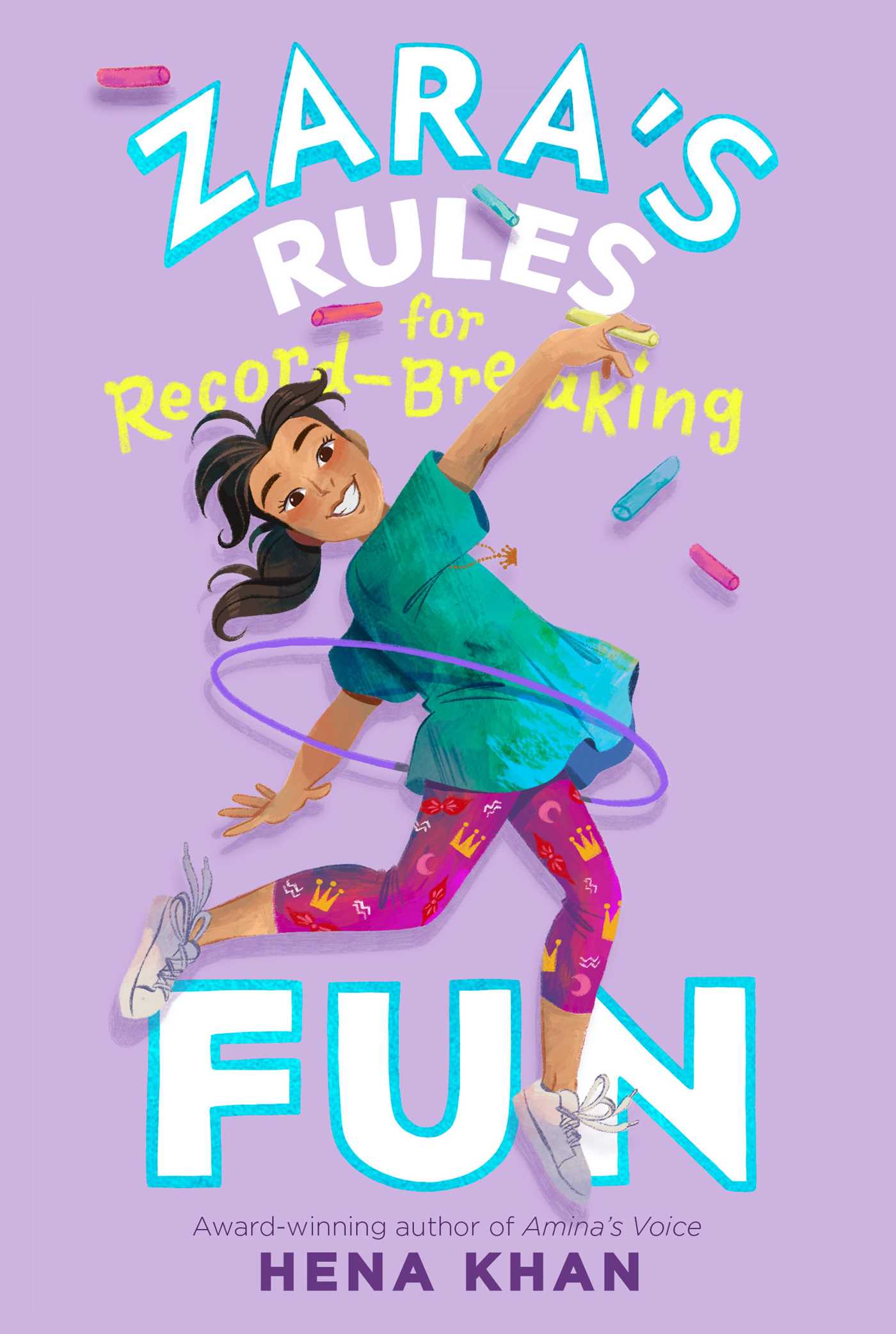
This early chapter book packs a lot of personality, growth, and fun into 127 pages.  The writing quality is engaging and the characters relatable.  If you have read the Zayd Saleem books you will recognize the family in this new stand alone series.  Either way though, from the surprising Naano to the fun Mamoo, the neighborhood children and the desire to maintain her reign as Queen of the neighborhood, the book may be meant for 7-10 year olds, but based on the kids in my house, anyone that picked it up, read the entire book before putting it back down.  The grandma covers her head, it mentions she reads Quran, there is a Salaam or two, an InshaAllah, and desi cultural foods mentioned.  The focus is not on religion or culture, but the layer adds depth to the characters, and normalizes names and practices in a universal plot.

img_9060

SYNOPSIS:

Zara’s neighborhood has a lot of kids in it, and Zara has the reputation of being the leader who rules with grace and fairness.  It is a position she takes very seriously.  When Mr. Chapman moves out and a new family moves in, Zara fears losing her place.  The new girl Naomi has a lot of ideas and everyone seems to like them.  Zara has a grand idea to set a Guinness World Record, but with her little brother Zayd messing her up, nothing is going as planned for the summer.

As she finds her self alone a lot and not having much fun, she decides to change things up.  She works to be less bossy, less controlling, more willing to to share her crown.  With a lot of heart, internal growth, recognizing her strengths and weaknesses, the neighborhood kids just might have a record-breaking summer.

img_9059

WHY I LIKE IT:

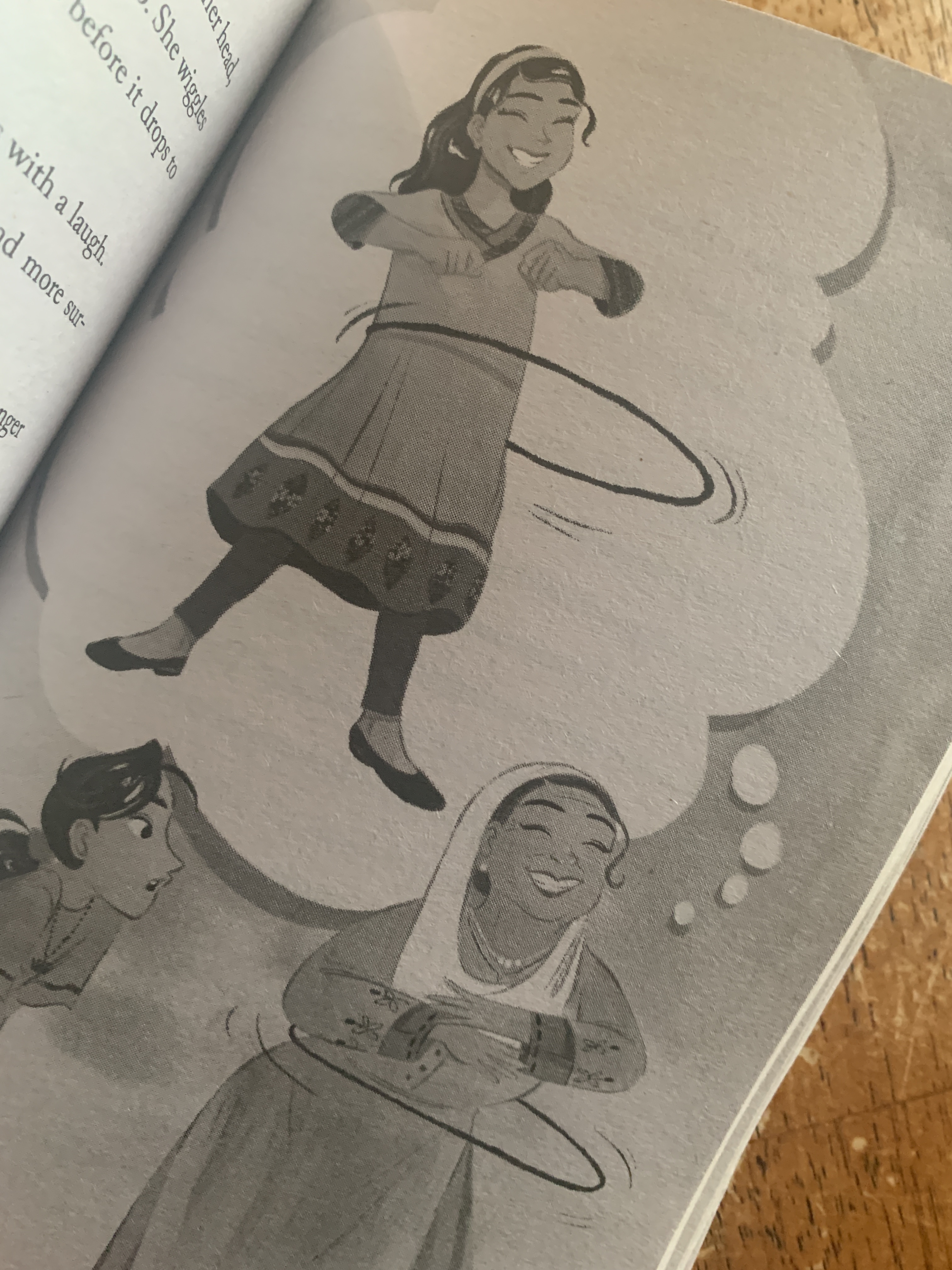
I love that the story wasn’t just surface level, it acknowledged some emotions and stresses and introspection, that I was pleasantly surprised to see played out in an early chapter book.  I really just enjoy the family, they read relatable and fun. The Nanoo’s surprise ability to hula hoop and her pettiness over a cooking competition genuinely made me smile.  The neighborhood kids and the politics of the different aged children having to find ways to compromise reminds me a lot of my summers as a kid, and the nostalgia was sweet.  I like the Islamic touchstones, I would have loved if they had to go in at sunset to pray or something of the like, but I was glad that at least that Nanoo reads Quran and an inshaAllah in the text made me feel seen.

FLAGS:

Music, dancing, frustration, jealousy

TOOLS FOR LEADING THE DISCUSSION:

I think this book should definitely be on every library and class shelf.  It releases tomorrow on Amazon, but Crescent Moon Store already has it.

The Button Box by Bridget Hodder & Fawzia Gilani-Williams

Standard
The Button Box by Bridget Hodder & Fawzia Gilani-Williams

img_8336

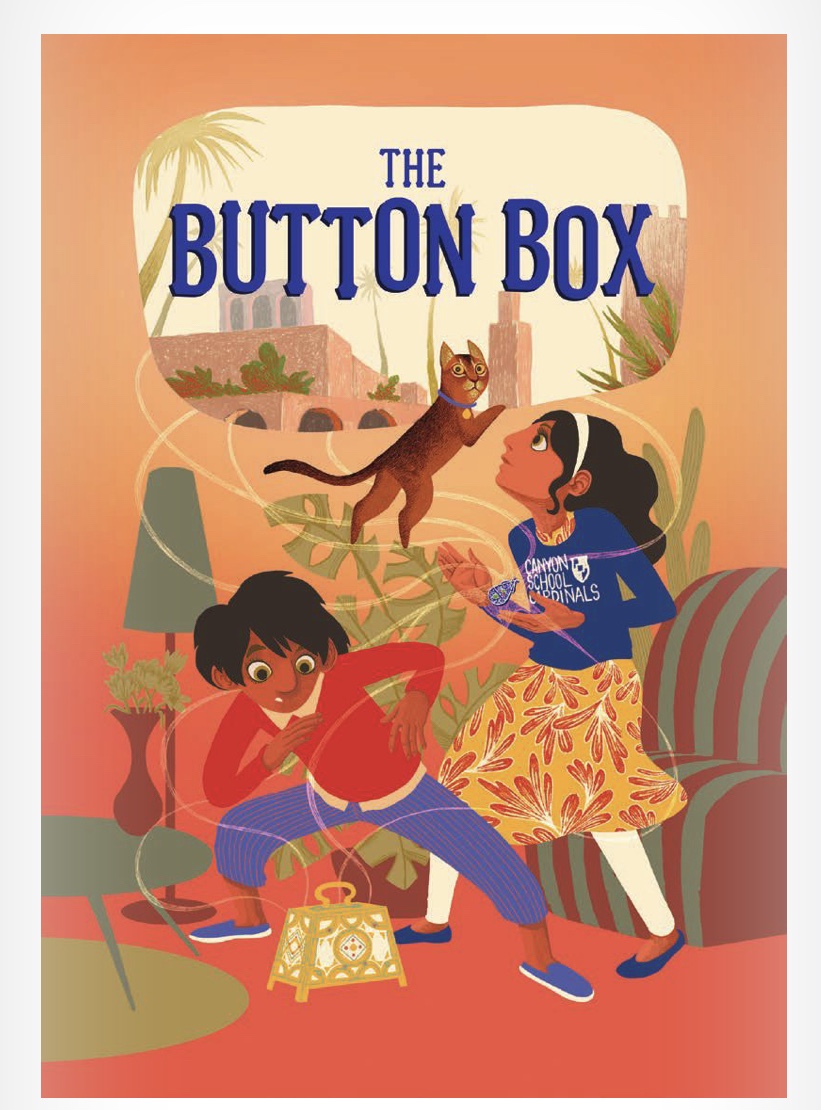
This 152 page book reads like a historical fiction interfaith Magic Treehouse for middle grades tale, and I thoroughly enjoyed it! I learned about Sephardic Jews, the language of Ladino, Prince Abdur Rahman, and a tiny bit about the Abbasids overthrowing the Ummayads.  I love that it starts with a map and ends with sources, facts about what information is real in the book and what is fiction, and a bit about Muslims and Jews and how to be an ally if you witness prejudice.  The book is co-authored, and in many ways the Jewish narrative does take the majority of the focus, but the Islamic phrases sprinkled in, the Islam practiced by a major character, and the setting, allow for both religions to shine and combine to make a compelling magical time traveling story for third graders (and their parents) and up.

SYNOPSIS:

Cousins Ava and Nadeem are in fifth grade and spend their afternoons afterschool with their Granny Buena.  Granny and Ava are Jewish and Nadeem is Muslim, though they believe differently, they always seem to find more that is the same, and respect is always given.  When they face bullying at school Granny Buena pulls out a crystal box full of buttons and tells the children, and the cat Sheba a tale about their ancestor Ester ibn Evram.  When she stops the story short, the two kids exam the button closer and find themselves back in time tasked with saving Prince Abdur Rahman and getting him from Africa to Spain.  They aren’t sure if that will be enough to get them back to their own time though, but they don’t have time to overthink it because if they fail, the Golden Age of Islam won’t happen, peace won’t come to Muslims, Jews, and Christians in the region, and their Jewish ancestors may face the backlash of helping the Muslim escape.  Along the way, they learn about their own family traditions, beliefs, and gain wisdom to handle their bullying problem at school.

WHY I LIIKE IT:

I love that I learned so much, and from what I could Google and ask about from those more knowledgeable, the facts about the time period and cultures all seem to check out.  Only one passage comparing Jewish belief and the text of the Quran is phrased oddly in my opinion, the rest of the Islamic sprinkling is well done.  There are numerous bismillahs, mashaAllahs, stopping for salat, quoting of the Quran and more.  The narrative is primarily Jewish, but the setting Islamic with athans being called and Salams being given.  The book does have a lot of Jewish detail, but I don’t think it was preachy, and the further uniqueness of Ladino words and culture I think would appeal to all readers no matter how familiar or unfamiliar they are with the two religions.

There are some questions that as an adult reader I wanted to know more about: how Nadeem and his mom are practicing Muslims in a strong Jewish family, how making sure history happened as it happened the first time sent the two kids back…then why were they sent there at all, is there going to be more button adventures, were their two cats or was it the same cat?   Honestly, a lot of the more obvious fantasy plot holes were accounted for and done quickly and simply: how their clothes changed but the button remained, how they could speak the language, how confused their aunt would be when her real niece and nephew arrived, etc.. The writing quality kept it all clear for the reader, and did so without the pacing of the story suffering.

FLAGS:

Near death experience, magic, mention of killing, fear, deception, bullying, fighting, physical altercation, misogynistic assumptions.

TOOLS FOR LEADING THE DISCUSSION:

This would be a great story to share if I return to the classroom. The history, the religions, the storytelling would provide so much to connect to and learn about.  As a book club selection though, it would be too young for our middle school readers and ultimately too short.  I would consider it for a read a loud with fourth and fifth grade.

To Purchase: Here is the Amazon link: https://amzn.to/3D9LyxI

Esa & Sol’s Adventures: The Hunt for the Saphaea by Asma Maryam Ali, illustrated by Eman Salem

Standard
Esa & Sol’s Adventures: The Hunt for the Saphaea by Asma Maryam Ali, illustrated by Eman Salem

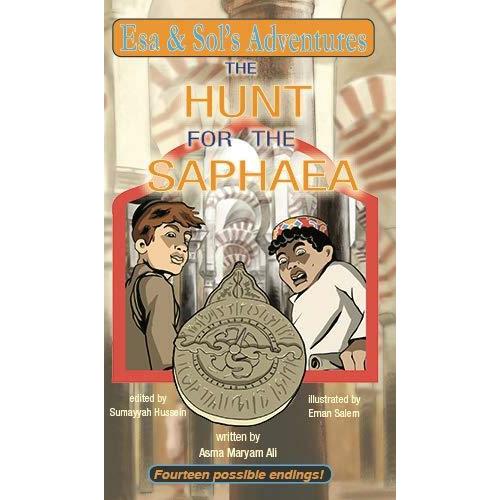
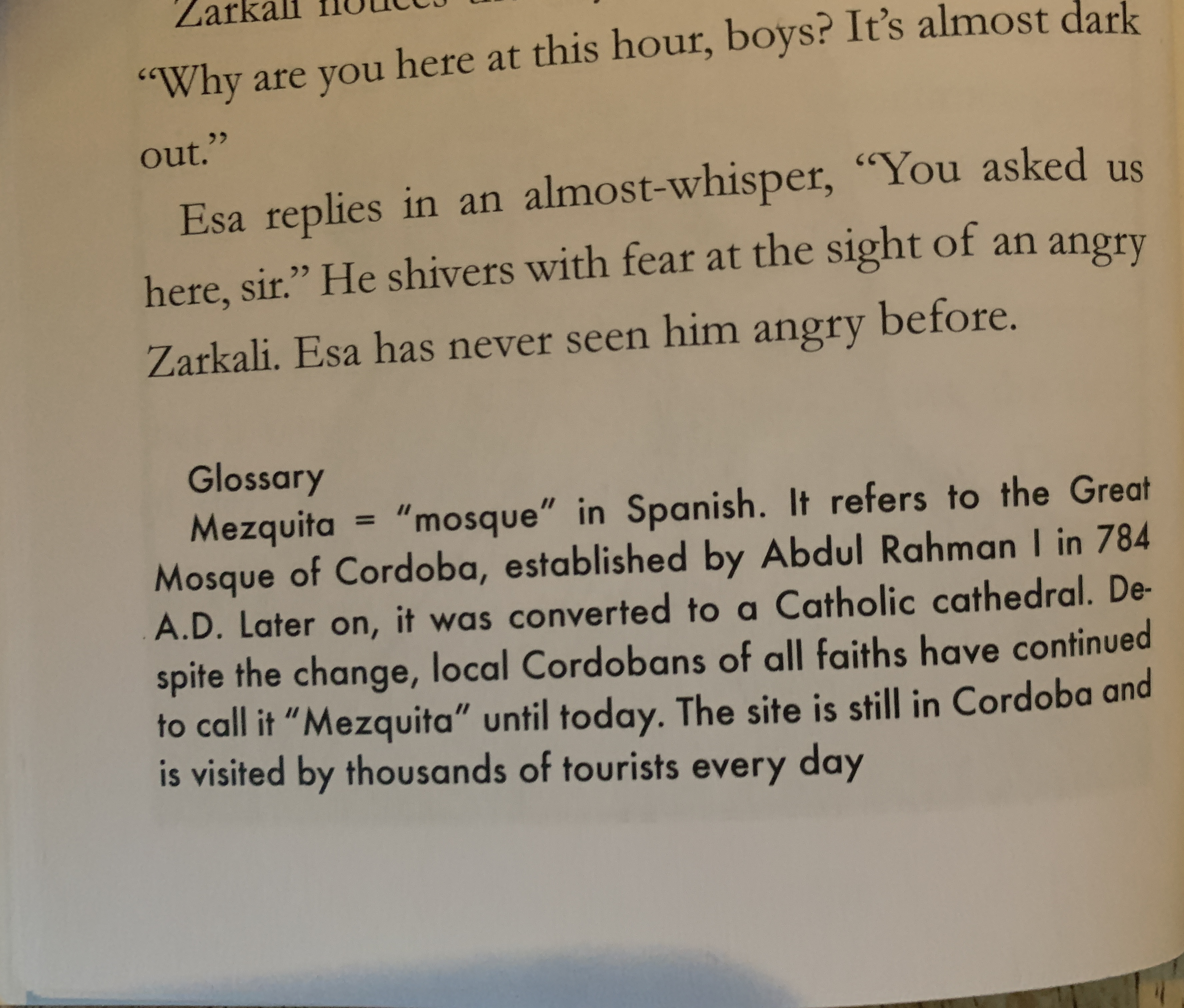
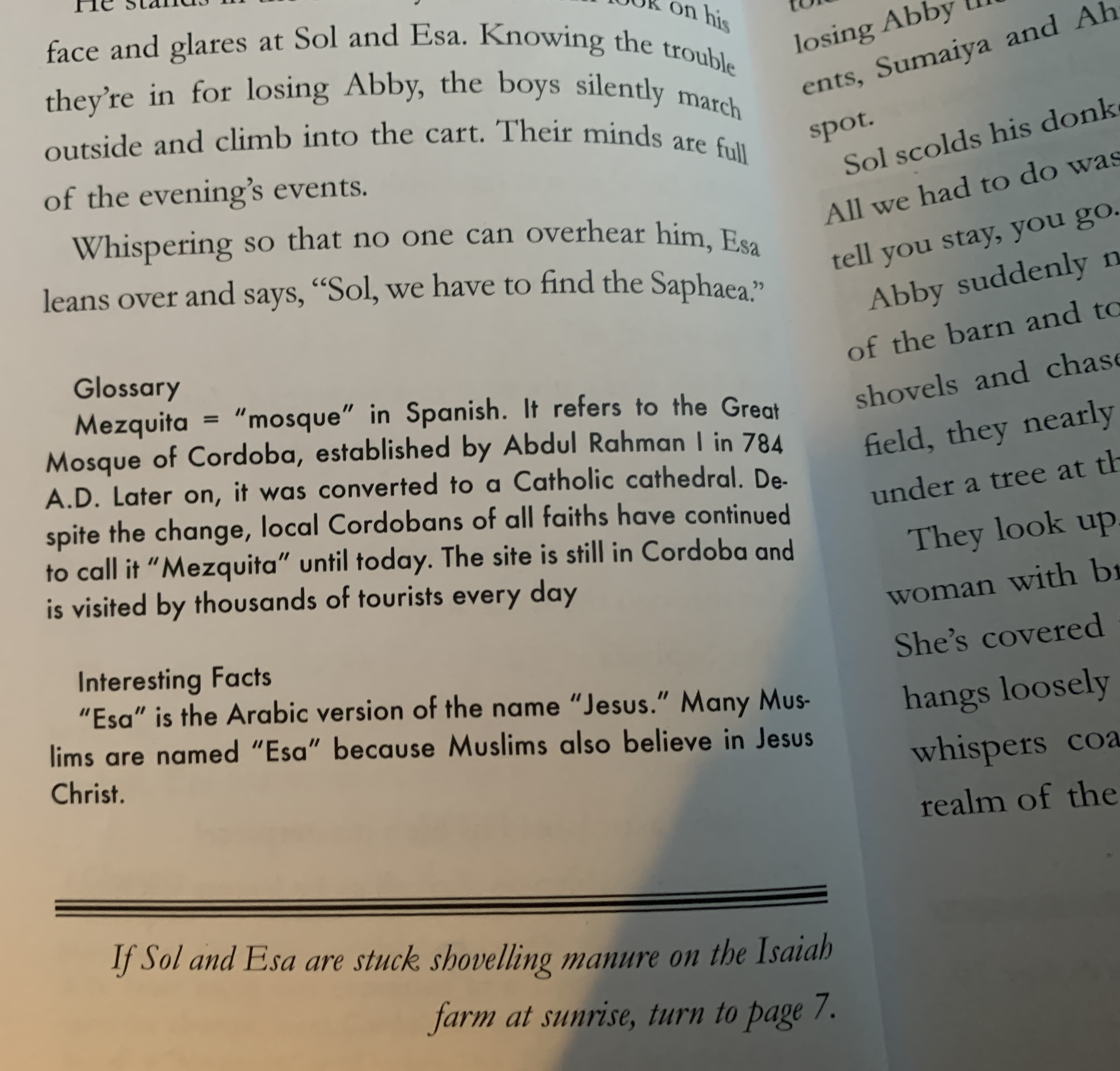
It is a bit tricky to review a choose-your-own-adventure style book, as each story twists and turns and leaves the reader with a different ending and thus, a different impression. I tried to explore every story line in a book that I had little expectation of, it is an intentionally splintered story after all, but even at that, this fell really short. The core of the story: a Muslim and Jewish boy in Cordoba, Spain in 1080 exploring real facts in a fictionalized story about hunting down a missing astrolabe, really had a lot of potential, unfortunately the tiny size (maybe 3.5 x 5.5 inches) and only being 76 pages, the frightening cover, and the misprinted footnote glossy right at the start, set the tone for a weak forgettable book, and by the time you get to the actual story and plot, you really have very little substance to change your mind.

SYNOPSIS:
Two nine-year-old boys start off the story chasing after their donkey who has run off and sent their oranges spilling over all around the square. They should clean up the chaos, but they remember that they are supposed to meet Zarkali, the greatest astronomer in all of Spain, as he finally has a job for them after months of waiting. His latest work is a brilliant astrolabe, but when they get to his workshop he isn’t there. When he finally arrives with his assistant Aleho they are frantic as the astrolabe, the Saphea, is missing. The boys were to be asked to help transport it, as they would blend in unnoticed, but now that it is missing what should they do? Should they search for it? Investigate if it was stolen? Accept their punishment for the mess with the oranges and their donkey? Let the first choice of many begin the adventure.

WHY I LIKE IT:

I love the author’s knowledge about Muslim Spain and how she tries to introduce it to children perhaps unaware of the rich history. The inside illustrations are wonderful, the cover truly misleads readers, and naturally I wish the book was larger in size and longer in length. The foundation of the story, the getting to know the characters and their world, needs to be longer. The story should be established before you have to make decisions. It is historical fiction, but needs the world building attention that a fantasy book would require, and this book just doesn’t have it. As a result the choices and endings, are all over the place, not just twists in the stories, but huge changes. Some of the paths no longer focus on the astrolabe that is missing, and seem to offer both threads of something far more sinister at play and choices that keep the boys lives mundane. The book counts on the reader re-reading the tale and making different choices, otherwise your interaction with the book could truly be over in nine pages, nine tiny pages at that. And like I said above regarding the cover and size, they don’t entice one to pick it up and read, then if your adventure is only a few pages long, and you already notice the repeated definition on pages 4 and 6 (before any choices are offered), chances are you won’t revisit the book, learn about real people, marvel at scientific discoveries, travel the region, appreciate interfaith harmony, and get swept up in a historically fictionalized tale that puts you in the drivers seat.

FLAGS:

Fine for middle grades and up.

TOOLS FOR LEADING THE DISCUSSION:

I highly doubt the book would even be looked at on a classroom library shelf, I have been trying for days to get my own children to read the book: they love to read, they love history, they love books with options, but they have yet to open the front cover.

A Sweet Meeting on Mimouna Night by Allison Ofanansky illustrated by Rotem Teplow

Standard
A Sweet Meeting on Mimouna Night by Allison Ofanansky illustrated by Rotem Teplow

img_0532

A story about the Morrocan Jewish holiday, Mimouna, that marks the end of Passover introduces readers to a small but growing Jewish celebration from Northern Africa.  Stemming from the historical fact of Jews often borrowing flour from their Muslim neighbors to make the traditional Maufletot, thin pancakes, after a week of not eating flour.  The story focuses on a Jewish girl and a Muslim girl meeting each other, celebrating with each other, and finding similarities between Ramadan and Mimouna.  Over 36 pages, kindergarten to second grade readers will get an introduction to two different faith holidays and see that friendship and kindness are possible everywhere.

img_0526

It is the last day of Passover in Fes and Miriam is tired of eating quickly baked unleavened matzah crackers, she is ready for the sweet dough pancakes of Mimouna, and she is willing to help her mom make them.  But before Passover, all flour was removed from the home, and she asks her mother where they can get flour tonight before the  party.

Mom and Miriam begin to walk.  They leave the part of town that Miriam is familiar with and Miriam sees a building with a dome and minarets.  “What is that?” she asks.  Her mother replies, “It is a mosque, where our Muslim neighbors pray.”

img_0529

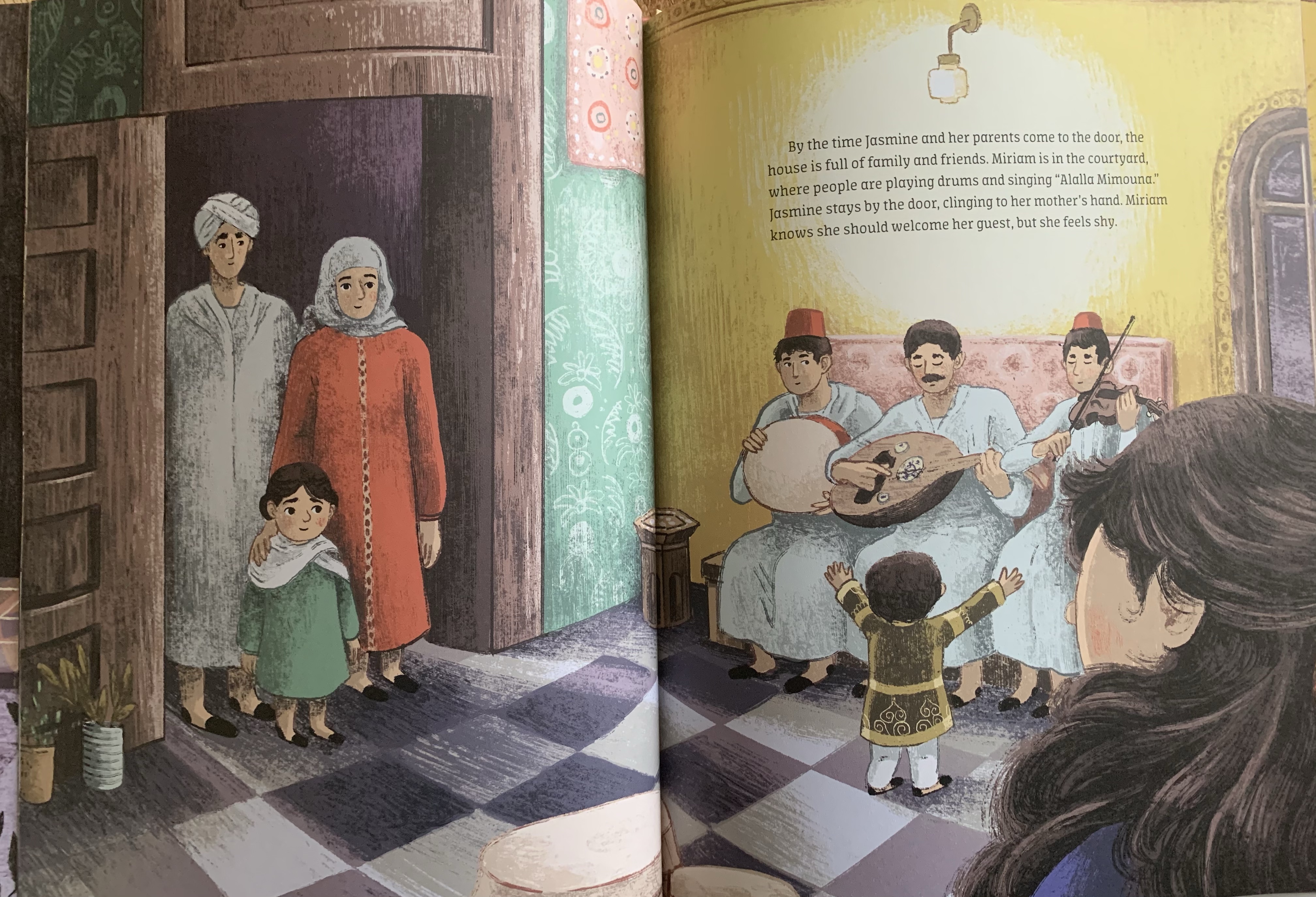
They then enter a courtyard where a woman and her daughter about the same age as Miriam appear and invite them in for tea.  The two women say salaam and kiss each other’s cheeks.  Miriam’s mom gives the other lady a jar of fig jam and invites her and her family to come to the house to celebrate Mimouna with them. When the women are done drinking tea, Jasmine is asked to go to the store room for two bags of flour and Miriam is sent to help.  Jasmine is told one bag is for them, and one is for their guests.  The two shy girls go get the flour, and when Miriam trips, Jasmine catches the bag just in time.

img_0525

On the way home, Miriam has so many questions about the lady and how her mother knows her and how come they don’t have a jasmine vine. But, when they get home there is a lot of work to be done before the guests start to arrive.

By the time Jasmine and her parents come the house is full and music is being played and songs are being song.  The first plate of maufletot goes to Miriam’s grandfather, and when she trips and they go flying it is Jasmine who catches them.  The girls giggle and Miriam teaches Jasmine to play the song, “Alalla Mimouna” on her tambourine.

img_0524

The party moves from house to house and at one home green wheat is dipped in milk and sprinkled over everyone’s head as a blessing for the upcoming year.  By the time the girls get back home they are tired, and as they share one last pancake, Jasmine tells Miriam about the nightly feasts of Ramadan after a day of fasting.  She invites Miriam to join them, and Mariam is excited, but Mariam’s mom explains that they are moving to Jerusalem.

img_0527

The following year on Mimouna Night, Mariam heads to the store to buy flour, but thinks of her friend Jasmine back in Morocco as she smells the jasmine growing in her home, and wonders if her friend is also thinking about her.

img_0528

The author is an Amerian Israeli, and I was nervous that there would be political overtones, but she deliberately wanted to avoid that and focus instead on presenting this little known Jewish holiday in an interfaith manner.  There is an info section at the end of the book explaining Mimouna and a recipe for moufletot.  In author interviews you can read more about how the story came to be, and what her hopes were in telling it: https://jewishbooksforkids.com/2021/03/14/interview-with-allison-ofanansky-author-of-a-sweet-meeting-on-mimouna-night/

Omar & Oliver: The Super Eidilicious Recipe By Maria Dadouch illustrated by Aly ElZiny

Standard
Omar & Oliver: The Super Eidilicious Recipe By Maria Dadouch illustrated by Aly ElZiny

omar and oliver

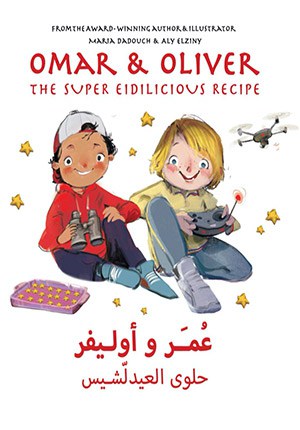
This super cute Eid book works great for ages 5 and up.  Written in both Arabic and English, not just translated in to both languages, the book features a Muslim celebrating Eid and a Christian boy working together to try and get Omar’s sister’s cookie recipe so they can be the best cookie cooks ever!  The book would work for either Eid and with the adorable illustrations, and included recipe, the book will get lots of requests all year round.

FD053694-FBC1-4E5A-AE24-83ECB746C1C1

Omar is excited that his friend and neighbor, Oliver, is sleeping over the night before Eid.  They boys are playing when Omar’s sister Judy brags that her friend has given her the best cookie recipe in the entire world.

Naturally, Omar and Oliver want to be the best too and offer to help Judy.  She refuses, and the quest to get the recipe is on, so that Omar can make them for Eid and Oliver for Christmas.

EEAEB882-C2C0-47C2-81C9-1262372C5C23

The boys try to steal it through the kitchen window.  But Judy catches them and slams the window shut.  They then try binoculars from the stairs, but the boys can’t write fast enough and Judy grabs an umbrella to shield the recipe.  Undeterred the boys pull out a drone, but the zoom on the camera isn’t quite good enough.

The boys then see Judy rushing out of the kitchen and run in to see if she left the recipe.  They don’t find it, but they peek at the cookies and see that they are golden brown and if left in any longer might burn.

6A93627C-F29C-462A-AE8B-D5819C0127F0

Tempted to let them burn, a sign on the fridge saying, “Eid: a time to share and show we care,” makes the boys realize saving them is the right thing to do.  Judy says she too saw the sign and rushed out to copy the recipe for the boys.  They then all work together to make lots of Eidilicious cookies and share them with everyone on Eid.

The book starts with some tips for parents on how to present the bilingual book and ends with a cookie recipe, as well as some information about what Muslims and Christians celebrate.  I love the illustrations and that they are two page spreads, but the page with the note is the whole resolution and the note is split on the folded binding and honestly I missed it when I read the book myself and when I read it at bedtime to my kids.  When I opened the book wide to take pictures it was crystal clear, and if you were reading it to a group you might not have an issue.

7EA4AAC0-C237-4ED9-81FA-8CD39832C997

I also didn’t love the word, Mashallamazing, I obviously get what it is trying to do, and I feel like it works with Eidilicious, but that Mashallamazing is a stretch.  Additionally, if it is claiming to be an interfaith book, a word like that might need some explaining.  I got a bit hung up on it, so I had my 13, 11, and 9 year olds read it and they did as well.  I also didn’t think the pulling out of the story to ask the reader if the boys were successful in getting the recipe was necessary after each attempt.

Disclaimer: I don’t speak Arabic and cannot comment on that, sorry!


Yes No Maybe So by Becky Ablertalli and Aisha Saeed

Standard
Yes No Maybe So by Becky Ablertalli and Aisha Saeed

yes no

This new rom com in book form with a Muslim female character written by a Muslim author, sets itself apart by being co-written by a Jewish author and the other half of the love story being told by a Jewish boy’s point of view.  This YA book is very relevant as a special election in Georgia served as the catalyst of the two authors coming together and fictionalizing the effects of white supremacy, Islamaphobia, and antisemitism for the book, while real headlines were urging the two to canvas, get involved, and make a change against the increased showing of hate with the election of Trump.  The presentation of Islam is probably realistic, but definitely not ideal, and with the kissing, multiple LGBTQ+ supporting characters, the profanities, and 436 page length, the book is probably best for 15 year old readers and up.

SYNOPSIS:

Jamie Goldberg is 17 and is spending his summer helping his cousin work on a special election campaign for a Democratic candidate in an incredibly red district in Georgia.  A very nervous kid, who hates public speaking and talking to girls in general, he would rather be behind the scenes or hanging out at Target.  His little sister, Sophie’s bat mitzvah is coming and things at home are crazy with pre party planning.  His grandma, an Instagram sensation uses him for tech support and video filming, and his easy going demeanor means he spends a lot of time, being bossed around.

Maya is the 17 year old only child of a lawyer mom and physician dad and has just found out that they are separating.  With her one friend too busy with work and starting at the University of Georgia, US born, Pakistani-American Muslim Maya, is not having a very good Ramadan.  When an interfaith event reunites her with a childhood play-date friend, Jamie, her mom convinces her to help him canvas to keep busy and sweetens the deal by bribing her with a car.

Naturally the two spend a lot of time together vounteering for Jordan Rossum, stuffing envelopes, canvassing, and putting up signs.  Along their way they become good friends, and invested in the election as a House Bill banning head coverings, and antisemitic bumper stickers start getting plastered around town.  The end of Ramadan, the election, the hate the two encounter, and families changing, bring Jamie and Maya together.

Maya’s parents are pretty chill about boys, and only caution her about unnecessary complications by dating in high school, when Maya throws it back on them, that their relationship is pretty complicated, she seems to not find an Islamic reason not to make-out with Jamie.  The whole book is angsty and the two feign cluelessness, but based on the cover of the book alone you know where it is going.  The true climax is how much the relationship can be used for political gain, and if they can get their candidate elected.

WHY I LIKE IT:

I like the political setting, it is a different and very relevant slant.  It might be a little alienating to readers outside the United States, because the political process isn’t really detailed, but the characters involvement in their small slice is a major aspect of the book.  The book is definitely pro Democrat, but addresses the gas lighting, hate speech, and views of those on both sides.

I also like that two minority authors came together to share an OWN voice perspective of life today.  For the most part the story telling is smooth with the two characters getting alternating chapters to tell their story from their point of view.  A few times, I felt details were missing, for example what Maya wore for Eid, when space was given to detail that she didn’t wear ethnic clothes to an iftar, and her picking a dress for Sophie’s bat mitzvah.  Similarly, Maya’s parents seemed flat for their trial separation being a major part of Maya’s stress.  Jamie’s grandma was probably my favorite side character, and one of the most fleshed out.

I am fully aware that some Muslims pick and chose what to follow and that not everyone is strict about boy/girl relations, but I felt like for a book that is set in Ramadan, uses religion as a catalyst for civic action, Maya’s mom wearing hijab, and an opening scene being set at the masjid, there is really nothing Islam in the defining aspects of the characters or story.  It is so watered down and almost catering to non Muslims to feel comfortable, that it left me annoyed.  And I think non Muslims too will wonder why Maya’s mom covers and Maya doesn’t and how that works, or why Maya switches to having one reason for not dating and then a religious one.

The book sets out to do a lot in terms of humanizing the effects of laws and policy on average people, but I don’t know that most Muslims hoping to see a mirror to their experience will find that in Maya.  I can’t speak about Jamie, and the Jewish experience, but Maya is rather forgettable in my opinion.

FLAGS:

There is a lot of cursing, and the F word at that.  In the dialogue set in Ramadan, it becomes a joke to substitute it for something else, but once the month is over, the language resumes.  There is kissing, and making-out with the main characters.  There is talk of hooking up, but nothing explicit.  There are is a side character friend that is gay and he and his boyfriend are affectionate.  After the bat mitzvah Sophie comes out to Jamie.

TOOLS FOR LEADING THE DISCUSSION:

I don’t think that I could do this as a middle school selection, the rationale for Jamie and Maya dating, isn’t ok for an Islamic School message.  I really wish just once, a book like this would have the main character, being like, “nope, sorry.”  It is getting predictable and while I know it is countering the oppressed woman view, it is becoming equally one dimensional in its presentation of Muslim women.


Planet Omar: Unexpected Super Spy by Zanib Mian illustrated by Nasaya Mafaridik

Standard
Planet Omar: Unexpected Super Spy by Zanib Mian illustrated by Nasaya Mafaridik

planet omar

Omar is back, and the nine year old kid with a huge imagination, proves that his heart is even bigger.  Middle graders that loved the first version, The Muslims, and the reboot, Planet Omar: Accidental Trouble Magnet, will undoubtedly love this book’s adventures and the real, relate-abl, presentation of Islam in a Muslim family.  While it references the first book, it can work as a stand alone book too, and can and will be enjoyed by kids and adults, girls and boys, Muslims and non Muslims.  At 217 pages, the large spaces, doodles, playful fonts, and illustrations, make the book fly by and beg to be read again and again.

C95DB8C6-9652-4EB8-8008-112361FAE8DF

SYNOPSIS:

Omar’s family still has their Science Sundays, but they don’t visit a new mosque every Saturday, as they have found a mosque near their home that gives his parents, “secret smiles” and them all a sense of community.  Omar and his sister still bicker, and his little brother Esa is still lovable, and the former bully, Daniel, is now a great friend to Omar and Charlie.  Life is good, Alhumdulillah, but in the midst of the boys planning how to get laser guided Nerf guns and have an all out battle, Omar learns the mosque’s roof is in need of repair and that the congregation will need to come up with 30,000 pounds to cover the costs, and fast.  In an act of selflessness, Omar abandons his dream of a foam gun and donates to the masjid.  Seeing that is not going to be anywhere close to enough he plots and schemes with his friends, his non Muslim friends, on how to raise the funds.  They bake cookies, make origami birds, and get their school to host a talent show to raise the money.  Their teacher and the head teacher coordinate the hall and judges and winning prizes all to help out Omar and the mosque, in the end though, they raise just under 1,500 pounds.  Not enough by themselves, but a great contribution to what other people hopefully are scrounging up.  The worst part however isn’t that they didn’t make enough, but that what they did make, goes missing.  Omar, Charlie, and Daniel, along with the parents and police and school personnel, try and find the money and who might have taken it before time runs out.

0030B40D-17F8-415C-A54A-7874768A5B5D

WHY I LIKE IT:

I love how effortlessly the author adopts a nine-year-old’s voice and persona.  So many of the details, for example, about how the school administration signed off on a fundraiser for a religious building, and how tickets were sold, and the planning took place are left out, as a nine year old, probably wouldn’t know, or be concerned with the logistics of such endeavors.  It seemed like some details should be given, but I doubt readers would feel that way, so I pushed it aside and went along for the ride.

Omar has amazing friends, from the unpredictable old neighbor lady, to his non Muslim friends being so enthusiastic and supportive of saving a mosque.  I love it, and that they are that way because Omar is so unapologetically Muslim first.  They even discuss a hadith about how building a mosque, builds you a house in Jannah, and a mainstream book published this, and it is AMAZING! It isn’t just a kid and his family, who happen to be Muslim, the whole plot of the book is to save a mosque, and the fact that this book exists, seriously is so beautiful, and powerful, and hopeful, Alhumdulillah.

This book has a lot of layers, most kids won’t pick up on the interfaith aspects being so ground breaking, or the beauty of teachers and parents believing and supporting young kids, but will just read it as a funny story with anecdotes and inside jokes that they get as kids, as Muslims, and maybe even as Desis.  It truly is the culmination of an author who can write well, characters that our kids can see themselves in, and an opportunity to tell our OWN stories that make this book work for kids, adults and everyone in between.

3C3DA84E-29F6-4A6D-90FE-0BC134E7E615

FLAGS:

Omar and his sister are mean at times, but alas love each other and look out for each other too.

TOOLS FOR LEADING THE DISCUSSION:

I don’t do an elementary book club, but if I did, I would do this book in a heartbeat.  For middle school it would be too quick of a read, but I think all classrooms and all libraries should have the book, up through middle school.

https://www.alaraby.co.uk/english/society/2020/2/7/planet-omar-pushing-for-muslim-characters-in-childrens-literature

I got my copy here in the US at www.crescentmoonstore.com and as always you cannot beat their customer service and prices.  If you don’t have the first book, you can get it there, too.  Thank you Noura and Crescent Moon Store.