Tag Archives: Identity

Abdullah’s Bear Needs a Name by Yasmin Hanif illustrated by Sophie Benmouyal

Standard
Abdullah’s Bear Needs a Name by Yasmin Hanif illustrated by Sophie Benmouyal

I love the idea behind this 28 page book, and the illustrations are pretty great too, but I felt like the story needed a little more depth to convey meaningful emotion, appreciation, and connection.  It starts with an Eid gift, but there is nothing tying it to the holiday after the first spread.  And while it shows both Islam and Desi culture in action, I wanted to hear the stories of his family, and the connection to his culture that helps him name his bear.  I also feel like the premise was a little rocky, did everyone get family heirlooms for gifts? Did they get other gifts? Why was he gifted this special stuffed toy and not his older or younger siblings? Would a kid really be that excited to get a hand me down stuffed bear? Once you read the author’s intent, and the inspiration for the story, an adult could connect the dots and help a reader recognize the internalized othering being overcome, and discuss it, but I don’t know if all kids would not pick a cultural name for a toy, or see that Abdullah didn’t consider reflective names either.

The book starts with the reader dropped into an Eid day celebration.  Abdullah is handed a gift by his parents and when he unwraps it he finds himself the new owner of an old well-loved teddy bear.  His father was the previous owner, but refuses to tell Abdullah the bear’s name, urging him to discover it on his own.

Abdullah loves the bear, and takes it with him to the store, to school, to cricket, to madrasa Everywhere he goes he tries out names: old names at the museum, classmates names, but nothing seems to fit.  When his Abba tells him a story about his grandfather, he finally finds the perfect name for his bear.

I really like the details in the illustrations, they bring the story to life and feel authentic: the store names, the Eid spread, the activities.  I feel like this book is so close to being a standout, but I don’t know that kids who don’t find themselves exactly in Abdullah’s mindset, would be able to relate and connect to what transpires.  Unfortunately, it is unclear if he grows and learns from the experience, or if it was contained to this one incident. 


Rainbow Fair by Diana Ma

Standard
Rainbow Fair by Diana Ma


If you see this 224 page middle grade book, the title might hint that the content is LGBTQ+ as the rainbow often symbolizes such, but if you look closely at the cover you don’t see a rainbow flag, just a Chinese scene on one side and on the other you will see crescent moon lights being hung up above a masjid silhouette, merging together with a little girl holding a rehal, a book and some art supplies. If you then turn the book over, or search the internet, and read the blurb, you will learn that the book is about Sophie, a Chinese Muslim girl learning and sharing her heritage at the school’s Rainbow Fair. As a result, I requested an arc to read and review. No where does it reveal that the book centers queer characters, LGBTQ+ support and allyship, consistently parallels Islamic faith with sexual and gender identities, and prioritizes intersectional identities and agenda over plot and insight. Had I known this, I wouldn’t have read the book, I share this review simply as a heads up to its contents, so families can decide for themselves if it is for them. The book is MG and honestly, it feels misleading and intentional that it is not articulated in a book meant for nine to 12 year olds.  With identity exploration of being Chinese, a child of immigrants, a main character being bisexual, the protagonist repeatedly claims to want to learn about her Muslim identity, but very little information or interaction with the knowledge is sadly ever shown.  The plot seems to just become a forced juxtaposition of two marginalized communities: Muslim and LGBTQ+, to make the point that we are all more than one label. I understand that my view and practice of Islam, is not every Muslims, but trying to have a faith identity and sexual/gender identity parallel one another by having the protagonist “coming out as Muslim,” and being “outted” as Muslim by her bisexual friend before she is ready, is an awkward read. It continues in this approach comparing a trans character being misgendered in a locker room to a Muslim character not having a space to pray, and likens the diversity of a mosque BBQ to the pride parade. I support finding common ground, but when questions about Muslims stoning gays are left hanging, the reader never getting a convincing answer to why her parents hide their Islam, and there is no real rising action, climax, or character arcs- I feel like the labels and the author’s agenda, even if OWN voice, are the point of the book, and it doesn’t make for a compelling read.

SYNOPSIS:

Sophie and Katie did their school’s Chinese booth together last year at the Rainbow Fair, they are best friends and do everything together, but since Katie has come out as bi, she has new friends and is petitioning to add an LGBTQ+ booth, and the rules say she can only be at one booth.  When a sleep over breakfast calls attention to Sophie not eating bacon, it comes out that she is Muslim, not something she meant to keep secret all these years, but something not even Katie knew about.  When discussions about being Muslim spill over into class when booths are being assigned, Sophie decides to do the Muslim booth. She is afraid her parents will be disappointed, and even though she knows nothing about Islam, she is ready to learn.  A new kid at school, Anna, is Muslim and joins Sophie at the booth, and as the two become friends, Anna tells Sophie there “is more than one way to be Muslim” and of course she is a “real Muslim.”  Empowered by not having to pick one identity, Sophia and Katie and all the other kids change Rainbow Fair and show how everyone is more than just one label.

WHY I LIKE IT:

The premise on the back of the book is promising, I just feel like the book missed meeting its own stated intention. The characters are not developed, there are no moments of growth or self reflection, they have no arc or relatability outside of a label.  Sophie paints her parents to be strict, but the precious little that is shown, never backs that up. As a result the reader has no idea why Sophie doesn’t just tell her parents she is doing the Muslim booth and ask them about Islam. After they see the booth at the fair, they say they don’t talk about Islam because of Islamophobia in America and feeling othered in China, but that is it.  Exploration of that would be a far more interesting story: Why did they leave China for Taiwan? When did they migrate to America, was it recent, or did they slowly start to hide their Islam? Dad learned to read Arabic in Taiwan, what was the Chinese community like? Why don’t they celebrate Eid, but have a Christmas tree, did something happen? Why do they not eat pork but drink alcohol? Sadly the two dimensional parents are not fleshed out and Sophie faults them, while constantly trying not to let Chinese stereotypes define them, but the repetitive contradiction, just leans into the labels and fails to make them feel real and relatable.

The book is all talk and no show, and with no real plot, the talking gets repetitive. Breaking the fourth wall we are taken in circles of the same talking points that more than once had me checking if I had bumped the screen and gone back to pages already read. Threads are introduced and then abandoned: what is the point of the whole roller derby thread aside from showing Sophie makes powerpoints, and her parents give in? The girls never go roller skating, it is not something that bonds them. We only know they are close because we are told they are. The beginning and end show Sophie can smell food and decipher its contents, so why isn’t that part of the story as she is trying to figure out Eid foods, cooking, the lunch offerings at the mosque? It hints that the Black culture booth is being suppressed, but it never develops it, nor articulates any real push back, it just skirts the issue. Why the judge-y competitive aunt and uncle? Is their inclusion meant to make Sophie’s parents more or less likeable? Does it reinforce or dispel Asian stereotypes?

From the very start the book feels forced.  Sophie has never gone to a sleep over, her best friend plans a sleepover birthday, but is willing to change it if Sophie can’t come.  What kind of stilted set up is this, why wouldn’t these bffs plan the birthday together, and get Sophie’s parents on board first? It makes no sense that if she can’t come it will be changed and not be a problem because they are so close and she has to be there. It also immediately contradicts the looming conflict of the book, that the parents are strict.  They gave in to roller derby, they give in to this sleep over, and have no problem that two of the girls are dating that sleep over, and “Shane is non binary and doesn’t identify as a girl or a boy.” Clearly the parents are very supportive.

Consistently Sophie drops words, or cultural practices, but doesn’t explain them or engage with them, both the Chinese historical and cultural rep, and Islamic, quick example, she has a Quran but never reads it, we don’t learn about the immortals her dad wants her to feature at the Chinese booth.  It makes it seem superficial and further distances the reader from connecting with Sophie, with culture, with faith, with the book.  Speaking of books, it really bothered me that two books mentioned as being intersectional, Black Muslim Author, Autumn Allen’s All You Have to Do, and Queer Muslim Author Adiba Jaigirdar’s Hani and Ishu’s Guide to Fake Dating are YA books, isn’t that off to mention repeatedly books that your target audience won’t know, or be in the demographic yet to read?

I could go on and on, but I will stop, I think it is clear I didn’t enjoy the book. 

FLAGS:

Islamophobia, alcohol, LGBTQ+, microagressions, racism, labels, stereotypes

TOOLS FOR LEADING THE DISCUSSION:
There is no way I could shelve this in an Islamic School.

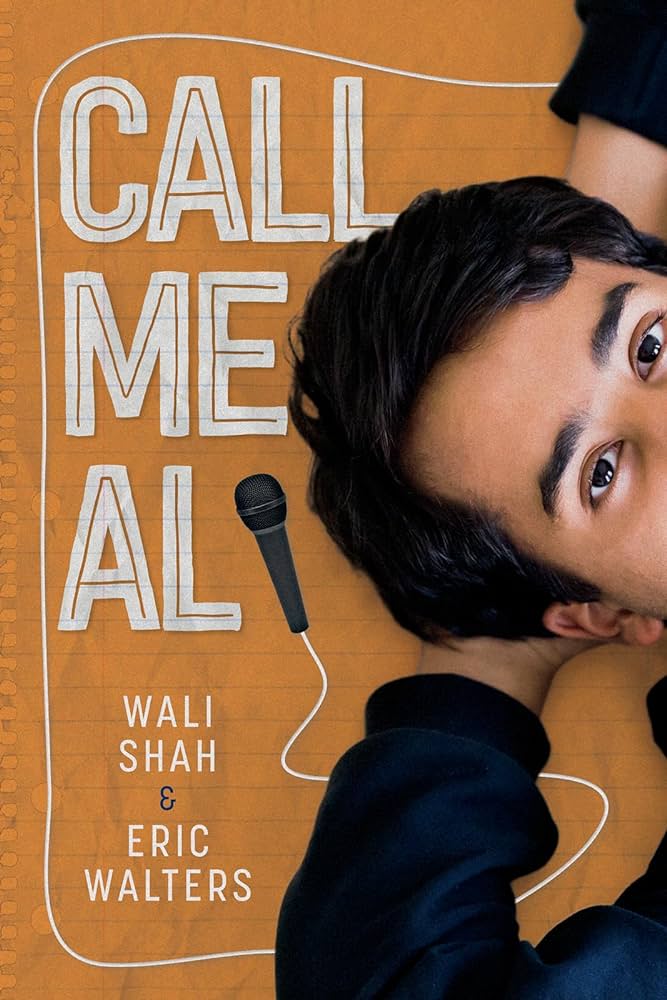
Call Me Al by Wali Shah and Eric Walters

Standard
Call Me Al by Wali Shah and Eric Walters

albook

I feel like I should have really liked this 264 page book: OWN voice, Muslim, MG, Pakistani, author is poet laureate for the City of Mississauga, Ontario, co authored by a prolific YA writer, but it unfortunately reads inconsistent and unpolished.  The characters at the beginning and their relationships with one another don’t read consistent with who they are in the middle.  Sure the character arcs from the middle to the end are nice, but it feels really disjointed from the first quarter of the book.  There are parts that feel so rushed, and other parts that are heavy handed with the preaching and the moral lessoning that I found myself skimming whole pages.  He says his family isn’t that “religious,” but Islam is centered with quotes from “the Prophet” (no salawat given, only a few times Prophet Muhammad is mentioned to identify which Prophet is being quoted) and “Imam Ali” (who the protagonist is named after), yet Al telling a girl he likes her is no problem at all.  He fasts because he has to, but tells his younger brother it is ok to sneak food, and the grandfather gives a whole speech on how the purpose of fasting is to feel empathy for the poor (face palm, in case you don’t know, it is a commandment of Allah swt).  I really struggled with how “Whites” are seen as opposites to “Muslims,” there is some push back with quotes from Malcom X on his hajj experience, but I didn’t feel like the character really ever accepted that Islam is a religion for all people, and White is a skin color.  Honestly the book reads like an early 2000 memoir.  I know it is fiction, but the cultural be-a-doctor-nothing-else-matters-stereotypes, and Islamophobic talking points that feel performative for a Western gaze, combine with a very unlikable arrogant protagonist, and result in a book that was difficult to connect with and get through.

SYNOPSIS:
Al, short for Ali does everything perfect, he has perfect grades, always listens to his parents, and respects the rules.  The book opens with him sneaking off campus with friends for lunch at the mall where he is caught by his grandfather, who seems incredibly strict, but later is the soft spot in a firm family.  His parents have moved to Canada from Pakistan, his mom used to be a teacher, but now takes care of their apartment building, his father was a physician and now drives a taxi.  It is non negotiable that Al will be a physician when he grows up.  The middle child of all brothers, his older brother Sam, short for Osama, has set the bar very high with his valedictorian status in high school, scholarships to start college, and student of the year award in middle school.  Al is in 8th grade and is expected to follow in his footsteps.  When Al’s crush on Melissa results in him writing a poem about her, he realizes he likes the written word to express himself.  His father thinks poetry is a waste of time. With a teacher that encourages creative writing, Islamophobia and hate crimes hitting close to home, and Al coming of age, the story focuses on Al’s 8th grade year as he discovers his own identity, with some help from his friends and the month of Ramadan.

WHY I LIKE IT:

I like that his friends really pushed back on him to own some of his internalized Islamophobia.  Zach is probably the most fleshed out character, and his humor, his teacher crush, his ability to apologize and make things right, is really the heart of the book.  It contrasts so greatly to how I feel about Al.  By the end he was ok, but at the beginning, his arrogance is obnoxious. I get that he is bright and a hard worker, but, yikes, he needs some humbleness.  The supporting characters are rather flat.  Al’s crush Melissa is shallow and only desired for her appearance, Dad is strict and demanding, not in an abusive way, but in a cold undeveloped way, mom is idyllic and supportive, and Ms. McIntosh is the driving motivator for Al. The other characters do little to flesh out the main players which is unfortunate.  I think some depth would have shown Al more rounded. His so called friends don’t know he is Muslim or what he eats, but they are friends, not just classmates, seems off and lacking.  The grandfather gives all the teachable moments, he starts off stern, and then is not, and the transition is jarring.  He speaks in quotes and lessons, and if it were quirky, it might help the flow of the book, but he really is the Islamic conscience of the book so to speak, but we know so little about him and his relationship with Al.

I didn’t like how fasting and Ramadan were presented. Al is embarrassed by fasting and being different.  I like that it says the family goes to the mosque, not sure why masjid wasn’t used, but there are no Muslim friends and no praying, so it has no real impact, which furthers the feeling that it is performative.  Al doesn’t seem to consider faith or culture until others question him about it, which is a missed opportunity to give Muslim kids a mirror to see themselves in the characters.  There are chapters of the book that really are wonderfully written, they just are sadly too far and few between.

FLAGS:

Crushes, Islamophobia, physical and verbal assault, racism, classism, bullying, lying, sneaking out, discussion of partition violence including great grandfather being killed. The book though, aside from the crush thread at the start and end, is quite clean, and the crush is pretty innocent.

TOOLS FOR LEADING THE DISCUSSION:
I wouldn’t seek out this book for a classroom shelf, but if it was in the library I would leave it.  I don’t think most kids would pick it up and make it past the first 25 pages though, Al is really unlikeable at the start.

Saving Sunshine by Saadia Faruqi illustrated by Shazleen Khan

Standard
Saving Sunshine by Saadia Faruqi illustrated by Shazleen Khan

img_9623

The themes, messaging and Islamic and cultural representation in this upper MG/lower middle school graphic novel are wonderfully unapologetically present.  Yet somehow, I never connected with the characters, and the plotting seemed stiff.  I don’t regret reading the book, and I’m sure most readers will be delighted with the main story of sibling annoyance, a sick turtle, and independent kids with reflective flashbacks and OWN voice threads of Islamophobia, immigration, starting to wear hijab, identity and othering.  I just felt the tropes were predictable, stereotypical even, and when the dad takes a stethoscope to a medical conference and the TSA agent doesn’t know what it is, I cringed.  Seriously, who takes a stethoscope on vacation? Who doesn’t know what one is? I normally love the author’s characters and wish for more Islam, this book gave me the Islam, but I really disliked the siblings, they were mean, angry, and annoying.  I own that reading a book about bickering kids a few days before my own five children returned to school may have jaded me, and I do think I found the religious touchstones predictable because I do read a lot of kid lit and I’m older, so while I’m not gushing in my praise for this book, I will be preordering a copy for myself and the school library. How is that for having an opinion and then completely walking it back? Yeah, it happens.

SYNOPSIS:

Twins Zara and Zeeshan bicker, a lot.  Zara loves animals and nature, Zeeshan space exploration, and both love their phones.  When the family heads to a medical conference in Key West where their mom is getting an award, the kids get their phones taken away by their parents when the two won’t stop fighting. The parents stick to their policy and the two are forced to stick together and entertain themselves while their parents attend lectures.  At one point they find a turtle and Zara takes the lead to try and help Sunshine, but will need her brother along the way.

WHY I LIKE IT:
I love that the characters identifying as Muslim was central and unapologetic.  I liked the flashbacks that provided a little bit of depth to the parents coming to America and their life in Pakistan, along with the personal reflections about starting to wearing hijab and when the kids started to go their own way.  But the airport scene, the identity issues, and the Islamophobia seemed a little superficial and over done.  The heart to hearts with the dad and his son and mom and Zara were sweet and insightful about belonging and where you come from, and not being so angry, but they also seemed very natural and in-character for the parents which is a disconnect from the anger the kids seem to carry.  If the parents are talking to them and modeling all this, it is a bit of a stretch that they are reacting as they are in the book.

I have a brother, it is just the two of us, we aren’t twins, but growing up in the 80s as the only Muslims in the area with a convert mom and immigrant dad, we came together a lot because only each other could understand the stresses we faced in and outside our home.  I thought this book would draw on that universal theme, and I was surprised that the point of the book felt a little underdeveloped.  I know MG can handle more than we give them credit for, but I felt like this book built up to have more of a warm hug, than I felt.  I wanted more of them plotting together, I didn’t feel like Zara really needed her brother to stick up for her, she wanted it sure, but that was a foot in the door that I think was missed.  She is strong, yet was being vulnerable with her brother, and he was able to step up for her, but it needed a few more beats to be appreciated.  I also wanted more connection to the turtle, his name is in the title, I thought he’d have a bigger role.

FLAGS:

Disrespect, lying, anger, yelling, bullying, teasing, Islamophobia, stereotypes, prejudice

TOOLS FOR LEADING THE DISCUSSION:

The book would allow for discussion for middle grade readers who might see themselves in the family dynamic or be able to relate to some of the Islamophobia.  It could also cause some worry for some children that being visibly Muslim or having cultural names, and wearing cultural clothes will bring negative differential treatment to them.

Available for order here

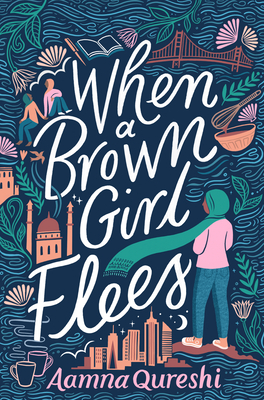
When a Brown Girl Flees By Aamna Qureshi

Standard
When a Brown Girl Flees By Aamna Qureshi

when a brown girl flees

I was both nervous and excited to read this contemporary book having loved the author’s fantasy, but unsure how a Brown Muslim Pakistani American girl running away from home would be presented.  Alhumdulillah, the author approached the story from a place of love.  There is no internalized Islamophobia, self othering, or in broad strokes even an identity crisis. The protagonist has made decisions, drastic ones, and is trying to piece her life back together on her own terms, but the love of culture, family and faith, is always upheld.  It reads like Islamic fiction, with very didactic passages and moral positioning, I’m still quite surprised that it is traditionally published.  The version I read had grammar errors, so I’m hoping that they will be corrected when the book releases in a few weeks.  The story is engaging, but the writing a bit monotone.  Much of the story is telling, not showing, and because of the surface level spoon feeding of so much of the plot, when the catalyst or rationale is not provided, the book seems underdeveloped, or lacking, unfortunately.  I would not recommend this book for the target audience of YA readers (12/13 and up) it contains sex, slut shaming, self harm, depression, suicidal thoughts, physical and emotional abuse, profanity, and mentions drug use.  I do think though, early college age readers will enjoy and benefit from reading the book.  At a time in the reader’s life when they are defining themselves on their own terms, owning up to their own mistakes and laying out a future path, this book will provide relatability amplified by religious and cultural touchstones.  The heart of the story is the connection of a girl with Allah swt after she has sinned, the guilt and regret she feels, and how she finds herself, and returns to try and fix things with her family.  The characters are flawed and the overall messaging beautiful, hopeful and uplifting.  Unfortunately, it just reads like an early draft and I wish it had a bit more refinement.  Keeping that in mind though, it does have a place, and I’m glad to see our “new adults”  can find reflections of  themselves in a piece of literature that amplifies their Islamic identity instead of criticizing or questioning it.

SYNOPSIS:

The book starts with Zahra deciding to run away from home.  She parks her car, leaves her phone and catches a flight to New York from California.  The reader doesn’t exactly know why she is running, only that a few days after high school graduation she is escaping a toxic home life, an impending wedding, and misery.  As the story peels back layers we start to see some of the nuance of what she is running from as characters from her past find her and physical space allows her some perspective to see her own role in her “old” life.  When she arrives in New York, it isn’t the city life that she seeks, but rather the nature and pace of Long Island that offers her a fresh start.  She heads to the masjid, makes a friend, and starts to put her life together without parental obligation, outside interference, and self loathing.  She cannot run forever though and she cannot escape herself.  She must confront her past, own her mistakes, be honest with her new friends, and find peace with her family, not because she has to as a Brown daughter of immigrants, but because she trusts Allah, loves her family, and wants to “fix” things.

WHY I LIKE IT:

I’m a sucker for books that show redemption through the love and mercy of Allah (swt).  Yeah her new friends were idyllic in their family life, relationships and worship, but we all want friends that make us better Muslims, so I let it slide. Islam is centered, she wears hijab, she reconnects with salat, it is her identity even when she is just going through the motions. The author at times conflated culture and faith, but it never issues blanket statements or falls into universal stereotypes for Desi culture or Muslims.  She does a good job of keeping the negatives to the people and the critiques to the failure to push back on dangerous expectations. My issues weren’t the character flaws either, I’m onboard with the messiness of being human and the ability to seek and receive forgiveness from our creator.  I just wanted to feel things more.  So much was just told when it should have been shown.  I wanted to see the stress and anguish of her family life, not simply told it was depressing.  I wanted to see her cutting life long friends out and being isolated, not told she had lost her friends.  The book focuses on her running, and why she ran, but a big plot point for why she ran, having sex, needed more fleshing out.  Why was she driven to such an act? I know that she was depressed, I’m not belittling that, but what pushed her to such a strong stance, when she was already allowed on the school trip, she hadn’t yet been given the ultimatum and over and over the book says “I miss my family,”” I miss my home,” “I miss my mom.”  I didn’t feel the connection or understand what she was feeling, thinking, and it seemed like a huge hole in the book.  For all the themes of mental illness, faith, generational trauma, misogyny, abuse, expectation, depression, lying, culture, life choices, higher education, family dynamics, self harm. the book never quite felt rich with emotion or deeper than the surface level story.  At the beginning the author says she first wrote the book when she was a senior in high school, and while that may have made the main character’s perspective and voice ring true, as a successful author now, I wish she would have added the nuance, the insight, the subtlety that would have drawn the reader in and allowed them to get inside Zahra’s head and heart to see her and perhaps even themselves.

FLAGS:

The author and book identify triggers in the book “please be mindful of TWs: depression, anxiety, emotional abuse, physical abuse, self-harm, suicidal ideation, slut-shaming, PTS.”

There is also music, boys and girls alone in cars together, lying, cursing, generational trauma, misogyny, abuse, expectation, depression, anxiety, guilt, life choices, higher education, family dynamics, cutting, a brother who is often high or smells like weed/pot, it mentions partying, a sexual event, deceit, physically assaulted by a parent.  Nothing haram is glorified, but it is there and it is detailed, and not everything is resolved.

TOOLS FOR LEADING THE DISCUSSION:

I would not be able to shelve or teach this book in an Islamic school library, but in a college MSA book club or a youth group of a similar age this book would be incredible to read and discuss.

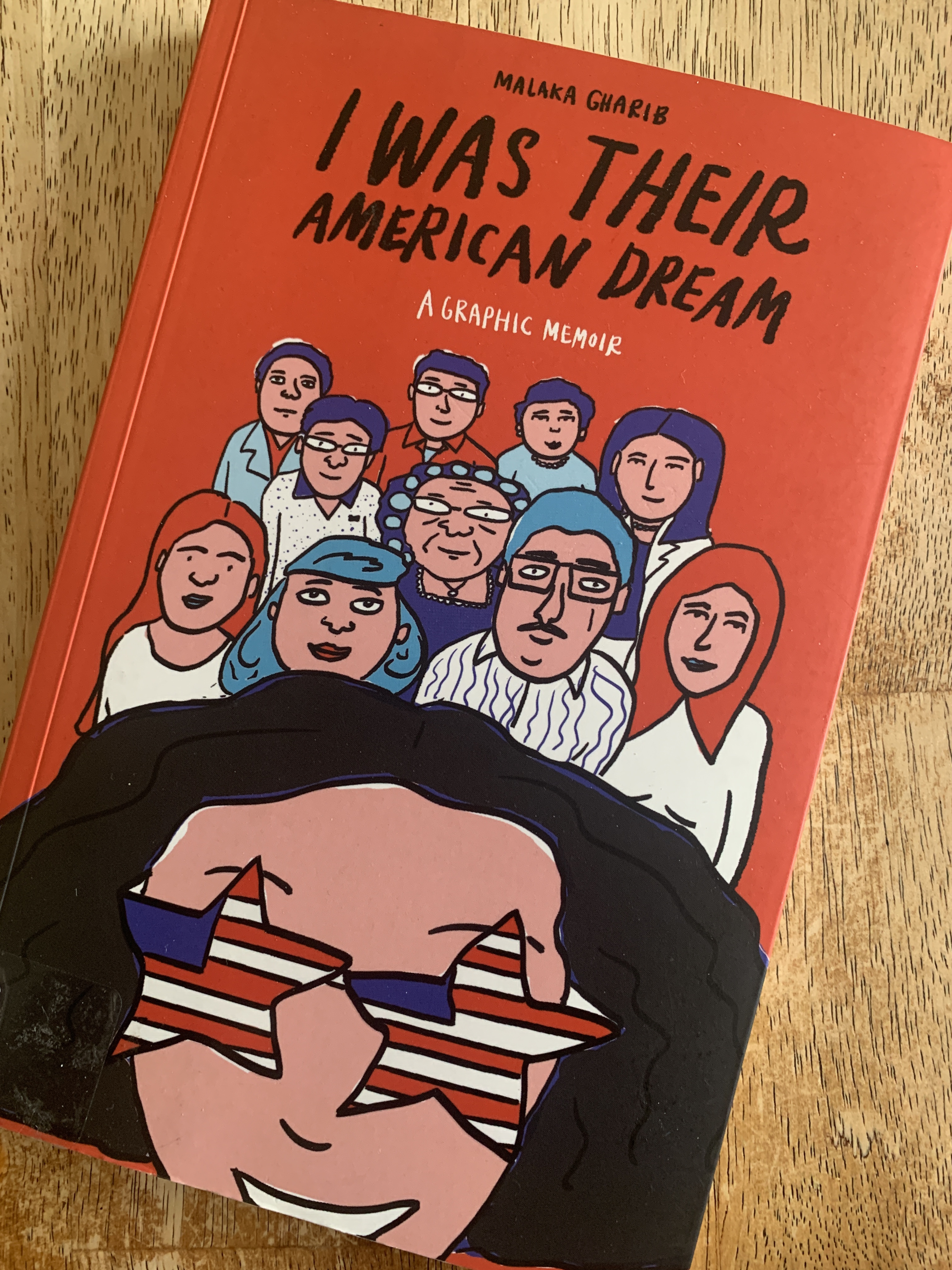
I Was Their American Dream: A Graphic Memoir by Malaka Gharib

Standard
I Was Their American Dream: A Graphic Memoir by Malaka Gharib

img_7800

I was hesitant to read the book, afraid it would pit the author’s two cultures (Egyptian and Filipino) and faiths (Catholic and Muslim) that her parents identified with against each other.  Raised as the daughter of immigrants from very different backgrounds in California I was very pleasantly surprised that the book leads with heart and positivity for the unique, yet universal feelings she experienced in her life.  The short 156 page red, white, and blue filled pages are funny, poignant, and reflective, that I think high school readers and up will enjoy spending time in Cerritos and Egypt through the eyes of Malaka.  It is easy to say that you can’t be Muslim and Catholic, but she doesn’t opine on the right or wrong of it in large terms, she discusses her life and her own situation.  As a teacher I would see students that would attend Islamic school five days a week and then go to church on Sundays, whether you agree with the choices this author/character makes is not what I intend to review, it is her life, but rather the manner in which it is shared.  There are many kids out there from “conflicting” backgrounds, and to see someone take the love and benefits offered to forge their own path in creating their own American dream, was a nice twist on the immigrant identity finding narrative.

SYNOPSIS:

The book starts with introductions to the characters, her family members that influence her, and then begins the tales of what brought her Filipino mother and Egyptian father to America, how they met, married, started a family, and divorced. Malaka exists outside her family in school, balancing her heritage and coming of age.  Raised during the school year by her mother and extended Filipino family, she spends summers in Egypt where her father resides with his new wife and children.  Coming of age as an immigrant, balancing cultures, religions, school, and dreams, the book concludes with her marrying a white Southerner and adding to the mix.

WHY I LIKE IT:

Even though she identifies more as Filipino American and goes to Catholic school, there is a fair amount of Islam and Egyptian culture included in the book.  I love that she loves her step mom and step siblings and finds beauty in Islam, learns to pray, read Quran, and mentions her love of Prophet Muhammad saw.  Sure as an Islamic school librarian, I wish she chose Islam, lived it and centered it in her life, but this is not a character, this is a real person, and to see her lovingly showing the goodness in Islam and how it has positively influenced her, is nice to see nonetheless.  There are a few storylines I didn’t quite understand, the skateboarding in Egypt a big one, but the quick pace of her narrative life-story flows well and is easily consumable.  Often stories like this are overly dragged down by dated pop cultural references and over criticizing “othering” paradigms, but this book contains enough to keep it grounded without it alienating contemporary readers.

FLAGS:

Stereotypes, lying, relationships, periods, music, dancing, nothing really stands out, there might have been some language, I read it a few days ago and honestly don’t recall anything overly problematic, but content wise it is a mature teenage read with retrospection and marriage being a part of the narrative.

TOOLS FOR LEADING THE DISCUSSION:
I don’t know that I would shelve or teach this book, but I think it is one to file away in my head for people I might encounter looking for a book about blended faiths and cultures benefitting from the many worlds they have one foot in and one foot out of, and those ultimately looking for a place to see their experiences mirrored.

I found my copy of this book at my local public library and it is also available here from Amazon.

Free Radicals by Lila Riesen

Standard
Free Radicals by Lila Riesen

radicals

This contemporary 400 page YA book about an American Afghan girl dealing with life and boys and worrying about family in Afghanistan since America’s withdrawal from the country, is written by an Afghan Australian, raised in America, and thus it seemed like a book I should review from an Islamic lens even if the blurb on the back seemed a little stereotypical with the oppressed-can’t-meet-with-boys theme.  Well, suffice it to say the blurb on the back is terribly misleading and this OWN voice book lightly sprinkles in Islam as cultural adoptions and there are flags, oh so many flags.  In the first 20 pages alone there is normalizing and discussion of sex, watching pornography, voyeurism, a females breast being exposed, drinking alcohol, a trans character changing, cheating, gossip of the main character circle jerking three guys, partying, a boy sneaking over, parents vacuuming to cover the sounds of their son and his girlfriend in the bedroom, attempted sexual assault, and the book doesn’t just say it is young adult, it specifies, 7th grade, ages 12 and up! I’m reviewing it as an Islamic School Librarian, but I am not ok with any 12 year olds reading this, and worry the American flag on top, the masjid on the bottom and the young girl on the side, just might entice a young reader to start reading, and that is alarming. The characters do not identify as Muslim, the grandpa known as Baba is a “conditional Muslim” he skips Ramadan, celebrates Christmas, and only prays a few times a week, so the drinking and the dating are really not concerns for the characters. I kept reading to see if there was some religious arc with the family in Afghanistan possibly coming, but SPOILER, I’ll save you the read, there is no Islam, a Quran is mentioned to be stored in a box with old shoes, the dad starts reading the Bible and considers “converting” and there are make-out scenes, a pan sexual character, vandalism, sexual assault rumors, just to name a few.  The writing is entertaining if not chaotic at times, but I cannot recommend this book for Muslim readers, and have reservations about some of the stereotypes for non Muslims, I will stay focused on the Muslim reader in this review, however, since the book is OWN voice, and just because I don’t like or agree with various aspects, does not mean that they are not accurate or real.

SYNOPSIS:

Mafi is 16 and since rumors about what she did at a party with three guys started circulating she finds herself friendless and unseen.  She has become the dealer of vengeance, working to ensure people get what is coming to them when the notes left in a tree are verified.  Living each day in sweats and hoodies she dreams of  Jalen, a basketball player, being more than just her brother’s friend.  When she starts to get sloppy in her justice “ghost” dealings she finds herself emotionally involved and her world changing as a result.  There are numerous side characters and side stories that keep this book buzzing: her parents relationship falling a part, her sister away at college, her grandfather’s dementia, her brother Rafi and his girl friend Bian, Rafi getting signed by a college for basketball that wants to make public his Afghan roots, a father who wants them to always deny their Afghan roots, Jalen’s own drive to be signed with a college, Jalen’s dad’s PTSD, motocross, driver’s license, the kid next door that smells of smoke, piercing noses, Brit, a popular trans activist with no sex drive who befriends Mafi, and rumors and gossip that poke and complicate every aforementioned character and relationship.

WHY I LIKE IT:

I have issues with the blurb on the back, the cultural/religious restraints are really non existent in the book, the SOL tree is only brought in for two acts of vengeance, and the age demographic is just too young to read about the sexual exploits, that are not detailed but are very present and normalized.  I have issues with the religious references that are present anecdotally for the dismissiveness it implies, but it is not an issue for the characters- because religion is not a part of their lives, and honestly- ultimately, I’m glad it was kept at arms length, because with so many “haram” story lines, it would be problematic to see the characters identifying as Muslim.  The writing at times was really engaging and smooth and I was shocked at how fast the pages were flying by.  At other times it seemed too chaotic and underdeveloped.  Keying a car seems such a sad planned act of vengeance, I wanted to know what acts she had done in the past other than the two mentioned in the book, there was a lot of set up to go deep on Bian, or Jalen’s dad or Mafi’s loss of friends, but it all just fizzled.  I never felt emotionally tied to the family in Afghanistan, or the dad on the deck.  I wanted to understand some of the walls the family established so that I could feel what the characters were feeling- and so often it just wasn’t there.  I absolutely loved the grandfather and his quirks and the sibling relationship of Rafi and Mafi as the story progressed.  After the initial shock value, the book really did settle down and have a lot of heart, but those first 20 pages were aggressive, and the last twenty seemed to just unravel.  I would have loved to see some commentary about the hypocrisy or ironies of Mafi’s life, she has insights, they just seemed missing when reflecting on her own family quirks: her family doesn’t want to identify as Afghan, yet all their nicknames are Afghani, she claims she can’t hang out with boys, but she seems to all the time with no problem, they have no Afghan friends and yet there is no acknowledgement of this when the man on the moped shows up, how long Baba has lived with them seems inconsistent, they eat dinner together most nights but seem like strangers.

Politically, the author has her views and thus the characters theirs.  For those not familiar there is enough information about Hazaras, and the Taliban, to understand her point of view, but I don’t know that the books really conveys a lot of the nuance or accounts for why the family would be heading to Pakistan while dropping jabs at Pakistan’s view of the Taliban. There is a bit of othering and we are the good ones not the terrorist ones that seems stereotypical, but the remarks are said in passing and not often.

FLAGS:

Sex, kissing, making out, voyeurism, porn, female breasts exposed, trans character changing, Islamophobic remarks, misogyny, bullying, language, loss, dementia, discrimination, drugs, mental health, rumors, gossip, lying, sexual assault, violence, ptsd, relationships, pan sexual, racism, theft, hate speech, death, fear, threats, sneaking out, Halloween, alcohol, hung over, violence, mention of murder, masturbation word play, a child using a dildo as a sword, pretty much every flag you can think of is present in some form.

TOOLS FOR LEADING THE DISCUSSION:
I would not shelve this book in an Islamic school library or classroom. I would hope that public libraries would not be displaying it near the books for younger YA as well.  It isn’t that I am holding it to a higher standard than other YA books, but it would be naive to think that the Afghan architecture on the bottom right of the cover that looks like a mosque and the light hearted blurb on the back, might excite young Muslim readers, and thus I’ve posted this review as much for my own conscious in making sure parents don’t pick this up for their kids as for warning Muslims that there isn’t Islamic rep in the book.

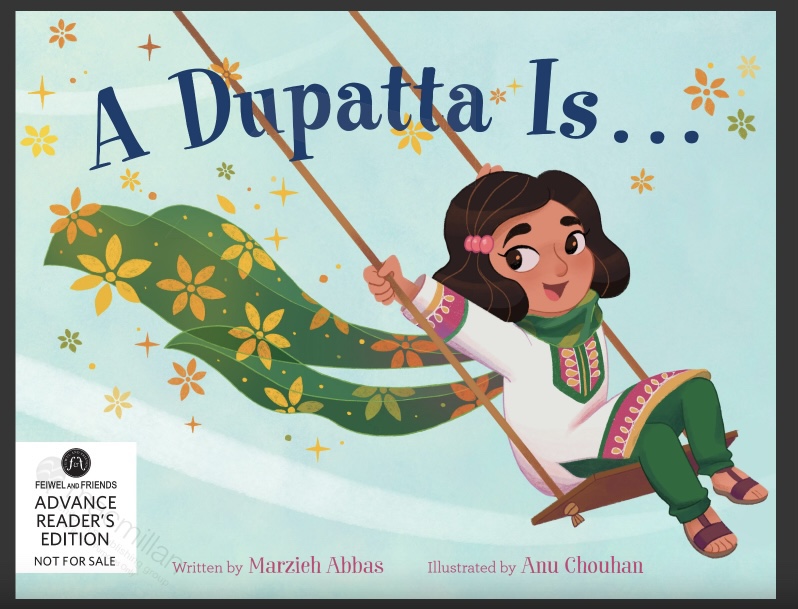
A Dupatta Is…by Marzieh Abbas illustrated by Anu Chouhan

Standard
A Dupatta Is…by Marzieh Abbas illustrated by Anu Chouhan

img_6073

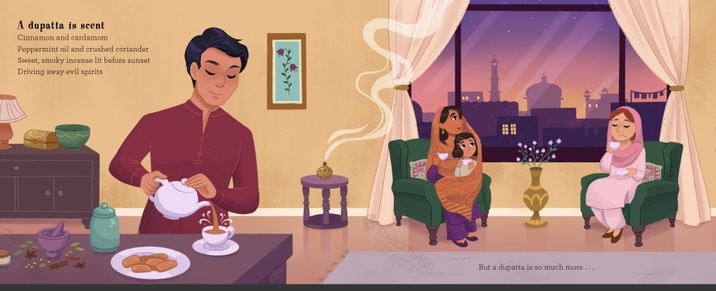
I read this 30 page early elementary book a few times before writing this review and honestly my cheeks hurt because I cannot stop smiling.  The lyrical writing radiates warmth and pride, culture and tradition, legacy and identity, while acknowledging both the playfulness and solemnness of a piece of fabric.  My heart breathed with the clarity and articulation that is felt and contained within the fabric that perhaps all Pakistanis feel, but cannot convey so poetically.  The book may be meant for children four to eight years old, but all readers will appreciate the text and illustrations that seamlessly flow like a favorite dupatta grabbed while running out the door. I struggled with picking only a few images to share, as every page became my new favorite as the book progressed.  Admittedly though, one page did give me pause as it conflated incense burning with getting rid of evil spirits which comes across as a religious belief, but is a cultural practice.

img_6074

The book starts out with the actual physical description of what a dupatta is and how it is adorned.  It then moves on to describing the color, the sound, the smell, the place, the function, the art, the beauty, the fun, the faith, the legacy, and the identity.  Each spread ends with the words, “but a dupatta is so much more…” seamlessly weaving so many facets of what a dupatta is together to create a true understanding of it from a tangible, to cultural, to practical perspective.

img_6076

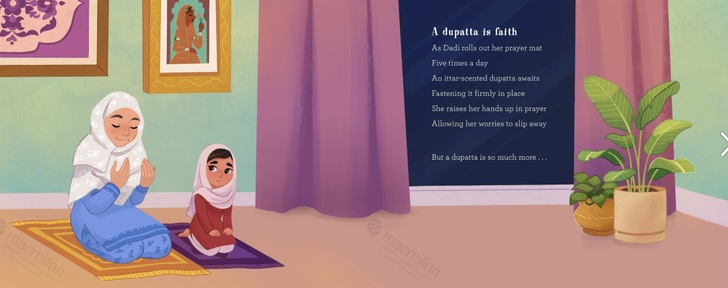
I love that there is a page about faith, and praying five times a day with a dupatta being worn, it is a little odd that there is a portrait decorating the wall behind the two characters making dua, but at least it is clearly behind them.  I absolutely loved that so often the wearer of the dupatta was also wearing a hijab, particularly the bride picture- which is absolutely gorgeous.  It signals without words that a dupatta can be worn to cover a Muslim woman’s head, but it is also often not.  The backmatter further details that it was once worn as part of the national dress and as a form of modesty, but now is often worn as an accessory.

img_6077

One summer in Pakistan, a friend and some cousins and I started trying to formulate 101 Things to do with a dupatta (wipe noses, pull things out of the oven, catch fish), it was the year of net dupattas so clearly covering your head was not one of them.  Sure we were being silly, but to see the book also highlight wiping sticky hands, and wrapping it up like a sari, and using it as a cradle to rock a baby was very, very accurate and heartwarming.

img_6079

Please pre order this book, it signals to publishers that these books are in demand and is a way to show what type of books we want to see.  I preordered  mine here.

Squire by Sara Alfageeh and Nadia Shammas

Standard
Squire by Sara Alfageeh and Nadia Shammas

squire

This 336 page YA graphic novel set in a fictitious world draws on the authors’ Arab culture and creates relatability for universal readers everywhere.  Themes of coming of age, war, family honor, discrimination, classism, deceit, and friendship, all interweaves with rich illustrations and warmth.  With a few unnamed #muslimsintheillustrations the story shows a lot of heart and with some language, violence, death, and oppression would be best suited for 9th grade and up.

SYNOPSIS:

Aiza and her family belong to the Ornu tribe and are treated as second class citizens in the Bayt-Sajji Empire.  With their traditional arm tattoos and seemingly more plentiful food, they are greatly disliked by the larger community and oppressed at every opportunity.  Aiza dreams of joining the army, rising in ranks, earning citizenship for her family and changing their future.  She also dreams of being a hero.  When she finally convinces her family to allow her to enlist, they also encourage her to hide her identity, and just like that, she is off.

Once in training she is pushed to excel or risk being sent to the front lines.  As she navigates new friendships, harsh instructors, and the shadowy General Hende, Aiza learns there is so much more to war and politicking than meets the eye.  Her life, her loyalties, her understanding of the world will all be tested, as Aiza must decide which path is for her.

WHY I LIKE IT:

The text and illustrations are seamless in conveying a united story, I was a little nervous with two authors, and I like that the story has twists and multitudes.  I loved seeing strong women in the military, as the authors’ say tough girls with swords.  While reading it I was completely submerged in the story and the characters, but writing this review a few days later, I’ve largely forgotten the characters names and quirks.  I’m not sure if it is because I read a digital version, or because the character building is a little lacking.  I don’t know that I was emotionally invested in some of the major plot points because I was not seeing the struggles it was requiring of the character to endure.  Admittedly I have not read a lot of fantasy graphic novels, so I don’t know that I have a lot to compare it to, but I do plan to read a physical copy when I can, and read follow up books in the series, to see if my impression changes.

FLAGS:

Some language, bullying, oppression, violence, death, killing.

TOOLS FOR LEADING THE DISCUSSION:

There is nothing religious in the text, so I wouldn’t use it as a book club selection, but I would definitely shelve it in a school library, classroom, and keep it in mind for readers that love these kind of books.

Good Intentions by Kasim Ali

Standard
Good Intentions by Kasim Ali

good intentions

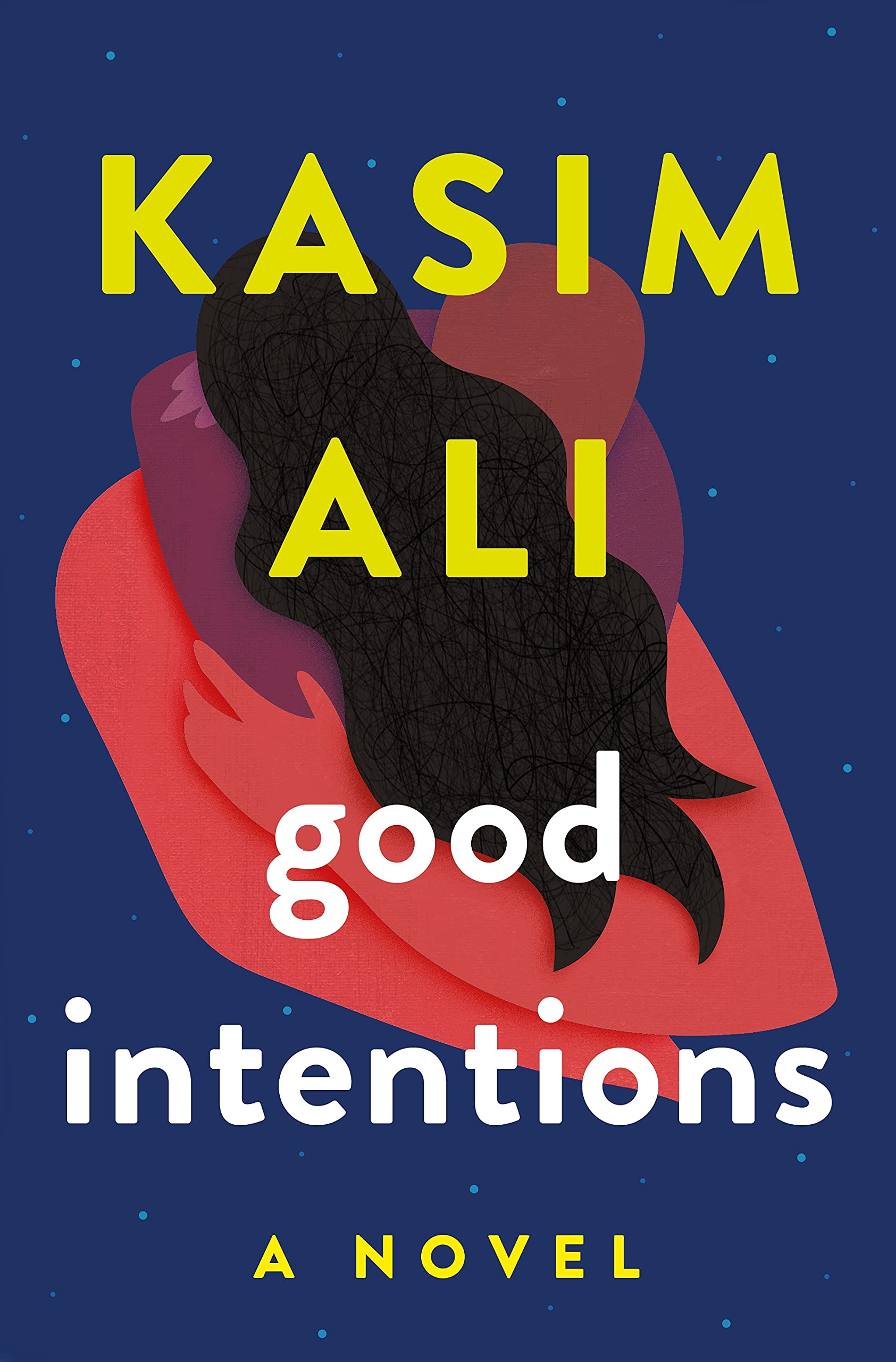
There is a reason that I read juvenile fiction: from board books to YA, but lately the “New Adult” category has really been tempting me.  Muslamic romance novels, often really need the protagonist to be looking to get married to make the plot work with some authenticity,  which means the main character usually needs to be a bit older than in their teens.  I decided to start my tiptoeing into the genre with this book, because I was intrigued at the racial and mental health themes that the blurb teased.  Sadly after reading the 288 page story, I still was waiting for more racial and mental health insight or enlightenment or perspective or deeper appreciation or anything really.  I kept reading hoping for more character growth, and to find out if the relationship worked.  I understand after finishing, that the book was intentionally more subtle and nuanced, and part of me appreciates it, but I still felt the book ultimately provided too little in either regard for me to feel satisfied or content that I had spent time with the characters.  The abruptness and harshness of the first few chapters, seemed disjointed from the dialogue filled introspective remainder of the book that showed so much potential, but left me feeling strung along for no real purpose.  The book covers mature themes of sexuality, drug use, racism, co-habitation, relationships, culture, mental health, and more.  The characters’ identify as Muslim, but aside from Eid prayers, iftar, and mentioning once that they should pray more, there is nothing religious practiced, mentioned, or contained in the story.

SYNOPSIS:

Told in a variety of timelines that all follow the relationship of Nur and Yasmina, the story begins with Nur finally after four years getting up the nerve to tell his desi parents that he has a Black girlfriend, and wants to marry her.  He leaves out that they have been living together for years, and the book then flips back to how they met and bounces around filling in the gaps that bring them back to the big reveal.

While in college, Nur had just broken up with Saara, but still goes to her fairly regular house parties.  At one such party he meets Yasmina, as a small group at the party sneak off to smoke pot, and he is immediately crushing.  His hungover broken-hearted gay friend Imran calls him out on it immediately, and his roommate Rahat chastises him for going to his ex’s parties.  Nearly all the main characters are met early on, and the rest of the book focuses on Nur and Yasmina growing closer through college, after school, through their early years of jobs and grad school, and the overshadowing of the fact that Nur has yet to tell his family about Yasmina, while Yasmina’s family is fully aware and fully supportive that they are living together.

All the characters are Muslim, but practice is pretty minimally detailed.  Yasmina tells Nur at their first meeting that she wishes she prayed more, and later it is mentioned that her parents were raised strict so they have raised their own children less so.  It is possible that Nur’s mom wears a scarf, but not clear either way, and they don’t seem to be bothered that she is living with her boyfriend.  Nur on one of his visits home goes for Eid prayers with his father, his mother and sister do not go, and it mentions that they are fasting.  Rahat does not find dating is for him, and wants to have a traditional arranged marriage, but it does not disclose if this is because of religious or cultural views.  Imran discusses his family praying and that he had to square away his sexuality with Allah swt more or less.

Nur and Yasmina’s younger sister have mental health afflictions.  Nur has anxiety attacks, and Hawa severe depression.  It does not label or identify or diagnose, this is my assumption, it does detail their experiences though, and how they affect those around them.

WHY I LIKE IT:

I actually enjoyed the writing style and the ease in which it flowed-save the beginning of the book. The beginning was a little crass, almost like the author was trying too hard to get the characters’ environment to read that they were in college.  The crude talking about sex and them talking about their parents’ intimacy and smoking and drinking and being vulgar, was in such contrast to the very subtle nuanced rest of the book that tried to show the layers of Nur and Yasmina’s relationships and lives.  Once I got through it, I genuinely wanted to know if they could make the relationship work.  No I’m not going to spoil it, but that really is why I kept reading.

I was disappointed that the book didn’t draw mental health out in the open.   I also wanted some religious based push back on racism.  It is a big thing in our communities and the book really could have had the characters argue it and make their points, right or wrong, for the disconnect between faith and culture.  It didn’t have to be preachy, or even mean that anyone changed their opinions, but it mentions numerous times, something to the effect of Nur’s parents being racist, but doesn’t detail why that is the suffocating presence in disclosing his relationship.  In four years I would imagine the opportunity to correct his parents way of thinking would have arisen, and he could have challenged it.  I get that might negate Yasmina’s point that Nur is racist, but I think it should have been made more clear then that he didn’t speak up when opportunities presented, otherwise it just seems unexplored and we, the reader, are expected to just accept the characters on face value, when the book really very easily could have nudged us, to self reflect and look inward.

FLAGS:

There is sex, and drugs, and lying, and racism, and all the other flags that adult books often have.  There is one “steamy scene” between Nur and Yasmina, but the rest of the relationship is very mild.  Nothing else is graphic in detailing their day-to-day living, or the day-to-day relationships of the other characters in the book: gay or straight.

TOOLS FOR LEADING THE DISCUSSION:

No. Would never, could never encourage unmarried Muslims living together, fictionally or otherwise.