Tag Archives: Family

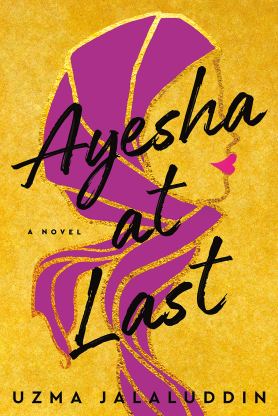
Ayesha at Last by Uzma Jalaluddin

Standard
Ayesha at Last by Uzma Jalaluddin

ayesha at last.jpg

This is not a YA book.  The back of the book and about 75% of the story could really make it seem ok for mature middle school and early high school readers, but I’m reviewing it as a “public service announcement,” that it really isn’t appropriate for a young adult demographic.  No where does the book claim to be YA, I’ve just seen a lot of people online ask if their 13-16 year old (ish) daughters would like it.  That being said, the 351 pages of halal romantic comedy a’ la Pride and Prejudice inspiration, really is a fun light summer read that I enjoyed and feel young college age girls and up will too.

SYNOPSIS:

Set in Canada, Ayesha is 27 and still sorting out what she wants in life while considering expectation, obligation, and passion.  Born in India, she came to Canada after her father died in secretive circumstances, and with a workaholic mom against marriage, a Nani who once studied to be a police officer, a Nana who quotes Shakespeare at all times, Clara, a best friend, and a flighty beautiful younger richer cousin, this cast of characters cheer her on, gently nudge her, and support her, giving a diverse and nuanced view of what a Muslim family looks like and how they interact.  Then throw in Khalid.  A very black and white character in his views on Islam, and culture and pretty much everything, and you have a storyline with a lot of potential, twists, and interconnections.  

Khalid works with Clara, lives across the street from Ayesha, and has an incredibly controlling mom who has just sent a marriage proposal to Ayesha’s flighty cousin Hafsa.  When a conference at the masjid forces Ayesha and Khalid to work together after meeting earlier, tension and sparks fly, and to top it all off Ayesha is pretending to be Hafsa. 

Khalid has his own team of supporting characters, Amir an alcoholic- womanizing-homeless colleague who for some reason is considered a friend, a sister who was banished to India and forced into an arranged marriage 12 years earlier, an Islamaphobe boss, and his own baggage regarding his father’s sudden death. 

Bring in the Wickham character of Tarek and the cast of characters is complete for all the action to go down at the mosque and give the Aunty Brigade a whole lot of gossip to process and spread.

WHY I LIKE IT:

The book is fairly predictable in the major story arcs, but there are a lot of twists that keep you hooked, and the author’s writing is smooth and fluid.  Being it is a loose retelling of a classic, I wasn’t expecting much and was pleasantly surprised how well the story would stand alone as an OWN voice piece about growing, maturing, changing and willing to challenge oneself. 

I love that every Muslim and desi character in the book is different and unique and not a cookie cutter of stereotypes and tropes.  Most of the females cover, but they are nuanced in how they do it, what it means, how they carry themselves etc., some shake hands with males some don’t, some are comfortable in bars, some are more reserved, some have never had a boyfriend, some have, and they really show the reader that Islam is a deeply personal conviction and the rules are interpreted and challenged differently for each person.  It also shows different male approaches and the internal struggles of doing what you want to do and what you know you should or shouldn’t do in a very realistic non preachy way.

My favorite relationship by far is that of Ayesha and Clara, I love that Ayesha’s non Muslim friend knows that Khadijah (RA) proposed to Prophet Muhammad (SAW) and jokes about rishtas and frequently asks “What would Nana do.”  Seriously, as someone of  Paki background, who started covering in high school, who is half American and proud to be Muslim, this is friendship goals!

The book is perfect for the beach, or a day at the pool, it is light and silly and really you just go with the outrageousness of some of the details.  There are a few thought provoking themes, but really it is just fun and sweet.

FLAGS:

I was really impressed how halal the main story romance remained, however a few of the side stories are a little intense for younger readers and don’t really appear until about 2/3rds of the way into the book.  Yes, Clara has a live in boyfriend and there are a few jokes and situations involving  hooking up, virginity and porn, along with some characters smoking and drinking and being around alcohol, but then the climax really puts more mature situations on center stage. 

Khalid’s sister had an abortion resulting from a pre-marriage relationship and thus was sent to India.  Amir shows Khalid a porn website where hijabi and niqabis strip and pose, a website that is discovered Tarek runs and Hafsa is featured on. The website and the pregnancy/abortion really are the crux of the book and it becomes a big portion of the last third of the book.  It isn’t that the content is overly detailed, it just what the concept presents.  It isn’t salacious or pornographic or titillating in presenting the information to the reader, but the mere presence of it in the story would make it inappropriate for a YA book or younger readers.

TOOLS FOR LEADING THE DISCUSSION:

No way the book could be taught in an Islamic school book club setting, however, if the teachers wanted to start a book club, this one would be a great candidate.


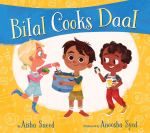
Bilal Cooks Daal by Aisha Saeed illustrated Anoosha Syed

Standard
Bilal Cooks Daal by Aisha Saeed illustrated Anoosha Syed

bilal cooks daal

Aside from me desperately wanting to get Bilal’s family a pressure cooker this 40 page book does a good job, and follows a reliable tradition of using food to introduce a “foreign” culture while simultaneously showing universal themes that show how similar we all are when it comes to family, meals, friends and feeling loved.  

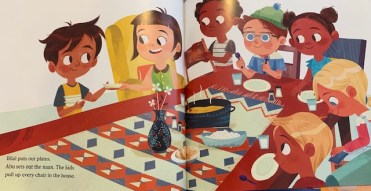
Bilal’s favorite food is daal, lentils, and when he is out riding his bike with his friends, his father calls him in to help him make it.  Confused as to why Bilal’s dad would need to start dinner so early in the day, Bilal’s friends join in, in helping make the slow cooking traditional asian subcontinent dish.

IMG_5306

They line up the spices, they put it in the pot, and then they wait.  They put their shoes back on and play hopscotch, they go swimming, they go for a hike and it still isn’t done. 

IMG_5308

At one point Bilal is worried his friends won’t like it, but after waiting all day and gathering more friends at each activity, when the time finally comes they all dive in and love it.

IMG_5309

I love the diversity of the friends and that the dad is cooking and involving his son.  I also like that everyone is willing to try something new and give it a chance.

IMG_5307

The book would work for all kids ages 4 and up with the expressive colorful illustrations, diction, and amount of text on the page.  The book is 9×8 so it works well in small groups and at bedtime.  

IMG_5310

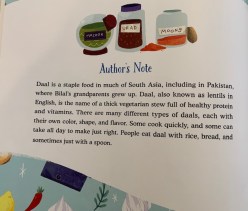
If you eat daal your kids will love seeing themselves in the pages, if you have never had daal there is a recipe at the end following an Author’s Note. 

IMG_5311

There is nothing religious in the book, and anyone from India, Pakistan, and Bangladesh could easily take ownership of the dish and story.  The Author’s note mentions that Bilal’s grandparents are from Pakistan and with a name of Bilal chances are he is a Muslim character.


We Hunt the Flame by Hafsah Faizal

Standard
We Hunt the Flame by Hafsah Faizal

we hunt the flame.jpg

A mature upper middle school/high school aged fantasy romance, written by a nikabi and filled with ancient Arab imagery and Arabic words.  Story-wise it read to me like a mashup of Hunger Games and Ember in the Ashes, and while the overall story is good, the first 60 pages of world building were utterly confusing to me.  I told myself I would read at least 100 pages and then decide if I wanted to continue, luckily before I hit 100 pages I found a glossary of terms, characters, and places online, and the story moved from world building to character development and I enjoyed the rest of the ride.

SYNOPSIS:

In a world that is slowly being taken over by the dark magic that is the Arz, a deadly forest that surrounds the country of Arawiya, one girl in one of the five Caliphates, Zafira, dares to venture into the darkness to hunt game and prevent her people from starving.  Unfortunately the Caliph of her state looks down upon women and this regular heroic act must be done with her impersonating a man and keeping her efforts as covert as possible.  Life for Zafira is hard as she not only juggles this masquerade, but her father has recently been killed, her mother is mentally absent, her best friend is getting married, the Arz is growing, and the people around her are starving.

In more or less alternating chapters we also learn of Nasir, the ‘Prince of Death’ who is an assassin for the Sultan who has also now taken over as Caliph of Sarasin.  Forced to kill innocent people by his heartless father, Nasir also is mourning the loss of his mother,  as he tries to earn his father’s approval and find some validation for his current life.

The two characters come together when an immortal witch summons Zafira to retrieve a magic book from a cursed island beyond the Arz and Naisr’s father sends him to intercept her.  The majority of the book takes place on the island of Sharr, an island that is not only a location, but a living consuming character, and involves a variety of other enchanted beings from the various states.  An immortal Safin, Benyamin, one of nine elites, Kafirah, and Altair, a general from Sarasin that weaves them altogether and complicates everything.   This group, the zumra, must work together to save Arawiya, while constantly evaluating how much they can trust one another, as well as themselves.

WHY I LIKE IT:

I love the detail and was pleasantly surprised with the pacing.  The chapters are short and kept the plot from dragging for 471 pages.  Having read it and enjoyed it, I don’t know that I can properly discuss it though.  There are things that I just accepted and moved on with without pondering over, because I don’t know if I understood it well enough to even ask the question aloud.  That being said, I feel like I got the story and I understood where the characters were coming from and I closed the book feeling satisfied and willing to read the next one in the series.  The characters grow and develop and they have a satisfying arc without being overly cliche or predictable.  I think Nasir grows much more than Zafira and knowing that the next book is more focused on him, intrigues me.  Altair is by far the most fascinating character and I hope to see more of him as well.

There is a map at the beginning of the book that I referenced A LOT, and truly I have no idea why the glossary and character list was not included in the book, as it is desperately needed. There are a lot of Arabic words and I would like to get an Arabic speaker’s perspective on how knowing what the terms meant affected the story comprehension. 

I like that Zafira has to find confidence in shedding her cloak and stepping in to herself, but I felt it told it more than it showed.  Some of the states are governed by women, the founders are women, that I didn’t feel her fear in hiding her gender.  Similarly, I wanted more information on who/what exactly the Lion of the Night was/is and where the affinities come from.  Perhaps minor points, but details that kept me from immersing myself in this fantastical land and kept me feeling like an outsider peering in and trying to connect with events just out of reach.

FLAGS:

There is a lot of killing, and some of it gruesome.  There is abuse and details of branding and a tongue being cut out.  There is alluding of sexual acts but nothing defined, random comments between characters and implications of girls in a room in the morning.  There is kissing and an intense makeout session that is used to achieve a battle goal, but it is detailed and the characters reflect on how it made them feel in terms of desire, longing, wanting, etc.  So, while it is there, it is there for a purpose other than titillation, that is why I think mature middle school could handle it.  There is a scene in a bar, but none of the main characters drink.  There is some language, albeit not in English.

TOOLS FOR LEADING THE DISCUSSION:

I don’t think I could do this with 6th graders in my middle school book club, but I will definitely suggest it for the high school one.  I think there are a lot of ways things can be interpreted and because it is a fantasy there is no right or wrong which would make the discussion fascinating.  The romance I think makes the book lean to being more female oriented, but I think there is enough action that boys will also enjoy it overall as well.

Book Website: https://www.wehunttheflame.com/

The book just came out, so I’m sure in the next few weeks and months there will be more tools, more interviews, and more details of what is to come in the series.


From Far Away by Robert Munsch and Saossan Askar illustrated by Rebecca Green

Standard
From Far Away by Robert Munsch and Saossan Askar illustrated by Rebecca Green

from far away

Robert Munsch is a staple in most classrooms and libraries, but somehow, much to my embarrassment, I just learned about this book.  Originally published in 1995 with a different illustrator, I read the newer version that was rereleased in 2017.  I’m not sure how they differ, but they stem from an autobiographical experience of the co-author Saossan Askar, and her leaving of the war in Lebanon.  She wrote to the author and their letters back and forth are how the book came to fruition. 

IMG_4986

The 24 page picture book is an AR 3.5 and my guess it is because of the content a bit more than the reading level.  While it never gets graphic or sensationalized, she does leave a war zone of bombs and shootings, and the words may trigger fear in younger children.

IMG_4987

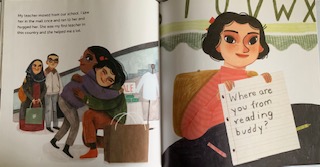
As the book progresses, the focus is much more on Saoussan settling in to her new life and the hiccups along the way.  From not knowing what anyone is saying, to sneaking out of class to go to the bathroom, and being frightened by a paper skeleton.  The book gives concrete examples that while silly, really show how someone unfamiliar with a new culture could be very confused and even scared.  

IMG_4989

The book has a happy ending with Saoussan adjusting and making friends and even becoming the best reader and speller in her class.  She also gets in trouble often for talking too much.  

IMG_4990

The book, like many in the genre of discussing war and refugees on a child’s level has its strengths and weaknesses.  The heart of the story I would say is wonderful, the illustrations lively and engaging, some of the transitions and details, however, are a bit abrupt and unsatisfying.  Once you know that it is based on reality and came about through letters, it makes more sense, but even that is a concept older readers will appreciate more than younger ones will.
IMG_4991

I checked the book out from the public library and I think does a great job of inspiring empathy.  It is vague as to what conflict is being left which makes it timeless in that I, unfortunately don’t see refugees disappearing soon.  The mom wears hijab, but there is no mention of religion in the book.

Here are the letters from his website: https://robertmunsch.com/book/from-far-away

From Far Away started with this letter:

To Robert Munsch
I am a little girl. My name is Saoussan. I am seven years old. I am in grade two now. I came to Canada one and half year ago. I didn’t know how to speak English at all. I was just sitting and listening. A lot of funny things happened to me.

Children were trying to talk to me, but I was not able to answer them. I began to talk a little by little.

I finished grade one and now I am in grade two. The teacher now is complaining to my dad that I am talking a lot in the class and I read and write a lot of stories.

One day I found a book called Thomas’s Snowsuit. I read it and I laughed with my family.

I went to the library and I brought some of your books. I enjoyed reading them. I even read them to my dad that he laughed so hard he could not stop laughing.

Please come to our school we want to hear a story from you and we want to see you.
I wrote back and asked her what “funny things” had happened. Saoussan wrote back telling me about her first Halloween in Canada:
To: Robert Munsch
Thank you for your letter. My teacher read it to the class and he said: I am not going to tell the class the funny thing that happened to her when she was in kindergarten and I am not going to embarrass you.

I don’t remember all of the funny things. But I remember one thing.

When I wanted to go to the washroom I didn’t know how to say I want to go to the washroom. That’s why I used to crawl to the door and when the teacher turns her head and looks at the other side I crawl under my friend’s desk and when someone opens the door I crawl out and go to the washroom.

When I come back from the washroom I wait beside the door and when someone opens the door I crawl in and go to my desk.

Once I crawled to the washroom. When I opened the washroom door I saw a skeleton. Then I screamed: Aaaaahhhhhhhhh!

Everybody came out. My teacher, Mrs. Garwan came, opened the washroom door and she tried to tell me that it is Halloween time and the skeleton is paper.

I didn’t understand her and I didn’t know what Halloween is.

She jumped up and down and danced around to explain to me that Halloween is just fun, but I thought the skeleton made her crazy and I screamed louder.

Then she hugged me to make me feel better and I jumped on her lap and the pee went down my knees. She put me down because she got wet.

Now I am in grade 2/3 and I am the best reader and speller in the class. This year when it was Halloween I weared a mask and a costume and we did a party at school. Then I went with my sister trick or treating to the neighbours.

Please, please, please, please, please, please, please, please come to our school.

I liked her letters so much that I decided to turn them into a book.

So Saoussan and I wrote a lot of letters back and forth and we made the letter into a book. Saoussan and I are both the authors and we split the royalties.

Mommy Sayang by Rosana Sullivan

Standard
Mommy Sayang by Rosana Sullivan

sayang.jpeg

A Pixar Animation Studios Artist Showcase book which beautifully illustrates the bond of a mother and daughter.  Set in Malaysia, this diverse book shows a rich culture that readers will learn about, as well as relate to in 48 large 9 x 11 pages.

IMG_4975

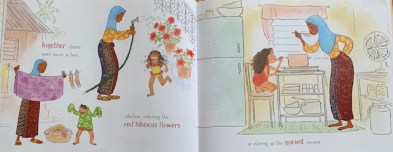
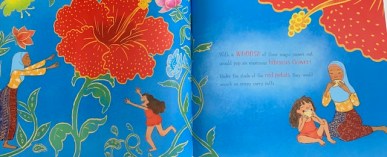
The simple text shows Little Aleeya watching her dear mother, Mommy sayang, pray five times a day, them doing chores together, cooking side by side, eating with friends and family, and smiling through it all.  Little Aleeya even dreams of her and her mother at night among the hibiscus flowers.

IMG_4976

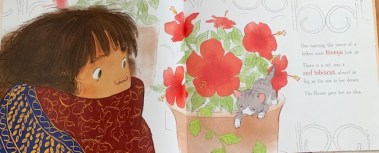
Mommy Sayang, however, gets ill and Aleeya waits and waits for her to get better.  Day after day Aleeya grows sadder and sadder until one day she gets an idea of how she can help her mother.

IMG_4977

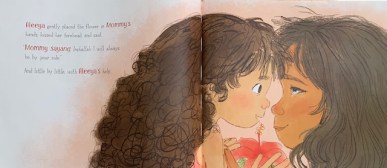
The change of perspective from Aleeya needing her mom, to her mom needing Aleeya is sweet and empowering.  The book doesn’t detail what makes her mom sick or why up until Aleeya’s idea takes form is she not able to hang out in her mother’s room with her.

IMG_4978

Listeners as little as 4 or 5 will enjoy the story and the tone provided by the minimal text and illustration style, older independent readers up to 2nd grade or so will learn new vocabulary and get a peek at a possibly new culture.

IMG_4979

I like that the mom wears hijab when they are out and about doing chores or people are over, but that when she is home in her bed she is not covered.  The illustrations are fabulous and gentle, as is the message.

IMG_4980

There is a small glossary of four words on the dedication and copyright page and there is a bit about the author, her inspiration, and what movies she has worked on at Pixar at the end.

Other Words for Home by Jasmine Warga

Standard
Other Words for Home by Jasmine Warga

other words for home.jpg

Three hundred and forty pages written in verse that beautifully consume you and leave you emotionally changed and vulnerable and humbled all at once.  The book claims it is for middle grades, but I think middle school will appreciate it more, and I sincerely hope everyone of all ages will take a couple of hours to fall under the spell that is woven to tell a story of a refugee leaving home and starting anew in America.

SYNOPSIS:

Jude is a 12 year old girl living on the beach in Syria, watching American movies with her friends and hanging out at her dad’s store.  With an older brother and a little sister on the way, life as told from her own perspective is pretty good.  Until it is not.  Until the crimes they only hear about happening in Aleppo and Damascus start to hit closer to home.  Until her brother starts sneaking out to meetings with other youth hoping to change the politics of their country.  Until a raid almost catches Jude and her brother and her parent’s decide it is time for Jude and her mother to journey to America, for a little while, to visit her mom’s brother and deliver the baby.

America is not like it is in the 90’s movies that Jude loves: Pretty Woman, Legally Blond, Miss Congeniality.  Her American aunt and her Uncle that seems to have forgotten his Syrian upbringing, are gracious and welcoming and their daughter, Sarah, who is less than a year older than Jude waxes and wanes in her approach to her cousin.  Adjusting to school, life without baba and her brother, and all the other adaptations that moving to a new country entail are brought to life through Jude’s eyes and understanding of the world around her.  As she comes of age and decides to wear hijab, as Islamaphobia shakes her sense of justice, and her little sister is born, the reader sees her grow and change and mature and find themselves hoping that she will soar.

WHY I LIKE IT:

I love that the style of the story telling somehow gives life to so much.  With verse some things are highlighted in detail and other things skimmed over and yet at the end, not only do you feel like you understand Jude, but a lot of the side characters as well, which caught me off guard.  Truly the writing is strong and deliberate.  A lot of the politics and war crimes occurring in Syria are not detailed, and I have to assume that is because the point of view is a 12 year old girl that is blissfully in her own world.  I imagine this is also why the target audience is listed as 8-12 year olds, because it simplifies a truly horrific situation.  Also because despite moments of raw vulnerability, the book stays pretty optimistic and hopeful.  

I like that the characters are Muslim, and that the mom scolds her brother for not going to the mosque.  The book does talk about Jude’s period starting and thus Jude starting to wear hijab, which is one of the reasons I feel like early middle school might be a bit more appropriate age group.  There isn’t too much talk about faith and Islamic beliefs, but a few tidbits are sprinkled in, prayer, not eating pork, modesty.  The book is not gender exclusive, but I think girls will gravitate much more to Jude’s perspective, experiences and voice.

The only thing I found a bit off is that the book takes place in modern time, present day, yet none of them have cell phones or social media.  Jude Skypes her dad, yet writes letters to her friend back in Syria and is distraught when they don’t have a forwarding address to send them to after her friend also leaves home.  It seems that social media, email, a cell phone number, something would be available for them to all keep in touch.

FLAGS:

There is mention of Jude and her friends having to sneak in to see Pretty Woman because Julia Roberts is a prostitute, and mention of blood between one’s legs and periods starting.  The book otherwise is pretty clean.  It hints at her kind of crushing on a boy that is in the play with her, but nothing more than friendship is explored.  Violence mentioned is minimal and language is clean even when dealing with hate crimes in America.

TOOLS FOR LEADING THE DISCUSSION:

There is a good chance that next year the students joining the middle school book club will be all girls, so if that is the case and the school counselor feels all the girls can handle the puberty aspects mentioned I would totally do this book.  The book reads very quick and might be a good way to get new kid to give a book club a try as well.

Author’s website: http://jasminewarga.com/about

Q & A with the Author: https://www.publishersweekly.com/pw/by-topic/childrens/childrens-authors/article/80127-q-a-with-jasmine-warga.html

Interview with the Author: https://www.hbook.com/2019/04/authors-illustrators/publishers-previews/spring-2019-publishers-preview-five-questions-for-jasmine-warga/


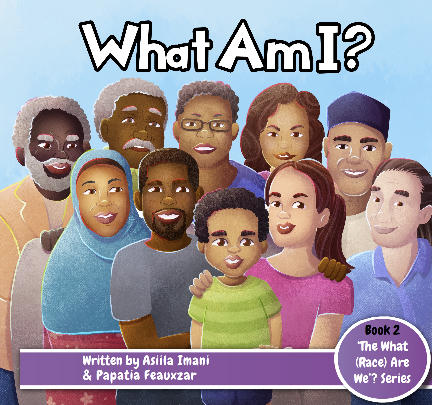
What Am I? Book 2 ‘The What Race are we Series’ by Asiila Imani and Papatia Feauxzar illustrated by Juliana Paz

Standard
What Am I? Book 2 ‘The What Race are we Series’ by Asiila Imani and Papatia Feauxzar illustrated by Juliana Paz

IMG_4825.jpg

This incredibly important 37 page picture book highlighting a little boys heritage will speak to children who see themselves in his quest to answer what he is, as well as (hopefully) inspire them to search out their own family ancestry and unique make up.

IMG_4828

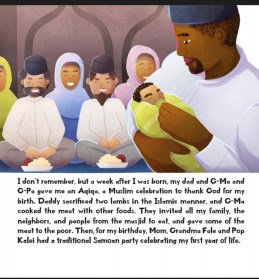
The book is not a traditional story book, in fact there isn’t much of a storyline, but the concepts presented show how beautiful and amazing multi-cultural and multi-ethnic families can be.  A lot of cultural information is conveyed and celebrated about Samoan and Pacific Island traditions as well as Islamic ones.

IMG_4831IMG_4832

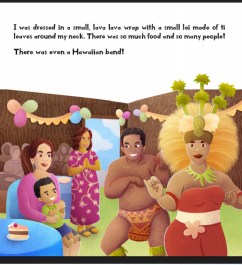
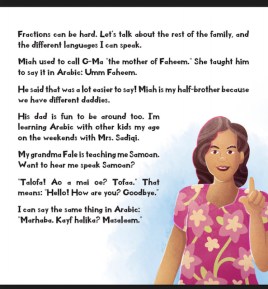
There is an aqiqa at the time of his birth as well as a Samoan party with a Hawaiian band.  Some members of his family cover, while other’s don’t.  He remarks how he has extra grandparents which equal extra blessings, and how he has a half brother because they have different dads.

IMG_4830

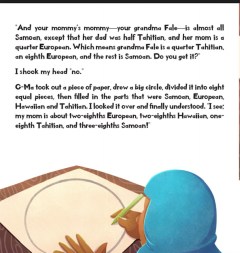
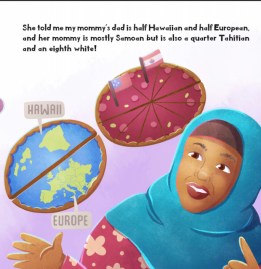
In addition to geography, there is also a STEM component as six-year-old Toa Idris learns he is a quarter this and half that through understanding fractions as visualized by slices of a pizza.  At one point Idris remarks that, “I can’t keep all those people and places straight,” and after reading the book half a dozen times, I honestly couldn’t either.  But, I think that is ok.  The point of the book is that being diverse is amazing, and having people love you is important, and culture and tradition and faith all make you richer.

IMG_4829 The text on each page is presented in a fun font, as are the pictures.  Really there is just one picture that makes Idris look angry and it is used in the story and the title page, which is unfortunate, I think it is supposed to have him look pensive, but it seems a bit off to me, where all the other pictures ooze with warmth and richness.

IMG_4826

I honestly don’t know what age group would benefit the most from the book.  Younger kids that may have been asked what their culture is will be empowered by having it reinforced that they are made just how Allah swt planned them to be, older readers will be able to create their own pizza slices, so to speak, and understand their own pieces, but I feel like both groups might need some coaching from an adult.  There are family trees at the beginning that almost become reference pages while reading the story and trying to keep everyone straight, that make the book almost interactive.  Muslim and non Muslim reader alike would learn about new cultures, and benefit from the “Extras” at the end.  Honestly, overall there is just a lot of information tossed around in the book, which isn’t a bad thing, it just might make it a bit more hit or miss if it will work for your child.

Love from A to Z by S.K. Ali

Standard
Love from A to Z by S.K. Ali

love from a to z.jpg

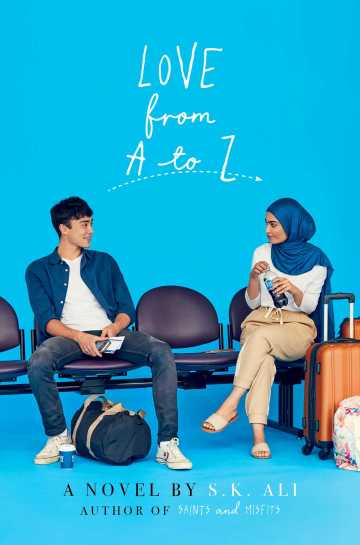
Now that there is legitimately a genre of YA Islamic Romance out there told in Own Voice, the expectations are high that a book is compelling, realistic, and unique somehow.  While the author’s first book, Saints and Misfits was pretty ground breaking, this 342 page was a great read, but not nearly as remarkable or memorable.  Granted it is not fair to compare the two books, and each day I do age out of the target demographic, but while the story reads authentic and true, albeit a bit serendipitous, it doesn’t have the teeth or grit I was kind of hoping for, and with a mother who suffers from multiple sclerosis my emotions were pretty invested.

SYNOPSIS:

Told from both Adam and Zayneb’s perspectives by way of their individual “Oddities and Marvels” journals, our two characters are presented by a narrator who keeps their story on track and interjects when their versions of an event differ. 

Zayneb is a high schooler and activist who has recently been expelled for threatening a teacher who consistently lets his Islamaphobic beliefs take over the days lessons.  In an environment filled with micro aggressions against Muslims, Zeynab’s parents are at a loss at how to keep their daughter from making waves, and thus allow her to leave her Indiana home a week before spring break to visit her aunt in Doha, Qatar.

Adam is at University in London where he has recently been diagnosed with MS and as a result has stopped going to classes, and is literally “making” the most of the time he has by making things.  As the term ends and he officially withdraws from school, he heads home to Doha to tell his dad and sister that he has the same disease that took his mother’s life years early.

The two characters meet at the airport briefly and then again on the plane and then at Adam’s house and the needless to say  their accidental meetings allow for friendship to grow, attraction to be built upon and a relationship to develop. Both characters have their own lives and own obstacles and own maturity that needs to occur in order for a happy ending to take place, and thus the book keeps you interested, invested and cheering them on.

WHY I LIKE IT:

I love the dynamic of how the book and characters are set up.  Both are practicing Muslims, both characters don’t cross a line, both characters have diverse mixed cultural backgrounds, and one is a convert and the other the daughter of a convert.  She is fiery and impulsive and emotional, he is pragmatic and calm and quiet.  While they have some background in common, their life experiences are rather different and it is very much a story about opposites attracting.  

I’ve been waiting for this book to come out, and so I knew my expectations would be too high.  That being said the book warns it is a love story and in some ways, that was what I kind of felt was lacking.  There was the physical attraction that was mentioned fairly often, but the deep connection of ideas or growing seemed a bit lacking.  

I really liked Adam, and his internal stresses and struggles and coming to grips with his disease seemed pretty developed.  Somehow though, and I’m probably in the minority, I didn’t love Zayneb.  She is impulsive and definitely learned and grew from the start of the book to the end, but I didn’t love her nuances with dealing with the Emmas and her friends back home and unraveling her teacher, it felt kind of forced and I can’t articulate why.  I’m glad she matured and she got answers about her grandmother, but maybe I should have felt so much in common with her and when I didn’t, I felt a little irritated.  Clearly I get too invested in fictional characters, I’ll admit that.

I like that Islam is presented in a non defensive way.  The parents aren’t evil, there is no rebelling, even the awful teacher spawns backlash and allies to Zayneb and her cause. There is no apologizing or overly explaining if the characters are pushing boundaries established by Islam or if they are establishing their own boundaries based on their understanding of Islam.  I like this, because it shows that Muslims are not a monolith, we are not one way good or bad.  Zayneb covers and prays and has friends that are boys and her family is kept in the loop of what she does, which alone breaks so many of the predominate stereotypes about Muslims.  Adam himself converted at age nine and plays the guitar and has friends that are girls, and is close to his sister, and likes dogs.  A side character is noted to be incredibly religious, but doesn’t cover.  The story takes place in an Islamic majority country, but attitudes at the swimming pool don’t allow Zayneb to dress modestly while she swims.  

Overall, the book is a delightful read that manages to keep the religious integrity in the characters and show their personalities as they come of age.  It may not be memorable years after reading, but what you do remember will be positive, and while you are reading it, you will have a hard time putting it down.

FLAGS:

There is angsty romance, and talk of sex.  The two main characters keep it pretty clean, but the side characters joke about hooking up, being horny, and sneaking off to hotel rooms.  The non Muslim aunt has a secret alcohol and cigarette stash that she gets called out on, but nothing more is mentioned about it. I think 9th or 10th grade and up will be perfectly ok to read.

TOOLS FOR LEADING THE DISCUSSION:

There is a lot to unpack in this book and I think if one just listens, teens will naturally add their own opinions and perspectives on EVERYTHING the characters experience, feel, question, and cope with.  The book just came out, but I would imagine that over time discussion questions will appear.

Author’s website: https://skalibooks.com/books/

Interview with the author: https://www.barnesandnoble.com/blog/teen/an-interview-with-s-k-ali-author-of-love-from-a-to-z/


Shadow Magic by Joshua Khan illustrated by Ben Hibon

Standard
Shadow Magic by Joshua Khan illustrated by Ben Hibon

shadow magic.jpg

This book is fun and enchanting, whether you read all 321 pages and fall in to the occasional illustrations and pour over the map, or listen to the audio and get swept away.  It is an AR 4.1, and the first in the three part series.  Told by the point of view of two characters, the book’s short chapters and high action speed are expertly crafted to keep suspense and interest high, while maintaining solid world building events and making the character’s history come alive.  There isn’t anything Islamic in the books, save some critical and cleverly named characters and ideas, but the author in interviews has said he is Muslim, and that is enough for me to share a book I thoroughly enjoyed on this blog!

SYNOPSIS:

Thorn is a fugitive kid, on the run from something left intentional vague and possibly the son of an outlaw.  Raised on the edge of Herne forest (earth), he is good with animals, feels comfortable in nature, has a soft heart for doing what is right, and isn’t afraid of hard work.  He finds himself being sold as a slave to the executioner of Gehenna, Tyburn, and is off to Castle Gloom where he will meet and befriend the new ruler of House Shadow (death/darkness), Lily.

Lillith Shadow’s parents and brother have been murdered and she is now the ruler of Gehenna.  She is also still a child and events around her require her to grow up fast.  To end hostilities with House Solar she is to wed Prince Gabriel, a pompous idiot, who she despises in principle and in person.  

When an attempt is made on Lily’s life, Thorn and an unexpected ally, K’leef a Prince from the Sultanate of Fire, must work together to figure out who is trying to kill Lily, possibly who killed her parents, where Thorn’s father is, who is raising an army of zombies, and now how to get out of this wedding without causing continued war.

The history of the six founding houses that make up this world, and their elemental magical rules and limitations as magic dies out with each passing generation, come together and a tale is told that contrasts easy everyday language in a mystical proper world of royalty and dukes, colored by the dark of death and necromancy and shadows, while somehow remaining light, and funny, and completely relatable as the kids come of age and learn who they are and what they are capable of doing and accomplishing.

WHY I LIKE IT:

I love that the book is clean and that it has both Thorn and Lily’s perspectives to move the story along and give insight into the characters.  I love the world building and how the history of each of the houses is so well thought out and clear.  
“The whole idea of House Shadow is based on the Middle-East. Lily’s dad’s name is Arabic for the devil. Her mother’s the great villainess of the Old Testament and Lily is Lilith, a Hebrew demoness. The view people have of House Shadow mimics the fear the West has of East, and specifically Islam. For that reason all of House Solar is named after archangels. . . Some houses were easier to establish than others. House Djinn was fire as djinns are (out of Arabic lore) beings of smokeless fire. Herne’s an ancient English forest deity, so again a pretty easy fix” (http://www.cybils.com/2017/03/interview-with-joshua-khan.html).

A big plot point is that Lily is magical, and it is against ancient laws, meaning all six houses agree, that women cannot practice magic.  The irony is great, in that even kids can pick up on the fact that the six brothers and founders of the magical houses acknowledge that the source of their magic comes from their mother, a woman, and the hypocrisy of it all is frustrating.  I love that three very different characters have to work together, and pick their battles, it really is a testament to the strength of friendships even with people so very different than yourself.

FLAGS:

Pretty clean, not recalling anything cringeworthy as we listened to it in the car (kids ages 3, 8, 9, 12).  The book is dark in that it takes place in Gehenna and there is talk of the undead and bringing the dead back to life and they really celebrate Halloween in their own dark way.  There is murder and death and assassinations, but it isn’t overly morbid or gory or violent.

TOOLS FOR LEADING THE DISCUSSION:

I think I’ve already 90% decided to start next years middle school book club off with this book.  It is fun and engaging and the discussions would connect this fantasy story to so much in the kid’s lives and greater world that I get giddy just thinking about how fun a discussion it will be.  Sadly the school year is wrapping up and I’ll have to wait until fall.  Here are some of my favorite interviews online with the author:

http://www.cybils.com/2017/03/interview-with-joshua-khan.html

https://www.greenhouseliterary.com/authors/joshua-khan/

Author’s Website: http://www.joshuakhan.com/


Who Will Help Me Make Iftar by Asmaa Hussein illustrated by Saliha Caliskan

Standard
Who Will Help Me Make Iftar by Asmaa Hussein illustrated by Saliha Caliskan

IMG_3796

This sweet story shows how even when people refuse to help, we should treat them with kindness, as our actions should be to please Allah alone, and inshaAllah in real life, much like in the story, people will fix their ways and offer their help in return.  This new story reads very much like the old(er) favorite Nabeel’s New Pants, where everyone is too busy to help, but then come around to realizing that helping one another is a way to show people we care.  This 32 page 8.5 x 11 soft back story is well bound with large glossy pages and clear text.  The story works well for ages 4 and up, as they will understand the moral message and inshaAllah feel inspired to find ways to help as well.  

IMG_3797

It is a 40 year tradition that Mustafa Amce and his wife Ayse Teyze feed iftar to their friends and families on the first day of Ramadan.  This year, however, Ayse is not well and Mustafa is confident he can enlist the help of neighbors and family to help him keep the tradition alive. 

IMG_3798

Unfortunately, everyone has an excuse.  His daughter is tired, his grand daughter is too busy with her video games and his neighbor doesn’t want to get his new shirt dirty.  Their sad reasons don’t stop old Mustafa Amce, and he makes the salad, and cooks the rice and beef by himself.

IMG_3799

When iftar time arrives, he offers sweet dates to those at the masjid and invites everyone to come to his courtyard to break their fasts together.  All those that had early refused to assist him feel incredibly guilty and don’t want to take advantage of a lovely meal. Mustafa reminds them that, “God loves those who are generous especially to their families, neighbors, and guests.  and I always want Got to love me.” So they join in the delicious meal.

IMG_3800

After food Ayse Teyze shows that while she might be ill, she can still save the day when her husband realizes he has forgotten to prepare dessert.  The guests then offer to wash the dishes and sweep the floor and take the leftovers to the poor.  And best of all when the athan for isha prayer calls out they all without prompting stand to join Mustafa Amce in praying salat together.

IMG_3801

The names are Turkish with a pronunciation guide at the end, as well as a paragraph about Ramadan.  The book would work for non Muslims and Muslims alike as the story is set in Ramadan, but more about coming together to help out.  The illustrations are large and detailed and descriptive.  You see the warmth between Mustafa and his wife as well as the apologetic feelings from those that were unwilling to help. 

IMG_3803