Tag Archives: warrior

Aicha by Soraya Bouazzaoui

Standard
Aicha by Soraya Bouazzaoui

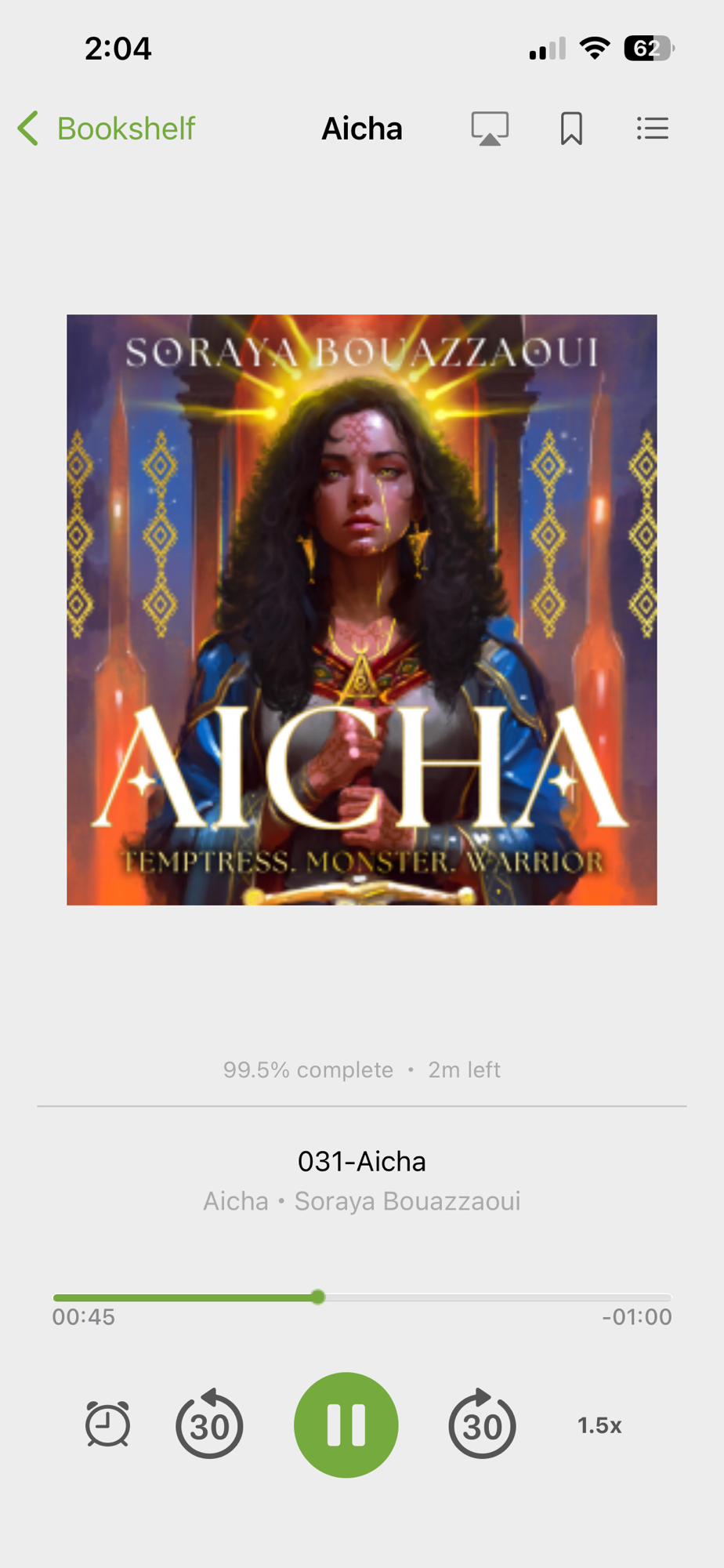
I listened to this book on my work commute, to and fro daily for weeks, Aicha would go about her day in Portuguese occupied Morocco and I would go about mine, and as the hours built, I realized this book has no plot, there is no building up for something, it really is just the two of us going about our days, granted, hers is far more interesting, but rather plotless just the same. There is world building of life under occupation and the rebel forces her family is a part of, there is even foreshadowing about who she is, but I do not, and did not, have prior knowledge of the myth the story stems from. And the more I listened and the closer we got to the approaching “siege,” the more I felt like I was mislead with the promises of what the book would be. Before I continue, there will be spoilers, and I admit while I was listening to it, I wasn’t bored, the pacing is off but the prose is lush and descriptive, albeit overly telling at the expense of showing, but none-the-less listening to it in 15 minute intervals twice a day at 1.5x speed was not a a burden, and was often enjoyable. Had I been reading it though, I think I would have dnfed mid way through after skipping pages at a time.

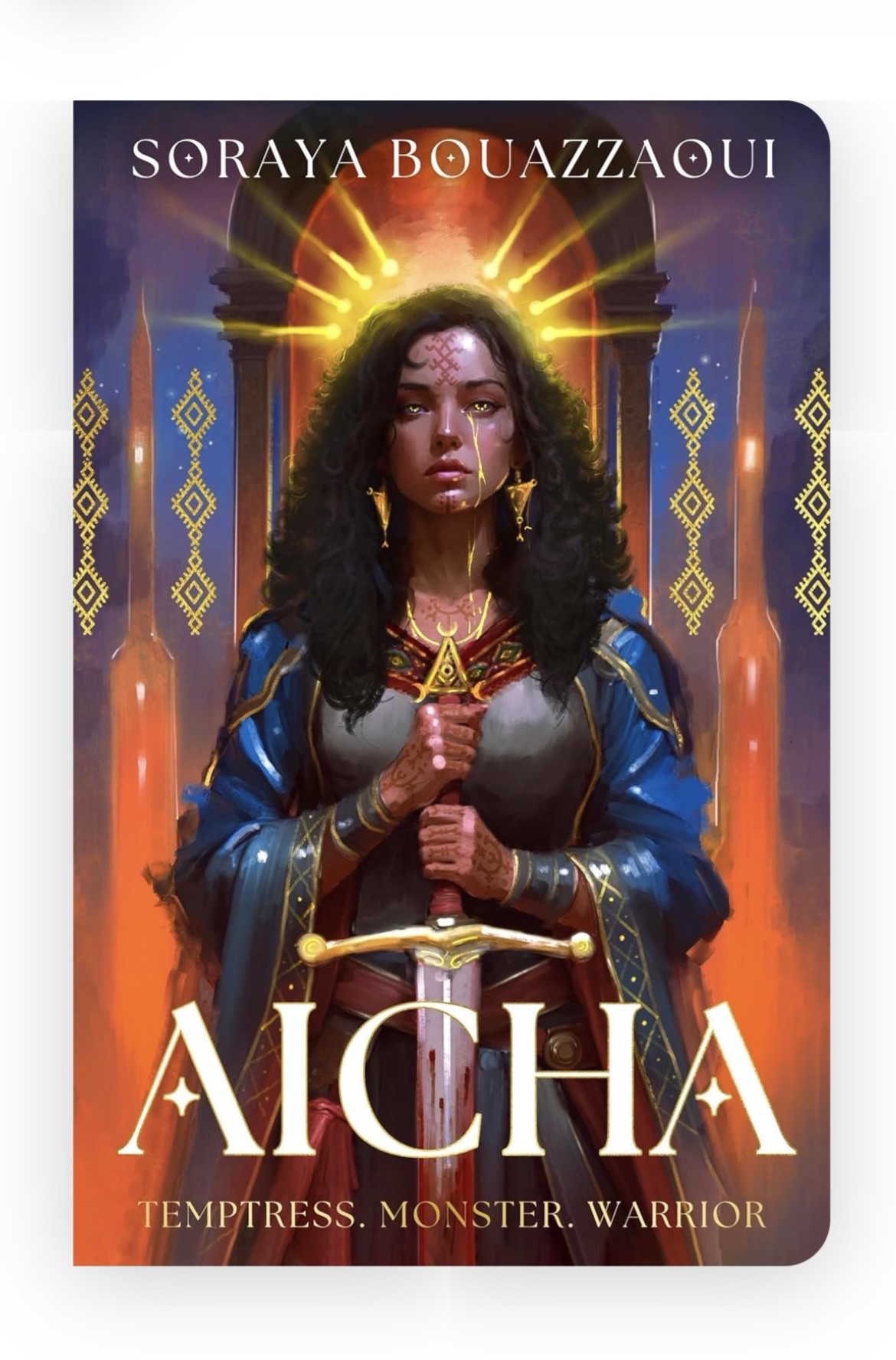
The front of the book says “Temptress, Monster, Warrior.” She is in love with Rachid, they are in a relationship, chapter 19 is a pretty intense, very adult, and mature, open door testament to that relationship, the occupiers threaten sexual assault, but she is not out flirting or tempting anyone, she is often dressed to look like a boy and disappear into shadows. Is she a monster? She has a jinn tied to her, so I’m going to say no, she is not, the jinn is blood thirsty and perhaps a monster, but the book title is her name. The daily musings, 352 pages, over 10 hours, are her life, the jinn doesn’t get top billing until the end. As for the warrior description, sure, she is a rebel, who trains at the hands of her blacksmith father, but the book is also teased as a female rage story, so when coupled with the term, warrior, why does she have to have Rachid step in to fight for her at the end? She couldn’t beat Duarte? She didn’t get to exact her revenge? Only once Aicha was dead was the jinn freed and the jinn given the pleasure of killing him-which cheapened the expectation and made the whole book feel misleading.

I also didn’t like on the back it saying, “Aicha is the story of Morocco’s warrior goddess,” the term
“goddess,” distracts for me how much Islam really is in the book. I loved how much actually. The book from the very first Author’s Note Flag Warning positions that the characters are Muslim, but they are not examples of Islam, and I might buy the book just to screen shot how fabulous the warning/statement is. The characters are Muslim through and through and that made me have a soft spot to keep listening. I’ll even admit the hasty nikkah to make it halal was emotionally charged, and nice to see.

Craft wise, aside from the lacking plot and slow pacing, I’m not sure why one chapter switched perspectives to Rachid, it felt sloppy. I don’t get why the siege wasn’t more robustly fleshed out, why the open door sex scene was so long, (I could just be a prude, and I’ve never done an audio with spice, so yeah, I might be unreliable on this point), and why did they all have to die, if it was so devastating in real life, we need backmatter to feel the weight of these characters. I will probably read anything future the author writes, so I own that, and I truly did enjoy the commentary on colonization and occupation and the last line of the backmatter being, “Free Palestine!”

I listened to the audio of this book and did not have access to the text of the book, so forgive misspellings of characters’ names.
We Hunt the Flame by Hafsah Faizal

Standard
We Hunt the Flame by Hafsah Faizal

we hunt the flame.jpg

A mature upper middle school/high school aged fantasy romance, written by a nikabi and filled with ancient Arab imagery and Arabic words.  Story-wise it read to me like a mashup of Hunger Games and Ember in the Ashes, and while the overall story is good, the first 60 pages of world building were utterly confusing to me.  I told myself I would read at least 100 pages and then decide if I wanted to continue, luckily before I hit 100 pages I found a glossary of terms, characters, and places online, and the story moved from world building to character development and I enjoyed the rest of the ride.

SYNOPSIS:

In a world that is slowly being taken over by the dark magic that is the Arz, a deadly forest that surrounds the country of Arawiya, one girl in one of the five Caliphates, Zafira, dares to venture into the darkness to hunt game and prevent her people from starving.  Unfortunately the Caliph of her state looks down upon women and this regular heroic act must be done with her impersonating a man and keeping her efforts as covert as possible.  Life for Zafira is hard as she not only juggles this masquerade, but her father has recently been killed, her mother is mentally absent, her best friend is getting married, the Arz is growing, and the people around her are starving.

In more or less alternating chapters we also learn of Nasir, the ‘Prince of Death’ who is an assassin for the Sultan who has also now taken over as Caliph of Sarasin.  Forced to kill innocent people by his heartless father, Nasir also is mourning the loss of his mother,  as he tries to earn his father’s approval and find some validation for his current life.

The two characters come together when an immortal witch summons Zafira to retrieve a magic book from a cursed island beyond the Arz and Naisr’s father sends him to intercept her.  The majority of the book takes place on the island of Sharr, an island that is not only a location, but a living consuming character, and involves a variety of other enchanted beings from the various states.  An immortal Safin, Benyamin, one of nine elites, Kafirah, and Altair, a general from Sarasin that weaves them altogether and complicates everything.   This group, the zumra, must work together to save Arawiya, while constantly evaluating how much they can trust one another, as well as themselves.

WHY I LIKE IT:

I love the detail and was pleasantly surprised with the pacing.  The chapters are short and kept the plot from dragging for 471 pages.  Having read it and enjoyed it, I don’t know that I can properly discuss it though.  There are things that I just accepted and moved on with without pondering over, because I don’t know if I understood it well enough to even ask the question aloud.  That being said, I feel like I got the story and I understood where the characters were coming from and I closed the book feeling satisfied and willing to read the next one in the series.  The characters grow and develop and they have a satisfying arc without being overly cliche or predictable.  I think Nasir grows much more than Zafira and knowing that the next book is more focused on him, intrigues me.  Altair is by far the most fascinating character and I hope to see more of him as well.

There is a map at the beginning of the book that I referenced A LOT, and truly I have no idea why the glossary and character list was not included in the book, as it is desperately needed. There are a lot of Arabic words and I would like to get an Arabic speaker’s perspective on how knowing what the terms meant affected the story comprehension. 

I like that Zafira has to find confidence in shedding her cloak and stepping in to herself, but I felt it told it more than it showed.  Some of the states are governed by women, the founders are women, that I didn’t feel her fear in hiding her gender.  Similarly, I wanted more information on who/what exactly the Lion of the Night was/is and where the affinities come from.  Perhaps minor points, but details that kept me from immersing myself in this fantastical land and kept me feeling like an outsider peering in and trying to connect with events just out of reach.

FLAGS:

There is a lot of killing, and some of it gruesome.  There is abuse and details of branding and a tongue being cut out.  There is alluding of sexual acts but nothing defined, random comments between characters and implications of girls in a room in the morning.  There is kissing and an intense makeout session that is used to achieve a battle goal, but it is detailed and the characters reflect on how it made them feel in terms of desire, longing, wanting, etc.  So, while it is there, it is there for a purpose other than titillation, that is why I think mature middle school could handle it.  There is a scene in a bar, but none of the main characters drink.  There is some language, albeit not in English.

TOOLS FOR LEADING THE DISCUSSION:

I don’t think I could do this with 6th graders in my middle school book club, but I will definitely suggest it for the high school one.  I think there are a lot of ways things can be interpreted and because it is a fantasy there is no right or wrong which would make the discussion fascinating.  The romance I think makes the book lean to being more female oriented, but I think there is enough action that boys will also enjoy it overall as well.

Book Website: https://www.wehunttheflame.com/

The book just came out, so I’m sure in the next few weeks and months there will be more tools, more interviews, and more details of what is to come in the series.