Tag Archives: Family

The Proudest Blue by Ibtihaj Muhammad & S.K. Ali illustrated by Hatem Aly

Standard
The Proudest Blue by Ibtihaj Muhammad & S.K. Ali illustrated by Hatem Aly

blueLOVE! Yes, usually when I’m so anxious for a book it disappoints, but not this one, it warmed my heart and soul and made me smile.  In 40 pages surrounded with absolutely adorable illustrations, the reader feels the love between siblings, the strength of self confidence, the power of being true to yourself, the beauty of hijab, and the awesomeness of light-up sneakers and five cartwheel recesses.
C7E95032-E080-4057-BC93-6B25CBCAAA29

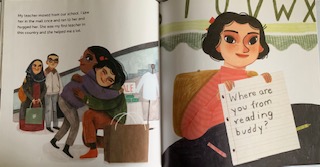
It is the first day of school for sisters Asiya and Faizah, and Faizah’s first day of wearing hijab.  The book starts out with the girls and their mom picking out a new scarf at the store.
677BD5F0-0C6E-472A-B086-05F93D4F17CC

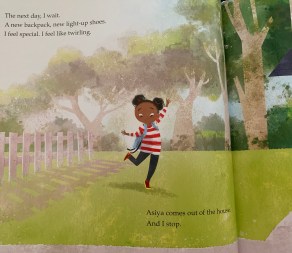
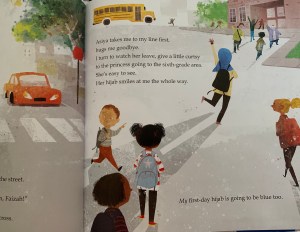
The first day of school has the girls walking to school hand in hand, Asiya in her beautiful blue scarf, and Faizah in her new shoes admiring her sister as if she were a princess.

DB80D90A-289E-4F35-A763-24526723E650

In line a classmate whisper asks Faizah about her sister, and Faizah has to find her voice to speak up about her hijab.  She then likens the blue hijab to the sky, special and regular before recalling that their mom had told them “The first day of wearing hijab is important. . . It means being strong.”

DFA253F0-16BC-464A-B630-BB93AFBFCF94

Throughout the day at school Faizah checks on her sister, sees other kids make fun of her, liken the blue to something beautiful, and then recall something their mom has told them to give her solace and strength.

06E90E71-3375-4E26-9F0A-F31DCA8058C4

As Faizah puts into practice the lessons from her mom about being strong, knowing who you are, and not carrying around hurtful words, she, like her sister finds strength.  A strength which radiates to those around them, and further connects the two girls.

C62B2893-3E2B-4628-BAAE-C195FBD3AB7A

Faizah has an amazingly sweet and authentic voice as she counts her light up steps and looks up to her older sister.  I love that the story stays on track and has its own rhythm of a school incident, a strong declaration about blue, a lesson remembered from Mama and a resolution.  With lots of mini climaxes the reader sees the strong perseverance and how being authentic will be challenged repeatedly.  The subtly of the hijab being whispered about and then proclaimed loudly is really tender and emotion filled.  Little reminders why OWN Voice stories are so important.

The illustrations are absolutely amazing on their two page spreads: the colors, tone, expressions, are perfect and a huge part of the narrative.  I love that when a boy points at Asiya, not just Faizah, but Asiya’s friends too are unhappy with the boy.  I also like that the boys being mean are not depicted clearly, but rather are shown in the shadows, furthering the point that mean words and those that spout them are not worthy of your time.

There are Authors’ Notes at the end and a picture of Ibtihaj  and her two sisters Asiya and Faizah. I think the book should be on every shelf, truly.  To be yourself and be proud of who you are is universal, as is kindness. The book does not discuss religion or mention Islamic reasons for her covering, and girls and boys alike will benefit from multiple readings of the book.

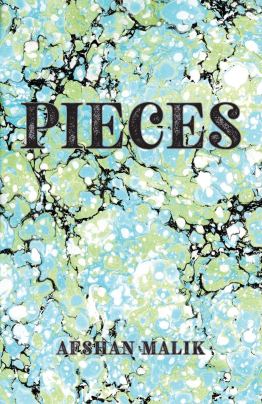
 

Piece by Afshan Malik

Standard
Piece by Afshan Malik

Pieces.jpg

This 168 page young adult book from Daybreak Press focuses on a small Muslim family in Texas, that has their own stresses and interpersonal relationships, but are thrown in to a whirlwind when the father of the family returns home from a medical mission to Syria and finds himself in the psych ward broken and troubled.  The effects each of the character’s struggles have on them as well as those they care about, makes for a haunting yet relatable read for fourteen year olds and up.

SYNOPSIS:

The Jamal family is made up of Hannah and her older high school aged sister Noreen and their physician parents Dahlia and Adam.  Hannah runs track and is more introverted in handling friends and her father’s life altering condition.  Noreen on the other hand is ultra organized and rational in her approach to life, much more like her OB mother.  To cope with the stress of her father’s return she commits herself to more clubs at school and staring at her phone.

Hannah doesn’t seem to have a lot of friends, and when the track team understands that Hannah’s dad is dead and Hannah doesn’t correct them until later, her comfortable acquaintances turn on her and she will have to learn to stand up for herself and use her voice in the course of the book.  Noreen’s character arc is a bit more dramatic as her involvement in yearbook club brings new people in to her life, mainly a boy, who might not be as a genuine in his goals as she is, and thus their climax results in a trip to the police station.  Dahlia has a close friend, and Adam has a few as well, but the story really stays pretty streamline in exploring the relationships of the family and how little things and big things affect them all.

WHY I LIKE IT:

I love that the book takes on a serious issue like PTSD and is framed in such reality.  The scene where the dad blurs his past memories with the current real happenings, is done very well.  It conveys how fractured his brain is while showing the stress his situation lends to the mood of the home is powerful. There is also a very real situation of attempted physical and sexual assault that occurs when Noreen finds herself in a position with a male classmate who attempts to take advantage of her.  The book holds back in details, and she is able to defend herself, keeping the book clean, while still implying what his intent was, and how fortunate she is to get away.

More superficially, but also more relatable is the girls bickering and fighting and pushing each other’s buttons, and the mom trying to help, but is alas is frequently at a loss at what to do with them.  The situations the girls face at school are probable and relatable that I think a lot of middle school and high school readers will see themselves trying to balance extra curricular activities, friends, finding a quite place to pray and keeping their hijabs coordinating.  The family is Muslim and they dress the part, talk the talk, and pray together regularly.  Islam is very present, but not preachy, it is just what the characters believe and what they use to shape their view of many of the tests they are facing.

There are a few hiccups that are worth noting, but don’t overly deter for my appreciation of the story.  I struggled with the writing style in the first few chapters.  It took a bit to feel a connection to the characters and get what was going on sorted out.  It is written in 3rd person omniscient (I believe, it’s been a while) with each chapter more or less focusing on one of the four main characters.  As a result a handful of times the narrative gets awkward in explaining what one of the characters is doing or thinking, because the focus is on someone else, or the timeline overlaps a bit.  It doesn’t happen an awful lot, but the book is under 200 pages, so it is annoying that it happens at all, let alone more than once.

Story wise the characters seem oddly isolated.  The book tells us how small the town is, and shows us how everyone knows the parents regularly, the girls seem to be pretty lonely.  There isn’t any warmth from the schools or neighbors in helping them deal with their dad coming home so wounded.  In a town they have lived in for so long, this seems off to me.  Also if the town is so small, and the family so religious, there is an imam who visits once, you’d think there would be more of an Islamic community presence for the mom and girls to find support from.

FLAGS:

There is violence in the remembering of what happened in Syria.  There is some Islamaphobic talk as Hannah endures some verbal bullying and the attempted physical and sexual assault on Noreen.

TOOLS FOR LEADING THE DISCUSSION:

I would consider this as a possible middle school book club choice.   It tackless some big things, and uses Islamic boundaries to talk about mental illness and sexual violence which is a huge plus when addressing our youth.  Noreen isn’t in a relationship or even overtly infatuated with the guy who puts her in a compromising situation.  But even if she was doing something “wrong” what he did is not ok, and the fact that the authorities believe her, and she plans to discuss it with her mom, and she is not further victimized by speaking out, is something our kids need to see and understand.

There are discussion questions at the end and I think males and females will benefit from reading and discussing this book.  Unfortunately, and possibly the only other disappointment in the book is the price.  Nearly twenty bucks for a short YA paperback book makes it hard to buy classroom sets for such activities, and I’m sure will even keep the avid reader debating whether they should purchase it or not.


Jasmine Falling by Shereen Malherbe

Standard
Jasmine Falling by Shereen Malherbe

jasmine

This 184 page book about a girl figuring out her past, to accept her present, and plot her future. is not marketed, or perhaps even written as a YA novel, but I’m reviewing it because while the protagonist is in her 20s the book could be enjoyable to ages 15 or so and up, if they are willing to stop trying to understand a lot about the book and are content to just go along for the heartfelt ride.

SYNOPSIS:

Jasmine is half Palestinian and half British and when her wealthy mother passes but stipulates to claim her inheritance Jasmine must find her father, the book leaves England and heads to Palestine.  To further complicate things she has only 10 days to find a father who has been missing for years, in a land she has only visited once before many years ago.

Once in Palestine, the story takes her from one city to the next and one village to another with pit stops at various historical sites along the way.   With lots of fragmented memories, the shadow world of Jinns, and a race against time and around the obstacles of the occupation, Jasmine rediscovers Islam, her family history, and the fears that haunt her.  She also meets Josh, a character of questionable allegiances, motives, and background himself, that constantly finds himself able to help Jasmine and possibly himself.

From Jericho and Jerusalem and Batien, Jasmine hears stories about her father from people that know her family,  as she pieces it all together and reunites with her family members, she understands her past and works to determine what path her future should take.

WHY I LIKE IT:

I love the backdrop of Palestine and the history and the richness of culture that is brought to light in a surprisingly non political way.  The interaction of the different faiths among the villagers and the love of the land is truly palpable.

The part I struggled with was the holes in the story telling, for each page that brought Jasmine closer to answering her one question of where her father is, the reader was given 27 new ones that would never be answered.  Where did the wealth come from, how did Jasmine’s parents meet, what were the circumstances that made Jasmine’s dad leave, who is Richard, who was Ali, how old is Jasmine, why are there so many Jinns every where, why is there secret passages in the mountain, how come she trusted Josh, how could Josh get from one city to another in record time, why did the soldiers at the check points know of her family and specifically her father, and most importantly why every time she meets someone that knows her family, why does she run away.   It is incredibly frustrating that every time the story hints at what makes her father so famous, or sought after or memorable, or hint at why he disappeared, something interrupts them and the reader is left in the dark, only to have the book end and no really understanding conveyed.

I get why the story is told in pieces, but really the story is confusing in how it is told, and it doesn’t need to be.  The author can write and the last 50 pages are really great.  For as confused as I was so often, I kept reading because the story is good.  There is just a tad too much with diving in to the past to understand the present, the supernatural of the jinn, the reemergence of faded memories and dreams, the political climate, the letters from World War II, that the character dynamics are lost until the end.  I care about Jasmine and am curious about Josh, but a little more detail to the relationships the two main characters have with all the other minor characters that they encounter would really make the story soar, and clarify so much.

One thing I didn’t love was the presentation of Jinns, I know it is to add cultural richness and a bit of muddled confusion, but really the story I think is strong enough without the supernatural and character building could have benefited in its place. I also really, really, really wished there was a map and an afterward telling what parts about Palestine and history and the Holy Cities is fact, for those of us that have never been.

FLAGS:

Jasmine attempts suicide, jumping out a window.  Jasmine also gets drunk a few times in the book before deciding to stop drinking as she doesn’t like who she is when she does.  There is some violence and killing talked about but not overtly detailed.

TOOLS FOR LEADING THE DISCUSSION:

I don’t think I would do this as a book club book, but I definitely would encourage those with connections to Palestine to read the book.  And I am really hoping that someone, anyone, that has read the book will chat about it with me.  For all the questions I have, I’m optimistic that I just missed the answers and that they were in fact there.


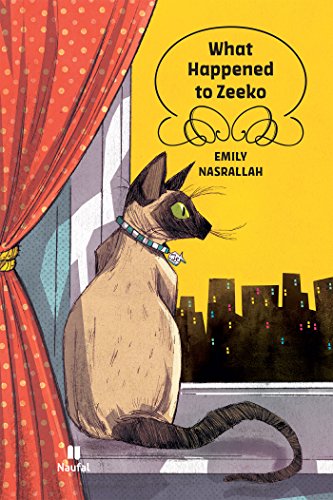
What Happened to Zeeko by Emily Nasrallah illustrated by Maha Nasrallah Kays

Standard
What Happened to Zeeko by Emily Nasrallah illustrated by Maha Nasrallah Kays

zeeko

Told from a cat’s perspective about living through parts of the 1982 war in Beirut, this translated from Arabic young adult book is 121 pages.  It reads to me more like a middle grades book, and while the story is fairly monotone and anticlimactic, I find myself oddly thinking about it and wondering about everyday events from different perspectives.

SYNOPSIS:

Zeeka as a young kitten is taken from his cat family and placed with a new human owner, Muna, a young girl who loves and cares, and seemingly understands her new furry friend.  The relationship between Muna and Zeeko is really the crux of the book as they get to know one another, trust one another, vacation in the mountains together and then seek refuge in the basement shelter of their building when the shelling starts and the bombs destroy the neighborhood.  

Through the relationship details, the reader learns a lot about what kind of person Muna is and why Zeeka is willing to perform a heroic act to try and help her escape the danger, while sacrificing his own comfort.  

WHY I LIKE IT:

I don’t know that I loved the book, but it was a quick read that I don’t regret spending time with.  It is translated from Arabic, so there are some hiccups, but nothing that impairs the story continuity or comprehension.  It almost starts out like an early chapter book with each chapter being two pages long.  But then all of a sudden a neighborhood cat is murdered by a group of naughty boys, and you realize that it is not for younger children. 

How the book handles war however, is very removed and not really detailed at all.  Much like The Cat at the Wall for about the same age group, the use of an animal to simplify the absurdity and details of war is used to show a different perspective, however, in this book there is no information given about the war.  The reader is never told who is fighting, why they are fighting, what sparked the fighting, nothing.  All we know is that there is fighting.  

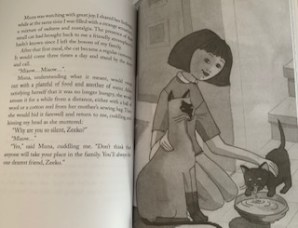
There is no mention of religion in the book, and I have no idea of the author’s faith, there really isn’t much culture in the book either. I didn’t learn much about Lebanon or the food or traditions.  I got the book from www. crescentmoonstore.com/ so I thought to review it as it seems available on Islamic websites.  Every dozen pages or so there are illustrations and sometimes there is a blank page before each new chapter and sometimes not.  There is a table of contents at the end of the book.

IMG_5938.jpg

FLAGS:

Murder of a cat, violence in general in terms of bombing and micro level of bullying and threatening.  

TOOLS FOR LEADING THE DISCUSSION:

I wouldn’t do this as a book club book, but I think if you are looking to learn more about Lebanon or point of view this book would have a lot of potential with guidance.  From a literary creative writing perspective the book would be a great tool to present complex events in simplified ways, it also would be a great read to get students to just look at things from different points of view.  If you have students that love cats and can handle the war aspects, this book would be fun for them.  In a social studies class if you are discussing affects of war or learning about Beirut in the 80’s the students will be able to fill in the gaps historically and politically.

IMG_5937.jpg


Secret Recipe Box by Helal Musleh illustrated by Nalan Alaca

Standard
Secret Recipe Box by Helal Musleh illustrated by Nalan Alaca

recipe-box.jpg

The publisher suggests this book for ages 4 and up, but I think it’s a bit long (30 pages) and detailed for that age group, and first grade and up will benefit more from this heartfelt story.

IMG_5872.jpg

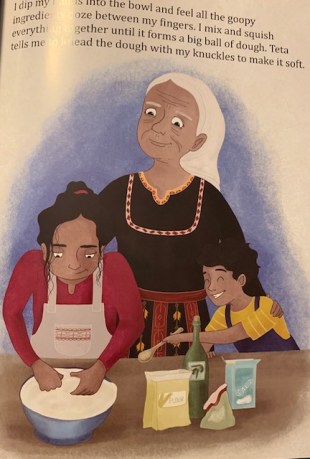
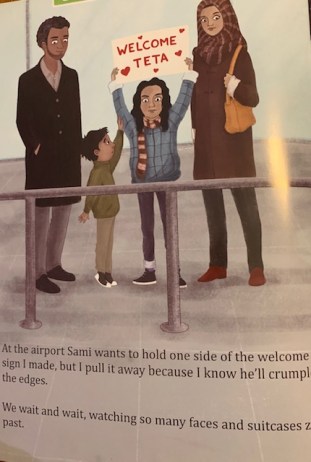
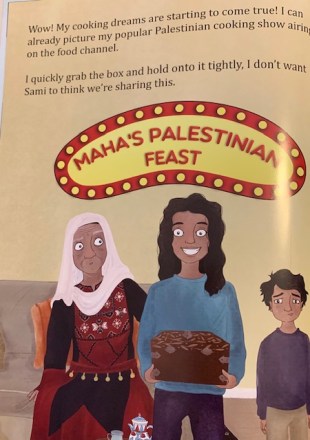
Maha is excited her Teta is moving from Palestine to live with her, her brother Sami, and parents in Canada.  Maha dreams of being a chef on a famous cooking show, and her Tata and her secret recipes will be a great way to practice.

IMG_5873.jpg

Her little brother Sami is always in the way though.  Whether it is wanting to hold a sign Maha has made, or is wanting to cook with her, she is annoyed by him at every turn.

IMG_5764.jpg

As Maha listens to Teta’s stories and learns about her life in Palestine, she starts to change in her approach to Sami and realizes that family has to take care of each other.

IMG_5874.jpg

After a day of cooking together, Maha, Sami, and Teta have made too much food and decide to go and share it with those in need at the soup kitchen.

IMG_5763

The book addresses kindness, changing, compassion, immigration, taking care of one another, multi generational lessons and love, stories, life lessons, and some highlights of Palestinian culture, food, clothing, and tradition.

IMG_5761

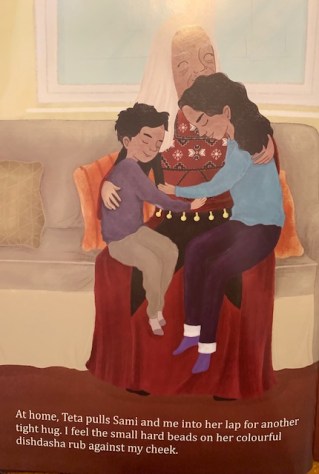
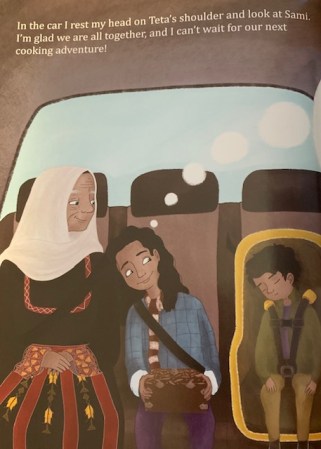
The book is warm and well done, with the exception of a few of the pictures which seem a bit off to me.  Overall, it is a sweet story that presents with a lot of lessons, but doesn’t force them upon the reader.  The character growth is gentle and subtle and will resonate with readers.

IMG_5762

The characters mention Halal food, and the grandma wears hijab even in the house, where the mother is shown wearing it at the airport, but not in the home.  The book would work for Muslim and non Muslim readers.

The Night Diary by Veera Hiranandani

Standard
The Night Diary by Veera Hiranandani

night diary

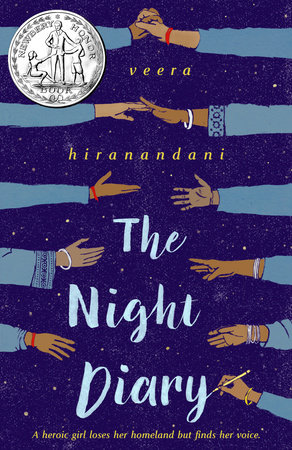
I was curious to see how partition would be presented in this book by an Indian Hindu author featuring characters who are half Hindu and half Muslim relocating to Hindu India.  Told in journal entries written by 12 year old Nisha to her deceased Muslim mother, the 264 page AR 4.5 book is wonderfully done, extremely compelling, and about so much more than the politics that birthed India and Pakistan.

SYNOPSIS:

Nisha and her twin brother Amil are opposites, yet they complete each other and care for each other in such a tangible and heart swelling way, that you can’t cheer for one while not rooting for the other one to find success and their place in the world as well.  As the twins turn 12 and Nisha is gifted with a journal from the families beloved cook Kazi, India and Pakistan too are about to come to fruition and Nisha’s journal entries detail her understanding of the larger events around her as well as her own struggles to come in to her own.

For Nisha words do not come easily.  She excels at school and loves to cook, but talking to people, or making friends eludes her and her longing for her deceased mother, make her a quiet reflective child.   She observes and  takes in so much around her, internalizes it, ruminates on it, and pieces it back together in a gifted way when she writes, that reading her entries, and the voice the author creates for her, is really amazing and fluid.  You feel like you really know Nisha and what makes her tick, what she fears, and how she thinks, you also get emotional attached to her and her world and find yourself surprised at how invested you are in not only her family’s successful migration across the new border, but also in her finding her voice and the confidence to use it.

Amil’s voice comes through Nisha, but her love for him and the way his strengths are her weaknesses and vice versa allows insight into the other family dynamics and attitudes to the two children.  Amil is an amazing artist, that suffers from dyslexia and does poorly in school.  He is weak and wiry, but fast, and he can talk and charm and ask all the questions that Nisha wants asked but can’t find the words for.  He and their physician father are rarely on good terms, as he isn’t the ideal strong boy with a medical degree in his future.

When it is decided that the family must leave their city where Muslims and Hindus and Sikhs live together and journey into Hindu India, the twins, their father, and their father’s mother, Dadi, must rely on each other to survive the riots and violence of the mass migration.  Nisha must also survive the understanding that with a Hindu father and Muslim mother there is so much about her own place in the world she doesn’t understand, and thus the journey is both an internal and external one, that will change Nisha forever.

WHY I LIKE IT:

I love that the protagonists voice is so steady and believable.  I truly fell in love with Nisha and felt her pain, happiness, anguish and overall got emotional for her, it was a rollercoaster.  The author does an amazing job of painting the politics of Jinnah, Nehru, Gandhi and Mountbatten in broad strokes, but believable ones to the understanding of a 12 year old.  She sees that one India held people of all faiths and that this breaking up of everything is leading to violence, upheaval, and horrors previously unimaginable.  She doesn’t understand why people had issues with her mother being of one faith and her father another, she loves her Muslim cook and loves listening to him pray five times a day as her paternal grandmother sings Hindu prayers in the other room.  She is both Hindu and Muslim and doesn’t see the contradiction within herself, suspending the reader’s own opinions on partition (if they have them), because how she sees it, does make sense for the story’s narrative.  The author takes Gandhi’s side of non violence and staying together, but balances very well and very intentionally that atrocities and humanity was seen from people of various faiths and political persuasions.  The role of British colonization and freedom from it, is slightly glossed over to the point of disservice, but again, being the target age of the reader and the age of the characters, I’m willing to over look it.  Families with Indian and Pakistani heritage will want to take the lacking information and help their children to fill in the blanks.

I love that the backdrop is the action of the story, but the relationship between the characters is truly the heart.  A lot of growth and compassion is conveyed very succinctly and powerfully.  Nisha wants so desperately to speak, but can’t, and her internal struggle and the pain she feels when she can’t speak up to help and participate in the world around her is gut wrenching.  As she confides in her diary, you realize that kids understand so much more than we adults often give them credit for.  The lesson is not lost on me.  I initially thought a book steeped in subcontinent history, with religious conflict and foreign words, wouldn’t appeal to a western elementary aged readers, after reading it, however, I now think this heartwarming story should be thrust upon them all.

FLAGS:

There is violence and death.  Not sensationalized, but detailed enough to set the tone of how serious the journeys were between the two countries when British rule stopped  There is some bullying and mention of the father smoking socially with friends.

TOOLS FOR LEADING THE DISCUSSION:

There is an Author’s Note, and a glossary at the back, and the inside covers have maps showing the journey the characters take.  I would absolutely do this as a Book Club selection for upper elementary, and will consider it even for middle school.  A lot of tools for teaching the book are available online, here are just a few:

Educator’s Guide: https://www.penguin.com/wp-content/uploads/2018/02/The-Night-Diary_Educator-GuideWEB.pdf

Children’s Discussion Questions: https://www.readbrightly.com/brightlys-book-club-for-kids-the-night-diary/

Classroom Bookshelf: http://www.theclassroombookshelf.com/2018/06/the-night-diary/


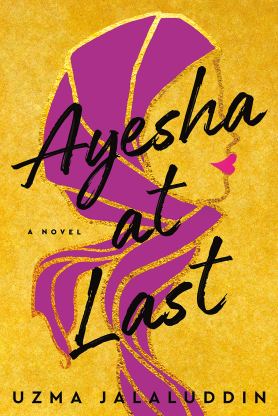
Ayesha at Last by Uzma Jalaluddin

Standard
Ayesha at Last by Uzma Jalaluddin

ayesha at last.jpg

This is not a YA book.  The back of the book and about 75% of the story could really make it seem ok for mature middle school and early high school readers, but I’m reviewing it as a “public service announcement,” that it really isn’t appropriate for a young adult demographic.  No where does the book claim to be YA, I’ve just seen a lot of people online ask if their 13-16 year old (ish) daughters would like it.  That being said, the 351 pages of halal romantic comedy a’ la Pride and Prejudice inspiration, really is a fun light summer read that I enjoyed and feel young college age girls and up will too.

SYNOPSIS:

Set in Canada, Ayesha is 27 and still sorting out what she wants in life while considering expectation, obligation, and passion.  Born in India, she came to Canada after her father died in secretive circumstances, and with a workaholic mom against marriage, a Nani who once studied to be a police officer, a Nana who quotes Shakespeare at all times, Clara, a best friend, and a flighty beautiful younger richer cousin, this cast of characters cheer her on, gently nudge her, and support her, giving a diverse and nuanced view of what a Muslim family looks like and how they interact.  Then throw in Khalid.  A very black and white character in his views on Islam, and culture and pretty much everything, and you have a storyline with a lot of potential, twists, and interconnections.  

Khalid works with Clara, lives across the street from Ayesha, and has an incredibly controlling mom who has just sent a marriage proposal to Ayesha’s flighty cousin Hafsa.  When a conference at the masjid forces Ayesha and Khalid to work together after meeting earlier, tension and sparks fly, and to top it all off Ayesha is pretending to be Hafsa. 

Khalid has his own team of supporting characters, Amir an alcoholic- womanizing-homeless colleague who for some reason is considered a friend, a sister who was banished to India and forced into an arranged marriage 12 years earlier, an Islamaphobe boss, and his own baggage regarding his father’s sudden death. 

Bring in the Wickham character of Tarek and the cast of characters is complete for all the action to go down at the mosque and give the Aunty Brigade a whole lot of gossip to process and spread.

WHY I LIKE IT:

The book is fairly predictable in the major story arcs, but there are a lot of twists that keep you hooked, and the author’s writing is smooth and fluid.  Being it is a loose retelling of a classic, I wasn’t expecting much and was pleasantly surprised how well the story would stand alone as an OWN voice piece about growing, maturing, changing and willing to challenge oneself. 

I love that every Muslim and desi character in the book is different and unique and not a cookie cutter of stereotypes and tropes.  Most of the females cover, but they are nuanced in how they do it, what it means, how they carry themselves etc., some shake hands with males some don’t, some are comfortable in bars, some are more reserved, some have never had a boyfriend, some have, and they really show the reader that Islam is a deeply personal conviction and the rules are interpreted and challenged differently for each person.  It also shows different male approaches and the internal struggles of doing what you want to do and what you know you should or shouldn’t do in a very realistic non preachy way.

My favorite relationship by far is that of Ayesha and Clara, I love that Ayesha’s non Muslim friend knows that Khadijah (RA) proposed to Prophet Muhammad (SAW) and jokes about rishtas and frequently asks “What would Nana do.”  Seriously, as someone of  Paki background, who started covering in high school, who is half American and proud to be Muslim, this is friendship goals!

The book is perfect for the beach, or a day at the pool, it is light and silly and really you just go with the outrageousness of some of the details.  There are a few thought provoking themes, but really it is just fun and sweet.

FLAGS:

I was really impressed how halal the main story romance remained, however a few of the side stories are a little intense for younger readers and don’t really appear until about 2/3rds of the way into the book.  Yes, Clara has a live in boyfriend and there are a few jokes and situations involving  hooking up, virginity and porn, along with some characters smoking and drinking and being around alcohol, but then the climax really puts more mature situations on center stage. 

Khalid’s sister had an abortion resulting from a pre-marriage relationship and thus was sent to India.  Amir shows Khalid a porn website where hijabi and niqabis strip and pose, a website that is discovered Tarek runs and Hafsa is featured on. The website and the pregnancy/abortion really are the crux of the book and it becomes a big portion of the last third of the book.  It isn’t that the content is overly detailed, it just what the concept presents.  It isn’t salacious or pornographic or titillating in presenting the information to the reader, but the mere presence of it in the story would make it inappropriate for a YA book or younger readers.

TOOLS FOR LEADING THE DISCUSSION:

No way the book could be taught in an Islamic school book club setting, however, if the teachers wanted to start a book club, this one would be a great candidate.


Bilal Cooks Daal by Aisha Saeed illustrated Anoosha Syed

Standard
Bilal Cooks Daal by Aisha Saeed illustrated Anoosha Syed

bilal cooks daal

Aside from me desperately wanting to get Bilal’s family a pressure cooker this 40 page book does a good job, and follows a reliable tradition of using food to introduce a “foreign” culture while simultaneously showing universal themes that show how similar we all are when it comes to family, meals, friends and feeling loved.  

Bilal’s favorite food is daal, lentils, and when he is out riding his bike with his friends, his father calls him in to help him make it.  Confused as to why Bilal’s dad would need to start dinner so early in the day, Bilal’s friends join in, in helping make the slow cooking traditional asian subcontinent dish.

IMG_5306

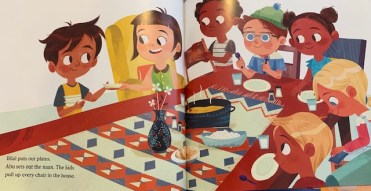
They line up the spices, they put it in the pot, and then they wait.  They put their shoes back on and play hopscotch, they go swimming, they go for a hike and it still isn’t done. 

IMG_5308

At one point Bilal is worried his friends won’t like it, but after waiting all day and gathering more friends at each activity, when the time finally comes they all dive in and love it.

IMG_5309

I love the diversity of the friends and that the dad is cooking and involving his son.  I also like that everyone is willing to try something new and give it a chance.

IMG_5307

The book would work for all kids ages 4 and up with the expressive colorful illustrations, diction, and amount of text on the page.  The book is 9×8 so it works well in small groups and at bedtime.  

IMG_5310

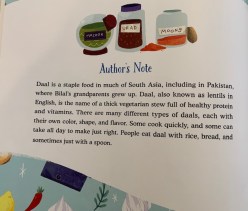
If you eat daal your kids will love seeing themselves in the pages, if you have never had daal there is a recipe at the end following an Author’s Note. 

IMG_5311

There is nothing religious in the book, and anyone from India, Pakistan, and Bangladesh could easily take ownership of the dish and story.  The Author’s note mentions that Bilal’s grandparents are from Pakistan and with a name of Bilal chances are he is a Muslim character.


We Hunt the Flame by Hafsah Faizal

Standard
We Hunt the Flame by Hafsah Faizal

we hunt the flame.jpg

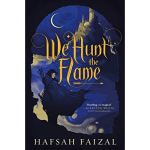
A mature upper middle school/high school aged fantasy romance, written by a nikabi and filled with ancient Arab imagery and Arabic words.  Story-wise it read to me like a mashup of Hunger Games and Ember in the Ashes, and while the overall story is good, the first 60 pages of world building were utterly confusing to me.  I told myself I would read at least 100 pages and then decide if I wanted to continue, luckily before I hit 100 pages I found a glossary of terms, characters, and places online, and the story moved from world building to character development and I enjoyed the rest of the ride.

SYNOPSIS:

In a world that is slowly being taken over by the dark magic that is the Arz, a deadly forest that surrounds the country of Arawiya, one girl in one of the five Caliphates, Zafira, dares to venture into the darkness to hunt game and prevent her people from starving.  Unfortunately the Caliph of her state looks down upon women and this regular heroic act must be done with her impersonating a man and keeping her efforts as covert as possible.  Life for Zafira is hard as she not only juggles this masquerade, but her father has recently been killed, her mother is mentally absent, her best friend is getting married, the Arz is growing, and the people around her are starving.

In more or less alternating chapters we also learn of Nasir, the ‘Prince of Death’ who is an assassin for the Sultan who has also now taken over as Caliph of Sarasin.  Forced to kill innocent people by his heartless father, Nasir also is mourning the loss of his mother,  as he tries to earn his father’s approval and find some validation for his current life.

The two characters come together when an immortal witch summons Zafira to retrieve a magic book from a cursed island beyond the Arz and Naisr’s father sends him to intercept her.  The majority of the book takes place on the island of Sharr, an island that is not only a location, but a living consuming character, and involves a variety of other enchanted beings from the various states.  An immortal Safin, Benyamin, one of nine elites, Kafirah, and Altair, a general from Sarasin that weaves them altogether and complicates everything.   This group, the zumra, must work together to save Arawiya, while constantly evaluating how much they can trust one another, as well as themselves.

WHY I LIKE IT:

I love the detail and was pleasantly surprised with the pacing.  The chapters are short and kept the plot from dragging for 471 pages.  Having read it and enjoyed it, I don’t know that I can properly discuss it though.  There are things that I just accepted and moved on with without pondering over, because I don’t know if I understood it well enough to even ask the question aloud.  That being said, I feel like I got the story and I understood where the characters were coming from and I closed the book feeling satisfied and willing to read the next one in the series.  The characters grow and develop and they have a satisfying arc without being overly cliche or predictable.  I think Nasir grows much more than Zafira and knowing that the next book is more focused on him, intrigues me.  Altair is by far the most fascinating character and I hope to see more of him as well.

There is a map at the beginning of the book that I referenced A LOT, and truly I have no idea why the glossary and character list was not included in the book, as it is desperately needed. There are a lot of Arabic words and I would like to get an Arabic speaker’s perspective on how knowing what the terms meant affected the story comprehension. 

I like that Zafira has to find confidence in shedding her cloak and stepping in to herself, but I felt it told it more than it showed.  Some of the states are governed by women, the founders are women, that I didn’t feel her fear in hiding her gender.  Similarly, I wanted more information on who/what exactly the Lion of the Night was/is and where the affinities come from.  Perhaps minor points, but details that kept me from immersing myself in this fantastical land and kept me feeling like an outsider peering in and trying to connect with events just out of reach.

FLAGS:

There is a lot of killing, and some of it gruesome.  There is abuse and details of branding and a tongue being cut out.  There is alluding of sexual acts but nothing defined, random comments between characters and implications of girls in a room in the morning.  There is kissing and an intense makeout session that is used to achieve a battle goal, but it is detailed and the characters reflect on how it made them feel in terms of desire, longing, wanting, etc.  So, while it is there, it is there for a purpose other than titillation, that is why I think mature middle school could handle it.  There is a scene in a bar, but none of the main characters drink.  There is some language, albeit not in English.

TOOLS FOR LEADING THE DISCUSSION:

I don’t think I could do this with 6th graders in my middle school book club, but I will definitely suggest it for the high school one.  I think there are a lot of ways things can be interpreted and because it is a fantasy there is no right or wrong which would make the discussion fascinating.  The romance I think makes the book lean to being more female oriented, but I think there is enough action that boys will also enjoy it overall as well.

Book Website: https://www.wehunttheflame.com/

The book just came out, so I’m sure in the next few weeks and months there will be more tools, more interviews, and more details of what is to come in the series.


From Far Away by Robert Munsch and Saossan Askar illustrated by Rebecca Green

Standard
From Far Away by Robert Munsch and Saossan Askar illustrated by Rebecca Green

from far away

Robert Munsch is a staple in most classrooms and libraries, but somehow, much to my embarrassment, I just learned about this book.  Originally published in 1995 with a different illustrator, I read the newer version that was rereleased in 2017.  I’m not sure how they differ, but they stem from an autobiographical experience of the co-author Saossan Askar, and her leaving of the war in Lebanon.  She wrote to the author and their letters back and forth are how the book came to fruition. 

IMG_4986

The 24 page picture book is an AR 3.5 and my guess it is because of the content a bit more than the reading level.  While it never gets graphic or sensationalized, she does leave a war zone of bombs and shootings, and the words may trigger fear in younger children.

IMG_4987

As the book progresses, the focus is much more on Saoussan settling in to her new life and the hiccups along the way.  From not knowing what anyone is saying, to sneaking out of class to go to the bathroom, and being frightened by a paper skeleton.  The book gives concrete examples that while silly, really show how someone unfamiliar with a new culture could be very confused and even scared.  

IMG_4989

The book has a happy ending with Saoussan adjusting and making friends and even becoming the best reader and speller in her class.  She also gets in trouble often for talking too much.  

IMG_4990

The book, like many in the genre of discussing war and refugees on a child’s level has its strengths and weaknesses.  The heart of the story I would say is wonderful, the illustrations lively and engaging, some of the transitions and details, however, are a bit abrupt and unsatisfying.  Once you know that it is based on reality and came about through letters, it makes more sense, but even that is a concept older readers will appreciate more than younger ones will.

IMG_4991

I checked the book out from the public library and I think does a great job of inspiring empathy.  It is vague as to what conflict is being left which makes it timeless in that I, unfortunately don’t see refugees disappearing soon.  The mom wears hijab, but there is no mention of religion in the book.
Here are the letters from his website: https://robertmunsch.com/book/from-far-away

From Far Away started with this letter:

To Robert Munsch
I am a little girl. My name is Saoussan. I am seven years old. I am in grade two now. I came to Canada one and half year ago. I didn’t know how to speak English at all. I was just sitting and listening. A lot of funny things happened to me.

Children were trying to talk to me, but I was not able to answer them. I began to talk a little by little.

I finished grade one and now I am in grade two. The teacher now is complaining to my dad that I am talking a lot in the class and I read and write a lot of stories.

One day I found a book called Thomas’s Snowsuit. I read it and I laughed with my family.

I went to the library and I brought some of your books. I enjoyed reading them. I even read them to my dad that he laughed so hard he could not stop laughing.

Please come to our school we want to hear a story from you and we want to see you.
I wrote back and asked her what “funny things” had happened. Saoussan wrote back telling me about her first Halloween in Canada:
To: Robert Munsch
Thank you for your letter. My teacher read it to the class and he said: I am not going to tell the class the funny thing that happened to her when she was in kindergarten and I am not going to embarrass you.

I don’t remember all of the funny things. But I remember one thing.

When I wanted to go to the washroom I didn’t know how to say I want to go to the washroom. That’s why I used to crawl to the door and when the teacher turns her head and looks at the other side I crawl under my friend’s desk and when someone opens the door I crawl out and go to the washroom.

When I come back from the washroom I wait beside the door and when someone opens the door I crawl in and go to my desk.

Once I crawled to the washroom. When I opened the washroom door I saw a skeleton. Then I screamed: Aaaaahhhhhhhhh!

Everybody came out. My teacher, Mrs. Garwan came, opened the washroom door and she tried to tell me that it is Halloween time and the skeleton is paper.

I didn’t understand her and I didn’t know what Halloween is.

She jumped up and down and danced around to explain to me that Halloween is just fun, but I thought the skeleton made her crazy and I screamed louder.

Then she hugged me to make me feel better and I jumped on her lap and the pee went down my knees. She put me down because she got wet.

Now I am in grade 2/3 and I am the best reader and speller in the class. This year when it was Halloween I weared a mask and a costume and we did a party at school. Then I went with my sister trick or treating to the neighbours.

Please, please, please, please, please, please, please, please come to our school.

I liked her letters so much that I decided to turn them into a book.
So Saoussan and I wrote a lot of letters back and forth and we made the letter into a book. Saoussan and I are both the authors and we split the royalties.