Tag Archives: Family

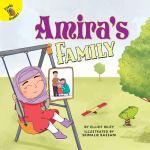
Amira’s Family by Elliot Riley illustrated by Srimalie Bassani

Standard
Amira’s Family by Elliot Riley illustrated by Srimalie Bassani

amira family

This 24 page, AR 1.5 book, is part of a series for emergent readers about different families.  The other books in the series focus on diverse family models, some that include a single parent, or lots of siblings, one in the series has foster kids, another adoption, one has two moms, so I’m not entirely sure why a refugee family is included in the group.  The family had to leave a dangerous home, but mom and dad and Amira, are not a “diverse” family structure, by the same definition used for the other books.  So, on its own it is nice to have a book for independent kindergarten and 1st grade readers, but as part of the collection, I find it a bit of a stretch.

5BD929BC-5490-4B6B-A729-CD85B227EE60

The book is divided into three chapters, or sections I guess, perhaps so that early readers can gain experience with a Table of Contents at the beginning.  There is also a Picture Glossary at the end along with a page encouraging Family Fun and a bit about the author.

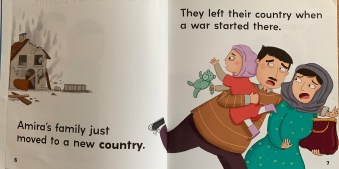
The book starts out introducing Amira, and her parents.  It then explains that they just moved to a new country, America, when a war started in their country.  It notes that Amira was sad to leave her home, and scared to move to a new place.

84893217-FB88-4ABC-8879-DA361636E17E

When Amira starts at school, the classmates welcome her and help her with the language.  It shows her teaching her language too, but it doesn’t look like more than random squiggles.  It then shows she likes recess and swings and slides, allowing the reader to see similarities with the character.

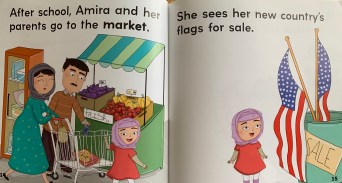
C2E8EF21-AC7B-4594-AA53-68B9764AB84DWhen the family goes shopping, Amira sees an American flag, buys it, and hangs it outside their home.  Amira loves her family and they love her, and it seems like they love their new home too.

C8E3398F-8A1B-4D40-8A79-4E1C52262E89

The illustrations are simple yet expressive, and show Amira and her mom in hijab.  It does not mention religion, or what country they left.

The story is basic, yet introduces young readers to the concept of refuges in a soft way.  It shows how the classmates are kind and the parents supportive of Amira.  I like that it also shows various emotions in the text and illustrations.

It might be making a bit of a political statement with the flag and national identity undertones, but I think it is a good thing to show that refugees can love a new country and be part of society, especially given the current climate toward immigrants.

I think the strength of this book is that it shows a Muslim character, and while meant for all new readers, Muslim children particularly will enjoy seeing themselves in a book they can read.  I’d check the library before buying the 8×8 paperback book, as it isn’t particularly memorable, but for the age group it serves a diverse and an inclusive purpose.

01FAE723-DA90-42EC-AC0D-B274B22515D9


Like the Moon Loves the Sky by Hena Khan illustrated by Saffa Khan

Standard
Like the Moon Loves the Sky by Hena Khan illustrated by Saffa Khan

moon

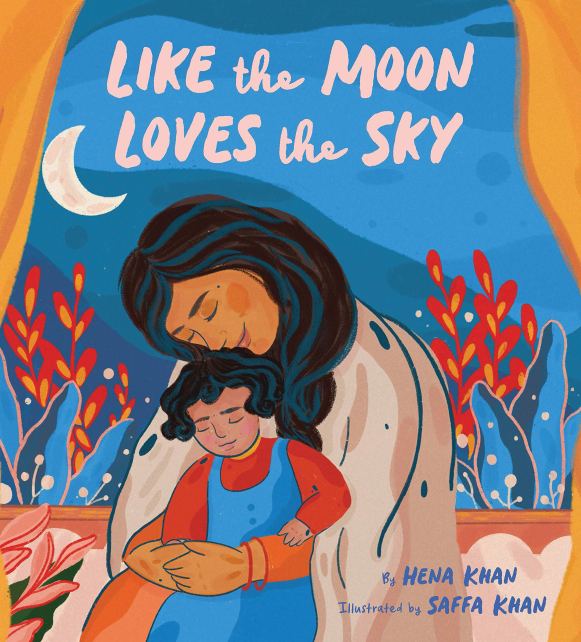
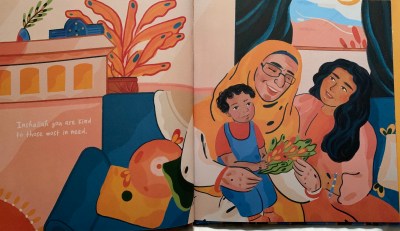
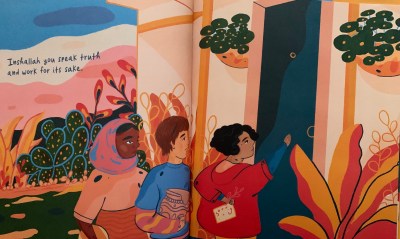
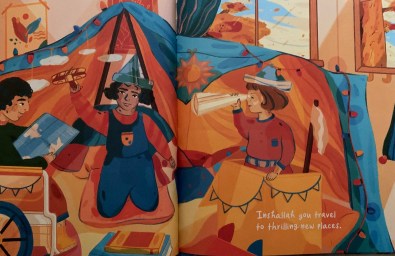
This 40 page book of prose begins each stanza with “InshaAllah” and reads as a beautiful prayer from parent to child.  Each two page spread is filled with warm vibrant colors and illustrations that radiate love while complementing the slow pace the book is meant to be read with.D900B288-5527-4519-8EDF-EE830D3A464D

The book is clearly from an Islamic perspective, yet I think any religious family would find beauty in the book.  The author has a note on the title page that defines inshaAllah as meaning God willing in Arabic and explains how it is a common wish/prayer for people of other cultures and faiths as well.  She also explains that that each line is inspired by the Quran, but universal for people everywhere.

94EE8AC2-8754-46F4-AF50-9CDB7BDFF145

Some of my favorites are:”InshaAllah you seek knowledge, reflect, and read, InshaAllah you speak truth and work for its sake. InshaAllah you have faith that won’t waiver or bend. InshaAllah you are kind to those most in need.”

287D37BD-90E8-4464-B075-524E842A4B43

The illustrations show a family that at times wears hijab and at others does not.  It shows multiple generations, and diverse characters in terms of skin color and mobility.  The illustrations at first weren’t my favorite, but they definitely grow on you.

70D903DA-9763-44CA-B765-2FE15AE34C10

Over all the story reads like a lullaby, and is soft and sweet at bedtime particularly.  The 10 x 10 size would make it work well in groups as well, and I could see it used to lull kids to sleep at nap time with great success for the youngest baby to early elementary.

F6B4AB6F-E13A-4C05-836B-24CD28BAC21C


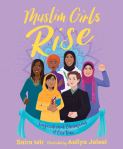
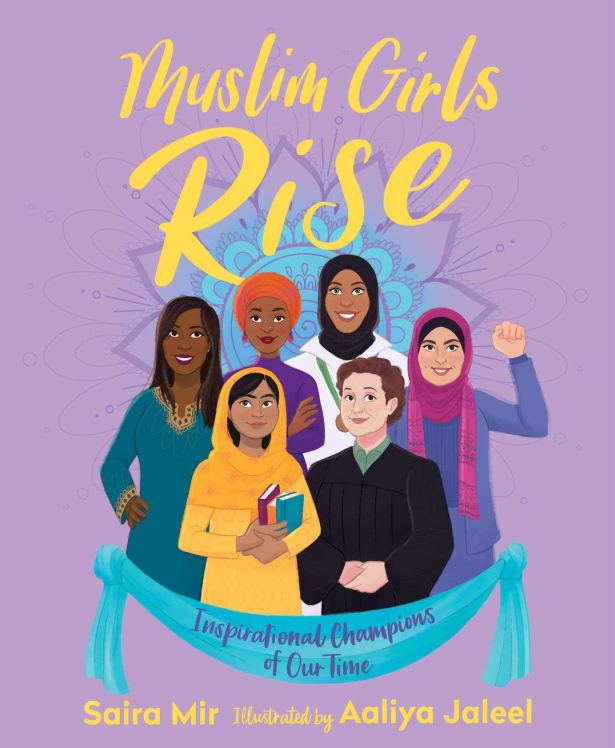
Muslim Girls Rise: Inspirational Champions of Our Time by Saira Mir illustrated by Aaliya Jaleel

Standard
Muslim Girls Rise: Inspirational Champions of Our Time by Saira Mir illustrated by Aaliya Jaleel

rise

Women you have heard of, some you are meeting for the first time. Some you like, some you disagree with, women that cover, women that don’t, some young, others older, some athletic, some academic, some a little bit of both.  One fictional, a few political, but in the end, all strong women of today, all Muslim, all unique, from all over the world, all known for paving the way for others to follow.

C51C5834-B3C5-4D19-94B3-99B21ADF83EA

In 42 pages, 19 females are highlighted and illustrated to inspire Muslim and non Muslim boys and girls alike, but really Muslim girls will get the most out of it.  Sure a female gets mentioned here or there in other compilations of influential people of our time, but this one, well, this one seems mostly for us.

2D8175C8-0798-4AC1-BF15-D0A9C284AEA9

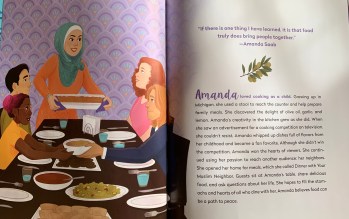
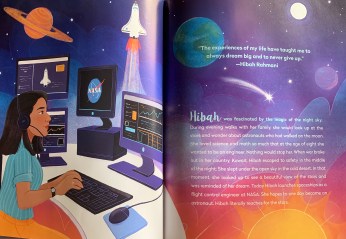
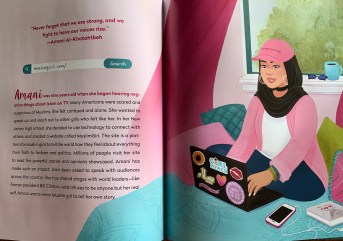
There are famous females in science, activism, fashion, film, sport, education, media influencers, make-up artists, you name it, and Muslim’s participate, so finally a book shining a light on the best of the best.  With each person getting a full two page spread, a few tidbits about who they are and what they are “famous” for are detailed in easy to read sentences that inspire, and if you haven’t heard of them before, enough general knowledge to get acquainted.  A few felt a little generic, but once you have a name, Googling them or researching them, is obviously, not difficult.

6D798E55-709C-442A-8DFF-4BA184C960E1

I wish there was a bit more information detailing who was chosen and why.  At first I thought it was  US or “western” movers and shakers, but then you have Maria Toorpakai Wazir, the tennis player in Pakistan, and Shirin Ebadi from Iran.  So then I thought ok, they are all contemporary, but Maryam Mirzakhani passed away in 2017.  Needless to say, one could argue that the list is arbitrary, and I think I would agree.

85FF7A9C-FD80-4F37-A1DE-B8726762E9CB

One could also argue, that these women may make history for notable things, but that they might say or do things that you might take issue with, and again, I agree.  They are people, they are fallible, and diverse, and have different perspectives and life experiences, but that’s ok, infact I think that might even be the point.  We all have different passions, and paths, and views and yet at the end of the day we should be able to lift each other up and inspire.  I think every person who reads this book will find someone that sounds or feels or looks like them, and that is a good thing, no, a great thing!

9C6EB606-F612-40BF-A947-092D2B76F1FE

My favorite was the Kamala Khan entry, because I didn’t realize the G. Willow Wilson was Muslim.  I erroneously assumed the other co-creator, Sana Amanat gave Kamala’s back story and home life its sense of OWN Voice, and I love that I learned I was wrong from a book.

2EC5EAF4-87F4-406C-B4D1-C95341536B66

The illustrations are right on and do an amazing job of conveying the character and the inspiration of the collection.  The book is much needed and I hope they do a similar style book for Muslim women in other time periods.

Special gratitude and appreciation to Gayartri Sethi (IG @desibookaunty) for gifting me this book for no other reason than to share the power and strength of women, and being a leader in that, by sending me a beautiful book.  May I learn from your generosity and pay it forward! Thank you.

The Light at the Bottom of the World by London Shah

Standard
The Light at the Bottom of the World by London Shah

light at the bottom

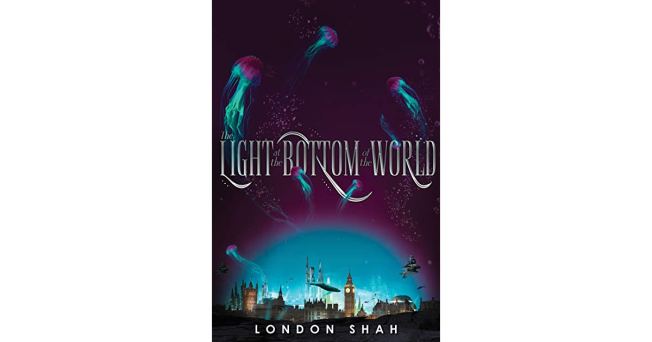
At the risk of sounding pretentious or like I have written a book before, sadly this really reads like a debut novel.  At 311 pages, there is a lot to love about this Muslim authored, Muslim protagonist sci-fi/dystopian adventure, but I have so many more questions about everything after reading the book, than I did before I started, that unless the next book (assuming there will be one), really steps it up- all the world building will have fallen flat with the lack of character connection I felt. At times I had to force myself to read through the lulls in the story, while at other times, I sacrificed precious sleep to read just a bit more.  The story is pretty clean and would have no problem letting my 5th grader read it, even while knowing it will have more appeal to my 8th grader.

SYNOPSIS:

It is 2099, and Earth has flooded forcing everyone to live underwater.  Set in London, 16-year-old Leyla McQueen, a submersible racer, lives alone with her dog Jojo.  Her mother has passed away and her father has recently been taken away to an unknown place for an unknown reason.  It is Christmas, and Muslim Leyla spends the day with her best friends, twins Theo and Tabby.  With futuristic technology, the wealthy twins show the reader what life under the sea entails and the world the characters now inhabit.  Pausing to recall the day the Earth flooded, New Years brings a huge race, the London Marathon, and Leyla somehow gets one of the 100 spots to enter the dangerous submersible race.  The winner gets whatever they want, and Leyla hopes to win, so that she might ask for her father to be released.

By opting to not harm someone, Leyla’s last minute reactions earn her the championship title of the race, however, her request to have her father freed is denied and instead she is gifted a submarine and the attention of the authorities who have ransacked her apartment, and stolen and destroyed her home.  Feeling like she has no reason to stay in London, she plots to escape the borders and go search for her father alone.  A family friend, she calls Grandpa, knows more than he has ever let on, and forces a friend’s son to keep an eye on Leyla, Ari.

Ari and Leyla explore the ocean, while Leyla whines and makes poor decisions, narrowly getting out of each situation, but not seeming to really learn her lesson.  As people appear and help them along the way, she finds where her father is being held, but not much else, and then poof, a few action scenes later to try and rescue her father, and Ari is captured and the book ends.

WHY I LIKE IT:

You have to respect the author who’s bio on the back flap of a Disney, Hyperion published book starts off with, “a British-born Muslim of Afghan descent,” and who dedicates the book to “my fellow Pathans.  We too are worthy of taking the helm.” I love it! Seriously, way to be so confident in who you are, and your story, that you own it and wear it with pride.  Truly, I felt empowered and can only imagine what Pathan girls everywhere would feel opening the book.

Similarly, Leyla, owns her Islam by praying, reading Quran, saying Bismillah before she races, and inshaAllah when she hopes in for things in the future.  She does get a bit close to Ari and doesn’t find that a problem.  She doesn’t cover, and there are no other Muslim characters in the book, but she is definitely religious, and it is seamlessly woven into her character without mentioning anything about what Islam is or stands for, but giving it authentic attention.

There are a few twists, one particularly large one, but not a whole lot of answers, or details.  There is no understanding as to why Leyla’s father has been taken, what happened to everyone other than those in the UK (especially Afghanistan, where Leyla presumably would have family), why so many people are willing to help Leyla find her dad, why Grandpa tells Leyla nothing at all, about Ari’s friend who died, and so much more.  So often it just feels that Leyla is whining and getting no where in her rash and stubbornness, but everyone seems to love her. Perhaps, everyone but me.  I really never felt connected to her, and her annoyingly ever-present dog.  There is more telling about how great she is or her father is, and very little showing.  I think if there is a second book, it could really elevate this one, but as it stands, so little is resolved, explained, or emotional resonance, that I don’t know that the characters or book will leave a lasting impression.

FLAGS:

Some language and a kiss.  There is death, and disease, and battles and government lies.

TOOLS FOR LEADING THE DISCUSSION:

I’m tempted to do this as a middle school book club selection, despite the one-dimensional characters, simply because it is clean and might introduce students to a genre they might not otherwise read.

Author’s website: https://www.londonshah.com/


Teach Us Your Name by Huda Essa illustrated by Diana Cojocaru

Standard
Teach Us Your Name by Huda Essa illustrated by Diana Cojocaru

name cover

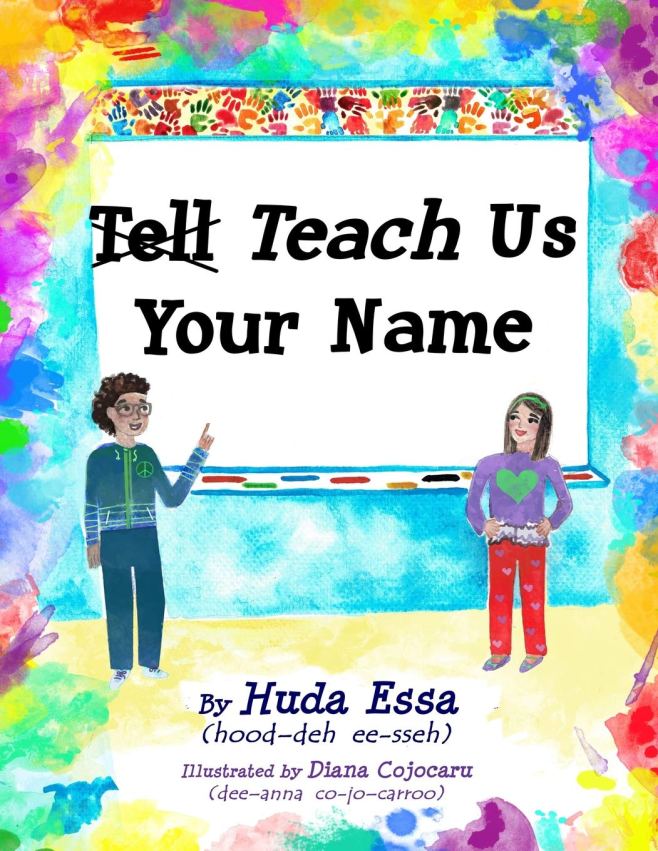
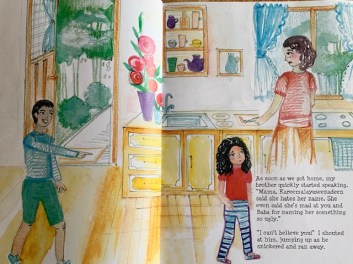
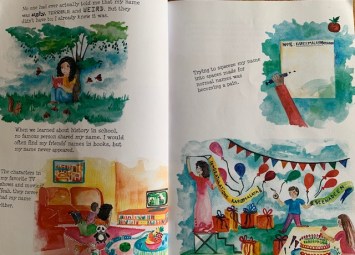
This book will resonate and empower anyone who has a “different” name, and hopefully provide insight and awareness for us all.  This 32 page picture book for grades 1st and up has a self empowering message, a confidence building approach, and problem solving tips to achieve a desired goal in a respectful way.  Written by a Muslim author, the book’s text is well done, unfortunately the pictures are inconsistent to me, some are beautiful and detailed, others seem rushed and unfinished.

IMG_0476

There are 20 letters in Kareemalayaseenadeen’s name, and the first day of school is such a stress for her.  She fears the teacher stumbling over her name, the other children laughing, and her unable to tell them how to pronounce her name correctly.  Her mom tries to explain that for some people the kids at school have hard names, and that for some people her name is easy.

IMG_0477

She reflects that in fact no one has ever made fun of her for her name, but that in history class she never sees her name, or on TV or in movies or on key chains.  She can hardly fit her name on her worksheets, and fitting it on banners is impossible too.  Eventually the kids kust call her Karma-Deen and even though she dislikes it, she is too shy to speak up.

IMG_0478

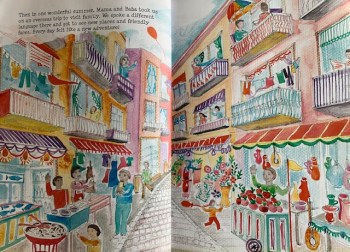
Over the summer, Kareemalayaseenadeen goes on vacation to visit family.  She doesn’t even think much about her name where everyone can pronounce it and say it with ease. Her Sittee though, has heard about her anxiety and sits with her to help her work through it.

IMG_0479

Sittee asks Kareemalayaseenadeen if she knows that her name means “excellent guidance” and that her name is a big part of her.  If she doesn’t like her name she isn’t liking an important part of herself.  She then urges her grandaughter to guide others on the proper way to pronounce her name.

IMG_0480

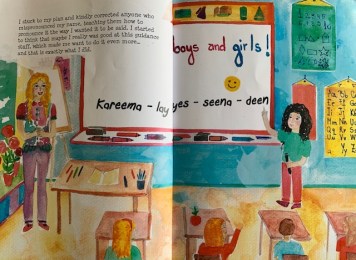
On the flight home, she ponders her grandma’s words and how to guide others to proper pronouncation, without being rude or settling on them shortening her name.  When she gets home she puts her plan in to action. And it works!

IMG_0481

When Kareemalayaseenadeen grows up, she becomes a teacher and each year she reads this book she has written (the one I’m reviewing) and asks her students to teach her how to say their names.

IMG_0482

The importance of how valuing someones name values the person and their family and culture is really one that as a society we have to keep working on.  We can say  names from Lord of the Rings, and Star Wars and Game of Thrones with no problem, so why can’t we try and pronounce someone’s name who is real and next to us and important to us? We have become lazy, and we need to do better, this book is sweet and kind and should really be read regularly as a reminder to us all, that names are beautiful.

IMG_0483

There is nothing religious about the book or even culture specific. There is a hijabi in the illustration of the market place in the unspecified “overseas country” and the name Kareemalayaseenadeen has Arabic bits, but a lot of names do as well, grandma is refereed to as Sitti, but isn’t defined, so the book is definitely meant for eveyone, especially those who will never find their name on a mug at a gift shop!


My Grandfather’s Masbaha by Susan Daniel Fayad illustrated by Avery Liell-Kok

Standard
My Grandfather’s Masbaha by Susan Daniel Fayad illustrated by Avery Liell-Kok

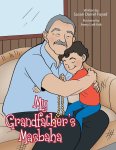
masbaha.jpgThis 20 page story is endearing and sweet for children aged 4 and up, with a great lesson.   At first I thought it was an Islamic fiction book, but after thinking about it, I’m not so sure.  Lots of faiths use prayer beads, although maybe only Muslims have 33, and the setting, Lebanon, is a pretty diverse place.  Regardless, the character’s names, and the lessons taught are universal and children will benefit from being reminded about how blessed they truly are, in a gentle loving way.

IMG_0113

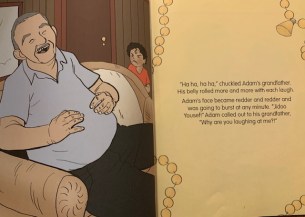
When little Adam’s friends go home and he has nothing to do, he enters his grandparents house stomping and complaining.  In response, Adam’s Jidoo, grandfather, starts to laugh.  This only makes Adam more angry.

IMG_0114

Jidoo Yousef then shows Adam his misbaha and explains that some people use it like an abacus to count, to mark prayers, some use it as decor, and that he uses it to remember God’s blessings.

IMG_0115

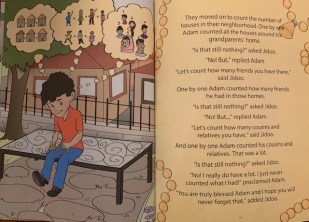
He and Adam, then go around and count all the blessings of toys, and people, and friends, and family, and food, and before Adam knows it, he is feeling blessed and thankful.

IMG_0116

The basic illustrations show the bond between Jidoo and Adam, but are nothing overly fabulous on the large 8.5 x 11 pages.  There is a lot of text on some of the pages, but it flows well and goes quickly.

IMG_0118

The book teaches a great lesson and if you get a chance to read it to your children, you definitely should.

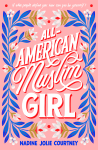
All-American Muslim Girl by Nadine Jolie Courtney

Standard
All-American Muslim Girl by Nadine Jolie Courtney

Book-Cover-All-American-Muslim-Girl

The power of own voice books is that while you may not agree with everything presented, you appreciate that it is being presented.  This 417 page high school young adult book is authentic and relatable and regardless of if you agree with the characters’ approaches, decisions, and understanding, you see and learn something about fictional characters that feels so real that you hopefully will find yourself in “real” life being a bit more understanding, kind, and accepting.

SYNOPSIS:

Allie is 16 and with her red hair and fair skin, she can pass for an all-American teen.  The only child of a college history professor and child development psychologist her family moves around a lot, but her dad’s extended family congregates in Dallas, and that is the anchor of family and love that warms the book.  Allie’s father Muhammad aka Mo is Circassian and his family speaks Arabic, including Allie’s grandma, Teta, who doesn’t speak any English.  Allie’s mom is a convert, but neither practice religion, and while Allie’s mom appreciates it, it is an incredibly hands off topic for Mo.  And Allie, well, she doesn’t speak Circassian or Arabic and knows nothing of Islam, and reinvents herself in each new school and city she finds her self in.

With Islamaphobia on the rise and Allie using her white privilege to neutralize a situation on an airplane, the reader sees as soon as they start the book, that Allie has a lot of skills to read people and understand how to handle complex situations, but that she hasn’t yet found her self.  As someone who can blend in and transform, the book is her journey to understand her heritage, her beliefs, what she wants in life and move toward finding her voice.  Much like Randa Abdel Fattah’s books which often turn the narrative from a Muslim girl rebelling against her faith and parents, this book has a young protagonist rebelling and turning to her faith.  The book seems to stem from a auto biographical place and the journey of learning about yourself, accepting yourself, and growing is universal.

Desperate to learn about Islam, Allie starts reading the Quran and hanging out with Muslims. While she knows Islam is not a monolith as she has family who cover, some that don’t, some that pray, some that don’t, some that fast, parents who drink, she still feels on the outside when she begins meeting with some Muslim girls at their weekly Quran study group.  As she gets to know the girls, she realizes how truly different Islam is for all of them, and how their experiences shape their views as well.  There is a convert, a black Muslim, a lesbian, some girls that cover, some that can’t read Arabic, some that find praying behind men misogynistic, some that feel unmosqued, they listen to music and read horoscopes, and Allie has a boyfriend.

Allie’s boyfriend, Wells, isn’t just incredibly cute and sweet, and accepting as he learns about Allie’s faith and her journey to understand it, but he is also the son of a cable shock jock toting that refugees should be stopped, and Muslims banned, yeah it is complicated.  As Allie learns more about who she is, she finds her self lying to everyone, and as she finds the courage to speak her truth, she must accept the consequences it has on those around her that she cares about.  Interwoven is a beautiful story line about her and her Teta’s relationship that is heartfelt and genuine and emotionally taxing when tragedy strikes.

WHY I LIKE IT:

I love that this book exists, and that it is written for Muslims and non Muslims alike. I think non Muslims will see that there are all types of Muslims, and we should be reminded that everyone has their own tests and is on their own path.  Paradoxically I love that it isn’t preachy, but desperately wish there was more emotional connection to Allah swt and RasulAllah, because honestly its a gaping void that makes some of the story fall flat for me.  I get that Islam is different for everyone, but while the book pushes so much that Allie wants to know about it to connect and fit in with her family, I feel like there isn’t much “spirituality” to her approach which kind of makes someone accepting religion seem lacking.  Her approach to prayer and fasting is almost robotic, and yes she says she likes it, but there isn’t any emotional resonance in her perhaps having an internal dialogue with God, or crying out to Him when her grandmother is in the hospital, instead it is read this passage from the Quran, or say this prescribed supplication, which makes her conundrum about her boyfriend, seem arbitrary.  Allie’s non believing, non practicing parents seem to have a softer spot for God, as Allie’s mom says something to the effect of it is hard to stop believing once you start, and Allie’s mom asserting multiple times that while she doesn’t practice she converted for herself, no one else.

I also kind of struggle with the attempt of getting every type of Muslim in the book to show that there isn’t a good Muslim bad Muslim dichotomy to the larger audience, but as a result seems to make the point that Islam can be changed to fit today’s world and that line makes me a bit nervous.  It is fiction, it is quite possibly the author’s own experience,  but I felt like the part of continued growth and working to follow the tenants of Islam got left out.  We all have our tests, and we all sin, but to just say ok, this is me and this is my Islam and stop there, halts the journey and character’s arc rather abruptly.

I love that the book really does a good job of laying out that there are problems, misogyny, racism, stereotypes, everywhere, not just Islam or religion, but in societal structures too, it is really shown across platforms and very seamlessly.  I like that a fair amount of side characters are fleshed out, and compassion extended even when opinions differ.  There is a lot of acceptance consistently shown from the characters and those that don’t show it are called out on it as well.

I wanted more on Allie’s dad though, to know what exactly his religious complexity entailed, I felt like I missed something, maybe I did, but just to say his relationship with religion is complicated or complex, left me wondering and wanting for details.

As it seems with so many of these YA books with female Muslim protagonists, the non Muslim boyfriends are absolutely amazing with their understanding, and patience (think A Very Large Expanse of Sea, The Lines We Cross, The Acquaintance), truly fictionalized high school boys, high five.

FLAGS:

There is Islamaphobia, kissing, drinking, death, racism, sexism, LGBTQ characters and discussions.  There is lying and talk of sex.

TOOLS FOR LEADING THE DISCUSSION:

This book is a bit advanced for middle school, the concepts and the acceptance of those concepts might not be conducive to Islamic School book clubs of high school level either.  That isn’t too say that kids can’t handle it or shouldn’t read it, but I think when presented from a school, it is assumed that you are endorsing an interpretation or practice of Islam, and this book might push that for some.

There aren’t a lot of author interviews or teaching guides, online, but if you do choice to read and discuss, you will be fine, there are a lot of layers, a lot to celebrate, and a lot to relate to in Allie’s story.
 

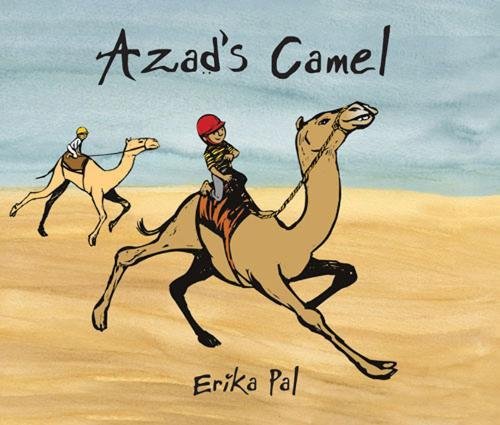
Azad’s Camel by Erika Pal

Standard
Azad’s Camel by Erika Pal

camel

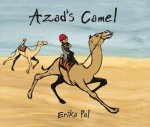
This beautifully illustrated picture book takes the reader in to the world of camel racing, children jockeys, mistreatment by adults, children being sold by their families and running away, all in a span of 40 pages and on an AR 3.5 level.  Yeah, its a lot for a kid’s book, but it has a happy ending and it does draw attention to an atrocity not often discussed or thought about.

IMG_8781

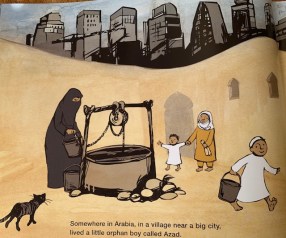
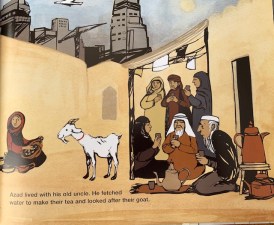
Young Azad lives with his old uncle in a village outside the city.  He helps take care of the goat and fetches water for tea in the mornings,  in the afternoons he plays with his friends.  One day he is doing handstands on a soccer goal post when a rich Sheikh drives by and sees him.

IMG_8780

The Sheikh comes back and convinces the uncle to let him take the boy to be trained as a camel rider to one day be famous.  The uncle agrees saying he can’t afford to keep him.

IMG_8782

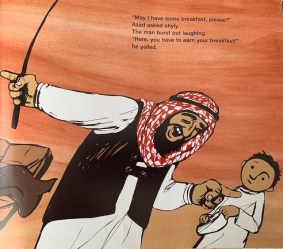
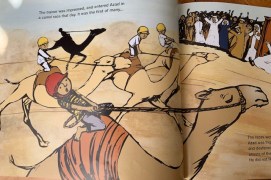
The Sheik takes Azad to the desert with other boys to live and be trained.  Azad learns that food is earned and chores are a must.  The races are dangerous and Azad doesn’t like them, but he is good and is forced to keep racing.

IMG_8783

One night the camel, Asfur, talks to Azad and the two plan to keep running past the finish line at their next race.  The pair are so fast that, they do just that, and no one can catch them.  They run through the city, and back to the desert.

IMG_8784

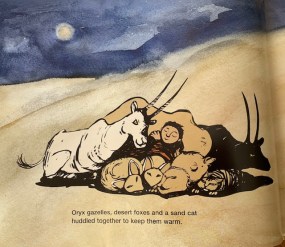
The other animals of the desert keep them warm when it gets cold and until a Beduin tribe discovers them and takes them in.  At last Azad and Asfur find a home.

IMG_8785

There is information about camel racing at the end including how robots are replacing child jockeys in some countries and how many young children are being returned to their families, school and a normal life.

IMG_8786

I like that the book takes on a real and sad occurrence, bringing camel racing and forced child labor in to light.  The story is truly written for younger elementary kids with short paragraphs on each page, large engaging illustrations, quick jumps in events and glossing over any truly graphic details.

IMG_8787

I do worry that stereotypes are reinforced with the use of calling the rich man who bought Azad a “Sheikh” and the Bedouins dancing at the end.  Culturally the book is a generic Middle Eastern country and doesn’t mention or emphasize religion at all with the exception of the women in the pictures being veiled.

I found the book at the library and think it has good information to discuss with your children, but I don’t know that I can see it being anyone’s favorite book, or a regular night time request.  While, yes, it does have a happy ending, you don’t really “feel” what Azad is going through, you are just glad he finds people that want him.


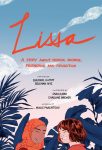
Lissa: A Story about Medical Promise, Friendship, and Revolution by Sherine Hamdy & Coleman Nye illustrated by Sara Bao & Caroline Brewer

Standard
Lissa: A Story about Medical Promise, Friendship, and Revolution by Sherine Hamdy & Coleman Nye illustrated by Sara Bao & Caroline Brewer

lissa-1440x2122

When I first started teaching I wasn’t a big fan of graphic novels, slowly I saw their benefit for struggling readers, and eventually I came to appreciate them as an enhanced tweak in story telling for everyone.  This book however takes the concept to the next level, for me anyway.   As the inside flap claims, it is a book “that brings anthropological research to life in comic form, combining scholarly insights and accessible, visually-rich storytelling to foster greater understanding of global politics, inequalities, and solidarity.” As a coming of age story of two friends at its core, yet taking on breast cancer, kidney failure, parental loss, different cultures, different religions and with a back drop of the Egyptian revolution, I’d say the book is meant for high school and up.  Not so much for content as for understanding and appreciation of all that went it to creating this ethnographic book.

SYNOPSIS:

Unlikely friends Anna and Layla cross economic, religious, and cultural differences to build a life long friendship.  The book is divided into three parts: Cairo, Five Years Later, and Revolution.  In the first part we see Layla’s family serving as the caretakers of a building and the two young girls bonding over pranks, arrogant tenants, and just being silly.  Anna’s family is American and the father works for the oil companies, thus they are financially very well off, however, the father is rather distant and the mother is dying of cancer.  The section concludes with the passing of Anna’s mom and the family going to Boston for the funeral.

Five years later finds the girls in college.  Layla in medical school and Anna at a university in Boston.  Layla’s father is suffering from renal failure and is unwilling to consider a transplant.  While Anna is trying to see if she carries the same genes as her mother and if insurance will cover it.  She also has to decide if she would want to have a complete double mastectomy, if she would want her breasts reconstructed, if she should do it now or later.  She gets a lot of opinions, but ultimately decides to find a way to pay for it and have it done.  Her father doesn’t understand, and Layla dismisses it forcing Anna to have to handle it alone.  But when news come that Layla’s father isn’t going to make it, she rushes back to Egypt to offer her support.

In the final section, the revolution has spread and Dr. Layla is helping those injured in Tahrir Square during the protests, and Anna is helping to identify bodies despite being attacked for being a foreigner and part of the problem.  Anna has kept the secret of her mastectomy from Layla and Layla assumes she has cancer.  At odds with their roles in the revolution, and with keeping secrets from each other and their differences in financial opportunities coming to a head, Anna returns to Boston.  When Layla’s brother is shot and loses an eye, however, Anna returns to Egypt and the two friends work to keep their relationship.

IMG_8951

WHY I LIKE IT:

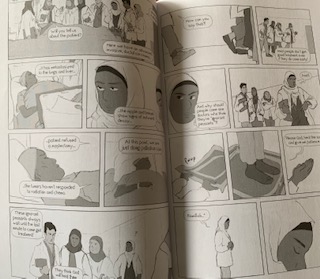
The book is grounded in so much conflict and turmoil, but fights hard to keep a character based narrative.  With two illustrators and two authors trying to convey medical approaches, two cultures, two religion, two friends, and a revolution, the last 70 pages of the 302 page book are details about how the book came about, interviews with the various contributors, a timeline of the revolution, discussion questions, key references and a teaching guide.  The book at times was confusing to me, and I’m not sure why, it quickly resolved itself or a flip back a few pages would clarify it, but I think some of the illustrations were just off enough that it complicated things.  Anna by and large is depicted oddly on a few pages along with her family as well.

IMG_8950

Layla’s family is definitely religious and at times has to challenge their thoughts to understand Anna and their own circumstances too.  I think it is handled really well and allows the reader to consider things without answers being clear cut, is it Allah’s will to not have a transplant and accept death as being written for you or to have the transplant and ask Allah to make it successful?  By and large the book poses questions through the juxtaposition of the two characters and the experiences they endure, and while it shows the choices they made, it draws the reader in to wonder what they would do in their shoes without judgement.  The book provides a lot of facts and leaves them there making it more thought provoking than a simple story.

The characters are often composites of real characters the academic author’s learned about, yet some are directly based on activists and leaders of the revolution.  The graffiti artwork is attributed and powerful.  There is a lot of information in the notes after the comics end.

FLAGS:

There is death and revolution, Layla’s brother is taking Tramadol, and their are sketches of breasts as Anna learns about her disease and prognosis.

TOOLS FOR LEADING THE DISCUSSION:

I wouldn’t do this as a book club as I don’t know how much middle schoolers would get out of it and the book is pretty pricey.  I would recommend people read it though as it gives a different perspective on numerous things many of us take for granted.

Home


Allies by Alan Gratz

Standard
Allies by Alan Gratz
allies.jpg

This is the second Alan Gratz multi-perspective historical fiction novel I’m reviewing for its inclusion of a Muslim character.  While in Refugee it seemed a natural choice to include a Muslim family, I was completely shocked that he would feature one in a WWII D-Day novel.  With numerous storylines spread over 322 pages the book is quick, fast paced, intense and emotional.  An enjoyable read for history lovers and curious kids fifth grade and up, it is an AR 5.6 and older kids will benefit from it too.

SYNOPSIS:

The characters and timeline are fictionalized to all take place on D-Day, June 6, 1944, as the Allied forces and French resistance come together to storm German occupied France on the beaches of Normandy.  Many of the details do come from history though as detailed in the Author Notes at the end of the book.

The book starts out following Dee, a German national who left for America to escape the Nazi’s and is now returning in a Higgins boat to fight them. Knowing no one will understand, including his friend Sid, a Jew from New York, he keeps this knowledge to himself and focuses on the task ahead.

Samira and her mother are the focus of the next mission and highlight the role of the French Resistance, the Maquis.  What makes their story more meaningful is that they are spies with the French Resistance, but they are French Algerians, not really a part of France at all, and they are Muslim.  In Samira’s back story we learn how she must remove her hijab and how she is treated different at school because Algeria and France are at odds.  When her mother is taken by the Nazis before she can deliver the message to the Resistance, Samira vows to do it and get her mother back as well.

19-year-old James from Winnipeg Canada is a paratrooper who volunteered for combat to feel empowered after years of bullying. His buddy in the story Sam is a Cree Indian from Quebec, who has few rights at home, and hopes to have more success in the military.

Medic Henry is scrambling along on the beach helping anyone and everyone he can.  Having left behind a segregated US, even the military has reservations about African Americans saving and serving. As he performs one heroic act after another being questioned and doubted and insulted all along the way, readers see how ridiculous and infuriating racism is on every level.

We meet Private Bill Richards who drives a Sherman tank and is following in his fathers WWI footsteps.  But who is unfortunately killed before reaching Bayeux.   And finally we meet Monique Marchand, a French 13 year old girl, who gets caught up in the invasion because she left her swim suit in the beach hut the day before and has returned to retrieve it. Determined to do something other than cower in fear, she starts helping fallen soldiers and meets up with American journalist Dorothy, a strong woman determined to not be stopped on the basis of gender.

All the story lines criss and cross as the invasion is a chaotic mess and everyone is dropped, disembarked, or arriving in the wrong place at the wrong time.  Surviving the day is an immediate challenge and not one that everyone will succeed at.  The larger success of the mission will depend on some lucky breaks and a whole lot of teamwork.

WHY I LIKE IT:

I love that the story somehow isn’t political at all in the traditional war story, war strategy sense.  But the strength at least for me, wasn’t the horrific battle at hand, which is truly violent and abhorrent, but the relationships between the people.   The realizing what is driving them, what matters and more importantly how hard our prejudices are.  The larger story of the Allies shows British, Americans, and Canadians coming together to defeat he Nazis, but yet, a girl, an African American, and a Cree are treated as “other” irregardless of how beneficial they are even in matters of life and death.

As for the story of Samira, she is a tough girl, both clever and brave.  To have a Muslim in  an American/westerm story of D-Day and a young girl at that, to me was pretty remarkable.  There isn’t mention of faith or anything other than that she is told to take off her scarf and continues to wear a small kerchief on her head anyway, but for Muslim kids all over, this character and how she behaves will spark a sense of extra pride in the Allies success over Hitler, just as the other minority characters will for their representation in such a dramatic event.

FLAGS:

There is a bit of mild profanity.  There is violence and death, and blood, not too bad, but the point is clear, the beach isn’t pretty.

TOOLS FOR LEADING THE DISCUSSION:

I think this book would be a great supplement to any WWII history lesson.  There are great resources at the end, and maps at the beginning and a high energy, short chaptered book that doesn’t skimp on character building or war intensity.

Author’s website: http://www.alangratz.com