Tag Archives: Afghanistan

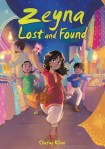
Zeyna Lost and Found by Shafaq Khan

Standard
Zeyna Lost and Found by Shafaq Khan

I think I needed this 336 page middle grade book that gets parents out of the way and lets a trio of kids  hop from country to country to solve a mystery, track down the bad guys and save the day. Set in the 1970s in the UK and on the Hippie Trail between Lahore, Pakistan and Istanbul, Turkey, the book is a fast paced read with humor, heart, and adventure.  I absolutely love Zeyna’s snark and voice, and her relationship with her brother and cousin, ground the story and make you cheer for them even when their antics are incredibly dangerous and improbable.  As an Islamic school librarian, my one critique with the book is that I wish there was more/any Islam. I, at one point considered that they are not Muslim, and I’m not sure what the author identifies as, but she does thank “Al-Barr, for all that is good” in the acknowledgements, and Zeyna does mention an Eid party in passing, so while I’m still on the fence, I’m going to assume they are all Muslim.  Major beats in the plot are meeting at both the Badshahi and Blue Mosque, but none of the characters ever pray, or mention the names of prayers when the athan is heard.  When they see women in burkas and chadors, Zeyna stares, not connecting the clothing to hijab, that one would hope she would know. There is only one salaam in the whole book, and the story is predominately set in Pakistan, Afghanistan, Iran, and Turkey. Granted I am sensitive, but it almost feels like a deliberate exclusion to the point of going out of the way to not let those details be present.  There are plenty of Urdu and Punjabi words and titles and cultural commentary, so it doesn’t seem that the author was concerned about watering down authenticity, a theme of the book infact is finding your place and accepting yourself.  All that aside I really enjoyed pickpocketing, imaginative, determined, sarcastic, loyal detective Zeyna, and I think kids will join me in hoping this is the first in a series.

SYNOPSIS:
Zeyna is 12, and likes to imagine she is a detective on a case, sneaking and snooping, and roping her inventing younger brother Mahir to be her Watson. The city is on edge with the theft of the Shirin Jewel, a large Persian ruby, a case involving the 15, that Zeyna would love to solve.  When she sees a man with knife in London, who later seems to be following her and her mum, and then drops a paper with their street name on it, Zeyna is convinced this her chance to prove her self. A sudden trip to Pakistan though dampens her mood as the clues to the case will be left in the UK. She doesn’t stay down long though, as her parents start acting peculiar in Lahore, meeting with strange people, lying about why they suddenly made the trip at all, and when the police show up at the familial home to arrest her parents, they all discover that her parents have vanished.  Zeyna realizes her parents and the events in London are tied to the missing ruby, and with the help of Mahir and their cousin Amina they set off to solve the case and find her parents.

WHY I LIKE IT:
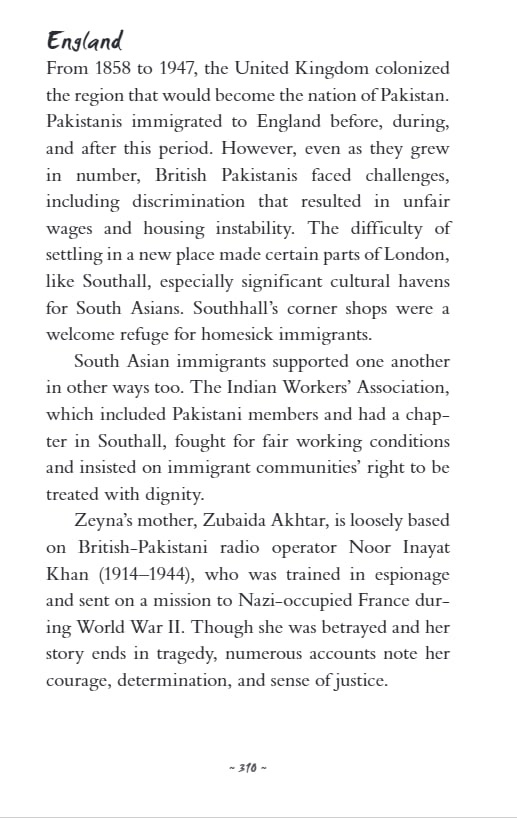
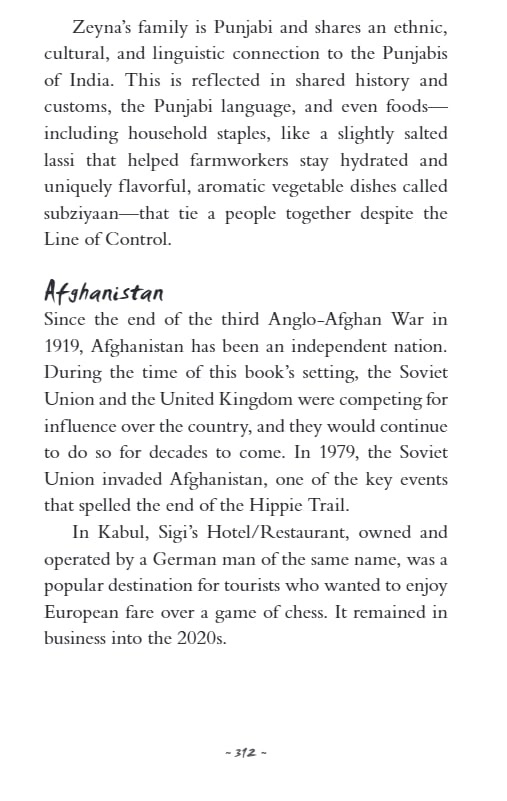
It’s hard to review a book like this without giving the twists and climax and resolution away, but more than once I gasped in delight when something happened on the page, and it crystalized where the book was going in my head.  Sure there were some particularly outlandish connections and a few plot holes, I even Googled when fax machines were invented, but I had a blast reading the book.  I loved the historical backmatter discussing the events in post partition Pakistan, a year before Bangladesh was independent, Soviet Union and UK competing over influence in Afghanistan, the discontent voices in Iran toward the shah, and the role of the Pudding House for messages in Turkey.  There are also discussion questions, a glossary, acknowledgements, and about the author at the end.

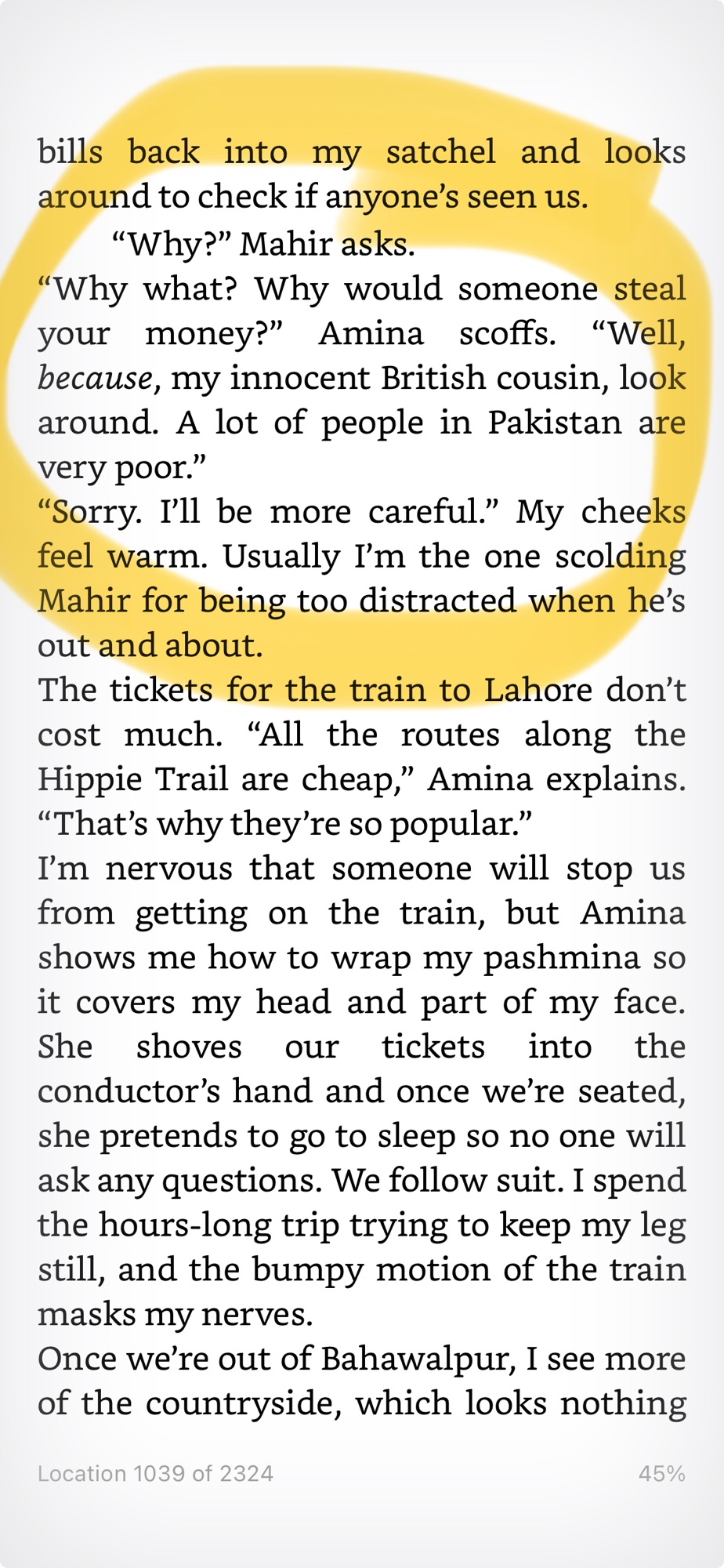
One tiny concern was the assumption that money could be stolen because the people around them are poor, it is just one paragraph, it isn’t a constant in the book, but it struck me as odd and stereotypical, and really not needed.

FLAGS:

Lying, stealing,  deception, pretending to be someone you are not, breaking and entering, eavesdropping, snooping, its a heist book!

TOOLS FOR LEADING THE DISCUSSION:
This would be an awesome book club book or novel study read, I can’t wait for it to be released in a few weeks so that I can have my kids read it.

Game Changers: Stories of Hijabi Athletes from around the World by Charlene Smith illustrated by Natalya Tariq

Standard
Game Changers: Stories of Hijabi Athletes from around the World by Charlene Smith illustrated by Natalya Tariq

This 80 page compilation of hijabi athletes from around the world focuses on 13 women that the author interviewed first hand.  Featuring athletes, sports and even countries that might be relatively unfamiliar to the targeted middle grade audience, the book will appeal to both boys and girls, Muslims and non Muslims.  Many included were the first to play with hijab, or the first female to play in their country, but each journey and experience is unique.  Each hijabi athelete and their sport is introduced to the reader over four pages with beautiful artwork, and pulled quotes.  A common issue I have with these types of books is wondering how those featured were chosen, and while this book doesn’t articulate it clearly, at least it sets some parameters in the forward and introduction, that for me at least, allowed me to appreciate the book that much more.  The book ends with four pages of “More Hijabi Athletes” that could have been included, as well as information on perseverance, hijab, modest sportswear, a glossary, resources, index, and acknowledgements.  There are real photographs included at he beginning and end of the book of various featured athlete in action. 


I can’t really review this non fiction book in my normal style, so I will simply say that the writing is clear and easy, at times details seemed overly vague, but to keep the continuity of the tone, and the reader engaged, I understand why specifics perhaps were not included.  In the first feature, I wish the infamous photograph would have been shared so the reader could see for themselves what the text was discussing.  Overall, this resource to inspire our Muslim girls is much needed and beautifully done.  I absolutely love the artwork. LOVE IT. The women are beautiful, strong, and the artwork conveys that for each of the 13 athletes.

The athletes featured:

Egyptian beach volleyball player Doaa Elghobashy
UAE hockey player Fatima Al Ali
Basketball player Fitriya Muhamed
Afghani soccer player Hajar Abulfazl
Syrian-American runner Rahaf Khatib
Basketball Player Kiandra Browne
Pakistani weightlifter Kulsoom Abdullah
Parkour Sara Mudallal
Downhill Mountain Bike Racer Sumayyah Green 
Iranian Triathlete Shirin Gerami
Kenyan Archer Shehzana Anwar
Wrestler Latifah McBryde
Skateboarder Nadeen Alhamad


Folktales for a Better World: Stories of Peace and Kindness by Elizabeth Laird illustrated by Mehrdokht Amini

Standard
Folktales for a Better World: Stories of Peace and Kindness by Elizabeth Laird illustrated by Mehrdokht Amini

img_5848-1

The presentation, the tone, the vibe, the seven countries and stories selected, the illustrations and large size really make this book enjoyable.  With folktales from Ethopia, Sudan, Palestine, Yemen, Afghanistan, Syria, and Uighur, some contain Islam and Muslims, and some do not, but the messaging and lessons are for all.  Folktales are often used in classroom settings, and I appreciate that this book can be used in bits or all together.  Most of the selections are 6-8 pages, but contain large illustrations to help the readers engage with the lessons being conveyed. Having read a few books by the author, I think it is clear that the people represented in this collection is very intentional, and these old stories from the occupied, the oppressed, and the war torn in contemporary times, really show the universal humanity of stories, kindness and peace.

The introduction from the author sets the tone before the stories begin. The Dog Fight from Ethopia is a tale of conflict and perspective and pride.  Allah Karim from Sudan is trusting that Allah swt will provide, compassion for the homeless, and charity.  From Palestine, the folktale True Kindness shows the value of hospitality.  The Next Sultan from Yemen focuses on fairness and justice as does The Emir and the Angel from Afghanistan. From Syria the tale of The Woodcutter and the Lion focuses on friendship and being selfish, and finally The Nine Princesses of Kashgar, a Uighur story, shares a story of defending your land against occupiers.

Early elementary kids will enjoy the tales and relate to the lessons, they will get lost in the pictures, and recall the messages long after the book concludes.  This book reminded me of how few folktales I’ve read outside of teaching, and I look forward to sharing this at bedtime, story times, and gift it to teachers and librarians to do the same.  You can purchase the book here from Crescent Moon Store and save 10%.

If You See a Bluebird by Bahram Rahman illustrated by Gabrielle Grimard

Standard
If You See a Bluebird by Bahram Rahman illustrated by Gabrielle Grimard

This cultural picture book shows life of an Afghan family before fleeing the country and after.  In the flashbacks the women are wearing hijab, now in the west they are not.  I debated if I should do a complete review or just a Muslim in the illustration tag, and ultimately decided to do a review so that I might document what I fear is a new trend.  In the last ten years most Afghan books addressed international involvement, the Taliban, and refugees, but seemed to still feature Islam and the characters as Muslim.  This book carries the refugee theme, but Islam is seen in the “before” illustrations only.  Another recently published book, The Carpet: An Afghan Family Story, similarly contained no Islam, but interestingly also kept it out of the illustrations.  Realistically, I know that two books don’t make a trend, but with the change of politics in Afghanistan, I think the OWN voice narratives are important to watch and be aware of.  In the past an Afghan book would be conflated with also being an Islamic rep book, and I don’t know if that will continue to be the case.  I also don’t know what the take away impression would be upon a kid if they were to pick the book off the shelf.  Would they find the head coverings in the unsafe country and the lack of hijabs in the safe country as a message about Islam, would they understand the politics, would they even notice?  The sweet story of a boy picking berries with his grandma involves music, wishing on birds, and reflecting on the violence that forced them to leave Afghanistan.

The book starts with Ali and his Nana waking up early to pick blackberries.  They don’t want to wake his exhausted parents, and quietly pack a lunch and get on their bikes and head out.  The blackberries are not as sweet as the mulberries he remembers from Afghanistan.  Suddenly he misses home.

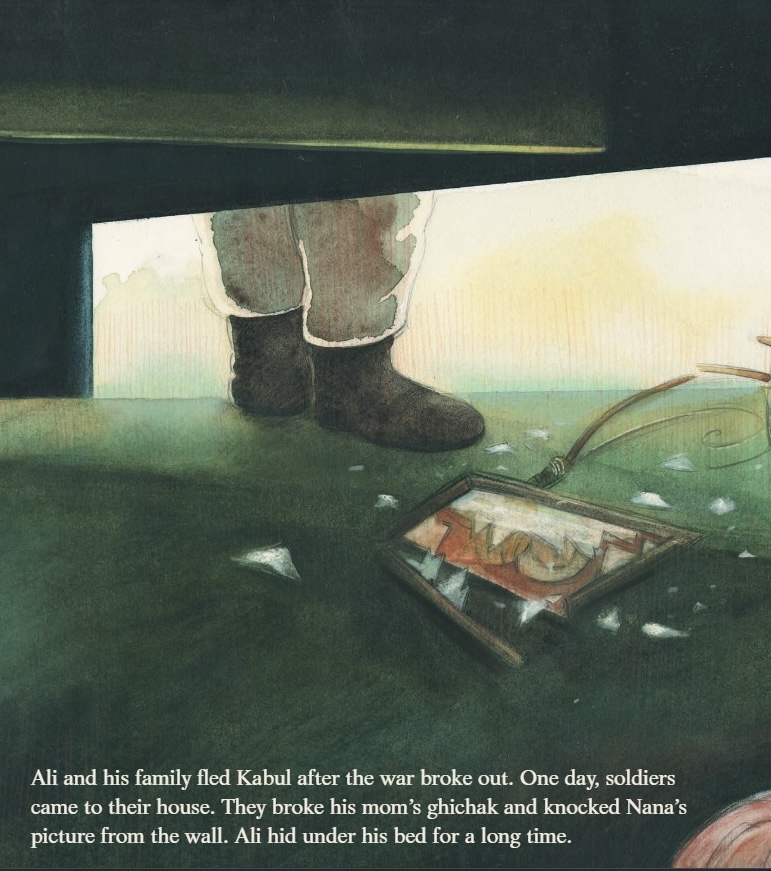
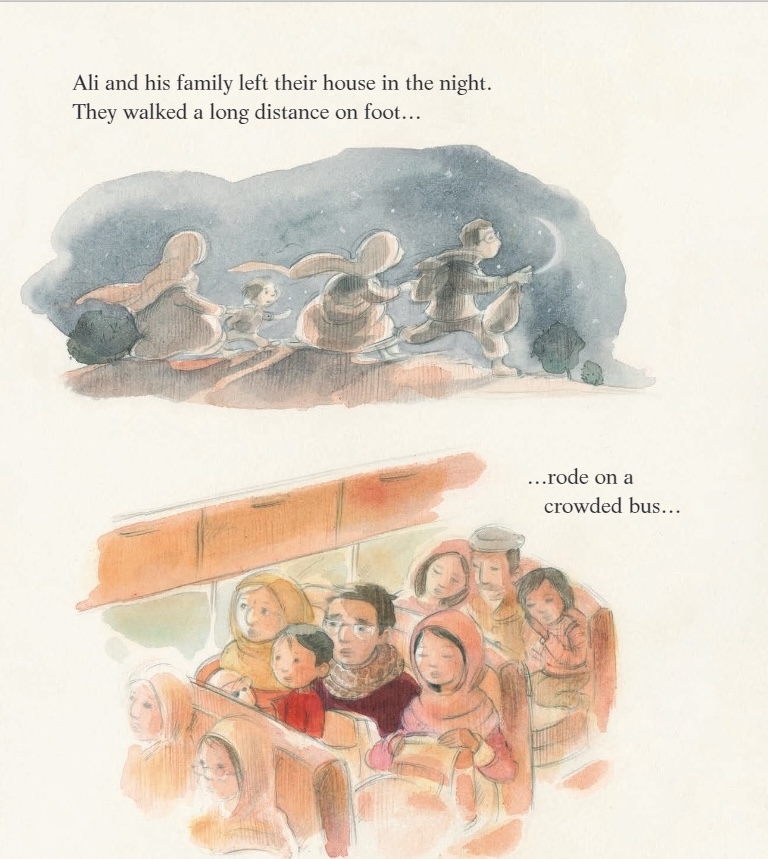
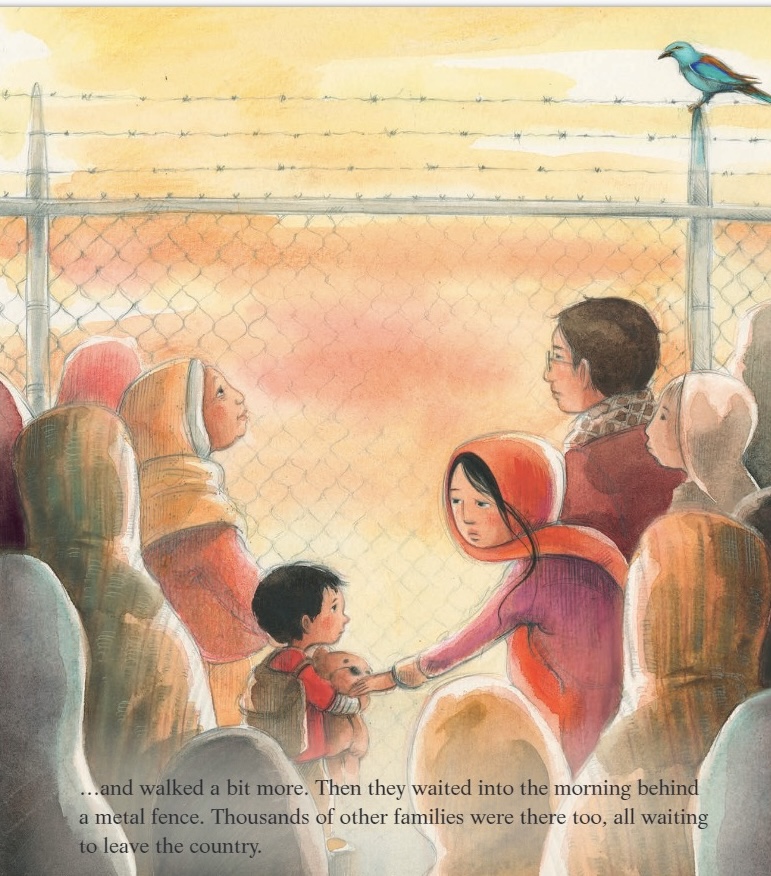
The family left Kabul after soldiers came to their house and they knew it wasn’t safe anymore.  He couldn’t bring both of his stuffies and the family left on foot at night.  They rode a bus and waited behind a fence before they boarded a plane.


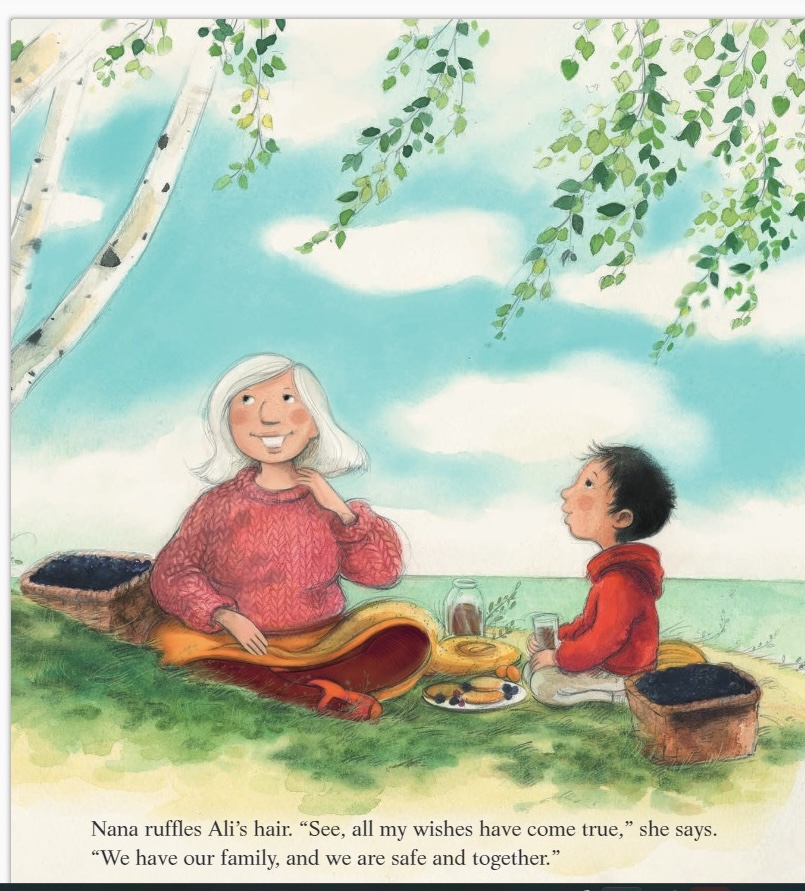
Back in the present the two eat their picnic, when a bluebird arrives, Nana tells Ali to make a wish before it flies away.  Nana says all her wishes have come true: the family is safe and together.  Ali is whisked back to sitting beneath the mulberry tree with his parents laughing and his toys around, he wishes for home.  Nana explains that home is not a place, it is the love you have.  The book concludes with Ali appreciating his loving family and his new “home.”

Free Radicals by Lila Riesen

Standard
Free Radicals by Lila Riesen

radicals

This contemporary 400 page YA book about an American Afghan girl dealing with life and boys and worrying about family in Afghanistan since America’s withdrawal from the country, is written by an Afghan Australian, raised in America, and thus it seemed like a book I should review from an Islamic lens even if the blurb on the back seemed a little stereotypical with the oppressed-can’t-meet-with-boys theme.  Well, suffice it to say the blurb on the back is terribly misleading and this OWN voice book lightly sprinkles in Islam as cultural adoptions and there are flags, oh so many flags.  In the first 20 pages alone there is normalizing and discussion of sex, watching pornography, voyeurism, a females breast being exposed, drinking alcohol, a trans character changing, cheating, gossip of the main character circle jerking three guys, partying, a boy sneaking over, parents vacuuming to cover the sounds of their son and his girlfriend in the bedroom, attempted sexual assault, and the book doesn’t just say it is young adult, it specifies, 7th grade, ages 12 and up! I’m reviewing it as an Islamic School Librarian, but I am not ok with any 12 year olds reading this, and worry the American flag on top, the masjid on the bottom and the young girl on the side, just might entice a young reader to start reading, and that is alarming. The characters do not identify as Muslim, the grandpa known as Baba is a “conditional Muslim” he skips Ramadan, celebrates Christmas, and only prays a few times a week, so the drinking and the dating are really not concerns for the characters. I kept reading to see if there was some religious arc with the family in Afghanistan possibly coming, but SPOILER, I’ll save you the read, there is no Islam, a Quran is mentioned to be stored in a box with old shoes, the dad starts reading the Bible and considers “converting” and there are make-out scenes, a pan sexual character, vandalism, sexual assault rumors, just to name a few.  The writing is entertaining if not chaotic at times, but I cannot recommend this book for Muslim readers, and have reservations about some of the stereotypes for non Muslims, I will stay focused on the Muslim reader in this review, however, since the book is OWN voice, and just because I don’t like or agree with various aspects, does not mean that they are not accurate or real.

SYNOPSIS:

Mafi is 16 and since rumors about what she did at a party with three guys started circulating she finds herself friendless and unseen.  She has become the dealer of vengeance, working to ensure people get what is coming to them when the notes left in a tree are verified.  Living each day in sweats and hoodies she dreams of  Jalen, a basketball player, being more than just her brother’s friend.  When she starts to get sloppy in her justice “ghost” dealings she finds herself emotionally involved and her world changing as a result.  There are numerous side characters and side stories that keep this book buzzing: her parents relationship falling a part, her sister away at college, her grandfather’s dementia, her brother Rafi and his girl friend Bian, Rafi getting signed by a college for basketball that wants to make public his Afghan roots, a father who wants them to always deny their Afghan roots, Jalen’s own drive to be signed with a college, Jalen’s dad’s PTSD, motocross, driver’s license, the kid next door that smells of smoke, piercing noses, Brit, a popular trans activist with no sex drive who befriends Mafi, and rumors and gossip that poke and complicate every aforementioned character and relationship.

WHY I LIKE IT:

I have issues with the blurb on the back, the cultural/religious restraints are really non existent in the book, the SOL tree is only brought in for two acts of vengeance, and the age demographic is just too young to read about the sexual exploits, that are not detailed but are very present and normalized.  I have issues with the religious references that are present anecdotally for the dismissiveness it implies, but it is not an issue for the characters- because religion is not a part of their lives, and honestly- ultimately, I’m glad it was kept at arms length, because with so many “haram” story lines, it would be problematic to see the characters identifying as Muslim.  The writing at times was really engaging and smooth and I was shocked at how fast the pages were flying by.  At other times it seemed too chaotic and underdeveloped.  Keying a car seems such a sad planned act of vengeance, I wanted to know what acts she had done in the past other than the two mentioned in the book, there was a lot of set up to go deep on Bian, or Jalen’s dad or Mafi’s loss of friends, but it all just fizzled.  I never felt emotionally tied to the family in Afghanistan, or the dad on the deck.  I wanted to understand some of the walls the family established so that I could feel what the characters were feeling- and so often it just wasn’t there.  I absolutely loved the grandfather and his quirks and the sibling relationship of Rafi and Mafi as the story progressed.  After the initial shock value, the book really did settle down and have a lot of heart, but those first 20 pages were aggressive, and the last twenty seemed to just unravel.  I would have loved to see some commentary about the hypocrisy or ironies of Mafi’s life, she has insights, they just seemed missing when reflecting on her own family quirks: her family doesn’t want to identify as Afghan, yet all their nicknames are Afghani, she claims she can’t hang out with boys, but she seems to all the time with no problem, they have no Afghan friends and yet there is no acknowledgement of this when the man on the moped shows up, how long Baba has lived with them seems inconsistent, they eat dinner together most nights but seem like strangers.

Politically, the author has her views and thus the characters theirs.  For those not familiar there is enough information about Hazaras, and the Taliban, to understand her point of view, but I don’t know that the books really conveys a lot of the nuance or accounts for why the family would be heading to Pakistan while dropping jabs at Pakistan’s view of the Taliban. There is a bit of othering and we are the good ones not the terrorist ones that seems stereotypical, but the remarks are said in passing and not often.

FLAGS:

Sex, kissing, making out, voyeurism, porn, female breasts exposed, trans character changing, Islamophobic remarks, misogyny, bullying, language, loss, dementia, discrimination, drugs, mental health, rumors, gossip, lying, sexual assault, violence, ptsd, relationships, pan sexual, racism, theft, hate speech, death, fear, threats, sneaking out, Halloween, alcohol, hung over, violence, mention of murder, masturbation word play, a child using a dildo as a sword, pretty much every flag you can think of is present in some form.

TOOLS FOR LEADING THE DISCUSSION:
I would not shelve this book in an Islamic school library or classroom. I would hope that public libraries would not be displaying it near the books for younger YA as well.  It isn’t that I am holding it to a higher standard than other YA books, but it would be naive to think that the Afghan architecture on the bottom right of the cover that looks like a mosque and the light hearted blurb on the back, might excite young Muslim readers, and thus I’ve posted this review as much for my own conscious in making sure parents don’t pick this up for their kids as for warning Muslims that there isn’t Islamic rep in the book.

Crescent Moon Friends by Wadia Samadi & Mo Duffy Cobb illustrated by Lisa Lypowy

Standard
Crescent Moon Friends by Wadia Samadi & Mo Duffy Cobb illustrated by Lisa Lypowy

img_6247

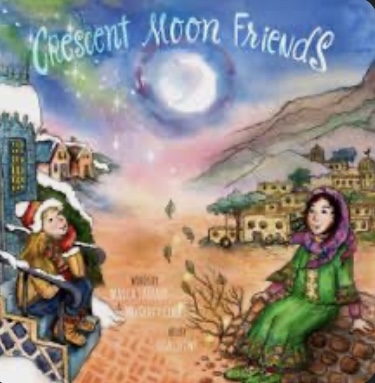
This 32 page book does not read like a new release, it looks like something you would have found in the early 2000s when the recent war in Afghanistan started and books about refugees from the region were popping up.  Admittedly back then, I probably would have been more forgiving that the smiling illustrations showed Islam in action and two characters from different cultures coming together through dialogue, respect, acceptance, and fun, but for reasons I’ll articulate, this book reads very superficial, dismissive and erroneous at times.  I am not Canadian or Afghani, I am a neighbor to both as a Pakistani American, and the book is OWN voice, so if I am just being overly picky, or sensitive, and am wrong, I am happy to acknowledge it, but before you push back, please read the entire review.

The description of the book says:

Crescent Moon Friends introduces the reader to two best friends Amelia and Aisha. While the pair is from Canada and Afghanistan, the girls reconcile their differences through exploration of the values they share. This book initiates a family conversation about Islam, explores tradition and language, and brings the girls closer together as a result. It is our hope that the book will be used as a teaching tool to help children understand the cultural backgrounds of others, and to create a warm environment for refugees resettling in Atlantic Canada from the Middle East.

This picture book is for both non- Muslims who are living in the West, and Muslims who are living outside their home countries. The focus of the book is on tradition, not religion, it also captures the significance of Islam. This is a valuable title for library and classroom use.

So first of all, I feel like the foundation of the book is othering Islam in making it seem that this book is an introduction of Islam to non Muslim with the premise being that Islam is what, a foreign religion? Numerous Canadians are both Afghani and Muslim in 2022, before I even began the book I was already fearing the framing.  Then it identifies Afghanistan as the Middle East, which just made me really question the accuracy.  Somehow after that first paragraph, the book then tries to say that the book is not about religion, but traditions.  While part of me appreciates that distinction, the second part of the sentence saying that it wants to capture the significance of Islam really shows the poor focus of the book.

Let me pause here though and answer a question I’m sure many of you are wondering, “why review a book that is not well written, and is not widely promoted or known about.” The answer is simple, a book such as this may not sell in big numbers and be regularly seen online and in stores, but they often do find their way into libraries and classrooms.  They are often shelved to fill “diversity” or “inclusion” quotas and thus their messaging does often reach our children.  I also highlight books like this, not just to pick on this particular book, but to show that OWN voices doesn’t make something automatically correct.  If this is the author’s own experience or is a memoir, there is some leeway, but saying that Afghanistan is in the Middle East or that Salam is Dari, not Arabic, or that it is “naan tandori” instead of “tandoori naan,” just makes the book seem inauthentic.  Often publishers, editors, agents perhaps don’t want to push back and appear uncultured or racist, so they don’t question details, is the only thing I can think of as to why this trend continues to perpetuate.  Which is also why the importance of having a piece sensitivity read cannot be overlooked, even when the author is writing about their own religion or culture. Yes, I too am only one person saying I have issues, but beta and sensitivity readers such as @muslimbookreviewers are four people and we discuss based on what we know and between the four of us there are a lot of singular specialties and a lot of  overlapping expertise that really help books get it right. Sorry for my rant, back to the book at hand…

The book starts with the white Canadian girl camping with her family and wondering what the upcoming school year will bring.  The text says. “she loved to look at the crescent moon.”  Already the writing is clearly weak, who loves to look at a particular phase of the moon, does she not like the waxing gibbous or whole moon? The next spread introduces Aisha, she is standing in the foreground with a mosque behind her and the text says she loves the moon too.  “There was a crescent moon on top of the mosque where her family went to pray.” Aisha has her hair loosely covered, and immediately we are connecting Aisha to her faith and to Amelia through their love of the crescent moon.  Interestingly, Aisha who would presumably love the crescent as it symbols holidays and month changes in the lunar calendar is presented as liking the moon because of it decoration aesthetic. It is where her family went to pray, sure it reminds her of home, but chances are she didn’t often go to the masjid as culturally most women don’t, so I’m not sure that this spread really has any accuracy or value, it just sounds good…if that.

The next spread is the first day of 6th grade with the teacher introducing a new friend to the class.  If it is the first day of school, aren’t they all new to the class? Aisha recalls that she left Afghanistan because there was a war in her country and school wasn’t safe, if she is twelve or thirteen, I’m not sure what caused the change in real life for the war timeline being referenced.  On a more relatable note it mentions that she missed swinging in her grandfather’s garden with cousins as well.

The next page showing the girls being silly with pencils to look like a bunny and walrus is sweet.  It shows language isn’t necessary, that silliness is universal and it is cute.  The girls then show how they share things unique to their culture with one another.  Aisha teaches her how to say Salam, hello in Dari, how to dance the Attan, about Eid, the most important Muslim holiday, and about a game with stones called anjaaq panjaaq.  But this is wrong, Salam is Arabic, Eid is Arabic for festival or holiday so what Eid is the book referring to? Also why not tell how to play the game, or how to do the dance or how Eid is celebrated? If the book is to build cultural (or religious) bridges, thus far I’ve only learned how to stick pencils in my mouth to look like a walrus or behind my head to look like a rabbit.

It is then Amelia’s turn to share Canadian culture and the book picks: ghosts, goblins, Santa Clause and the Easter Bunny.  I find this a bit offensive on Canadians’ behalf, really their holidays are what make them who they are?  Later we will learn that Amelia is not religious, yet the symbols for religious holidays of Easter and Christmas are what are being presented.  Additionally, the holidays mentioned are not even unique to Canada: Christmas, Halloween, and Easter, are the same in America at the very least.

The next spread shows their moms becoming friends and the girls playing in Aisha’s mom’s scarves, hijabs, shoes and make-up.  I find the joy sweet, but I wonder if the book as stated in the details by the author/publisher is to help refugees- is this a bit misleading- that they are settled and have an abundance of clothing accurate?  Often refugees need assistance, will a book like this send the wrong message about helping those fleeing war get established, by not just avoiding talking about need, but celebrating surplus?

Aisha is then shown helping Amelia with math and when Aisha needs help with a Halloween costume, Amelia is there.  The book really is doubling down on the importance of Halloween to Canadian culture, which again feels off.  But also most Muslims don’t celebrate pagan holidays, so I’m not sure I like the positioning that it is cultural to celebrate and that to be Canadian one must engage in the rituals.  Whether you see it as pagan or just assimilation, either way it doesn’t sit right for a book aimed at finding common ground between diverse individuals.  Math is neutral and universal, why not have Amelia help Aisha with something also less controversial?
img_6242

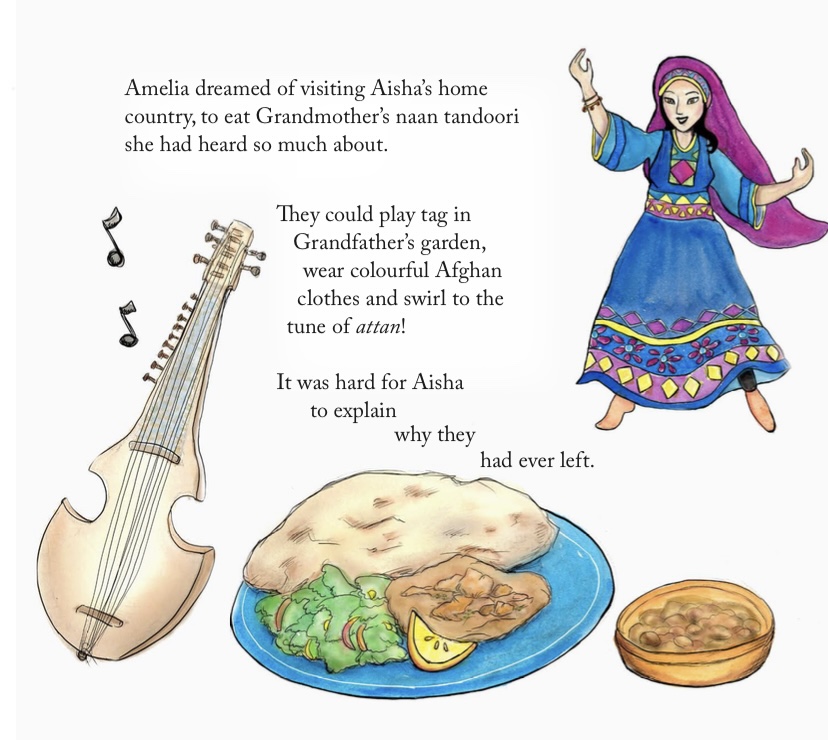
The next spread shows Aisha missing Afghanistan, and Amelia being a supportive friend and wanting to visit Afghanistan too.  Unfortunately, once again the weak writing has her sounding like an adult missing the laughter in the air and hope and flowers, not a kid talking.  When Amelia joins in, naan tandori is mentioned, which is backward, if it is the same as in Urdu it should be tandoori naan.  She also wishes they could wear colorful Afghani clothes and dance the Attan, which are two acts not limited to Afghanistan.  They can put on traditionally clothing and dance in Canada.

The story then takes a huge pivot and shows Aisha and her mom praying with the very vague text of her mom “described her way of life, Islam as the peace in her heart, and said turning to Allah in prayer would keep Aisha happy.”  The text seems misplaced and the messaging completely pointless, why not frame it as what Aisha believes or what her faith teaches her? It almost comes across as her mom forcing the belief on her and this being the first Aisha has heard about it.  The next page is set up the same, but shows Amelia’s faith to be kindness and compassion while they sit in nature.  I think the intent was to be positive, but when you have two people representing entire populations, all sorts of stereotypes come in to play that either have to be so general as to be accurate or more specific to the two characters at hand.  In this case I feel the takeaway is that holidays define Canadians, even religious holidays, but they are fine to participate in because Amelia is not part of organized religion.

Thus the next spread of Aisha’s family celebrating Christmas with Amelia makes sense in the story, but I find alarming because it normalizes abandoning your own religious convictions and adopting another faiths in order to fit in and assimilate.  Imagine a teacher reading this book to a first grade class and little Muslim children who demand that Christmas and Easter stay out of public schools are hearing messaging normalizing the holidays for people of all faiths.  Imagine a recent immigrant or refugee further feeling pressured to adopt these practices because they want to be seen as “good citizens” or be accepted by the larger community.  The contrast of Aisha’s family celebrating Christmas is Amelia helping make star and moon shaped cookies for Eid.

The story comes back to the girls love of the moon, one as a dreamer, the other as a scientist.  It tells of other firsts Aisha experiences and Amelia learning about Aisha and her faith.  I’m not sure what a genie lamp has to do with Islam, but it is in the illustration with a hamsa hand, a book, a tasbih, and a crescent with a minaret coming out.

Aisha then starts to wear hijab and Amelia learns how to wear one too. No details about what or why hijab is worn or given, and in the illustrations it doesn’t completely cover anyone’s hair. The girls ski together and drink hot chocolate and living in Canada allows Aisha “to be the girl she was meant to be.”  I’m not sure what that means, but that seems to be the resolution to the book before it circle backs to the mom and concludes.

I think on the very surface the book is a nice idea, but the conflation of what it means to be Canadian with observance of holidays and the lacking details of what it means to be Muslim Afghani make the book miss so much and ultimately do more harm than good if shared.
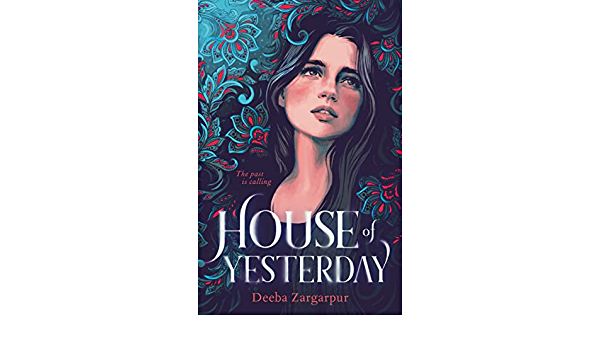
House of Yesterday by Deeba Zargarpur

Standard
House of Yesterday by Deeba Zargarpur

house of yesterday

While reading this 320 page YA supernatural/contemporary book-I couldn’t turn the pages fast enough.  When finished- I was bothered that certain threads weren’t resolved, now that I’ve ruminated a bit- I think the vagueness of the author’s prose in sharing her “fever dream” on paper has lingered and the gaps not as troublesome.  The author’s OWN voice Afghan-Uzbek Muslim identity adds layers to a story that is both haunting in the literal sense and familiar in the immigration inter-generational traumas and secrets shared.  Even deeper though, the book pokes at universal themes of regret, holding on to the past, family, friendships, and grief.   The book’s characters identify as Muslim, but the story is not Islamic, nor is there much religion save a few salams and mentions of Eid.  The supernatural elements in the book, whether you understand it to be ghosts, or personified memories, or jinn, are a large part of the book, but are not framed in a belief or spiritual manner, and while some may find it Islamically off-putting, I felt the book explored what the main character was enduring and what the weight of the past was doing to her, didn’t necessarily cross the haram line.  Her father has a girlfriend he is looking to marry, but it isn’t celebrated, and there are close male/female friendships, but the book is relatively clean for the genre and would be a good fit for high school readers and up.

SYNOPSIS:

Summer on Long Island has Sara retreating into herself.  Surrounded by nearly a dozen aunts and uncles and numerous cousins, it is the separation of her parents and trouble with her best friend that makes getting out of bed every morning a challenge.  As a result, her mother ropes her in to helping with her latest remodeling project.  When she enters an old crumbling house one morning to take “before” pictures, she starts seeing things, and feeling things.  Things about her past.  Things about her beloved grandma, Bibi Jan, who is alive and deteriorating from dementia.  What is the house trying to tell her? Why won’t anyone tell the truth?

WHY I LIKE IT:

I love the mystery and the chills of the story.  As the reader you aren’t entirely sure where the story is headed, what you are to do with the bits of the puzzle you are given, but the intrigue to find out pulls you forward.  That being said, the book does reads debut, a few of the side story lines are not fleshed out enough to feel important, satisfying, or resolved and they come across as being abandoned.  I would have liked to see more of Sara and her father’s relationship, the details don’t seem to fit, and the continuity seems halfhearted.  At times so does the “night” it all changed with Sam.  I like the interpretive vagueness of the supernatural threads and that they are up for interpretation amongst readers not just at the end, but throughout the book.  I also like the family’s closeness even when they are disagreeing. For most of the book Sara and her cousins aren’t portrayed as particularly close and I didn’t invest time to differentiate one from another, but by the end, I felt that they were grounded and different and relatable, and I am not sure when that change occurred.  At times the writing seemed a bit repetitive, but the lyrical style would then catapult the story ahead.  There was one place that the fourth wall was broken though, and I was bothered by that slip.

Overall I loved that the Uzben Afghan culture sprinkles showed immigrant nuances, and that the love between the generations countered the trauma being shared as well.  The messaging is subtle but powerful long after the last page has been read.

FLAGS:

For the most part the book stays clean, the father has moved on and has met someone he would like to marry, the mom and aunts briefly recall sneaking out to attend a prom decades earlier.  There is mention of a child bride, and swimsuits, tank tops, and cocktail dresses being worn with no second thought.  For a YA book, the flags are incredibly minimal, save the “ghosts”(?). There are flags of a death that is detailed, the book is “spooky” at times, there is mental health, divorce, pain, dementia, abandonment, theft, running away, and fear.

TOOLS FOR LEADING THE DISCUSSION:

I would love to read this book with some high schoolers.  It is a quick read that would allow for a lot of self reflection, arguments, and entertainment.  The book is available here and releases in a few days, so if planning to purchase, please consider preordering and showing your support.

A Sky-Blue Bench by Bahram Rahman illustrated by Peggy Collins

Standard
A Sky-Blue Bench by Bahram Rahman illustrated by Peggy Collins

sky cover

I know many of you are thinking, another book about school for girls in Afghanistan, and given the reception by most to the author’s first book, The Library Bus,  I can sense the rolling eyes.  I was in the minority on that one, as I enjoyed it, but, this one is simpler, sweeter, more universal while being complimented by culture, and I hope it is a more authentic and accurate OWN voice portrayal.  I know I have a lot to learn about white washing narratives and breaking down colonial paradigms, so I promise if you disagree I will listen.  But I genuinely enjoyed the illustrations and little Aria finding a way to make a bench so she could sit comfortably at school with her prosthetic leg.  The girls go to school, and the furniture was burned to keep warm in the winter, a concept that the author verifies at the end as something experienced in his own life.  Aria has to find a way to sit in class because she wants to learn, and lack of wood working experience, resources, and doubt that a girl can do it from her classmates, isn’t going to stop her.  Over 32 pages, early elementary age children will meet a determined young girl as she pieces together scraps to build a bench.

Screen Shot 2021-10-22 at 10.49.20 PM

Aria has been in the hospital for a while after an accident took her leg.  She is excited to be back at school, but quickly realizes it is hard to sit on the floor with her new helper leg.  She tries leaning on the wall, standing even, but just getting up and down off the floor is really difficult.  At home when she mentions it to her mom, her mom reassures her that she can get through it and her little brother offers to help her carry her things.

Screen Shot 2021-10-22 at 10.51.12 PM

That night Aria considers how much she would miss school if she isn’t able to figure something out.  Then she has an idea, she’ll build a bench.  At school the next morning, classmates tell her “Girls don’t build benches,” but Aria responds, “I can do anything a boy can.”

With that, a single friend joins Aria as they comb the city for discarded wood, broken furniture, screws, and nails.  They assemble the resources and when they have enough Aria and her mom head across town, past the Blue Mosque, to visit the carpenter, Kaka Najar.  He shows them how to fit the pieces together like a puzzle and loans them the tools needed to be successful.  He even gifts her some sky-blue paint, “the color of courage, peace, and wisdom.”

Screen Shot 2021-10-22 at 10.52.30 PM

That weekend Aria and her mom and little brother build a bench, paint it blue, and get it to school.  When the other students see it, their excitement bubbles and they imagine building tables, book cases, and more.  Anything is possible after all, there is paint left in the can and they are willing to work together.

Screen Shot 2021-10-22 at 10.53.08 PM

There is nothing religious in the text, save the mention of walking past a mosque, but in the illustrations the women are all covering their heads when they are out, and are uncovered at home, the school uniform seems to be a white hijab and black abaya.  I wish there were some Pashto words sprinkled, and it was a bit off that she was building a bench, but the finished project was a bench and table. The end has an Author’s Note and I enjoy seeing the smiling faces and bright illustrations in a book set in Afghanistan.

Screen Shot 2021-10-22 at 10.54.15 PM

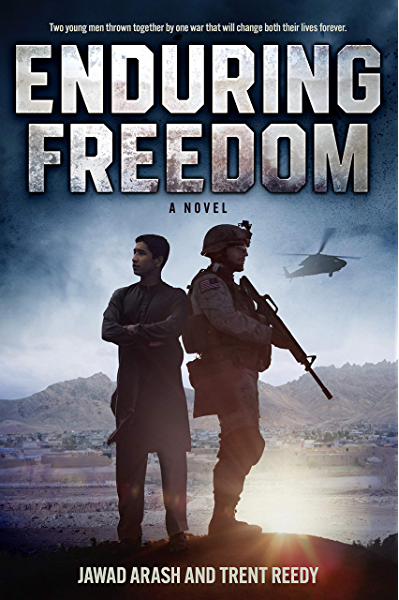
Enduring Freedom by Jawad Arash and Trent Reedy

Standard
Enduring Freedom by Jawad Arash and Trent Reedy

enduring freedom

This isn’t the type of book I am naturally drawn to, and had it not been offered to me as an arc, I didn’t even request it, I probably would not have read it.  So, to say that this young adult OWN voice 246 page post 9/11 war story had a lot to overcome for me personally, is putting it mildly.  I gave in and decided to read it for the simple fact that I was curious to see what the narrative is in today’s literature, as we approach the 20 year anniversary of the attacks on US soil.  The afterward is very clear that the agenda of the two authors, one an Afghan and the other a US veteran, was to show a personal view of growth and assumptions on both sides and how the future of Afghanistan needs to be rooted in education and stability.  I think the book accomplished its goals, and made very clear how the terrorists first victims were their own people, and that extreme ideologies of the Taliban were and are still not reflective of the larger population.  The pacing of the dual narratives, however, was a bit off to me, and I really felt that some of the major plot points didn’t get explored in a meaningful way, that they were simply glossed over and brushed aside to keep the book inline with the authors’ objectives.  The book is not overly political, and the Muslim characters are religious and knowledgeable, but for a book that talked about how even in war the people, the soldiers, are the story, I wanted to see more internal wresting with choices and their outcomes, then what was offered.
SYNOPSIS:

The book is told in alternating view points, one is that of Baheer an Afghan boy living with his large extended family in Kabul next to a Taliban compound.  The family is religious, Baheer’s grandfather, Baba Jan, is well read in poetry and religious text and often quotes the Quran by ayat and surah number.  The family sells carpets, and often hides the latest movies or news recordings in the rolls, so that they can be brought home, the blackout shades pulled and the tapes enjoyed.  They are fearful of being harassed for not having long enough beards, shaved heads, turbans and the like. Baheer and his brother Rahim do not enjoy school with the strict and abusive teachers.  The talibs seem to touch them inappropriately and scold them harshly.  Their older sister is not allowed to attend school and never has even though the family used to live in Pakistan where the boys enjoyed school. It doesn’t explain why they were there or why they returned.  One uncle is assaulted by the Taliban and soon after, a news clip showing the attacks on 9/11 is secretly watched by the family.  As a result they decide to move to Farah, in Western Afghanistan where Baba Jan has family and property, to be away from the impending US attacks and Taliban assaults.
Joe Killian is the other voice.  When the book starts he is sitting in class, his senior year, when news about the attacks on the World Trade Center starts to break.  He had joined the national guard that summer for the college money, and as his classmates sit glued to the televisions in Iowa, he is nervous that he is about to be called up to war.  He doesn’t get called up that day, he graduates, and is studying journalism in college when the call finally comes.  He is preparing for combat, but when he is deployed and discovers it is a reconstruction mission he is angry and annoyed.  A year of helping what he terms barbarians, is not what he signed up for.

The majority of the book reads like a ‘day in the life’ of each of these two voices, as they adapt to life in Farah, as they deal with each other’s presence and as their friendship forces their assumptions to change.  The interactions between Joe and Baheer show the power in getting to know someone to alter perceptions, and the threat of the Taliban on both the average citizen and the US forces on the ground as a unifying enemy to allow the friendship to grow.

The book concludes when Joe’s year of deployment is up, but really the authors’ notes at the end are a better conclusion to the real life friendship and growth of the two authors that resulted in the writing of the book

WHY I LIKE IT:

I love that the family sees the planes hitting the towers and is mortified at the brazen destruction and loss of life.  They immediately start praying for the victims even as they realize they will be the recipients of the backlash. I like that it highlights where practicing Muslims and extremists differ, by having the Quran quoted and explained as opposed to the rhetoric the Taliban is spouting.  Baba Jan’s manner for speaking the ayats is a bit awkward in that most people don’t in daily conversation source and reference their dialogues, but it does grow on you.  I think the book is very simplistic in making the Taliban to unequivocally be the ‘bad guys’ without any context of how they gained traction. It talks about the Soviets, but I think it will leave the readers wondering where this group came from and why the Afghan people allowed it. Unfortunately, there are a lot of nuances and complexities that are overlooked by such a simple narrative, and allow for an inaccurate picture to be formed.

I like that Baheer pushes back on Joe who thinks America is perfect and that Afghanistan is less than, by pointing out the flaws in American society as well as his own.  I was ok with Baheer pushing the cultural limits to talk to a girl, it was innocent and I think understandable. My biggest concern is that I really felt that there needed to be more space on the page dedicated to understanding the repercussions of him being an informant to the Americans, and his brother passing on information to the Talibs.  People were taken in to custody and injured and killed as a result of these boys’ actions and to just chalk it up to something to be forgiven, was not enough for me.  I wanted them to hash it out and wallow in their choices, not forgive and move on so quickly.  I also wanted to know more about their reconstruction efforts.  It seemed rather minimal: relocating explosives, helping a burn victim, sending supplies to a school, I think in a year, that there would be more mixing with the people than the book would suggest.  And finally, I felt like the sister not getting to go to school was handled as an obligation to address, not that any insight or understanding was really given to such a hot button issue.

The book is really slow and dragging at parts, I couldn’t tell you about any of the dozen or so soldiers that are mentioned, I don’t even recall any of their names. I think the book has a lot of potential, and perhaps it does shine in showing the effects of war and terrorism on the Afghan people.  It held my attention while actively reading it, but I just as easily could have put it down and forgotten about it if I wasn’t under obligation to offer an opinion in exchange for an early copy.

FLAGS:

There is language, stereotypes, physical abuse, sexual misconduct, death, killing, violence, acts of war, bloodshed, a crush. Upper middle school and high school can handle it.

TOOLS FOR LEADING THE DISCUSSION:

I don’t think I’d select this book as a book club selection because I’m not sure what would be gained from the book.  The characters assumptions are challenged and evolve, but I think most minorities know that, getting to know someone is often the best way to have their image changed.  I think the book still functions to make Americans feel better about  invading Afghanistan, rather than have us question what the long term affects of our involvement have been.

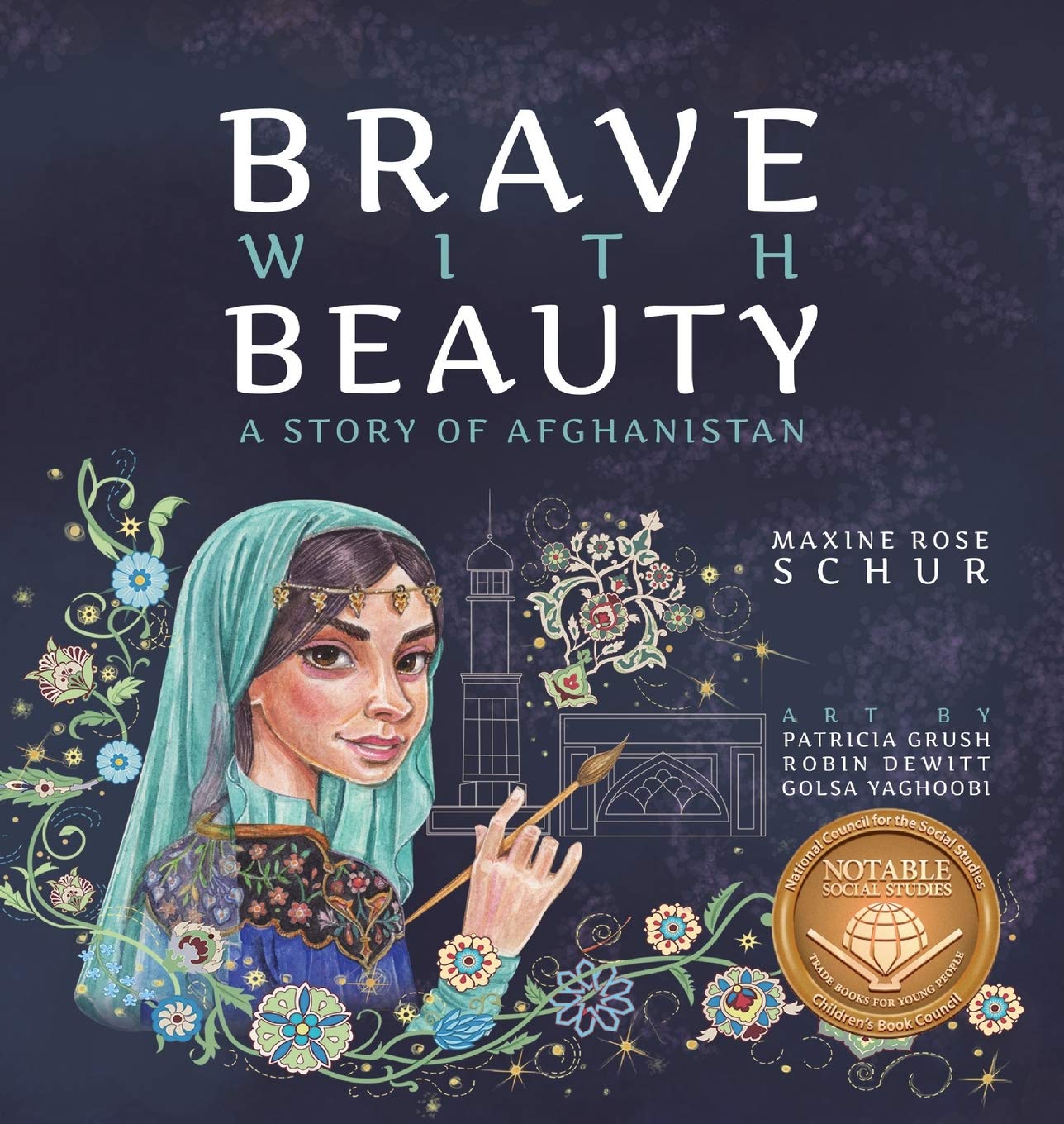
Brave with Beauty: A Story of Afghanistan by Maxine Rose Schur illustrated by Patricia Grush, Robin Dewitt, and Golsa Yaghoobi

Standard
Brave with Beauty: A Story of Afghanistan by Maxine Rose Schur illustrated by Patricia Grush, Robin Dewitt, and Golsa Yaghoobi

brave

This 44 page fictionalized retelling of Queen Goharshad, a 15th century monarch of the Timurid dynasty in Afghanistan should really be a larger book than 8 x 8 to appreciate the artwork that is detailed and stunning.  The story of Goharshad, wife of Emperor Shah Rukh, and her influence on art, music, culture, higher education, and architecture, is one that we should be more familiar with, but the actual text and manner in which the story is conveyed isn’t consistent for me and I wanted more details about the society she stepped in to to rule,  I know it is fiction, and meant for 2nd to 4th graders, but I would like to think that readers will want to know what obstacles she had and what support she enjoyed and from where.  That they will question if it was a rich kingdom that she could pay musicians to play everywhere, and wonder if families sent their daughters to the University she built, ask why it wasn’t for women to design a  Masjid, and what was the name of the smaller mosque that bore an older woman’s name? The book at times overly summarizes and at other times is haltingly detailed.  It is a good read to reflect a strong woman and her influence on her land, but unless assigned, I don’t know that seven to ten year olds will pick up the book and be inspired by it enough to change their perception of the Afghanistan that they may see on the news.

img_0171

Seven centuries ago Goharshad loved beautiful things such as painting and the texts of Rumi.  Her brothers played at being like Genghis Khan and teased her for not being brave.  She vowed to be brave with beauty even though she didn’t know what that even meant.  At age 14 she was given in marriage to the king, Shah Rukh, in Herat.  She ruled with her husband and had resources and time to spread her beauty by speaking up and being brave.

img_0172

Her first act of beauty was by filling the kingdom with music.  She wanted music every day in the court and beyond. Music that was playful and pious, music that painted pictures in the listeners minds and brought joy like the laughter of God.  She next sketched and designed a beautiful and enchanting garden to be built.  It doesn’t say where it was, but that people came from all around to enjoy it.

img_0173

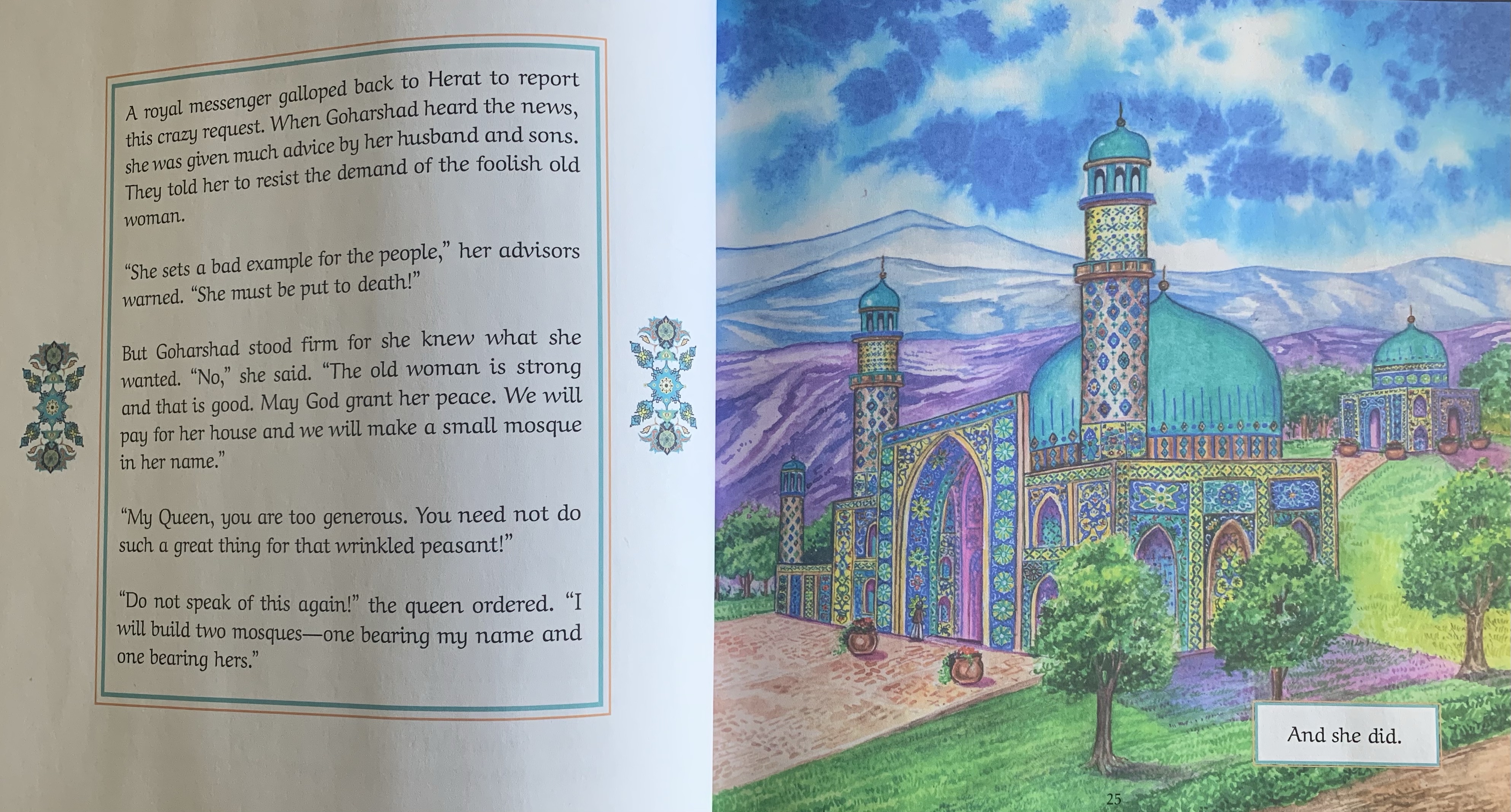
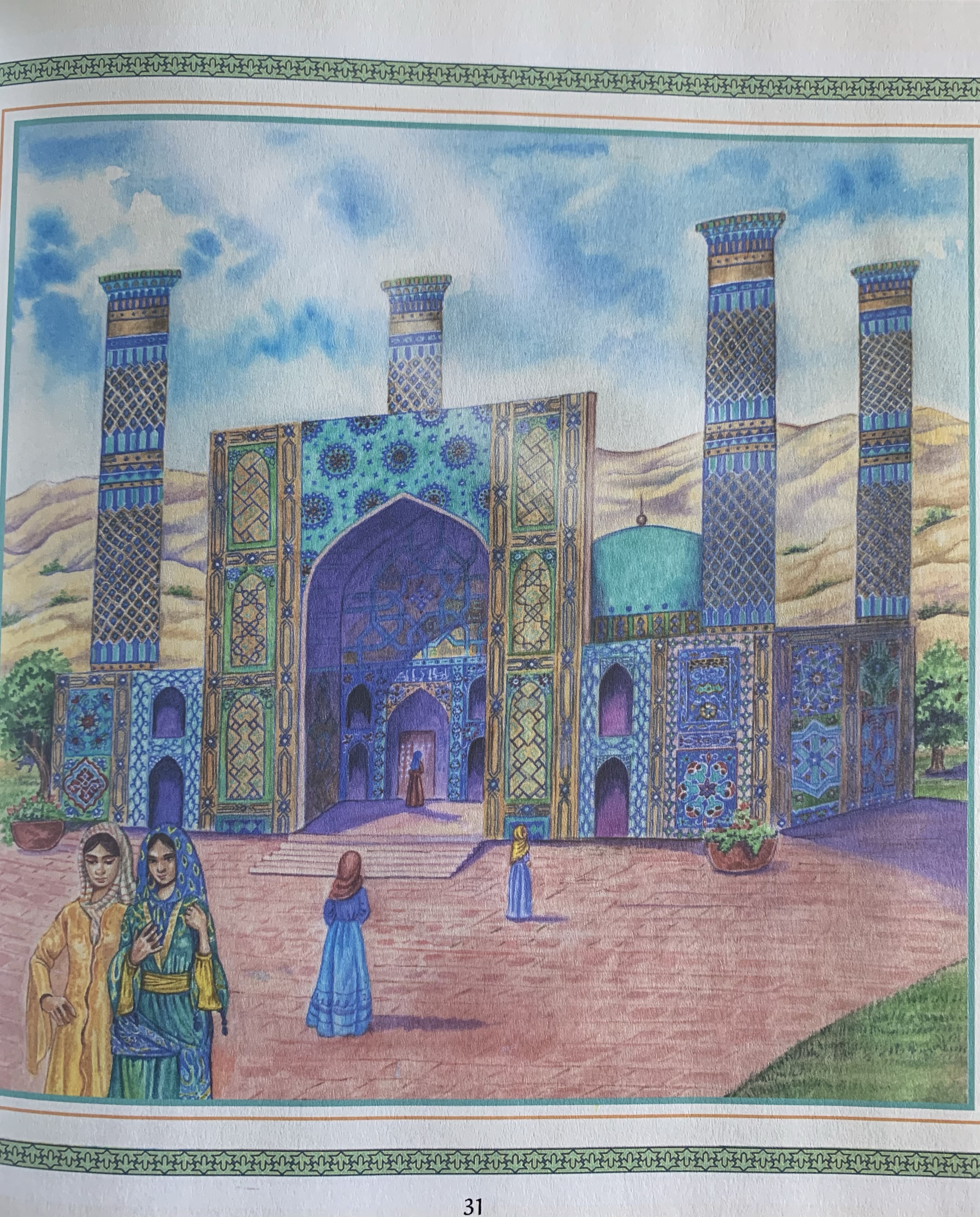
Feeling braver she turned her sights on building a mosque in the western city of Mashhad.  She designed it and called the court architect, Qavam al-Din Shirazi to discuss.  He doubted if it was right for a woman to design such spaces, but she assured him that she had the talent for it, so construction began.  An elderly woman refused to sell her cottage for the new project unless a mosque with her name was built.  The advisors wanted the old woman put to death or imprisoned, Goharshad disagreed appreciating the woman’s strength and instead agreed.  The big mosque was built with Goharshad’s name and a smaller one on the property with the old lady’s.

img_0175

With such an accomplishment complete, the Queen again summoned the architect and expressed her desire to build a great center for learning.  A college for girls, a grand mosque for prayer, and a vast library.  She wanted the structure decorated with paint from precious stones and sold her crown to finance the project.

img_0174

After her husband died Goharshad reigned, but sadly after she died, much of her accomplishments died as well.  Over time, harsh weather and war, nearly all her buildings disappeared and those that remain, do so in ruin.  The book ends with hope that memories of her will endure, A guide to some of the words in the story,  an Author’s note, and a Guide for Parents and Educators.

img_0176

There is not a lot of Islam in the story, just the building of masajid .  Some may take issue with her stress and celebration of music, and likening it to God laughing, but if you look at it as her story, it should be able to be appreciated even if you disagree.

img_0177