Category Archives: Muslim Character

Seven is Special! By Shagufta Malik

Standard
Seven is Special! By Shagufta Malik

sesven

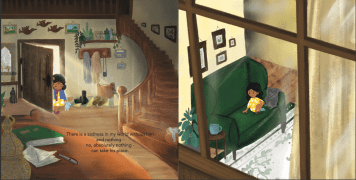
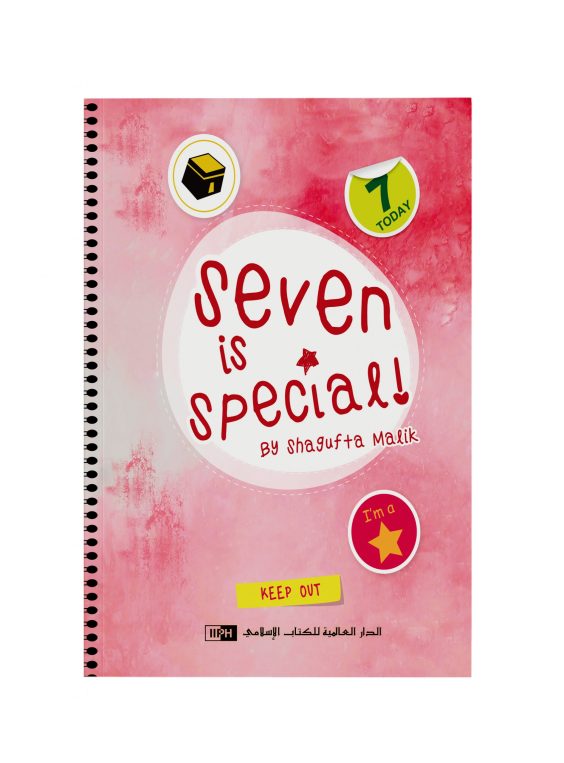
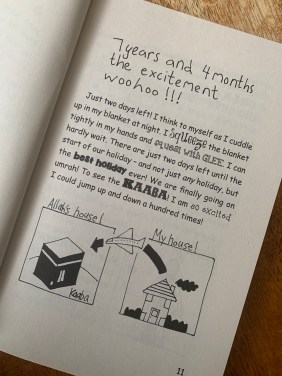
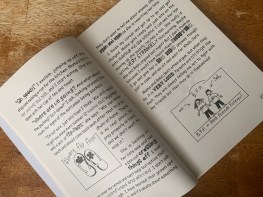
I’ve seen this book on and off over the years, but it wasn’t until I saw @muslimkidsbooknook’s post about it, did it register that it is a chapter book, with a plot and story.  I thought it was a journal for seven year olds with prompts perhaps.  Needless to say I judged a book by its cover and hope at some point the author will consider changing the title, redesigning the cover, and tightening up the story, because there is a lot to enjoy in this book, but to get to it, you have to get it in your hands, and open the cover.  The doodles, the author’s voice, and the playful font over 128 pages will appeal to elementary aged girls, but boys will find plenty to relate to as well if you can convince them to give it a try.

img_4501

SYNOPSIS:

Seven-year-old Maryam has started taking her salat more seriously, and finally the family, her parents and her, are going on a REAL holiday.  They are going for Umrah.  Maryam is so excited, but then the trip gets canceled and her mom is sick, and Maryam is tired of always feeling different than her classmates.  Will everything work out? Will prayers and duas be answered? Will eight be great?

img_4502

WHY I LIKE IT:

I love that the book stays on a seven/eight year old level, but I do question how much stress is on how sick the pregnant mom is, and how kids will understand that.  I was sick, very sick, with all my pregnancies, and my older children saw me and it still affects them, in sometimes surprising ways.  My oldest daughter says she is never having kids.  Granted she is 14, but I would worry that reading a children’s book that mirrors something that was pretty traumatic for her to see will cement her impression about childbearing.  Obviously, I could be the exception, and perhaps like many literary mirrors it would make her relate more to the story.  I know she is above the target audience, but the illness of the mom is a large part of the book, and it is very detailed and specific.  I think if you are a young child reading it, you might ask your mom if that was her experience, and it could be a lovely conversation about heaven being at your mother’s feet, and the tests and blessings of it all, but the book really doubles down on some of the details of the throwing up and vomiting, and I wish her being sick could be shown in more situational ways.  Maybe she tried to do an activity with her daughter, but couldn’t, or she had to ask another mom to help with something she normally did at Maryam’s school, etc..  There are such wonderful tangible little nuggets in the book about salat at the park, and kids duas, and making wudu in public, that I think a little reframing of the illness and symptoms is definitely in the author’s skill set.

I love the unapologetic voice of being Muslim and some of the insecurities that Maryam faces and grows from.  Kids will enjoy seeing their concerns articulated, and inshaAllah benefit from her perspective as they make decisions about their own identity and attitude.  I know some families make a big deal about starting salat at seven, but when the book starts she has been seven for a while, so I’m not entirely sure why that was the focus of the book’s title.  Additionally, the pink cover really screams that it is a girl book, and I think boys will be nervous to be reading a “girl book,” that really isn’t gender specific in the storyline.  Yes, there are all sorts of stereotypes in that assessment, but I think you all get what I’m saying.

img_4503

FLAGS:

Illness, a bit of a temper bubbling over, stress.

img_4504

TOOLS FOR LEADING THE DISCUSSION:

I think young readers that are handed the book and start it, will finish reading it.  It is a super quick read, and with the drawings and conversational language, they will enjoy the pages as they fly by.  It is an elementary read, and anyone older will probably see the foreshadowing that the mom is expecting, while the second and third grade readers, will probably be genuinely surprised.

Little Seeds of Promise by Sana Rafi illustrated by Renia Metallinou

Standard
Little Seeds of Promise by Sana Rafi illustrated by Renia Metallinou

seeds

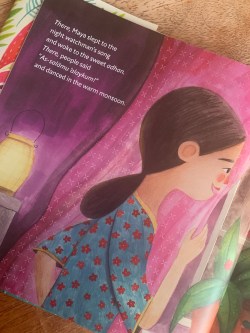
This sweet, well-done 48 page picture book for early elementary aged readers shows the fear associated with being in a new place, the love of an elder family member, and the courage it takes to make new friends.  The story focuses on a young Pakistani girl who has recently moved to a new country and how she tries to remember the wisdom of her Nani to blossom in her new home.  The culture rich story is universal and lyrical, with hints of making duaa, greetings of salam, and the soothing sounds of the athan that make memories of home so foreign to her in her new residence. Young readers will empathize with Maya, and see the symbolism in the seeds she is anxious to plant and cultivate.

img_4475

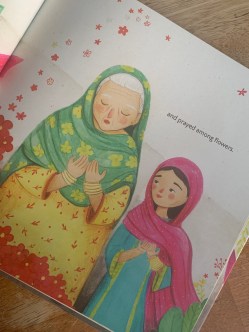
Maya finds her new home unfriendly and cold, she feels different with her food, and clothes, and way she speaks.  Home to her is dancing in the warm mansoon rains, saying As-salamu ‘alykum, and waking up to the sweet athan.  Nani was also there, her old home.  Sweet Nani with her hundred wrinkles, smelling like flowers.  When Maya left, Nani gave her a gift.  Little seeds of promise, so that they and she might bloom where planted.  But Maya doesn’t know where to plant them, she carries them with her everywhere she goes, but like a secret, she keeps them close.

img_4477

Channeling her Nani’s tenderness, she knows that she has to plant them if one day she wants to be surrounded by flowers.  Maya loves flowers, dancing around them, praying among them.  Maya finds a patch of earth.  She longs for rain, she hopes for warmth. She makes way for the rays of the sun.  The text talks of flowers, the illustrations show both the plant and the growing friendships.  For days nothing happens, with the seeds or the classmates.  But Maya remembers that seeds have a long journey from the ground up.

img_4476

Maya nurtures her seed, just the one she dared plant, with love and kindness.  She too feels ready to burst.  Can she be brave enough to plant all the seeds, can she share them, and her self in her new world? Can their be warmth here, like there was over there? Can this too be home?

img_4478

I love the symbolism and juxtaposition of the seeds growth with her own.  The character arc and the transition of home being one place to being the other, is very well done, older readers will feel an aha moment when they grasp it and younger kids will enjoy both the surface story and the dialogue you can have with them about blossoming where planted.

img_4479

Religion is not a strong thread, but Islam is present in her memories of her maternal grandmother and all the warmth and love that those memories contain.  I love that the classmates were never mean, they just didn’t know her either.  I wish there was a bit more diversity of skin tone and mobility in the classroom illustrations and the friend circle she is hoping to join.  Overall, a beautiful OWN voice picture book that will be enjoyed for multiple bedtime, small group, and classroom readings.

Esa & Sol’s Adventures: The Hunt for the Saphaea by Asma Maryam Ali, illustrated by Eman Salem

Standard
Esa & Sol’s Adventures: The Hunt for the Saphaea by Asma Maryam Ali, illustrated by Eman Salem

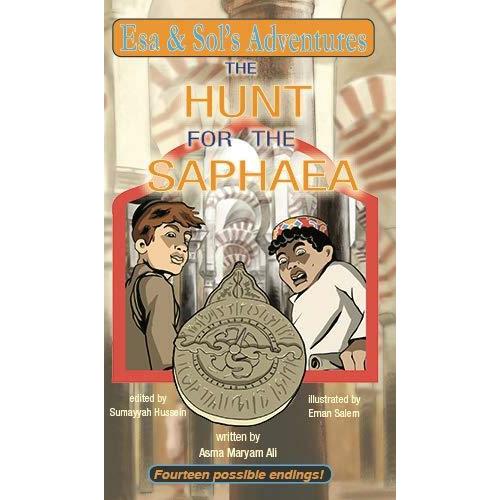
It is a bit tricky to review a choose-your-own-adventure style book, as each story twists and turns and leaves the reader with a different ending and thus, a different impression. I tried to explore every story line in a book that I had little expectation of, it is an intentionally splintered story after all, but even at that, this fell really short. The core of the story: a Muslim and Jewish boy in Cordoba, Spain in 1080 exploring real facts in a fictionalized story about hunting down a missing astrolabe, really had a lot of potential, unfortunately the tiny size (maybe 3.5 x 5.5 inches) and only being 76 pages, the frightening cover, and the misprinted footnote glossy right at the start, set the tone for a weak forgettable book, and by the time you get to the actual story and plot, you really have very little substance to change your mind.

SYNOPSIS:
Two nine-year-old boys start off the story chasing after their donkey who has run off and sent their oranges spilling over all around the square. They should clean up the chaos, but they remember that they are supposed to meet Zarkali, the greatest astronomer in all of Spain, as he finally has a job for them after months of waiting. His latest work is a brilliant astrolabe, but when they get to his workshop he isn’t there. When he finally arrives with his assistant Aleho they are frantic as the astrolabe, the Saphea, is missing. The boys were to be asked to help transport it, as they would blend in unnoticed, but now that it is missing what should they do? Should they search for it? Investigate if it was stolen? Accept their punishment for the mess with the oranges and their donkey? Let the first choice of many begin the adventure.

WHY I LIKE IT:

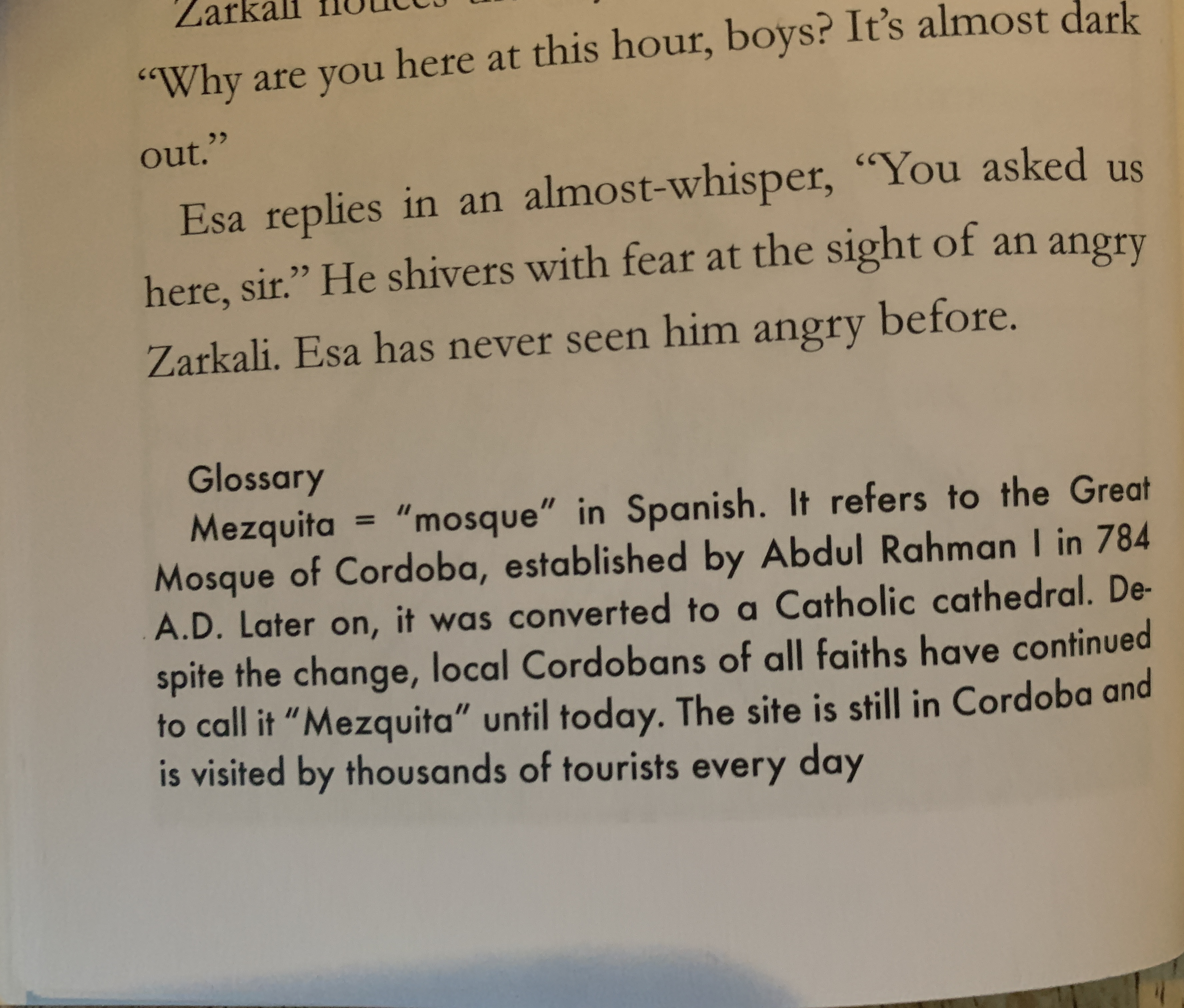
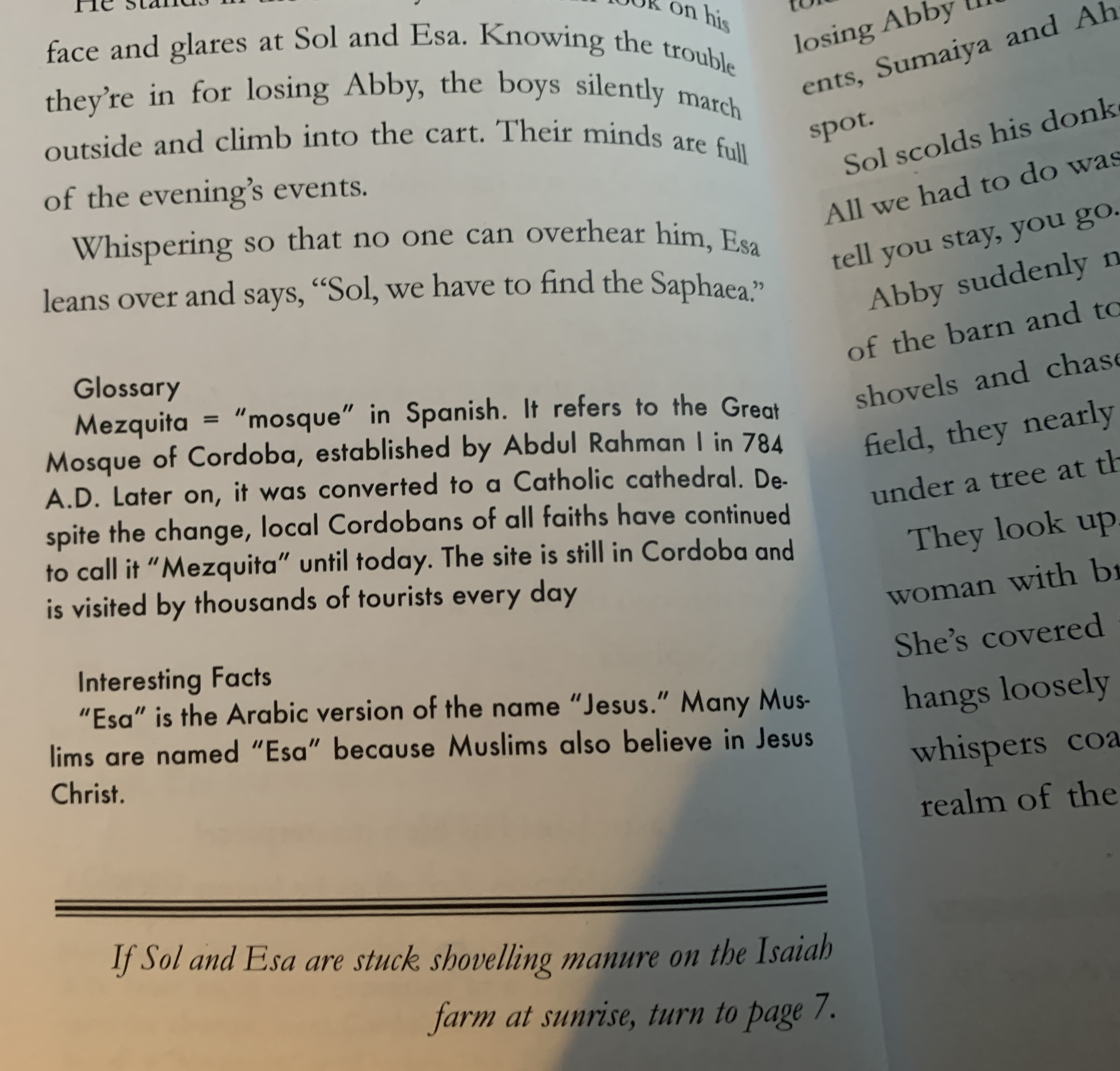
I love the author’s knowledge about Muslim Spain and how she tries to introduce it to children perhaps unaware of the rich history. The inside illustrations are wonderful, the cover truly misleads readers, and naturally I wish the book was larger in size and longer in length. The foundation of the story, the getting to know the characters and their world, needs to be longer. The story should be established before you have to make decisions. It is historical fiction, but needs the world building attention that a fantasy book would require, and this book just doesn’t have it. As a result the choices and endings, are all over the place, not just twists in the stories, but huge changes. Some of the paths no longer focus on the astrolabe that is missing, and seem to offer both threads of something far more sinister at play and choices that keep the boys lives mundane. The book counts on the reader re-reading the tale and making different choices, otherwise your interaction with the book could truly be over in nine pages, nine tiny pages at that. And like I said above regarding the cover and size, they don’t entice one to pick it up and read, then if your adventure is only a few pages long, and you already notice the repeated definition on pages 4 and 6 (before any choices are offered), chances are you won’t revisit the book, learn about real people, marvel at scientific discoveries, travel the region, appreciate interfaith harmony, and get swept up in a historically fictionalized tale that puts you in the drivers seat.

FLAGS:

Fine for middle grades and up.

TOOLS FOR LEADING THE DISCUSSION:

I highly doubt the book would even be looked at on a classroom library shelf, I have been trying for days to get my own children to read the book: they love to read, they love history, they love books with options, but they have yet to open the front cover.

Ms. Marvel Stretched Thin by Nadia Shammas illustrated by Nabi H. Ali

Standard
Ms. Marvel Stretched Thin by Nadia Shammas illustrated by Nabi H. Ali

stretch

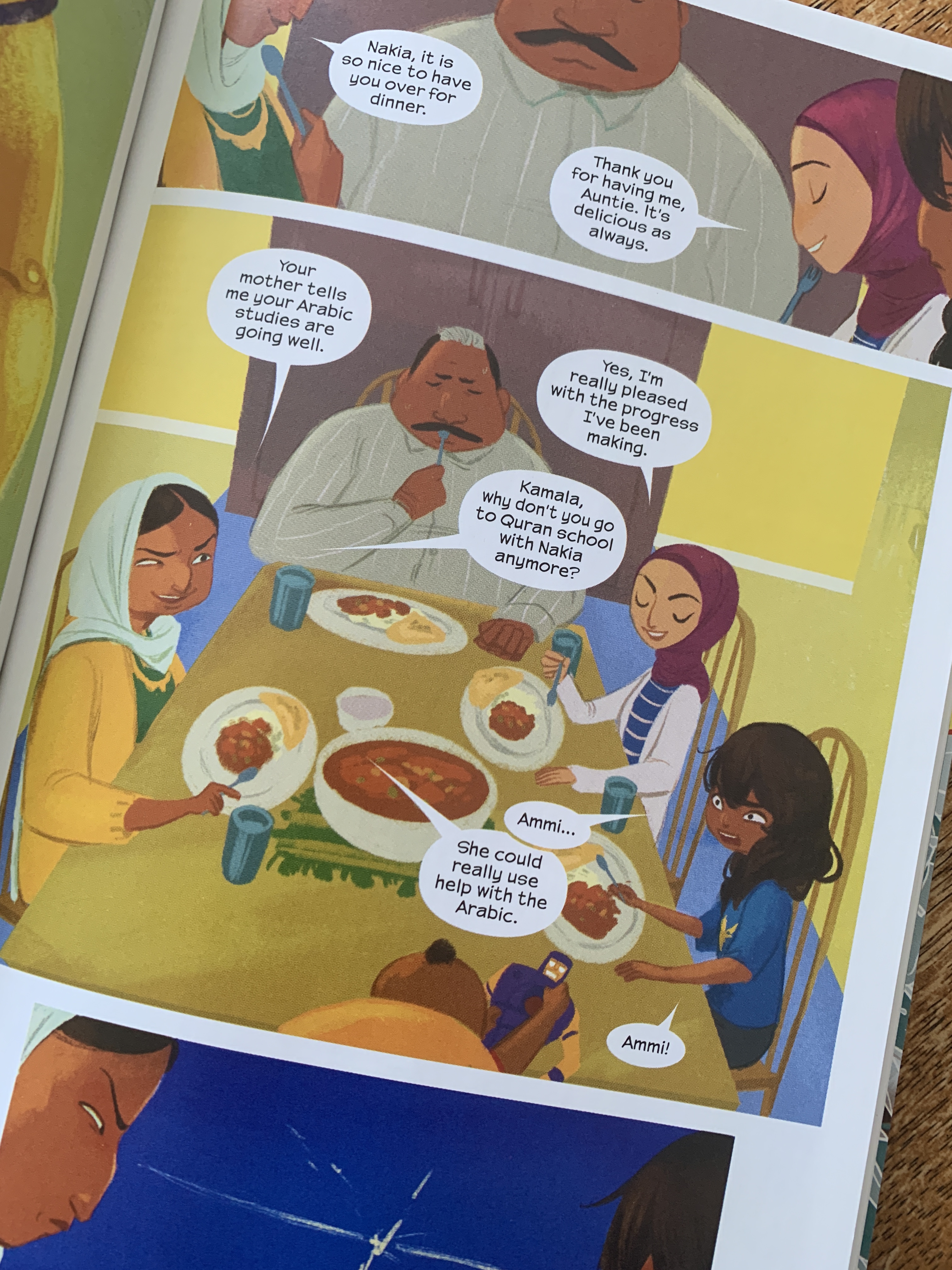
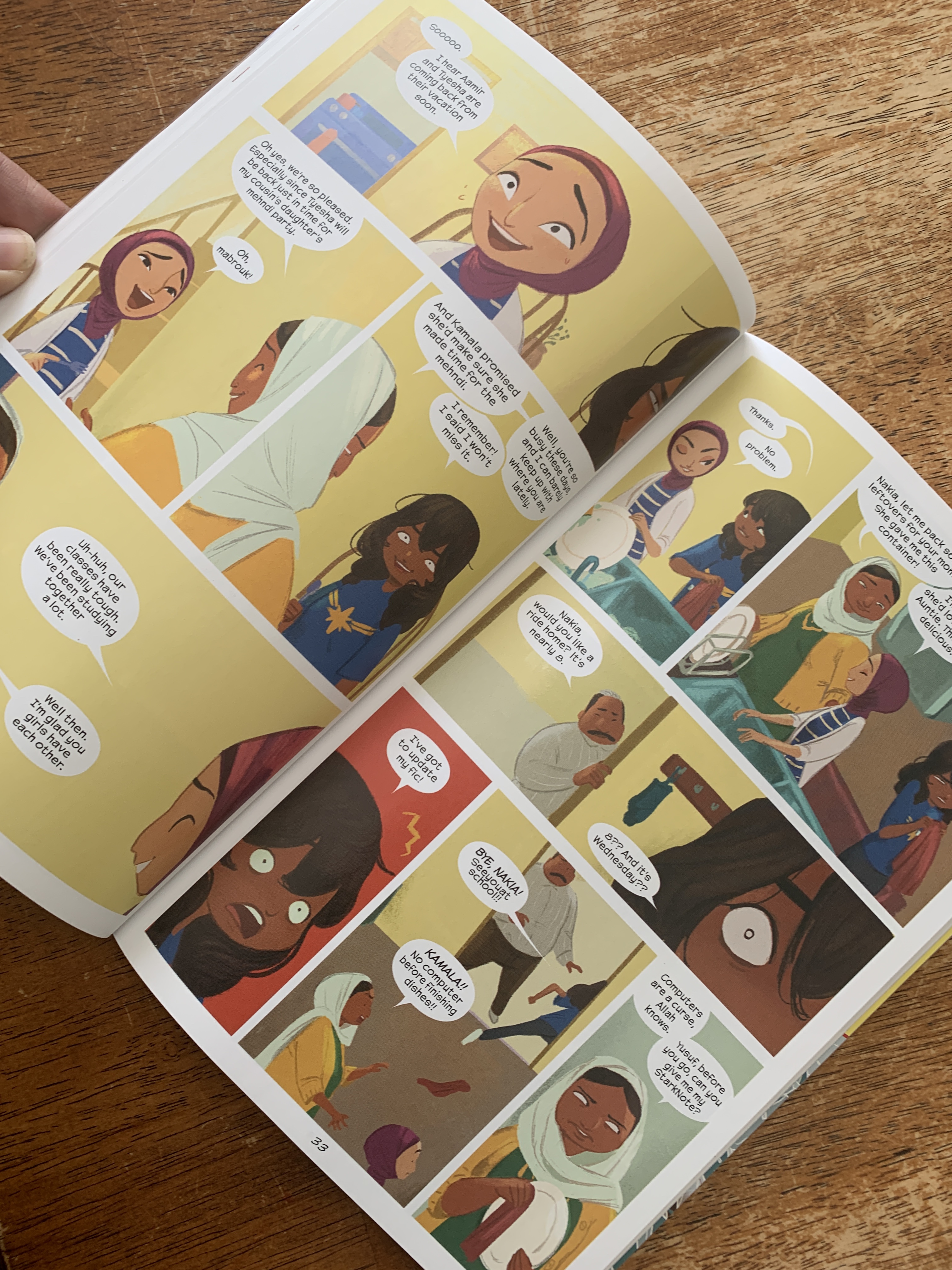
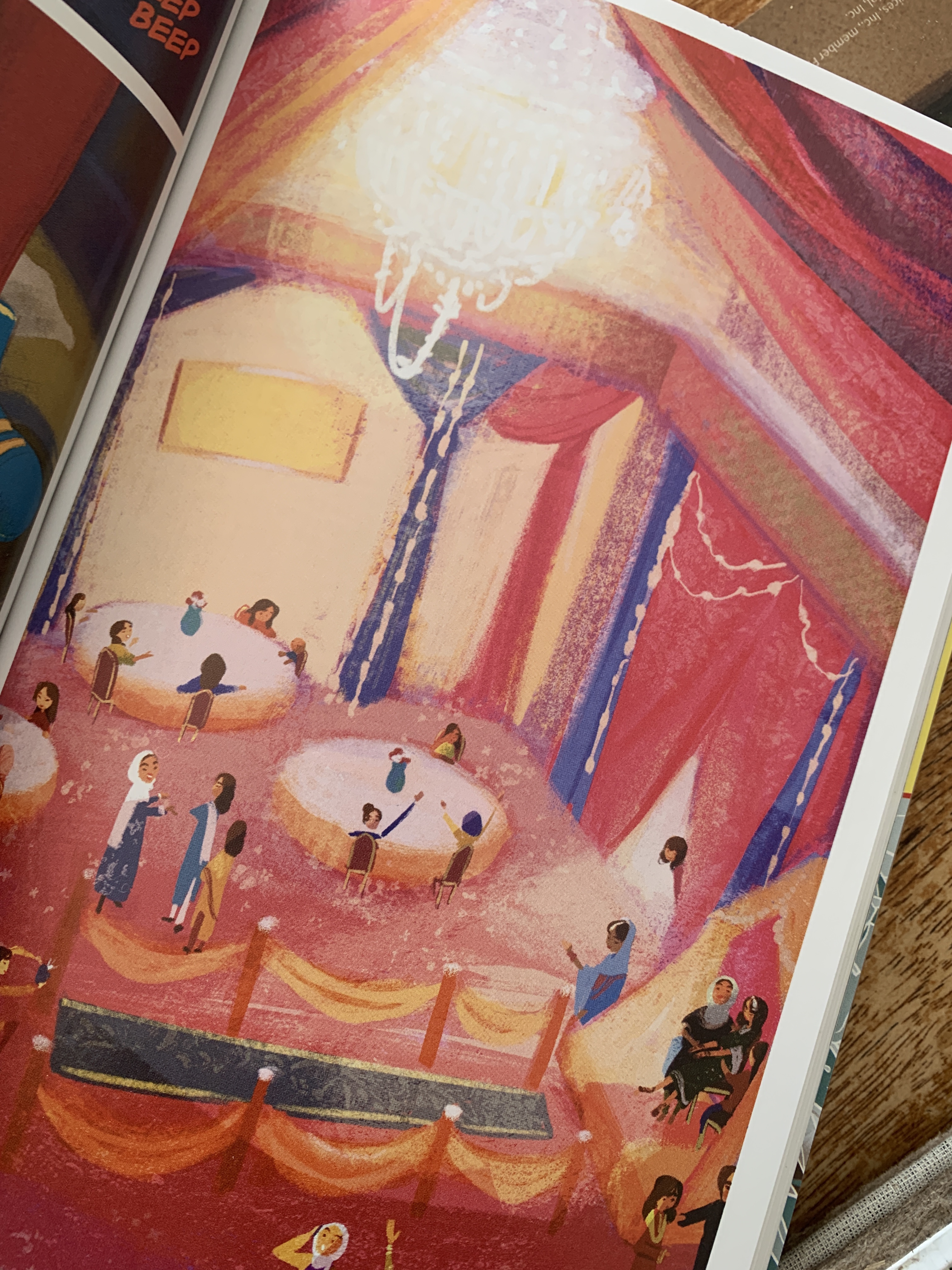
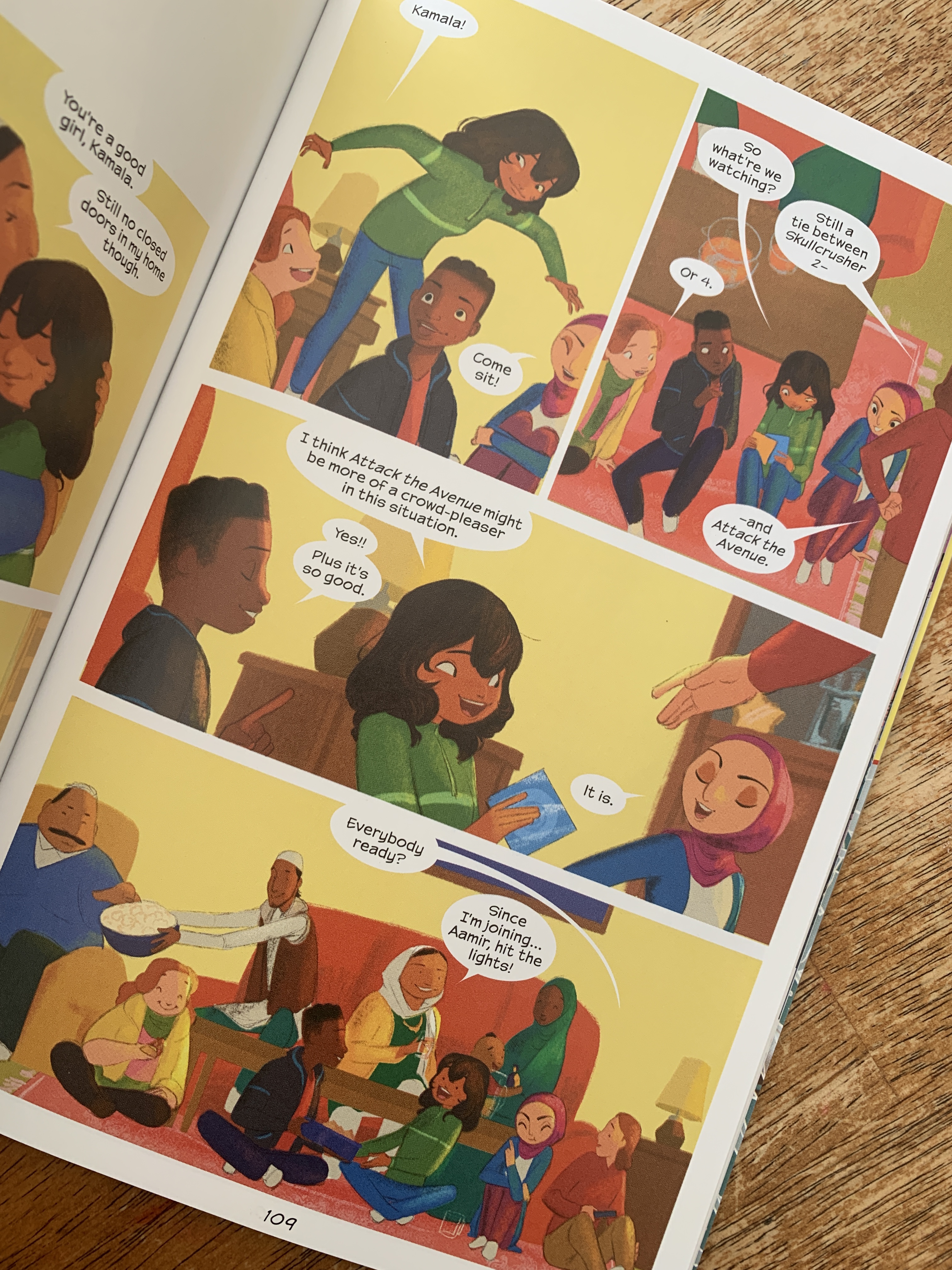
This tween graphic novel of our favorite Muslim superhero is authored and illustrated by a new Muslim duo that share an OWN voice story over 110 pages about balancing life and priorities and making time for family.  There is a little bit of action, but the majority of the plot, really is balancing it all, with the help of school friends, one being the hijab wearing brilliant Nakia, and Kamala’s friends from Avengers Training: Miles Morales (Spider-Man) and Tippy Toe (Squirrel Girl).  This seems to be a different format of a lot of the same story-line found in the Avengers Assembly: Orientation book, but for fans of the characters and genre, this middle grades graphic novel (comic book?) will be well received with it’s easy to follow panels and relatable story.  For desi and/or Muslim kids they will appreciate the mehndi celebration, the hijab wearing side characters, the pressure to do well in Quran class, and the tight rope Kamala’s parents give the mixed gender group of friends.

img_4441

SYNOPSIS:

Kamala is being stretched thin with school, super hero training, writing her fan fic, moderating the website, and helping out with her nephew Malik while her brother and sister-in law are on vacation.  The stress has her embiggening all out of whack too, it is a lot for one girl, and when an evil robot takes advantage it will mean even more disappointment for her Ammi.  Kamala ruins her fancy mehndi dress and in embarrassment makes her family leave early, she is late to pick up Malik, and she is sleeping through school.  Finally, with the only two people that know about her alter ego, Kamala gets help from Nakia and Bruno to take down the robot.  She then combines her “club” friends, with her school friends, so that her family can meet everyone, and they can hopefully help her feel more at easy and less stretched thin.

img_4442

WHY I LIKE IT:

I don’t mind the story telling being more personal and less action, but the robot element is really underdeveloped and very much minimized, I’m not even really sure what the point of it was and how it was resolved.  The book seems to be confused if the kids are pre teen or teens, they are called both in the book, and I don’t know if it is an error, or is a joke from Tony Stark, but the voice seems to be ambiguous as well, which makes it hard to completely connect to the characters.  I wish the mom wouldn’t cover when at home, I mean I’m glad to see her covering and talking about Quran and all, but being an OWN voice portrayal, it would have been nice to see that detail.  The way that the friends as boys is handled is actually really well, it doesn’t become a whole religious or cultural soap box issue, but chaperones are present and the mom is on top of it. There is no hint that anything would be going on, but it is nice to see that accurate representation.  I also like the diversity that is present even within the Desi family.  Sadly, the book as a stand alone is rather forgettable, I’m not entirely sure what to compare it to, if there will be more in this particular series, or just more like it from other MCU characters, but for people that love Marvel, at least this rep exists if nothing else, it does offer a reminder to all kids to prioritize their time, ask for help when needed, and to make space for their families.

img_4443

FLAGS:

Clean. There is a destruction seeking robot and villain, but very tame.

img_4444

TOOLS FOR LEADING THE DISCUSSION:
I think the book would be fun on any middle grade classroom shelf.  There isn’t much to discuss, but kids especially in Islamic schools will  enjoy the representation.

img_4445

A Sky-Blue Bench by Bahram Rahman illustrated by Peggy Collins

Standard
A Sky-Blue Bench by Bahram Rahman illustrated by Peggy Collins

sky cover

I know many of you are thinking, another book about school for girls in Afghanistan, and given the reception by most to the author’s first book, The Library Bus,  I can sense the rolling eyes.  I was in the minority on that one, as I enjoyed it, but, this one is simpler, sweeter, more universal while being complimented by culture, and I hope it is a more authentic and accurate OWN voice portrayal.  I know I have a lot to learn about white washing narratives and breaking down colonial paradigms, so I promise if you disagree I will listen.  But I genuinely enjoyed the illustrations and little Aria finding a way to make a bench so she could sit comfortably at school with her prosthetic leg.  The girls go to school, and the furniture was burned to keep warm in the winter, a concept that the author verifies at the end as something experienced in his own life.  Aria has to find a way to sit in class because she wants to learn, and lack of wood working experience, resources, and doubt that a girl can do it from her classmates, isn’t going to stop her.  Over 32 pages, early elementary age children will meet a determined young girl as she pieces together scraps to build a bench.

Screen Shot 2021-10-22 at 10.49.20 PM

Aria has been in the hospital for a while after an accident took her leg.  She is excited to be back at school, but quickly realizes it is hard to sit on the floor with her new helper leg.  She tries leaning on the wall, standing even, but just getting up and down off the floor is really difficult.  At home when she mentions it to her mom, her mom reassures her that she can get through it and her little brother offers to help her carry her things.

Screen Shot 2021-10-22 at 10.51.12 PM

That night Aria considers how much she would miss school if she isn’t able to figure something out.  Then she has an idea, she’ll build a bench.  At school the next morning, classmates tell her “Girls don’t build benches,” but Aria responds, “I can do anything a boy can.”

With that, a single friend joins Aria as they comb the city for discarded wood, broken furniture, screws, and nails.  They assemble the resources and when they have enough Aria and her mom head across town, past the Blue Mosque, to visit the carpenter, Kaka Najar.  He shows them how to fit the pieces together like a puzzle and loans them the tools needed to be successful.  He even gifts her some sky-blue paint, “the color of courage, peace, and wisdom.”

Screen Shot 2021-10-22 at 10.52.30 PM

That weekend Aria and her mom and little brother build a bench, paint it blue, and get it to school.  When the other students see it, their excitement bubbles and they imagine building tables, book cases, and more.  Anything is possible after all, there is paint left in the can and they are willing to work together.

Screen Shot 2021-10-22 at 10.53.08 PM

There is nothing religious in the text, save the mention of walking past a mosque, but in the illustrations the women are all covering their heads when they are out, and are uncovered at home, the school uniform seems to be a white hijab and black abaya.  I wish there were some Pashto words sprinkled, and it was a bit off that she was building a bench, but the finished project was a bench and table. The end has an Author’s Note and I enjoy seeing the smiling faces and bright illustrations in a book set in Afghanistan.

Screen Shot 2021-10-22 at 10.54.15 PM

House of Glass Hearts by Leila Siddiqui

Standard
House of Glass Hearts by Leila Siddiqui

glass hearts

This 278 page magical realism YA book featuring a Muslim family grabs your attention and heart in the prologue, unfortunately it quickly releases it, and until you get over a third of the way in to the story, it is a struggle to read.  Once you accept that half of the book, the storyline set in the present, is going to be terrible, you enjoy the historical narrative and appreciate that the short book with a quick pace spends more time in the subcontinent during partition, than it does with the painfully underdeveloped characters trying to make sense of past secrets and their present day manifestations.  The book doesn’t have any major flags in terms of religious representation, it is just ritual acts of praying and reading Quran, nothing detailed or explored, and relationship-wise there is nothing high school readers can’t handle (spoilers and more details can be read in the FLAGS section).  Despite being a first time author, she works as an editor, so one would really expect the climax to hit harder with clearer writing, the characters to be developed, the details written to serve a purpose, and the protagonist teen’s voice not to read overwhelmingly at the beginning as a five year old.  The overall story concept and historical fiction component are exciting, the development of the characters just really failed an otherwise engaging read. 

SYNOPSIS:

Maera’s brother Asad goes missing in 2011 from their grandfather’s home in Pakistan while they are visiting.  They search and cannot locate him or a body, the loss devastates Maera’s family.  Ten years later, her grandfather passes away, and the next morning a greenhouse appears in their backyard in America.  Not just any greenhouse, her grandfather’s greenhouse from Pakistan.  Maera thinks she is going crazy, her mother doesn’t acknowledge the structure, she doesn’t acknowledge much, not about the reality in front of them, not the night Asad disappeared, or the needs of her daughter. Maera’s aunt (mom’s twin) and cousin come from Pakistan to mourn the loss of the grandfather together, he passed in Pakistan, not sure why Maera and her mom didn’t go there, but I digress.  Cousins Jamal, aka Jimmy, and Maera are the only two that seems determined to figure it all out.  Their grandfather’s journal turns up and with Maera’s friend Sara and Rob, the neighbor and former best friend of Asad, the four of them set out to understand what is going on in the greenhouse.

The greenhouse seems to be alive, and entering it dependent on the whims of something within, a churail,  a shape shifting creature of myth that is more than a witch, a succubus that targets men.  A woman who died violently and was wronged by men, whose feet are turned backward, and who is neither alive or dead.  As the four work through the journal, venture in to the greenhouse, and confront those within, secrets will be unearthed, exposed, and finally dealt with.

The historical interwoven story is that of the grandfather during colonial British rule and partition.  As a young boy Haroon is searching for his father fighting in Burma and the adventures he has along the way. Shah Jehan’s father takes Haroon in at one point, and the girl with an emperor’s name sneaks him out to watch the village deal with the churail who are killing the men in their village.  The incident scars Haroon, but his affection for Shah Jehan and the role she will continue to have in his life is established. The understanding that the subcontinent is being carved up and starved by the colonizers in the name of freedom is made clear in the characters that Haroon encounters and the quickly maturing boy grows in to a young man as he starts to understand the world around him and the larger powers at play.  When the migration and violence between Hindus getting to India and Muslims going to Pakistan occurs, the pieces in the past and present come together to reveal the terrors that the greenhouse houses. 

WHY I LIKE IT:

I loved the commentary both in the text, and explicitly detailed in the afterward about how culturally the past is handled.  How little generations discuss what they have endured and been through.  I have been asked by my father-in-law a few times to try and coax my mother-in-law to detail her journey with their oldest son from India to Pakistan.  She has apparently never clearly told what happened, what she saw, and what they experienced.  She waves it off now, but her own children didn’t even know there was more to the story, and as my inlaws approach their 90s I have little hope of them recalling or sharing their stories.  Recently my son needed to hear some first person accounts of war, so he contacted my American grandfather to learn about his time in the Korean War, much of it I knew, Americans, generally speaking, talk about this type of experience in passing.  My son, also wanted to compare his story to someone who lived as a civilian through a war, and asked my mother-in-law, his Dadi, about her experience living through the Indo-Pakistan War of 1971, not that long ago, and we all sat spellbound as she recalled the sirens and how they kept the children fed and calm and whatnot.  They were stories no one had thought to ask it seemed.  She has seven children and almost thirty grandchildren.  This book struck such a chord with me, I need to actively seek out these stories before it is too late.   Chances are no one else in the family will. Not speaking the language fluently has cost me my chance to learn my own father’s family’s stories and I need to find a way to gather my husband’s family’s stories before it is too late. I love that in the book, The Past is capitalized as if it is a named living person shaping the lives of so many.  It is, and these stories are wonderful reminders and motivators to ask the elders to share their memories.

The present day story thread, however, is chalked full of holes, one dimensional characters, and pointless tangents.  Sara and Maera read like they are early elementary aged.  They are so terribly voiced in the beginning, I have no idea, how an editor author and mainstream publisher did not require correction.  The dialogue, the action, the role of the parents, it is terrible.  Speaking of terrible, the mother and aunt are absolutely flat and useless.  They mope, sleep and sit in the corner.  I don’t understand why you wouldn’t develop them to link the past story to the present one.  I’m not being picky here, it is that bad.  I also wanted to know why the dad left.  Seems like it would flesh out the mom a bit, justify her approach to life.  Sara and Rob are obviously brought in to serve as vessels for the action, and for Maera and possibly Jimmy to play off of.  But their backstories are so pathetic.  How do you not know or see your neighbor for ten years.  Ok, I get that he was Asad’s best friend and your family in their grief and denial pushed him away, but he never checked the mail or took out the trash, or was seen? And Sara offers absolutely nothing to the story other than to be part of the forced crush/romance line pairing off her and Jimmy and Rob and Maera.  Alhumdulillah, it stays tame with the angsty longing and hand holding.  

Random details that serve no purpose reach a pinnacle with the paragraph long time spent on Maera wearing Rob’s tank top.   I have no idea why we should care that she is wearing a tank top.  Sure as a Muslim reviewer it furthered the notion to me, that she is probably more culturally religious, and yes I know Muslim’s dress to different degrees of modesty, but I really couldn’t find any other reason for the emphasis on the black tank top. Overall, all the friendships in the story seem so off: Rob and Asad, and Sara and Maera.  They should be easy plot points, but they don’t connect, or read believable.  

Plot wise: if you had a building magically appear in your back yard along with a journal, would you not read that journal as fast as possible? Sure you would lose sleep and maybe skip a meal or two, but hello, a building just appeared in your back yard that is moving and growing, your grandfather died and your brother’s body was never found: stop what you are doing and read the journal.  It mentions that when Asad went missing there were a lot of other kids, cousins at the house, so where are they now? Why was there no mention of them, and only Jimmy seems to have a vested interest in the grandfather passing, and the growing need to remember Asad.  I did not understand the sacrifice and hair connection and how that was what Maera understand the Churail to be asking for.  I did not understand the end of chapter entitled “The Separation,” it says they entered together, so…. ya?Off and on in the greenhouse there are multiple churail, this seems inconsistent with what we learn from the one churail about leaving.  The whole climax needs a Cliff’s Notes synopsis.  I honestly have no idea what happened.  The churail was scared of the beast, but they all went off together, affectionately? I’m trying not spoil anything here.  Why was the churail so different at the beginning compared to the end, why did she get a growth arc, when the other characters didn’t? Shouldn’t there have been some cathartic reprieve verbalized between the mom and SPOILER (sorry I tried) Asad? I felt deprived.  

There were a few grammar errors, but because I read an ARC, I’m hoping they have been corrected

FLAGS:

There is a little bit of language (F word at least once).  Children are conceived, it isn’t explicit, but the fact that it happened is critical to the story.  There are crushes, angsty/longing, hand holding, hugging.  There is sexual assault implied as a major plot point, but not detailed.  There is death, and killing, often gruesome, some real, (hits harder), some far fetched.  The book is YA and  ok for high school readers and up in my opinion.

TOOLS FOR LEADING THE DISCUSSION:

I would be interested in seeing if some of the muddled passages are cleaned up in the published physical copy, the book’s characters are weak, but the historical fiction component is a story that needs to be shared more and more as we, collectively, seek to understand the past, the impact of colonization, and the emergence of telling our OWN voice stories.  For all the flaws, I haven’t completely written off the book, I’m hopeful that even if this one doesn’t make the cut for a book club, that inshaAllah the author will keep writing and filling in the blanks.
What’s The Matter Habibi? written and illustrated by Betsy Lewin

Standard
What’s The Matter Habibi? written and illustrated by Betsy Lewin

matter habibi

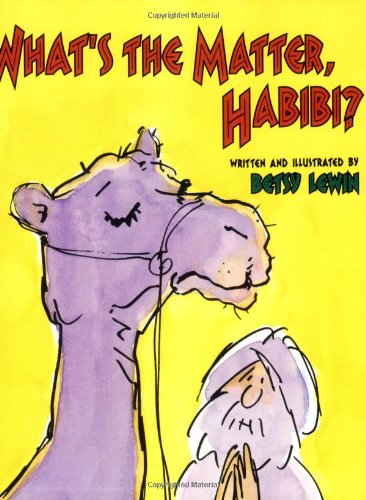
This short silly 32 page AR 2.7 book by the illustrator of the famous Click, Clack, Moo books tells a tale of an unhappy camel in Egypt and his caring owner Ahmed’s attempt to understand what is wrong.  There is nothing religious in the book, save a few visible hijab wearing women in the bazaar illustrations, and the main human character’s name.  The cultural backdrop though,  does introduce and encourage familiarity for young readers who may not have exposure to Arabic words and people.  The author is clearly not Arab, but the book thanks the Cairo NESA delegates for their help in developing the story.  Before reading it I was nervous that because the presentation would be coming from an outside perspective,  that the messaging would be condescending and/or stereotypical.  I think I was perhaps giving the book way too much thought, because ultimately the story isn’t that deep.  The illustrations and tone are warm and focus on a camel wanting a fez and the efforts it takes for Habibi to acquire one and for Ahmed to track him down.  It is surface level silliness for younger kids, the camel and owner are kind to each other and the setting just ties it all together.  I am not Arab, and could definitely argue that the camel and his silly owner do perpetuate stereotypes, so feel free to offer up your thoughts if you have read the book.  Irregardless of where you side, the fact that I’m sure had I read this book in 1997 when it was published, I would have been gushing to see the name Ahmed in a widely available book, but here we are nearly 25 years later and I’m questioning if these are stories that are better left to be told by OWN voice perspectives.

img_4356

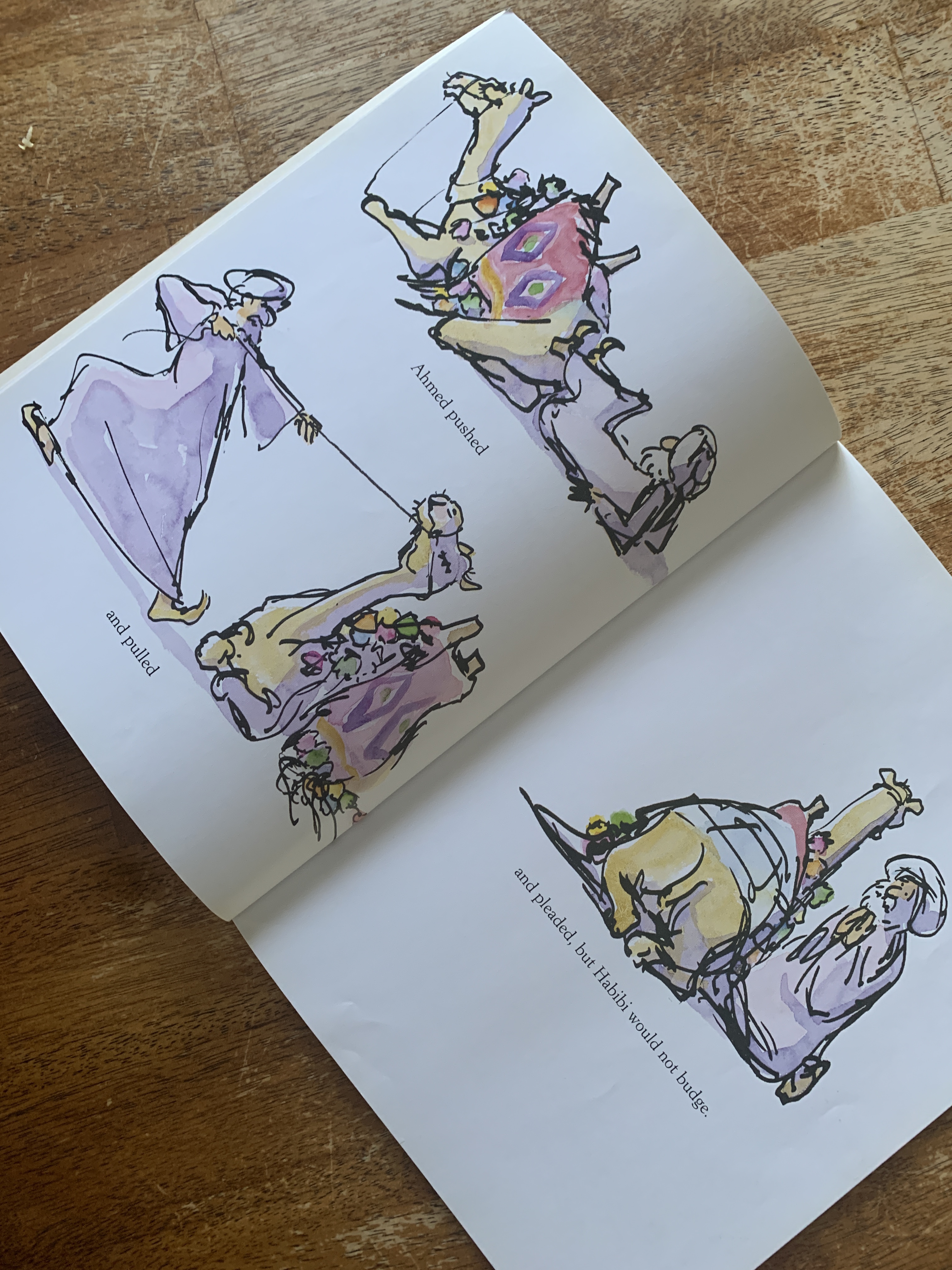
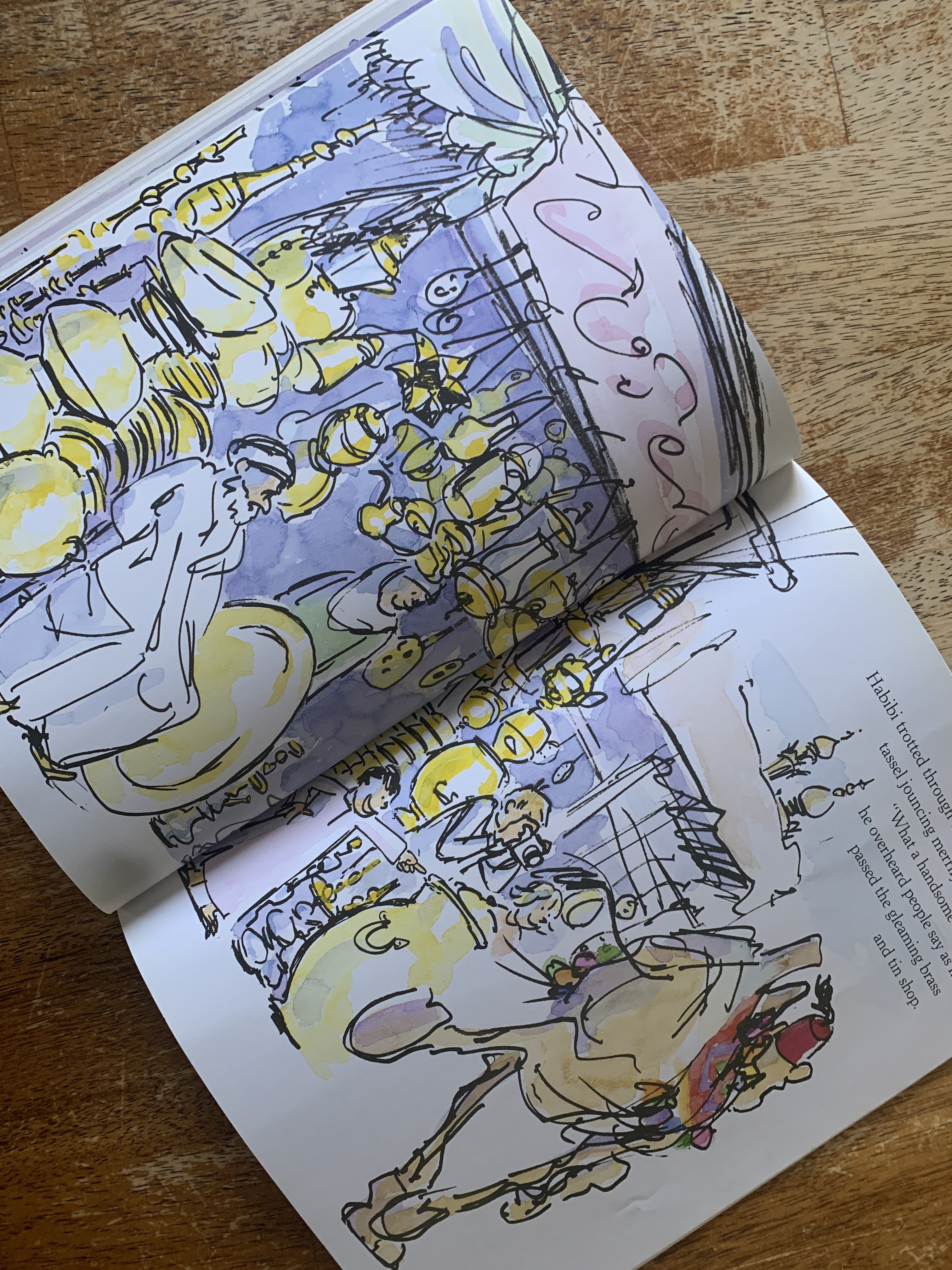
Ahmed and Habibi give rides to children every day, but one day Habibi refuses to get up.  Ahmed asks if it is a toothache, a tummy ache, and no response.  When he asks if his feet hurt, Habibi stands up, and Ahmed gives the camel his babouches (that magically fit).

img_4357

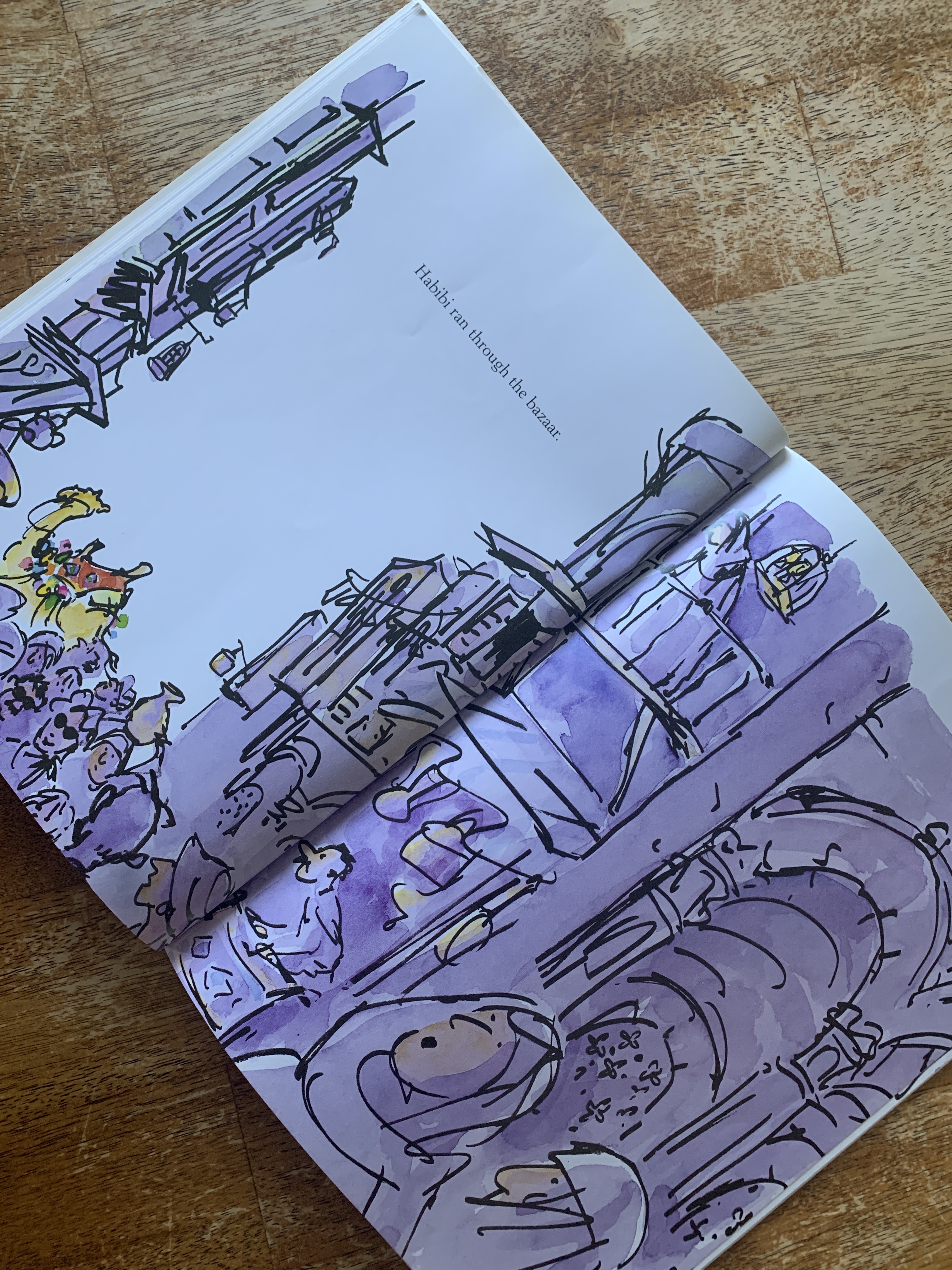
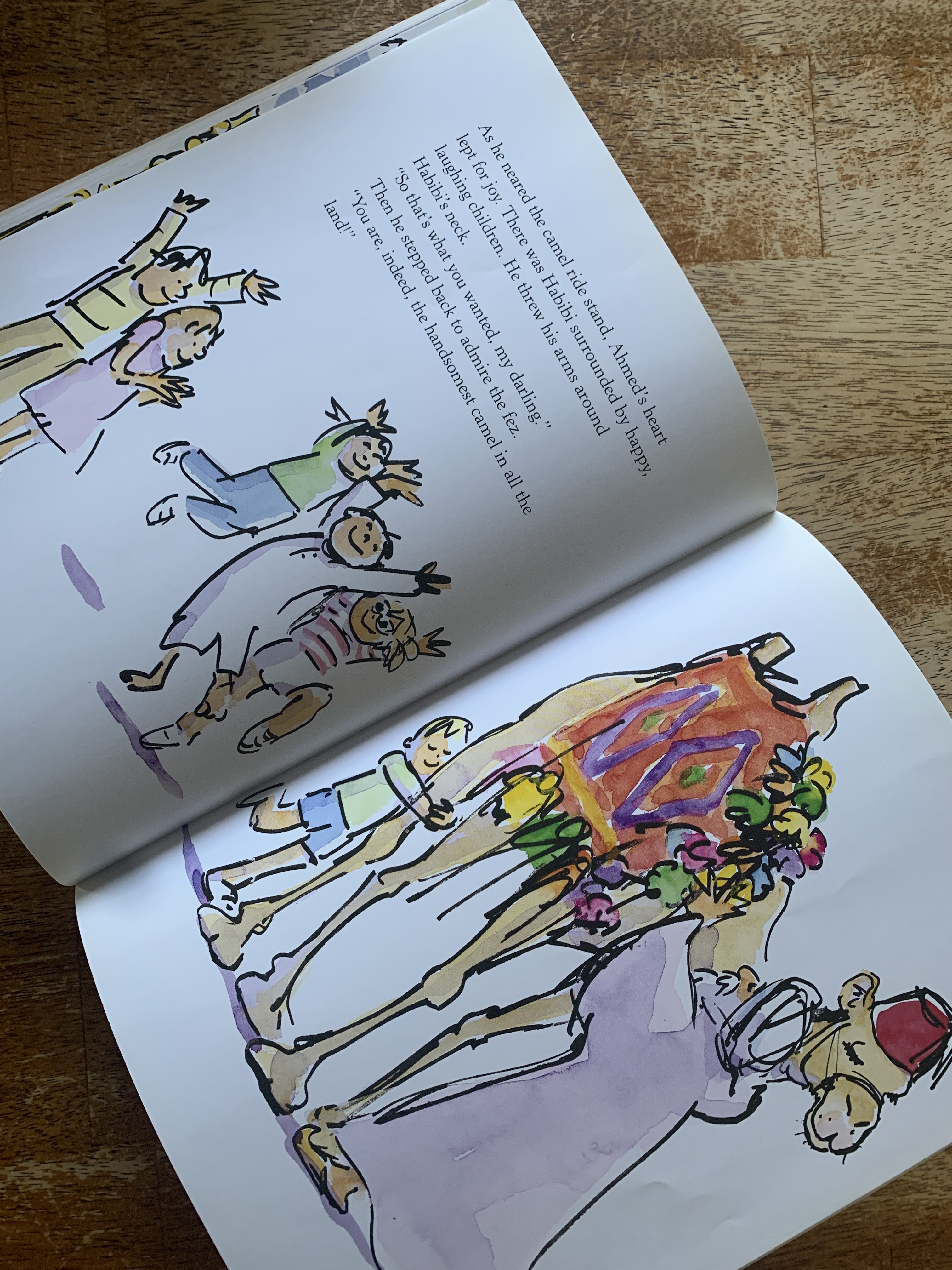
Habibi then takes off running through the bazaar.  He approaches the man selling fezzes and a trade is made: the slippers for a hat.  Ahmed trailing behind barefoot, then has to purchase his own shoes back.  As Habibi passes different shops and hears how handsome he is, Ahmed is able to follow him.  When they finally reunite, Habibi is surrounded by happy children, and Ahmed admits, he really is a handsome camel.  Happily Habibi gives the children extra long rides and then let’s Ahmed ride him home.

img_4358

This book would work well for story times to ages four and up.  It would lend itself to themes about silly animals, hats, Egypt and Arab culture.  The crowds of people including the children are dressed in both thobes and pants and t-shirts.  You see traditional headgear on some and none on others.  It seems clear that the camel is not the normal mode of transportation, as there are no other camels, or even cars, only people walking in the book.  Habibi is a novelty for the children and adults he passes, so one could possibly safely assume he is a tourist attraction of sorts.

img_4360

Daring Dreamers Club: Piper Cooks Up a Plan by Erin Sodenburg illustrated by Anoosha Syed

Standard
Daring Dreamers Club: Piper Cooks Up a Plan by Erin Sodenburg illustrated by Anoosha Syed

piper

This is book two in the series, I couldn’t get the first book from the library, and I wasn’t willing to wait for the one that focuses on Muslim character, Zahra’s story to be published, it could be a few years.  At 224 pages this middle grades book is fairly formulaic with five diverse girls becoming friends, each book featuring one girl’s story with the others serving as supporting characters, and with the tie-in to Disney Princesses, I really didn’t expect much. Imagine my surprise when I found myself enjoying the characters and their lessons and struggles, sigh.  The book is sweet, the characters like-able, and the author really doesn’t try and force all the characters into every scene.  The book focuses on Piper and the other girls add to her story where it helps, they don’t all have equal time and it doesn’t get confusing because of it.  You can even read the books out of order.  Zahra wears hijab and her Islam is mentioned in a journal entry where she discusses the five pillars, the importance of charity, and getting dirty looks.  There is nothing preachy, but none of the other character’s are defined by their faith and I truly don’t know if I’m bothered by the singling out of Islam being her identity or flattered by it.

img_4279

SYNOPSIS:

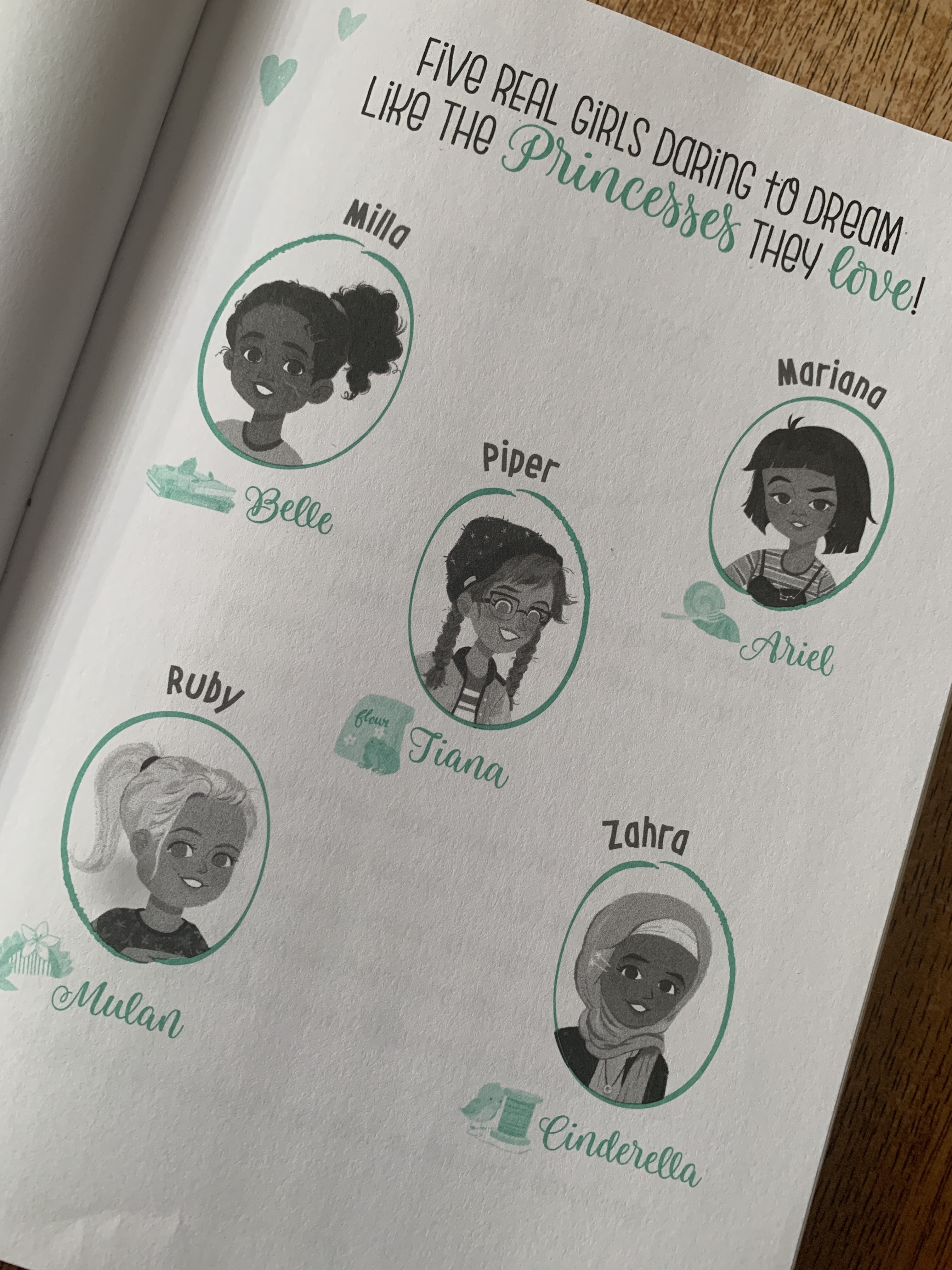
Five girls are grouped together at school in an advisory class to help prepare them for middle school: Milla, Piper, Ruby, Mariana, and Zahra.  Their advisor loves Disney Princesses and in their weekly journal entries has them write about their assigned Princesses as they explore their similarities and how they would tackle challenges, face fears, and the like.  The girls are diverse in family dynamics, race, religion, ability, etc.  Milla is African American with two moms and food allergies.  Zahra is good at art, Muslim, and likes to sew.  Ruby is a twin, her parents are divorced and she is great at sports.  Mariana is hispanic, and is an amazing swimmer.  Piper is Jewish, has dyslexia and loves to cook.  In the book she is struggling with school, while she excels in her food science creations.  She gets accepted to appear in a kids cooking show competition, but will need the help of her Daring Dreamer friends to prepare for the challenges about to be thrown at her during the competition, and to help her from falling behind in school.

Each girl has their journal entry presented in the book which helps to understand more about the different girls, as well as a little bit of introspection to the events happening in the larger story.

WHY I LIKE IT:

I like that the characters are really supportive, and the lessons aren’t so on the nose.  Piper isn’t just told that she doesn’t have to win the competition to have value, you feel it long before she accepts it herself.  Her personality really comes through and it isn’t for attention or for sympathy, she helps a competitor, there is no giant round of applause or moral reflection, she just helps.  I love that even though the story is Piper’s and her dream, there are larger issues woven in and felt, not necessarily preached. Piper is the middle child and feels she has to prove herself, she remarks on how being pulled out of class in early elementary school to get help has made it hard for her to ask for academic help now, the role of confidence and how charity and giving back is important, even while her own family’s financial situation isn’t clear.  I like the role of Piper’s siblings, they are quirky, but loving, and they work through their annoyances to help each other.  It is heartwarming.

I have my own mixed feelings about Disney Princesses, as a child of the 80’s, the 90’s brought all the glory of Jasmine, and Ariel, and Belle, and Mulan, and my friends and I definitely identified with different characters.  I may or may not have tied my hijab up many a days and claimed that I was Mulan in high school, but somehow with my own daughter I didn’t really bring the Princesses in to her day-to-day existence, I don’t think she has even seen all the movies, we read books (we didn’t even have a tv when she was little), she’s 14 now.  It had become too commercialized, I worried about the messaging more.  This book reminded me of what my friends and I as older “kids” channeled the Disney Princesses to be.  It wasn’t all about pink and sparkles, it was battling the bad guy, hanging on to your dreams, and persevering when things were tough.  This book channels those thoughts, it isn’t in your face Disney, it is more muted, and I appreciate that.  It is a solid middle grade read and I think an enjoyable one at that.

img_4283

FLAGS:

In this particular installment, there are no crushes, no holidays, no music, one character has two moms, but in this book, I don’t know that a casual reader would pick up on it. It says “Moms” once, it might be a bigger deal in the story that focuses on Milla, but I haven’t read it to comment.  There is lying and Piper tries to justify it, but I think it is clear and has its own resolution.

img_4284

TOOLS FOR LEADING THE DISCUSSION:

It is much too young for a middle school book club, but I think because it is such an easy engaging read, that in a home, or classroom, the book would be appealing to 3rd graders and up.

The author’s website: https://www.erinsoderberg.com/daring-dreamers-club.html

img_4280

The Tale of Princess Fatima, Warrior Woman: The Arabic Epic of Dhat al-Himma translated and edited by Melanie Magidow

Standard
The Tale of Princess Fatima, Warrior Woman: The Arabic Epic of Dhat al-Himma translated and edited by Melanie Magidow

princess fatima

I’m not sure how to really review this 167 page book.  It is the translated YA work of an Arabic Epic that took place somewhere between the seventh and 10th centuries and began possibly being compiled in the 1100s.  It was told orally, but when written, comprised some 6000 pages.  The translator notes that the choices of what to include and how to translate, all potentially alter and reshape the narrative, so as a reviewer I’m simply going to review the text in my hands.  I have no outside knowledge of this epic woman, and approached the book as I would have in high school when reading The Odyssey or Beowulf: some of the history is accurate, the characters fictitious, the culture possibly representative.  As a result, I find the comparisons to Wonder Woman and Katniss Everdeen on the back cover, very odd choices.  At times the contemporary diction, in my opinion cheapens the narrative.  Sure I appreciate the modernization of the text to make it an easy read, but throwing in modern slang seems too much.  I found the book’s framing unfortunately counterproductive of what it hoped to achieve.  I have no idea what the other 5,900 pages include and what the translator had to choose from, but the majority of the book focuses on marriage, being raped by her husband, and working to prove who the father of her Black son is when her and her rapist husband are white.  I was prepared for battles, and conquering, and fighting misogyny, and saving the down trodden, not every one just wanting to marry her.  Many of the characters are Muslim, some convert to Christianity to escape Dhat al-Himma, the Quran is quoted, prayers are made, the Kaaba visited.  I do however, take issue with the explanation of the child’s skin coloring being attributed to intercourse (rape) occurring while Fatima is menstruating and a case of Prophet Muhammad (saw) being used as proof of this occurring.  So much of the text is footnoted, this instance is not, and I find it disturbing.  The book also contains a lesbian character who ends up marrying a man, violence, death, and many other potential flags (see below) that might make it better suited for older college age readers.

SYNOPSIS:

The story doesn’t begin with the birth of Fatima, but rather with her great great grandfather.  It sets the stage a bit to show culture, how women and honor are treated, and the line of her ancestry.  When we get to know Fatima a few chapters later she is being born and her gender is a disappointment, so she is hidden away.  As she grows away from her tribe she becomes an accomplished warrior and captures her father in a raid.  When she returns to her people, her cousin, Walid, born the same time as her, is struck by her beauty and wants to marry her.  She refuses.  Repeatedly.  Finally she agrees to battle him and if he wins, she will marry him.  She wins, and he still doesn’t back down, finally she is forced/tricked in to marrying him by the Caliph’s agent.  The two are pronounced wed, but little changes for Fatima, she is a warrior and does not seek intimacy or companionship.  Eventually, her husband Walid enlists the help of Fatima’s milk brother and friend, Marzuq, to have him drug Fatima, so that he can rape her.  He acknowledges the rape, the whole community does, but allows it, because he is her husband.  When the child is born he is Black and Walid and his family refuse to accept that the child is his.  Amira Fatima is socially put on trial for being a whore and that the child is illegitimate.  As Walid works to have them killed, Fatima works to prove her innocence and carry on with her life trusting in Allah swt completely, all while the Arab-Byzantine battles are raging in the borderlands.  As Abdelwahhab, Fatima’s son, grows he too becomes a formidable warrior and the two have continued adventures.

WHY I LIKE IT:

I love the richness of the culture coming through a compelling story. Fatima is incredibly devout in her worship of Allah, swt.  She does not falter, ever.  When she is being tested she needs only her faith, at one point a man converts to Islam upon having a dream as a result of her conviction in praying.  That being said, I genuinely don’t understand a few critical points.  How can a woman who single handedly destroys tribes not be listened to, to make her own decisions to lead her own life.  I get that that is perhaps the poignant point of the story in today’s context, but there are a lot of strong women in this book, so why does her marriage and being defined by her not wanting to marry get so much of the spotlight? Her father didn’t want her, but they don’t resolve anything, they just reunite and all is well.  I need more.  I want to know what happened to Walid once he became Christian, was it a permanent thing, a temporary fix? What ended up happening between her and Marzuq? He was her trusted advisor and immediately regretted drugging her, what happened to him.  I want more about her mother, maybe even her Aunt or other women to see how their lives compared and contrasted to the powerful women highlighted.  How did they view her, was she inspiration, an anomaly, beloved, loathed?

I appreciate the footnotes, the introduction, the Note on the Translation, the further reading list, help with pronunciation and the character list.  A map would have been nice.

FLAGS:

There is violence, killing, rape, talk of sexual intercourse and menstruation.  There is misogyny, racism, flirting, sexual temptation, a lesbian character, magic, jinn.

TOOLS FOR LEADING THE DISCUSSION:
I would not be able to lead a proper discussion on this book, I am just not knowledgeable enough on the larger story.  I think I would like to be a student or be able to join a discussion led by someone well versed in The Tale of Princess Fatima and all the subtext that brought her story to life and maintained it over time.  It would be fascinating.

There was an Old Auntie who Swallowed a Samosa by Asmaa Hussein illustrated by Milton Bazerque

Standard
There was an Old Auntie who Swallowed a Samosa by Asmaa Hussein illustrated by Milton Bazerque

samosa

I feel like such a broken record of late (and in the future), of my reviews of books published by Ruqaya’s Bookshelf; the stories are WONDERFUL, but I really struggle with the titles.  I truly thought this was a cultural/religious version of the classic, I Know an Old Lady who Swallowed a Fly.  But it isn’t.  It is an original clever, laugh-out-loud hysterical story for preschool to early elementary.  And one that parents and caregivers will not dread reading over and over again with the well done rhyme, expressive illustrations, a silly conclusion, religious framework, and universal appeal.  The book is on point, the title and cover illustration, sadly for me are not, and don’t, in my opinion, do the story justice.

img_4190

Auntie Sophie is making samosas with some peppers she grew herself.  Under the close company of her kitty, we learn how the Scotch bonnets were grown and cared for.  The doorbell rings and Auntie Eynara has arrived with her beautiful cake to take to the masjid for iftaar.  

img_4191

Auntie Sophie  hurries and fries her samosas and the ladies head up the hill to the only mosque in town.  Everyone breaks their fasts with a date, but Auntie Sophia dives in to her samosas.  When the imam’s mic crackles, she swallows the samosa whole and something is terribly wrong.  Her belly is on fire and jelly nor garlic knots nor mint lemonade not rice can cool it down.

img_4193

Just when she thinks she is ready to pray, it starts up again, and having eaten everyone’s dinner, Auntie Sophia is getting very tired. As she rolls out the door and down the hill to her house, she figures out what happened to her delicious samosa filling, and calls to have pizza and halal hot wings delivered to the mosque.  She also pledges to grow flowers next year instead!

img_4192

Kids will love the book as it is outrageous, while at the same time being so relatable.  The mosque, iftar, eating something spicy, the book is a favorite at our house for both the two and six year old and the horizontal 8.5 x11 orientation, keep eyes glued to the pages, while the rhyming lines move the story along.  I enjoy being able to talk about the peppers and different foods and smell of garlic with my kids after the 17th reading or so, and I love the diversity of the characters at the mosque.