Category Archives: islamic fiction

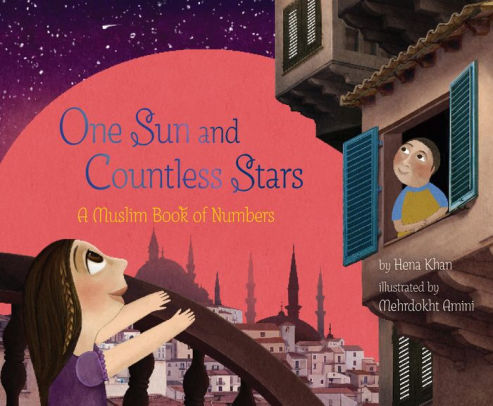
One Sun and Countless Stars by Hena Khan illustrated by Mehrdokht Amini

Standard
One Sun and Countless Stars by Hena Khan illustrated by Mehrdokht Amini

one sun

I don’t think that Hena Khan is necessarily a controversial figure, but some days her work feels very polarizing as some praise her ability to share OWN voice desi American Muslim stories while others feel like she waters down the very stories she is sharing to appease the majority.  Irregardless of our nuanced views, many of us first were made aware of her when we we were swept away in 2012 by the mainstream book, Golden Domes and Silver Lanterns.  Since then she also has published a book about shapes in the same format, and now this counting book that reminds me how beautiful and powerful it is to see Islam so unapologetically presented to all children.

Screen Shot 2021-11-10 at 10.25.04 PM

The author’s note at the end is important:

There are many significant numbers in Islam.  They include one for God, five for the pillars of the religion and daily prayers, seven for the circles pilgrims and visitors walk around the Ka’aba during hajj and more.

Mathematics and astronomy were among the intellectual pursuits of early Muslims.  They helped to develop algebra and used geometry to create the elaborate patterns found in Islamic art.

For this book, I chose concrete and illustratable terms rather than abstract concepts.  The representations for each number focus on things we can count in the world around us.

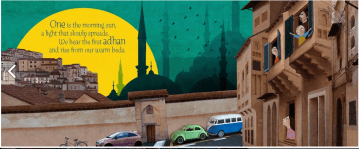
The book counts the diverse and global parts of a practiced faith.  The unique and the mundane, all beautifully illustrated and richly conveyed.  From cups of tea and shoes taken off for prayer to two hands making dua and four lines of a surah being memorized.  The book counts up to nine and then marvels at the countless stars that we see each night.

The first page is possibly a bit problematic in accuracy.  The tone and framing of starting the day with the sun rising and the sound of the adhan is warm and beautiful, but the adhan is not called at sunrise for the first prayer of the day, fajr.  Fajr begins at dawn.  There are only 21 words on the first page, so I’m inferring a lot about the correlation of the sun and athan that may or may not be present.  It is something frequently misrepresented, so it catches my attention. And yes, the seven tawafs mentioned in the author’s note would also apply to umrah, not just hajj.

Overall, the book is lovely and will remind many of us what made us all celebrate Hena Khan and her stories so many years ago.

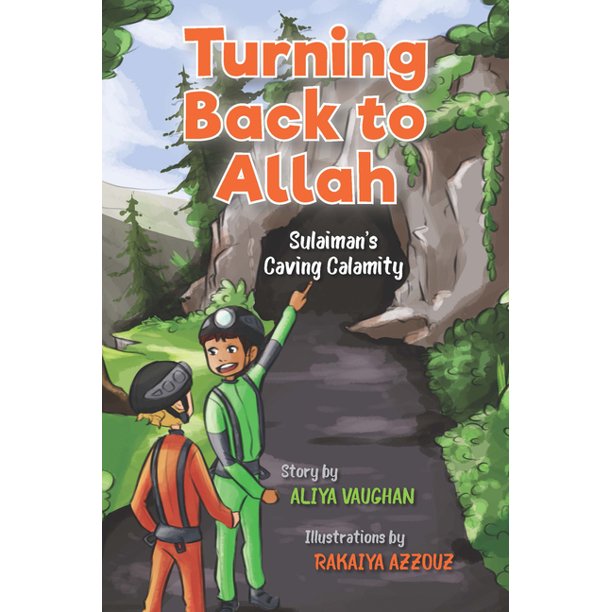
Turning Back to Allah: Sulaiman’s Caving Calamity by Aliya Vaughan illustrated by Rakaiya Azzouz

Standard
Turning Back to Allah: Sulaiman’s Caving Calamity by Aliya Vaughan illustrated by Rakaiya Azzouz

turning back to Allah

Good early elementary books can be tricky: the voice needs to read authentic, the lessons not preachy, and the scenarios relatable, all while not talking down to the reader or talking above their comprehension.  As fabulous middle grade books seem to be popping up at record speed, I find myself reading the same old books with my fourth child who is six.  Alhumdulillah, this book was nominated in the Muslim Bookstagram Awards 2021 competition and I was able to purchase and receive it quickly from Noura at Crescent Moon Store.  My son can read it, although because of the British terminology, he did better when I read it to him, none-the-less, he could explain it, he genuinely understood and related to the main character, and was emotionally connected to the outcome of the story.  The 49 page, color illustrated story is perfect for independent readers first or second grade and up.  The book also contains comprehension questions, etiquettes for du’a, a list of times and places when du’as are answered, and evidence for the story from hadith.  Additionally there are ayats from the Quran at the beginning and end of this well sourced book, alhumdulillah.

img_4985

SYNOPSIS:

Sulaiman is getting ready for an overnight scout trip in some caves.  He is nervous having been stuck in his apartment elevators the summer before and being lost at a park with his family.  His stress has him being mean to his little sister, and his dad tries to mediate, but you can sense that their normal bickering is heightened because this is going to be hard for Sulaiman.  The scouts meet up to board their mini bus and Sulaiman is acting weird, he wants to sit by the window, he wants to read signs, finally he tells Jacob about his worries and the two boys agree to stick together like glue while they are in the caves.  Foreshadowing is set, and when Sulaiman’s batteries roll away and he stops to retrieve them he gets separated from the group and he will have to rely on his faith in Allah swt to feel less alone and brave what is to come.

img_4984

WHY I LIKE IT:

I love that when Sulaiman is arguing with his sister he doesn’t have hadith quoted at him.  Sure it is ideal, but really, as parents we just want the bickering to stop most times and our kids to be nice.  It is often easier to instill morals and lessons in calm times, not in the middle of an emotional kerfuffle.  At the same time, when he is scared, he falls back on the lessons he has been taught from the Quran and sunnah.  I love how it reads realistic.  We want our kids to turn to Allah swt for all things, but sometimes to teach that we encourage them to seek Allah swt in times of happiness and times of hardship.  Sulaiman is scared, really scared, and he turns to Allah swt, and it is heartfelt and emotional.

I’m embarrassed to say, but I was a little confused by the being lost in a park prior story thread.  It either needed more detail, or maybe just more context, but I thought it was the same park they are heading to with scouts, then realized it was a completely separate park and incident, so I would like a bit more framing of that story line.  Also the stress of being stranded in the elevator, doesn’t directly connect to the rest of the story, perhaps bringing up some claustrophobia fears would have helped tie it all together.  As it is, it just seems that Sulaiman seems to be tested a lot and rather traumatically.

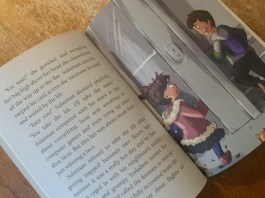
The illustrations being in full color and full page are a welcome surprise in the book.  However, there is one two-page illustration that shows the kids laughing before boarding the minibus, but it isn’t derived directly from the text, and I initially thought Sulaiman was being laughed at for his fears.  I went back, and it doesn’t seem that is the case, but I wonder if I was the only one confused by that illustration.

All-in-all the book physically is appealing to children with the open font, colorful pictures, size, and length.  The story is relevant, and the islamic tie-ins powerful, alhumdulillah.

FLAGS:

Some teasing, possible bullying among siblings.  Some scary moments mentioned and explored: being stuck in an elevator, lost in a park, left alone in a cave.

img_4984

TOOLS FOR LEADING THE DISCUSSION:

This would be a fun read aloud in a second grade class.

Golden Girl by Reem Faruqi

Standard
Golden Girl by Reem Faruqi

golden

I began reading this book not having any idea what it was about. All I knew, or all I cared to know, was that the incredibly amazingly talented Reem Faruqi wrote it, so I wanted to read it. While I know it will be hard for most to avoid knowing the plot, I think it was a blessing that I was able to be swept away so completely and so fully in a story that is wonderful and memorable, and truly sets a higher standard for the way that a story can be told. Faruqi’s voice and authenticity had me in tears. I didn’t even realize my eyes were dripping until my son asked me if I was ok. It wasn’t the plot that had my emotions spilling over, sure it helped, but it was the storytelling, the hadith and deen and snapshot of a life so unlike my own that simultaneously is exactly my own that a physical reaction emerged. It is the power of OWN voice storytelling. It is the power of brilliant writing. It is not just a book about a Muslim character, this book blurs the lines for me between Islamic fiction and fiction with Muslim characters. Middle school readers (mature middle grade readers) will enjoy the book, older readers will enjoy and appreciate the 336 page story told in verse. You can pre-order the book and I hope you will, it helps convey the message to publishers that this book is highly anticipated and that we need voices like this. Additionally, Goodreads currently is hosting a giveaway, you can head there to try and win a free copy.

(If you don’t want to know what the story is about, maybe skip the next section.)

SYNOPSIS:

Aafiyah’s name means well-being, protection, health, money, happiness, everything good, but Aafiyah has secrets too. She is privileged and loved, and she knows it, but sometimes when she sees something she likes she accidentally borrows it. Sometimes it isn’t an accident. Sometimes she doesn’t just borrow. Much of her life is wonderful, a best friend that lives next door, doting parents, tennis, vacations, trips to Pakistan to visit grandparents, and a love of “weird but true facts.” So what happens when all that changes. When her grandfather gets sick and the family wants to bring him to America for treatment, when Aafiyah’s dad gets detained and imprisoned on the way home, and Aafiyah’s secret may be a way to help her family?

WHY I LIKE LOVE IT:

I absolutely love that the characters are so well rounded and developed. Yes, Muslims have vices, and even young practicing Muslims have tests and struggles. The bar has been raised, we aren’t just a monolith, and our only struggles aren’t girl/boy issues, alcohol, not being oppressed and getting an education, we are complex people, we are human. The bulk of the story is Aafiyah growing up: her responsibility within her family, her changing body and appearance, her friendships, her responsibility for her actions, her desire to want to help and improve and step in to her own. I love that all these layers of life somehow are explored in such sparse lines. It doesn’t drag, but it gives the necessary pauses to involve the reader in her logic and view of the world. Aafiyahs’ kleptomaniac tendencies, her father being detained, her grandfather’s illness. they all move the story along, but they are foils for a much more intimate character story. A story that is surprisingly funny and light and impossible to put down.

I absolutely love how Islam is woven in, how she exudes Islam in all that she is, because she is a Muslim completely, the good and the bad. The guilt she feels, the desperation to be forgiven, the knowing that Allah swt sees all. The book is never even close to being preachy, but she proudly owns her identity and the details of her faith are not watered down, or even justified, it is who she is and it isn’t up for debate.

Culture is presented unapologetically as well. She is critical of things she sees in Pakistan, and similarly celebrates and admires good things about Pakistan and Pakistani culture. The book does not seem to have an agenda in presenting Muslims or Pakistan as good or bad, just as Aafiyah sees them. Which isn’t revolutionary on the surface, but it really is refreshing because it highlights how many books simply don’t. It makes the contrast painfully obvious between books that are shy about certain things, when they have their characters deflect and disassociate from certain “realities” and books that confidently uphold their identity and demand that the reader steps up and truly see the characters and their experiences.

There is a beautiful and raw author’s note at the end that shares some of the inspiration for the threads of the book, a glossary, a recipe for Aloo Gosht and resources for help with kleptomania.

FLAGS:

Stealing, lying, chatter about crushes, music, dancing. Being attractive and the reactions that it gets is woven through out.

TOOLS FOR LEADING THE DISCUSSION:

If I have a majority girl group, I will teach this. It isn’t a girl only book, but I think some of the more subtle themes would need a safer girl space to discuss.

The World is Your Masjid written and illustrated by Kate Rafiq illustrated by

Standard
The World is Your Masjid written and illustrated by Kate Rafiq illustrated by

masjid

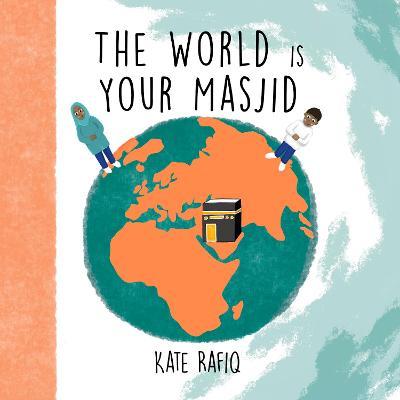
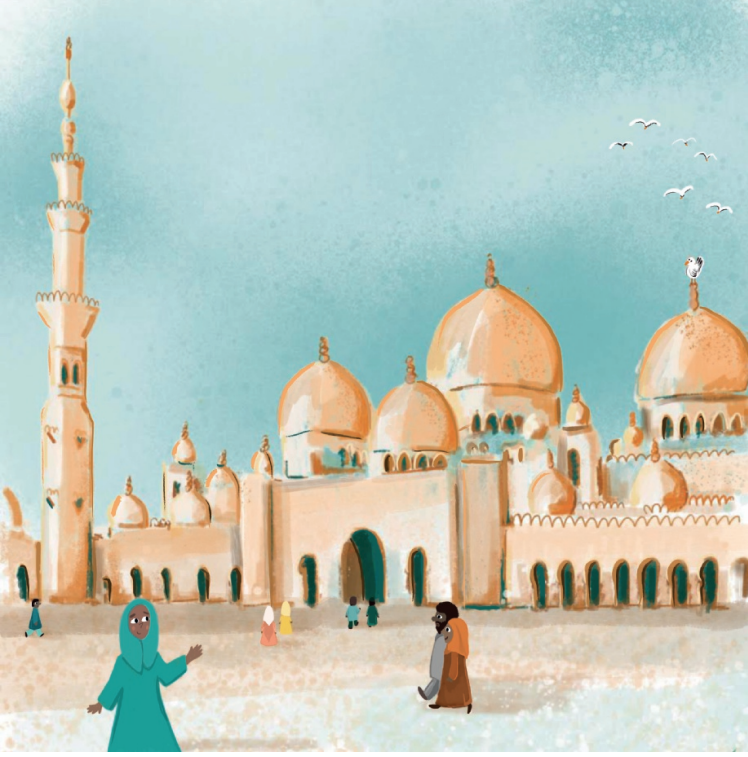
This 30 page preschool to early elementary aged book is a simple rhyming book that reaffirms all the places we can pray and touches on those that we shouldn’t.  The engaging illustrations and relatable scenarios make the book a great choice for bedtime stories and small group readings.  

Screen Shot 2021-11-17 at 11.33.41 AM 1

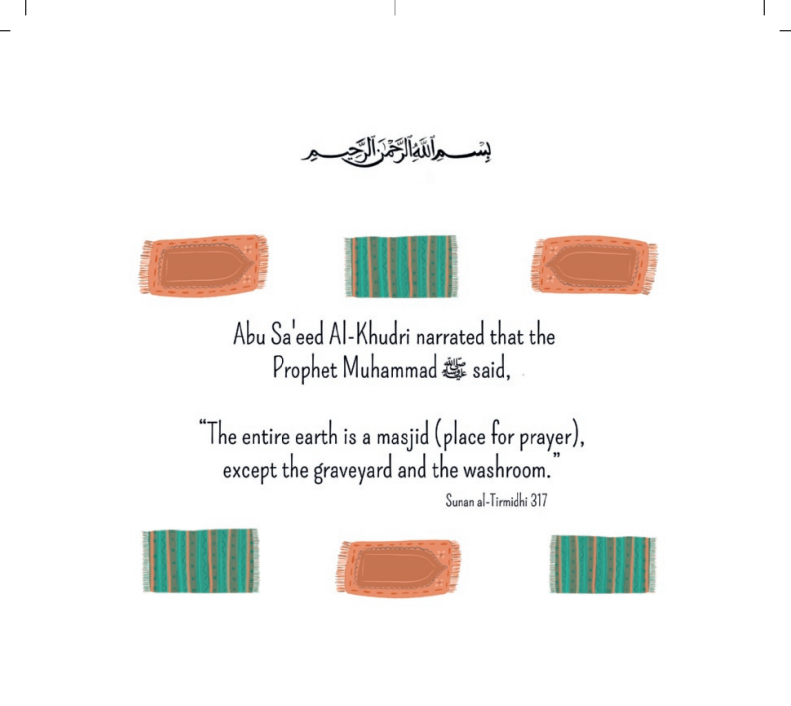
The book starts out with a hadith, “The entire earth is a masjid (place for prayer), except the graveyard and the washroom” (Tirmidhi-317) and points out that one must pray five times a day. Screen Shot 2021-11-17 at 11.37.00 AM

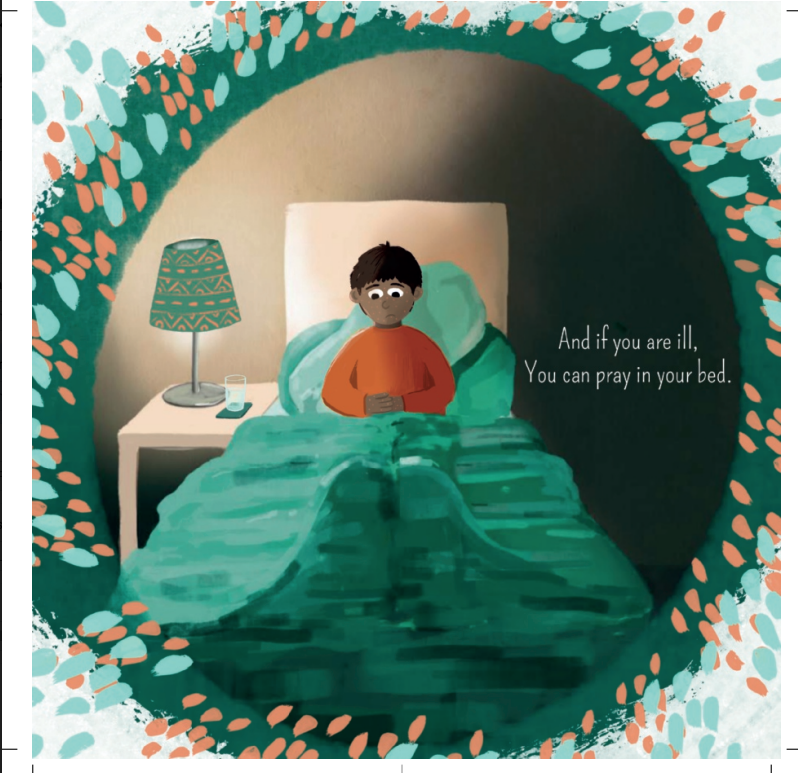
It establishes that if you pray it a mosque you can follow the imam, but not to worry if you cannot, because you can pray (nearly) anywhere: a field in the rain, school, a train, a garden, a shed, even when sick you can pray in your bed.

Screen Shot 2021-11-17 at 11.36.46 AM

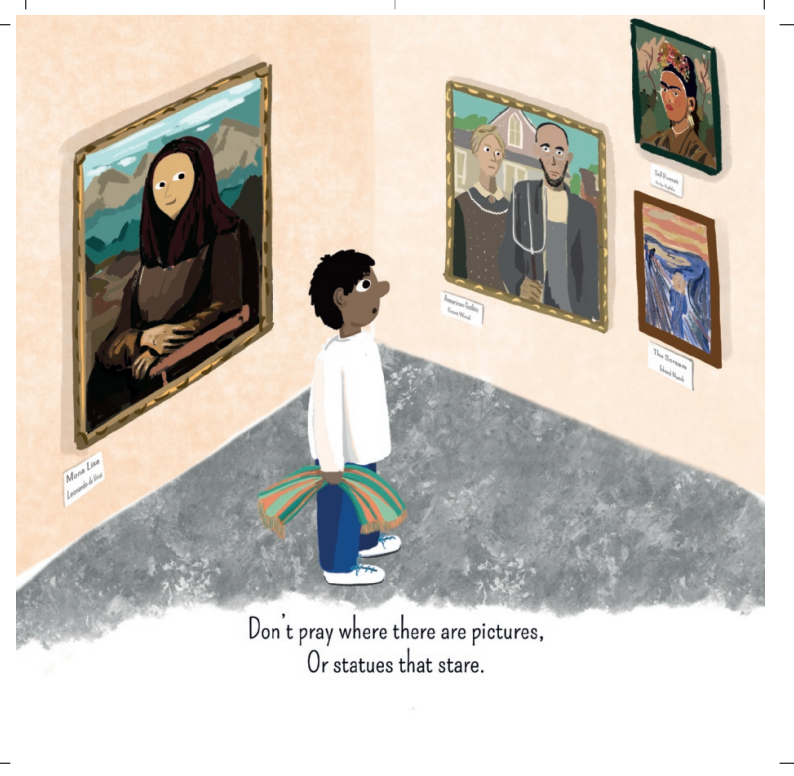
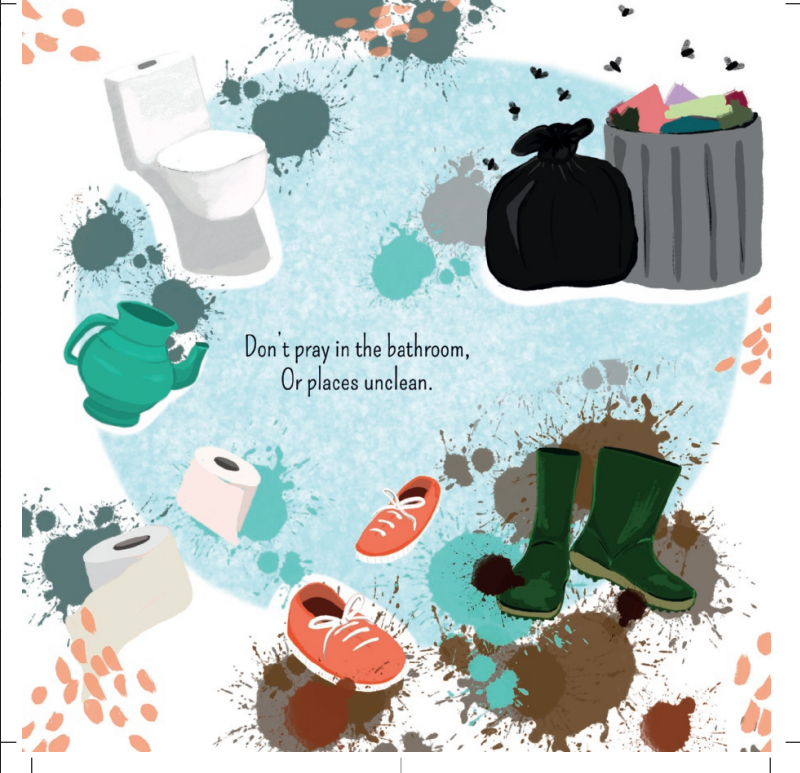
It then also turns to places you shouldn’t and can’t pray and sources a hadith about not praying where there are faces and statues that might distract you (Bukhari 374). The bathroom and graveyard are also included.  

Screen Shot 2021-11-17 at 11.35.05 AM

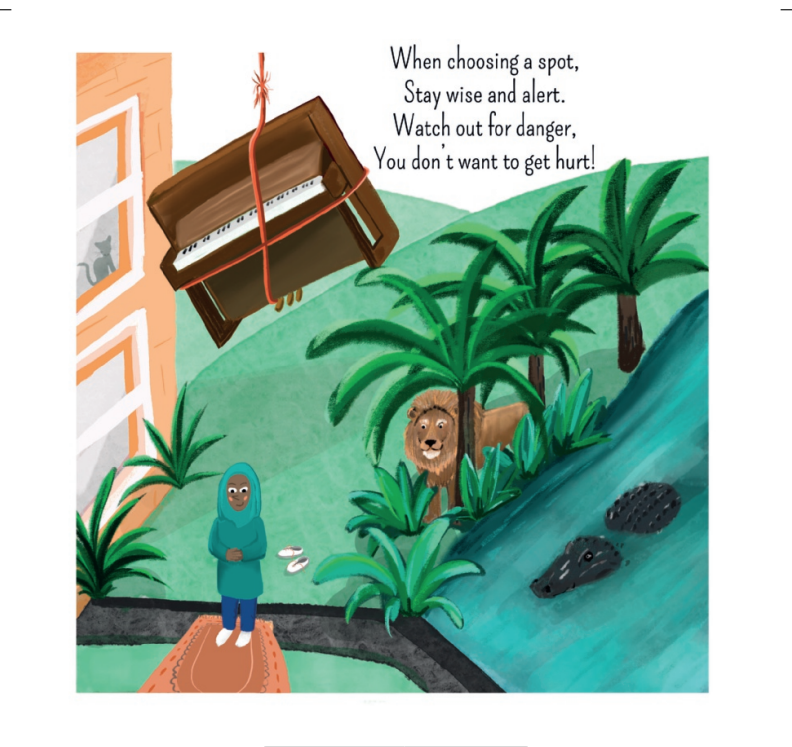
As an after thought, and for added laughs it reminds little readers to not pray in dangerous spots as well.

Screen Shot 2021-11-17 at 11.35.12 AM

Overall, I enjoyed the book and can see it pairing with In My Mosque to help create the foundation of a storytime theme about prayer and mosques.  The fact that it takes it a step further and doesn’t just list all the places serious and crazy that you can pray, elevates the book from being mediocre to being memorable and I appreciate that.  I also appreciate the Islamic sourcing, truly something that is required to show accuracy even in the “simplest” of all books.

Screen Shot 2021-11-17 at 11.35.30 AM

The Adventures of Nur Al-Din by Badees Nouiouat

Standard
The Adventures of Nur Al-Din by Badees Nouiouat

nur al din

I really enjoyed this book.  It is self published, and the expectation was zero and I honestly read all 214 pages in two sittings. I probably could have read it faster, but ahh kids and dinner, and my middle school son somehow got to it to read when I put it down.  We both enjoyed the quick pace, the strong Islamic presence, and the historical fiction based plot.  The book has a bit of language, hell and damn a few times, mentions prostitution and a brothel in two instances, and alcohol is present, but it is always crystal clear on Islamic and Muslim behavior.  The book is linear and straight forward and  probably YA readers will appreciate it, but I think it really is a middle school aged read, I think technically that makes it Young YA or Lower YA.  My only small grievance is the modern slang.  I appreciate that it isn’t written like Treasure Island and that you understand what the pirate crew is saying in plain modern English, but the few mentions of “idiot,” “chill out,” and “awesome” stick out very obviously and could easily be “fixed.”  Overall, so very impressed by the consistent pacing, historical references, writing quality, and internal reflection on our ummah’s strengths and weaknesses.

SYNOPSIS:

Farid is a young boy in Tunisia, and as the Spaniards start to flex their influence, his life begins to change.  The son of a fisherman, the family can barely enter the waters under the watchful eyes of the Spanish fleets.  When approached after a fight to join an Islamic pirate crew by Captain Aruj of the Barbarossa and his brother Khidr, he decides to leave his family and stretch his wings.   Having always dreamed of being in a leadership role, his optimism, and eagerness is quickly put to the test as the crews’ first mission in Northern Africa fails and sends the pirates scrambling on land.  They journey to the Mosque of Uqba (Great Mosque of Kairouan), and get help from the Emir in Tunis to replenish their losses.  It is then onto Tripoli where friendships and internal issues of race, and nationality threaten the cohesion of the Muslim pirates.  But it is in Spain where things really come to a head and Farid finds himself separated from his crew, in-prisoned for years, and tested both physical and emotionally that the story finds its climax before ending, and leaving the reader ready for more.

WHY I LIKE IT:

I have a soft spot for historical fiction, the original American Girl books for me were treasures to behold.  So the setting of this book really won me over: the mention of rulers, historical landmarks, the pain of the Inquisition on Spanish Muslims, the fact that there was a not just one map in the book, but two, all great things.  Like I mentioned above the pacing of the book is quick, from start to finish, and it is a pirate story so there is death, violence, battles, killing, and treason, but seeing as often in books about these type of things, I find myself glossing over the long detailed battle scenes, I was grateful that they are short and quick and possibly overly simplified.  It discusses weaponry, but it is not detailed, no glossary is needed, although there is one of the Islamic words at the beginning.  As for the Islam presence, it is very much a part of the story.  They raid a ship, the alcohol goes in the sea, they call athan differently, the characters discuss different madhhabs, just rulers are just even if they aren’t Muslim, and terrible rulers can also be Muslim, it doesn’t shy away from internal reflection and I appreciate that.  The only thing that caught my attention of being unaccounted for Islamically was when Farid puts on red and gold pants to head in to battle.  One- that seems the opposite of camouflage, and two- many Muslim don’t find it permissible for men to wear red and gold, obviously different people feel differently, but it seemed odd that the colors were specifically mentioned in such a quick moving book to no end.

Character-wise, I wanted a little more insight into Sameer and his racism, I also would have liked a little more about Farid’s first day in the sun after imprisonment.  I liked that the Jewish struggles under King Ferdinand in Spain weren’t just mentioned, but were brought in to the story.  And while I appreciate the reasoning for showing that Muslims were hiding behind a brothel to participate in learning and worship and thikr, that and the mention of a woman trying to seduce Farid in the street, both make the target audience a little more mature than the rest of the book might warrant otherwise.

FLAGS:

There is killing, fighting, raiding, stealing and there is plenty of physical violence.   The book mentions prostitution, seduction, and there is a fleeting glance at a woman that the main character pauses for, knowing he should lower his gaze, but then she is rescued and never seen or heard from again.  There is mention of alcohol as it is captured, as non Muslims stagger around drunk, etc.. There are a few curse words used a few times each: damn and hell and God.

TOOLS FOR LEADING THE DISCUSSION:

I think I would absolutely do this for a middle school book club amongst a mature group of girls and boys.  It is an easy read, but the discussions would be phenomenal as history and context would all come in to play.

For the sake of buzz and growth and attention, I hope the author will shop the book around, if he hasn’t already, see if it can be published on a larger platform and gain some traction.  We need books like this, solid Islamic fiction books, that aren’t shy to show our strengths and weaknesses and inspire our youth.

Esa & Sol’s Adventures: The Hunt for the Saphaea by Asma Maryam Ali, illustrated by Eman Salem

Standard
Esa & Sol’s Adventures: The Hunt for the Saphaea by Asma Maryam Ali, illustrated by Eman Salem

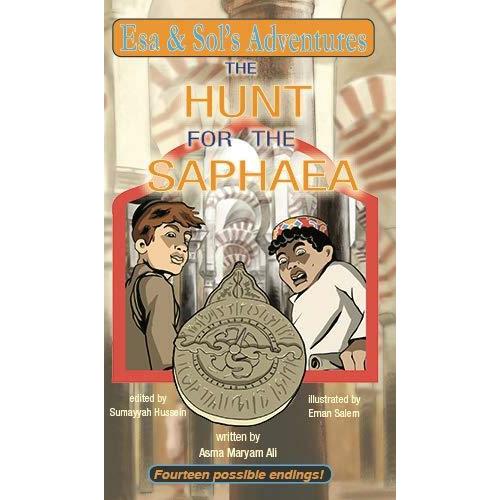
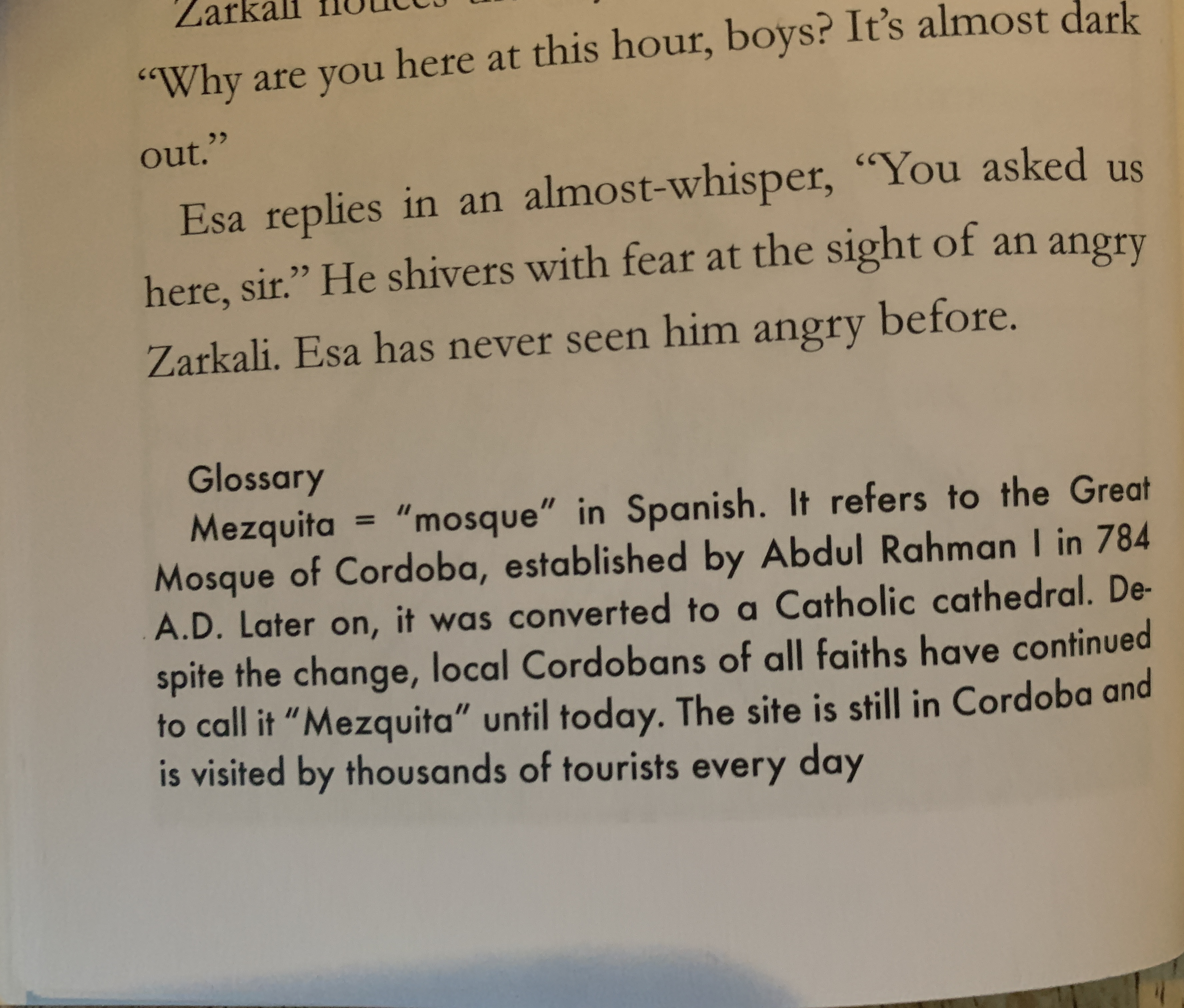
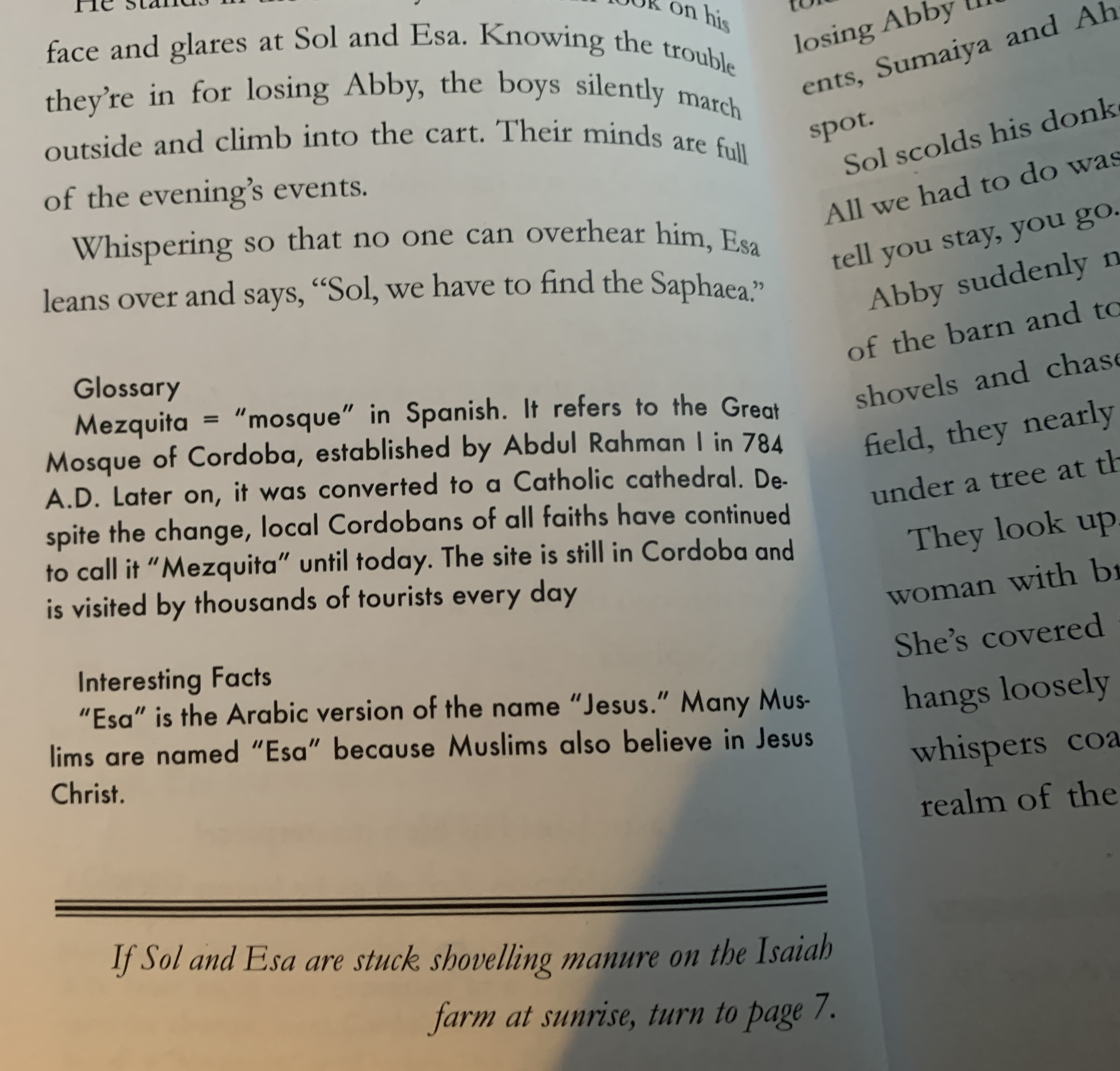
It is a bit tricky to review a choose-your-own-adventure style book, as each story twists and turns and leaves the reader with a different ending and thus, a different impression. I tried to explore every story line in a book that I had little expectation of, it is an intentionally splintered story after all, but even at that, this fell really short. The core of the story: a Muslim and Jewish boy in Cordoba, Spain in 1080 exploring real facts in a fictionalized story about hunting down a missing astrolabe, really had a lot of potential, unfortunately the tiny size (maybe 3.5 x 5.5 inches) and only being 76 pages, the frightening cover, and the misprinted footnote glossy right at the start, set the tone for a weak forgettable book, and by the time you get to the actual story and plot, you really have very little substance to change your mind.

SYNOPSIS:
Two nine-year-old boys start off the story chasing after their donkey who has run off and sent their oranges spilling over all around the square. They should clean up the chaos, but they remember that they are supposed to meet Zarkali, the greatest astronomer in all of Spain, as he finally has a job for them after months of waiting. His latest work is a brilliant astrolabe, but when they get to his workshop he isn’t there. When he finally arrives with his assistant Aleho they are frantic as the astrolabe, the Saphea, is missing. The boys were to be asked to help transport it, as they would blend in unnoticed, but now that it is missing what should they do? Should they search for it? Investigate if it was stolen? Accept their punishment for the mess with the oranges and their donkey? Let the first choice of many begin the adventure.

WHY I LIKE IT:

I love the author’s knowledge about Muslim Spain and how she tries to introduce it to children perhaps unaware of the rich history. The inside illustrations are wonderful, the cover truly misleads readers, and naturally I wish the book was larger in size and longer in length. The foundation of the story, the getting to know the characters and their world, needs to be longer. The story should be established before you have to make decisions. It is historical fiction, but needs the world building attention that a fantasy book would require, and this book just doesn’t have it. As a result the choices and endings, are all over the place, not just twists in the stories, but huge changes. Some of the paths no longer focus on the astrolabe that is missing, and seem to offer both threads of something far more sinister at play and choices that keep the boys lives mundane. The book counts on the reader re-reading the tale and making different choices, otherwise your interaction with the book could truly be over in nine pages, nine tiny pages at that. And like I said above regarding the cover and size, they don’t entice one to pick it up and read, then if your adventure is only a few pages long, and you already notice the repeated definition on pages 4 and 6 (before any choices are offered), chances are you won’t revisit the book, learn about real people, marvel at scientific discoveries, travel the region, appreciate interfaith harmony, and get swept up in a historically fictionalized tale that puts you in the drivers seat.
FLAGS:

Fine for middle grades and up.

TOOLS FOR LEADING THE DISCUSSION:

I highly doubt the book would even be looked at on a classroom library shelf, I have been trying for days to get my own children to read the book: they love to read, they love history, they love books with options, but they have yet to open the front cover.

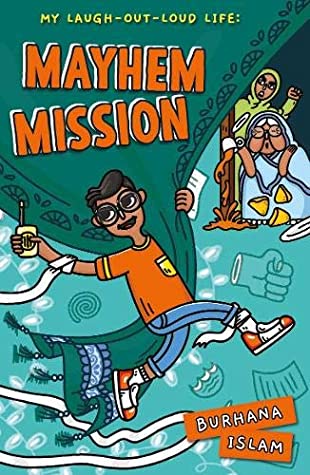
My Laugh-Out-Loud Life: Mayhem Mission by Burhana Islam

Standard
My Laugh-Out-Loud Life: Mayhem Mission by Burhana Islam

mayhem

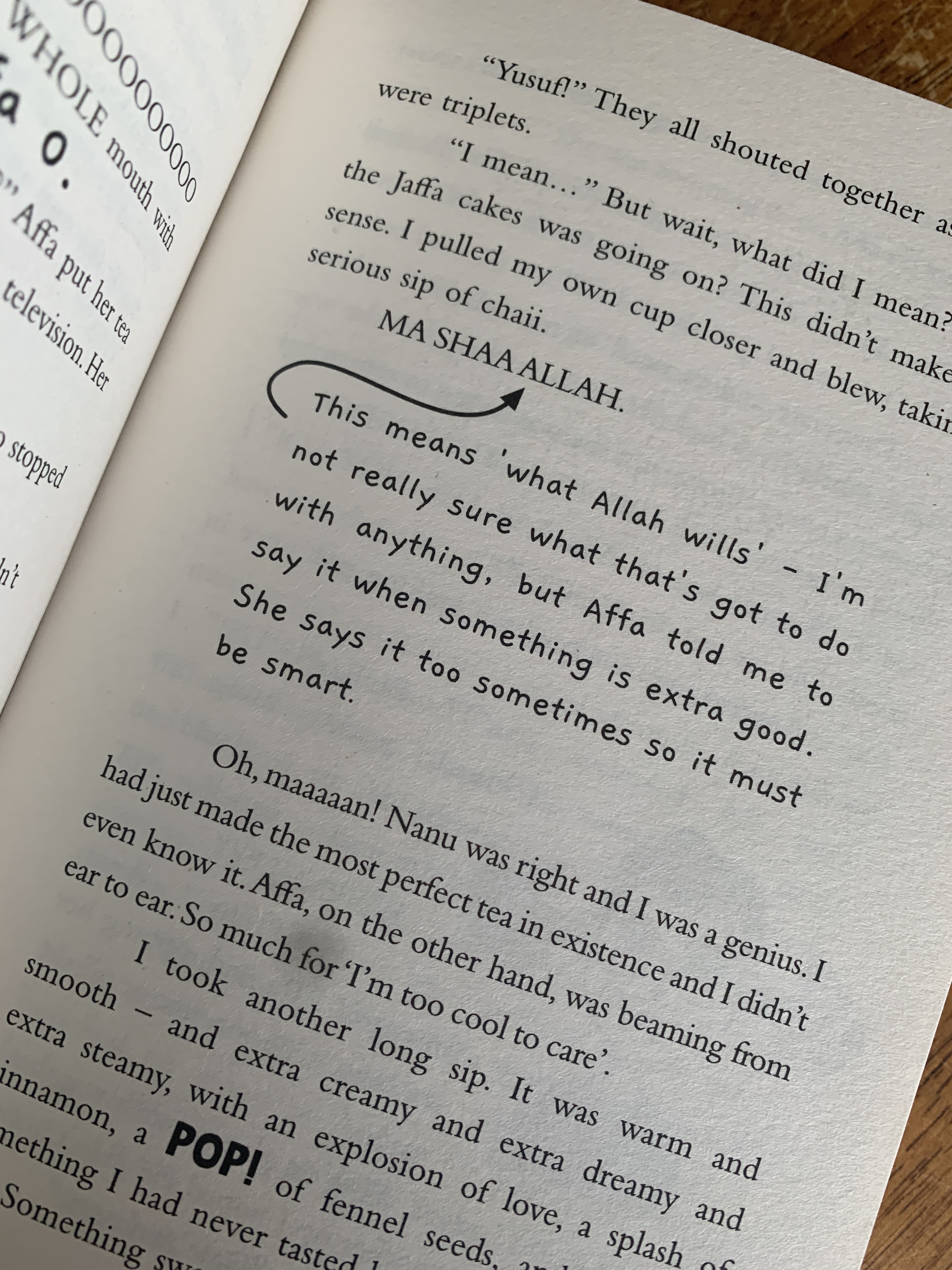
Fairness aside, any book about a genuine Muslim British boy written in first person with doodles, lists, and hilarity for middle grade readers is going to be compared to the Planet Omar Books, and not only do they have the advantage of being first, but they also have set the bar really high.  This 266 page book is decent and fun, and if your children enjoy Omar, they will enjoy this, but even my kids compared the two and found this one just a bit lacking.  The story is outrageous and funny and has a lot of heart, the writing is sufficient, it just feels like the story gets away from the author.  Information is given for no reason and to no purpose, the story loses its way and fumbles around for a bit in the middle, seems to get off track at points, and is a bit weak in character development.  That being said, would I purchase and read future books in the series? Absolutely! I love that the standard and quality for books with Muslim characters by Muslim authors for our children are at this level.  There is no apologizing for Islamic Bangladeshi culture in this book, and the mainstream publication means Muslim and non Muslim children are seeing a nutty, loving family that they can relate to in a myriad of ways, alhumdulillah.
img_4078

SYNOPSIS:

Yusuf’s much older sister is getting married, and she remarks that he now needs to be the man of the house.  Unsure of what that means, he asks Sheikh Google, and is not prepared to do what it entails.  Not at all, he is only nine, but rather than discuss it, he decides instead that he must stop the wedding. So, with a bit of help at times from his cousin Aadam, it is full steam ahead to sabotage the upcoming nuptials.  With little time, he attempts to make his sister unwanted in her inability to cook, keep her hidden in her room by removing all the hijabs in the house, spreading rumors that she has died, ruining her wedding dress, and more, so much more.  It is cringe worthy at times, and hard to put down at others, but alas there is a happy ending, and lucky us, we get to read all about it in Yusuf’s year five what I did over summer vacation essay.

img_4077

WHY I LIKE IT:

I love that the family dynamic is a single mom, her mom, and the two kids.  I think it is important to show some diversity that reflects the family situations of many Muslim children that have thus far been a bit down played.  The book is relatable and contemporary with Marvel references, while tossing in everyday cultural references too.  The family prays, does tasbeh, memorizes Quran, covers, etc.  The book tries to give some depth to the characters, such as Yusuf’s eczema, but it kids don’t get it and the text muddles it to the point, that it misses connecting to the readers.  Also, even kid readers get that a simple conversation could have prevented most everything in the book.  Time is tight, but not that tight for things to get so outrageous.  The book is a British, but I think US readers can handle it, they may, like me, have to Google Jaffa Cakes, but I think they will be fine.
img_4076

FLAGS:

Deceit, sneaking, lying, gossip, destruction of food and property.

TOOLS FOR LEADING THE DISCUSSION:

I don’t think the book would lend itself to a book club, but I think home and classroom and library shelves will benefit from hosting this book.

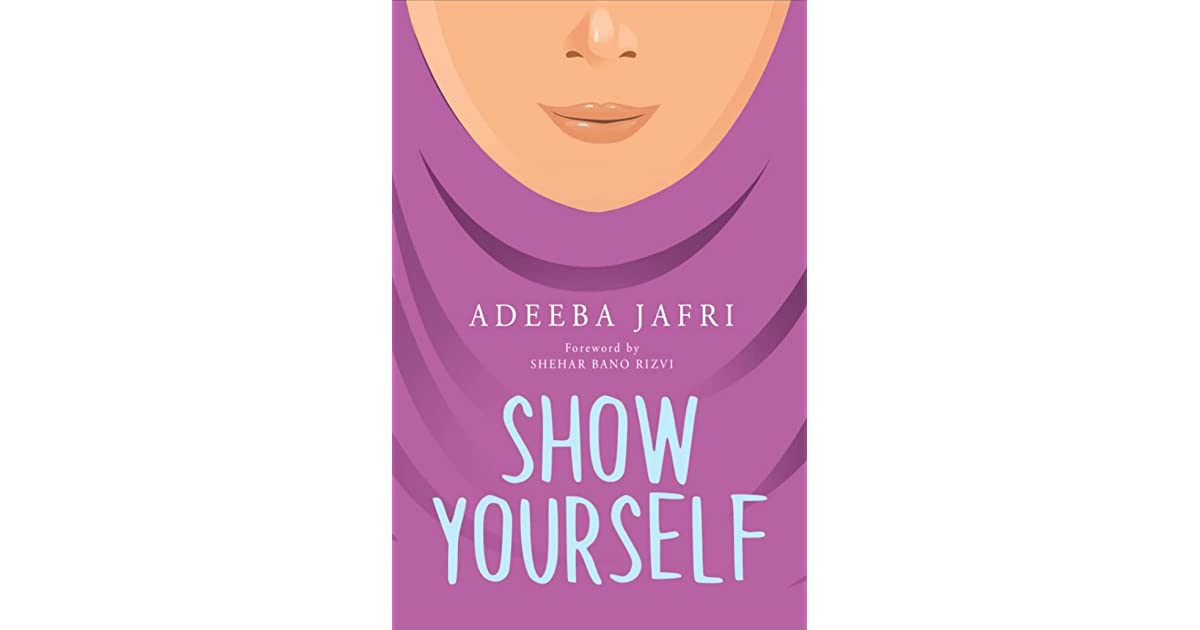
Show Yourself by Adeeba Jafri

Standard
Show Yourself by Adeeba Jafri

show yourself

At 98 pages the book claims to be two YA mental health novellas that bring attention to mental health in a relatable and contemporary audience through Muslim characters.  As someone with some experience in loving individuals going through some of the issues addressed in the book, I was thrilled that voices were making it on to the page and in a capacity to increase discussion about self-harm.  Unfortunately, the presentation of the two short stories baffled me and I don’t think the book will find its way in to many YA reader’s hands.  I don’t know why it is two novellas when the characters are the same and it very easily could, and should, have been fleshed out into a single longer novel.  I think it would have shown a better well-rounded understanding on the importance of knowing and recognizing signs of someone struggling with their mental health, how coping skills aren’t often enough and outside help is needed, how assumptions and stereotypes further alienate those suffering, and just overall made the characters deeper and more relatable.  Instead we get two isolated snapshots that subtly try to discuss mental health, but use a very immature cover story that misses the target audience.  The book as is, is better suited for middle school readers, but I think even they would get a limited view of how to help those close to them, or reach out themselves if they are hurting.  It needs to be five short stories with different characters and a unifying theme, or one complete novel.  Unfortunately, as much as I wanted to share this book with my teen daughter so we could discuss, I couldn’t convince her to read it, which is unfortunate, because the author can write, it just isn’t tempting presented as it is.

SYNOPSIS:

The book is two novellas, the first focuses on three female Muslim friends and one’s little sister.  The girls all go to school together, but are of different economic statuses, have different interests but support one an other, and have different family dynamics, that all come in to play.  The close knit community means the parents are social with each other as well, and one parent or another is always picking or dropping them off at each other’s homes.  When Hana gets a new phone, Aliya is clearly jealous, Lena tries to brush it off and keep the peace, but, when Hana’s phone goes missing, even she has to admit that “rebel” Aliya is looking guilty. As the girls search for the phone, Lena spends time with her family, goes to her brother’s robotics tournament and finally confronts Aliya.  Aliya’s mom has disappeared earlier, and with her purple dipped hair, sudden influx of funds for Ubers and new accessories, the girls fight and Aliya pulls away.  When Aliya and her dad don’t attend Hana’s younger sister, Sara’s ice skating performance, it seems the friendships are irreconcilable.  Aliya, however, shows up to the after party things are revealed and amends are made.

The second novella is the story of what happened with Aliya’s parents, particularly her mother.  Similar to Sara, Aliya’s mother was harming herself and eventually abandoned her family.

WHY I LIKE IT:

I like that it shows Muslims suffering, coping, and dealing with mental health issues.  The topic is way too taboo and it effects all swaths of the human population, we need to normalize discussions about it.  I wish the novellas would have stressed getting professional help more, sure it is great that Hana is going to try and put her phone down and pay attention to her younger sister, but that is not always enough.  Aliya mentions that after her mom left her and her dad went to therapy, but the mom claimed to leave to get help and then never came back.  I think there needs to be A LOT more emphasis on what “good” help looks like and what it can do to change lives.

The book is self published it seems through a publisher, so hopefully the author could ramp up the story telling, character building, and messaging, to really make the book shine.  I don’t understand the title, I don’t know why it is under a hundred pages.  I don’t know who the forward is written by.  If you want to write a book about mental health you really need to have done a lot of research, not just necessarily your own experience, and you probably should have a bunch of letters after your name.  Otherwise just write a work of fiction and touch on some of the issues that you want to support discussions about.  The book seems to straddle committing to one or the other, and ultimately it falters because of it.

I do like that the characters are Muslim, the book is not preachy, some seem to be more religious then others, but it isn’t really part of the story.  The characters’ culture and nationalities seem to be left intentionally vague.  It mentions gossip from the ladies at the masjid, which I think should have been drawn out more.  Really if you ask me, this is a great rough draft, it needs fleshing out is all, build it up to 250 pages and set out to reach middle school readers instead, and it will resonate and have the effect I think the author is hoping for.

FLAGS:

Self harm, abandonment, assumptions about a man Aliya seems to be sharing a meal with in a photograph, gossip, lying.

TOOLS FOR LEADING THE DISCUSSION:

Because it doesn’t seem to stress how to help and what help is out there, I don’t know that the book would be a great read for all.  I think if you are looking to open a discussion with a small group of readers or individually, you may be able to assign the book and discuss in a safe environment.

I went for Hajj by Na’ima B. Robert illustrated by Paula Pang

Standard
I went for Hajj by Na’ima B. Robert illustrated by Paula Pang

hajj

Before I review this delightful book, I would like to make a public service announcement of sorts.  It is not Hajj season, not even close.  I pre-ordered this book on June 23 from Amazon, I should have/was supposed to have it before Hajj in the middle of July.  I got it TODAY! When I realized that the US publication date was delayed for a book already published in the UK, I reached out to Kube Publishing and they suggested trying “an independent bookseller such as IslamicBookstore.com or CrescentMoonStore.com.”  I know this.  Noura is a dear friend, but I messed up.  Please don’t do the same.  SUPPORT LOCAL BOOKSELLERS! I’m sorry, lesson learned.

img_3841

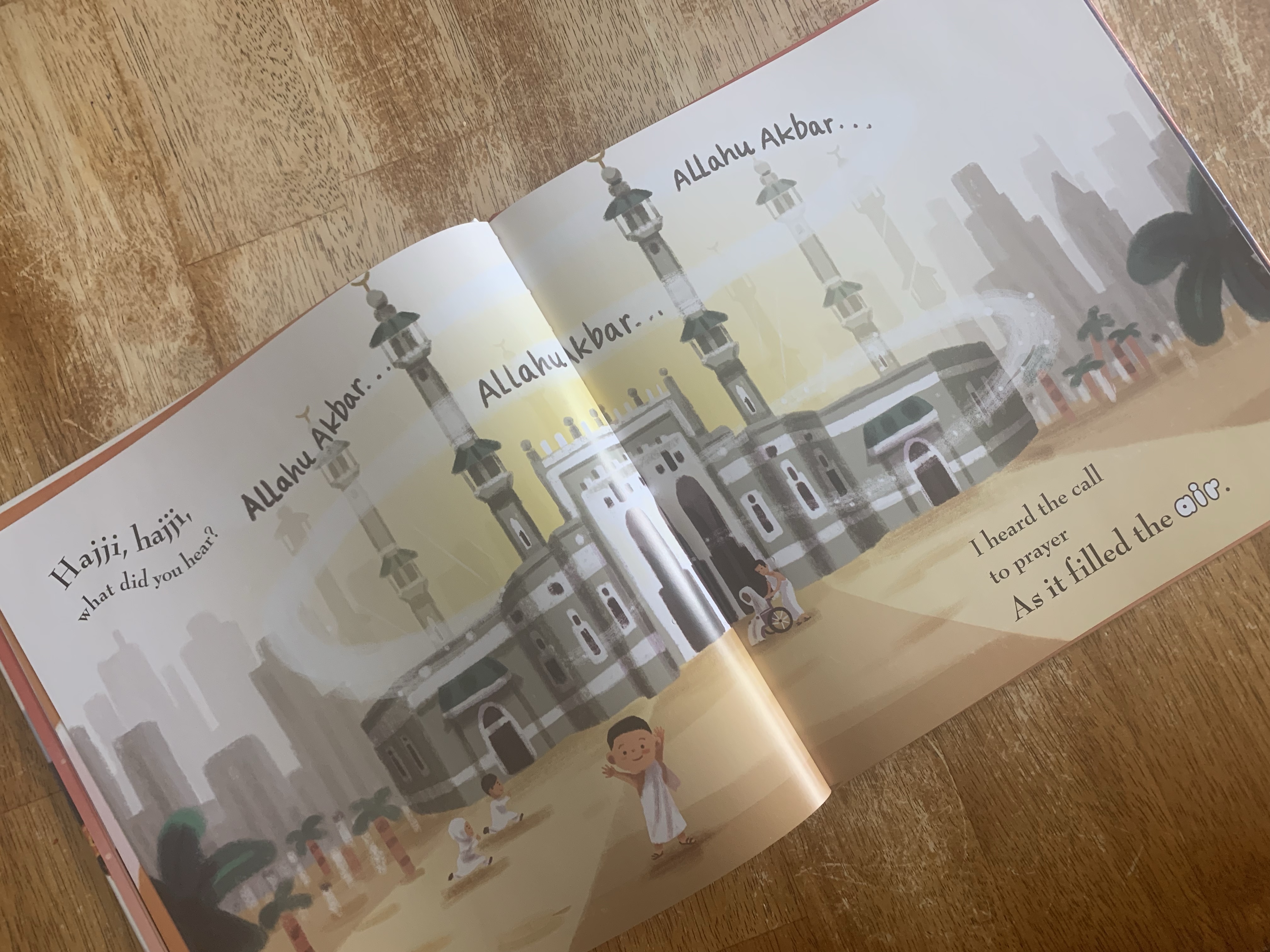
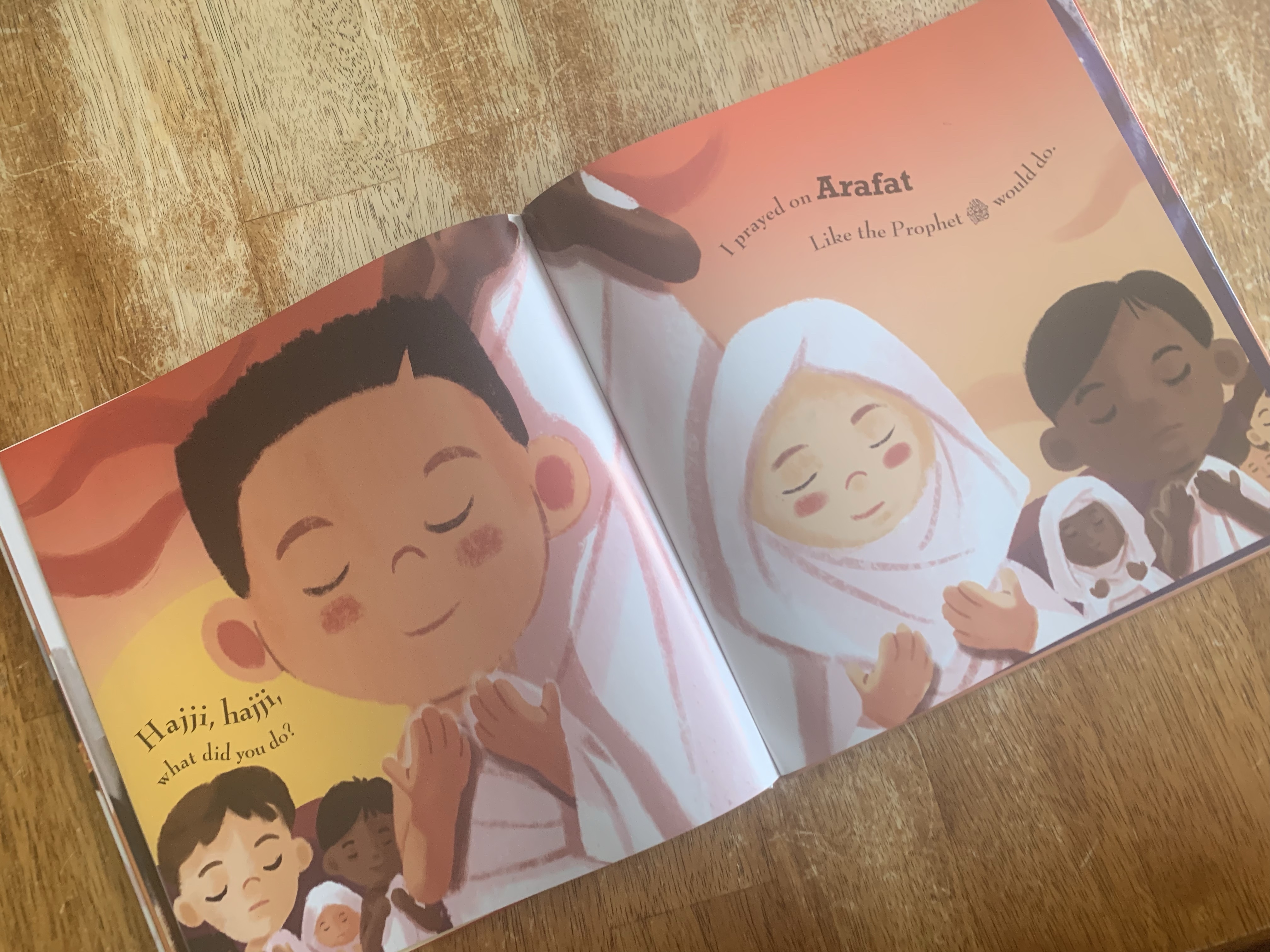
Now back to the book that already feels like a classic staple that needs to be on every Muslim families book shelf, and in every public learning space for non Muslims to enjoy and benefit from as well.   The 31 page “inspirational, semi-fictional narrative” is perfect for ages two to seven as it mimics the beloved Eric Carle and Bill Martin, Jr. classic, Brown Bear, Brown Bear, What Do You See? but framed around Hajj and what is seen, done, and heard.  Each two page spread begins with, “Hajji, hajji…”.

img_3842

The book starts with a detailed Note to Parents and Teachers that explains the points to highlight, and discuss with children.  The story is then organized by the steps of hajj in broad strokes and illustrated with both charm and detail that will hold readers and listeners attention.

Hajji, hajji what did you wear?

I wore two white sheets

And my shoulder was bare.

img_3843

The book starts with the little boy narrator on the plane looking down on the clouds and sea. He then puts on his two sheets, hears the call to prayer,  sees the black stone and the station of Ibrahim before he makes his seven tawaafs, runs between safa and marwa and heads to Mina. He prays at Arafat like the Prophet (saw) did, and falls asleep in the cold night desert air.  He sees stones being thrown and eats meat on Eid before getting his head shaved.  The book concludes with a glossary.

img_3840

The book is well done and is a great mix of information and entertainment, alhumdulillah.

The Tale of a Tiny Droplet by Ally Daanish illustrated by Oana Cocheci

Standard
The Tale of a Tiny Droplet by Ally Daanish illustrated by Oana Cocheci

droplet

I would imagine if you were to pitch the idea of this book it would go very favorably.  A raindrop goes on an adventure to a desert kingdom after facing adversity for being small, an ocean wave wants to consume her, a chance encounter with a grain of sand and confidence in Allah swt to keep them safe leads to refuge being offered in an oyster who journeys them through the ocean to salam its inhabitants only to wash up near the palace and at the feet of a prince who has been searching for a treasure for his mother’s crown.  The problem comes in its delivery.  It is told in rhyme that is incredibly forced and trying to do too much.  It is a 32 page children’s picture book trying to blend religion, science, adventure, and two points of view.  It needs to be clear, not concerned with a rhyme scheme that muddles the themes.  The book has potential and with the QR code and online teaching resources I could see an Islamic school teacher using this to explain how a pearl is formed and the incredibleness of one of Allah’s creations, but it will take a lot of outside explanation.  I am confident that no four to six year old is going to independently understand clearly what is going on.  I myself had to read it multiple times to figure out what was going on, and even then I found more holes, inconsistencies, and head shaking then there should have been in a large, glossy, well illustrated, effort filled book.

img_3589

A tiny droplet wants to be free, but this personified little water being’s friends tell her only great things live in the kingdom and she is too small.  Not sure how greatness and physical size become synonymous, but they do apparently.  So, on a windy day, the raindrop jumps out of the sky to join the ocean as a means to reach the kingdom.  A hurricane, or wind gale, catches her and she collides with a grain of sand.  But the pov switches, and the sand collides with her and it hurts the sand.  Grain apologizes and Droplet says not to worry she she is heading to the ocean too.  Grain warns her that the ocean isn’t safe, that there is a big wave who will consume them.  Droplet says she isn’t afraid and trusts Allah swt will keep them safe.  The wave threatens to chase them with all its pride (?) if they dare to run and hide.  The pair find an oyster to hide in and they swim with the tide. The oyster is bothered by their tiny feet so he throws them a blanket.  The wave continues to give chase, but they trust Allah swt and after months and days they wash up on the kingdoms shore.

img_3590

The book then pivots and focuses on a young prince who is searching for a gem for his mother the Queen.  Her crown has lost its shine.  He has travelled for months and day through mountains and valleys to no avail. One day while walking, back home on the beach, he hears voices hoping for safety from the wave.  Droplet and Grain think the wave has perhaps finally got them, but it is the prince opening the oyster and finding just the gem he needs. The book concludes with the pearl saying “Alhumdulillah” to the distant stormy sky, “All things can live in the kingdom and its palace rising high.”

img_3591

So my questions, first I’m not sure how a droplet isn’t free, is there only one wave in the ocean? Who is talking at the end, obviously the anthropomorphism as a science lesson kind of hits a dead end, it went from two talking objects to one new talking object, so thats creepy.  Wouldn’t it have been better to end when the gem was found and then have an info or fact page highlighting how pearls are made, having two distinct characters morph into one is a bit jarring story wise. The concept of the kingdom not allowing in little things, and then concluding that all things are welcome, is also so painfully underdeveloped.  Even little readers are going to find that assumption so off the mark.  I like that they trust Allah, but Droplet keeps saying she isn’t scared, but continues to run? swim? The duo don’t want to be consumed, but essentially aren’t they consumed by the oyster? The Pearl feels like it beat the wave despite its size, but it was the other drops that were telling Droplet she was too small, not the wave.

img_3592

All confusion aside, my kids and I might just not be the ideal readers.  My six year old didn’t know what a pearl was, so he was incredibly confused.  I thought the book was going to be about the water cycle, so it took me a minute to realize that wasn’t where the story was going. There is a QR code on the front and if you go to the website a number of resources are available https://www.lotehouse.com/product-page/the-tale-of-a-tiny-droplet. I wish there was info within the binding though to explain the process of sand and water in an oyster making a pearl and I wish a heavy handed editor would have cleaned up the text.  Sadly, a potential great book mixing adventure, science and deen just really missed the mark.