Tag Archives: Muslim Family

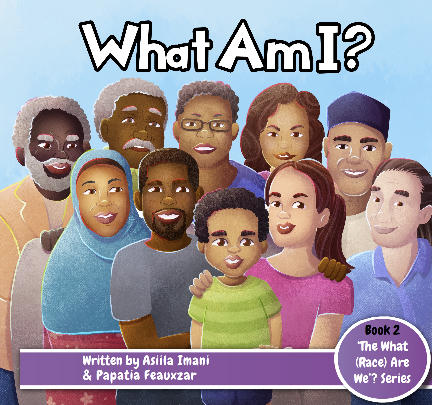
What Am I? Book 2 ‘The What Race are we Series’ by Asiila Imani and Papatia Feauxzar illustrated by Juliana Paz

Standard
What Am I? Book 2 ‘The What Race are we Series’ by Asiila Imani and Papatia Feauxzar illustrated by Juliana Paz

IMG_4825.jpg

This incredibly important 37 page picture book highlighting a little boys heritage will speak to children who see themselves in his quest to answer what he is, as well as (hopefully) inspire them to search out their own family ancestry and unique make up.

IMG_4828

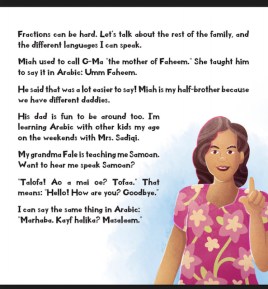
The book is not a traditional story book, in fact there isn’t much of a storyline, but the concepts presented show how beautiful and amazing multi-cultural and multi-ethnic families can be.  A lot of cultural information is conveyed and celebrated about Samoan and Pacific Island traditions as well as Islamic ones.

IMG_4831IMG_4832

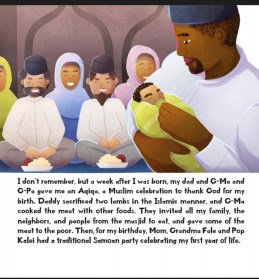
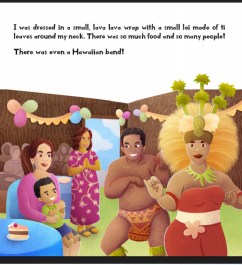
There is an aqiqa at the time of his birth as well as a Samoan party with a Hawaiian band.  Some members of his family cover, while other’s don’t.  He remarks how he has extra grandparents which equal extra blessings, and how he has a half brother because they have different dads.

IMG_4830

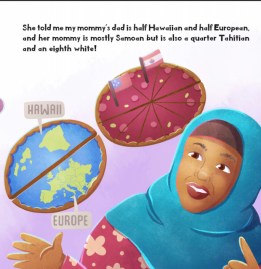
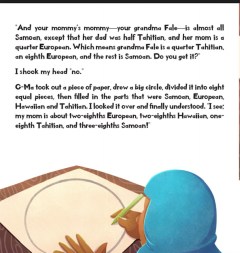
In addition to geography, there is also a STEM component as six-year-old Toa Idris learns he is a quarter this and half that through understanding fractions as visualized by slices of a pizza.  At one point Idris remarks that, “I can’t keep all those people and places straight,” and after reading the book half a dozen times, I honestly couldn’t either.  But, I think that is ok.  The point of the book is that being diverse is amazing, and having people love you is important, and culture and tradition and faith all make you richer.

IMG_4829 The text on each page is presented in a fun font, as are the pictures.  Really there is just one picture that makes Idris look angry and it is used in the story and the title page, which is unfortunate, I think it is supposed to have him look pensive, but it seems a bit off to me, where all the other pictures ooze with warmth and richness.

IMG_4826

I honestly don’t know what age group would benefit the most from the book.  Younger kids that may have been asked what their culture is will be empowered by having it reinforced that they are made just how Allah swt planned them to be, older readers will be able to create their own pizza slices, so to speak, and understand their own pieces, but I feel like both groups might need some coaching from an adult.  There are family trees at the beginning that almost become reference pages while reading the story and trying to keep everyone straight, that make the book almost interactive.  Muslim and non Muslim reader alike would learn about new cultures, and benefit from the “Extras” at the end.  Honestly, overall there is just a lot of information tossed around in the book, which isn’t a bad thing, it just might make it a bit more hit or miss if it will work for your child.

Badir and the Beaver by Shannon Stewart illustrated by Sabrina Gendron

Standard
Badir and the Beaver by Shannon Stewart illustrated by Sabrina Gendron

badir and

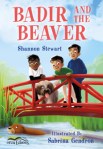
This 92 page early chapter book is a great linear story for 1st through 3rd graders.  The size, font, spacing, illustrations, chapter length, and content make it a fun read that incorporates diversity, environmental action, teamwork, information about beavers and acceptance all through the efforts of young Badir, a recent immigrant from Tunisia during the blessed month of Ramadan.

SYNOPSIS:

Badir is new to Canada and while he misses Tunisia, he is joyful and upbeat as we meet his older brother Anis, young twin siblings and classmates.  Out one night before iftar, he sees what he thinks is a giant rat swimming in a lake, but no one believes him.  When he sees it a second time, a lady at the park explains to him that it is a beaver, not a rat, and pulls out a Canadian coin to show him there is a connection between beavers and Canada.  With new knowledge about the difference between a lake and a pond, a rat and a beaver, Badir is fascinated with how beavers build homes, mate for life, and benefit the environment.  He even likens the beaver eating at sunset to his families own Ramadan schedule.

But all is not well for the beaver, as a petition is being circulated to relocate the rodent and save the trees in the park from his sharp teeth.  With new friends, a supportive teacher and classmates, Badir is determined to prevent the beaver from having to leave his home as Badir and his family had to do.

WHY I LIKE IT:

I love that this book is subtle in highlighting the welcoming of immigrants into a community, about having the main character be Muslim and it being Ramadan, and showing that diverse people can come together for a bigger cause and even become friends.  The main story line is naturally to save the beaver and the trees in the park, so the information and facts about beavers is appreciated and well presented.  I think most everyone of every age will learn something new about the common rodent.  But, by the main character being genuinely like-able and infectious, the reader will also realize that any negative stereotypes about Muslims or immigrants really aren’t a factor.  Badir’s family is really nice, the parents prepare food together, they feed their kids’ friends, and invite them over. The author does a good job at accurately making them seem like any other family.

IMG_4808

There isn’t much stress on Badir being Muslim or what that means outside of it being Ramadan, praying, and going to the mosque as a family at night.  The illustrations show the mom in hijab. The book tells a tiny bit about Tunisia, but not why they left, and definitely makes the foods they eat sound delicious.  Overall, it really does a good job of keeping the book about the beaver and finding a solution.

The book is for both non Muslims and Muslims and seems to be written by a non Muslim, and while set in Ramadan it is definitely not limited to being a “Ramadan story.”  There are small pictures on many pages and a full page picture in each of the 12 chapters.

IMG_4806

FLAGS:

None

TOOLS FOR LEADING THE DISCUSSION:

I think this book should be in classrooms and school libraries.  It really is well written, informative, and fun.  I don’t do a story time for the target audience of this book, but I think it would be a candidate for my “Lunch Bunch” meetings, when I read aloud to 4th and 5th graders once a week while they eat lunch.  Even if it is slightly below a 5th grade level, I think even older kids who pick it up and read it, or listen to it being read, will find it interesting, entertaining, and worth their time.

Publisher’s page: https://www.orcabook.com/Badir-and-the-Beaver-P3992.aspx


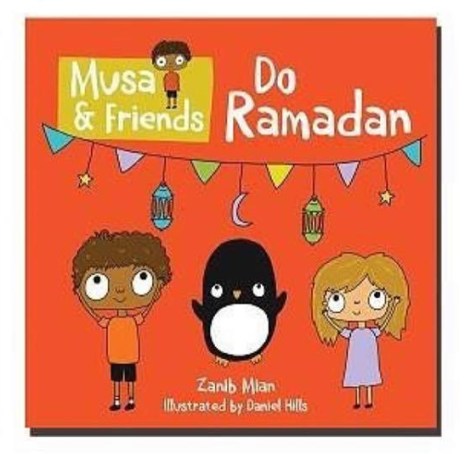
Musa & Friends Do Ramadan by Zanib Mian illustrated by Daniel Hills

Standard
Musa & Friends Do Ramadan by Zanib Mian illustrated by Daniel Hills

musa ramadan

Zanib Mian has really set the standard for quality affordable children’s Islamic books title after title.  So, I really was on pins and needles waiting for these Musa & Friends board books, and then I got one (thank you Crescent Moon Store) and part of me is really disappointed, and part of me is wondering what I’m missing.

They are at cheapest $8 a book, and there are 8 pages.  Yes, the binding and page thickness is awesome, and the 5.5 square size is adorable in a toddler’s hands, but I guess I wanted more.  More pages, more feeling or tone of Ramadan, a little more substance.

IMG_4711

The illustrations are super fun and Zanib Mian has a history of writing toddler and preschool appropriate books, so needless to say I was surprised that I didn’t love this book.  Granted I’ve only seen the Ramadan book, and maybe the others in the series are much more satisfying, or maybe when you have all four together, they round each other out, which I’m really hoping is the case.

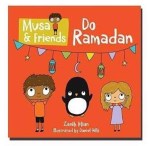
The text amount per page is great for littles, but the content is rather random in my opinion. They little diverse family and their penguin love Ramadan, they go to the masjid for taraweeh, they wake up for suhoor, they read Quran, they give money to the poor, they eat too much iftar and they love eid.

IMG_4712

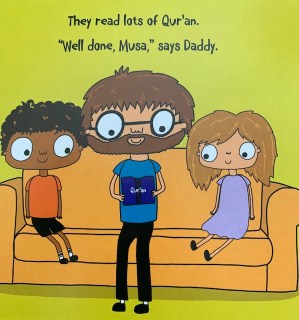
The book is meant for Muslim children as no details are given about what iftar or suhoor mean or that Ramadan involves fasting.  The illustrations won’t help much either in explaining the terms or even teaching concepts as the page on giving to charity has Musa and Penguin putting money in a jar, Musa’s dad is reading Quran, even though the text says, “Well done, Musa,” and even the penguin says “Gobble, gobble, gobble,” when eating(?).

IMG_4713

The books are cute and if you aren’t overly critical and you receive the book as a gift you will probably be very happy.  I just expected more and after the smallness of size of “A Young Muslim’s Mindful Book of Wellbeing” combined with the shortness of these books, I won’t just blindly order a bunch of Muslim Children’s Books without considering if they are worth it anymore, which makes me sad.


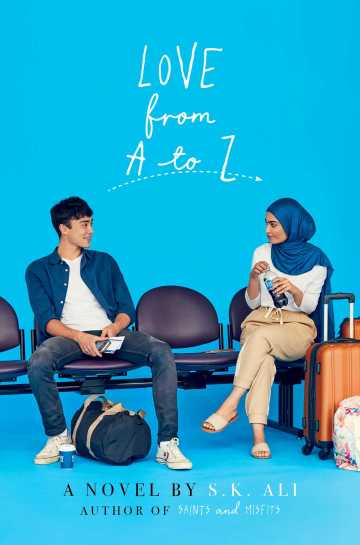
Love from A to Z by S.K. Ali

Standard
Love from A to Z by S.K. Ali

love from a to z.jpg

Now that there is legitimately a genre of YA Islamic Romance out there told in Own Voice, the expectations are high that a book is compelling, realistic, and unique somehow.  While the author’s first book, Saints and Misfits was pretty ground breaking, this 342 page was a great read, but not nearly as remarkable or memorable.  Granted it is not fair to compare the two books, and each day I do age out of the target demographic, but while the story reads authentic and true, albeit a bit serendipitous, it doesn’t have the teeth or grit I was kind of hoping for, and with a mother who suffers from multiple sclerosis my emotions were pretty invested.

SYNOPSIS:

Told from both Adam and Zayneb’s perspectives by way of their individual “Oddities and Marvels” journals, our two characters are presented by a narrator who keeps their story on track and interjects when their versions of an event differ. 

Zayneb is a high schooler and activist who has recently been expelled for threatening a teacher who consistently lets his Islamaphobic beliefs take over the days lessons.  In an environment filled with micro aggressions against Muslims, Zeynab’s parents are at a loss at how to keep their daughter from making waves, and thus allow her to leave her Indiana home a week before spring break to visit her aunt in Doha, Qatar.

Adam is at University in London where he has recently been diagnosed with MS and as a result has stopped going to classes, and is literally “making” the most of the time he has by making things.  As the term ends and he officially withdraws from school, he heads home to Doha to tell his dad and sister that he has the same disease that took his mother’s life years early.

The two characters meet at the airport briefly and then again on the plane and then at Adam’s house and the needless to say  their accidental meetings allow for friendship to grow, attraction to be built upon and a relationship to develop. Both characters have their own lives and own obstacles and own maturity that needs to occur in order for a happy ending to take place, and thus the book keeps you interested, invested and cheering them on.

WHY I LIKE IT:

I love the dynamic of how the book and characters are set up.  Both are practicing Muslims, both characters don’t cross a line, both characters have diverse mixed cultural backgrounds, and one is a convert and the other the daughter of a convert.  She is fiery and impulsive and emotional, he is pragmatic and calm and quiet.  While they have some background in common, their life experiences are rather different and it is very much a story about opposites attracting.  

I’ve been waiting for this book to come out, and so I knew my expectations would be too high.  That being said the book warns it is a love story and in some ways, that was what I kind of felt was lacking.  There was the physical attraction that was mentioned fairly often, but the deep connection of ideas or growing seemed a bit lacking.  

I really liked Adam, and his internal stresses and struggles and coming to grips with his disease seemed pretty developed.  Somehow though, and I’m probably in the minority, I didn’t love Zayneb.  She is impulsive and definitely learned and grew from the start of the book to the end, but I didn’t love her nuances with dealing with the Emmas and her friends back home and unraveling her teacher, it felt kind of forced and I can’t articulate why.  I’m glad she matured and she got answers about her grandmother, but maybe I should have felt so much in common with her and when I didn’t, I felt a little irritated.  Clearly I get too invested in fictional characters, I’ll admit that.

I like that Islam is presented in a non defensive way.  The parents aren’t evil, there is no rebelling, even the awful teacher spawns backlash and allies to Zayneb and her cause. There is no apologizing or overly explaining if the characters are pushing boundaries established by Islam or if they are establishing their own boundaries based on their understanding of Islam.  I like this, because it shows that Muslims are not a monolith, we are not one way good or bad.  Zayneb covers and prays and has friends that are boys and her family is kept in the loop of what she does, which alone breaks so many of the predominate stereotypes about Muslims.  Adam himself converted at age nine and plays the guitar and has friends that are girls, and is close to his sister, and likes dogs.  A side character is noted to be incredibly religious, but doesn’t cover.  The story takes place in an Islamic majority country, but attitudes at the swimming pool don’t allow Zayneb to dress modestly while she swims.  

Overall, the book is a delightful read that manages to keep the religious integrity in the characters and show their personalities as they come of age.  It may not be memorable years after reading, but what you do remember will be positive, and while you are reading it, you will have a hard time putting it down.

FLAGS:

There is angsty romance, and talk of sex.  The two main characters keep it pretty clean, but the side characters joke about hooking up, being horny, and sneaking off to hotel rooms.  The non Muslim aunt has a secret alcohol and cigarette stash that she gets called out on, but nothing more is mentioned about it. I think 9th or 10th grade and up will be perfectly ok to read.

TOOLS FOR LEADING THE DISCUSSION:

There is a lot to unpack in this book and I think if one just listens, teens will naturally add their own opinions and perspectives on EVERYTHING the characters experience, feel, question, and cope with.  The book just came out, but I would imagine that over time discussion questions will appear.

Author’s website: https://skalibooks.com/books/

Interview with the author: https://www.barnesandnoble.com/blog/teen/an-interview-with-s-k-ali-author-of-love-from-a-to-z/


Yaseen’s Big Dream by Umm Juwariyah illustrated by Azra Momin

Standard
Yaseen’s Big Dream by Umm Juwariyah illustrated by Azra Momin

IMG_3404.jpg

Kids love to stretch their imagination and do the impossible, but for Yaseen Muhammad, his dreams at night are his favorite activity to see just how far his abilities can go.  In this 21 page paperback 8.5 x 8.5 square book, Yaseen Muhammad will imagine his best day ever as the President of the United States and share with kids 1st through 3rd grade exactly what he will make happen, inshaAllah, when he wakes up.

IMG_3401

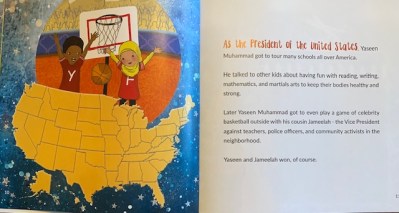
In a very busy day as the first kid president, Yaseen Muhammad dreams of starting the day leading morning prayer in the Oval Office, and then getting his family to help him prepare a special lunch for everyone in every state.  He’ll visit schools all over America and play celebrity basketball with his cousin and vice President Jameelah. He’s Jedda will teach people to start their own gardens, and he’ll give a speech on TV, after all why not, “Nothing is Impossible.”

The pictures are lively and descriptive that the reader and listeners will enjoy looking at them.  The characters are visibly Muslim as the women wear hijab, and in the text it mentions the characters praying, and Yaseen Muhammad dreaming he is the imam.  There is a lot of text on the pages, but the story flows and the information serves a purpose in establishing who Yaseen Muhammad is and connecting him and his dream to the readers.  The text is uniformly on the right with the pictures on the left making the book very convenient if sharing during story time and you are like me and hold the book in your left hand when reading to a group.

IMG_3402

The only thing that struck me as off, was in the illustration of Jameelah and Yaseen playing basketball. Yaseen’s t-shirt has a Y on it and Jameelas an F. Not a J for Jameelah or a Y signaling they are on the same team.  It is minor, but all my kids noticed it too and wondered why.  

A couple of places I stumbled over some of the grammar and wording, but after reading it aloud a hundred times (exaggeration, slightly) to figure out why, I don’t think anything is wrong, it is just a bit awkward, but it is probably me.  For example when Yaseen is speaking to the whole world on TV he says “Every kid can make a difference in your community, in your state, in your country, and even in the world. Dream Big.”  Seems like it should be, Every kid can make a difference in “their” community, in “their” state, no?

IMG_3403

Overall, a good empowering story for all children and one that highlights African American Muslims in text and illustrations.  A great book to have in rotation to encourage kids to dream, make the world better, and believe in themselves.  Alhumdulillah.


The Gift of Ramadan by Rabiah York Lumbard illustrated by Laura K. Horton

Standard
The Gift of Ramadan by Rabiah York Lumbard illustrated by Laura K. Horton

IMG_3804

A new 32 page hard back Ramadan book that shows a little girls excitement isn’t enough to get her to abstain from food and drink for the whole long day of fasting, but that there are other ways to enjoy the gift of the blessed month.  A great book that shows how Ramadan is a month of growing and learning and sacrificing and coming together too.  Perfect for ages 4 and up to be read in small groups or at bedtime.  The pictures are delightful and show diversity, and while the little girls love of sparkles might appeal more to little girls, I think the message will allow boys to enjoy and benefit from the book as well.

IMG_3806

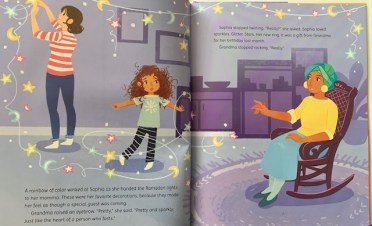
Sophia is helping her family decorate for Ramadan and when they see the crescent moon, they know that fasting will start tomorrow.  Excited to be included Sophia can’t wait.  Sahoor, however, is really early and she is really tired.  She eats a little, but by fajr time she can’t even keep her eyes open and falls asleep in sajood.

IMG_3807

When she wakes up it is almost noon, and even though she is hungry she decides keeping busy will help the time pass.  Reading, cleaning, drawing, nothing is working.  Her little brother runs around waving a cookie, and Sophia can’t get away fast enough. 

IMG_3808

She caves and starts eating cookies, her grandma finds her and consoles her.  “There’s always tomorrow and the day after and the next.  You have a full month to keep trying.” The two then discuss other ways to enjoy the month.  Sophia knows her mom reads Quran, but Sophia can’t on her own.  Her father helps others and gives charity, but Sophia doesn’t have any money.  She is about to give up, but then sees her grandma’s hands covered in flour and realizes she can help her make iftar for those that are fasting.

IMG_3809

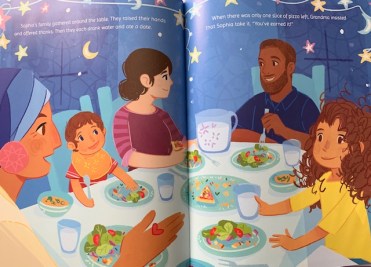
She helps with the salad and the pizzas for iftar, but when some of the pizzas burn, Sophia will have to show what she has learned and understood to make iftar a success and make everything sparkle.

IMG_3810

There are a lot of Ramadan books out there, but I like that this one doesn’t have the adults saying she can’t fast, but just the same grandma is there to encourage her to do what she can and take advantage of other parts of the month.  I also like that she doesn’t succeed.  Fasting especially on these long summer days can be hard and acknowledging that, and encouraging kids to persevere I think is a very valuable lesson.  Sophia also comes up with a way to help on her own.  Parents are tired and entertaining ways for the kids to be engaged in Ramadan is great, but can be exhausting.  This shows that kids with the right understanding of the month, inshaAllah can find ways on their own too.

IMG_3811

There is an Author’s Note at the end explaining Ramadan, and the book would work and appeal to Muslim and non Muslim kids alike.  Sophia reminds me a bit of Pinkalicious and Fancy Nancy and will probably appeal most to kids that also like those characters. The grandma covers her head, the mom does not, but does when praying and reading Quran.  It mentions and shows praying and breaking one’s fast with water and dates, yet stays focused on the story and does not get preachy or dry.


Who Will Help Me Make Iftar by Asmaa Hussein illustrated by Saliha Caliskan

Standard
Who Will Help Me Make Iftar by Asmaa Hussein illustrated by Saliha Caliskan

IMG_3796

This sweet story shows how even when people refuse to help, we should treat them with kindness, as our actions should be to please Allah alone, and inshaAllah in real life, much like in the story, people will fix their ways and offer their help in return.  This new story reads very much like the old(er) favorite Nabeel’s New Pants, where everyone is too busy to help, but then come around to realizing that helping one another is a way to show people we care.  This 32 page 8.5 x 11 soft back story is well bound with large glossy pages and clear text.  The story works well for ages 4 and up, as they will understand the moral message and inshaAllah feel inspired to find ways to help as well.  

IMG_3797

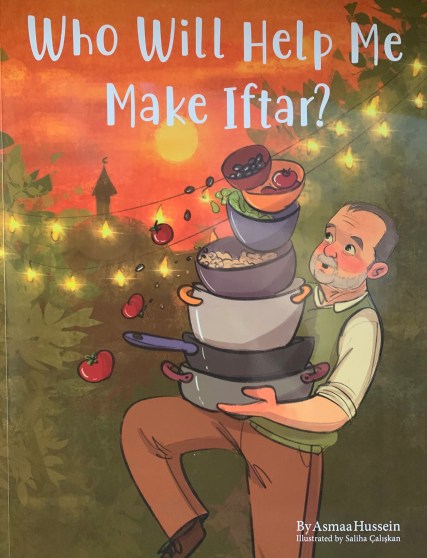
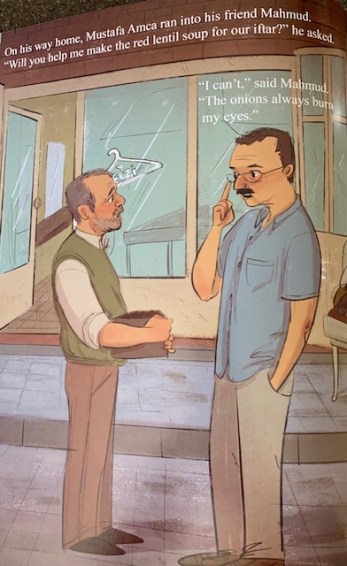
It is a 40 year tradition that Mustafa Amce and his wife Ayse Teyze feed iftar to their friends and families on the first day of Ramadan.  This year, however, Ayse is not well and Mustafa is confident he can enlist the help of neighbors and family to help him keep the tradition alive. 

IMG_3798

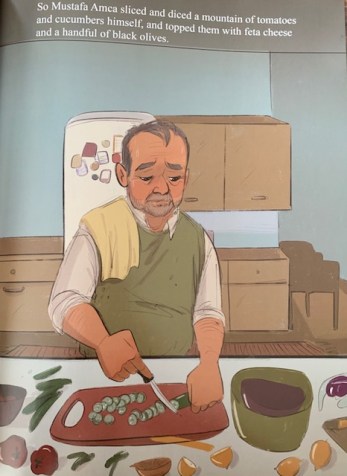
Unfortunately, everyone has an excuse.  His daughter is tired, his grand daughter is too busy with her video games and his neighbor doesn’t want to get his new shirt dirty.  Their sad reasons don’t stop old Mustafa Amce, and he makes the salad, and cooks the rice and beef by himself.

IMG_3799

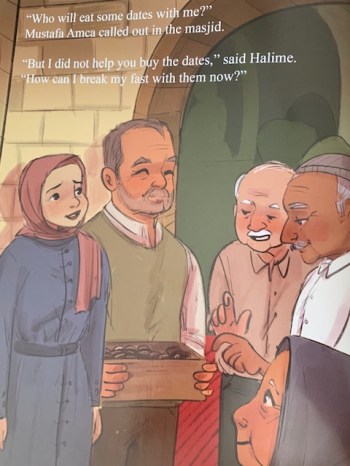
When iftar time arrives, he offers sweet dates to those at the masjid and invites everyone to come to his courtyard to break their fasts together.  All those that had early refused to assist him feel incredibly guilty and don’t want to take advantage of a lovely meal. Mustafa reminds them that, “God loves those who are generous especially to their families, neighbors, and guests.  and I always want Got to love me.” So they join in the delicious meal.

IMG_3800

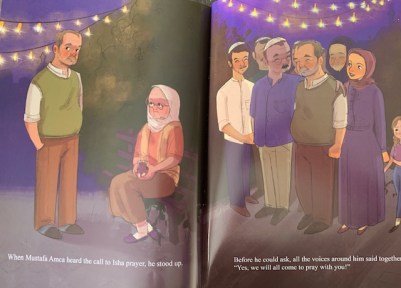
After food Ayse Teyze shows that while she might be ill, she can still save the day when her husband realizes he has forgotten to prepare dessert.  The guests then offer to wash the dishes and sweep the floor and take the leftovers to the poor.  And best of all when the athan for isha prayer calls out they all without prompting stand to join Mustafa Amce in praying salat together.

IMG_3801

The names are Turkish with a pronunciation guide at the end, as well as a paragraph about Ramadan.  The book would work for non Muslims and Muslims alike as the story is set in Ramadan, but more about coming together to help out.  The illustrations are large and detailed and descriptive.  You see the warmth between Mustafa and his wife as well as the apologetic feelings from those that were unwilling to help. 

IMG_3803

Forgiveness by Isa Beaumont

Standard
Forgiveness by Isa Beaumont

IMG_3669

This dual language book, is structured and feels like a leveled reader, but is more geared for fluent reading five to seven year olds.  It definitely has more complex diction and vocabulary than an emerging reader would be able to handle in English, I have no idea about the Arabic.  

SYNOPSIS:

The concept in 26 pages is how to forgive others and react calmly when we are upset.  The book is brightly illustrated on glossy sturdy softbound pages, and the characters are found in all of the company’s stories and plush figures at https://www.littlemaysoor.com/

IMG_3670

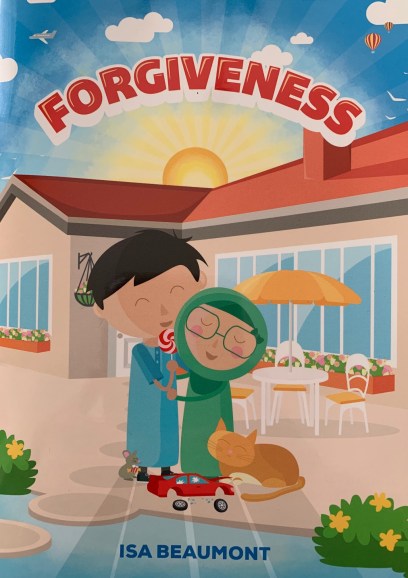
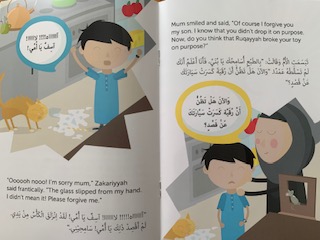
Little Zakariyyah has been behaving well, and as a result his mom gets him a new red toy car, he loves it and plays with it in the garden everyday. His sister Ruqayyah wants to play with it, he agrees and when he hands it to her, she accidentally drops it and it breaks.  In anger Zakariyyah begins screaming for her to “Go away from me!” Mom comes out to see what is going on and calm everyone down, she takes Zakariyyah inside and pours him some milk.  When she hands it to him, his hand slips and he drops the glass breaking it and making a mess. Mom forgives him and obviously highlights the similarities to what just happened with his sister and the toy car.  Mom then gently guides him to acknowledge his poor behavior and asks him what he things he should do.  Zakaraiyyah knows he needs to ask Allah swt for forgiveness and then apologize (apologise) to Ruqayyah.  Once he does this, his sister shares some sweets with him and reminds him of a hadith, “The strong one isn’t he who can overpower others.  Instead, the strong one is he who can control himself when he becomes angry.”
IMG_3671

WHY I LIKE IT:

Before the story begins there are six points you can implement before reading the story, and after the story, there are beginner and advanced concept questions and a place to write the answers provided.  The book has an agenda and it achieves its mark in showing a moral concept in an Islamic framework.

The book is written in British English which could make the spelling a bit confusing for new American readers, but manageable.  I honestly don’t know if the book was written in English then translated to Arabic or the other way around.  Some of the wording seems awkward so it could be attributed to it being translated from Arabic or it might just be the American/British difference.  For example Zakariyyah loves playing in “a small sand pit for children,” why not just say, sandbox? Again not terrible, but rationale for why I think children sounding out words might be a bit young for the target audience.  

I liked the story and how it lets the reader see the similarities to the events that unfold, just like I loved that the mom asked Zakariyyah what he should do, rather than dictate or scold him.  I was surprised when I read it, how smooth the ending was, because it really could have had Ruqayyah come across as a know-it-all and it didn’t.

The beginning of the book stumbled a bit with the set up trying to tell about Zakariyyah, why he got the toy and then staging the plot of the book.  If he had been playing with the car everyday, is it still a new car? Also the illustration before he drops the milk has him sitting at the table with a glass a milk in front of him.  Sure, maybe it was the second glass that he dropped, but it’s noticeable.

IMG_3672

FLAGS:

Clean

IMG_3673

TOOLS FOR LEADING THE DISCUSSION:

The book is obviously too short for a book club per se, but I think if you had a small group of readers, or are home schooling, you really could ask a child to read the book and then reflect back what they understood and what they learned and how they hope to put it in to practice.

Even with not reading the Arabic, the book is pretty solid in its approach and I plan to check out the other books in the series as I do a lot of story times with basic morals as themes.


The Jinni on the Roof: A Ramadan Story by Natasha Rafi illustrated by Abdul Malik Channa

Standard
The Jinni on the Roof: A Ramadan Story by Natasha Rafi illustrated by Abdul Malik Channa

IMG_3592

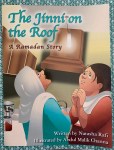
This 37 page culturally Pakistani Ramadan story is super sweet and fun.  There is so much I feel like my critical self should not like about the story, but by about page 15 each time I read it, I find my self full on smiling and thoroughly enjoying little Raza’s antics and his endearing grandma’s method for dealing with him.

IMG_3594

Raza is too young to fast, but with a house full of relatives gathered for Ramadan, Raza awakens to the sound of his uncle snoring before the siren to signal the start of fasting and the azan calling the worshippers to pray echo through Lahore.  Before he can go back to sleep, however, he hears the cook heading up the stairs to wake up grandma and then the smell of the food hits him and he wants a paratha more than anything.

IMG_3595

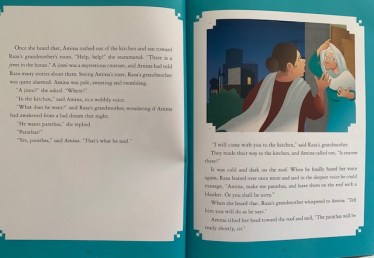
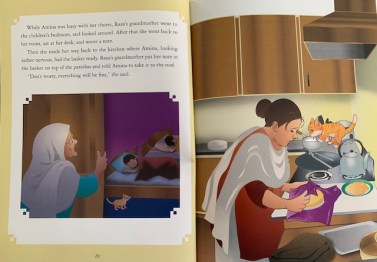
Raza embarks on a mission that involves him sneaking up to the roof, pretending to be a jinni and scaring Amina the cook through the chimney to convince her to send up food and a blanket.  

Scared out of her wits, Amina gets the grandma, culturally wards off evil, and delivers the goods to the jinni on the roof.  But the joke is on Raza who is out-witted by his grandma and gets the punishment of washing dishes for the rest of Ramadan, and learning that fasting a whole day will take a lot of will power, if he couldn’t even wait a few hours to get his beloved parathas.

IMG_3596

The book informs the reader that the following year Raza is able to successfully fast, that he is rewarded with gifts and that all is well and forgiven.  There is a glossary, information about Ramadan and a recipe at the end of the story as well.

I love that the plan just happens, it isn’t premeditated or considered, so it takes the reader along for the ride as it is unfolding.  It isn’t a deep story, but there is room for discussion as to whether Raza was naughty, or just caught up in the moment.

IMG_3597

The book is illustrated well and with big 8.5 x 11 pages, the book is engaging for first and second grade readers and listeners, as there is a lot of text on the pages.  The book takes a bit to find its stride as the author tries to use Urdu words, show their Arabic counterparts and then describe them in English. 

IMG_3598

There is a lot of cultural stage setting with everyone in grandmas house, the traditions of the family, of Ramadan, etc.  I think Desi familiar kids will get the most out of the book, but theoretically Muslim kids and non Muslims too could learn and enjoy it too.  I wish jinn and jinni were explained just a bit in the text, not just in the glossary, along with why an 8 year old wouldn’t be fasting or be required to do so. 

IMG_3599

My own kids, aged 8, 9, and 12, struggled on the first two pages, but when I told them to keep reading they zoomed through the rest smiling and ended saying it was good while giggling and shaking their heads.  We are Pakistani American and I think they enjoyed seeing familiar words and phrases in the book and sympathizing with Raza as well, and his sneaky plan that almost nearly worked.


Love, Hate & Other Filters by Samira Ahmed

Standard
Love, Hate & Other Filters by Samira Ahmed

love hate and other.jpg

I seriously wish I could get back the few hours I spent reading this 281 page AR 4.8 book.  The blurbs talks about a girl being torn between the world around her and the world her Muslim-Indian-American parents want for her, unfortunately the protagonist is rather unlikeable and her worlds are actual not that different.  Islam is not represented at all, it is just mentioned as a checkpoint almost for the main character to continually justify her identity as “other” and try and illicit sympathy.  It seems to be a part of the story so that the story line of Islamaphobia can be addressed, but the book is cultural at best, and even that is rather lacking.

SYNOPSIS:

Maya Aziz is 17 and missing a dance her senior year to attend a wedding because she is not allowed to go to such events as the daughter of conservative Indian Muslim (dentist) immigrants living in Illinois.  But, immediately the hypocrisy shows itself as at the wedding, a boy, Kareem, deemed suitable by her parents is presented to try and woo Maya and possibly marry her, and the two of them wander off together, and consider meeting up at an after party.  As the reader gets to know Maya and her circle of characters, we meet her “cool” Aunt who lives alone and wants Maya to have a life of boys and partying and going to school in New York.  Her parents are never really defined except to maintain the stereotype of being controlling, focused on food and appearances, and not understanding their only daughter.  At school Maya has a best friend Violet who loves to flirt and remains loyal to Maya throughout, a cute boy Phil, who she has been crushing on for years, and some side figures that stir up some trouble.  

The premise of the book is that Maya loves film and wants to go to NYU to attend film school, her parents, want her to live at home and go to the University of Chicago.  The idea is that because they are immigrants, and culture and religion dictate all, that she get educated and married.  This conflict is intensified by Kareem, her sudden relationship with Phil, and a terrorist act that is first blamed on Muslims occurring hundreds of miles away in Chicago and giving someone at Maya’s school a reason to take out his anger on her and her family.

WHY I LIKE IT:

I don’t like it.  The book is presented as an own voice minority representation piece, but it isn’t.  I get that Islam is personal and that people identify with it and choose different paths, but this isn’t a case of her looking at Islam and saying it isn’t for me, this is a book that is billed as Islamic fiction, yet the character does nothing Islamic, seems to know nothing of Islam and has no moral conscious for anything about the faith.  She says she doesn’t pray or go to the mosque, the parents lament after hate crimes materialize against them, that maybe they should have gone to the mosque at some point.  She wears shorts, and tank tops and a bikini and doesn’t feel a tinge or reflection.  Even if she were to remark that this is an act of rebellion the reader would know, oh because she was perhaps raised with modesty, but no, she wears whatever.  She constantly mentions that she can’t have a boyfriend because she is Muslim, but then makes out with Kareem on like their second meeting, kisses him in her parents living room before deciding she doesn’t like him, repeatedly kisses Phil, practically spends a night with him, and then in the epilogue is kissing a Hindu guy she kind of just met.  Yes, there are Muslims that do this, I’m not judging, but how exactly is being Muslim then stopping you from doing that you want to be doing?  At one point when out with Kareem, he is drinking wine, Maya remarks she has had it before, and that at least it isn’t eating pork.  Misguided and off the mark, yes  some Muslims do drink, but with all build up that she can’t do things like that, only to find out she has, and it isn’t a big deal, and she doesn’t even see it as a deal breaker or worth mentioning to her parents who have set her up on this whole path to semi arranged marriage, seems so off.

Anyone hoping to pick up a pice of Islamic fiction to identify with, are going to be so completely let down.  The book seems to be written for non Muslims to feel good about having read a book with a minority character.  It’s like a coming of age story, except there is no self reflection or understanding of the world, no lessons learned, or wisdom gained, unfortunately.

I kept reading hoping that if even the Islam was poorly done that the love story would be sweet, or the presentation of hate and Islamaphobia would be on point, but it also was shallow.  Really only one kid had it out for Muslims, and yes he got violent with Maya and threw a brick through her parent’s dental practice, but it could have been used to show light on misguided hate and it didn’t, I don’t really even know what it was used to show.  Maya’s parents got scared and wanted to keep her close, thus forbidding her from going to NYU, but they were already on the fence about it.  Yes, maybe it added to the catalyst of her running away from home an in to the arms of Phil, but even that ended up seeming lame, as she left for NYU and was in someone else’s arms by the end of the book.  So, not sure really, what religion at all had to do with anything, and why the author and publishing team would want to advertise the book with such a strong religious angle, or even cultural one for that matter.  The parents are both successful dentists, who let their daughter do whatever, yes they have an opinion on her future, but Maya reads like a brat, I wish I could like her, and take her side against her tyrant parents, but they don’t actually seem written that bad, and Maya doesn’t make any effort, so she really comes across as whiney, privileged, and entitled.  

FLAGS:

Alcohol, lying, hate crime, terrorism, physical altercation, kissing, hand holding, talk of condoms, sneaking out.  I would not let a 4th grader read this or even a 7th grader, based on content.  Quality, I’d encourage most kids to skip it altogether.

TOOLS FOR LEADING THE DISCUSSION:

I wouldn’t consider this as a book club, I considered not even reviewing it, with the fear that people wouldn’t read the whole review and would just assume I was throwing my support behind it.  I am a bit disappointed that the book is available through Scholastic as its back flap reads very different than the text within.