Tag Archives: Muslim Family

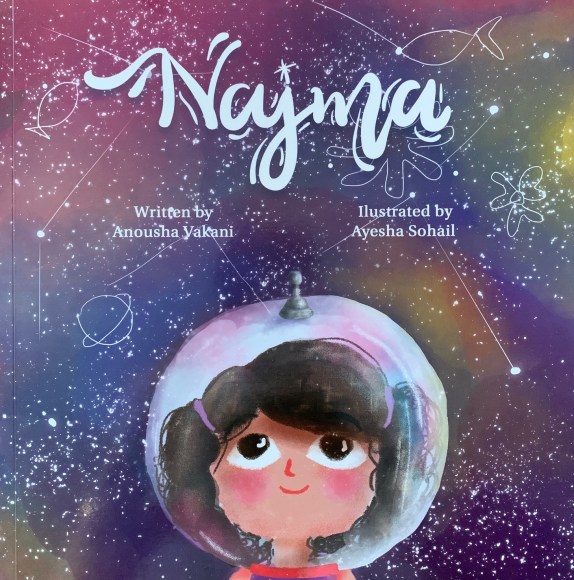
Najma by Anousha Vakani illustrated by Ayesha Sohail

Standard
Najma by Anousha Vakani illustrated by Ayesha Sohail


IMG_7194

In a world of new STEM books and female powered books, this 28 page fact driven story adds one more empowering element, Islam.  With beautiful pictures on thick glossy pages, the 10×10 book is both educational and endearing for boys and girls ages 6 and up.

IMG_7183

There isn’t a story with a climax or moral, but there are characters, Najma and her astronomer Mom, who move the book along, and keep it “grounded” so to speak.

IMG_7184

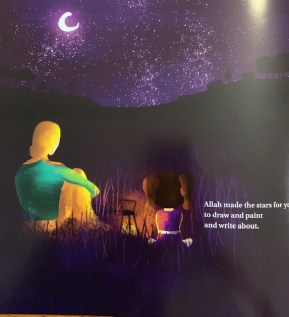
Little Najma loves the stars and space above her, she knows Allah created them, but she wants to know more about them, what they provide, and how Allah made them.

IMG_7185

Mama and Najma look through a telescope as Mama teaches the life cycle of a star in simple terms over 11 pages.


Najma then asks what stars are for, and Mama tells her the benefits of the sun that Allah swt made for us and the stars as well.  Mama explains Allah only has to say, Be and it is.

IMG_7188

Every scientific concept, and daily life example is tied back to Allah swt.  And with Najma’s adorable little face, and the beautiful complimentary illustrations, the book conveys facts about the universe, love between mother and child, and awe at Allah’s signs.IMG_7189

Thank you Crescent Moon Store for amazingly fast delivery of this brand new book.  InshaAllah there will be more books like this combining science, Allah, and strong females for us all to learn from and enjoy.


The Proudest Blue by Ibtihaj Muhammad & S.K. Ali illustrated by Hatem Aly

Standard
The Proudest Blue by Ibtihaj Muhammad & S.K. Ali illustrated by Hatem Aly

blueLOVE! Yes, usually when I’m so anxious for a book it disappoints, but not this one, it warmed my heart and soul and made me smile.  In 40 pages surrounded with absolutely adorable illustrations, the reader feels the love between siblings, the strength of self confidence, the power of being true to yourself, the beauty of hijab, and the awesomeness of light-up sneakers and five cartwheel recesses.

C7E95032-E080-4057-BC93-6B25CBCAAA29

It is the first day of school for sisters Asiya and Faizah, and Faizah’s first day of wearing hijab.  The book starts out with the girls and their mom picking out a new scarf at the store.

677BD5F0-0C6E-472A-B086-05F93D4F17CC

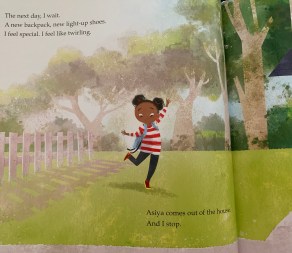
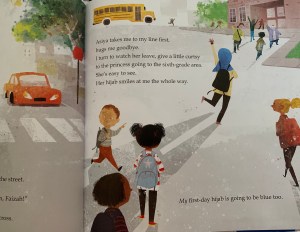
The first day of school has the girls walking to school hand in hand, Asiya in her beautiful blue scarf, and Faizah in her new shoes admiring her sister as if she were a princess.

DB80D90A-289E-4F35-A763-24526723E650

In line a classmate whisper asks Faizah about her sister, and Faizah has to find her voice to speak up about her hijab.  She then likens the blue hijab to the sky, special and regular before recalling that their mom had told them “The first day of wearing hijab is important. . . It means being strong.”

DFA253F0-16BC-464A-B630-BB93AFBFCF94

Throughout the day at school Faizah checks on her sister, sees other kids make fun of her, liken the blue to something beautiful, and then recall something their mom has told them to give her solace and strength.

06E90E71-3375-4E26-9F0A-F31DCA8058C4

As Faizah puts into practice the lessons from her mom about being strong, knowing who you are, and not carrying around hurtful words, she, like her sister finds strength.  A strength which radiates to those around them, and further connects the two girls.

C62B2893-3E2B-4628-BAAE-C195FBD3AB7A

Faizah has an amazingly sweet and authentic voice as she counts her light up steps and looks up to her older sister.  I love that the story stays on track and has its own rhythm of a school incident, a strong declaration about blue, a lesson remembered from Mama and a resolution.  With lots of mini climaxes the reader sees the strong perseverance and how being authentic will be challenged repeatedly.  The subtly of the hijab being whispered about and then proclaimed loudly is really tender and emotion filled.  Little reminders why OWN Voice stories are so important.

The illustrations are absolutely amazing on their two page spreads: the colors, tone, expressions, are perfect and a huge part of the narrative.  I love that when a boy points at Asiya, not just Faizah, but Asiya’s friends too are unhappy with the boy.  I also like that the boys being mean are not depicted clearly, but rather are shown in the shadows, furthering the point that mean words and those that spout them are not worthy of your time.

There are Authors’ Notes at the end and a picture of Ibtihaj  and her two sisters Asiya and Faizah. I think the book should be on every shelf, truly.  To be yourself and be proud of who you are is universal, as is kindness. The book does not discuss religion or mention Islamic reasons for her covering, and girls and boys alike will benefit from multiple readings of the book.


Towers Falling by Jewell Parker Rhodes

Standard
Towers Falling by Jewell Parker Rhodes

towers falling


I realize the inherent difficulty of writing books for middle grades about the events of September 11, 2001: the author lived through it, the readers did not.  Yet, it seems like at some point a book regarding it, will just feel right, and I don’t think for this age group, I’ve found it yet.  This AR 3.3, 228 page book is a quick read, and while some of the characters have spunk and personality, a few of the storylines seem incredibly forced and the overall timeline and holes in the story will be ultimately disappointing for most readers.

SYNOPSIS:

Deja is starting a new school now that her family has gotten a room at a homeless shelter.  Immediately her fifth grade classmates are given an assignment about home, with the end goal that eventually this project will transform in to being about the change of New York’s skyline fifteen years ago.  The details regarding the attacks of September 11, are not given forthright and as Deja knows nothing about the attacks, and the fall of the towers, her inability to get answers adds to her frustration at home and school.

Deja is angry as she bares a lot on her young shoulders.  Her dad can’t hold a job, and his moods and ill health put caring for her younger siblings on her.  Her mom works as a waitress and is always tired.  They lost their house, lived in their car for a while, and now occupy one room in a shelter.  Deja refuses to lie about her home life and thus her aggressive attitude is always on guard.  Another new kid, Ben, joins the class and he and Turkish American popular girl, Sabeen, all quickly become really good friends.  Each have something brewing beneath the surface that they are dealing with, but their friendship helps them cope and bonds them together.

As the trio of kids work on their projects together, Ben finally shows Deja online footage of the attacks and clues her in to what everyone else in their Brooklyn class seems to know and has failed to tell her.  Deja links her father’s declining health to that fateful morning and decides she needs to go to Ground Zero and get some answers.

She doesn’t really get answers, but at least it is the catalyst for an overdue conversation with her and her father, and hopefully a start on the road to healing the family rifts.

WHY I LIKE IT:

Much like the book Nine, Ten there seems to be the token Muslim girl in the story to offer her perspective on the Islamaphobia that occurred after the attacks.  In this case Sabeen doesn’t detail anything specific happening to her, other than a clerk at a store telling her to go back to Saudi and her uncle getting screened regularly at the airport.  Of all the characters I feel like Sabeen gets the short end of the stick.  She is incredibly flat, stereotyped and undeveloped.  Her family is Turkish, she is wealthy, her mom wears niqab and they are all overly kind and sweet, which is great, but when Deja goes over for lunch, they ask her if she prays, which seemed so random and off to me.  A lot of the basics about the character the author got right, she says that the terrorists were Muslim, but they weren’t, sharing a sentiment many of us Muslims feel. She wears hijab, and takes it off when she gets home.  I don’t like that the mom speaks English, Arabic and Turkish, but is first introduced having Sabeen translate for her with another parent.  Seems incredibly pretentious and misleading.  Ultimately her storyline is just overly forced.  She has to leave Ben’s house when they talk about September 11, because she is so affected by it.  She wasn’t even alive when it happened, and I get that when it is discussed us Muslims are on guard, but the author makes it seem like it is her whole world and influences everything around her.  If you live in New York, especially, I’d imagine at some point you’ve had to come to terms with it, no?

That’s why I also struggled with Deja’s dad.  He is so debilitated by the events of 9/11 he can’t function, yet they happened 15 years ago, presumably before he met Deja’s mom and they started a family.  So, really she fell in love with him in his current condition and thought having three kids with him was a good idea? He was fine and then wasn’t? For 15 years he hasn’t been able to get some sort of help for his PTSD type symptoms?  Seems like a stretch in the timeline, and one that is hard to excuse even for 3rd and 4th graders.

I really like how Deja’s homelessness is brought out and hopefully readers can learn some empathy from her.  Unfortunately the entire 5th grade class is so idyllic that I don’t know that most if any kids reading the book will relate to such a well behaved, so accepting, forgiving and generous group of kids. I mean yeah that’s the goal, but its way too overdone.  Ben, Sabeen, and Deja are best friends after the first meeting even though Deja is rude, mean, and doesn’t like them.  I’m not even sure what Ben and Sabeen get out of being friends with Deja?  Deja undoubtedly benefits from them, but there aren’t a lot of compelling reasons given why they’d be so drawn to her.

And finally, I struggled with the theme of how being “American” united them all.  It makes sense when discussing it as a class, that it doesn’t matter their color, income, life experience, whether they were immigrants or born in America, but the concept comes up again at a critical point when Ben and Deja are on the subway and seems so misplaced to me.  On the subway there would be plenty of tourists and visitors, that wouldn’t be American, no?

FLAGS:

The book is clean, it does mention some drunk people at the shelter, but nothing specific, just in passing.

TOOLS FOR LEADING THE DISCUSSION:

I wouldn’t do this as a book club selection because the target age is lower than who I meet with.  But, even despite some of my criticisms I’d recommend this book be in classrooms and school libraries as it does offer up a perspective on historical fiction that hopefully could lead to a slightly deeper understanding of the events at a young age.


Bismillah Little Leyla by Qura Abid illustrated by Mona Ismail

Standard
Bismillah Little Leyla by Qura Abid illustrated by Mona Ismail

leyla

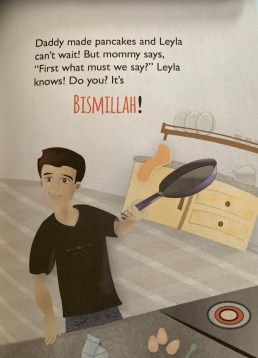
I thought this book might be leveled- reader type based on the binding and page numbers (26), but it reads more like a picture book with its repetitive refrain, and honestly the awkward small size (5×8) makes it feel like a pamphlet.  So, I’m not sure who it is trying to appeal to, and unfortunately is a great example of how the outward presentation killed an otherwise decent book.  I also don’t know who is to blame for the final physical product, the author, the publisher, the printer? But at a $10 price point, I’m not sure anyone who purchases this book is going to be happy with the size and binding, and the book will simply get lost on a book shelf, and be forgotten.

D2F8834B-35BD-4EDA-AD61-7DBBE81379C0

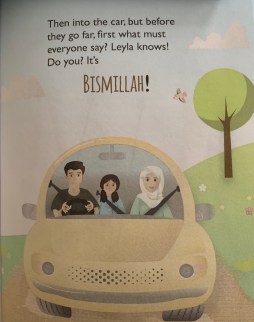
The premise of the book is good.  Rather than just tell kids to say Bismillah before they do anything, Little Leyla actually does it in the course of a morning.  I like that it shows that we say Bismillah before we do all types of things, not just before we eat or get in a car, but even when we swing and play a game or put on a jacket.

66AC3E97-BC82-4A6E-8E25-8E22F728E46E

The climax of the book is Leyla saying bismillah, shooting a goal and scoring against her dad.  The lesson being that Allah is always there to help us.

017585B3-7AD4-4769-AD6A-C218ECAE4A33

I’ve read the book a dozen times, to myself and aloud, and I think the book has a natural cadence based on the diction and sentence length, and I think it wants to rhyme.  Additionally, after each example and on nearly every page, the refrain at the end of the paragraph is (nearly) the same:  “What must she say? Leyla knows! Do you? It’s Bismillah!”  The repetition makes it memorable, but with the sing song beat and on and off, often forced, rhyme, I find myself tripping over the words a lot, and I cant quite put my finger on why.  If the book were larger, and I were using it for a preschool story time, I would just have to practice it a few times, but there is no way, sadly,  you could read this book to a group if you want them to see the pictures.

857FA476-B9FF-46D0-BBBA-035CBFADD7B1

The illustrations might be ok, it might also be a presentation thing that makes them look washed out OR maybe that is how they are, I’m not sure. The detail and expressions are there, they just kinda seem faded.   Concept wise I like that they show the dad cooking and Mom playing soccer. The mom wears hijab she the family seems warm and happy.

DD72FDED-2FB4-4E08-8275-22E7E7202728

Thanks again to crescentmoonbooks.com for the excellent customer service and selection.


Leila in Saffron by Rukhsanna Guidroz illustrated by Dinara Mirtalipova

Standard
Leila in Saffron by Rukhsanna Guidroz illustrated by Dinara Mirtalipova

leila

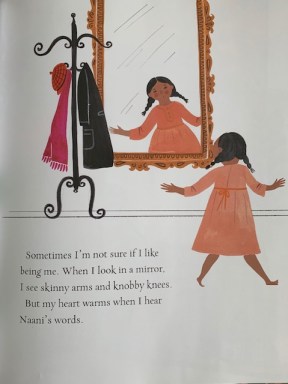
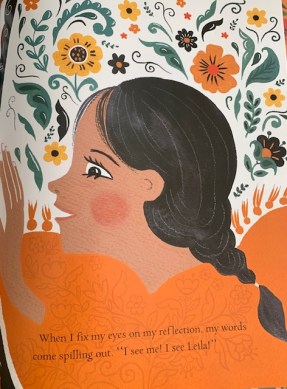
I had really wanted to love this book about a young Pakistani girl living outside of Pakistan learning to love all her different parts.  Unfortunately, the book was so scattered that no point was made, no message conveyed, and sadly, no excitement at being represented in literature really felt, .

IMG_6403

This 32 page book isn’t bad, it just really isn’t memorable.  It starts out with Leila arriving at her Naani’s house for dinner as her parents and her do every Friday.  Her maternal grandmother comments that she likes Leila’s saffron buttons.  Leila beams at this because she doesn’t know that she always likes being herself.

IMG_6404

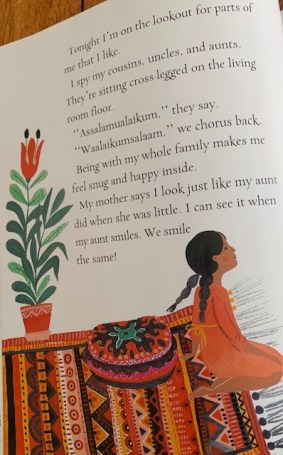
Tonight, they are joined by lots of extended family and Leila is on the lookout for parts of herself that she likes.  She feels safe with her family, and likes being told she looks like her aunt when she smiles.

IMG_6405

The book then kind of abandons the theme of finding parts of oneself to like, and moves on to cultural trinkets to enjoy.  She identifies camels on shelves and Arabic books too, and can’t wait to go on her first trip to Pakistan someday to get her own “Arabic books” and “special ornaments.”  I’m not sure why they books aren’t in Urdu, but none-the-less without any written connection to Islam, they are in Arabic, thus giving, erroneously, the reader the impression that is the language of Pakistan.

IMG_6406

Leila then helps her Naani cook which almost seems like an additional theme of the book: the passing on of traditions.  The book doesn’t really stay here though either, and has Leila running outside to get cilantro from the neighbor Miguel.  Possibly another theme in addressing multicultural neighbors or just how to be a good neighbor, is now being brought up, but nope, the book bounces back to dinner with the family.

IMG_6407

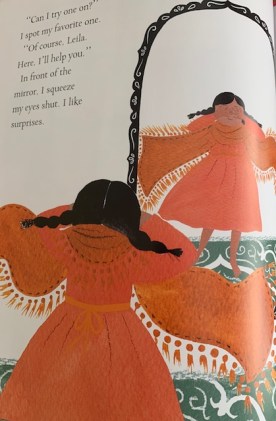
When it is time to leave, Naani invites Leila upstairs while her parents wait to leave.  Here she goes through fabric and scarves rich in color and textures and likens them to ethnic foods.  She then tries on her favorite one, but acts like she has never tried it on before or seen it before, I’m really not sure, the language is a bit awkward to me.  Anyway she opens her eyes in a surprise and likes what she sees, she likes her self, all her parts.

IMG_6408

I wish this book for preschool and kindergarteners, would have streamlined the message it wanted to convey most.  I like finding pieces of yourself and liking the completed you, but I don’t know what the pieces really are in the book.  Yes I could assume and figure it out, but I’m not 5 years old.  The book should have articulated it clearly.  Or if the book wanted to celebrate culture and family traditions, it should have stuck to that.  It really seems all over the place no matter how many times I read it.

IMG_6409

The illustrations are rich and vibrant.  They definitely give a lot to look at and the expressions on the characters faces will probably make the little ones giggle.  There are a few Urdu and Arabic words used in the story that are defined on the back cover.

IMG_6410

The characters aren’t identified as Muslim, none of them wear hijab, but they say Salam and have Arabic books, so one can assume. I picked up the book at the library and don’t regret it, but I probably wouldn’t buy it or unfortunately, check it out again.

Piece by Afshan Malik

Standard
Piece by Afshan Malik

Pieces.jpg

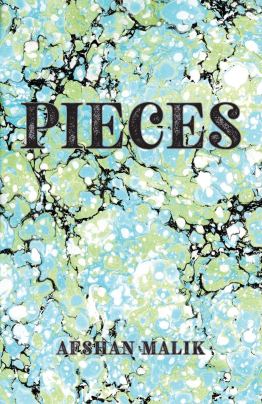
This 168 page young adult book from Daybreak Press focuses on a small Muslim family in Texas, that has their own stresses and interpersonal relationships, but are thrown in to a whirlwind when the father of the family returns home from a medical mission to Syria and finds himself in the psych ward broken and troubled.  The effects each of the character’s struggles have on them as well as those they care about, makes for a haunting yet relatable read for fourteen year olds and up.

SYNOPSIS:

The Jamal family is made up of Hannah and her older high school aged sister Noreen and their physician parents Dahlia and Adam.  Hannah runs track and is more introverted in handling friends and her father’s life altering condition.  Noreen on the other hand is ultra organized and rational in her approach to life, much more like her OB mother.  To cope with the stress of her father’s return she commits herself to more clubs at school and staring at her phone.

Hannah doesn’t seem to have a lot of friends, and when the track team understands that Hannah’s dad is dead and Hannah doesn’t correct them until later, her comfortable acquaintances turn on her and she will have to learn to stand up for herself and use her voice in the course of the book.  Noreen’s character arc is a bit more dramatic as her involvement in yearbook club brings new people in to her life, mainly a boy, who might not be as a genuine in his goals as she is, and thus their climax results in a trip to the police station.  Dahlia has a close friend, and Adam has a few as well, but the story really stays pretty streamline in exploring the relationships of the family and how little things and big things affect them all.

WHY I LIKE IT:

I love that the book takes on a serious issue like PTSD and is framed in such reality.  The scene where the dad blurs his past memories with the current real happenings, is done very well.  It conveys how fractured his brain is while showing the stress his situation lends to the mood of the home is powerful. There is also a very real situation of attempted physical and sexual assault that occurs when Noreen finds herself in a position with a male classmate who attempts to take advantage of her.  The book holds back in details, and she is able to defend herself, keeping the book clean, while still implying what his intent was, and how fortunate she is to get away.

More superficially, but also more relatable is the girls bickering and fighting and pushing each other’s buttons, and the mom trying to help, but is alas is frequently at a loss at what to do with them.  The situations the girls face at school are probable and relatable that I think a lot of middle school and high school readers will see themselves trying to balance extra curricular activities, friends, finding a quite place to pray and keeping their hijabs coordinating.  The family is Muslim and they dress the part, talk the talk, and pray together regularly.  Islam is very present, but not preachy, it is just what the characters believe and what they use to shape their view of many of the tests they are facing.

There are a few hiccups that are worth noting, but don’t overly deter for my appreciation of the story.  I struggled with the writing style in the first few chapters.  It took a bit to feel a connection to the characters and get what was going on sorted out.  It is written in 3rd person omniscient (I believe, it’s been a while) with each chapter more or less focusing on one of the four main characters.  As a result a handful of times the narrative gets awkward in explaining what one of the characters is doing or thinking, because the focus is on someone else, or the timeline overlaps a bit.  It doesn’t happen an awful lot, but the book is under 200 pages, so it is annoying that it happens at all, let alone more than once.
Story wise the characters seem oddly isolated.  The book tells us how small the town is, and shows us how everyone knows the parents regularly, the girls seem to be pretty lonely.  There isn’t any warmth from the schools or neighbors in helping them deal with their dad coming home so wounded.  In a town they have lived in for so long, this seems off to me.  Also if the town is so small, and the family so religious, there is an imam who visits once, you’d think there would be more of an Islamic community presence for the mom and girls to find support from.

FLAGS:

There is violence in the remembering of what happened in Syria.  There is some Islamaphobic talk as Hannah endures some verbal bullying and the attempted physical and sexual assault on Noreen.

TOOLS FOR LEADING THE DISCUSSION:

I would consider this as a possible middle school book club choice.   It tackless some big things, and uses Islamic boundaries to talk about mental illness and sexual violence which is a huge plus when addressing our youth.  Noreen isn’t in a relationship or even overtly infatuated with the guy who puts her in a compromising situation.  But even if she was doing something “wrong” what he did is not ok, and the fact that the authorities believe her, and she plans to discuss it with her mom, and she is not further victimized by speaking out, is something our kids need to see and understand.

There are discussion questions at the end and I think males and females will benefit from reading and discussing this book.  Unfortunately, and possibly the only other disappointment in the book is the price.  Nearly twenty bucks for a short YA paperback book makes it hard to buy classroom sets for such activities, and I’m sure will even keep the avid reader debating whether they should purchase it or not.


Secret Recipe Box by Helal Musleh illustrated by Nalan Alaca

Standard
Secret Recipe Box by Helal Musleh illustrated by Nalan Alaca

recipe-box.jpg

The publisher suggests this book for ages 4 and up, but I think it’s a bit long (30 pages) and detailed for that age group, and first grade and up will benefit more from this heartfelt story.

IMG_5872.jpg

Maha is excited her Teta is moving from Palestine to live with her, her brother Sami, and parents in Canada.  Maha dreams of being a chef on a famous cooking show, and her Tata and her secret recipes will be a great way to practice.

IMG_5873.jpg

Her little brother Sami is always in the way though.  Whether it is wanting to hold a sign Maha has made, or is wanting to cook with her, she is annoyed by him at every turn.

IMG_5764.jpg

As Maha listens to Teta’s stories and learns about her life in Palestine, she starts to change in her approach to Sami and realizes that family has to take care of each other.

IMG_5874.jpg

After a day of cooking together, Maha, Sami, and Teta have made too much food and decide to go and share it with those in need at the soup kitchen.

IMG_5763

The book addresses kindness, changing, compassion, immigration, taking care of one another, multi generational lessons and love, stories, life lessons, and some highlights of Palestinian culture, food, clothing, and tradition.

IMG_5761

The book is warm and well done, with the exception of a few of the pictures which seem a bit off to me.  Overall, it is a sweet story that presents with a lot of lessons, but doesn’t force them upon the reader.  The character growth is gentle and subtle and will resonate with readers.

IMG_5762

The characters mention Halal food, and the grandma wears hijab even in the house, where the mother is shown wearing it at the airport, but not in the home.  The book would work for Muslim and non Muslim readers.

Allah Tells Me… by Ali Gator (Firhana & Ahmed Imam)

Standard
Allah Tells Me… by Ali Gator (Firhana & Ahmed Imam)

Allah Tells Me - web-500x500

This 28 page, thick glossy full-color book for 3-8 year olds, introduces and describes the five pillars of Islam in an age appropriate manner.

IMG_5648.jpg

The book is fact based and informative, but the illustrations and voice of the text reads in a gentle inviting tone that will appeal to small children.  There is no story, but rather a boy that takes you each of the pillars and talks to the reader.

IMG_5649.jpg

The short paragraphs about shahada, salat and wudu, fasting, zakat, and hajj are detailed and will need some additional explaining if used to teach kids.  If you are using it to just introduce general concepts, the pictures and sentences will suffice.

IMG_5650.jpg

The book is in English but does use Arabic words to describe each tenant with in-text translations in parenthesis, as well as footnote translations on occasion.

IMG_5651.jpg

The book is set up as a tool for parents and teachers to use when educating young Muslim children and thus some hadith and ayats are present at the beginning and end, as well as some directions, games and activities.

IMG_5652.jpg


Our Granddad by Maryam Ahmed illustrated by Kulthum Burgess

Standard
Our Granddad by Maryam Ahmed illustrated by Kulthum Burgess

grandad.gif

This 29 page (four chapter) middle elementary book about understanding sickness, old age, and a bit of death, makes some good points about sabr and dua and Allah testing us with illness.  The story, however, is really dry and never becomes more than just a vehicle for conveying the author’s message of how Islam views elders and the challenges often brought upon as they age.

SYNOPSIS:

Hafsah, age 8, and her 11 year old brother Hasan are meeting after school so that they can join their parent’s in the long drive to Devon to check on their sick grandfather.  The drive is apparently really long, but being that we don’t know where the kids live or how long the drive is, we just know it is a long, painful, miserable drive.  The family is silent with worry about the grandfather on the trip, but no indicators as to what his diagnosis or symptoms are is given, just that he is ill and as the night and drive progress, the children worry he is dying.  Hasan, in the darkness of the car, sheds some tears about losing his fun granddad, but no details about the adventures they go on, or why he is fun are shared.  Their mom encourages them to continue to make dua and tells them that maybe the illness is a blessing, but the children don’t understand what she means by that.

When they arrive, the children are told it is too late bother their granddad and to wait til morning to see him.  The next day the doctor tells them he had an asthma attack and is on new medicines that are helping.  Seems like there should be more to the illness, as asthma once the attack is over can be controlled, and no other mention of heart problems or pneumonia or other diseases are indicated.  Hafsah and Hasan finally get to see him and are surprised he is awake and talking and they learn that sometimes Allah tests us by giving us hardships and that their duas and prayers were helping.  He shares the hadith, “No Muslim is afflicted with an ordeal, be it an illness or something else, without Allah thereby causing his sins to drop away just as a tree sheds its leaves.” Unfortunately, the hadith is not footnoted or attributed, but the characters and readers understand the lesson and find peace in knowing that every hardship is an opportunity not a punishment.

WHY I LIKE IT:

I love the concept of the book, just not the execution of the principles it instructionally conveys.  Kids need books that explain some of the big concepts that they can’t necessarily understand or even ask about, such is why do we get sick, what is going to happen to our grandparents etc.  The book really just needed more showing and less telling.  It details how the kids chase each other home from school, but doesn’t tell of the adventures that granddad and Hasan go on, it just tells us that they miss having these adventures.  There is no character development, and there is definitely space for the reader to feel for the grandpa and the concern of the kids, but it is glossed over in words not in anecdotal sharing.

The book is British, and some of the words and phrases might be confusing to American kids, such as the description of the grandfather being poorly used repetitively.

The book is presented well with clear font and spacing on glossy pages bound in a hard illustrated cover.  There are small detailed life-like pictures throughout the story that show the kids and family.  The females are in hijab and the family is clearly Muslim.


FLAGS:

None

TOOLS FOR LEADING THE DISCUSSION:

This is probably a decent book to have in an Islamic School library, it would function as a reference book more than a novel or book kids would naturally pick up.  If doing a theme on aging or sickness, or tests from Allah, this book would fit in nicely in adding to a discussion, but outside of that, I can’t see that kids will even remember the book or what it is about.


More to the Story by Hena Khan

Standard
More to the Story by Hena Khan

more to the story.jpg

For a book written by an accomplished author for 3rd to 7th graders focusing on a Muslim family, I was surprised at how despite wanting to absolutely love this book, I only kind of liked it.  For the first 100 of 271 pages, I really kept hoping there was going to be more to the story.  Luckily the story did pick up, but I couldn’t get passed how much crushing all the sisters were doing on the one boy in the story, and how much stronger I wanted the main character to become.

SYNOPSIS:

Told from Jameela, “Jam’s” perspective, the second of four daughters living with their parents in Georgia, the story focuses on the interpersonal relationships of the members of the family and their parents’ close friends who’s nephew has moved in with them from England, Ali.  All the kids are close in age and of Pakistani ethnicity, and are Muslim.  As the reader gets to know Maryam, Jam, Bisma, and Aleeza, you see the characters develop pretty well and their quirks and personalities emerge.  Jam is more tomboyish than the gorgeous Maryam who likes to bake.  Jam and Bisma share a room and are closer than Jam and Aleeza, the baby of the family who Jam finds is becoming a brat.  Jam also enjoys watching football and eating spicy food with her dad and desperately wants to be an award winning journalist like her grandfather.  She puts out a family newsletter and is ecstatic to be named the feature’s editor as she starts 7th grade.  Ali is a year older and has moved to stay with his aunt and uncle until his mom and sister can join them.  He spends a lot of time with the sisters and in Little Women inspired fashion the little ones want his attention, Jam is a little jealous to learn he finds himself tongue tied when talking to the beautiful Maryam and Maryam in 9th grade is drawn to Ali, but doesn’t vocalize it too much.  And then as the story picks up speed, Jam says, “In a matter of weeks, Baba got a new job and moved across the world, Bisma got sick and has to be in the hospital, and I messed up everything with Ali and the paper. How did my whole life get turned upside down so quickly?”  

The rest of the book is dealing with Baba working in the Middle East, Bisma being diagnosed with lymphoma, Jameela learning some journalistic basics, and Ali and Jameela becoming a bit more than just friends. 

WHY I LIKE IT:

I love that a Muslims desi family is being represented in an own voice novel that mentions religion as a natural part of their life, and doesn’t apologize or overly explain it.  That being said, I feel like the book is trying to present “us” to the outside so to speak, rather than empower our own.  And I point this out, because I feel like it could have done both.  Dialogue between Ali and Jameela about how they might date as they get older, how Ali can’t see any of the sisters having an arranged marriage.  How when Maryam gets asked to a dance her mom doesn’t mention any religious reason her daughter should say no.  None of the girls wear hijab, and they mention that they don’t wear hijab, at one point Jam knows she should get up and pray, but doesn’t.  I don’t expect a fictional story to teach our upper elementary age kids how to behave that is a parent’s job, but to have some basic Islamic tenants brushed aside after being mentioned is worth noting.  Had the book just been more cultural, maybe I wouldn’t be so critical, but Muslim girls are going to be excited to see themselves in this book and some of the messages might tilt a little more liberal than some parents would expect.  It is one thing when our girls read a book with a romantic twist and we say that, that is not for us, but when a book celebrates us not just crushing, but vocalizing those crushes and moving in to a gray area (they hug but it could be an innocent friend hug) and they make a point to be next to each other, Muslim parents should be aware.  In the larger society it wouldn’t even register on the radar, hence I point it out.

Another thing that kind of bothered me and was again related to Jameela and Ali’s relationship was that when Jameela cut her hair in support of Bisma losing hers with chemo treatments, she seems to need Ali’s approval.  I get that she wanted him to see her and all that, but I really wanted her to be strong enough in and of her self that even if she looked awful she would own it and not let it define her and not let a boy’s opinion about her physical appearance weigh that heavily on her.  Again I know 4th grade girls start noticing boys and having crushes and middle school is only worse, but I just was hoping that her strength and confidence would come from her own growth arc, not from someone else, let alone someone she likes. Side-note here too about the hair, it is donated to make a wig, which I know might also be a sensitive subject regarding if that is allowed in Islam or not.

In terms of the cancer and the sister’s rallying together all that I thoroughly enjoyed and found the most interesting passages in the book.  I think the understanding of a real subject and finding a way to help and deal with this was executed expertly and powerfully without sensationalizing the concern or simplifying the experience either.

FLAGS:

The book is clean, but there is a lot of mention of how Ali affects the girls.  And potentially depending your own opinions on the hair being donated.

TOOLS FOR LEADING THE DISCUSSION:

I wouldn’t do this as a book club book, I’m actually hesitant in even recommending it to my 12 year old daughter.  I know she has read worse, but again me handing her a book about Muslim girls might make her understanding of what we expect regarding boy/girl interactions to be a bit muddled.