Tag Archives: Kube

All the Ways to be Pretty by Shamaila Khan illustrated by Reyhana Ismail

Standard
All the Ways to be Pretty by Shamaila Khan illustrated by Reyhana Ismail

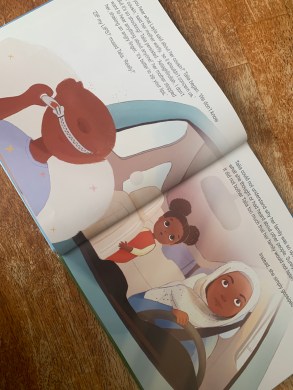
The premise of this book is fabulous, an Islamic approach to internal beauty to counter the societal emphasis on external appearance, by drawing on the examples of Ai’shah (RA), Khadija (RA), Sumayyah (RA), Maryam (RA), Hajar (RA), and Rufaidah (RA), may Allah swt be pleased with them all.  The illustrations are decent, focusing on the girl understanding what her mother is saying and her imaging herself with those qualities.  The part that I struggled with, is I flipped through it before I started reading it, and the pages are often walls of text.  Additionally, I didn’t realize it is rhyming text over 34 pages.  SubhanAllah though, somehow, it works.  I can see this book being shared at preteen gatherings in masajids, homes, and schools everywhere.  The rhyme at times is forced and lacking, but the flow makes the walls of text zoom by and the information shared is not overwhelming and Alhumdulillah, it doesn’t stray too far from the central messaging. You could share it with younger readers, but I think it works best if the audience knows some of the women and facts highlighted, and the information shared is a mix of reminder and new tidbits urging further exploration. The publisher lists the reading age at 7-10 which is probably a good fit based on the amount of text, but the rhyme, mirrors at the end, and starting point of battling beauty standards on the screen and “Princess” messaging is a bit of a target audience disconnect, which is why I point it out so consumers are aware.

The book starts with a lengthy author’s note before the rhyming scene of a mother and daughter walking to school and discussing what the daughter would like to be.  The girl doesn’t answer a profession, but rather responds that she wants to be pretty, and gives some justifications.  The mother gently then encourages her not to just want to be pretty, but rather pretty smart, pretty wise, pretty brave, pretty pious, pretty resilient, and pretty kind, before concluding with the girl throughout the day thinking of how to be like them, and her mother, to earn Allah’s pleasure.  Each attribute is a two page spread with one of the historical women featured.  The book ends with a hadith and six mirrors with the characteristics beneath them.

I like that the book does not try to give an entire biography about the women featured.  I also like that Islamic references are also brought in, some explained some not. It is “Islamic fictionalized non fiction” it is meant for Muslims with Islamic framing, not just Muslim characters, and it has substance.  Lately so many self published or even Islamic published books seem to not feature Islamic foundational themes, and I realize how much I have missed reading books that do.  Yes, I normally would have a solution to offer as to how to make the pages less text filled and I know I should say that maybe it shouldn’t rhyme, because it makes for some awkward phrasing, over explaining, and useless lines, but alas, I have no suggestions.  We need books that present our Sahabas and Prophets in a manner that allow our kids to know them and think of them and emulate them. Alhumdulillah, I can see this book being read and shared and discussed, and that to me is a “pretty “good thing.

Bilal’s Bad Day by Neelum Khan illustrated by Alice Larsson

Standard
Bilal’s Bad Day by Neelum Khan illustrated by Alice Larsson

img_7727-1

I like the concept and presentation of this picture book that involves spinning a spinner at the midway point to determine what page you should “jump” to, to continue the story. I can see this being a great tool to introduce and practice different calming strategies to use when times are tough.  I love that some of the ideas of faith based, and some are not, and that a thorough introduction of how to use the book and strategies precedes the fictional story.  BUT, oh come on you knew it was coming, I don’t know if the information is sound.  Translation, I don’t have to use calming strategies, and the book does not disclose if the author is qualified to be giving them.  I can’t imagine the strategies would cause harm, and we can always benefit for de-escalating and centering, and truth be told I don’t even know if one would have to be “qualified” to give this advice.  I simply put it out there for you all to decide for you and your little ones.

The book starts with Bilal opening his eyes to the sounds of his siblings squabbling, breakfast disappoints when they are out of his favorite cereal, and dad’s joke about his hair is not appreciated.  Top it all off with news that guests with a baby were coming over for lunch, and Bilal knows it isn’t going to be a good day.  With cleaning, itchy clothes, and the smell of food building as the day passes, the doorbell ringing sends him over the edge and mum and dad need to find a calming strategy to help him.  This is when the reader gets to spin the arrow and jump to the page to see what and how to use the different options.

The book has whatever option picked work to calm Bilal down, but notes at the beginning that multiple options and repeats are often more the reality.  The story then has Bilal later that evening reflect on the day before asking the reader to reflect on their own similar experiences as well through six bulleted considerations. The 40 page book concludes with hadiths.

This book needs to be read and discussed before the moment of need arises, and be aware the spinner at bedtime is too much of a distraction.  The book is best with dialogue, understanding, and practice.

The Magical Moroccan Rug by Naveed Mir illustrated by Anisa Mohammad

Standard
The Magical Moroccan Rug by Naveed Mir illustrated by Anisa Mohammad

img_4186-1

I really like the premise of the book, a Muslim Magic Tree House so to speak, two kids that magically go back in time, in this case to Andalucía. At times the book did make me smile, but really it feels like a missed opportunity.  The writing needs tightening, it feels early reader at 94 pages long with a few full page illustrations, but the vocabulary and text filled pages support the suggested reading level of middle grade.  It takes way too long to build up to the “action,” and when it gets to the plot it doesn’t seem to know what to do with itself.  It is a lot of walking this way only to turn around and walk back for no development, character growth, or enriching reason.  As an adult I had to force myself to keep reading, my eight year old who loves Magic Tree House books had basic foundational questions and couldn’t’ get past page 24.  Honestly it just needed some proof reading and some trimming, which is why I found it so frustrating; it really had so much potential.  Example, if the little boy is so excited to see his grandfather after 8 years, why didn’t he go with his dad to the airport, why did his elderly tired grandfather immediately go to a community event after arriving in the UK from Morocco, why wouldn’t Yusuf go with his beloved grandfather to the masjid.  And this is all within the first few pages.  If the logic isn’t there for the mundane set-up, it is hard to get on board for the fantasy aspect of a flying carpet going back in time.  The historical figures are introduced in passing and don’t leave much of an impression, so yes it is good to give readers a bit of information on people they may not have heard of before, but it doesn’t give them enough connection to make them memorable.  The backmatter sadly is not more information about the three historical figures presented: Abdur Rahman (The Falcon of Andalus), Lubna of Cordoba, and Abbas Ibn Firnas, it is a glossary and a Quick Quiz.  The answers to the quiz are not provided, there are additional facts shared but no sources given, and there is urging to find out more about Muslim Spain, but no directions, links, or book suggestions are provided.  The publisher should have proofed the book, it reads like a pitch, maybe a first draft, and our children and their purchasing adults deserve better.  We have growing options of stories with historical Islamic OWN voice framing, and unfortunately this book had a lot of potential, a few pages of interest, but not ultimately enough intrigue to win me, or my kids over.

img_4187-1

SYNOPSIS:

Yusuf and his friend Jack live in the same neighborhood, but don’t go to the same school.  They spend a lot of time together though, and have known each other since they were babies.  When Yusuf’s grandfather comes to visit from Morocco, he brings an old carpet and gifts it to his 10 year old grandson.  Unsure what to do with it, Yusuf puts it in his room, and feigns gratitude.  With a history project looming, and a dislike for historical study, Yusuf and Jack find themselves heading on a magic carpet ride into the past.

They arrive in Cordoba in 856 CE, disoriented and dizzy, Omar, their guide, greets them, walks them through the mosque answers one question then walks them back to the carpet to take them to a different time, 786 CE and they see diverse people living together peacefully.  They first observe “one of the greatest rulers that Andalus ever had,” The Falcon of Andalus, aka Abdur Rahman.  He is a humble leader that freely interacts with his subjects.  They then head to the 10th century to see Lubna with a crowd of scholars in Cordoba  learning from her in the library.

When Yusuf remembers his history project about flight, Umar guides them to 875 CE with a pit stop in CE 852 to see Abbas Ibn Firnas take flight, well fail and then eventually take flight in 875.  The boys then say their goodbyes and are whisked away home. Where they can’t believe what transpired, and are determined to figure out how to make it happen again.

img_4188-1

WHY I LIKE IT:

I like the concept, and that Jack is not Muslim, and Yusuf is unapologetically Muslim.  Seeing the two interact is enjoyable and both good modeling, and mirroring.  The heart of the book is truly not bad, it is the tangents that get long winded for no advancement of the story that take away from the flow.  As stated above the relationship between Yusuf and his grandfather doesn’t align with what is said and what is shown.  The end suffers the same lack of editing.  How can grandpa and Yusuf live in the same home, but they can never find a moment to talk.  Nothing is gained by delaying their conversation, so why delay it, and go on and on about delaying it?

If the point is to share not just with Yusuf and Jack about key historical figures, but with also the reader.  Then there needs to be more interaction with the characters, not just watching them from afar.  Interact with other observers or students or colleagues, convey information from a “personal level” not just drop a snippet here or there from what feels like a vague Wikipedia page.  If the book is not sourced, why not take some fictional liberties and flesh out Abbas, Lubna and Abdur Rahman, so that they are remembered. Include more information about the three real characters in the backmatter, reinforce the idea that a magic carpet is not real, but these remarkable people were, and they changed the world.

I don’t know that kids will have issues with how the carpet worked, but because the set up was so weak, I had a hard time going along with any of it.  I wanted to know why it had to be a grandson, not a son or daughter, how grandpa or his grandpa figured that out when it wasn’t a relative that gave the first Yusuf the carpet, but a storyteller.  How Umar knew to look for them at that moment.  Why did they go to 856 CE and then go to 786 CE why couldn’t they just meet Umar on the first stop? Seems unnecessarily dragged out, for no reason.  When was grandpa’s last trip? Could you get stuck out of your time? If no one can see or feel the rug, why do they keep hiding it? Can people see and hear them, or only their guide?

I like that Yusuf prays and Jack knows that Yusuf prays, and what a mosque is.   I didn’t like that they hear the athan, and went with everyone to pray, but then just left without praying.  The book seemed to do that a few times.  Have the kids walk through a crowd presumably toward something or for some purpose only to turn around and return to the place of origin having gained nothing, learned nothing, or seen anything, again just drags the book out and frustrates readers.

There really is not conflict in the book, no climax either, there is no really stress about getting back, stress about figuring out how to go on the next adventure, it is there, but not heightened, and it is unfortunate, because the book really could be adventure filled, and it just isn’t.

img_4189-1

FLAGS:
None

img_4190-1

TOOLS FOR LEADING THE DISCUSSION:
If you are learning about Abbas Ibn Firnas, or Lubna, or The Falcon of Andalus or Spain, and have access to supplemental material, the book has value.  I don’t know that if a kid picked it up off the shelf even with interest in history, that they would finish reading the book.  It doesn’t provide a solid feeling of learning or understanding about the time and place and people seen in the time travels, nor is it action packed on its own.  So if you can motivate a child to read it and then look further into it, the book would help connect the past as being interesting and engaging, but on its own, the book does not achieve that.

Raisah and the Boat Trip by Nadia Ali illustrated by Fatma Zehra Köprülü

Standard
Raisah and the Boat Trip by Nadia Ali illustrated by Fatma Zehra Köprülü

img_0124

I’ve seen this book reviewed and promoted on social media.  I’ve even read the reviews.  Yet for some reason I thought the book was a refugee story. It is not.  It is a family’s trip out on a boat interwoven with what they see and ayats from the Quran.  It can be read as a simple straight forward story, or the interspersed ayats can be paused for and discussed.  Honestly the book probably will not be asked for multiple times by young children, but as a teacher, librarian, parent, you are going to reach for this book quite often.  It is a book that can be used in story times about Allah’s creation, the ocean, science, experiences, and the signs that help us know Allah swt.  And for that reason I wish the book was larger.  It is great for bedtime, but the 9 x 9 size makes it cumbersome for story times, even for small groups.  Technology can help, but I really just wish it was a bit bigger to enjoy the simple illustrations and increase the sense of wonder Raisah feels upon the vast ocean.
img_0126

The book starts with Raisah, Mama, and Papa getting on a boat and heading out on the ocean.  They observe the water getting darker the further they go out, the saltiness of sea water compared to river and lake water, and then they turn off the engine and pull out their fishing rods.

img_0125

They joke about what they will catch while dropping the fact for readers about the blue whale being the biggest creature in the ocean, before a cargo ship catches their attention and they marvel at transportation opportunities on the sea.

img_0127

There are seven ayats from the Quran included in the 28 page book and the surah number and ayat are sourced.  The book can be ordered here from Crescent Moon where code ISL saves you 10% at checkout or here from Amazon.

img_0128

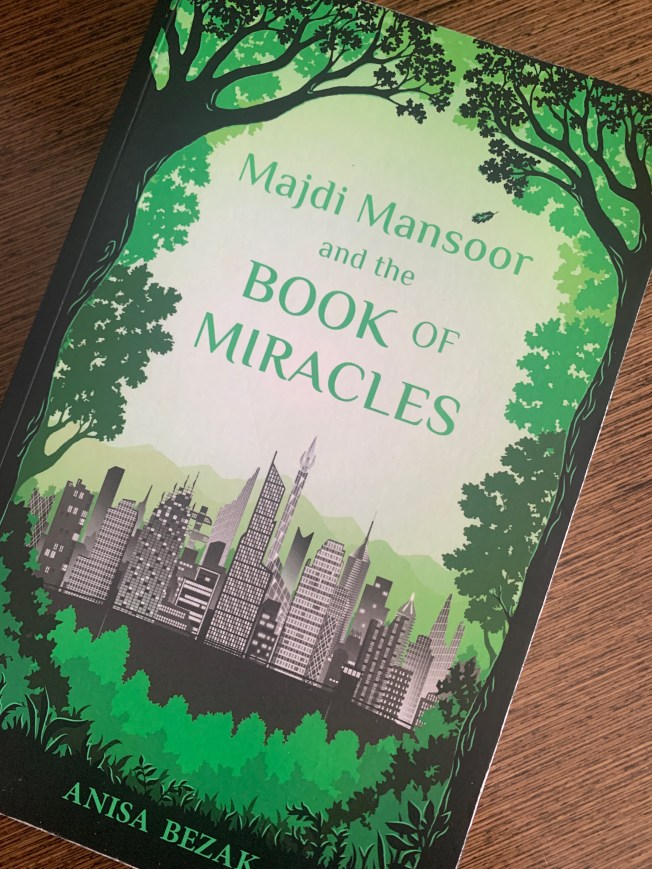
Majdi Mansoor and the Book of Miracles by Anisa Bezak

Standard
Majdi Mansoor and the Book of Miracles by Anisa Bezak

img_0030

I don’t think I have ever seen or even heard of any dystopian Islamic fiction reads, we have a handful of Islamic historical fiction, and dystopian with Muslim characters, but the genre made me curious, and with that motivation I began the 458 page book.  The beginning didn’t immediately grip me, but I told myself to read a hundred pages before deciding to DNF it or keep reading, and long before that arbitrary mark, I was intrigued by the story, invested in the characters, and impressed by the consistent writing, pacing, and role of Islam.  The book is preachy and idyllic, but that is to be expected, the way Islamic ideas and concepts and concerns were included as plot points though, is surprisingly well done.  For much of the story, I kept wondering who the target audience would be.  The vocabulary is a bit advanced, and the pages full of small text.  The book starts story wise-solid middle grade, but I think by the end I would recommend this book for advanced middle grade or early middle school Muslim readers.  I’ve heard from some adults that they read a chapter to their kids each night, and I think that aloud younger kids might also enjoy the story and be swept away to a future land run by a corporation where religion is banned, books are a thing of the past, a boy speaks only in Quranic ayats and hadith, and bullies of all sizes will have to be faced.

SYNOPSIS:

Twelve year old Jacob is an orphan in Tanas World and is unwillingly part of a gang.  One day in a boarded up old building he finds a book, a physical book, the Quran.  Religion is not allowed, Islam most of all, but he reads the book, and even though he doesn’t believe, he keeps rereading the pages.  When an attempt to steal some tech takes him outside the boundaries of the walled off city, he meets a small boy, Majdi Mansoor, who talks in a peculiar way. When threatened by the gang, Jacob decides to take Majdi’s side and that one act sets the two boys on a course that will change them forever.

I don’t want to give away too much, but Jacob is taken in by the Mansoor family who live in isolation and in hiding outside Tanas Corps patrols.  The parents are kidnapped, the children seek to save them and along the way meet smugglers, a Muslim community corrupted by bidah and djinn, Muslim Defense Unit rebels seeking revenge, and the executives who want the MEECA device to imprison the planet.

WHY I LIKE IT:

I was honestly impressed with the quality of writing, but I honestly don’t know if it was because my expectations were so low, or in fact was sufficiently edited and refined.  The characters have heart, the world building is believable, and the Islam is handled with an even hand.  At times members of the Mansoor family are too “good,” but Jacob has a sense of humor, is fallible, and curious which allows the story to stay moving and on task. There are some major plot points that are not resolved, and I’m assuming the political details will play out in the second book.  I’m hoping at least. The book doesn’t talk down to the reader, but older readers might find it too preachy.

I’m hoping my early teens who love Islamic fiction chapter books such as The Broken Kingdom series, The Adventure of Nur Al-Din books, and The Moon of Masarrah quartet will similarly enjoy this.

FLAGS:

Death, bullying, manipulation, assault, revenge, danger, whispers of shatan, bidah

TOOLS FOR LEADING THE DISCUSSION:

I would love to do this as a Middle School book club, I think it would be a bit too cheesy, but I think there would be some great discussions to be had about seeking, temptation, bidah, forgiveness, and the way that Majdi talks and Islam is woven in to the text.

My First Book About Salah: Teachings for Toddlers and Young Children by Sara Khan illustrated by Ali Lodge

Standard
My First Book About Salah: Teachings for Toddlers and Young Children by Sara Khan illustrated by Ali Lodge

img_3719

Looking at the books in the series, reading them to my children, getting the latest one delivered to my doorstep: every step along the way makes me smile, alhumdulillah.  The soft warm illustrations and impressive amount of information lovingly conveyed in board book form really makes the series a staple for young children.  The newest addition to the series is about Salah, and I love that the framing is that prayer is a blessing, it doesn’t open with listing the five daily prayers, it begins with Isra wal Miraj.  It sets the tone that prayer is special and beautiful and a gift.  It does eventually list the five required prayers, the words of the athan, Fatiha in English and Arabic, steps of wudu, and parts of salah, but the way it is woven together is seamless and so much more than just lists of information.  With ayats from the Quran sprinkled in, the book flows from one focus to the next, leaving the end as always, for facts and questions.  Appropriate for ages two and up, this 26 page board book can and will still inspire and teach older kids.

The only pause this book gave me were the illustrations.  There is not a single page where the people praying are standing shoulder to shoulder, foot to foot.  I could see if in a few pictures the creative liberty, or Covid reality manifest itself in the pictures, but whether it is a family praying, or people in a masjid, there is a gap between the individuals, and that seemed off to me.  Additionally because of the spacing in all the pictures, the pictures where perhaps the people are not praying together, but are just shown to be making tasleem or the illustration that all Muslims of all colors and all professions and all abilities pray, it almost seems to show men and women praying together.  I don’t know that the toddlers in the audience will notice, but perhaps be aware of it if when reading it to your children.  Aside from that the illustrations show the global faith of Islam and the beauty that we all worship together.

Available to purchase here and I’m sure it will be stocked by Crescent Moon as well.  Oh PS it also comes with a sheet of stickers.

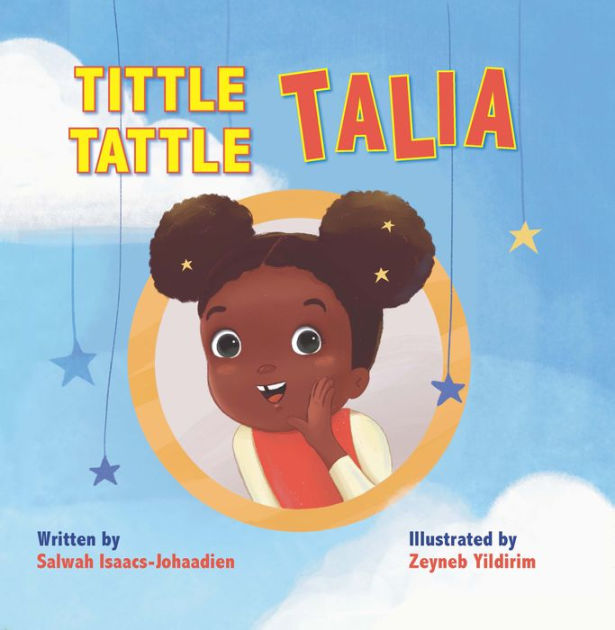
Tittle Tattle Talia: A Story about Gossiping by Salwah Isaacs-Johaadien illustrated by Zeyneb Yildirim

Standard
Tittle Tattle Talia: A Story about Gossiping by Salwah Isaacs-Johaadien illustrated by Zeyneb Yildirim

tattle

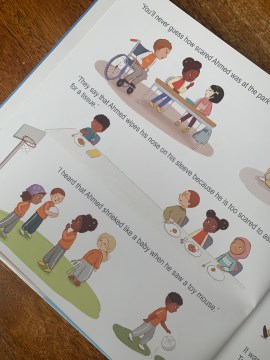
I really enjoyed this Islamic moral book about gossiping.  Over the years I’ve taught a few Sunday school lessons, class lessons, and even hosted story times on the Islamic cautions regarding backbiting, and honestly I don’t think kids really grasp how easy it is to commit the act and be a part of it.  They understand they shouldn’t do it, what the punishment is, and that it is bad, but I don’t know that the materials I’ve used and seen, have really connected with younger kids without a lot of supplementing; and this book highlighted that we really can be messaging better on a child’s level.  The pages are incredibly text heavy, but neither I nor my audience seemed to mind until close to the end, because of the comedy and relatability of the story up to that point.  I think the coach getting overly involved took it back to being a lesson from adults and broke the child perspective tone.  I do love that the kids that listen to the gossip are also held accountable, the importance of the coach’s message clearly is important, but the story telling quality would have benefitted from a few tweaks.  The illustrations are cute, unfortunately the font is not very appealing.  I do like that the salwat is given in Arabic, and that Hadith are mentioned in the text as well as in the backmatter with an author’s note.

img_2774

The story starts with Talia owning that she loves to share tales about the people around her, before telling one to her older sister.  Her sister tries to stop her and tells her that she needs to watch what she says or she might one day have to eat her words.  Talia wonders what eating your words means.  Similar situations occur between Talia and her brother, her mother, as well as her father.  Each time the story is reprimanded and a funny euphuism remarked upon and then giggled about by Talia.

img_2775

At school she does the same, telling stories, often at the expense of a boy named Ahmed, and the more interest the other kids show, the more outrages her tales become.  She soon starts telling them about everyone, and her classmates and friends grow weary and fearful that they might be next.

It all comes to a climax when Talia’s classmates say enough is enough and stop talking to her, and go as far as refusing to pick her when picking teams, and playing with her at all.  The coach concludes then that the match should be cancelled and Talia should apologize.  The cancellations seems extreme, and the forcing to apologize almost takes away from the emotional realization that her “tales” have become bullying.

img_2776

As Talia leaves, her classmates gather up and she sees Ahmed not joining them.  When she gets to her front gate, her friends catch up to her and apologize and acknowledge their roles in perpetuating the gossip.  Talia then goes to find Ahmed and get him some ice cream to apologize.

I don’t quite think the friends needed to apologize, I think they should have just realized their role, I think with discussion it might be clarified, but I worry that it defers Talia’s ownership of wrong doing, and could send some mixed messages.

img_2777

It is also a little pausing that Talia makes up a story about why a girl wears hijab, when her own mother wears hijab and she is clearly Muslim.  On the one hand, I like that it shows how ridiculous her tales have gotten, but it also could seem like she is falling for a stereotype as well.  There is good rep in the illustrations of those that cover and those that don’t, there is a child in a wheelchair and lots of shades of skin colors and hair types.  The text also contains traditional Islamic names and some that are not.

img_2779

The book helps our children to be better and the story engaging enough to be memorable, that while I wish it was cleaned up a better to strengthen the writing, I do find it a benefit on a shelf to be shared at bedtime, in classrooms, in story times and as a reminder to not participate in gossip or listen to it.

img_2778

My Baba’s House: A Poem of Hope by Dr. Amani Mugasa illustrated by Eman Salem

Standard
My Baba’s House: A Poem of Hope by Dr. Amani Mugasa illustrated by Eman Salem

my babas house

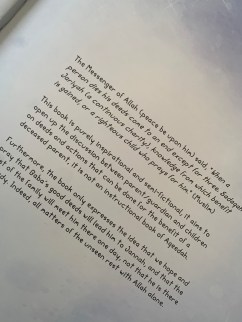
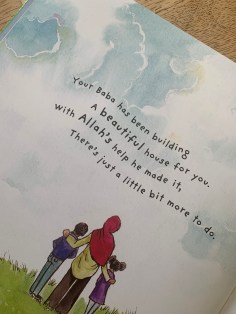
I wanted to love this Islamic centered children’s book about grief, but I found it a bit problematic and misleading.  I am by no means an expert in Islamic matters of death or in psychological bereavement, but the note at the beginning of the book- if I wasn’t already going to look at it critically- really raised some warning flags.  It says that the book is not an instructional book on Aqeedah, that even though the title and whole story is about a house being built that “the book only expresses the idea that we hope and pray that Baba’s good deeds will lead him to Jannah, that that the rest of the family will meet him there one day, not that he is there already.” So, before you even start the story, it seems that the disclaimer is making it clear that this book is not religiously accurate, and that it is just meant to soothe and provided hope.  After taking all that in to consideration, and reading the 26 pages of text over a dozen times, I think I finally pinpointed why the book further reads problematic for me.  It is the repeating phrase, “Your Baba has been building a beautiful house for you,”  because he hasn’t right? He has built a house for himself through his good deeds in this duniya, he benefited HIS parents by being a righteous Muslim.  The words “for you” completely take the book in my head from being a slight suspension of timing where the deceased are, in to be misleading.  So if the book is not accurately framed and only to be taken as something “to open the discussion,” what is the point? Why fill it with Islamic references and concepts, if they will then have to be clarified, corrected, and re taught?  Sigh, I’m happy to listen to those that want to change my mind, truly I am.

img_9013

The rhyming book starts out with a mom and two kids being consoled by the text that their Baba has been building a house for them with Allah’s help.  That it is amongst the flowers, made with Allah’s powers. That with every good deed he did, their Baba becomes a builder, that there are pure rivers and trees, and that the house is hidden through Allah’s gate.

img_9014

To find their Baba’s house they will walk with Prophets, and see ripe fruits, and smell sweet musk.  There will be rivers of milk and he will carry them above his head.  The illustrations on this page are a little off in my opinion the shadows of a person elevating and even the girl looks a little concerned.

img_9015

I like that the next spread addresses that only Allah knows when the day will come that we reunite. And then the next pages tell how the children can help decorate their Baba’s house by calling adhaan, reading Qur’an, being kind, giving charity, and making duas.

img_9016

The book concludes with encouraging patience and finding reassurance in knowing we belong to Allah and to Him we return.

With the exception of the one page, the illustrations are adequate and show a mixed racial family.  The rhyming lines are rather weak, and ultimately there are just better books out there about grief that don’t have to be so qualified for accuracy.

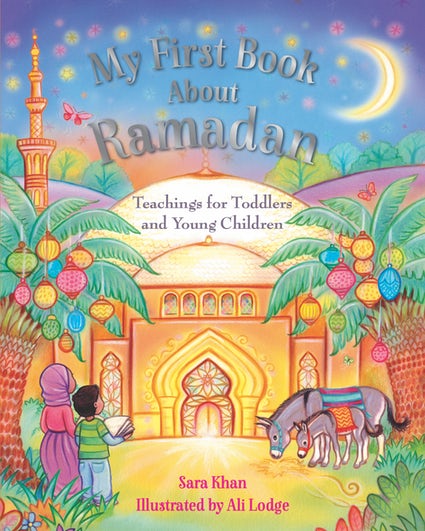
My First Book About Ramadan: Teachings for Toddlers and Young Children by Sara Khan illustrated by Ali Lodge

Standard
My First Book About Ramadan: Teachings for Toddlers and Young Children by Sara Khan illustrated by Ali Lodge

ramadan

Once again, Sara Khan pushes the standard of what can be conveyed and presented in a toddler board book.  This book on Ramadan not only introduces concepts of the blessed month to our littles Muslims, but also provides details that will allow the book to stay relevant even as a child grows.  The soft, yet colorful pages allow the book to be engaging and attention holding for ages 2 and up, and provides a great way to get young children looking forward to Ramadan, as well as be read repeatedly during the month.  The 26 thick pages have a facts and questions about Ramadan at the end which make the book shareable with non Muslims and the many shapes, colors, cultures, and ages that make up our Muslim communities fill the pages that radiate with joy and love.

img_7070

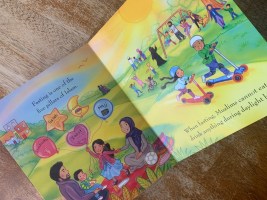
The book starts out expressing the excitement of Ramadan, the new moon, and the anticipation.  It then talks about how Allah swt wants us to fast from dawn until sunset.  It mentions the five pillars, and fasting in Ramadan being one of them, and what it means to fast.

img_7071

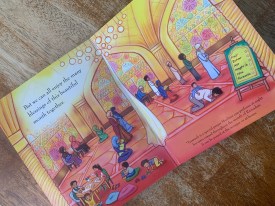
It focuses on doing good deeds to make Allah swt happy.  It also dedicates a two page spread to showing who doesn’t have to fast, which answers that inevitably next question that people ask.  The book then says that even if you aren’t fasting, there are still blessings everyone enjoys in the month and spends a few pages detailing those activities and acts of worship.

img_7072

It mentions that Ramadan is the month of the Qur’an and that Laylat al-Qadr is the night of power, but doesn’t give much detail about either. Eid is celebrated at the end and a dua is made referencing a hadith in Bukhari about entering through the gate of Ar-Rayyan.

I love that the book’s tone is that this is what Allah swt wants us to do, and this is what makes Him happy.  Even with numerous Ramadan books out there, this one still manages to find a way to be unique, and truly the entire series is enjoyable and beneficial, alhumdulillah.


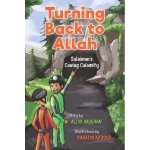
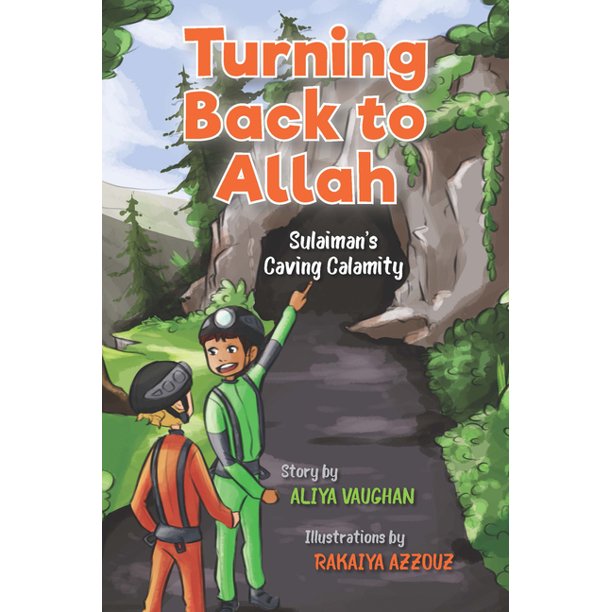
Turning Back to Allah: Sulaiman’s Caving Calamity by Aliya Vaughan illustrated by Rakaiya Azzouz

Standard
Turning Back to Allah: Sulaiman’s Caving Calamity by Aliya Vaughan illustrated by Rakaiya Azzouz

turning back to Allah

Good early elementary books can be tricky: the voice needs to read authentic, the lessons not preachy, and the scenarios relatable, all while not talking down to the reader or talking above their comprehension.  As fabulous middle grade books seem to be popping up at record speed, I find myself reading the same old books with my fourth child who is six.  Alhumdulillah, this book was nominated in the Muslim Bookstagram Awards 2021 competition and I was able to purchase and receive it quickly from Noura at Crescent Moon Store.  My son can read it, although because of the British terminology, he did better when I read it to him, none-the-less, he could explain it, he genuinely understood and related to the main character, and was emotionally connected to the outcome of the story.  The 49 page, color illustrated story is perfect for independent readers first or second grade and up.  The book also contains comprehension questions, etiquettes for du’a, a list of times and places when du’as are answered, and evidence for the story from hadith.  Additionally there are ayats from the Quran at the beginning and end of this well sourced book, alhumdulillah.

img_4985

SYNOPSIS:

Sulaiman is getting ready for an overnight scout trip in some caves.  He is nervous having been stuck in his apartment elevators the summer before and being lost at a park with his family.  His stress has him being mean to his little sister, and his dad tries to mediate, but you can sense that their normal bickering is heightened because this is going to be hard for Sulaiman.  The scouts meet up to board their mini bus and Sulaiman is acting weird, he wants to sit by the window, he wants to read signs, finally he tells Jacob about his worries and the two boys agree to stick together like glue while they are in the caves.  Foreshadowing is set, and when Sulaiman’s batteries roll away and he stops to retrieve them he gets separated from the group and he will have to rely on his faith in Allah swt to feel less alone and brave what is to come.

img_4984

WHY I LIKE IT:

I love that when Sulaiman is arguing with his sister he doesn’t have hadith quoted at him.  Sure it is ideal, but really, as parents we just want the bickering to stop most times and our kids to be nice.  It is often easier to instill morals and lessons in calm times, not in the middle of an emotional kerfuffle.  At the same time, when he is scared, he falls back on the lessons he has been taught from the Quran and sunnah.  I love how it reads realistic.  We want our kids to turn to Allah swt for all things, but sometimes to teach that we encourage them to seek Allah swt in times of happiness and times of hardship.  Sulaiman is scared, really scared, and he turns to Allah swt, and it is heartfelt and emotional.

I’m embarrassed to say, but I was a little confused by the being lost in a park prior story thread.  It either needed more detail, or maybe just more context, but I thought it was the same park they are heading to with scouts, then realized it was a completely separate park and incident, so I would like a bit more framing of that story line.  Also the stress of being stranded in the elevator, doesn’t directly connect to the rest of the story, perhaps bringing up some claustrophobia fears would have helped tie it all together.  As it is, it just seems that Sulaiman seems to be tested a lot and rather traumatically.

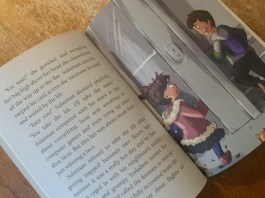
The illustrations being in full color and full page are a welcome surprise in the book.  However, there is one two-page illustration that shows the kids laughing before boarding the minibus, but it isn’t derived directly from the text, and I initially thought Sulaiman was being laughed at for his fears.  I went back, and it doesn’t seem that is the case, but I wonder if I was the only one confused by that illustration.

All-in-all the book physically is appealing to children with the open font, colorful pictures, size, and length.  The story is relevant, and the islamic tie-ins powerful, alhumdulillah.

FLAGS:

Some teasing, possible bullying among siblings.  Some scary moments mentioned and explored: being stuck in an elevator, lost in a park, left alone in a cave.

img_4984

TOOLS FOR LEADING THE DISCUSSION:

This would be a fun read aloud in a second grade class.