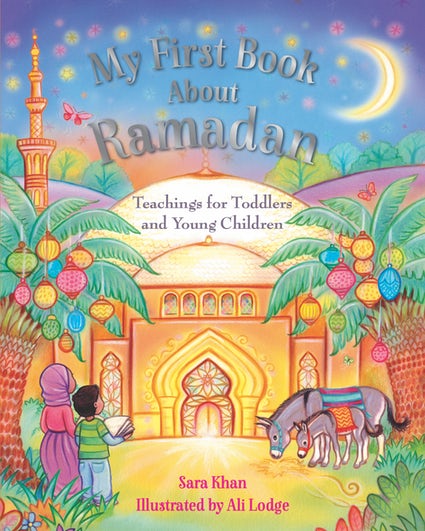
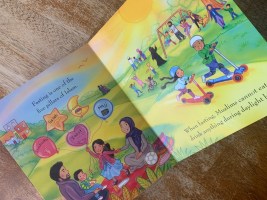
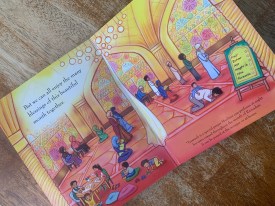
Once again, Sara Khan pushes the standard of what can be conveyed and presented in a toddler board book. This book on Ramadan not only introduces concepts of the blessed month to our littles Muslims, but also provides details that will allow the book to stay relevant even as a child grows. The soft, yet colorful pages allow the book to be engaging and attention holding for ages 2 and up, and provides a great way to get young children looking forward to Ramadan, as well as be read repeatedly during the month. The 26 thick pages have a facts and questions about Ramadan at the end which make the book shareable with non Muslims and the many shapes, colors, cultures, and ages that make up our Muslim communities fill the pages that radiate with joy and love.
The book starts out expressing the excitement of Ramadan, the new moon, and the anticipation. It then talks about how Allah swt wants us to fast from dawn until sunset. It mentions the five pillars, and fasting in Ramadan being one of them, and what it means to fast.
It focuses on doing good deeds to make Allah swt happy. It also dedicates a two page spread to showing who doesn’t have to fast, which answers that inevitably next question that people ask. The book then says that even if you aren’t fasting, there are still blessings everyone enjoys in the month and spends a few pages detailing those activities and acts of worship.
It mentions that Ramadan is the month of the Qur’an and that Laylat al-Qadr is the night of power, but doesn’t give much detail about either. Eid is celebrated at the end and a dua is made referencing a hadith in Bukhari about entering through the gate of Ar-Rayyan.
I love that the book’s tone is that this is what Allah swt wants us to do, and this is what makes Him happy. Even with numerous Ramadan books out there, this one still manages to find a way to be unique, and truly the entire series is enjoyable and beneficial, alhumdulillah.
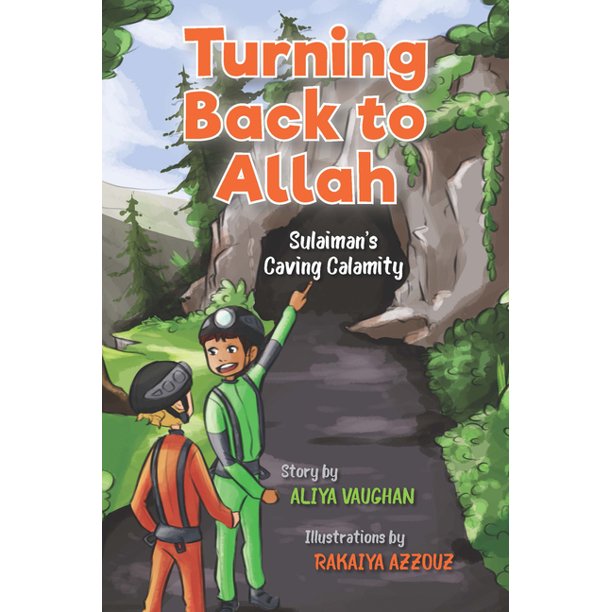
Good early elementary books can be tricky: the voice needs to read authentic, the lessons not preachy, and the scenarios relatable, all while not talking down to the reader or talking above their comprehension. As fabulous middle grade books seem to be popping up at record speed, I find myself reading the same old books with my fourth child who is six. Alhumdulillah, this book was nominated in the Muslim Bookstagram Awards 2021 competition and I was able to purchase and receive it quickly from Noura at Crescent Moon Store. My son can read it, although because of the British terminology, he did better when I read it to him, none-the-less, he could explain it, he genuinely understood and related to the main character, and was emotionally connected to the outcome of the story. The 49 page, color illustrated story is perfect for independent readers first or second grade and up. The book also contains comprehension questions, etiquettes for du’a, a list of times and places when du’as are answered, and evidence for the story from hadith. Additionally there are ayats from the Quran at the beginning and end of this well sourced book, alhumdulillah.
SYNOPSIS:
Sulaiman is getting ready for an overnight scout trip in some caves. He is nervous having been stuck in his apartment elevators the summer before and being lost at a park with his family. His stress has him being mean to his little sister, and his dad tries to mediate, but you can sense that their normal bickering is heightened because this is going to be hard for Sulaiman. The scouts meet up to board their mini bus and Sulaiman is acting weird, he wants to sit by the window, he wants to read signs, finally he tells Jacob about his worries and the two boys agree to stick together like glue while they are in the caves. Foreshadowing is set, and when Sulaiman’s batteries roll away and he stops to retrieve them he gets separated from the group and he will have to rely on his faith in Allah swt to feel less alone and brave what is to come.
WHY I LIKE IT:
I love that when Sulaiman is arguing with his sister he doesn’t have hadith quoted at him. Sure it is ideal, but really, as parents we just want the bickering to stop most times and our kids to be nice. It is often easier to instill morals and lessons in calm times, not in the middle of an emotional kerfuffle. At the same time, when he is scared, he falls back on the lessons he has been taught from the Quran and sunnah. I love how it reads realistic. We want our kids to turn to Allah swt for all things, but sometimes to teach that we encourage them to seek Allah swt in times of happiness and times of hardship. Sulaiman is scared, really scared, and he turns to Allah swt, and it is heartfelt and emotional.
I’m embarrassed to say, but I was a little confused by the being lost in a park prior story thread. It either needed more detail, or maybe just more context, but I thought it was the same park they are heading to with scouts, then realized it was a completely separate park and incident, so I would like a bit more framing of that story line. Also the stress of being stranded in the elevator, doesn’t directly connect to the rest of the story, perhaps bringing up some claustrophobia fears would have helped tie it all together. As it is, it just seems that Sulaiman seems to be tested a lot and rather traumatically.
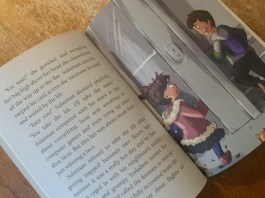
The illustrations being in full color and full page are a welcome surprise in the book. However, there is one two-page illustration that shows the kids laughing before boarding the minibus, but it isn’t derived directly from the text, and I initially thought Sulaiman was being laughed at for his fears. I went back, and it doesn’t seem that is the case, but I wonder if I was the only one confused by that illustration.
All-in-all the book physically is appealing to children with the open font, colorful pictures, size, and length. The story is relevant, and the islamic tie-ins powerful, alhumdulillah.
FLAGS:
Some teasing, possible bullying among siblings. Some scary moments mentioned and explored: being stuck in an elevator, lost in a park, left alone in a cave.
TOOLS FOR LEADING THE DISCUSSION:
This would be a fun read aloud in a second grade class.
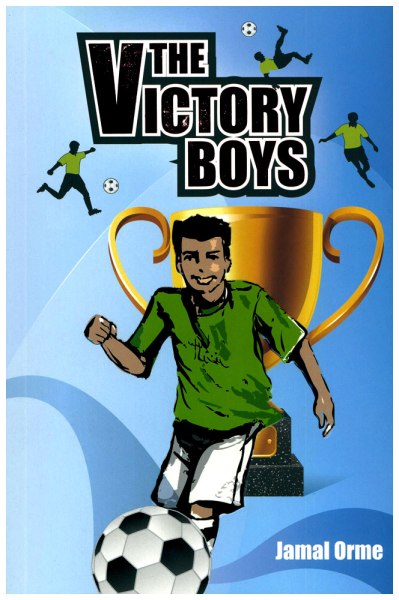
I’m not sure why Amazon states the book is for pre-school and up, when the publisher, Kube, posts this book for ages 7 and up. I think 3rd or 4th grade soccer/football fans will enjoy the book. There are some slightly mature ideas presented and worked through, and the soccer lingo assumes the reader knows the sport. Plus the quality of the illustrations and the small font isn’t going to entice someone not already excited to read the book based on the content within. My boys, ages 8 and 9, enjoyed the book, as did I, once the story got going. It doesn’t really grip you from the first sentence, but as the story progresses and the way Islam is woven in makes for some learning experiences in the midst of a few intense football matches.
SYNOPSIS:
The boys at the Sunday Madrasa do not enjoy their time there. They find the Imam boring and thus are not inspired to learn. When they sneak a football into break time however, they suddenly feel more engaged and present in their lessons. A change the Imam notices and appreciates, but doesn’t know the reasoning for as he strictly forbids football and finds it a waste of time. Outside of Madrasa, Junayd is having a hard time at home. He has to help out a lot at his father’s restaurant and his older brother Saleem has gotten in trouble with the police. His mom prays for the kids, but is also at a loss as to how to help with the stresses at home.
During a secret game of football in the masjid courtyard, an arrant ball breaks the neighbor’s greenhouse window, and the boys are forced to come clean about their covert game. The Imam demands the kids stop playing and that they tell their parents what they have done, so that they may earn some money to replace the window. As the kids come through with the money and the Imam sees the kids resort back to their lackluster attitudes to learning. He gets an idea to start a football club after madrasa classes. The only problem is that he knows nothing about the sport and no parents are willing to help.
Saleem by chance comes to collect his brother one day, and as he hollers advice from the sidelines, the Imam recruits him to coach the team. In response the Imam ever so gently uses football to teach not only the madrasa kids, but Saleem as well. When the boys learn of an upcoming tournament, the Madrasa enters an A and B squad and the Shabab Al-Nasr, Victory Boys, will be tested not only in their play, but also in their manners, and understanding of what it means to be a team and Muslim.
WHY I LIKE IT:
I love that the Imam grows and changes. I mean it is a kids book about soccer, but really it is the adult in the story that shows the most heart. He goes out of his comfort zone, reevaluates his opinions, and admits when he is wrong. High five Imam! I also like that he didn’t give up on Saleem, and the way he leads him is with such kindness and compassion, that even youngsters, will be impressed.
The book does not talk down to the reader, which is nice, but at the same time I think it pushes the age appropriateness a bit with the detail devoted to alcohol being sold at the restaurant, Junayd’s father’s flaws, and even Adam’s dad’s tantrum of sorts. There really aren’t any nice parents in the book. We don’t learn much about the moms, but none of the dads seem too supportive. Really the only nice adults are the Imam and the neighbor who’s window they broke.
The timeline isn’t entirely smooth, the kids come together and play well as a team remarkably fast for how intense the tournament is, and how well they perform. And some of the characters could have used some fleshing out, I couldn’t really tell you much about them. The font is really small and the spacing often forgotten. The book is about 95 pages with a glossary and an acknowledgement at the end, fortunately the 2nd book in the series seems to space the words and lines out more and is 155 pages.
The story is solid and for the most part well written. I read it in one sitting and thoroughly enjoyed the lessons learned and then put into practice. The book isn’t preachy, but you are glad to see the Imams words given life in the other characters’ actions. Saleem changes quickly, but the author and story account for it in a way that is believable for the audience and the message of not giving up on one another comes through loud and clear. There is a lot of technical detail about the sport, but it doesn’t drag on, it adds to the excitement even if you just know the basics.
FLAGS:
The talk of alcohol, of Saleem being with a group of kids and a stolen car, there is some yelling and aggressiveness from the adults.
TOOLS FOR LEADING THE DISCUSSION:
The story is a bit short for a book club selection, but I would definitely consider it for Lunch Bunch (where I read to 4th and 5th graders while they eat lunch). And I think most Islamic School libraries and classrooms should stock the series.