Tag Archives: grief

The Gift of Eid by Shifa Saltagi Safadi illustrayed by Aaliya Jaleel

Standard
The Gift of Eid by Shifa Saltagi Safadi illustrayed by Aaliya Jaleel

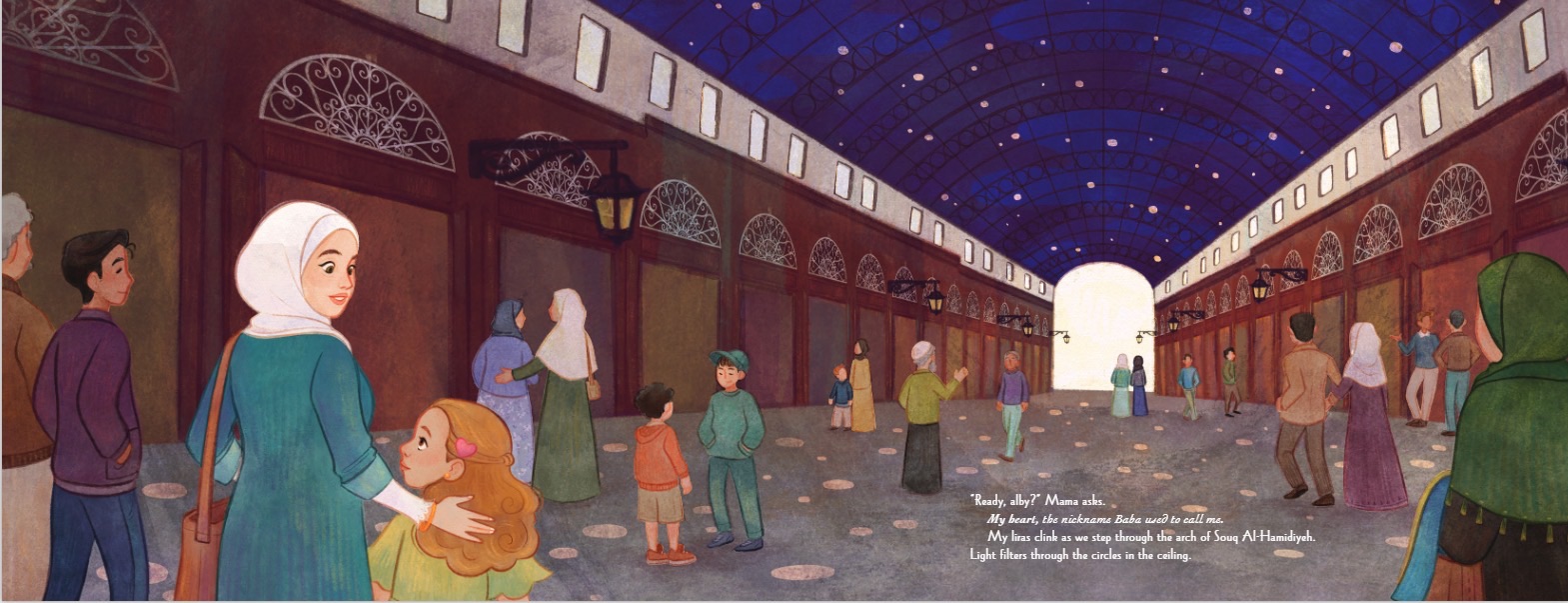
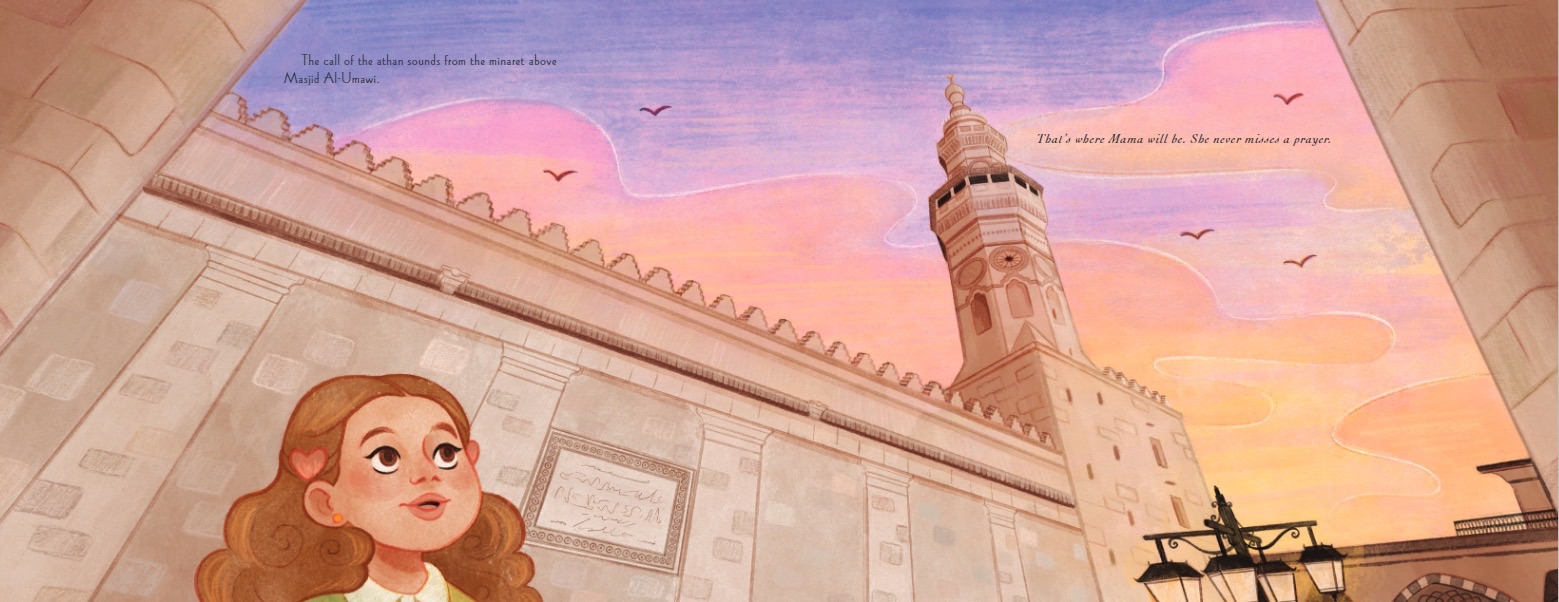
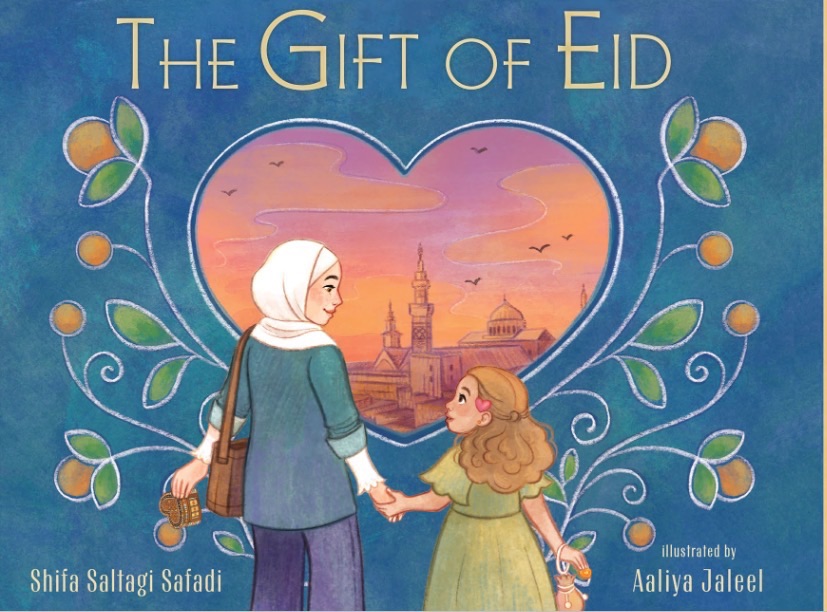
With heartfelt words and large two-page spread illustrations, this beautiful book shares a mother and daughter finding the perfect Eid gift for one another while bringing the reader into the Souq Al-Hamidiyeh, before sending them off to Masjid Al-Umawi for a warm hug.  A retelling of the classic, A Gift of the Magi, the story poignantly presents threads of love, gifts, loss, and Eid to fill the reader with joy, peace, and gratitude.  I’m admittedly very bias, as a close friend of the author, but this beautiful book doesn’t need lip service or marketing, it will appeal to all readers in all settings, and be cherished and asked for, over and over again, all throughout the year. Alhumdulillah.

The book starts with Yasmine and her mama entering the souq through the archway, and Yasmine remembering her father and her imagining the circles in the ceiling to be twinkling stars.  He is no longer with them, the magic is gone and money is tight now, but with liras jingling in her pocket, Yasmine is determined to find an Eid gift for her mother that will make her smile.

Yasmine looks around the shops as her mother counts out liras to buy za’atar, and tries to find something cheaper than sfeeha at the bakery.  She finally knows what to get her mother, but it is more lira than she has.  With determination and selflessness she makes a decision to get her mama the perfect gift.

The process separates the two, and when they reunite at the masjid for maghrib salat, it isn’t the gifts themselves, but rather what they mean, that make the laughter, tears, and love overflow.

I love the emotional depth the book conveys so deftly, never explaining or pulling the reader out of the story, thus allowing the connection to linger long after the book is closed, a rare treat in a picture book.

Sami’s Special Gift: An Eid al-Adha Story by M.O. Yuksel illustrated by Huseyin Sonmezay

Standard
Sami’s Special Gift: An Eid al-Adha Story by M.O. Yuksel illustrated by Huseyin Sonmezay

img_5215-1

This sweet 32 page story, blends themes of loss, grief, giving, homelessness, Islam, Eid al Adha, and joy with simple early reader level text and beautiful illustrations. The book never gets preachy and doesn’t other, making it a great addition to all shelves, everywhere. There is information about Eid al Adha and what a homeless shelter is in the backmatter along with a glossary that explains, Islamic and Turkish terms.

Sami loves Eid and celebrating at the carnival with Dede, his grandfather, but this year, Dede is not there, and Sami is sad. When a package from Nene arrives from Turkiye with Dede’s favorite sheep decorated Eid tie for Sami, things start to look up. Sami never wants to take it off, and even wears it over his new Eid clothes as they head to the mosque for prayers. After salat and before the carnival, the family visits a local butcher and picks up meat to take to the homeless shelter.

Sami has never been to a homeless shelter and has only heard of his parents going and helping there. He asks his parents about it on their way and once they arrive heads off to play ball with a boy, as his sister shares her doll with a little girl. When it is time to leave for the carnival, Sami imagines what the his life would be like if he lost his home and belongings, and makes a decision, knowing exactly what his Dede would do.

img_5218-1

I love how the book weaves in information about Islam by having the family praying, listening to the imam, wearing new clothes, and giving in charity, without pulling out of the story. Same for the Turkish cultural inclusions of food and words. I also like that in the illustrations the mom wears hijab when out of the house, but not inside. It all comes together smoothly and is unapologetic, even while handling the sadness of his grandfather no longer being with him, the empathy at the homeless shelter, and joy at the carnival.

My only concern is when it says both in the text and in the backmatter that meat is given: one third to friends, one third to family and one third to the poor. I don’t know that it is wrong, but to clarify you keep one third for yourself (and family), and distribute one third to friends, and one third to the poor. Additionally, I also know a lot of people might not love the illustration style, but the picture of them in the mosque, won me over.

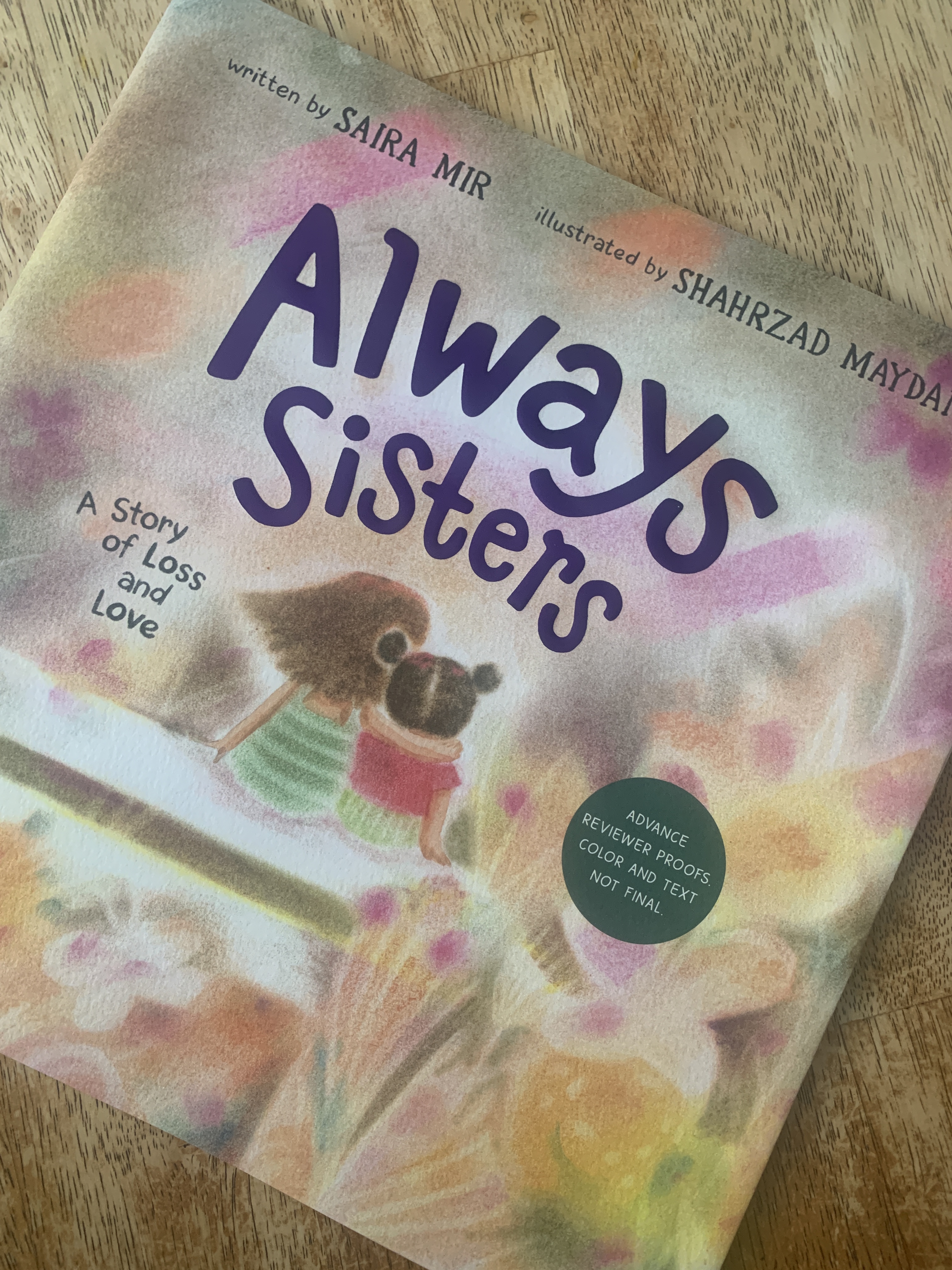
Always Sisters: A Story of Loss and Love by Saira Mir illustrated by Shahrzad Maydani

Standard
Always Sisters: A Story of Loss and Love by Saira Mir illustrated by Shahrzad Maydani

This 32 page picture book for early elementary children addresses an important topic of pregnancy loss and grief through the eyes of a young girl excited and then devastated by the loss of her unborn sister.  The author is Muslim, but their is nothing religious in the text, it is a universal and poignant story from an OB-GYN who has counseled patients and experienced it in her own family.  The book is a story that can benefit children needing reassurance or simply provide a way to have heartfelt conversations.  The soft illustrations and gentle steps the character takes to help with the big feelings inside will allow readers of all ages to feel less alone, and see that support is available.

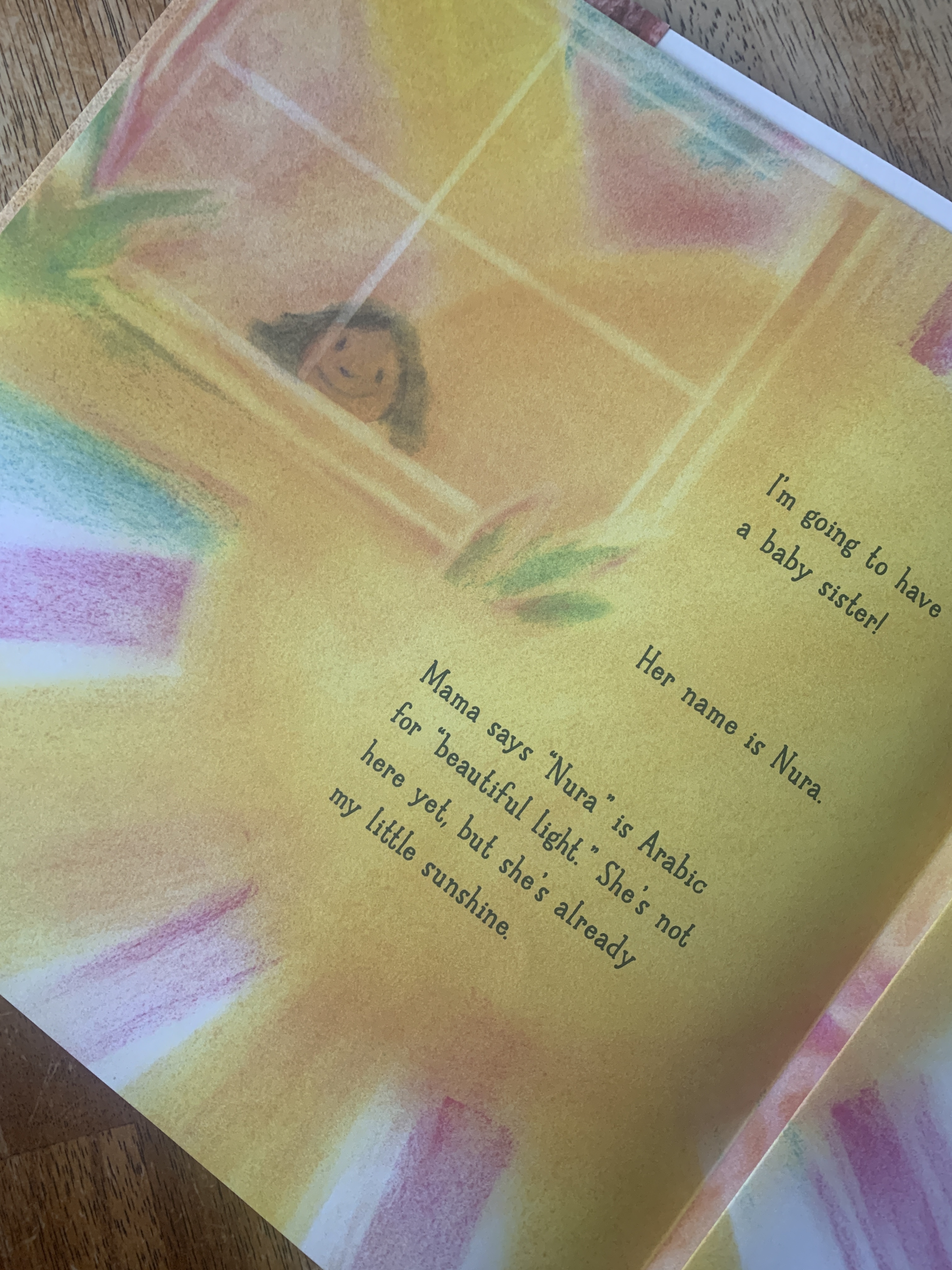
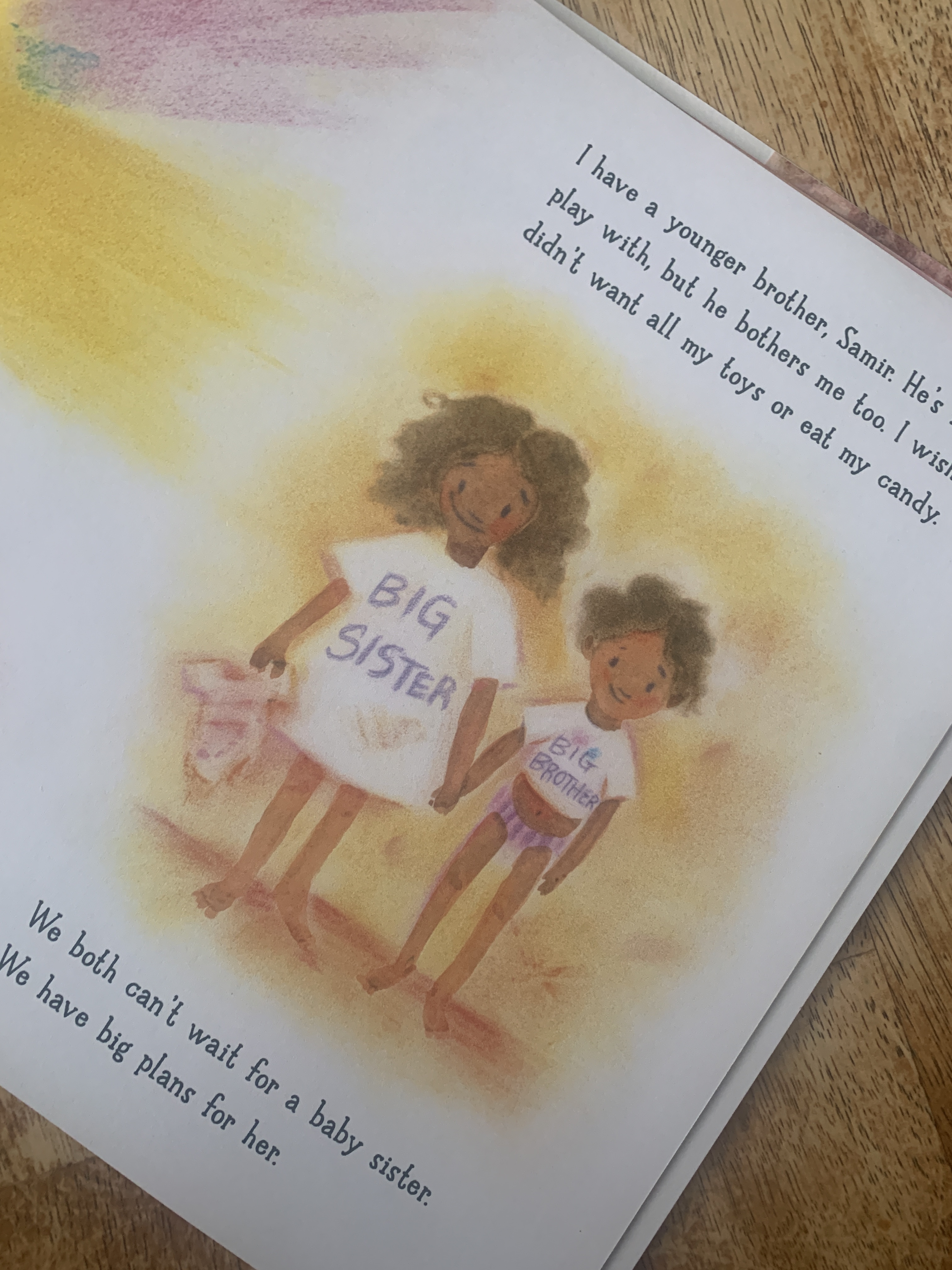
Nura is not born yet, and Samir is a fun little brother, but Raya has big plans for a baby sister.  They will run through sprinklers in matching bathing suits, and she’ll pass on her ballet costumes for her to wear, she’ll love chocolate and dolphins and they’ll share everything. Raya even hopes they will share a birthday, that would be the best present ever.

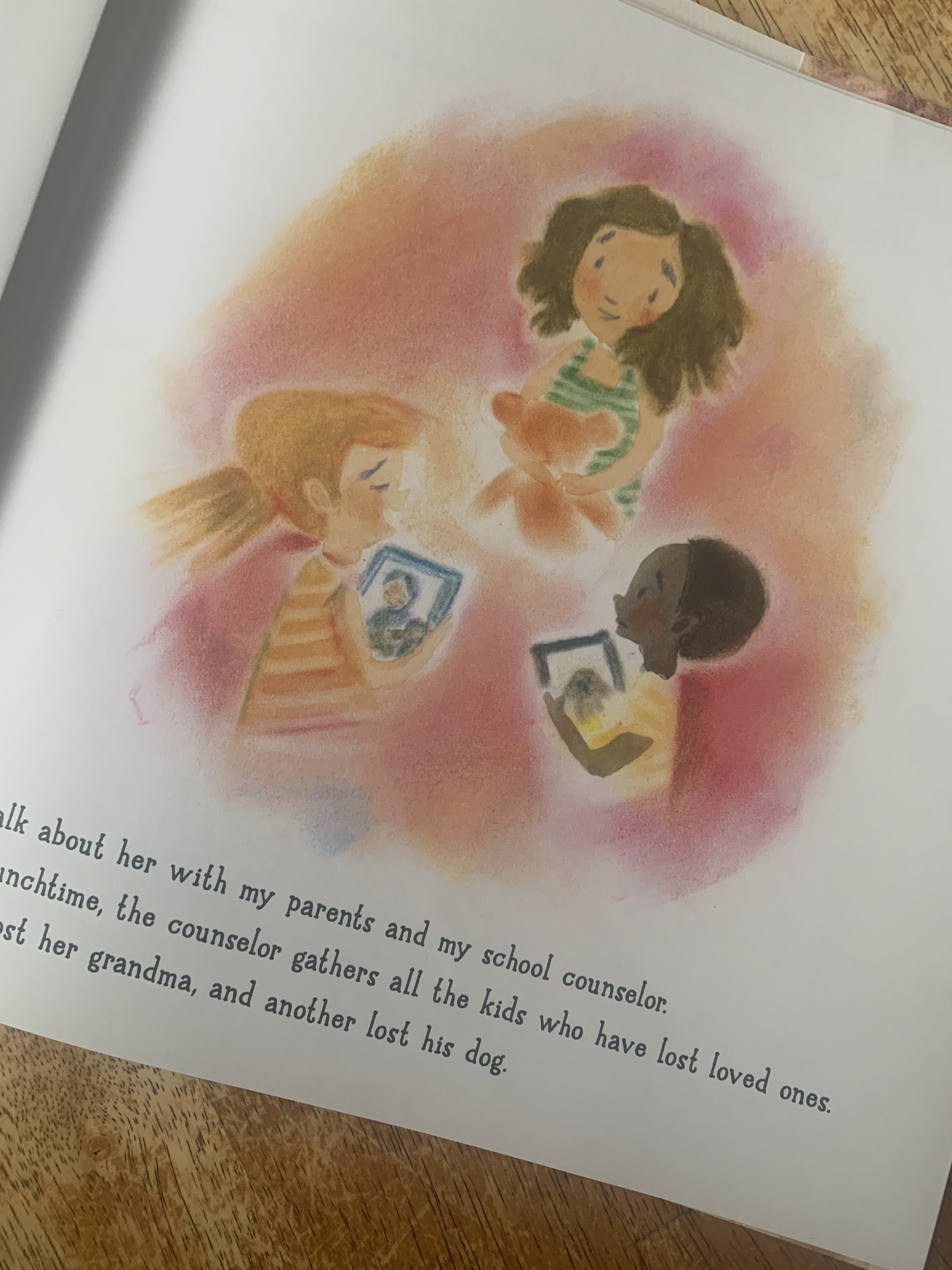
One day Mama goes to the doctor for a checkup, but when she comes back she looks like she has been crying.  She tells Raya, Nura won’t be coming home.  Nura is confused and sad.  There is an ache in her heart.  She talks to her parents, draws pictures, meets with the school counselor.  The family plants a tree and they talk about her and remember.

I like that you see the joy and anticipation the little girl has for the arrival of her little sister and the painful aftermath when she is not going to get to see her dreams materialize.  The book isn’t just a resource, it has literary elements as well that make the book valuable for those who can relate and even those that have been spared from such a loss.  The book can be preordered here. 

Much Ado About Nada by Uzma Jalaluddin

Standard
Much Ado About Nada by Uzma Jalaluddin

much

I get teased a lot by my Lit Sisters for enjoying Hana Khan Carries On so much, so I’m writing this review to convince them why I think this is Uzma Jalaluddin’s best book yet, and why they should preorder here and dive in ASAP! First note that is an adult read, it is not targeted to teens, the protagonist for the majority of the book is nearly 30 years old. It is a romance, it is not a hundred percent halal, but it is definitely halal-ish, and if you feel like you reach a point where it absolutely isn’t, please keep reading (you might be surprised).  The book for being what I thought would be an empty calorie rom-com guilty pleasure snack, tells the story of Nada in spiraling layers that keep the reader hooked.  Just when you think it is predictable and tropey, the next layer peels back a twist and depth that kept me ignoring my kids and glued to the pages for two days straight.  I furiously scribbled notes writing down “haram” deal breakers and most by the end where crossed off, so no this is not Islamic fiction, but there is no internalized Islamophobia, there is no liberal agenda, the author knows the lines and is abiding by them and occasionally breaking them in a fictional entertainment world for Muslim and non Muslim readers alike.  I hate to compare, but in many ways it reads like an adult S.K. Ali book.  There is social commentary on Islamic communities from a place of love and practice from the inside, there are relatable characters, there is humor, there is love, laughter, and warmth. On occasion there is skirting of the halal/haram line a bit here and there, and sure males and females are a little too friendly at times, but it isn’t the oppressive parents and identity crisis, it is joy. Muslim reality and stress, with true mirroring joy as well.

So why am I reviewing this book here? Simple so you can enjoy it.  So often I feel like reviewers particularly, but casual readers as well, become nervous while reading, that the book is going to take a turn and become haram or preachy that we can’t just get lost in the story.  So my gift to you, is that if you enjoy rom-coms and don’t usually go for “Muslamic” ones because of apprehension, you can dive in and enjoy this.  You can laugh when they ask for a doctor at an Islamic convention, you can roll your eyes when hijabi’s bring extra scarves to throw on the stage of the band (there is a guitar player, but mostly daf and vocals), you can be upset at the slight physical touching (keep reading), and you can nod along with the commentary on divorce, misogyny, wheelchair access, and mental health, but you can also just cheer for the protagonist to find her way to happiness and love too.

SYNOPSIS: (Will be brief because other wise there will be too many spoilers, and because of how the book is told, you don’t want spoilers, trust me, you want to enjoy)

The book opens with Nada trying to hide from both her mom who wants discuss her future and her best friend Haleema who is determined to have a girls weekend with her bestie at the Deen & Duniya Islamic conference in Toronto.  Cornered she finds herself at the conference organized by Haleema’s soon to be inlaws and face to face with a variety of characters from her past including past victims of her bullying, past love interest, past business partners, past camp roommates, college friends, startup mentors, and others- it is a very popular and large conference

Yep, that is all you are getting.

WHY I LIKE IT:

Again, to avoid spoilers I’m going to simply point out a few plot concerns I had with the book, because it is who I am, and I need to get them off my chest.

In some of the flashback scenes Nada’s voice reads the same as it does in the present.  Her articulation of Baz’s potential as a daf player at 11 years old is very mature and insightful and not realistic at all that she can opine on his skill and the role his hand size have on his mastery at that moment of the instrument.  She would probably just think, yeah he is good, or wow, he isn’t bad.

I found it odd that Marya’s husband had opinions on Nada’s makeup, it seemed a bit forward.  Also they were in line, then they left, the pacing of the scene was a little off, I read an arc, but I’m hoping it is cleaned up a bit, because it is an important scene.

Haleema is Nada’s college friend, but toward the end in college flashbacks she really disappears, and it was noticeable, because the reader is constantly told Haleema and Nada were good college friends, but never shown.  So in those scenes to not have her there, without note, is suspect.  Nada really isn’t a good friend to here either, at any stage of life save the conclusion, I’m not sure why Haleema does so much for her honestly.

There is a wedding scene without a wali, and there should be a comment as to why the wedding is performed without the religiously mandated staple or how they are getting around it.  It reads off for a book that gets so many details correct.  I am hoping that the final has it corrected! PLEASE!!!!!!

Also for a different wedding Sufyan is noted to have got an invite to help serve chai, but he is the groom’s cousin’s son, introduced earlier as a nephew, before the cultural chain of relation is given, so why wouldn’t he be at the wedding?

FLAGS:

Music, female and male close friendships, sneaking around, bullying, talk of sex, sex, kissing, talk of pregnancy, lying, stealing, theft, there might be a curse word or two, sorry, not sure.  For an adult book it is clean, these days for a YA book it would be considered remarkably clean.

TOOLS FOR LEADING THE DISCUSSION:

I wouldn’t suggest it for a school library or high school book club, but I wouldn’t put up much of a fight if it was on the shelf or schedule.

Amir’s Blue Jacket by Sarah Musa illustrated by Rania Hasan

Standard
Amir’s Blue Jacket by Sarah Musa illustrated by Rania Hasan

This heartfelt elementary picture book does a remarkable job of drawing the reader in to the emotions of the main character, his relationship with his grandfather, and imparting a moral message without being preachy. The illustrations are lovely on their own, but the way the muted tones convey the memories and illustrate the text really ties the book together. Whether it is for a larger story time or a one-on-one bedtime read, the book will offer discussion, comfort, guidance, and a little surprise at the end for Muslim and non Muslims alike. The slightly allegorical book does conclude with a widely known hadith (it is attributed to Prophet Muhammad saw, but is not further cited/sourced) and the family is clearly Muslim with their names mentions of Eid and God, and a hijab clad woman, but the book is universal and a lovely addition to any book shelf.

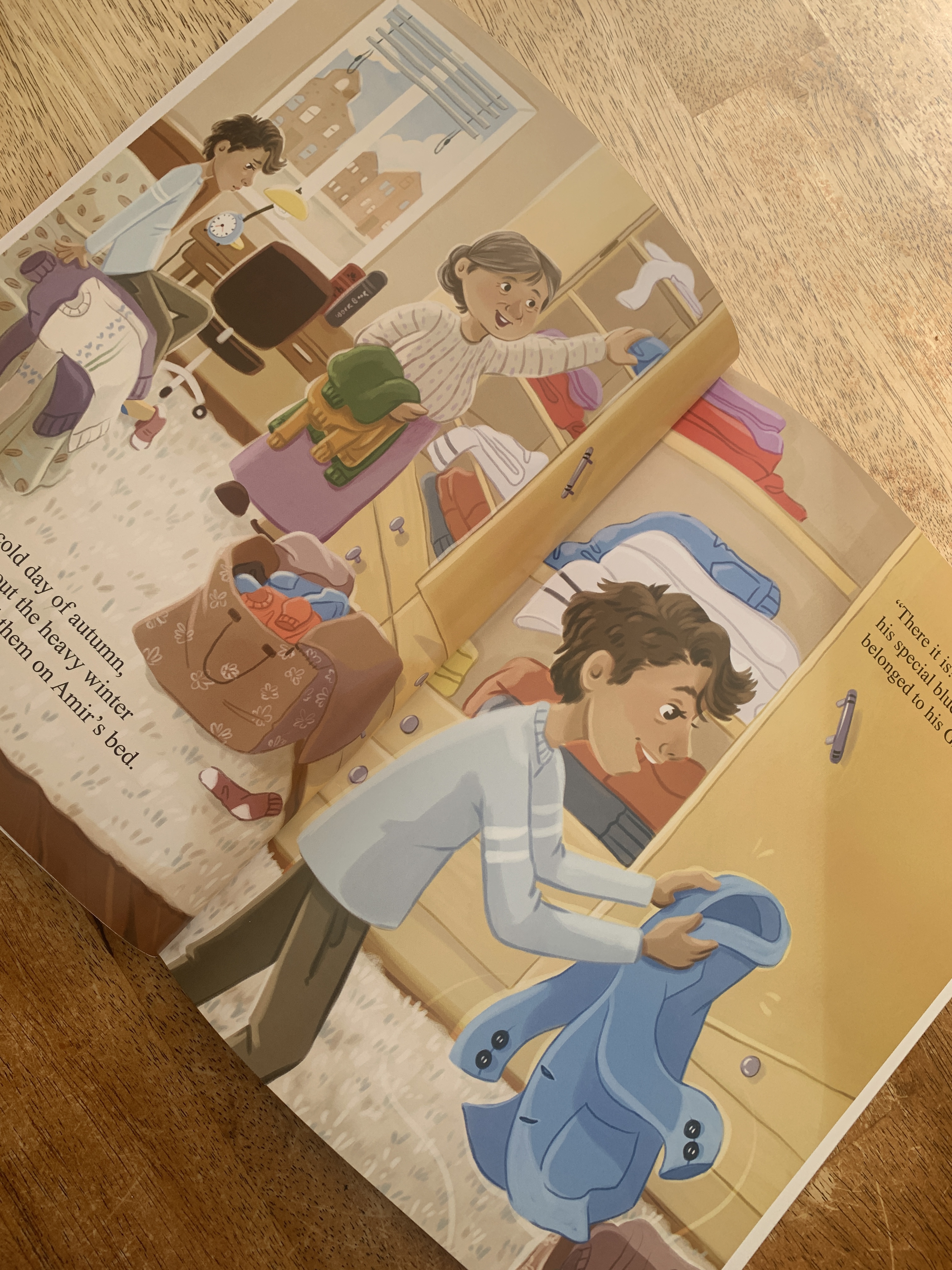
The book starts with Amir finding his Grandpa’s old blue jacket and recalling wrapping himself in it the day after his beloved Grandpa died. With it smelling like mothballs, he tosses it in the washing machine, but unfortunately when it comes out it has clearly shrunk. Amir is in denial, he says it fits fine and he has no desire for a new one. It is Grandpa’s jacket, and Amir is going to wear it, no matter how tight it is. Amir storms off to sit under the apple tree and recalls picking apples and making applesauce the year before for the whole neighborhood. Grandma shares that she used to keep grandpa’s cane but when someone needed it, she let it go.

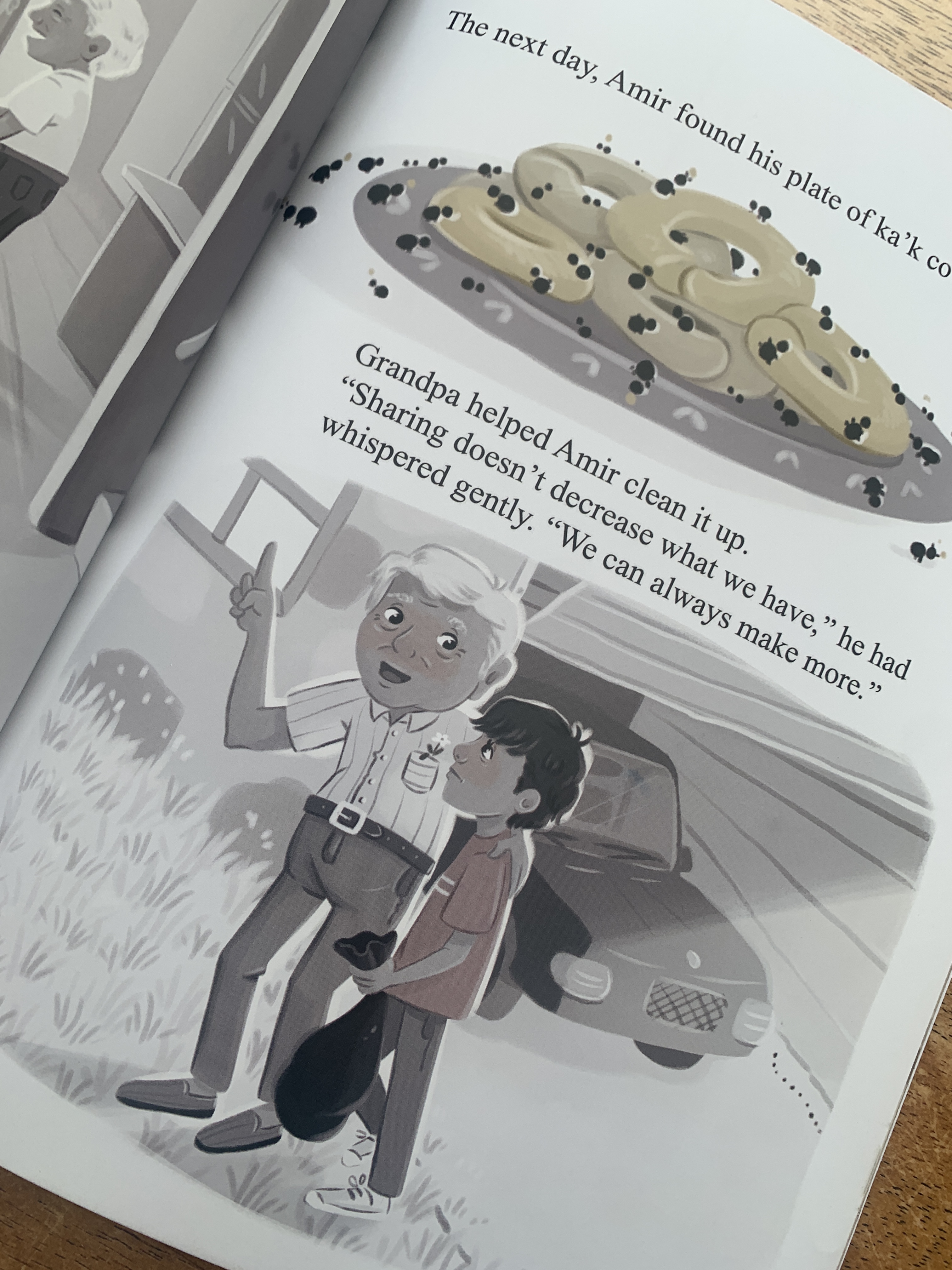
Grandma stirs another memory in Amir when she pulls the tray of ka’k out of the oven, of him trying to sneak a whole plate for himself only to have his hiding spot taken over by ants. When he is asked this time to share a plate, every step to the neighbors house reminds him even more of making the trip with his grandfather. Slowly he starts to realize that his memories are with him, not in his grandfather’s things, and Amir makes a decision that would make his grandfather proud, and (inshaAllah) give him more good deeds, even though he is gone.

The idea of sadaqah jariyah is understood through the story, and present in the hadith at the back, but it is never mentioned outright. Just as God is used, not the term Allah (swt). As Amir feels denial, frustration, and eventually peace, nothing is really told, it is shown, which really opens the book up to be a tremendous tool in sharing it with children and asking them to discuss what they understand, what they feel, and what they took away from Amir and his Grandpa’s blue jacket story.

The book is available through the publisher Ruqaya’s Bookshelf as well as HERE at Crescent Moon Bookstore where code ISL will save you 10%.

House of Yesterday by Deeba Zargarpur

Standard
House of Yesterday by Deeba Zargarpur

house of yesterday

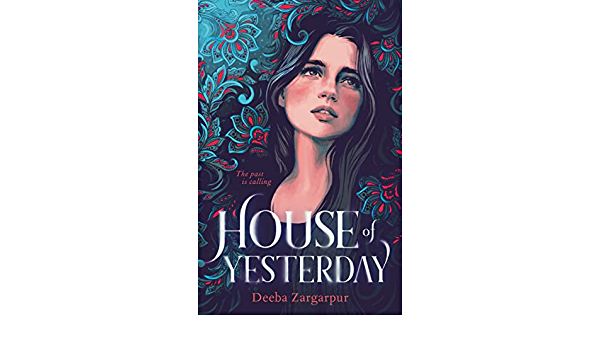
While reading this 320 page YA supernatural/contemporary book-I couldn’t turn the pages fast enough.  When finished- I was bothered that certain threads weren’t resolved, now that I’ve ruminated a bit- I think the vagueness of the author’s prose in sharing her “fever dream” on paper has lingered and the gaps not as troublesome.  The author’s OWN voice Afghan-Uzbek Muslim identity adds layers to a story that is both haunting in the literal sense and familiar in the immigration inter-generational traumas and secrets shared.  Even deeper though, the book pokes at universal themes of regret, holding on to the past, family, friendships, and grief.   The book’s characters identify as Muslim, but the story is not Islamic, nor is there much religion save a few salams and mentions of Eid.  The supernatural elements in the book, whether you understand it to be ghosts, or personified memories, or jinn, are a large part of the book, but are not framed in a belief or spiritual manner, and while some may find it Islamically off-putting, I felt the book explored what the main character was enduring and what the weight of the past was doing to her, didn’t necessarily cross the haram line.  Her father has a girlfriend he is looking to marry, but it isn’t celebrated, and there are close male/female friendships, but the book is relatively clean for the genre and would be a good fit for high school readers and up.

SYNOPSIS:

Summer on Long Island has Sara retreating into herself.  Surrounded by nearly a dozen aunts and uncles and numerous cousins, it is the separation of her parents and trouble with her best friend that makes getting out of bed every morning a challenge.  As a result, her mother ropes her in to helping with her latest remodeling project.  When she enters an old crumbling house one morning to take “before” pictures, she starts seeing things, and feeling things.  Things about her past.  Things about her beloved grandma, Bibi Jan, who is alive and deteriorating from dementia.  What is the house trying to tell her? Why won’t anyone tell the truth?

WHY I LIKE IT:

I love the mystery and the chills of the story.  As the reader you aren’t entirely sure where the story is headed, what you are to do with the bits of the puzzle you are given, but the intrigue to find out pulls you forward.  That being said, the book does reads debut, a few of the side story lines are not fleshed out enough to feel important, satisfying, or resolved and they come across as being abandoned.  I would have liked to see more of Sara and her father’s relationship, the details don’t seem to fit, and the continuity seems halfhearted.  At times so does the “night” it all changed with Sam.  I like the interpretive vagueness of the supernatural threads and that they are up for interpretation amongst readers not just at the end, but throughout the book.  I also like the family’s closeness even when they are disagreeing. For most of the book Sara and her cousins aren’t portrayed as particularly close and I didn’t invest time to differentiate one from another, but by the end, I felt that they were grounded and different and relatable, and I am not sure when that change occurred.  At times the writing seemed a bit repetitive, but the lyrical style would then catapult the story ahead.  There was one place that the fourth wall was broken though, and I was bothered by that slip.

Overall I loved that the Uzben Afghan culture sprinkles showed immigrant nuances, and that the love between the generations countered the trauma being shared as well.  The messaging is subtle but powerful long after the last page has been read.

FLAGS:

For the most part the book stays clean, the father has moved on and has met someone he would like to marry, the mom and aunts briefly recall sneaking out to attend a prom decades earlier.  There is mention of a child bride, and swimsuits, tank tops, and cocktail dresses being worn with no second thought.  For a YA book, the flags are incredibly minimal, save the “ghosts”(?). There are flags of a death that is detailed, the book is “spooky” at times, there is mental health, divorce, pain, dementia, abandonment, theft, running away, and fear.

TOOLS FOR LEADING THE DISCUSSION:

I would love to read this book with some high schoolers.  It is a quick read that would allow for a lot of self reflection, arguments, and entertainment.  The book is available here and releases in a few days, so if planning to purchase, please consider preordering and showing your support.

My Baba’s House: A Poem of Hope by Dr. Amani Mugasa illustrated by Eman Salem

Standard
My Baba’s House: A Poem of Hope by Dr. Amani Mugasa illustrated by Eman Salem

my babas house

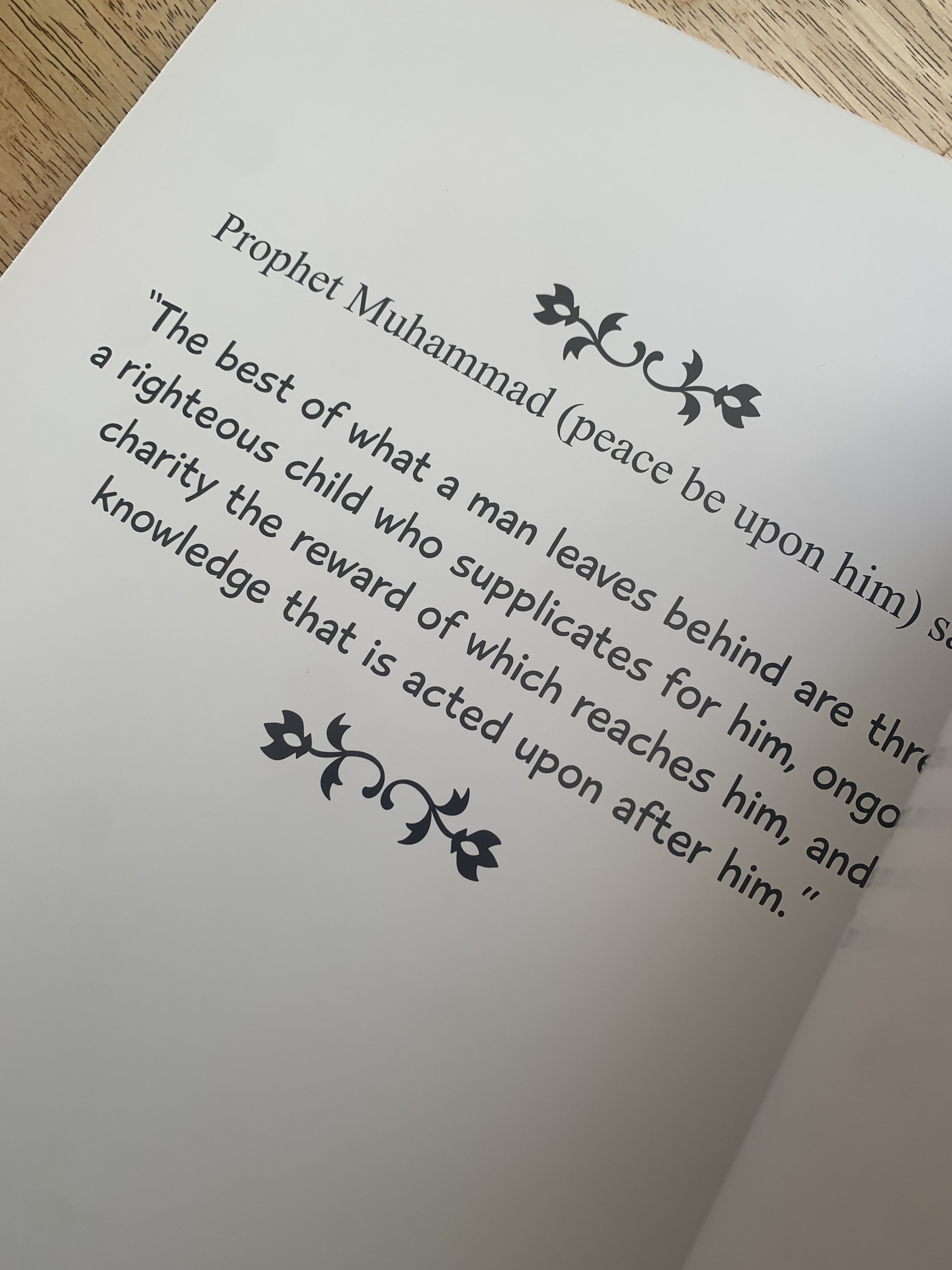
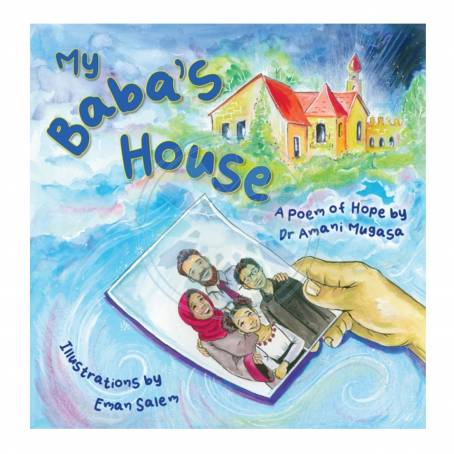
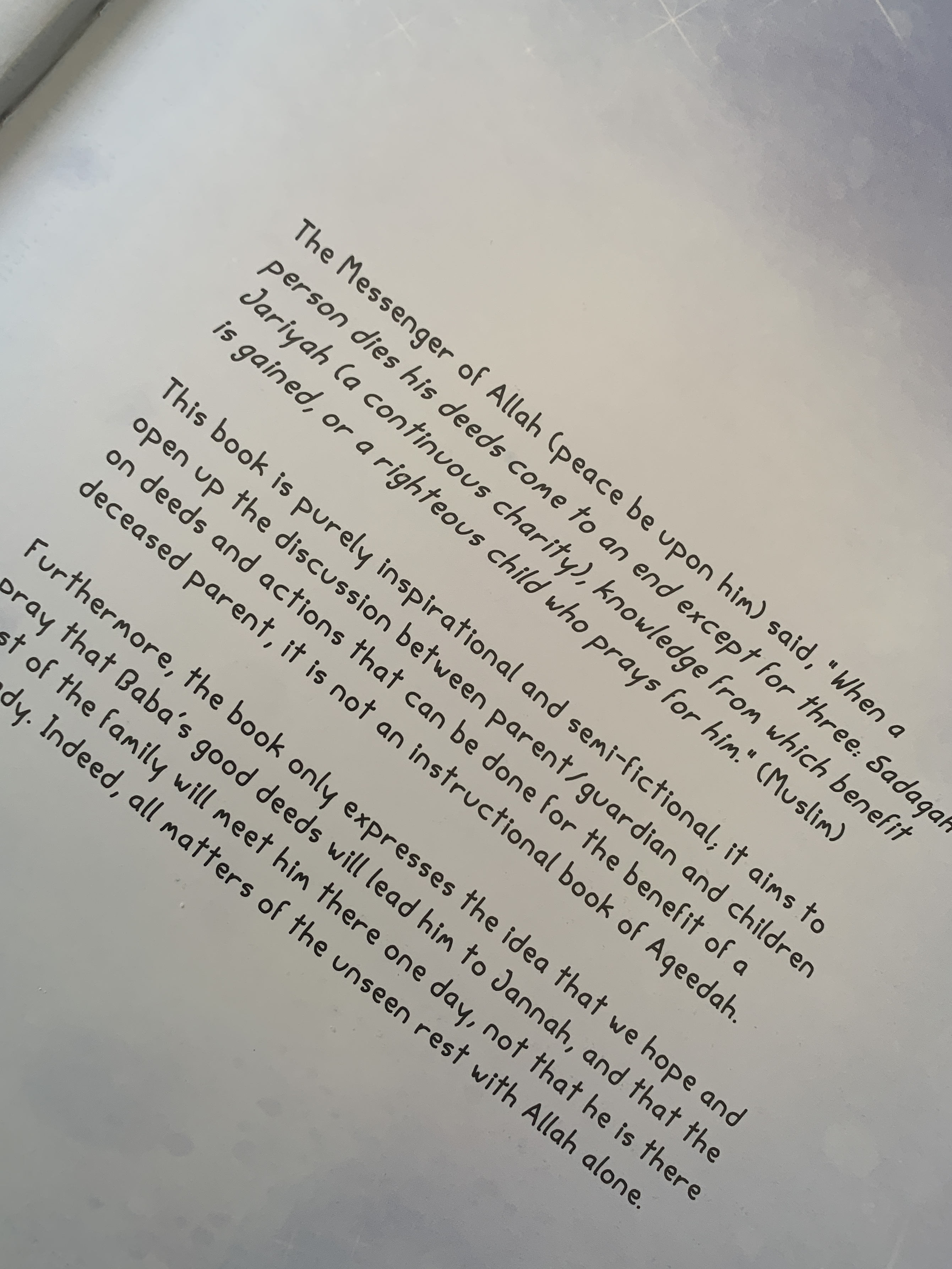
I wanted to love this Islamic centered children’s book about grief, but I found it a bit problematic and misleading.  I am by no means an expert in Islamic matters of death or in psychological bereavement, but the note at the beginning of the book- if I wasn’t already going to look at it critically- really raised some warning flags.  It says that the book is not an instructional book on Aqeedah, that even though the title and whole story is about a house being built that “the book only expresses the idea that we hope and pray that Baba’s good deeds will lead him to Jannah, that that the rest of the family will meet him there one day, not that he is there already.” So, before you even start the story, it seems that the disclaimer is making it clear that this book is not religiously accurate, and that it is just meant to soothe and provided hope.  After taking all that in to consideration, and reading the 26 pages of text over a dozen times, I think I finally pinpointed why the book further reads problematic for me.  It is the repeating phrase, “Your Baba has been building a beautiful house for you,”  because he hasn’t right? He has built a house for himself through his good deeds in this duniya, he benefited HIS parents by being a righteous Muslim.  The words “for you” completely take the book in my head from being a slight suspension of timing where the deceased are, in to be misleading.  So if the book is not accurately framed and only to be taken as something “to open the discussion,” what is the point? Why fill it with Islamic references and concepts, if they will then have to be clarified, corrected, and re taught?  Sigh, I’m happy to listen to those that want to change my mind, truly I am.

img_9013

The rhyming book starts out with a mom and two kids being consoled by the text that their Baba has been building a house for them with Allah’s help.  That it is amongst the flowers, made with Allah’s powers. That with every good deed he did, their Baba becomes a builder, that there are pure rivers and trees, and that the house is hidden through Allah’s gate.

img_9014

To find their Baba’s house they will walk with Prophets, and see ripe fruits, and smell sweet musk.  There will be rivers of milk and he will carry them above his head.  The illustrations on this page are a little off in my opinion the shadows of a person elevating and even the girl looks a little concerned.

img_9015

I like that the next spread addresses that only Allah knows when the day will come that we reunite. And then the next pages tell how the children can help decorate their Baba’s house by calling adhaan, reading Qur’an, being kind, giving charity, and making duas.

img_9016

The book concludes with encouraging patience and finding reassurance in knowing we belong to Allah and to Him we return.

With the exception of the one page, the illustrations are adequate and show a mixed racial family.  The rhyming lines are rather weak, and ultimately there are just better books out there about grief that don’t have to be so qualified for accuracy.

Queen of the Tiles by Hanna Alkaf

Standard
Queen of the Tiles by Hanna Alkaf

queen

This 320 page YA book is hard to put down and middle school readers and up that love words, a good mystery, and fantastic writing are in for a treat.  I can’t recall the last whodunit that had me absolutely sure that I knew who was guilty, while simultaneously doubting myself until the reveal.  I mean, maybe there wasn’t even a crime to unravel? And fear not, I’m not going to spoil anything in this review.  Just know that this Muslim authored, Muslim character filled, Malaysian set, Scrabble feast is worth a space on your shelf as it will undoubtedly make a place in your heart and beg to be read again and again to see what you missed.

SYNOPSIS:

It has been one year since Najwa has competed in a Scrabble tournament, one year since her best friend, Trina Low, died playing Scrabble at the very same tournament, at the same hotel, with many of the same participants.  And with Najwa battling her angry negative thoughts, splotchy memory, nerves, and grief, she is walking a fine line of functioning and faltering.  When Instagram posts and messages start popping up from Trina’s account, everyone becomes a suspect in unraveling what really happened and doing it fast enough to prevent it from happening again.

The backdrop is the Scrabble games that are still taking place, the play on words, the scoring, the plotting, the twists, the scrambling, and unraveling of so many characters that are more connected than they first appear.

WHY I LIKE IT:

I love Scrabble, my mom and I used to play weekly when I was in junior high through college, and while the games were “friendly,” and neither us very good, the game holds wonderful memories. Usually chess is referenced for strategies in real world approaches, so to see Scrabble on a competitive level and have it being in many ways a metaphor for the larger storyline truly had me giddy.  I’m still grinning in fact as I write this review.  The mixing of the two story lines is flawless, with the word play, and scoring, and definitions, that I am just beyond impressed with the writing, the clarity, the intensity, and the way it holds the readers attention.

Many of the characters are Muslim and they mention their hijabs, waking- or rather trying to wake each other up for fajr. At one point Najwa and Mark, Trina’s ex-boyfriend are meeting to talk and she acknowledges the halal gap left as they sit down and how they are both always mindful of her Muslimness and his non Muslimness.  Islam is there, but is not a big part of the story. I beamed when it popped up, but if doesn’t influence the story much, for example one night Najwa plans to sleep in her hijab incase she has to run for her life, so you know, she won’t be slowed down by trying to cover her head.  Yeah, the book has some dry humor too.

There is a large mental health role in the book, as it seems in all of the author’s books: The Weight of Our Sky and The Girl and the Ghost.  Najwa is coping with her grief and trauma and working closely with her doctor to improve her situation.  Other characters mention going to therapists and likewise getting professional help.  I love that it isn’t just a character trait, but that it is a big part of the story, and not in a negative way, but in an actively working to manage it way.

I like how the gender neutral character is handled and pronouns are used.  It is not opined upon, it is not in your face, it is a side character, they have a preference of how to be referred to as, a quip is made that if they win they don’t want to be queen of the tiles, but a more less gendered term perhaps monarch, and that is it.  It is not a judgement, it is not a big part of the story, and no one makes it a huge issue, the character isn’t fleshed out much, but they are respected and have more to their personality than this one facet.  I think that provides a great approach in seeing something in literature that can perhaps spark important conversations in real life in need be.

The only slight pauses the book gave me were when it talks about how incredibly wealthy and distant Trina’s parents were, but then for much of her life she lived in a modest town house style house.  Also, despite Mark and Najwa’s awareness of boundaries, and Najwa being called out for crushing on Mark, at one point he hugs her and I don’t know if that is an oversight or was intentional.

FLAGS:

There is death, murder (?), poisoning, deceit, plotting, cheating in multiple ways, kissing, crushes, relationships, multiple mental health threads, intense competition, danger.

TOOLS FOR LEADING THE DISCUSSION:

I would love to do this as a book club selection.  I think as long as no one spoils the outcome there would be so much to chat about: the twists and turns, the way Islam and Malay culture is shown, the influence of western culture, concept of competitive Scrabble, pronoun sensitivities, and healthy friendship.  Girls and boys in middle school will be drawn to the story, and I can’t wait to share.

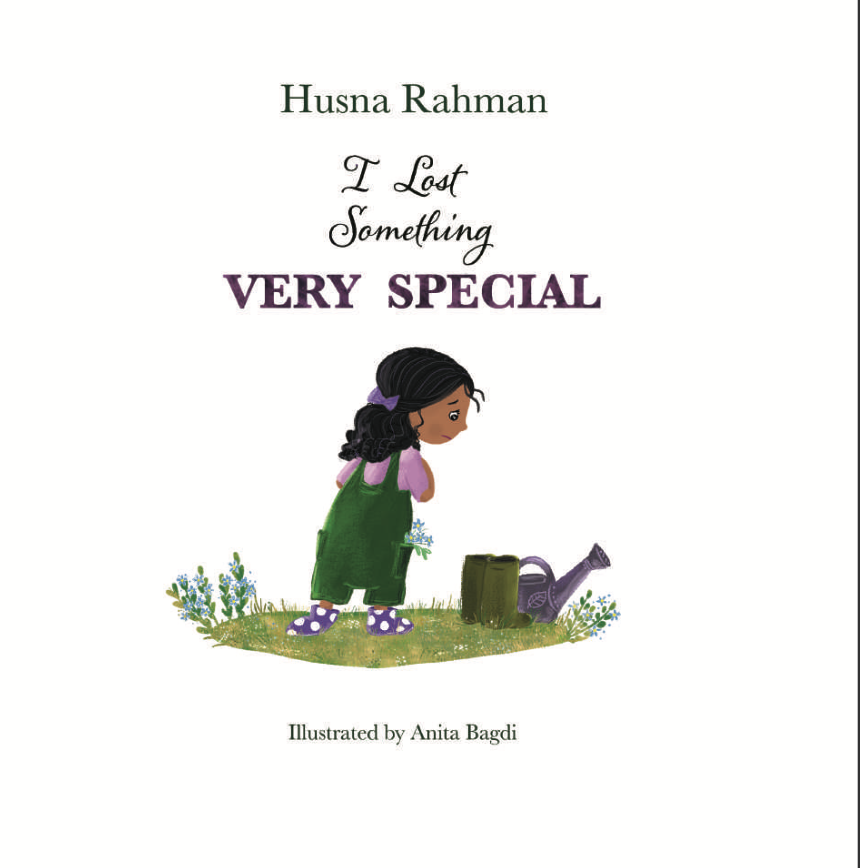
I Lost Something Very Special by Husna Rahman illustrated by Anita Bagdi

Standard
I Lost Something Very Special by Husna Rahman illustrated by Anita Bagdi

Screen Shot 2021-11-04 at 11.08.02 AM

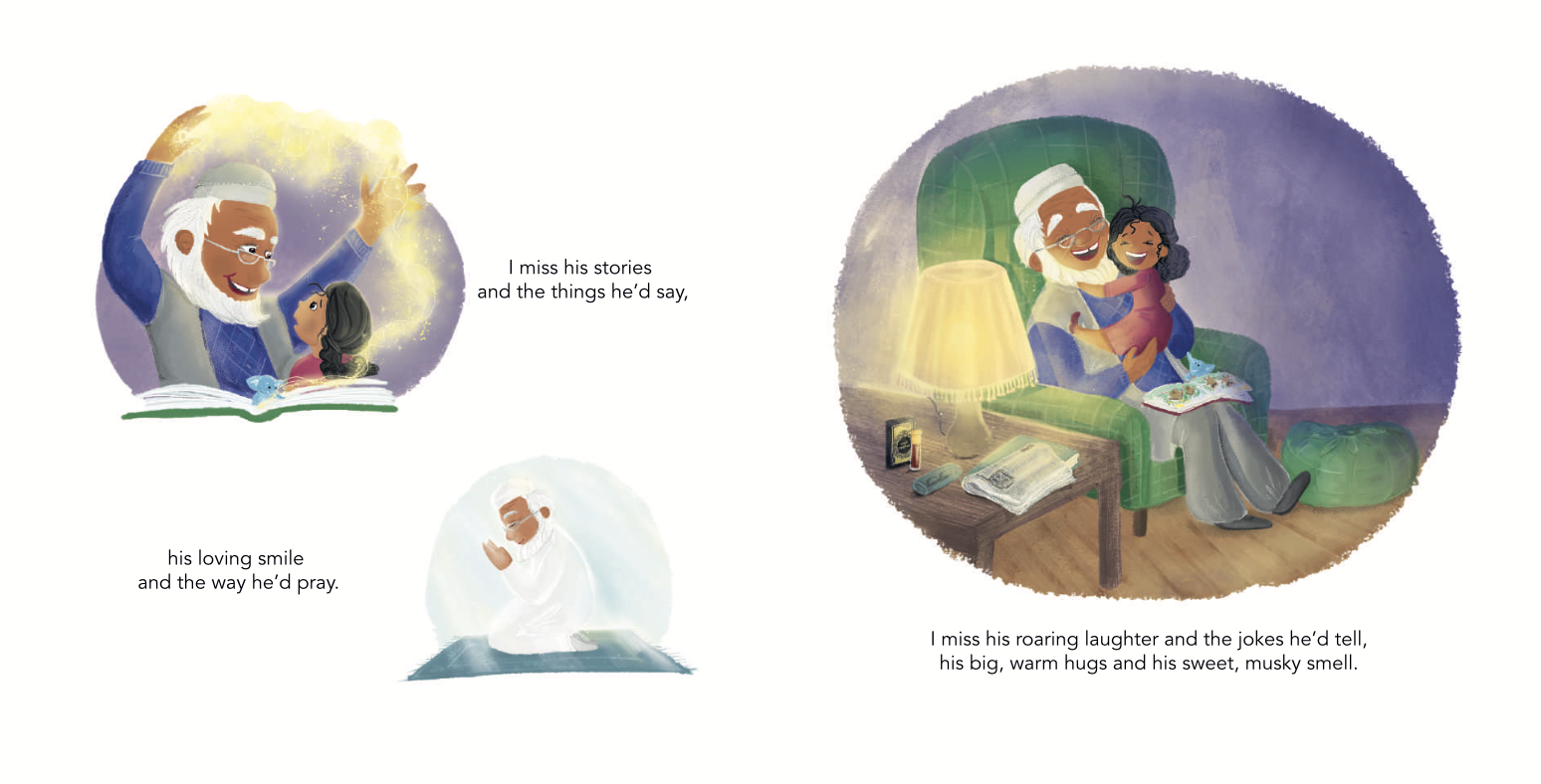
This beautifully illustrated 34 page story about the loss of a beloved grandfather is universal and heartfelt.  It is not an Islamic fiction book as there is no mention of the duniya or akhira or accepting Allah’s decree, the family however, is visibly Muslim and it shows women in hijab and the little girl narrator praying salat with her now deceased grandfather.  Similarly, there are no cultural words or references in the text, but the illustrations show Bangladeshi culture, writing, and warmth.  The author is a psychotherapist and counselor, and all readers, young children and up, will benefit from the tenderness and emotion-filled paperback book.

Screen Shot 2021-11-04 at 11.08.58 AM

A young girl starts the book stating that she has lost something.  She recalls other things she has lost, a scarf, a toy, her voice, a tooth, and how after a while the item was found or it came back and she was able to carry on.  Today, however, is not the same, she has lost her grandfather, and he isn’t coming back, and she doesn’t know if she can carry on.

Screen Shot 2021-11-04 at 11.09.36 AM

She goes to his house, and he isn’t there, and the heartbreak is palpable.  She knows in time she will forget the lost scarf and lost voice, but she doesn’t want to ever forget her grandfather.  She finds some pictures and recalls him teaching her to ride her bike, them praying together, and planting a garden, his stories, his smell, his laugh, his hugs.
Screen Shot 2021-11-04 at 11.10.21 AM

As she assembles the pictures in a scrapbook, she is filled with memories and warmth and his wisdom.  The book ends with her seemingly coming to accept her new reality and then the book asking the reader if they have felt loss, what memories they carry, and what they miss the most about those that are gone.
Screen Shot 2021-11-04 at 11.10.01 AM

The sparse text and amazingly expressive illustrations make the book a beautiful addition to help children cope with their own feelings, and to learn empathy for others going through their own trials of loss.

Screen Shot 2021-11-04 at 11.08.18 AM

We Will Meet Again in Jannah: What a Great Day that will be! An Activity book for Bereaved Muslim Siblings by Zamir Hussain illustrated by Emily McCann

Standard
We Will Meet Again in Jannah: What a Great Day that will be! An Activity book for Bereaved Muslim Siblings by Zamir Hussain illustrated by Emily McCann

jannah

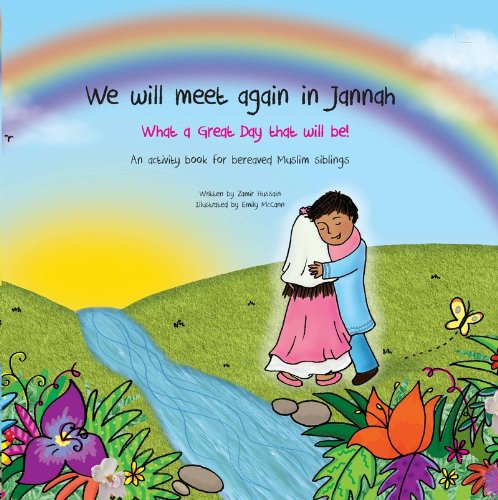
I don’t review workbooks, or a lot of non fiction books, but by far the most thematic requests I get asked about, are children’s books about bereavement.  The loss of a friend or loved one is just not a topic that you see covered very often, if at all.  Sure there are books about jannah, but they are more silly and framed as a reward, not about the loss felt that would precede paradise.  This 32 page paperback activity book is part reassurance, part encouragement, part discussion starter, and part remembrance all within a faith framework.  Much of the book is not sibling specific, perhaps a few tweaks and you could have a grandparent version, a parent version, an aunt or uncle version, etc.,  even as a parent you may consider adjusting the book as you share it if you are unable to find a specific book for your child’s needs.

img_3901

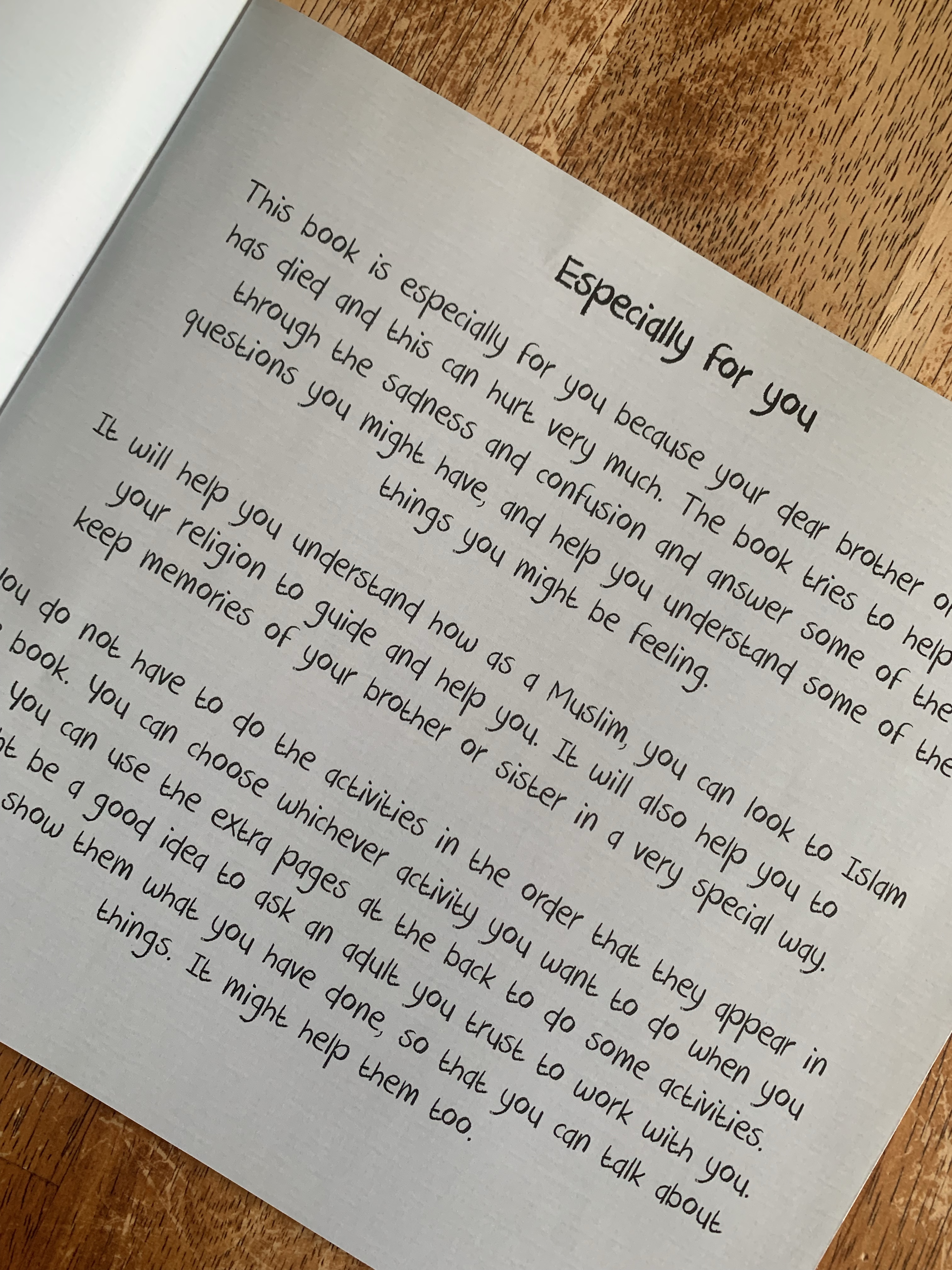
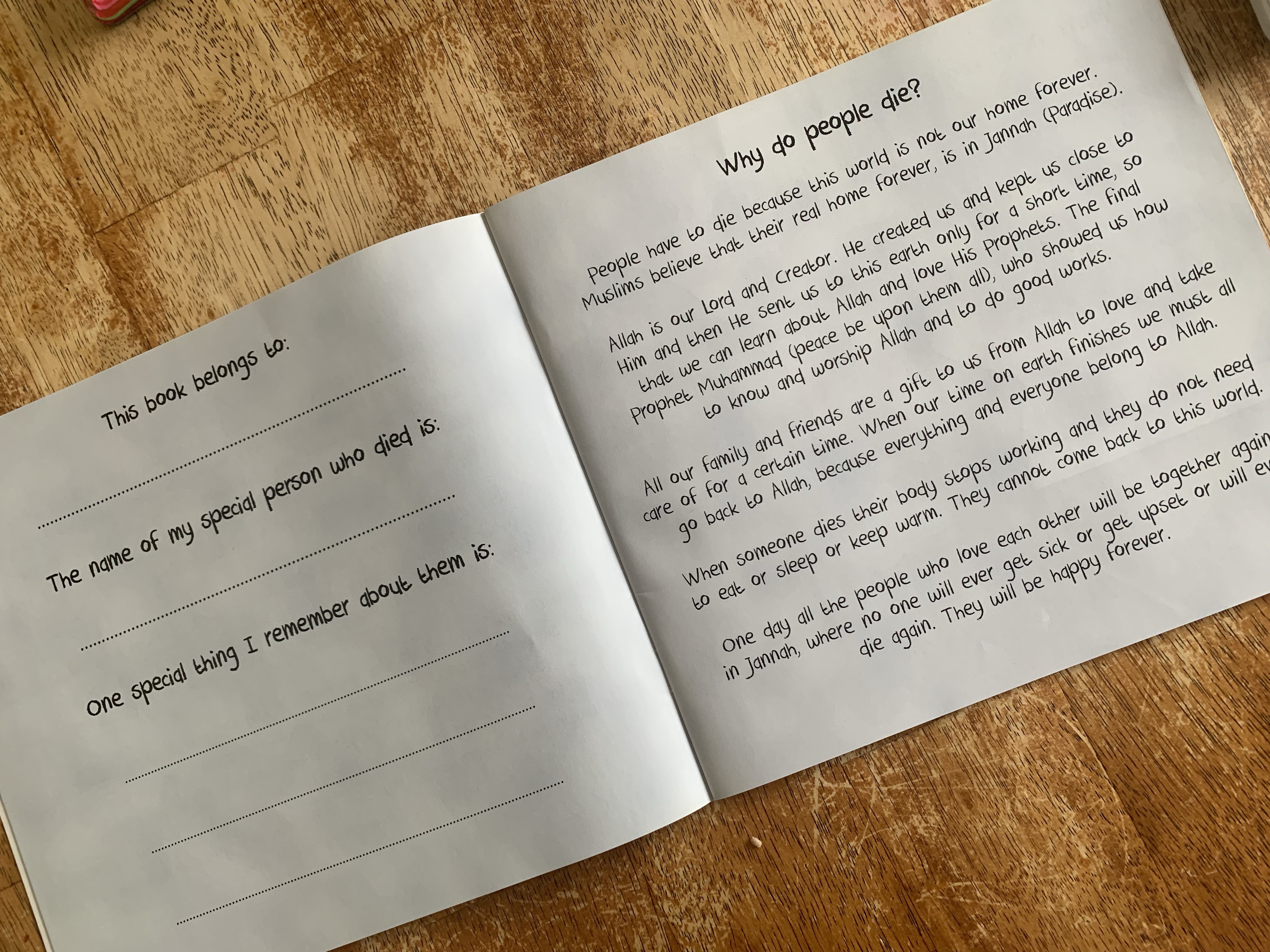
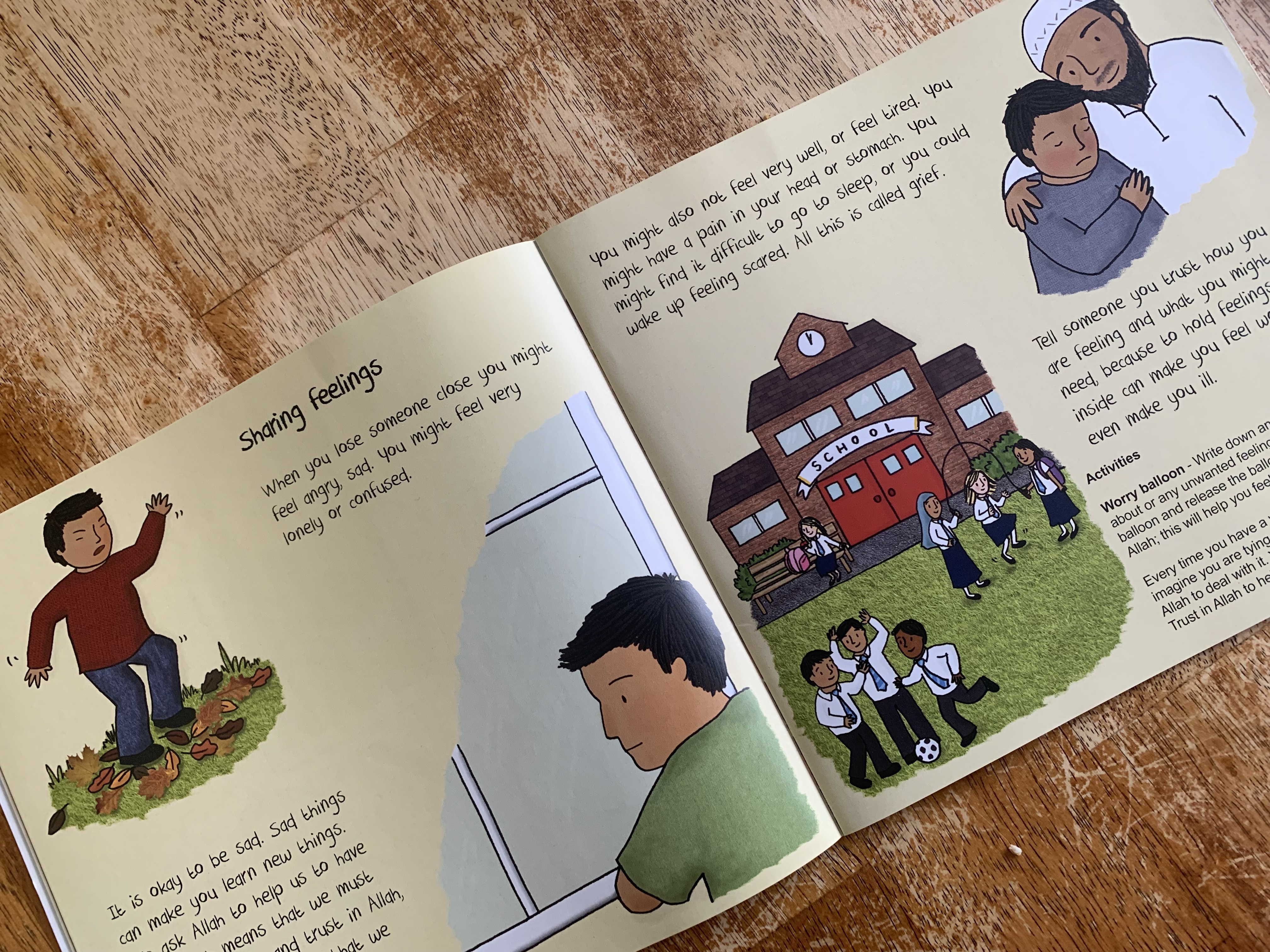
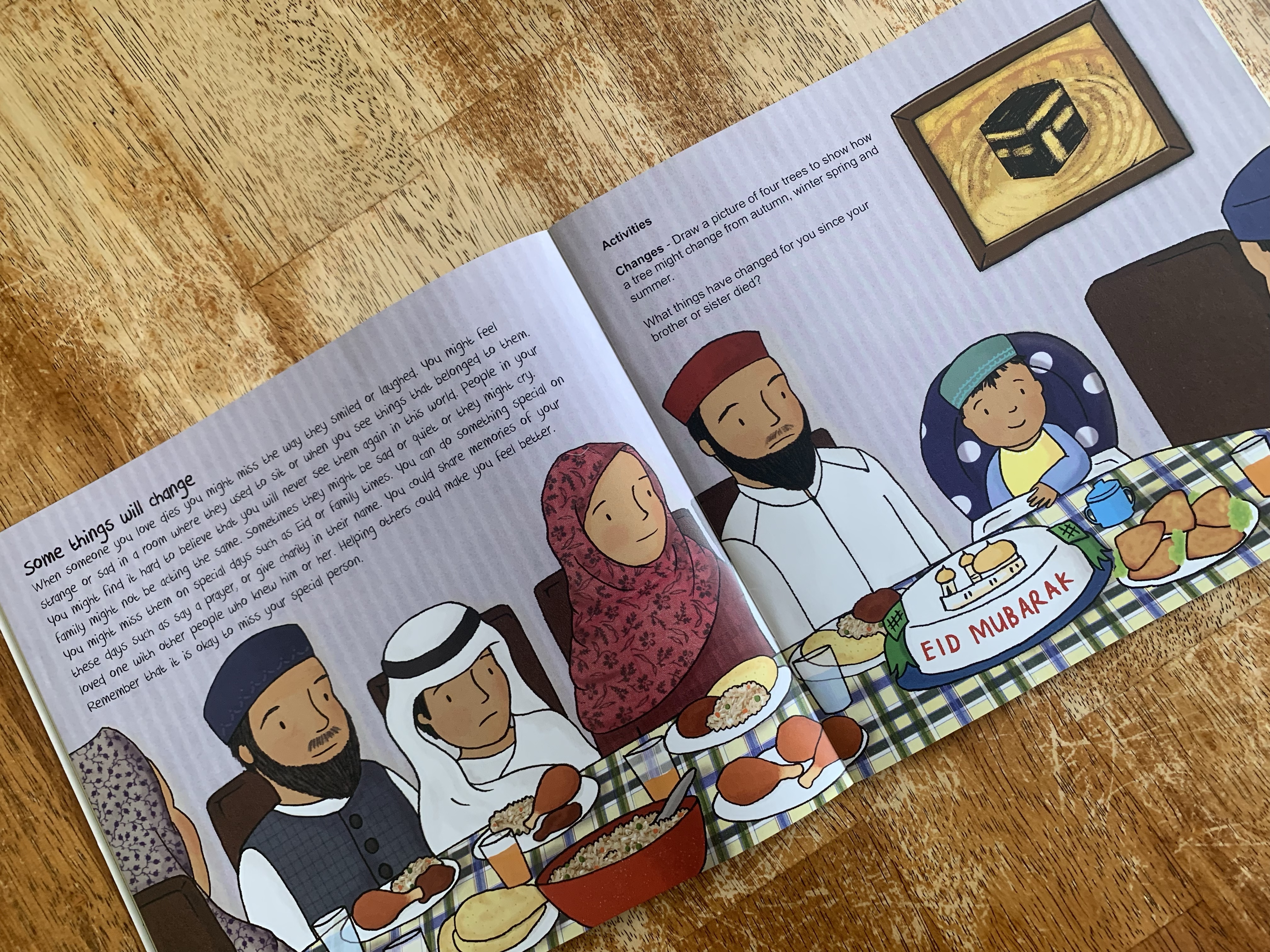
The book starts with the author talking to the reader and setting the tone about what has occurred and what is to follow in the book.  It then asks the reader to write or share who they are, who passed, and something special they remember about them.  It discusses why people die and then starts the two page spreads that address a theme and presents an activity to help you feel better, or to remember or celebrate the one who has died.  Topics include: You’re never too big to cry, It’s not your fault, Talking and sharing the pain, Some things will change other’s will stay the same, etc..  Some of the activities are wonderful and can be done in any order, at any time, and others, you may want to adjust.  The idea of releasing a balloon, for example, with your worries in it, is symbolically effective, but not so great for the environment.  The end of the book has additional resources on how to use the book, things to do with the child, further support,  additional resources, and Islamic guidance.

img_3902

I love that Islamic foundations and vocabulary are not just used, but explained in a very age appropriate, non condescending manner, through out.  I love that it is clear that you don’t have to talk if you don’t want to, that it is not the child’s job or responsibility to make the adults feel better, that nothing is anyone’s fault, and that there is no right or wrong way to grieve.

img_3903

I wish the book was larger in size and perhaps hardback so that the activities that require writing would have more space and ease in completing.  The text for the activities is also very tiny.  I also wish that the author’s qualifications for such advices was included.  I Googled the author to find out:  “Zamir Hussain is a Muslim Chaplain at Birmingham Children’s Hospital and has pioneered resources in Islamic health care. She has published several books for bereaved Muslim parents and siblings. She has also developed the first UK blended learning resource, including care plans and pathways for Islamic daily, palliative, end of life and bereavement care for paediatric staff. Zamir has worked as a Muslim Chaplain for both the Heart of England NHS Trust and Birmingham Children’s hospital for over five years, where she has also run training courses for the staff as well as delivering training and talks on care for Muslim patients to organisations around the country.”

img_3904

We need more books about coping, talking, dealing, understanding death for our children, inshaAllah this is a start, alhumdulillah.