Tag Archives: battle

Farrah Noorzad and the Ring of Fate by Deeba Zargarpur

Standard
Farrah Noorzad and the Ring of Fate by Deeba Zargarpur

img_5607-1

This 323 page middle grade fantasy written by a Muslim author features Muslim characters in a jinn filled adventure, but is not very Islam filled.  Jinn are widely accepted these days in western literature even by non Muslims, so it doesn’t hold the Islamic rep weight it perhaps once did, and while the characters mention prayer once or twice, they are never shown to rely on faith, practice it, or have it be a central part of their identity.  None-the-less, at times I truly could not put the book down, the fast paced adventure coupled with the compelling characters really hooked me and pulled me in, until it didn’t.  I’m not entirely sure of why the rapid unravel of my connection to the book happened, but I’m guessing it is because of A: I struggle with fantasy. B: the plot was really kind of weak. C: the “Alice in Wonderland” style world building is not a style I enjoy. D: So much of the tension in the book is predicated on conversations not happening because the time is not right, but ultimately I’m pretty sure it is E: A little bit of all of the above.  The book is fun, I think kids will like it even though so much wasn’t clarified, resolved, and seemed unnecessary to me, I’m not the target audience, and I recognize that.  It is worth noting that the premise of the book stems quite heavily on the fact that Farrah is a “harami” as it is called, she is a child born out of wedlock. The details of the parents’ relationship prior to her birth are glaringly absent, but that stigma affects her relationships and is central to the story.

SYNOPSIS:

Farrah only sees her father one day a year on her birthday, Yalda, the winter solstice.  While hiking and climbing her father presents her with a gift, a ring, and when she hears a voice and makes a wish, her world will never be the same.  Her father, who she thought was a judge in the UAE, is actually a jinn king, who is now trapped in the ring that Farrah wished upon.  When he is imprisoned, a jinn boy named Idris is freed and together the two of them set out to free her father and get some answers.  They journey to the jinn world where they meet the other jinn kings and learn they are next to be imprisoned by the ring. While there they meet Farrah’s half brother Yaseen, who joins Farrah and Yaseen before returning to Earth, picking up Farrah’s human friend Arzu, and heading to battle Azar in the underworld.  New friends, new worlds, and new perspectives give readers a lot of reasons to cheer for Farrah and her found family as they take on jinns and try to make sense of it all.

WHY I LIKE IT:

I like the main characters: Farrah, Yaseen, Idris and Arzu.  I need more answers and more development of Farrah’s mom, dad, their relationship, Yaseen’s mom, Idris’s parents and situation, though a lot was resolved plot wise in the last 19 pages, the unresolved character arcs nagged at me.  I’m guessing there is going to be a second book, so perhaps some insights will come, but for as enjoyable as the main character’s voice is in understanding her own motives, and those of her friends, the lack of development for the remaining characters was quite a contrast.

I felt that the plot was a little weak as well, why did they go to the jinn world, just to return, whey did they seek the protection charms but then abandon them, why was Idris imprisoned in the first place, even if they got the ring back at the mall what were they going to do with it, what was the answer to the first riddle, who was making the rules about the riddles and the trades? I’m not saying some of that wasn’t answered and I just didn’t get it, but it is a sample albeit a small sample of all the unanswered questions I had about what was going on, at all times.

I’m biased against Alice in Wonderland type stories where the reader is just taken from one climax to the next without any world building showing or hinting at why this is now happening.  Like falling down a rabbit hole, it seemed like each event was building the fantasy world for Farrah and the reader in real time and I would have like a little grounding.  It worked for a large part of the book, but I think not understanding enough about the jinn and jinn world, is what made the climax fall a little short for me unfortunately.

I needed people to have conversations, I know when characters are fighting shadow creatures, they can’t explain their family dynamics, but when the same literary device happens again and again, and the characters never have conversations, never get answers, it gets a little frustrating for the adult reader reading a middle grade book, i.e. me.  Maybe kids don’t care, but mom and dad and the grandparents all needed to have a conversation, and that sadly never came.

FLAGS:

Lying, poisoning, entrapment, fighting, mention of being born out of wedlock, sneaking out, near death experiences, stealing.

TOOLS FOR LEADING THE DISCUSSION:

I don’t think I understand the book well enough to teach it, but I would absolutely have it on a classroom, library, and home shelf.
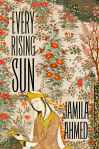
Every Rising Sun by Jamilya Ahmed

Standard
Every Rising Sun by Jamilya Ahmed

The lush writing and ever present threads of Islam captivated me from the first page of this Shaherazade retelling.  I truly could hear my own voice in my head reading each word, and falling into the masterful story-telling of the protagonist/author.  With about a third of the book left though, I was sadly stopped abruptly in my tracks.  I found myself annoyed by Shaherazade, and having to convince myself that even though this is an adult read, she is very much coming of age and finding herself, only she doesn’t evolve and grow, and doesn’t have a character arc, and by the end I felt deflated.  Is the book good? Yes.  Would I recommend it to readers 18 and up that enjoy OWN voice, strong female, historical fiction? Absolutely.  But I find myself frustrated, because when the book was good, it was so good, but as the end drew closer, I realized there were holes, big ones, that could so easily have been fixed.  The author has the skill, the knowledge, all the tools, but alas, I didn’t appreciate Dunyazade because she is largely absent.  I didn’t know the interworking of her assistants and friends so I didn’t care about them, side characters were so painfully underdeveloped. And with 50 pages left, I was for the first time perhaps ever, glad that the narrative moved from showing to telling (I know, who am I even). I needed the articulation to connect the dots particularly of Shahryar and Shaherazade’s relationship.  The 423 page book could have, and should have, been a hundred pages longer to not feel so rushed at the end, and there should have been a map.  The book has adult themes but they are handled in almost a YA manner.  The beheadings, affairs, wedding nights, battles, war, are not detailed, but rather identified and moved on from even though they are so central to the plot.

SYNOPSIS:

In twelfth-century Persia the daughter of the Malik’s adviser stumbles on the Khatoon and her lover, she anonymously alerts the King to the affair and the beheading of wives begins.  To keep the country from revolting at their mad king, Shaherazade offers to become his next wife, to assuage her guilt for what she set in motion, on the hope that her storytelling will keep her alive come morning.  Life doesn’t pause however, as Shaherazade spins her tales, but rather amplifies.  She accompanies her husband, Malik Shahryar as they join Saladin in the Third Crusade.  The caravan, the journey, the battles, the romance, all bring the climax of returning home to a Kirman under siege will test Shaherazade’s story-telling abilities to the brink and with it the Seljuk Empire.

WHY I LIKE IT:
The prose is on point, time stood still while getting lost in a world of history, imagination, and the author’s skill.  The constant presence of Islam in the characters life was incredible. It was not established and then left to the side: the times are marked by prayers, the athan is ever-present, the duas are heartfelt.  Yes the characters drink wine, and sleep around, but they also fast and treat their prisoners of war with compassion.

I really struggled with how little I cared about people dying, there should have been more connection and more emotion for the side characters, and as the story progressed, I became increasingly irritated that I wasn’t forced to care about them, to know them, to appreciate what they meant to Shaherazade.

I also felt that the majority of the story took place over one year.  How do you forget that you are telling stories to save your life and (SPOILER) start sneaking around with some other guy.  You have a guard detail that follows you everywhere, you are in a caravan and you live in a tent, everyone knows everything!  Shaherazade is also clueless a lot of the times asking soft questions and then told how intelligent she is and allowed to plot and scheme with various rulers.  I love that she has a voice, she isn’t silenced, that she is never apologetic for being opinionated and her very presence is never a kindness, she takes up space and doesn’t look back, but the inconsistencies in her judgement needed some smoothing out.  Show her understanding grow, and increase her intellect to wisdom, don’t have her charming and manipulating leaders one minute and then being so naive the next.  She should have been so much smarter by the end of the book than she was shown to be in her personal dealings.  Her political knowledge was strong, and she was a force, and that level of insight into her own life would have been a character arc to see.

The book is adult, but it almost reads YA and I’m not sure why, it is sourced, the historical presence is exciting, the words and flavors intoxicating.  I normally love when the characters are shown and the reader doesn’t have to be told things, but the only reason I finished to the end was honestly because I got some telling.  I was relieved to hear from Shahryar what he knew, what he felt, what he could own up to.  Perhaps had there been more showing of the intricacies of palace life with the side characters the book would not have gotten to that point, but the lush writing could only carry the book so far.

FLAGS:

Relationships. sex, kissing, fornication, killing, beheading, lying, hangings, war, battle, drinking wine, scheming, kidnapping, attempted rape, it is Adult, but nothing is overly detailed or glamorized.

TOOLS FOR LEADING THE DISCUSSION:

I would love to chat about this book, I think I could be swayed to love it, or play the devils advocate and argue for the sake of arguing.  Being how highly recommended this book came to me from a dear friend, I’m ready to battle and anxious to discuss!

I got my copy from the library, but can be purchased here.

Majdi Mansoor and the Book of Miracles by Anisa Bezak

Standard
Majdi Mansoor and the Book of Miracles by Anisa Bezak

img_0030

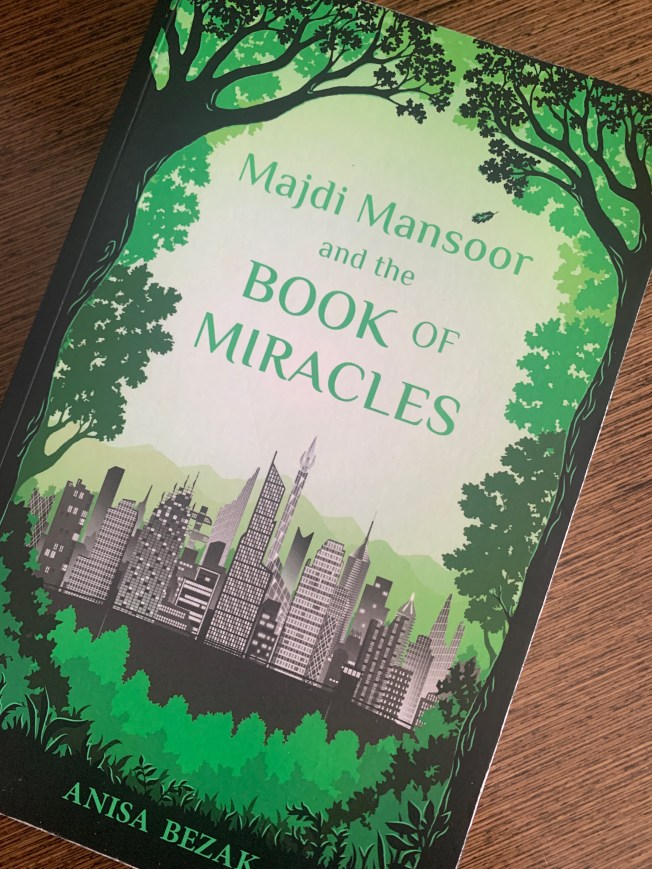
I don’t think I have ever seen or even heard of any dystopian Islamic fiction reads, we have a handful of Islamic historical fiction, and dystopian with Muslim characters, but the genre made me curious, and with that motivation I began the 458 page book.  The beginning didn’t immediately grip me, but I told myself to read a hundred pages before deciding to DNF it or keep reading, and long before that arbitrary mark, I was intrigued by the story, invested in the characters, and impressed by the consistent writing, pacing, and role of Islam.  The book is preachy and idyllic, but that is to be expected, the way Islamic ideas and concepts and concerns were included as plot points though, is surprisingly well done.  For much of the story, I kept wondering who the target audience would be.  The vocabulary is a bit advanced, and the pages full of small text.  The book starts story wise-solid middle grade, but I think by the end I would recommend this book for advanced middle grade or early middle school Muslim readers.  I’ve heard from some adults that they read a chapter to their kids each night, and I think that aloud younger kids might also enjoy the story and be swept away to a future land run by a corporation where religion is banned, books are a thing of the past, a boy speaks only in Quranic ayats and hadith, and bullies of all sizes will have to be faced.

SYNOPSIS:

Twelve year old Jacob is an orphan in Tanas World and is unwillingly part of a gang.  One day in a boarded up old building he finds a book, a physical book, the Quran.  Religion is not allowed, Islam most of all, but he reads the book, and even though he doesn’t believe, he keeps rereading the pages.  When an attempt to steal some tech takes him outside the boundaries of the walled off city, he meets a small boy, Majdi Mansoor, who talks in a peculiar way. When threatened by the gang, Jacob decides to take Majdi’s side and that one act sets the two boys on a course that will change them forever.

I don’t want to give away too much, but Jacob is taken in by the Mansoor family who live in isolation and in hiding outside Tanas Corps patrols.  The parents are kidnapped, the children seek to save them and along the way meet smugglers, a Muslim community corrupted by bidah and djinn, Muslim Defense Unit rebels seeking revenge, and the executives who want the MEECA device to imprison the planet.

WHY I LIKE IT:

I was honestly impressed with the quality of writing, but I honestly don’t know if it was because my expectations were so low, or in fact was sufficiently edited and refined.  The characters have heart, the world building is believable, and the Islam is handled with an even hand.  At times members of the Mansoor family are too “good,” but Jacob has a sense of humor, is fallible, and curious which allows the story to stay moving and on task. There are some major plot points that are not resolved, and I’m assuming the political details will play out in the second book.  I’m hoping at least. The book doesn’t talk down to the reader, but older readers might find it too preachy.

I’m hoping my early teens who love Islamic fiction chapter books such as The Broken Kingdom series, The Adventure of Nur Al-Din books, and The Moon of Masarrah quartet will similarly enjoy this.

FLAGS:

Death, bullying, manipulation, assault, revenge, danger, whispers of shatan, bidah

TOOLS FOR LEADING THE DISCUSSION:

I would love to do this as a Middle School book club, I think it would be a bit too cheesy, but I think there would be some great discussions to be had about seeking, temptation, bidah, forgiveness, and the way that Majdi talks and Islam is woven in to the text.

Zain’s Super Friday by Hena Khan illustrated by Nez Riaz

Standard
Zain’s Super Friday by Hena Khan illustrated by Nez Riaz

img_9576

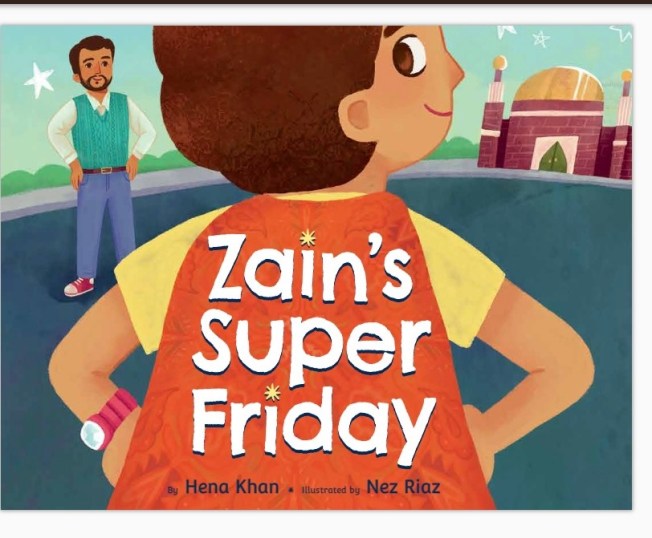
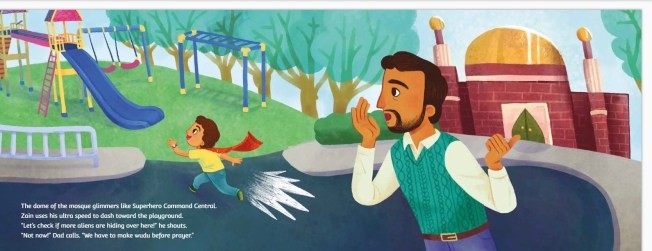
I love the joy and normalizing of mainstream titles celebrating salat, Jummah, and the masjid becoming increasingly available for us to read and share.  This particular book is great for preschool to early elementary aged children that enjoy going to the masjid, but sometimes want to put on a cape and be the hero battling aliens, that know how to behave during salat, but sometimes have a hard time sitting still, and parents that want to play with their kids, but sometimes have to get some work done first.  With  threads of patience, kindness, and determination woven in to masjid activities, the book is both a mirror for Muslim kids and a window for those that wonder what a Friday prayer service looks like.  The 32 page book is unapologetic, joyful, and a great addition to book shelves.

img_9578

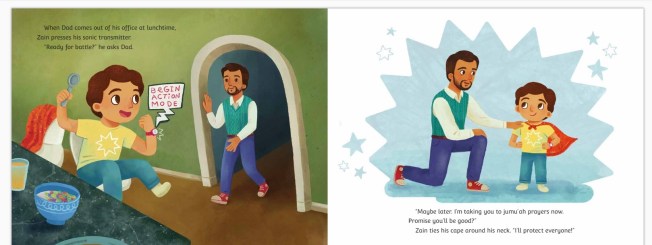
Zain wakes up early Friday morning and is ready to save the world. Dad greets Zain with a “Jum’uah Mubarak,” but has to pass on battling the aliens taking over the kitchen.  At lunchtime, when dad takes a break from work, Zain tries again to engage him in heroic play, but it is time for Jum’uah.  Zain slips on his cape and vows to protect everyone.

When they get to the mosque, aka command central, Zain tries again, but dad redirects him to make wudu before salat. Heat action dries his feet, but the adhan starts and giant shoes and aliens will have to wait, yet again.  During the khutbah, wiggly Zain sits by his dad, but when the Imam encourages them to stand for salat and fill any gaps, Zain takes it as a call to duty and races to the front announcing, “Here I come, Commander Imam, reporting for duty.”

The kind Imam knows just what to do, and as Zain controls his focus, even dad finds time to be a hero and battle the aliens on this super Friday at the mosque.

img_9580

I love that wudu, athan, khutbah, Imam, are all used without a glossary and that the Author’s Note is informative and unapologetic in tying it all together and making the terms clear.  I wish masjid was used instead of mosque, but I know that is just my personal preference.  I love that the Imam is kind and the dad is gentle and playful.  Even when Zain is not getting to do what he wants, he is not unhappy with being at Jumuah, or making salat, or being redirected, he just wants to indulge his imagination.  The warmth and joy of the illustrations reinforces the tone of the book, and with the inclusion of charity, and the happy ending, I can’t wait to have a physical copy of this book in my hands.

The book releases on October 10, 2023 and can be preordered/ordered here on Amazon and I’m sure will be available once released at Crescent Moon Store, where my initials ISL at checkout will always save you 10%.

img_9582

Rebel of Fire and Flight by Aneesa Marufu

Standard
Rebel of Fire and Flight by Aneesa Marufu

rebel

I struggled with this 384 page young adult fantasy.  It skirts and plays with Islamic doctrine as the characters and plot points dance with fantasy and fiction; and because I never felt that the author was completely in control of the story and where it was going, I could never relax and be swept away.  The author identifies as Muslim and in the backmatter addresses how experiences with Islamophobia influenced her writing, yet I don’t know why jinn and hijab were in the book when fictionalized creatures and cultural dress would have sufficed.  Clearly the character on the cover is in hijab, the names of half the characters are Muslamic, the culture is very desi, the broad concepts of jinn, the ghaib, sihr, Prophet Sulaiman, call to prayer, are all Islamically rooted, but characters go to worship at temples, jinn and jinniya eat corpses and are described so often as looking like smoke.  There is no clear identifier that these characters are in fact Muslim, it is simply hinted at, which makes the fictional parts seem like extensions of religious doctrine and ultimately made me uncomfortable with much of the story.  It also makes me think readers will not know where the lines are, if my brain was muddled, I can’t imagine a  young teen reading it and keeping it clear.  There is a few rushed romantic scenes of kissing, there is a trans character who’s gender identity and born gender is a significant plot line in the story, and there is a lot of oppression, racism, death, abuse, misogyny and fear.  It is a dark read that metaphorically takes real societal concepts and sets them in shades of gray with the added use of fantasy. There are a lot of layers in the story, and while it wasn’t poorly written, there were definitely places it needed to be better.  I really didn’t like any of the characters, I didn’t understand their motives, their relationships, their drives, the commentary on occupiers and rebels was weak as was the push back on misogyny after the first few chapters.  I didn’t feel a love of hot air balloons or feel that the battle scenes accounted for many of the characters that would suddenly be missing from the scenes.  I think the dual perspectives kept the intensity of the climaxes at bay and halted the rising action.  Too many misses for me to recommend this standalone book, but if you’ve read it and can talk me through it, I’m willing to listen.

SYNOPSIS:

In a land where girls are running out of time to be arranged in marriage at 17 and transportation is done in hot air balloons, there are two groups of citizens: the darker Ghadaean’s are the rulers and the lighter skinned hāri are oppressed.  The book establishes this power dynamic early on in a quick synopsis: the hāri came from the Himala mountain range to trade to Ghadaea, but their greed and lust for power drove them to try and seize the land.  They failed, and now 90 years later the hāri are punished for the mistakes of their grandfathers (4%).  Both groups fear sihr and jinn.  Everyone is vegetarian because jinn are attracted to rotting corpses, animal and human, and thus anything dead is quickly burned.  When a radical hāri group, the Hāreef, is formed with a new leader, sihr and jinn are no longer enemies but tools to rebel against the racist oppression, and assist in the war to change the balance of power.  

Khadija is 16 and with her mother and younger brother deceased at the hands of some hāri, her older sister married and off in a balloon, her father is desperate to get her married.  Most females are not allowed to read, nor are they even allowed out of the house alone.  The fear of the jinn is weaponized to keep them in, and misogyny prevents from proving themselves.  While out meeting with a suitor, Khadija in a burst of desperation leaves her father and jumps in to an escaping balloon.  Khadija does not know how to fly a balloon, having never even ridden in one, but when it lands in different town she meets Jacob.

Jacob is hāri and the second of the dual perspectives telling the story, he is orphaned and is unique in that he is an apprentice of a glass blowing Ghadaean.  He meets Khadija and offers her food, and in the span of a few hours she saves him and he saves her and both seem to have a dead glass blower on their hands.  Add this to his growing rift with his best friend William, who has joined the Hāreef, and is now dead, and you have Khadija and Jacob escaping in a balloon, not trusting each other nor knowing who and what they support.

From here on the two’s friendship and motives wax and wane as they are drawn in to battle together, and against each other.  Neither are “good” or “bad” nor are their decisions always clear, but they will be forced none-the-less to figure out what they want and what they stand for as peri’s are tortured, nawab’s are killed, jinnya queens are called upon, wishes are granted and a group of hāri and Ghadeans known as the Wazeem offer a unified collective.  Unfortunately, change and power never come easy and when a dead son is brought back as an ifrit and an ancient princess in the jinn world is ready to battle, all the shades of gray that exist in politics, revolution, rebellions, families, hate, racism, gender identities, and control all come spilling out from balloon baskets and the ghaib. 

WHY I LIKE IT:

I honestly kept reading to see how the author was going to bring it to a conclusion and wrap up all the loose threads.  And while the book lagged at times, she definitely got it concluded.  Aside from the religious signaling, but never owning identity problems, I struggled with the writing too.  The hāri Jacob doesn’t read like a little brother, he and Khadija read the same age, and so his importance in the Hāreef seems an ill fit.  Plus he is very duplicitous and I get that that is part of the story, but I never liked him so it just got annoying how many second, third, fourth chances he got, and I mean, why would anyone care? 

Khadija seems like she is going to battle misogyny early on, I hate that marriage and arranged marriage is equated to oppression, but the not being allowed out and not being educated seems to fizzle in the middle and then come out a bit in the final scene.  I hoped it would have been commented on in every new city they arrived at.  The set up was there, but because it wasn’t, it made it seem more of a shortsightedness of her own father, and not a larger problem when strong women existed elsewhere.  This also reinforced a “brown Muslim” man stereotype that is never pushed back on.  

The racism, power struggle oppression is more consistent, but with the foundation that the hāri came and tried to take over nearly  90 years ago makes it hard to feel too bad for them.  They tried to occupy and now are enslaved.  Neither is ideal, but why didn’t they just go back? We aren’t talking more than one generation, it is the “crimes of their grandfathers,” they had a home, they were kicked out, they should leave.  Yes, I know they are human and racism is wrong, my point is a literary one, that the foundation should have been stronger, more detailed.

The love interest I also felt was lacking, Darian comes out of nowhere, they are in love, he gives her his heart so he is saved, I didn’t feel the tension, I didn’t get it, not at all.  It was forced and cheesy and I just know he kept getting hurt, they would kiss, and then he was back to getting hurt or possessed or something, had no personality what so ever.

The seal of Prophet Sulaiman and the hundreds of pieces of it didn’t sit right with me, nor the jinns being smoky and eating corpses.  I truly don’t understand why very real Islamic concepts were brought in and twisted.  Why not just create your own characters and say they were loosely inspired.  I felt like the religious rep and OWN voice kept one foot in the religious inspired world and one in the fantasy is fiction so I can do what I want, and it didn’t work for me.  I think it crossed in to being disrespectful, and had the author not identified herself as Muslim, I would have been furious as the book reads like an outsider who doesn’t get that jinn are real, Prophet Sulaiman was real, sihr is real, the ghaib is real.  It really needed some some clarification on where the story existed and where the religion or religious inspiration started and stopped.

The trans character is worth highlighting because it does touch into Islamic rulings regarding hijab, even though we don’t know if Anam or any of the characters are Muslim. Anam is born a male, but leaves her family of exorcists and is a leader of the Wazeem as a female. She presents as a female, but when she enters a room where numerous Wazeem women are changing many hide, draw their hijabs, make horrified gestures etc., it has to be explained to Khadija why this is.  It does not bother Khadija. Story wise it is a critical point because the Jinniya Queen Mardzma is the queen of female warriors and it is unknown if Anam would be seen as female or male. When Anam went from being an exorcist to the greatest human warrior present is beyond me, but there was a lot of assumptions you had to accept while reading.

FLAGS:

Death, erroneous religious rep, kissing, murder, killing, lying, torturing, threat of sexual assault, murder, coming back from the dead, oppression, racism, trans, misogyny, abuse, hetero relationships, stealing.

TOOLS FOR LEADING THE DISCUSSION:

I would not shelve this book in an Islamic school library or classroom, nor would I use it as a book club selection.  Although if my local public library or some adult Muslims read it and were planning to discuss, I would join to hear their thoughts about it.  I would not be able to lead, but I would enjoy picking it apart with others.

The book releases shortly, just because it didn’t work for me, if you think it sounds like something you would like, you can preorder and purchase it HERE.

An Andalus Adventure by S.N. Jalali

Standard
An Andalus Adventure by S.N. Jalali

andalus

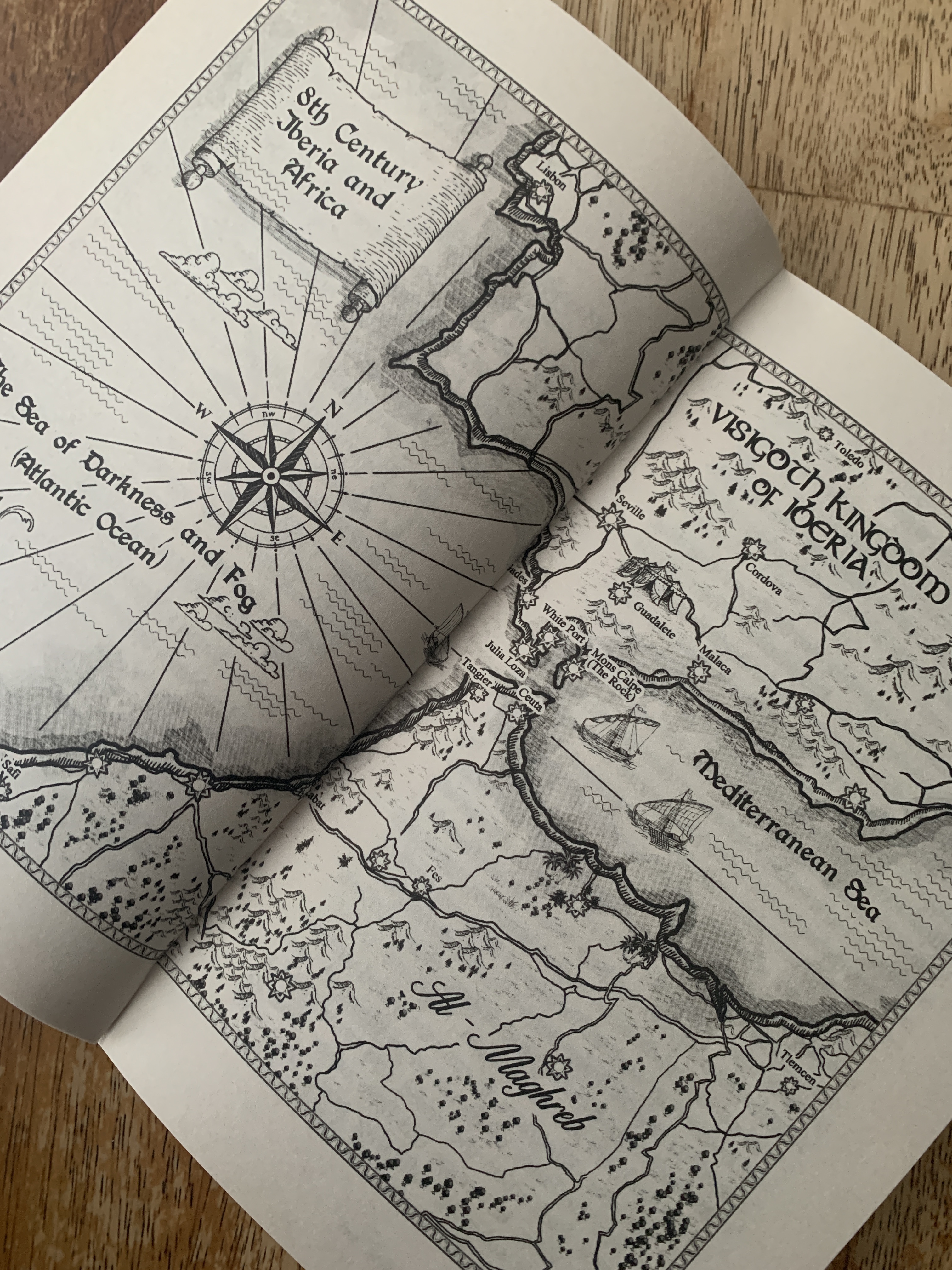
I truly am glad I read this book. I love historical fiction, visiting Spain is on my bucket list, this book has a map, details about what is historical what is fiction, has Islam woven in to the heart and soul of the story and characters, and yet it was a hard read.  The first few pages grip you, the last 50 bring it all together, but the middle 250 were hit and miss in this lower YA/upper MG book.  I honestly had to force myself to keep reading.  My teen and tween son couldn’t get past 38 pages or so, and I’ve asked around and no one I know that started the book, finished it.  I think ultimately there are just too many characters, too many points of view, that even though the history is rich, the literary points all in order, their isn’t enough character connection to hold the readers through the wandering details.  This author’s style is a bit more slow, but I think in the House of Ibn Kathir series, the setting of being in school and having friend problems is relatable to readers; boarding horses on to a boat, deciding to wage war, and going in to battle are not familiar concepts, and without the emotional connection it loses momentum.  The climax is nice but ultimately rather lackluster, and the beauty of characters taking shahada, Jews being freed, Solomon’s table, an old lady with a premonition, and a character dying are just not enough to keep the story in reader’s hands, unfortunately. 

img_4397

SYNOPSIS:

The summary might make the book seem fast paced, and while it does constantly move forward to a clear destination, it isn’t a “buckle your seatbelt and hang on” type of story.  The setting is Northern Africa and the Iberian Peninsula in 711 CE, 92 years after the Hijrah.  The book opens with two young siblings Ben and Bella, overlooking the coast, dreading their lives under Visigoth oppression, and hiding their Jewish culture and faith.  It then jumps to the Governor of Ceuta, Count Julian (Ilyan), awaiting to meet with Umayyad leader Tariq ibn-Ziyad.  He is hoping to rescue his daughter from the court of King Roderick and convince the Muslim General to enter Iberia, restore the rightful king, and free the people essentially.  Add in voices from Qasim, a young Berber, and Jacob a captured Iberian, and the stage is set to get everything in order to cross the straights, survey the enemy, take on the King, and introduce Islam to the new land.

WHY I LIKE IT:

I absolutely love the Islam and the history and the fictional liberties.  I love that the book is clean, although, I do wonder if more information about Lady Florinda would have helped the reader understand her father’s desperation, I do understand the vagueness, but it is a glaring omission that keeps the reader curious.  Ultimately I wanted more backstory.  The little given about the characters was engaging.  I loved the teasing about being a shepherd, Jacob coming to love Islam, Bella not wanting to marry, but it seemed to always stop short of sweeping me away.  I didn’t cry (SPOILER) when Hisham died, I barely knew him.  I didn’t feel the urgency to hide and escape from Leander’s proposal.  It set up to add depth regarding Old Mother Magda, the Cave of Secrets, and the unverified death of the king, but after being stated it was never mentioned again or resolved for any real purpose. 

All that aside, I think the book has value, it is just really dry in spots, a lot of spots, and given the vocabulary, the changing narrators, the choppiness between chapters, and the history, it is hard to keep reading or be anxious to pick up once you have put it down.  So with all that in mind, I think the book would be great to use in a classroom setting.  You could read a chapter Monday, and then pick it back up on Thursday and not worry that no one remembers anything because it is focusing on new characters anyway.  In a middle school, or upper elementary the book would be a great crossover between History, English, and Islam classes. The book would naturally lend itself to the students keeping character journals, the supplements and backmatter would allow for references and insight in to real history, and I think the book would do really well in this set up to connect with the audience. 

The Epilogue was nice, but a little disjointed.  I appreciated the updates on the characters and it showing Muslims and people of other faiths coexisting and being accepting even within families, but the connection to the story was a little lost.  Similarly, I love that it mentioned  Abbas Ibn Firnas, but I don’t know that most kids know enough about him to know what is being hinted at and what the outcome was of his flight at the end.

FLAGS:

Death, war, battles, killing, nothing graphic, very tame, not graphic or detailed gore.

TOOLS FOR LEADING THE DISCUSSION:

I don’t know that I could get middle school students to read the book for a book club, it would have to be motivated by a grade to get through it in a classroom setting I’m afraid.  See above to read my thoughts on how to present it.

I purchased my book on Amazon and will receive a few pennies if you decide to purchase a copy using this link.

Shatter Me by Tahereh Mafi

Standard
Shatter Me by Tahereh Mafi

shatter

In many ways this 338 page dystopian YA fiction book focuses more on romance than the super human powers the 17 year old protagonist has and the role she will play in the resistance.  That isn’t to say the book is bad, just that it isn’t as high action, or reform-a-broken-world, or even use-my-super-powers-to-save-myself-and-those-around-me as I had hoped. It is more a lot of self loathing, desire, and anger.  That being said, I am on the fence about reading the rest of the series, as this is the start of a six book series, with two “half” novellas interjected in and being told from other characters’ perspectives.  If this was a show pilot, however, I would let Netflix automatically start the next episode until I had binge watched the entire season, not necessarily because the story is great, or the characters amazing, or the writing stellar, but because it is easy and fun and you really want to suspend belief and know who all these attractive mutated teens running a broken world are, and yes you will roll your eyes at the syrupy sweet lust filled pages, but it is YA so maybe I’m just overly cynical and 15 year olds and up will enjoy it.  It is an AR 4.3, but the language, violence, and romantic build ups should not be read by 4th graders.

SYNOPSIS:

The book starts with Juliette counting how many days she has been locked up in a cell, 264, void of human interaction of any sort and hinting at the reason her parents feared her and turned her in.  She is then joined by a male cellmate, Adam, one she slowly realizes she remembers from her youth and is in love with.  As he asks her questions we learn a bit about her power and the state of the world.  Juliette can kill people with her touch and apparently has killed someone, a child.  Her parents, along with everyone else, have always feared her, and not being hugged or touched her whole life has definitely been a painful existence for her.  Adam is a soldier and can touch her, he is also planted to learn about her as part of his job.  Warner, another teen, is in charge of a soldiers in the Reestablishment and has been following Juliette for a long time trying to see how they can weaponize her and use her for their cause.  Adam was playing a role, and now Juliette will have to play one in a world where the food is fake, the clouds the wrong color, and artifacts of culture and life before it all fell apart are destroyed and deemed illegal.  Along the way she will have to see the world in shades of gray and be willing to forgive and understand that people are not just for or against the way things, are, that sometimes you just have to do things to survive and protect the ones you love.

WHY I LIKE IT:

With all the talk of Iran in the news, I felt compelled to read a book with a Persian character, or at least by a Persian author, so I revisited the works of Iranian-American Muslim Tahereh Mafi.  The book reminds me of a Bollywood drama from the 90s where the hero and heroine do everything suggestive, except kiss, in this book they do a lot, but I guess don’t quite cross a line.  The scenes with Adam and Juliette are too much at times, where the story building about her understanding herself, her world, and what her powers can be, too little. The stage however, is set for the book and characters to grow in the series and with that optimism of knowing that the story stretches on, I have to hope the twists and turns make for a more interesting ride than this first book presents.  Most of the drama is already spelled out on the back cover, she can kill people just by touching them, she wrestles with seeing herself as a monster, or as being more than human.  It really doesn’t start getting good until she finds others like her, but then she is bored of them and the book ends.  The book has a huge following, so much like perhaps the Twilight series, maybe I’m just too cynical, and not in the target demographic, or maybe I need to keep reading.

FLAGS:

There is violence, *SPOILER* Juliette accidentally kills a child.  There is language, there is suggestive talk, there are romantic passages with kissing and touching.  For a book about a character who can’t touch, I feel like the majority of the book is about her touching and being touched.

TOOLS FOR LEADING THE DISCUSSION:

I wouldn’t do this as a book club, because I feel like it really is just a book setting the stage for what more is to come and because it ends so abruptly it feels almost like a teaser, yes a 300+ page teaser.  I was hoping that I could at least suggest it to readers of Hunger Games, City of Ember, The Giver, etc., but I don’t think it spends enough time on the crisis of the world at hand, and the adjustments made by a select few to appeal to the same readers.  It really is a romance, at least thus far, and the destruction of life and the environment just a back drop for their storyline.

Allies by Alan Gratz

Standard
Allies by Alan Gratz
allies.jpg

This is the second Alan Gratz multi-perspective historical fiction novel I’m reviewing for its inclusion of a Muslim character.  While in Refugee it seemed a natural choice to include a Muslim family, I was completely shocked that he would feature one in a WWII D-Day novel.  With numerous storylines spread over 322 pages the book is quick, fast paced, intense and emotional.  An enjoyable read for history lovers and curious kids fifth grade and up, it is an AR 5.6 and older kids will benefit from it too.

SYNOPSIS:

The characters and timeline are fictionalized to all take place on D-Day, June 6, 1944, as the Allied forces and French resistance come together to storm German occupied France on the beaches of Normandy.  Many of the details do come from history though as detailed in the Author Notes at the end of the book.

The book starts out following Dee, a German national who left for America to escape the Nazi’s and is now returning in a Higgins boat to fight them. Knowing no one will understand, including his friend Sid, a Jew from New York, he keeps this knowledge to himself and focuses on the task ahead.

Samira and her mother are the focus of the next mission and highlight the role of the French Resistance, the Maquis.  What makes their story more meaningful is that they are spies with the French Resistance, but they are French Algerians, not really a part of France at all, and they are Muslim.  In Samira’s back story we learn how she must remove her hijab and how she is treated different at school because Algeria and France are at odds.  When her mother is taken by the Nazis before she can deliver the message to the Resistance, Samira vows to do it and get her mother back as well.

19-year-old James from Winnipeg Canada is a paratrooper who volunteered for combat to feel empowered after years of bullying. His buddy in the story Sam is a Cree Indian from Quebec, who has few rights at home, and hopes to have more success in the military.

Medic Henry is scrambling along on the beach helping anyone and everyone he can.  Having left behind a segregated US, even the military has reservations about African Americans saving and serving. As he performs one heroic act after another being questioned and doubted and insulted all along the way, readers see how ridiculous and infuriating racism is on every level.

We meet Private Bill Richards who drives a Sherman tank and is following in his fathers WWI footsteps.  But who is unfortunately killed before reaching Bayeux.   And finally we meet Monique Marchand, a French 13 year old girl, who gets caught up in the invasion because she left her swim suit in the beach hut the day before and has returned to retrieve it. Determined to do something other than cower in fear, she starts helping fallen soldiers and meets up with American journalist Dorothy, a strong woman determined to not be stopped on the basis of gender.

All the story lines criss and cross as the invasion is a chaotic mess and everyone is dropped, disembarked, or arriving in the wrong place at the wrong time.  Surviving the day is an immediate challenge and not one that everyone will succeed at.  The larger success of the mission will depend on some lucky breaks and a whole lot of teamwork.

WHY I LIKE IT:

I love that the story somehow isn’t political at all in the traditional war story, war strategy sense.  But the strength at least for me, wasn’t the horrific battle at hand, which is truly violent and abhorrent, but the relationships between the people.   The realizing what is driving them, what matters and more importantly how hard our prejudices are.  The larger story of the Allies shows British, Americans, and Canadians coming together to defeat he Nazis, but yet, a girl, an African American, and a Cree are treated as “other” irregardless of how beneficial they are even in matters of life and death.

As for the story of Samira, she is a tough girl, both clever and brave.  To have a Muslim in  an American/westerm story of D-Day and a young girl at that, to me was pretty remarkable.  There isn’t mention of faith or anything other than that she is told to take off her scarf and continues to wear a small kerchief on her head anyway, but for Muslim kids all over, this character and how she behaves will spark a sense of extra pride in the Allies success over Hitler, just as the other minority characters will for their representation in such a dramatic event.

FLAGS:

There is a bit of mild profanity.  There is violence and death, and blood, not too bad, but the point is clear, the beach isn’t pretty.

TOOLS FOR LEADING THE DISCUSSION:

I think this book would be a great supplement to any WWII history lesson.  There are great resources at the end, and maps at the beginning and a high energy, short chaptered book that doesn’t skimp on character building or war intensity.

Author’s website: http://www.alangratz.com


Islamic History for Kids: Story of Badr by Qasim Riaz

Standard
Islamic History for Kids: Story of Badr by Qasim Riaz

badr.jpg

This fictional story of a non-fiction-historical event over 37 large, 12×12, pages really brings the battle of Badr to life for readers ages seven and up.  The book is engaging and keeps chidden focused, excited, and clear as to what is unfolding, why the battle was important for Muslims, and why it still has lessons today.  Unfortunately, there are no source notes, bibliography, or references in the book, so I’m not sure how accurate the details are, and I haven’t yet had a chance to have someone more knowledgeable than I check it for accuracy.  The ayats from the Quran quoted are identified in text and yes, I understand it isn’t a reference book, but even having some imam or scholar give their approval would reassure people considering purchasing the book.  Additionally, fairly prominently there is a disclaimer at the beginning of the book that says, “The characters in this book are entirely fictional.  Any resemblance to actual persons living or dead is entirely coincidental,” which is a common disclaimer, but in a book of this nature, it did strike me as odd.  So, you may want to read it first yourself before presenting it to your child as fact.

3A02CEE2-B385-4AF0-8091-BB9E54CBE579

There is also a typo that my children discovered rather quickly and pointed out to me, I was a little disheartened when I asked about it, to discover the author knew about it before mailing it out, but for some reason didn’t find it necessary to put a note or let the customer be aware of it. I put a post-it note in mine to show all of you, and will be taking a black marker to it shortly.  Mistakes and typos happen, but I felt that they should have let the consumer know, once they knew that it was there, for accuracy sake.

85C78105-8FD8-4B2F-B031-A49272D287DF

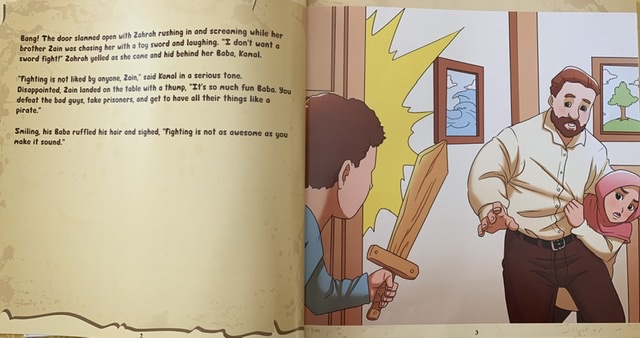
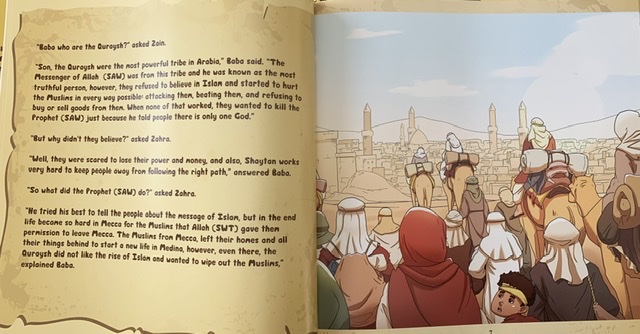
The book starts off with a brother and sister fighting, Zain and Zahrah.  When the father goes to stop them, Zain tells him that Prophet Muhammad (SAW) used to fight, and the father concedes the point, but points out it was not something he wanted to do.  He tells them that for the first 13 years he didn’t fight back even when the Quraysh made fun of him.

DA52115E-5314-4E5A-BE6B-9E38E6E88817

The kids ask who the Quraysh are and why they didn’t believe the Prophet, to which the father lovingly answers their questions before telling him about the verses revealed allowing them to fight from Surah Al-Baqarah.

They learn about Abu Sufyan returning from Syria with a large caravan and how the Prophet wanted to surprise them. Only to learn that Abu Sufyan had arranged a much larger army from Mecca to come and attack the Prophet and his Companions.

There are details about how they determined the size of the army based on how many camels were being eaten, and how the Muslims camped near the wells to control the water.  The story reads smoothly and pulls out when the children have questions seamlessly.

FF278825-CA1F-4904-9F20-DF21DA7085BE

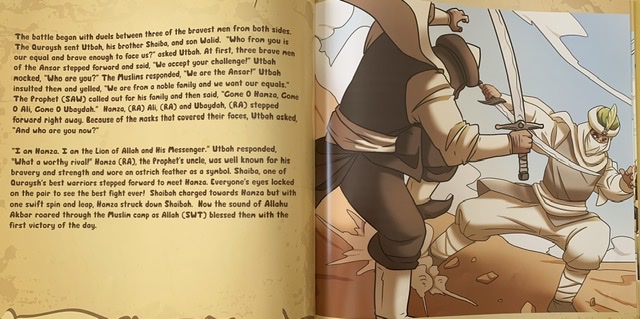
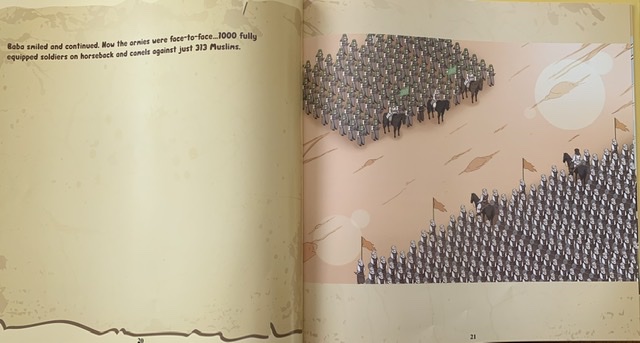
As the battle is set 1000 soldiers against 313 Muslims, the book explains how the battle starts with three duels and explains how Utbah, Shaiba and Walid battle Hamza (RA), Ali (RA), and Ubaydah (RA).  The Ansar win all three battles and the Quraysh charge.

5F4EFF83-0553-4FD0-919A-45814B973E9F

Prophet Muhammad (SAW) makes duas, and Allah (SWT) answers sending a thousand angels following one after another to help.

715028DE-D6FB-436D-88A1-65ACCA437AB2

When the dust settles the Muslims are victorious and the order is given for the prisoners to be treated kindly.  They are given food, rides, and the opportunity to pay a ransom for their freedom or they could teach 10 Muslims to read and write in exchange for their release.

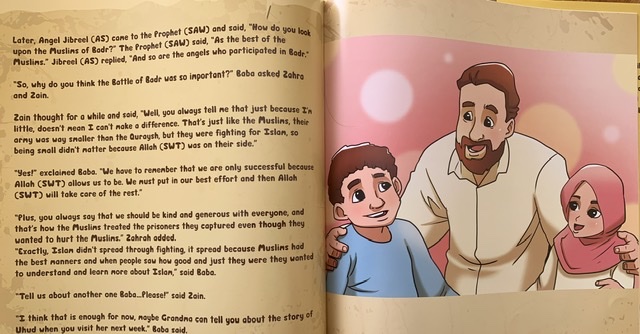
With the story concluded the father then makes sure the children understand some of the many lessons from the battle.  Including having Allah on your side, trusting Allah, putting in your best effort, and being kind and generous even to those against you.

DE00F1A5-8C32-4CF9-8B6D-D880A4C77726

There is no illustrator listed, but the pictures are done really well showing modern relatable, squabbling kids getting drawn in to a historical story by their father.  The emotion on the characters faces adds depth to the story and engages the readers in seeing and understanding a desert battle so long ago.

The text on some pages varies quite noticeably, with some pages barely having a line to spare and some only being a line or two long.  It does slightly affect the rhythm (and aesthetic) of the book, but it is manageable as long as you remember to give the kids enough time to see the picture on the short pages, as the overall size makes the book perfect for story time to large and small groups.  The book stays on level, which is nice, and there is a glossary of abbreviated terms (AS, RA, SAW, SWT) at the end.

The company: Ghazi Production is planning Uhud to be the next book, and informed me a bibliography will be included in that one.  InshaAllah!


The Broken Kingdom by H.G. Hussein

Standard
The Broken Kingdom by H.G. Hussein

broken kingdom.jpg

An engaging chapter book that blends adventure, friendship, battles, mystery, and faith over 292 pages of easy reading and rich storytelling.  The book appeals to readers 10 and up with it being completely clean and age appropriate for anyone younger who can handle the storyline.  The characters are not just active and practicing Muslims, but the story too, is Islamic in nature.   The story is unabashedly pro-Islam and slightly dogmatic, but not overly preachy and faith is woven in seamlessly throughout the story.

SYNOPSIS:

The Sultan of the Islamic Empire is having a recurring dream that involves a floating city falling when a flying object hits it, when he asks his guiding Imam what it means he learns that the city will be destroyed unless the Sultan assists.  Not knowing where the city is, what the object is, and trusting the Sheikh explicitly, a retired soldier is brought back in to service to find the city and save it.  Adam, before he leaves the capital is joined by two others to help him on his journey, Ali and Umar.  Ali is a quiet man whose voice when reciting is absolutely beautiful and whose eyesight and archery skills are unparalleled.  Umar is the Muezzin and the Grand Mosque and a seemingly close figure to the Sultan with familial ties to the area.  The trio sets off to Benghazi to talk with some Bedouins who were ambushed by some man-beasts and are too afraid to speak of the encounter.  It is believed that their experience and the dream are linked.

To reach Benghazi they must travel first by boat for about a week, while at sea they come across an abandoned vessel that has but one survivor and a lion aboard.  After the lion is killed and the injured man brought with them, they are able to continue to try and get information from the Bedouins.  Finally, the Bedouins and the trio are off to the place of the attack and the journey moves on.  When a rockslide and attack from these same mysterious beasts separates the group, Adam, Ali, and Umar are on their own to make there way through the mountains and figure out the threat on their own without the Bedouins.  They journey through a river within a mountain for days on end before meeting soldiers that take them back to their unnamed city.  The city is the one from the dream.  And as they must search to understand what plagues the inhabitants, how to defeat it, and how to survive, they suffer loses, confusion and only a few answers.   They do save the city from the immediate threat, but not from a larger looming one.

WHY I LIKE IT:

The book reads really smooth, a lot of self published chapter books are all over the place, and this one, sticks to the story pretty well.  There are a few tangents, such as the lion on the ship, that really have very little baring on the story, except to show maybe how good of an archer Ali is, however, most are mildly amusing and thus not terribly frustrating.  There are a few smaller incidents that make the book a little less cohesive, for example a passage about a man named Tarek, who brings the Sultan a message and is rewarded with gold, or such detail about Umar not being allowed to go on the assignment and then the Sultan allowing him to go, perhaps it is to show the Sultan’s generosity and willingness to take other people’s opinions in to consideration, but they aren’t particularly smooth anecdotes to the book and read a bit unpolished.  Often these little dives into side issues with fair amounts of detail made me think they would play a role later in the book, but by-and-large, they don’t. One that particularly stood out was Adam meeting the Chief’s daughter in the forbidden woods. I still really want to know why she and her children were there.  I also wanted more information about the man-beast figures and the man and woman that were so quickly killed, and the markings on the trees and in the caves (trying not to spoil too much), in the climax.

I love that the book is Islamic fiction from top to bottom, there are lots of morals exposed and teachings mentioned in real tangible situations.  The character’s pray and carry themselves at all times as Muslims and it is refreshing to read.  Characters in the book take shahada based on the manners of the Muslim characters and the readers see and understand repeatedly the power actions and values have in defining a person.  One of my favorite exchanges in the book is when Adam tells Ali, “The main reason for failure is manners.  To be specific, lack of manners.”  The details continue, and hopefully reinforce and articulate what parents everywhere are trying to teach their children.

The font and binding and all are adequate, I don’t love the cover though.  It seems this is the second cover, and I wish it was more eye catching, it is really bland, and unfortunately won’t compel readers to pick it up.  I also really wish their was a map.

FLAGS:

There is violence, nothing sensationalized or celebrated and it even mentions how heavy hearted characters should be about going in to battle and taking a life.

TOOLS FOR LEADING THE DISCUSSION:

I would love to do this as a middle school book club book. I’d love to hear how the students take the Sultan being referred to as Allah’s representative on Earth.  I get Leader of the Believers, and even Caliph, but I felt this description to be a bit grandiose.  I actually thought it was perhaps a Shia perspective, nothing wrong with that, it just wasn’t something I’d ever heard before and yes I assumed, but the author said, “Of course not.“  He then said, “The Caliph must ensure that the laws of Allah, Most High, are present on Earth.  Every Caliph represented the Creator ensuring Shariah was present, the same as every Prophet and Messenger.” Still not completely clear, I asked a trusted source (not Google) who said it comes from the Ummayads under Muawiyah. So, I’m not sure if anyone else would be hung-up on this, but it is something that stood out to me, although definitely not making the book something to avoid.

I think kids will have strong opinions on the mystery at hand being the book ends on a cliff hanger.  With a lot of questions still up in the air and no real right or wrong answer, I think discussing the book would be a lot of fun.

The book’s website: https://www.thebrokenkingdom.com/