Category Archives: ramadan

Moonlight Hope: A Muslim American Coming of Age Story by Nora Salam

Standard
Moonlight Hope: A Muslim American Coming of Age Story by Nora Salam

moonlight hope

This 354 page New Adult read is truly Islamic fiction, and as long as you know what you are getting in to, you probably will thoroughly enjoy it.  It is Islamic centered, it is preachy, it is idyllic, it counters many stereotypes about Muslims and various cultures, while simultaneously falling into other tropes that define the genre, it has mature framing that is not suitable for younger readers, but doesn’t detail anything that is super “haram.”  If you are looking for a potentially halal romance between YA and Adult ages with Islamic messaging this book is a solid choice.  If however, you will be annoyed by any of the aforementioned labels, this book will not hold your attention or beg to be finished.  It reminds me a lot of Umm Zakiyyah’s If I Should Speak and A Voice books where the story has its own twists and character arcs but it spends a lot of time preaching and setting itself up to tout an Islamic perspective, or concept as well.  I wanted to read two books in the “New Adult” category and see if I could spread my reviews to include them, and with this being the second,  I think I should resist the temptation, and stick to what my library background familiarized me with.

SYNOPSIS:

Told in alternating voices of Intisar and Majed, two individuals in New York City, at different places in their life, but finding that when they hit rock bottom, Islam is the answer.

Intisar is graduating nursing school when the story opens and has only one goal in mind, get married.  She has strict Sudanese parents and has put all of her dreams on finding freedom in the perfect spouse.  She meets a guy at a friend’s house and they secretly date, kiss, and hold hands.  When he ghosts her, she is devastated and reluctantly finds herself agreeing to marry a much older man of her parent’s choosing.  Loosing herself in the idea of marriage, she finds herself heartbroken, ostracized and falling apart.  She starts to put herself back together slowly by finding Islam, her confidence, and some much needed perspective.

Majed has a famous family: his mother a model, his father and siblings singers, and he manages their careers.  After passing out from drugs and alcohol more than once he really starts to examine his life and the road he is on.  He sneaks away to rehab and in the process stumbles on to Islam.  He is Egyptian, but the family is not religious at all, and infact stop talking to him when he converts.  The trials of being a Muslim in New York with no family are not easy, but he feels it is worth it and his journey to Hajj and through loss brings him closer to Allah (swt).

The two stories are parallel and collide slightly in the periphery, but the book ends with them finally coming together and the ever dreaded words of “to be continued,” leaving the reader hanging.

WHY I LIKE IT:

I do like that the story shows struggles when one comes (back) to Islam, it isn’t always a walk in the park, it has challenges and stresses.  The book starts each chapter with a verse from the Quran and is very open about what it is.  So, while at times, the preachiness did get to me, it was very clear what type of book it was from the beginning and I kept reading.

Some of the side characters I felt needed to be fleshed out a bit.  I didn’t understand many of the random friends, how they affected the main character often seemed off, or completely underdeveloped in what was revealed about them: particularly Izzedine, Parita, the girl that married Mansour, the uncle at the Masjid that thought Majed was a spy, etc..  I also really struggled with the presentation of Uncle Munir and his calling Majed, baby, and how he just happened to bump in to him outside the bar, and the kisses.  I’m guessing it was meant to show him as over the top affectionate, but it just read as odd.

I like that the book addresses hypocrisy, mental health, and expectations.  It doesn’t paint all Muslims as good or bad, nor society at large.  The book reads as a journey, and many characters are given a chance to correct their errors and be seen in a new light.

The majority of the book is written well, but right away the book gave me pause as Intisar and her friends chat all through the Jummah khutbah, I get that it is trying to show her disregard for intentional practice of her faith and her “boy crazy/marriage” obsession, but you cannot speak during the khutbah, it isn’t just dirty looks, you truly cannot talk for it to count, and it isn’t even remarked upon, and it made me skeptical of the book for a while.  There is a word missing from a sentence on page 161 and at one point a brother in the prayer hall aims a shoe to throw.  But you wouldn’t be wearing shoes in the room where you pray, and the mosque has hallways and a glassed off section for women, so this seemed like an obvious oversight that should be fixed.

FLAGS:

Drugs, alcohol, lying, overdose, sneaking out, kissing, hooking up, physical affection, violence, temptation, sexual predatory behavior, it is an adult book, so I’m not going to continue listing everything. Nothing haram is overtly detailed or glorified. Ages 17 and up, could handle it.

TOOLS FOR LEADING THE DISCUSSION:
Too mature for my book club crew, but I wouldn’t mind it on a shelf in the school library.

10 Steps to Us by Attiya Khan

Standard
10 Steps to Us by Attiya Khan

steps

I try really hard to keep an open mind when reading Islamic YA romance books knowing that certain standards are probably not going to exist to move the story along, and of course I’m fully cognizant that Islam is practiced in a myriad of ways and chances are, I will disagree with a fair amount of any book in this genre.  This particular book though, was hard to read.  Ultimately I just didn’t like the protagonist, she was shallow and flimsy and her grasp on reality seemed lacking at times.  The premise of the book is that you can have a boyfriend, if the boyfriend is Muslim.  So by not agreeing with the very foundation; made the rest of the book hard to wrap my head around.  The book is largely about hijab, and the author starts the book thanking the individuals that “educated her about the hijab,”  yes, the article “the” is often used, and thus so much of the nuanced lived OWN voice experience of wearing hijab, is lacking.  The book features language, lying, kissing, making out, talk of wanking, condoms, groping, and a scene that nearly concludes with sex, but stops short, barely.  Perhaps high school seniors and college age teens could read this 231 page book, but I don’t know that the book is worth their time.  Practicing Muslims will be irritated by the lack of mirroring, cultural readers will be annoyed that the protagonist didn’t push back on toxic assumptions, and non religious readers will be left confused at what the book hopes to accomplish by including religion and culture to no real definitive purpose in a romance novel.

SYNOPSIS:

High school student Aisha wears hijab much to her parents protests, and tries to avoid the Islamophobic aggressions that she endures in her white Kent neighborhood.  She learns more about Islam than cultural superficiality from a family friend, an aunty, and she goes through her daily life largely unnoticed.  She has a close friend, who is popular and likes to party, but Aisha doesn’t go out much, yet Isabelle still finds ways to include her.  Everything starts to change however, when Darren moves in to town, defends Aisha at the bus stop and seems to be interested in being more than just friends.  Aisha doesn’t date, but reasons if Darren were a Muslim, nothing would stop her.  She devises a 10 step plan to make it all work, she just has to convert him.

While she sets her plan in motion, she finds herself lying to Isabelle, who has a crush on Darren, lying to her parents so that she can sneak around with Darren, and lying to Shafqat Aunty about her relationship with Darren.  Along the way, she will lose her friendship with Isabelle, uncover dangers of equating culture and religion, remove and reconsider her hijab, nearly lose her virginity, and have to decide where her boundaries are.  By the end of the book, nothing is clearly articulated for Aisha’s future or what she has decided regarding her relationship with Islam, hijab, and future boyfriends.

WHY I LIKE IT:

I struggled with the book.  I like the flipped stereotype of the family not supporting hijab, but Aisha wearing it for her self anyway, unfortunately, I never felt that I understood why she felt strong enough to wear it, what brought her closer to Islam, and learning about Islam, and what the catalyst of it all was.  I think knowing more of Aisha’s backstory might have made her more like-able.  Throughout the book Shafqat Aunty is her whole Islamic touchstone.  She doesn’t seem to have any other way of learning, or studying Islam.  It seems that to come to Islam in high school would mean a level of maturity would exist that the character simply does not exhibit.  I started wearing hijab at 16, I was the first in my family, I did it for me, I was actively trying to be a better Muslim and understand Islam, and hijab was simply a physical, tangible manifestation of that.  So to see a character so passive in the learning, was a bit of a disconnect for me.  I’m not saying that everyone has an experience like mine, but her grasp of basic Islamic tenants seems so weak, and she doesn’t seem to have a way to acquire understanding, or even a desire to obtain it.  Often Darren seems to know more about Islam than she does.

I really struggled with the conceptual thread that her hijab prevents her from feeling comfortable making-out with Darren, so she hides it when clothing starts falling off.  Shouldn’t hijab be the reminder to not have gotten in that situation in the first place? Perhaps if she would have had some depth, or the relationship wasn’t “love at first sight” I would feel a bit more invested in her trying to sort out her beliefs while in the midst of such strong lust, but it wasn’t developed to that level.

I liked the initial idea of sorting through cultural and religious views on divorce especially considering the woman involved is being abused, but I didn’t think the book exerted a strong enough stance that divorce in Islam is absolutely ok, that abuse is not ok, and anything otherwise is backwards culture.  The book set itself up to make a strong statement, but then it abandoned it.  I’m not sure why the author didn’t get up on a soap box and preach, I mean it would have given the book something really powerful to highlight and given Aisha some growth in understanding where culture has undermined the power of women’s rights in Islam.

The book dismisses understanding one’s faith, and falls into predictable troupes despite setting itself up to be “different,” when  Aisha fears being shipped off to Pakistan when her parents find out about her and Darren.  The writing feels forced at times, and a few times He when referencing God is not capitalized.  I appreciate that some surahs, and duas, and Ramadan are included, but they don’t seem to shape Aisha, it seems like she is simply going through the motions.

The book ends on a “cliff hanger” of her either placing her scarf in the hamper or the garbage.

FLAGS:

Language, talk of sex, fairly vivid make-out scene that stops short of sex when they pause to acquire a condom and then Aisha changes her mind.  There is a lot of lying, normalizing relationships if both are Muslim, even if both are not, talk of domestic violence, slut-shaming, hickies, crude jokes.

TOOLS TO LEAD THE DISCUSSION:

There is no way I would encourage this book in an Islamic school setting.

A Sweet Meeting on Mimouna Night by Allison Ofanansky illustrated by Rotem Teplow

Standard
A Sweet Meeting on Mimouna Night by Allison Ofanansky illustrated by Rotem Teplow

img_0532

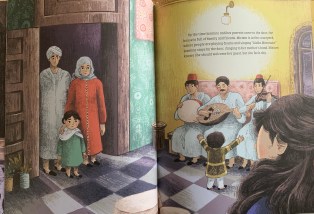
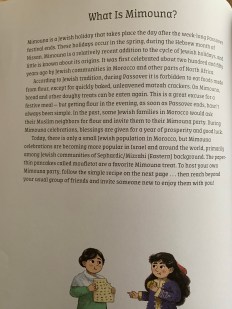
A story about the Morrocan Jewish holiday, Mimouna, that marks the end of Passover introduces readers to a small but growing Jewish celebration from Northern Africa.  Stemming from the historical fact of Jews often borrowing flour from their Muslim neighbors to make the traditional Maufletot, thin pancakes, after a week of not eating flour.  The story focuses on a Jewish girl and a Muslim girl meeting each other, celebrating with each other, and finding similarities between Ramadan and Mimouna.  Over 36 pages, kindergarten to second grade readers will get an introduction to two different faith holidays and see that friendship and kindness are possible everywhere.

img_0526

It is the last day of Passover in Fes and Miriam is tired of eating quickly baked unleavened matzah crackers, she is ready for the sweet dough pancakes of Mimouna, and she is willing to help her mom make them.  But before Passover, all flour was removed from the home, and she asks her mother where they can get flour tonight before the  party.

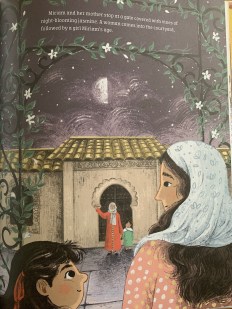
Mom and Miriam begin to walk.  They leave the part of town that Miriam is familiar with and Miriam sees a building with a dome and minarets.  “What is that?” she asks.  Her mother replies, “It is a mosque, where our Muslim neighbors pray.”

img_0529

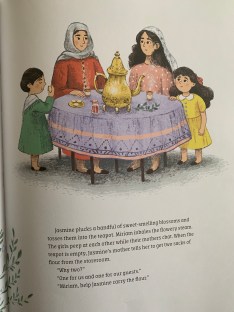
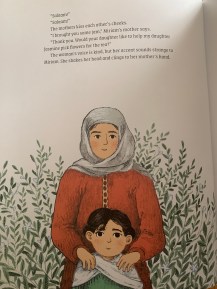
They then enter a courtyard where a woman and her daughter about the same age as Miriam appear and invite them in for tea.  The two women say salaam and kiss each other’s cheeks.  Miriam’s mom gives the other lady a jar of fig jam and invites her and her family to come to the house to celebrate Mimouna with them. When the women are done drinking tea, Jasmine is asked to go to the store room for two bags of flour and Miriam is sent to help.  Jasmine is told one bag is for them, and one is for their guests.  The two shy girls go get the flour, and when Miriam trips, Jasmine catches the bag just in time.

img_0525

On the way home, Miriam has so many questions about the lady and how her mother knows her and how come they don’t have a jasmine vine. But, when they get home there is a lot of work to be done before the guests start to arrive.

By the time Jasmine and her parents come the house is full and music is being played and songs are being song.  The first plate of maufletot goes to Miriam’s grandfather, and when she trips and they go flying it is Jasmine who catches them.  The girls giggle and Miriam teaches Jasmine to play the song, “Alalla Mimouna” on her tambourine.

img_0524

The party moves from house to house and at one home green wheat is dipped in milk and sprinkled over everyone’s head as a blessing for the upcoming year.  By the time the girls get back home they are tired, and as they share one last pancake, Jasmine tells Miriam about the nightly feasts of Ramadan after a day of fasting.  She invites Miriam to join them, and Mariam is excited, but Mariam’s mom explains that they are moving to Jerusalem.

img_0527

The following year on Mimouna Night, Mariam heads to the store to buy flour, but thinks of her friend Jasmine back in Morocco as she smells the jasmine growing in her home, and wonders if her friend is also thinking about her.

img_0528

The author is an Amerian Israeli, and I was nervous that there would be political overtones, but she deliberately wanted to avoid that and focus instead on presenting this little known Jewish holiday in an interfaith manner.  There is an info section at the end of the book explaining Mimouna and a recipe for moufletot.  In author interviews you can read more about how the story came to be, and what her hopes were in telling it: https://jewishbooksforkids.com/2021/03/14/interview-with-allison-ofanansky-author-of-a-sweet-meeting-on-mimouna-night/

Baddawi by Leila Abdelrazaq

Standard
Baddawi by Leila Abdelrazaq

Baddawi-cover

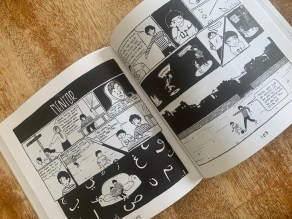
This 8.5 x 8.5 middle school graphic novel biography tells a powerful story of a young boy coming of age and striving to find his place in the chaos of the Nakba and its aftermath.  Over 128 pages the reader will learn and be outraged about the displacement and genocide of so many Palestinians as they see the events through Ahmad’s eyes and relate to his dreams and experiences despite the terror around him. The book has violence, destruction, death and mentions rape, yet the humanity shines through as it is also heartfelt and memorable.  I had my 14, 12, and 10 year olds read it and we have discussed it at length in context to what they already know about Palestine and the ethnic cleansing occurring.  It is a seamless mix of history and character driven narratives brought to life by the black and white illustrations of the author/illustrator’s family history.

img_1656

SYNOPSIS:

There are 10 children in the author’s father’s family, and her father, Ahmad, was born in a refugee camp in northern Lebanon, called Baddawi.  The story starts on October 29, 1948 when Safsaf was ethnically cleansed.  Ahmad’s father, the author’s grandfather had been in Akka at the time of the massacre, and her grandmother hid from the Israeli soldiers, the family, once reunited, would escape for a refugee camp, hoping that they would one day return.

We first get to know Ahmad as he starts first grade in Baddawi.  Things do not start well for the little guy as right away he gets teased by other students, his class is too large so he is selected to be joined with a girls class, and he doesn’t have soccer cleats so he isn’t allowed to play soccer, luckily he gets two good crayons, unlike his friend who gets a white one.  Ahmad is identifiable by his striped shirt that he wears throughout as a nod to Handala, the boy depicted with a striped shirt with his hands clasped behind his back and his face not shown.  The artist said his face would be revealed when Palestine was free, sadly the artist, Naji al-Ali passed away, and Palestine is still occupied.

Ahmad desperate to purchase soccer cleats devises a business plan that his mother takes as gambling and quickly puts an end to, in exchange she offers to pay him if he helps her collect and prepare za’atar.  It isn’t as fun, or as lucrative, but they family is busy packing up to return to Palestine.  Unfortunately the Naksa, the setback, the six day war occurs, and more Palestinians are ethnically cleansed and the families cannot return. Ahmad and all those in Baddawi carry on, playing, celebrating Eid, trying to claim normalcy.  The camp however, is not safe and soldiers raid the camp killing PLO leaders and innocent people in their way.  With no option but to keep on keeping on, these acts of violence are often taken in stride. It is so hard to believe, but what else can they do, the children still play, deal with bullies, and cope with universal struggles in addition to being shot by rubber bullets, and fearing cluster bombs and shellings.  At one point Ahmad and his siblings are left in Baddawi to finish school while his parents are in Beirut.

When the family is reunited in Beirut, Ahmad is in a better school, but violence follows as Mossad agents start raiding PLO homes in Lebanon.  Ahmad goes back and forth between Beirut and Baddawi, wherever he can go to school.  His favorite library is the one at the American University in Beirut and he hopes to attend school there, but without connections, he is at a loss to come up with funding.  His intellect finally lands him an opportunity to leave the Middle East to pursue higher education, he ends up in the United States, and when the story ends, readers are left hoping that everything works out even knowing it will be 10 years before he can return home to see his family.

img_1657

WHY I LIKE IT:

I love that the harsh horrific life is not shied away from in a war, but the little things are just as important in shaping and showing Palestinians to be resilient and culture rich.  I love how the concept of Handala is included and amplified.  The book is at times funny, and at other times devastating.  The connection to the characters is pretty remarkable, in such a relatively short book, and I am fairly confident it will be pulled off the shelf and thumbed through often.  I really wanted to know if the girl in the book that Ahmad left behind ended up being the author’s mother, or if he married someone else, but I couldn’t find it by Googling.  This book is truly powerful, and I highly recommend it.  There isn’t a lot of religion, the family is shown praying on Eid and celebrating.  It mentions the diversity in Beirut, but nothing too detailed.  Similarly, there isn’t a lot of political detail.  There is a glossary at the end, some actual photographs of Ahmad and his family.  At the beginning of the book there is a preface about Handala and how Ahmad represents more than just her father’s experience as well as information about the tatreez patterns on the pages and a map.

img_1658

FLAGS:

There is violence, torture, killing, death, bullying, and possibly gambling.  The book mentions that women were raped, but it isn’t detailed.  The war is ever present and depicted, but it isn’t sensationalized.  Ahmad and a girl study together and the family wants them to get married, but Ahmad opts instead to leave for school, nothing inappropriate.

img_1661

TOOLS FOR LEADING THE DISCUSSION:

This book might not work as a book club selection, but I hope middle school children and their teachers or parents will encourage them to read this book and think about it.  Imagine if it was their homes that were taken, imagine what they would do, and how they would manage, and to be aware that it is still going on and that we cannot be silent.

img_1660

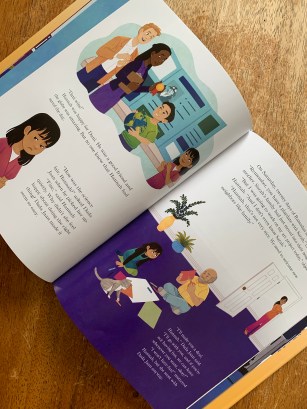
Hannah and the Ramadan Gift by Qasim Rashid illustrated by Aaliya Jaleel

Standard
Hannah and the Ramadan Gift by Qasim Rashid illustrated by Aaliya Jaleel

img_0275

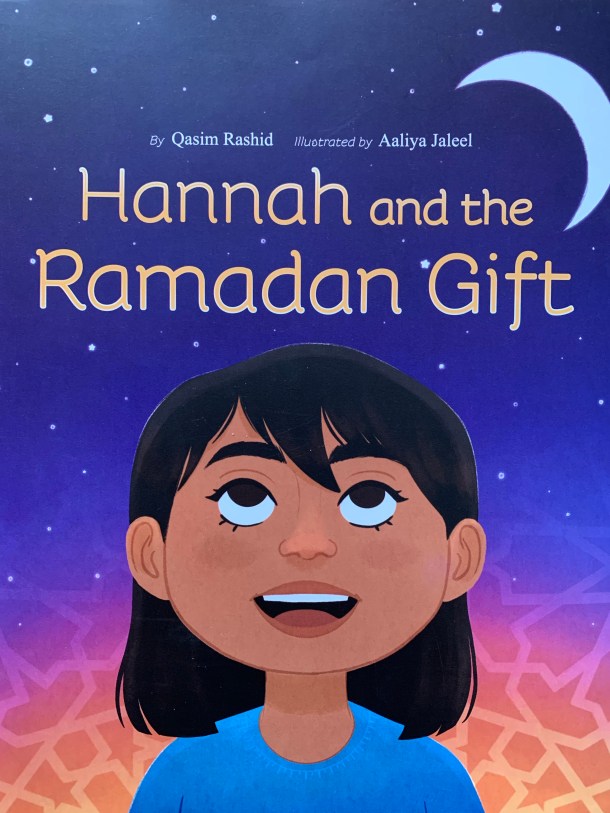
You may have seen this new 40 page Ramadan book that came out yesterday and thought, “another book about what Ramadan, is and a girl being told she is too young to fast, I’ll pass.”  And I’m here to tell you, please reconsider.  This book is wonderful and it is not the same-old-same-old.  I know the title and cover don’t hint at the heartfelt story within, but it really does an amazing job of showing, not just telling, about the feelings and purpose of Ramadan beyond the restraining of food and drink.  The text is a bit heavy, but the illustrations keep even four and five year olds engaged, and the story works for Muslim and non Muslim children alike.  The OWN voice book has a Desi slant with Urdu words, Pakistani clothing and featuring an immigrant family, but the cultural tinges are defined in the text and it flows smoothly.  This would be a great book to share with your children’s class to show how Ramadan is more than just going without food, or being just one day, or one act of kindness, it is an ongoing effort to show kindness to those near and far.  The book shows an authentic Muslim family and presents universal themes, making Ramadan and Islam more relatable and familiar to all readers, and inspiring Muslim children to find their own ways to save the world.

img_0276

The book starts with Hannah being woken up by her paternal grandfather, Dada Jaan, it is the first day of Ramadan, and she is excited.  She hopes that now that she is eight years old, she is old enough to fast.  Her heart sinks when she is told, “Fasting is for grown-ups, not for growing children,” but her spirits rebound when Dada Jaan tells her that she is going to celebrate Ramadan by saving the world.

The first thing Hannah and Dada Jaan do is collect cans from the pantry to take to the soup kitchen.  Dada Jaan explains what a soup kitchen is, and why it is important to help those that don’t have enough food.  Hannah is worried they won’t be able to help everyone in the whole world, but Dada Jaan encourages her to start with her neighbors.

img_0277

Later in the day, Hannah’s friend loses a beloved family necklace, and when the bell rings she doesn’t want to be late for class, but she remembers that she is supposed to help, so she does.  Hannah finds the necklace, but her teacher is not happy when she comes to class late, and Hannah isn’t even given a chance to explain.

On the 11th day of Ramadan, Hannah and Dada Jaan decide to save the world again before they head off to the science fair.  They are packing up clothes to take to the shelter.  Hannah is worried that the people at the shelter won’t know that they are the ones that donated the clothes.  Dada Jaan says that it is enough to help people out of love and adds that the best superheroes work in secret.

img_0278

At the science fair Hannah sets up her model replica of Abbas ibn Firnas’s flying machine next to her friend Dani.  When Dani runs off to see a robot, his globe rolls off the table and Hannah saves it. Dani ends up winning and she is happy for him, but she is sad that no one knows she saved his project.

Twenty days in to Ramadan, Hannah has a play date with a girl she has never met before and Hannah does not want to go.  Sarah is new to the neighborhood and Hannah’s mom insists she goes.  Luckily Dada Jaan strikes up a deal that he will take her and they can leave when ever she wants.  Hannah and Sarah have so much fun together, Hannah doesn’t want to leave.

img_0282

When they get home, Dada Jaan shows Hannah old photographs of when he and Dadi Jaan had first come and didn’t even know the language.  They talk about how the kindness of others helped them, that and Dadi’s butter chicken.  The night before Eid, Dada Jaan asks Hannah if she helped make the world a better place, she doesn’t think she did, but he seems to think otherwise.

On Eid day they go to the mosque, then to the cemetery to pay respect to Dadi Jaan, and when they return home they find Hannah’s whole world there to celebrate with her.  Cousins, friends Maria and Dani from the church across the street and the synagog by the mosque, as well as the Sikh family that runs the soup kitchen.  Dada Jaan and Hannah enjoy gulab jamun, kheer, and jalebis as they discuss if Hannah really did help the world this Ramadan.

img_0280

It is hard in my heart to go wrong with a story that focuses on an amazing grandfather/granddaughter relationship that ends with them racing to get the last gulab jamun, so I might be a little bias.  But I was genuinely surprised and delighted by the direction the book took and the way it presented Ramadan in everyday situations that children can relate to and imitate. I was a little disappointed that the book wasn’t larger considering the phenomenal illustrations.  It is just 8.5 x 11.  I love that the characters pray and read Quran, and the mom covers and the neighbors are diverse.

Too Small Tola by Atinuke illustrated by Onyinye Iwu

Standard
Too Small Tola by Atinuke illustrated by Onyinye Iwu

9781536211276

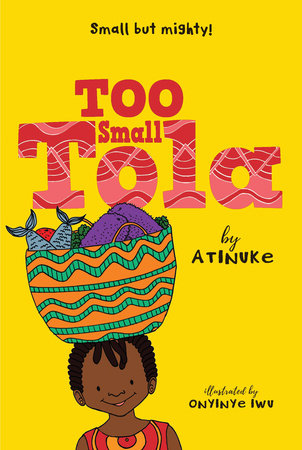
This AR 3.6, 89 page early chapter book features three stories set in Lagos, Nigeria.  The main character and her family are Christian, but many of the neighbors are Muslim, and the third story is set in Ramadan with Easter and Eid falling at the same time.  The sense of community throughout the book, the OWN voice detail and charm make this book silly, warm, and delightful for first through third grade readers.

img_9777

SYNOPSIS:

In the first story Tola heads to the market with her Grandmommy.  Not the fancy mall, but the muddy market further away.  Her older brother Dapo is too busy playing soccer to help, her older sister Moji is busy with homework, that leaves little Tola to carry the items on her head with her tough as nails little grandmother.  Everyone says she is too small, but Grandmommy knows she can do it.  As they purchase the items, and neighbors call to have them pick up items for them too, the duo have to take lots of breaks on their way home, but Too Small Tola does it and proves to herself and others that she might be small, but she is strong.

The second story once again focuses on life in Lagos and the one bedroom apartment the family shares.  One morning both the power and the water are out and the jerry bottles need to be filled at the pump.  When some bullies trip Tola and the water spills, an elderly neighbor lady patiently waits for the right time to get her revenge on Tola’s behalf, and when the bully challenges the woman, the entire line stands together.  Tola may be small, but she stood for something and made a difference.

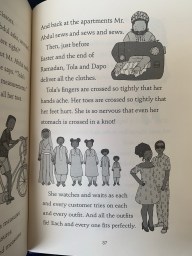
The final story involves the neighbor, Mr. Abdul, the tailor who lives downstairs, coming to measure Tola and her family for their new Easter clothes.  He let Tola measure everyone last year and praises her as the best measurer in Lagos, and Tola is eager to take the measurements this year.  When the tailor breaks his leg, he is worried he will not be able to ride his bicycle to his clients and will not be able to prepare the Eid feast and pay rent.  Tola knows they have been fasting all Ramadan and between her, Grandmommy, and Dapo they come up with a plan to help.  Dapo will peddle the bike and take Tola to measure everyone for their orders.  Tola may be small, but she can save the day for the Abdul family.

WHY I LIKE IT:

I love little Tola and her sassy grandma.  The book would lend itself so wonderfully to be read aloud as it bursts with personality and dialogue.  I love the sense of community in such a day-to-day life that would seem to stark and hard to most western readers.  Tola’s draws on those around her to find her strength, from her Grandmommy, to her neighbors, they may tease her that she is too little, but they also build her back up and stand with her.  I love the diversity in Tola’s world.  She seems so excited that Eid and Easter will be aligned and that after her services they will be joining the Abdul’s feast, such a great lesson of tolerance and respect without being preachy about tolerance and respect.  Young readers will enjoy Tola and the insight into Nigeria.

FLAGS:

Grandmommy lies when a neighbor calls her in the market to ask her to pick up his TV, she pretends the battery dies as she and Tola laugh at how ridiculous them carrying a TV would be in addition to everything else they are carrying.  There is bullying when Tola is tripped and then when Mrs. Shaky-Shaky trips the bully.

img_9781

TOOLS FOR LEADING THE DISCUSSION:

This wouldn’t work for a book club, but would be ideal in small groups, or to be read aloud.  There would be a lot to discuss as children would relate to Tola and find themselves cheering her on.

It’s Ramadan and Eid al-Fitr! by Richard Sebra

Standard
It’s Ramadan and Eid al-Fitr! by Richard Sebra

img_9007

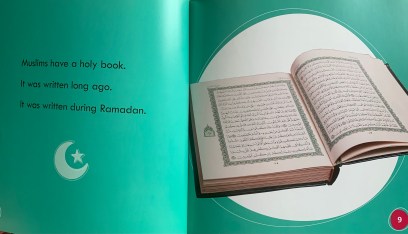
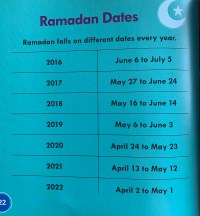
Sigh, another erroneous children’s nonfiction book from a holiday book series targeting classrooms.  This 24 page book is meant for pre-school to first grade and in addition to being vague and repetitive, states that Muslims have a holy book that was written in Ramadan.  It never states the Quran by name, and clearly it wasn’t written, it was revealed in Ramadan.  It later also states that Eid al-Fitr is the last day of Ramadan, failing to acknowledge that it falls on the first of Shawwal, when Ramadan is over.  The table of Ramadan dates at the end spanning from 2016-2022 is also problematic if you are trying to explain that we often don’t know until the night before when Ramadan and Eid will be because we need to sight the moon.  These errors may appear minor, but when they seem to fill every recently published children’s nonfiction book, it really makes the correction of such assumed facts that much harder to overcome.  If our non-fiction books are so consistently flawed, our sense of reality is being shaped erroneously, and imagine what else we have consumed as fact that isn’t accurate over the years.  Please speak out when you come across these errors, in Islamic books and all non-fiction works.

img_9008

The book is filled with simple short sentence and often repeats the same basic information on multiple pages.  The two page spreads contain the text on one side and a realistic photograph on the other with critical thinking prompts to consider.

img_9009

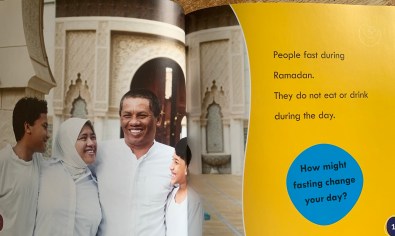
It starts off by establishing that Muslims have a calendar based on the moon, that Ramadan is the ninth month and it is a holy month.  The next page again reasserts that Ramadan is not one day, but a whole month before introducing the idea that families get together to pray.  The erroneous page about the Islamic holy book follows and then the concept of fasting: not eating or drinking during the day is presented.  The critical thinking point asks readers to consider how fasting might change your day.

img_9010

There is then a page about prayer which includes that we kneel on rugs, pray everyday, but pray more in Ramadan.  I’m not sure why this page didn’t follow the page that first mentioned prayer, especially since the next page goes back to talking about food which probably should have followed the page on fasting.

img_9011

The page about Eid being on the last day of Ramadan is then followed by more sentences over a few pages about Eid being a festival, there being food, and gifts. There is a table of Ramadan dates at the end, as well as an index and books to further read.  There isn’t a proper glossary because there really isn’t any vocabulary presented  in the vague descriptions, but there is a picture glossary with words such as celebrate, dates, gifts, and prayers.

img_9012

Ramadan by Mari Schuh

Standard
Ramadan by Mari Schuh

ramadan edelweis

This 16 page holiday book is one in a series of six.  It keeps the text simple, the images bright and inviting, and turns the pages in to a search and find activity to increase time spent with the material.  The information is accurate and basic, there is nothing wrong (phew) with this recent addition to the very crowded nonfiction holiday book field.  In fact I appreciate that dates are explained and that the food looks tempting even if non Muslim children aren’t familiar with the dishes.  It shows a child in sajood and explains that he is praying. The realistic pictures show smiling faces and Muslim kids will feel represented. Non Muslim readers will become familiar with Ramadan as a time of fasting, the Quran, and prayer.

The pictures to look for are given at the beginning and again at the end with the “answers.” The limited pages have very minimal text.  The first one mentions a lantern being hung for Ramadan. It then states that Ramadan is a Muslim holy month where people fast, don’t eat or drink.

It shows a picture of the Quran and says it is used to pray, before showing someone praying on a prayer rug. When the sun has set it is time to eat. Dates are a sweet fruit to snack on after dark. It then shows a child and adult making dua and again reiterates that the holy month is for praying and helping others.

‘Tis The Night Before Eid by Yasmin Rashidi illustrated by Mariam Aldacher

Standard
‘Tis The Night Before Eid by Yasmin Rashidi illustrated by Mariam Aldacher

img_8995

On the surface this 32 page inspired re-imagining of the classic Christmas poem might not seem that impressive, but it is really quite effective in highlighting general key points of Ramadan, the mix of sadness that Ramadan has gone too quickly with the excitement of Eid, and showing the diversity of Muslim families and communities.  The large 8 x 10 hard bound pages showcase fun and relatable illustrations that would help inform those unfamiliar with the holiday, while also mirroring and encouraging Ramadan and Eid excitement.  It is already a favorite at our house and with simple rhyming lines, the book can lend itself easily to more in-depth discussions (there is a glossary at the back) or be kept as a sweet flowing story that you don’t mind reading repeatedly at the prodding of toddlers and preschoolers alike.

img_8997The story starts with it being the night before Eid.   Ramadan has flown by, iftar eaten, dishes are put away, trips to the masjid for Taraweh have concluded and now it is time to prepare for Eid.  The house is cleaned, clothes ironed, sweets prepared and dreams of gifts filling the kids minds.

img_8998

The narrative bounces back to Ramadan to explain that fasting is not eating til sundown for 30 days, that Quran was revealed during the blessed month and that we hold on to the lessons of Ramadan all year long.

I pre-ordered mine from the author’s website https://rashidibooks.com/home , but it is also available at Crescent Moon Store https://crescentmoonstore.com/products/twas-the-night-before-eid.  There are also printables on the author’s website.

img_9002

Ramadan and Eid Al-Fitr: Traditions and Celebrations by Melissa Ferguson

Standard
Ramadan and Eid Al-Fitr: Traditions and Celebrations by Melissa Ferguson

This 2021 nonfiction middle grade book about Ramadan and Eid al-Fitr breaks sections down by key concepts and the use of stock image photographs. The information is fairly accurate, no major flags, just a few awkward stresses: that kids look for the moon, that meat is so important at iftar, but most of the information is conveyed well. There is a glossary, more books to check out, internet sites to visit, an index, and pronunciation guide. The Capstone published, 32 page book, shows diversity in the pictures- some women with hijab and some without, different skin tones as well, and while it might not be the most tempting book to pick up, the text is inviting for non Muslims to understand Ramadan and Eid, how to join their Muslim friends in being kind and forgiving, and answers a lot of questions in a straightforward manner. Muslim children will also enjoy seeing their beliefs explained in a positive manner to readers in a book that stays religion focused and doesn’t get distracted by culture.

The book sections are: What is Ramadan?, When is Ramadan?, What does Fasting Mean?, Suhoor, Iftar, The Qur’an and Prayer, Acts of Kindness, Ramadan at School, and Eid Al-Fitr. It starts by introducing a fictional character named Ayesha reading the Quran with her family. It is the start of Ramadan, a month of praying, fasting, spending time with loved ones, and trying to be better people.

It then explains the lunar calendar before discussing that fasting is a choice to not eat or drink from dawn until sunset. It also notes that children and the sick and elderly are not required to fast.

It talks about eating healthy foods early in the morning before praying the first prayer of the day. It details iftar being dates and water, followed by the sunset prayer and then a large meal after that.

It is very clear in explaining that Muslims believe it was during Ramadan that God began to teach Prophet Muhammad the Quran more than 1,400 years ago. It identifies our five prayers and that people can pray at home or in mosques and that children learn to pray with their parents as they grow up.

The book then becomes a little more unique as it gives time to the aspect of kindness in Ramadan. It gives examples of what Muslims do, from raising money and hosting large dinners, to buying and donating a toy. It even dedicates a whole page to children doing kind acts with little to no money: setting the table, making a card, smiling. It encourages non Muslims to join a Muslim friend in doing an act of kindness too.

The next section, is similarly unique in talking about Ramadan at school and how often at school we learn about different religions in our neighborhood. It gives bulleted suggestions on how to learn about Ramadan in school and how to say Ramadan greetings. The book concludes with Eid Al-Fitr and coming back to Ayesha and her family celebrating.