Category Archives: Picture book

Rami the Ramadan Cat by Robyn Thomas illustrated by Abira Das

Standard
Rami the Ramadan Cat by Robyn Thomas illustrated by Abira Das

rami

This delightful little story about a boy, a lost cat, Ramadan and making friends, has a great lesson in empathy and understanding even when things are hard.  The 28 page beautifully illustrated glossy book (8.5 x 11)  is set in Ramadan, but is enjoyable for children 5 to 9 all year long.
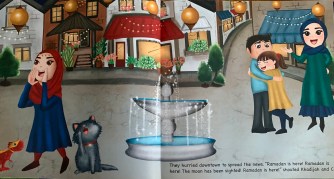
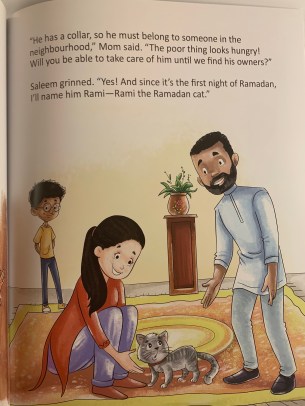
Saleem has just moved to a new city with his parents and doesn’t know anyone.  Feeling lonely on the first day of Ramadan he is outside sulking when he sees a lost little cat.  He brings it in and his parents help him take care of him until they can find the cat’s owners.

B342E851-726B-4B8A-9B63-F381F5C1009D

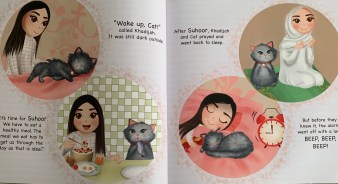
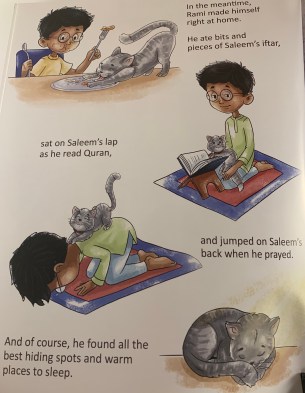
Saleem decides to call the cat, Rami the Ramadan cat for his timely appearance.  The next day the family makes flyers to post around to try and find Rami’s owner.  But no luck even after a few weeks, and secretly Saleem starts hoping they never find the owners.  Rami is his best friend, he jumps on Saleem when he is praying, keeps him company when he reads Quran, even shares his iftar with him.

22F7C85A-8891-4121-A608-421511688C49

One night at the mosque, Saleem makes Dua that Rami will stay with him forever.  After Taraweeh, Saleem can’t find his father, he waits by the door as everyone leaves, but can’t see him, he checks the shoe rack and his shoes are gone.  Feeling scared and alone he wonders if his father left him.  When his father returns from the washroom, Saleem is relieved, but wonders if that is how Rami felt that first day of Ramadan.

6E10660E-7FE3-4341-AF7E-B75EDF45DC8E

The next morning Saleem and his mom knock on every door in the neighboorhood until they find Rami’s owner.  When they find her, she is a nice lady, and tell Saleem, the cat’s name is Sammy.  Rami gives her his address and asks her to contact him if she ever needs someone to cat-sit Rami.

3634A3A5-B74D-4505-8C44-AED216D38872

Saleem’s Eid isn’t very fun without his only friend.  After prayers, there is a knock at the door, Sammy’s owner has come to offer to let Saleem keep Rami if he promises to bring him around to visit with her and her grandkids sometime.  She has other cats and sensed that he was missing Saleem.

16157CCA-24F9-4BDD-A661-B3353B6775C4

Saleem’s parents invite the lady, Mrs. Tompkins and her grand kids in to celebrate eid with them and Saleem and the children play with Rami, the best eid present ever.

The book shows Saleem praying and reading Quran and going to the masjid, but it isn’t preachy.  I think even non Muslims would enjoy the book and not be confused by anything Saleem and his family are doing.

I love that the mom so clearly wears hijab out of the house, but not in the house.  That there is some skin color diversity in the book, that Mrs. Tompkins is in a wheel chair.  I also love that the new friends, and only friends are presumably non Muslim, and that a little gray cat brought them all together, Alhumdulillah.

We are Muslim, Al-Hamdu Lillah! by Kathy Fannoun

Standard
We are Muslim, Al-Hamdu Lillah! by Kathy Fannoun

we are muslim

In digging through and pulling out board books for my nine month old to chew on, I realized I never reviewed this staple.  Published in 1994, this 16 page 4 x 5 book does a good job in rhyming verse discussing the universal bond of Islam for our littlest ones.

72F3DEAA-A0DD-4BEC-9667-E782A5AFE53E

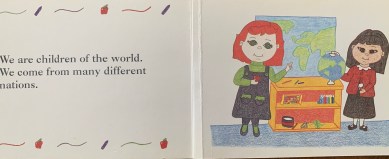
It starts out by stating that we are children form many different nations, and are different shapes and sizes, but that Allah swt created us all.

B32A82CC-61BC-47CE-94F4-D302669CAFB4

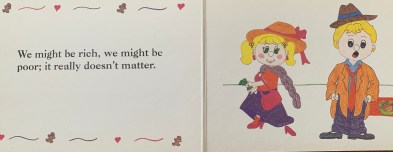
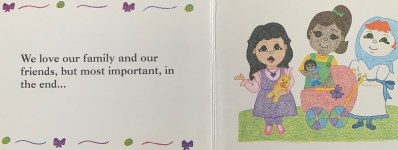
It reminds us that even though our words are different, and some of us are rich and others poor, we still enjoy God’s gifts and love our families, because in the end we all praise Allah, and are Muslims, Al-Hamdu Lillah!

D007C9D7-BB64-40AA-948A-687D94CAE643

The illustrations are clearly hand drawn and filled in with colored pencils, but they show diverse skin tones, a few different ethnic dresses, some in hijab and kufis, others not, and all smiling.

664F0608-6997-4DC6-A34F-A3B9492D4688

This book is basic, which makes it perfect for little ones at bedtime and even in small groups.  Younger children appreciate the simple message and rhyme scheme and it is the perfect size in their hands.

0E54226D-5415-4FBC-90F9-0764BC4B7154

This book is probably bringing back memories for many of you, as it was one of the first books of its kind.  A board book, that is Islamic, cute and fun, for English readers. I remember in high school reading it to my Sunday school preschool class at the masjid, sharing it at story times at the masjid as an adult, and reading it to my own kids over the years.  The binding is still holding strong, and the words still remind me how blessed I am to be s Muslim, Al-Hamdu-Lillah!

Allah is Al Khaliq (The Creator) by Saba Ghazi Ameen

Standard
Allah is Al Khaliq (The Creator) by Saba Ghazi Ameen

allah is al khaliq

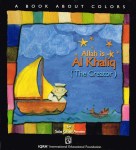
This is one of the first books I got for my first unborn child nearly 14 years ago, and as I am now on my fifth child I only recently realized (thanks @Taleswithmimi) that I have never reviewed this beloved sturdy 10 page 6 x 4.5 inch board book.

BA6F2A98-9A1F-4DDA-ADC4-36FAD933FD8C

It starts by declaring and defining that Allah is Al-Khaliq, the Creator of all I see, it then, in rhyming verse lists some of Allah’s gifts as organized by colors.

Red, green, blue, yellow, orange, purple, white, pink and black, are presented in a fun, and playful way on two page spreads.  The fun illustrations and bright colors are well done and perfect size for little ones to take in.

The book was published in 2002 and is still relevant today.  I highly suggest it for toddlers to chew on and learn their colors from in an Islamic context.  That being said, any religious kids would be fine with the book, while it is Islamic fiction, any faith that acknowledges the Oness of a Creator, will not find anything more religion-specific in the book.

I love that there are tabs on the side to show the colors, and that there are NO FLAPS!  It’s companion book that goes over shapes in a similarly beautiful, Allah is Ar-Rahman (the Compassionate) but there are flaps.  Thin ones at that. Needless to say they were damaged or gone within days and four of my kids have never enjoyed them!

My Great-Grandmother’s Gourd by Cristina Kessler illustrated by Walter Lyon Krudop

Standard
My Great-Grandmother’s Gourd by Cristina Kessler illustrated by Walter Lyon Krudop

gourd
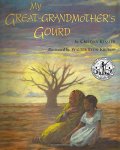
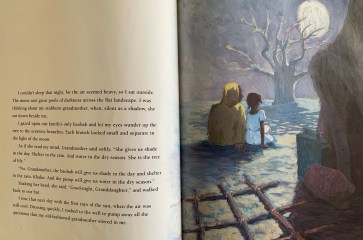
A beautiful story based on a true event in Sudan, this 32 page AR 4.2 book contains lessons about tradition, new technology, village life, culture, family, love, and community.  Unfortunately it is one of those books that I doubt any child would pick up and want to read.  Meant for fourth graders, there is a lot of text on each page, and the story is not quick and light, it is thoughtful and memorable. The book is a powerful one in opening one’s eyes to a different culture, environmental challenges, and innovations making it an important one for parents and teachers to share with younger children and encourage older ones to spend some time with.

8A5303D5-525F-4D37-A886-F22F18D0FE0B

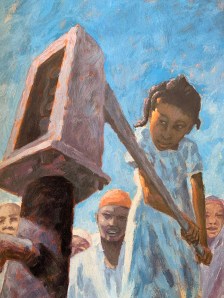
Fatima’s Sudanese village has just installed a new pump, and to show how easy it is to use, Fatima is chosen to try it out first.  With all the excitement over new technology, life for the village is about to get easier.  No more hauling the water with camels and filling the baobab trees to store the water in for the dry season.

104E36DC-E27A-47BB-8C4C-A510198CE604

Easier for everyone except Fatima’s grandmother.  She refuses to abandon the methods of the past so easily, and independently begins to prepare her tree, her great-grandmother’s gourd.  Fatima tries to talk her out of it, and the other villagers mock her refusal to accept technology.

DCB3DBD3-7EC3-4631-9A9D-EC34DE46055F

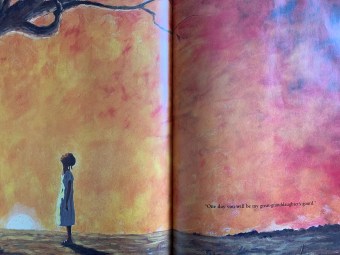
When Fatima hears the neighbor louder than the call to prayer calling her grandmother a fool and laughing at her, Fatima boldly and defiantly joins her grandmother in preparing the tree for when the rains come.

84F665EB-EFD6-49A6-BFDA-FF348CD80D00

The two dig a circle, a necklace, around the old tree to catch the water in the hard red clay, when the rains come, it catches the water, and when it stops, the two move the water to the inside of the tree with buckets. All the while, the villagers shake their heads at the two hard at work.

56BA11B5-7314-4D88-BDAA-50FE61765467

When, in the middle of the dry season, the pump breaks and it will be days before it can be repaired, the chief, Ibrahim, declares they must resort back to the old ways and Fatima and her grandma offer to share their water to hold everyone over.  “Maybe it’s wise to mix old with the new,” Grandma poignantly notes.  The following year the village works together to prepare the trees, just in case the pump breaks.

E4443445-EDEA-4C9C-99E4-4BE6AFB96C1A

There is a glossary of Arabic Words at the beginning of the book and an Author’s note about the “Thirst Triangle” and the use of the baobabs or tabaldi trees used to store water.

F429299A-BFD4-4BCC-9DA4-134FEAF09E4F

There is nothing overtly religious in this culturally rich story.  The women cover their head, they say “inshaAllah,” the call to prayer is mentioned and they have Islamic names: Fatima, Ibrahim, Musa, Ahmed, Ali, Osman etc..

The Mighty Head of Moustafa by Rania Emara illustrated by Fruzsina Kuhari

Standard
The Mighty Head of Moustafa by Rania Emara illustrated by Fruzsina Kuhari

moustafa head

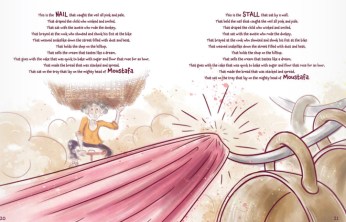
This fun new twist on “The House that Jack Built” uses the same style of building sentences on to a repeated story that the classic uses, as well as the silliness of it all, but is made unique with the Middle Eastern setting and cultural aspects.

90A73EFF-DE4E-4D30-9AF6-3353B0E0B979

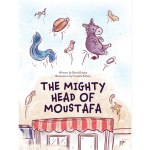
The 8.5 x 11 size gives ample room to see the fun engaging illustrations that bring the comical rhymes to life in both small to medium sized groups.  I won a digital version, and will probably end up purchasing a paperback copy for my bookshelf, as the pictures and text will be easier to pour over in physical form.

1F6DDDD0-6F9D-4AFC-B8CF-8F5418D7DAD7

The book is 22 pages of text and perfect for toddlers to listen to, on up to 2nd or 3rd graders to read on their own and still be entertained.  There is nothing religious about the book, the boy is named Moustafa obviously, and there is a girl whose veil is the climax of the story, but nothing in the text is religion specific.

D7820AEC-BBAE-40AC-A521-79BDD19AD815

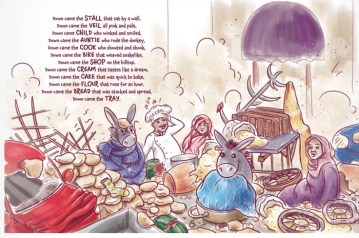
It all starts out with a tray on the mighty head of Moustafa.   Upon that tray is bread stacked and spread that goes with cake that was quick to bake, and before you know it, there is an aunty who rode a donkey next to a child with a veil, and then a nail, oh that tricky nail that caught the veil. . .

9568D24E-1062-4EA4-AA69-64DD4D6DCB7E

Moustafa and his tray and everything along the way are all brought to a tumbling halt, all because of a nail. The crash and falling down undoes the entire build up, and the smiling face of Moustafa makes you want to read it all over again.

266C3E0C-6233-41B9-ABE2-20C6E4307EA5

Alhumdulillah!

E2A54CA5-A964-4405-8181-F73EA84649BF

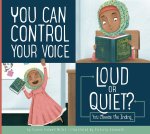
You Can Control Your Voice: Loud or Quiet? You Choose the Ending by Connie Colwell Miller illustrated by Victoria Assanelli

Standard
You Can Control Your Voice: Loud or Quiet? You Choose the Ending by Connie Colwell Miller illustrated by Victoria Assanelli


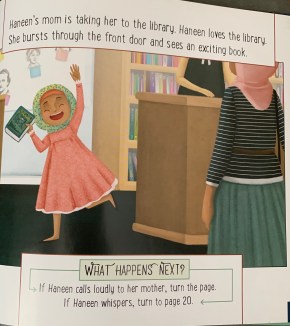
you can controlA choose your own adventure picture book, that doesn’t have anything Islamic specific, doesn’t seem to be written by a Muslim or illustrated by a Muslim, and that was found at the public library, starring a Muslim mom and daughter.  Oh hurrah for beautiful illustrations, teachable moments, volume control in a library and the fun to read the story and have control over what happens next.
91F3712F-C173-46C0-BD30-6B6814B951BA

This 24 page book meant for kids in kindergarten to second or third grade is part of a series featuring diverse characters learning universal manners and making good choices. To see Muslims represent a universal lesson in a relatable environment is a great way to normalize seeing women in hijab in real life.

685B4BFC-16EB-437A-842F-ED10B2580851

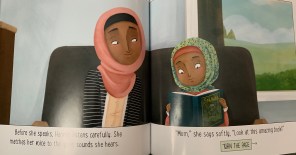
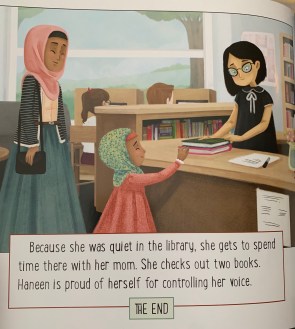
Haneen and her mom are at the library, and Haneen finds a book about fairies and cannot contain her excitement.  Immediately the reader has to choose what Haneen does next.  If she stays loud, the story ends rather quickly, but if she tries to keep her voice down, she might get to stay at the library a little longer.

9E7FC801-D531-42AA-9542-81C4BAF75364

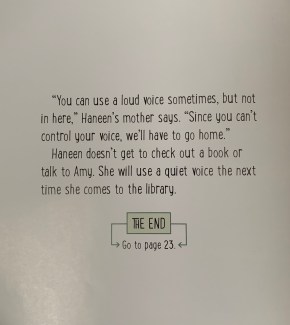
There is a big test when she sees a friend, and disturbs a gentlemen working on the computer, but if you make good choices Haneen gets to check out two books.  If your choices aren’t ideal you might have to just get the fairy book and get out, and if you really struggle to know how loud or quiet to be, you’ll have to come back another day and try again.

C00E287A-E463-427B-9AC4-C748681CC0F5

At the end of the book are some things to think about, to drive the point home.  I love the line, “We are all free to make choices, but choices have consequences.”  A great lesson for little ones, and a great reminder for older readers too.

3EF9066A-60F4-4A31-9E1C-19F228A0D7F4

The book is 9×8 and the expressions on the characters faces make the book a great option for circle time, story time, bedtime, and just to have on hands for kids to thumb through and enjoy.  Well done!

90F0B566-EE2F-490B-8D8C-3AD148BC0CE5

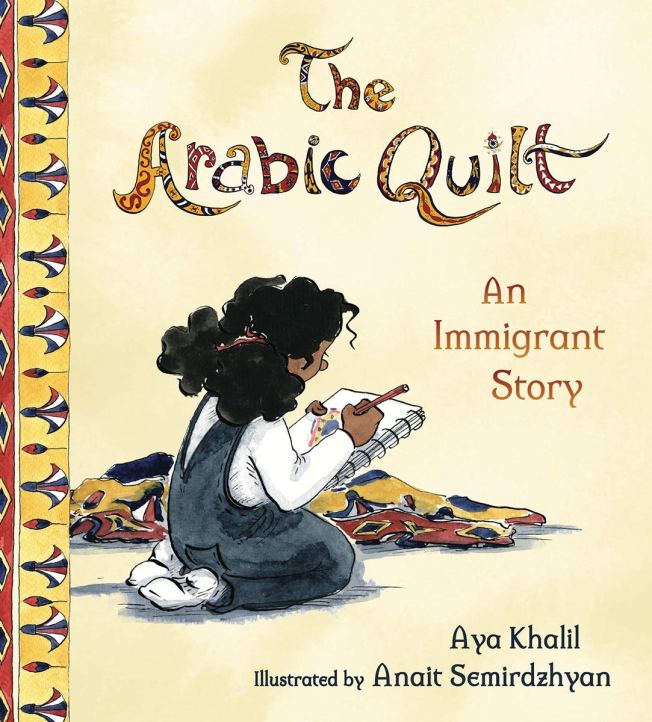
The Arabic Quilt: An Immigrant Story by Aya Khalil illustrated by Anait Semirdzhyan

Standard
The Arabic Quilt: An Immigrant Story by Aya Khalil illustrated by Anait Semirdzhyan


arabic quilt

This 36 page picture book tells a beautifully presented story that incorporates events from the author’s real life that convey a story of loving your culture, finding similarities and giving people a second chance.  Ideal for students between 2nd and 4th grade, younger children will enjoy having the story read to them, and older kids will benefit from the message as well.

7C03525B-A26D-427F-A7EA-591BB3095F10

Kanzi is about to start her first day of 3rd grade in a new school.  It doesn’t specify if she has just come from Egypt, but being she seems to speak English well, knows that she’d rather have peanut butter and jelly instead of a kofta sandwich and mentions that she got a quilt when she visited her grandmother, in Egypt, she possibly is just starting a new school, not her first in America, but it is considered an immigrant story, so I’m not certain. E403D261-438B-4263-A2FB-C3F8693C9D3E

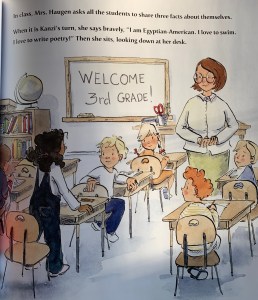
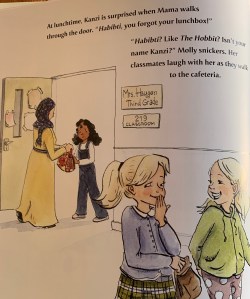
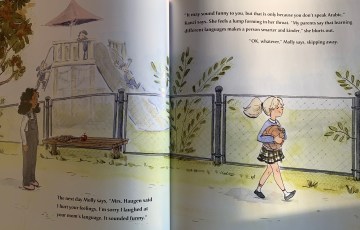
When she arrives in class and introduces herself she bravely says that she is Egyptian-American, but on the way to school she turns down the Arabic music in the car, so the reader sees that she is a little nervous about being seen as “different.”  When her hijab wearing mom brings her forgotten kofta sandwich and calls Kanzi ‘Habibti,’ classmate Molly teases her that she is being called a hobbit.

A crying Kanzi tells her teacher and Mrs. Haugen reassures her that “being bilingual is beautiful.”  That night Kanzi asks her mom to send her a turkey sandwich for lunch the next day, and before beds she writes a poem as she snuggles in her beloved quilt.

76FCD440-0D81-4893-80F3-1CC6033E8461

At school Molly apologizes to her and says that it just sounded funny.  Kanzi tells Molly it is because she doesn’t speak Arabic and that her mom says that “learning different languages makes a person smarter and kinder.”  Molly dismisses the comment and smugly walks off.

Mrs. Haugen sees Kanzi’s poem about her quilt from her grandma in Egypt and asks her to bring her quilt to school. The kids love it, and Friday Kanzi’s mom shows up to help with a special project: an Arabic quilt with the kids names.

98E875AE-0FD1-4827-BF39-1CA7B1172843

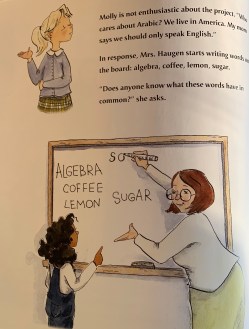
Molly is not enthusiastic and Mrs. Haugen writes English words that come from Arabic on the board: coffee, lemon, sugar, algebra.  Telling the kids that “we can speak non-English languages and still be American.”

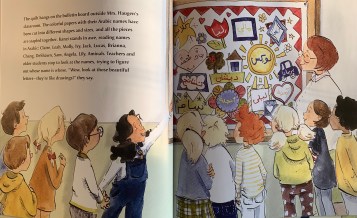
Kanzi and her mom write the kids names down and the children copy them.  The teacher cuts them out and makes a quilt to hang in the hall.  On Monday when everyone sees the quilt, they love the beautiful letters and colors.  Even Molly sincerely apologizes and asks Kanzi to write her mom’s name in Arabic as a gift.  The two hug and seemingly will become friends.

832244F2-1F7E-4C4A-9778-40E0EEC6BE82

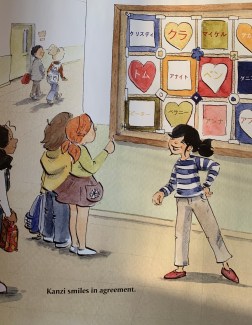
Across the hall another quilt is hung with names in Japanese, as another student and teacher were inspired by Kanzi and her quilt.  The last page of the story is a letter Kanzi has written to her parents telling them how grateful she is that she has two languages and that she will speak them without guilt.

BB6797A4-05C9-4CDC-AC70-88273ED3997B

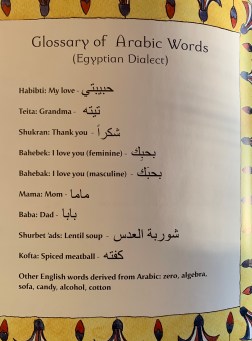
The story is beautifully told and exquisitely illustrated on well-sized 9.5 x 10.5 pages in a hardback binding.  The mom wears hijab and it mentions it, but there is nothing religious about the text.  It is a universal story of coming to be proud of your roots and inviting those around you to learn and grow.  There is a Glossary of Arabic Words at the end and a bit about the author and illustrator.

9AF3D465-F5DA-4F25-8FC1-5BEE16FD9B21

My kids favorite page by far was reading the names written in Arabic and they all enjoyed the story (ages 13, 10, 9, 4).  I actually had an issue when Molly apologized the first time, feeling that Kanzi’s response was a bit pretentious to what seemed like an 8 year old being told to go say she was sorry, but my older three unanimously and fervently disagreed with me, saying that she was obviously insincere and Kanzi knew it.  I’d love to hear from other readers if they felt like Molly was sufficient in saying sorry and admitting that it sounded funny and that Kanzi was arrogant in saying that people that know two languages are smarter and kinder, or if Molly was being rude and racist and Kanzi was sticking up for herself.

CF16ACA2-8EC4-443B-AA8B-2B9EA3D05D6D

Irregardless, the book is well done, enjoyable, and will get repeated reads by a large range of readers.  My children keep pulling it off the book shelf, and for that I need to thank Gayatri Sethi (@desibookaunty) who generously sent me the book the same day I checked it out from the public library.  Her generosity once again is a gift that I hope to pay forward in the future.  This book also highlights how amazing teachers can be and often are in facilitating inclusion, understanding, and respect.

ED8D19BC-96FE-4B8F-8B35-87A1AA885B7F


Amira’s Family by Elliot Riley illustrated by Srimalie Bassani

Standard
Amira’s Family by Elliot Riley illustrated by Srimalie Bassani

amira family

This 24 page, AR 1.5 book, is part of a series for emergent readers about different families.  The other books in the series focus on diverse family models, some that include a single parent, or lots of siblings, one in the series has foster kids, another adoption, one has two moms, so I’m not entirely sure why a refugee family is included in the group.  The family had to leave a dangerous home, but mom and dad and Amira, are not a “diverse” family structure, by the same definition used for the other books.  So, on its own it is nice to have a book for independent kindergarten and 1st grade readers, but as part of the collection, I find it a bit of a stretch.

5BD929BC-5490-4B6B-A729-CD85B227EE60

The book is divided into three chapters, or sections I guess, perhaps so that early readers can gain experience with a Table of Contents at the beginning.  There is also a Picture Glossary at the end along with a page encouraging Family Fun and a bit about the author.

The book starts out introducing Amira, and her parents.  It then explains that they just moved to a new country, America, when a war started in their country.  It notes that Amira was sad to leave her home, and scared to move to a new place.

84893217-FB88-4ABC-8879-DA361636E17E

When Amira starts at school, the classmates welcome her and help her with the language.  It shows her teaching her language too, but it doesn’t look like more than random squiggles.  It then shows she likes recess and swings and slides, allowing the reader to see similarities with the character.

C2E8EF21-AC7B-4594-AA53-68B9764AB84DWhen the family goes shopping, Amira sees an American flag, buys it, and hangs it outside their home.  Amira loves her family and they love her, and it seems like they love their new home too.

C8E3398F-8A1B-4D40-8A79-4E1C52262E89

The illustrations are simple yet expressive, and show Amira and her mom in hijab.  It does not mention religion, or what country they left.

The story is basic, yet introduces young readers to the concept of refuges in a soft way.  It shows how the classmates are kind and the parents supportive of Amira.  I like that it also shows various emotions in the text and illustrations.

It might be making a bit of a political statement with the flag and national identity undertones, but I think it is a good thing to show that refugees can love a new country and be part of society, especially given the current climate toward immigrants.

I think the strength of this book is that it shows a Muslim character, and while meant for all new readers, Muslim children particularly will enjoy seeing themselves in a book they can read.  I’d check the library before buying the 8×8 paperback book, as it isn’t particularly memorable, but for the age group it serves a diverse and an inclusive purpose.

01FAE723-DA90-42EC-AC0D-B274B22515D9


Like the Moon Loves the Sky by Hena Khan illustrated by Saffa Khan

Standard
Like the Moon Loves the Sky by Hena Khan illustrated by Saffa Khan

moon

This 40 page book of prose begins each stanza with “InshaAllah” and reads as a beautiful prayer from parent to child.  Each two page spread is filled with warm vibrant colors and illustrations that radiate love while complementing the slow pace the book is meant to be read with.D900B288-5527-4519-8EDF-EE830D3A464D

The book is clearly from an Islamic perspective, yet I think any religious family would find beauty in the book.  The author has a note on the title page that defines inshaAllah as meaning God willing in Arabic and explains how it is a common wish/prayer for people of other cultures and faiths as well.  She also explains that that each line is inspired by the Quran, but universal for people everywhere.

94EE8AC2-8754-46F4-AF50-9CDB7BDFF145

Some of my favorites are:”InshaAllah you seek knowledge, reflect, and read, InshaAllah you speak truth and work for its sake. InshaAllah you have faith that won’t waiver or bend. InshaAllah you are kind to those most in need.”

287D37BD-90E8-4464-B075-524E842A4B43

The illustrations show a family that at times wears hijab and at others does not.  It shows multiple generations, and diverse characters in terms of skin color and mobility.  The illustrations at first weren’t my favorite, but they definitely grow on you.

70D903DA-9763-44CA-B765-2FE15AE34C10

Over all the story reads like a lullaby, and is soft and sweet at bedtime particularly.  The 10 x 10 size would make it work well in groups as well, and I could see it used to lull kids to sleep at nap time with great success for the youngest baby to early elementary.

F6B4AB6F-E13A-4C05-836B-24CD28BAC21C


Zainab is Different by Irfana Khan illustrated by Josh Wise

Standard

zainab is different book

This 24 page picture book for kindergarten children and up, is sweet in its handling of being labled “different,” without getting overly negative or caught up in the manifestation of discrimination.  Unfortunately, with so much emphasis on different religions: the places of worship, the holidays celebrated, the manner of dress, etc., faith becomes inadvertantly highlighted as the root cause for the division and discrimination.  Perhaps I am reading too much in to it, and the book just needs a few more examples to make the author’s point that we are all different and unique, but as it is, I didn’t love it, my kids all thought it was cute though, especially my daughter named Zainab.

IMG_0555

Zainab walks to school every morning with her mom.  She says hi to the neighbor and can’t wait to get to school to her best friend Melissa and her amazing teacher Mrs. Sperber.

IMG_0556

One day Melissa and Zainab want to play hide-and-seek and ask Matt if he wants to play too.  He responds, “Eww, I don’t want to play with Zainab! My dad said she’s weird and different from us.”

IMG_0557

Having never been called that, Zainab is bothered by the words and tells her teacher.  The teacher points out that they have different colored hair, but can see that Zainab is still hurt and tells her not to worry, she has an idea.

IMG_0558

At circle time the teacher starts of by highlighting differences with the kids identifying their favorite color, and her writting their names on the ones they like best.  She then asks about places of worship they visit: churches, mosques, synagogues, temples, and again writes their names on the ones they have been to or frequent.

IMG_0559 Next she moves on to holidays celebrated, and then special clothing, only hijab is mentioned though.  The teacher then discusses feelings and how things about us might be different but our feelings are the same.  We like it when we are all nice to each other, and are sad when someone is mean.

IMG_0560

Zainab sees her name with different people’s names on the pictures now hanging up and Matt comes and apologizes for being mean earlier. The teacher also mentions that maybe some haven’t visited any of the buildings discussed.

IMG_0561

The pictures appear to be done in colored pencil and are colorful and detailed with the pictures of the places of worship bein actual images.  The 8.5 by 11 pages are large and would work well at story time or bedtime.

IMG_0562

The fact that Matt’s words are assumed to be about religion seems presumptious to me.  Maybe they are, maybe they aren’t, I feel like there needed to be more there.  A few pages about things other than faith, in my opinion, would make the message of us all being different in some things and the same in other things a bit more powerful.   The pacing too is a bit off. It is a big jump from what is your favorite color to do you go to a church?  The resolution is really quick too, as it is tied into feelings, a little bit more of showing the reader, rather than just telling them, would amplify the process and the message.