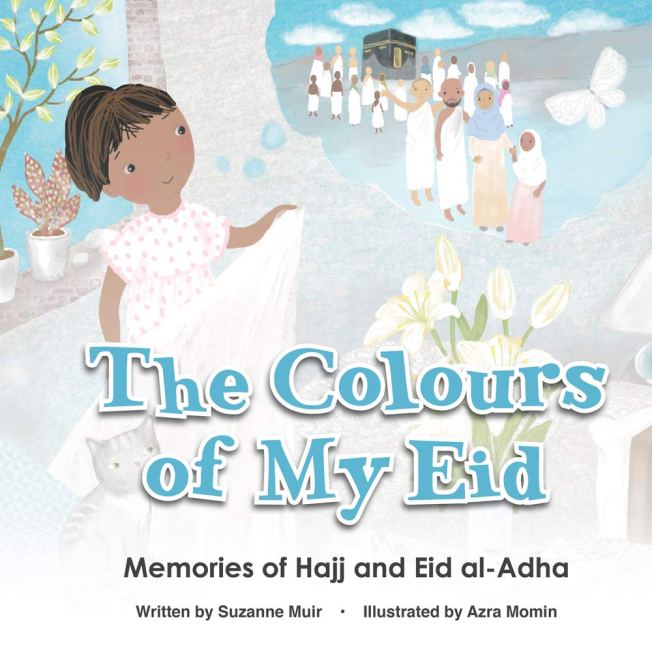
At 18 pages, this 8 x 8 book focused around colors contains a lot more information than what initially meets your eyes. The warm beautiful, full page pictures fall opposite a highlighted color and a description of that color in the child’s world that reminds the characters of their time at Hajj or celebrating Eid al-Adha. On each of the fun text pages is a light green text box at the bottom with factual information that older children or adults will benefit from and be able to share with younger listeners. The main text is ideal for toddlers and up, and older kids up to 3rd grade will benefit from the nonfiction highlights that can educate or remind Muslims and non Muslims alike, about the importance of Hajj and Eid al-Adha.
The book starts with an introduction about the Islamic language and perspective used, and clarifies that the colours emphasized are to help visualize the point being made, it also gives information about Eid al-Adha.
The colors highlighted are: white, black, brown, green, grey, yellow, and purple. The large simple text takes something relatable such as the monkey bars, or balloons, or the sky and corresponds it to a memory of Arafat, or ihram, or the hills of Safa and Marwa.
The nonfiction text gives specific dimensions of the Ka’aba, the story of Hajar and baby Ismail, the requirement of Hajj and some of the steps. There is a lot of information conveyed which at times is incredibly detailed, and sometimes, rather vague and generic, i.e. Tawaf is when Muslim pilgrims circle the Ka’aba as part of the Hajj rituals. Overall, this little book packs a punch, and I was equally impressed at how it held my five year old’s attention with the colors, and my interest with the facts detailed below.
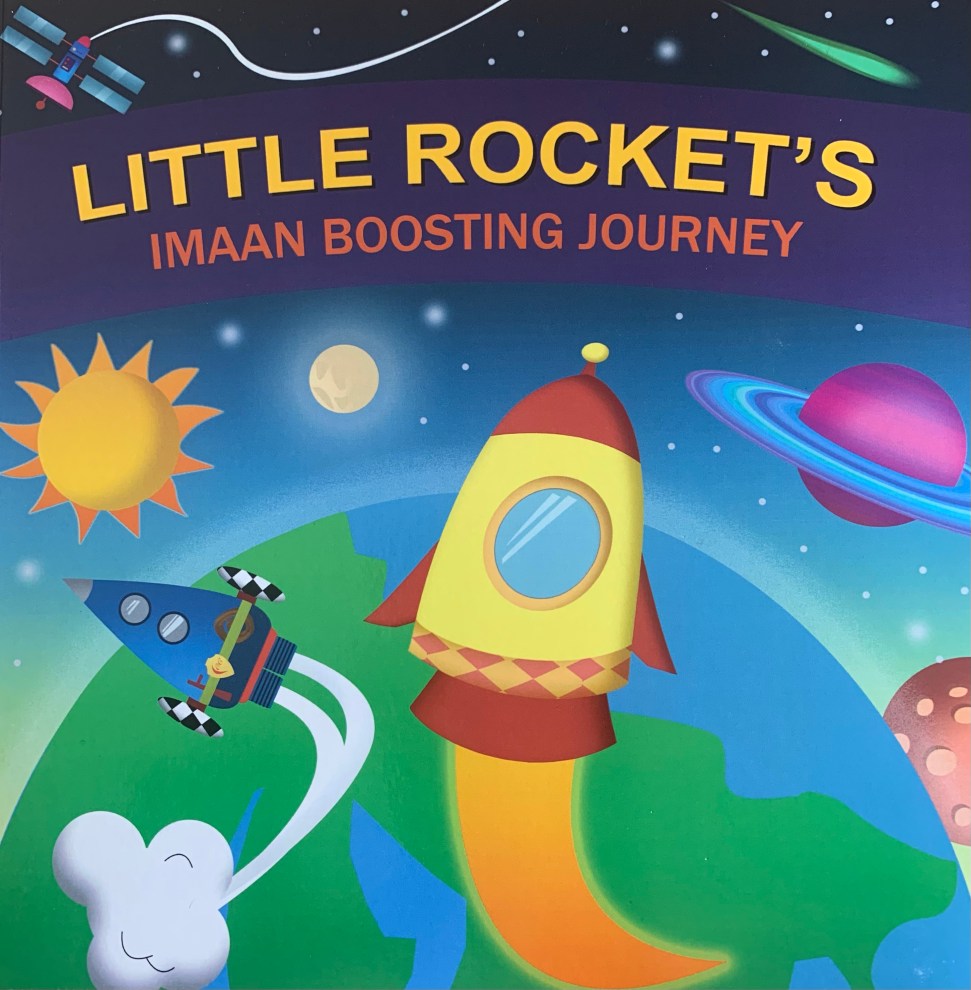
This 32 page toddler to first grade picture book at first appears to be just another book praising Allah’s creation from the ground level up to the heavens as the main character is a personified rocket ship. However, I was delighted to see that after a few pages the book goes deeper in both Islamic messaging and in literary action. Told in rhyme, Little Rocket will face dangerous comets, make desperate humbled duas for help, be rescued by Officer Cosmo, show gratitude, and grow in his imaan and understanding of Allah’s creation and mercy. With a guide at the end to further involve children in the lessons of the book, and a glossary; the bright glossy illustrations will give little Muslims important well woven in lessons in a fun story packaging.
Little Rocket is about to take off from his little town, it is his first flight, so he is a little nervous. A little dhikr calms his heart and bismillah he is off. He prayers for courage as he looks down and sees so many of Allah’s creations.
As he enters space the colors of Earth become the dark sky full of stars and planets that do not fall. Careful not to get too close to the burning sun. Little Rocket wants to keep heading toward Neptune, but needs to take a rest on a rocky moon. As he drifts off to sleep in the quiet of space he is abruptly awoken by comets hitting the surface.
Little Rocket is hit and the ash is thick from the destruction. He gets stuck from falling debris and prays to Allah swt for help. A brave blue rocket, Officer Cosmo, hears something, and comes to Little Rocket’s aid. SubhanAllah Officer Cosmo is able to save a very grateful Little Rocket.
Little Rocket heads home feeling closer to Allah swt then he did when he left that morning and knows that “There is none worthy of Worship, but Allah.”
The power of Dua saved the day and with concepts and vocabulary of space all combined in a story with a sweet plot, this book will be requested over and over, and inshaAllah help little ones to appreciate and trust Allah always.
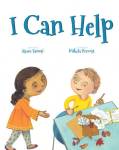
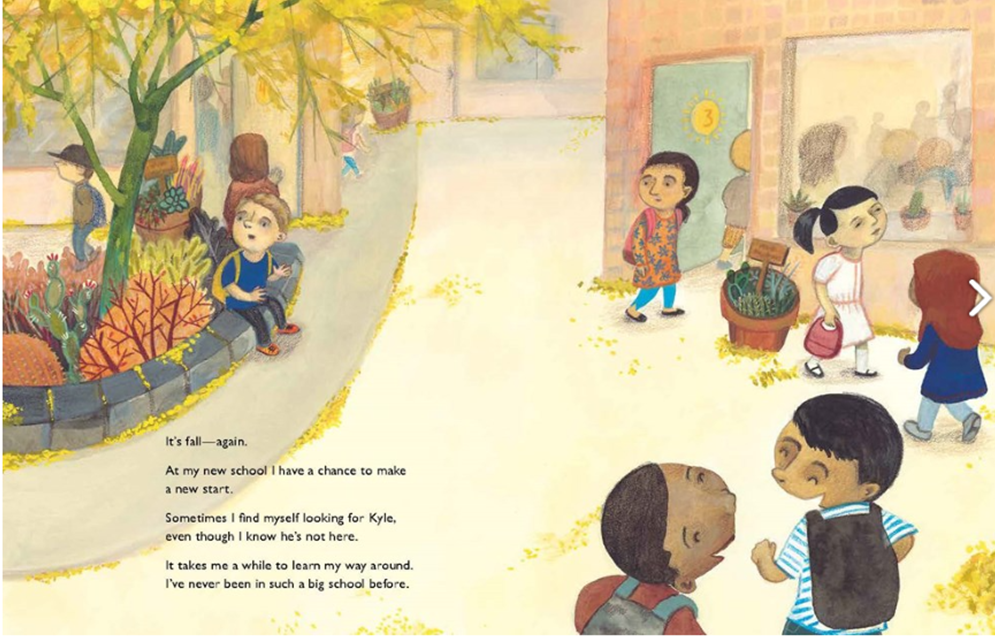
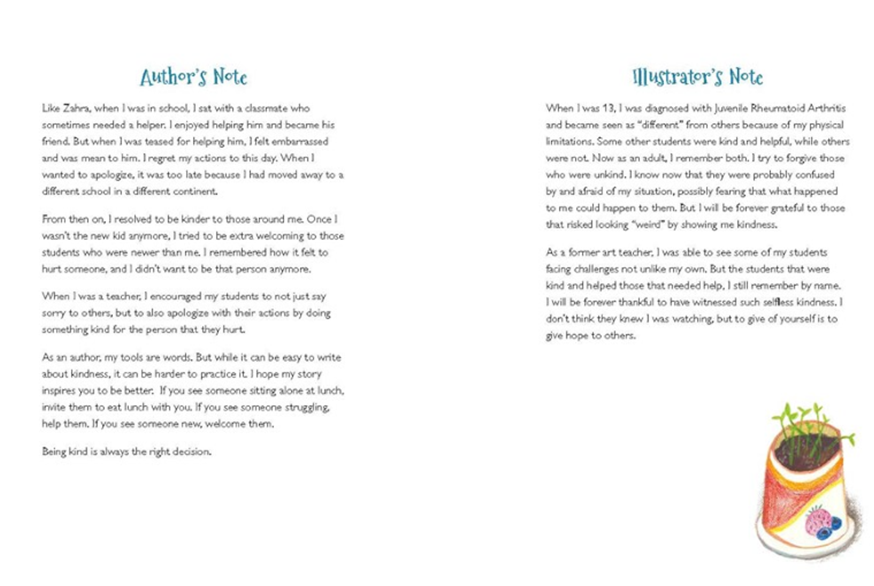
This 44 page early elementary book is absolutely beautiful: the message, the relatability, the representation, the heartfelt author note. Reem Faruqi is brilliant. Once again she takes something so personal to her and allows the readers to see pieces of themselves in her OWN voice narrative. This book at it’s core is about peer pressure, but the way it stays with the reader will resonates deeply and powerfully. Readers will remember the choice Zahra made and the way it changed not only her relationship with Kyle, but also her own view of herself, while forgetting the names of the classmates that teased her and made her question herself. It is not the outside reprimanding that gives this book it’s strength, but the guilty conscious that such a young character has to come to terms with as she moves forward.
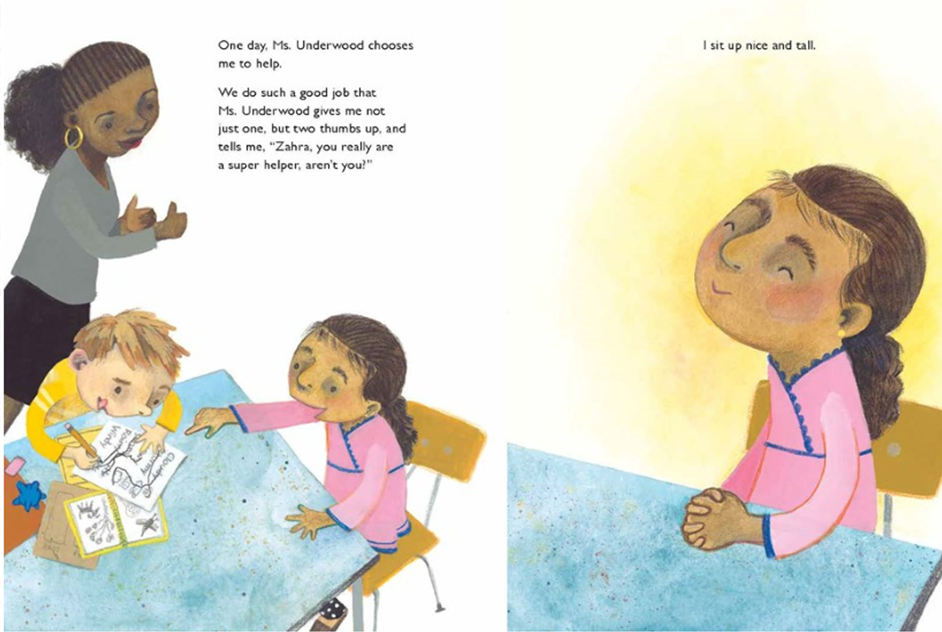
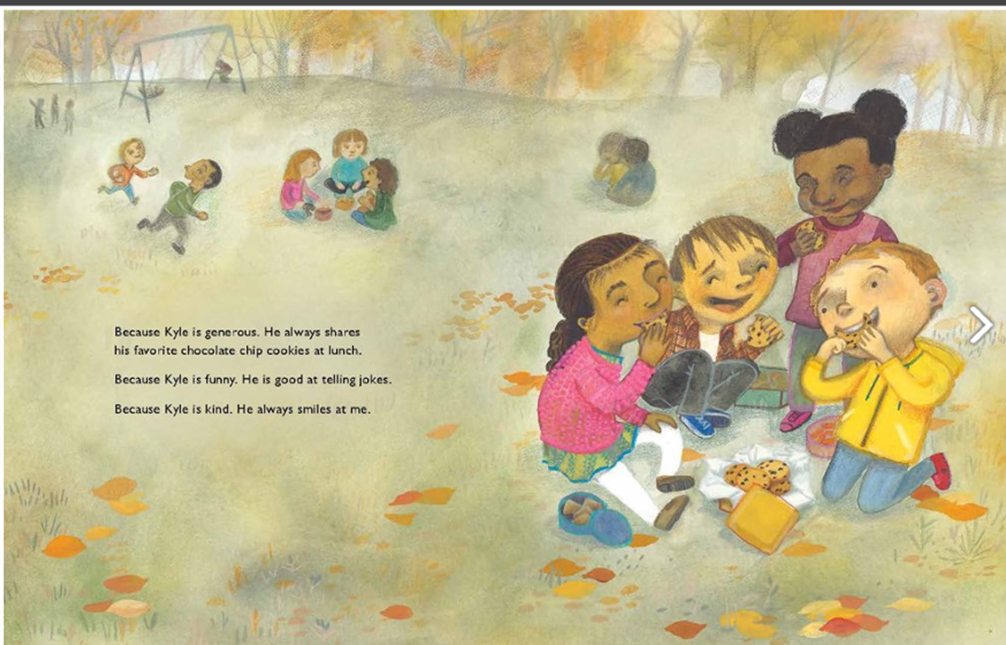
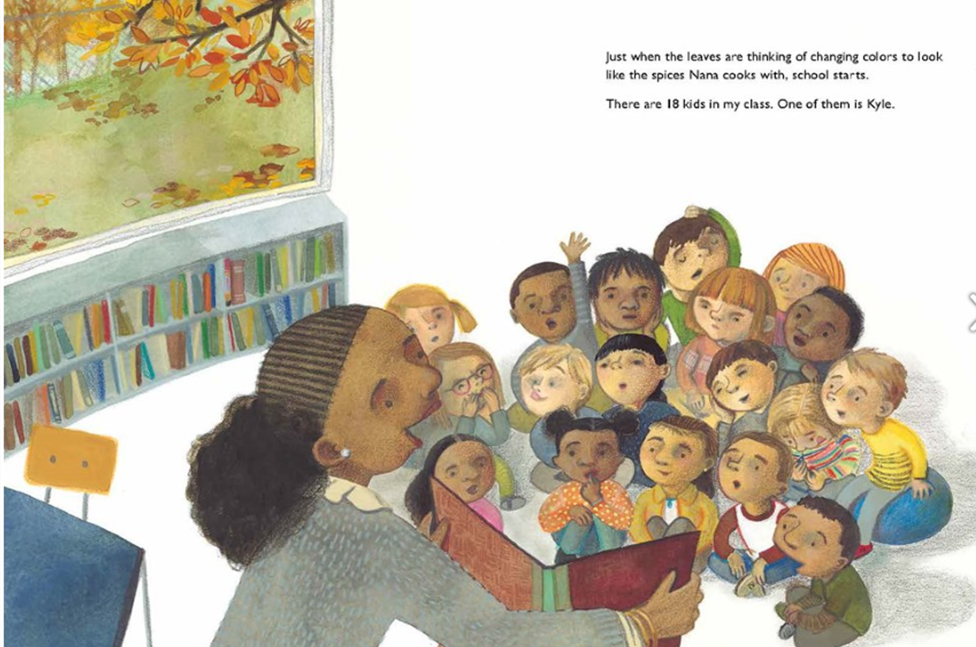
There are 18 kids in Zahra’s class in early fall, when the leaves are about to be the color of Nana’s spices. One of the kids is Kyle. Kyle often needs a helper, and Zahra is happy to help him with his cutting and gluing and writing. The two have become friends. Kyle is funny and nice and shares his cookies.
Zahra also likes the praise she gets for being such a good helper. One day when the leaves have darkened, Zahra is climbing a tree and hears some of the girls making fun of Kyle. She doesn’t want to listen, but her ears want to hear. When she comes down, they ask her why she helps him. She doesn’t really know.
When she is helping him later, she sees the girls staring at her, and she snaps at Kyle. The next day Ahmed helps Kyle instead. Zahra misses being around Kyle, but he says that she is mean and he doesn’t know her any more. Zahra doesn’t know herself any more either.
The next year finds Zahra at a new school, and when the opportunity presents itself for her to help someone, she jumps to offer herself as a helper remembering Kyle and finding her voice, one that she recognizes.
The book is inspired by the author’s own experience, and the rawness and relatability shines through. The illustrator also relates to the book and needing help with physical limitations. There is nothing overtly religious or cultural other than the mention of the spices, Zahra’s and Ahmed’s names, and the term for Zahra’s grandfather. The diverse kids in the classroom and the universal messaging make this book a must read for every kid and big person. Be kind, always be kind.
A story about the Morrocan Jewish holiday, Mimouna, that marks the end of Passover introduces readers to a small but growing Jewish celebration from Northern Africa. Stemming from the historical fact of Jews often borrowing flour from their Muslim neighbors to make the traditional Maufletot, thin pancakes, after a week of not eating flour. The story focuses on a Jewish girl and a Muslim girl meeting each other, celebrating with each other, and finding similarities between Ramadan and Mimouna. Over 36 pages, kindergarten to second grade readers will get an introduction to two different faith holidays and see that friendship and kindness are possible everywhere.
It is the last day of Passover in Fes and Miriam is tired of eating quickly baked unleavened matzah crackers, she is ready for the sweet dough pancakes of Mimouna, and she is willing to help her mom make them. But before Passover, all flour was removed from the home, and she asks her mother where they can get flour tonight before the party.
Mom and Miriam begin to walk. They leave the part of town that Miriam is familiar with and Miriam sees a building with a dome and minarets. “What is that?” she asks. Her mother replies, “It is a mosque, where our Muslim neighbors pray.”
They then enter a courtyard where a woman and her daughter about the same age as Miriam appear and invite them in for tea. The two women say salaam and kiss each other’s cheeks. Miriam’s mom gives the other lady a jar of fig jam and invites her and her family to come to the house to celebrate Mimouna with them. When the women are done drinking tea, Jasmine is asked to go to the store room for two bags of flour and Miriam is sent to help. Jasmine is told one bag is for them, and one is for their guests. The two shy girls go get the flour, and when Miriam trips, Jasmine catches the bag just in time.
On the way home, Miriam has so many questions about the lady and how her mother knows her and how come they don’t have a jasmine vine. But, when they get home there is a lot of work to be done before the guests start to arrive.
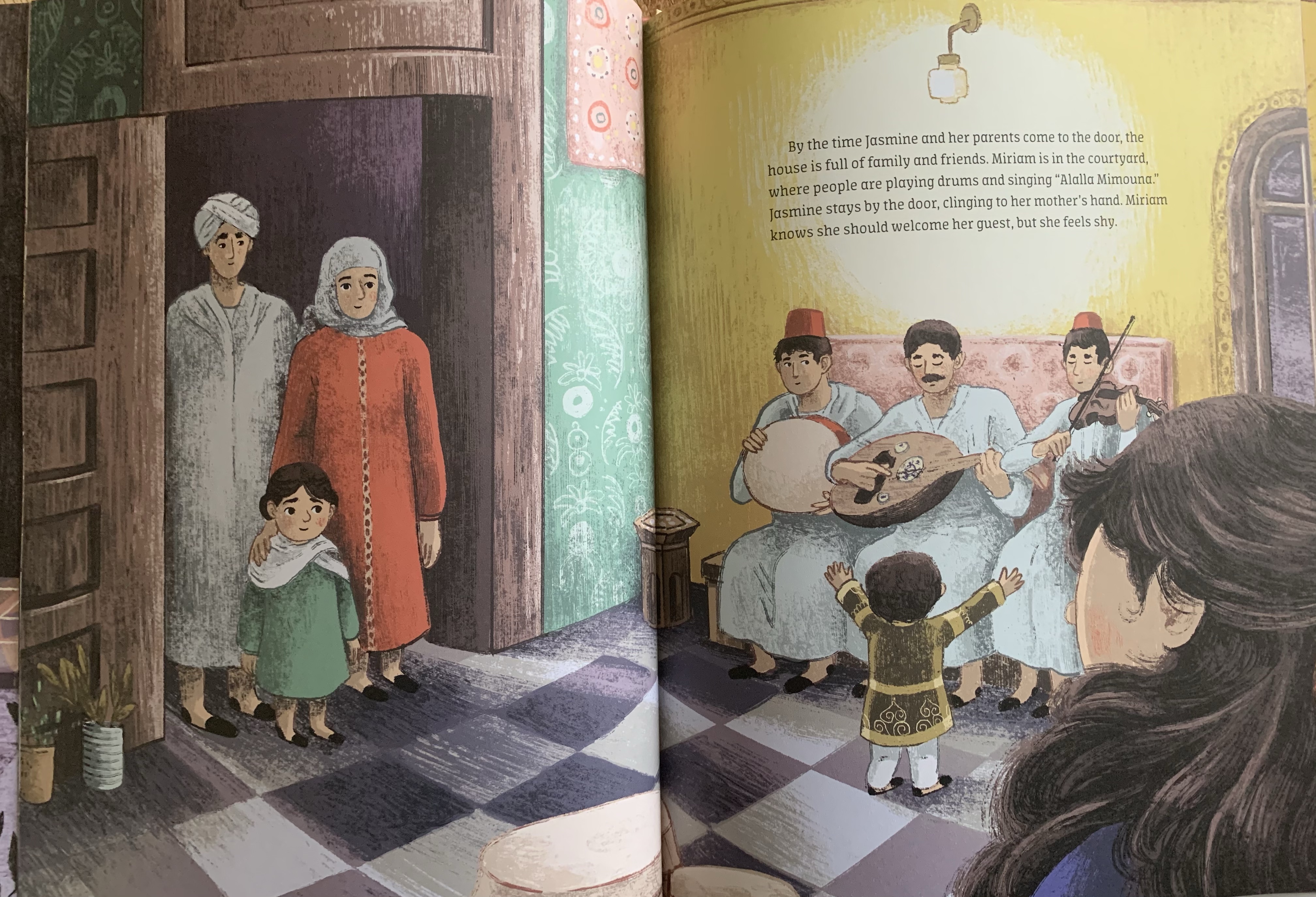
By the time Jasmine and her parents come the house is full and music is being played and songs are being song. The first plate of maufletot goes to Miriam’s grandfather, and when she trips and they go flying it is Jasmine who catches them. The girls giggle and Miriam teaches Jasmine to play the song, “Alalla Mimouna” on her tambourine.
The party moves from house to house and at one home green wheat is dipped in milk and sprinkled over everyone’s head as a blessing for the upcoming year. By the time the girls get back home they are tired, and as they share one last pancake, Jasmine tells Miriam about the nightly feasts of Ramadan after a day of fasting. She invites Miriam to join them, and Mariam is excited, but Mariam’s mom explains that they are moving to Jerusalem.
The following year on Mimouna Night, Mariam heads to the store to buy flour, but thinks of her friend Jasmine back in Morocco as she smells the jasmine growing in her home, and wonders if her friend is also thinking about her.
The author is an Amerian Israeli, and I was nervous that there would be political overtones, but she deliberately wanted to avoid that and focus instead on presenting this little known Jewish holiday in an interfaith manner. There is an info section at the end of the book explaining Mimouna and a recipe for moufletot. In author interviews you can read more about how the story came to be, and what her hopes were in telling it: https://jewishbooksforkids.com/2021/03/14/interview-with-allison-ofanansky-author-of-a-sweet-meeting-on-mimouna-night/
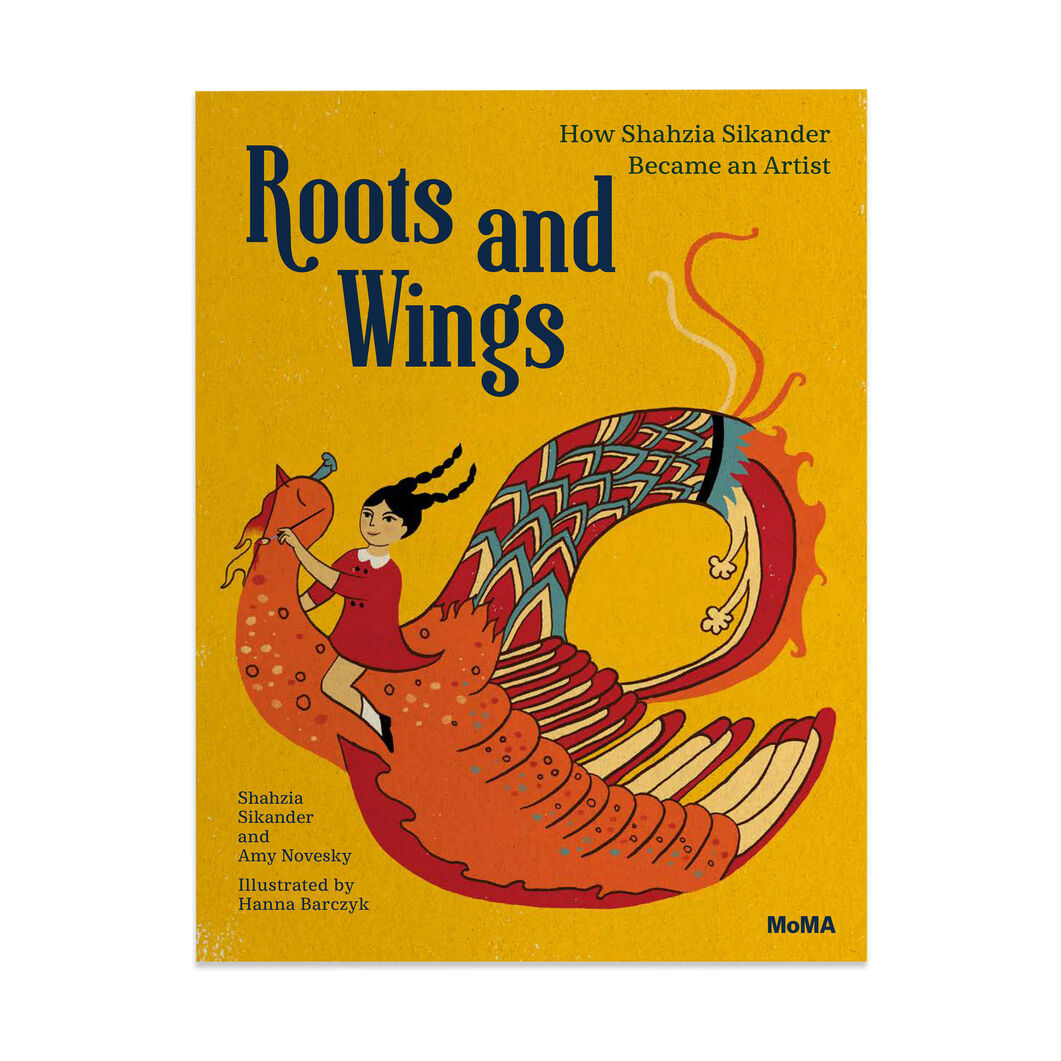
At 40 pages, this biography about Pakistani born artist Shahzia Sikander is filled with culture and experiences. The story shows the influences of her family, the city of Lahore, her love of math, and her art education have in shaping her in to the artist she is today. The book features photographs of her work at the end, but I found it odd that she didn’t illustrate the book herself. The playful blocky pictures and text would appeal to first or second graders with some assistance, but would be better suited for readers a bit older if they are unfamiliar with some of the cultural and artistic vocabulary. There is no mention of Islam in the book, when researching, it says her family is Muslim. It seems she went to Catholic school, and a road trip was taken that included visiting the Sistine Chapel. A few illustrations show people in hijab and it mentions the athan ringing out five times a day. The book was interesting, but I wish I could have found it at the library, rather than purchasing it. I don’t know that it will be read more than once, but that speaks more to personal preference, rather than the quality of the book. If you enjoy fine art, are from Lahore, are a fan of Shahzia Sikander’s work, you will definitely enjoy this book.
The story starts with a girl stepping in to a painting with many rooms, filled with many people in a joint family. It is her (Shahzia’s) home, and her family. The rooms are filled with ancient fables, Russian fairy tales, poetry, English, Urdu, Bollywood songs, and American Westerns.
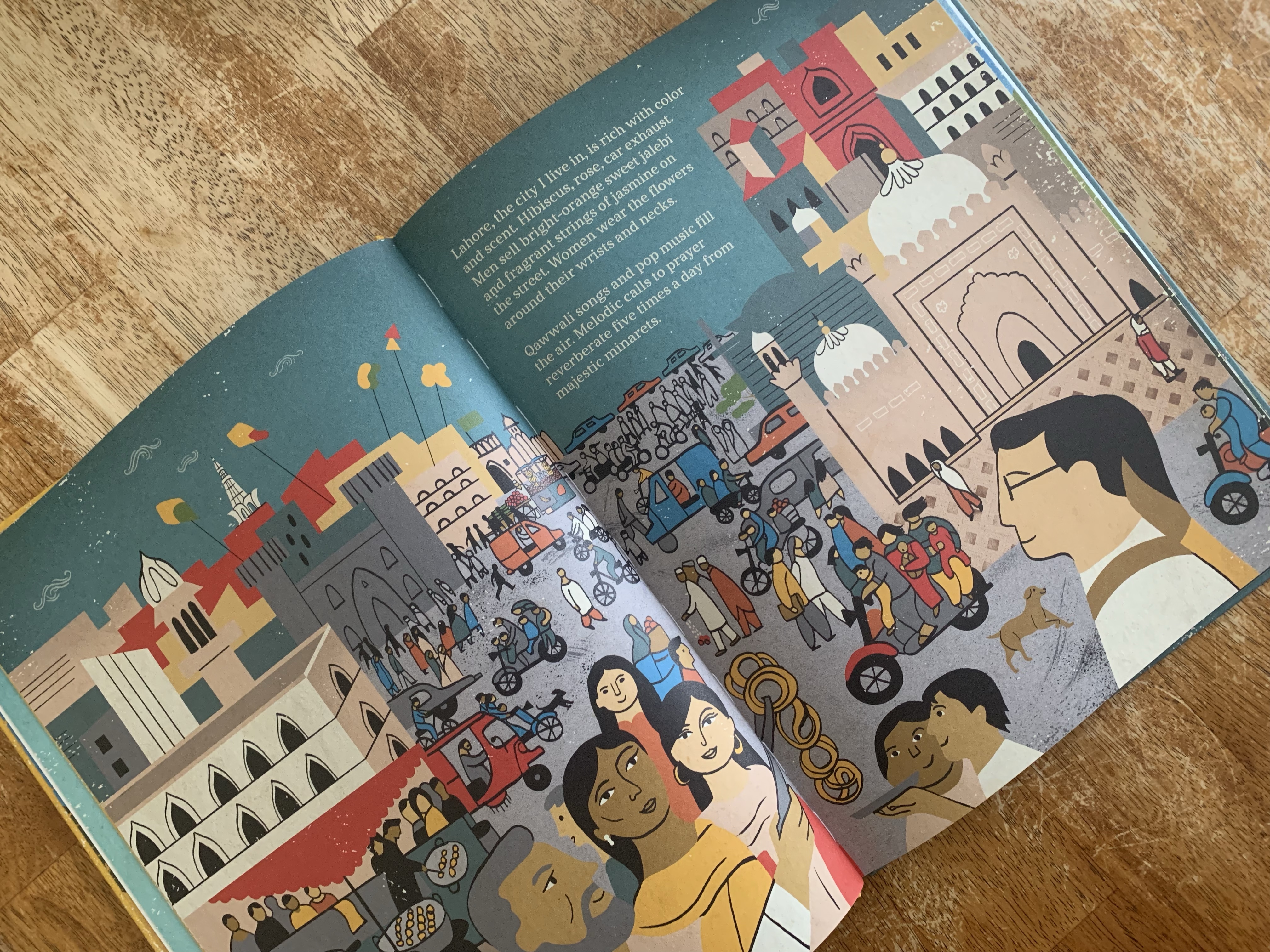
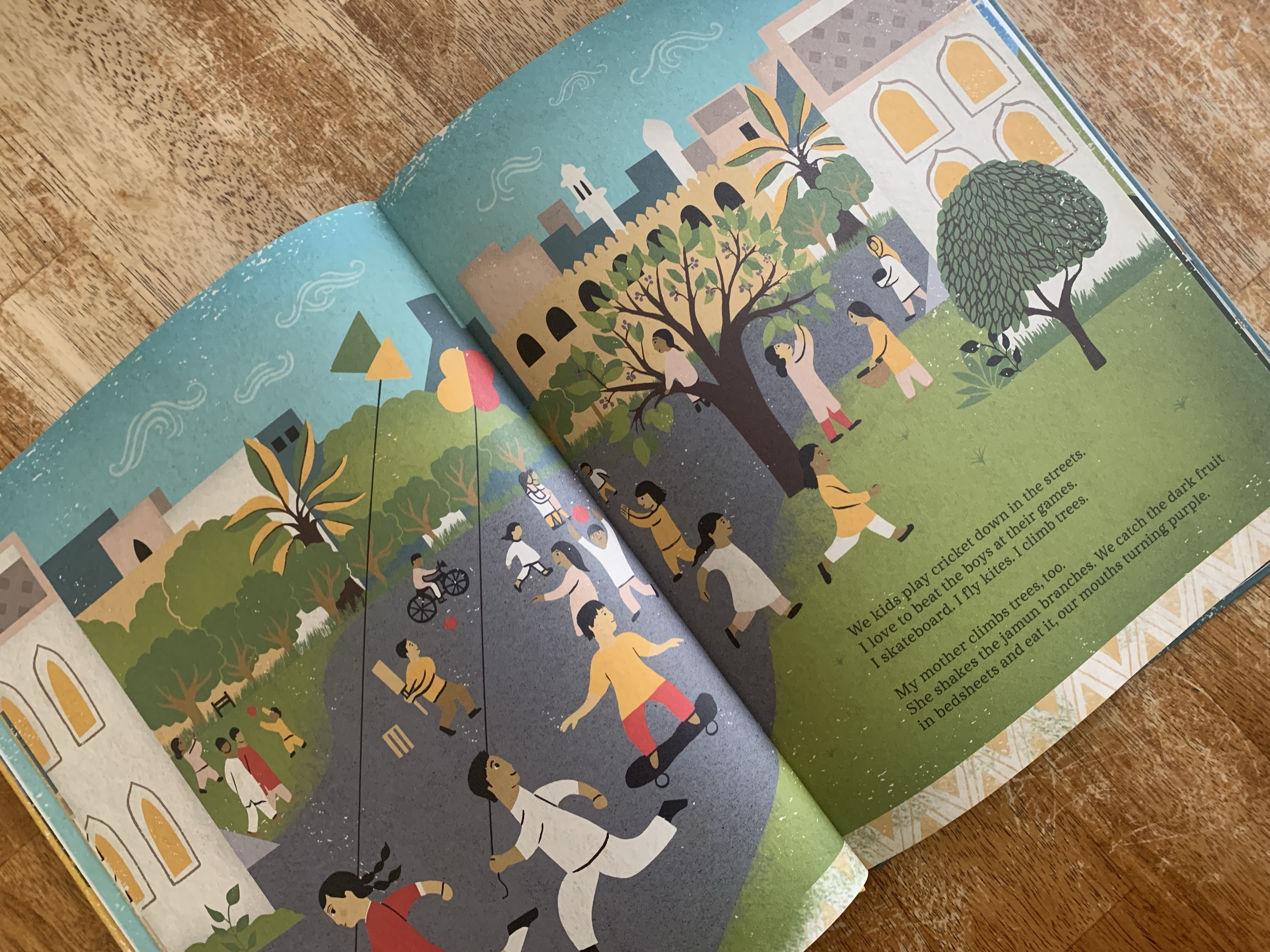
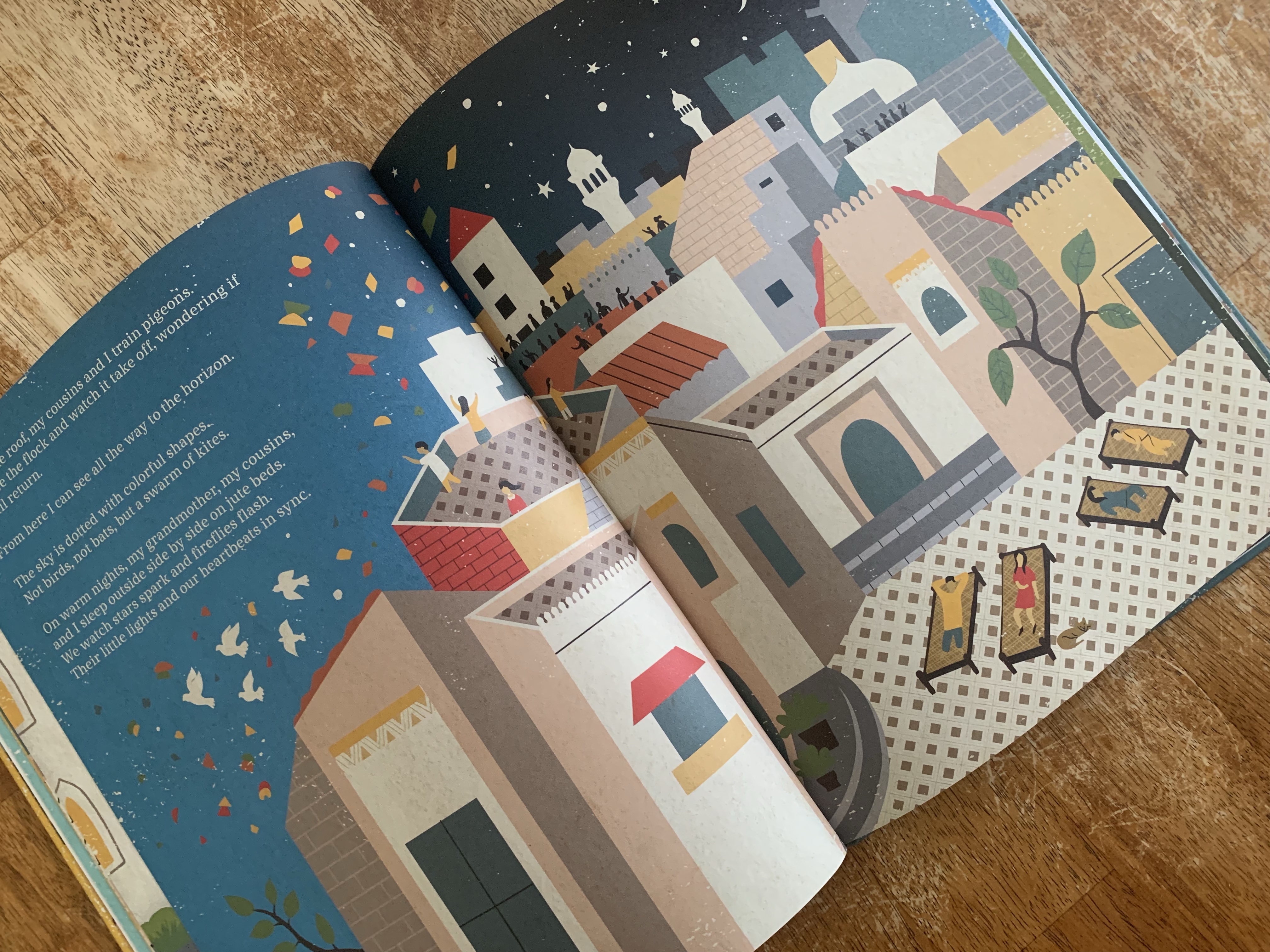
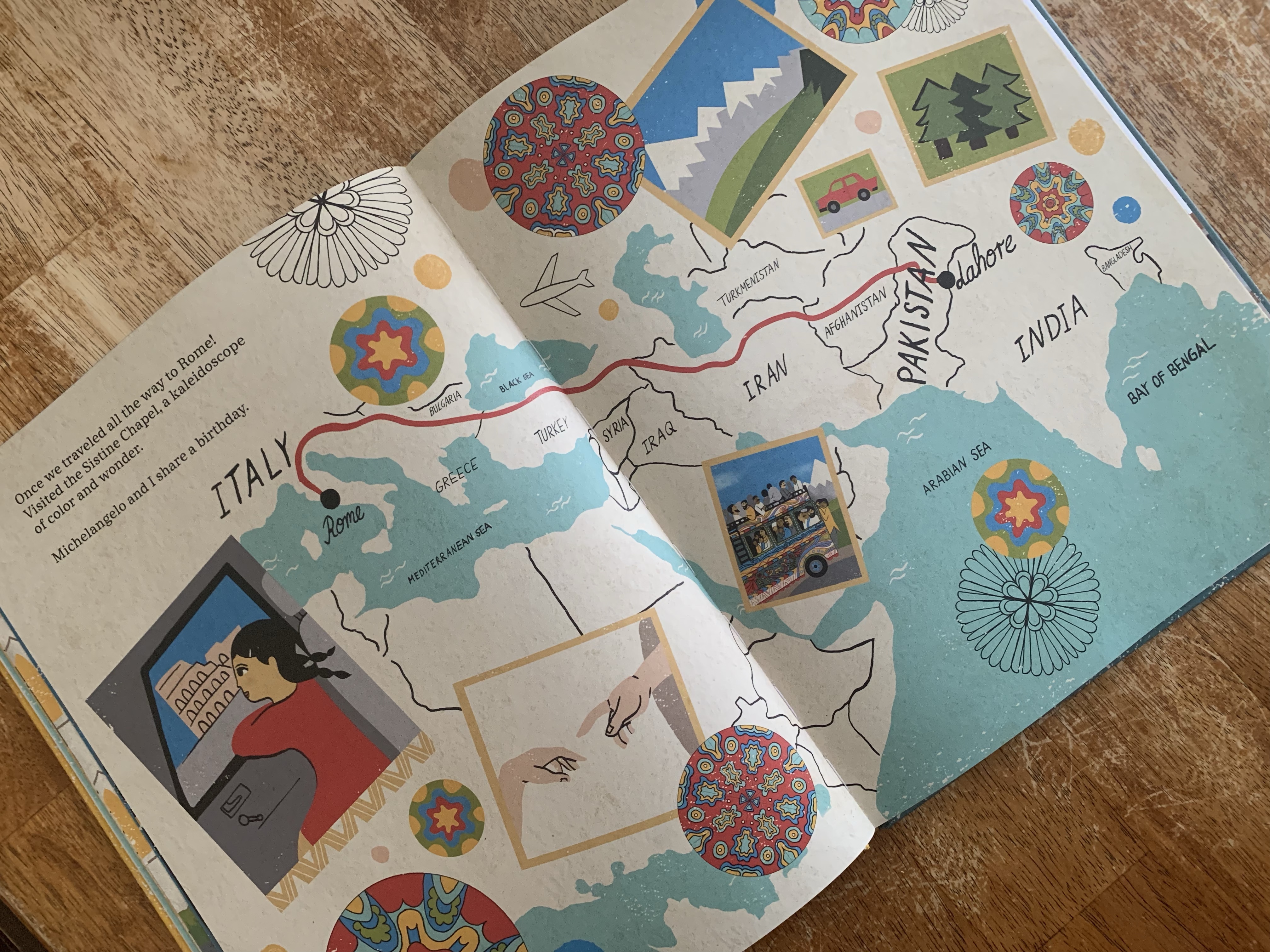
Outside is the city of Lahore, in Pakistan, streets rich in smell and color and sound exist: orange jalebi and strings of jasmine, sounds of Qawwalis and pop music, the melodic call to prayer from the minarets. As a child she plays cricket and climbs trees and flies kites. Up on the roof she trains pigeons and looks out at the horizon.
When it gets hot, her family heads north. They once traveled all the way to Rome. She visited the Sistine chapel, her and Michelangelo share a birthday.
At school she is shy. She loves math, as it is a tool to understand the world. She finds she is also good at drawing birds, and people. She studies miniatures with a magnifying glass. Eventually training in miniature painting with a master. Art becomes her ticket to new worlds.
She heads off for America, taking her roots with her, but once she arrives she cannot leave. Her passport is the wrong, color. She lives in New York and cannot return to Pakistan for nine years. Now she can travel and soar and share her work with the world.
There is a glossary at the end and more information about Shahzia and her paintings.
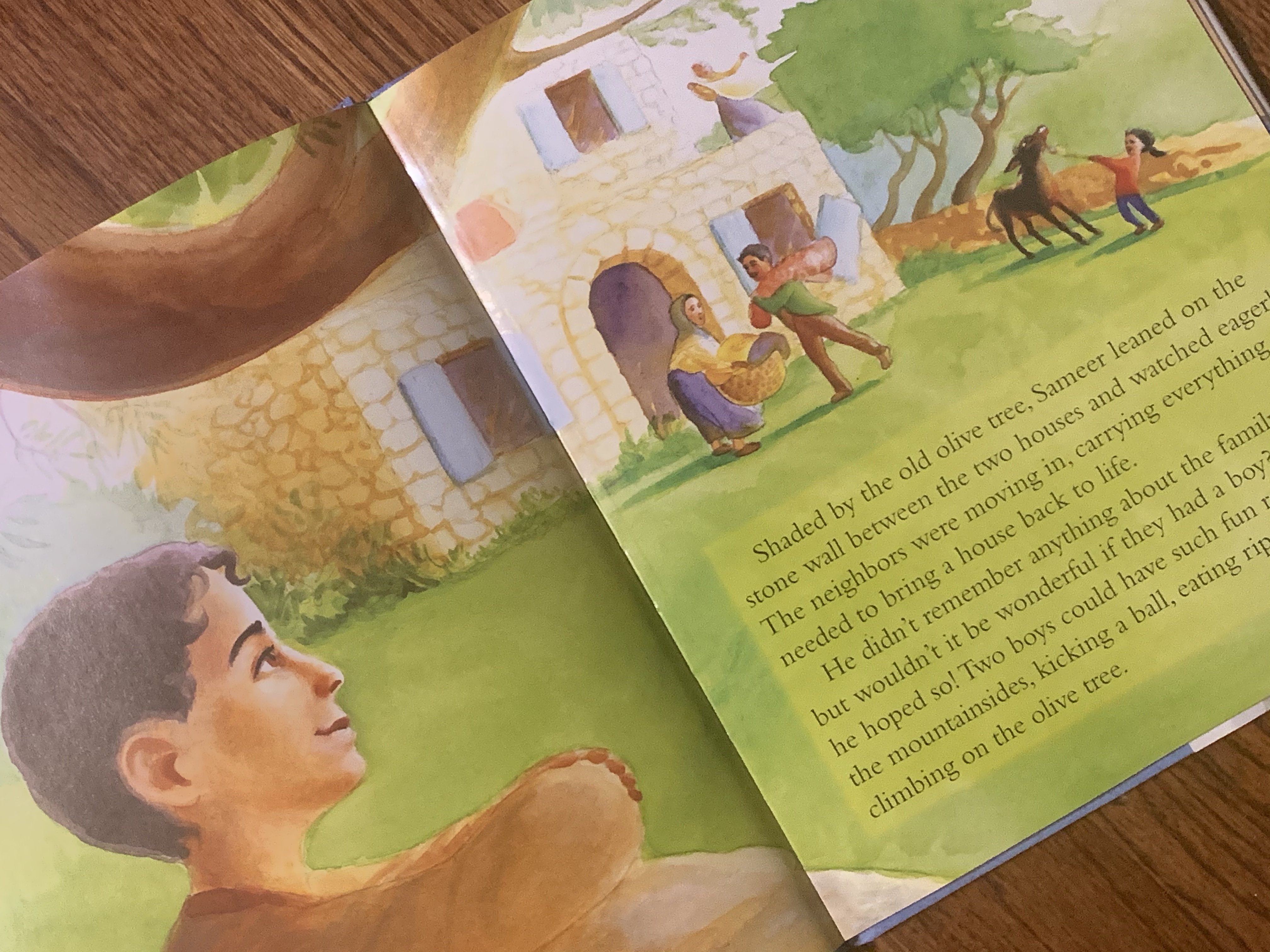
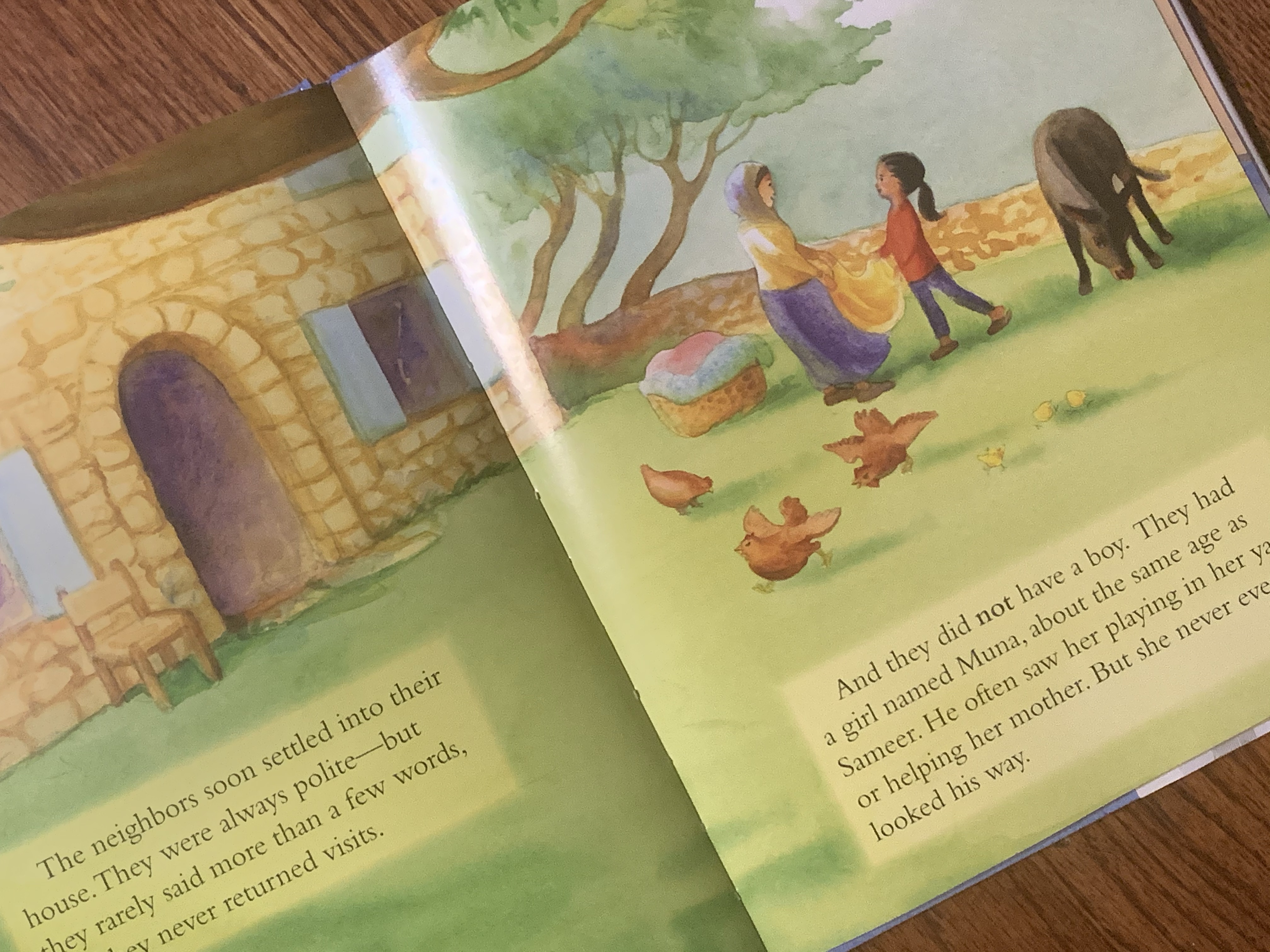
Set in Lebanon, this 32 page book for kindergarten to second graders uses the ever important olive tree as a point of contention between two neighbors. Muna’s family moved away during the conflict because they were not like the others in the village, and while they were gone, Sameer’s family cared for the olive tree on their neighbor’s property, and collected the olives that fell on their side of the wall. But now that the neighbors have returned, Sameer is not only disappointed that they don’t have a boy his age to play with, but also clashes with Muna when she says that he shouldn’t take their olives. By the end of the book, olive branches of peace will be referenced and hope hinted at in this brightly illustrated book with a lesson.
I like that why Muna’s family left is not abundantly clear, saying that “For many years the house next to Sameer’s had stood empty. . . that the family who lived there had gone away during the troubles because they were different from most of the people int he village.” Lebanon is a diverse place and the illustrations seem to show both Mom’s wearing head scarves, the text does not detail if they are unlike each other because of religion, or culture, or some other reason, and I kind of like that it is left vague so that children learn in the end perhaps, it doesn’t matter.
When the family moves back home, Sameer watches them and recalls the ways his mom prepares the best olives in Lebanon. The neighbors are polite, but not friendly. They don’t ever say much and they don’t return visits. One day when the ripe olives have fallen on the ground, Sameer heads out with his basket to collect them. Muna, who has never looked over at Sameer, watches him and tells him that they are her olives, and that the tree has been in her family for a hundred years.
The two bicker about who has rights to the olives on Sameer’s side of the wall and in anger, Sameer dumps his basket of olives on Muna’s side and walks off. After that, no one on Sameer’s side collects the olives on the ground. One night there is a storm and the olive tree and part of the stone wall are destroyed. The adults gather to survey the damage, but walk off without saying anything. The two children are left to decide what to do next about their beloved tree, and their relationship with one another.
I like that the resolution is subtle, but thought provoking and that the adults don’t seem to interfere too much. I can’t imagine that they don’t have opinions about their neighbors and the olives, but the book stays on the children and the assumptions, stubbornness, and unsaid words that have created such a divide, and must ultimately be resolved as a result.
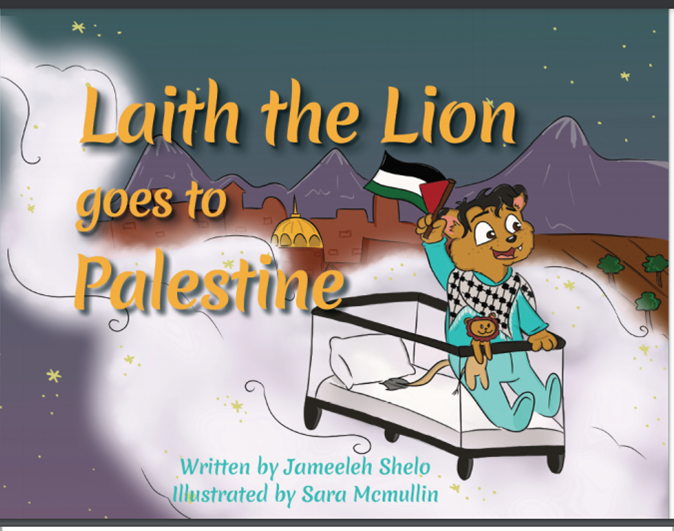
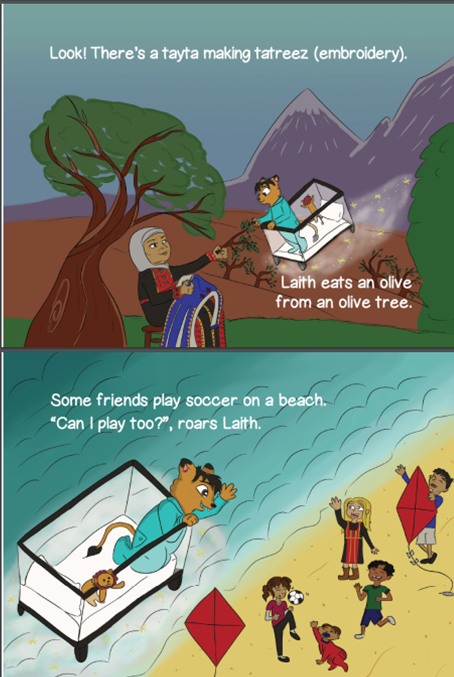
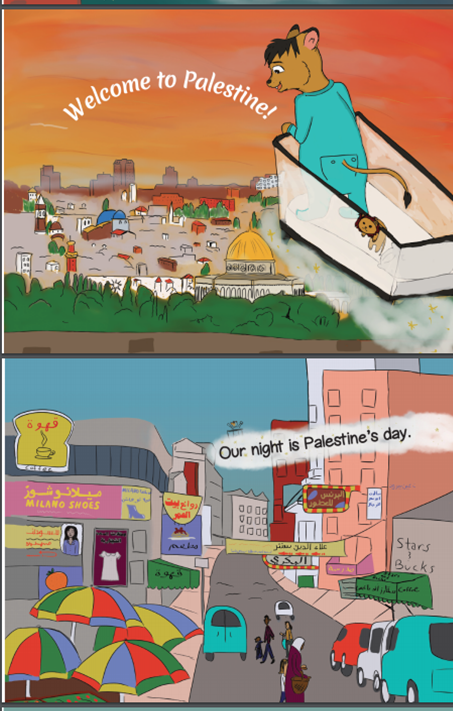
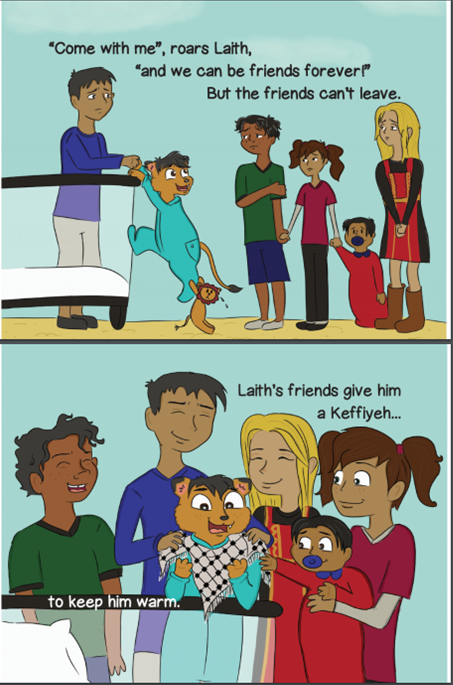
This 36 page toddler to kindergarten book features a little lion that doesn’t like to sleep. One night he wishes for friends to play with and his crib starts shaking and moving and a magical adventure begins to unfold. The story highlights and celebrates Palestine, as that is where the crib takes him, but the story is also about not wanting to go to sleep, not wanting to miss anything fun, and seeing nighttime and daytime routines. I love that it shows tatreez (embroidery), and mentions olives, and the friends he makes on the beach playing soccer are so welcoming, even gifting him a keffiyeh to keep warm with, but I really wanted more sites of Palestine, and more childish adventure and wonder about the beloved country. The book mentions wishing and uses the word “hate” in describing how Laith feels about bedtime. The taytas wear hijab, but there is no mention of religion. The book is a great introduction to Palestine or a mirror for Palestinian children to see themselves in a fun animal led universal story.
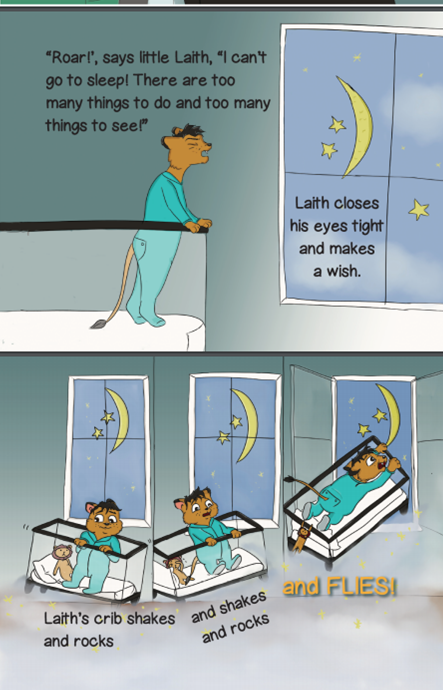
Laith is a lion, his mom is a giraffe and his father a bird (perhaps a hawk or falcon), he loves bath time and story time, but not bedtime, he doesn’t want to miss anything. So when he makes a wish and finds himself flying outside in his crib, he is disappointed to see mama and baba asleep. his taytas asleep, and all of his friends sleeping too. He wishes for someone to play with, and roar he is off to Palestine, where his night is their daytime.
In his world every character is an animal, but in his adventure, the characters are human. He sees a grandma and eats an olive before asking some kids playing soccer on the beach if he can join. As they play and cheer he gets cold and wants to go home. He invites his friends, but they have to stay. They gift him a keffiyah, and he leaves.
On his way back to his room, he looks in on his friends. Daliyah is getting dressed for school. Zain and Idris are brushing their teeth, and his taytas are making breakfast. When he wakes up he tells his parents he wants to go back to Palestine, and they remark on him having a beautiful dream.
I love that there are diverse kids depicted in Palestine, that Laith’s grandmas are involved in his daily life, that the concept of day and night on different sides of the world is accounted for. I don’t know how I feel about the voyeurism, sure it is innocent enough, but maybe Daliyah could have been getting ready for school, rather than getting dressed. I like that the keffiyah came back with him and the illustrations show the Dome of the Rock.
I bought this as an ebook, because I was impatient and didn’t want to wait for shipping to show support to Palestinian books and authors. It came with a coloring sheet as well, and is $2.99 on the website https://www.laiththelion.com/ it is also available as a hardback book on the website (heavily discounted) or on Amazon at its regular price.
I’m not sure what I expected this book to be, I just knew I wanted to get my hands on it, but I’m fairly certain, that even if I would have had some expectations, they would have been no where near how well done this 40 page book for four to eight year olds is overall. It is unapologetically American-Palestinian Muslim in an inclusive funny delightful way, that only an OWN voice book can be. There have been some great picture books lately that are authentic, yet mainstream, and this book pushes that standard just a little bit higher as it normalizes jummah, halal food, dabke, hijab, with familiar threads of street food, spunky little sisters, untied shoelaces, tradition, and excitement. The story has a twist and some intentionally misleading foreshadowing, that give the book depth and added fun. Readers of all backgrounds will relate to this book and find something that they can relate to, as they laugh and marvel at Musa’s infectious enthusiasm for hot dogs.
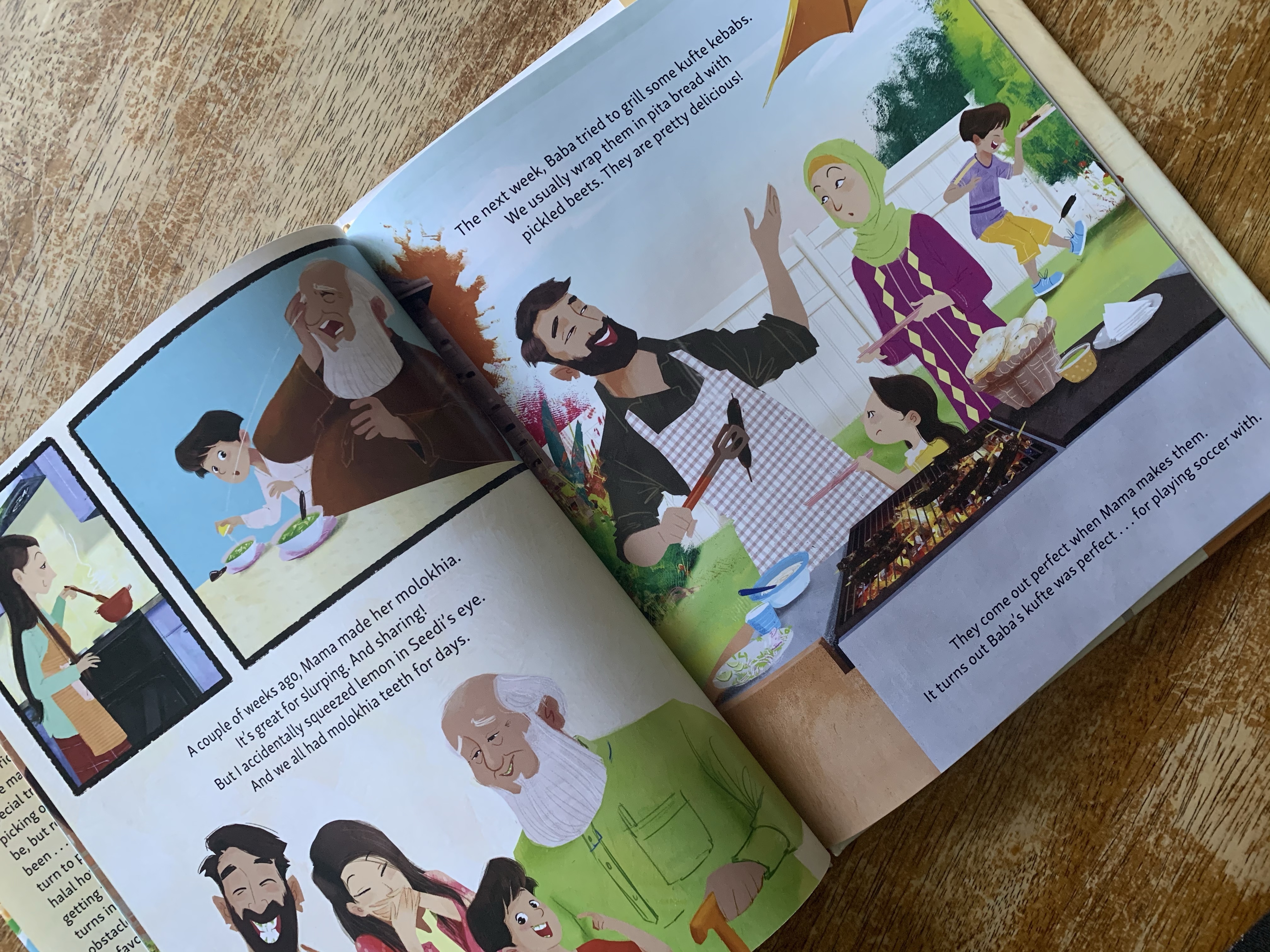
Musa Ahmed Abdul Aziz Moustafa Abdel Salam, aka Musa, loves Fridays. His family heads to the masjid for Jummah prayer and then home for a special Jummah treat. Lately, they’ve had molokhia, that stayed in their teeth for a week, kufte kabobs that were better for soccer playing than eating, riz bi haleeb with lost dentures, and prelicked jelly beans. Alhumdulillah, this week is Musa’s turn to pick, and he is picking his favorite: halal hot dogs with Salam sauce.
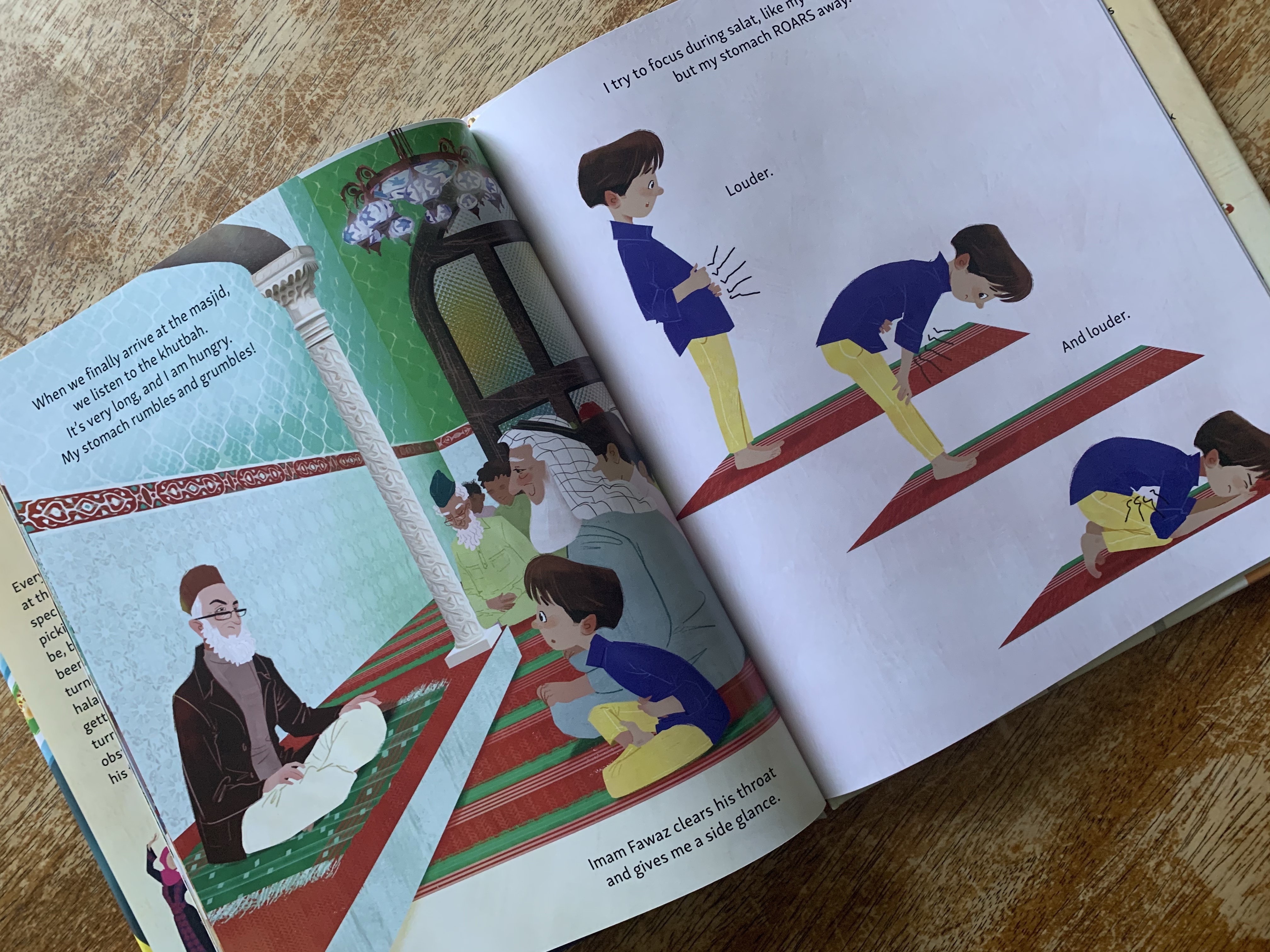
They head to the mosque dancing dabke as they leave their house with smiling faces. The khutbah is long though, and during salat his stomach is roaring! Afterward he is off, but Seedi has to help Maryam find her red shoes in a sea of red shoes and mama is chatting with friends.
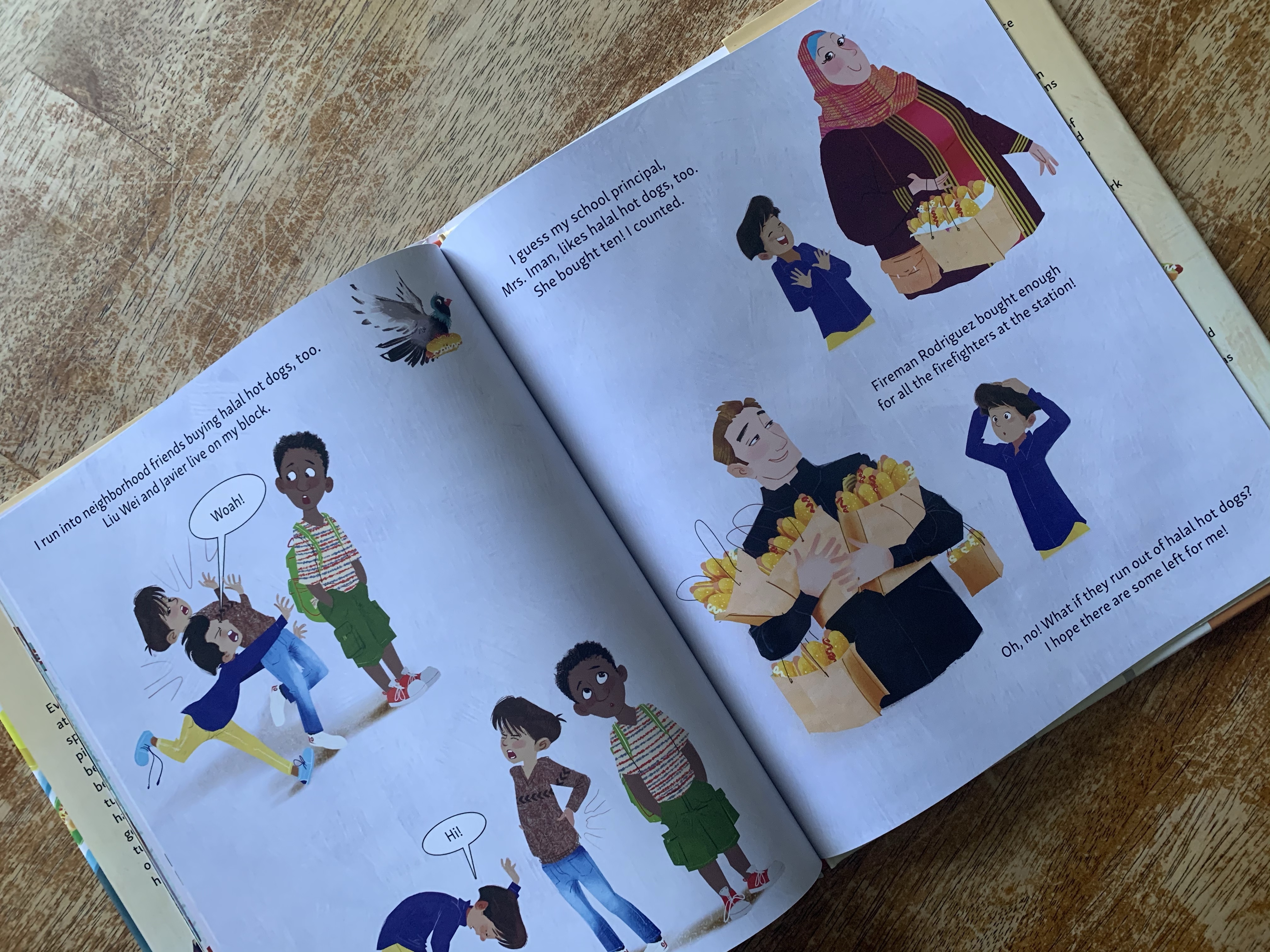
Dad gives in and lets Musa go get the hot dogs alone. As he heads to the stall with the best hotdogs: the perfect amount of hot, chewy, juicy hot dog goodness, he passes all sorts of foods being eaten. There is falafel and bao and tacos and samosas and churros, but he is determined to get hot dogs, even though the line is really long.
He sees friends in line, and firefighters, and even his school principal. Everyone loves hot dogs, even birds and squirrels. Finally he buys a whole bag full with special Salam sauce and races home to share with everyone. But uh oh, it doesn’t go as planned, and I’m not about to spoil it, so get yourself a copy like I did from http://www.crescentmoonstore.com or your library, and maybe don’t read it while you are fasting, because you will be craving hot dogs, mmmmmm nom nom nom.
There is an Author’s Note at the end that details her kids’ influence on the story and explains that a portion of the proceeds go to UNRWA USA, a non profit that helps Palestinian refugees. There is a glossary of Arabic Words and Terms, and a section explaining Halal Laws.
The book shows the mom in hijab outside the home, and uncovered within the home. There are diverse skin colors among the Muslim and non Muslim characters in the book, as well as a variety of ages depicted. Seedi wears a keffiyah on Jummah, but different clothes on different days. The illustrations are wonderful and descriptive and do a lot to compliment the story by setting a relatable and diverse-positive visual.
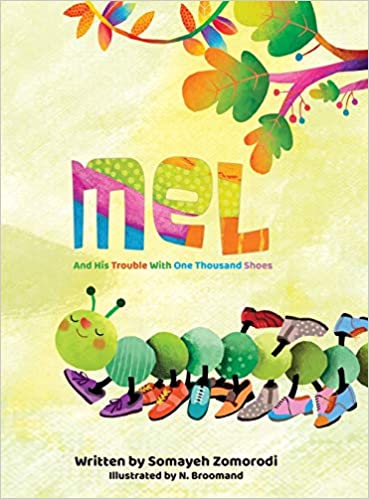
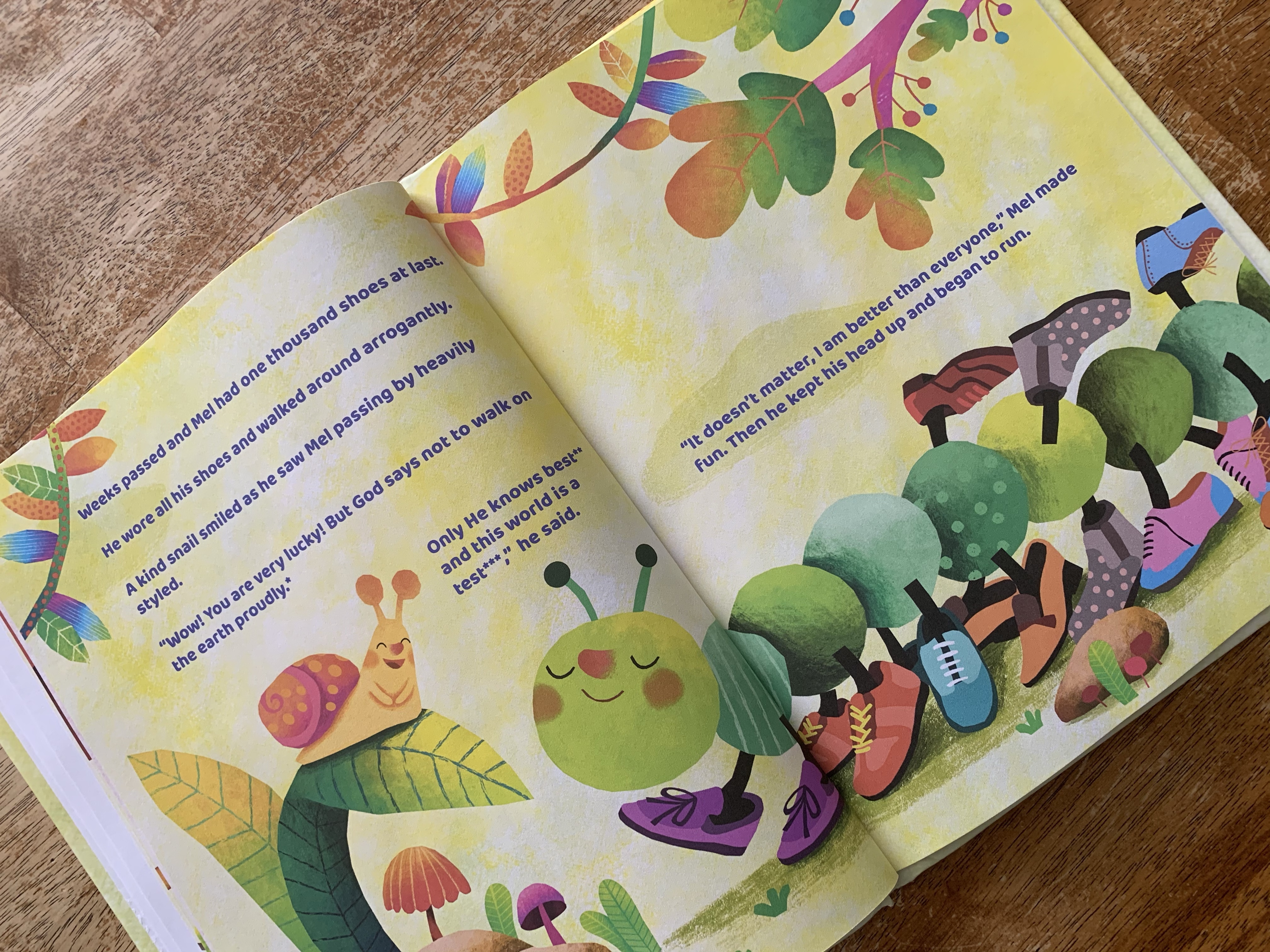
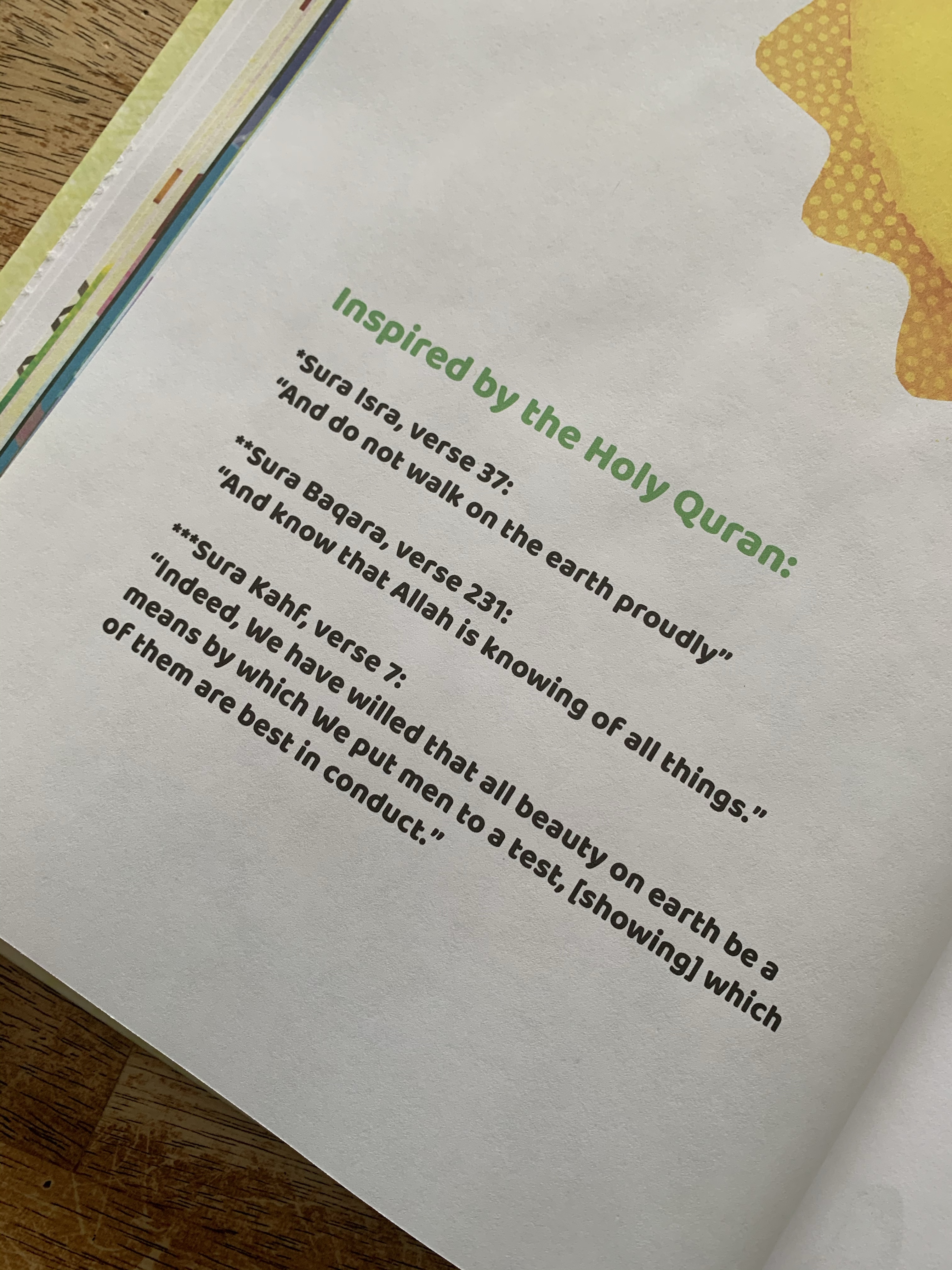
The book has a solid premise, although it reads a lot like The Very Greedy Bee, and has lovely 8.5 by 11 pictures on its 24 pages, but unfortunately the text is all over the place. The story contradicts itself, it is overly wordy, and way to rhymy. Yeah, rhymy isn’t even a word, but if it were, this book, would be a great example. I struggled with the font as well, the lowercase f looks like a capital F, and no matter how many times I read it, I’d get tripped up thinking an interior word was being capitalized. The book says that it is based on the ayat in the Quran that reads, “And do not walk on the earth proudly,” and even has two other ayats listed at the end as inspiration, but really it is a single page and a single character that blurts out the ayats from the Quran that talk about walking on the earth proudly and this world being a test. While the illustrations are fun, it just isn’t enough to make the book a solid read to convey humbleness and gratitude. Children will be lost in the text, confused by the inconsistencies, and disappointed in the super quick resolution.
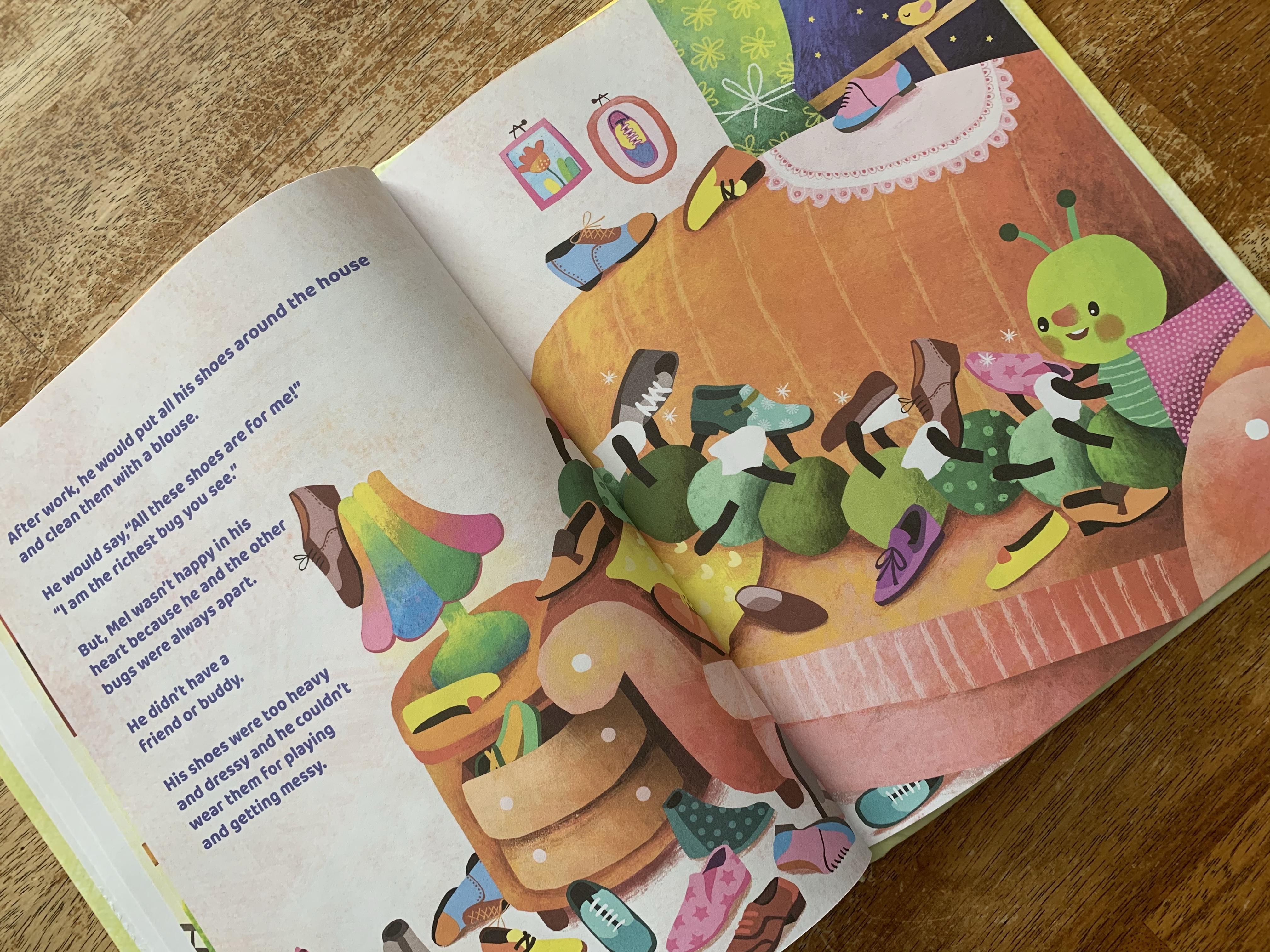
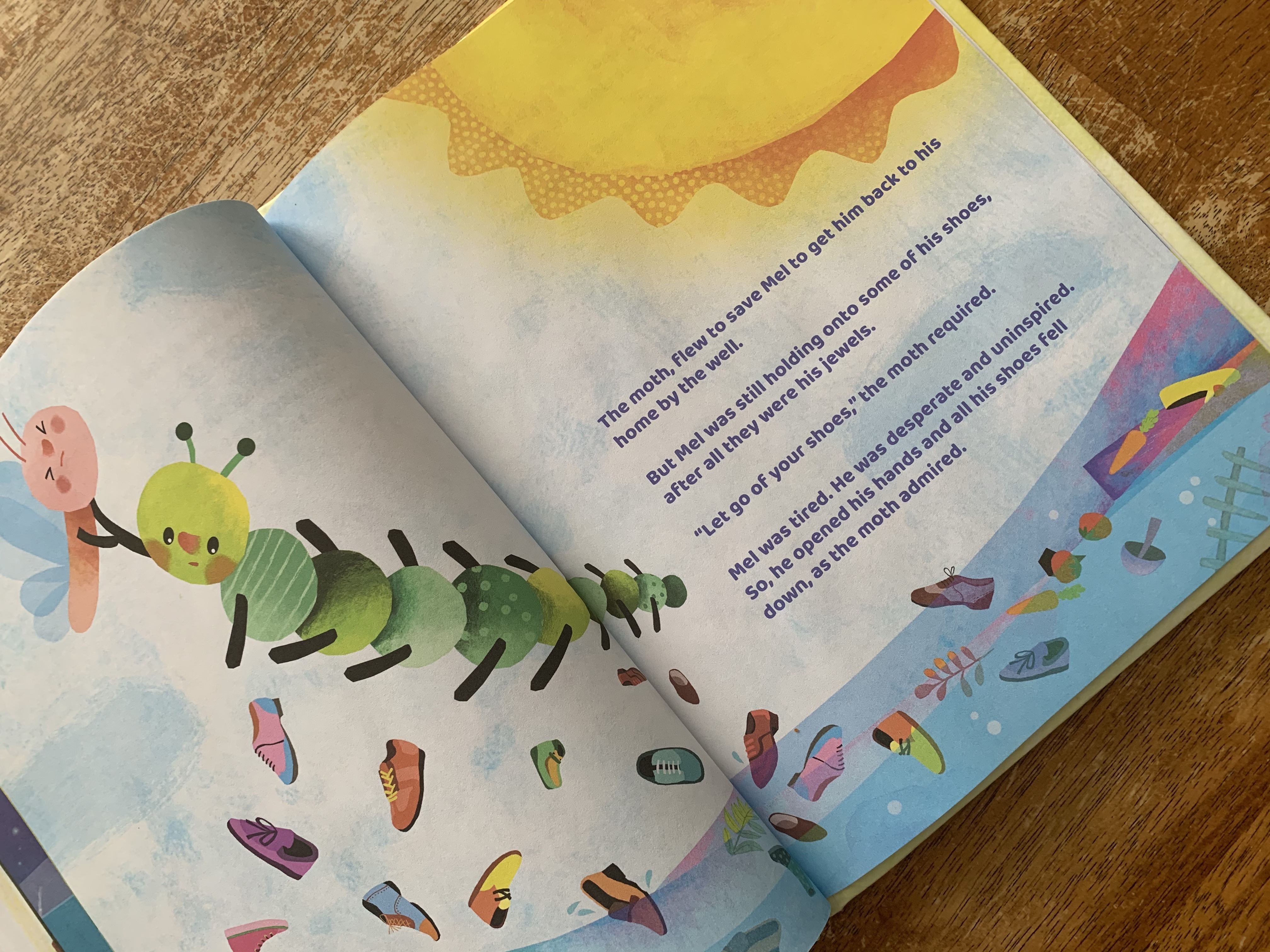
Mel the millipede lives in a farm next to a well. He has one thousand feet and although he doesn’t need shoes, he likes to collect them. He has 950 and is working to find the remaining 50 to complete his collection.
It says, “No one was as happy as Mel; one could tell.” Then on the next page as he cleans his shoes with a blouse it is revealed that he isn’t happy in his heart because he is always alone. But the picture stills shows him smiling.
He finally has his 1,000 shoes, we don’t know how or where he got them, when a small snail tells him that “God says not to walk on the earth proudly. Only He knows best and this world is a test.” There is no explanation, Mel just says “it doesn’t matter, I am better than everyone.”
This whole time walking, Mel has been wearing his shoes although it has mentioned that he can’t wear them because they are heavy and he doesn’t want to get them dirty. As he watches the other bugs fly kites and balloons he is sad that he can’t play because his shoes are too heavy. But he has been walking outdoors and is on a mushroom lamenting with his shoes on. Those flying kites aren’t moving much…one is a worm, one a snail, very inconsistent.
One night a moth knocks on his door warning Mel of a flood. Mel ignores the frantic urgings, fearing that it is a trap to get his shoes. He thinks everyone is jealous of his shoeing. The flood waters sweep him and his shoes out of the house and throughout the night he risks his life multiple times to save his beloved shoes.
When morning arrives, he is still trying to save his shoes, when moth, attempts to save Mel. To get Mel back to his house, he will have to convince him to drop his shoes. Mel is tired and desperate and uninspired so he drops his shoes and is brought to dry land. I don’t think uninspired is the right word, shouldn’t be be grateful and willing to change to save his life? But even that notion is a stretch because in the illustrations he is so close to land. He could just swim over, shoes or no shoes, moth doesn’t need to be flying him to safety. Additionally, when the water recedes, won’t his shoes still be there?
The conclusion is Mel hugging moth and apologizing to the bugs. I’m not sure what he is apologizing to them for, nor is it explained. Since the book claims to be based or inspired by ayats, I feel like this would have been a good place for a moral cathartic lesson, but alas, it just says, “the end.”
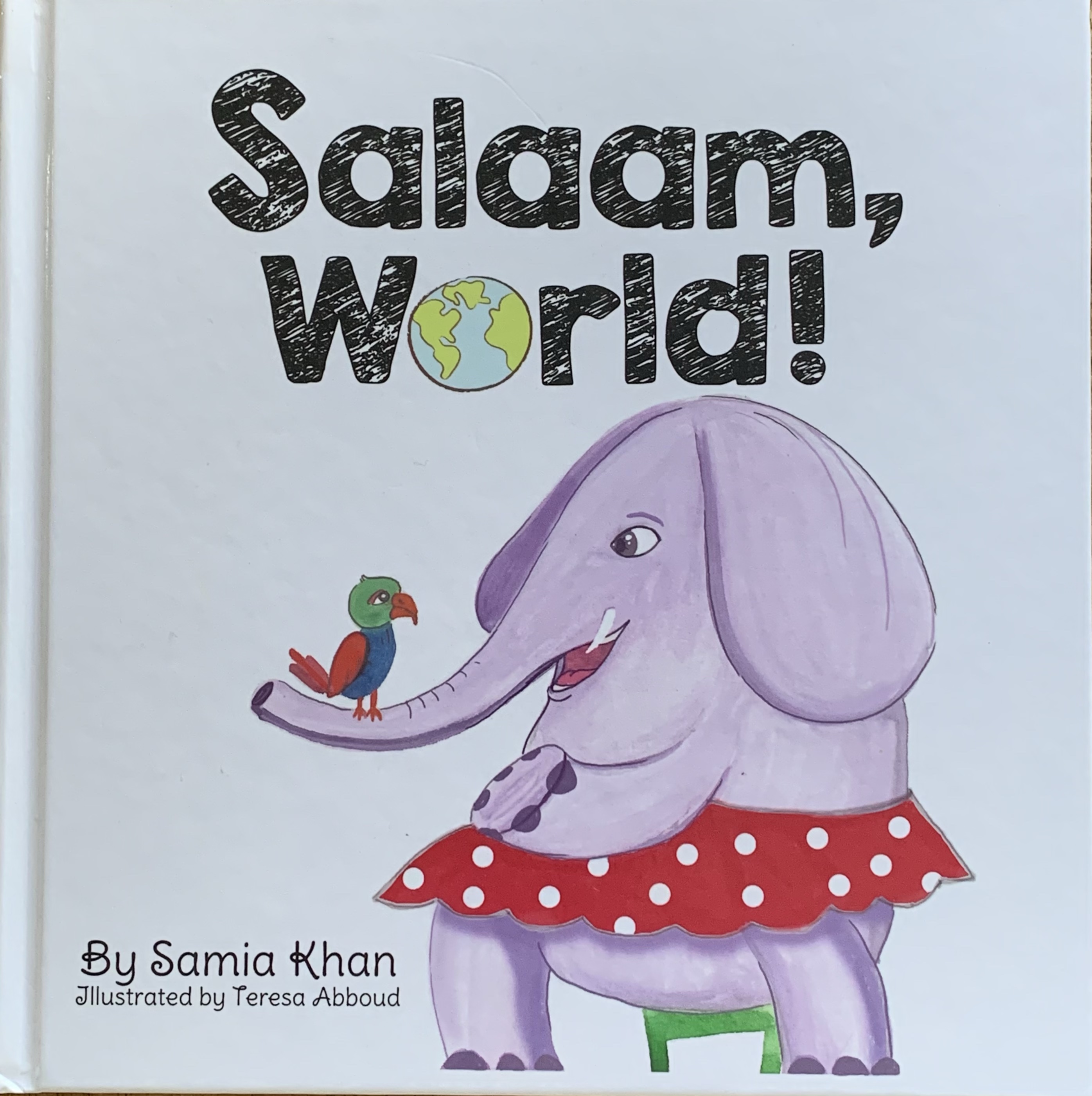
This 26 page rhyming picture book starts out basic enough with salaam being said from various locations, but it digs a little deeper as the book progresses to explain what salaam means, and how to respond. A good introduction to the greeting of peace for ages three and up. The pictures are jungle animals testing out the word and the 10 by 10 size is sufficient for bedtime and in small groups. My picky critiques are I don’t like the font as I think it is hard for early independent readers to decipher when capitalized, words such as “catastrophic” and “salutation” are a bit advanced for the demographic, and I wish there was a bit more Islam in the book, but overall it is sufficient, and an effective tool to helping get little ones to say salaam.
“Salaam from above, salaam from below, salaam from the mountaintops covered in snow,” is how the book begins as a cat hanging from a tree and braving the elements offers his greetings. A donkey then asks us to hold up and explain what the word means.
Salaam is defined as meaning peace in Arabic and a word that Muslims use that is like ‘hello’ only kinder. It is sending peace to those you say it to, and a show of respect. The animals say it to others before noting that you can say it short or long: Salaam or Assalamualaikum.
The book then asks how to respond before teaching us to say walaikum-assalam and telling us not to be alarmed the next time we hear the greeting, but to return it and spread it.