Category Archives: Picture book

Is That a Teapot by the Toilet: A Muslim Child’s Potty Training Story by Rabia Bashir illustrated by Basma Hosam

Standard
Is That a Teapot by the Toilet: A Muslim Child’s Potty Training Story by Rabia Bashir illustrated by Basma Hosam

I think I’ve loved every Bismillah/Precious Bees book I’ve ever read, and this book is no exception.  It is only the second children’s book I’ve ever seen on the subject of Islamic bathroom etiquette and I think combined with My First Muslim Potty Book, our little Muslims and their potty trainer adults are in a great position to explain, teach, laugh, and be successful in getting our little ones out of diapers and adopting Islamic Sunnahs and hygiene.   I love that this book is inspired by the author’s real life experiences, that it starts with a few WHO facts about the lack of access people have worldwide to a proper toilet with a portion of the book sales going to help those who lack hygienic facilities, and that the book is approved by a Sheikh.  Additionally, I love that there is a song that goes along with it (it isn’t posted yet, but will be shortly inshaAllah), that there are questions and games at the end with informative pages about istinja and the duas to be said, it is silly, the illustrations adorable and expressive, and overall just oh so relatable.  The book is perfect for ages three and up, and a great reminder resource for older kids that may need a nudge to stay on top of their bathroom behavior and feel normalized by seeing themselves in the pages.

It is a big day for mom and dad and Rayyan and Ridhwan.  Rayyan is going to start using the potty.  They have practiced entering the bathroom, but now they are going to do it for real: saying Bismillah and entering with the left foot first.  Only he uses his right, so they do it again, and it happens once more, and now mom and Rayyan are laughing and dancing.  The third time is the charm and in they go.

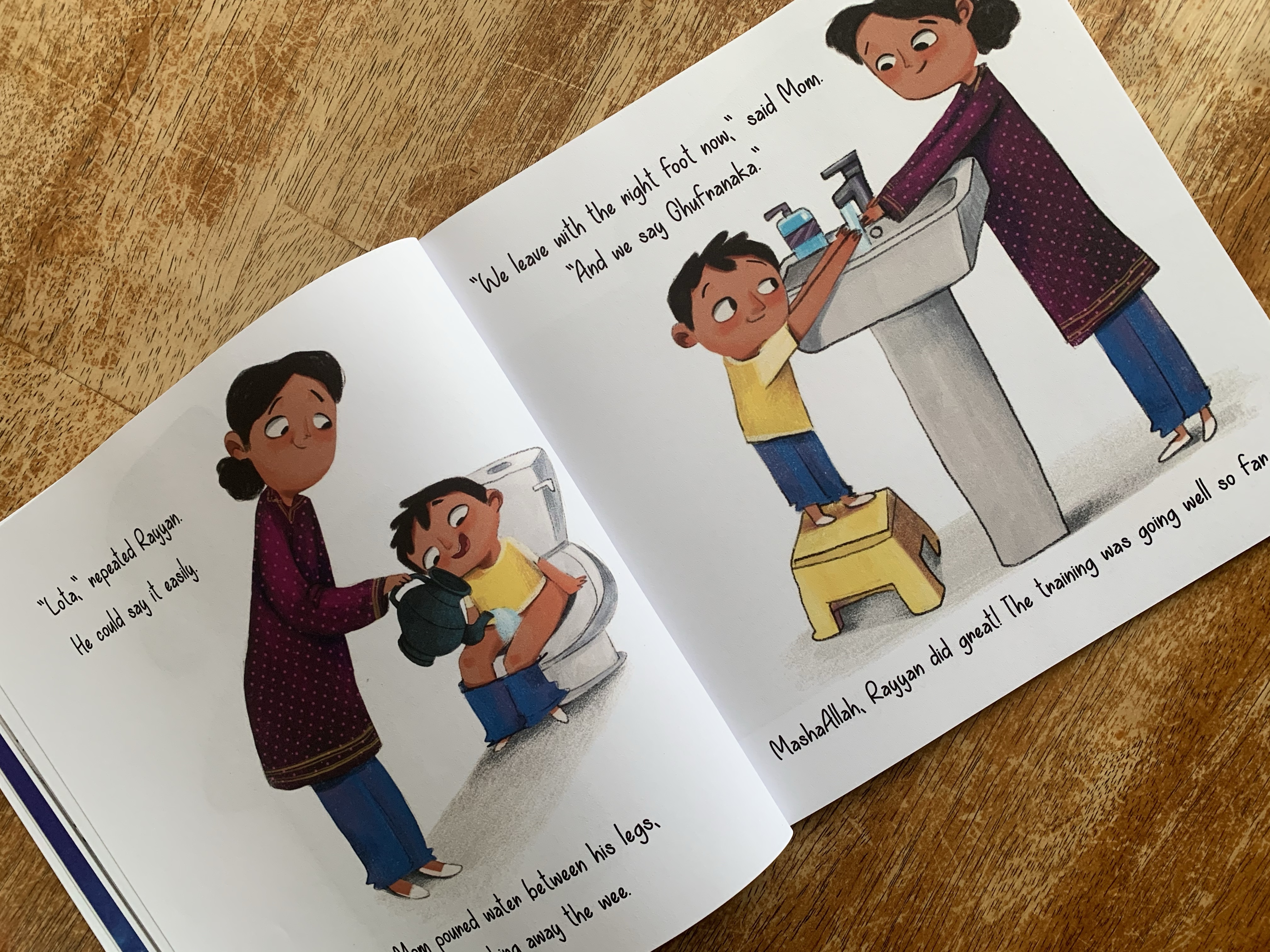
He sits on his little potty, and he goes, hurray, but when he starts to stand up, Mama explains that he must clean himself, all Muslims do.  Rayyan asks if that is a teapot when Mama lifts up what she calls in Bengali a bodna and his Urdu speaking father calls a lota.

Lota sticks and Rayyan is washed and ready to clean his hands before heading out the door with his right foot and saying Ghufranaka. So far so good, but it isn’t a one time thing.  There are a lot of days of accidents, but over time it gets better so the family decides to head out.  When all of a sudden Rayyan has to go, the family runs to a halal restaurant to borrow their restroom.

Phew they made it just in time, and instead of a teapot looking lota they have a watering can which makes his dad have to stand really far away to help him wash. Rayyan notices different places have lotas that look different than his does at home.  At a wedding they had to use a plastic cup, the mosque has a mini shower, at the park Mama pulls out a plastic bottle from her purse.  Rayyan decides he wants his own little bottle too, so they pick one out that he can keep in his backpack.  

One year later it is a big day for Ridhwan, he is about to start potty training, like kids all over the world. There is then a two page spread about many words different languages use to call the vessel that they use to wash themselves in the bathroom. There are questions to talk about regarding the story, a maze to get to the restroom in time, the Muslim Potty Training Song to the tune of the Hokey Gokey, which I’m assuming in America is the Hokey Pokey, a page answering What is Istinja?, Duas when using the toilet, the story behind the story, information about the illustrator and about the author.  All-in-all 48 pages.  

I purchased mine on Amazon, I think the local stockists will have it shortly and I would assume the bismillahbees.com website will as well.  I know the author recently had her father pass away, inna lillahi wa inna illayhi rajioon, so please make duas for her and her family, and be patient on the QR code and song which inshaAllah are forthcoming.

The Library Bus by Bahram Rahman illustrated by Gabrielle Grimard

Standard
The Library  Bus by Bahram Rahman illustrated by Gabrielle Grimard

library bus

It seems this polarizing 32 page picture book has instagram reviewers torn, perhaps along racial/cultural lines, as to whether the book is wonderful or simply victim to perpetuating the same old tropes and stereotypes.  Maybe being half brown, I shouldn’t be surprised to find myself in the middle.  I think if you are tired of feeling like the only strong Muslim female from the subcontinent acknowledged by the West is Malala Yousafzai, and seeing her single narrative and experience being repackaged in a new book every other week, then yes, this book is going to grate on a similar nerve and OWN voice or not, you will write it off as Afghanistan being close enough to Pakistan and the story of a girl and education being unoriginal.  I think the flip side is that if you find a female lead taking education in the form of a library bus to the places where formal education is not available and you love the empowerment that women educating women can have in changing a society, then you are going to probably love a female driving a bus, a female teaching, a girl planning to go to school, a grandfather making sure in a previous generation when women couldn’t be educated, that he taught his daughter, and being thankful that it is a person from the society and not a “white savior” coming to help the people in Afghanistan.  Both as far as I can tell have merit.  I think that you see in the book what your paradigm and perspective is before you even start.  I have read it and re read it and then read it again over the span of many weeks. I was alerted to it by @muslimkidsbooknook who sensed that we might disagree before she even posted her review (haha it’s like she knows me!), so my review is going to try really hard to focus on the text, and what it says, not on the 30 books before it that had a similar message or on my views on publishers only accepting manuscripts with reassuring easily palatable narratives, there is enough of that already about this book out there.  I’m going to try and offer my perspective on what the book contains and while it has problems for me, I definitely liked it more than I disliked it. Oh and one more thing: the illustrations, swoon, are gorgeous, like really, really beautiful. Bismillah…
img_0157

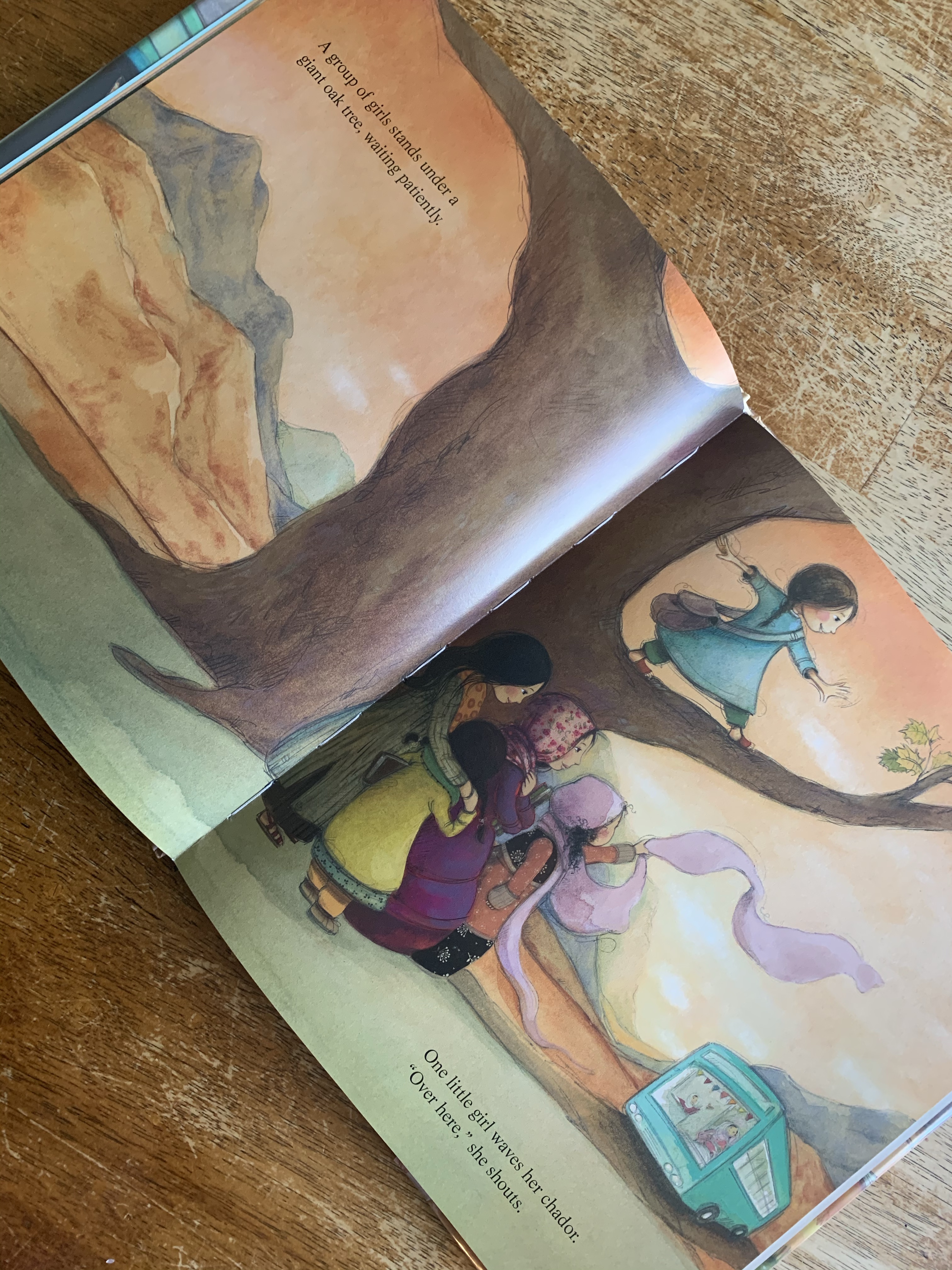
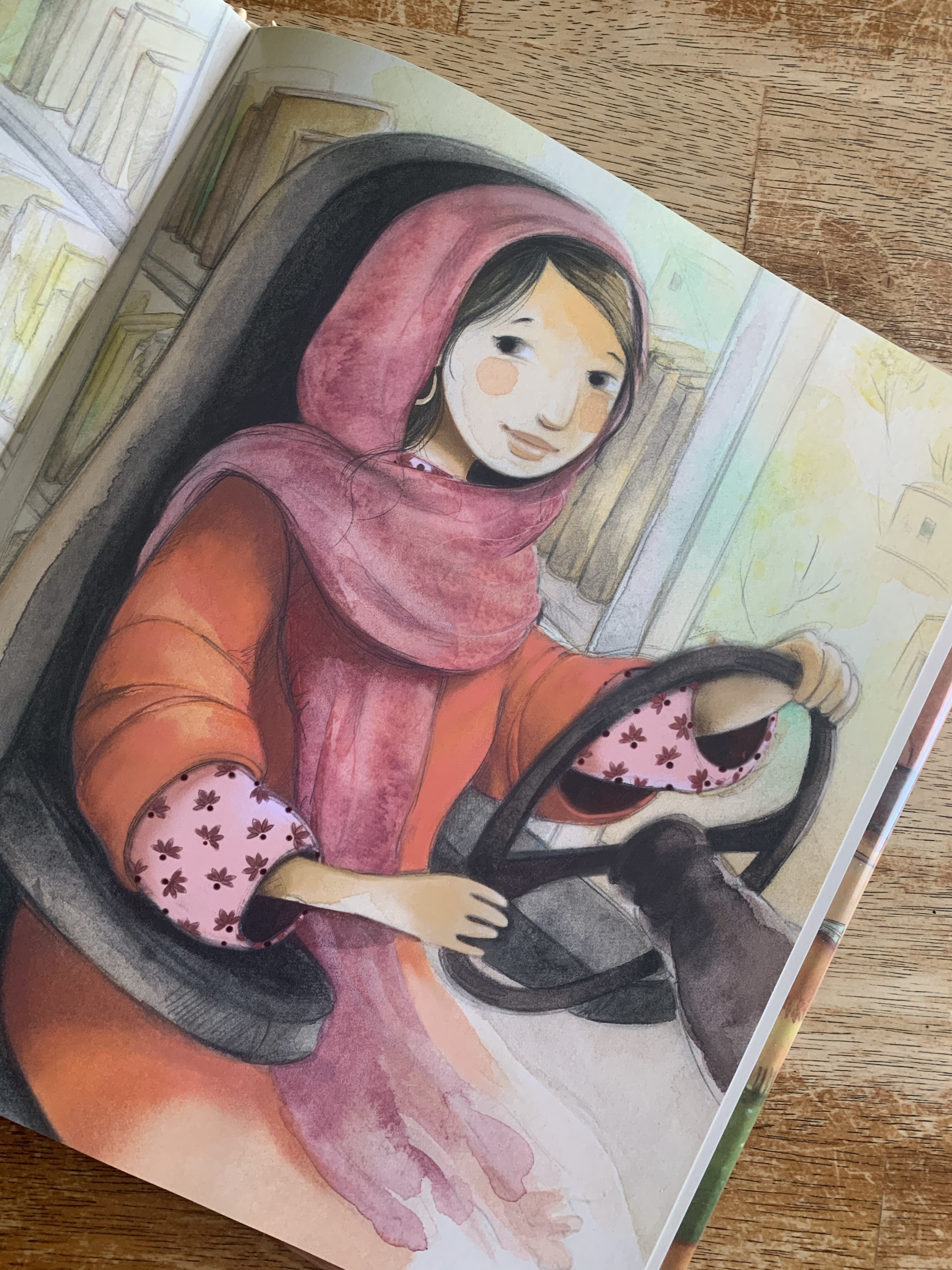
Pari and her mother are getting ready to set off in their library on wheels.  It is Pari’s first day as her mother’s helper and she is a little nervous. It is dark when Pari’s mom drives the bus to their first stop- a small village tucked in a valley between two gray mountains.  There are a group of girls waiting for the bus and call it over to return books and pick new ones.  This reminds me of my time in New England and hearing about the Book Mobiles and Mobile Book Fairs that would visit the small seaside towns that didn’t have proper libraries.  Even my mom used to tell me stories about waiting for the Book Mobile to stop on her street in Davis County, Utah to get books once a month.  The concept is universal and that it takes place in Afghanistan and is driven by a woman who is educated and independent, is intentional with the hopes of being inspiring.

img_0158

The girls then gather for a lesson, it is hard to know how impromptu it is or if it is a regular organized class.  It is also not made clear if they always practice English or it is something unique to the day, but they sing the alphabet song and count to ten.  After class a girl tries to chat with Pari and see how much she knows.  Pari lies and says she can print, but in reality can’t even read or write in Farsi yet. This shows a gap in the story as earlier Pari said she could barely count all the books in the library, and in the pictures there are a lot of books, but she is trying to keep up as the girls count to ten.  As the mom and daughter team pack up to head to their next location they discuss how Pari’s mama learned.

Pari’s grandpa taught her mom a long time ago, at a time when girls were not allowed to go to school and she had to hide in the basement to learn.  Pari wonders if her mom was afraid of the basement.  It is always dark down there.  It is really one paragraph on one page that mentions that girls could not learn.  It is presented in the past tense, and as the story progresses we learn that next year when Pari is older she will be going to school.

img_0159

There is a two page spread about the mom seemingly going off on her mantra that learning makes you free.  And I’m ok with it.  It says when you go to school study hard, period, then the next line says, “Never stop learning. Then you will be free.” Yes! I agree, how many of us pursued a skill or a hobby during this pandemic to feel free from the confines of staying at home.  Learning in any capacity is liberating.  It may not keep you safe in a war, but the freedom of the mind to find peace and pursue passions is critical to mental health and survival.  Am I reading too much in to these basic lines? Absolutely, well probably anyway.

img_0160

When the bus gets to a refugee camp with tents everywhere, Pari and her mom start handing out pencils and notebooks before settling in to what seems an organized English lesson of ABC.  I am torn on my thoughts about them stressing English over their own language.  A sense of pride in who they are by learning Farsi or Dari or Pashtu would show readers that Afghan culture is rich and worth learning and valuing.  I worry that by stressing the English, it presents the culture and language erroneously as the opposite.  At the same time, as a child and teen, I went to Pakistan over a dozen times and would beg my (middle class) cousins to teach me Urdu.  I’d make them take me to Urdu Bazaar for dictionaries and text books, and preschool grammar books so that I could learn my father’s language.  And it never happened.  I’d beg in letters before I got there, and they would agree, but when I arrived they all wanted to work on their English.  They wanted to practice it in conversation, they wanted me to read over their assignments, they would introduce me to their coaching center teachers, their principals, the tutors, and I’d find myself teaching them colloquialisms and explaining idioms, and I’d watch my “textbooks” gather dust.  This was before social media, and YouTube and Netflix and I was their link from their studies to the larger world that rewarded knowledge of the English language.  Is it correct or even logical? No.  But it was my experience that they desperately wanted to learn English over Urdu or the required provincial language Sindhi.  Would readers of this book know that? No.  Do critics of them learning English wish that it wasn’t the case more than wishing that the book simply didn’t highlight it? I don’t know.
img_0161

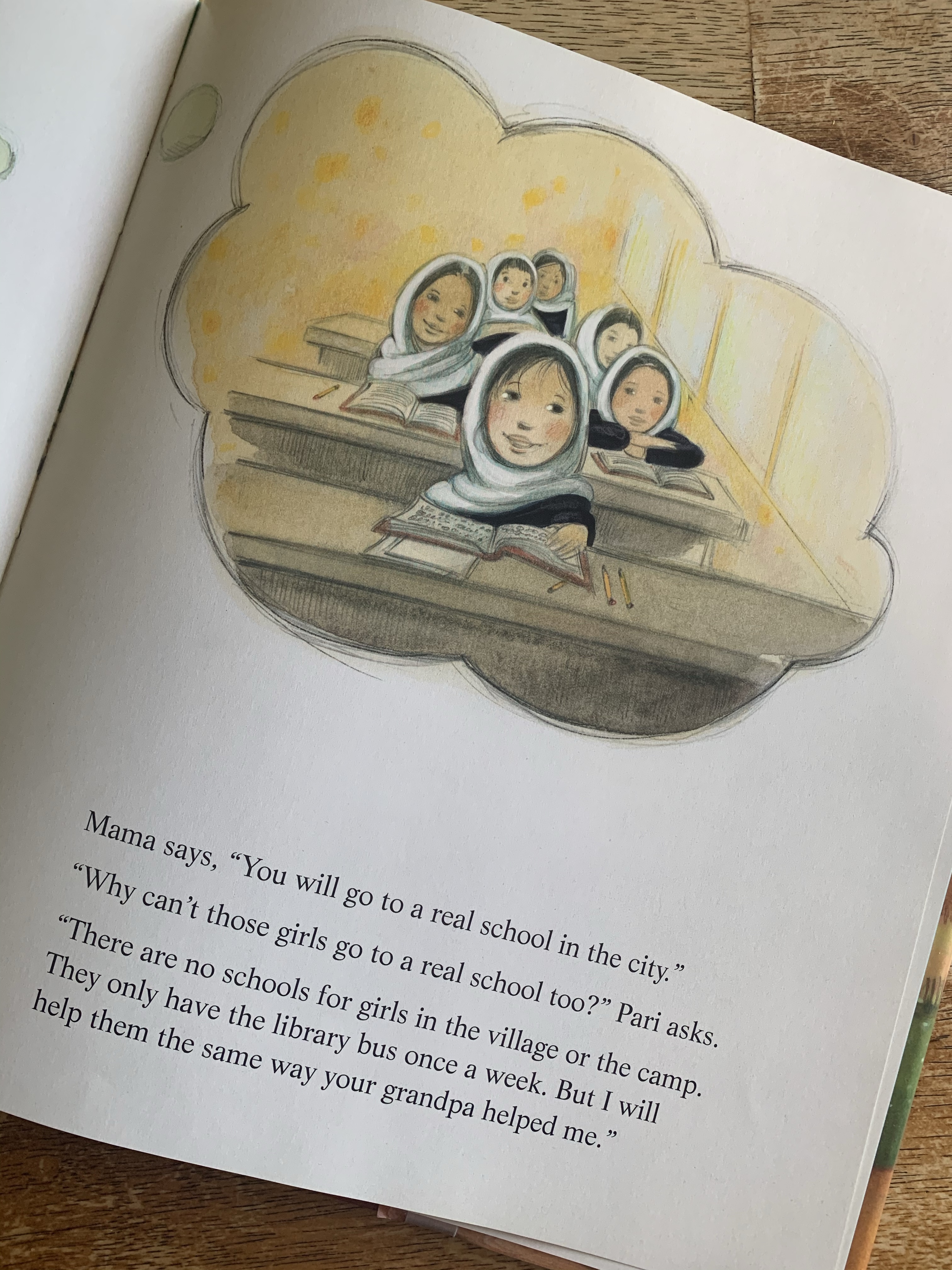
As they leave the camp, Pari reads the letters of the refugee organizations off the tents.  I find it off that earlier she called it ACDs instead of ABCs and yet now she knows the alphabet.  Again I’ve read the critiques questioning why the refugee camps are named and have over thought it.  In some ways I think it is a reminder that the country has been at war and that individual organizations are helping care for those displaced by countries that tore the country apart.  The text says that, “there are no schools for the girls in the village or the camps.” If anything I took this to show that while we stereotype Afghan society as not making education of females important, that international relief groups don’t either.  The great saviors aren’t teaching the girls in the camps, a mom and her daughter come once a week.  There is a subtle yet powerful critique of foreign policy there, if you want to really be honest, I think this should be made more clear.  At the end of the day the strong Afghan people are putting their country back together after a never ending illegal conflict has ravaged them further.
img_0162

The author says in his note at the end that this book is based on real people he met in refugee camps when he returned to his homeland and that this book is a tribute to the strong Afghan people, particularly the women.  Imagine where any war torn nation would be without the bravery and determination of mothers and teachers, and women who will risk it all for their children and ultimately an entire generation, when politics and power have found other things to value.

The book on its own I think is fine, allbeit written plainly for western readers.  Do I wish stories about life in this part of the world didn’t feature war and refugees and education, absolutely.  We can argue my experience compared to your experience, to the author’s purpose and intent, to the publisher’s vision. That is the beauty of books, we don’t have to agree and we can discuss and we can all be better for it.  There is nothing Islamic in the book other than some of the characters wearing a scarf or chador or hijab.


img_0163

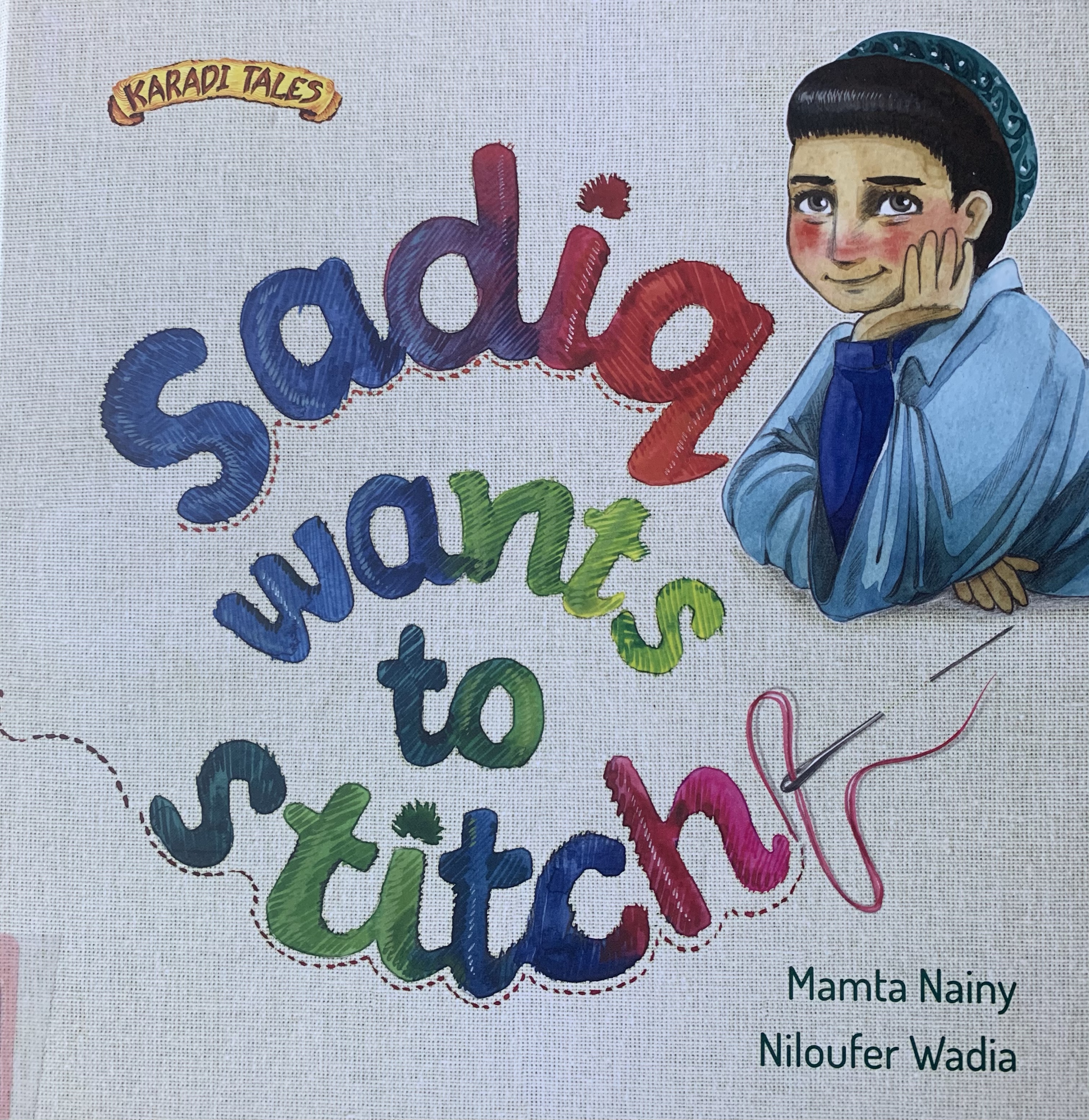
Sadiq Wants to Stitch by Mamta Nainy illustrated by Niloufer Wadia

Standard
Sadiq Wants to Stitch by Mamta Nainy illustrated by Niloufer Wadia

img_9844

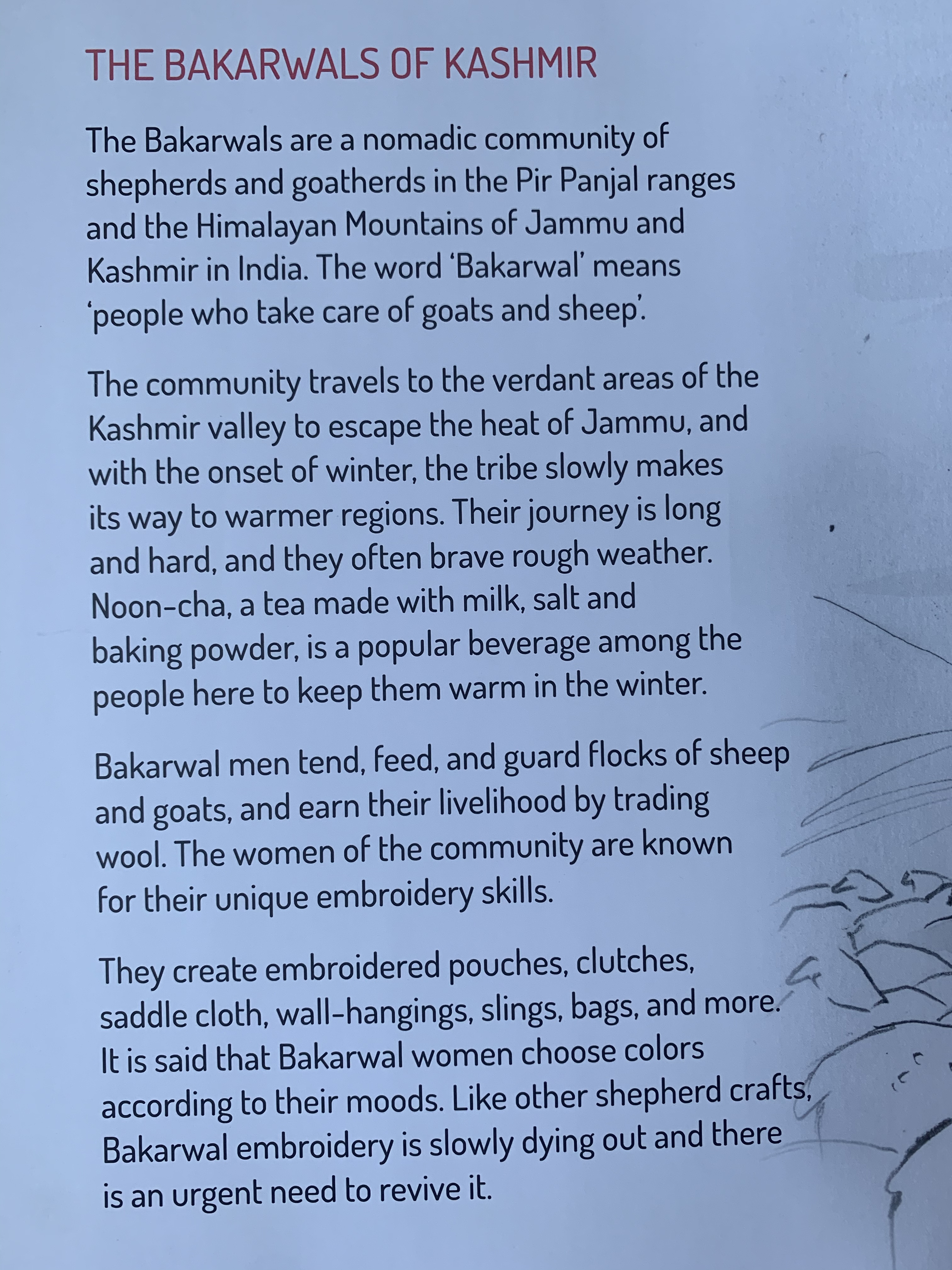
This 40 page AR 4.5 book touches on gender norms and breaking cultural expectations, as well as a mother’s love and a child’s determination.  The beautifully illustrated pages show Kashmir’s landscapes and culture.  The message is for third graders and up with its longer passages and understanding of gender roles, but younger children will enjoy the story just as well.  My only concern is the timeline of the story, the mother has a week to make two embroidered rugs and worries when she awakens with a fever on the day the rugs are expected, exclaiming that she hasn’t even started the second rug.  How was she going to meet the deadline even if she wasn’t ill? Even with the extension, she asks for a few days, not a few hours.  That aside, the book is a lovely glimpse into a nomadic culture and people.  There is no glossary at the end explaining namaz or Chacha or Bhai, but there is a bit of information about the Bakarwals of Kashmir at the end that provides context and enhances appreciation.

img_9845

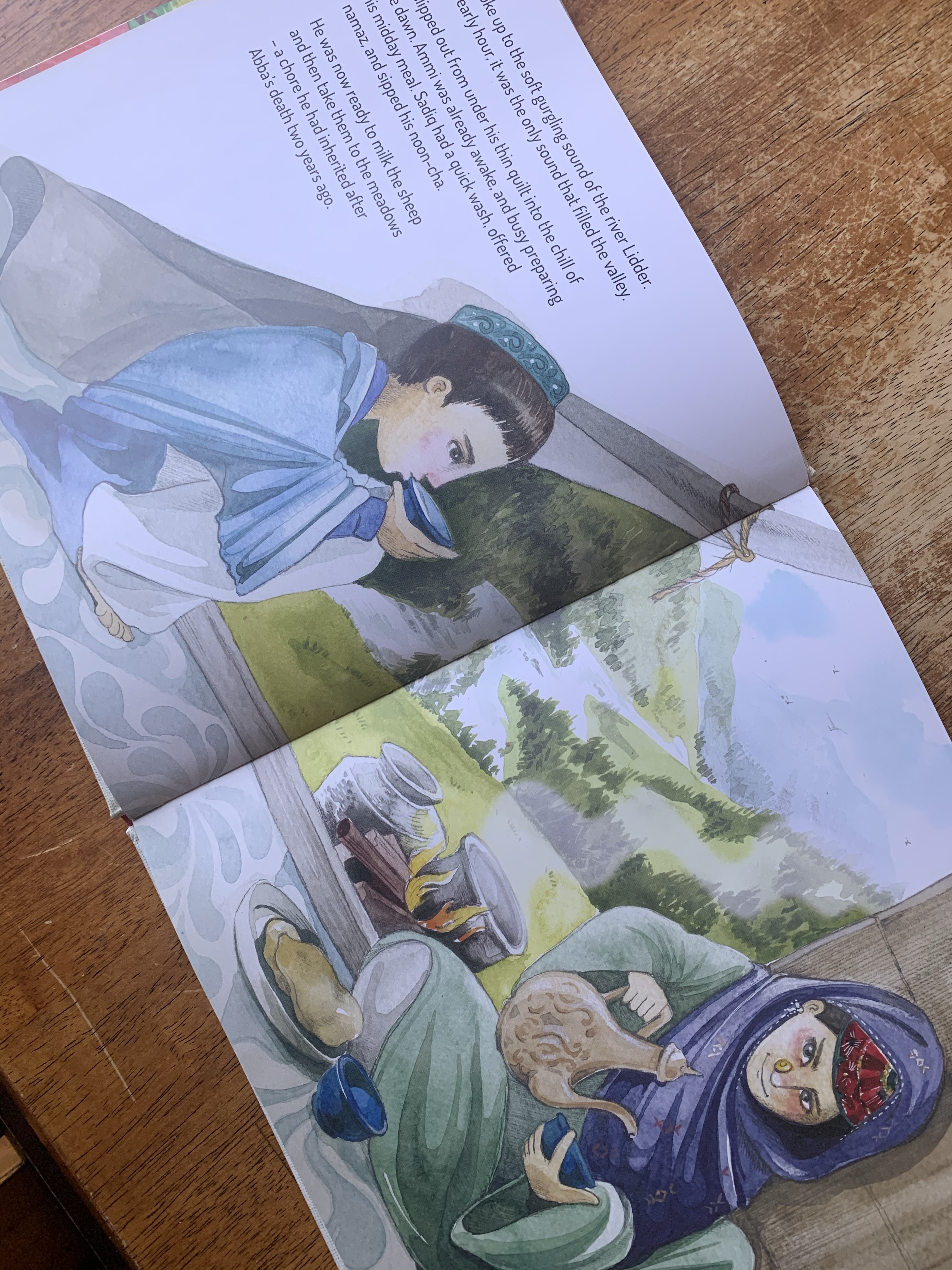
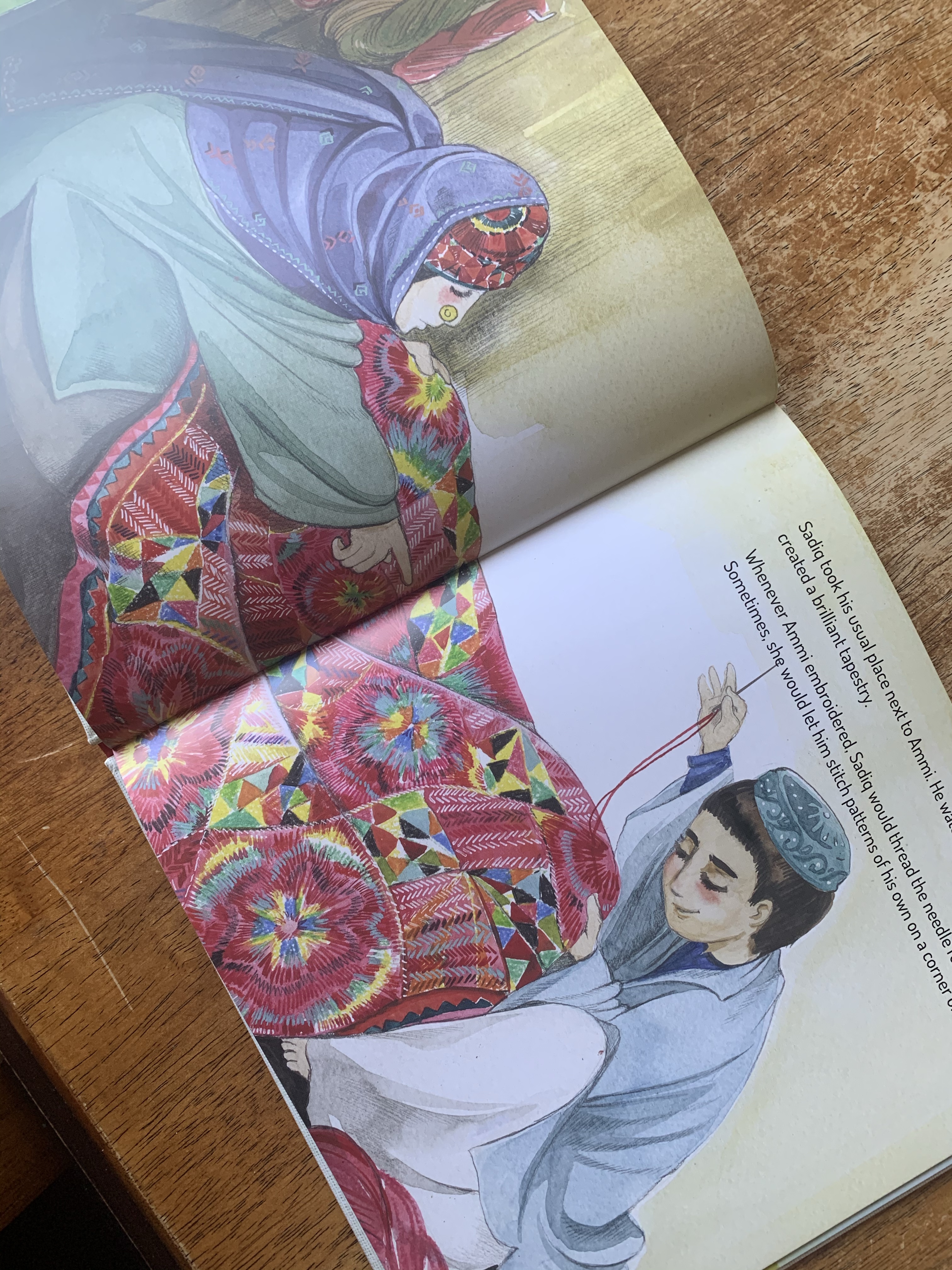
Sadiq wakes up to the sounds of the river Lidder, he prays and drinks his cha and heads to the meadow to milk the sheep and take them out to pasture.  His father died two years ago, and now the responsibility of the flock is his. After his chores are done he sits and watches his mother embroider.  He sometimes stitches his own patterns on the edges, but his mother does not like him sewing.

img_9846

When an order from the city comes in for two rugs by the end of the week, Sadiq offers to help.  His mother refuses his assistances claiming that the women stitch and the men tend to the sheep in their community. Sadiq dreams of the designs and colors he would like to sew and decides he will do so in secret.

img_9848

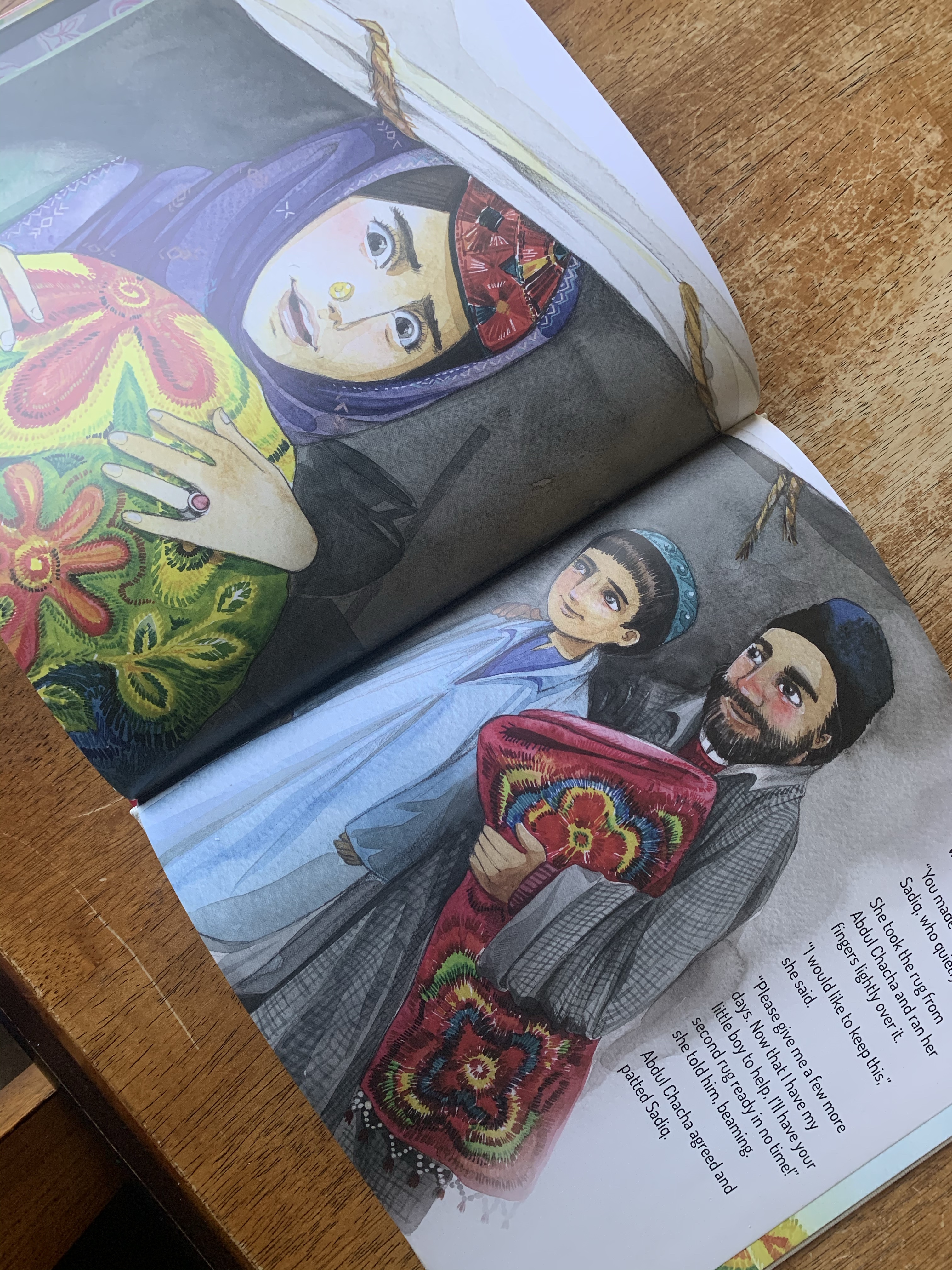
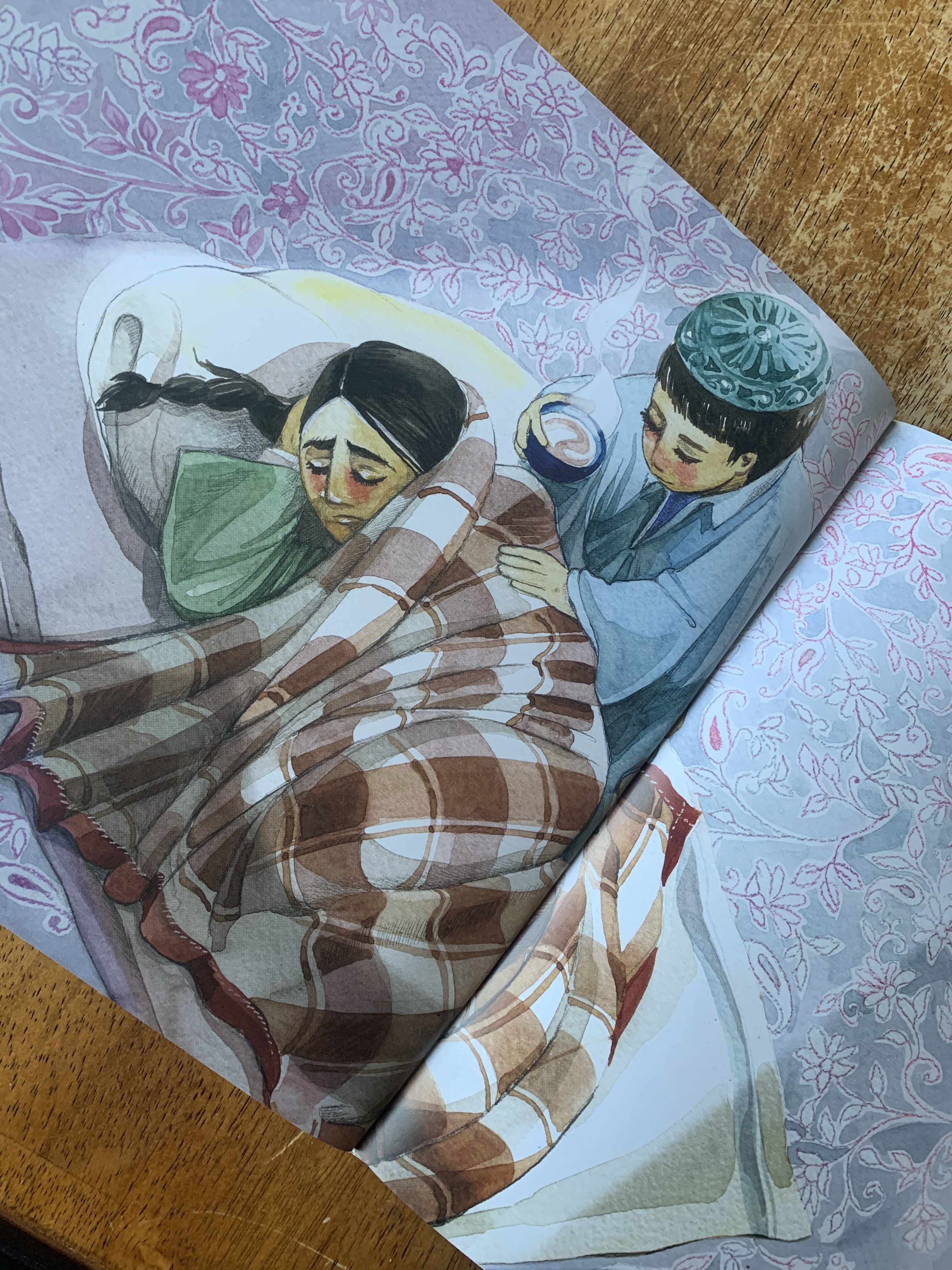
On the day when the rugs are to be picked up, Sadiq’s mother has a fever and cannot stitch.  When the man comes, Sadiq’s mother starts to explain that they are not ready, but Sadiq surprises them both with his completed rug.  The man likes it, but notes it is not what was ordered. Ammi wants to keep Sadiq’s rug and asks for a few more days to complete the second one, now that she has her son to help her.

img_9847

Abdul agrees to a few more days, and the next morning Sadiq’s mom has hung Sadiq’s rug for everyone to see, and is proudly crediting her son’s work.  She hugs him, just like she did in his dream, and chides him that she still expects him to do all his other chores before he sews.

img_9849

Fatima’s Great Outdoors

Standard
Fatima’s Great Outdoors

fatima's great outdoors

As a partially brown person who enjoys camping and does it frequently, I have been anxiously waiting to get my hands on this beautiful 40 page, kindergarten to fourth grade picture book. So, trust me, I’ve read it multiple times to myself, to my children, and even to a Muslim storytime group to try and figure out why I like it, but, unfortunately, really don’t love it. Ultimately, I think it is because there is just too much going on.

Everything about this book is wonderful: the idea to encourage brown people to go camping, to highlight that time in the wilderness is for everyone and doesn’t have to look a certain way, that bullying and micro aggressions are oppressive, that immigrants have diverse and full lives in their home countries and work hard when they come to America, that culture and language and food and music is diverse, yet universal, that learning new skills and trying hard things makes you a super hero, that dad’s can cook and mom’s can be great fire starters and critter catchers, truly it is all so powerful and affirming, it is just a lot for one book.

It could easily be a three book series with just the information and layered themes presented, and I really wish it was spread out. If you are a 4th grade desi kid who has been camping or desperately wants to go camping this book is a great glimpse to mirror your place in the hobby without compromising your unique spin on it, but I think for anyone not in that demographic, many of the little celebrations, messages, themes, and cultural nuggets will simply be lost.

I wanted to hear the campfire stories and jokes, and laugh at the lyrics being belted out, not just told about them. I wanted to feel Fatima’s accomplishment at helping set up the tent and maybe see her struggle and rebound, not just be told she suggested reading the directions. The book has a ton of industry praise and personally came with a lot of expectation for me, so perhaps I’m overly critical, but kids in my storytime were struggling to stay focused when they couldn’t relate to the cultural touchstones being tossed out, they didn’t get the “not being good at math stereotype,” they needed the non text pictures to be explained to grasp their impact on the story, and they wanted to know why of all the Islamic things a Muslim family could do while camping, halal bacon was the only Islamic reference and came with precious little contextual defining.

The story starts with a Fatima and aapa waiting to be picked up after a terrible week of school to go camping for the first time. The Khazi family has immigrated from India and their father has told them that camping is an American pastime. During the week Fatima has been teased for her pronunciation and lunch, had her hair pulled and done poorly on a math test. But when her parent’s pull up with a packed car and the girls jump in to enjoy samosa and Bollywood songs, the weekend holds promise.

When they get to the campsite, Fatima and her dad tackle the setting up of the tent. Dad cannot seem to figure it out, and after the week she has had, Fatima is scared to help, but after a while she suggests looking at the directions and it seems that does the trick. The family enjoys shami kabab and rotis from home for dinner, before the girls climb in the tent.

A spider on the outside of the tent is magnified inside, and has the girls terrified it is a monster. Mom, the ever brave lizard and scorpion disposer in India reassures them that it is nothing and sends them off to brush their teeth before settling in for the night.

The next morning mom shows the girl the small spider keeping the mosquitos out and they all share a laugh while dad is cooking anda and roti on a gas grill. He calls the girls to come out in urdu to attempt a campfire to cook the halal beef bacon on like other American’s do. Dad and Fatima can’t get it to light, so mom, who is from a smaller town in India has to show them how it is done. Along the way Fatima looks at the other campers and is annoyed that they aren’t having trouble and that her family always is so different. The other families it is worth noting are white.

The Khazi family then starts to pack up and then they go for a hike, play in water and when the time to leave comes Fatima is sad. She doesn’t want to go back to the life they live where they are different and teased and her parents have to work two jobs each. But aapa suggests she share her fun at show and tell, and the family reassures her that they will be back.

The book ends with Fatima telling her class she is a superhero because she can build fires and tents and isn’t afraid of spider monsters. There is no glossary to define the urdu words used and spoken, but there is a reference at the end about the author’s @brownpeoplecamping initiative.

I think the book is rather remarkable and ground breaking because of its subject matter. The illustrations are wonderful, and the book a great reminder that camping and being outdoors is for all. I just wish it focused on a theme or two and highlighted them for this Indian American Muslim Family with relate-ability for other types of minority groups. The book set its own standard in what it wanted to achieve and convey, and sadly I think it missed the mark.

Maryam’s Magic: The Story of Mathematician Maryam Mirzakhani by Megan Reid illustrated by Aaliya Jaleel

Standard
Maryam’s Magic: The Story of Mathematician Maryam Mirzakhani by Megan Reid illustrated by Aaliya Jaleel

img_8776

This 40 page nonfiction biography is beautifully illustrated and informative.  I had never heard of Maryam Mirzakhani the Iranian born, first female winner of the Fields Medal.  Her life from loving stories and not liking math, to becoming a student and later a professor in the United States is remarkable and inspiring.  Second through fourth grade readers that both love and struggle with math will be drawn in to her unique way of looking at the world, and the math she found to serve as her magic wand in explaining it.  I don’t know if she identified as Muslim, while in Iran she was forced to cover, but when she left, she no longer did.  The illustrator is Muslim and religion aside, I am thrilled that a book like this exists, and that such a brilliant woman and her accomplishments can be presented to young readers.

img_8778

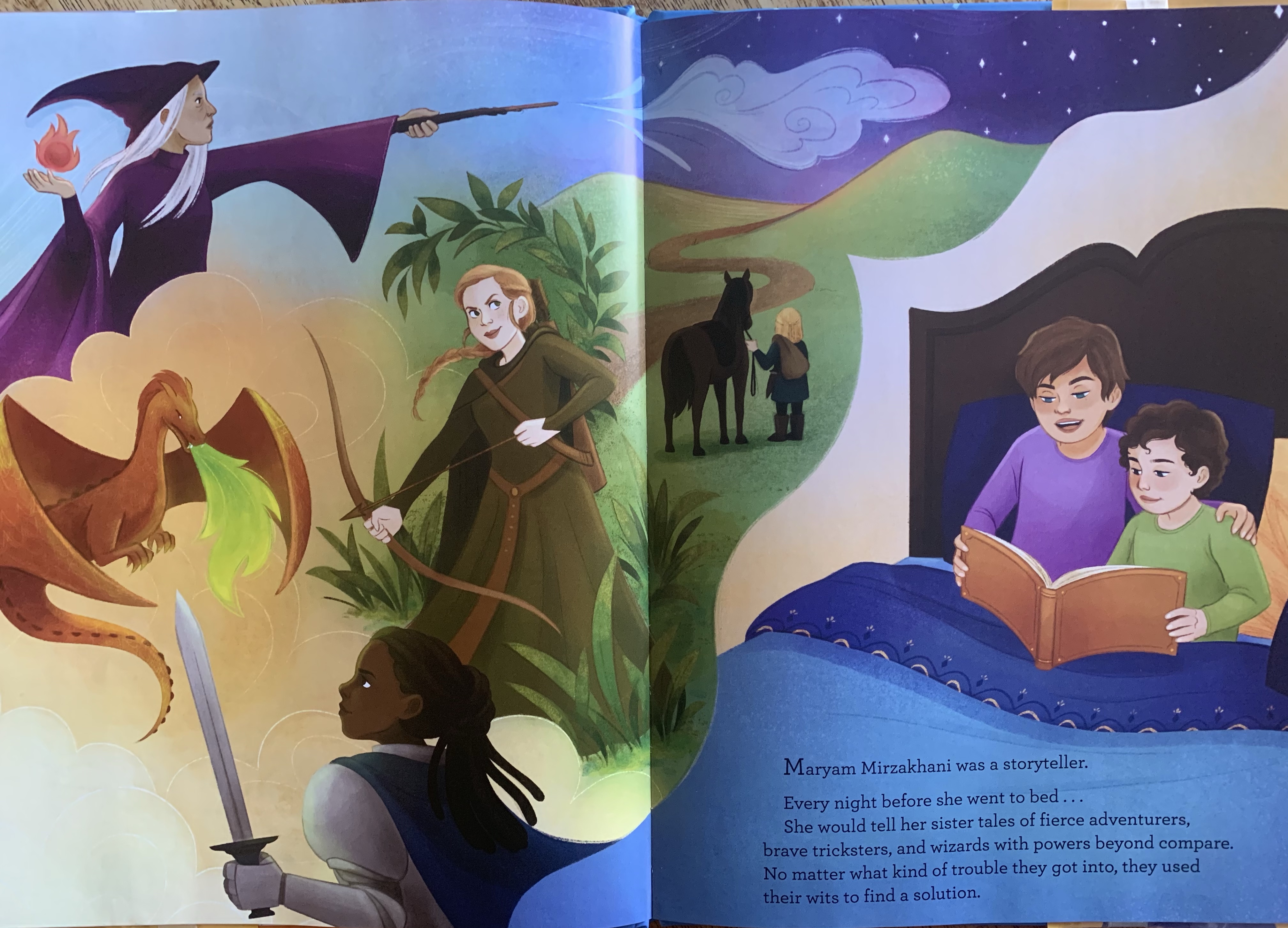
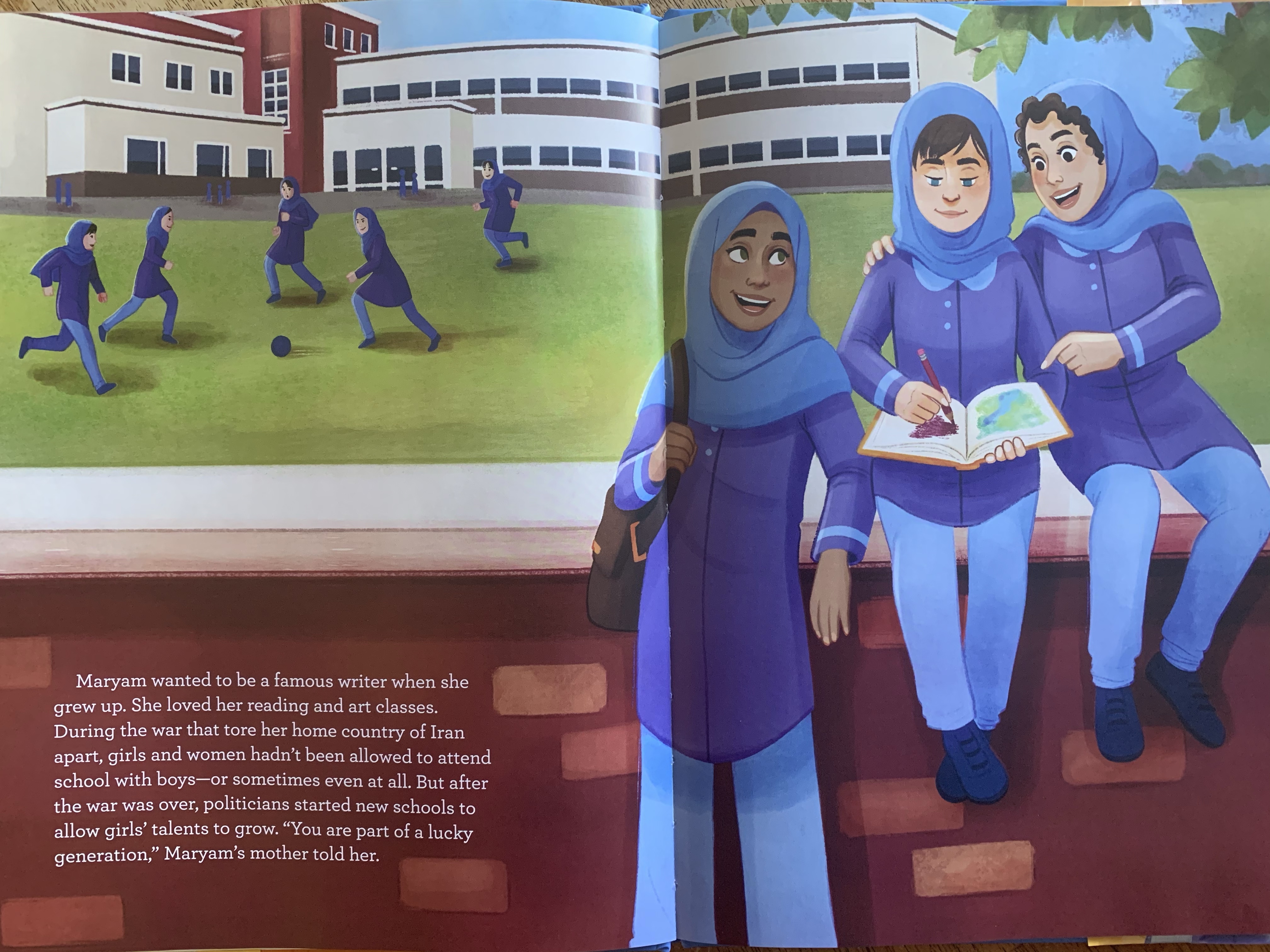
Maryam loves stories.  She reads them to her sister, her best friend Roya and her browse bookstores and dream themselves into plots of their favorite stories.  On the weekends she spreads long rolls of paper on the floor to draw and color her imaginary worlds.  She wanted to be an author when she grew up and knew how lucky her generation was to attend school after the war that tore her country apart.

img_8779

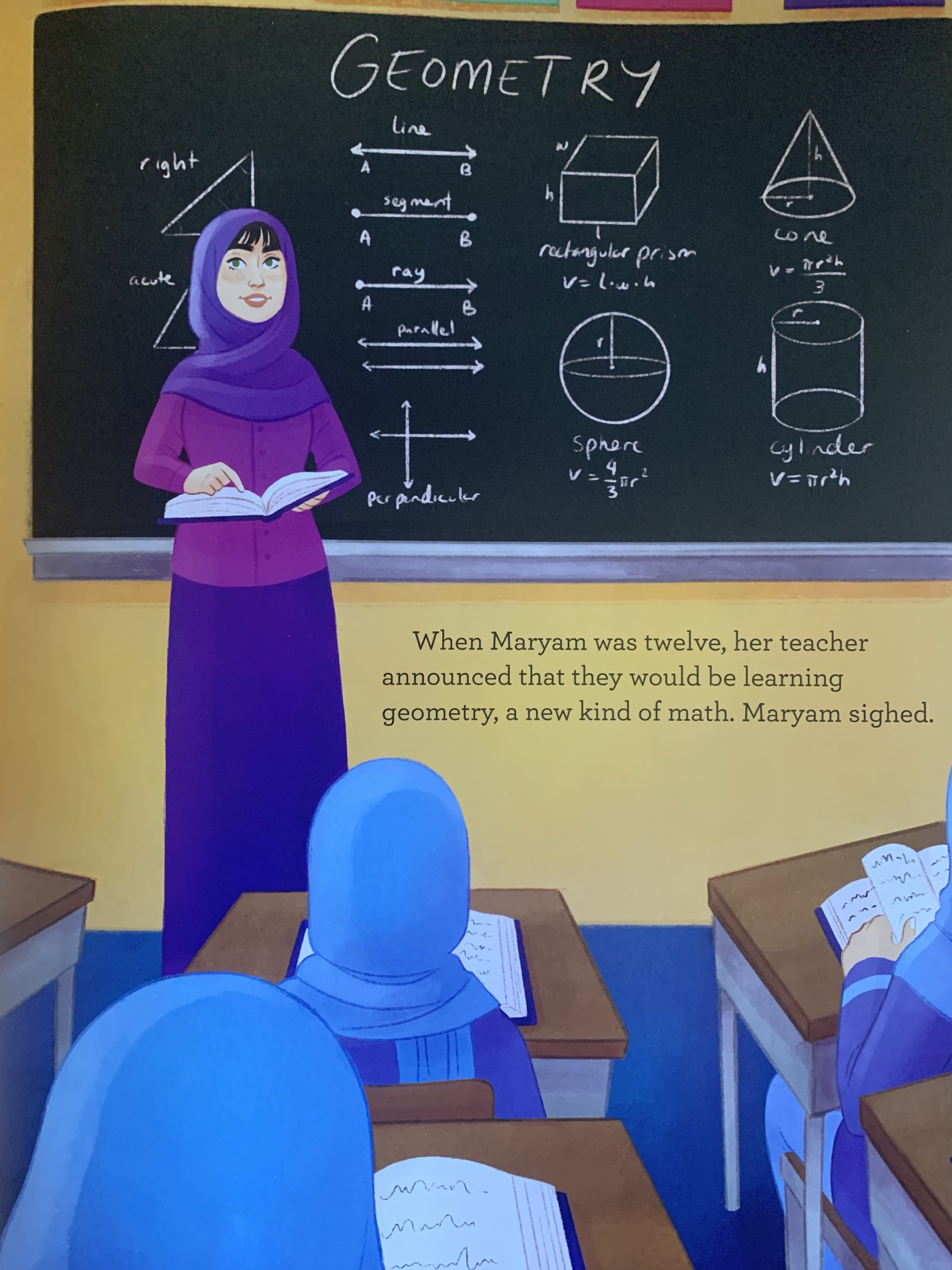
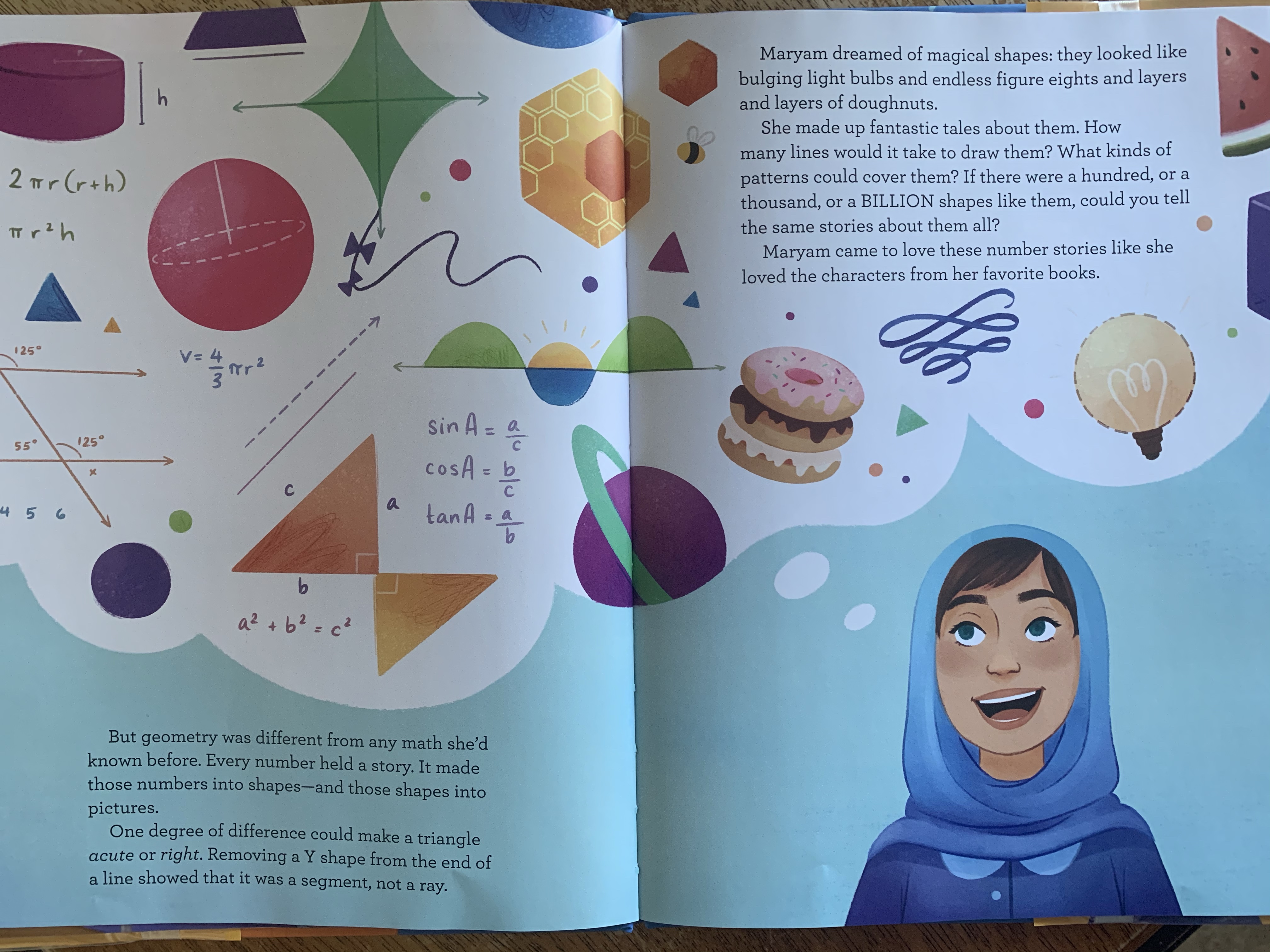
Math made her head spin, she would rather be doodling, but when she was 12 her teacher introduced her class to geometry.  It was different, the numbers held stories and the shapes were pictures. She made stories about the problems and wondered about them as if they were characters.

img_8781

In high school, Maryam and Roya entered the International Mathematical Olympiad.  The first year they received participation medals, but the next year, Maryam won the grand prize with a perfect score. She finished her schooling in Iran devoting her life to the stories that numbers told and left Iran to start graduate school at Harvard in the United States.

img_8782

When she had a hard time solving problems she would spread large rolls of paper on the floor and solve them.  Her daughter would tell people she was a painter.  She wanted to stretch the mind and how people went about solving equations.  She became a professor and a lecturer and one of her discoveries became known as “the magic wand theorem.”

In 2017 she passed away from breast cancer and the world lost a remarkable storyteller, mathematician and human.  The book concludes with an author’s note, important dates, and books to reference to learn more about Maryam Mirzakhani.

img_8780

It’s Ramadan and Eid al-Fitr! by Richard Sebra

Standard
It’s Ramadan and Eid al-Fitr! by Richard Sebra

img_9007

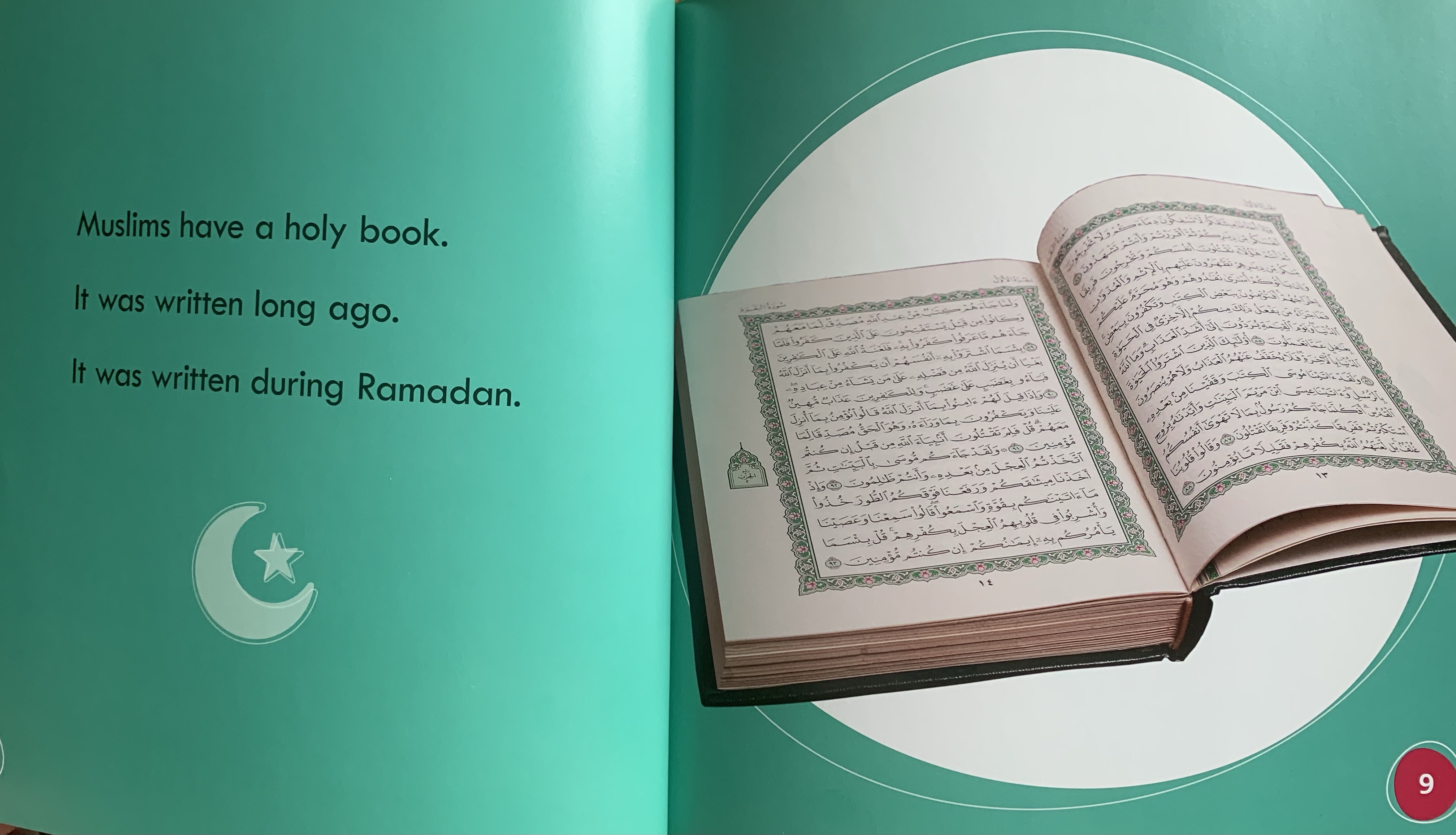
Sigh, another erroneous children’s nonfiction book from a holiday book series targeting classrooms.  This 24 page book is meant for pre-school to first grade and in addition to being vague and repetitive, states that Muslims have a holy book that was written in Ramadan.  It never states the Quran by name, and clearly it wasn’t written, it was revealed in Ramadan.  It later also states that Eid al-Fitr is the last day of Ramadan, failing to acknowledge that it falls on the first of Shawwal, when Ramadan is over.  The table of Ramadan dates at the end spanning from 2016-2022 is also problematic if you are trying to explain that we often don’t know until the night before when Ramadan and Eid will be because we need to sight the moon.  These errors may appear minor, but when they seem to fill every recently published children’s nonfiction book, it really makes the correction of such assumed facts that much harder to overcome.  If our non-fiction books are so consistently flawed, our sense of reality is being shaped erroneously, and imagine what else we have consumed as fact that isn’t accurate over the years.  Please speak out when you come across these errors, in Islamic books and all non-fiction works.

img_9008

The book is filled with simple short sentence and often repeats the same basic information on multiple pages.  The two page spreads contain the text on one side and a realistic photograph on the other with critical thinking prompts to consider.

img_9009

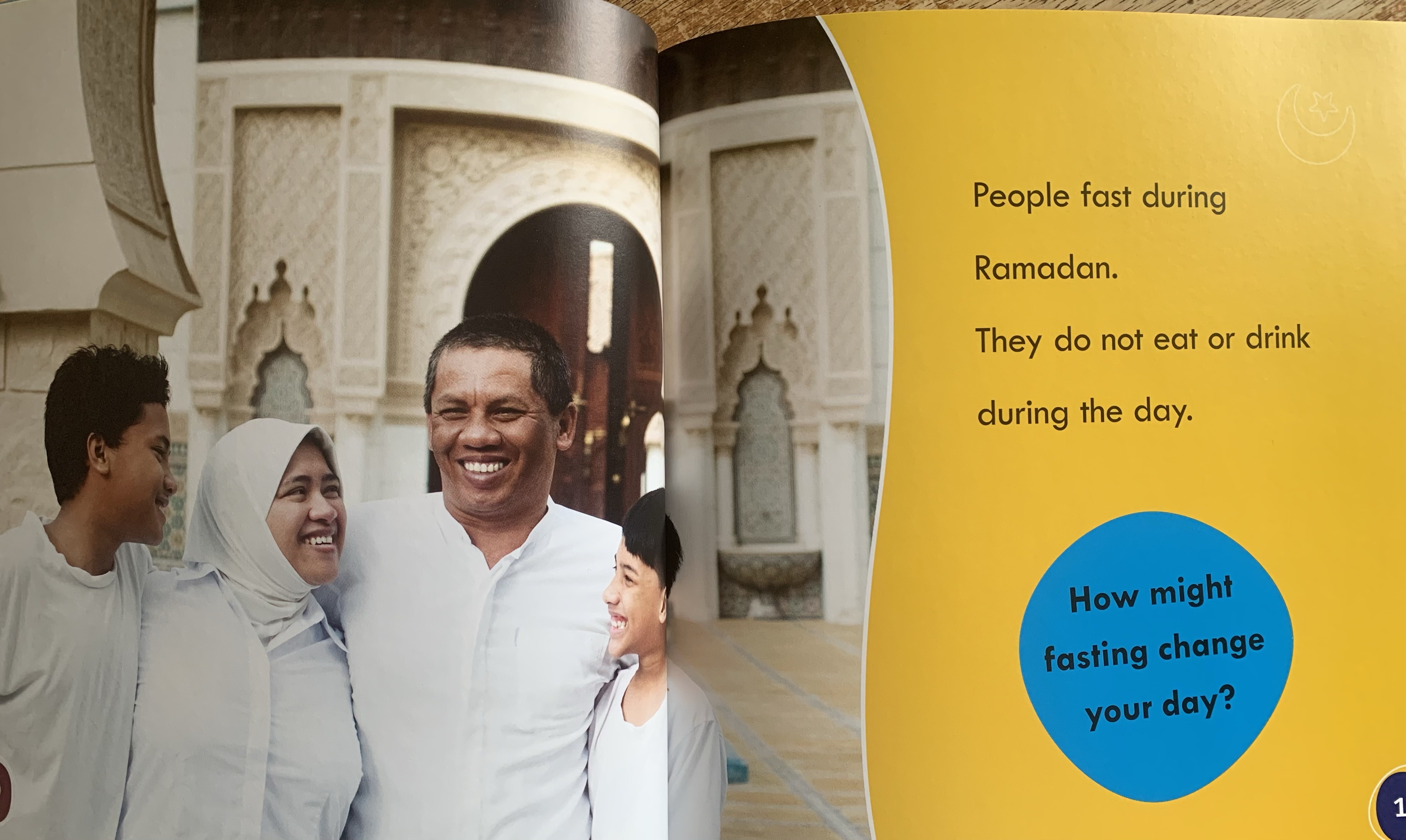
It starts off by establishing that Muslims have a calendar based on the moon, that Ramadan is the ninth month and it is a holy month.  The next page again reasserts that Ramadan is not one day, but a whole month before introducing the idea that families get together to pray.  The erroneous page about the Islamic holy book follows and then the concept of fasting: not eating or drinking during the day is presented.  The critical thinking point asks readers to consider how fasting might change your day.

img_9010

There is then a page about prayer which includes that we kneel on rugs, pray everyday, but pray more in Ramadan.  I’m not sure why this page didn’t follow the page that first mentioned prayer, especially since the next page goes back to talking about food which probably should have followed the page on fasting.

img_9011

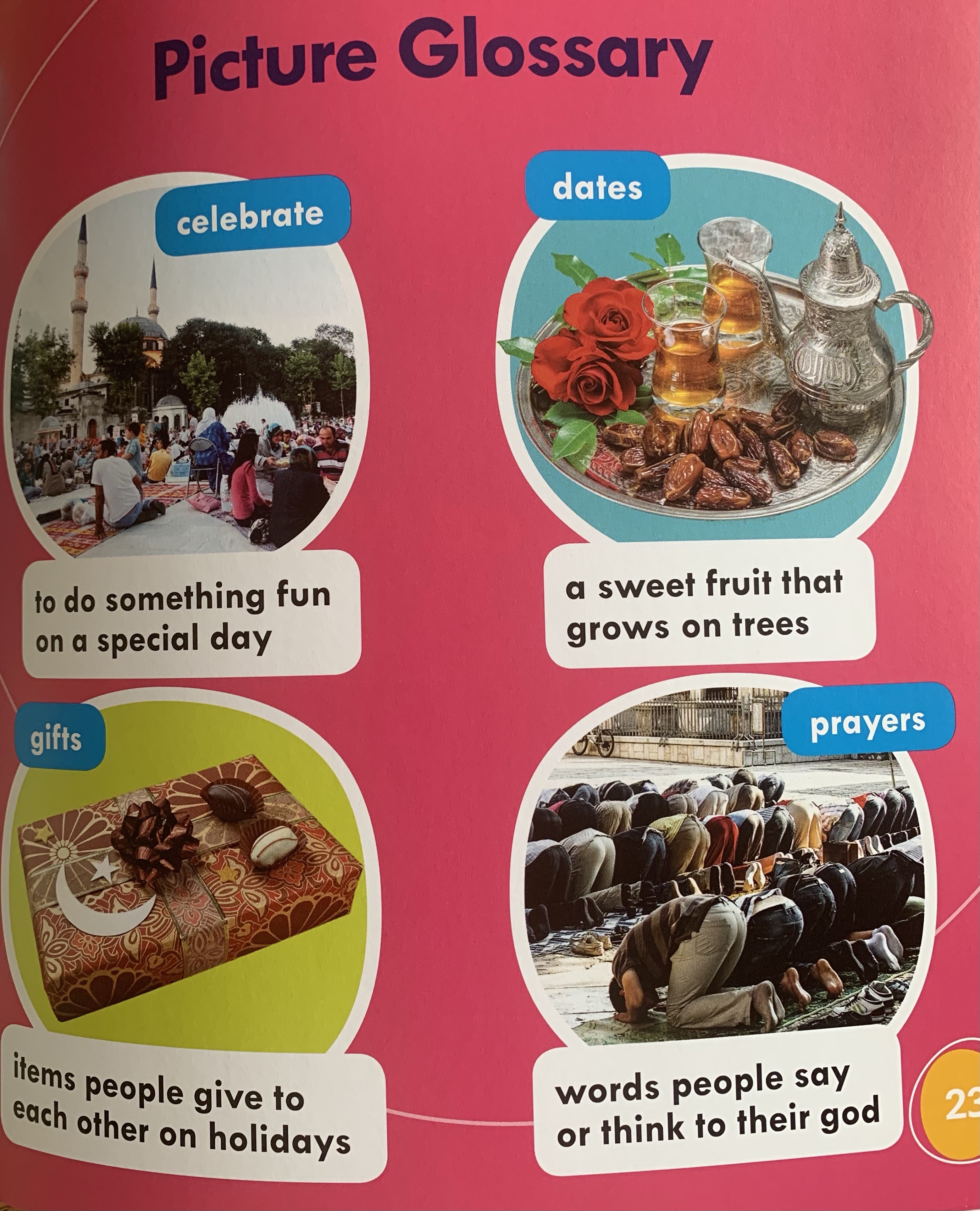
The page about Eid being on the last day of Ramadan is then followed by more sentences over a few pages about Eid being a festival, there being food, and gifts. There is a table of Ramadan dates at the end, as well as an index and books to further read.  There isn’t a proper glossary because there really isn’t any vocabulary presented  in the vague descriptions, but there is a picture glossary with words such as celebrate, dates, gifts, and prayers.

img_9012

The Prayer to the Merciful for Little Ones by Saniyasnain Khan illustrated by Bindia Thapar

Standard
The Prayer to the Merciful for Little Ones by Saniyasnain Khan illustrated by Bindia Thapar

img_8938

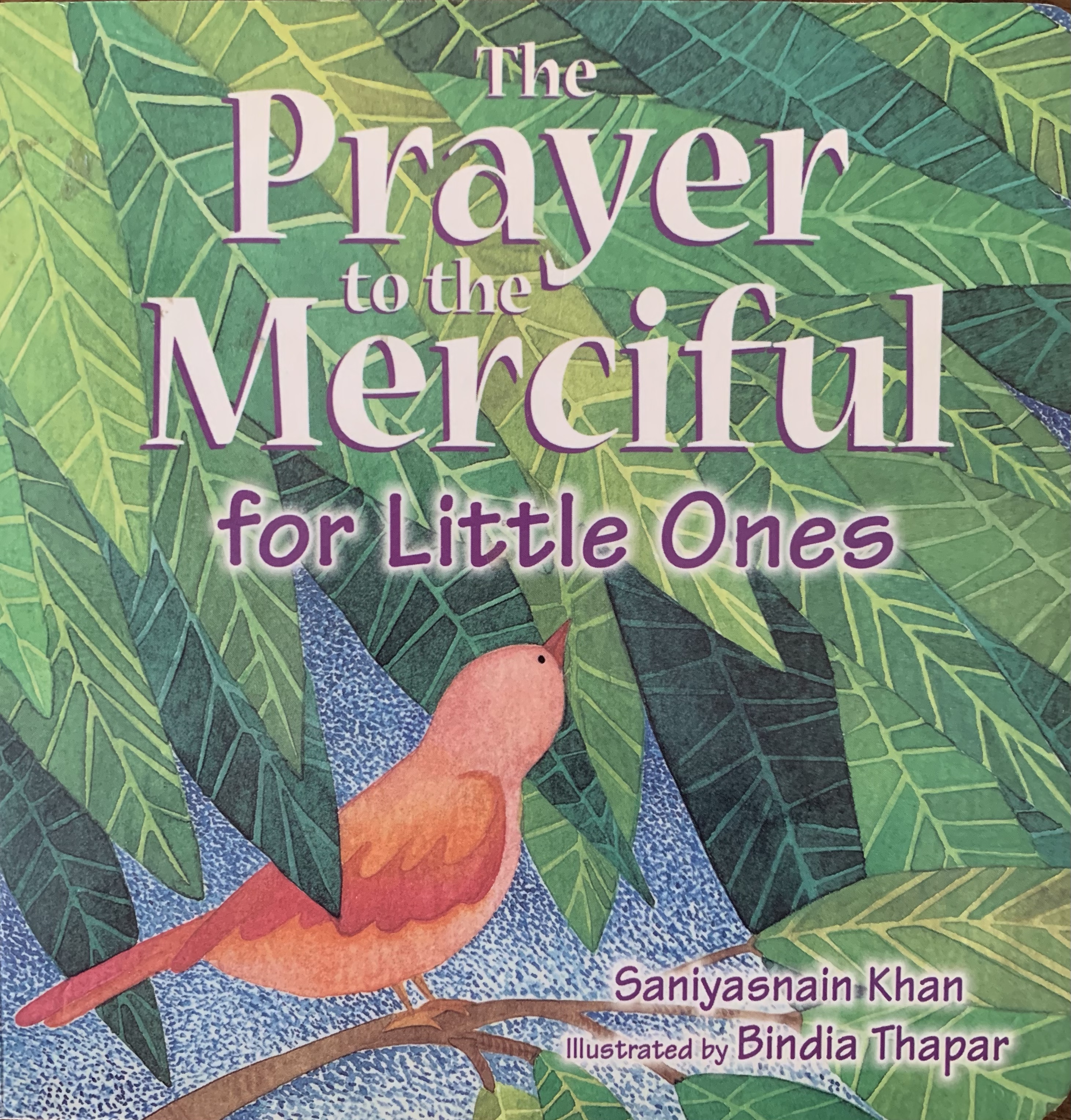
This 14 page board book is a prayer based on Surah Fatiha and explores the first few ayats with reflective and thoughtful duas.  It has soft muted illustrations of birds and nature on small 5 by 5 pages.  The idea of the book is sweet and soft that I can imagine reading it with a child in your lap after salat, or perhaps whispering into them at bedtime, but it really is a prayer for the parents to read.  Children might understand from the text that everything is from Allah swt and He is always with us and helps us, but because it doesn’t repeat those notions, I don’t think the message will stick. The vocabulary is not reflective of toddlers understanding, and really the comfort comes from them listening to a loved one’s voice not the text or pictures.  I have five kids, this book was purchased when I was pregnant with the first one, I don’t think it has ever willingly been picked up by any of them or sat through in the idyllic picturesque manner that a person with no children would imagine spawning from such a heartfelt book.  I hope I’m in the minority and other families have loved and appreciated this book as it was undoubtedly intended.

07F4AB67-2FEB-44B0-A5FF-994F9A884FDE

The book starts with a complete english translation of Surah al Fatiha.  The next two page spread is entitled “Praise be to Allah” which is explored in the text of praising Allah for the blessing given and knowledge of Allah being close. The theme isn’t entirely on point, but follows the rhythm of duas: praising Allah swt and glorifying him mixed in with making your requests.

6377C9F1-53DD-4C0A-84D4-66AD00FB9725

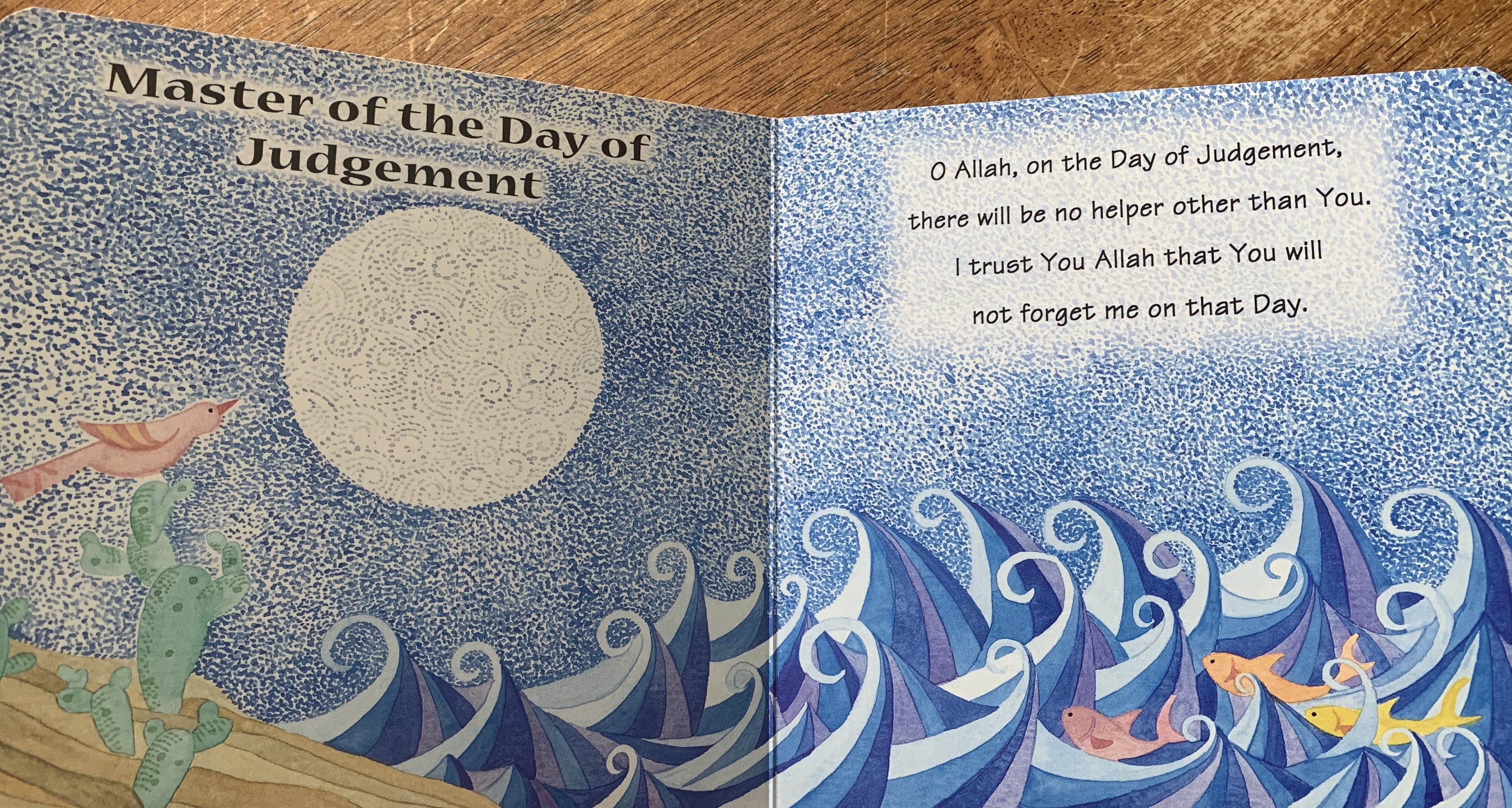
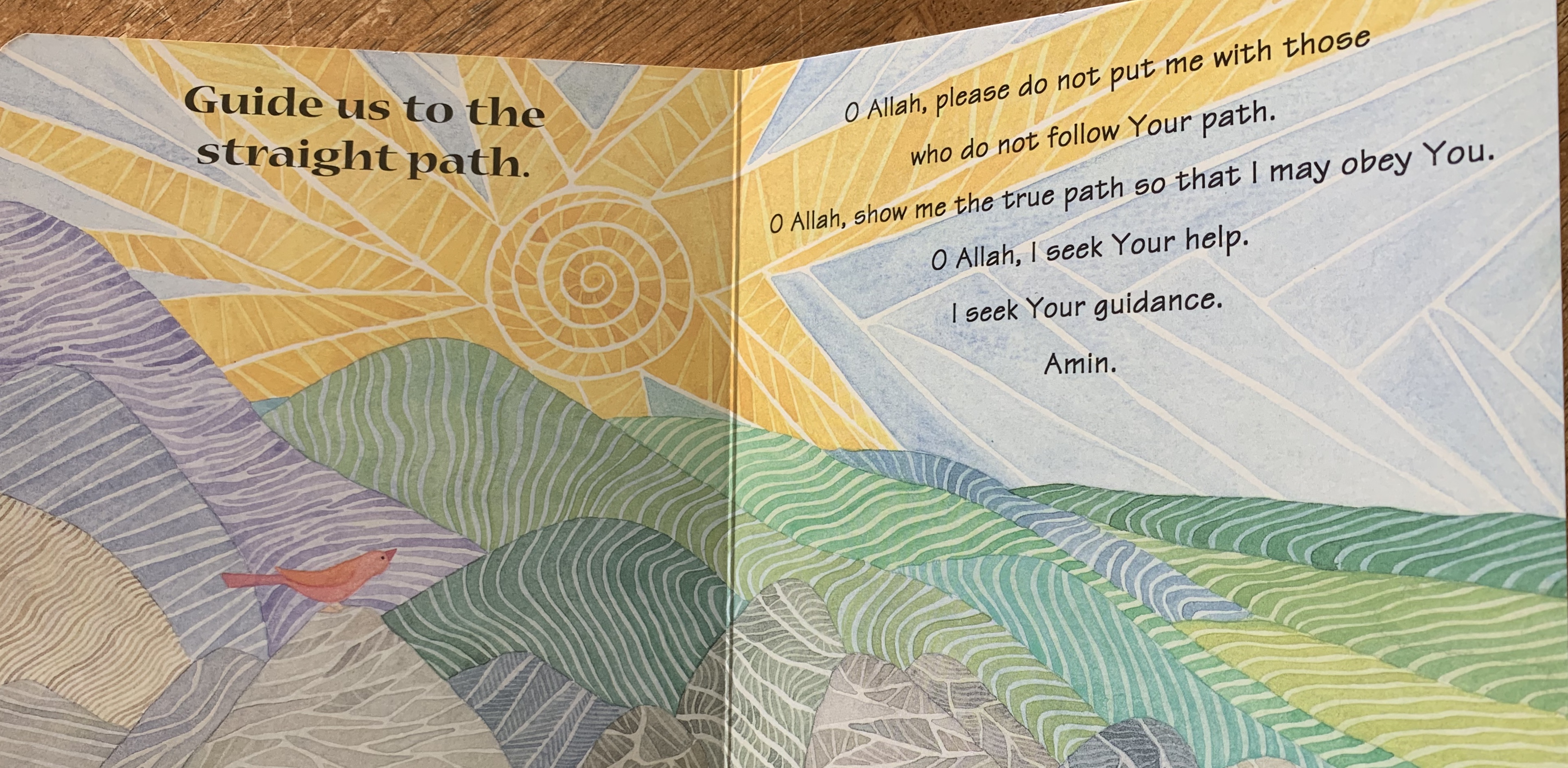
“Lord of the Universe” is the next heading, followed by “The Compassionate, the Merciful,” “Master of the Day of Judgement,” “You alone we worship and to You alone we turn for help.”  The final section is “Guide us to the straight path.”

40595865-EF04-42DC-9A71-B4F09DECE81E

The book came out in 2003, and I was ecstatic to see it available, however, there are now just better and more varied options available, that this one will once again be lost on my shelves.

80351529-FA74-444A-A8CA-7F23A6E3EB4C

My First Book About the Qur’an: Teachings for Toddlers and Young Children y Sara Khan illustrated by Ali Lodge

Standard
My First Book About the Qur’an: Teachings for Toddlers and Young Children y Sara Khan illustrated by Ali Lodge

img_9014

I had planned to review the Ramadan book in Sara Khan’s My First Book about series, but needless-to-say all of the board books in the collection look remarkably similar and the one on my shelf, that I thought was the Ramadan one is this one, the one about the Qur’an.  Rather than find another Ramadan book, I figured to just go with it, Ramadan is the month of the Qur’an after all, and the book is both informative and engaging for little Muslims.  The soft detailed pictures and sturdy binding introduce toddlers and up to the belief in Allah, the pillars, care for all creation and being good to one another.

img_9015

The book starts out stating the the Qur’an tells us in the beginning there was only Allah, and that He created everything.  His creations are as big as the heavens and the Earth and as small as the creatures we cannot even see.  He created the trees and mountains and the angels and jinn, as well as the people, He made us all special.

img_9017

Allah wants us to follow His rules and sent books and Prophets to show us how to act.  He wants us to be good to one another, to be thankful, to look after our world, and everything in it.  Allah wants us to worship Him alone and pray five times a day, fast in Ramadan, give money to the poor, and go for Hajj.

img_9016

He also wants us to have families and to get married and raise our children to be good Muslims, so that when we die we will go to Paradise.  The book ends with facts about the Qur’an and questions and answers that can help further the conversation, increase understanding, and encourage love for the holy book.

Ramadan by Mari Schuh

Standard
Ramadan by Mari Schuh

ramadan edelweis

This 16 page holiday book is one in a series of six.  It keeps the text simple, the images bright and inviting, and turns the pages in to a search and find activity to increase time spent with the material.  The information is accurate and basic, there is nothing wrong (phew) with this recent addition to the very crowded nonfiction holiday book field.  In fact I appreciate that dates are explained and that the food looks tempting even if non Muslim children aren’t familiar with the dishes.  It shows a child in sajood and explains that he is praying. The realistic pictures show smiling faces and Muslim kids will feel represented. Non Muslim readers will become familiar with Ramadan as a time of fasting, the Quran, and prayer.

The pictures to look for are given at the beginning and again at the end with the “answers.” The limited pages have very minimal text.  The first one mentions a lantern being hung for Ramadan. It then states that Ramadan is a Muslim holy month where people fast, don’t eat or drink.

It shows a picture of the Quran and says it is used to pray, before showing someone praying on a prayer rug. When the sun has set it is time to eat. Dates are a sweet fruit to snack on after dark. It then shows a child and adult making dua and again reiterates that the holy month is for praying and helping others.

‘Tis The Night Before Eid by Yasmin Rashidi illustrated by Mariam Aldacher

Standard
‘Tis The Night Before Eid by Yasmin Rashidi illustrated by Mariam Aldacher

img_8995

On the surface this 32 page inspired re-imagining of the classic Christmas poem might not seem that impressive, but it is really quite effective in highlighting general key points of Ramadan, the mix of sadness that Ramadan has gone too quickly with the excitement of Eid, and showing the diversity of Muslim families and communities.  The large 8 x 10 hard bound pages showcase fun and relatable illustrations that would help inform those unfamiliar with the holiday, while also mirroring and encouraging Ramadan and Eid excitement.  It is already a favorite at our house and with simple rhyming lines, the book can lend itself easily to more in-depth discussions (there is a glossary at the back) or be kept as a sweet flowing story that you don’t mind reading repeatedly at the prodding of toddlers and preschoolers alike.

img_8997The story starts with it being the night before Eid.   Ramadan has flown by, iftar eaten, dishes are put away, trips to the masjid for Taraweh have concluded and now it is time to prepare for Eid.  The house is cleaned, clothes ironed, sweets prepared and dreams of gifts filling the kids minds.

img_8998

The narrative bounces back to Ramadan to explain that fasting is not eating til sundown for 30 days, that Quran was revealed during the blessed month and that we hold on to the lessons of Ramadan all year long.

I pre-ordered mine from the author’s website https://rashidibooks.com/home , but it is also available at Crescent Moon Store https://crescentmoonstore.com/products/twas-the-night-before-eid.  There are also printables on the author’s website.

img_9002