Category Archives: Picture book

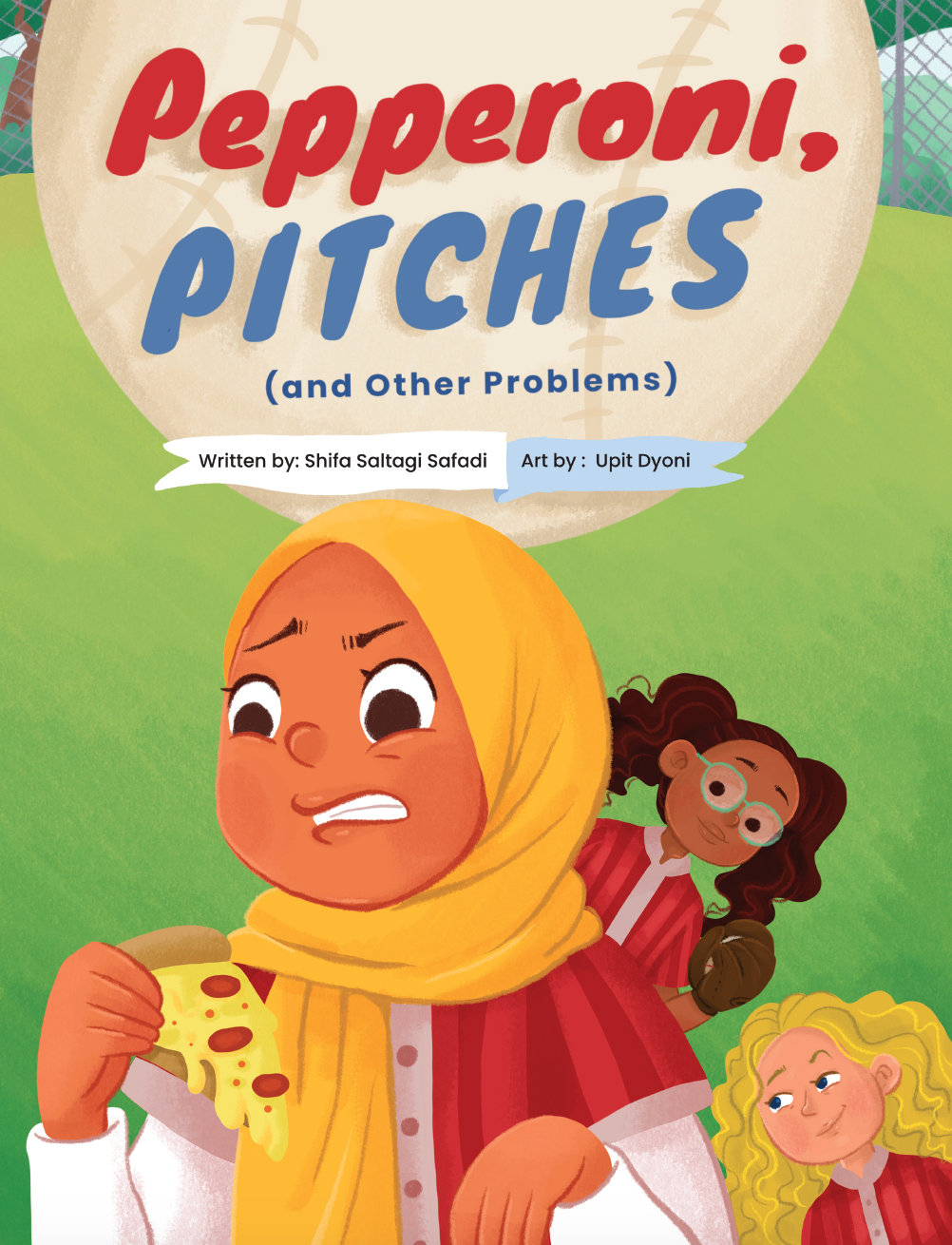
Pepperoni, Pitches (and Other Problems) by Shifa Saltagi Safadi illustrated by Upit Dyoni

Standard
Pepperoni, Pitches (and Other Problems) by Shifa Saltagi Safadi illustrated by Upit Dyoni

pitches

I absolutely love how smart this book is, and how it allows for elementary aged readers to feel that “aha moment” when they read it, get it, and realize that they need to remember the lessons because it could happen to them.  The illustrations are an added bonus and are perfectly aligned with the tone and text of the story.  My only issue, is the title.  Pitches reads as a euphemism for another word and since the book involves girl drama, teasing, and misunderstandings, it really is hard to not have that thought zap your brain when you see the title.  Perhaps if the “and Other Problems” would have used a bigger font on the word “Problems” the alliteration would have been more obvious, and hidden the word “Pitches” a bit.  If I’m alone in this, I apologize to the author and publisher, (I’ve mentioned my concern to them), but for others that saw the word and questioned the content, rest assured it is about baseball and the book doesn’t have even a speck of questionable content.

img_4682

Amira is at a new school, and luckily it is Tuesday, Pizza Tuesday to be exact, and she can’t wait to dive into a cheesy slice.  Unfortunately, Olivia takes the last cheese piece and when Amira asks if she will let her have it, Olivia says she had it first.  Stuck with an egg salad sandwich that smells, Amira sits alone and broods.

In gym they are playing baseball, but no one knows how good Amira is, and she is picked last.  When Amira is up to bat, Olivia is the pitcher and her pitches are terrible.  Amira still mad about lunch and afraid that the others will blame her for not hitting the unhitable balls, shouts, “you’re supposed to aim at my bat.”  Everyone laughs, but Olivia runs off clearly upset.  The new pitcher sends a decent throw and Amira hits a home run.  The captain of the team praises her, and Amira is hopeful she’ll have someone to sit with her at lunch.  After class, Amira sees Olivia crying in the bathroom and no one asking her if she is ok, Amira doesn’t feel so well, and doesn’t ask either. On the bus ride home Amira is greeted with cheers for her home run, but Elena the captain, isn’t among them.

img_4683

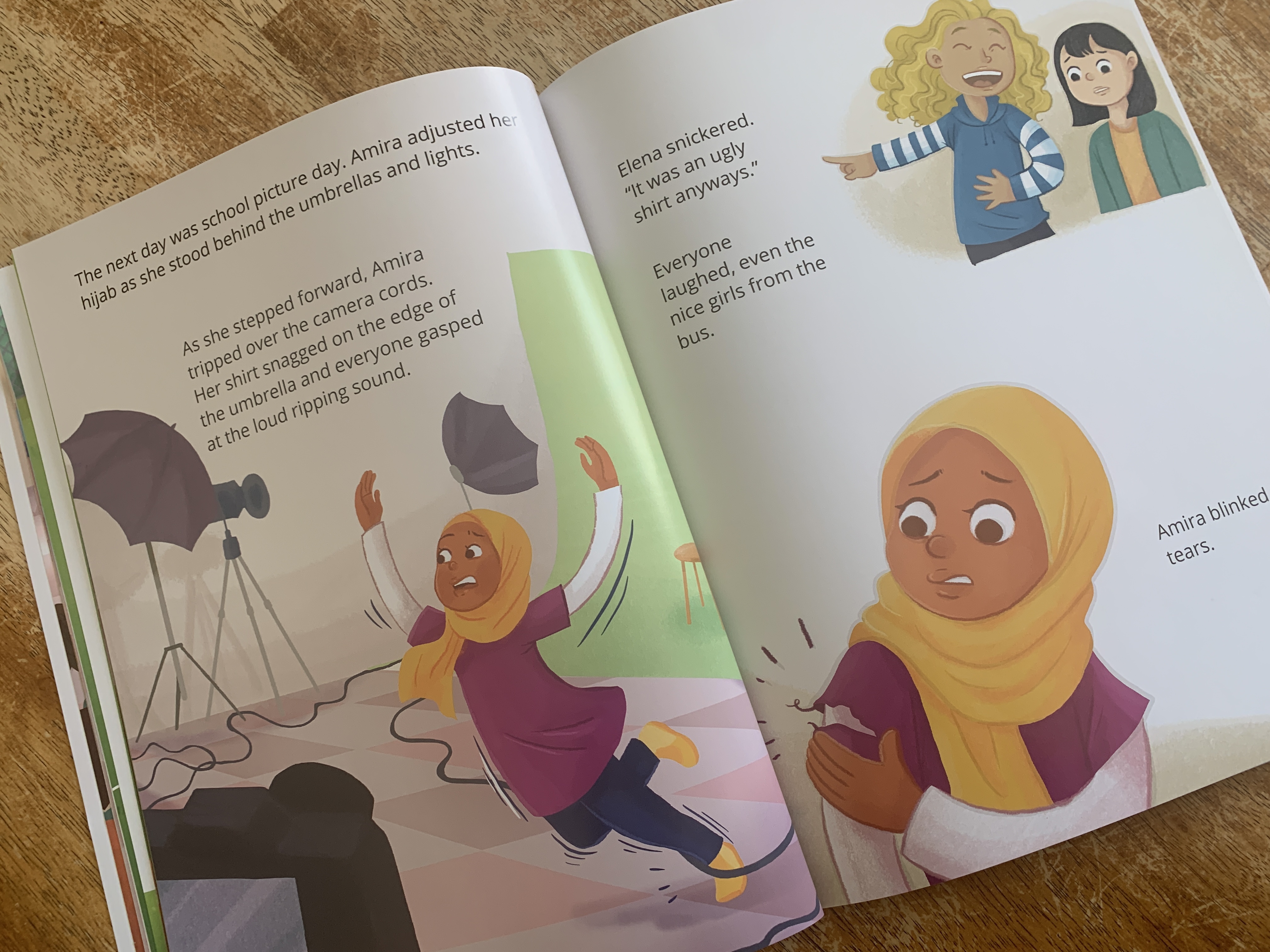
The next day is picture day, and Amira trips and rips her shirt.  Everyone laughs, Elena says, “it was an ugly shirt anyways.”  Only one person offers her help.  Could Amira have misread the whole class dynamics?  How should she move forward?

Sorry, I’m not going to spoil the ending, but the message about owning up to your choices is stressed, along with making kind decisions, and sometimes needing to take a step back and understand things from someone else’s perspective.

img_4684

Like nearly all Ruqaya’s Bookshelf books, the story is universal, but the characters, illustrations, and point of view is a relatable Muslim one that allows our young Muslim readers to feel seen and celebrated.  The reliable large glossy pages make the book a great deal for your money and is available on the publisher’s website: http://www.ruqayasbookshelf or from my favorite bookstore http://www.crescentmoonstore.com

img_4685

Could Be Anything! by Eman Mouneimne El Ayoubi illustrated by Victoria Romanenkova

Standard
Could Be Anything! by Eman Mouneimne El Ayoubi illustrated by Victoria Romanenkova

mariam

This is not normally a book I would review because it will read like paid endorsement, which it is not.  It is a 32 page personalizable book, that I’m highlighting because it exemplifies a concept of Islamic literature, that is often lacking.  We have numerous books teaching Islamic concepts to toddlers and preschoolers, but forget to teach the secular concepts through an Islamic lens.  We often have a bookshelf of Islamic books that include learning to say Alhumdulillah, and the names of Allah swt; and a bookshelf of non Islamic books that features stories about dinosaurs, monster trucks, and being silly.  This book reminded me of how important it is to have books that do both.  Not to necessarily preach, or even teach, just to merge the two shelves and present a singular framework of Islam, a way of life, not just a religion to our youngest believers.

Sure the name and customizable appearance is fun, but deeper than that, learning about different careers knowing that Allah swt created all of us to do so many worthwhile jobs is a great lesson to be sharing.  The larger concept of teaching Qadr to our children is only presented on the back cover of the book and can be implemented by using the parent guide at the end of the story.

img_4967

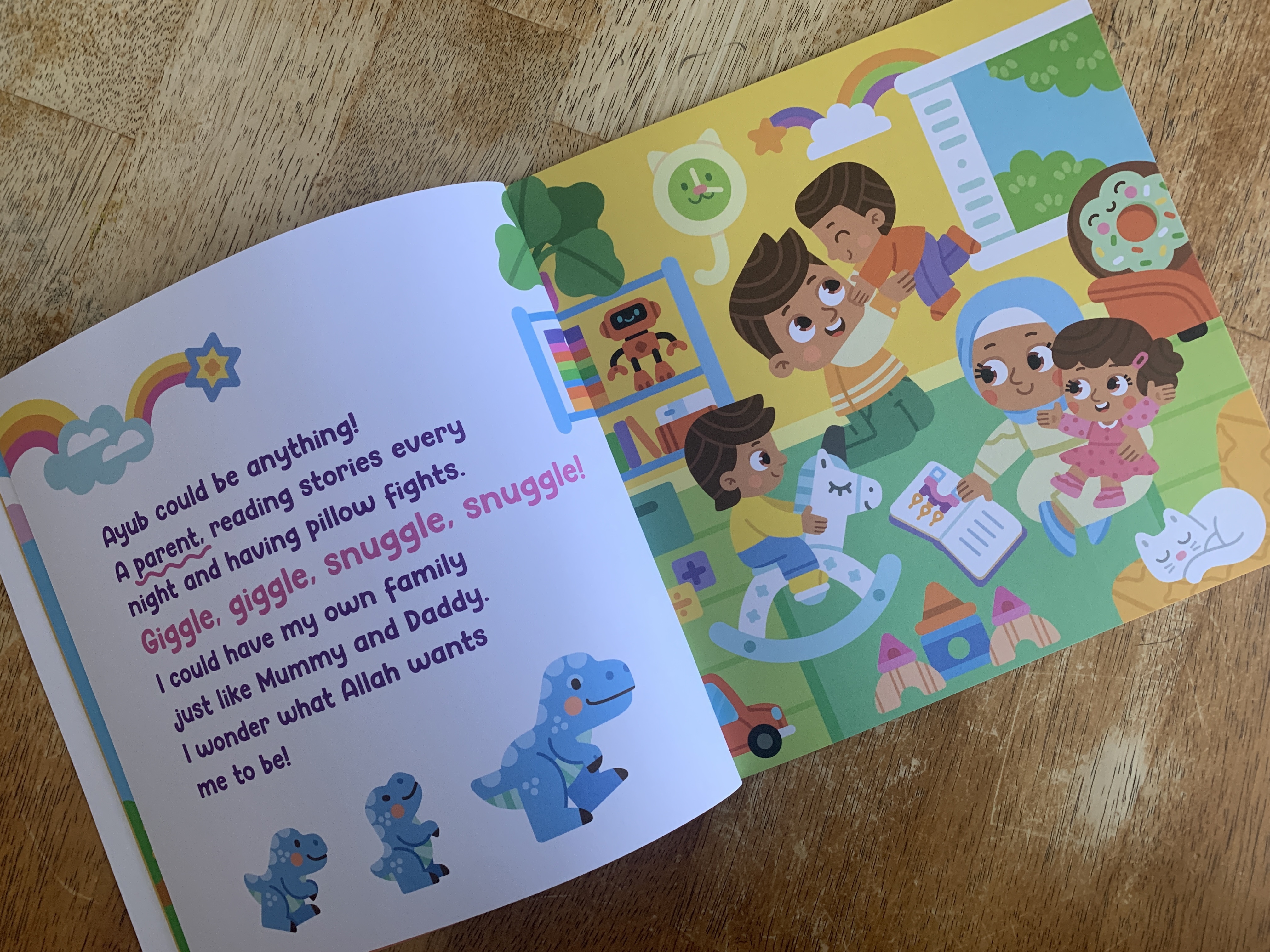
The book starts with asking what you want to be when you grow up and informing the child that Allah swt has a plan for us all.  Each page after then mentions the child’s name, introduces a career, and ties back to that Allah swt has written, or decreed something for us.

img_4968

The highlighted careers vary from being a parent, to an astronaut.  A teacher to a chef, a mechanic to a dentist.  There is no priority, nor opinion on one career or job or hobby being more important or more valuable than another.

img_4970

The pages are bright and colorful and the paperback book thick and sturdy.  I did struggle with the word “could,” and often would self edit as I read and would change it to, “Ayub ‘can’ be anything.” I’m not sure why the diction is what it is, but it reads incorrect to me.

img_4969

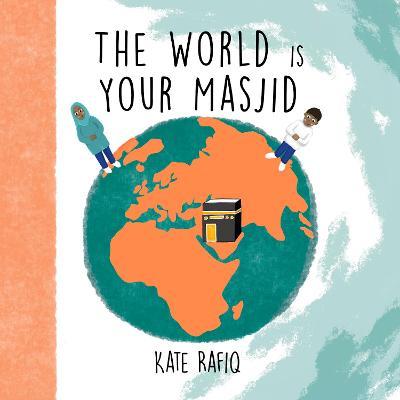
The World is Your Masjid written and illustrated by Kate Rafiq illustrated by

Standard
The World is Your Masjid written and illustrated by Kate Rafiq illustrated by

masjid

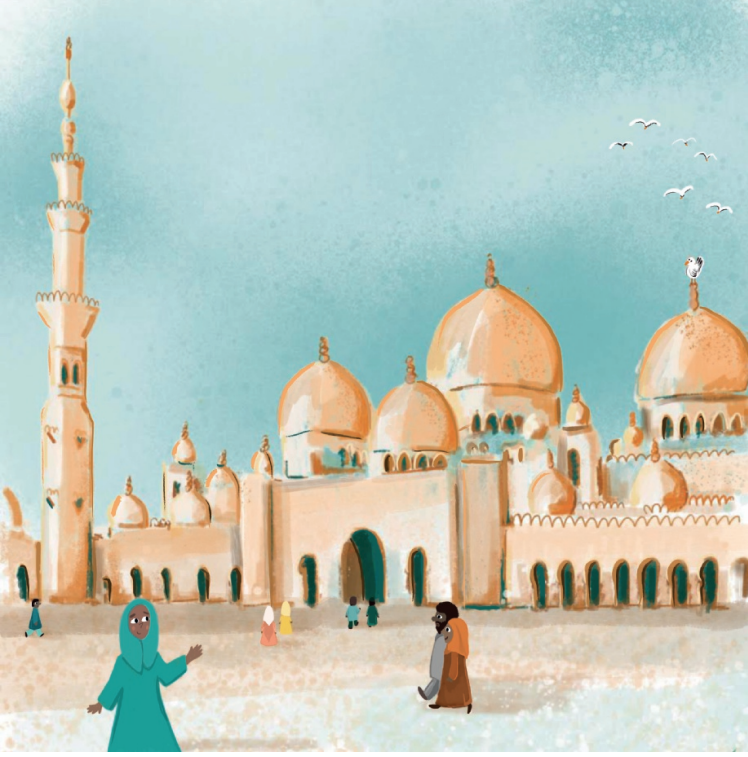
This 30 page preschool to early elementary aged book is a simple rhyming book that reaffirms all the places we can pray and touches on those that we shouldn’t.  The engaging illustrations and relatable scenarios make the book a great choice for bedtime stories and small group readings.  

Screen Shot 2021-11-17 at 11.33.41 AM 1

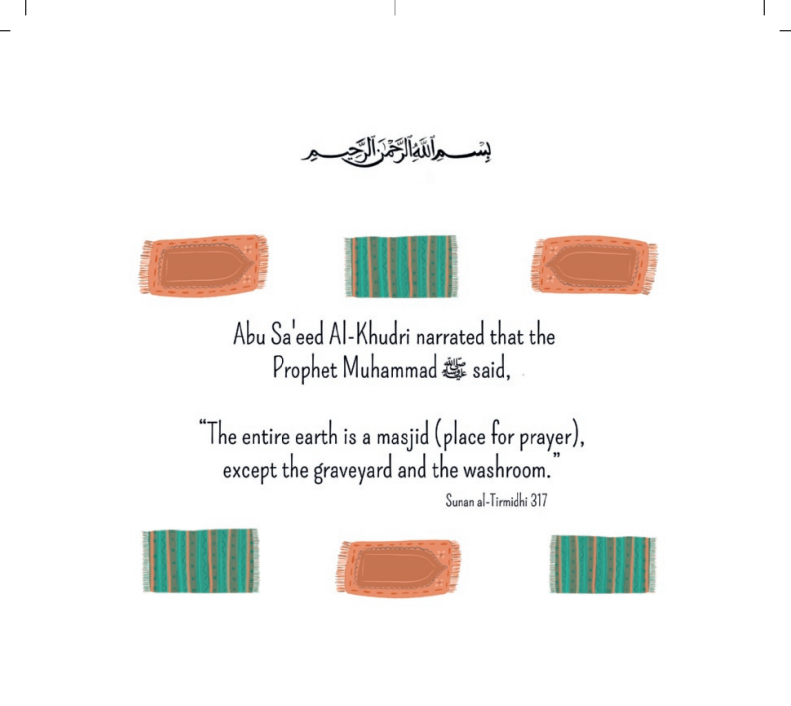
The book starts out with a hadith, “The entire earth is a masjid (place for prayer), except the graveyard and the washroom” (Tirmidhi-317) and points out that one must pray five times a day. Screen Shot 2021-11-17 at 11.37.00 AM

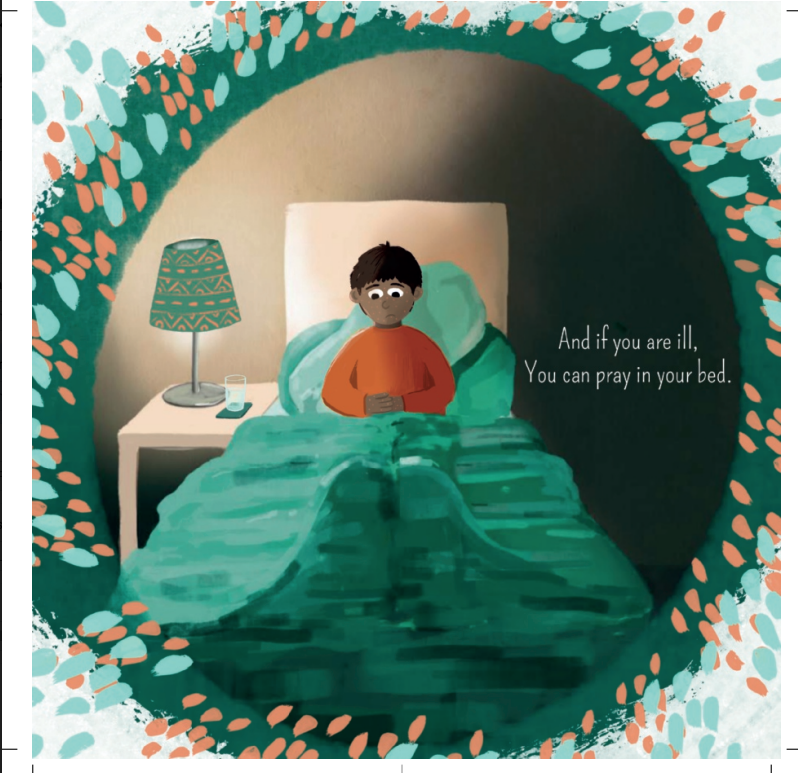
It establishes that if you pray it a mosque you can follow the imam, but not to worry if you cannot, because you can pray (nearly) anywhere: a field in the rain, school, a train, a garden, a shed, even when sick you can pray in your bed.

Screen Shot 2021-11-17 at 11.36.46 AM

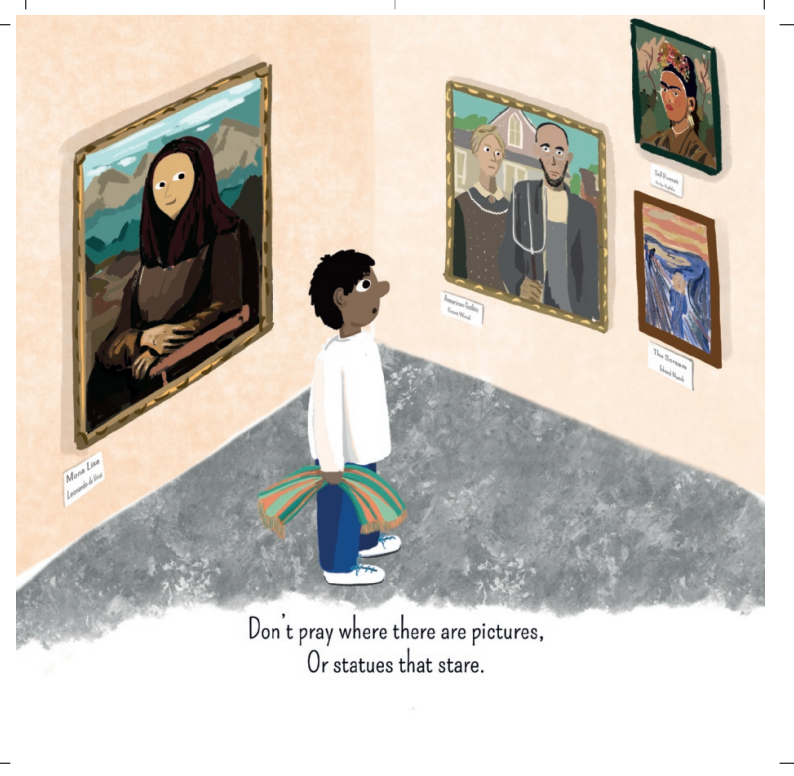
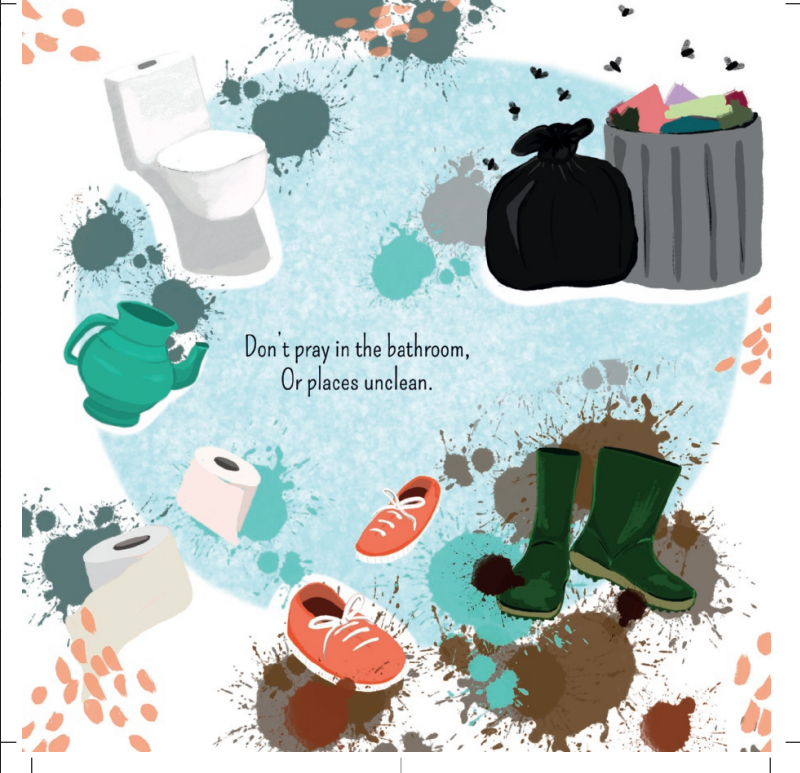
It then also turns to places you shouldn’t and can’t pray and sources a hadith about not praying where there are faces and statues that might distract you (Bukhari 374). The bathroom and graveyard are also included.  

Screen Shot 2021-11-17 at 11.35.05 AM

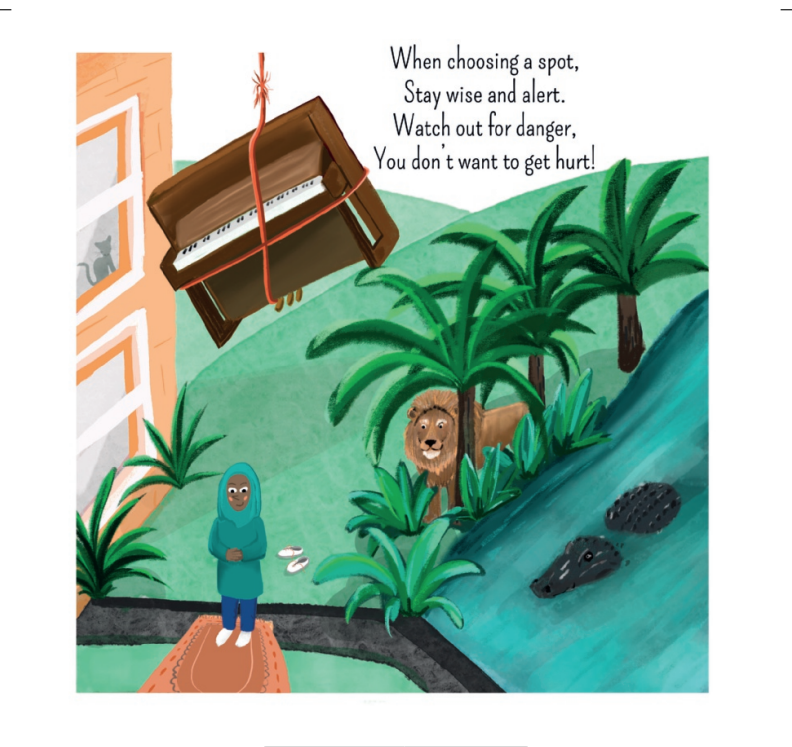
As an after thought, and for added laughs it reminds little readers to not pray in dangerous spots as well.

Screen Shot 2021-11-17 at 11.35.12 AM

Overall, I enjoyed the book and can see it pairing with In My Mosque to help create the foundation of a storytime theme about prayer and mosques.  The fact that it takes it a step further and doesn’t just list all the places serious and crazy that you can pray, elevates the book from being mediocre to being memorable and I appreciate that.  I also appreciate the Islamic sourcing, truly something that is required to show accuracy even in the “simplest” of all books.

Screen Shot 2021-11-17 at 11.35.30 AM

A Sari for Ammi by Mamta Nainy illustrated by Sandhya Prabhat

Standard
A Sari for Ammi by Mamta Nainy illustrated by Sandhya Prabhat

sari

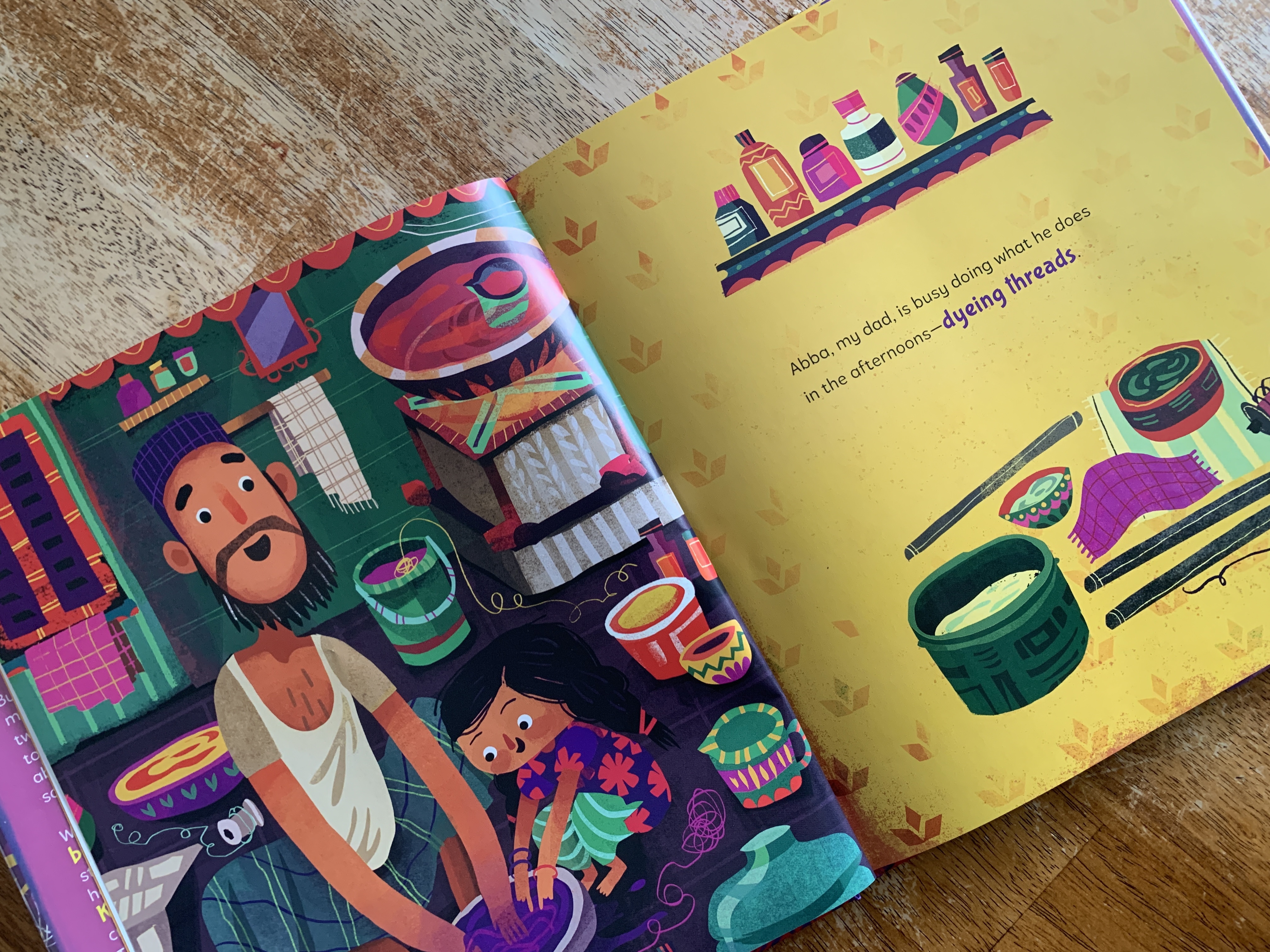
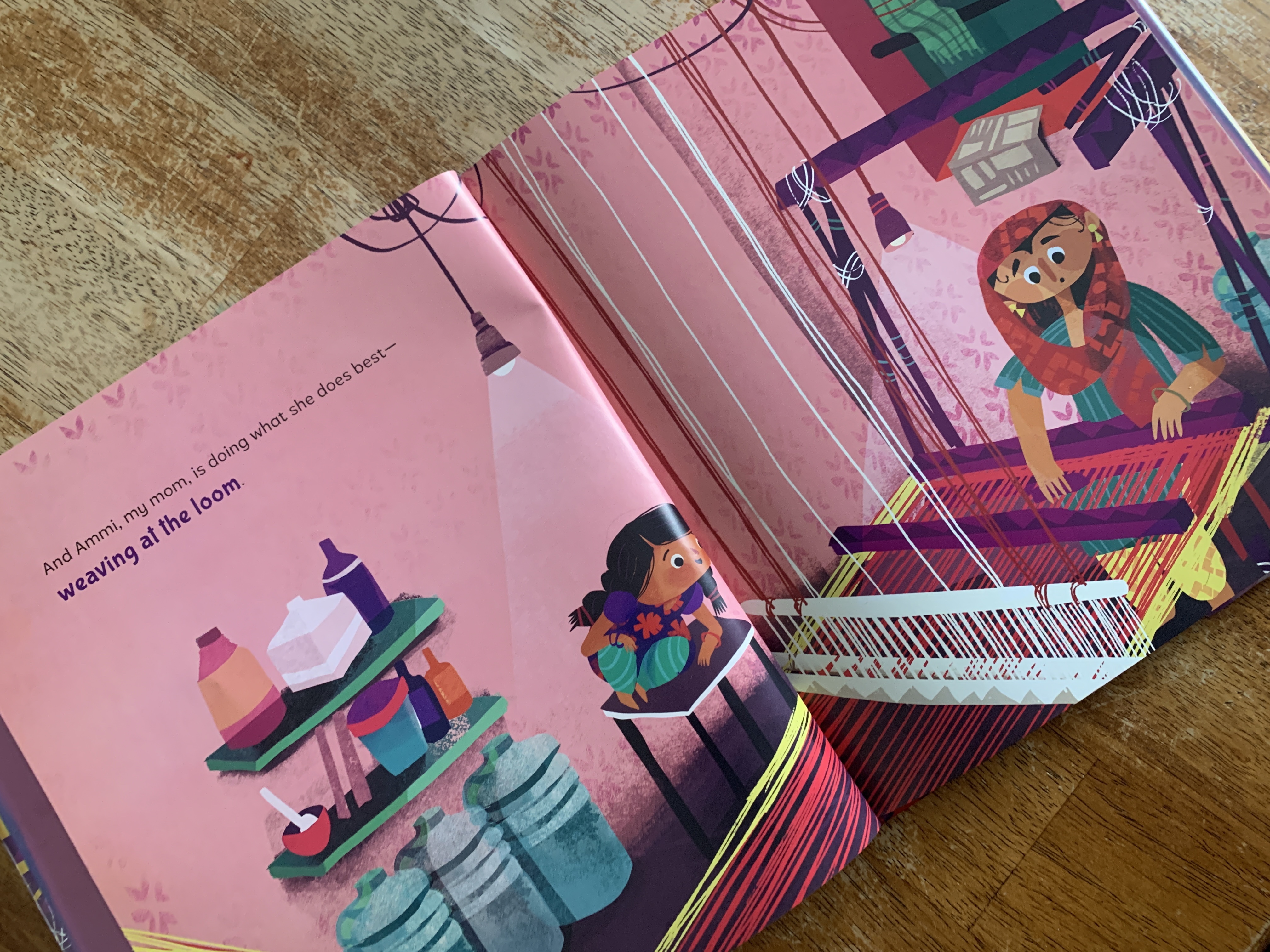
This book combines knowledge with a sweet story and a spunky narrator.  Over 32 brightly illustrated pages the reader learns about the art of dyeing yarn, weaving, and the tradition of weaving saris in India moving from Mysore to Kaithoon in Kota.  The little girl loves it all, helping her father dye the threads, and watching her mother work the loom.  It often takes a month to make a sari, and her mother makes beautiful saris, but she never wears them.  With the help of her older sister Sadaf, the little girl hopes to earn enough money to gift her mother a beautiful sari to wear.  It will take a lot of work, some community help, and some sacrifice, but Ammi is worth it and the girls are up for the challenge.  Preschool to early elementary readers will enjoy learning about the daily life of these amazing Indian Muslim artisans and a craft that they perhaps were not aware existed.

img_4662

The buffalo are sleeping, but in the afternoon Abba is busy dyeing threads, and mama is weaving colors into prints of mangoes, peacocks, birds, leaves, and flowers.  The whole family helps.  Abba goes to the haat to sell the completed saris.  Sometimes Mama goes as well, but she doesn’t wear the saris, she wears worn-out salwar-kameezes.

One day, when Ammi finishes a particularly beautiful sari the little girl asks her to keep it, but her Ammi says, “If we keep the saris, how will we eat?”  The little girl doesn’t understand, they don’t eat saris.

img_4663

Sadaf explains to her little sister that the only way their Ammi will wear a sari is if they buy her one.  So the little girl breaks her bank apart to count the money she has and convinces Sadaf that the things they wanted with the money are nothing compared to how much they want something for their mother.

But Sadaf says they only have enough money for a towel, not a sari, so the girls gather some items to sell to the junk man.  They have enough to buy Ammi a duputta, but still not a sari.

img_4665

They wander home through the wheat field trying to come up with other money raising ideas.  The wheat remind the little girl of worshippers on Eid day- all praying together at the mosque.  The little girl remembers that sometimes their neighbor Amina Khala purchases dyed threads from them and they rush over to see if she has any work for them.  Luckily she does, and they have just enough to buy a sari for Ammi and be rewarded with a smile and tears from their beloved and talented mother.

img_4664

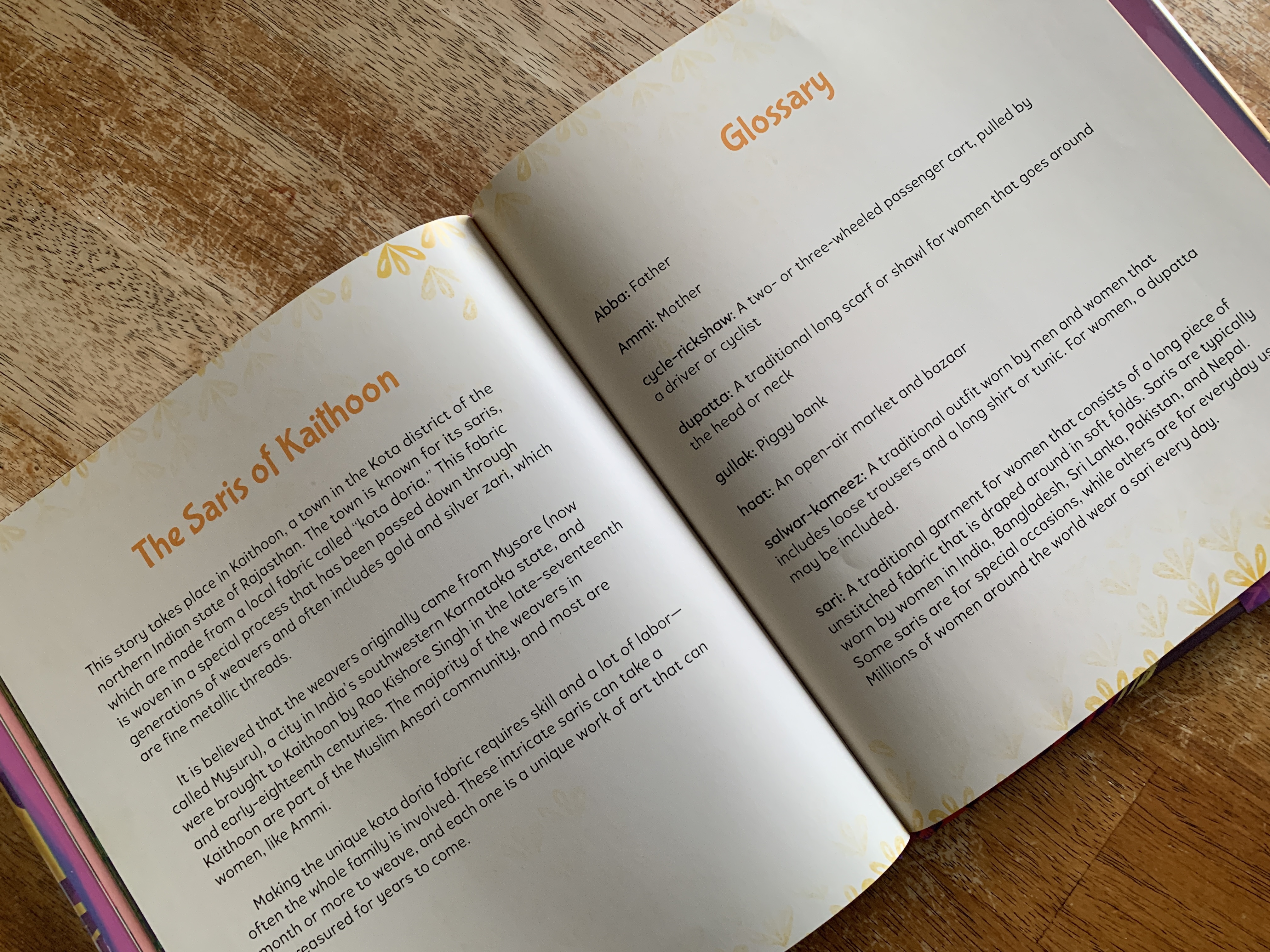
The book has an information page at the end about The Saris of Kaithoon, as well as a glossary.  The story ends a bit abruptly, but the teardrop in the illustrations, the hugging, and the smile, do provide a universal relatability to parents everywhere when their children gift them something so genuinely from the heart.  The illustrations also show women with their heads covered going about their daily life.

img_4666

My Name is Bana by Bana Alabed illustrated by Nez Riaz

Standard
My Name is Bana by Bana Alabed illustrated by Nez Riaz

bana

OWN voice books are always important, and while we see a rise in minority voices claiming their own stories, to read a child’s story about war and hope by a child, is particularly impressive.  Bana Alabed was born in 2009, she is an activist, a Syrian refugee, and now an author.  Her clear voice doesn’t stumble and her perspective is unapologetic, yet hopeful.  Over 40 pages she tells her story in her own words with beautifully warm and complementary illustrations filling the pages.  For kindergarten and up, this book stands out in a crowded field of refugee inspired stories for its authenticity, strong author, and overall emotional connection.

img_4629

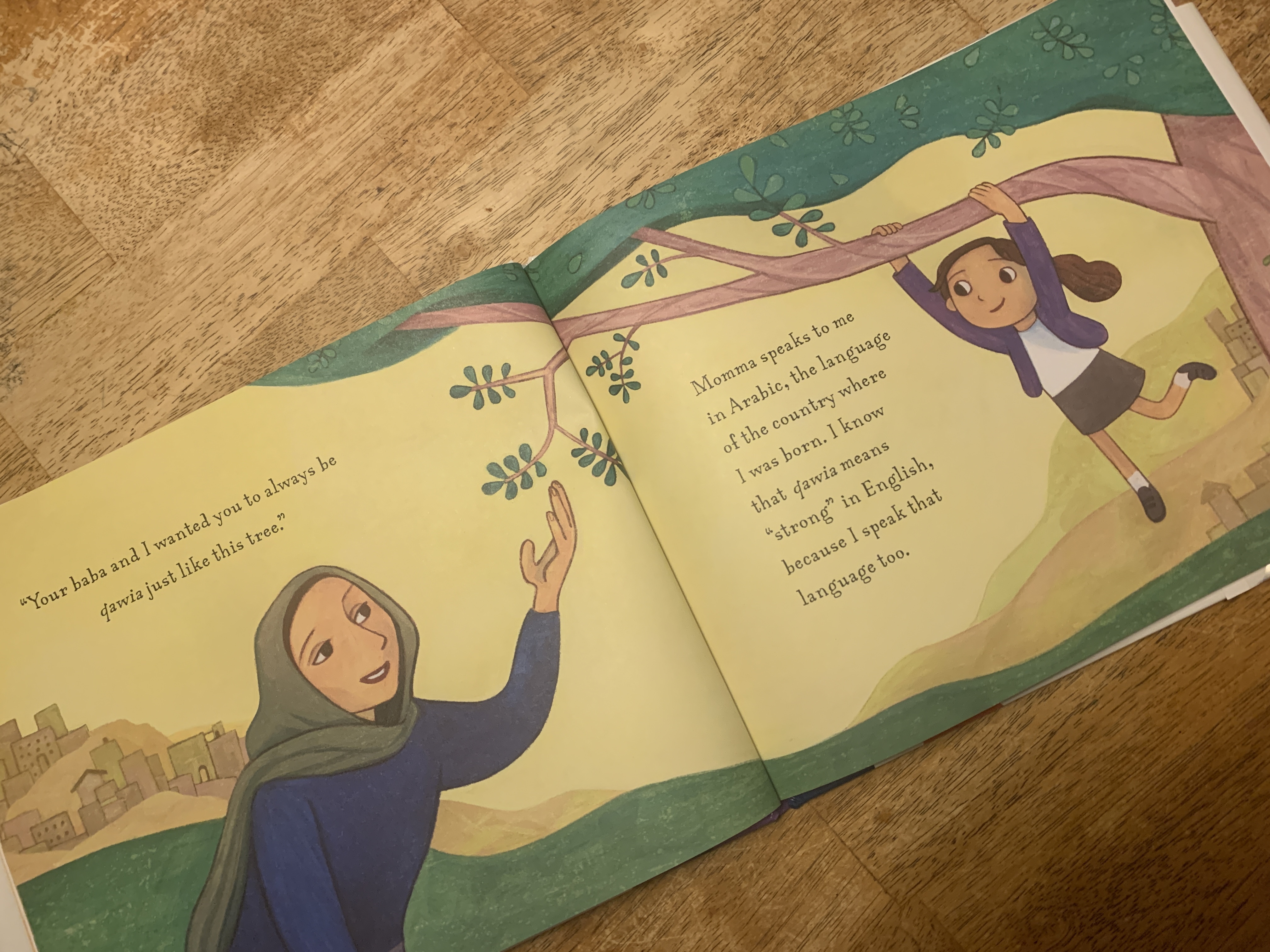
Bana begins her picture book memoir by asking her mother why she was named Bana.  Her mother explains that she was named after a tall bushy tree that grows in Syria.  Her favorite tree.  A tree that is qawai, Arabic for strong.

img_4630

Bana then asks what it means to be strong.  And once again her mother lovingly explains, that strong is to be brave even when you are scared, and to be sturdy so others can lean on you.  It also means you use your mighty voice to speak up when something is wrong, you read, study, and exercise your body.

img_4631

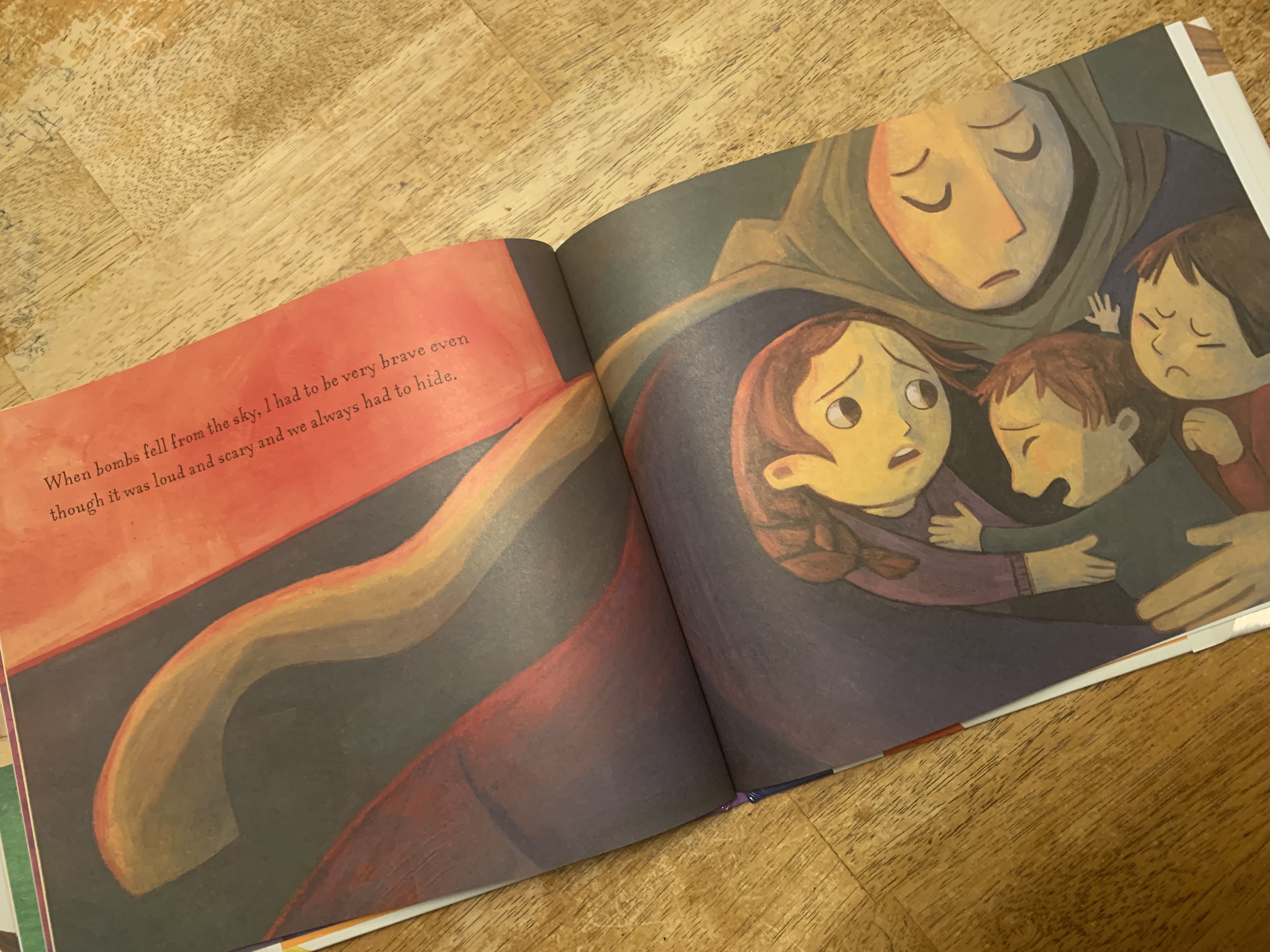
Bana appreciates her name, and being strong, because war came to her country.  When bombs fell they had to hide, when her brothers were scared, she had to keep them distracted, when they moved to a new place where they didn’t know the language or any people, she had to be strong still.

img_4632

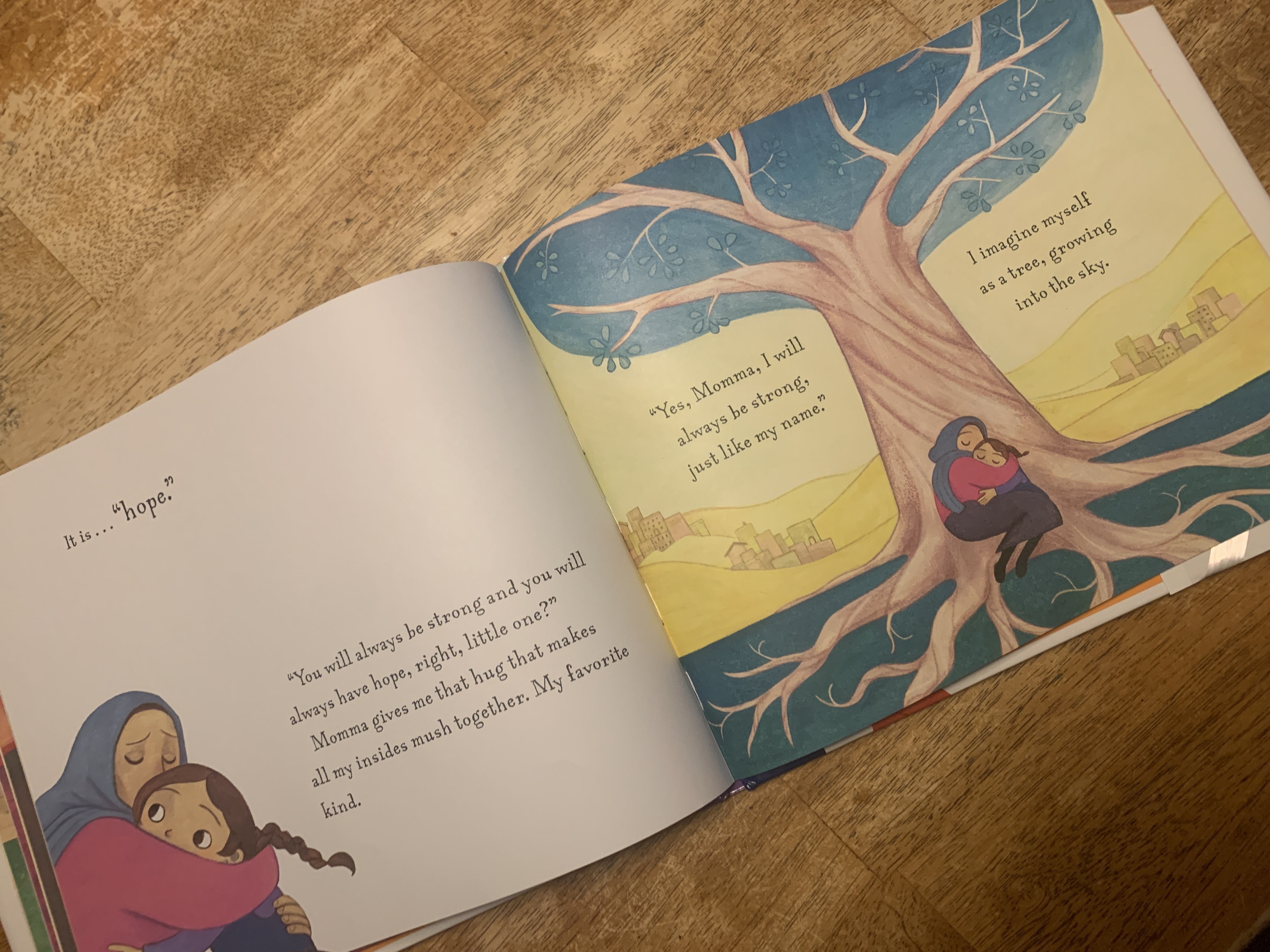
As a young girl, Bana tweeted about the war, the book doesn’t touch on that, but it does show her being strong as she shares her story all over the world.  It then returns to her and her mother discussing amal, Arabic for hope, and Bana imagines herself strong, reaching into the sky.

img_4633

The book ends on a simpler note of acknowledging her little brothers’ names: Laith and Noor, lion and light.  The Author’s Note at the end is just as powerful as the text of the book and provides more information about Bana’s experience and outlook. The way that war is handled is not overpowering for young readers, and will provide a great starting point of discussion.  The relationship between Bana and her mother is warm and supportive and equally deserving of mention with the little people you share the book with, alhumdulillah.

“Kids shouldn’t have to always be strong.  Every child deserves to live in peace.” Bana Alabed

Arab Arab All Year Long! by Cathy Camper illustrated by Sawsan Chalabi

Standard
Arab Arab All Year Long! by Cathy Camper illustrated by Sawsan Chalabi

arab

This 40 page month-by-month celebration of Arab culture, both old an new, will be a source of pride and smiles for readers of all ages.  The author is an Arab American of Lebanese decent and the illustrator was born in Lebanon.  The book shows Muslim’s teaching others about Ramadan, looking up hijabi fashions, as well as making cookies at Easter and dressing in sleeveless shirts.  To be Arab is not a monolith and this book seems to convey that culture and tradition and love are all it takes to be included in the broad diverse identity of being Arab.

January starts with finding stars with Arabic names, and February recalls how a comic about Martin Luther King, Jr. helped inspire the Arab Spring.  The kids in turn make a comic to teach others about Ramadan.  March is a chuckle about Arab time, and April is making maamoul with Sitti for Easter. May is learning to write Arabic and June for gathering grape leaves to make warak enab.  July is picnics that remind mama of Morocco and making perfume with familiar smells and memories. 

August is playing the doumbek with Dad who is in an Arab band. September is researching hijab costumes to wear to comic con.  Dressing up like Umm Kulthum wins first prize.  October is pomegranate time, which means the kids jump in the tub to eat and enjoy the messy fruit. Chilly November air requires the Palestinian keffiyeh to keep memories warm, and December when friends are busy over winter break it is time for sleep-overs and henna parties.
I like that dressing up is not for Halloween and that while some examples are country specific, many are general.  The book specifically mentions a few Arab countries, but the electronic arc did not include all the supplemental information that the published hardback book will contain.  I can’t wait to check it out and gift to my Arab friends and their children. 

I Lost Something Very Special by Husna Rahman illustrated by Anita Bagdi

Standard
I Lost Something Very Special by Husna Rahman illustrated by Anita Bagdi

Screen Shot 2021-11-04 at 11.08.02 AM

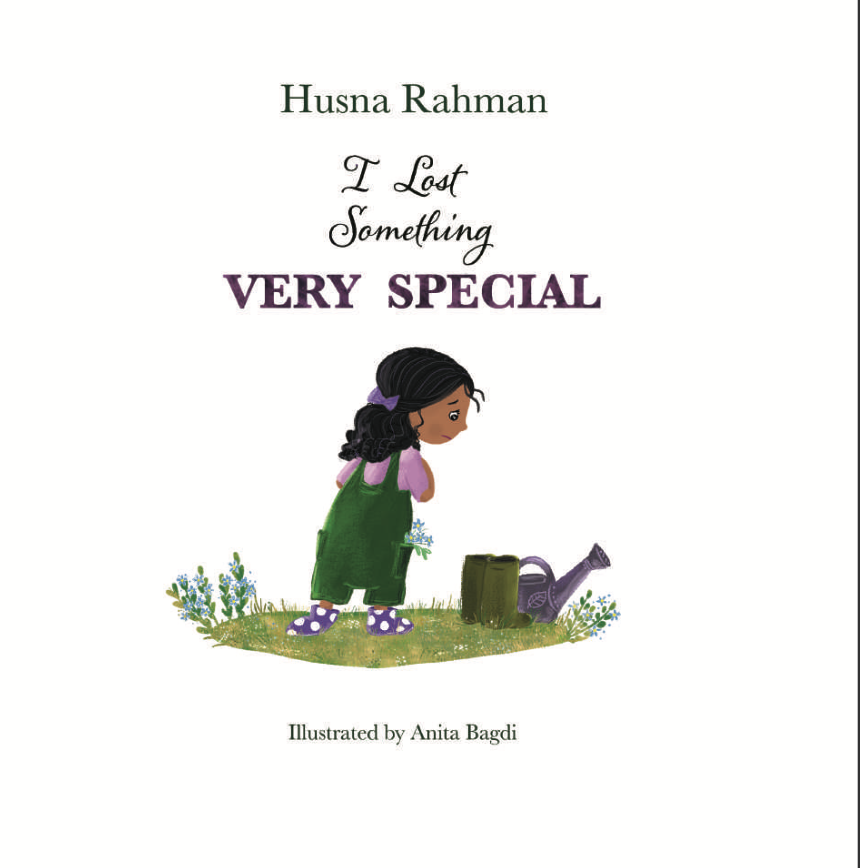
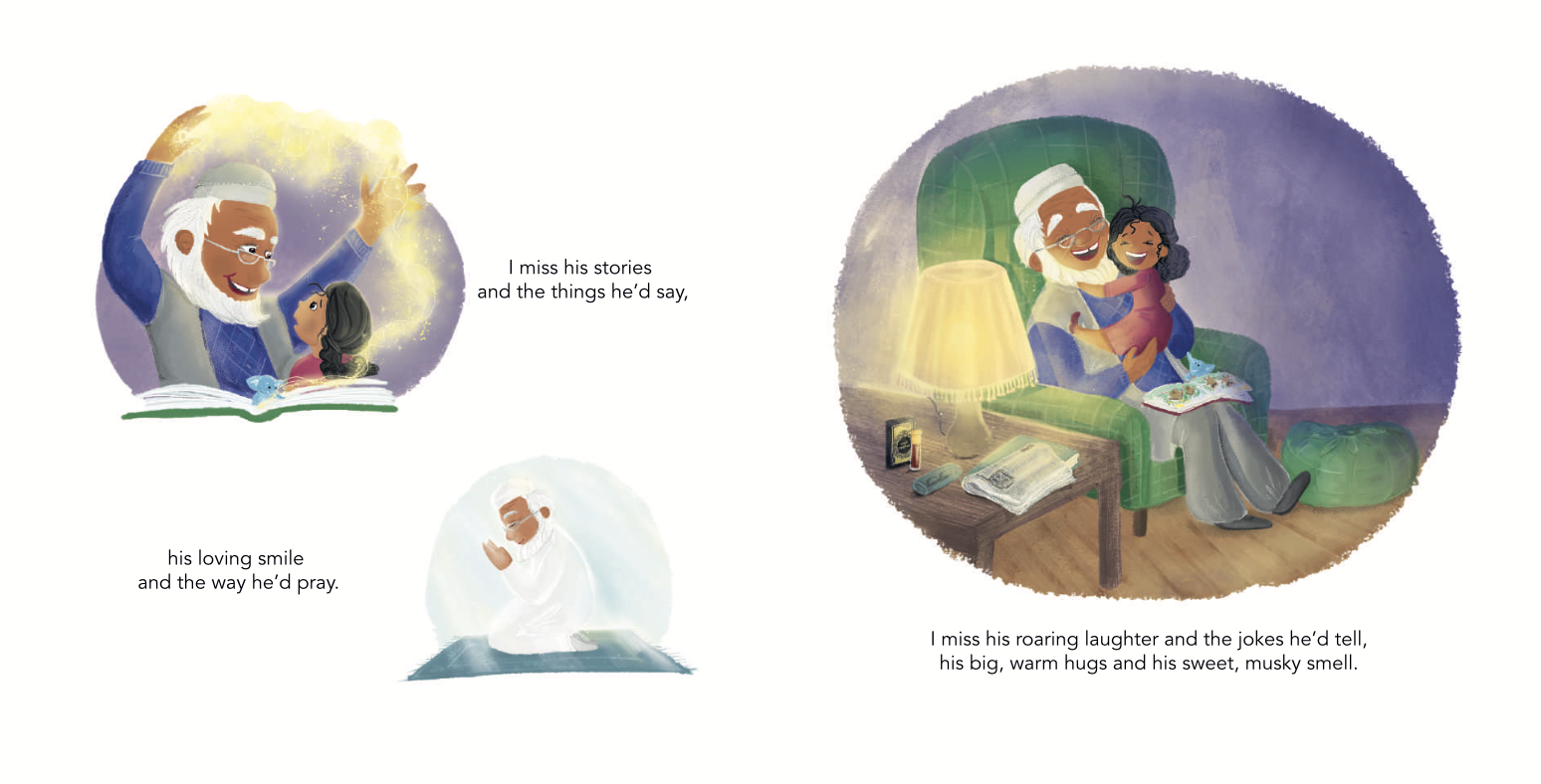
This beautifully illustrated 34 page story about the loss of a beloved grandfather is universal and heartfelt.  It is not an Islamic fiction book as there is no mention of the duniya or akhira or accepting Allah’s decree, the family however, is visibly Muslim and it shows women in hijab and the little girl narrator praying salat with her now deceased grandfather.  Similarly, there are no cultural words or references in the text, but the illustrations show Bangladeshi culture, writing, and warmth.  The author is a psychotherapist and counselor, and all readers, young children and up, will benefit from the tenderness and emotion-filled paperback book.

Screen Shot 2021-11-04 at 11.08.58 AM

A young girl starts the book stating that she has lost something.  She recalls other things she has lost, a scarf, a toy, her voice, a tooth, and how after a while the item was found or it came back and she was able to carry on.  Today, however, is not the same, she has lost her grandfather, and he isn’t coming back, and she doesn’t know if she can carry on.

Screen Shot 2021-11-04 at 11.09.36 AM

She goes to his house, and he isn’t there, and the heartbreak is palpable.  She knows in time she will forget the lost scarf and lost voice, but she doesn’t want to ever forget her grandfather.  She finds some pictures and recalls him teaching her to ride her bike, them praying together, and planting a garden, his stories, his smell, his laugh, his hugs.

Screen Shot 2021-11-04 at 11.10.21 AM

As she assembles the pictures in a scrapbook, she is filled with memories and warmth and his wisdom.  The book ends with her seemingly coming to accept her new reality and then the book asking the reader if they have felt loss, what memories they carry, and what they miss the most about those that are gone.

Screen Shot 2021-11-04 at 11.10.01 AM

The sparse text and amazingly expressive illustrations make the book a beautiful addition to help children cope with their own feelings, and to learn empathy for others going through their own trials of loss.

Screen Shot 2021-11-04 at 11.08.18 AM

Little Seeds of Promise by Sana Rafi illustrated by Renia Metallinou

Standard
Little Seeds of Promise by Sana Rafi illustrated by Renia Metallinou

seeds

This sweet, well-done 48 page picture book for early elementary aged readers shows the fear associated with being in a new place, the love of an elder family member, and the courage it takes to make new friends.  The story focuses on a young Pakistani girl who has recently moved to a new country and how she tries to remember the wisdom of her Nani to blossom in her new home.  The culture rich story is universal and lyrical, with hints of making duaa, greetings of salam, and the soothing sounds of the athan that make memories of home so foreign to her in her new residence. Young readers will empathize with Maya, and see the symbolism in the seeds she is anxious to plant and cultivate.

img_4475

Maya finds her new home unfriendly and cold, she feels different with her food, and clothes, and way she speaks.  Home to her is dancing in the warm mansoon rains, saying As-salamu ‘alykum, and waking up to the sweet athan.  Nani was also there, her old home.  Sweet Nani with her hundred wrinkles, smelling like flowers.  When Maya left, Nani gave her a gift.  Little seeds of promise, so that they and she might bloom where planted.  But Maya doesn’t know where to plant them, she carries them with her everywhere she goes, but like a secret, she keeps them close.
img_4477

Channeling her Nani’s tenderness, she knows that she has to plant them if one day she wants to be surrounded by flowers.  Maya loves flowers, dancing around them, praying among them.  Maya finds a patch of earth.  She longs for rain, she hopes for warmth. She makes way for the rays of the sun.  The text talks of flowers, the illustrations show both the plant and the growing friendships.  For days nothing happens, with the seeds or the classmates.  But Maya remembers that seeds have a long journey from the ground up.

img_4476

Maya nurtures her seed, just the one she dared plant, with love and kindness.  She too feels ready to burst.  Can she be brave enough to plant all the seeds, can she share them, and her self in her new world? Can their be warmth here, like there was over there? Can this too be home?

img_4478

I love the symbolism and juxtaposition of the seeds growth with her own.  The character arc and the transition of home being one place to being the other, is very well done, older readers will feel an aha moment when they grasp it and younger kids will enjoy both the surface story and the dialogue you can have with them about blossoming where planted.

img_4479

Religion is not a strong thread, but Islam is present in her memories of her maternal grandmother and all the warmth and love that those memories contain.  I love that the classmates were never mean, they just didn’t know her either.  I wish there was a bit more diversity of skin tone and mobility in the classroom illustrations and the friend circle she is hoping to join.  Overall, a beautiful OWN voice picture book that will be enjoyed for multiple bedtime, small group, and classroom readings.

A Sky-Blue Bench by Bahram Rahman illustrated by Peggy Collins

Standard
A Sky-Blue Bench by Bahram Rahman illustrated by Peggy Collins

sky cover

I know many of you are thinking, another book about school for girls in Afghanistan, and given the reception by most to the author’s first book, The Library Bus,  I can sense the rolling eyes.  I was in the minority on that one, as I enjoyed it, but, this one is simpler, sweeter, more universal while being complimented by culture, and I hope it is a more authentic and accurate OWN voice portrayal.  I know I have a lot to learn about white washing narratives and breaking down colonial paradigms, so I promise if you disagree I will listen.  But I genuinely enjoyed the illustrations and little Aria finding a way to make a bench so she could sit comfortably at school with her prosthetic leg.  The girls go to school, and the furniture was burned to keep warm in the winter, a concept that the author verifies at the end as something experienced in his own life.  Aria has to find a way to sit in class because she wants to learn, and lack of wood working experience, resources, and doubt that a girl can do it from her classmates, isn’t going to stop her.  Over 32 pages, early elementary age children will meet a determined young girl as she pieces together scraps to build a bench.

Screen Shot 2021-10-22 at 10.49.20 PM

Aria has been in the hospital for a while after an accident took her leg.  She is excited to be back at school, but quickly realizes it is hard to sit on the floor with her new helper leg.  She tries leaning on the wall, standing even, but just getting up and down off the floor is really difficult.  At home when she mentions it to her mom, her mom reassures her that she can get through it and her little brother offers to help her carry her things.

Screen Shot 2021-10-22 at 10.51.12 PM

That night Aria considers how much she would miss school if she isn’t able to figure something out.  Then she has an idea, she’ll build a bench.  At school the next morning, classmates tell her “Girls don’t build benches,” but Aria responds, “I can do anything a boy can.”

With that, a single friend joins Aria as they comb the city for discarded wood, broken furniture, screws, and nails.  They assemble the resources and when they have enough Aria and her mom head across town, past the Blue Mosque, to visit the carpenter, Kaka Najar.  He shows them how to fit the pieces together like a puzzle and loans them the tools needed to be successful.  He even gifts her some sky-blue paint, “the color of courage, peace, and wisdom.”

Screen Shot 2021-10-22 at 10.52.30 PM

That weekend Aria and her mom and little brother build a bench, paint it blue, and get it to school.  When the other students see it, their excitement bubbles and they imagine building tables, book cases, and more.  Anything is possible after all, there is paint left in the can and they are willing to work together.

Screen Shot 2021-10-22 at 10.53.08 PM

There is nothing religious in the text, save the mention of walking past a mosque, but in the illustrations the women are all covering their heads when they are out, and are uncovered at home, the school uniform seems to be a white hijab and black abaya.  I wish there were some Pashto words sprinkled, and it was a bit off that she was building a bench, but the finished project was a bench and table. The end has an Author’s Note and I enjoy seeing the smiling faces and bright illustrations in a book set in Afghanistan.

Screen Shot 2021-10-22 at 10.54.15 PM

What’s The Matter Habibi? written and illustrated by Betsy Lewin

Standard
What’s The Matter Habibi? written and illustrated by Betsy Lewin

matter habibi

This short silly 32 page AR 2.7 book by the illustrator of the famous Click, Clack, Moo books tells a tale of an unhappy camel in Egypt and his caring owner Ahmed’s attempt to understand what is wrong.  There is nothing religious in the book, save a few visible hijab wearing women in the bazaar illustrations, and the main human character’s name.  The cultural backdrop though,  does introduce and encourage familiarity for young readers who may not have exposure to Arabic words and people.  The author is clearly not Arab, but the book thanks the Cairo NESA delegates for their help in developing the story.  Before reading it I was nervous that because the presentation would be coming from an outside perspective,  that the messaging would be condescending and/or stereotypical.  I think I was perhaps giving the book way too much thought, because ultimately the story isn’t that deep.  The illustrations and tone are warm and focus on a camel wanting a fez and the efforts it takes for Habibi to acquire one and for Ahmed to track him down.  It is surface level silliness for younger kids, the camel and owner are kind to each other and the setting just ties it all together.  I am not Arab, and could definitely argue that the camel and his silly owner do perpetuate stereotypes, so feel free to offer up your thoughts if you have read the book.  Irregardless of where you side, the fact that I’m sure had I read this book in 1997 when it was published, I would have been gushing to see the name Ahmed in a widely available book, but here we are nearly 25 years later and I’m questioning if these are stories that are better left to be told by OWN voice perspectives.

img_4356

Ahmed and Habibi give rides to children every day, but one day Habibi refuses to get up.  Ahmed asks if it is a toothache, a tummy ache, and no response.  When he asks if his feet hurt, Habibi stands up, and Ahmed gives the camel his babouches (that magically fit).

img_4357

Habibi then takes off running through the bazaar.  He approaches the man selling fezzes and a trade is made: the slippers for a hat.  Ahmed trailing behind barefoot, then has to purchase his own shoes back.  As Habibi passes different shops and hears how handsome he is, Ahmed is able to follow him.  When they finally reunite, Habibi is surrounded by happy children, and Ahmed admits, he really is a handsome camel.  Happily Habibi gives the children extra long rides and then let’s Ahmed ride him home.

img_4358

This book would work well for story times to ages four and up.  It would lend itself to themes about silly animals, hats, Egypt and Arab culture.  The crowds of people including the children are dressed in both thobes and pants and t-shirts.  You see traditional headgear on some and none on others.  It seems clear that the camel is not the normal mode of transportation, as there are no other camels, or even cars, only people walking in the book.  Habibi is a novelty for the children and adults he passes, so one could possibly safely assume he is a tourist attraction of sorts.

img_4360