Category Archives: Non Fiction

Yusra Swims by Julie Abery illustrated by Sally Deng

Standard
Yusra Swims by Julie Abery illustrated by Sally Deng

yusra

This 32 page biography told in sparse rhyme about Yusra Mardini is powerful in its minimal text and realistic illustrations.  Children as young as six could easily read it, but I think older kids will be more moved by the story of a 17 year old girls Olympic swimming dreams being derailed by war, and the difficult journey her and her sister took to escape.  With no more than 10 words on each two page spread, the vocabulary is more suited to perhaps third grade and up.

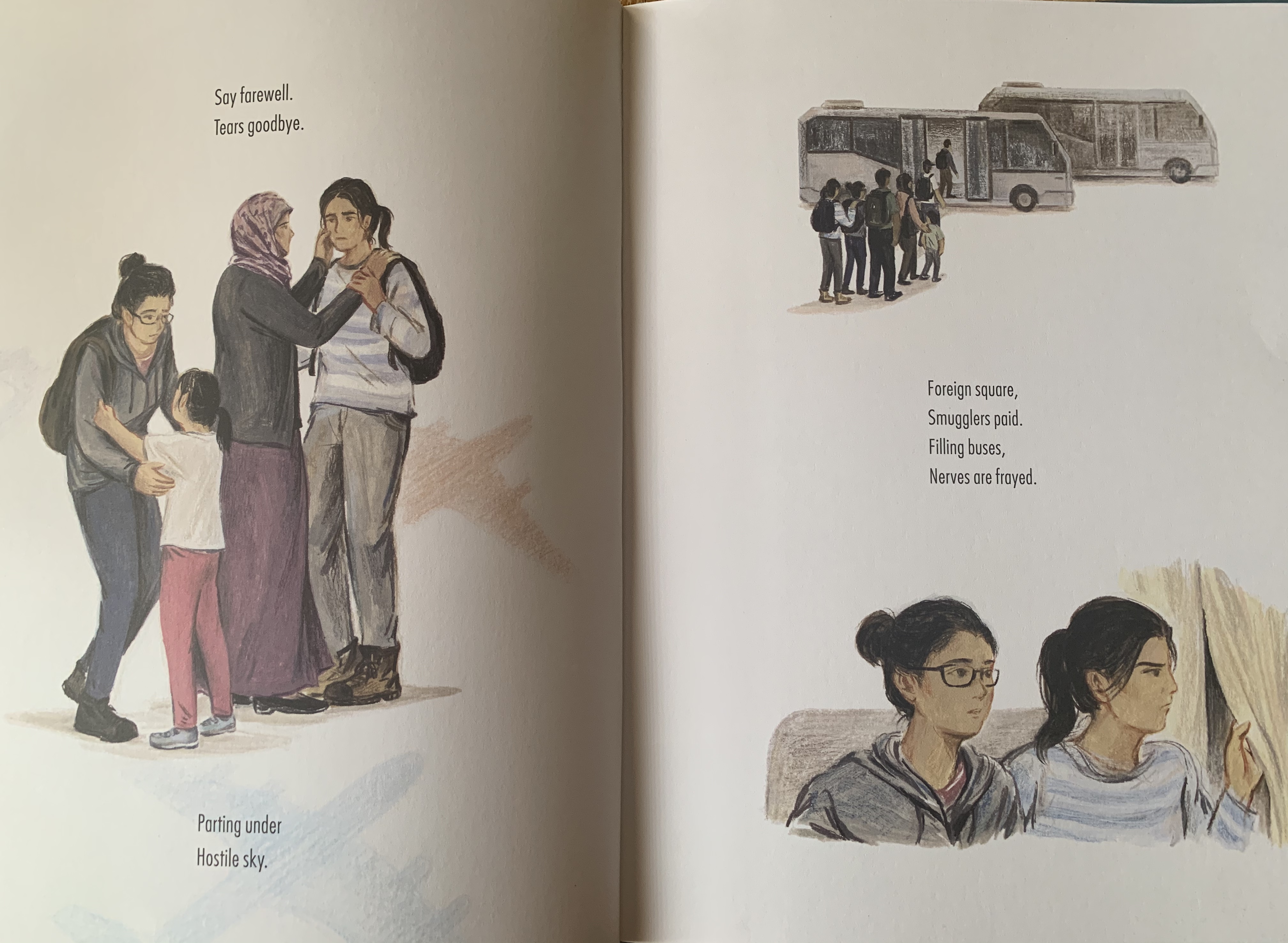
Yusra lives in Syria and dreams of the Olympics.  She trains even as conflict grows in the country.  When it gets bad, she has to flee, her father can only afford to send her and her sister.  Smugglers are paid and they leave.  They take on the open sea, and her and her sister steer the boat through the water when the engines stall.  Once they reach land, and pray, they are stared at.  A kind stranger offers her shoes. They continue on land by foot, bus and train.  They finally reach Berlin.

Once settled, she resumes her training, and a fact page at the end shares how the International Olympic Committee invited her in 2016 to join the Refugee Olympic Team and compete in Rio de Janeiro.  And thus she achieved her dream and was able to swim in the Olympics.

83175260-2878-4DDF-AA9F-3618FEEF41A5

There is nothing religious in the book, except when she is leaving and is hugging a woman in hijab.  Presumably it is her mother, and thus I’m assuming that she too is Muslim. When you google it some articles say she grew up in a muslim family while others say she is Christian, so I really have no idea.

DCAB592B-C32C-4FDB-AF1D-8CF13F36F164

Alia’s Mission: Saving the Books of Iraq by Mark Alan Stamaty

Standard
Alia’s Mission: Saving the Books of Iraq by Mark Alan Stamaty

alia

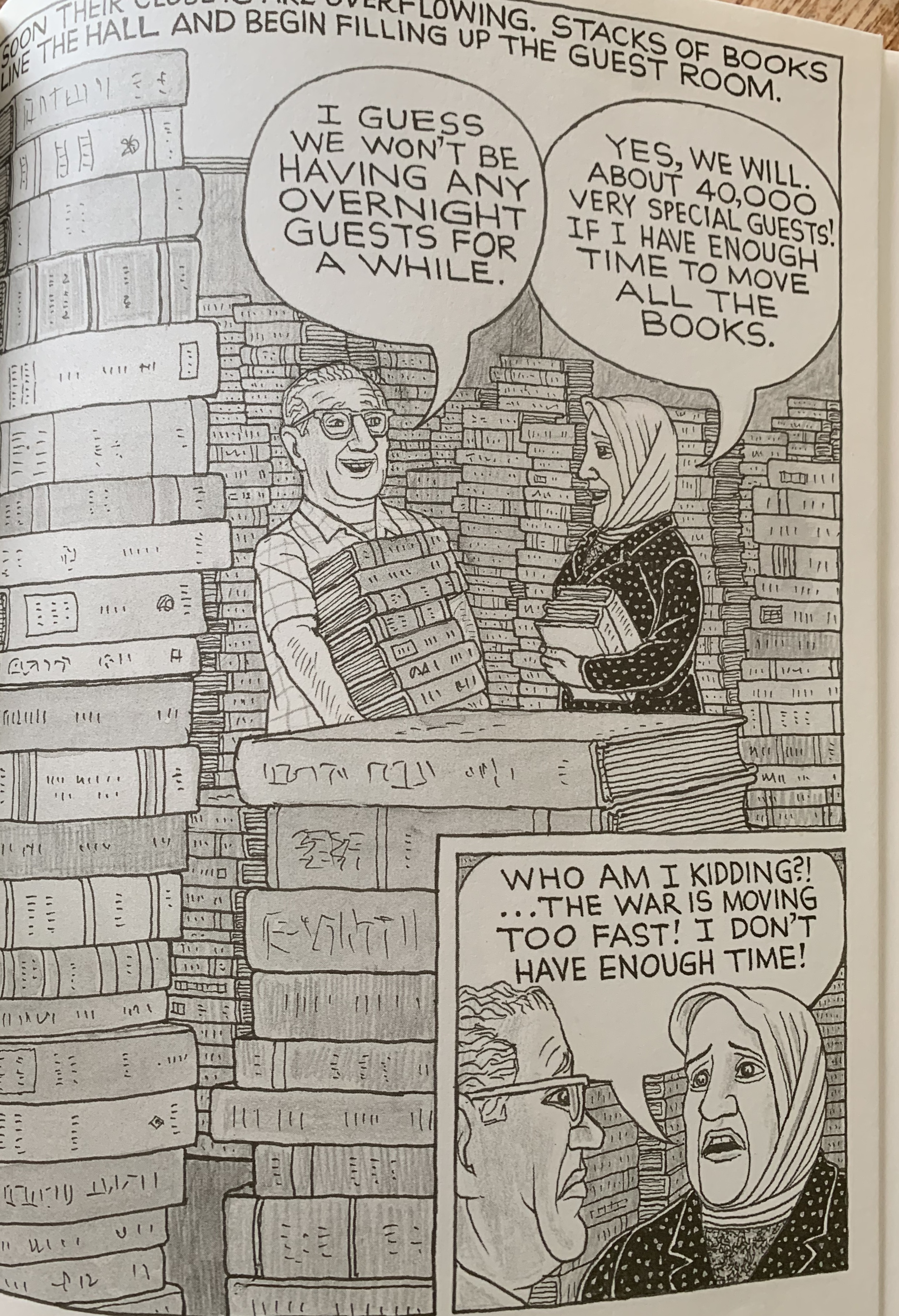
Based on the true story of Alia Muhammed Baker, the Basra librarian who saved 30,000 books in 2003 from the destruction during the Iraq War, this 32 page graphic novel, is an AR 3.9 and while it isn’t a chapter book and isn’t just a picture book, it works well for 2nd through 4th grade readers that will enjoy a bit of history, a lot of excitement, and detailed panels that make the story come to life.  The story, as it is based on fact, is very similar to The Librarian of Basra, but with it’s different presentation style, might appeal to a larger audience to appreciate and celebrate what she did to save such precious books, naturally, I’m a huge fan!

5532A37C-C4DF-46FA-8334-5F4AA3A06AB5

SYNOPSIS:

Alia is the Chief Librarian of Basra Central Library and has always loved books and learning.  As war draws closer, she tells her husband she is worried that the library could be bombed or set ablaze.  She goes to the government to voice her concerns and ask that the books are relocated, but her request is denied.  So she takes matters in to her own hands, and starts smuggling books under her shawl and in to her car, and stacks them in her home.  Every day she does this for a week, soon closets are over flowing and she starts stacking the books in her guest room.  Worried that she isn’t making fast enough progress, she gets the restaurant owner next door to help her when looters start taking the pencil sharpeners and furniture from the library.  She has a plan to have everyone possible come together to move the books, and many people come to help.

Eventually the library is set on fire, the news gives Alia a stroke.  When she recovers she learns she saved 30,000 books, and up next for this real life super hero? Building a new library, inshaAllah.

A3A17616-7940-4E80-8CA1-9798A8BA4FC8

WHY I LIKE IT:

I love that it shows the value of libraries and books, the determination of one person, and the support of a community.  People are awful during a war, yet, sometimes they are pretty amazing too.  The illustrations are detailed and varied, with inviting text and clear concise language.  It really is well done.

B0FB5A2A-7376-4F20-BCD1-6D64956B77C6

FLAGS:

Destruction of property, sneaking, looting.

TOOLS FOR LEADING THE DISCUSSION:

I think it would be great to have kids read this story and the librarian of Basra and discuss


The Bee Tree by Stephen Buchmann and Diana Cohn illustrated by Paul Mirocha

Standard
The Bee Tree by Stephen Buchmann and Diana Cohn illustrated by Paul Mirocha

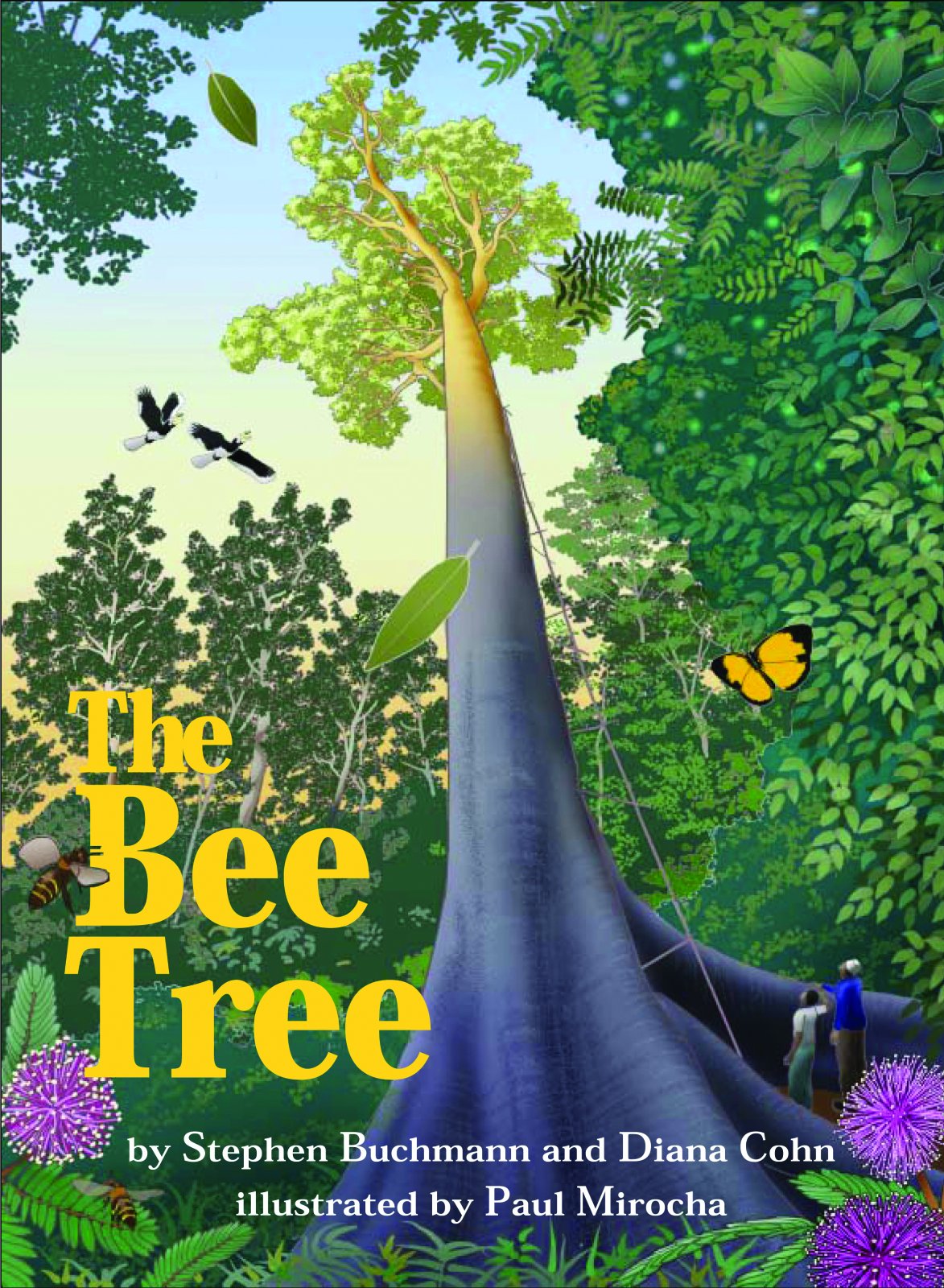
bee treeThis is one of those books that it is hard to know who the target audience is and who would most enjoy the text heavy 40 pages about a boy coming of age in Malaysia by harvesting honey in a traditional manner.  The two page spread illustrations are rich and inviting, and with an AR 5.7 level, the book would work well for children that enjoy other cultures, honey, insects, or children that you hope will be inspired to start seeing the world a little differently than they are used to doing.
5BD37914-E9B7-4D0B-BB0A-1286A8BC4C72

The story starts with a boy talking about his grandfather and how every year he goes to collect the honey from the tualang trees.  The bees travel hundreds of miles and arrive just as the rainforest starts to bloom.  The trees that they build their nests in are higher than the eye can see and grandfather, known as Pak Teh, is the leader of the honey hunting clan.

7CA311E6-B1B6-40E7-B735-FAACAD76597F

He tells everyone what their jobs will be: some will carry ropes, others pails, others torches.  One day, he tells them, someone will have to take his place as the one who climbs all the way up to the top to gather the honey.  He believes Nizam, the narrator, is the one.

To prove himself, Nizam has to practice climbing 120 feet into the sky.  Nizam and grandfather spend a lot of time together praying five times a day and walking through the dense rain forest.  He reminds Nizam that the forest doesn’t belong to them, but to the unseen protector. They enter the forest as if they are visiting a neighbors home.

837003A0-ED16-4CA9-9CD8-3CEBA7846D0A

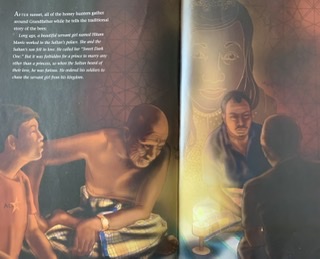
At night all the hunters sit together and Grandfather tells the traditional story of the bees.  A story that involves a beautiful servant girl named Hitam Manis who worked in the Sultan’s palace and how the Sultan’s son and her were in love.  When the Sultan found out he ordered the girl run out from the kingdom.  As she and her loyal friends fled she was hit by a metal spear.  She did not die, but her and her friends were magically transformed into a swarm of bees.  Because it was metal that harmed her, she ruled that metal was never allowed to touch the honey.  Hence, when the bee hunters harvest they use a bone knife, leather pouches, and a wooden ladder.

2637F18A-FB0A-424D-AACF-58285BE31EC5

When it is time to enter the forest, it is pitch dark with no moonlight.  The hunters tap their glowing torches against the trees sending light sparks to the ground to tempt the bees and leaving their nests free for Nizam to collect the honey from.  For seven nights they climb the trees, and then they return home.  With greetings of salam, peace be upon you, Grandfather informs the family that when he can no longer climb the tree, Nizam will carry on the tradition.

908CAC37-2CCE-477A-93BC-B3EEF723C2BF

The book ends with factual information about Malaysia, the rainforest, giant honey bees, honey hunters, and the future.

Betty Before X by Ilyasah Shabazz with Renee Watson

Standard
Betty Before X by Ilyasah Shabazz with Renee Watson

betty

This 248 middle grades (AR 4.9) fictionalized biography of Betty Sanders, later to be Betty X and then Betty Shabazz, is the early years of her life in Detroit during the 1940s and how she understood her place in her family, and in the community.  Written by her daughter, the book hops around to major events in her life and doesn’t detail a lot of the whys, but rather keeps an 11 year-old-perspective, allowing readers to identify with her family stresses and anger at the racial discrimination and violence that is rampant.  Showing disagreements within the black community allows young readers to broaden their horizons and not see the civil rights as a monolithic point on a timeline, but something that is still ongoing and part of culture still today.  There is nothing Islamic in the book, as this is a glimpse of her childhood long before Nation of Islam, her conversion to Sunni Islam or her Hajj, in fact the majority of the book focuses on her involvement in the Bethel African Methodist Episcopal Church.

SYNOPSIS:

Betty was born in Georgia, as the story goes, but before she was even a year old, Betty’s grandma took her away from her mother and gave her to her aunt, Fannie Mae, to raise.  Having seen a bruise on the baby girl’s neck Grandma Matilda didn’t feel that the young mother was capable to care for Betty.  Fannie Mae showered Betty with love and consistency and treated her like her own daughter.  Betty saw her first lynching while in Fannie Mae’s care and the image stayed with her her whole life.  When Betty was seven her aunt died and Betty went to live with her biological mother, Ollie Mae, in Detroit.

In Detroit, Ollie Mae has married and has three daughters with her husband, Arthur, who also has two sons.  A full house that is religious and disciplined, but for Betty not full of love.  She prays that her mother will look at her the way she looks at her sisters, but that never seems to happen. The family attends Bethel AME church and at age 11 that is when the story gets going.  Betty and her friends sneak out of church to get candy and the cost will probably be a whipping.  Luckily a few of the church ladies like Betty and realize how hard Ollie Mae is on her.  They work to get Betty permission to hang out with girls her own age and try and convince her mother to let her join the Jr. Housewives’ League.  Ollie Mae doesn’t agree with the work of the Housewives, a strong group of women that work to convince others to only support businesses that hire Negroes.  This organization is a major division within the community and the church.  Mrs. Malloy and Mrs. Peck are leaders in the organization, and one of Betty’s friends is for it, while another is against it. This rift affects Betty in many ways.

At age 11 Betty leaves home to go and live with the Malloy family.  A husband and wife who have no children and own a shoe repair shop.  One night turns into two and then she is living there full time and only seeing her siblings and mom at church on Sunday.  She even gets to calling Mrs. Malloy, Mother.  As she comes of age with a new family, and splintering friendships she seeks to make her own family with those that love her, and seeing violence targeted against blacks when a young boy is shot by police in the back, and working with civil rights activists- the icon and leader we know Betty Shabazz to be, is shaped and inspired.

WHY I LIKE IT:

I love that she gets her own story and own voice, not just to be left as someone’s wife.   She is a force before she meets Malcolm and after he is murdered.  Her story is shaped by so many outside influences, but ultimately it is her own and even in her early years the reader feels that.  She seeks out those that love her the way she should be loved, but she doesn’t give up on those that try and leave her either.  She fights for her mother’s praise and doesn’t abandon friends that believe differently than her, which is powerful to see from an 11 year old.  She sees the world around her and takes a stand against that which is wrong, she feels and hurts and doubts, but she gets back up.

I like that she questions if what she is fighting for will make a difference, while simultaneously doesn’t want to take racism quietly.  The day-to-day nuances flesh out the struggle of the civil rights and give a unique perspective that biographies that cover adult lives or larger portions of one’s life don’t necessarily spend time on.  Seeing activism affect a young girl’s friendships will stay with readers,  as well as how desperate she is for her mother’s love, just as seeing how she is treated on a shopping trip will create a sense of universal struggle that make equality in society resonate as being the responsibility of us all, not just those that are being oppressed.

FLAGS:

Racism, violence, murder, lynching, abuse, Betty being born out of wedlock.

TOOLS FOR LEADING THE DISCUSSION:

The book would work for a book club, and would definitely be a great historical fiction touchpoint to bridge with the Black Lives Matter movement.  A classroom discussing Civil Rights and Malcolm X would perhaps get more value from it than a half hour lunch chat, but either way the book should be read, the ideas discussed, and people made aware of Betty Shabazz’s life.


The World is Not a Rectangle: A Portrait of Architect Zaha Hadid by Jeanette Winter

Standard
The World is Not a Rectangle: A Portrait of Architect Zaha Hadid by Jeanette Winter

rectangle

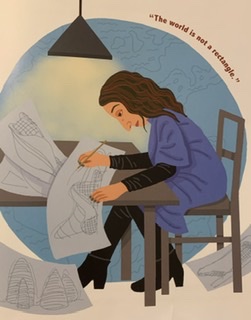
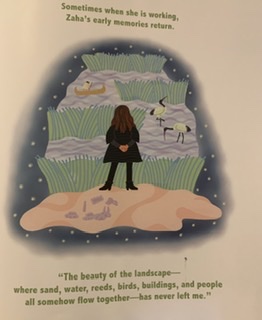
This non fiction book spread over 56 pages on an AR 4.0 level is the biography of the famed Iraqi architect’s inspiration, triumph over obstacles and accomplishments.  It doesn’t go in to great detail of her life, but gives enough information for children to become familiar with her and be inspired by all that she accomplished not only as an Arab, Muslim woman, but as an architect and trail blazer of design and structure.  The pages are beautifully illustrated and the simple text flows and dances around the pages like her buildings in real life.

0BE54CFC-BBDB-4507-9DDA-FDA54576B014

Born in Iraq where rivers flow, wind swoops across sand dunes, and cities existed thousands of years ago, Zaha finds designs and shapes throughout her home and the city of Baghdad.  She has ideas about arrangements of furniture and designs of clothing, she loves that dunes and rivers and marshes don’t have corners.

CEE97AF8-91A3-46AC-A63E-E3484F1790B1

She is a Muslim that attends Catholic school and loves math.  She goes to London for college to study to be an architect. She is relentless in her passion and fills notebooks with plans, paintings with what she sees in her mind and graduates with honors.

94EC3F0A-2584-4786-9FF8-9FE173CB04A5

She opens her own office and with a few friends, she designs buildings that swoosh and zoom and flow and fly.  The world is not a rectangle, but unfortunately no one wants to build her designs.  She keeps entering competitions, and winning, but they refuse to build her buildings.

FE2B9584-E1C6-4B19-94B8-9684A9F6BC0C

She designs buildings that come from her memory of grasses swaying, and wind blowing over dunes, and shells being cradled.  She designs an opera house like a pebble in the water, with the singer the pearl.  A ski jump that reaches the sky like a mountain.

91BAFF18-340B-4334-B856-5984A4CF1060

One by one, Zaha’s designs become buildings all over the world.  She has over 400 employees and designs buildings, shoes, doll houses, furniture, she does what she likes and urges others to do so as well.  Zaha passed away in 2016, but her visions are still carried out.


Let it Go: Learning the Lesson of Forgiveness by Na’ima B. Robert and Mufti Menk illustrated by Samantha Chaffey

Standard
Let it Go: Learning the Lesson of Forgiveness by Na’ima B. Robert and Mufti Menk illustrated by Samantha Chaffey

let it go

1AA90D6C-5528-4766-B486-219F31FF7AEC

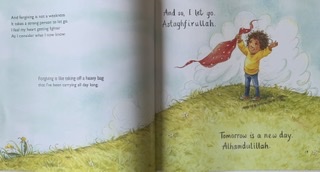
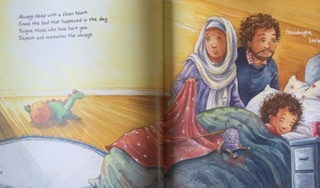
This 32 page rhyming book follows a little boy around as he is weighed down by a lot of things not going his way.  He doesn’t want to forgive until he is the one that hurts someone else and realizes we all make mistakes, forgiveness is not a weakness, and we all feel angry at times.  The book breaks from the story to ask the reader to think about their emotions in various situations, and encourages the reader to talk about their feelings.  The framework is Islamic and the repenting to Allah swt is part of the message. I found it awkward to read independently, but I read it to a small group of my own kids and their cousins, seven in all, ages four to thirteen, and it worked very well to discuss what the boy was feeling and how they would react.  I think this book would be great in a classroom or as a book an adult reads to a child at bedtime to encourage conversation.  I had to point out to the little ones, that the knapsack was getting bigger with the little boys anger, and explain what it was, but as a tool to foster dialogue it was incredibly powerful.

AF3C685C-9745-42B2-96C3-53F2B28B50B7


The book starts out with a poem/du’a by Mufti Menk that sets the tone for the book.  It makes clear that we are all human and feel things and that this book is a tool to understand and emotionally grow from.  No one is going to get in trouble or be reprimanded.

997B392B-E053-4EB3-AAAE-B40023247F90

The story stats with the little boy waking up happy and ready to have a wonderful day.  But then when he comes down for breakfast, his sister has eaten the last piece of toast.  The book asks the reader, “how do you feel when things don’t go your way?” and asks the little boy to let sorry make it better so that he can let it go.  But the little boy doesn’t want to let it go, he wants to hold on, and as a result it makes his heart feel heavy.

71B6DCC3-5B85-423E-A3F7-6F1F3DC80136

This pattern is followed throughout the book giving examples when the boy doesn’t get included in a game at school with his friends, when his friend kicks his football (soccer ball) in to the road and it gets popped by a passing car, and at dinner when his older brother laughs at him.

5BAA4271-891B-4D25-8451-B1A787D4C1F9

He then picks on his sister at bedtime, and doesn’t even know why he is doing it, and realizes that he too has made a mistake.  He learns that “it takes a strong person to let it go,” and that “forgiving is like taking off a heavy bag that I’ve been carrying all day long.”

4D498CEE-6886-40ED-925B-6D230205CB6C

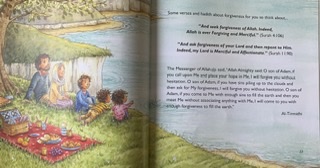
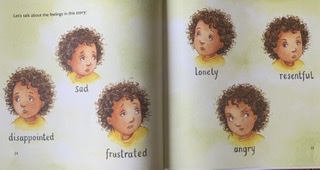
The book ends with some verses and hadith about forgiveness.  Has some facial expressions with emotions to discuss, and space to write down things that make you feel angry, hurt, or sad as well as a place to share what makes you happy, grateful, and safe.  There is also a glossary of Islamic Arabic terms on the inside back cover.

D5E111E7-2791-466B-9343-B362E7D4EB23


A Girl Called Genghis Khan: How Maria Toorpakai Wazir Pretended to Be a Boy, Defied the Taliban, and Became a World Famous Squash Player by Michelle Lord illustrated by Shehzil Malik

Standard
A Girl Called Genghis Khan: How Maria Toorpakai Wazir Pretended to Be a Boy, Defied the Taliban, and Became a World Famous Squash Player by Michelle Lord illustrated by Shehzil Malik

maria

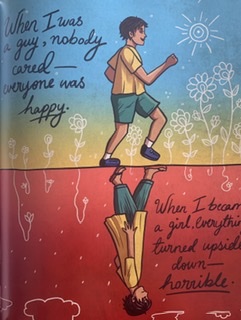
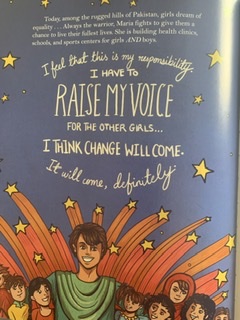
This children’s biography of Maria Toorpakai Wazir, Pakistan’s world famous squash player, is simplified and suitable for children 2nd grade and up.  At 42 pages with bright illustrations older kids will understand a little bit more about the cultural norms that were being oppressive and the strength and risks Maria took to play a sport she loved and defy the Taliban while disguising herself as a boy. Younger children will probably only get her determination and perseverance, which is impressive in its own right.

C9A2CED0-B2A4-43F9-942A-B5A32B0B7E9C

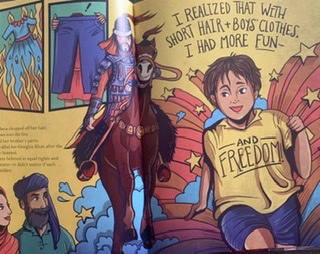
In 1990, Maria was born in the mountains of the Tribal Areas in Pakistan.  Conservative society and strict gender roles amplified by the control of the Taliban in 2001.  Maria’s parents supported rights for their sons and daughters, and allowed Maria to cut her hair, dress like a boy, and play sports.

9C7E2AE9-5668-48C6-8E41-304F1583B644

Her father called her Ghenghis Khan after the great warrior and when the family moved to the city of Peshawar he even introduced her as his son to people.  As Ghenghis, Maria was always picking fights and encouraged instead to play sports to channel her wildness.

2FB5AF13-2468-44A6-ACD2-1A118F69F9C6

She fell in love with the game of squash, and when she went to join the Squash Club she had to submit her birth certificate which revealed that she was a girl.  The director let her join the club, as the only girl among 400 boys.  But now her secret was out.

713C71CE-338C-4241-BD6F-05091868E560

She was bullied and her family ridiculed, but she kept playing and kept winning.  The President of Pakistan awarded her honors for her outstanding achievements, but that infuriated the Taliban and they threatened her family.

FF2A709B-F539-44B0-92FB-48C336C2213B

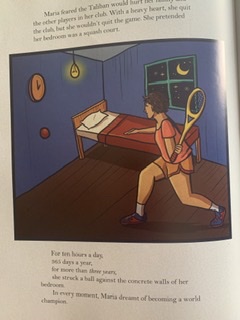
As a result Maria had to hide, and would practice at night, in secret, and for 3 years she played against the wall in her bedroom.  Appealing to squash clubs around the world for help, she finally heard from Jonathon Power in Canada, willing to help her get away from the Taliban and be able to play.

3915AD01-442F-4473-9571-9D798C8B1389

She left behind everything she knew at 20 years old to train in Toronto.  She still represented Pakistan in tournaments.  She studied, she prayed, she succeeded.  She now is back in Pakistan establishing health clinics, sports clubs, and schools for girls and boys.

The story is inspirational, and well told, it shows how culture limited her, not religion, and that in a larger city, culture was a little less conservative.  Muslim and non Muslim children will be inspired by her efforts, her willingness to look like a boy and her determination to excel.  Muslim kids will enjoy that it shows her praying, but might be surprised to see her in shorts and tank tops.  The book would be a great conversation starter about women’s rights and how it isn’t just in Pakistan that women struggle to have equal opportunity and respect.  It also might many children’s first exposure to the sport of squash.

138B3D8B-B868-437B-B7C8-5674879B81DA

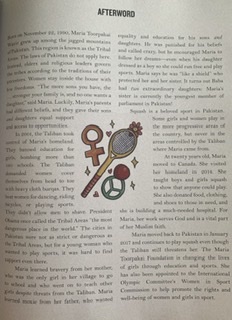
There is an afterward at the end with more information.  A list of additional reading about other inspirational women, a selected bibliography and a highlight timeline of female firsts in sports.


Our Superhero Edhi Baba written and illustrated by Maria Riaz

Standard
Our Superhero Edhi Baba written and illustrated by Maria Riaz

edhi

This is a hard review to write.  I have been trying to get this book in my hands since it was published and just could not.  I’d ask people to bring it from Pakistan, or try and order it on Amazon to find it out of stock.  And then finally I was fortunate that my cousin was able to purchase it for me, get it to my dad who was visiting Karachi, my dad then mailed it to me within the U.S. and voila a book that sells online for $15 (and is currently in stock) in my hand for RS 475 (less than $3), I mention this because if I had paid $15 for a 7×7 inch book that has only 16 pages, I’d be grumpy.  Having paid less than $3 (plus shipping) and involved multiple family members in the process, if I’m honest, I’m still a little disappointed with.

6A2DB5A1-8FE8-4608-8C3A-E81A352477EA

The book is beautifully illustrated, the author is the illustrator so why not make the book larger, so the illustrations could be appreciated?  The book is really short and very vague, even the note at the end could provide so much more about this national hero, his accomplishments, his struggles, his goals, his legacy.  And I’m not sure why it doesn’t.

7B314A2E-9BFA-4D25-A810-339E20A460AD

The book is framed with kids presenting superheroes in class: Superman, Hulk, Spiderman, etc., two kids wearing grey shirts and white pants start their presentation about Edhi.

B695DEF7-CC65-4623-817F-DCD780CA508B

In rhyming lines the kids talk about how Edhi’s mother would give to the needy and how he continued this giving whatever he could spare from a young age.  How giving everyday made his heart grow big.  He gave to everyone and didn’t discriminate based on skin.  It mentions that he started an ambulance service and we should follow his plan of helping and donating.

A2DF1235-63EA-4FEF-8495-66B63AEFA578

The note at the end talks about how to donate and how superheroes have big hearts and share not just with people they like, but even people they don’t like.  The author then says that she donates money and skill.

7E6B0C80-7C8B-44C5-846F-C0781DBC84DA

The writing is clear enough for the sparse words on the page.  I don’t want to critique a Pakistani writing rhymes in British English, because I speak one language, and clearly realize the beauty in being able to speak and write and convey in more than one language, but it is a bit awkward in parts.

F0FC330D-C20E-4957-9917-7C0551D0ED91

The idea of the book is beautiful.  Edhi was a humanitarian that needs recognition both within Pakistan and abroad.  But, I really wish this book had a bit more substance to it.  I think it can get a conversation going with little kids, but older kids will find it very generic, and unless a nearby adult can add to the story, it sadly won’t be remembered.

B33B93B2-BA26-4194-B1EF-F864E9B3112D

A portion of the book goes to support edhi.org, but it doesn’t specify how much.

(size reference):

97973BFE-6B49-478F-A110-B1C122ECAD9E

The Story of the Holy Prophet Muhammad (peace and blessings of Allah be on him): Ramadan Classics: 30 Stories for 30 Nights by Humera Malik

Standard
The Story of the Holy Prophet Muhammad (peace and blessings of Allah be on him): Ramadan Classics: 30 Stories for 30 Nights by Humera Malik

the story of prophet muhammad

I debated posting about this book for so long that Ramadan is more than half over.  But as a reference for years to come, I thought I should go ahead and throw my late support toward this Ramadan tradition and a book deserving of space on your shelf for children 4th grade and up.  I’ve seen people praising it for a few years, and finally I ordered it this year, however, I wanted to not only read it, but also test it out first: reading a story a day, discussing and asking the correlating questions with my own children, before reporting back.  I cannot and thus won’t comment on the accuracy of authenticity of the book, nothing stood out as erroneous to me and there is a bibliography at the back, but there is a reason I try and steer clear of non fiction, I’m just not qualified to comment.

SYNOPSIS:

The book starts with the birth of Prophet Muhammad (saw) and ends with the selection of Abu Bakr (ra) as the first Khalifah.  Each chapter is between one-and-a-half to two-and-a-half pages and the 30 chapters plus one Eid day chapter (so a total of 31), covers 103 pages in all.  There are a few pictures of where the Battle of Badr took place, the Cave of Hira, not many.  There are three questions at the back of the book for each of the chapters, but no answers.  The book is pretty linear, just the second chapter bounces back to Prophet Abraham (as) and Hagar and the story of Zamzam and then the rebuilding of the Ka’bah.  It is a glorified timeline, which in this case is a good thing.  It doesn’t go off on tangents or provide a ton of outside references, it is concise and general, but hits the key parts: marriage to Khadijah, first revelation, migration to Abyssinia, Taif, Hijrah, treatment of slaves, year of sorrow, Battle of Badr, Battle of Uhud, Treaty of Hudaibiyah, it talks of tensions with various tribes, coming to an agreement about the Khalifah, and more.

I think younger children might possibly be able to have the short chapters read to them and then explained, but really, it would be a lot to process.  The words are simplified and the gist of situations are conveyed, but topics aren’t necessarily shied away from.  It discusses that Prophet Muhammad (saw) had more than one wife, and that there were slaves, and there were tensions with the Jews, and Bilal was tortured, all things that picture books might skip over.

WHY I LIKE IT:

I like that even my young teen could read and involve herself without feeling like the exercise was childish.  Many of the answers are open ended in nature and require more than just a one word answer.  It allows for children to add other facts that they know about RasulAllah to the dialogue and make connections to our history with our current life very easily.  Even children that know the story of Prophet Muhammad (saw) will find the book engaging and smooth enough to read through again (and hopefully again each Ramadan) and learn new tidbits, understand concepts more clearly and be reminded about the beauty of our Prophet.

FLAGS:

Nothing

TOOLS FOR LEADING THE DISCUSSION:

If I was a teacher, I would definitely start each morning reading a chapter and doing the Q and A, whether it was Ramadan or not.  I think we need to be more connected to our Prophet and grow our love and appreciation for him, so books like this are such a great tool in accomplishing that goal.


The Most Powerful Night: A Ramadan Story by Nada Hassan illustrated by Soumbal Qureshi

Standard
The Most Powerful Night: A Ramadan Story by Nada Hassan illustrated by Soumbal Qureshi

the most powerful night

This beautiful poetic book about Laylat Al-Qadr explains in detail and wonder the importance of the most blessed night in the blessed month of Ramadan.  The soft purples and pinks of Laila’s room, and the repetitive refrains set the mood and tone of an informative bedtime story that will convey the awe and mercy of the night to seven and eight year olds.

C2080E23-FF92-40D7-A40A-49F53DD85406

The book is 40 pages, and pretty text heavy, but it flows smooth enough, and the details in the pictures are enough to keep little ones engaged. Younger and older children will also enjoy the story as both an introduction to the night the Quran first came down, and as a reminder of the gifts to be had.

816801CB-54C8-4FDE-836D-C9038DB1B538

Laila is sad that Ramadan is leaving as she peers out the window and sees the moon resmembling a crescent again.  Her mother takes the opportunity to tell her about the blessings of the last ten nights, and Laylat Al-Qadr specifically.

DD841DEB-9591-4305-80E6-CC328CAB45E6

“The Night of Power and Miracles,” Laila’s mother explains is a night like no other, that comes only once a year.  Thousands of angels come down until there isn’t a speck of space that they do not fill.

13B3DC09-7A02-4921-BD9A-9DCBAAAE77D5

The night that is better than a thousand months and all our deeds are multiplied 70 times, the night the Holy Quran was first revealed to Prophet Muhammad (saw).

2F0180A5-B187-4511-A3B8-9DC0F37A55E8

Laila wants to make sure she pronounces it correctly and practices saying Laylat Al-Qadr.  Excited to make sure she is praying and reading Quran that night, she is desperate to know what day it is.  Her mother explains to her that we do not know.  Laila uses this to her advantage to get to stay up past bedtime for each of the last 10 days.

46D932B3-0A00-44AB-B44D-6A9CE84ECD65

The book begins with Surah Al Qadr in Arabic and with the meaning of the translation in English.  It ends with a glossary, more information about Ramadan, and a glimpse of the author’s first book: Ramadan Around the World.

C84423A6-DCE5-4185-ABD7-3F0FF86ED59E

The 9 x 11 hardback binding and font are beautifully done and with there no other books for children that I can think of that discuss Laylat Al-Qadr, I foresee this one being read at least once a year, if not more, for many years to come, alhumduillah.