Category Archives: Muslim Character

Daring Dreamers Club: Piper Cooks Up a Plan by Erin Sodenburg illustrated by Anoosha Syed

Standard
Daring Dreamers Club: Piper Cooks Up a Plan by Erin Sodenburg illustrated by Anoosha Syed

piper

This is book two in the series, I couldn’t get the first book from the library, and I wasn’t willing to wait for the one that focuses on Muslim character, Zahra’s story to be published, it could be a few years.  At 224 pages this middle grades book is fairly formulaic with five diverse girls becoming friends, each book featuring one girl’s story with the others serving as supporting characters, and with the tie-in to Disney Princesses, I really didn’t expect much. Imagine my surprise when I found myself enjoying the characters and their lessons and struggles, sigh.  The book is sweet, the characters like-able, and the author really doesn’t try and force all the characters into every scene.  The book focuses on Piper and the other girls add to her story where it helps, they don’t all have equal time and it doesn’t get confusing because of it.  You can even read the books out of order.  Zahra wears hijab and her Islam is mentioned in a journal entry where she discusses the five pillars, the importance of charity, and getting dirty looks.  There is nothing preachy, but none of the other character’s are defined by their faith and I truly don’t know if I’m bothered by the singling out of Islam being her identity or flattered by it.
img_4279

SYNOPSIS:

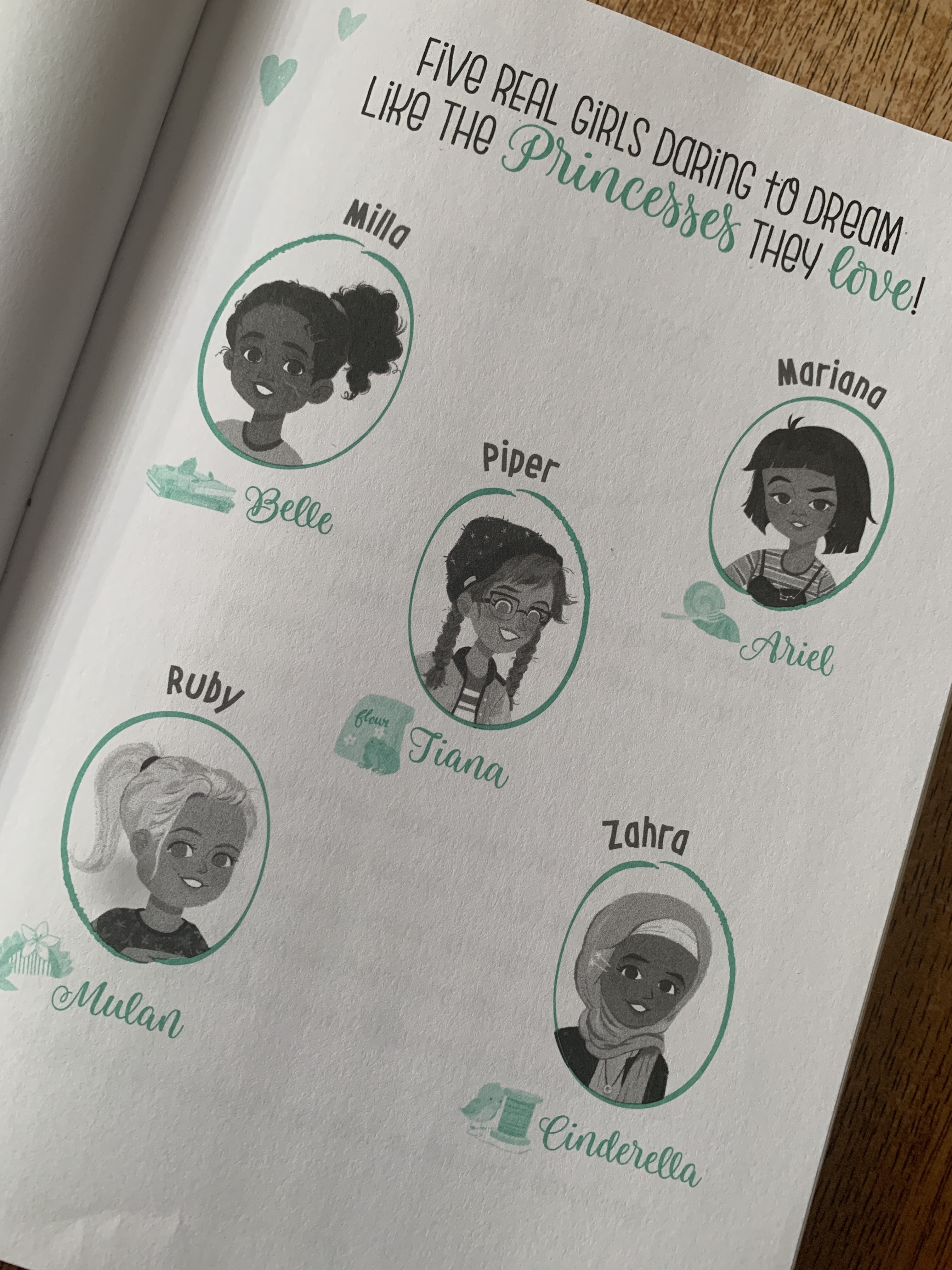
Five girls are grouped together at school in an advisory class to help prepare them for middle school: Milla, Piper, Ruby, Mariana, and Zahra.  Their advisor loves Disney Princesses and in their weekly journal entries has them write about their assigned Princesses as they explore their similarities and how they would tackle challenges, face fears, and the like.  The girls are diverse in family dynamics, race, religion, ability, etc.  Milla is African American with two moms and food allergies.  Zahra is good at art, Muslim, and likes to sew.  Ruby is a twin, her parents are divorced and she is great at sports.  Mariana is hispanic, and is an amazing swimmer.  Piper is Jewish, has dyslexia and loves to cook.  In the book she is struggling with school, while she excels in her food science creations.  She gets accepted to appear in a kids cooking show competition, but will need the help of her Daring Dreamer friends to prepare for the challenges about to be thrown at her during the competition, and to help her from falling behind in school.
Each girl has their journal entry presented in the book which helps to understand more about the different girls, as well as a little bit of introspection to the events happening in the larger story.

WHY I LIKE IT:

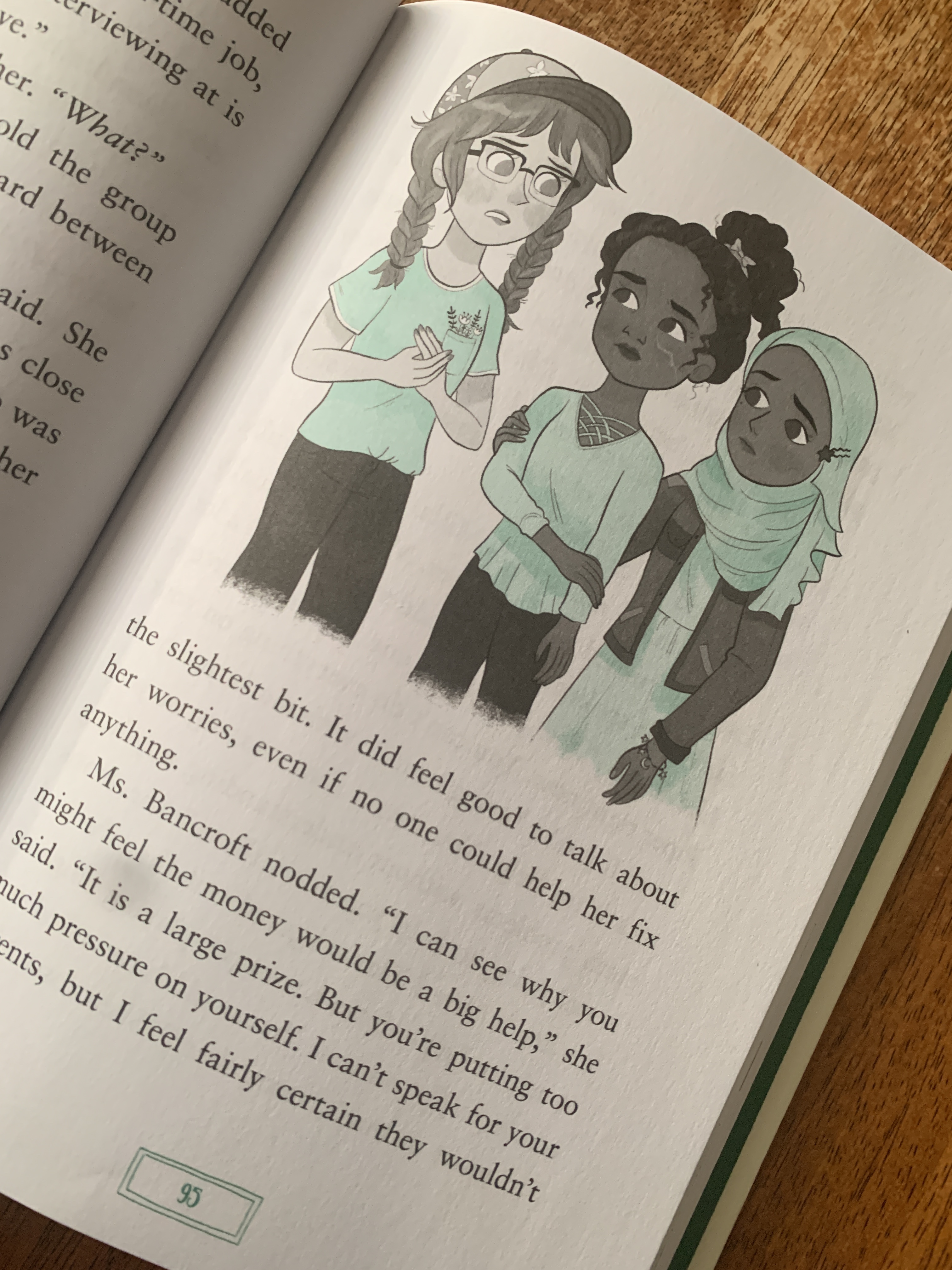
I like that the characters are really supportive, and the lessons aren’t so on the nose.  Piper isn’t just told that she doesn’t have to win the competition to have value, you feel it long before she accepts it herself.  Her personality really comes through and it isn’t for attention or for sympathy, she helps a competitor, there is no giant round of applause or moral reflection, she just helps.  I love that even though the story is Piper’s and her dream, there are larger issues woven in and felt, not necessarily preached. Piper is the middle child and feels she has to prove herself, she remarks on how being pulled out of class in early elementary school to get help has made it hard for her to ask for academic help now, the role of confidence and how charity and giving back is important, even while her own family’s financial situation isn’t clear.  I like the role of Piper’s siblings, they are quirky, but loving, and they work through their annoyances to help each other.  It is heartwarming.

I have my own mixed feelings about Disney Princesses, as a child of the 80’s, the 90’s brought all the glory of Jasmine, and Ariel, and Belle, and Mulan, and my friends and I definitely identified with different characters.  I may or may not have tied my hijab up many a days and claimed that I was Mulan in high school, but somehow with my own daughter I didn’t really bring the Princesses in to her day-to-day existence, I don’t think she has even seen all the movies, we read books (we didn’t even have a tv when she was little), she’s 14 now.  It had become too commercialized, I worried about the messaging more.  This book reminded me of what my friends and I as older “kids” channeled the Disney Princesses to be.  It wasn’t all about pink and sparkles, it was battling the bad guy, hanging on to your dreams, and persevering when things were tough.  This book channels those thoughts, it isn’t in your face Disney, it is more muted, and I appreciate that.  It is a solid middle grade read and I think an enjoyable one at that.

img_4283

FLAGS:

In this particular installment, there are no crushes, no holidays, no music, one character has two moms, but in this book, I don’t know that a casual reader would pick up on it. It says “Moms” once, it might be a bigger deal in the story that focuses on Milla, but I haven’t read it to comment.  There is lying and Piper tries to justify it, but I think it is clear and has its own resolution.

img_4284

TOOLS FOR LEADING THE DISCUSSION:

It is much too young for a middle school book club, but I think because it is such an easy engaging read, that in a home, or classroom, the book would be appealing to 3rd graders and up.

The author’s website: https://www.erinsoderberg.com/daring-dreamers-club.html

img_4280

The Tale of Princess Fatima, Warrior Woman: The Arabic Epic of Dhat al-Himma translated and edited by Melanie Magidow

Standard
The Tale of Princess Fatima, Warrior Woman: The Arabic Epic of Dhat al-Himma translated and edited by Melanie Magidow

princess fatima

I’m not sure how to really review this 167 page book.  It is the translated YA work of an Arabic Epic that took place somewhere between the seventh and 10th centuries and began possibly being compiled in the 1100s.  It was told orally, but when written, comprised some 6000 pages.  The translator notes that the choices of what to include and how to translate, all potentially alter and reshape the narrative, so as a reviewer I’m simply going to review the text in my hands.  I have no outside knowledge of this epic woman, and approached the book as I would have in high school when reading The Odyssey or Beowulf: some of the history is accurate, the characters fictitious, the culture possibly representative.  As a result, I find the comparisons to Wonder Woman and Katniss Everdeen on the back cover, very odd choices.  At times the contemporary diction, in my opinion cheapens the narrative.  Sure I appreciate the modernization of the text to make it an easy read, but throwing in modern slang seems too much.  I found the book’s framing unfortunately counterproductive of what it hoped to achieve.  I have no idea what the other 5,900 pages include and what the translator had to choose from, but the majority of the book focuses on marriage, being raped by her husband, and working to prove who the father of her Black son is when her and her rapist husband are white.  I was prepared for battles, and conquering, and fighting misogyny, and saving the down trodden, not every one just wanting to marry her.  Many of the characters are Muslim, some convert to Christianity to escape Dhat al-Himma, the Quran is quoted, prayers are made, the Kaaba visited.  I do however, take issue with the explanation of the child’s skin coloring being attributed to intercourse (rape) occurring while Fatima is menstruating and a case of Prophet Muhammad (saw) being used as proof of this occurring.  So much of the text is footnoted, this instance is not, and I find it disturbing.  The book also contains a lesbian character who ends up marrying a man, violence, death, and many other potential flags (see below) that might make it better suited for older college age readers.

SYNOPSIS:

The story doesn’t begin with the birth of Fatima, but rather with her great great grandfather.  It sets the stage a bit to show culture, how women and honor are treated, and the line of her ancestry.  When we get to know Fatima a few chapters later she is being born and her gender is a disappointment, so she is hidden away.  As she grows away from her tribe she becomes an accomplished warrior and captures her father in a raid.  When she returns to her people, her cousin, Walid, born the same time as her, is struck by her beauty and wants to marry her.  She refuses.  Repeatedly.  Finally she agrees to battle him and if he wins, she will marry him.  She wins, and he still doesn’t back down, finally she is forced/tricked in to marrying him by the Caliph’s agent.  The two are pronounced wed, but little changes for Fatima, she is a warrior and does not seek intimacy or companionship.  Eventually, her husband Walid enlists the help of Fatima’s milk brother and friend, Marzuq, to have him drug Fatima, so that he can rape her.  He acknowledges the rape, the whole community does, but allows it, because he is her husband.  When the child is born he is Black and Walid and his family refuse to accept that the child is his.  Amira Fatima is socially put on trial for being a whore and that the child is illegitimate.  As Walid works to have them killed, Fatima works to prove her innocence and carry on with her life trusting in Allah swt completely, all while the Arab-Byzantine battles are raging in the borderlands.  As Abdelwahhab, Fatima’s son, grows he too becomes a formidable warrior and the two have continued adventures.

WHY I LIKE IT:

I love the richness of the culture coming through a compelling story. Fatima is incredibly devout in her worship of Allah, swt.  She does not falter, ever.  When she is being tested she needs only her faith, at one point a man converts to Islam upon having a dream as a result of her conviction in praying.  That being said, I genuinely don’t understand a few critical points.  How can a woman who single handedly destroys tribes not be listened to, to make her own decisions to lead her own life.  I get that that is perhaps the poignant point of the story in today’s context, but there are a lot of strong women in this book, so why does her marriage and being defined by her not wanting to marry get so much of the spotlight? Her father didn’t want her, but they don’t resolve anything, they just reunite and all is well.  I need more.  I want to know what happened to Walid once he became Christian, was it a permanent thing, a temporary fix? What ended up happening between her and Marzuq? He was her trusted advisor and immediately regretted drugging her, what happened to him.  I want more about her mother, maybe even her Aunt or other women to see how their lives compared and contrasted to the powerful women highlighted.  How did they view her, was she inspiration, an anomaly, beloved, loathed?

I appreciate the footnotes, the introduction, the Note on the Translation, the further reading list, help with pronunciation and the character list.  A map would have been nice.

FLAGS:

There is violence, killing, rape, talk of sexual intercourse and menstruation.  There is misogyny, racism, flirting, sexual temptation, a lesbian character, magic, jinn.

TOOLS FOR LEADING THE DISCUSSION:
I would not be able to lead a proper discussion on this book, I am just not knowledgeable enough on the larger story.  I think I would like to be a student or be able to join a discussion led by someone well versed in The Tale of Princess Fatima and all the subtext that brought her story to life and maintained it over time.  It would be fascinating.

There was an Old Auntie who Swallowed a Samosa by Asmaa Hussein illustrated by Milton Bazerque

Standard
There was an Old Auntie who Swallowed a Samosa by Asmaa Hussein illustrated by Milton Bazerque

samosa

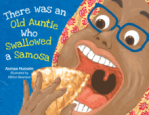
I feel like such a broken record of late (and in the future), of my reviews of books published by Ruqaya’s Bookshelf; the stories are WONDERFUL, but I really struggle with the titles.  I truly thought this was a cultural/religious version of the classic, I Know an Old Lady who Swallowed a Fly.  But it isn’t.  It is an original clever, laugh-out-loud hysterical story for preschool to early elementary.  And one that parents and caregivers will not dread reading over and over again with the well done rhyme, expressive illustrations, a silly conclusion, religious framework, and universal appeal.  The book is on point, the title and cover illustration, sadly for me are not, and don’t, in my opinion, do the story justice.

img_4190

Auntie Sophie is making samosas with some peppers she grew herself.  Under the close company of her kitty, we learn how the Scotch bonnets were grown and cared for.  The doorbell rings and Auntie Eynara has arrived with her beautiful cake to take to the masjid for iftaar.  

img_4191

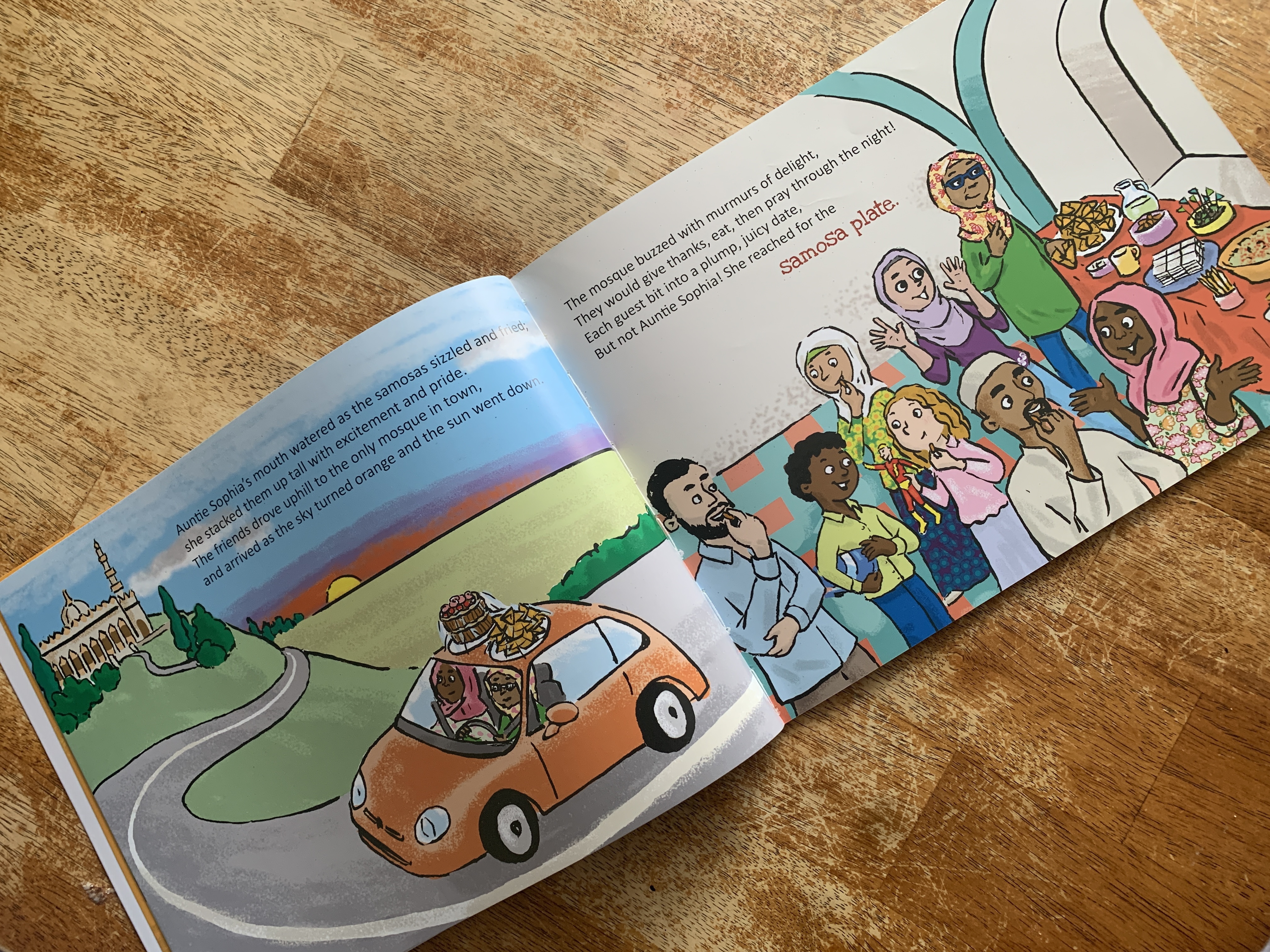
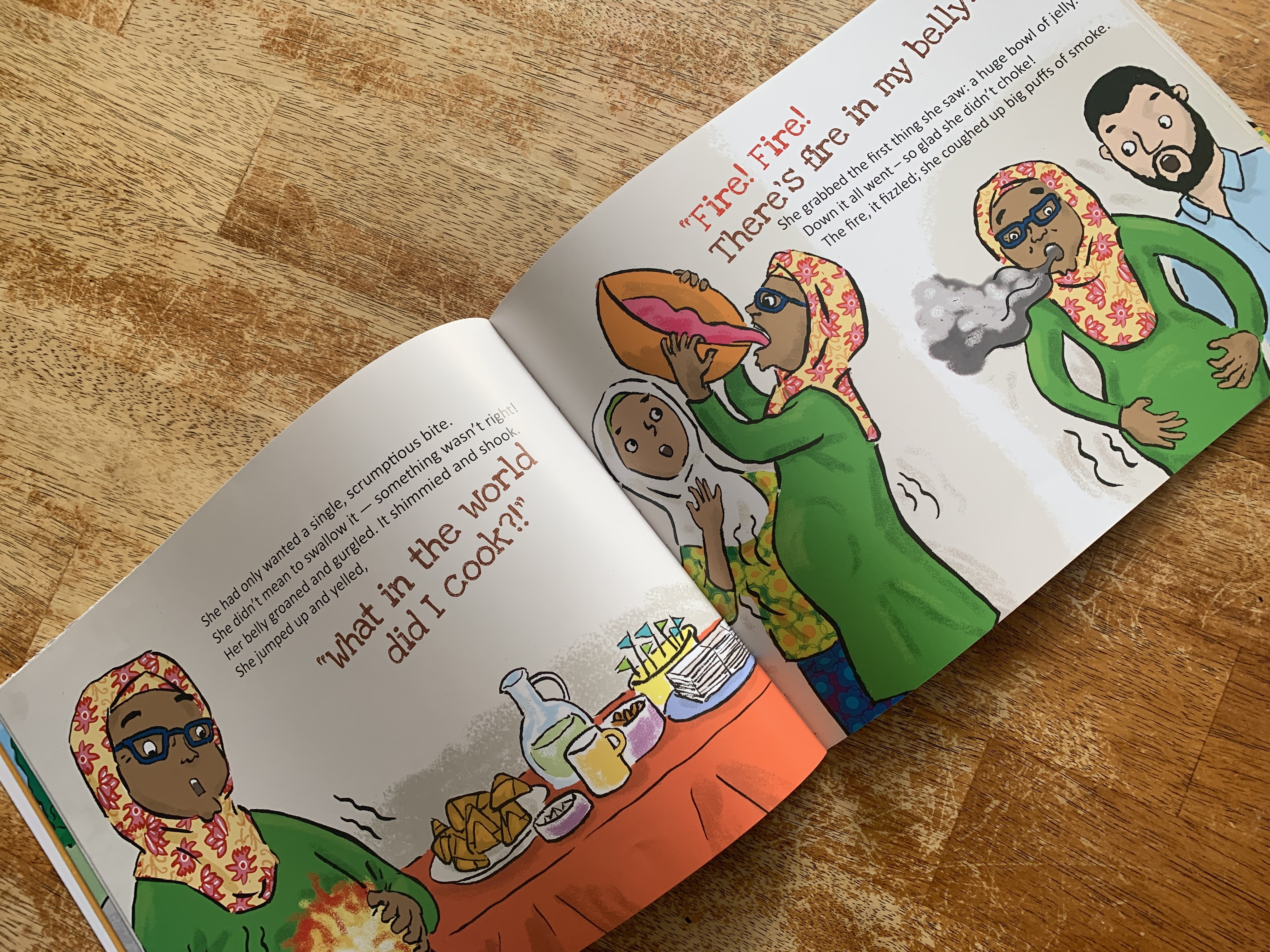
Auntie Sophie  hurries and fries her samosas and the ladies head up the hill to the only mosque in town.  Everyone breaks their fasts with a date, but Auntie Sophia dives in to her samosas.  When the imam’s mic crackles, she swallows the samosa whole and something is terribly wrong.  Her belly is on fire and jelly nor garlic knots nor mint lemonade not rice can cool it down.

img_4193

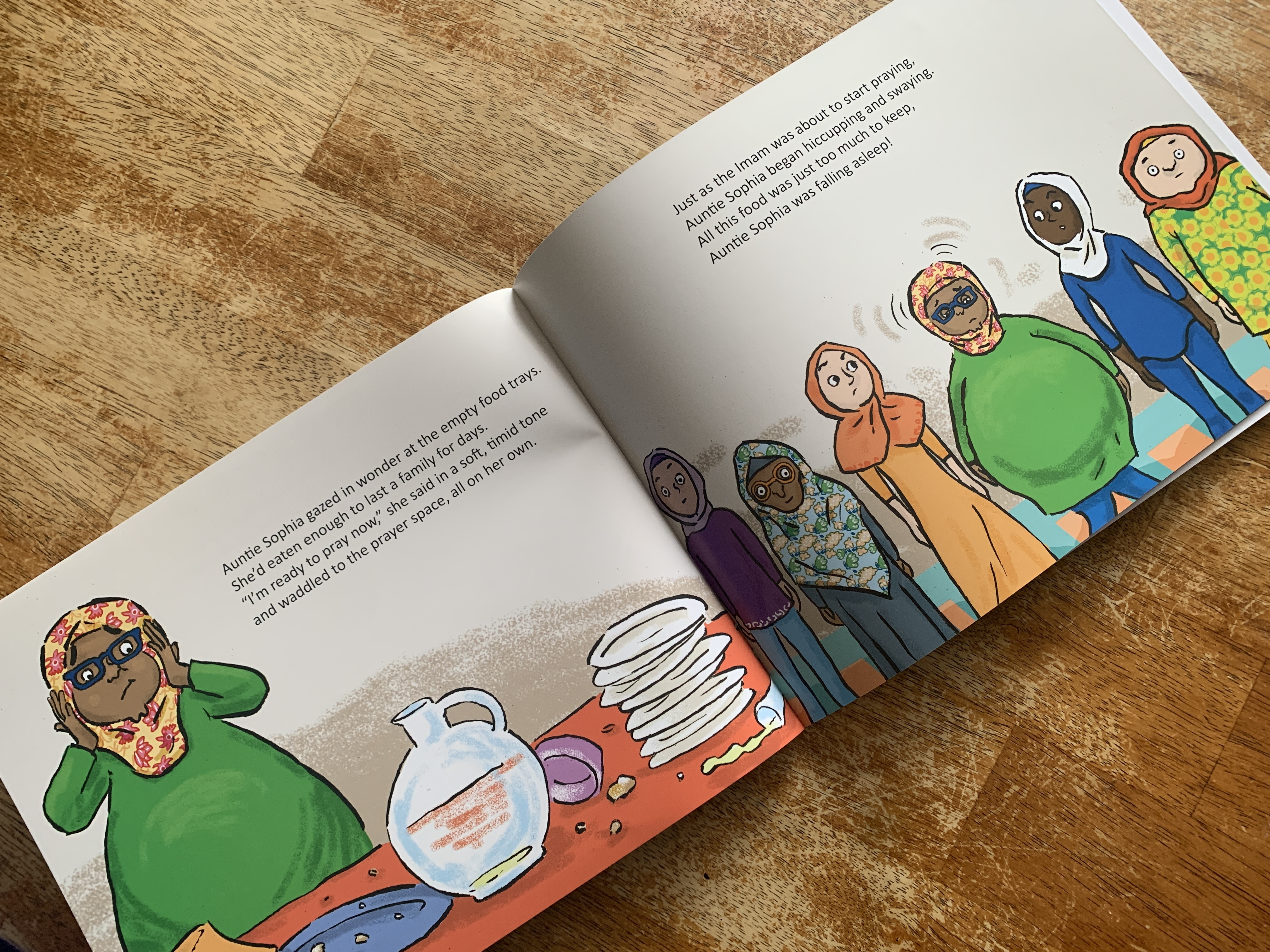
Just when she thinks she is ready to pray, it starts up again, and having eaten everyone’s dinner, Auntie Sophia is getting very tired. As she rolls out the door and down the hill to her house, she figures out what happened to her delicious samosa filling, and calls to have pizza and halal hot wings delivered to the mosque.  She also pledges to grow flowers next year instead!

img_4192

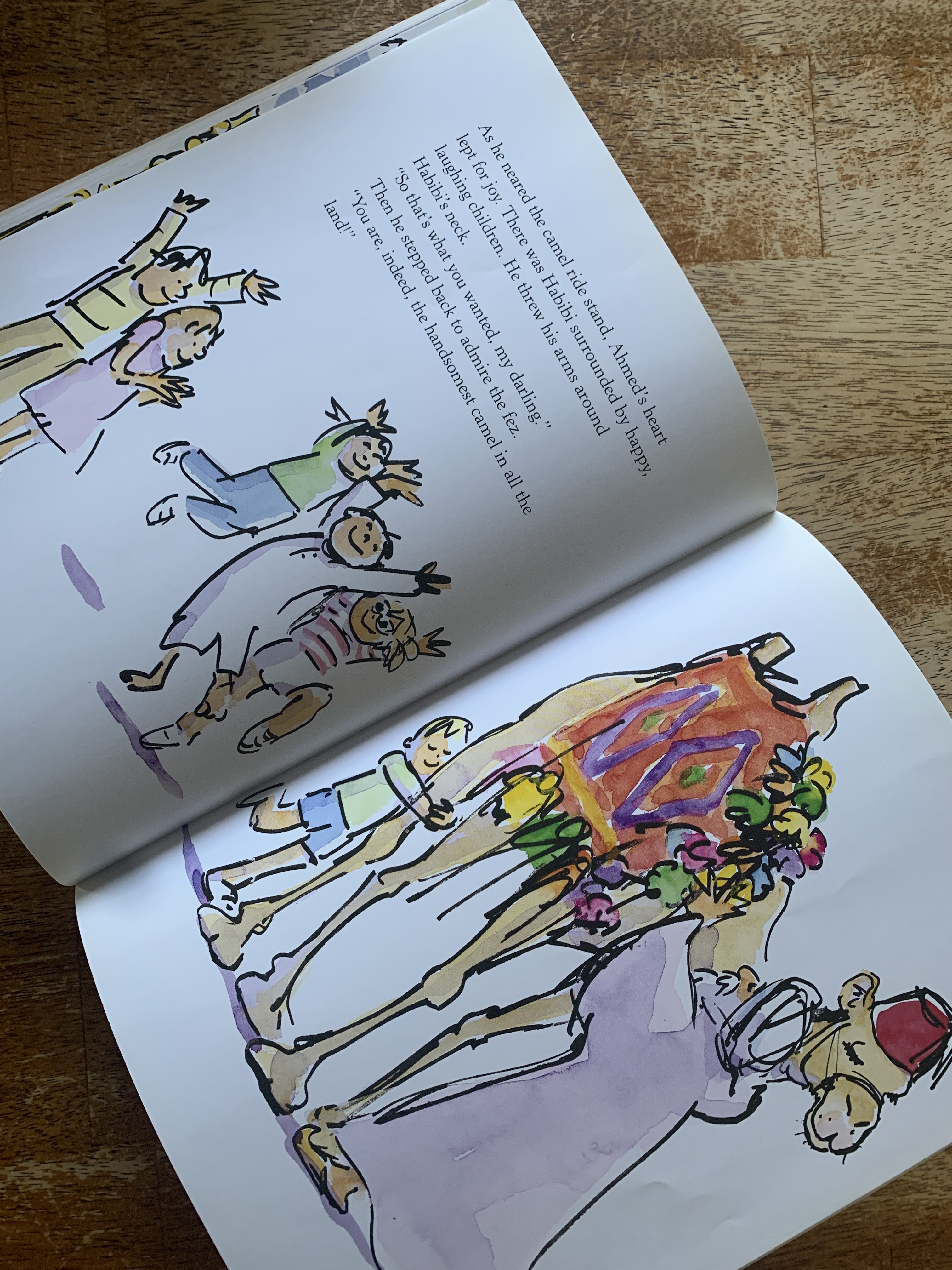
Kids will love the book as it is outrageous, while at the same time being so relatable.  The mosque, iftar, eating something spicy, the book is a favorite at our house for both the two and six year old and the horizontal 8.5 x11 orientation, keep eyes glued to the pages, while the rhyming lines move the story along.  I enjoy being able to talk about the peppers and different foods and smell of garlic with my kids after the 17th reading or so, and I love the diversity of the characters at the mosque. 

My Laugh-Out-Loud Life: Mayhem Mission by Burhana Islam

Standard
My Laugh-Out-Loud Life: Mayhem Mission by Burhana Islam

mayhem

Fairness aside, any book about a genuine Muslim British boy written in first person with doodles, lists, and hilarity for middle grade readers is going to be compared to the Planet Omar Books, and not only do they have the advantage of being first, but they also have set the bar really high.  This 266 page book is decent and fun, and if your children enjoy Omar, they will enjoy this, but even my kids compared the two and found this one just a bit lacking.  The story is outrageous and funny and has a lot of heart, the writing is sufficient, it just feels like the story gets away from the author.  Information is given for no reason and to no purpose, the story loses its way and fumbles around for a bit in the middle, seems to get off track at points, and is a bit weak in character development.  That being said, would I purchase and read future books in the series? Absolutely! I love that the standard and quality for books with Muslim characters by Muslim authors for our children are at this level.  There is no apologizing for Islamic Bangladeshi culture in this book, and the mainstream publication means Muslim and non Muslim children are seeing a nutty, loving family that they can relate to in a myriad of ways, alhumdulillah.

img_4078

SYNOPSIS:

Yusuf’s much older sister is getting married, and she remarks that he now needs to be the man of the house.  Unsure of what that means, he asks Sheikh Google, and is not prepared to do what it entails.  Not at all, he is only nine, but rather than discuss it, he decides instead that he must stop the wedding. So, with a bit of help at times from his cousin Aadam, it is full steam ahead to sabotage the upcoming nuptials.  With little time, he attempts to make his sister unwanted in her inability to cook, keep her hidden in her room by removing all the hijabs in the house, spreading rumors that she has died, ruining her wedding dress, and more, so much more.  It is cringe worthy at times, and hard to put down at others, but alas there is a happy ending, and lucky us, we get to read all about it in Yusuf’s year five what I did over summer vacation essay.

img_4077

WHY I LIKE IT:

I love that the family dynamic is a single mom, her mom, and the two kids.  I think it is important to show some diversity that reflects the family situations of many Muslim children that have thus far been a bit down played.  The book is relatable and contemporary with Marvel references, while tossing in everyday cultural references too.  The family prays, does tasbeh, memorizes Quran, covers, etc.  The book tries to give some depth to the characters, such as Yusuf’s eczema, but it kids don’t get it and the text muddles it to the point, that it misses connecting to the readers.  Also, even kid readers get that a simple conversation could have prevented most everything in the book.  Time is tight, but not that tight for things to get so outrageous.  The book is a British, but I think US readers can handle it, they may, like me, have to Google Jaffa Cakes, but I think they will be fine.
img_4076

FLAGS:

Deceit, sneaking, lying, gossip, destruction of food and property.

TOOLS FOR LEADING THE DISCUSSION:

I don’t think the book would lend itself to a book club, but I think home and classroom and library shelves will benefit from hosting this book.

We Will Meet Again in Jannah: What a Great Day that will be! An Activity book for Bereaved Muslim Siblings by Zamir Hussain illustrated by Emily McCann

Standard
We Will Meet Again in Jannah: What a Great Day that will be! An Activity book for Bereaved Muslim Siblings by Zamir Hussain illustrated by Emily McCann

jannah

I don’t review workbooks, or a lot of non fiction books, but by far the most thematic requests I get asked about, are children’s books about bereavement.  The loss of a friend or loved one is just not a topic that you see covered very often, if at all.  Sure there are books about jannah, but they are more silly and framed as a reward, not about the loss felt that would precede paradise.  This 32 page paperback activity book is part reassurance, part encouragement, part discussion starter, and part remembrance all within a faith framework.  Much of the book is not sibling specific, perhaps a few tweaks and you could have a grandparent version, a parent version, an aunt or uncle version, etc.,  even as a parent you may consider adjusting the book as you share it if you are unable to find a specific book for your child’s needs.

img_3901

The book starts with the author talking to the reader and setting the tone about what has occurred and what is to follow in the book.  It then asks the reader to write or share who they are, who passed, and something special they remember about them.  It discusses why people die and then starts the two page spreads that address a theme and presents an activity to help you feel better, or to remember or celebrate the one who has died.  Topics include: You’re never too big to cry, It’s not your fault, Talking and sharing the pain, Some things will change other’s will stay the same, etc..  Some of the activities are wonderful and can be done in any order, at any time, and others, you may want to adjust.  The idea of releasing a balloon, for example, with your worries in it, is symbolically effective, but not so great for the environment.  The end of the book has additional resources on how to use the book, things to do with the child, further support,  additional resources, and Islamic guidance.

img_3902

I love that Islamic foundations and vocabulary are not just used, but explained in a very age appropriate, non condescending manner, through out.  I love that it is clear that you don’t have to talk if you don’t want to, that it is not the child’s job or responsibility to make the adults feel better, that nothing is anyone’s fault, and that there is no right or wrong way to grieve.

img_3903

I wish the book was larger in size and perhaps hardback so that the activities that require writing would have more space and ease in completing.  The text for the activities is also very tiny.  I also wish that the author’s qualifications for such advices was included.  I Googled the author to find out:  “Zamir Hussain is a Muslim Chaplain at Birmingham Children’s Hospital and has pioneered resources in Islamic health care. She has published several books for bereaved Muslim parents and siblings. She has also developed the first UK blended learning resource, including care plans and pathways for Islamic daily, palliative, end of life and bereavement care for paediatric staff. Zamir has worked as a Muslim Chaplain for both the Heart of England NHS Trust and Birmingham Children’s hospital for over five years, where she has also run training courses for the staff as well as delivering training and talks on care for Muslim patients to organisations around the country.”

img_3904

We need more books about coping, talking, dealing, understanding death for our children, inshaAllah this is a start, alhumdulillah.

Show Yourself by Adeeba Jafri

Standard
Show Yourself by Adeeba Jafri

show yourself

At 98 pages the book claims to be two YA mental health novellas that bring attention to mental health in a relatable and contemporary audience through Muslim characters.  As someone with some experience in loving individuals going through some of the issues addressed in the book, I was thrilled that voices were making it on to the page and in a capacity to increase discussion about self-harm.  Unfortunately, the presentation of the two short stories baffled me and I don’t think the book will find its way in to many YA reader’s hands.  I don’t know why it is two novellas when the characters are the same and it very easily could, and should, have been fleshed out into a single longer novel.  I think it would have shown a better well-rounded understanding on the importance of knowing and recognizing signs of someone struggling with their mental health, how coping skills aren’t often enough and outside help is needed, how assumptions and stereotypes further alienate those suffering, and just overall made the characters deeper and more relatable.  Instead we get two isolated snapshots that subtly try to discuss mental health, but use a very immature cover story that misses the target audience.  The book as is, is better suited for middle school readers, but I think even they would get a limited view of how to help those close to them, or reach out themselves if they are hurting.  It needs to be five short stories with different characters and a unifying theme, or one complete novel.  Unfortunately, as much as I wanted to share this book with my teen daughter so we could discuss, I couldn’t convince her to read it, which is unfortunate, because the author can write, it just isn’t tempting presented as it is.

SYNOPSIS:

The book is two novellas, the first focuses on three female Muslim friends and one’s little sister.  The girls all go to school together, but are of different economic statuses, have different interests but support one an other, and have different family dynamics, that all come in to play.  The close knit community means the parents are social with each other as well, and one parent or another is always picking or dropping them off at each other’s homes.  When Hana gets a new phone, Aliya is clearly jealous, Lena tries to brush it off and keep the peace, but, when Hana’s phone goes missing, even she has to admit that “rebel” Aliya is looking guilty. As the girls search for the phone, Lena spends time with her family, goes to her brother’s robotics tournament and finally confronts Aliya.  Aliya’s mom has disappeared earlier, and with her purple dipped hair, sudden influx of funds for Ubers and new accessories, the girls fight and Aliya pulls away.  When Aliya and her dad don’t attend Hana’s younger sister, Sara’s ice skating performance, it seems the friendships are irreconcilable.  Aliya, however, shows up to the after party things are revealed and amends are made.

The second novella is the story of what happened with Aliya’s parents, particularly her mother.  Similar to Sara, Aliya’s mother was harming herself and eventually abandoned her family.

WHY I LIKE IT:

I like that it shows Muslims suffering, coping, and dealing with mental health issues.  The topic is way too taboo and it effects all swaths of the human population, we need to normalize discussions about it.  I wish the novellas would have stressed getting professional help more, sure it is great that Hana is going to try and put her phone down and pay attention to her younger sister, but that is not always enough.  Aliya mentions that after her mom left her and her dad went to therapy, but the mom claimed to leave to get help and then never came back.  I think there needs to be A LOT more emphasis on what “good” help looks like and what it can do to change lives.

The book is self published it seems through a publisher, so hopefully the author could ramp up the story telling, character building, and messaging, to really make the book shine.  I don’t understand the title, I don’t know why it is under a hundred pages.  I don’t know who the forward is written by.  If you want to write a book about mental health you really need to have done a lot of research, not just necessarily your own experience, and you probably should have a bunch of letters after your name.  Otherwise just write a work of fiction and touch on some of the issues that you want to support discussions about.  The book seems to straddle committing to one or the other, and ultimately it falters because of it.

I do like that the characters are Muslim, the book is not preachy, some seem to be more religious then others, but it isn’t really part of the story.  The characters’ culture and nationalities seem to be left intentionally vague.  It mentions gossip from the ladies at the masjid, which I think should have been drawn out more.  Really if you ask me, this is a great rough draft, it needs fleshing out is all, build it up to 250 pages and set out to reach middle school readers instead, and it will resonate and have the effect I think the author is hoping for.

FLAGS:

Self harm, abandonment, assumptions about a man Aliya seems to be sharing a meal with in a photograph, gossip, lying.

TOOLS FOR LEADING THE DISCUSSION:

Because it doesn’t seem to stress how to help and what help is out there, I don’t know that the book would be a great read for all.  I think if you are looking to open a discussion with a small group of readers or individually, you may be able to assign the book and discuss in a safe environment.

Beautifully Me by Nabela Noor illustrated by Nabi H. Ali

Standard
Beautifully Me by Nabela Noor illustrated by Nabi H. Ali

beautifullyThis 40 page glowing OWN voice book bursts with body size positivity, Bangladeshi culture, Islamic terminology, diversity, and a beautiful message.  The illustrations and theme alone make the book worth your time and reveal how few body positive books are out there for our early elementary aged children.  That being said, the book might require or benefit from some child led discussion.  If your child is aware of various body shapes including their own, then this book is a great mirror to build them up and as a tool in emphasizing the critical importance of understanding and knowing people are beautiful just as they are.  If your child doesn’t seem to be aware that society views individuals with a larger body size as being a negative, this book might take a little navigating as the theme is more focused on pushing back on fat shaming than it is on accepting all body types.  The book also opens its self up to discussions about pronoun identity, what beauty means, why people tease or be mean to themselves and others, and being aware of how our words affect those around us.

img_3976

The family is visibly Muslim with Zubi starting with salaam.  The mom wears hijab and a sari, even at home, Dadi also has her head covered.  Eid is mentioned as a time when a gift was given that is too tight to wear, and worth noting from an Islamic perspective- Zubi’s sister is dieting to look pretty at a school dance.  Bangladesh is represented in the foods and some of the phrases the family says, and the clothing mentioned and depicted in the illustrations.  There is a glossary at the back.

img_3977

Zubi is excited for her first day of school, she slides on her dress and shirt her mom had made for her in Bangladesh and her bangles on each arm.  She heads to her parents room to show off her outfit where she finds her mom in a gorgeous yellow sari complaining about her big belly.  At breakfast Dadi has made flaky parathas, but Zubi’s older sister Naya is dieting and would rather have oatmeal. Dad calls the girls to take them to school when his mom asks how come he hasn’t worn the new shirt she got him for Eid.  He embarrassedly admits he has put on some pounds and his size is now a large, not good.

img_3978

At school she is having fun and even makes a new friend, but at recess some one yells that Alix looks fat.  Alix is wearing a yellow dress that Zubi thinks is beautiful and doesn’t understand why when they are called fat in it, it comes across as negative. After each incident Zubi mulls over what she is hearing and what it means for her, once she is home though she isn’t quite ready to talk to her family about it.  At dinner, it all hits her as she decides she too shouldn’t eat, that she should be on a diet to be pretty.  She heads off to her room, as her family realizes the impact of their own views and words about themselves, have had on Zubi.  The family works to unpack their own mistakes and be better all while making sure the message to Zubi is that you are beautifully you.

img_3979

I like that the book has the dad helping the mom put on her sari, and the dad comes and chats with Zubi about what happened at school.  Mom might be in the medical field, she seems to be wearing a white coat over her sari, which is subtle and impressive that she is going to work in a sari for anyone that has ever tried to wear one and simply get in and out of a car (just me maybe).  I do like that the mom remarks that she should be kind to her body since it housed her daughters.  I think reminding us that bodies serve a miraculous function is important.   I love the diversity in the classroom and how full of life Zubi is in all aspects of her day.   She is proud of her culture, and sees those around her as being bright, kind and funny, not just the shape of their bodies.  Some of her self reflections after an incident do highlight that many kids, including Zubi, don’t see body size as good or bad, its just one’s body.  Hopefully the adults reading the book will also be reminded and realize that is a message worth actively working to maintain, at any age.

img_3980

I think some of the criticism about the book not showing healthy food choices, or overall health is that we sometimes expect one book to do it all when there aren’t a lot to chose from.  The book celebrates being beautiful AND being big.  It doesn’t need to address all the societal and adult baggage that comes from food choices, lifestyle, health, judgement, stereotypes, etc.. And I think if you feel really strongly and defensive about it, then focus on pushing for more books, not one book to do it all.  Encourage illustrators to show a variety of body types on the pages of books in young children’s hands as well as by toy makers, cartoons, movies, tv shows, etc..  Body positivity and being confident in yourself, no matter your size, shape, appearance, benefits everyone. Celebrate being beautiful.

img_3981

I went for Hajj by Na’ima B. Robert illustrated by Paula Pang

Standard
I went for Hajj by Na’ima B. Robert illustrated by Paula Pang

hajj

Before I review this delightful book, I would like to make a public service announcement of sorts.  It is not Hajj season, not even close.  I pre-ordered this book on June 23 from Amazon, I should have/was supposed to have it before Hajj in the middle of July.  I got it TODAY! When I realized that the US publication date was delayed for a book already published in the UK, I reached out to Kube Publishing and they suggested trying “an independent bookseller such as IslamicBookstore.com or CrescentMoonStore.com.”  I know this.  Noura is a dear friend, but I messed up.  Please don’t do the same.  SUPPORT LOCAL BOOKSELLERS! I’m sorry, lesson learned.

img_3841

Now back to the book that already feels like a classic staple that needs to be on every Muslim families book shelf, and in every public learning space for non Muslims to enjoy and benefit from as well.   The 31 page “inspirational, semi-fictional narrative” is perfect for ages two to seven as it mimics the beloved Eric Carle and Bill Martin, Jr. classic, Brown Bear, Brown Bear, What Do You See? but framed around Hajj and what is seen, done, and heard.  Each two page spread begins with, “Hajji, hajji…”.

img_3842

The book starts with a detailed Note to Parents and Teachers that explains the points to highlight, and discuss with children.  The story is then organized by the steps of hajj in broad strokes and illustrated with both charm and detail that will hold readers and listeners attention.

Hajji, hajji what did you wear?

I wore two white sheets

And my shoulder was bare.

img_3843

The book starts with the little boy narrator on the plane looking down on the clouds and sea. He then puts on his two sheets, hears the call to prayer,  sees the black stone and the station of Ibrahim before he makes his seven tawaafs, runs between safa and marwa and heads to Mina. He prays at Arafat like the Prophet (saw) did, and falls asleep in the cold night desert air.  He sees stones being thrown and eats meat on Eid before getting his head shaved.  The book concludes with a glossary.

img_3840

The book is well done and is a great mix of information and entertainment, alhumdulillah.

Amira & Hamza: The War to Save the Worlds by Samira Ahmed

Standard
Amira & Hamza: The War to Save the Worlds by Samira Ahmed

amira and hamza

Make sure you are sitting in a comfy spot when you crack open this middle grades fantasy adventure, because it hits the ground running from the very beginning and doesn’t let up over 368 pages.  The like-able and relatable brother sister duo snarkily banter and bicker about everything from cultural Indian (Desi) folklore, religious stories, Marvel, Lord of the Rings, He-Man, Arabic Sesame Street, Star Wars, hygiene, fears, potential science fair projects, and food, all while battling jinn, devs, peris, and reality as they work to save the worlds.  The book is chalked full of STEM concepts, cultural touchstone, Islamic footholds, pop culture, and fun, as one character remarks, it is the ultimate fan fiction. I regularly Googled people, references, and concepts, and ended up learning quite a bit.  And don’t fret if you ever get lost or confused, or something doesn’t make sense, you don’t have to worry that you missed something or that the author left a gap in the narrative, the book moves quick and Amira’s constant dialogue and commentary points out all the ridiculousness of what they are experiencing and the questions that she wishes she had time to ask, explore, and discover.  The author never loses control of the narrative, and keeps the world building on level without skimping on details and understanding.  I have not loved any of the author’s previous books in their entirety, I think this one, however, is her best one yet, and the switch to middle grades is a good fit.  

SYNOPSIS:

Twelve-year-old Amira and her 10-year-old brother Hamza are heading to the Shriner’s Madinah Temple in their hometown of Chicago to explore the exhibit of Ancient Astronomy artifacts, or as Hamza calls it “tools that belonged to dead Muslim Astrologers.”  Hosted by the Islamic Society of Ancient Astronomy corresponds with the eclipse viewing party of the incredibly rare super blood blue moon.  In typical Hamza fashion however, a Nerf gun is brought and things are touched.  When Amira is tasked with bringing her brother up to the roof to learn how to use the telescopes, the two scuffle over a small box with a tiny moon inside, a series of snatching and tussling between the siblings cause the Box of the Moon to break, or rather start working.  As day turns to night, the moon seems to be breaking a part, and everyone in the world is suspended in sleep except for Amira and Hamza, and an entire jinn army is heading their way.

When jinn leaders Abdul Rahman and Maqbool reach the children they must convince them that they are not there to harm them, but rather to recruit them as the chosen ones to save the worlds: Qaf and Earth and the barrier, the moon, that keeps the realms separate from destruction at the hands of Ifrit.  The confusion over there being two of them creeps up, but is squashed as Suleiman the Wise left tests to prove that the chosen one is properly equipped to battle Iftrit as it has been prophesized.  The children must work together to prove themselves they must then actually seek out and defeat Ifrit.  As tests and challenges arise, it becomes clear (pun intended) that the two are not the chosen ones, but with no option of turning back they must forge ahead none-the-less.

“What? We’re Indian, dude, we were basically born half doctor.”

WHY I LIKE IT:

I love Amira and Hamza’s banter.  The references are at times laugh out loud funny.  Similarly, I was impressed by all the historical and STEM concepts intertwined in the story, there is even a tiny bit about mental health.  I learned about parts of the moon, historical figures, folklore, and more.  The characters are Muslim, Amira wears Ayatul Kursi around her neck and they talk of Sunday school.  The book isn’t religious though, in they aren’t saying Bismillah before they embark on things, or supplicating when in danger, but they greet different beings with peace, and the framing is clearly from an Islamic paradigm.  I think the high speed pacing works for most of the book, and somehow you still get to know and connect with the characters, but at times a slight pause to clarify a point would have been nice.  I would have liked to have the kids proving they were the chosen ones a bit more articulate and dramatic before hand rather than in retrospect.  I feel like the jinn transportation of cauldrons could have used a bit of backstory as well.  And a little fleshing out of the scroll, the government structure and communication methods of Qaf, would have helped some of the transitions between the action.  I read a digital ARC and it had a page reserved for a map, and I think when the physical book comes out that will be really helpful, as I didn’t quite fully understand the 18 realms and their locations  in comparison to the locations the children encounter.  

FLAGS:

UPDATE:  I TOOK THIS BOOK AS COMPLETE FICTION. THAT THE ISLAMIC PREMISE WAS A STARTING OFF POINT, AND DIDN’T DWELL TOO MUCH ON THE ACCURACY.  I READ AN ADVANCED READER COPY OF THE BOOK THAT DID NOT HAVE ALL THE SUPPLEMENTAL AUTHOR’S NOTES AND RESOURCES AT THE END.  I WAS UNAWARE THAT THE AUTHOR FELT SHE WAS INCOPERATING FACT AND ACCURACY IN THIS INCREDIBLY FICTIONALIZED BOOK. AND AS A RESULT I AM NERVOUS TO SUGGEST THIS BOOK TO THE MIDDLE GRADE INTENDED AUDIENCE.  IF YOU HAVE A MUSLIM CHILD THAT IS WELL VERSED ON PROPHET SULAIMAN, THE CONCEPT OF FICTION, AND IS OLDER THAN THE IMPRESSIONABLE EIGHT OR NINE YEAR OLD INTENDED AUDIENCE, ONLY THEN PERHAPS WOULD THIS BOOK WORK FOR YOU.  IT WOULD BE VERY MISLEADING IF YOUR CHILD TAKES THE TWISTED STORY AS FACTUAL AND BASED ON THE NOTES AND RESOURCES AT THE END, THIS VERY WELL COULD HAPPEN. To read more about the concerns you can click here and head over to Muslim Mommy Blogs take on the book.

There is magic and magical beings. A transgendered jinn.  It mentions Amira and Hamza celebrating Halloween. Death and fighting.

TOOLS FOR LEADING THE DISCUSSION:

I think this would be a great audio book to listen to with the family or a read aloud in a middle grades classroom.  It is too young for middle school readers to not find it slightly predictable, but if you had it on a classroom or home shelf I am sure it would be picked up, read, enjoyed by middle grades and middle schoolers alike.  It reads much like the Rick Riordan Presents series and I hope that there are more books featuring Amira and Hamza in the future.


The Tale of a Tiny Droplet by Ally Daanish illustrated by Oana Cocheci

Standard
The Tale of a Tiny Droplet by Ally Daanish illustrated by Oana Cocheci

droplet

I would imagine if you were to pitch the idea of this book it would go very favorably.  A raindrop goes on an adventure to a desert kingdom after facing adversity for being small, an ocean wave wants to consume her, a chance encounter with a grain of sand and confidence in Allah swt to keep them safe leads to refuge being offered in an oyster who journeys them through the ocean to salam its inhabitants only to wash up near the palace and at the feet of a prince who has been searching for a treasure for his mother’s crown.  The problem comes in its delivery.  It is told in rhyme that is incredibly forced and trying to do too much.  It is a 32 page children’s picture book trying to blend religion, science, adventure, and two points of view.  It needs to be clear, not concerned with a rhyme scheme that muddles the themes.  The book has potential and with the QR code and online teaching resources I could see an Islamic school teacher using this to explain how a pearl is formed and the incredibleness of one of Allah’s creations, but it will take a lot of outside explanation.  I am confident that no four to six year old is going to independently understand clearly what is going on.  I myself had to read it multiple times to figure out what was going on, and even then I found more holes, inconsistencies, and head shaking then there should have been in a large, glossy, well illustrated, effort filled book.

img_3589

A tiny droplet wants to be free, but this personified little water being’s friends tell her only great things live in the kingdom and she is too small.  Not sure how greatness and physical size become synonymous, but they do apparently.  So, on a windy day, the raindrop jumps out of the sky to join the ocean as a means to reach the kingdom.  A hurricane, or wind gale, catches her and she collides with a grain of sand.  But the pov switches, and the sand collides with her and it hurts the sand.  Grain apologizes and Droplet says not to worry she she is heading to the ocean too.  Grain warns her that the ocean isn’t safe, that there is a big wave who will consume them.  Droplet says she isn’t afraid and trusts Allah swt will keep them safe.  The wave threatens to chase them with all its pride (?) if they dare to run and hide.  The pair find an oyster to hide in and they swim with the tide. The oyster is bothered by their tiny feet so he throws them a blanket.  The wave continues to give chase, but they trust Allah swt and after months and days they wash up on the kingdoms shore.

img_3590

The book then pivots and focuses on a young prince who is searching for a gem for his mother the Queen.  Her crown has lost its shine.  He has travelled for months and day through mountains and valleys to no avail. One day while walking, back home on the beach, he hears voices hoping for safety from the wave.  Droplet and Grain think the wave has perhaps finally got them, but it is the prince opening the oyster and finding just the gem he needs. The book concludes with the pearl saying “Alhumdulillah” to the distant stormy sky, “All things can live in the kingdom and its palace rising high.”

img_3591

So my questions, first I’m not sure how a droplet isn’t free, is there only one wave in the ocean? Who is talking at the end, obviously the anthropomorphism as a science lesson kind of hits a dead end, it went from two talking objects to one new talking object, so thats creepy.  Wouldn’t it have been better to end when the gem was found and then have an info or fact page highlighting how pearls are made, having two distinct characters morph into one is a bit jarring story wise. The concept of the kingdom not allowing in little things, and then concluding that all things are welcome, is also so painfully underdeveloped.  Even little readers are going to find that assumption so off the mark.  I like that they trust Allah, but Droplet keeps saying she isn’t scared, but continues to run? swim? The duo don’t want to be consumed, but essentially aren’t they consumed by the oyster? The Pearl feels like it beat the wave despite its size, but it was the other drops that were telling Droplet she was too small, not the wave.

img_3592

All confusion aside, my kids and I might just not be the ideal readers.  My six year old didn’t know what a pearl was, so he was incredibly confused.  I thought the book was going to be about the water cycle, so it took me a minute to realize that wasn’t where the story was going. There is a QR code on the front and if you go to the website a number of resources are available https://www.lotehouse.com/product-page/the-tale-of-a-tiny-droplet. I wish there was info within the binding though to explain the process of sand and water in an oyster making a pearl and I wish a heavy handed editor would have cleaned up the text.  Sadly, a potential great book mixing adventure, science and deen just really missed the mark.