Category Archives: How-To

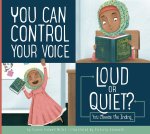
You Can Control Your Voice: Loud or Quiet? You Choose the Ending by Connie Colwell Miller illustrated by Victoria Assanelli

Standard
You Can Control Your Voice: Loud or Quiet? You Choose the Ending by Connie Colwell Miller illustrated by Victoria Assanelli


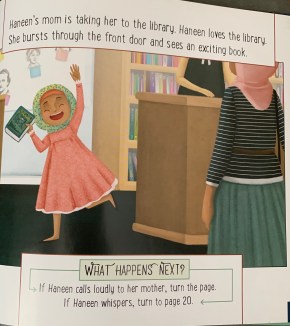
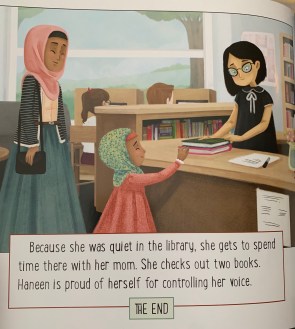
you can controlA choose your own adventure picture book, that doesn’t have anything Islamic specific, doesn’t seem to be written by a Muslim or illustrated by a Muslim, and that was found at the public library, starring a Muslim mom and daughter.  Oh hurrah for beautiful illustrations, teachable moments, volume control in a library and the fun to read the story and have control over what happens next.

91F3712F-C173-46C0-BD30-6B6814B951BA

This 24 page book meant for kids in kindergarten to second or third grade is part of a series featuring diverse characters learning universal manners and making good choices. To see Muslims represent a universal lesson in a relatable environment is a great way to normalize seeing women in hijab in real life.

685B4BFC-16EB-437A-842F-ED10B2580851

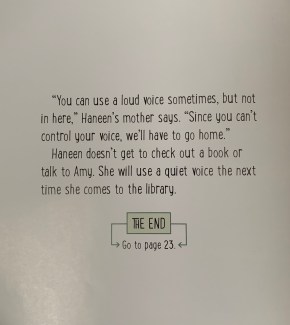
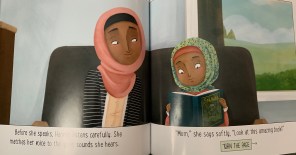
Haneen and her mom are at the library, and Haneen finds a book about fairies and cannot contain her excitement.  Immediately the reader has to choose what Haneen does next.  If she stays loud, the story ends rather quickly, but if she tries to keep her voice down, she might get to stay at the library a little longer.

9E7FC801-D531-42AA-9542-81C4BAF75364

There is a big test when she sees a friend, and disturbs a gentlemen working on the computer, but if you make good choices Haneen gets to check out two books.  If your choices aren’t ideal you might have to just get the fairy book and get out, and if you really struggle to know how loud or quiet to be, you’ll have to come back another day and try again.

C00E287A-E463-427B-9AC4-C748681CC0F5

At the end of the book are some things to think about, to drive the point home.  I love the line, “We are all free to make choices, but choices have consequences.”  A great lesson for little ones, and a great reminder for older readers too.

3EF9066A-60F4-4A31-9E1C-19F228A0D7F4

The book is 9×8 and the expressions on the characters faces make the book a great option for circle time, story time, bedtime, and just to have on hands for kids to thumb through and enjoy.  Well done!

90F0B566-EE2F-490B-8D8C-3AD148BC0CE5

Teach Us Your Name by Huda Essa illustrated by Diana Cojocaru

Standard
Teach Us Your Name by Huda Essa illustrated by Diana Cojocaru

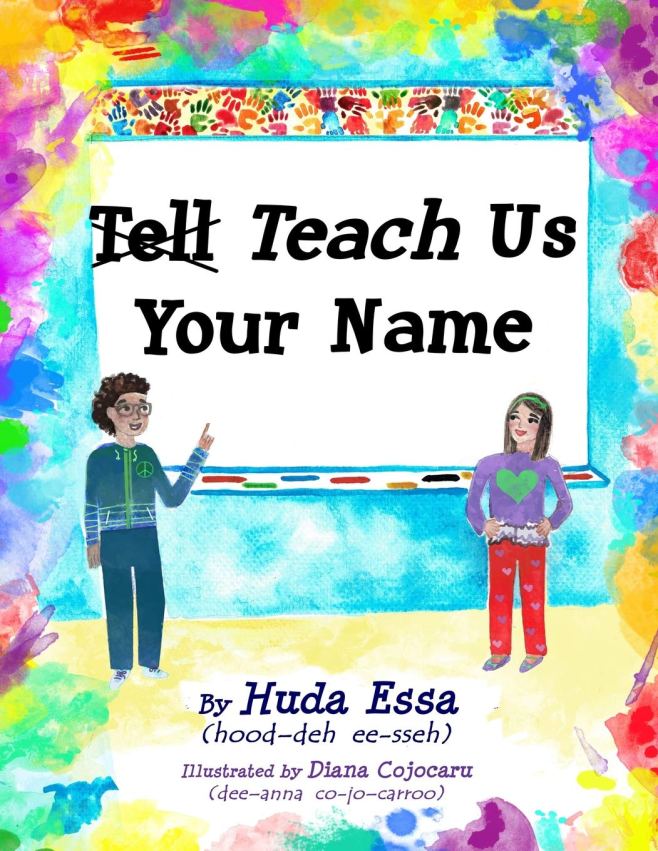
name cover

This book will resonate and empower anyone who has a “different” name, and hopefully provide insight and awareness for us all.  This 32 page picture book for grades 1st and up has a self empowering message, a confidence building approach, and problem solving tips to achieve a desired goal in a respectful way.  Written by a Muslim author, the book’s text is well done, unfortunately the pictures are inconsistent to me, some are beautiful and detailed, others seem rushed and unfinished.

IMG_0476

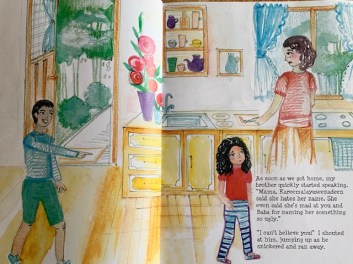
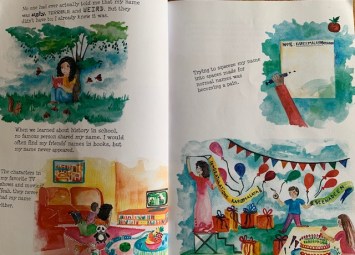
There are 20 letters in Kareemalayaseenadeen’s name, and the first day of school is such a stress for her.  She fears the teacher stumbling over her name, the other children laughing, and her unable to tell them how to pronounce her name correctly.  Her mom tries to explain that for some people the kids at school have hard names, and that for some people her name is easy.

IMG_0477

She reflects that in fact no one has ever made fun of her for her name, but that in history class she never sees her name, or on TV or in movies or on key chains.  She can hardly fit her name on her worksheets, and fitting it on banners is impossible too.  Eventually the kids kust call her Karma-Deen and even though she dislikes it, she is too shy to speak up.

IMG_0478

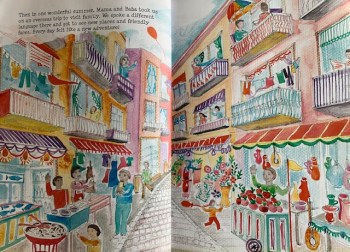
Over the summer, Kareemalayaseenadeen goes on vacation to visit family.  She doesn’t even think much about her name where everyone can pronounce it and say it with ease. Her Sittee though, has heard about her anxiety and sits with her to help her work through it.

IMG_0479

Sittee asks Kareemalayaseenadeen if she knows that her name means “excellent guidance” and that her name is a big part of her.  If she doesn’t like her name she isn’t liking an important part of herself.  She then urges her grandaughter to guide others on the proper way to pronounce her name.

IMG_0480

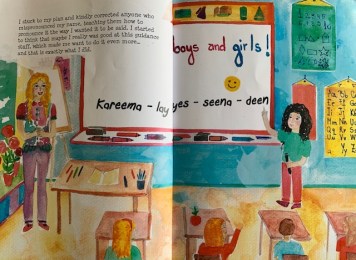
On the flight home, she ponders her grandma’s words and how to guide others to proper pronouncation, without being rude or settling on them shortening her name.  When she gets home she puts her plan in to action. And it works!

IMG_0481

When Kareemalayaseenadeen grows up, she becomes a teacher and each year she reads this book she has written (the one I’m reviewing) and asks her students to teach her how to say their names.

IMG_0482

The importance of how valuing someones name values the person and their family and culture is really one that as a society we have to keep working on.  We can say  names from Lord of the Rings, and Star Wars and Game of Thrones with no problem, so why can’t we try and pronounce someone’s name who is real and next to us and important to us? We have become lazy, and we need to do better, this book is sweet and kind and should really be read regularly as a reminder to us all, that names are beautiful.

IMG_0483

There is nothing religious about the book or even culture specific. There is a hijabi in the illustration of the market place in the unspecified “overseas country” and the name Kareemalayaseenadeen has Arabic bits, but a lot of names do as well, grandma is refereed to as Sitti, but isn’t defined, so the book is definitely meant for eveyone, especially those who will never find their name on a mug at a gift shop!


Amira Can Catch! by Kevin Christofora illustrated by Dale Tangerman

Standard
Amira Can Catch! by Kevin Christofora illustrated by Dale Tangerman

amira_can_catch

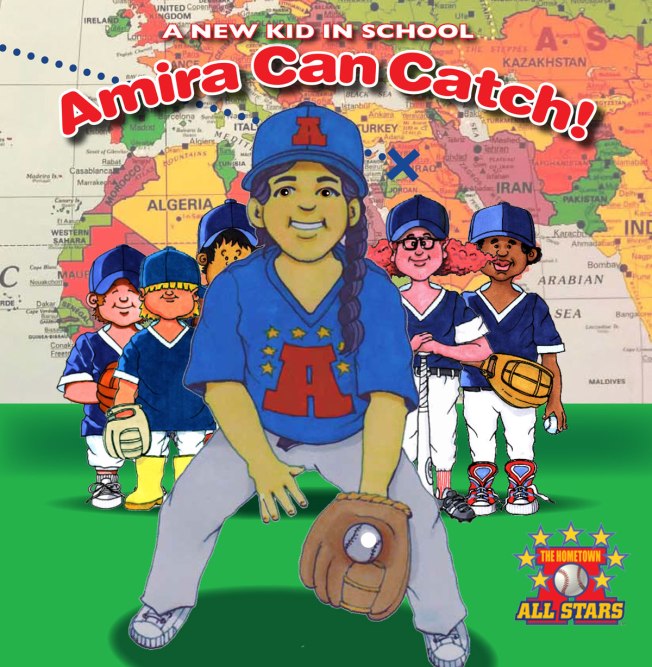
This is book four in the Hometown All Stars series aimed at 4-7 year olds.  The purpose of the series is to teach real coaching skills to help children learn about baseball, get out of the house to play, and have fun.  The 34 page book is baseball technique heavy with a fictional storyline to move it along.  Most sports books focus on team work and being a good sport, but this one takes it a step further by emphasizing the basic skills needed to play the game, as well as sneaking in lessons about inclusion and acceptance.  If your child is American and likes sports, the book will be a hit, pun intended, but there is a lot of text on each page and as America’s pastime, there is a lot of space dedicated to what it means to be American.

IMG_0410

A refugee Muslim girl from Syria, Amira, is invited to play on the after school baseball team, but first needs some help at school with spelling and adding.  Luckily the kids in class are super nice and accepting and help her learn about life in America, while similarly listening to her tell about life in Syria and at the refugee camp.  Not only do they all become friends, she also gets everyone to appreciate how much food they have, and the variety, as well as gets everyone to try pickles. Yum! They like them.

IMG_0411

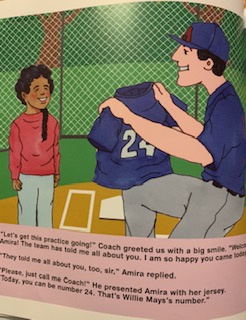
The kids at baseball practice are also incredibly welcoming as they get Amira a jersey, and teach her all about #24 Willie Mays.  From here, it is like a virtual baseball practice, the kids warm up with stretches, running the bases, and practicing their stances.  There are little info headers explaining things such as what hand to wear your mitt on and explaining how to squat, why the coach is using foam balls, and reminding the reader not to throw balls in the house.

IMG_0412

The kids learn three different types of catches.  How to stand, how to position their hands and how to be ready.  They run drills and practice, practice, practice. They find out Amira is really good, and she tells them that they had a lot of time to practice catching and throwing in the refugee camp.

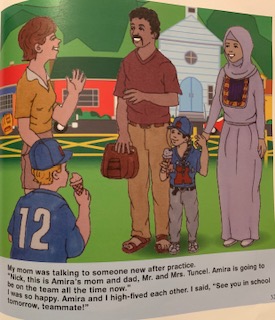
The coach then asks the kids and readers questions before Amira’s parents arrive to pick her up.  With big smiles on their faces, the mom is wearing a hijab and chatting with the narrators mom.

IMG_0415

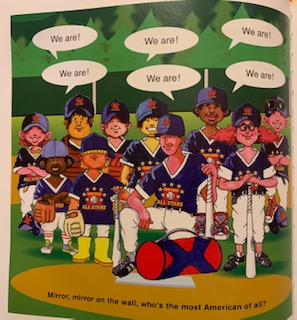
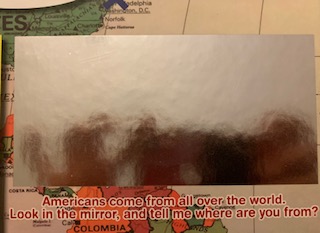
The book ends with a whole page on “What Does It Mean to be American,” a review of new words learned in the book, and all the kids answering who’s the most American of all, with “We are!”  The back cover has a reflective patch with the statement “Americans come from all over the world.  Look in the mirror, and tell me where are you from?”

IMG_0416

The book and series are a great way to learn about a game, that really a lot of kids today may not know much about.  Some of the terms, the skills, and just familiarity is clearly conveyed, with the illustrations providing the visuals and diagrams for what the coach is talking about in the text.  The fact that the author chose to add a refugee to such an “American” book and have the supporting  characters so welcoming, really does show the best of what Americans can be.

IMG_0417

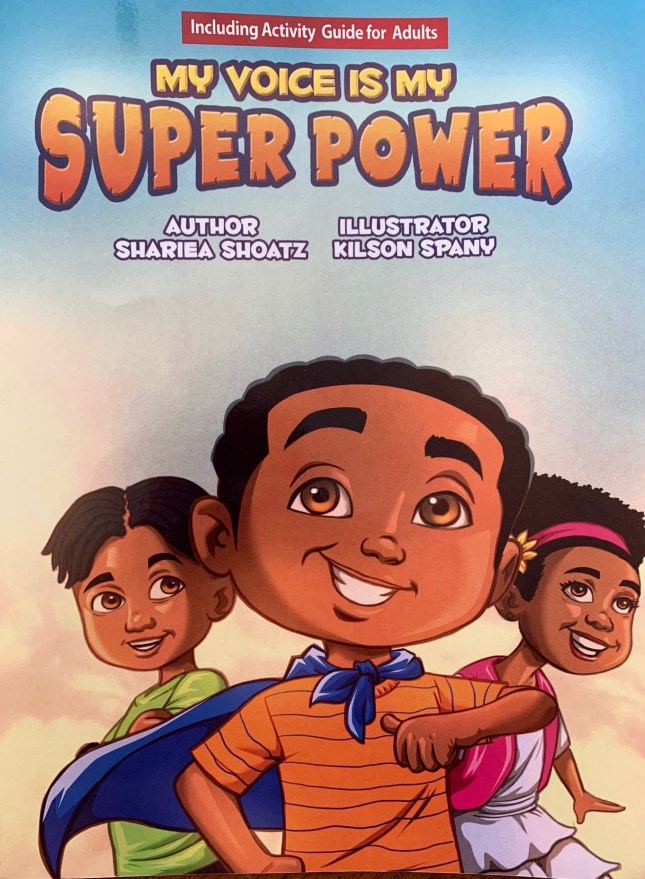
My Voice is my Super Power by Shariea Shoatz illustrated by Kilson Spany

Standard
My Voice is my Super Power by Shariea Shoatz illustrated by Kilson Spany

IMG_0210

I want to believe most parents and/or caregivers discuss body boundaries and what’s appropriate and what’s not, with their children regularly.  But if you don’t, or haven’t, or just glossed over it while at the doctors office, this book is a great discussion starter and road map.  The author comes from a place of educational and personal experience and the 33 page book tells a story that children can read independently with a discussion guide for parents to follow at the end.  Even if you don’t feel comfortable letting your children read the story independently or with you, there is a page depicting male and female private parts, I still think the book is a way for adults to face their own squeamishness of discussing it, and get ideas of how to present to their children.  Being nervous or uncomfortable is not an excuse to not discuss sexual abuse against children with our children.  For their voice to be their super power, we must first be willing to use ours to open the subject with them, educate them, and empower them.  Abuse happens in every culture, religion, socio economic bracket, period, to think differently is naive and dangerous.

IMG_0120

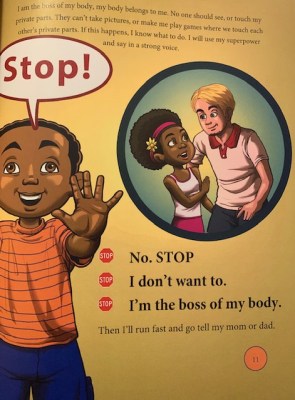
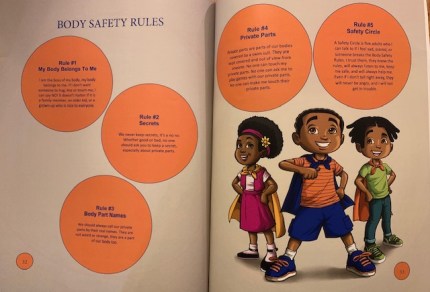
Nine-year-old Buddy is heading to his cousins’ house for a sleepover, but before heading out, he addresses the readers to make sure they know the body safety rules and to make sure his super power, his voice, is ready.  His voice is what he can use if he feels unsafe, or to help his friends if they feel unsafe.  He can say “Stop” or “No” if someone breaks one of the Body Safety Rules.

IMG_0121

His mom, a muhajaba, has being teaching him since he was three to use his voice to let people know his body belongs to him.  He knows he can say no when he doesn’t want to hug or kiss or touch someone, even if they are a family member.

IMG_0122

The book then talks about body parts that everyone can see and labels them with a diagram before explaining private parts and labeling them as well.  The book also discussing using the proper names, not nicknames or “cute” names, such as hotdog and cookie, to describe anatomy and body parts.

IMG_0123

If someone breaches or doesn’t listen to the “No” or “Stop” the book encourages everyone have a safety circle of adults you trust and like and that you feel safe and comfortable talking to.  It also mentions that if one person doesn’t listen or believe you to go to another person in the circle until someone does.

IMG_0124

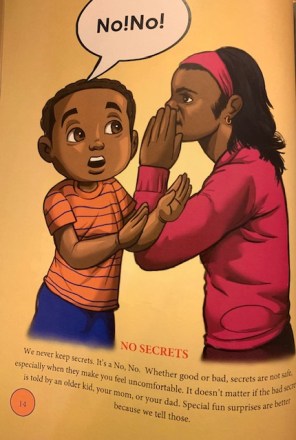
Another rule is No Secrets, and the book explains the difference between a secret and a surprise, which does eventually get told.

IMG_0125

When Buddy gets to his cousins house, the kids play and have fun, when a friend of the aunt’s stops by and gives only Keisha a treat before leaving.  When Buddy asks about the friend, his cousin talks about how they play pretend and tickle and how they have a secret touch game.  Buddy explains the rules to his cousin and then goes with her to help her talk to her mom about the breaking of Body Safety Rules.

IMG_0126

The story ends with the mom calling “people” to take the friend away and the kids feeling empowered that they kept their bodies safe.

IMG_0127

The Activity Guide for Adults gives information for each of the pages in the story to help the adult understand why that part of the story is included (i.e. grooming, disclosure, etc.) and activities to ensure understanding and mastery.

IMG_0128

The book is not religion specific, and would be a great benefit to all children, everywhere with parental involvement and dialogue.

May Allah swt keep all our children safe, ameen.


Bedtime Sunnahs Emaulating the Prophet one night at a time by Alia G. Dada illustrated by Robin Boyer

Standard
Bedtime Sunnahs Emaulating the Prophet one night at a time by Alia G. Dada illustrated by Robin Boyer

sunnah.jpg

A beautiful rhyming 11 page story for toddlers and up to learn parts of the Prophetic routine for bedtime.  Yes, 11 pages, the book in total is 28 pages, six are Appendixes, one is about the author, one is a dedication, and the rest are blank or title pages.  For a $15 book, I’m a little disappointed, which is unfortunate because the illustrations and information on those 11 pages is great.  The references are informative and important to see what Hadith the Sunnahs come from, but I think the story itself could have, and should have, been longer.

2D4EFF33-886B-46DB-92F6-74C7679D6F61

Each page has a different family getting ready for bed and doing various acts.  I love that moms and dads are involved in bedtime routines. The illustrations show diversity and the text is simple, flowing, rhyming and straight forward.

5EB6E7CC-3194-480E-9A58-EE259FAB9DB5

From brushing teeth to reciting Athkar, making duas to Allah and laying on our right side, each page has wonderful detail in the warm full color pages.  I love the decorations on the bedroom walls, signs with Allah’s name, statements saying “Strong like Zainab, Brave like Fatima, Smart like Khadija”, as well as “Smile! it’s Sunnah!”.

1DB8BDCD-6CEB-4104-B072-6A2D21951D71

The book is for Muslim children obviously, and makes getting ready for bed seem like a fun and bonding event.

The first Appendix is a Parents Notes on what the purpose of the book is and the second one is Islamic Terminology.  From the their Appendixes address the Ahadeeth about sleeping in a state of Wudu and on your right side, bedtime Atkhar, and reciting the three Quls,  I wish it would have including the Quls, seeming as the book is meant to provide information for caregivers to convey to a child, and many households may have non Muslims or new reverts in that role.

10500B30-4BF9-4473-94D5-F9D4EDFAEDD1

The remaining two reference pages are Additional Sunnahs for Advanced Children which include Reciting Ayah al Kursi, the last two verses of Surah al Baqarah, the dua before bed and when waking in the morning.  The dua texts are given, the Ayats are not. There is then a final page about the author.

F8DCC46D-0DFC-4A20-9E63-645B06FAE324

The hardbound glossy cover and thick inside pages are well done in this 8×8 perfect sized book for bedtime, I just wish there was more of it.


Two Pigeons on a Pilgrimage: A Hajj Story by Rabia Bashir illustrated by Aisha Dean

Standard
Two Pigeons on a Pilgrimage: A Hajj Story by Rabia Bashir illustrated by Aisha Dean

pigeons

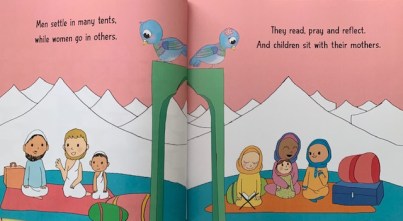
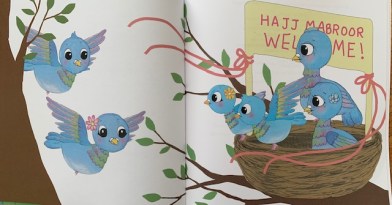
An adorable 40 page paper back book about Hajj aimed at ages 3 and up and told from the perspective of two Pigeons performing Hajj with humans.

IMG_5976

A boy and girl pigeon say Bismillah and spread their wings as they head off to Hajj.  They see pilgrims at the airport wearing ihram before they start circling the Ka’ba like the humans below.  After seven rounds they go to Ibrahim’s Station before they are off to Safa and Marwa while pausing to sip on Zamzam.

IMG_5977

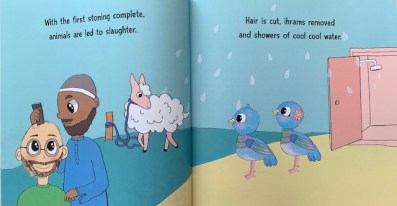
With Umrah complete they are off to Mina, then Arafat where duas are made.  They then go to sleep under the stars in Muzdalifah, before they slaughter an animal, cut their hair, shower, and throw stones at Shaitan.

IMG_5978

The concepts are simplified, but told in sequential order of how hajj is performed with very little commentary or embellishment.  The lines rhyme, so there is some creativity thrown in to keep the pattern and facts in line.  The font size, spacing and overall presentation of the book is good for reading at bed time or in small groups.

IMG_5979

The best part of the book, are the pictures.  They are sweet, colorful, and engaging and to find out at the end that they are done by a 12 year old girl is an extra added bonus.

IMG_5980

The book is factual in the steps for hajj, but because it doesn’t have a glossary, or give much information about why Muslim’s perform Hajj or details about the different acts of worship, it probably is better suited for Muslim kids that will hopefully know some of the answers, or have access to an adult who can answer and fill in the blanks.

IMG_5981

Overall, a good addition to books about Hajj to share with your little ones.  I just wish it would have come out a little bit earlier, as the Hajj starts in a few days and the book just came out.  If you can’t find it this year, inshaAllah get a head start for next year as I think the book has staying power and will be read more than once as both a learning tool, and fun book requested by kids.

IMG_5982


Allah Tells Me… by Ali Gator (Firhana & Ahmed Imam)

Standard
Allah Tells Me… by Ali Gator (Firhana & Ahmed Imam)

Allah Tells Me - web-500x500

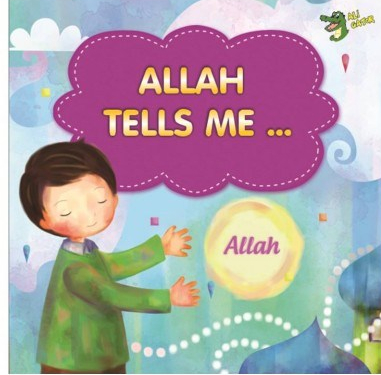
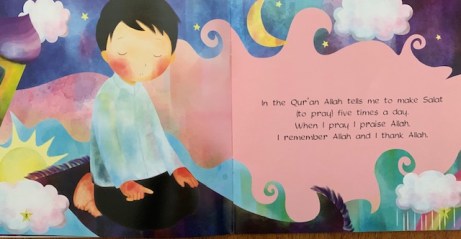
This 28 page, thick glossy full-color book for 3-8 year olds, introduces and describes the five pillars of Islam in an age appropriate manner.

IMG_5648.jpg

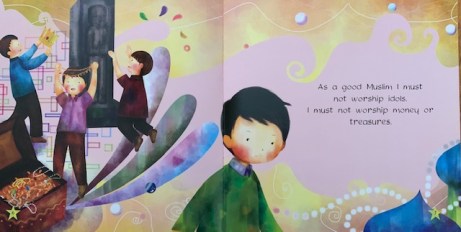
The book is fact based and informative, but the illustrations and voice of the text reads in a gentle inviting tone that will appeal to small children.  There is no story, but rather a boy that takes you each of the pillars and talks to the reader.

IMG_5649.jpg

The short paragraphs about shahada, salat and wudu, fasting, zakat, and hajj are detailed and will need some additional explaining if used to teach kids.  If you are using it to just introduce general concepts, the pictures and sentences will suffice.

IMG_5650.jpg

The book is in English but does use Arabic words to describe each tenant with in-text translations in parenthesis, as well as footnote translations on occasion.

IMG_5651.jpg

The book is set up as a tool for parents and teachers to use when educating young Muslim children and thus some hadith and ayats are present at the beginning and end, as well as some directions, games and activities.

IMG_5652.jpg


Bilal Cooks Daal by Aisha Saeed illustrated Anoosha Syed

Standard
Bilal Cooks Daal by Aisha Saeed illustrated Anoosha Syed

bilal cooks daal

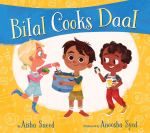
Aside from me desperately wanting to get Bilal’s family a pressure cooker this 40 page book does a good job, and follows a reliable tradition of using food to introduce a “foreign” culture while simultaneously showing universal themes that show how similar we all are when it comes to family, meals, friends and feeling loved.  

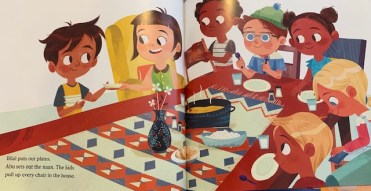
Bilal’s favorite food is daal, lentils, and when he is out riding his bike with his friends, his father calls him in to help him make it.  Confused as to why Bilal’s dad would need to start dinner so early in the day, Bilal’s friends join in, in helping make the slow cooking traditional asian subcontinent dish.

IMG_5306

They line up the spices, they put it in the pot, and then they wait.  They put their shoes back on and play hopscotch, they go swimming, they go for a hike and it still isn’t done. 

IMG_5308

At one point Bilal is worried his friends won’t like it, but after waiting all day and gathering more friends at each activity, when the time finally comes they all dive in and love it.

IMG_5309

I love the diversity of the friends and that the dad is cooking and involving his son.  I also like that everyone is willing to try something new and give it a chance.

IMG_5307

The book would work for all kids ages 4 and up with the expressive colorful illustrations, diction, and amount of text on the page.  The book is 9×8 so it works well in small groups and at bedtime.  

IMG_5310

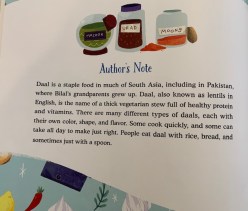
If you eat daal your kids will love seeing themselves in the pages, if you have never had daal there is a recipe at the end following an Author’s Note. 

IMG_5311

There is nothing religious in the book, and anyone from India, Pakistan, and Bangladesh could easily take ownership of the dish and story.  The Author’s note mentions that Bilal’s grandparents are from Pakistan and with a name of Bilal chances are he is a Muslim character.


Purity & Prayer: A Rhyming Picture Book of Sacred Rulings by Ameena Bint Abdir Rahman illustrated by Reyhana Ismail

Standard

IMG_2921

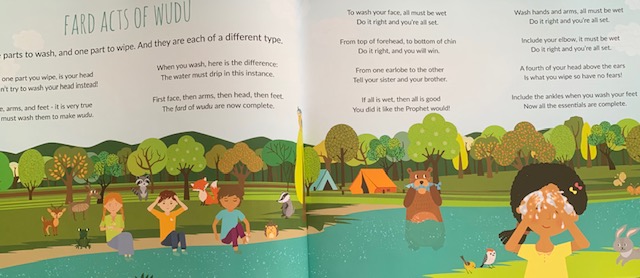
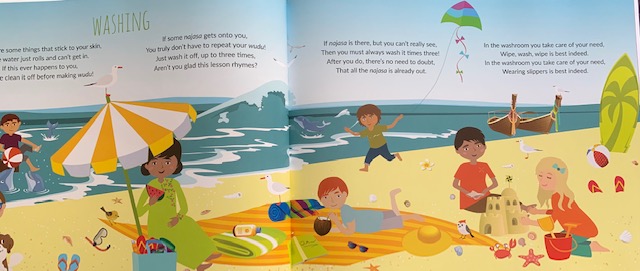
This book is definitely non fiction, and I’m reviewing it because I figure some of you like me, have looked at it online and wondered how it can do everything it claims.  The book is 50 pages, fully illustrated (with faces), meant for children before the age of accountability, written in rhyme about fiqh (wudu and salah) according to the Hanafi madhab, and everything is scholar supervised and checked.  I’ve read it a few times now, and yeah, it does all it claims to, and is a great tool and resource, and book to have around for kids of all ages, plus I think they’ll really enjoy it.

IMG_2922

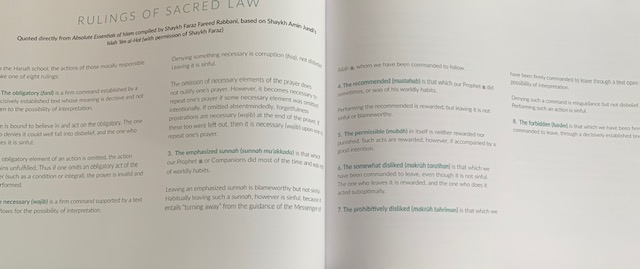
The book has a lot of information and disclaimers about how the author wrote the book and verified the information, there is a dua, preface, and Author’s Note at the beginning, and Rulings of Sacred Law by Shaykh Faraz Fareed Rabbani, an Appendix, References, Glossary of Arabic Terms, messages from the Fiqh Teachers, Author, and Illustrator at the end.

IMG_2925

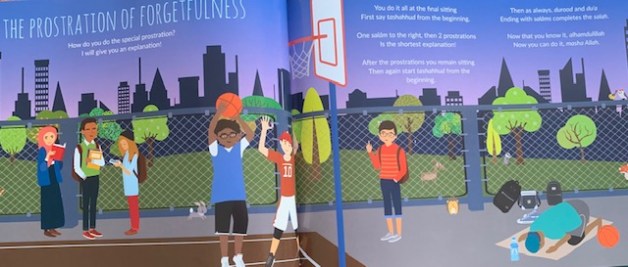
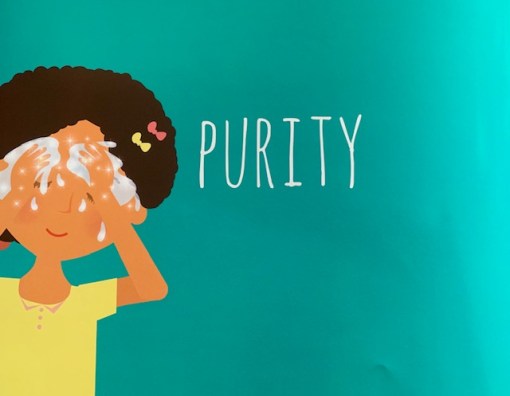
The 8.5 x 11 hard bound horizontal glossy book is divided into sections.  The first section is Du’a and Salah, followed by Purity which covers things like fard parts of wudu, what breaks wudu, etc..  The next section is Prayer and covers the fard conditions and integrals within prayer, wajib things you say, how you recite, postures, what breaks your salah, and incorporated in to the sections are what would need to be redone to make your salah valid.

IMG_2923

Each subheading is a two page spread with a title and either rhyming couplets or quatrains to convey the information.  While naturally at some parts the rhyme is incredibly forced, but because I found myself learning things, I wasn’t as bothered by it as I thought I would.  The repetition sometimes got jarring, but again, because the complex facts are being brought down to a child’s level ,and yet isn’t belittling, I’m willing to overlook a lot. 

I like that it isn’t just facts, the Appendix is there for that, but also similes and metaphors that will help put the concept in perspective.  Du’as can be made at any time like making a call to Allah.  Prayer is like visiting a friend, you have to go at the time you were invited, dressed nicely, wear appropriate clothing.  

IMG_2924

The breakdown of when you have to repeat the whole salah, or do a special prostration is incredibly helpful.  As is knowing what laughter breaks wudu and what breaks wudu and salah.  It is so great that children will see how detailed our religion is, and how everything has an explanation.  Yes, you shouldn’t laugh while praying, but clearly it happens, so when it does this is what you do.  The approach makes the book grow with children as their knowledge and awareness increases.

IMG_2926

I hope to read a two page spread each night with my kids, and have them discuss.  My kids range in age from 3-12 and while my 3 year old won’t add a lot, he will be entertained by the rhyme, fascinated by the pictures, and be included in the early introduction to fiqh.  InshaAllah the older kids will learn or review something and know how to find such knowledge if they have questions in the future.

IMG_2927

Undoubtedly, such a book, was a huge undertaking, may Allah swt reward all those involved, I was pleasantly surprised and greatly impressed at how the book reads, presents the information, and still connects to younger children, mashaAllah.


The Young Muslim’s Mindful Book of Wellbeing by Zanib Mian

Standard
The Young Muslim’s Mindful Book of Wellbeing by Zanib Mian

wellbeing.jpg

This tiny book (5.5 inches square) is non fiction and I’m reviewing it, because I think it has a lot of value and will appeal to the parents that check out this site for book suggestions for their middle grade children.  The flower on the cover and the topic, might naturally turn away boys, but the depicted character that presents the information is a boy and while it is a token gesture, it is a nice one, to try and make the book and it’s contents appeal to all children.  Irregardless of if you have teens, or tweens, or toddlers, girls or boys, I think parents should read the book and use the concepts and framing presented when talking with their children.  At least that is what I hope to do.  One doesn’t need to wait until their child comes home crying from friend drama, or losing out on something they desperately wanted, to implement the lessons and reassuring bits of mindfulness, it should be the established foundation of how to handle emotions in a healthy way, inshaAllah.

SYNOPSIS:

The book is broken into 14 chapters based on topics covered, and the directions encourage the reader to read them all in order the first time through, then going back to certain sections as needed.  The headings include: How to be happy, A Way Out of Every Problem, How to Feel OK If You Wanted Something, but Didn’t Get It, Friends, Feeling Sad, and Talking to Allah.  The information is presented in a positive reassuring manner that helps the reader to feel like others have felt this way too, and to try some of the suggestions.  It doesn’t belittle or talk down to the feelings one might be having which is great, as the concept of Allah (swt) is incorporated onto every page.  Strengthening ones relationship with Allah as a way to cope with stresses and know that He is always there, is the central theme throughout.

The book offers advice on dealing with negative people, negative thoughts, and finding your own positivity and strength with the help of Allah no matter what.  The book isn’t dry though, it engages the reader and uses examples children can relate to and comparisons that are tangible.  At one point the book talks about shields that reflect back whatever you are giving off.  So when you are shining from the inside, you feel better, and so do others around you.  When talking about seeing the bigger picture, the book urges the reader to consider seeing an entire room through a key hole and likening it to how we see our own lives seeing only what is happening right now.

The book also takes into account that somethings may take work to feel better, and that it isn’t an easy fix to feel good, but inshaAllah worth the effort.  The end summarizes in two points what the previous 36 pages articulate and explore, concluding how to make you shine and be your best self.

WHY I LIKE IT:

I love that we are talking to and with children, not just toddlers, about their feelings.  We aren’t telling them to just cheer up or be happy or get over it.  We are giving them tools that they can carry throughout their lives, inshaAllah.  The pages are text heavy, granted the book is small, but the book is thick and the amount of words on the pages could intimidate some, but like I said earlier, even if the child won’t read it, parents will benefit from it and implementing it in the home.  Also just having the book sitting around will urge kids to pick it up and thumb through it, I would almost guarantee it.

My critiques are the presentation.  I am no expert on the content and what I read seemed logical, and I liked it.  Vague I know, hence I don’t review non fiction often, because what do I know?  As for the physical annoyances of the book, it is too small.  It doesn’t need to be huge, but for the topics covered, it is trivialized by the size, in my opinion. 

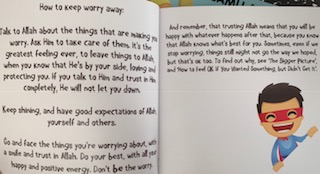
I don’t mind the font, I mind that it changes size so often and for no other reason it seems than to fit everything on the page.  Nearly every chapter is a different size font, but sometimes its even within the same chapter.  A few times for example the page on the left appears to be a size 14 font and the text in the same chapter on the right is like an 11, making it seem inconsistent and jarring..  If the idea needed to be bolded, or shouted or whispered, I support playing with font size, but this is not the case, it is so that the picture and text can all fit without having to turn the page, and its not the best solution I feel, its too distracting. 
IMG_2672.jpg

The other inconsistency that I found a bit odd, are the illustrations.  The little boy on the cover with his yellow flower and yellow shirt take you through maybe 80% of the book, but on occasion other characters pop up, which is fine, when they are drawn in the same manner, like the frog.  But the random appearance of the full color super hero, reminiscent of My Dad’s Beard book, and the full color Migo and Ali looking bears, there’s also a one time appearance of a girl in full color, seems bizarre.  I don’t see the cameos as adding a shoutout to the content and author, but more like the books from the 90s that used free clipart to illustrate the pages that otherwise would be text only. 

FLAGS:

None

TOOLS FOR LEADING THE DISCUSSION:

I think this would be a great book for a school counselor to use as a guideline for group discussions.  I think it could be done from the library, but a counselor and students would really benefit from the book and the manner in which the material speaks and empowers youth to shine.